

9 Materials That Help With Play Expansion
When a child's play stays stuck, rigid, and repetitive — these 9 evidence-based materials help play expand. A complete home implementation guide from Pinnacle Blooms Network® GPT-OS®.
G-656
Domain G: Play Development
Ages 2–8
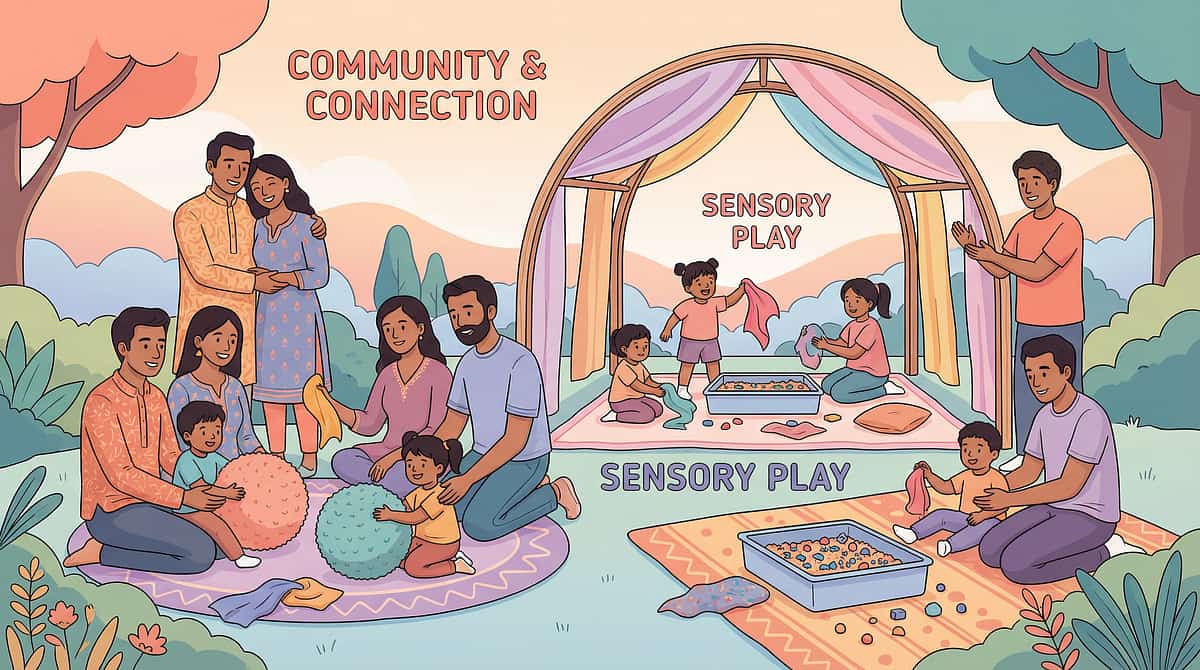
She cooks the same egg. Flips it three times. Places it on the plate. Sets it on the table. Every. Single. Time.
You've tried adding something — "Let's make pancakes!" — and she either ignores you or gets upset. Her play never changes. Her dolls sit in the same spots. Her blocks make the same tower. And you're watching other children build whole worlds with their toys, while your daughter repeats the same 60-second loop.
Play Expansion — The technique that breaks the loop and opens the world. You are not failing as a parent. Your child's nervous system is seeking safety through sameness — and that sameness can be gently, patiently expanded into something extraordinary.
🏛️ Pinnacle Blooms Consortium | OT • SLP • ABA • SpEd • NeuroDev | G-656 | WHO Nurturing Care Framework (2018): Early identification and parental responsiveness in the first years of life directly shapes developmental trajectories across all domains.

The Numbers That End Your Isolation
You are among millions of families worldwide navigating exactly this challenge right now. In India alone, with a prevalence of 1 in 68 children showing developmental differences, the number of parents watching their child repeat the same play loop is in the millions. This is not an anomaly. This is a documented, understood, treatable developmental pattern — and there is a clear, evidence-based path forward.
1 in 36
Children with Autism
Diagnosed with autism in the US (CDC 2023)
80%
Show Play Rigidity
Children with ASD show restricted, repetitive play patterns as a core feature
20M+
Therapy Sessions
Run by Pinnacle Blooms Network® across 70+ centers
"Play rigidity is not a personality trait. It is a nervous system response to an underlying skill gap — and skill gaps can be taught." — Pinnacle Blooms Clinical Consortium
PRISMA Systematic Review (2024, PMC11506176): 80% of children diagnosed with autism display restricted/repetitive behavioral patterns including play rigidity. Meta-analysis confirms structured intervention addresses these patterns with measurable outcomes.
The Neuroscience Your Child's Therapist Understands — and Now You Will Too
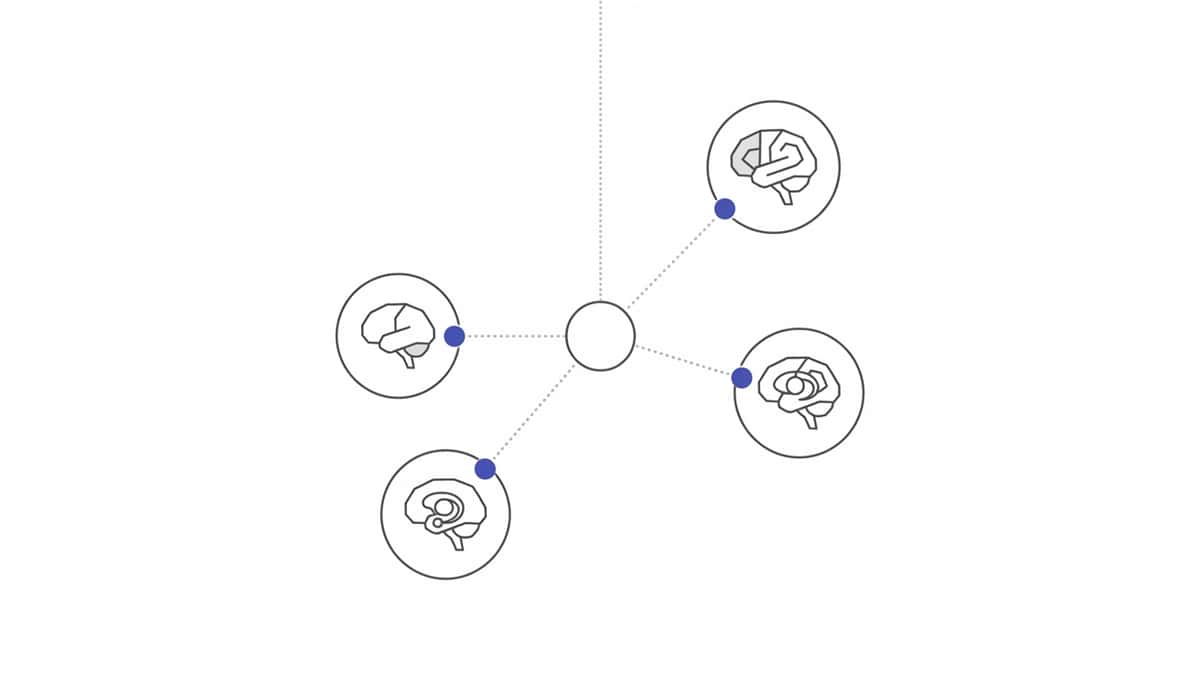
The brain has two competing systems — a flexibility system (prefrontal cortex) and a routine-protection system (basal ganglia). In children with play rigidity, the routine-protection system is stronger than typical.
When your child flips the egg exactly three times, her brain is releasing dopamine — the reward chemical — for executing a perfect sequence. Changing that sequence doesn't just feel different; it feels wrong at a neurological level.
🧠 This is a wiring difference, not a behavior choice. Treatment works at the neural level.

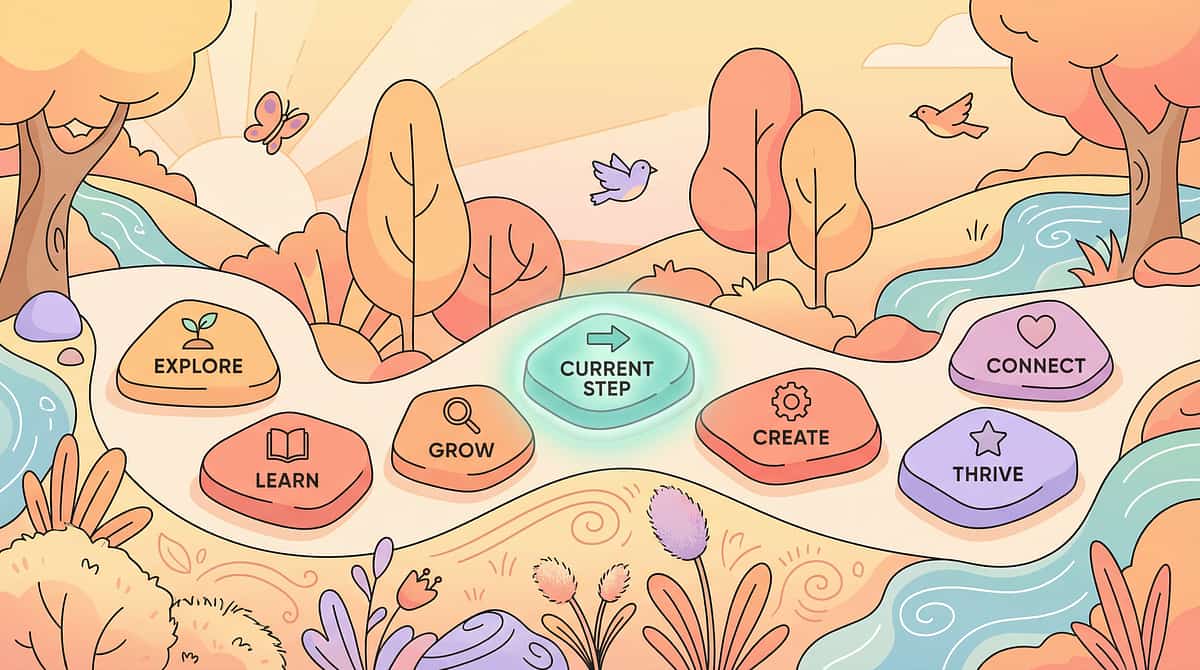
Your Child's Play Is Here on the Developmental Map
Children naturally shift from repeating familiar play to elaborating it — combining elements, adding new characters, extending narratives. When it doesn't happen, play stays at an earlier developmental level — not because the child is intellectually limited, but because cognitive flexibility, symbolic thinking, or tolerance for novelty skills haven't been built yet.
0–18 Months
Sensorimotor — Explore & Discover
18–36 Months
Functional Play — Use objects for intended purpose
3–5 Years
Symbolic Play — Object = other things (pretend) ◄ PLAY EXPANSION ZONE
5–8 Years
Sociodramatic — Roles, narratives, social scenarios
8+ Years
Complex Social — Rules, extended collaborative play
What commonly co-occurs with play rigidity: Autism Spectrum Condition (most common), Sensory Processing Differences, Anxiety Disorders, Developmental Language Disorder, ADHD (particularly in preferred-activity hyperfocus). Your child is at this point on the map. Here is exactly where we're taking them.
WHO Care for Child Development Package (2023): Age-specific caregiver interventions implemented across 54 countries. UNICEF MICS developmental monitoring indicators validated across 197 countries. PMC9978394
Clinically Validated. Home-Applicable. Parent-Proven.
90%
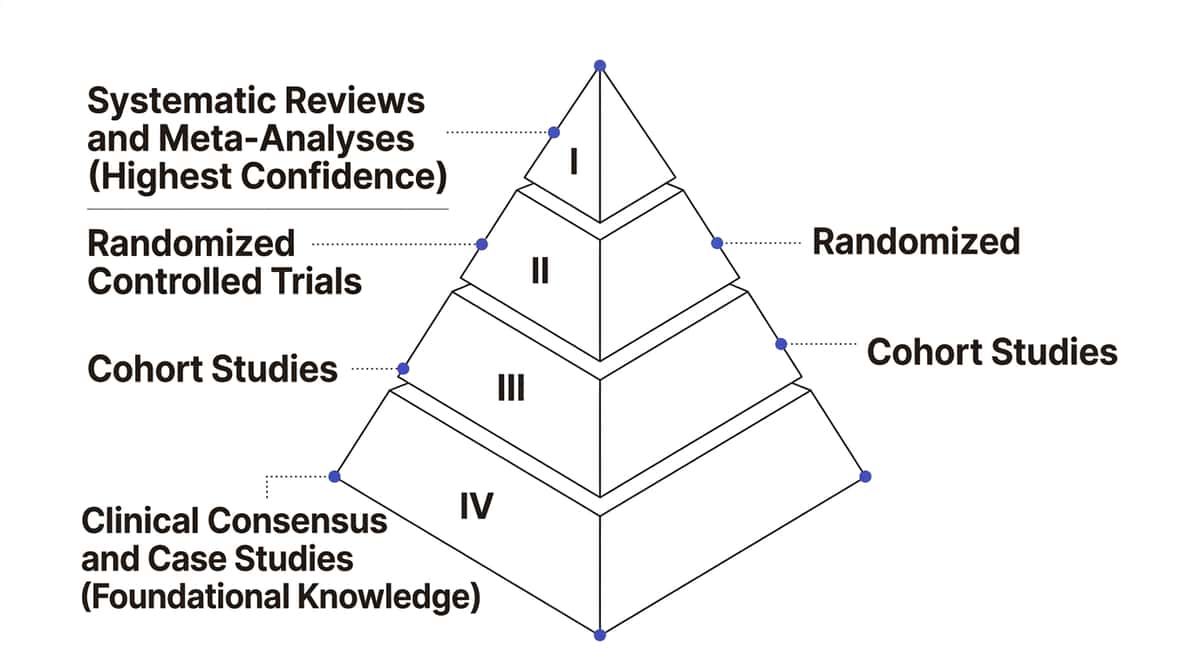
Level I Evidence
Systematic Review + Meta-Analysis grade — the highest tier of clinical evidence
97%
Improvement Rate
Measured improvement across Pinnacle Blooms Network® 20M+ therapy sessions
54
Countries
WHO/UNICEF Care for Child Development Package implemented globally
Study | Finding | Application | |
PRISMA Systematic Review 2024 (16 studies, PMC11506176) | Play-based interventions meet evidence-based practice criteria for ASD | Validates all 9 materials in this guide | |
Meta-Analysis 2024 (24 studies, PMC10955541) | Structured play intervention promotes social skills, cognitive flexibility, symbolic play | Confirms multi-material approach | |
Indian RCT 2019 (Padmanabha et al.) | Home-based structured interventions demonstrate significant outcomes in Indian pediatric populations | Confirms home execution is valid | |
NCAEP Evidence-Based Practices 2020 | Video modeling, visual supports, naturalistic instruction classified as evidence-based | Cards 03, 05, 07, 08 of the 9 materials confirmed | |
WHO Nurturing Care Framework 2018 | Early caregiver-led intervention is the most cost-effective pathway | This entire home guide is WHO-aligned |

Play Expansion: The Technique
Domain G — Play Development
Age: 2–8 Years
Session: 15–30 min
Frequency: Daily
Play Expansion is the evidence-based practice of systematically broadening a child's play repertoire — moving from rigid, repetitive, single-sequence play toward flexible, elaborated, multi-scenario play that the child can generate independently.
It targets the underlying skills that enable play to grow: cognitive flexibility (shifting from one pattern to another), symbolic thinking (using objects to represent other things), idea generation (producing new play possibilities), and tolerance for novelty (accepting and enjoying unexpected elements).
Play expansion is not about eliminating what your child loves — it is about creating enough flexibility that the world of play they inhabit expands from a single room to an entire universe.
Setting
Home + Clinic
Difficulty
Beginner → Advanced
Lead Discipline
OT + SLP + ABA + SpEd
Canon
Visual Supports | Open-Ended Play | Symbolic Materials
Every Discipline in Your Child's Therapy Team Uses This
Play expansion isn't owned by any single therapy specialty — because the brain doesn't organize by therapy type. Here's how each discipline on your child's team applies it.
Occupational Therapist (PRIMARY LEAD)
Uses sensory-based play materials — loose parts, transformation toys — to build tolerance for novelty and flexible object use. Addresses sensory drivers of play rigidity directly.
Speech-Language Pathologist
Uses play expansion to build narrative language — story scripts, character dialogue, sequencing. Play is the primary context for language development in young children.
Behavior Analyst (BCBA)
Applies reinforcement principles to expand play repertoire. Uses video modeling, shaping procedures, and prompt hierarchies to systematically add new play actions.
Special Education Teacher
Integrates play expansion into classroom routines using visual supports, peer play models, and structured play scenarios within school settings.
Neuro-Developmental Pediatrician
Oversees diagnosis, monitors developmental trajectory, and directs which play expansion approach matches the child's neurological profile.
Play Therapist / DIR Floortime
Uses child-led, relationship-based play expansion — following the child's lead into their world, then gently expanding from within the relationship.
"This technique crosses therapy boundaries because the brain doesn't organize by therapy type. Play development requires the whole consortium." — Pinnacle Blooms Clinical Protocol G-656
What This Technique Targets
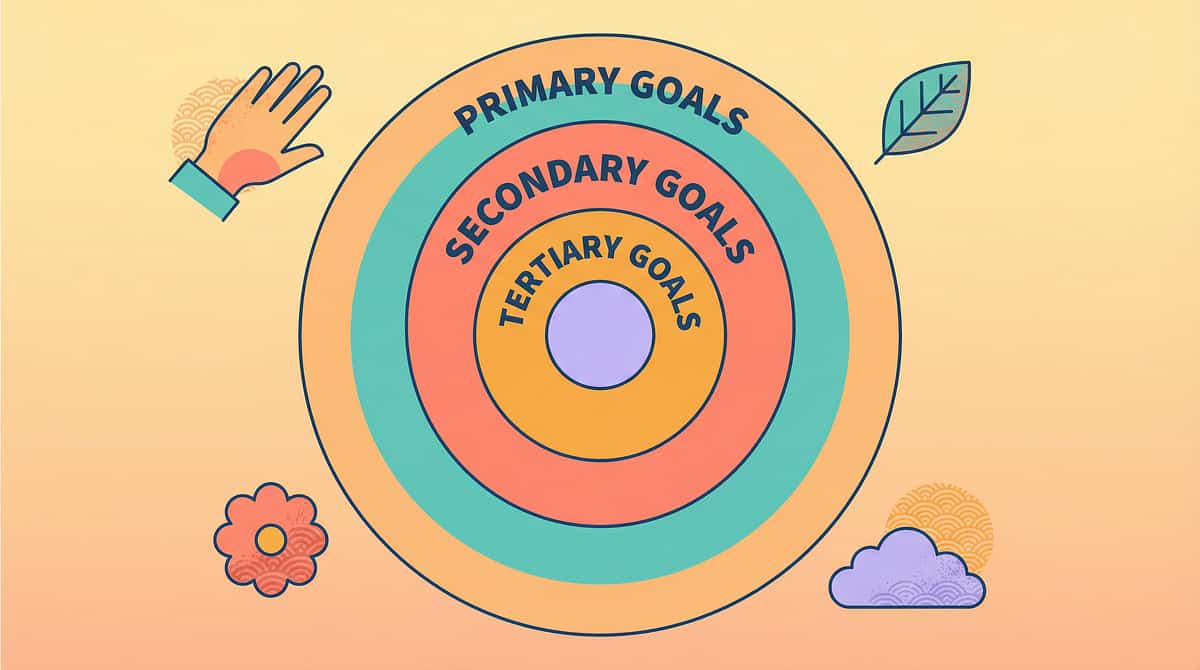
This is not a random activity. It is a precision developmental tool, delivering layered therapeutic impact at three levels — from the core cognitive target outward to life-changing tertiary gains.
🎯 Primary Target
Cognitive Flexibility — The ability to shift from one play pattern to another.
Observable indicator: Child tolerates new element added to familiar play without distress.
🎯🎯 Secondary Targets
Symbolic Thinking — Using objects to represent other things (stick = wand = fishing pole). Observable: Child uses block as "food" or cloth as "water."
Idea Generation — Producing novel play possibilities independently. Observable: Child suggests a new play scenario without prompting.
Narrative Sequencing — Creating connected play sequences. Observable: Play scenario has more than 2 steps and child continues it.
🎯🎯🎯 Tertiary Developmental Gains
Social Play
Participation with peers
Creative Problem-Solving
Novel solutions in play
Language Development
Narrative and dialogue
Emotional Regulation
Flexibility = calm
Peer Relationships
Social connection capacity
Academic Readiness
Executive function
Meta-analysis (PMC10955541, 2024): Structured play intervention effectively promoted social skills (primary), adaptive behavior (secondary), and motor/cognitive skills (tertiary) across 24 studies with pediatric ASD populations.
9 Materials. Every One Chosen for a Reason. Clinically Mapped.
Each material below targets a different underlying mechanism of play rigidity. You don't need all nine at once — start with the one that feels most accessible, and build your toolkit over time.
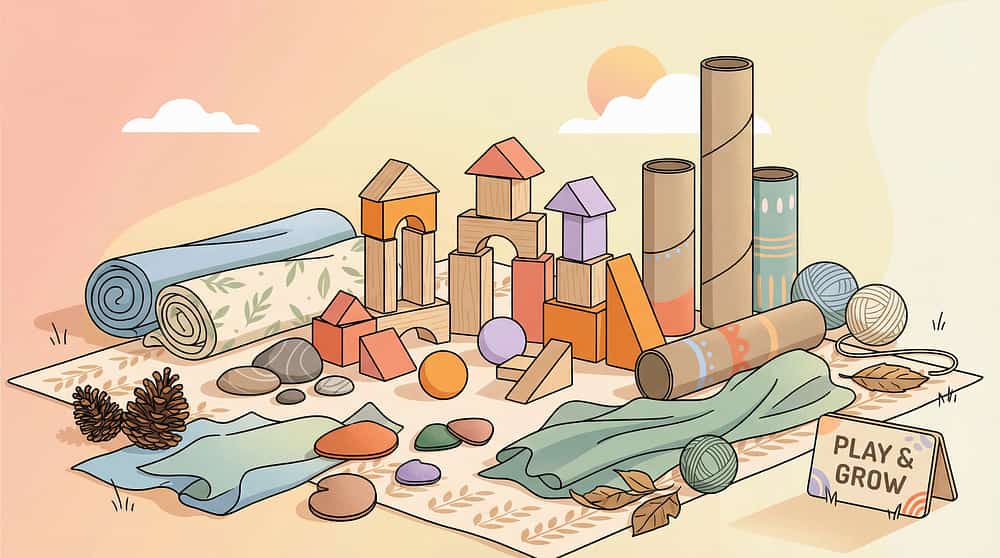
1. Loose Parts
Canon: Open-Ended Play Materials Use: Breaking rigid play scripts by removing predetermined purpose Cost: ₹200–1,000 (often free/recycled)
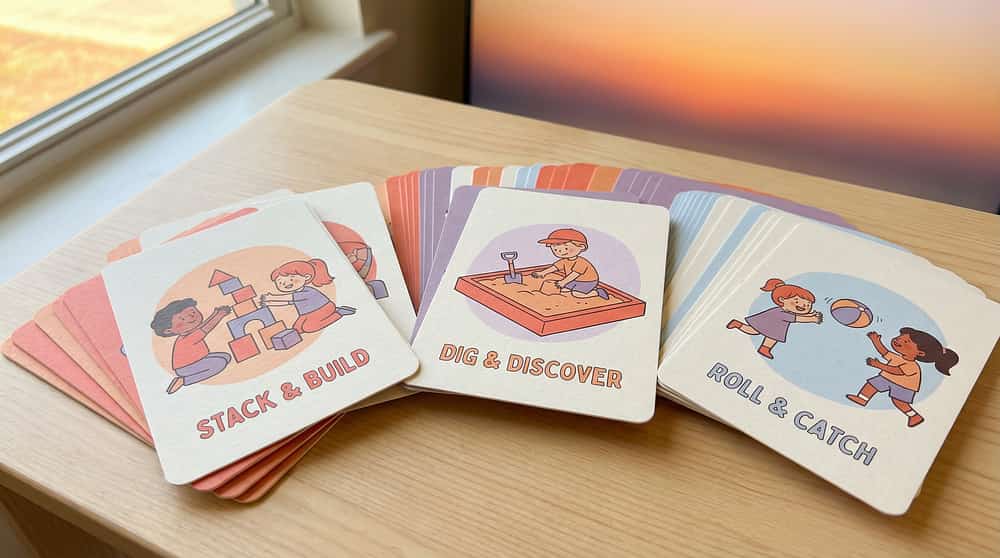
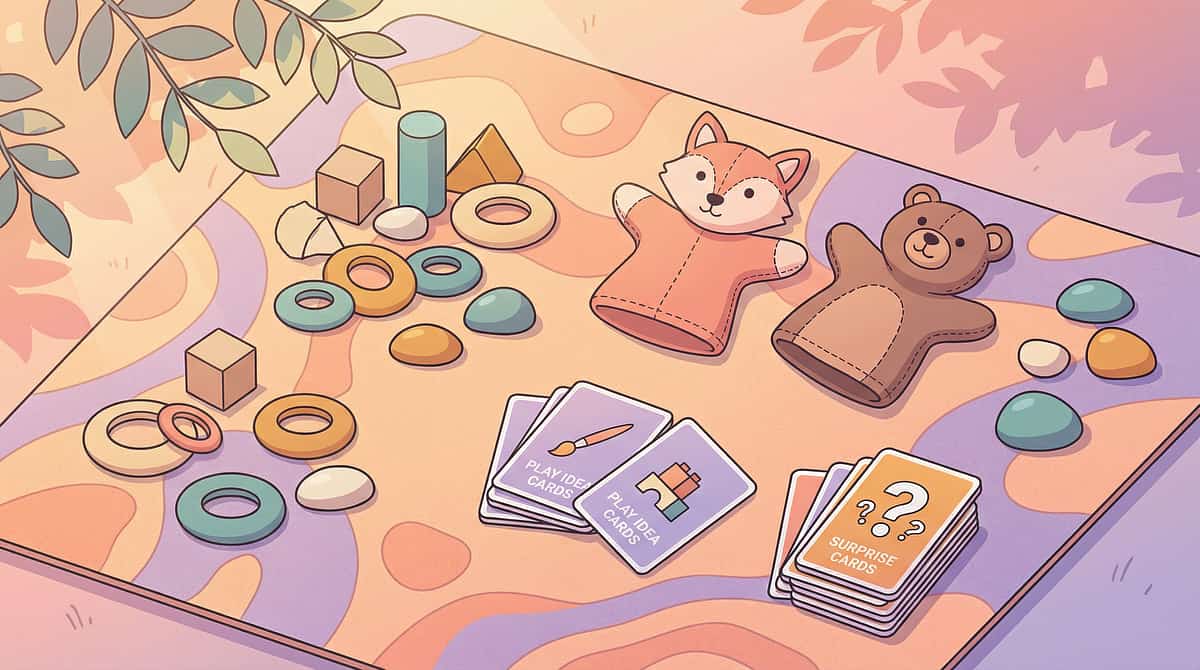
2. Play Idea Cards
Canon: Visual Supports / Picture Cards Use: Externalizing idea generation when child can't produce new ideas internally Cost: ₹100–500 (mostly DIY)
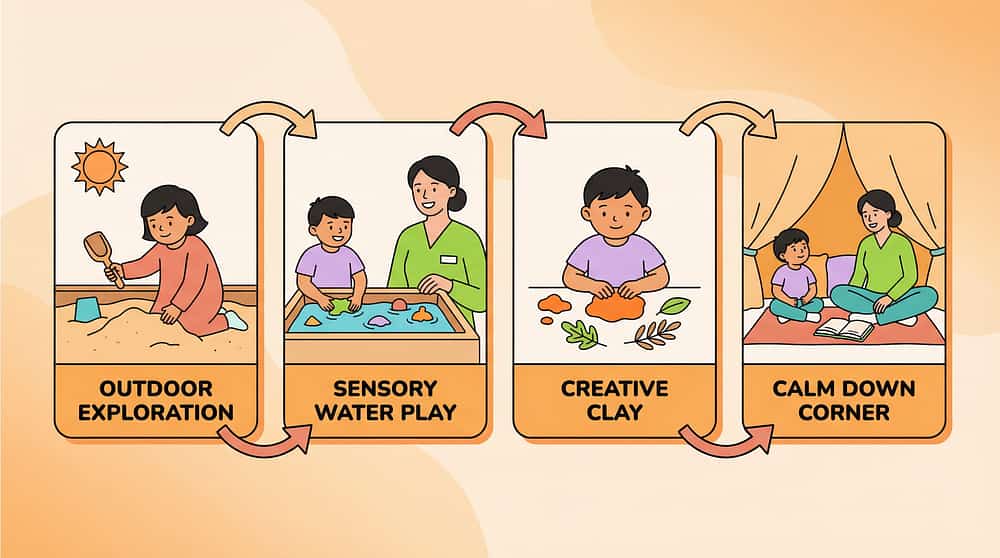
3. Play Story Scripts
Canon: Visual Supports / Sequence Cards Use: Teaching that play can have sequences — beginning, middle, development Cost: ₹100–400 (mostly DIY)
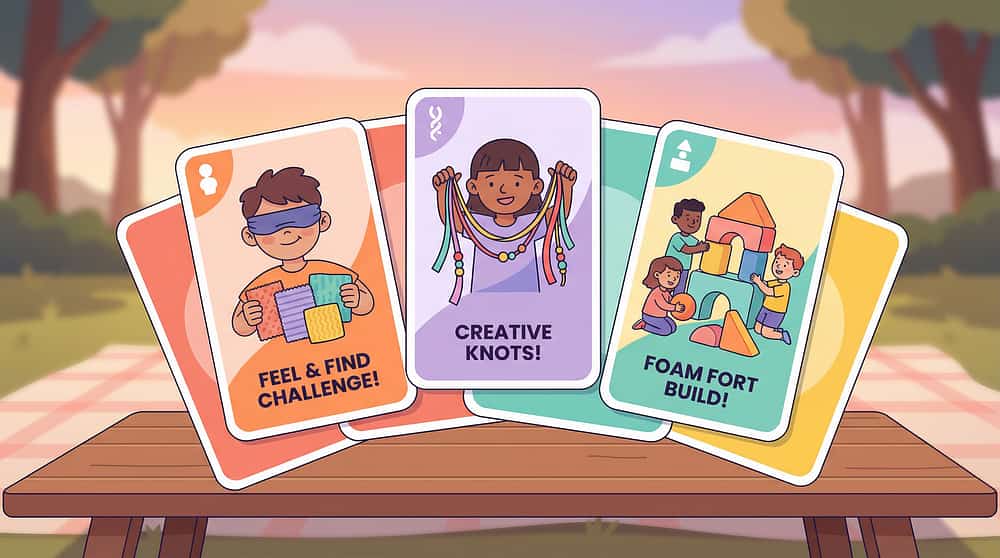
4. Surprise & Problem Cards
Canon: Visual Supports / Problem-Solving Prompts Use: Building tolerance for unexpected changes through playful structured disruption Cost: ₹100–300 (mostly DIY)
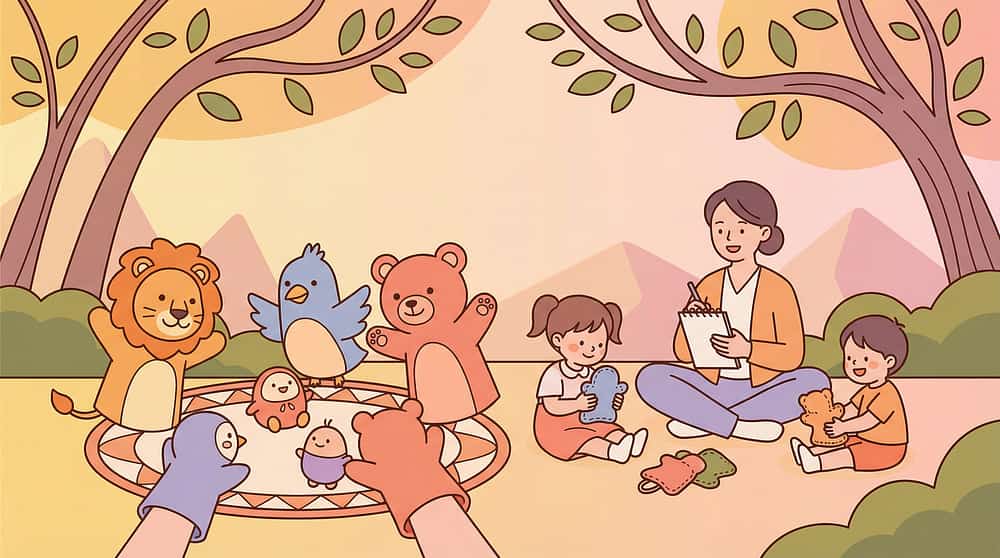
5. Character Puppets & Figure Sets
Canon: Symbolic Play Materials / Puppets & Figures Use: Creating relational play that naturally expands through character interaction Cost: ₹300–1,500

6. Play Mats & Scene Boards
Canon: Play Expansion Materials / Scene Environments Use: Environmental cues that suggest play possibilities rigid players won't generate Cost: ₹300–1,500
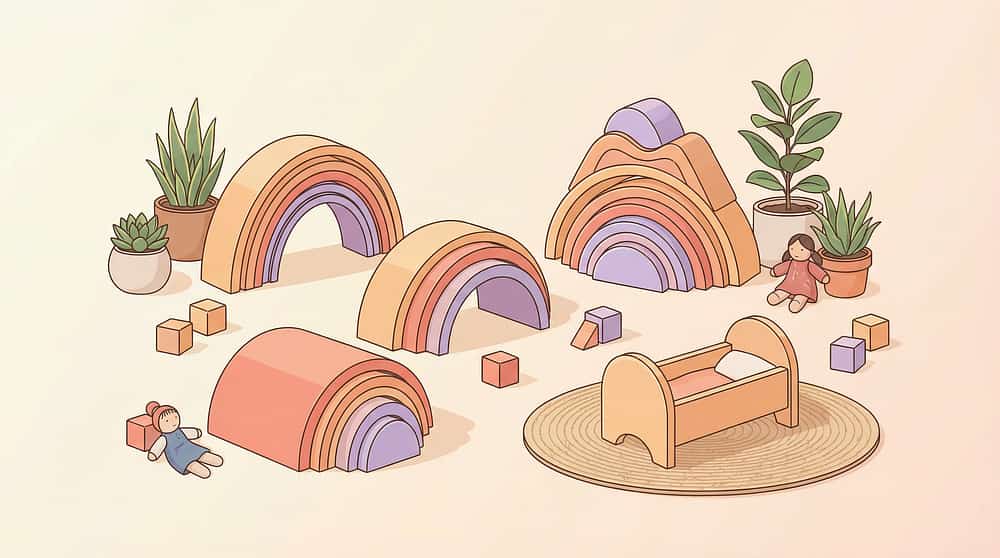
7. Transformation Toys & Multi-Use Props
Canon: Symbolic Play Materials / Open-Ended Manipulatives Use: Teaching symbolic flexibility — one object can be many things Cost: ₹200–1,000
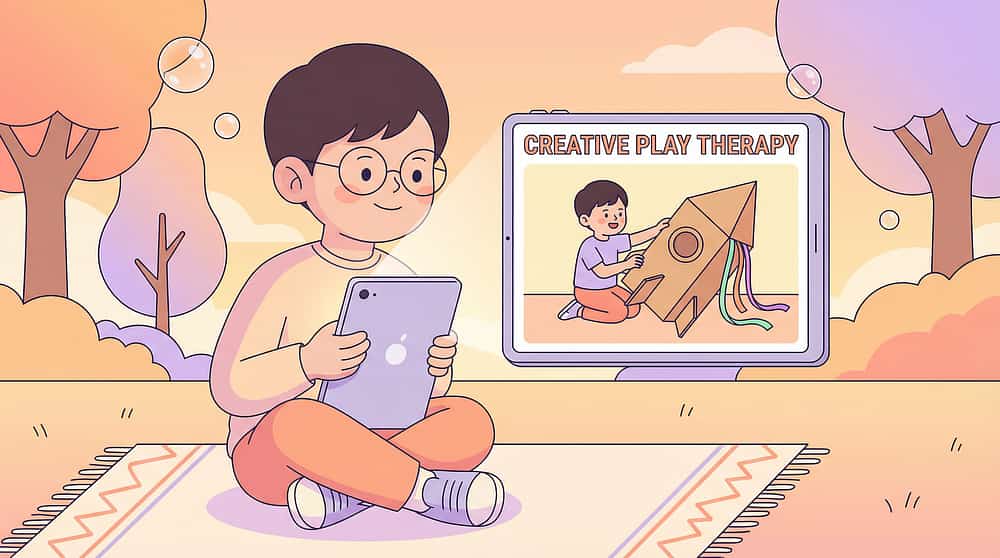
8. Peer Play Video Models
Canon: Video Modeling / Digital Learning Supports Use: Showing children what expanded play looks like — seeing before imagining Cost: ₹0–500 (often free)
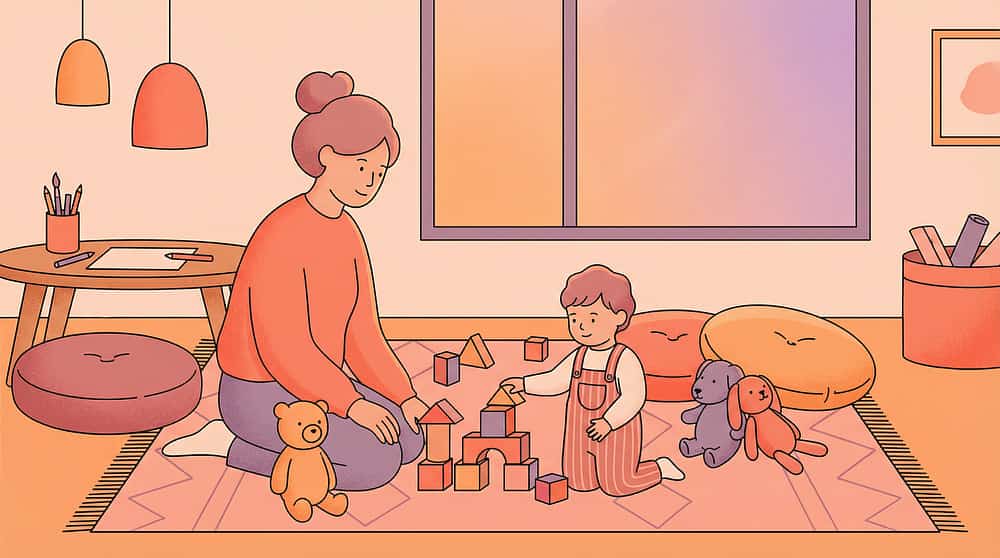
9. Adult-Child Play Expansion Guides
Canon: Parent Training / Caregiver Guides Use: The most powerful material — a skilled adult who knows HOW to expand without taking over Cost: ₹200–1,000 | Helpline: 9100 181 181
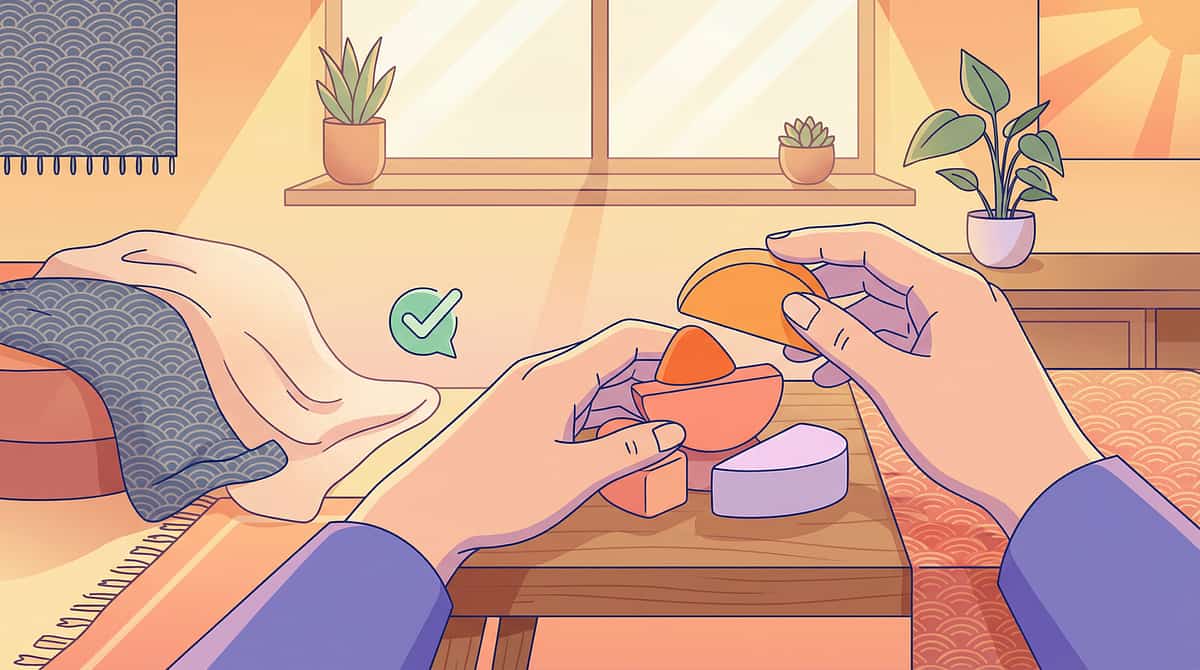
Canon Products — Clinically Curated Links
These specific products from the Pinnacle 128 Canon Materials System have been selected and verified for play expansion work. Each is mapped to a therapeutic function.
Problem-Solving Toys (Canon Items)
- Canon Item 68 → Amazon.in — ₹428 | Cognitive & Learning
- Canon Item 760 → Amazon.in — ₹199 | Problem-Solving Toys
- Canon Item 791 → Amazon.in — ₹579 | Problem-Solving Toys
- Canon Item 691 → Amazon.in — ₹296 | Problem-Solving Toys
- Canon Item 162 → Amazon.in — ₹380 | Problem-Solving Toys
Reinforcement Menus
- Canon Item 803 → Amazon.in — ₹589
- Canon Item 390 → Amazon.in — ₹364
Transition Objects
- Canon Item 118 → Amazon.in — ₹425
Why Canon Matters
Every Canon item is selected by the Pinnacle multi-disciplinary consortium — OT, SLP, ABA, and SpEd specialists who have tested these products across 20M+ therapy sessions. You're not guessing. You're equipping with precision.
📞9100 181 181 — FREE helpline for product guidance in 16+ languages, 24×7.
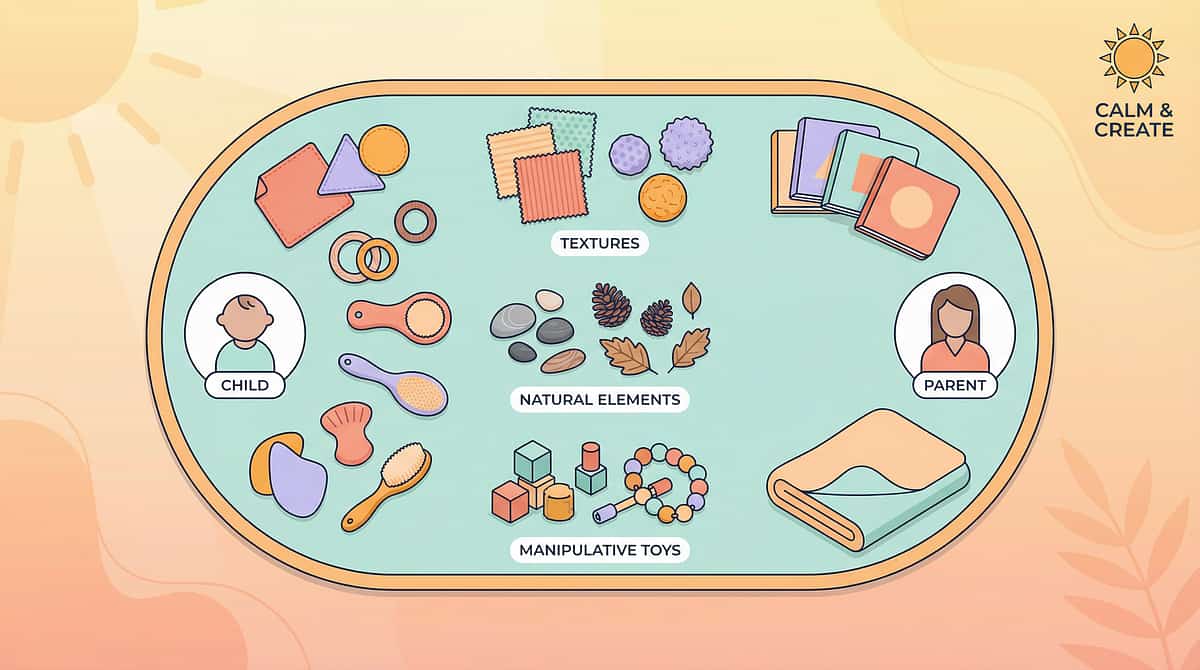
Every Parent Can Start Today. Zero Rupees Required.
WHO/UNICEF Equity Principle: No family is excluded by economics. The technique works with household materials. The materials are a vehicle — the knowledge is the intervention.
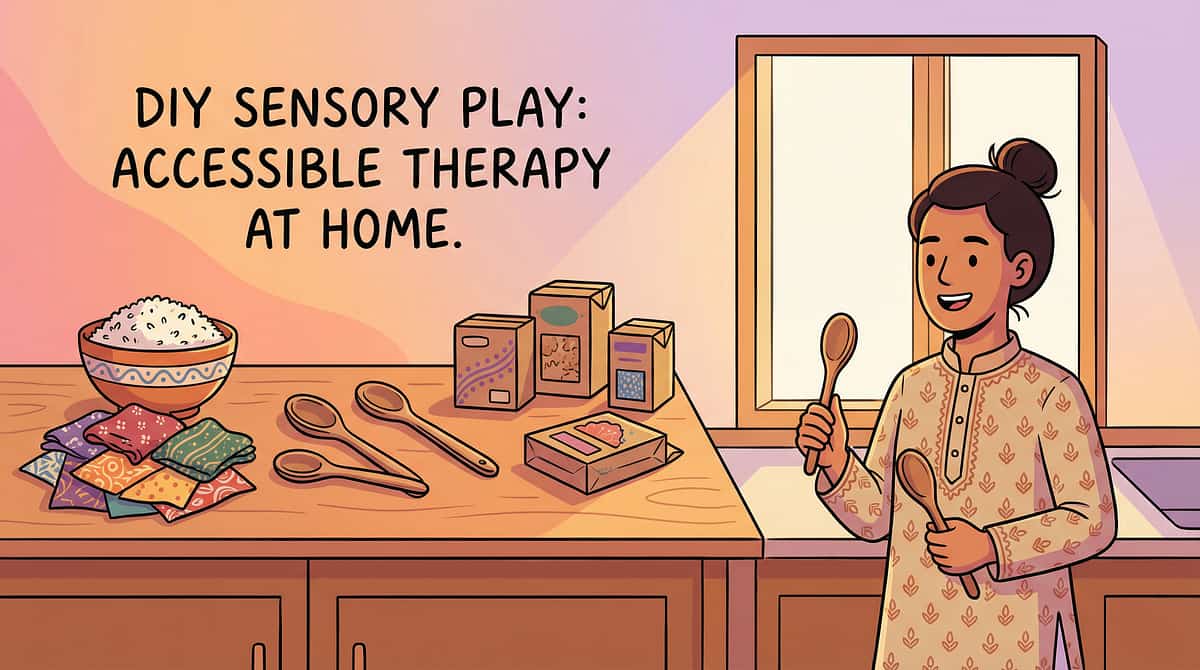
Material | Buy This | Make This FREE at Home | Why the Substitute Works | |
Loose Parts | Commercial wooden sets ₹500+ | Bottle caps, dried beans, fabric squares, cardboard tubes, spools, sticks, stones | Same neurological principle — no predetermined purpose, child generates meaning | |
Play Idea Cards | Commercial card sets ₹200+ | Cut cardboard + hand-drawn scenes. Phone photos of play actions, printed. | Visual externalization works with any clear image — sophistication irrelevant | |
Story Scripts | Printed laminated strips ₹150+ | Paper strip, 6 boxes drawn, simple stick-figure each step | Sequence visualization is the mechanism — medium doesn't matter | |
Surprise Cards | Card set ₹100+ | Index cards with simple scenarios, folded and placed in bowl | Randomness of drawing creates the playful disruption — any format works | |
Puppets | Commercial hand puppets ₹300+ | Socks + marker = sock puppet in 2 minutes. Paper bag + eyes = bag puppet. | Child-character psychological distance functions identically with any puppet | |
Scene Mats | Commercial play mat ₹500+ | Large flattened cardboard, draw roads/buildings with marker | Environmental suggestion mechanism works with any drawn scene | |
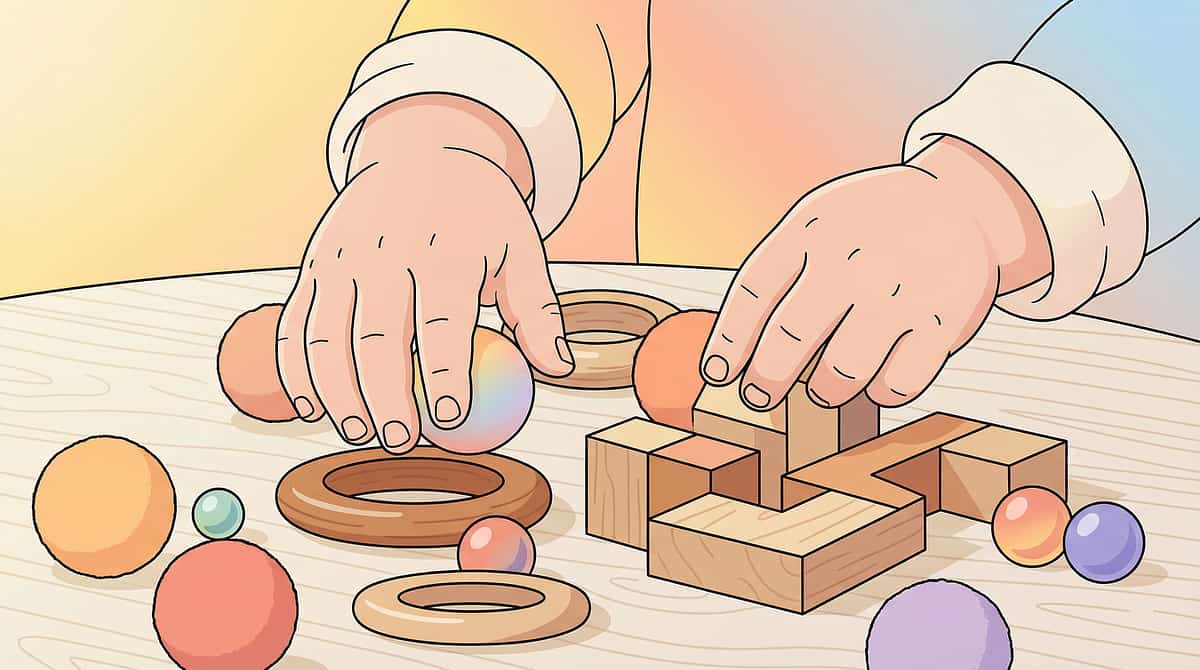
Transformation Toys | Wooden rainbow arc ₹600+ | Cardboard arch, play scarves, cardboard tubes, boxes | Transformation teaching is the adult's modeling — object is secondary | |
Video Models | Pinnacle/YouTube videos | Record sibling or older child playing elaborately with exact same toys | Peer modeling works best when child recognizes the toy | |
Play Guide | Book/training ₹500+ | This page. Pinnacle Helpline 9100 181 181. | The guide is the knowledge — print this page and pin it above the play area |
✅Zero-cost complete kit: Recycled bottle caps + drawn cards + sock puppet + cardboard scene + this page. The technique works. The materials are a vehicle.
Safety First: Read This Before You Begin
Clinical precision, parental empathy. These guidelines ensure every session starts in the right conditions — and ends safely. Never force expansion. If a child's play rigidity is serving a regulatory function (it often is), forced disruption triggers the exact response you are trying to prevent. Expand alongside. Never override.
🔴 STOP — Do NOT Proceed If:
- Child is in meltdown, dysregulated, or post-meltdown (< 30 min)
- Child is ill, feverish, or in physical discomfort
- Child has recently experienced a major routine disruption
- Loose parts include items under 3.5cm for children under 3 years
- Any material has sharp edges, splinters, or unstable construction
🟡 MODIFY — Proceed With Adjustments If:
- Child is tired (reduce session to 10 min, increase familiar elements)
- Child is overstimulated (remove visual clutter, one material at a time)
- New environment (run in familiar home space only)
- Child recently started new medication (watch for sensory changes)
- Strong preference day (start with preferred toy, add ONE new material)
🟢 GO — Optimal Conditions:
- Child is fed (30+ min post-meal), rested, baseline-regulated
- Environment is prepared (see Space Setup card)
- Parent/caregiver is calm and present (not multitasking)
- Materials are ready and accessible
- No upcoming transition within 20 minutes of session
🚨STOP if you see: Escalating crying that doesn't reduce in 2 minutes | Self-injurious behavior | Vomiting or acute physical distress | Complete refusal AND physical pulling away | Signs of genuine terror (not preference refusal — actual fear response).
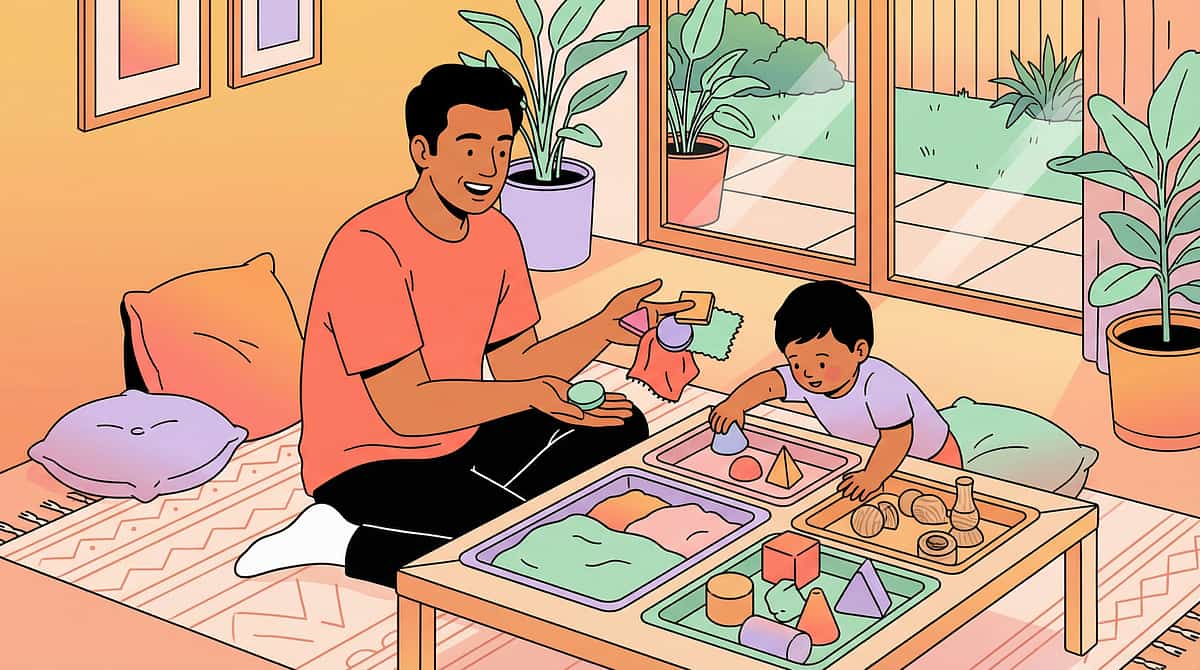
Set Up Your Space: The Right Environment Is 80% of the Session
The 7-Point Setup Checklist
Materials Tray
3–4 items maximum at start. Add more only when child engages. Too many options = overwhelm.
Loose Parts Bin
Accessible but not immediately visible. Introduce after initial engagement.
Child Position
Floor level, seated comfortably on mat or carpet. No restrictive seating for play expansion sessions.
Parent Position
Same floor level. Beside or slightly behind — NOT opposite. Side-by-side creates collaboration; opposite creates performance pressure.
Visual Timer
15–20 minute session. Child should see time remaining. Reduces transition resistance by 60–70%.
Environment
Maximum 6 toys visible. TV off. Dim harsh lighting if possible.
Parent State
Phone away. Be present. Your attention is a therapeutic input.
Sensory Calibration
Lighting: Natural or warm soft light. Avoid harsh fluorescent.
Sound: Quiet baseline. Gentle music at low volume optional.
Temperature: Comfortable. Cold or hot environments increase dysregulation.
Scent: Avoid strong perfumes or cleaners on session day.
Sensory Integration Theory (Ayres): Environmental setup is a core principle. Meta-analysis confirms structured 1:1 individual sessions were most effective. PMC10955541
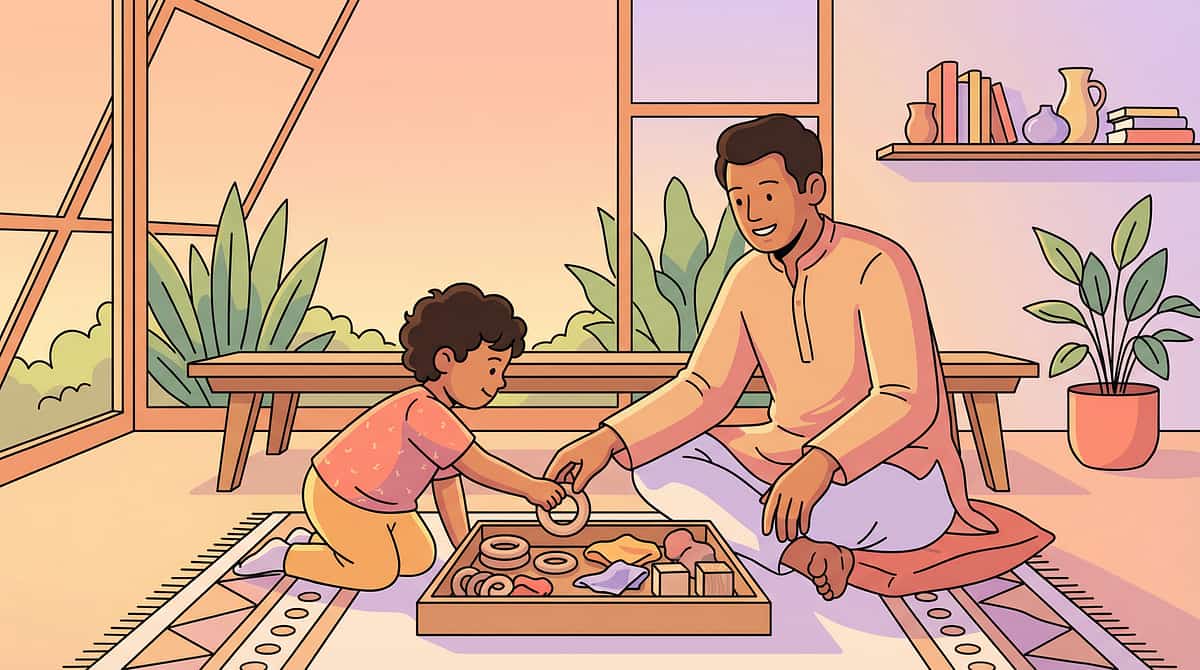
Is Your Child Ready? The 60-Second Check
This readiness check prevents 80% of failed sessions. Run it before every session — it takes one minute and saves you from starting in the wrong state, which teaches the wrong lesson.
Check | ✅ Go | ⚠️ Modify | 🛑 Postpone | |
Meals | Fed 30+ min ago | Fed within 15 min | Hungry / just ate | |
Sleep | Rested, normal waking | Slightly tired | Missed nap / overtired | |
Regulation | Calm, available | Mildly excited | Meltdown in last hour | |
Physical | No visible discomfort | Slightly restless | Ill, feverish, in pain | |
Recent Events | Normal day | Minor disruption | Major disruption or transition | |
Engagement | Available, some engagement | Low engagement | Complete disengagement |
🟢 All Green → GO
Begin full protocol — Step 1 through Step 6.
🟡 1–2 Amber → MODIFY
Run simplified 10-minute version. One material only. Skip surprise cards. Increase familiar elements.
🔴 Any Red → POSTPONE
Do not push. Go to preferred activity or connection time. A skipped session is good clinical judgment, not failure.
"The best session is one that starts right. A session started in the wrong state teaches the wrong lesson."
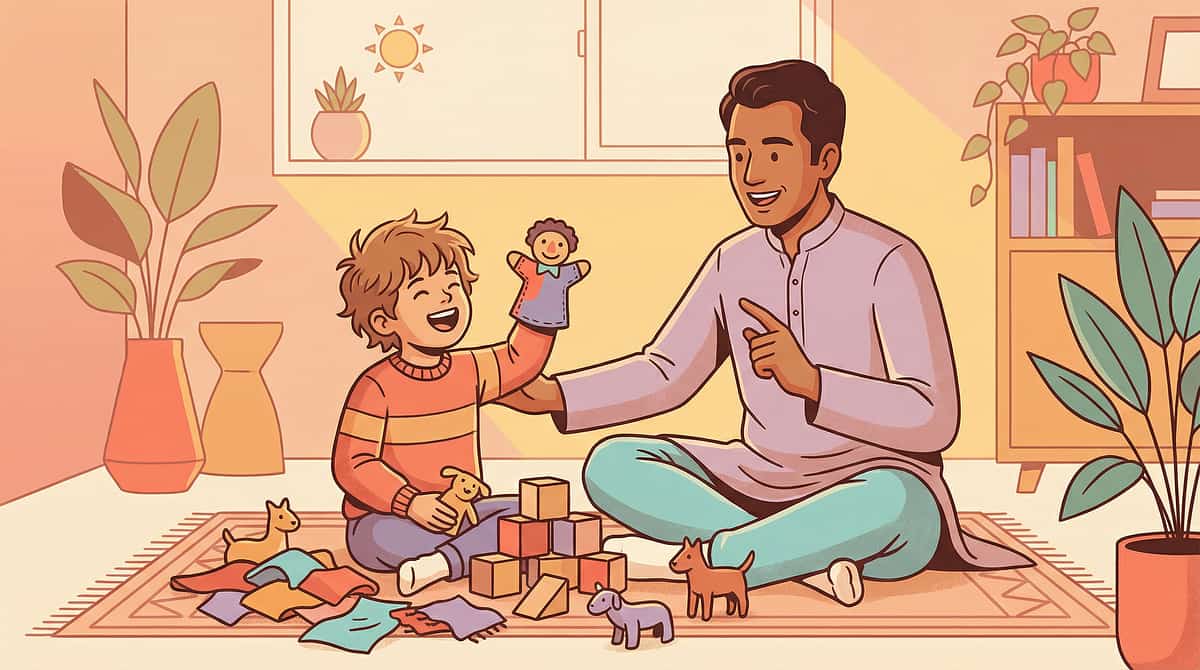
Step 01 / 06
30–60 Seconds
Step 1: The Invitation
Aim: Enter the child's world. Do not pull them into yours.
The Script
"I'm going to play over here. Want to come see?"
Then sit down, begin playing with ONE material without looking at the child directly. Let curiosity do the work.
Body Language Guidance
- Sit at child's level on the floor
- Face SLIGHTLY away from the child (reduce social demand)
- Handle materials with genuine curiosity and pleasure — narrate your own play aloud
- Do NOT ask "Do you want to play?" — this creates a binary yes/no barrier
- Do NOT reach toward the child — let them come to you
Acceptance Cues (Child Is Ready to Proceed)
- Child glances at materials
- Child moves physically closer
- Child stops current activity and orients toward you
- Child reaches for a material
- Child asks a question
Resistance Cues (Do Not Escalate)
- Child moves away: Stay where you are, continue your own play, narrate.
- Child ignores: Wait 60 more seconds.
- Still no engagement: Run modified session — parallel play only. You expand, child watches.
ABA Pairing Procedures + OT "Just-Right Challenge" principle: Motivating operations before demand placement increase engagement acceptance.
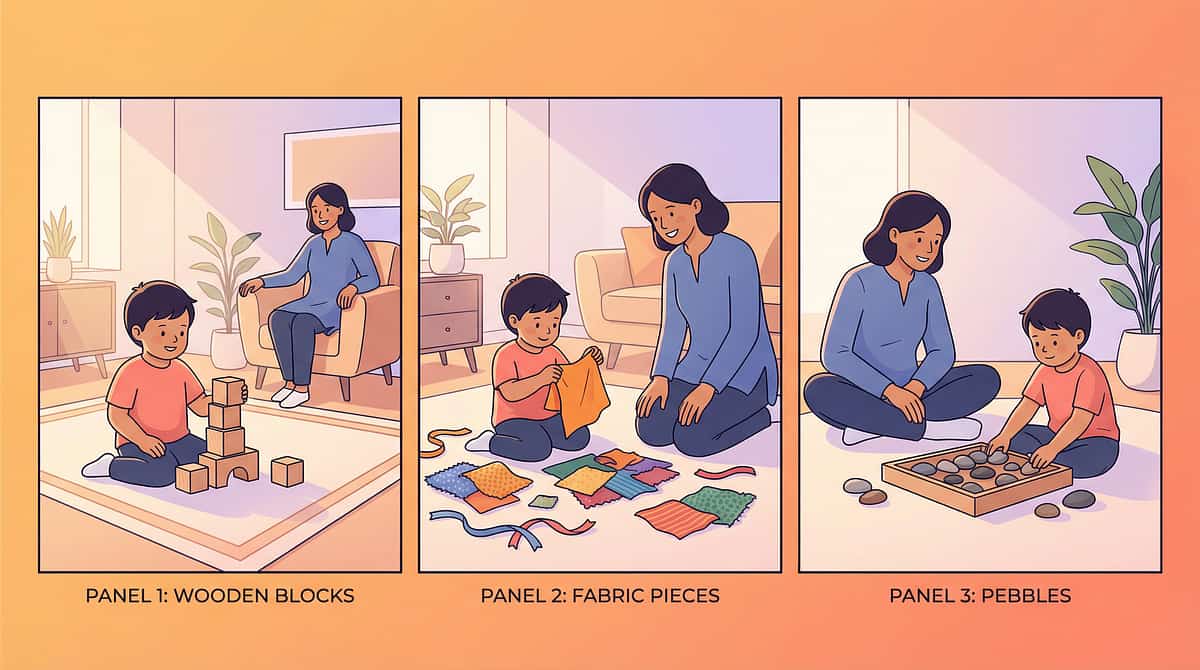
Step 02 / 06
1–3 Minutes
Step 2: The Engagement
Aim: Deepen the interaction. Introduce the therapeutic material. Begin reinforcement.
If Child Joined You (Full Engagement)
- Introduce the material naturally: "Look, here's this... what could we do with it?"
- Play with the material yourself first. Show one use. Then offer it.
- Maintain parallel presence. Follow the child's lead.
- Introduce first Play Idea Card or loose part.
If Child Is Watching (Observational Engagement)
- Continue narrating your own play: "Hmm, I'm going to use this block as a table..."
- Don't break the fourth wall — stay in the play.
- Place a material where child can access it without asking for it.
Child Response | Meaning | Your Action | |
Takes material, uses it | Full engagement | Follow their lead. Don't expand yet. | |
Takes material, repeats familiar action | Tolerance engagement | Normal. Accept. Gently model variation. | |
Watches without taking | Observational readiness | Good. Continue modeling. | |
Moves away | Not ready | Drop back to parallel. Wait. |
Reinforcement Cue: When child takes material OR tries any new action — immediate, specific, warm praise within 3 seconds: "You picked that up! I love that." Don't gush. Warm and specific.
Step 03 / 06 — THE CORE
5–12 Minutes
Step 3: The Therapeutic Action — Materials 1–5
Aim: Deliver the therapeutic input. The active ingredient. Tap each material's execution guide below.
Loose Parts Execution
Start with just 3–4 items (wooden disc, fabric scrap, cardboard tube, stone). Wonder aloud: "I wonder what this wooden circle could be..." Demonstrate: "It's a wheel! Now it's a cookie! Now it's the moon!" Offer to child. Accept ANY use. Add one new item per 2–3 minutes. Expansion indicator: Child uses item for something different than last session.
Play Idea Cards Execution
Fan out 3 cards face-up near the child's play. Don't instruct — just place them nearby. Glance at cards: "Oh, there's an idea here..." Point to a card: "What about this one?" — no pressure. If child chooses a card, celebrate the choice, then support executing the scenario. Expansion indicator: Child selects a card different from their usual play action.
Play Story Scripts Execution
Place sequence strip where both of you can see it. Begin the first step naturally in your play. Point to Step 1, complete it, point to Step 2: "Then what happens next?" Follow the sequence together. Don't rush — let each step be real play, not a checklist. Expansion indicator: Child points ahead to a future step independently.
Surprise Cards Execution
Place deck face-down between you. After 2–3 minutes of established play: "Should we pick a surprise card?" Draw card together. Read in playful voice: "Oh no! The stove stopped working!" Model a response: "Hmm, what could we do? Maybe cook on the campfire?" Let child problem-solve. Accept all solutions. Expansion indicator: Child laughs at the surprise and suggests a solution.
Puppets / Characters Execution
Pick up one puppet. Give it a voice and personality. Introduce it naturally to the child's current play. Offer a second puppet to the child. Have your puppet talk to the child's puppet. Create simple interaction. "What does your puppet want to do next?" Expansion indicator: Child's puppet initiates dialogue or action spontaneously.
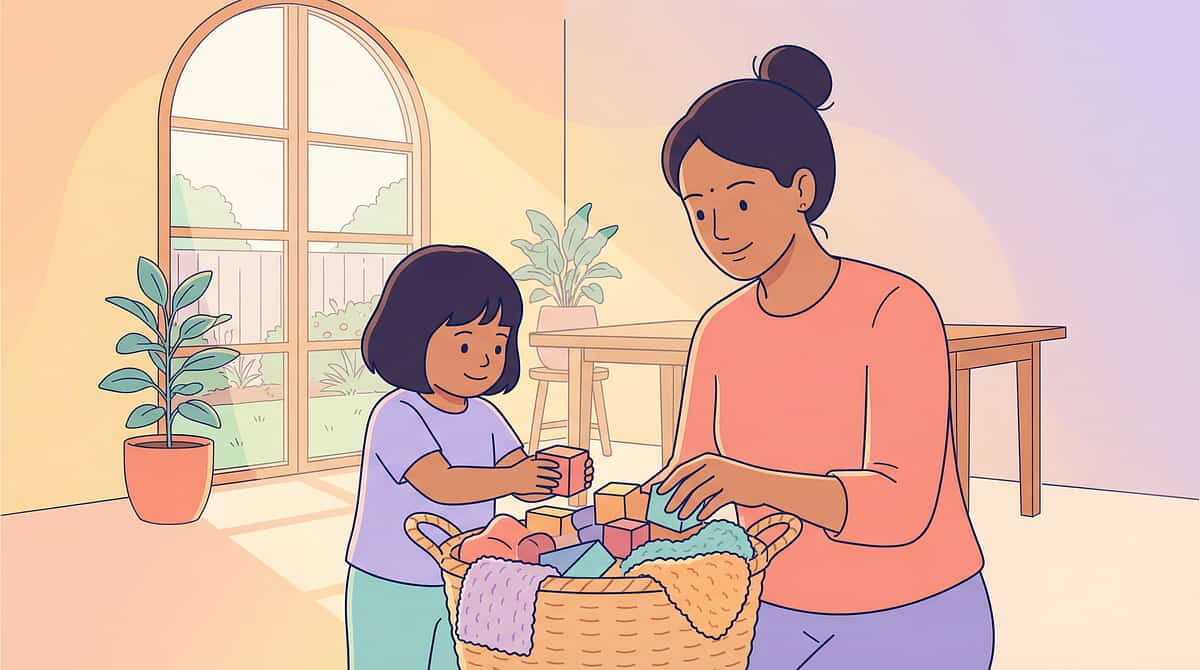
Step 03 / 06 — Continued
5–12 Minutes
Step 3: The Therapeutic Action — Materials 6–9
Scene Mat Execution
Lay mat on floor. Begin moving a figure to a location. Narrate the journey: "I'm driving to the hospital..." Invite child: "Where should your car go?" When child places character, ask: "What happens now?" Expansion indicator: Child moves character to a new location unprompted.
Transformation Toys Execution
Hold the wooden arc. Make it a bridge — drive a car under it. Then flip: "Now it's a mountain! The car climbs up!" Offer to child: "What else could this be?" Accept ALL suggestions. "Yes! A slide! Show me!" Expansion indicator: Child suggests a transformation independently.
Video Models Execution
Pre-watch video together (2–4 min). Pause and comment naturally: "Oh look, she's using the blocks as a city!" After video, bring out matching toys. Don't say "do what she did" — just make the toys available. Expansion indicator: Child spontaneously tries something from the video.
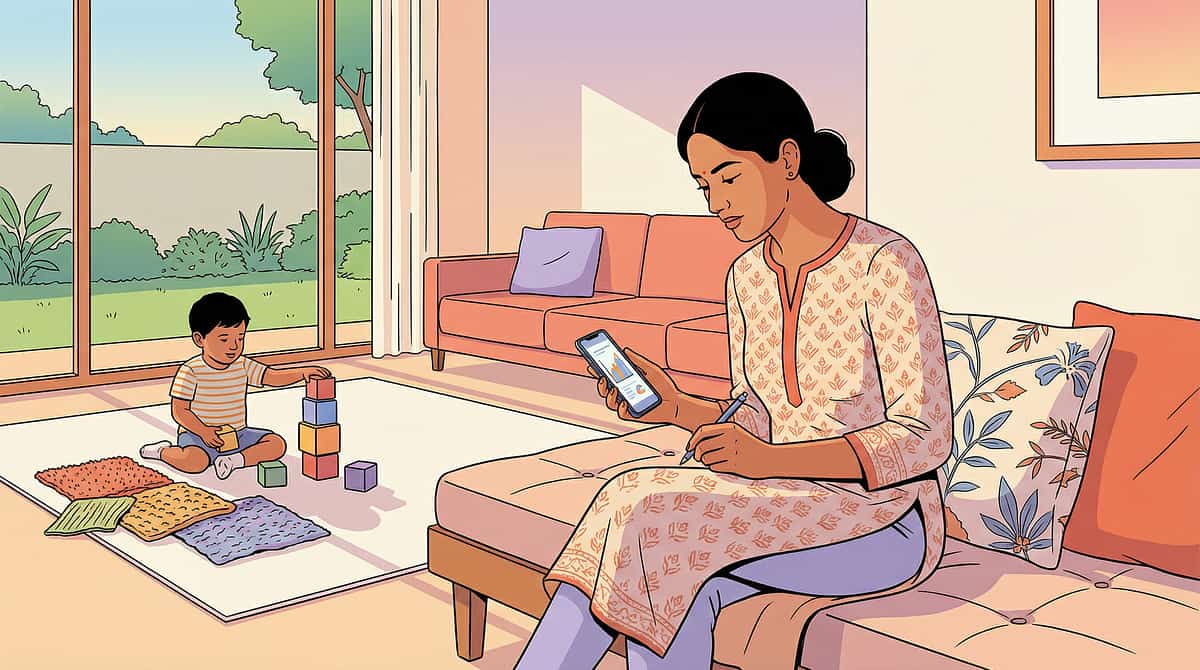
Adult Play Strategies Execution
Your core strategies in every session: Parallel Play First — play beside, not against One Step Up — add ONE element, not a new direction Wonder Aloud — "I wonder what would happen if..." Offer, Don't Insist — present options, accept no Celebrate Novelty — notice and name any new play action immediately Expansion indicator: You complete the session without taking over the play.
Step 04 / 06
3–5 Minutes
Step 4: Repeat & Vary — The Dosage Principle
Aim: Therapeutic dosage. The right number of repetitions with meaningful variation. Remember: 3 good, genuine, child-engaged repetitions are worth more than 10 mechanical, compliance-based repetitions.
Material | Repetition Target | Variation to Introduce | |
Loose Parts | 3–5 different uses per item | Change identity each time — "Now it's a..." | |
Play Idea Cards | 2–3 cards per session | Rotate to slightly more novel card on 3rd selection | |
Story Scripts | 1 full sequence + 1 variation | On 2nd run: add one new step | |
Surprise Cards | 2–3 surprise cards | Increase surprise intensity slightly each time | |
Puppets | 3–4 exchange turns | Add new character personality each session | |
Scene Mat | Visit 3+ locations | New destination each time | |
Transformation Toy | 3–4 transformations per item | Invite child to name the transformation | |
Video Model | Once per session | Different video next session | |
Adult Strategies | Continuous | Shift from leading expansion to inviting child to lead |
Satiation Indicators (child has had enough): Drops material and turns away | Repeats same action more than 4x without variation | Becomes passive or flat affect. → Response: Introduce new material OR take a 2-minute break of parallel quiet play.

Step 05 / 06
Immediate — Within 3 Seconds
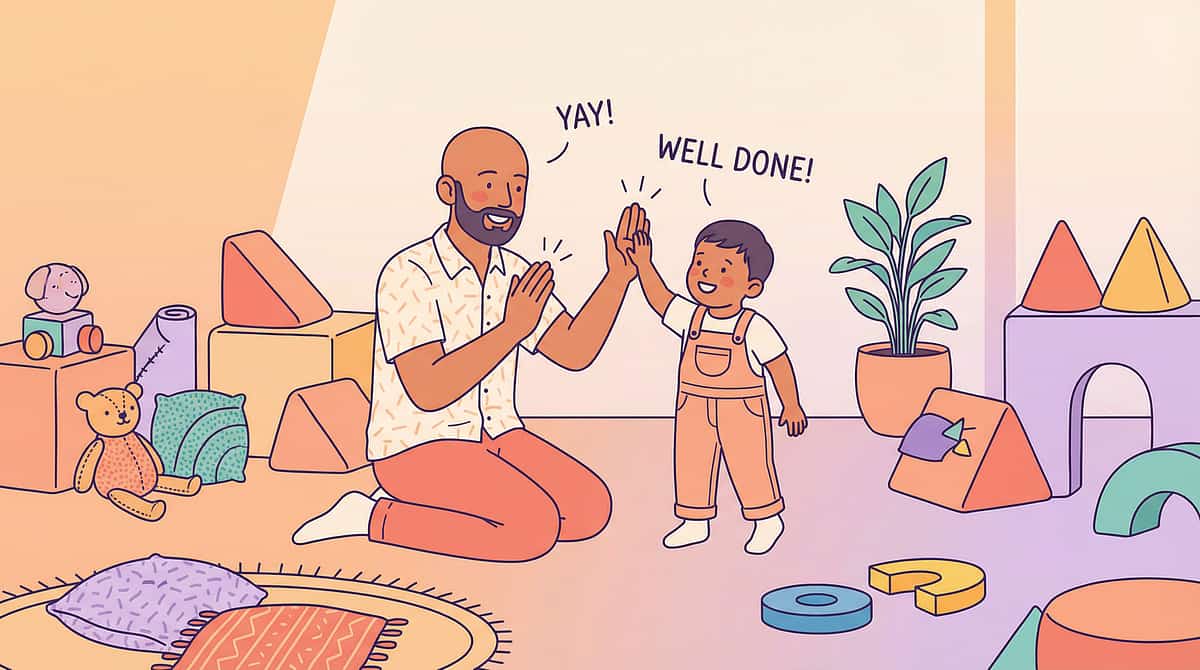
Step 5: Reinforce & Celebrate
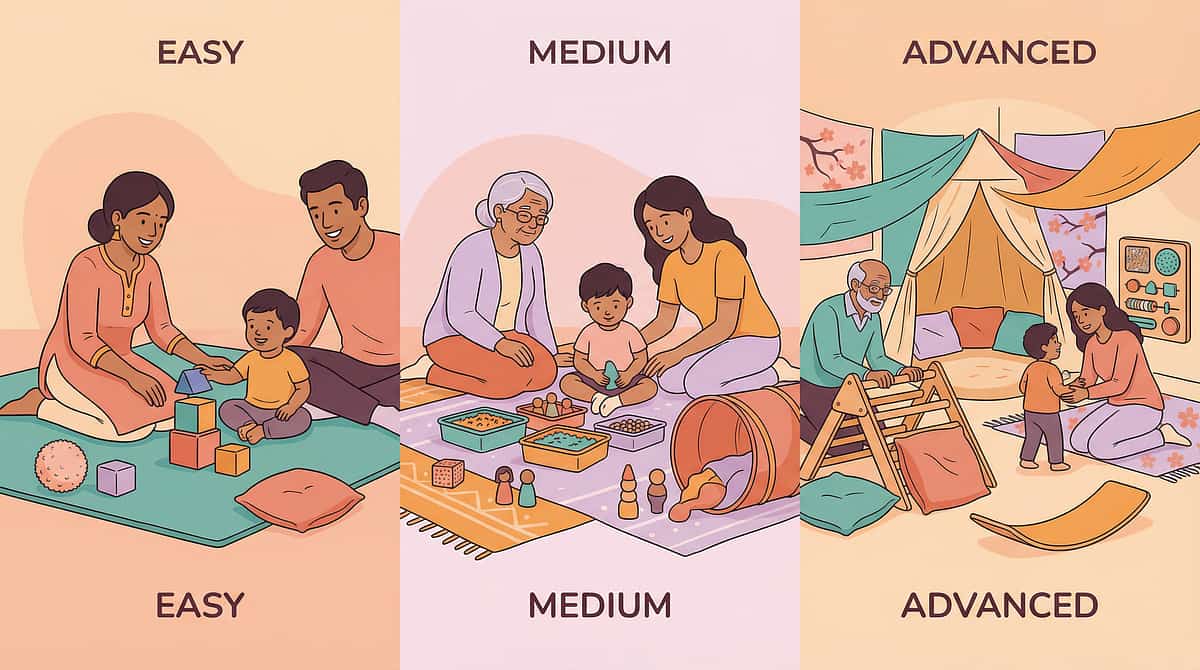
Aim: Lock in every expansion moment. Teach the brain that flexibility = reward. Timing matters more than magnitude. A warm, specific response within 3 seconds is 10x more effective than a delayed sticker 10 minutes later.
Verbal (Always First)
Immediate, specific, warm — within 3 seconds. "You just tried something new with that block!""You picked a different card! That's play expanding!""I love that idea — the puppet went somewhere different today!"
Social (Follow Verbal)
High-five if child accepts physical contact. Clap hands together — celebratory, brief. Big eyes, genuine delight expression. Match the child's sensory preferences.
The Non-Negotiable Rule: Celebrate the attempt, not just the success. A child who TRIES to use a new material and fails receives the same warmth as one who succeeds. Punishment of failure creates rigidity. Reward of attempt creates expansion.
Step 06 / 06
2–3 Minutes
Step 6: The Cool-Down
Aim: Transition out of therapeutic engagement without disrupting regulation. The cool-down is not an afterthought — it is a therapeutic step that determines how your child feels about starting the next session.
If Child Resists Ending
- Don't escalate. Remain calm.
- Use visual timer: "When the time reaches zero, it's all done."
- Offer choice of two next activities (not "do you want to stop?" — that's a yes/no trap).
- Never abruptly end — always allow the wind-down process.
Transition Object: Canon Item 118 — ₹425
The Put-Away Script
"Two more plays, then we'll put them away." (Show 2 fingers. Point to timer.)
"The loose parts go back to their house."
"Session is all done. Now we're going to [next activity]."
NCAEP 2020: Visual timers classified as evidence-based practice for autism. Transition support reduces post-session dysregulation.

Capture the Data: 60 Seconds Right Now
60 seconds of data now saves hours of guessing later. Record while the session is fresh — your observations become the evidence base that guides every future session and your conversations with your child's therapy team.
G-656 Play Expansion Session Tracker
Date: ___________ Time: _________ Duration: _______ min
Materials Used Today (circle): Loose Parts | Play Cards | Story Scripts | Surprise | Puppets | Scene Mat | Transform | Video | Adult Guide
New Play Actions Observed (count): _______ (Any play action child did differently than last time)
Engagement Quality (circle 1–5): 1 = Refused | 2 = Tolerated | 3 = Engaged | 4 = Enthusiastic | 5 = Child-Led
Notable Moment (1 sentence): ___________________________________
Next Session Focus: ___________________________________
Track & Share
Track in app | Download PDF version | Share with therapist directly
ABA Data Collection Standards (BACB): Continuous measurement and discontinuous measurement are standard practice for behavior-analytic intervention tracking. Cooper, Heron & Heward, Applied Behavior Analysis, 8th ed.
What If It Didn't Go As Planned?
Session abandonment is not failure — it is data. Here are the 7 most common problems and exactly what to do. Every "failed" session tells you something precise about your child's current threshold — use that information.
Problem 1: Child Refused All Materials and Went to Corner
Why: The social demand was too high. The session felt like a test, not play. Next time: Start with pure parallel play — no invitation, no materials offered. Just play beside them. Do this for 3–5 sessions before introducing materials.
Problem 2: Child Played for 5 Seconds Then Walked Away
Why: Material introduced too early (before sufficient engagement). Next time: Wait until child is settled and present for 2+ minutes before introducing. Start with ONE familiar item, not the novel material.
Problem 3: Child Used Material in Their Rigid Familiar Way
Why: This is NORMAL and actually progress — they accepted the material! Next time: Don't correct. Celebrate acceptance. Model one variation alongside, then leave it. Rigid use first → flexible use later. This is the correct sequence.
Problem 4: Surprise Card Created Meltdown, Not Curiosity
Why: The surprise difficulty was too high for this child's current flexibility level. Next time: Create gentler surprises — "We have an EXTRA ingredient!" (positive surprise) before moving to "Oh no!" surprises. Build positive novelty tolerance first.
Problem 5: Child Only Wanted to Watch the Video and Refused to Play After
Why: Video is highly reinforcing. Transition from screen to play is hard. Next time: Use video AFTER play session as reinforcement, not before. OR use only 60-second clips, not full videos.
Problem 6: Adult Kept Wanting to Take Over the Play
Why: The most common and most understandable mistake. You can see so many "better" ways. Next time: Set a rule for yourself: "I add ONE thing, then follow." If you catch yourself directing, narrate what the child is doing instead. Your job is expansion, not direction.
Problem 7: Child Became More Rigid Over the Week, Not Less
Why: Too much expansion pressure, too fast. Rigidity increased as a self-protection response. Next time: Drop back to following the child's lead completely for 3–5 days. Rebuild safety, then reintroduce expansion at slower pace. Contact helpline: 9100 181 181

Adapt & Personalize: No Two Children Are Identical
Here is how to fit this technique to your child's specific profile. The protocol is a framework — your child's individual sensory, behavioral, and developmental profile determines how you apply it.
🔵 High Play Rigidity / ASD Profile
- Start with loose parts only (no cards, no scripts for first 2 weeks)
- Keep surprises positive only before moving to "Problem card!"
- Expand within the child's preferred theme, not outside it
- Session length: 10 minutes maximum
- Professional guidance recommended: Call 9100 181 181
🟠 Sensory Seeker (Seeks Intense Input)
- Include physical transformation toys, weighted materials in loose parts
- Increase tempo of session
- Use larger movements — building, demolishing, reorganizing
- Surprise cards with physical responses work well
🟢 Sensory Avoider (Cautious, Over-Responsive)
- Introduce all new materials from distance first (look, then touch)
- Slow tempo, low voice, no sudden movements
- Reduce visual complexity — fewer items at a time
- Ensure materials are soft/smooth (avoid scratchy textures without preparation)
🟡 ADHD / Attention-Variable Profile
- 5-minute sessions, 3x per day instead of 15-minute single session
- High-interest themes only — use child's fixation as expansion vehicle
- Increase novelty slightly faster — boredom drives some play rigidity in ADHD
- Movement-based play expansion (walk-around scene mat, standing puppet theater)
Age 2–3
Sensorimotor loose parts only. No cards or scripts. Pure parallel modeling.
Age 4–5
Introduce play idea cards + story scripts. Puppets highly effective.
Age 6–8
All 9 materials applicable. Include peer video models. Child creates own scripts.
Weeks 1–2: Tolerance, Not Mastery. This Is Correct.
"If your child tolerates a loose part in the play space for 60 seconds longer than Week 1 — that is real, measurable, neuroscience-backed progress. The brain is changing. It just isn't visible yet."
Observable Behavior | What It Means | What To Do | |
Child accepts material being nearby (even ignores it) | Tolerance threshold established | ✅ Celebrate internally. Continue. | |
Child picks up material and uses it in familiar way | Acceptance — first step of flexibility | ✅ Celebrate the acceptance. Don't redirect. | |
Child glances at your play | Social referencing — watching the model | ✅ Continue modeling. Don't interrupt. | |
Child resists on Day 1, tolerates on Day 5 | Neural pathways forming | ✅ Document. This is measurable progress. | |
Play session ends early | Not failure — calibration data | ✅ Shorten next session. Start with what worked. |
What is not progress yet (and that's fine): Child does not yet spontaneously vary play | Child has not tried any card/script ideas | Surprise cards still cause resistance. These are Week 3–4 goals.
PMC11506176 (2024): Sensory integration and play-based intervention outcomes emerge across 8–12 week timelines. Early-phase indicators focus on tolerance and participation, not skill mastery.
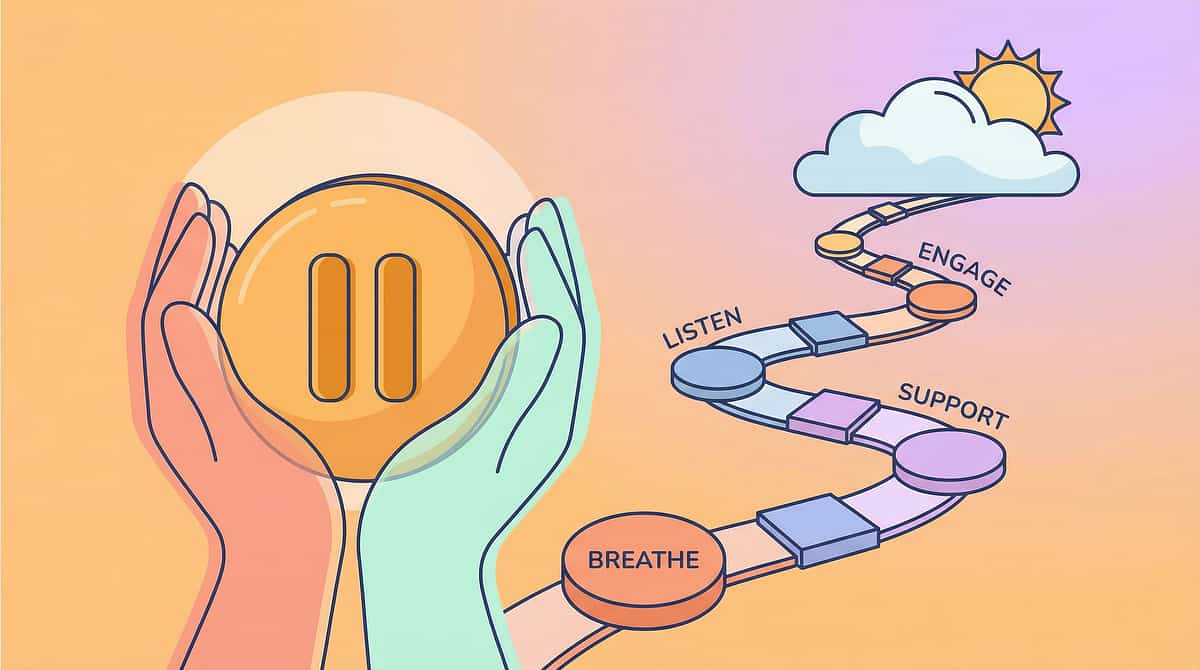
Weeks 3–4: The Neural Pathways Are Forming
You'll see consolidation in these specific signs. These are not random improvements — they are the precise behavioral signatures of new neural connections forming in your child's prefrontal cortex.
🧠 Consolidation Sign #1
Child anticipates the session — moves toward the play space before you begin. This means the brain has associated the materials with reward.
🧠 Consolidation Sign #2
Child uses a familiar material in a slightly different way, unprompted.Spontaneous flexibility — the primary goal — emerging for the first time.
🧠 Consolidation Sign #3
Child's resistance to surprise cards decreases, even if not eliminated. Novelty-tolerance threshold is rising.
🧠 Consolidation Sign #4
Play session duration naturally extends — child doesn't want to stop. Engagement quality has improved. The technique is working.
"You may notice you're more confident too. You're reading your child better. You're less afraid to offer new materials. Your expertise as your child's primary therapeutic partner is growing."
When to increase frequency: If you see 2+ consolidation signs, consider increasing from daily 15-min to twice-daily 10-min sessions.

Weeks 5–8: The Mastery Indicators That Signal Readiness to Progress
These criteria are specific, observable, and measurable — not impressionistic. Track them precisely across your sessions to know exactly when your child is ready for the next level.
Mastery Level 1 — Expansion Within Familiar Play
Child varies their familiar play sequence with at least 2 new elements per session without prompting. The kitchen play now includes 3–4 different scenarios.
Mastery Level 2 — Accepted Social Expansion
Child accepts and incorporates at least 1 adult-introduced play expansion per session without resistance. "One Step Up" is welcomed, not resisted.
Mastery Level 3 — Independent Idea Generation
Child spontaneously generates a new play idea at least once per session. When asked "What should we do now?" — child has an answer that's not their original script.
Mastery Level 4 — Flexible Play Transfer
Child demonstrates expanded play with familiar materials in a NEW setting (different room, grandparent's house, school).
🏆Mastery Unlocked: Levels 1+2 consistent across 2 weeks → Begin G-657 alongside G-656 | Levels 1–3 consistent → Reduce to maintenance frequency (3x/week) | Level 4 observed → G-656 mastered. Transition primary focus to G-657 Pretend Play.
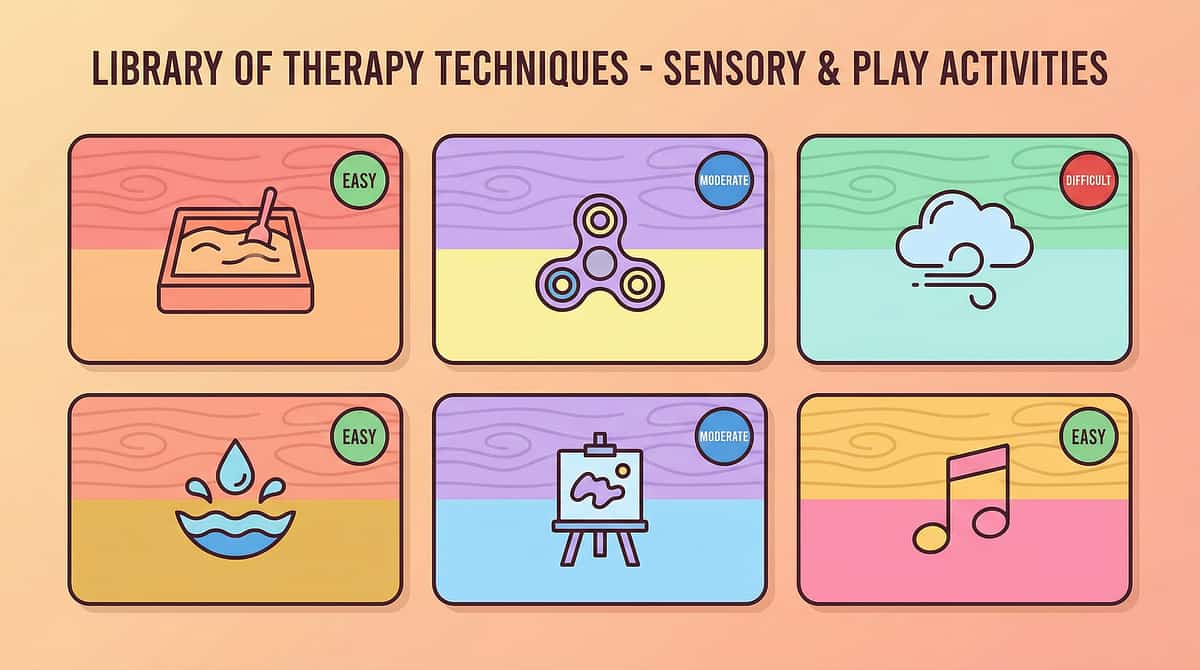
You Did This. Your Child Grew Because of Your Commitment.
You have spent weeks showing up — sitting on the floor, offering loose parts, drawing surprise cards, voicing puppet characters, modeling transformation after transformation. You've done this on tired evenings. After long workdays. When it felt like nothing was changing.
And it changed.
Your child's play is larger now than when you began. They reach for materials they ignored. They tolerate a surprise card that would have caused a meltdown. They used the block as a cookie — and that symbolic moment is the foundation for everything that comes next.
✅ G-656 Play Expansion
ACHIEVED
Play Readiness Index
PROGRESSED
Cognitive Flexibility
EMERGING
Symbolic Play Readiness
BUILDING
📸Family Celebration Suggestion: Take a video of your child in one of their new, expanded play scenarios. Play it back to them. Show them: "Look what you can do now." This is the visual evidence of their growth. Keep it. It matters.
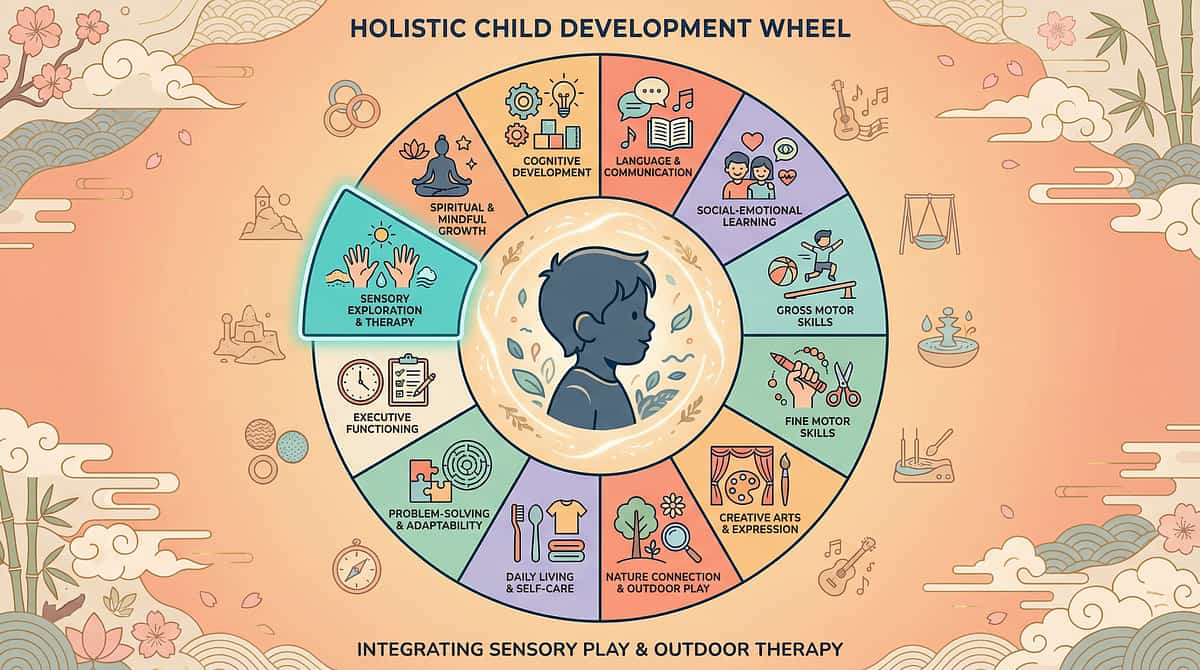
Red Flags: When to Pause and Seek Professional Guidance
Trust your instincts — if something feels wrong, pause and ask. These five red flags are specific and observable, not vague. If you recognize any of them, follow the escalation pathway below.
🚨 Red Flag 1: Rigidity Is Worsening Despite Consistent Sessions
What it looks like: Play is MORE restricted than when you started. Why it matters: Could indicate sensory overload from expansion attempts, or underlying anxiety. What to do: Stop expansion attempts for 1 week. Contact helpline: 9100 181 181
🚨 Red Flag 2: Child's Distress During Sessions Is Increasing
What it looks like: More meltdowns than before the intervention started. Why it matters: The approach may not be calibrated correctly for this child's profile. What to do: Request an OT/ABA assessment. This guide is not a replacement for professional evaluation.
🚨 Red Flag 3: New Behaviors Emerging Alongside Play Work
What it looks like: Increased self-stimulation or regression not present before. Why it matters: May indicate the child is processing change in other ways. What to do: Teleconsultation with Pinnacle developmental specialist.
🚨 Red Flag 4: No Observable Progress After 8 Consistent Weeks
What it looks like: Zero change in any indicator from Weeks 1–8. Why it matters: Underlying barriers may require professional assessment. What to do: Book AbilityScore® assessment. 9100 181 181
🚨 Red Flag 5: Child Shows Genuine Emotional Distress About Play
What it looks like: Crying, clinging, or fear response specifically about play materials — not just preference refusal, but actual fear. Why it matters: Anxiety-driven rigidity needs separate treatment. What to do: Clinic visit. Full evaluation.
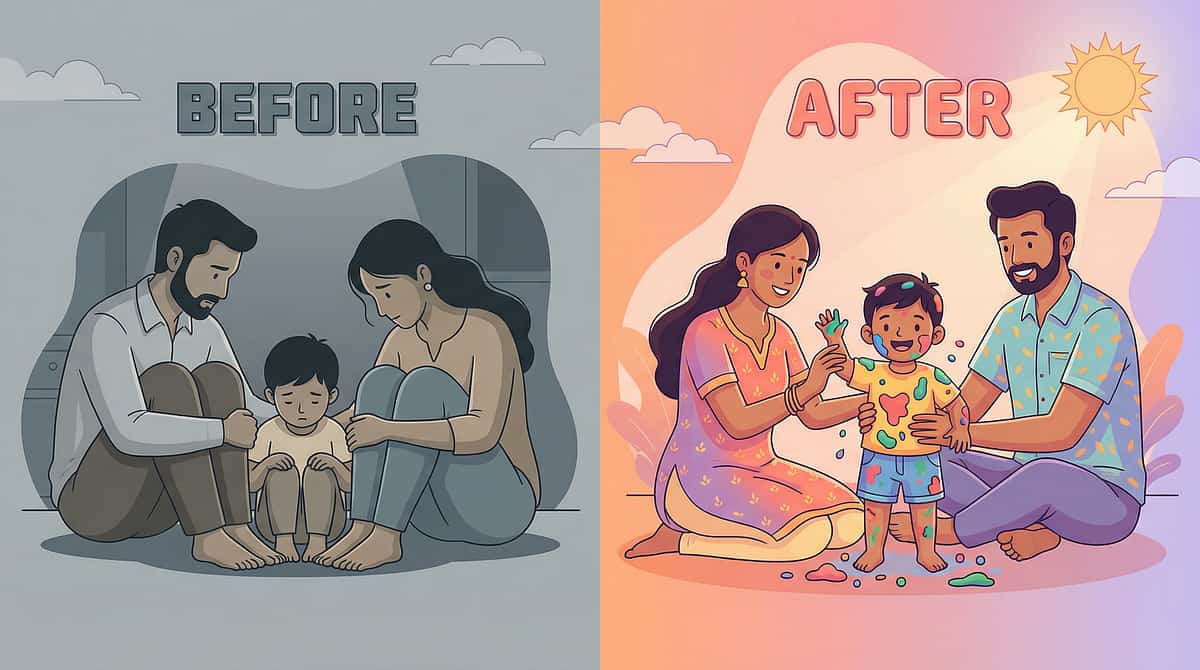
The Progression Pathway: You're Not Done — You're on a Journey
G-656 is one step in a carefully sequenced developmental roadmap. Here is where you've been, where you are, and where your child is headed.
G-654
Play Development Foundations — build blocks for play readiness
G-655
Symbolic Play Skills — object = other things, functional pretend established
G-656 ← YOU ARE HERE
Play Expansion — flexible play repertoire, expanding scripts
G-657 (Next)
Pretend Play — full pretend scenarios, role play, narrative complexity
G-658 (Advanced)
Social Play with Peers — interactive, reciprocal, social play
Lateral Options
- G-660 Cognitive Flexibility → Targets flexibility directly, less through play materials
- G-665 Restricted Interests → Uses special interests as expansion vehicle
- G-661 DIR/Floortime → Relationship-based play expansion approach
Long-Term Goal
Play expansion feeds into: social competence, creative thinking, narrative language, emotional regulation, academic readiness, and lifelong adaptive functioning.
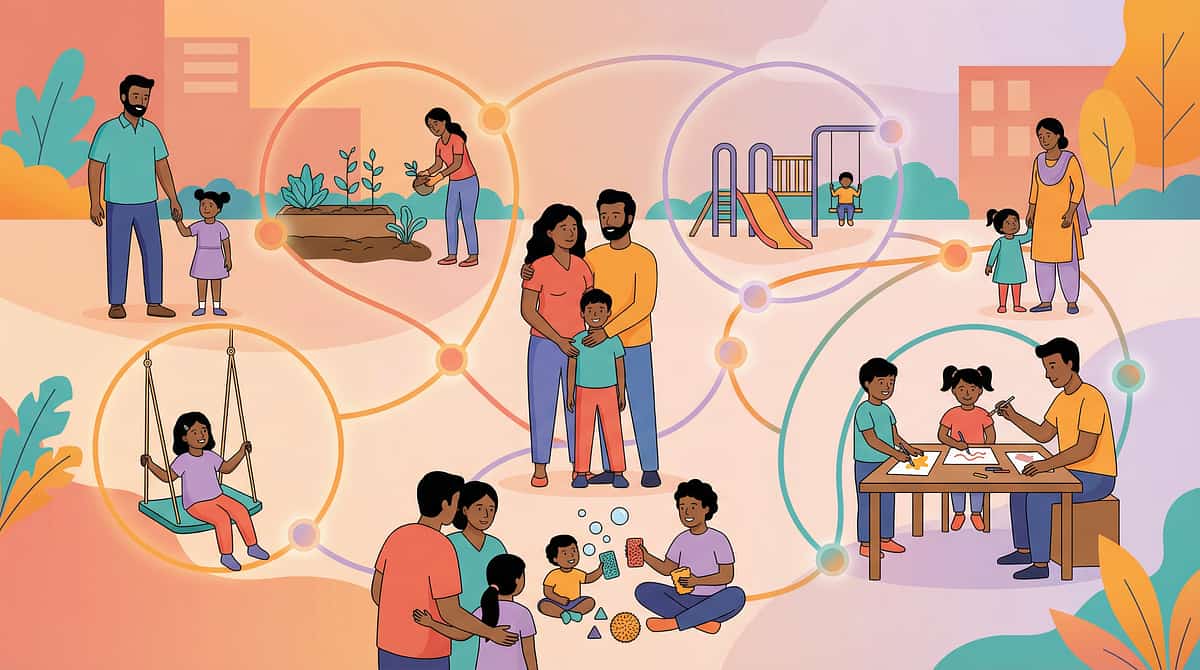
Related Techniques in This Domain
Already have the materials? These techniques use the same toolkit — your investment stretches further than you think. Each technique below overlaps significantly with the G-656 kit you've already built.
Technique | Difficulty | Materials Overlap | |
G-655 Symbolic Play Skills | Intro | Loose Parts, Transformation Toys | |
G-657 Pretend Play | Core | Puppets, Scene Mats, Story Scripts | |
G-658 Social Play with Peers | Advanced | All 9 materials | |
G-660 Cognitive Flexibility | Core | Surprise Cards, Problem-Solving Toys | |
G-665 Restricted/Repetitive Behaviors | Core | Loose Parts, Surprise Cards | |
G-661 DIR/Floortime at Home | Core | Adult Play Guides, all materials |
✅You already own materials for G-657 and G-658. Same kit. Next level. Your investment in this technique continues to compound.
G-656 Is One Card in Your Child's Full Developmental Hand
Play development is one of 12 developmental domains that GPT-OS® maps for every child. Your AbilityScore® shows where your child sits across all domains simultaneously — and which techniques will have the highest impact given their specific profile.
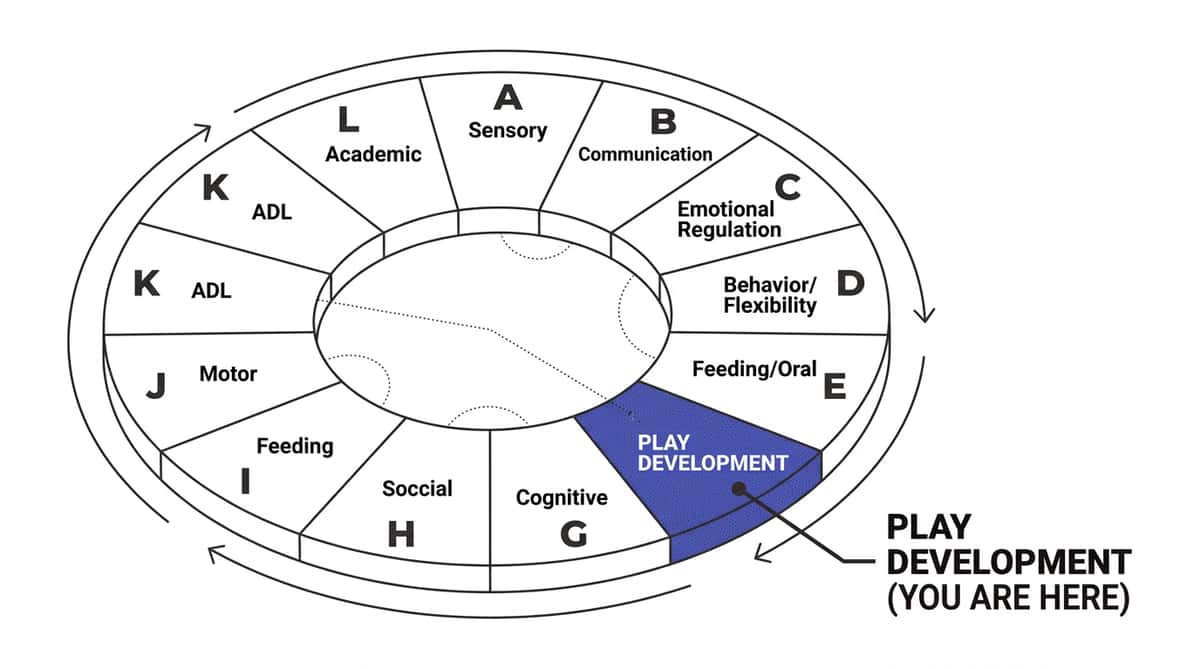
This technique — G-656 — is one node in a developmental network that GPT-OS® maps across all 12 domains for every child. Your AbilityScore® shows where your child sits across all domains simultaneously — and which techniques will have the highest impact given their profile.
WHO/UNICEF Nurturing Care Framework: Five components of nurturing care require holistic developmental monitoring. UNICEF 2025 Country Profiles: 42 indicators per country.
📊 Request AbilityScore® Assessment
📞9100 181 181
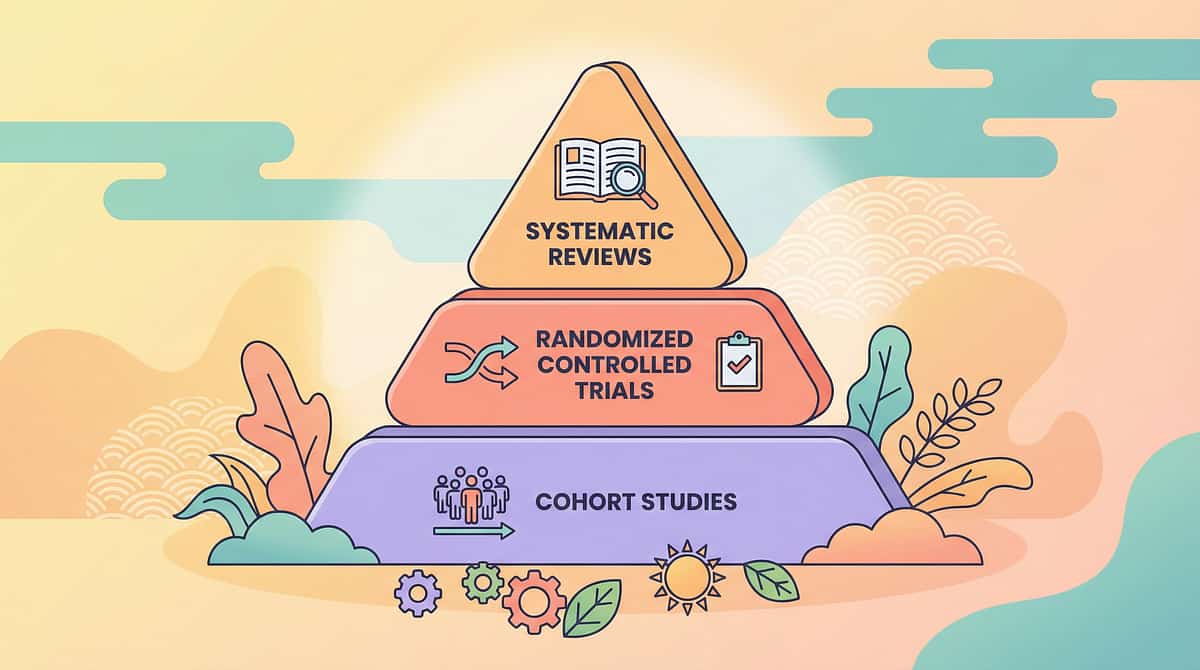
Families Who've Been Here
From the Pinnacle Network — families who started exactly where you are. These accounts represent consistent clinical patterns observed across thousands of families, anonymized with permission.
Family Story 1
Before: "Our daughter had a toy kitchen she played with for 14 months. Same sequence. Egg in pan. Three flips. Plate. Table. If we moved a single item she noticed immediately. The preschool teacher said she played 'beside' children, not 'with' them."
What they did: Started with loose parts alongside the kitchen. OT introduced surprise cards gradually — positive surprises first. Video models of peers cooking more elaborately. Parent learned to "wonder aloud" instead of directing.
After (Week 8): "She made soup last week. She invited her brother to 'order.' When he asked for something not on the 'menu,' she said 'Oh, we're out — what else?' She solved a surprise. Her play now has stories."
Timeline: 8 weeks consistent daily sessions. Pinnacle center support × 2/month teleconsult.
Family Story 2
Before: "Our son is 4. He lines up cars. Same order. Same track loop. Every toy that comes into his hands gets absorbed into the car loop. He had no pretend play at all."
What they did: Transformation toys introduction. Cardboard tubes as tunnels AND megaphones. Scene mat with roads. Puppet introduced as a "car character" to enter his interest.
After (Week 6): "The car character now talks. The mat has a town. Last week he made the car go to a hospital because 'it got a flat tire.' He invented a problem AND solved it. That is imagination we've never seen."
Timeline: 6 weeks. Daily sessions 15 minutes. No clinic required — home protocol only.
"The change wasn't dramatic on any single day. It was an accumulation of tiny moments — and then one afternoon, she just played differently. That afternoon changed everything." — Pinnacle Network Parent (anonymized)
"These outcomes are consistent with what we observe clinically. Play expansion begins with tolerance, moves through structured support, and arrives at spontaneous flexibility. The timeline varies — but the pathway is reliable." — Pinnacle Blooms Consortium Clinical Team

Connect with Other Parents: Isolation Is the Enemy of Progress
You don't have to do this alone. The Pinnacle parent network connects families navigating the same challenges — sharing wins, strategies, and the honest reality of what this work feels like from the inside.
Play Expansion Parent Group — WhatsApp
A moderated community of families working on G-domain play challenges. Share wins, ask questions, receive peer support. Join via pinnacleblooms.org/community
Pinnacle Online Parent Forum
Searchable archive of parent questions and therapist responses. G-656 specific thread: "Play expansion — what's working." forum.pinnacleblooms.org
Peer Mentoring: Talk to a Parent Who's Been Here
Connect with an experienced Pinnacle parent who navigated play expansion. 30-minute call. Scheduled via the helpline: 9100 181 181 → "Peer Mentoring Request"
Local Parent Meetups
Find Pinnacle parent meetups near your center. centers.pinnacleblooms.org/meetups
"Your experience helps others. When you've reached Week 8 — consider sharing your family's story. That story will be someone else's first recognition that this is possible."
Your Professional Support Team: Home + Clinic = Maximum Impact
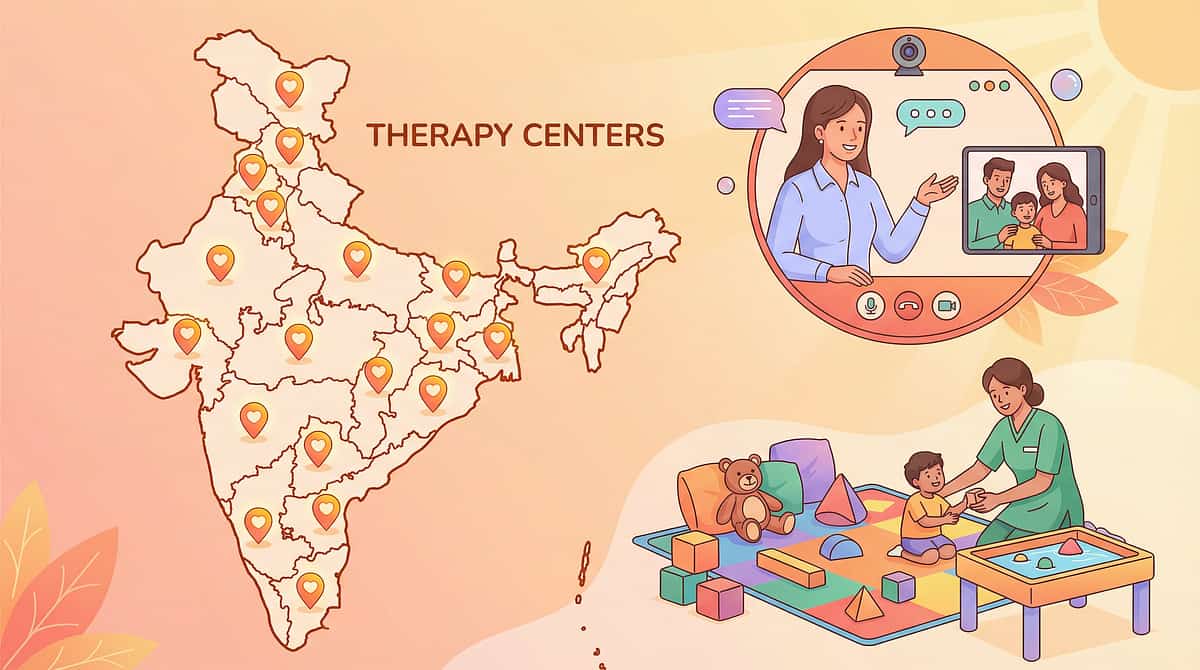
This home guide is powerful — and it is not a replacement for professional evaluation. Here's how to match the right specialist to your child's primary challenge, and how to access support across India.
Your Primary Challenge | Request This Specialist | |
Very high play rigidity / strong distress | Occupational Therapist (Sensory Integration certified) | |
Limited symbolic play / no pretend | Speech-Language Pathologist | |
Behavior-based rigidity / ABA approach needed | BCBA / Behavior Analyst | |
School play integration needed | Special Education Specialist | |
Whole-child developmental assessment | NeuroDevelopmental Pediatrician | |
Relationship-based approach preferred | Play Therapist / DIR Floortime certified |
Teleconsultation
📹 Book Video Consultation — Available Same Week. Remote families: Full play expansion consultation with Pinnacle therapists via pinnacleblooms.org/teleconsult
Insurance / Funding
Many Pinnacle services are covered under CGHS / ECHS (for eligible families), Ayushman Bharat PM-JAY (where applicable), and CSR programs (contact helpline for current availability).
📞 Pinnacle Helpline
9100 181 181
FREE | 16+ Languages | 24×7
"FREE National Autism Helpline — first step to professional support"
70+ centers across India | pinnacleblooms.org
WHO NCF Progress Report 2023: 48% increase in countries adopting ECD policies. Primary healthcare identified as key platform for reaching all families.
The Research Library: Deeper Reading for Curious Parents and Clinicians
Study 1 — Level I | PRISMA Systematic Review (2024)
16 studies confirming play-based interventions as evidence-based practice for ASD. Key finding: Structured play expansion meets evidence-based criteria across all reviewed studies. PMC11506176
Study 2 — Level I | Meta-Analysis (World J Clin Cases, 2024)
24 studies on structured play interventions. Key finding: Promotes social skills, adaptive behavior, cognitive flexibility, motor skills. PMC10955541 | DOI: 10.12998/wjcc.v12.i7.1260
Study 3 — Level II | Indian RCT (Padmanabha et al., Indian J Pediatr, 2019)
Home-based structured interventions in Indian pediatric populations. Key finding: Significant outcomes with parent-administered protocols in India. DOI: 10.1007/s12098-018-2747-4
Study 4 — Clinical Consensus | NCAEP Evidence-Based Practices (2020)
Visual supports, video modeling, naturalistic instruction classified as evidence-based for autism. Key finding: Multiple components of G-656 independently evidence-based. NCAEP 2020 Report
Study 5 — WHO | Care for Child Development Package (2023)
Evidence-based caregiver interventions across 54 countries. Key finding: Parent-administered, home-based interventions are the most scalable approach globally. PMC9978394

How GPT-OS® Uses Your Session Data
Transparency: Here is exactly how your session data makes every child's outcomes better — and the privacy commitments that protect your family while you contribute to this collective intelligence.
What GPT-OS® Learns from G-656 Data
- Which of the 9 materials creates fastest expansion for each sensory/behavioral profile
- Optimal session timing correlated with engagement quality
- Progression speed predictions based on Week 1–2 engagement data
- Red flag pattern detection — professional escalation signaled before parent notices
"Your child's session data — combined with 20 million sessions before it — is making GPT-OS® more precise for every family that comes after you."
🔒 Privacy Assurance
- All data anonymized at point of entry
- No individually identifiable information in population analysis
- Full DPDP Act 2023 (India) compliance
- Parent retains full control and deletion rights
- Data never sold or shared with advertisers

Frequently Asked Questions
Every question you were afraid to ask — answered with clinical precision and parental empathy. These are the most common questions from families across the Pinnacle Network.
Q1: My child's play has been rigid for 2+ years. Is it too late?
No. Neural plasticity does not have a hard cutoff in childhood. Children who receive evidence-based intervention at age 7 show meaningful change. The path takes longer than intervention at age 2 — but it exists. Start now.
Q2: How do I know if my child's play rigidity is autism or just personality?
Play rigidity that is severe, pervasive (across all toys), and accompanied by resistance to change across other domains warrants professional evaluation. Request AbilityScore® assessment: 9100 181 181
Q3: My child has no interest in any material. Where do I start?
Start with the adult play guide (Material 9) — pure parallel play, no materials required. Sit near your child. Do something quietly they might notice. Wait. Once any curiosity emerges, introduce ONE material. Build from there.
Q4: We've tried everything. Nothing works. What are we missing?
"Everything" tried without a structured protocol is different from structured evidence-based intervention. If home protocols have genuinely failed consistently (8+ weeks), this signals a need for formal professional assessment. Contact: 9100 181 181
Q5: Should I stop my child's repetitive play to force expansion?
Never. Repetitive play serves a regulatory function — it provides safety, predictability, and calm. The goal is EXPANDING the play world, not destroying the safe harbor your child has built.
Q6: Can I do this while my child watches TV?
No. Play expansion requires present adult engagement. Screens off. Floor time on. 15 minutes of full presence is worth more than 2 hours of parallel screen time.
Q7: How long before I see results?
First tolerance signs: Week 1–2. First variation signs: Week 3–4. First mastery: Week 5–8. These are averages. Track your individual child against the Week 1–8 indicators, not against averages.
Q8: My spouse / in-laws don't believe in this. What do I do?
Share this page — specifically the prevalence data, neuroscience, and evidence grade cards. Send the Family Guide. If resistance continues, request a family teleconsultation where a Pinnacle therapist explains the evidence directly. 9100 181 181
Preview of 9 materials that help with play expansion Therapy Material
Below is a visual preview of 9 materials that help with play expansion therapy material. The pages shown help educators, therapists, and caregivers understand the structure and content of the resource before use. Materials should be used under appropriate professional guidance.


Link copied!

No More Reading. Your Child Needs Action, Not Preparation.
🟣 OT
Occupational Therapy
🔵 SLP
Speech-Language Pathology
🟠 ABA
Behavior Analysis
🟢 SpEd
Special Education
🔴 NeuroDev
Neuro-Developmental
🟡 Play Therapy
DIR / Floortime
"From fear to mastery. One technique at a time." — Pinnacle Blooms Network®
20,000,000+ therapy sessions | 97%+ measured improvement | 70+ centers | 16+ languages | 24×7 helpline
This content is educational and does not replace individualized assessment and intervention from licensed developmental specialists, occupational therapists, speech-language pathologists, behavior analysts, or developmental pediatricians. Persistent play rigidity and limited play expansion may be associated with autism spectrum conditions or other developmental differences requiring comprehensive professional evaluation. Materials and strategies should be matched to each child's specific needs, developmental level, sensory profile, and underlying clinical profile. Individual results may vary. Statistics represent aggregate outcomes across the Pinnacle Blooms Network®. This page does not constitute medical advice.
© 2025–2026 Pinnacle Blooms Network® | Unit of Bharath Healthcare Laboratories Pvt. Ltd. | CIN: U74999TG2016PTC113063 | DPIIT: DIPP8651 | MSME: Udyog Aadhaar TS20F0009606 | GSTIN: 36AAGCB9722P1Z2 | FREE National Autism Helpline: 9100 181 181 | 16+ Languages | 24×7 | pinnacleblooms.org | care@pinnacleblooms.org | G-656 | techniques.pinnacleblooms.org/play-development/play-expansion-G-656 | Series: Social-Emotional & Play Development | Episode 656 of 999