
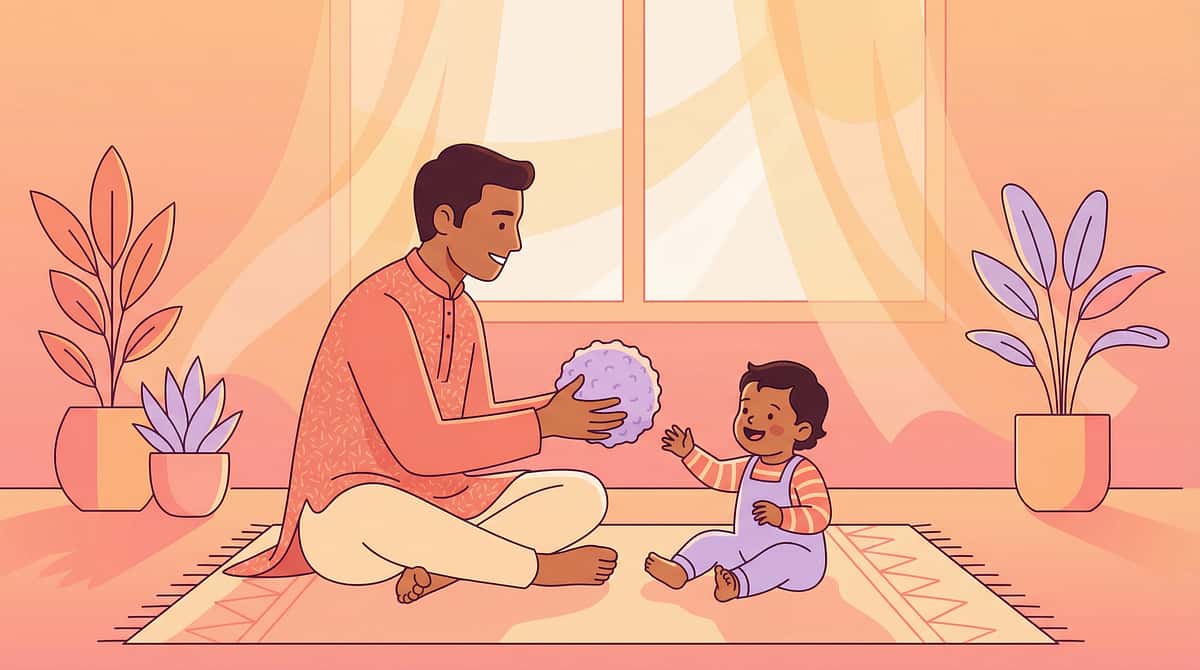
Her body doesn't know where it ends.
Your daughter stands so close their noses almost touch. When other kids back away, she follows — completely unaware. She can repeat the "arm's length" rule perfectly. Five minutes later, she's back in someone's face. She's not being rude. Her nervous system is speaking in a language that needs translation.
B-212 · Personal Space Awareness
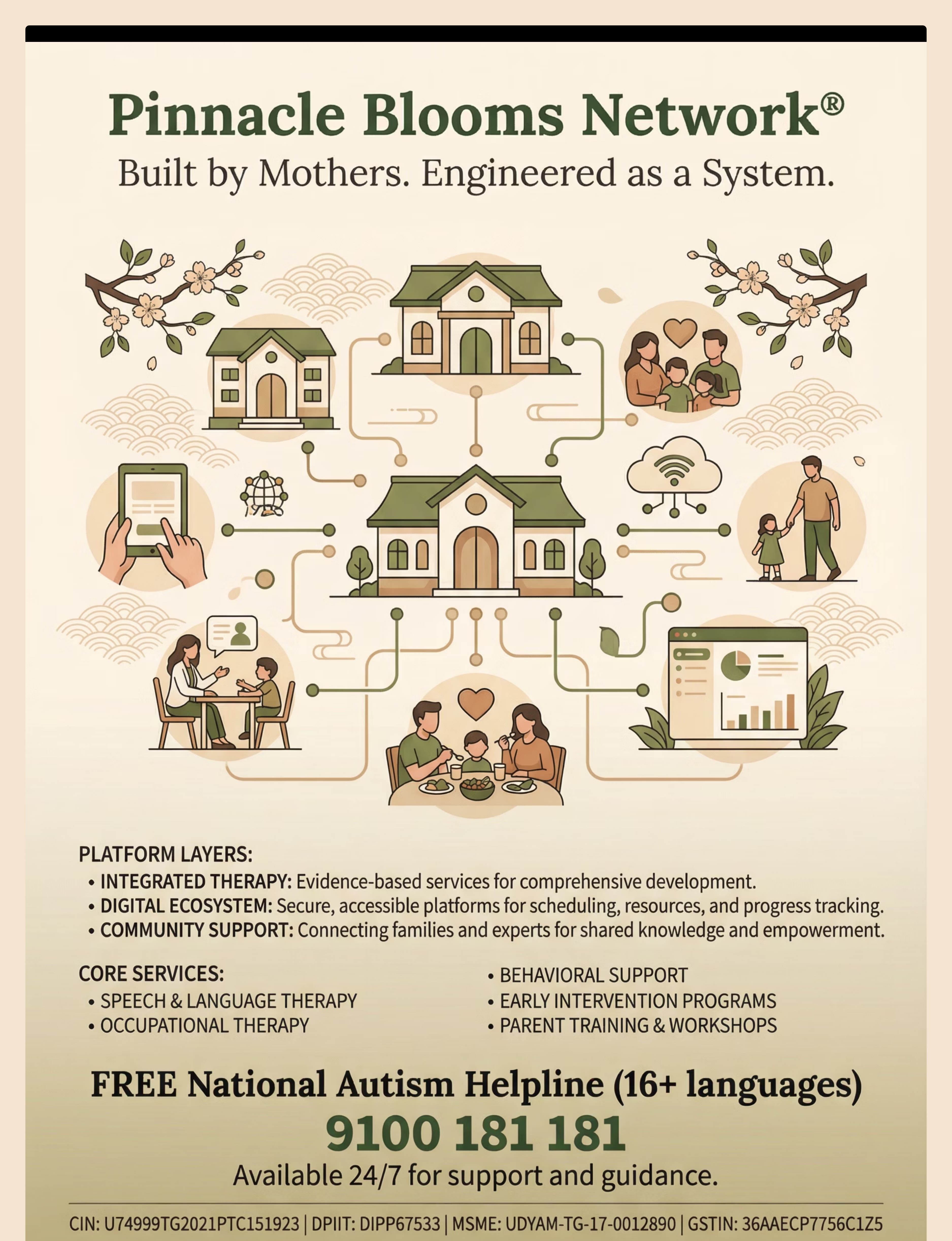
Pinnacle Blooms Network®
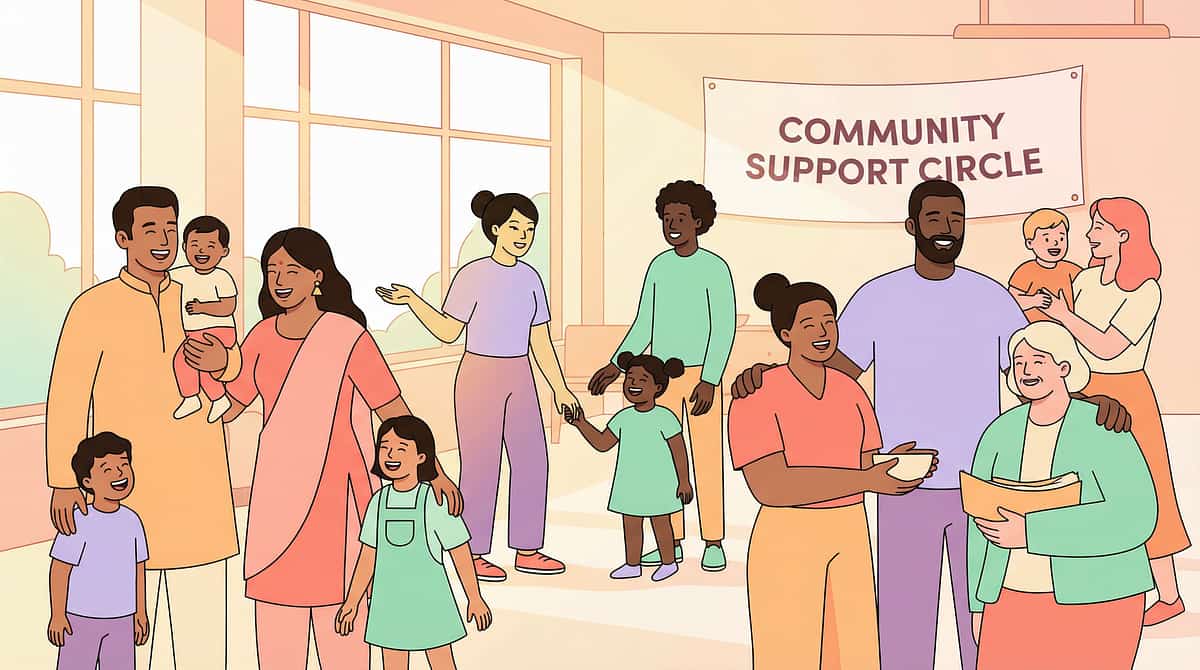
Millions of families. One invisible struggle.
Difficulty with personal space is not a parenting failure. It is a documented, researched, intervention-responsive challenge rooted in how the nervous system processes proprioceptive and social information. You are among millions of families navigating this exact pattern — and clinical science has mapped the path forward.
80%
Sensory Processing
of children with ASD experience sensory processing difficulties affecting body awareness
1in36
ASD Diagnosis Rate
children diagnosed with autism — personal space challenges among the most common social difficulties
54
Countries
implementing WHO CCD Package — home-based intervention proven effective across low- and middle-income nations
📚 PRISMA Systematic Review (2024, PMC11506176): 80% of children with ASD display sensory processing difficulties. Meta-analysis (World J Clin Cases, 2024, PMC10955541): Sensory integration therapy improves social skills and adaptive behaviour across 24 studies.
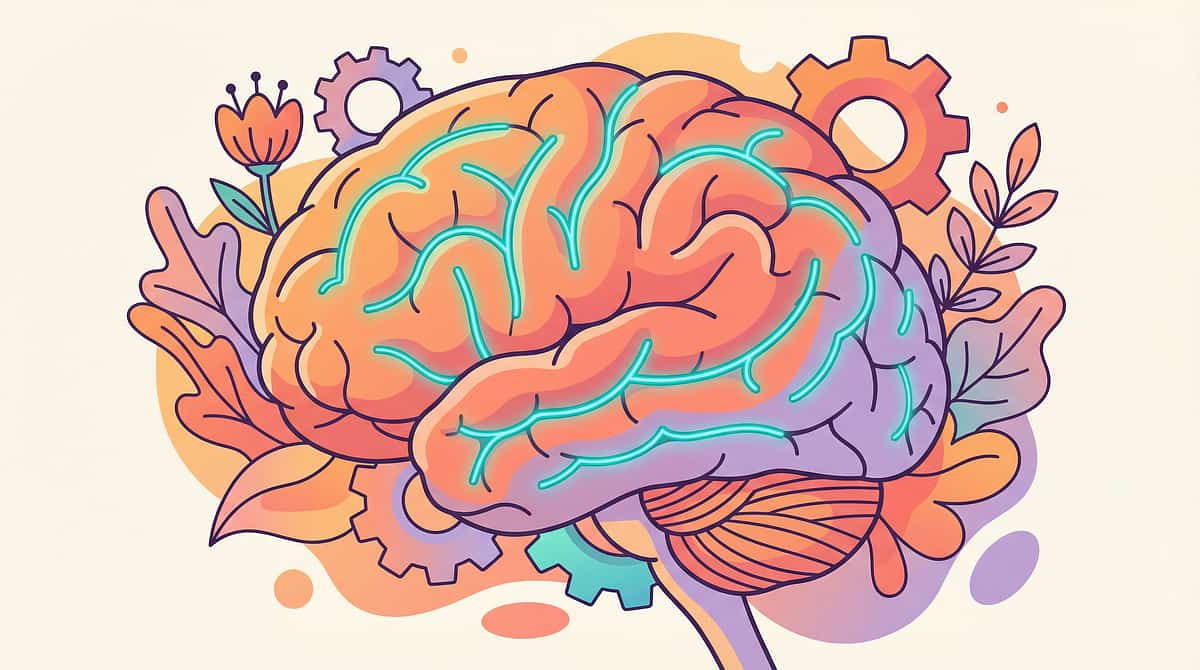
This is a wiring difference. Not a behaviour choice.
The Science
Personal space awareness depends on proprioception — the brain's sixth sense that maps where our body is in space without looking. This sense is processed in the somatosensory cortex and cerebellum. When proprioceptive processing is atypical, the child's brain receives imprecise signals about body position. They literally cannot feel where they end and space begins.
Simultaneously, the superior temporal sulcus — responsible for reading social cues — may not register the micro-signals of discomfort others display: leaning back, facial tension, stepping away.
Parent Translation
Your child isn't ignoring the signals. Her brain isn't reliably receiving them. The knowing and the doing are disconnected because the sensory infrastructure that makes distance automatic for others requires explicit building in her.
This is a neurodevelopmental difference — not defiance, not rudeness, not a character flaw.
"You can't follow a rule about invisible space. When the boundary becomes visible and felt, the concept becomes learnable."
🏥 Primary: OT (Sensory Integration) | Secondary: SLP (Pragmatic Language), NeuroDevelopmental Pediatrics · Research: Frontiers in Integrative Neuroscience (2020), DOI: 10.3389/fnint.2020.556660
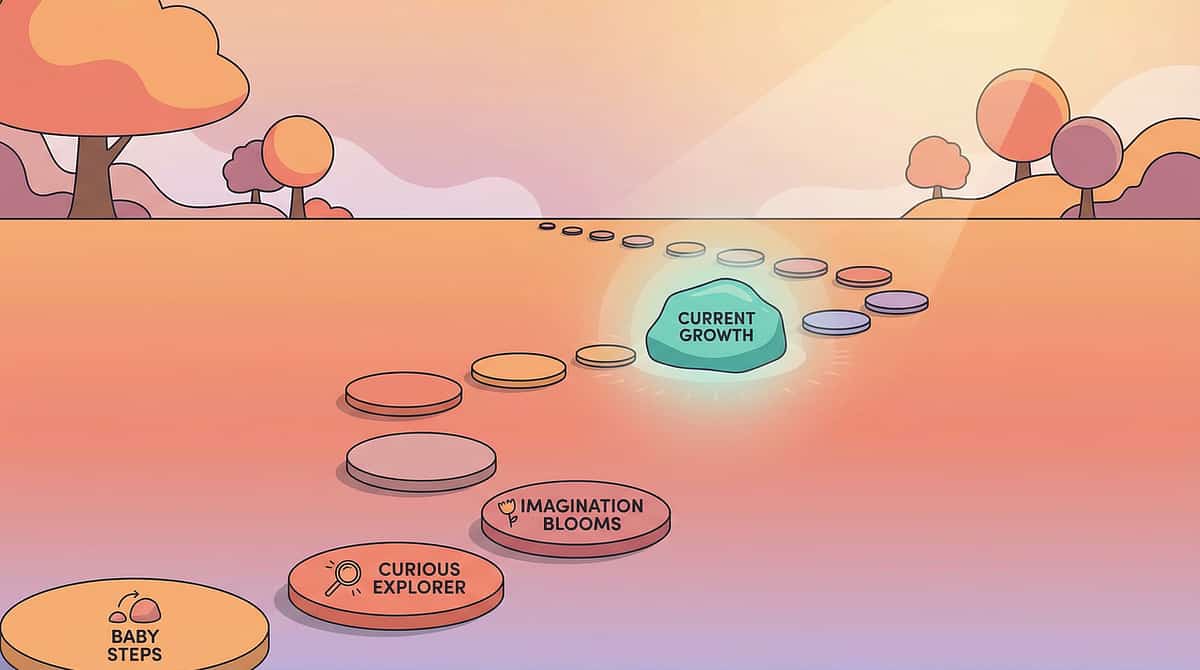
Your child is here. This is where we are heading.
Personal space awareness develops gradually. The invisible bubble of comfortable distance — described by anthropologist Edward T. Hall as "proxemics" — is shaped by proprioception, social cognition, sensory processing, and cultural learning. When structured support is provided systematically, outcomes are strongly positive.
1
Birth–2 yrs
Body boundary formation begins
2
2–4 yrs
Proxemic awareness emerges
3
4–6 yrs ⚡
Typical personal space challenge zone
4
6–9 yrs
Social distance differentiation develops
5
9–12 yrs
Context-appropriate distance mastery
Personal space difficulties commonly co-occur with: Sensory Processing Disorder · Developmental Coordination Disorder · ADHD · Autism Spectrum Disorder · Pragmatic Language Differences
📞 9100 181 181 — Developmental assessment available at 70+ Pinnacle centres · WHO Care for Child Development (CCD) Package, PMC9978394

Personal Space Awareness Training
B-212
Domain B · Social Communication
"The Invisible Bubble Protocol" — parent-friendly alias
Personal Space Awareness Training is a multi-modal intervention targeting proxemic regulation — the ability to sense, maintain, and adjust appropriate physical distance during social interactions. It combines proprioceptive input (body-awareness-from-the-inside), visible boundary tools (body-awareness-from-the-outside), explicit social rule teaching, and structured practice to build what should eventually become automatic spatial self-monitoring.
Age Range
4–12 years
Session Duration
10–20 minutes
Frequency
Daily (learning phase), then 3–5×/week
Materials
Boundary Tools · Body Awareness · Social Skills
Taxonomy: Pinnacle 128 Canon Materials System + 20 Category Classification + 12 Domain (A–L) Architecture
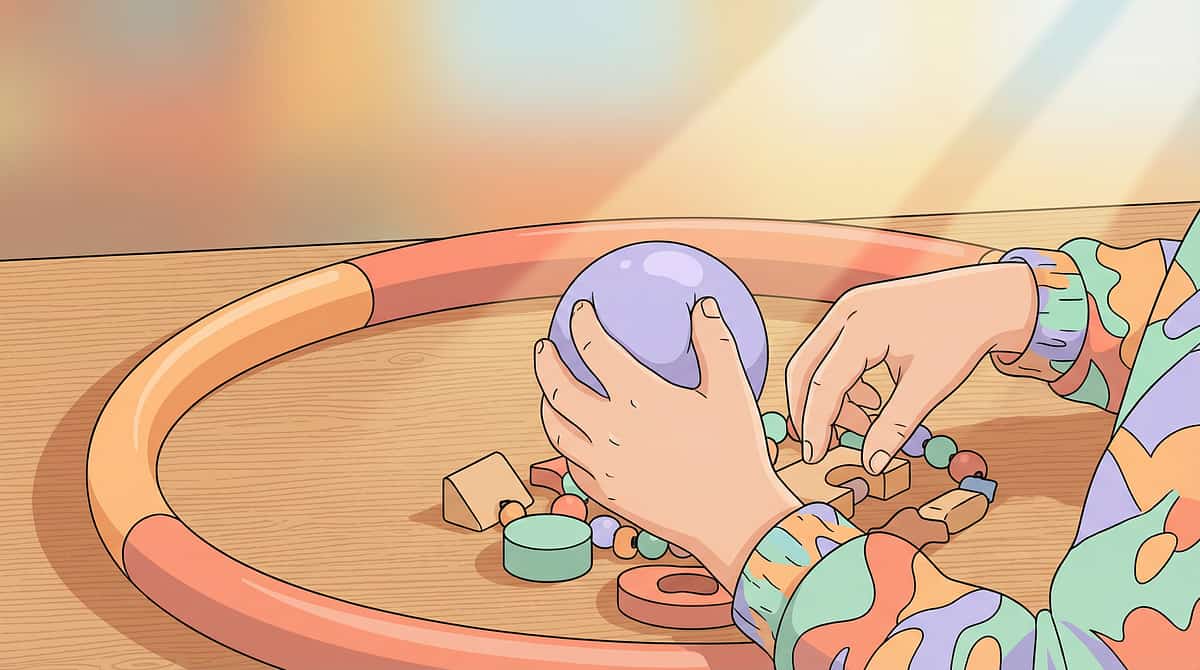
Five disciplines. One child. One integrated protocol.
Personal space awareness crosses therapy boundaries because the brain doesn't organise by therapy type. Each discipline brings a unique and essential lens to this challenge — together they form a complete system of support.
OT (Primary Lead)
Assesses proprioceptive processing differences; designs sensory diet including heavy work; selects and sequences boundary tools; monitors body awareness progression.
SLP (Secondary)
Addresses pragmatic language: reading listener cues, turn-taking distance norms, facial expression recognition linked to space invasion.
BCBA/ABA
Structures reinforcement for correct distance maintenance; designs discrete trials for space-checking behaviour; builds generalisation programmes across settings.
SpEd
Implements classroom accommodations (floor markers, visual cues, movement breaks); coordinates cross-setting consistency; trains teaching staff.
NeuroDev Pediatrics
Rules out DCD, ADHD, anxiety contributors; calibrates sensory intervention intensity; coordinates with school health services.
📞 9100 181 181 — Multi-disciplinary assessment at 70+ Pinnacle centres · WHO/UNICEF Nurturing Care Framework adapted for multi-disciplinary delivery (2022): DOI: 10.1080/17549507.2022.2141327
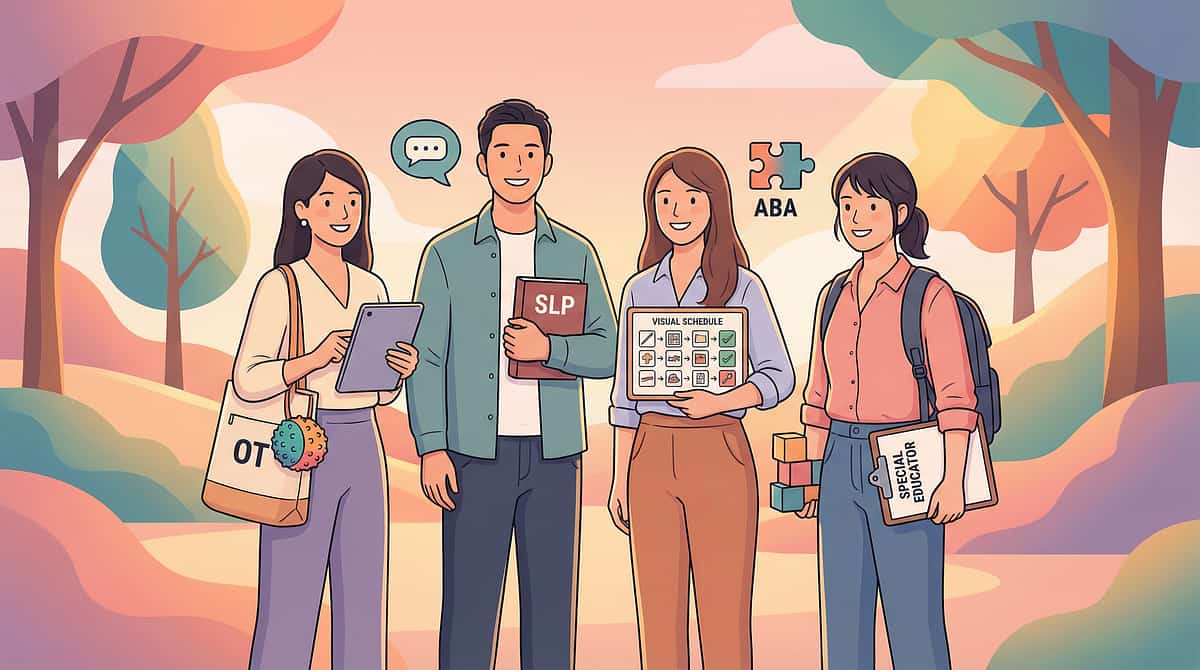
Primary · Secondary · Tertiary — Every layer of this challenge addressed.
This is a precision tool, not a random activity. Every material and step in this protocol targets a specific layer of the personal space challenge — from the core skill to the ripple effects on peer relationships and classroom participation.
Observable Indicator 1
Child stops at arm's length without prompting
Observable Indicator 2
Child notices and responds to others stepping back
Observable Indicator 3
Child asks "was I too close?" — metacognitive awareness emerging
Observable Indicator 4
Peer interactions at appropriate distance in new settings
📚 Meta-analysis (World J Clin Cases, 2024): Sensory integration therapy promoted social skills (primary), adaptive behaviour (secondary), sensory processing and motor skills (tertiary). PMC10955541
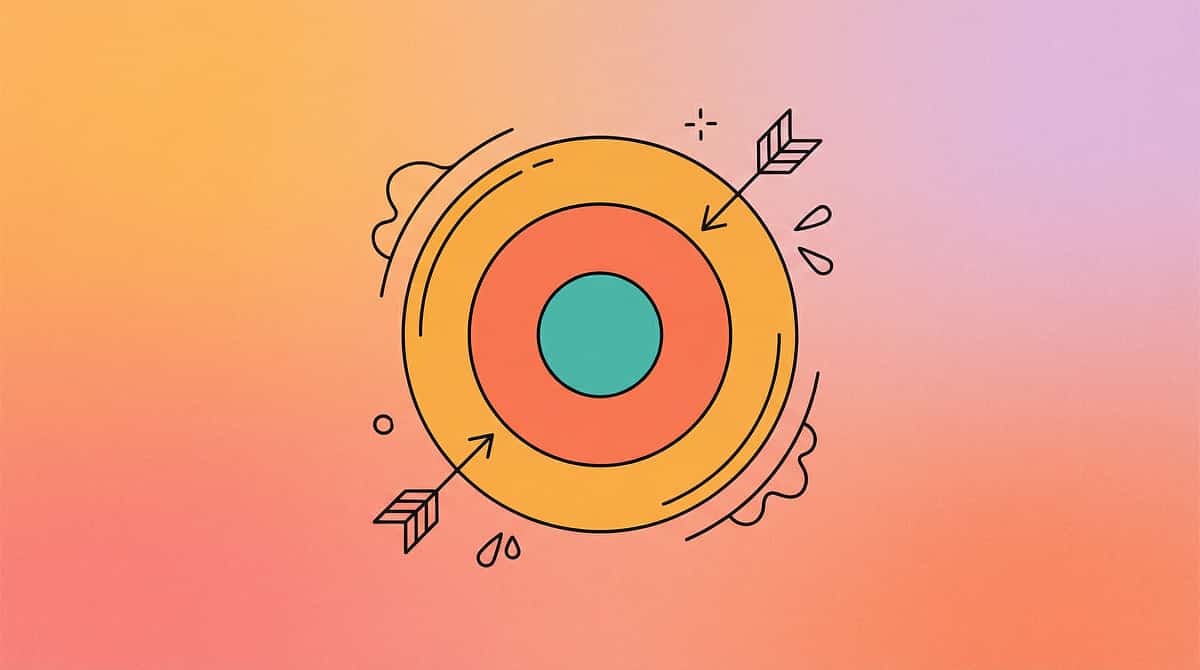
9 Materials. 6 Mechanisms. One Complete System.
Each of these 9 clinically validated materials addresses a specific mechanism underlying personal space difficulty. Together they form a comprehensive home intervention system — with DIY options for every item.
#1 Hula Hoops
See where space ends
₹150–500
#2 Arm's Length Tools
Physical reference
₹50–300
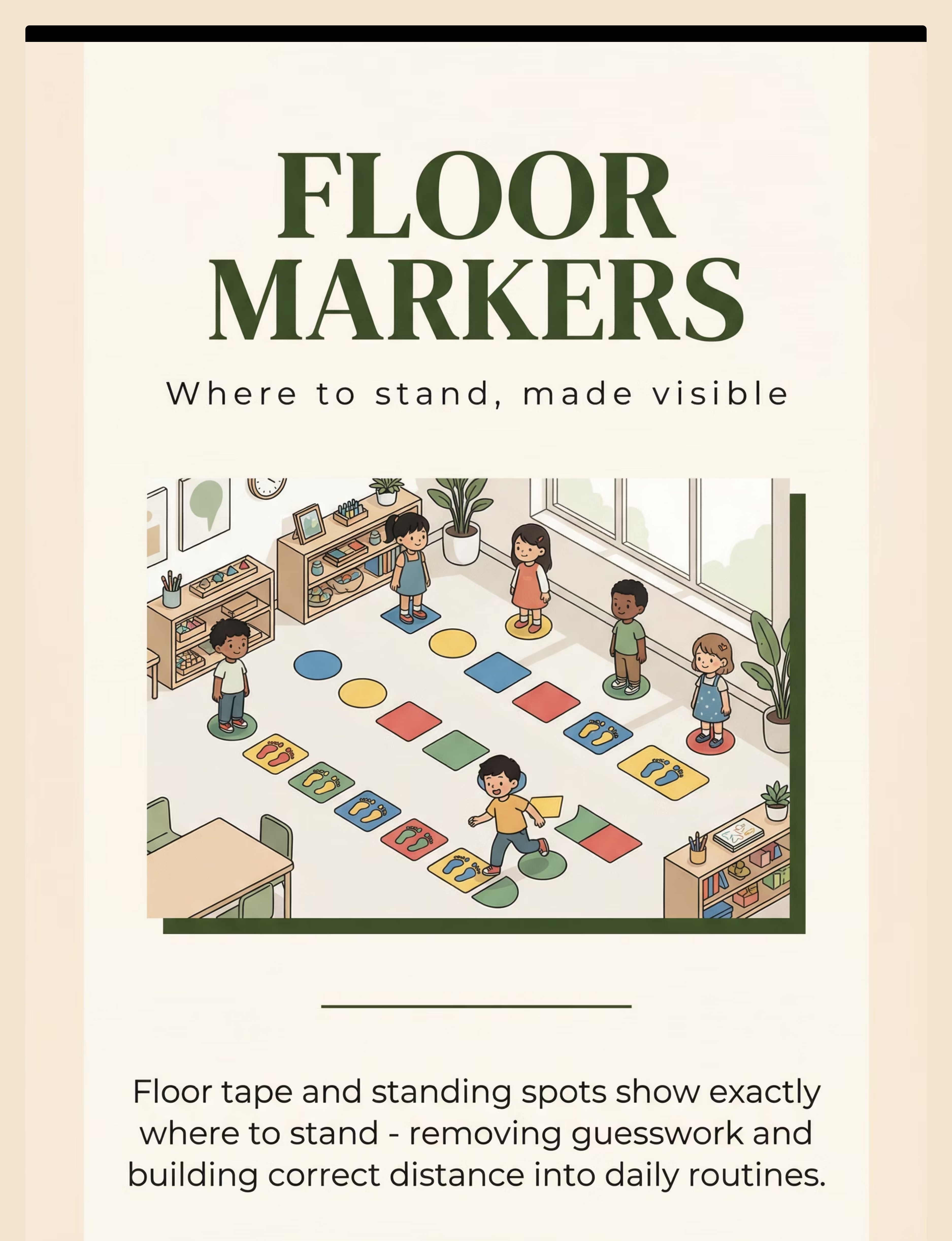
#3 Floor Markers
Where to stand, visible
₹100–400
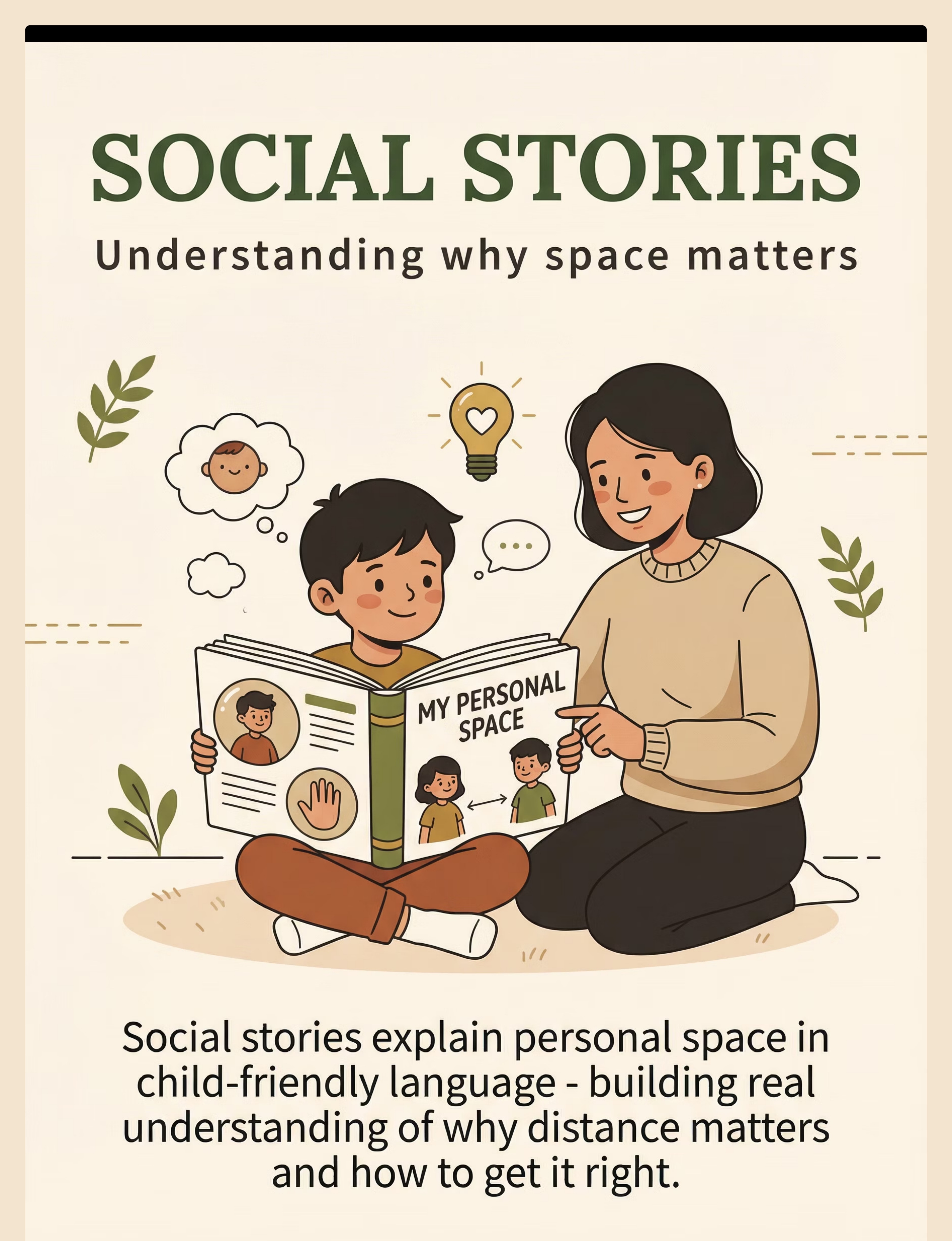
#4 Social Stories
Why space matters
₹200–1,000
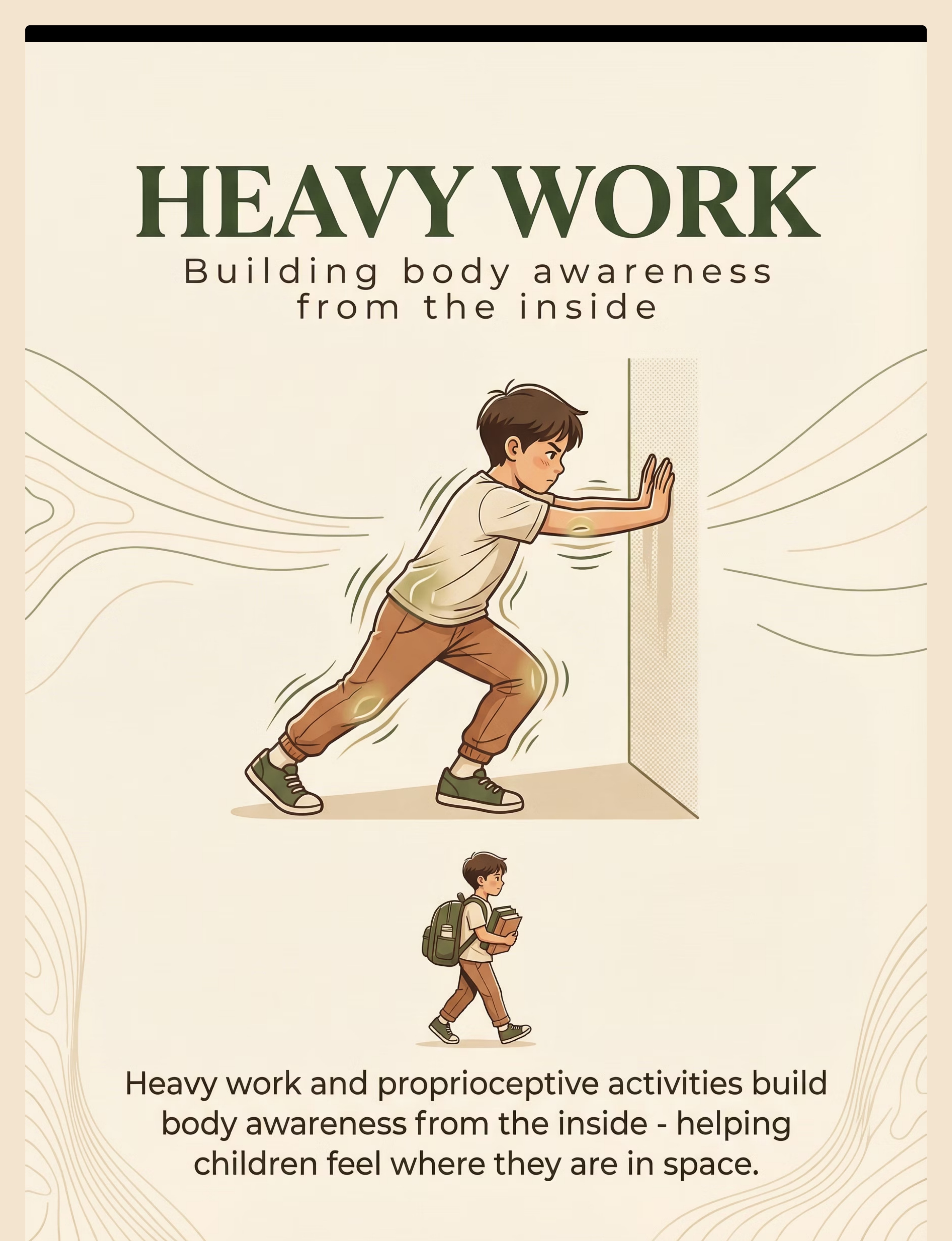
#5 Heavy Work
Body awareness inside
₹0–2,000
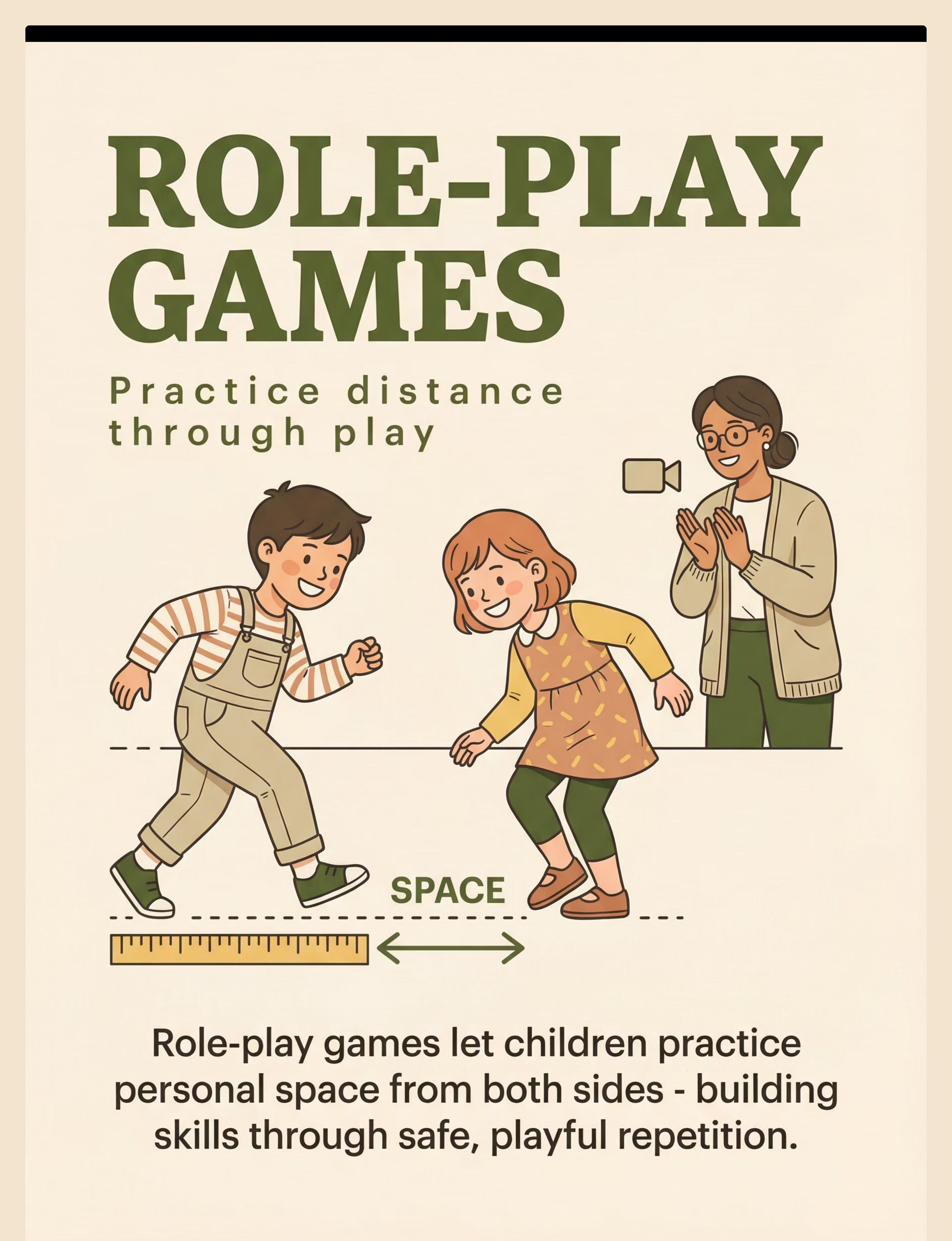
#6 Role-Play Games
Practice through play
₹0–500
#7 Cue Cards
Visible reminders
₹50–300
#8 Body Awareness Games
Know where you are
₹0–1,000
#9 Zones & Distance
Different people, different closeness
₹300–1,500
Total Investment: ₹0 to ₹2,000 (starter kit) | DIY options available for every material · Pinnacle 687 Product Database + 128 Canon Materials Classification System
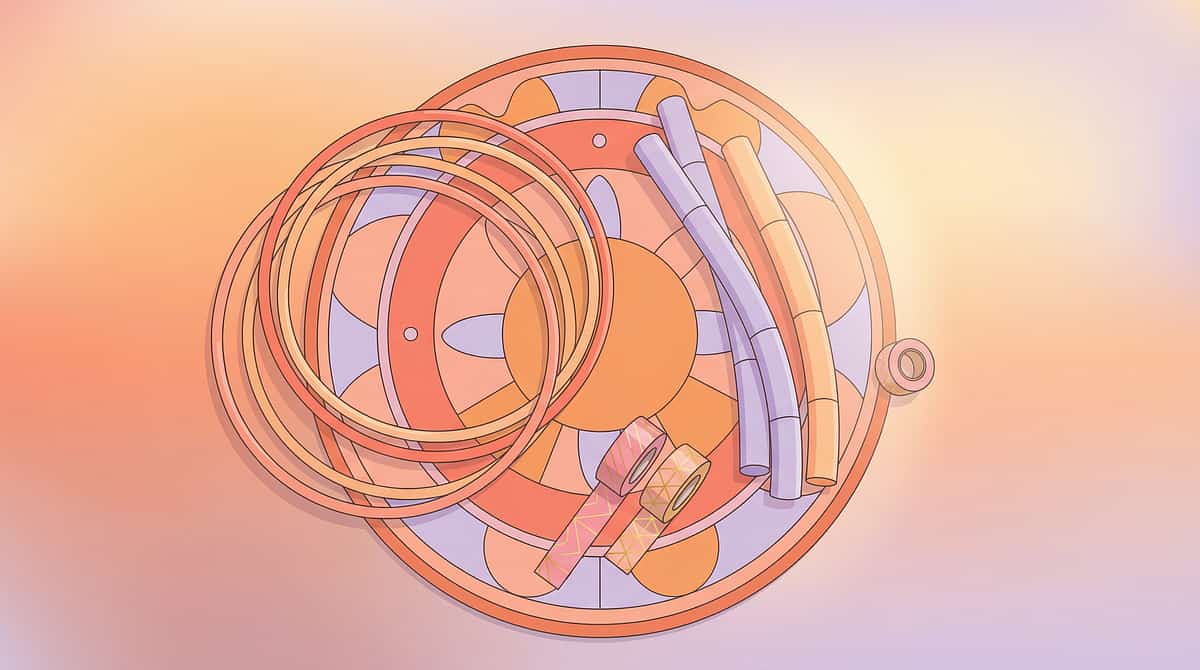
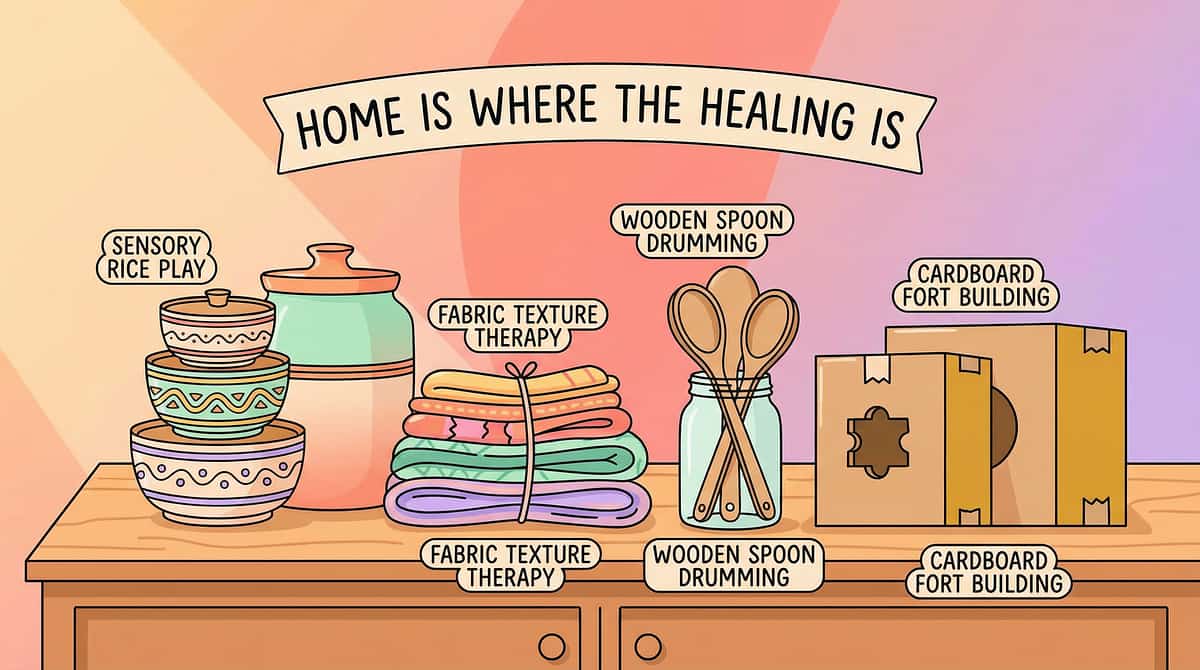
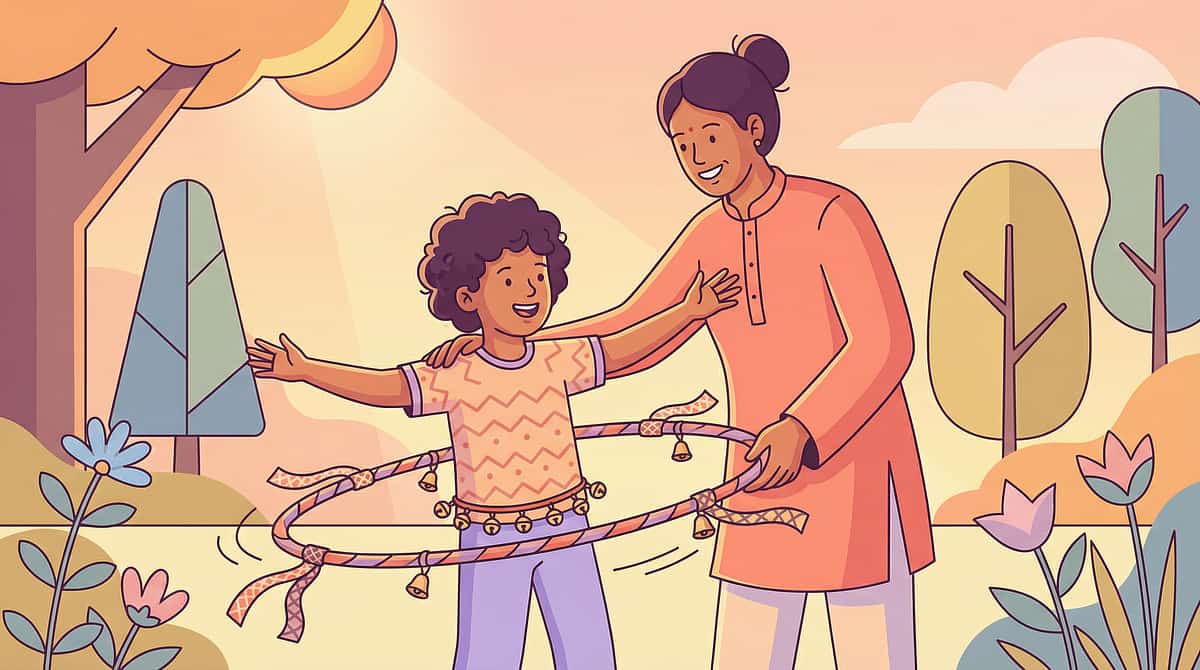
Material 1: Hula Hoops & Personal Space Circles
OT + SLP Lead
See and feel where your space ends
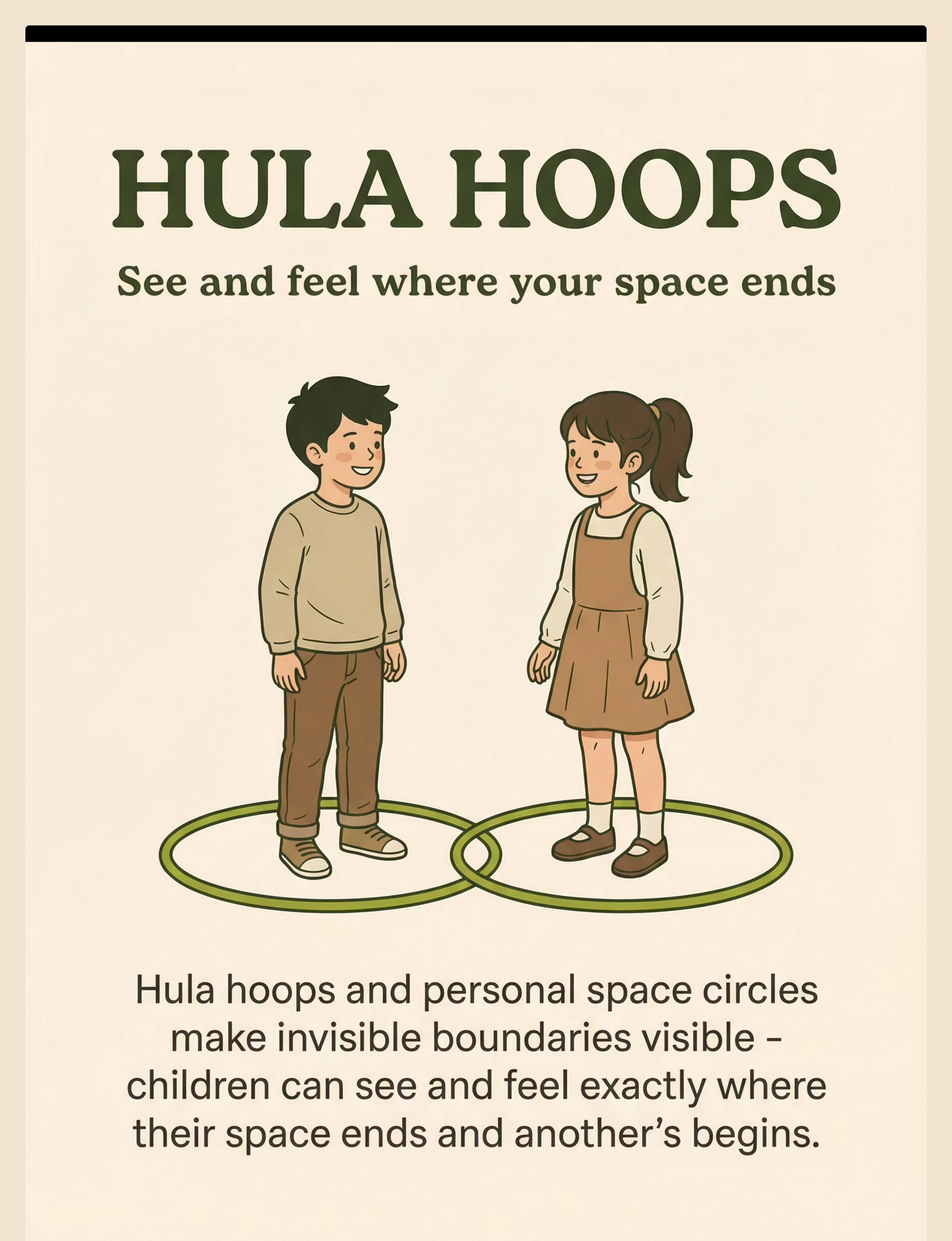
The most powerful principle in personal space intervention: make the invisible boundary visible and tangible. When a child stands inside a hula hoop, they can see and physically feel exactly where their space ends. When two children each hold a hoop, they experience "my space" and "your space" — meeting, but not overlapping. For children whose proprioception doesn't deliver reliable positional feedback, external visible boundaries are not a crutch — they are the correct therapeutic tool.
01
Place & Stand
Place two hoops on the floor touching. Child and partner each stand in their own hoop.
02
Name It
"This is YOUR space. That is THEIR space." Practice a short conversation from inside hoops.
03
Experience Both Sides
Child steps into parent's hoop: "How does that feel? A bit crowded, right?"
04
Fade the Tool
Hoop → rope circle → imaginary bubble. Gradually build internal sense of boundary.
"You can't follow a rule about invisible space. When the boundary becomes visible, the concept becomes learnable."
💡 DIY: Rope circle (₹0) | Floor tape circle (₹50) | Fabric boundary ring (₹80) | Cardboard circle (₹0) · Price: ₹150–500 · Safety: Ensure adequate space, no tripping hazards, age-appropriate hoop size.
Material 2: Arm's Length Tools
OT Lead
Physical reference for the right distance
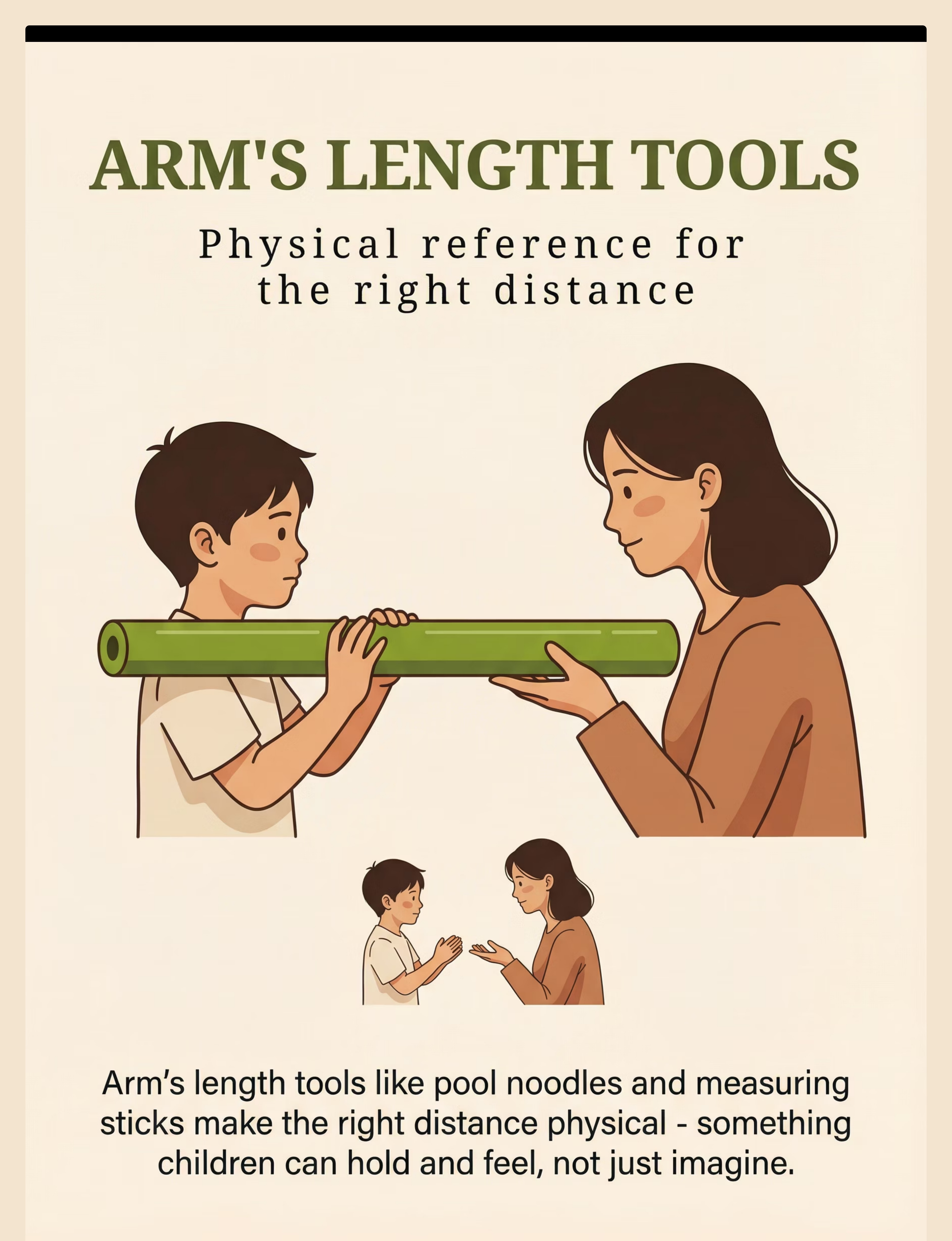
"Arm's length" is universally taught but frequently fails because children cannot translate the concept into felt body awareness. A pool noodle or measuring ribbon provides a physical reference that makes the abstract distance concrete and measurable. The child holds one end; the other rests near the conversation partner. They can see and feel what arm's length IS. The tool is gradually faded as internal body sense develops.
What to Use
Pool noodle cut to arm length (₹50–100) | Wooden dowel with soft tips | Ribbon tied to arm length | "Space sword" — a decorated pool noodle the child names and personalises
Fading Sequence
Weeks 1–2: Noodle in hand during practice
Weeks 3–4: Noodle on floor as reference, not held
Week 5+: No noodle, self-assessment only
Weeks 3–4: Noodle on floor as reference, not held
Week 5+: No noodle, self-assessment only
Where & When
Therapy sessions, home practice, before school events. Build the body memory first in structured practice, then generalise.
"Until the body learns what arm's length feels like, a physical reference makes the invisible measurable."
Price: ₹50–300 · Safety: Soft materials only. Teach: "This is a measuring tool, not a touching tool." · NCAEP (2020): Tangible, concrete supports are evidence-based practice components for spatial and social skill development in autism.
Material 3: Floor Tape Markers & Standing Spots
OT + SpEd Lead
Where to stand, made visible
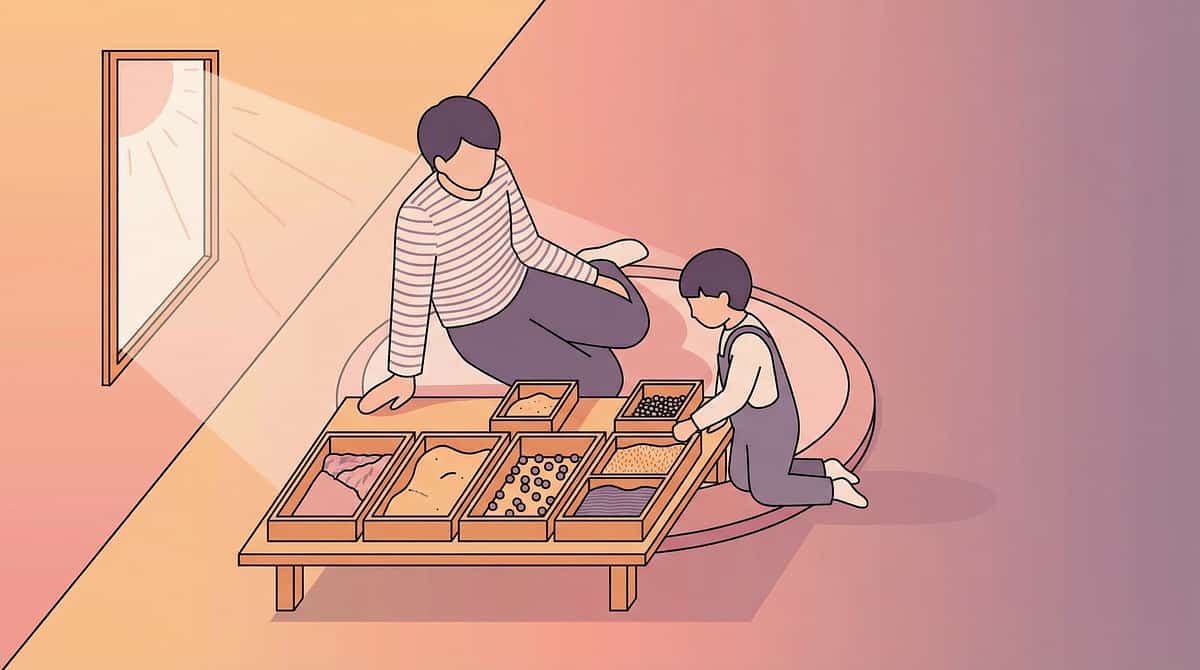
Floor markers remove the calculation problem. The child doesn't need to estimate distance — they simply need to find their spot. Consistent, visible floor markers during circle time, queue situations, lunch tables, and conversation practice eliminate spatial guesswork. Over hundreds of repetitions, standing in the correct position builds the internal calibration that wasn't present. These are training tools, not permanent accommodations — used consistently across settings, they accelerate skill generalisation dramatically.
Classroom Circle Time
Highest priority setting. Consistent markers across every circle session.
Queue Situations
Mark where to stand relative to the person ahead. Practice daily.
Lunchroom Seating
Defined spots reduce crowding at shared tables and benches.
Home Practice
Kitchen conversations, homework spots. Install during active learning phase.
"The right distance practised hundreds of times in the same spot becomes the right distance felt in new situations."
💡 DIY: Coloured masking tape (₹50) | Carpet tape squares | Rubber door mats | Sticker footprints (₹80) · Price: ₹100–400 · Safety: Non-slip tape only, no tripping edges.
Material 4: Social Stories® About Personal Space
SLP + SpEd Lead
Understanding why space matters
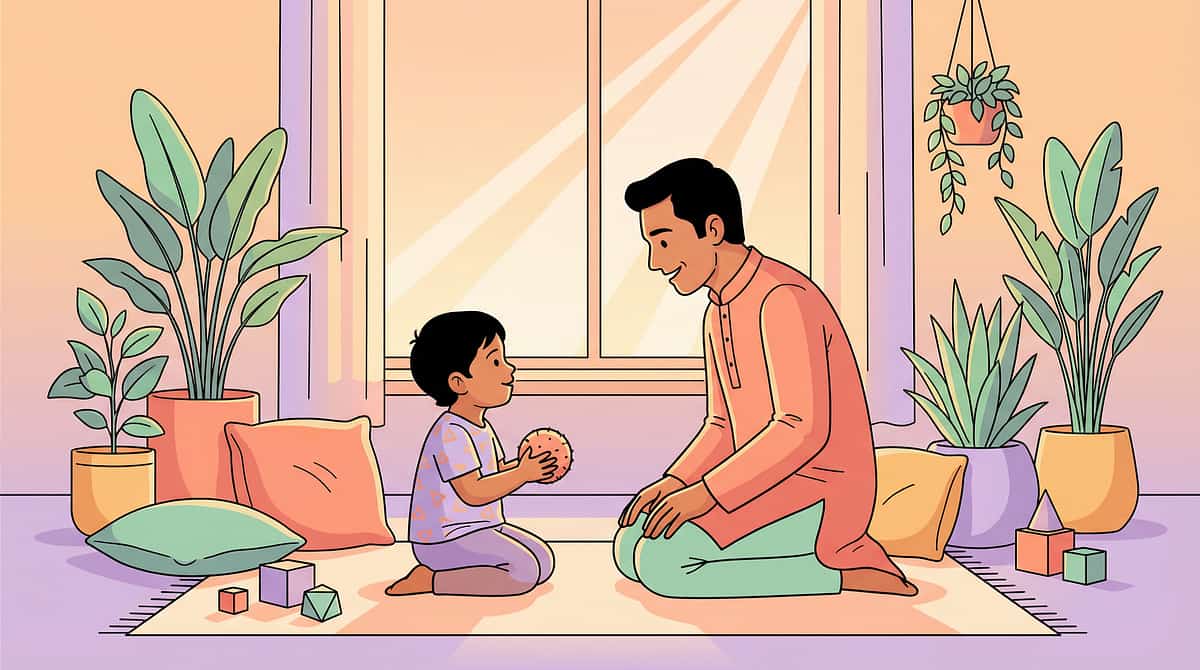
Social Stories® (Carol Gray, 1991 — evidence-based practice, NCAEP 2020) explain personal space rules and their social consequences in child-friendly, concrete language. For children who don't notice others' discomfort signals, a social story builds that understanding explicitly. Personalised stories featuring the child's own situations and name are most effective. They are preventive tools — read when calm, before challenging situations, to prime awareness without shame or pressure. Never as a consequence after an incident.
1
Descriptive
"When people talk, they usually stand about one arm's length apart."
2
Perspective
"When someone stands very close, the other person sometimes feels a bit uncomfortable."
3
Directive
"I can try to check my distance by looking to see if I can see the whole person's face."
4
Affirmative
"Keeping a comfortable distance helps people feel relaxed and happy when talking with me."
Price: ₹200–1,000 | Custom creation: FREE with Pinnacle ETP™ templates · Read 3–5× per week, BEFORE events, not as correction · Social Stories® are NCAEP 2020 evidence-based practice for autism. PMC9978394
Material 5: Proprioceptive Activities & Heavy Work
OT Primary Lead
Building body awareness from the inside
This is the foundational, inside-out intervention. Heavy work — activities involving resistance, pushing, pulling, carrying, and compression — delivers deep joint and muscle input that calibrates the proprioceptive system. Regular proprioceptive input improves the brain's ability to map body position in space. For children whose personal space difficulties stem from proprioceptive processing differences, a daily heavy work programme is often the single highest-impact intervention — because it builds the sensory foundation upon which all other strategies depend.
Carrying
Grocery bags (both hands), backpack during morning activity, laundry basket across floor
Pushing
Wall push-ups (10× before conversations), pushing laundry basket, tug-of-war with towel
Crawling & Climbing
Wheelbarrow walking (adult holds feet), bear crawling across the room
Jumping
Jumping on mattress (2 min), bouncing before social events or school
Price: ₹0 (household activities) to ₹2,000 (weighted vest, resistance bands) · Safety: OT consultation for individualised programme. Activities should be appropriately challenging, not exhausting. · PMC11506176 | DOI: 10.3389/fnint.2020.556660
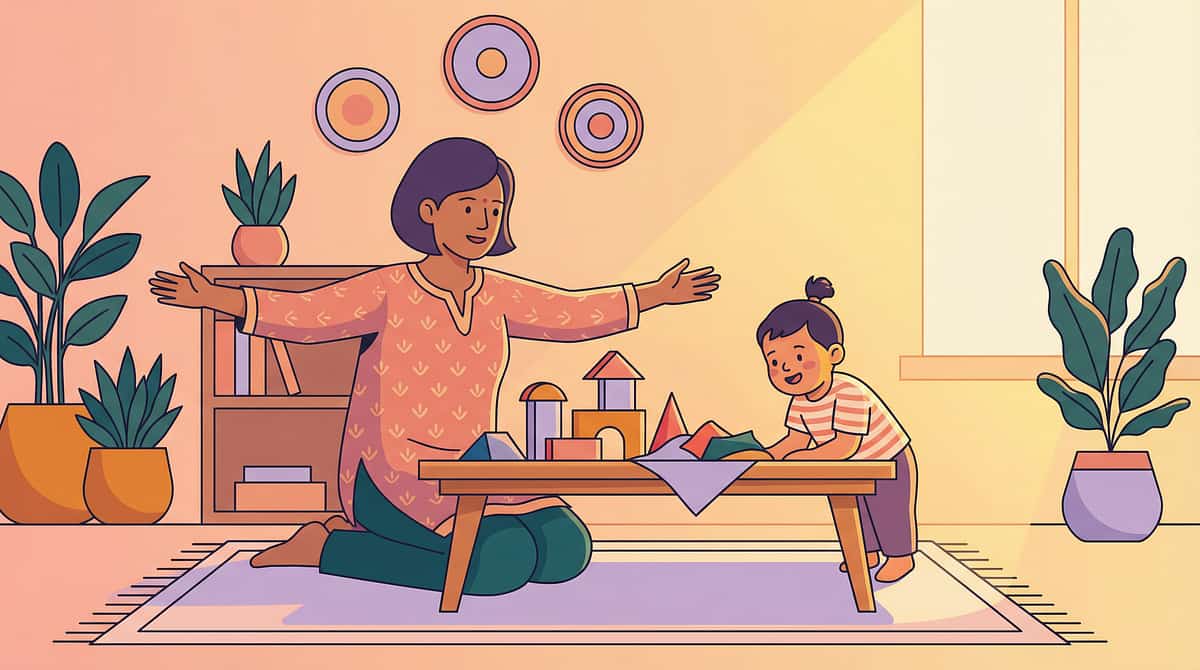
Material 6: Role-Play & Practice Games
SLP + BCBA Lead
Practice distance through play
Role-play lets children experience personal space from both sides — as the person who stands too close AND as the person whose space is invaded. This dual perspective-taking builds empathy AND awareness simultaneously. Video recording practice and watching playback together gives children an external visual reference for a situation their body does not internally register. Practice-based learning transfers to real situations far more effectively than verbal instruction alone.
Game 1: Approach and Stop
Child walks toward adult — adult says "STOP" when distance is comfortable. Child notes position. Repeat 10×.
Game 2: Comfortable or Too Close?
Adult demonstrates three distances. Child judges: too close / just right / too far. Builds distance discrimination.
Game 3: Freeze and Film
During conversation practice, freeze mid-interaction. Child looks in mirror or at video: "Where are your feet? How close is that?"
Price: ₹0–500 (mostly practice-based) | Scenario cards: ₹200–500 · Video modelling is NCAEP 2020 evidence-based practice for autism. Practice-based social skills training: Meta-analysis PMC10955541.
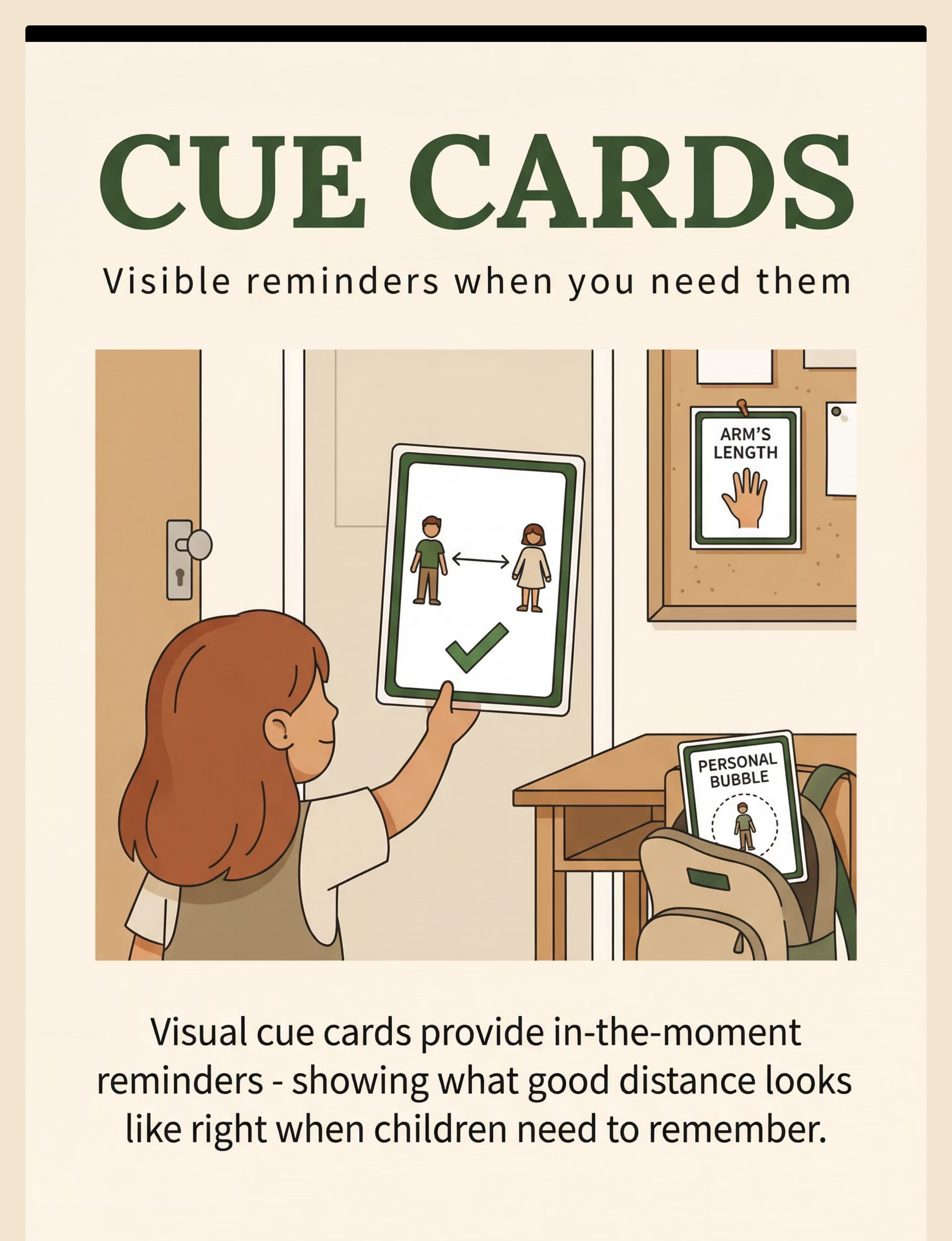
Material 7: Visual Cue Cards & Reminders
SLP + ABA Lead
Visible reminders when you need them
Knowing the rule and remembering it at the moment it is needed are two entirely different cognitive tasks. Visual cue cards serve as external working memory — placed at the exact moment and location where the child needs to check their distance. These cards externalise the checking process that typically developing children do automatically, until — with practice — it becomes internal.
Door Card
"SPACE CHECK → Can I see their whole face?" (before leaving home)
Desk Card
"MY SPACE · YOUR SPACE · ARM'S LENGTH" (at school desk)
Wearable Card
Small laminated reminder on lanyard (child-controlled, discreet)
Mirror Card
"Check your distance like you check your hair" (bathroom mirror)
Classroom Poster
Universal "personal bubble" visual (whole-class normalisation)
💡 DIY: Print, laminate, cut — Free Canva templates. Child should help design their own cards: ownership increases use. · Price: ₹50–300 · Safety: Placement must not embarrass child in front of peers. Private signals between parent/teacher and child are most effective. · Visual supports: NCAEP 2020 evidence-based practice. PMC9978394.

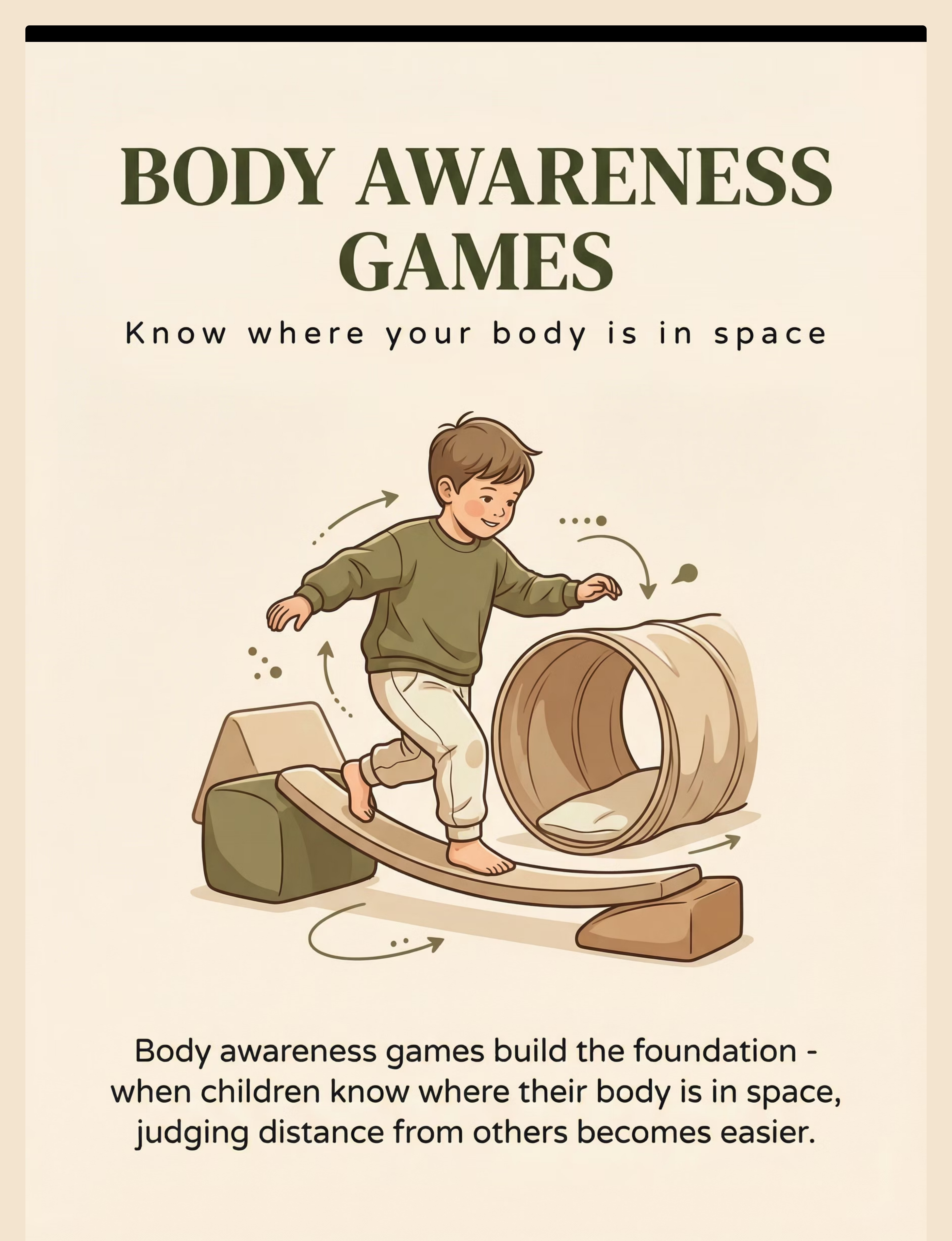
Material 8: Body Awareness Games & Activities
OT Lead
Know where your body is in space
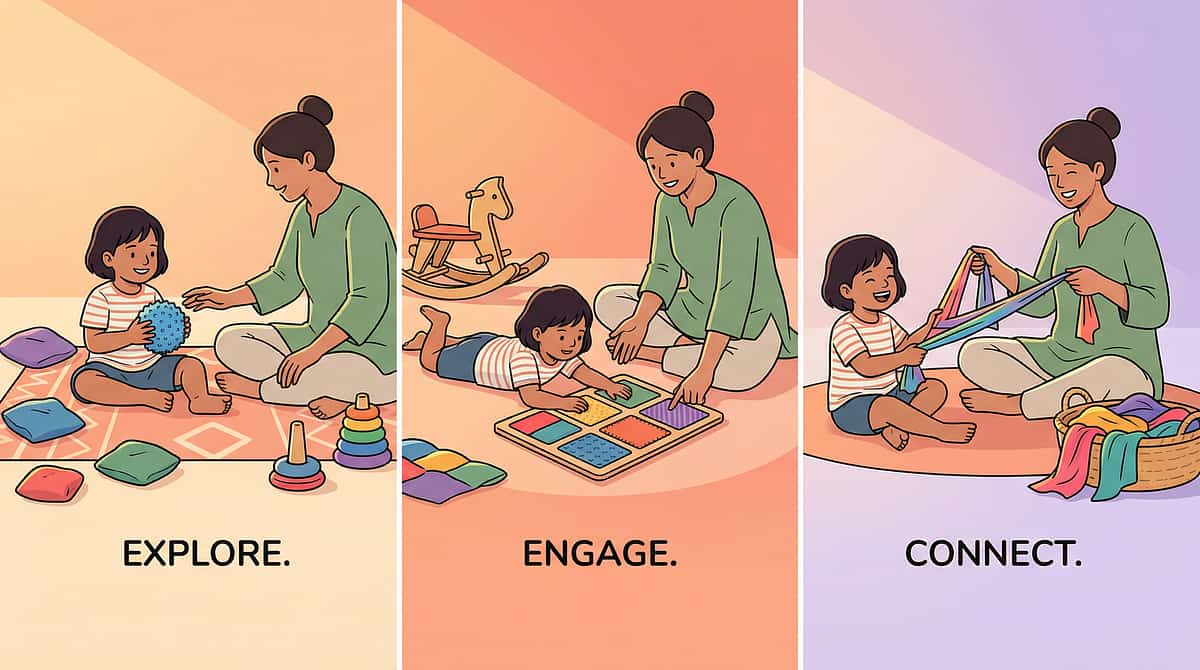
Personal space awareness is built on body awareness. You cannot know your distance from others if you don't have a clear sense of where your own body is in space. Body awareness games strengthen the proprioceptive and spatial processing that underlies distance judgment. These activities are often fun, engaging, and perceived as play — providing therapeutic benefit without the social pressure of direct space-training situations.
Mirror Games
Match partner's body position exactly. Builds body-part awareness and spatial mapping.
Obstacle Courses
Navigate through narrow spaces to build spatial judgment. Simon Says with body positions.
Yoga for Kids
Body part naming + spatial positions. Balance board standing for body position awareness.
Freeze Dance & Statue
Hold a body position and describe it. "Freeze Dance" with body-position awareness challenge.
Price: ₹0–1,000 (most games require no equipment) · Safety: Motor-appropriate for the child's coordination level. Safe movement spaces. · PMC11506176: Gross motor and body awareness components of sensory integration therapy show measurable outcomes.
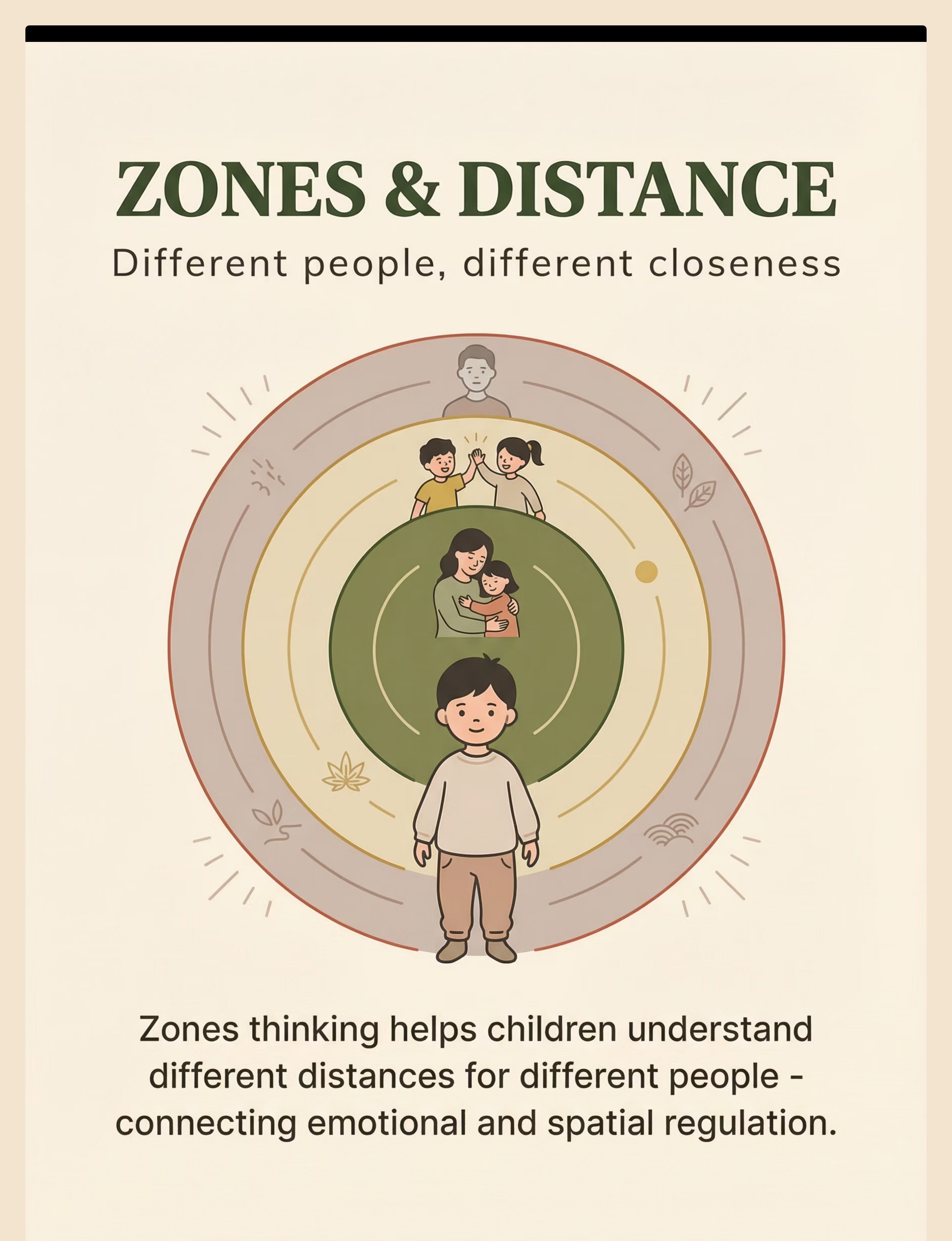
Material 9: Zones of Regulation — Closeness Mapping
SLP + SpEd Lead
Different people, different closeness
The Zones of Regulation® framework (Leah Kuypers) extended to personal space teaches a powerful parallel concept: different people in your life get different distances, just as different situations call for different emotional regulation. This framework also connects arousal state to space management — when in the "yellow zone" (excited, wiggly), a child may need to be MORE conscious of distance, because arousal increases the tendency to seek sensory input through closeness.
DIY: Draw concentric circles. Child names who belongs in each ring. Add distance labels. Post on bedroom wall.
Price: ₹300–1,500 (Zones of Regulation curriculum) | DIY circles: ₹0 · Zones of Regulation® (Kuypers, 2011): Evidence-based emotional-spatial self-regulation framework. PMC9978394
Zero budget. Full intervention. Start tonight.
Evidence-based therapy should not depend on purchasing power. Every intervention in this protocol has a zero-cost home alternative. The table below shows exactly what to buy — and what to make for free.
Material | Buy This | Make This (FREE) | |
Hula Hoops | ₹150–500 | Rope circle on floor | |
Arm's Length Tools | ₹50–100 (pool noodle) | Newspaper rolled + taped | |
Floor Markers | ₹100 (coloured tape) | Sticker dots from old labels | |
Social Stories | ₹200–400 | Write by hand with photos | |
Heavy Work | ₹0–2,000 | Household activities (FREE) | |
Role-Play Games | ₹0–500 | Practice at home (FREE) | |
Cue Cards | ₹50–100 | Print + laminate (₹50) | |
Body Awareness Games | ₹0–500 | Simon Says, mirror games (FREE) | |
Zones Circles | ₹300 | Draw on paper (FREE) |
Total DIY Starter Kit: ₹0–200 · "Evidence-based therapy should not depend on purchasing power. Every intervention in this protocol has a zero-cost home alternative." — WHO/UNICEF Nurturing Care Framework, 2018 · PMC9978394: WHO CCD Package household-material-based intervention efficacy across 54 LMICs.
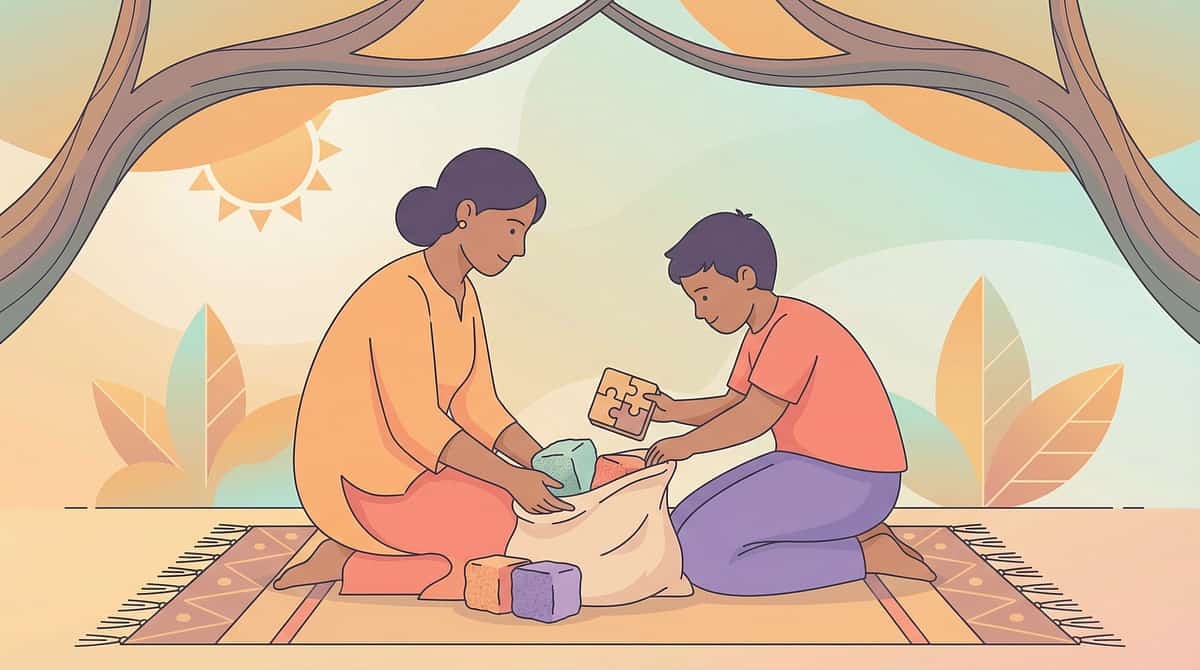
Before you start — your 2-minute safety check.
🔴 DO NOT PROCEED if:
- Child is in meltdown or post-meltdown recovery (within 30 minutes)
- Child shows signs of illness, fever, or physical pain
- Child is extremely hungry or overtired
- Any family member is dysregulated or distressed
- Heavy work activities: child has any joint, bone, or muscle injury — consult OT first
🟡 MODIFY the session if:
- Child is mildly elevated (bouncy, loud, unfocused) → Begin with 5 min heavy work first
- New environment → Start with familiar materials only
- Child resistant → Offer choice between two activities, not forced participation
- Visitor in home → Postpone formal practice; use as naturalistic observation only
🟢 PROCEED when:
- Child is calm, alert, and recently fed
- Regular predictable home environment
- Caregiver is present, calm, and has 15–20 minutes
- Materials are prepared and space is set up in advance
STOP IMMEDIATELY if: Signs of emotional flooding | Child expresses physical discomfort | Aggressive behaviour during practice | Child asking to stop — always honour this. · 📞 9100 181 181 — Clinical guidance available 24×7 · DOI: 10.1007/s12098-018-2747-4 (Padmanabha et al.)
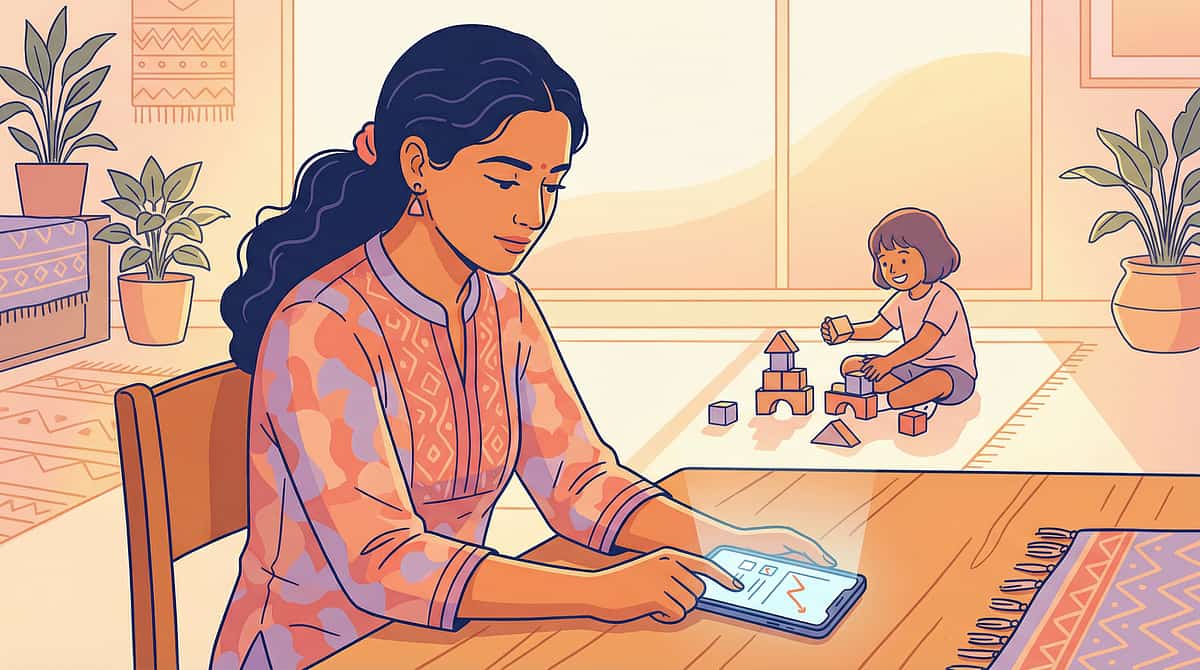
Prepare the space before you prepare the child.
Physical stage precision prevents 80% of session failures. A well-prepared environment removes distractions and ensures every material is within reach before the child enters. Spatial precision is not perfectionism — it is clinical practice.
1
Clear the Floor
Minimum 2×2 metre area. Remove excess furniture and distracting toys.
2
Place Floor Markers
Two markers at arm's length apart. Child's spot and parent's spot clearly marked.
3
Set Up Materials
Hoops, noodle, cards — within reach but not scattered. Prepared before child enters.
4
Manage Screens & Sound
Screens off (TV, tablets). Natural lighting preferred. Quiet or gentle ambient music.
5
Regulate the Environment
Comfortable temperature (not too warm). Phone on silent. Keep framing playful — not "practice session."
Lighting: Natural, diffuse (avoid harsh overhead lighting) · Sound: Quiet or gentle ambient music · PMC10955541: Meta-analysis confirms structured 1:1 environment most effective for sensory integration intervention.
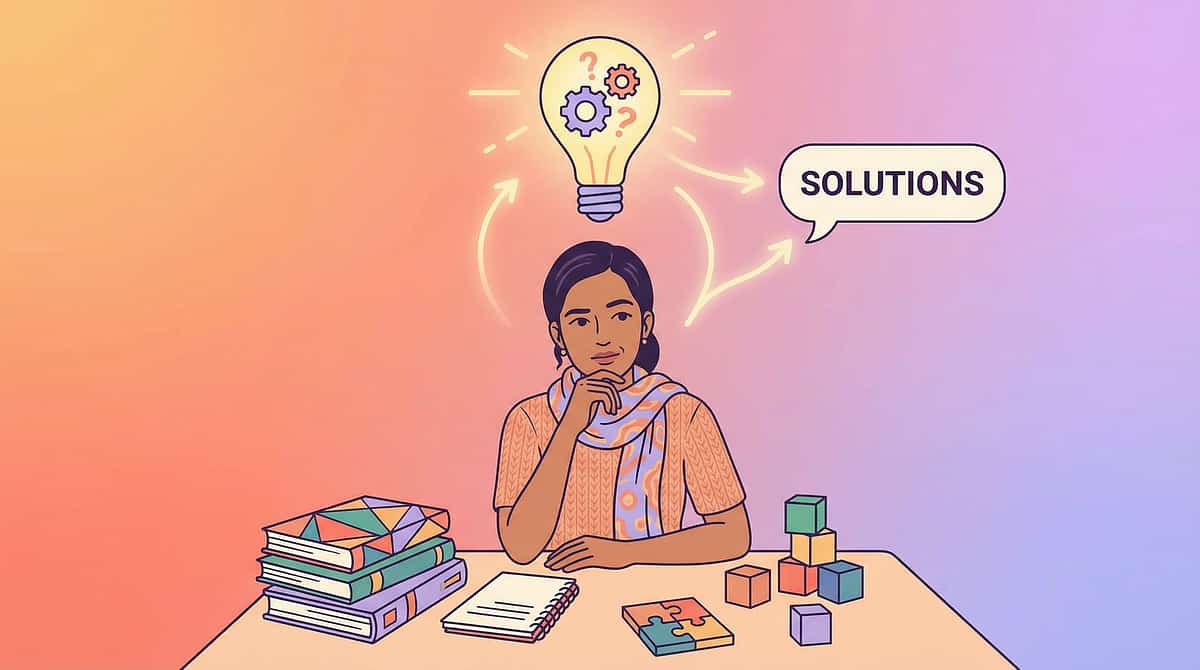
Step 1: The Invitation (Session Open)
STEP 1 of 6
⏱ 2–3 minutes
Begin every session with 5 minutes of proprioceptive warm-up — wall push-ups, carrying a heavy bag, jumping. This is not optional. It prepares the nervous system for spatial learning. Then invite the practice as an activity, not a lesson. The language you use at the opening sets the entire emotional tone of the session.
✅ USE These Words
- "Let's do our space game!"
- "Ready to practice our bubble?"
- "Want to try the hula hoop thing?"
❌ AVOID These Words
- "We need to practice your personal space."
- "Your teacher said you stood too close again."
- "Why can't you just remember arm's length?"
01
10 wall push-ups
Both hands on wall, push and hold
02
Carry heavy bag
From one room to another
03
Wheelbarrow walk
Adult holds ankles across the room
04
Jump × 20
On mattress or cushion, then transition to "our space game"
The warm-up is therapeutic, not optional. Proprioceptive input before spatial practice primes the nervous system for the sensory learning that follows.
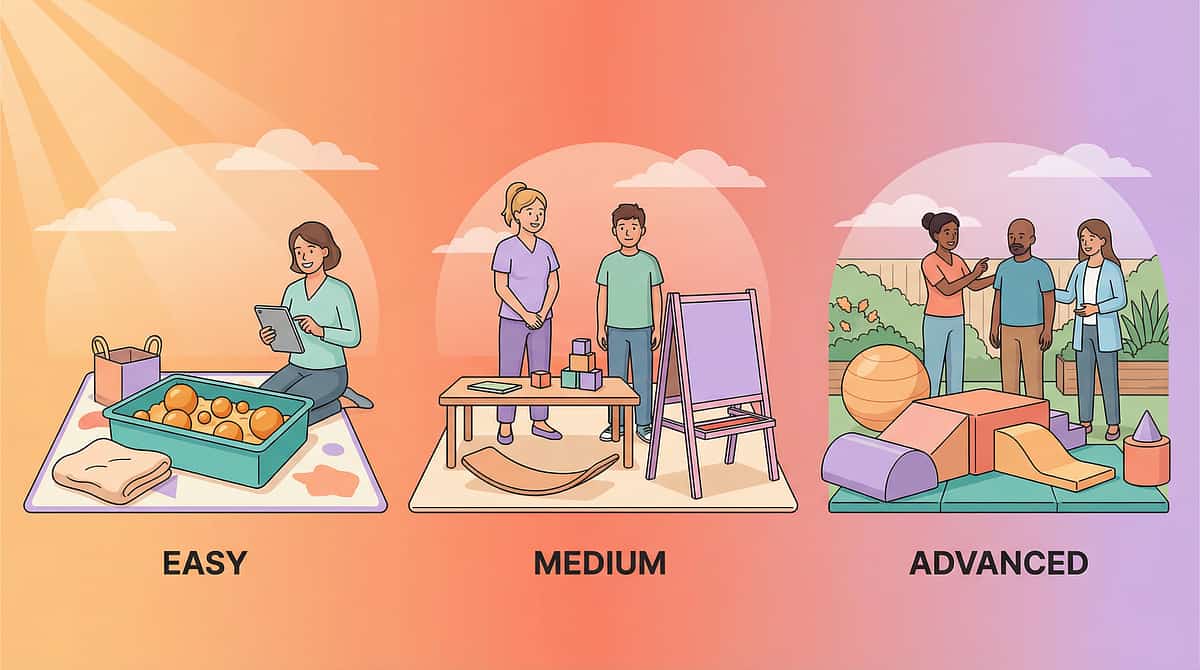
Step 2: Engagement — Visible Boundaries
STEP 2 of 6
⏱ 3–5 minutes
Make the invisible boundary visible. Two hula hoops, two people, one clear principle: this circle is yours, that circle is mine. When the boundary is tangible, the rule becomes learnable. Never frame closeness as rude or wrong — frame distance as comfortable and respectful.
01
Place the Hoops
Two hula hoops on floor, touching each other. Both people stand in their own hoop.
02
Name the Boundary
"This circle is YOUR space. My circle is MY space. When we talk, we stay in our own circles."
03
Practice Conversation
Short conversation from inside hoops (2–3 exchanges). Feel what comfortable distance is.
04
Experience the Difference
Child steps into parent's hoop: "How does that feel? A bit crowded, right? That's what it can feel like."
05
Debrief
"You did it! You stayed in your circle the whole time." Celebrate specifically.
"When we each have our own space, the other person feels comfortable. That's the goal — comfortable conversations."

Step 3: Action — Arm's Length Tools
STEP 3 of 6
⏱ 3–5 minutes
Move from visible boundary to felt distance. Put the hoops aside and introduce the pool noodle. The child holds one end; you hold the other — it maintains perfect arm's length during conversation. The goal is for the child to feel that distance in their body so it can eventually be reproduced without the tool.
01
Introduce the Noodle
"Now we're going to try without the circles. Hold one end — I'll hold the other."
02
Practice Conversation
Both hold the noodle during a short conversation. The noodle maintains arm's length perfectly.
03
Feel the Distance
"Can you feel how far that is? That's arm's length. That's the conversation distance."
04
Self-Check Without Noodle
Put noodle down. "Walk toward me and stop when it feels right." Check and confirm with noodle.
05
Repeat & Celebrate
Repeat 5 times. Celebrate each correct stop. "That was exactly right."
Weeks 1–2
Noodle in hand during practice
Weeks 3–4
Noodle on floor as reference, not held
Week 5+
No noodle, self-assessment only

Step 4: Reinforce — Floor Markers & Real Situations
STEP 4 of 6
⏱ Ongoing, daily situations
Build correct distance into every routine. Place tape spots at arm's-length distance at your home practice station. Every practice conversation happens standing on the spots. Then extend to recurring daily situations — kitchen conversations, homework time, queue practice. Give the child responsibility for finding their spot.
Home Practice Station
Two tape spots on floor at arm's-length distance. Every practice conversation happens here.
Kitchen & Homework
Tape spot for child, spot for parent. Side-by-side spots at appropriate distance for homework time.
Queue Practice
Mark where to stand relative to imaginary person ahead. Practice daily in real queue situations.
School Coordination
Coordinate with teacher for floor markers at circle time and lunch. Use Pinnacle ETP™ school communication template.
When to reduce markers: when child independently finds appropriate distance 80% of the time across 2 weeks without markers. · 📞 9100 181 181 — School coordination support available. · ABA antecedent modification. PMC9978394.

Step 5: Cool-Down — Social Stories & Debrief
STEP 5 of 6
⏱ 5 minutes
Understanding anchors the practice. Sit together comfortably — physical practice is now done. Read a short personal space social story, then reflect together with open, curious questions. The debrief should feel like a conversation between equals, not an evaluation. Celebrate specifics, then preview tomorrow's opportunity.
1
Read Together
Sit comfortably. Read a short personal space social story (3–4 minutes). Calm, connected tone.
2
Reflect
"Why do you think people like their own space?" / "What does it feel like when someone stands too close to you?"
3
Celebrate Specifically
"Today you stopped at the right spot FOUR times. That's really new for you." Never generic praise.
4
Preview Tomorrow
"Tomorrow at school, try to check your distance when you talk to [friend's name]."
"I am learning about personal space. When I talk to friends, I try to stand about one arm's length away. When I get the distance right, my friends feel comfortable, and I feel proud."
Social Stories® are NCAEP 2020 evidence-based practice. Narrative debrief following practice improves skill consolidation. PMC9978394.

Step 6: Data Capture — Track Your Child's Progress
STEP 6 of 6
⏱ 2 minutes post-session
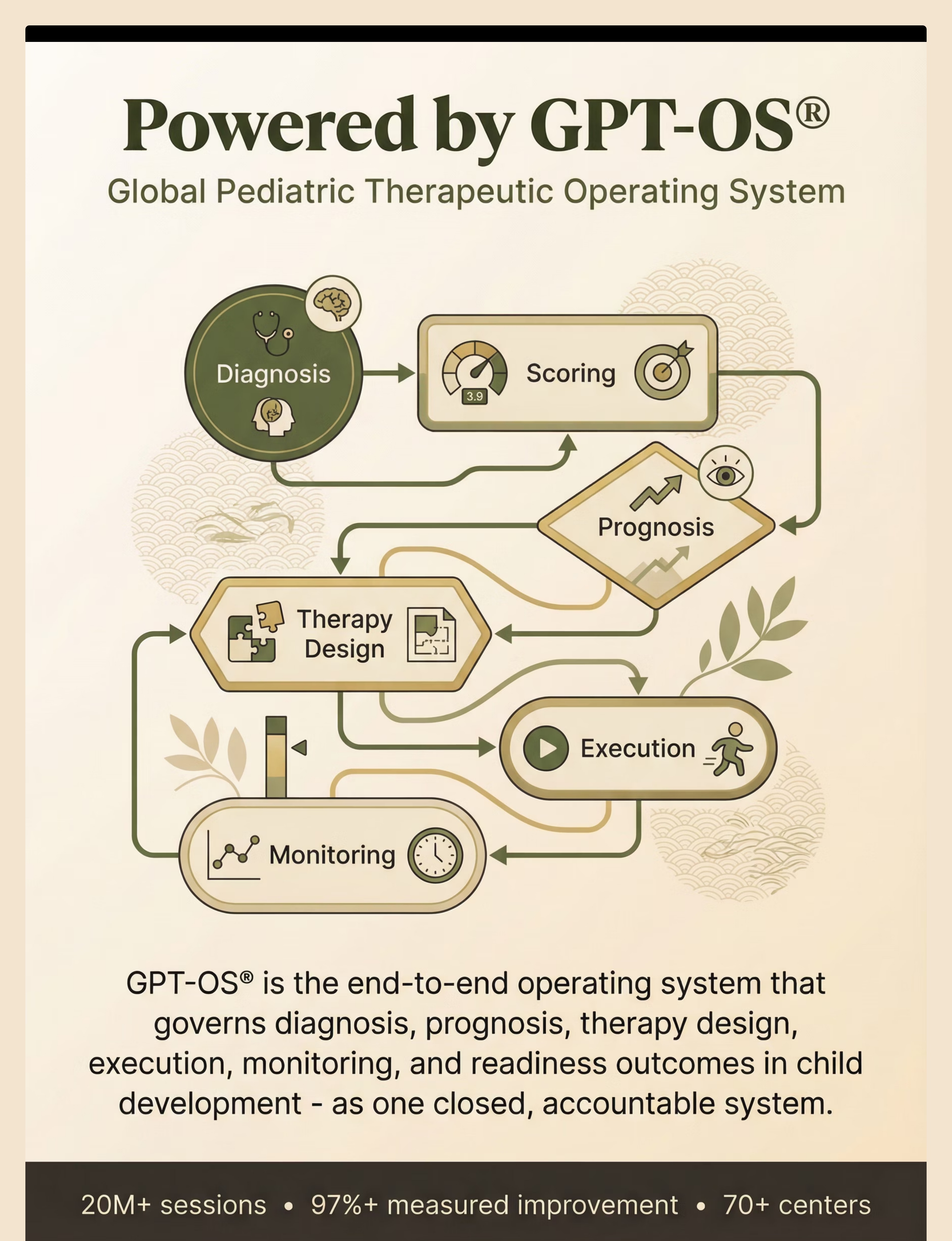
What gets measured gets improved. Two minutes of data capture after each session builds a picture of your child's trajectory — and feeds the GPT-OS® system with the information it needs to personalise the next protocol recommendation.
Date | Hoop OK? | Noodle Correct Stops | Marker Needed? | Natural Situations | Notes | |
__/__ | Y/N | __/5 | Y/N | __/3 | ___ |
Weekly Summary
Average correct stops this week: __/5
Natural situations with appropriate distance: __/5
Child self-correction instances: __
Natural situations with appropriate distance: __/5
Child self-correction instances: __
GPT-OS® Integration
Log data into your child's AbilityScore® tracker. Data feeds the Social Communication Readiness Index — generating personalised session recommendations.
Systematic data collection is core to ABA-based programmes. Outcome monitoring enables timely protocol adjustment. NCAEP 2020.

How does your child's challenge present? Personalise this protocol.
Every child is unique. The more precisely you can describe your child's pattern, the more precisely this protocol can be calibrated for them. Answer the questions below — or call the helpline for live personalisation support with a specialist.
Primary Concern
Stands too close | Follows when others back away | Constant touching | Doesn't notice cues | All of the above
Settings Affected
Home | School | Playground | All settings
OT Assessment
Has child been assessed by OT? Yes / No / Scheduled
Triggers
What triggers worst episodes? Note specific settings, times of day, or people.
What Helps
What currently helps, even a little? Note any strategies or tools that have shown promise.
ETP™ Request
Would you like a personalised ETP™ recommendation? Yes / No

Week 1–2: Progress looks like tolerance — not mastery. That IS real progress.
Progress Arc · Week 1–2
15%
Early Progress Milestone
Tolerance and participation are the measurable outcomes at this stage
✓ What You WILL See
- Child tolerates hula hoop practice for 3–5 minutes
- Responds to "stop" cue from parent (pool noodle check)
- Can identify "too close" in a picture or demonstration
- Heavy work accepted into morning routine without resistance
- Social story read without protest
✗ What You WON'T See Yet (and that's okay)
- Spontaneous distance checking in natural situations
- Generalisation to school or peer interactions
- Self-correction without adult prompt
- Awareness in the moment of closeness (this comes much later)
"If your child held their hula hoop position for 3 seconds longer than day 1 — that is neural pathway formation. Celebrate it." · PMC11506176: Sensory integration intervention outcomes emerge across 8–12 week timelines.
Week 3–4: The nervous system is forming the pattern.
Progress Arc · Week 3–4
40%
Consolidation Phase
Patterns are beginning to form — watch for spontaneous naming of the concept
Consolidation Indicator 1
Child approaches session materials without being asked
Consolidation Indicator 2
Spontaneously says "that's my bubble" or names the concept
Consolidation Indicator 3
Correct pool noodle stop distance 3–4/5 attempts
Consolidation Indicator 4
Floor markers in use without reminders in that specific spot
Generalisation Seeds
Child pauses before approaching a sibling (even without acting on the pause) | Asks "was I too close?" after an interaction — metacognition emerging
When to increase frequency: when accuracy consistently exceeds 70% in structured sessions → add one more natural situation per day. · Neuroplasticity evidence: Synaptic strengthening through structured, repeated input follows predictable timelines in paediatric populations.
Week 5–8: Self-monitoring begins.
Progress Arc · Week 5–8
65%
Emerging Independence
Self-monitoring is visible — watch for the "check" micro-pause before approaching
In Sessions
Maintains appropriate distance with visual cues in familiar settings. Floor markers needed only in new or high-demand situations.
Spontaneously
Checks own distance 1–2× per day without prompting. Hula hoop needed only for warm-up, not primary practice.
With Peers
Peer interactions showing fewer reports of crowding. Peer relationships benefiting from improved spatial awareness.
What to do now: Begin fading floor markers (remove one spot per week) | Introduce new conversation partners (neighbour, cousin) | Reduce session frequency to 4×/week | Increase naturalistically occurring practice opportunities.
Watch for the "check" — the micro-pause before approaching someone where the child visually scans their distance. This is the external evidence of the internal process forming. · PMC9978394: Generalisation across settings and people follows structured programme timelines.
When home practice isn't enough — and that's okay.
Home programmes are powerful — and they have limits. The situations below are your signal that professional assessment will add significant value. Seeking specialist support is not an admission of failure — it is the next clinical step.
⚠️ Seek OT Assessment if:
After 8 weeks of consistent home practice, no measurable improvement in structured sessions | Personal space difficulties are part of broader body awareness challenges (bumping into things, tripping frequently) | Child shows distress in response to space-correction | Proprioceptive activities don't seem to register sensorially
⚠️ Seek SLP Assessment if:
Social cue reading is broadly impaired (doesn't recognise facial expressions, doesn't respond to body language, misses turn-taking signals) | Pragmatic language difficulties are broader than personal space
⚠️ Seek NeuroDev Paediatric Review if:
Concerns about ADHD (impulsivity component), DCD, or ASD that have not yet been formally assessed
📞9100 181 181 · FREE National Autism Helpline · Available 24×7 · 70+ Centres Nationwide · "Tell us what you're seeing. We will help you find the right next step." · DOI: 10.1007/s12098-018-2747-4
B-212 is one milestone on a larger journey.
Personal space is one piece of the Social Communication puzzle. B-212 builds the foundation that the techniques above it depend on. Here is where you are — and where you are headed.
1
B-211
Greetings & Conversation Openers
2
B-212 ← YOU ARE HERE
Personal Space in Talking
3
B-213
Facial Expressions in Speech
4
B-214
Reading Listener Cues
5
B-215
Ending Conversations
Prerequisite Techniques
- B-207: Body Awareness Foundations (if proprioception is a primary issue)
- B-209: Understanding Social Cues (if cue-reading is a major component)
Next-Level Techniques
- B-213: Facial Expressions in Speech
- B-214: Reading Listener Cues
- Domain A: Sensory Processing (if sensory profile is broader)
Long-term goal: Age-appropriate personal space awareness across all settings and relationships — Social Communication Readiness Index target. · WHO/UNICEF milestones provide developmental trajectory framework.
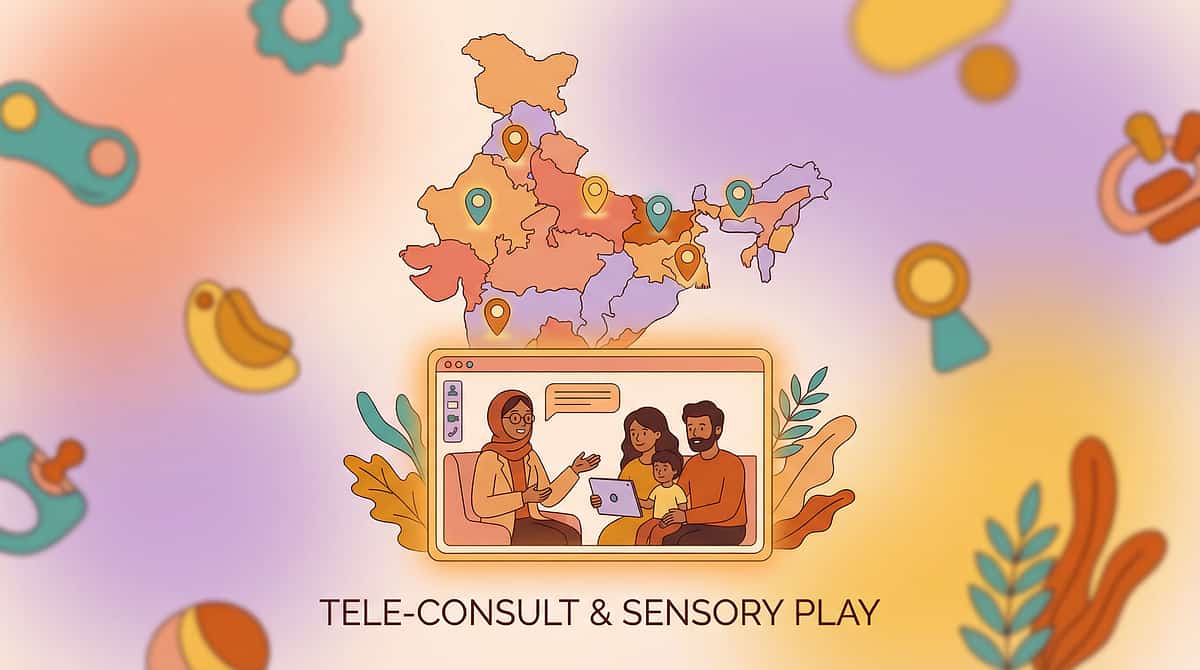
Personal space is one piece. Here is the complete picture.
B-212 is feeding data into your child's Social Communication Readiness Index. Every session you log contributes to a personalised developmental plan across all 12 domains. This is not a single technique — it is one node in a complete, integrated map of your child's development.
"B-212 is feeding data into your child's Social Communication Readiness Index. Every session you log contributes to a personalised developmental plan across all 12 domains."
WHO/UNICEF Nurturing Care Framework: 5 components of nurturing care require holistic developmental monitoring. WHO NCF (2018).
From nose-to-nose to comfortable conversations. Real families. Real change.
Before (Week 0): "My daughter would walk straight into someone's face when she started talking — nose-to-nose, unaware. At her sixth birthday party, three children moved away from her within ten minutes. She followed each of them across the room, maintaining that tiny gap, completely oblivious. Her teacher had a note in her file: 'stands too close, does not respond to verbal reminders.'"
After (Week 10): "At her next school event, I watched her approach a classmate. She stopped. Not at nose-distance — at proper talking distance. She didn't look at me for permission. She just... stopped there, naturally. The other child didn't back away. They just talked. I had to leave the room before I cried."
"The turning point was the morning heavy work routine combined with consistent floor markers at school. Her body needed the proprioceptive input before it could manage spatial awareness in social situations. Once that foundation was in place, the visible boundary tools clicked quickly."
— Pinnacle OT, Sensory Integration Specialist
📞 9100 181 181 — Speak to a Pinnacle specialist today. · Parent-reported outcomes research: Peer narratives are the strongest driver of home intervention adherence.
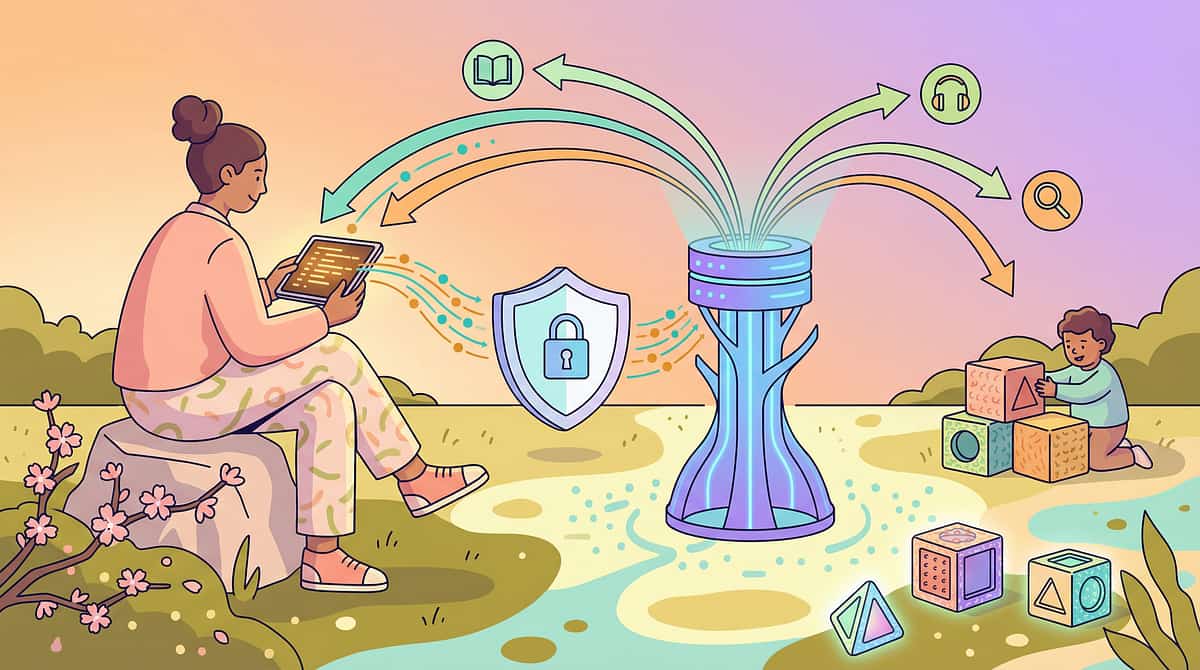
70+ Pinnacle Centres. Specialist assessment available near you.
When you are ready for professional support — whether for a formal AbilityScore® assessment, OT sensory integration evaluation, or school transition planning — the Pinnacle network is here. Online teleconsultation is also available for families globally.
01
AbilityScore® Baseline
Standardised, multi-domain assessment across all 12 developmental areas
02
Sensory Profile Evaluation
OT-led. Identifies proprioceptive processing pattern and sensory diet recommendations
03
Social Communication Readiness Index
Baseline score across Domain B. Benchmarks progress from this point forward
04
EverydayTherapyProgramme™
Personalised, session-by-session home protocol generated from your child's profile
05
FusionModule™ Coordination
Multi-disciplinary care coordination across OT, SLP, ABA, and SpEd
Padmanabha et al., Indian J Pediatr 2019: Centre-based assessment informs and amplifies home-based intervention. DOI: 10.1007/s12098-018-2747-4
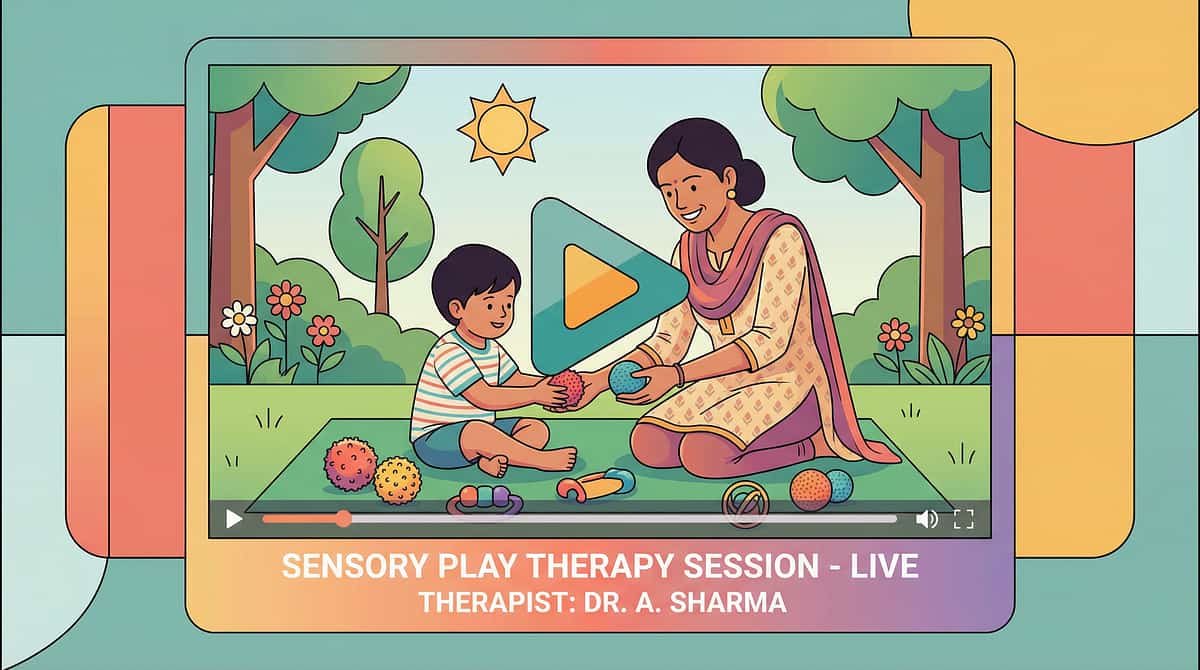
Your data. Your child's personalised plan. Protected.
GPT-OS® is the intelligence layer that transforms your session logs into progressively personalised recommendations. Transparency is non-negotiable: here is exactly what it learns, and exactly how your data is protected.
What GPT-OS® Learns
Correct distance maintenance rate | Response to visible boundary tools | Generalisation patterns | Progress velocity — all feed personalised recommendations
🔒 Privacy Assurance
Data anonymised and aggregated. Individual profiles accessible only to family and Pinnacle clinical team. No data sold. ISO/IEC 27001 standards applied.
Population Impact
"Your child's data — combined with 20M+ sessions — improves protocol recommendations for every family navigating this same challenge."
Watch the Reel that brought many families to this page.
Reel B-212
Social Communication Series · Episode 212
The original Reel that introduced thousands of parents to these 9 materials — visual demonstrations of each material in action, therapist voiceover, and the GPT-OS® closure sequence. Ideal for sharing with grandparents, school teachers, and co-parents who need to understand the protocol quickly.
Reel Details
Title: 9 Materials That Help With Personal Space in Talking
Series: Social Communication & Body Awareness Solutions
Duration: 75–85 seconds
Series: Social Communication & Body Awareness Solutions
Duration: 75–85 seconds
What It Covers
Visual demonstrations of all 9 materials in action, therapist voiceover explaining the science, GPT-OS® closure sequence
Related Reels
← B-211: Greetings & Conversation Openers
→ B-213: Facial Expressions in Speech
→ B-213: Facial Expressions in Speech
Video modelling is NCAEP 2020 evidence-based practice for autism. Multi-modal learning (visual + text + demonstration) improves parent skill acquisition.

One caregiver practising this. Five caregivers practising this. The difference is immeasurable.
Consistency across caregivers multiplies impact. Every adult in your child's life practising the same approach reduces the learning timeline by weeks. Share this page with grandparents, co-parents, and classroom teachers using the options below.
Share on WhatsApp
Pre-written message: "This page has everything we need to help [child's name] with personal space — 9 materials, a 6-step protocol, and weekly milestones. techniques.pinnacleblooms.org/social-communication/personal-space-in-talking-B-212"
Family Guide (PDF)
Printable, laminate-ready one-page family guide. Clear, visual, no therapy jargon. Print for grandparents, babysitters, and extended family.
Teacher Communication Template
Request floor markers and seat modification. Pinnacle ETP™ template included. Formal accommodation request support available at 9100 181 181.
"Consistency across caregivers multiplies impact. Every adult in your child's life practising the same approach reduces the learning timeline by weeks."
WHO CCD Package: Multi-caregiver training is critical for intervention generalisation. PMC9978394.

Your child doesn't need a perfect plan. She needs you to start.
Every family who has watched their child stop at the right distance — naturally, without prompting — started exactly where you are right now. The protocol works. The science is solid. The community is here. All that's needed is the first step.
🥇 Call FREE Helpline
9100 181 181
Speak to a specialist within minutes. 24×7. 16+ languages. No appointment needed.
Speak to a specialist within minutes. 24×7. 16+ languages. No appointment needed.
🥈 Request AbilityScore® Assessment
Get your child's personalised baseline. 70+ centres or online.
→ pinnacleblooms.org/assessment
→ pinnacleblooms.org/assessment
🥉 Start the Home Protocol Tonight
Start with the heavy work warm-up. No materials required. Begin right now.
→ Scroll to Step 1: Readiness Check
→ Scroll to Step 1: Readiness Check
📞 9100 181 181 | pinnacleblooms.org | care@pinnacleblooms.org · 🏥 OT · SLP · BCBA · NeuroDev Paediatrics | Pinnacle Blooms Network® · CIN: U74999TG2016PTC113063 | DPIIT: DIPP8651 | MSME: TS20F0009606 | GSTIN: 36AAGCB9722P1Z2
Preview of 9 materials that help with personal space in talking Therapy Material
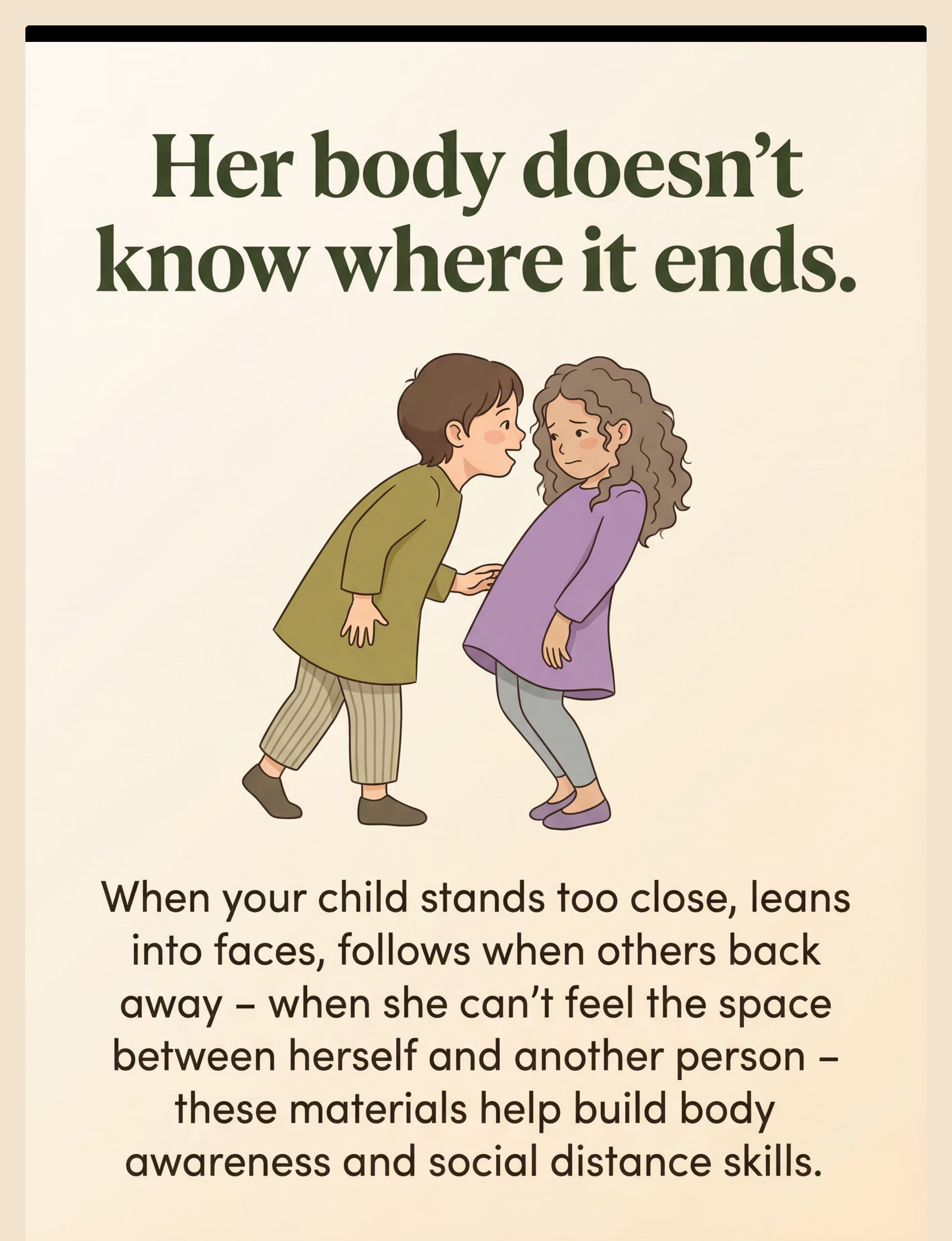
Below is a visual preview of 9 materials that help with personal space in talking therapy material. The pages shown help educators, therapists, and caregivers understand the structure and content of the resource before use. Materials should be used under appropriate professional guidance.


Link copied!

The Pinnacle Promise.
"Every technique on this platform has been developed, reviewed, and validated by Pinnacle's consortium of CROs, Occupational Therapists, Speech-Language Pathologists, BCBAs, Special Educators, Neurodevelopmental Paediatricians, Families, and Regulatory Specialists. Every protocol is designed to be parent-executable, clinically grounded, and evidence-referenced. This is not content. This is infrastructure."
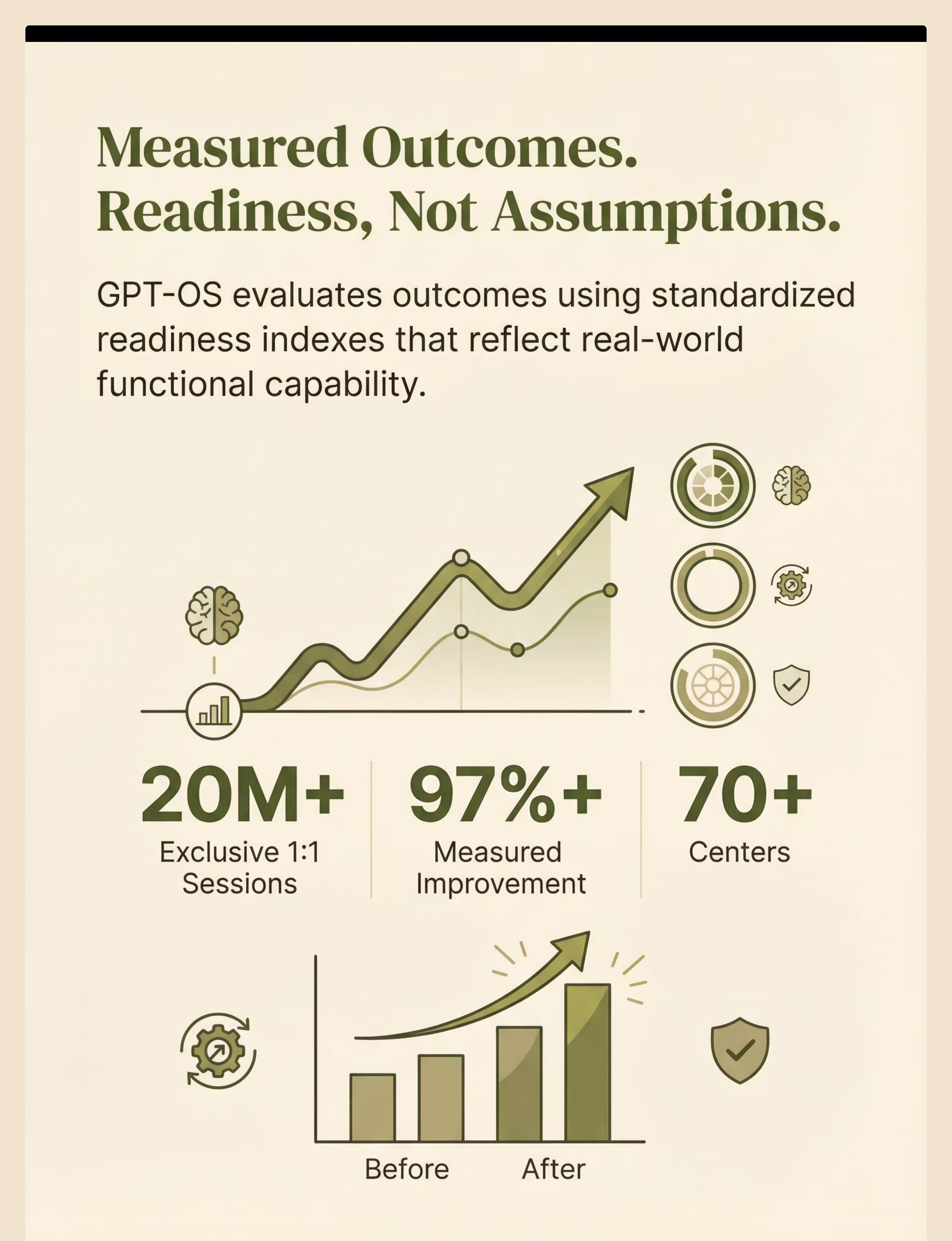
20M+
Therapy Sessions
Exclusive 1:1 sessions tracked and analysed
97%+
Improvement Rate
Measured improvement across readiness indexes
70+
Centres
India's largest autism therapy network
70+
Countries
Families served globally
This content is educational. It does not replace assessment by a licensed occupational therapist, speech-language pathologist, or healthcare provider. Persistent personal space difficulties should be evaluated comprehensively to understand underlying causes and guide appropriate intervention. Individual results may vary. Statistics represent aggregate outcomes across the Pinnacle Blooms Network.
© 2025 Pinnacle Blooms Network®, unit of Bharath Healthcare Laboratories Pvt. Ltd. All rights reserved.
Ready for the next step in your child's Social Communication journey?
📞9100 181 181 | Available 24×7 | 16+ Languages · Pinnacle Blooms Network® — Built by Mothers. Engineered as a System.