

9 Materials That Help With Parent Overwhelm
Because you cannot pour from an empty cup.
Parent Wellbeing & Caregiver Support — Episode 882

Parent Burnout · Caregiver Stress · Self-Compassion · Support Systems · Sustainable Caregiving
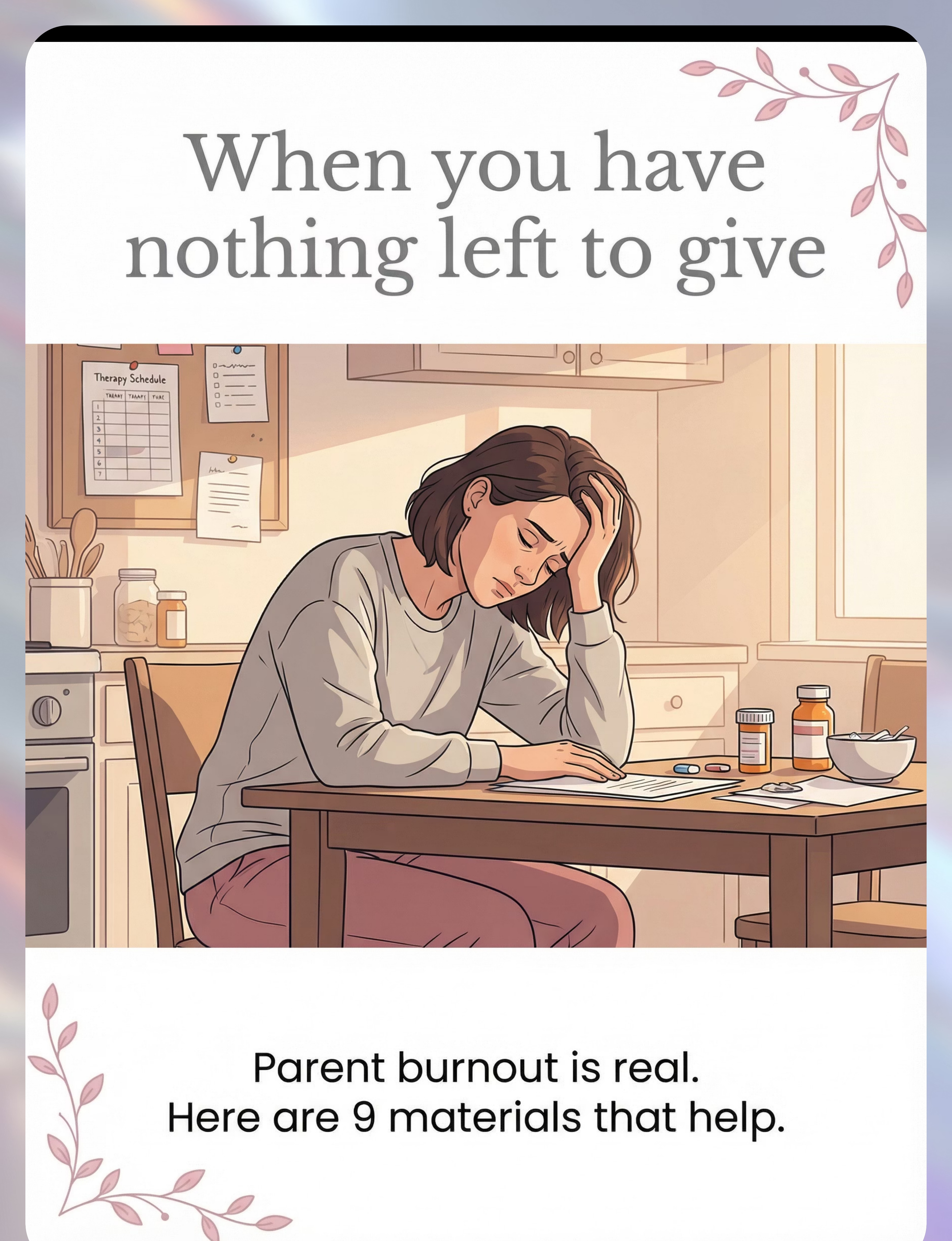
When You Have Nothing Left to Give
Parent burnout is real. The exhaustion, the isolation, the feeling of disappearing into caregiving — these are not personal failures. They are entirely predictable outcomes of unsustainable demands meeting insufficient support.
"I am drowning. I wake up exhausted and go to bed more exhausted. Every day is the same relentless cycle — therapy appointments, school pickups, meltdown management, medication schedules, IEP meetings, feeding challenges, sleep struggles, and the constant vigilance that raising a child with special needs requires. There's no break. There's no 'off' switch."
If this sounds like you, this resource was built for you. Not to lecture you about self-care — but to offer 9 realistic, friction-free materials that help when big solutions feel impossible.

The Voice of a Parent Running on Empty
The experience of caregiver burnout is unlike ordinary parenting stress. It is pervasive, persistent, and consequential — affecting your body, your relationships, your identity, and your ability to provide the very care that caused the burnout.
"Three years later, I am a shell of who I was. The energy is gone. The hope is harder to hold. The fight has become a grind. Every victory is followed by a new battle. Every milestone reached reveals three more that seem impossibly far away."
You are not alone in this experience. And you are not failing. You are coping with more than most people will ever understand — often with far fewer resources than the job requires.

Understanding Caregiver Burnout
Clinical Definition
Caregiver burnout — also termed parental burnout or compassion fatigue — is a state of chronic physical, emotional, and mental exhaustion that occurs when caregiving demands consistently exceed available resources and recovery capacity. It is characterized by:
Overwhelming Exhaustion
Not relieved by ordinary rest. Bone-deep depletion that persists regardless of sleep.
Emotional Distancing
Feeling detached from your child or caregiving role as a protective mechanism.
Sense of Ineffectiveness
Feeling like a failure despite immense, sustained effort every single day.
Identity Loss
No longer able to access who you were before caregiving consumed everything.
Research shows that parents of children with autism and other developmental disabilities have stress levels comparable to combat veterans, with elevated rates of depression, anxiety, and physical health problems.

Common Signs of Caregiver Burnout
Burnout develops gradually, and many parents have normalized severe exhaustion without recognizing how depleted they've become. These are the signs to watch for:
Emotional & Mental Signs
- Chronic exhaustion not relieved by sleep
- Feeling detached or emotionally numb
- Loss of patience and increased irritability
- Feeling like a failure despite immense effort
- Difficulty experiencing positive emotions
- Intrusive thoughts about escaping
- Hopelessness about the future
- Feeling like you've lost your identity
Physical & Behavioral Signs
- Physical symptoms: headaches, muscle tension
- Increased susceptibility to illness
- Social withdrawal and isolation
- Neglecting basic needs (eating, sleeping, hygiene)
- Increased use of alcohol, food, or screens as coping
- Resentment toward child, spouse, or situation
- Difficulty making decisions or thinking clearly
- Loss of interest in previously enjoyed activities

Why Burnout Risk Is Higher for Special Needs Parents
Burnout differs from ordinary parenting stress in critical ways. For parents of children with disabilities, chronic illness, or intensive developmental needs, risk is significantly elevated due to structural, not personal, factors.
These are structural problems — not personal failures. Self-care alone cannot solve them. Parents need practical tools to survive within the current system while advocating for systemic change.
Burnout vs. Tiredness vs. Depression
Understanding the difference helps determine the right level of support. These states overlap and can co-occur — burnout can lead to depression. When in doubt, seek professional evaluation.
Normal Tiredness
Tired but recovers with rest. Can still experience positive emotions. Stress is related to specific events that resolve. Maintains interest in activities. Relationships strained but functional.
Intervention: Rest, better sleep, occasional self-care, social support.
Caregiver Burnout
Chronic exhaustion not relieved by rest. Emotional distancing from role or child. Sense of ineffectiveness despite effort. Physical symptoms, identity loss, can't remember who you were before.
Intervention: Structured support, respite, therapy, systemic changes, daily survival tools.
Clinical Depression
Persistent hopelessness most of the day, most days. Inability to feel pleasure even in good moments. Thoughts of worthlessness, death, or self-harm. Significant impairment in daily functioning.
Intervention: Professional mental health treatment, possibly medication, crisis support if severe.

Overview
9 Materials That Help
These are not magic solutions. They are small, realistic, friction-free tools for surviving a marathon that has no finish line — designed for real parents with no time, no energy, and no margin.
Together, these 9 materials cost ₹500–1,500 — and most can be created entirely from items you already own. Start with the crisis card. Add one material at a time.

Material 1 of 9
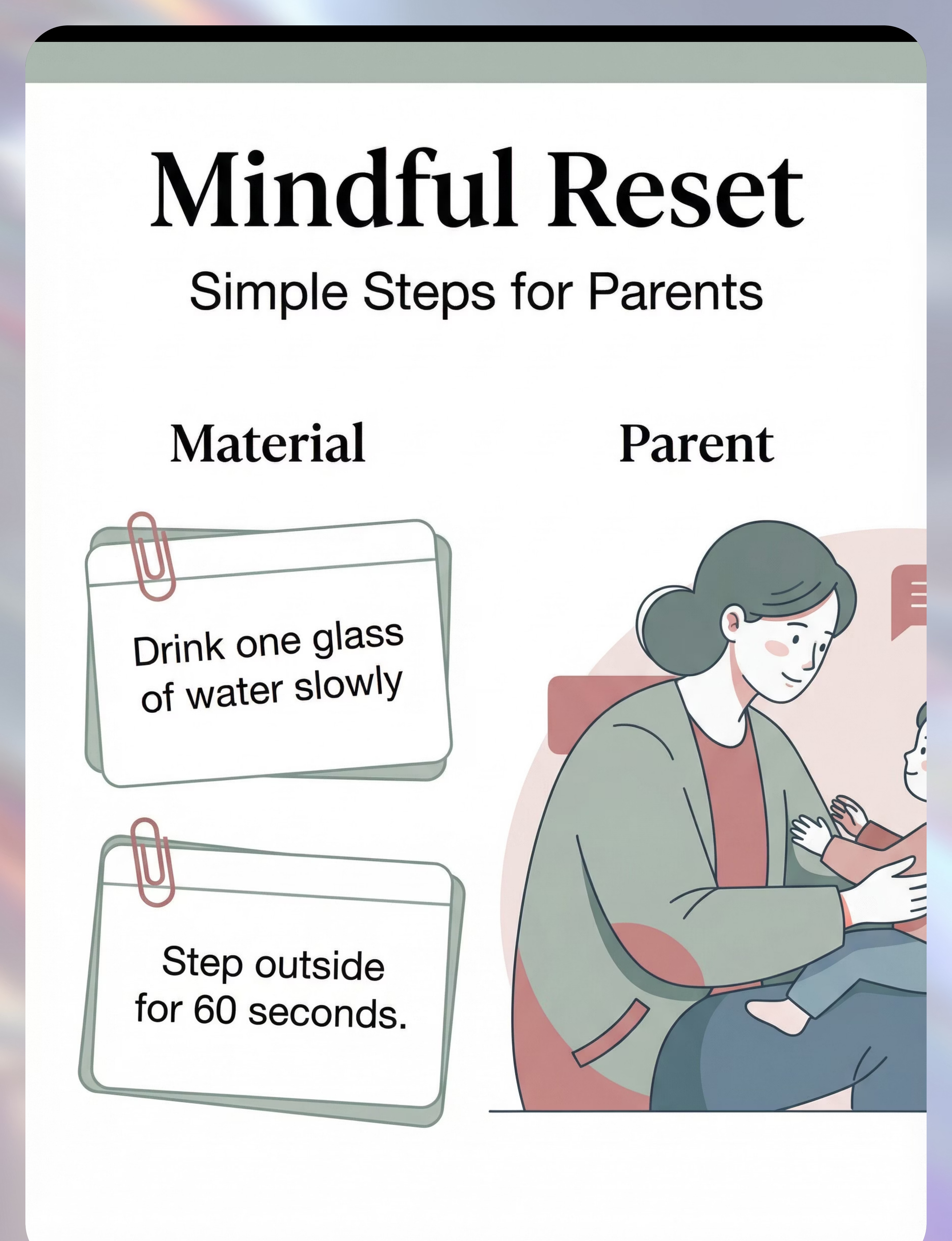
5-Minute Micro-Care Cards
MICRO-CARE CARDS → 5 minutes still counts
Traditional self-care advice fails overwhelmed parents because it assumes resources that don't exist — time, energy, childcare, money. 5-Minute Micro-Care Cards flip the paradigm by acknowledging that parents may only have tiny fragments of time, and those fragments still count.
Each card contains one self-care action that takes 5 minutes or less and requires no special resources. They work because they're realistic and friction-free — interrupting the all-or-nothing thinking that says "If I can't do an hour of yoga, why bother?"
Over time, micro-moments accumulate. They rebuild the habit of noticing your own needs and create tiny spaces where you exist as a person, not just a caregiver.
Micro-Care Cards: What to Write
One action per card. Keep the stack somewhere visible — kitchen counter, pocket, nightstand. Pull one when you have a fragment of time. These are invitations, not demands.
Body Care
- Drink a full glass of water
- Stretch your neck and shoulders for 2 minutes
- Step outside and feel the weather for 60 seconds
- Wash your face with warm water
- Apply lotion to your hands slowly
Breath & Calm
- Take 5 slow breaths — in for 4, out for 6
- Put your hand on your heart. Feel it beating.
- Clench every muscle for 5 seconds, then release
- Sit somewhere quiet for 3 minutes. Just sit.
- Listen to one song that you love
Connection
- Text one friend: still here, thinking of you
- Look at one photo that makes you smile
- Send a voice memo to someone you miss
- Write one line about how you're really feeling
Mindset
- Name one thing you did well today
- Remind yourself: this moment is hard AND I am handling it
- Look in the mirror and say: you're doing enough
- Eat something you actually enjoy — slowly
Key Insight:Small is not nothing. When life allows only fragments, those fragments are where you survive.

Material 2 of 9
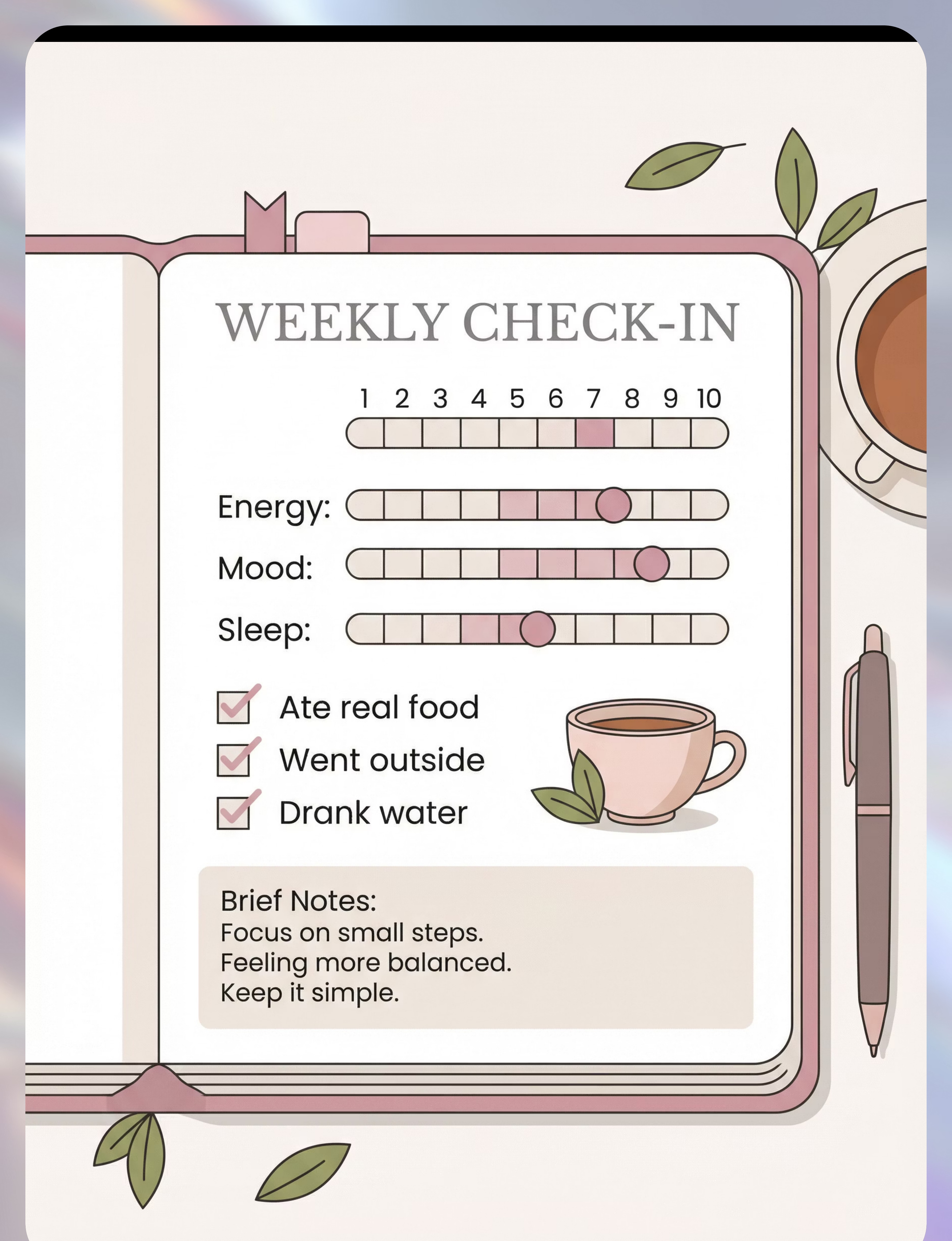
Burnout Self-Assessment Journal
BURNOUT JOURNAL → Making the invisible visible
Many parents don't recognize how depleted they've become because decline is gradual and they've normalized severe exhaustion. A burnout self-assessment journal provides regular structured check-ins on key indicators of wellbeing — sleep, nutrition, mood, connection, capacity.
Tracking serves multiple functions: it creates a moment of self-awareness amid chaos; it provides data that shows when things are getting worse (or better); it can serve as evidence when advocating for more support; and it validates your experience by naming what's happening rather than just surviving it.
The journal doesn't fix burnout. But it makes it visible. And what's visible can be addressed.
Burnout Journal: What to Track
1
Daily Quick Check (30 seconds)
- Overall energy: 1–10 scale
- Sleep: hours + quality (rested / okay / exhausted)
- Basic needs met? (Ate real food / Went outside / Drank water / Showered) — yes/no
- One word for today: ___
2
Weekly Deeper Check (5 minutes)
- Biggest drain this week
- Anything that filled me up
- Body check: Am I in pain? Sick?
- Relationship check: How connected do I feel?
- Warning signs I notice
3
Monthly Reflection (15 minutes)
- Am I doing better, worse, or the same?
- What would I tell my past-month self?
- What do I need that I'm not getting?
- What one small thing could help next month?
Safety Note: If tracking reveals persistent hopelessness, thoughts of self-harm, or inability to function, this indicates crisis-level burnout requiring professional intervention. The journal is for awareness — not to replace mental health care.
Key Insight:You can't address what you can't see. Tracking makes the invisible visible and validates what you're experiencing.
Material 3 of 9
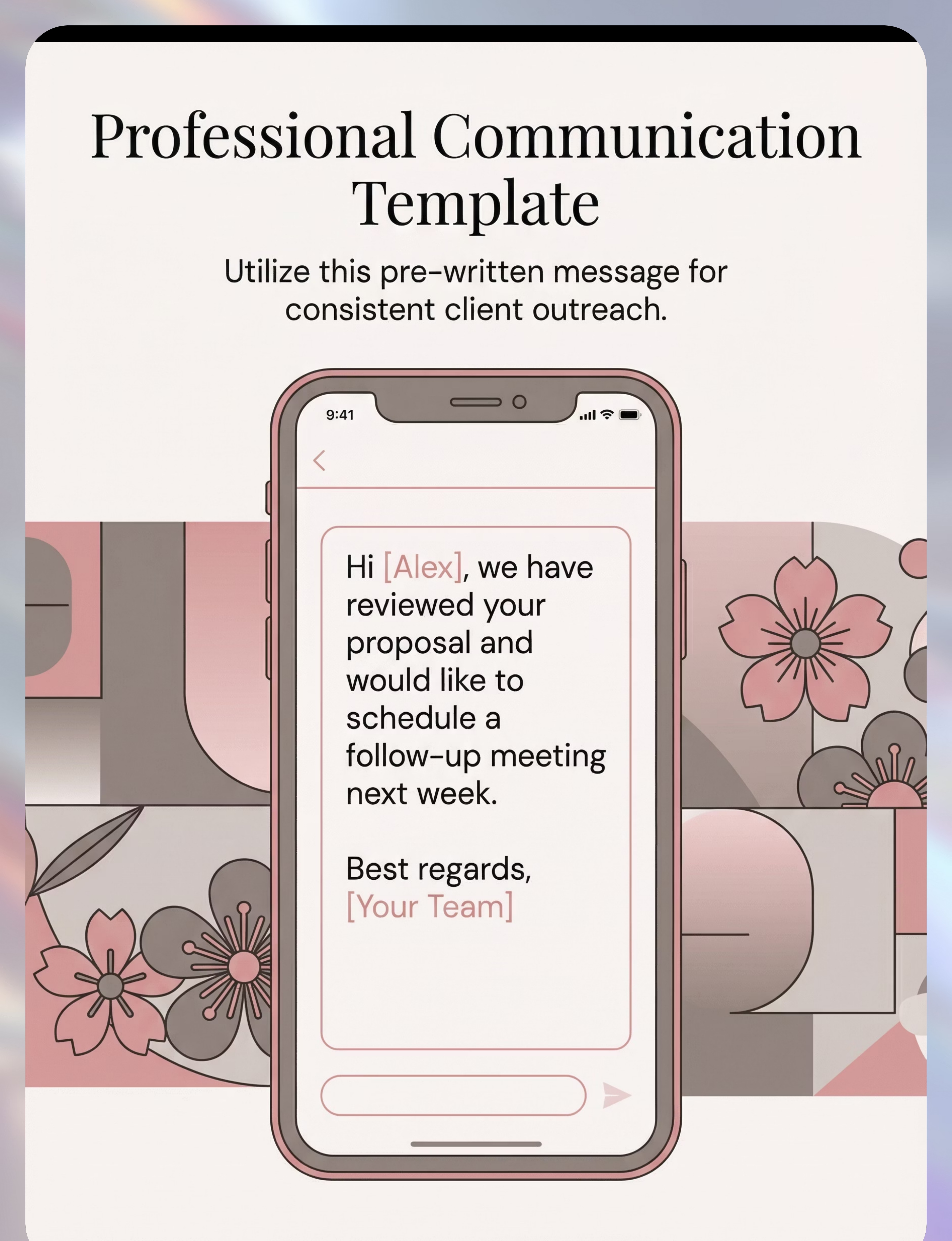
Automated Support Request Templates
REQUEST TEMPLATES → Asking for help without the labor
Burned-out parents often don't ask for help — not because they don't need it, but because asking is its own overwhelming task. Figuring out what to ask for, how to phrase it, overcoming shame, anticipating misunderstanding — all of this requires cognitive resources that depleted parents don't have.
Automated support request templates remove the friction from asking. They're pre-written messages that specify exactly what kind of help is needed, making it easy for both the parent to ask and the helper to respond.
The templates also include guidance for helpers: "Please don't offer advice. I just need practical help." This reduces the emotional labor of explaining, justifying, or managing others' reactions.
Support Request Templates: Ready to Send
Save these in your phone notes or on a printed card. Fill in the blanks and send when needed. Reduces decision fatigue and emotional labor every time.
Meal Support
"Hi [name], we're struggling to keep up with meals right now. Would you be able to bring something on [day]? Anything works — takeout, frozen, homemade. No need to stay. Just drop and go is totally welcome."
Childcare Respite
"Hi [name], I need some respite time. Is there any chance you could take [child] for [X hours] on [day]? Even if it's just an hour, it would help. Let me know."
Company (Not Advice)
"Hi [name], I'm lonely and exhausted. Would you be willing to come over for an hour? You don't need to do anything — just sit with me while the kids play. No advice needed, just presence."
Phone Connection
"Hi [name], I miss talking to you but I'm too overwhelmed to have a real conversation. Can we do a 15-minute call this week? Just to hear your voice. I might cry. That's okay."
Safety Note: Some people will not respond or will respond unhelpfully. This is about them, not about you deserving help. Cast a wide net and focus on helpers who come through.
Key Insight:Asking for help is work. Templates do the work for you so the ask becomes possible.

Material 4 of 9
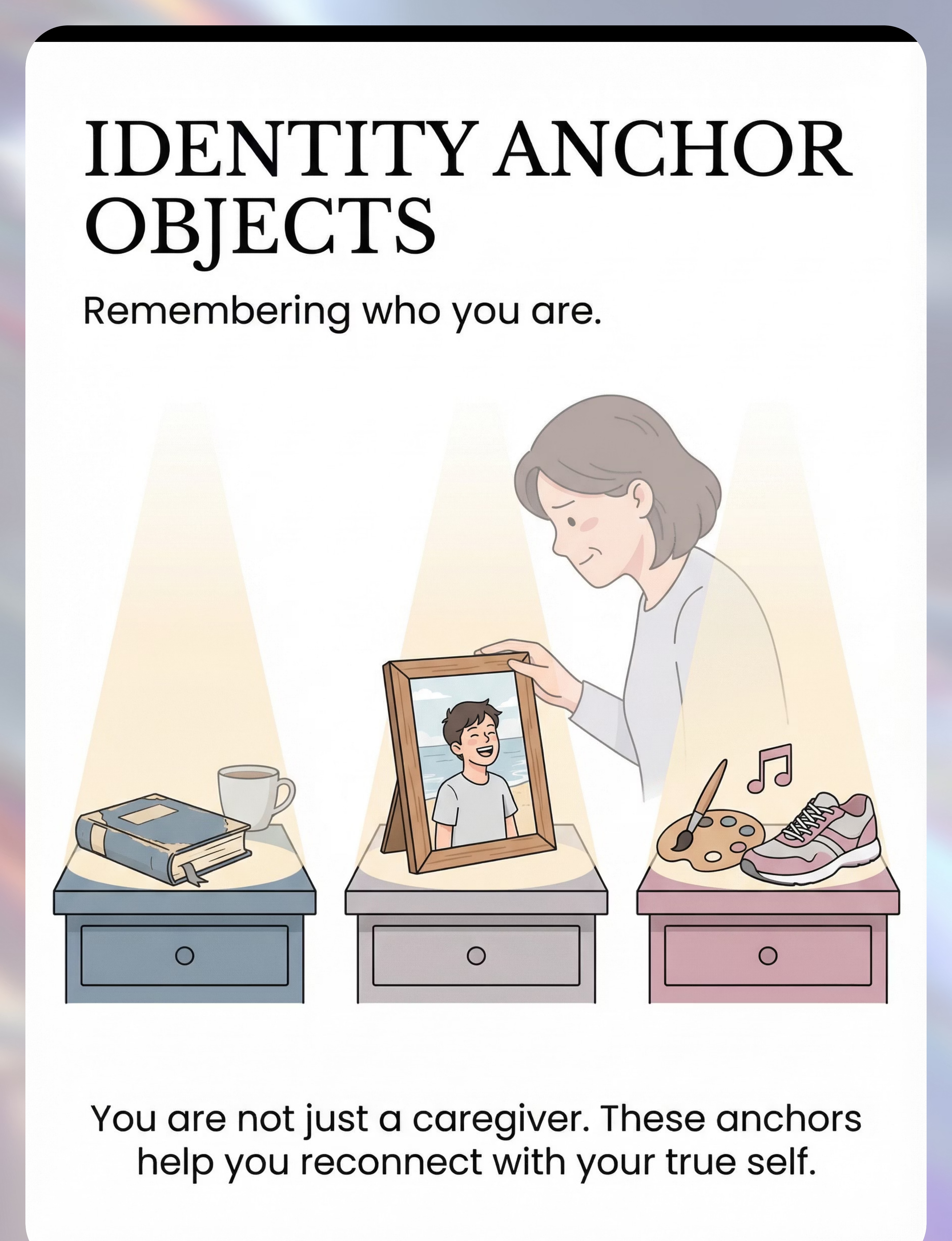
Identity Anchor Objects
IDENTITY ANCHORS → Remembering who you are
A painful dimension of caregiver burnout is identity loss — the sense that you've disappeared into the caregiving role and can no longer access who you were before. You were a person with interests, passions, personality, dreams. Now you're a caregiver, advocate, scheduler, and manager.
Identity anchor objects are small physical items that connect you to parts of yourself that existed before caregiving consumed everything. They are tangible reminders: I am more than this role.
"You haven't disappeared. Parts of you are dormant, not dead. Anchors keep the connection alive."
Identity Anchors: Finding and Placing Them
Identify Your Lost Identities
Who were you before caregiving consumed everything? Examples:
- Reader, artist, cook, dancer, traveler
- A professional with a career identity
- Musician, athlete, gardener, writer
- Adventurer, friend, collector
Pick 2–5 small objects that represent these identities.
Placement & Use
- Put anchors where you'll see them daily — nightstand, kitchen counter, bathroom
- Don't hide them. Visibility is the point.
- No action required. Just notice them.
- When you see the object, let it remind you: this part of me still exists
- Optional: 30-second moment of connection — pick it up, remember
Examples: Camera on shelf (photography). Dance shoes visible (dancer). Cookbook open on counter (cooking). Photo from a trip (traveler).
Safety Note: Identity anchors can trigger grief for what's been lost. This is normal and valid. If grief feels overwhelming, the anchors are working — they're surfacing something real that may benefit from therapy.
Key Insight:Dormant is not dead. Your identity is waiting, not gone.
Material 5 of 9
Feeling Validation Cards
VALIDATION CARDS → Permission to feel what you feel
Burned-out parents often add suffering to suffering by judging their own feelings. They feel exhausted, then criticize themselves for not having more stamina. They feel resentment toward their child, then shame themselves for being a "bad parent." This internal criticism compounds the pain.
Feeling validation cards are simple cards with statements that normalize and validate difficult parenting emotions. They interrupt the self-judgment cycle by providing an external voice of compassion — saying what you need to hear, when your inner critic is loudest.
Over time, the messages can become internalized, building a more self-compassionate inner voice that doesn't require the card to speak up.

Validation Cards: What to Write
One statement per card. Simple, readable. No lectures or advice — just validation. Keep the stack accessible: nightstand, kitchen drawer, wallet. Pull when feeling judged by your own mind.
On Exhaustion
"You're exhausted because you're doing an exhausting job. This is not weakness — it's reality. Being tired doesn't mean you're failing. It means you've been working too hard for too long."
On Resentment
"Feeling resentment doesn't make you a bad parent. It makes you a human who needs more support. Resenting the demands is not resenting your child — the feelings are different."
On Grief
"You're allowed to grieve the life you expected. Grief and love can coexist. Missing who you used to be is valid. You've given up a lot."
On Escape Fantasies
"Fantasizing about running away doesn't mean you will. It means you need a break. Imagining a different life is a normal response to an overwhelming situation."
On Self-Doubt
"You're doing better than you think. Burnout distorts your view of yourself. If you weren't a good parent, you wouldn't be struggling this hard to do right by your child."
On Guilt
"Feeling guilty doesn't mean you've done something wrong. It often means you care deeply. You don't have to earn rest or prove you deserve help. You already do."
Safety Note: If feelings include persistent hopelessness or thoughts of self-harm, please seek professional help immediately. These require more than cards can provide.
Key Insight:Your hardest feelings are normal. Validation interrupts the shame spiral and makes suffering bearable.

Material 6 of 9
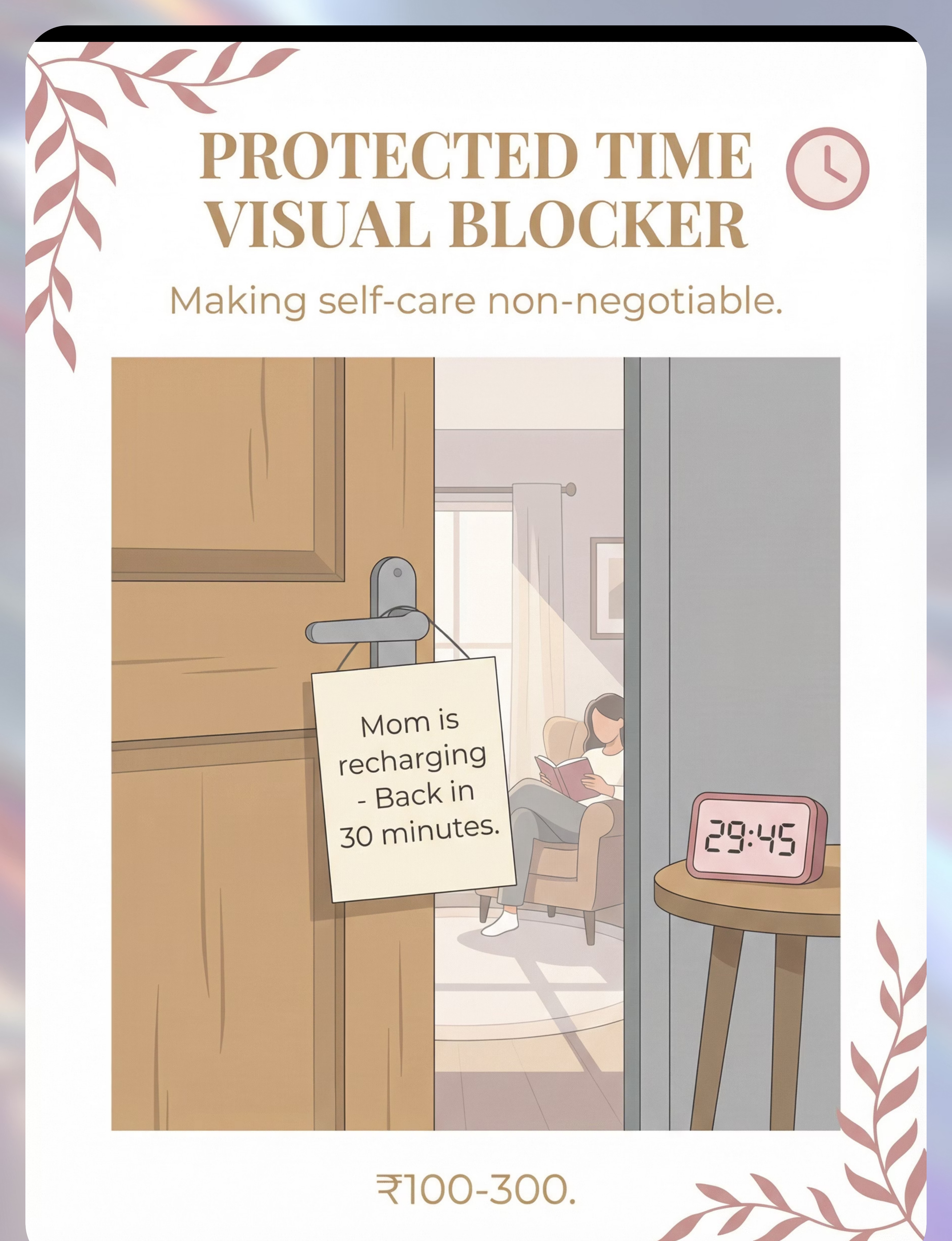
Protected Time Visual Blocker
TIME BLOCKER → Making self-care non-negotiable
Burned-out parents rarely take time for themselves because caregiving demands always seem more urgent. Even when respite is theoretically available, the parent fills the time with caregiving tasks — "I should use this hour to do therapy prep, answer emails, research programs." The to-do list is never done.
Protected time visual blockers make self-care time visible and boundaried, treating it with the same priority as any other appointment. The visual element is key: it makes the abstract commitment to self-care concrete, communicates to others that this time is real, and creates a boundary where boundaries have collapsed.
Even 15 minutes of truly protected time — not multitasking, not on call, not interruptible except for emergencies — is valuable. Start there.
Protected Time: How to Create It
Door Sign
Simple sign: "Mom/Dad is recharging. Back in ___ minutes." Hang on door handle. Visible to anyone who might interrupt. Can include "unless emergency" qualifier.
Designated Space
One chair or corner that is "parent space." When you're there, you're off duty. The physical spot becomes a visual signal that means protected time.
Visible Timer
Timer counting down protected time. Others can see: X minutes until parent is available. Creates accountability and reduces ambiguity about when you'll return.
Calendar Blocking
Schedule "parent time" like any appointment. Color-code it. Treat it as non-negotiable as your child's therapy. If you wouldn't cancel their session, don't cancel yours.
Safety Note: Protected time requires someone else being responsible for the child. If you're the only caregiver, this may only be possible during your child's sleep or when another adult is present. This is a structural problem requiring support — not a personal failure.
Key Insight:What isn't boundaried gets bulldozed. Visual blockers create the lines that keep you in the equation.

Material 7 of 9
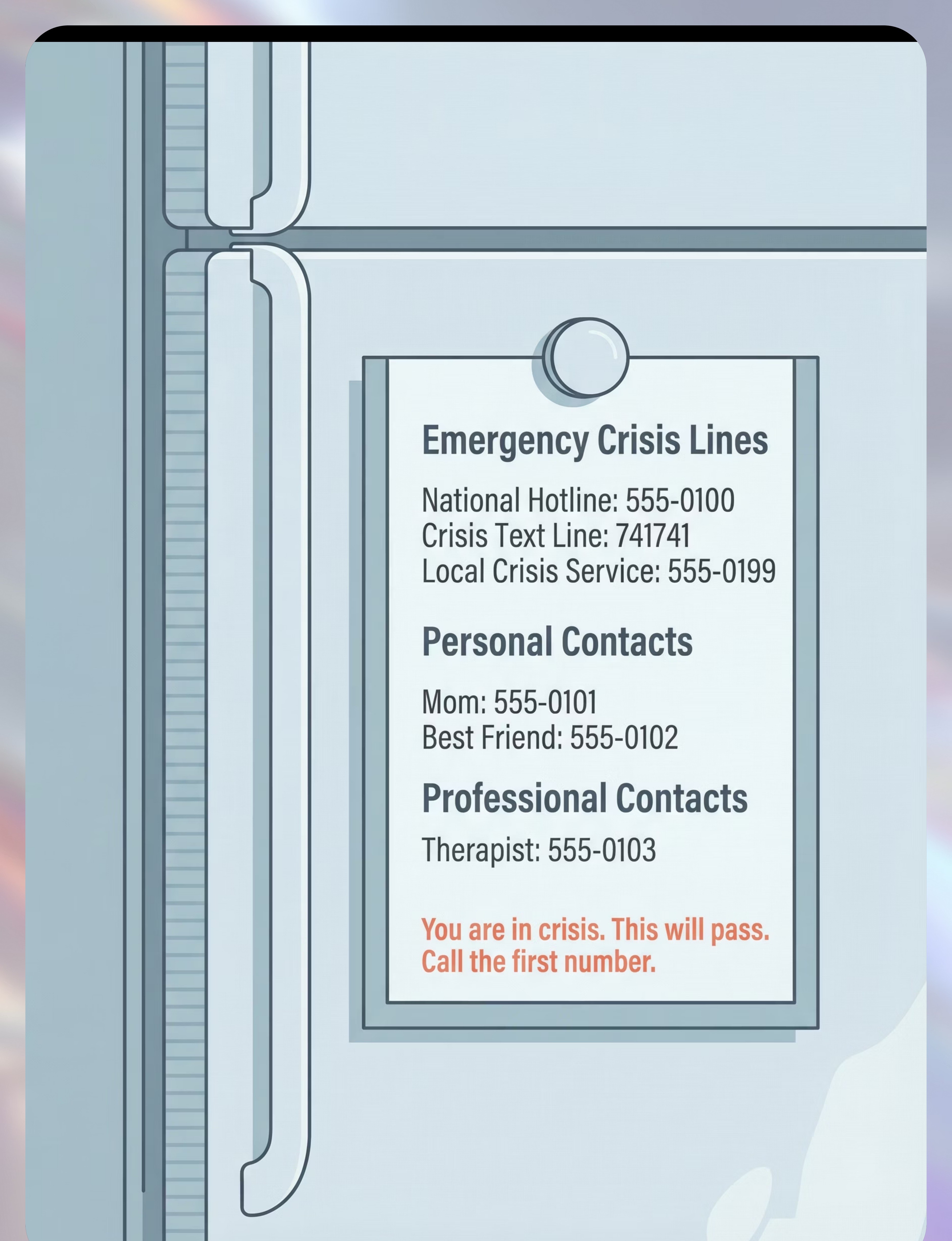
Crisis Contacts Card
CRISIS CARD → Help when you're past helping yourself
When burnout reaches crisis level — you can't stop crying, you're having thoughts of harming yourself, you feel you might snap — depleted parents often don't know who to call or can't access the information in that state. Thinking clearly is impossible when you're in crisis. The crisis contacts card removes that barrier.
It puts essential numbers in one visible place, prepared in advance — before you need it. You may never need it. But knowing it's there provides a safety net. And if crisis does come, you've removed one barrier between you and help.
If you are having thoughts of suicide, harming yourself, or harming your child, please use this card or call emergency services immediately. Reaching out is strength.
Crisis Card: What to Include & Where to Put It
What Goes on the Card
- Crisis Lines: National mental health crisis line, suicide prevention hotline, crisis text lines
- Personal Emergency Contacts: 2–3 people who could come to your house immediately and know your situation
- Professional Contacts: Therapist's office and emergency line, doctor, psychiatrist if applicable
- Practical Backup: Who can take your child on zero notice? Who has a house key?
- Reminders: "You are in crisis. This will pass." "You are not a burden for needing help."
Placement & Setup
- Refrigerator (primary location)
- Wallet (always with you)
- Phone note — screenshot in camera roll
- In car. By bed. Multiple locations.
- Create phone contact called "AAA CRISIS" so it appears first
- Laminate or protect — it needs to last
India Crisis Lines: iCall: 9152987821 | Vandrevala Foundation: 1860-2662-345 | NIMHANS: 080-46110007
Key Insight:Crisis depletes the ability to seek help. Prepare the path to help before you need it.
Material 8 of 9
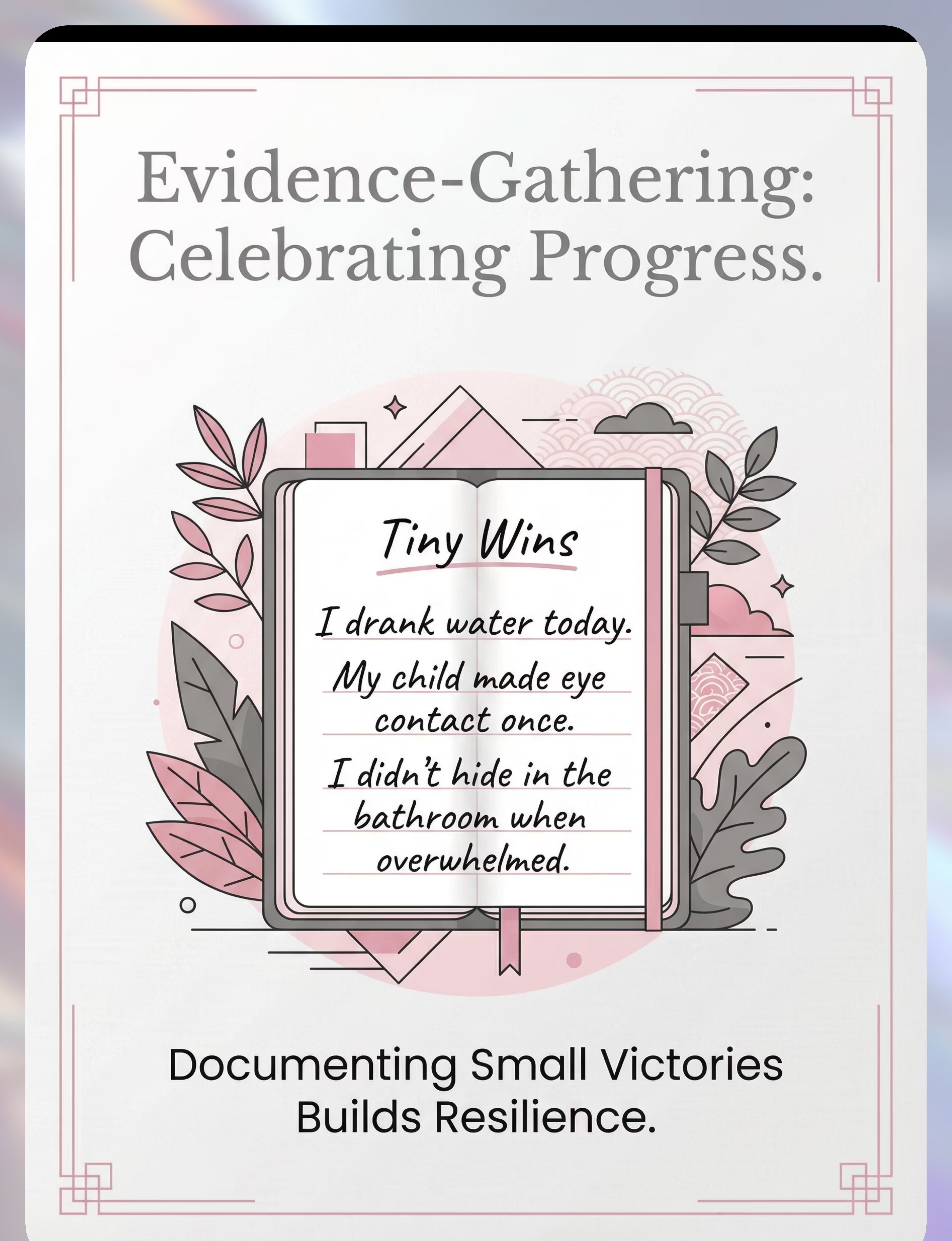
Gratitude & Tiny Wins Log
TINY WINS LOG → Finding what's working
Burnout narrows focus to what's wrong, what's hard, what's failing. The brain's negativity bias is amplified by exhaustion. A gratitude and tiny wins log deliberately redirects attention to what's working — not to deny the hard parts, but to balance the ledger.
The practice is brief: 1–3 things daily, written or mental, taking less than a minute. Over time, this rewires the brain's attention patterns. You start noticing what's going right because you're looking for material for the log. The hard stuff doesn't disappear — but it's not the only thing you see.
Burned-out parents often discount their accomplishments. The log redefines what counts as a win: "I drank water today." "I didn't yell, even though I wanted to." These are real wins in a hard life.

Tiny Wins Log: What Counts & How to Start
What Counts as a Tiny Win
- You got out of bed
- You fed people (including yourself)
- A therapy technique worked for even 5 seconds
- Your child did something positive
- You didn't lose your temper when you wanted to
- You asked for help
- You said no to something
- You rested for even a moment
- You showed up for an appointment
- You made it through the day
Prompts If You're Stuck
- What's one thing that went slightly better than yesterday?
- What's one thing I'm glad I did?
- What's one thing I'm glad I didn't do?
- What's one moment I want to remember?
- What's one thing about my child I appreciated today?
"I survived" is always valid. "I tried" is always valid. These count.
Safety Note: If you genuinely cannot find anything to be grateful for over a sustained period, this may indicate severe depression rather than typical burnout. Please seek professional support.
Key Insight:What you focus on expands. Noticing wins doesn't deny the hard parts — it balances them.
Material 9 of 9
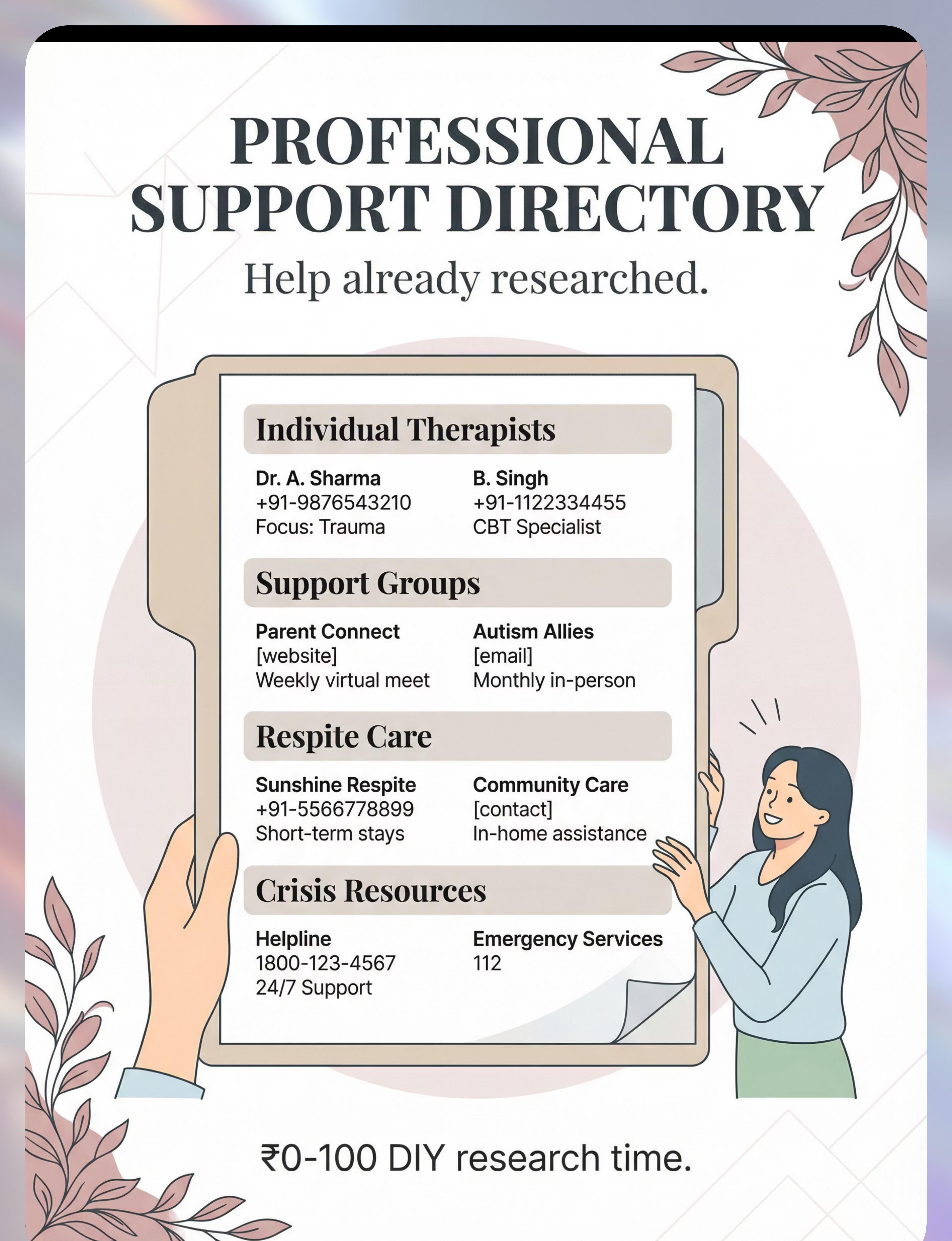
Professional Support Directory
SUPPORT DIRECTORY → Help already researched
Burned-out parents know they need professional help — therapy, respite, support groups — but researching options is yet another task requiring energy they don't have. A pre-researched directory removes this barrier by gathering all relevant support options in one place, ready to reference when help is needed.
Having the information ready transforms "I should find a therapist" from an overwhelming project into a simple action: pick from the list, make the call. The more friction removed, the more likely you will actually access help when you need it most.
This directory can be created during a slightly higher-capacity moment — or by a supportive friend or family member who wants to help but doesn't know how. That's a perfect ask to make.
Support Directory: Categories to Research
Individual Therapists
- Specializing in caregiver stress, burnout, parenting
- Insurance accepted or sliding scale options
- Telehealth availability
- What to say: "I'm a caregiver experiencing burnout and need support"
Support Groups
- Local in-person groups for special needs parents
- Online groups and video call options
- Diagnosis-specific groups if relevant
- Meeting times and how to join
Respite Care
- Local respite providers and agencies
- Requirements, cost, and availability
- How to arrange and fund
- Emergency respite options
Crisis Resources
- Crisis hotlines (local and national)
- Emergency mental health services
- Nearest hospital with psychiatric services
Practical Support
- Meal services or delivery discounts
- Housekeeping services
- Errand services and childcare options
Online Resources
- Websites with burnout resources
- Helpful apps for caregivers
- Podcasts for caregiver support
Key Insight:Barriers compound. When help is pre-researched, one barrier is removed and connection becomes possible.
All 9 Materials at a Glance
Together, these tools address the full spectrum of parent overwhelm — from daily survival to crisis readiness, from identity preservation to support access. Start with what feels most urgent.
1
Create your Crisis Card first
Safety always comes first. This takes 10 minutes and could save everything.
2
Choose your Identity Anchors
Place 2–5 objects where you'll see them. No action required — just presence.
3
Make your Micro-Care Cards
Write 10–20 cards. Keep the stack visible. Pull one whenever you have 5 minutes.
4
Start simple journaling
Even just a 1–10 daily rating. 30 seconds. That's enough to begin seeing patterns.
5
Write your Request Templates
Save 3–5 templates in your phone. Send the first one this week.
6
Add Validation Cards + Tiny Wins
Write validation statements for your hardest feelings. Note one win per day.
7
Implement a Time Blocker
Start with 15 minutes, 3× per week. Protect it like a therapy appointment.
8
Build your Support Directory
When you have slightly more capacity — or ask someone to do this for you.

Materials Summary: Cost & Category
Material | Category | Cost Range | DIY? | |
5-Minute Micro-Care Cards | Daily Survival | ₹100–300 | Yes | |
Burnout Self-Assessment Journal | Self-Awareness | ₹150–400 | Yes | |
Automated Support Request Templates | Support Access | ₹50–150 | Yes | |
Identity Anchor Objects | Identity & Compassion | ₹0 | Items you own | |
Feeling Validation Cards | Identity & Compassion | ₹100–300 | Yes | |
Protected Time Visual Blocker | Boundaries | ₹100–300 | Yes | |
Crisis Contacts Card | Crisis Safety | ₹0–50 | Yes | |
Gratitude & Tiny Wins Log | Daily Survival | ₹100–200 | Yes | |
Professional Support Directory | Support Access | ₹0–100 | Yes |
Total for all 9 materials: ₹500–1,500. Most can be created from items you already own. The essential starter kit: Micro-care cards + Crisis contacts card + One identity anchor.
A Message From Someone Who Understands
"I want to start by saying what no one says enough: what you're going through is genuinely hard. Not 'hard like everyone's life is hard.' Hard in a way that most people will never understand. You are doing more than most people could handle. You're running a marathon that has no finish line, with no training, no breaks, and often no recognition. And if you're burned out, that's not a personal failure. It's an entirely rational response to an impossible situation."
The 9 materials in this resource are not about "fixing" your burnout with small hacks. They are about survival — about finding the smallest possible actions that might help when big actions are impossible. They are something to hold onto while you find the bigger help you need.
You deserve support. Not because you've earned it — because you exist and you're struggling and help is what struggling people deserve.
What Sustainable Caregiving Can Look Like
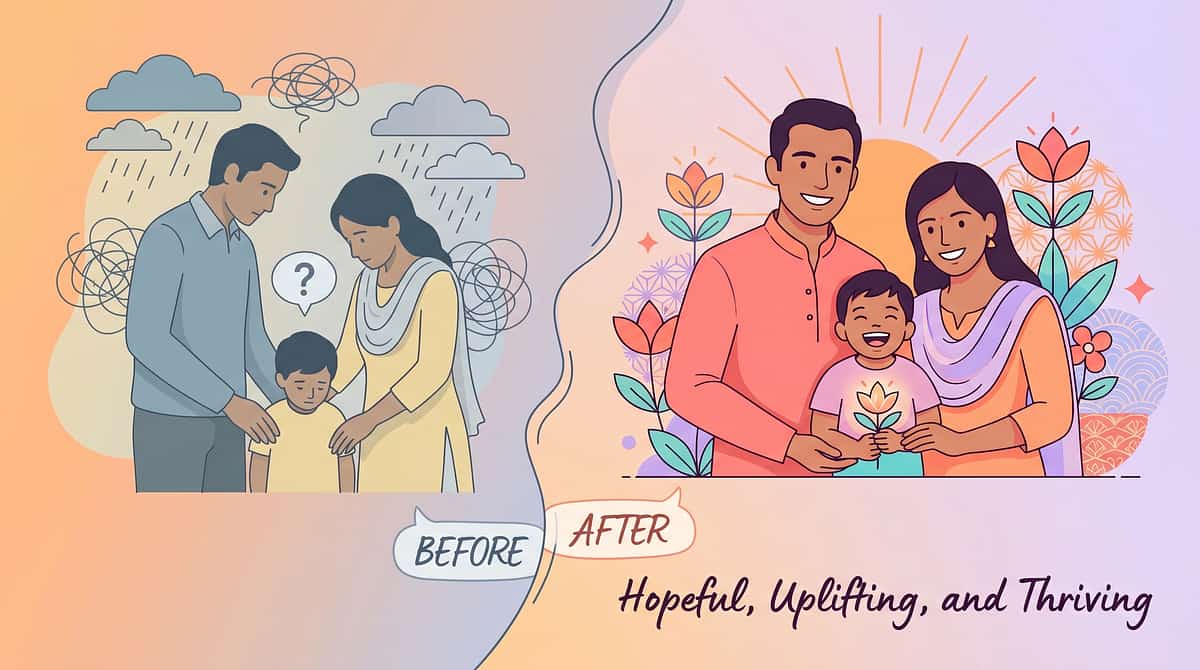
Recovery from burnout is not linear, and it doesn't mean caregiving becomes easy. It means it becomes survivable — and sometimes, on good days, even meaningful.
Crisis-Level Burnout
No supports, at risk, barely surviving each day
High Depletion
Minimal support, barely coping with daily demands
Moderate Stress
Some supports, managing with difficulty, using survival tools
Sustainable Caregiving
Regular support, maintained identity, relationships functional
Thriving Caregiver
Robust support system, full engagement with life, joy alongside caregiving
Sustainable is enough. You don't have to thrive immediately. Moving from crisis to manageable is a profound achievement worth celebrating.
Special Considerations for Different Caregivers
Burnout looks different depending on your circumstances. These adaptations acknowledge that one size never fits all.
Single Parents
All responsibilities fall on one person. No partner to share burden. Higher burnout risk.
Adaptations: Extra emphasis on external support-building, creative respite options, lower internal expectations, more aggressive resource-seeking. You are doing the work of two people.
Parents With Multiple Children
Balancing special needs child with other children. Guilt about attention distribution. Siblings often feel invisible or become little helpers.
Adaptations: Family systems approach, sibling support resources, acknowledge the impossible position without adding guilt.
Parents With Their Own Conditions
Managing own mental health, disability, or chronic illness while caregiving. Capacity is reduced before caregiving even begins.
Adaptations: Explicit priority on parent's own health. No shame for needing more help. Your condition is real and matters.
Cultural Factors
Cultural expectations around caregiving. Stigma about seeking help. Gender role pressures. Family involvement that helps or harms.
Adaptations: Culturally appropriate support sources. Working within family systems. Addressing stigma with compassion, not shame.
Warning Signs That Require Immediate Help
These signs go beyond burnout and require professional intervention — not micro-care cards, not a journal. Please reach out immediately if you recognize any of these in yourself.
- Thoughts of suicide or self-harm
- Thoughts of harming your child
- Complete inability to function or care for your child
- Dissociation or feeling detached from reality
- Substance use that is affecting safety
- Partner violence or family crisis
- Child in danger due to your current state
India Crisis Lines: iCall: 9152987821 | Vandrevala Foundation: 1860-2662-345 | NIMHANS: 080-46110007
These feelings indicate you need and deserve more support than self-help tools can provide. Reaching out for help is strength, not failure. Please make the call.
The Structural Reality of Caregiver Burnout
Burnout is often framed as individual failure — a self-care problem to be solved by the individual parent. This framing is wrong, and it adds blame to injury. Burnout is largely structural.
Self-care alone cannot solve structural problems. These materials keep you afloat within a broken system — while the larger work of systemic change continues. Both matter. Your individual survival matters. And you deserve the structural supports too.
A Survivor's Testimony
"I almost didn't make it. Three years into my son's diagnosis, I was so burned out I couldn't function. I'd lost weight, lost friends, nearly lost my marriage. The turning point wasn't a single thing — it was finally getting real help. A therapist who specialized in caregiver burnout. Respite care that actually worked. A support group of parents who understood without me having to explain. And the small tools that got me through the daily moments: my crisis card on the fridge, my protected 20 minutes every morning before the kids woke up, my validation cards for when I felt like a monster for being angry."
"It's been two years since that crisis point. I still struggle. Caregiving is still hard, and it probably always will be. But I'm surviving now. Sometimes, on good days, I'm even thriving. I've reclaimed pieces of myself. I've rebuilt some friendships. I've found joy with my son, not just exhaustion. Parents who are where I was: please get help. Please know that it can get better. Not easy — but sustainable. That's enough."
— Mother of a child with autism, Pinnacle Network. Illustrative case; outcomes vary by individual circumstances and support access.
Save This for the Hard Days
Share this with a parent who's drowning. Send it to someone who needs permission to rest. You are not failing. You are depleted. And you deserve support.
1
🔖 Save
Bookmark this resource for the moments when you're running on empty and need a reminder of what to reach for first.
2
📤 Share
Send to a parent you know who is struggling. Sometimes the most powerful gift is saying: I see you. Here's something that might help.
3
📞 Call
FREE National Autism Helpline — 9100 181 181 — 16+ languages, 24×7. Parents can call for themselves, not just for their child.
#ParentBurnout
#CaregiverSupport
#SpecialNeedsParent
#SustainableCaregiving
#YouMatter
Coming next in this series: 9 Materials That Help With Parent-Child Connection (Episode K-883)

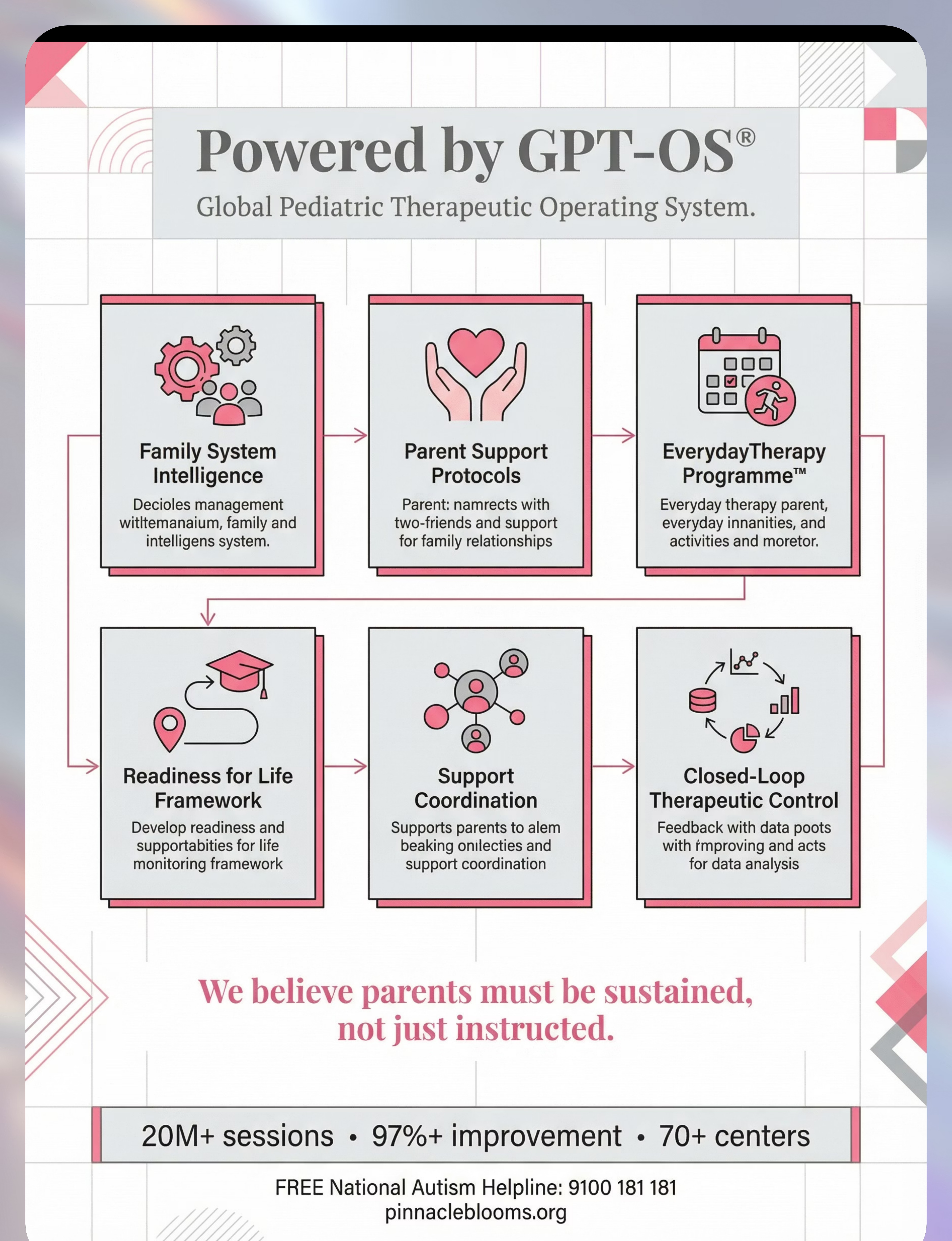
Powered by GPT-OS®
Global Pediatric Therapeutic Operating System
GPT-OS® is the end-to-end operating system that governs diagnosis, prognosis, therapy design, execution, monitoring, and readiness outcomes in child development — as one closed, accountable system. We believe parents must be sustained, not just instructed.
Family System Intelligence
Recognizes that child development cannot be separated from caregiver wellbeing. The family is the unit of care.
Parent Support Protocols
Structured approaches to preventing and addressing caregiver burnout — built into service delivery, not added as an afterthought.
EverydayTherapyProgramme™
Designed to be sustainable — not just for children, but for the families implementing it day after day.
Readiness for Life Framework
Outcomes measured not just in child progress, but in family sustainability and caregiver health over time.
Support Coordination
Connecting families to resources that reduce caregiver burden — from respite care to community supports.
Closed-Loop Therapeutic Control
Continuous adjustment to keep programme demands within sustainable range for each unique family.
20M+ exclusive 1:1 sessions · 97%+ measured improvement · 70+ centers · Built by mothers who understand
Real-World Evidence & Readiness
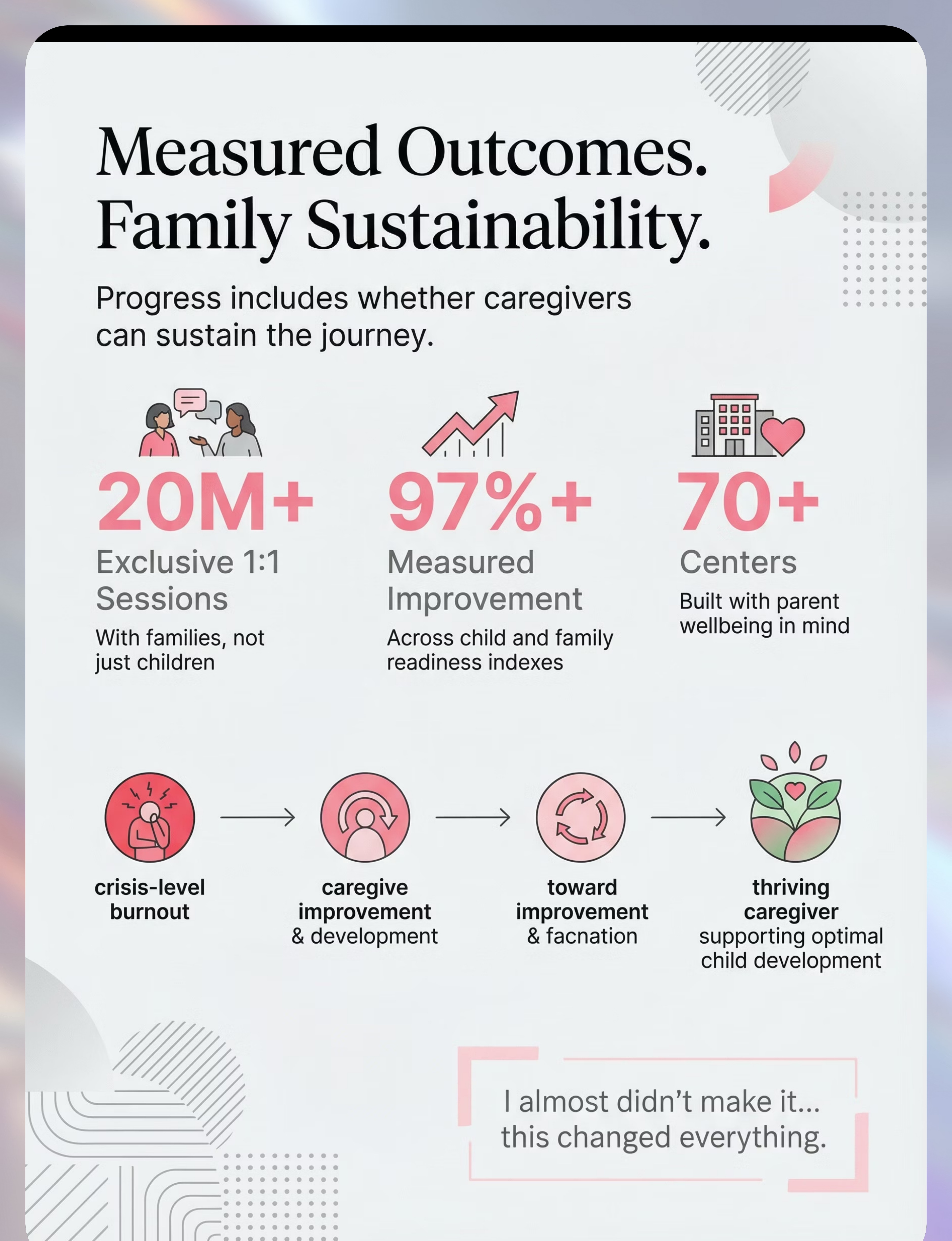
Measured Outcomes. Family Sustainability.
Progress includes whether caregivers can sustain the journey. GPT-OS evaluates outcomes using readiness indexes that include family functioning — not just child metrics in isolation.
1
Exclusive 1:1 Sessions
With families — not just children. Parent wellbeing tracked throughout.
2
Measured Improvement
Across child and family readiness indexes, including caregiver sustainability.
3
Centers
Built with parent wellbeing embedded in every layer of service design.
Caregiver Sustainability Readiness Indexes
For caregiver sustainability, readiness progression is tracked from: crisis-level burnout with no supports → partial support and high depletion → consistent self-care practices with moderate stress → sustainable caregiving with maintained identity and relationships → thriving caregiver supporting optimal child development.
About Pinnacle Blooms Network®
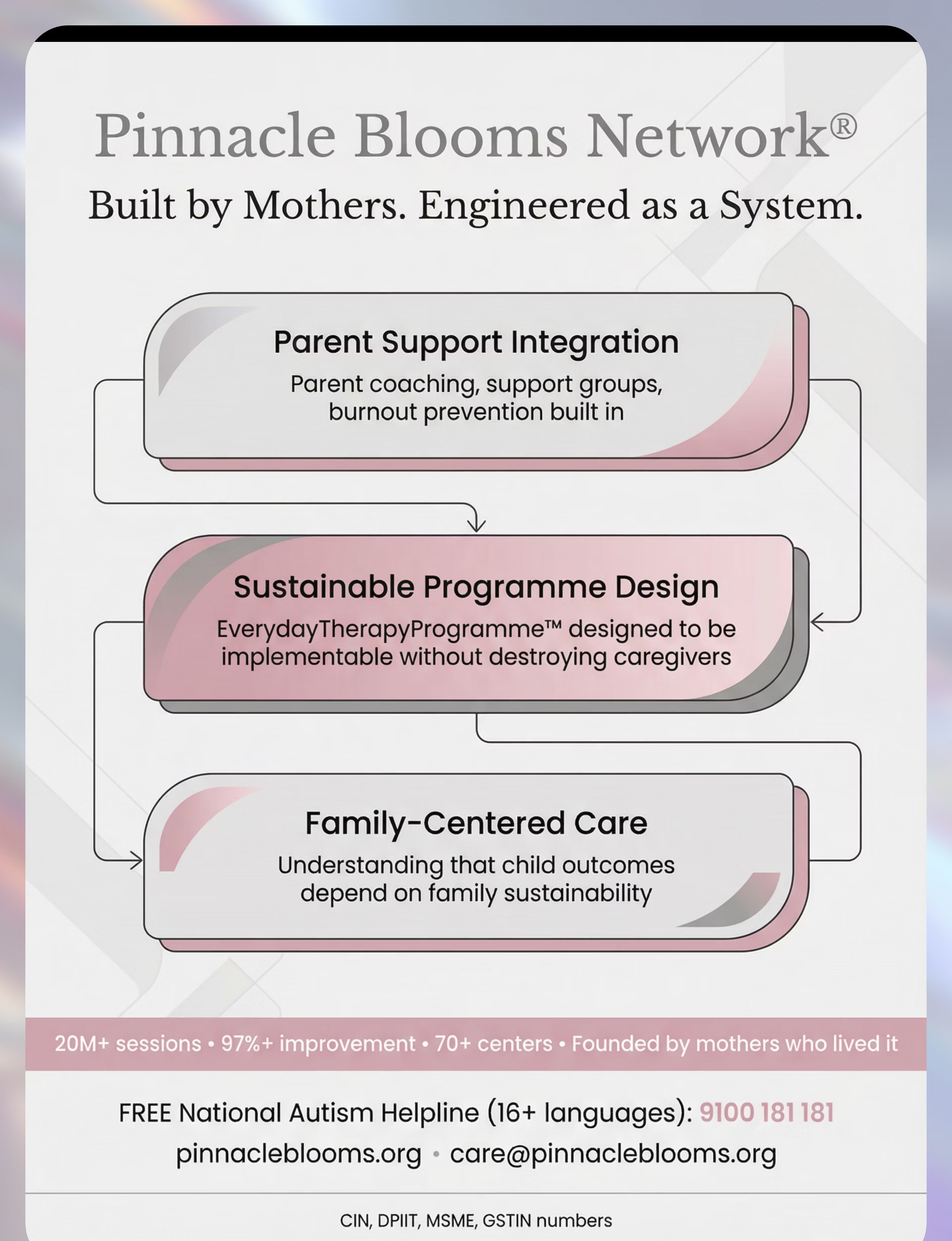
Built by Mothers. Engineered as a System.
Pinnacle is the execution layer of GPT-OS® — built by people who know that parent wellbeing is not an afterthought. Founded by mothers who lived the experience of caregiving, Pinnacle builds systems that sustain families, not just treat children.
1
Parent Support Integration
Parent coaching, support groups, and burnout prevention built directly into service delivery — not as extras, but as essentials.
2
Sustainable Programme Design
EverydayTherapyProgramme™ designed to be implementable without destroying caregivers. Intensity adjusted to family capacity.
3
Family-Centered Care
Understanding that a child's outcomes depend fundamentally on their family's sustainability and caregiver health over the long term.
20M+ sessions · 97%+ measured improvement · 70+ centers · Founded by mothers who lived it

Connect With Pinnacle Blooms Network®
FREE National Autism Helpline
Available in 16+ languages. 24×7. Parents can call for themselves — not just for child-related concerns. You matter too.
9100 181 181
pinnacleblooms.org | care@pinnacleblooms.org
Statutory Identifiers
CIN | U74999TG2016PTC113063 | |
DPIIT | DIPP8651 (Govt. of India) | |
MSME | Udyog Aadhaar: TS20F0009606 | |
GSTIN | 36AAGCB9722P1Z2 |
Pinnacle Blooms Network® is a unit of Bharath Healthcare Laboratories Pvt. Ltd.
Preview of 9 materials that help with parent overwhelm Therapy Material
Below is a visual preview of 9 materials that help with parent overwhelm therapy material. The pages shown help educators, therapists, and caregivers understand the structure and content of the resource before use. Materials should be used under appropriate professional guidance.



Link copied!
Important Notice
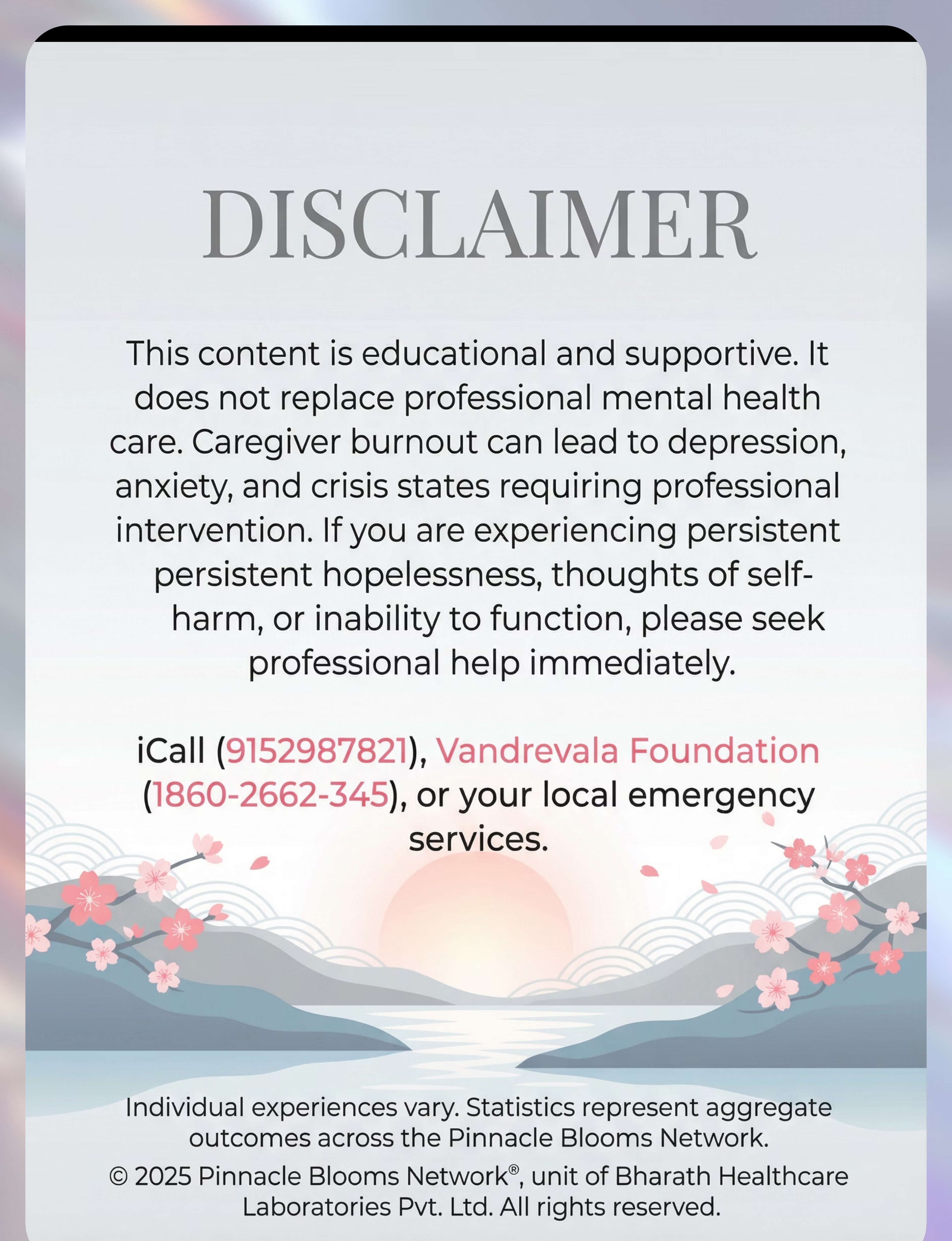
Disclaimer
This content is educational and supportive. It does not replace professional mental health care. Caregiver burnout can lead to depression, anxiety, and crisis states requiring professional intervention. If you are experiencing persistent hopelessness, thoughts of self-harm, or inability to function, please seek professional help immediately.
Crisis Resources: iCall (9152987821) · Vandrevala Foundation (1860-2662-345) · NIMHANS (080-46110007) · Or your local emergency services.
Sources: Mikolajczak, M., & Roskam, I. (2018). A theoretical and clinical framework for parental burnout. Frontiers in Psychology. | Neff, K. (2011). Self-Compassion: The Proven Power of Being Kind to Yourself. | Parent wellbeing protocols developed through experience with families in 20M+ exclusive 1:1 therapy sessions.
Individual experiences vary. Statistics represent aggregate outcomes across the Pinnacle Blooms Network. © 2025 Pinnacle Blooms Network®, unit of Bharath Healthcare Laboratories Pvt. Ltd. All rights reserved. | Series: Parent Wellbeing & Caregiver Support · Episode K-882 | Related: K-881 Parent Self-Compassion Practices · K-883 Parent-Child Connection · K-884 Sibling Support and Balance