

When Their Body Can't Follow the Plan
Your child sees the obstacle course. Their brain knows exactly what to do. Their legs won't move. This is not stubbornness. This is not laziness. This is motor planning — and it can be built.

Pinnacle Blooms Network®
F-586
Ages 3–12
Pinnacle Blooms Network® | F-586
Why It Happens
What You Need
The Protocol
Progress Arc
Our Research
techniques.pinnacleblooms.org | GPT-OS® Powered | OT • SLP • ABA • SpEd • NeuroDev | 📞9100 181 181
ACT I — THE RECOGNITION MOMENT
The Recognition Moment
"Birthday party. Twelve kids run through the obstacle course laughing. My son stands at the start, frozen. Not scared. Not refusing. Just — stuck. Like the signal from his brain isn't reaching his feet. I smiled and pretended it was fine. Inside, I was breaking." — Parent, Pinnacle Network
This moment is not unique to your family. Millions of parents have stood exactly where you are, watching their child at the edge of participation — close enough to touch it, unable to cross. What you witnessed is not a behavior problem. It is a neurological event with a name, a mechanism, and a documented path forward.
You are not failing. Your child's nervous system is still learning to speak.
🏅 Pinnacle Blooms Consortium
Multi-disciplinary clinical authority
👶 Ages 3–12
Gross Motor • Motor Planning
🔬 Evidence-Based
16+ peer-reviewed studies (2013–2024)
WHO Nurturing Care Framework (2018): Early parental awareness and responsive caregiving directly impacts motor developmental outcomes. nurturing-care.org

ACT I — THE NUMBERS
The Numbers That End the Isolation
Millions of families are watching their children freeze at obstacle courses right now. Here is the science behind the silence.
1 in 6
Motor Coordination Challenges
Children experience difficulties significant enough to affect daily function
80%
Motor Planning Challenges
Children with developmental differences show praxis challenges affecting complex physical tasks
20M+
Therapy Sessions
Exclusive Pinnacle sessions generating the world's largest pediatric motor development dataset
Developmental Coordination Disorder (DCD) — also called Dyspraxia — affects an estimated 1.8 million school-age children in India alone. For children on the autism spectrum, motor planning challenges appear in 40–80% of presentations. These children are not clumsy by nature. Their proprioceptive and praxis systems are processing movement differently — and the right materials change everything.
PMC11506176 — PRISMA Systematic Review (2024) | PMC10955541 — Meta-analysis, World J Clin Cases (2024) | DOI: 10.12998/wjcc.v12.i7.1260

ACT I — THE BRAIN-BODY GAP
The Brain-Body Gap: A Neurological Explanation
Motor planning isn't a single action — it's a three-stage neurological circuit. Understanding where the breakdown happens is the first step to fixing it.
Motor Planning Has Three Stages
The cerebellum coordinates timing and sequencing. The proprioceptive system tells the brain where the body is in space. In many children with DCD, autism spectrum presentations, or sensory processing differences, these systems require therapeutic input to develop efficient communication pathways.
The "freeze" is a gap in the execution arrow — not a gap in your child's desire.
🧠 Stage 1 — Ideation
"I need to step on the stone, then crawl through the tunnel, then walk the beam." Most children with motor planning challenges can do this. They know what to do.
🗺️ Stage 2 — Planning
Organizing the precise sequence of muscle movements required for each action. This is where many children struggle. The route from intention to motor sequence is inefficient.
⚡ Stage 3 — Execution
Sending the planned motor command through the body and receiving proprioceptive feedback to self-correct. Without accurate body-position feedback, every movement is a guess.
"Your child isn't refusing to move. Their praxis system — the brain's motor planning infrastructure — is working harder than you can see, and sometimes it simply cannot complete the circuit. This is a wiring difference, not a behavior choice." — Pinnacle Occupational Therapy Consortium
Frontiers in Integrative Neuroscience (2020): Comprehensive framework for evaluating sensory integration/sensory processing treatment in ASD. DOI: 10.3389/fnint.2020.556660

ACT I — DEVELOPMENTAL MAP
Your Child's Developmental Map
Motor planning develops progressively from infancy through middle childhood. Here is where obstacle course navigation sits — and where intervention opens the path forward.
Age 2–3
Imitates simple 1-step body movements
Age 3–4
Navigates simple sequences & obstacles
Age 4–5
Completes 2–3 element courses with support
Age 5–7 ★
Multi-element obstacle courses — peer level. WHERE MANY CHILDREN WITH MOTOR PLANNING CHALLENGES PRESENT.
Age 7–9
Complex sequences & variation
Age 9–12
Novel course mastery with peer fluency
Comorbidity Awareness
Motor planning challenges commonly co-occur with: Autism Spectrum Disorder (proprioceptive differences, praxis difficulties), ADHD (working memory limitations affecting sequence retention), Developmental Coordination Disorder / Dyspraxia (primary diagnosis), Sensory Processing Disorder (under-responsive proprioception), and Hypotonia (reduced postural control).
WHO Care for Child Development (CCD) Package (2023) | UNICEF MICS indicators | PMC9978394

ACT I — THE EVIDENCE
The Science Is Settled. The Technique Works.
Supported by 16+ peer-reviewed studies (2013–2024) across systematic reviews, RCTs, and 20 million real-world therapy sessions.
PRISMA Systematic Review (2024)
Sensory integration/motor intervention meets evidence-based practice criteria for children with ASD. Level I Evidence.
Meta-Analysis (2024)
Sensory integration therapy promotes gross motor skills across 24 controlled studies. Effect size: Significant.
Indian RCT (2019)
Home-based sensory-motor interventions show significant outcomes in Indian pediatric populations. Locally validated.
NCAEP EBP (2020)
Visual supports, task analysis, and graduated physical guidance classified as evidence-based practices. Practice-level validation.
PMC11506176 | PMC10955541 | PMC9978394 | DOI: 10.1007/s12098-018-2747-4 | NCAEP Evidence-Based Practices Report (2020)
📞FREE National Autism Helpline: 9100 181 181 | 16+ languages | 24×7

ACT II — THE TECHNIQUE
Obstacle Course Motor Planning Intervention
Parent Alias: "Brain-Body Bridge Training"
Domain
Gross Motor • Motor Planning • Sensory-Motor Integration
Age Range
3–12 years
Session Duration
15–20 minutes per session | 4–5 sessions per week
Mastery Timeline
6–10 weeks | Child independently navigates 4–6 element courses
F-586 | Series: Gross Motor & Physical Development | Episode 586 | Pinnacle 128 Canon Materials + 20 Category System
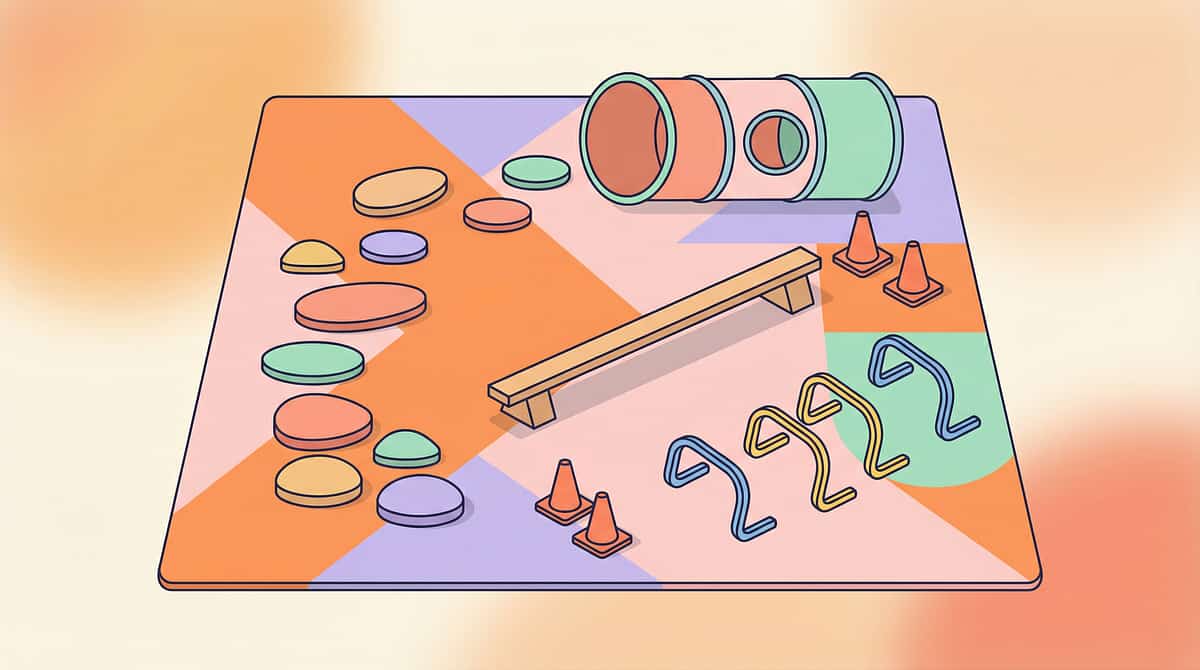
ACT II — THE DISCIPLINES
The Consortium Disciplines Behind This Technique
Motor planning does not belong to one discipline. Five specialties converge because the brain doesn't organize by therapy type.
1
🔵 OT — Occupational Therapy (Primary Lead)
Addresses the sensory-motor integration foundation. Occupational therapists assess praxis, design graduated challenge progressions, and prescribe specific materials targeting proprioceptive, vestibular, and tactile processing.
The OT lens asks: "Which sensory system is limiting the motor plan?"
2
🟢 ABA — Applied Behavior Analysis (Secondary)
Structures the reinforcement environment, task analysis, and data collection framework. ABA principles determine reinforcement schedules, prompt hierarchies, and errorless learning progressions.
The ABA lens asks: "What behavioral antecedents and consequences will sustain engagement?"
3
🟡 SpEd — Special Education (Supporting)
Integrates visual sequence supports, cognitive scaffolding, and working memory supports that translate therapy gains to school-based physical education and play environments.
The SpEd lens asks: "How do we generalize this to classroom and community settings?"
4
🔴 NeuroDev Pediatrics (Diagnostic Oversight)
Provides diagnostic framing (DCD, ASD motor presentations, hypotonia), coordinates inter-disciplinary approach, and determines when pharmaceutical or medical co-management is indicated.
The NeuroDev lens asks: "What is the underlying neurological architecture being addressed?"
"This technique crosses therapy boundaries because the brain doesn't organize by therapy type. A child navigating an obstacle course is simultaneously processing proprioceptive input, executing motor plans, managing working memory, regulating arousal, and problem-solving." — Pinnacle Blooms Consortium, FusionModule™
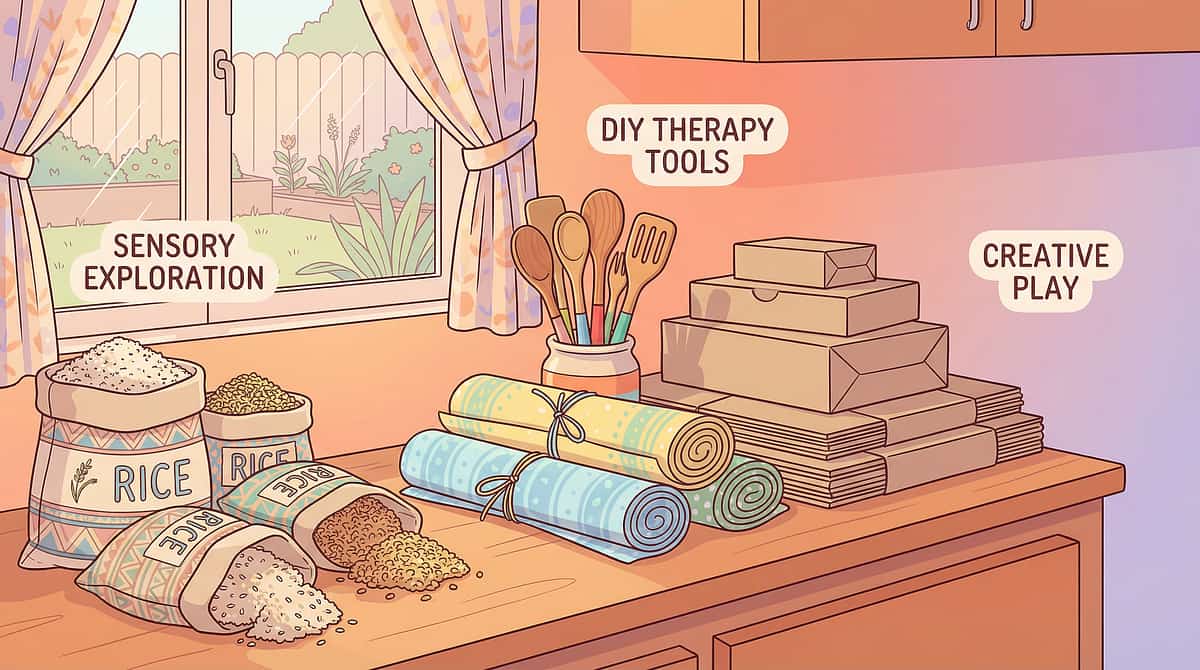
ACT II — PRECISION TARGETS
Precision Targets: What We Are Building
Primary Targets — Core Direct Intervention
- Motor Planning (Praxis): Ideation → Planning → Execution of novel multi-step movement sequences
- Proprioceptive Body Awareness: Accurate internal map of body position in space
- Motor Sequencing: Ability to hold and execute ordered movement plans in working memory
- Spatial Navigation: Judging body position relative to environmental obstacles
🎯 Secondary Targets — Halo Benefits
- Bilateral coordination
- Postural control and dynamic balance
- Anxiety reduction around physical challenge
- Visual-motor integration
- Working memory for sequential tasks
🌱 Tertiary Targets — Long-Term Gains
- Peer play participation
- Physical education readiness
- Self-confidence in physical environments
- Independence in sports and recreation
Week 2–3
Stops bumping into obstacles → Body Awareness building
Week 3–4
Begins obstacle without freezing → Motor Planning activating
Week 4–6
Completes course in correct order → Sequencing established
Week 5–8
Child requests obstacle course play → Confidence confirmed
PMC10955541 — Meta-analysis (2024): Sensory integration therapy effectively promoted motor skills, adaptive behavior, and participation across 24 studies.
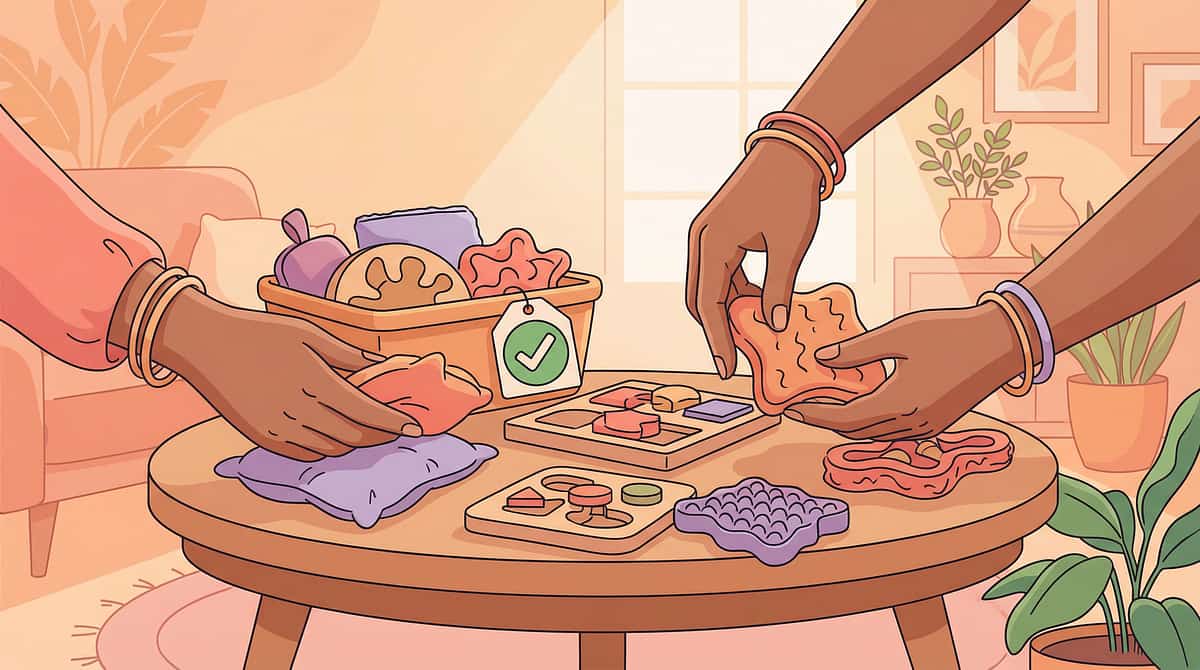
ACT II — 9 MATERIALS
9 Materials. One Brain-Body System.
Each material targets a specific layer of the motor planning architecture. Together, they build the complete system. You don't need all 9 immediately — start with the right 3 for your child's profile.
1. Stepping Stones / Balance Pods
📦 Balance Equipment | ₹1,500–4,000
2. Tunnel / Crawl-Through Tube
📦 Gross Motor Equipment | ₹1,000–3,500
3. Balance Beam / Walking Line
📦 Balance Equipment | ₹800–3,000
4. Cone Weave / Agility Markers
📦 Gross Motor Equipment | ₹300–1,000
5. Hurdles / Step-Over Bars
📦 Gross Motor Equipment | ₹500–2,000
6. Crash Pad / Landing Mat
📦 Safety & Sensory Equipment | ₹2,000–6,000
7. Visual Sequence Cards
📦 Visual Supports | ₹200–800
8. Weighted Materials
📦 Proprioceptive / Sensory Tools | ₹1,500–5,000
9. Timer / Gamification System
📦 Reinforcement / Behavioral Tools | ₹0–500
Total Starter Investment: ₹5,000–15,000 for a complete home obstacle course kit. Zero-cost version available — see DIY Alternatives card.
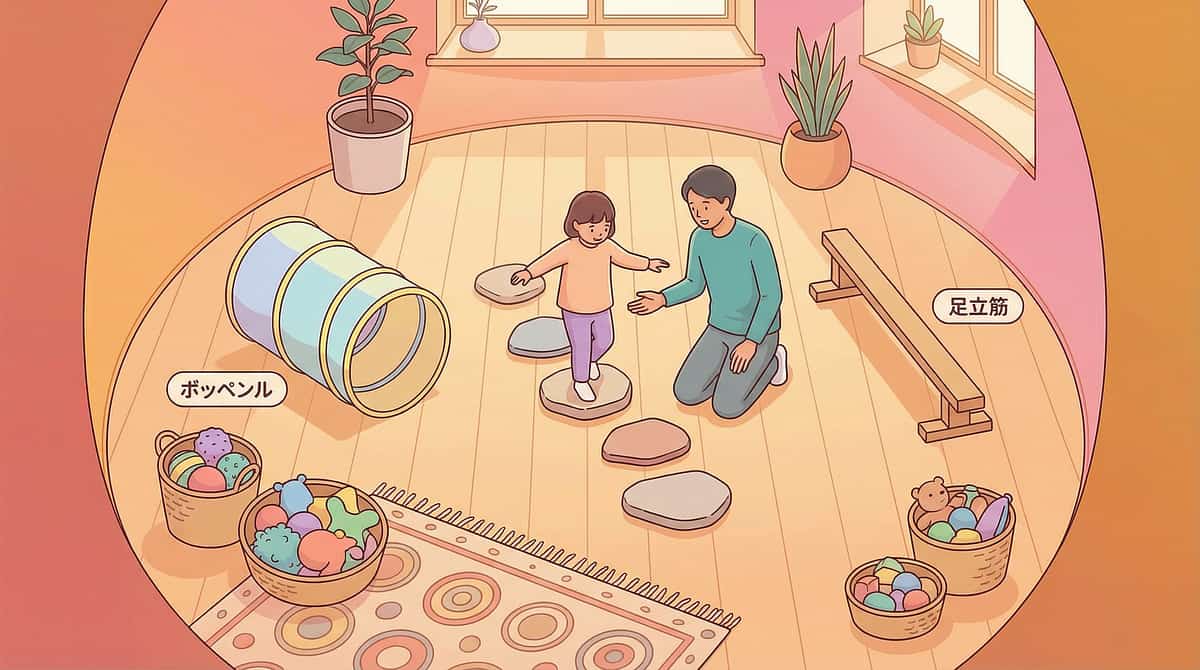
Material 1
Material 1: Stepping Stones / Balance Pods
What It Is
Colorful foam or plastic pods in varying heights and distances that children step across in sequence, requiring active weight-shifting and motor planning for every single step.
Canon Category
📦 Balance Equipment
Price Range
₹1,500–4,000
🔗 Search: "stepping stones kids balance" on Amazon.in
🎯 What It Targets
- Motor planning: Each step requires judging distance and committing to a movement
- Proprioception: Amplified feedback when feet land on uneven surfaces
- Weight shifting: Controlled lateral and forward transfer of body weight
- Sequencing: Choosing the next stone and executing in order
Why It's First
Stepping stones are the foundational element of every obstacle course. Each step requires the child to judge distance, shift weight, and execute — the complete motor planning loop in miniature. Master this, and every other element becomes more accessible.

Material 2
Material 2: Tunnel / Crawl-Through Tube
What It Is
A collapsible fabric or plastic tunnel, typically 1–1.5 meters long, that children crawl through on hands and knees. The enclosed, proprioceptively rich environment is uniquely therapeutic.
Canon Category
📦 Gross Motor Equipment
Price Range
₹1,000–3,500
🔗 Search: "crawl tunnel children play" on Amazon.in
🎯 What It Targets
- Body scheme: Builds the mental map of where your body is in space — especially critical for the enclosed dimension
- Spatial awareness: Judging whether your body fits, how to tuck, how to move forward
- Committed movement sequences: You cannot stop mid-tunnel; the child must commit and execute
- Proprioception: Contact with tunnel walls provides rich proprioceptive feedback
For Fearful Children
Some children fear the enclosed space. Never force. Begin with crawling under a single chair. Build tunnel confidence over 2–3 weeks before reintroducing the full tunnel.

Material 3
Material 3: Balance Beam / Walking Line
What It Is
A low wooden beam (2–5 cm high) or a taped line on the floor, requiring the child to walk heel-to-toe without stepping off. The reduced width forces focused motor control.
Canon Category
📦 Balance Equipment
Price Range
₹800–3,000 (or free with painter's tape)
🔗 Search: "balance beam kids low" on Amazon.in
🎯 What It Targets
- Dynamic balance: Maintaining equilibrium while in forward motion
- Weight shifting: Controlled alternating foot placement
- Postural control: Core engagement to maintain upright stability
- Linear motor planning: Planning a straight-line path from start to finish
The Cognitive Benefit
A clear, constrained path actually reduces cognitive load. When the route is obvious, the child's full attention can focus on motor execution rather than decision-making. This is the balance beam's hidden therapeutic power.

Material 4
Material 4: Cone Weave / Agility Markers
What It Is
Small colorful cones or flat disc markers placed in a line or pattern, requiring the child to weave between, step around, or navigate past without knocking them over.
Canon Category
📦 Gross Motor Equipment
Price Range
₹300–1,000
🔗 Search: "training cones children agility" on Amazon.in
🎯 What It Targets
- Spatial awareness: Learning the precise borders of your body's footprint
- Body-object spatial judgment: "Is my shoulder going to clear that cone?"
- Directional motor planning: Changing direction in sequence
- Real-time adjustment: Self-correcting body trajectory mid-movement
Progression Tip
Start with widely spaced cones (1 meter apart). Progress to 50 cm. Eventually introduce a weave pattern. Each new arrangement is a completely new motor planning demand — novel enough to continue building the system.
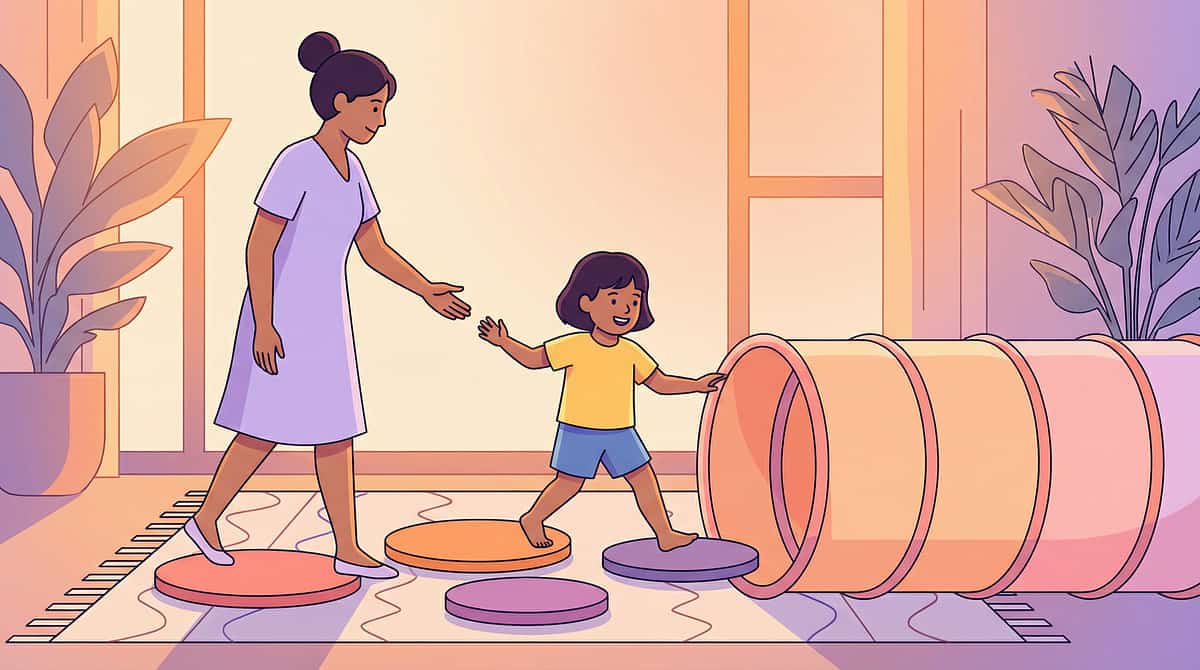
Material 5
Material 5: Hurdles / Step-Over Bars
What It Is
Soft, adjustable barriers (ideally pool noodles resting on upturned cups) that children must step or jump over. The key safety principle: barriers must collapse if contacted, never rigid.
Canon Category
📦 Gross Motor Equipment
Price Range
₹500–2,000
🔗 Search: "hurdles kids adjustable sports" on Amazon.in
🎯 What It Targets
- Height calibration: "How high must I lift my leg to clear this?"
- Leg lift planning: Pre-planning the muscle command before the step
- Motor sequencing rhythm: Step — lift — step — lift without breaking stride
- Bilateral coordination: Alternating legs in a controlled sequence
Real-World Transfer
Height calibration is used constantly in everyday life: stepping over a backpack on the floor, clearing a doorstep, navigating construction zones. Children who practice hurdles show measurable improvements in everyday obstacle avoidance within weeks.
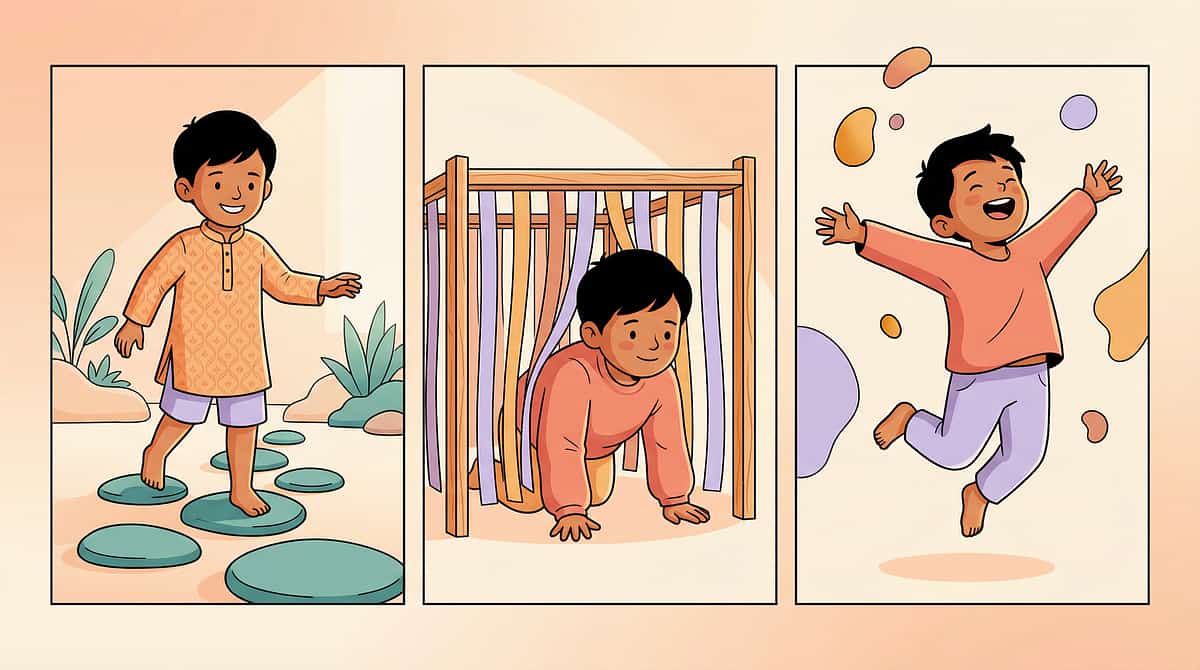
Material 6
Material 6: Crash Pad / Landing Mat
What It Is
A thick foam mat (minimum 4–6 inches) providing a safe, visually inviting landing zone at the end of the course or beneath jumping elements. The crash pad is as much a psychological tool as a physical one.
Canon Category
📦 Safety & Sensory Equipment
Price Range
₹2,000–6,000
🔗 Search: "crash pad gymnastics children foam" on Amazon.in
🎯 What It Targets
- Fear reduction: Removes the consequence of falling; unlocks motor exploration
- Proprioceptive input: Landing delivers deep pressure to joints — a regulatory gift
- Jump-landing motor planning: Planning the jump, anticipating the landing
- Arousal regulation: Physical input on the pad can regulate a dysregulated nervous system
The Psychology of Safe Landings
Children who fear falling avoid physical challenge. The crash pad is the single most important permission-granting element in the entire course. When a child learns that landing is safe and even delightful, they begin attempting elements they previously refused.

Material 7
Material 7: Visual Sequence Cards
What It Is
Photo or drawn cards showing each obstacle in order (1–2–3–4), posted at the START position at eye level. The child can refer to the sequence before and during the course without relying on working memory alone.
Canon Category
📦 Visual Supports / Cognitive Tools
Price Range
₹200–800 (or free with phone photos)
🔗 Search: "visual schedule cards children sequence" on Amazon.in
🎯 What It Targets
- Working memory support: Externalizes the sequence so the child doesn't have to hold it mentally
- Sequence planning: Transforms an invisible plan into a visible one
- Cognitive scaffolding: The scaffold is gradually removed as internalization builds
- Anxiety reduction: Knowing what comes next eliminates unpredictability-triggered freezing
Fading Protocol
When a child completes the course correctly 3 sessions in a row, begin fading: first move cards further away, then remove one card, then remove all. This gradual fading ensures the sequence is genuinely internalized before the scaffold disappears.

Material 8
Material 8: Weighted Materials (Vest / Ankle Weights)
What It Is
A vest or wrap worn before (not typically during) the obstacle course that provides deep pressure and increased proprioceptive input, priming the nervous system for motor planning activity.
Canon Category
📦 Proprioceptive / Sensory Tools
Price Range
₹1,500–5,000
🔗 Search: "weighted vest children sensory OT" on Amazon.in
🎯 What It Targets
- Proprioceptive amplification: More body information = better body map for motor planning
- Body awareness: Weight helps the child "feel" their body more clearly
- Arousal regulation: Deep pressure input calms over-responsive systems and activates under-responsive ones
- Pre-course readiness: Creates optimal neurological state before the motor planning demand
Critical Safety Note
Weight must be 5–10% of the child's body weight maximum. Wear time: 20–30 minutes before activity, then remove. Always consult your OT for precise weight prescription. Never use during activities with significant fall risk from height without professional guidance.

Material 9
Material 9: Timer / Gamification System
What It Is
A visible countdown or stopwatch (phone timer works perfectly) plus a simple reward system — sticker chart, token board, or achievement badges — that transforms the obstacle course from a therapy task into a personal challenge game.
Canon Category
📦 Reinforcement Menus / Behavioral Tools
Price Range
₹0–500 (free stopwatch app)
🎯 What It Targets
- Motivation: Intrinsic competition with self ("beat my time") sustains engagement across weeks
- Self-competition: Removes peer comparison pressure — the only competitor is yesterday's self
- Progress visibility: Children who can see their improvement are neurologically rewarded for practice
- Session structure: A timer signals beginning and end, providing the predictability dysregulated children crave
Active Canon Products
Reinforcement Menu #803 — Reward/motivation material set
Reinforcement Menu #390 — Sticker and token economy system

ACT II — DIY ALTERNATIVES
Every Material Has a ₹0 Version
WHO/UNICEF Equity Principle: No family should be excluded from evidence-based intervention by cost. Here is how to build this entire system from household materials today.
🛒 Buy This
Commercial therapeutic materials for maximum clinical precision
🔨 Make This Today
Household substitutes with equivalent therapeutic mechanism
Stepping Stones | Upturned buckets, carpet squares taped to floor in different colors, folded towels, foam floor tiles |
Tunnel | Blankets draped over chairs in a row, large cardboard boxes with ends removed and taped together, table with tablecloth |
Balance Beam | Painter's tape line on floor (zero-risk), 2×4 wood plank flat on ground, rope laid on floor to walk along |
Cones / Markers | Plastic cups (safe if kicked), empty water bottles with sand inside, stuffed animals as markers, chalk circles on pavement |
Hurdles | Pool noodles across upturned cups (falls away if contacted — no tripping), wrapping paper tubes across weighted containers |
Crash Pad | Stack of folded comforters and blankets (min. 6 inches), couch cushions piled on floor, old mattress on floor |
Visual Sequence Cards | Printed photos of each obstacle taken with your phone, simple drawn pictures, numbered cards from paper plates |
Weighted Vest | Backpack with books (5–10% of child's body weight), compression clothing, heavy work activities as warm-up instead |
Timer / Gamification | Free stopwatch app on phone, homemade sticker chart on paper, hand-drawn achievement badges |
Complete ₹0 Starter Course: Tape line (balance beam) + Blanket tunnel over two chairs + 4 plastic cups as cones + 3 pool noodle hurdles + Pillow stack as crash landing + Hand-drawn sequence cards. Total: ₹0 + household items you own today.
📞9100 181 181 | Free guidance on DIY adaptations | 16+ languages
WHO Nurturing Care Framework (2018): Context-specific, equity-focused interventions implemented across 54 LMICs using household-material-based protocols | PMC9978394
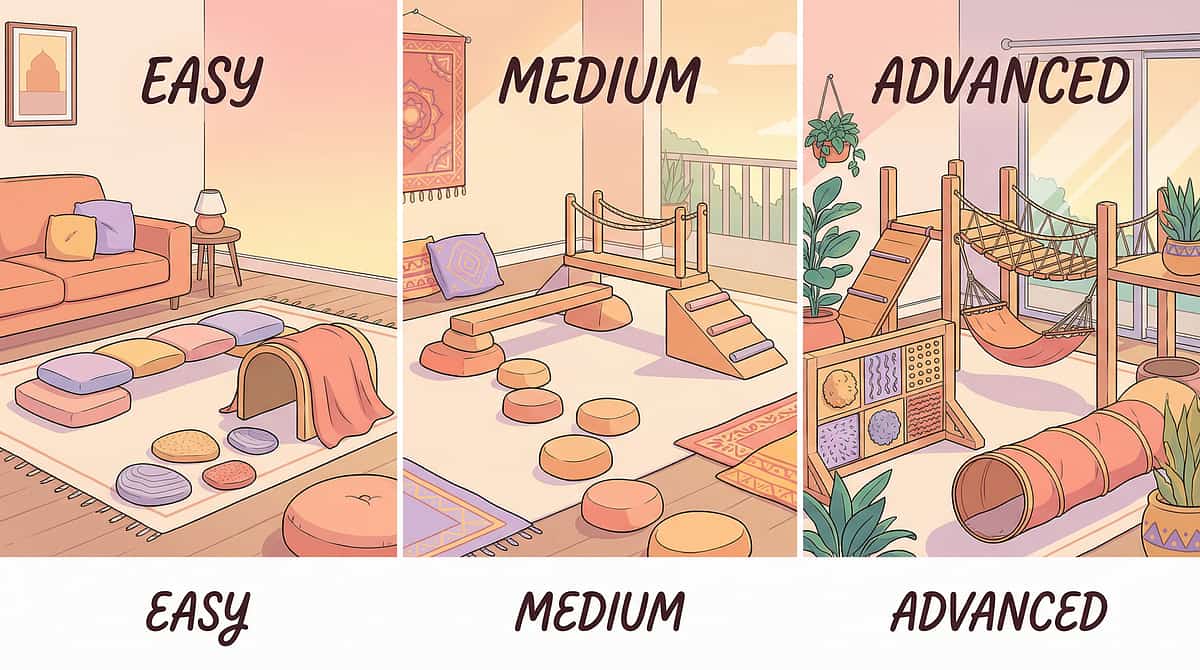
ACT II — SAFETY PROTOCOL
Safety Protocol: Your Pre-Session Checklist
Every session begins with a safety evaluation. This is not optional — it is foundational clinical practice.
1
🔴 STOP — Do NOT Proceed If:
- Child has had a fall or injury in the last 48 hours
- Child is showing signs of illness (fever, unusual fatigue, pain)
- Child has a known seizure disorder — consult neurologist first
- Child is severely dysregulated, in full meltdown, or non-responsive
- Any surfaces are wet, slippery, or unstable
2
🟡 MODIFY — Simplify if:
- Child appears tired, hungry, or mildly dysregulated
- Sensitivity is heightened — reduce to floor-level elements only
- Child is apprehensive about a specific element — remove it entirely
- Less than 2 hours since a large meal
3
🟢 PROCEED — When:
- Child is fed, rested, alert, and regulated
- All surfaces are soft, non-slip, stable
- Parent has 100% supervisory focus
- All elements begin at floor level
- Session will be 15–20 minutes maximum
🔴 Stop Session Immediately If:
- Child cries or screams (distress sounds, not excitement)
- Child vomits or complains of dizziness
- Any fall from height onto hard surface
- Child shows self-injurious behavior triggered by activity
- Child's regulatory state dramatically worsens during session
Emergency Escalation: Mild concern → Modify session → 📞9100 181 181 (free teleconsultation) | Urgent concern → Pause all sessions → Book clinic assessment
Indian Journal of Pediatrics RCT (2019): Safety protocols for home-based sensory-motor interventions. DOI: 10.1007/s12098-018-2747-4

ACT II — SPACE SETUP
Your Home Obstacle Course: Spatial Setup Guide
Spatial Requirements
- Minimum space: 5 meters × 2 meters clear floor area
- Surface: Carpet, yoga mat, or interlocking foam tiles
- Small space: Build 2–3 element mini course in a hallway
Course Sequence
[START] → ① Stepping Stones (2m zone) → ② Tunnel (1.5m) → ③ Balance Line (2m zone) → [FINISH] ④ Crash Pad Landing
← 5–6 meters minimum total course length →
💡 Environment Settings
- Lighting: Bright, natural light preferred. No flickering lights.
- Sound: Quiet. No TV. Calm instrumental music optional.
- Temperature: Comfortable active temperature, no restrictive clothing.
- Distractions: Phones silent. Siblings managed. Protected therapy time.
Parent Positioning Rule
Stand beside the course — never in front. Your job is to observe, encourage, and be present. The child must attempt independently first. Prompt only after genuine attempt.
Card Placement
Visual sequence cards: eye-level on wall at course start. Timer: visible to child from START position.
PMC10955541 — Meta-analysis confirms 1:1 individual structured environment sessions were most effective. Ayres Sensory Integration: Environmental setup is a foundational clinical principle.

ACT III — READINESS CHECK
60-Second Pre-Flight Check
Check all 6 indicators before starting every session. The best session is one that starts right.
Check | ✅ Go | ⚠️ Modify | ❌ Postpone |
Fed & Hydrated | Last meal 45min–2hr ago | Meal within 30 min | Hungry or very full |
Sleep State | Rested, alert | Slightly tired but engaged | Overtired or just woken |
Regulation State | Calm, curious, lightly excited | Mild fidgeting, manageable | Meltdown within last 30 min |
Sensory State | Normal sensory day | Slightly sensitive | Severely dysregulated |
Motivation | Shows interest in activity | Neutral | Active avoidance or crying |
Health Status | No illness signs | Mild sniffles only | Fever, pain, obvious illness |
🟢 6/6 = GO
Begin full protocol
🟡 4–5/6 = MODIFY
2-element course, lower demands, shorter duration
🔴 Under 4 = POSTPONE
Offer a preferred calm activity. Try again tomorrow.
"The best session is one that starts right. A 5-minute session that ends with your child's nervous system intact is worth infinitely more than a 30-minute forced session that ends in tears."

ACT III — STEP 01
Step 1: The Invitation
Duration: 30–60 seconds
Body Language
- Stand at course entrance, facing it — not facing child
- Point to first element with casual gesture — not commanding
- Tone: Excited-curious, not urgent or pressured
- Smile naturally; avoid over-enthusiasm that feels performative
If Resistance
Do not proceed. Offer to watch together first: "We can just look at it for now." Spend 2 minutes familiarizing with elements without any movement demand.
✅ Child Acceptance Signals
- Walks toward the course
- Makes eye contact with an element
- Says "okay" or nods
- Reaches toward an element
⚠️ Child Resistance Signals
- Turns body away
- Says "no" or covers ears
- Flops to floor
- Runs to another area

ACT III — STEP 02
Step 2: The Engagement
Duration: 1–3 minutes
Demonstration Approach
- Show each element yourself, imperfectly — this reduces performance pressure
- Move through slowly, narrating: "Judging the distance... step... okay, tunnel now, I fit if I tuck in..."
- Laugh if you wobble. Model that imperfection is part of the process.
How to Present Each Material
- Stepping stones: Point to first one, say "start here"
- Tunnel: Hold entrance open slightly — invite
- Balance line: Walk it once yourself first
- Crash pad: Hop onto it yourself with a laugh — show it's safe and fun
Child Response Indicators
- Engagement: Moves to first element, asks "can I go?"
- Tolerance: Watches, doesn't approach yet — wait, that's okay
- Avoidance: Backs away — reduce to one element only for today
Reinforcement Cue
When child touches first element: immediate verbal praise — "Yes! You're doing it!" — before they even step. Praise the approach, not just the success.
PMC11506176 — Systematic review: Sensory integration intervention with structured material introduction meets evidence-based practice criteria.

ACT III — STEP 03
Step 3: The Therapeutic Action
Duration: 5–10 minutes
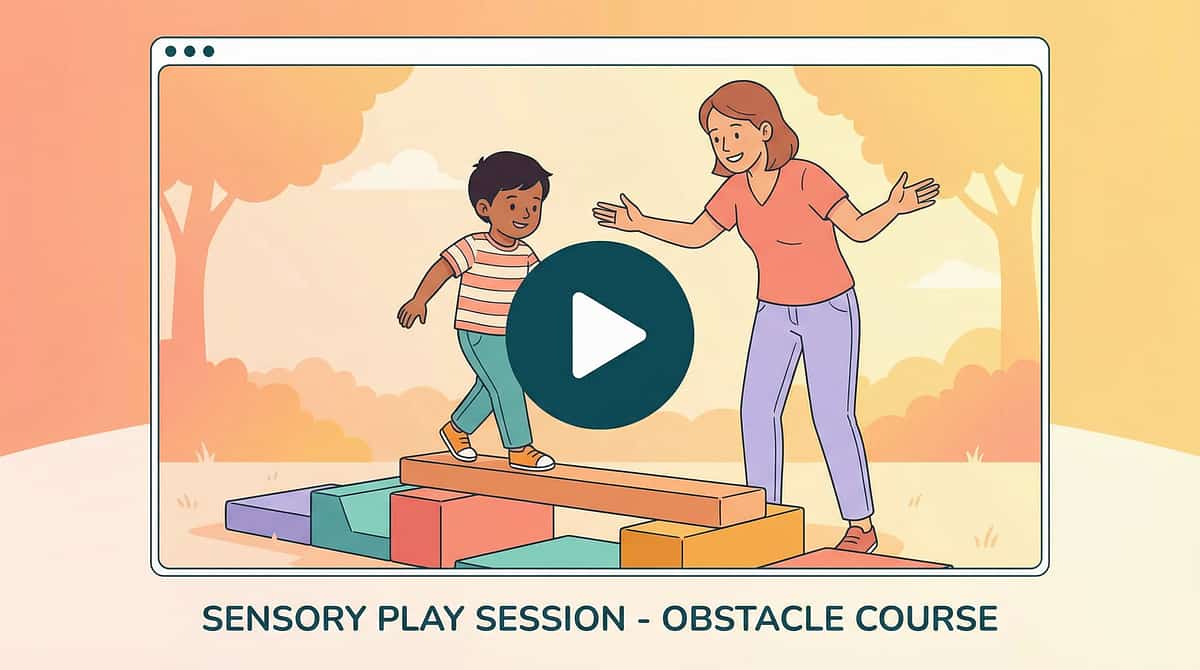
The child navigates the obstacle course in sequence. The therapeutic action is not merely physical — it is the repeated neural circuit activation of: sensory input → motor plan formation → execution → proprioceptive feedback → adjustment.
1
Sessions 1–3: 2 Elements
Stepping stones (3 stones, close together) → Crash pad jump. Use visual sequence cards at start. Parent at side, silent unless needed.
2
Sessions 4–6: 3 Elements
Stepping stones → Tunnel → Crash pad. Cards still posted; begin fading verbal reminders.
3
Sessions 7–10: 4–5 Elements
Full course introduction begins. Timer introduced for self-competition.
Parent Actions During the Course
- ✅ Watch attentively — child registers being witnessed
- ✅ Gentle verbal encouragement at completion of each element: "Balance line — yes!"
- ✅ If child freezes: wait 10 seconds before prompting. Silence is not failure.
- ✅ If child goes out of sequence: allow it, don't correct mid-run. Debrief after.
Prompting Hierarchy (Least to Most Invasive)
Wait
Silence — 10 seconds
Point
Gesture toward next element
Verbal
"What's next?"
Show Card
Point to sequence card
Physical
Hand-over-hand guidance
PMC10955541 — Meta-analysis: Home sessions 15–20 min with core therapeutic action at 40–60% of session time.
ACT III — STEP 03 CONTINUED
Common Execution Errors & Fixes
Error | Why It Happens | Fix |
Parent runs alongside narrating everything | Anxiety — wanting to help | Step back; let silence work |
Child goes in wrong order | Sequencing challenge | Accept it; add numbered cards next session |
Child skips the hard element | Avoidance | Note which one; practice it separately tomorrow |
Child rushes and knocks things over | Motor precision underdeveloped | Slow down — say "slow and steady" |
ACT III — STEP 04
Step 4: Repeat & Vary
Duration: 3–5 minutes
Target Repetitions
- Sessions 1–2: 2–3 full runs (quality > quantity)
- Sessions 3–5: 3–4 full runs
- Sessions 6+: 4–5 runs + time trial on final run
"3 good repetitions are worth more than 10 forced ones. When you see tension, frustration, or shutdown beginning — stop. End before the cliff."
Satiation Indicators — Stop Here
- Child slows significantly without exertion fatigue
- Begins avoiding elements they previously completed
- Smiling stops; expression becomes flat or negative
- Self-stimulatory behavior increases
- Child asks for a break
5 Variation Options
A — Change Direction
Run the course backwards. Different motor planning demand, same elements.
B — Change Speed
"Slow motion run." "Racing speed." "Ninja-quiet run." Speed variation dramatically changes motor planning demands.
C — Add a Carry Task
Child carries a stuffed animal or ball through the course. Dual-tasking = significant praxis upgrade.
D — Rearrange Stones
Move stepping stones to different distances. Novel arrangement = new motor plan required.
E — Eyes-Closed Balance
Tape-line only, eyes closed for 3 steps. Forces pure proprioceptive motor planning.
ACT III — STEP 05
Step 5: Reinforce & Celebrate
Exact Praise Scripts — Specific, Immediate, Genuine
"You walked the WHOLE beam without stepping off! That took real concentration — I watched your feet stay right on the line!"
"You went all the way through without stopping! Your body knew exactly how to fit!"
"YOU DID THE ENTIRE COURSE! That is something your brain and body figured out together — and that is HUGE."
"You went for it. You tried the hard part. That's exactly what practice looks like — and that is worth celebrating."
Type | Example | When to Use |
Verbal | Specific praise scripts above | Every session, every completion |
Social | High five, fist bump, hug (if welcomed) | Each element completion |
Token Economy | Sticker per element → 5 stickers = chosen reward | Sessions 1–4 (building habit) |
Natural Consequence | "Choose the next variation!" | When intrinsic motivation builds |
Tangible | Small preferred item at session end | Use sparingly, fade over time |
"Celebrate the attempt. Not just the success. The child who tries the tunnel and stops halfway has done more therapeutic work than the child who refuses to approach it."
Reinforcement Menu #803 — Reward/motivation material set | Reinforcement Menu #390 — Sticker and token economy system
ACT III — STEP 06
Step 6: The Cool-Down
Duration: 2–3 minutes
No session ends abruptly. The nervous system activated during obstacle course training needs a deliberate downregulation transition. Abrupt endings cause post-session dysregulation — the meltdown 20 minutes after a "great session."
1
Transition Warning (2 min before)
"Two more runs, then we're going to pack up and have some quiet time." Hold up 2 fingers. Use a visual timer for non-verbal children.
2
Final Run Ritual
Last run is always slow and celebrated. "One last explorer run — take your time."
3
Material Put-Away Ritual
Child helps carry stepping stones, fold the tunnel, collect the cones. This provides proprioceptive calming input through carrying and organizing.
4
Body Press & Breathing
If overstimulated: firm palm pressure on shoulders for 10 seconds. Deep breathing: "In for 4, hold for 2, out for 4."
5
Transition Cue
"Great work today. What do you want to do next?" — Offer 2 calm options only.
Visual timer and transition support: Visual supports classified as evidence-based practice for autism (NCAEP 2020).
ACT III — DATA CAPTURE
60 Seconds of Data Now = Months of Insight Later
Within 60 seconds of ending the session, record 3 data points. That's all. Consistency matters more than complexity.
Elements Completed
Circle which elements were completed today. Example: Stones ✅ Tunnel ✅ Beam ❌ Cones ✅
Freeze / Stop Moments
Tally mark for each time child froze mid-course during the session.
Emotional Tone (1–5)
Ring scale: 1=distressed, 3=neutral, 5=joyful. One number, instantly readable.
What the Data Tells You
- Elements completed increasing over weeks → Motor planning building ✅
- Freeze moments decreasing → Working memory and sequencing improving ✅
- Emotional tone trending upward → Confidence and safety feeling growing ✅
- Specific element always triggering freezes → That element needs isolated practice ✅
📞9100 181 181 | Share your data with our teleconsultation team for personalized guidance
ABA Data Collection Standards: BACB Guidelines + Cooper, Heron & Heward (Applied Behavior Analysis, 8th ed.)

ACT III — TROUBLESHOOTING
The Reality Card: When Sessions Don't Go Perfectly
"Session abandonment is not failure — it's data. The most important information you have is what didn't work."
Problem 1: Child froze at the start and wouldn't move
Why: Overwhelm from multi-element visual field. Solution: Block view of full course. Reveal only the first element. Say: "Just this stone right now — nothing else."
Problem 2: Child started but stopped mid-course
Why: Working memory dropped the sequence. Solution: Next session: larger visual sequence cards, numbered stations. Verbal cue: "Check your cards — what's next?"
Problem 3: Child did elements in wrong order
Why: Sequencing challenge. Solution: Accept today, don't correct mid-run. Next session: physical arrows on floor pointing to next element. Color-coded path.
Problem 4: Child kept bumping into cones
Why: Spatial body awareness underdeveloped. Solution: Proprioceptive warm-up first (jumping jacks, crashing into pad 5 times, carrying heavy backpack). Then course.
Problem 5: Child had a complete meltdown
Why: Sensory/emotional overload reached threshold. Solution: Stop session immediately. Co-regulation first. Next session: reduce to 1 element. Note which moment triggered the threshold.
Problem 6: Child refused the tunnel (fearful)
Why: Claustrophobia or uncertainty about enclosed space. Solution: Remove tunnel entirely. Practice crawling under a single chair. Build confidence over 2–3 weeks separately.
Problem 7: Child crashed emotionally 20 minutes later
Why: Post-session sensory rebound — delayed dysregulation. Solution: Extend cool-down to 5 minutes. Add proprioceptive calming at session end. Reduce course intensity by 20%.

ACT III — ADAPT & PERSONALIZE
This Technique Is a Starting Point — Not a Script
⬇️ Easier Modifications
For difficult sensory days and early sessions:
- Reduce to 2 elements (stones + crash pad only)
- Keep everything at floor level
- Keep visual cards in child's hand throughout
- Parent walks alongside (not ahead)
- Double time between elements — child's pace
- Familiar elements only; no new introductions
⬆️ Harder Modifications
For breakthrough sessions and mastery phase:
- 7–8 element courses with novel arrangements
- Time trial: beat personal best
- Carry a weighted object through the course
- Eyes closed on balance beam section
- Parent introduces surprise change mid-course
- Community obstacle courses (playground, park)
Sensory Profile Adaptations
For Sensory SEEKERS (under-responsive)
Begin with 3 min heavy work. Use weighted vest. Make steps larger, jumps higher, crashes bigger. Speed up the course — fast movement provides more vestibular input.
For Sensory AVOIDERS (over-responsive)
Introduce elements one at a time over multiple sessions. Reduce tunnel length. Never time avoider children initially. Ensure total environmental control (quiet space, no audience).
ACT IV — WEEK 1–2
Week 1–2: The Pairing Phase
15%
Progress Arc
Week 1–2 of 8-week journey
This phase is about nervous system familiarization — not skill mastery. Week 1–2 progress is often invisible in the motor output but profound in the neural architecture being built. Many parents feel disappointed because they're looking for the wrong indicators.
✅ You MAY See
- Child approaches the course without backing away (that's enormous)
- Child completes 1–2 elements before stopping
- Freeze moments still present but duration shortens slightly
- Child tolerates parent's presence during the course
- Meltdowns during or after session are rare
❌ You Will NOT See Yet
- Full course completion
- Smooth, confident navigation
- Correct sequencing without visual card support
- Independent self-starting
Common Parent Mistake
Increasing difficulty because "it seems too easy." Keep it easy. Easy success builds the positive neurological associations that enable harder challenges later.
"If your child walked toward the first stepping stone without you pulling them — that is a neural pathway forming. Celebrate every approach. Progress in week 1 is measured in centimeters, not meters."
PMC11506176 — Systematic review: SI intervention outcomes emerge across 8–12 week timelines. Early phase = tolerance and participation, not mastery.
ACT IV — WEEK 3–4
Week 3–4: Neural Pathways Are Forming
40%
Progress Arc
Week 3–4 of 8-week journey
These are the signs that most parents miss because they're looking for the wrong things. Consolidation is behavioral and attitudinal — not just motor.
🧠 Neural Formation Signs
- Child anticipates the course — approaches without prompting on familiar session days
- Sequence becomes partially automatic — moves to next element without checking cards every time
- Freeze moments shorter — the "stuck" gap narrows from 15 seconds to 5 seconds
- Child self-corrects — notices when out of sequence and adjusts
- Speed naturally increases — because processing is becoming more efficient
🌱 Generalization Seeds
Spontaneous appearance of skills in daily life:
- Child navigates everyday obstacles more confidently (steps up a curb more easily)
- Less shoulder-bumping in narrow spaces
- Improved body awareness during dressing
- More willing to try physical play at park
When to Increase Intensity
When child completes current course with >80% element completion in 3 consecutive sessions AND emotional tone is consistently 4–5/5 → increase to next level.
"You may notice you're more confident too. Your hands aren't hovering as much. You've learned to read your child's readiness. That parent skill — that is also therapy."

ACT IV — WEEK 5–8
Week 5–8: Mastery Is Recognizable
75%
Progress Arc
Week 5–8 of 8-week journey
Generalization Indicators
- Navigates playground equipment with noticeably reduced hesitation
- Participates in PE obstacle activities at school without behavioral avoidance
- Attempts unfamiliar physical challenges (different stones, new playground elements)
Maintenance Check
After a 2-week break from deliberate practice: does the child still retain the skill? If yes = motor plan is consolidated. If regression appears = continue weekly maintenance sessions.
Progression Unlock
F-586 Mastered
Current technique complete
F-587
Playground Navigation
F-588
Sports Readiness
PMC10955541 — Meta-analysis (2024): Sensory integration therapy across 24 studies showed measurable, durable outcomes.

ACT IV — CELEBRATE
🏆 You Did This.
Your child can now navigate obstacle courses. But more than that — they have a motor planning system that is measurably stronger than it was 8 weeks ago. That system will serve them for a lifetime.
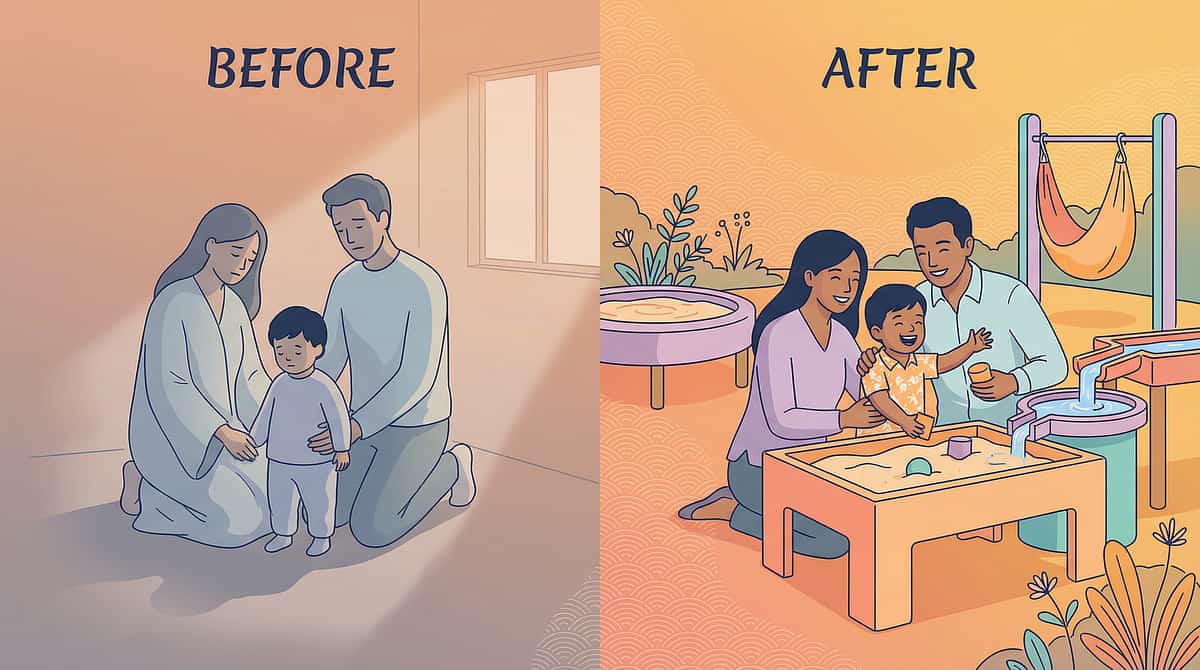
From
A child who froze at the start of obstacle courses
To
A child who navigates 4–5 element courses independently and approaches physical challenges with curiosity instead of fear
The Parent Achievement: You showed up 4–5 times a week. You calibrated the difficulty without crushing the spirit. You celebrated approach instead of only outcome. You were the scientist, the cheerleader, the spotter, and the safe harbor — all in 15-minute sessions. That is clinical-grade parenting.
🎉 Visit a Playground
Take your child to a playground and let them lead the physical play
📸 Document the Moment
Record a video of your child navigating the course and watch it together
📖 Journal It
"8 weeks ago, [name] froze at obstacle courses. Today…"
🏅 Family Award
Create a physical, displayable award for this milestone

ACT IV — RED FLAGS
Clinical Guardrails: Know When to Pause
Five red flags require you to pause sessions and consult a professional. These are not signs of failure — they are clinical data that require expert interpretation.
🔴 Flag 1: Regression Without Cause
Child was completing 4 elements and suddenly returns to freezing across 3+ sessions without any environmental explanation. Action: Contact Pinnacle teleconsultation. Regression after consolidation may indicate sensory processing shift or co-occurring condition.
🔴 Flag 2: New Self-Injurious Behavior
Any head-banging, biting, or scratching that appears or increases in connection with obstacle course sessions. Action: Stop all motor planning sessions immediately. Urgent consultation. This is sensory overload signaling.
🔴 Flag 3: Significant Fear Escalation
Child develops intense fear response to previously mastered elements, especially if new fear extends to other physical activities. Action: Sensory profile re-evaluation needed. Do not push through fear.
🔴 Flag 4: Multi-Domain Motor Regression
Obstacle course skills declining AND handwriting worsening AND dressing becoming harder simultaneously. Action: Neurological review with Pinnacle NeuroDev Pediatrics.
🔴 Flag 5: No Progress After 10 Weeks
No measurable change in any data point after 10 weeks of 4–5 sessions per week. Action: Professional praxis assessment required. Underlying DCD or sensory processing disorder may need formal evaluation.
Mild Concern
Modify technique → 📞 9100 181 181 (free)
Moderate Concern
Teleconsultation → Plan revision
Significant Concern
Clinic assessment → Full evaluation
Urgent
Nearest Pinnacle center → Same-week appointment
Preview of 9 materials that help with obstacle courses Therapy Material
Below is a visual preview of 9 materials that help with obstacle courses therapy material. The pages shown help educators, therapists, and caregivers understand the structure and content of the resource before use. Materials should be used under appropriate professional guidance.


Link copied!

ACT IV — RELATED TECHNIQUES
More Techniques in the Gross Motor Domain

F-575: Balance & Coordination Training
🟡 Core | Uses your balance beam + stepping stones already set up. Dedicated bilateral coordination work.
F-584: Climbing Skills Intervention
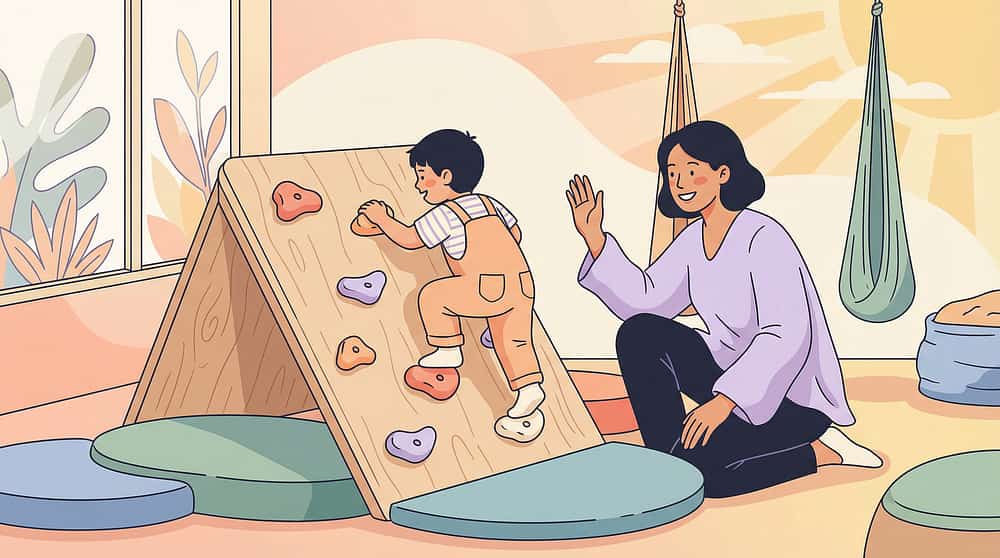
🟡 Core | Uses your crash pad from current setup. Progressive height exposure in controlled environment.
F-585: Swimming Readiness
🟡 Core | Previous technique in this series. Foundational for aquatic motor planning.

F-587: Playground Navigation
🔴 Advanced | Your next step after F-586 mastery. Real-world motor planning in higher-risk environments.
✅ You already own materials for F-575 (balance beam + stepping stones) and F-584 (crash pad) from your current setup. Start them next with zero additional investment.