

"He could spin that wheel for forty minutes straight. And I had no idea if I should stop him or let him be."
You noticed it first at eighteen months — the way your child would find the wheel on any toy and spin it, again and again, with extraordinary precision. Or how a dropped coin on the tile floor could hold their attention longer than anything you could offer. Then someone said it with that look: "He does that a lot, doesn't he?" And your stomach dropped.
You are not failing. Your child's nervous system is doing something purposeful. And you are exactly the parent who is going to understand why.
🌟 Pinnacle Blooms Consortium | Verified Clinical Content
Domain D: Behavior & Flexibility
OT | ABA | SpEd | NeuroDev | SLP
📞FREE Autism Helpline: 9100 181 181 | Call anytime. 16+ languages.
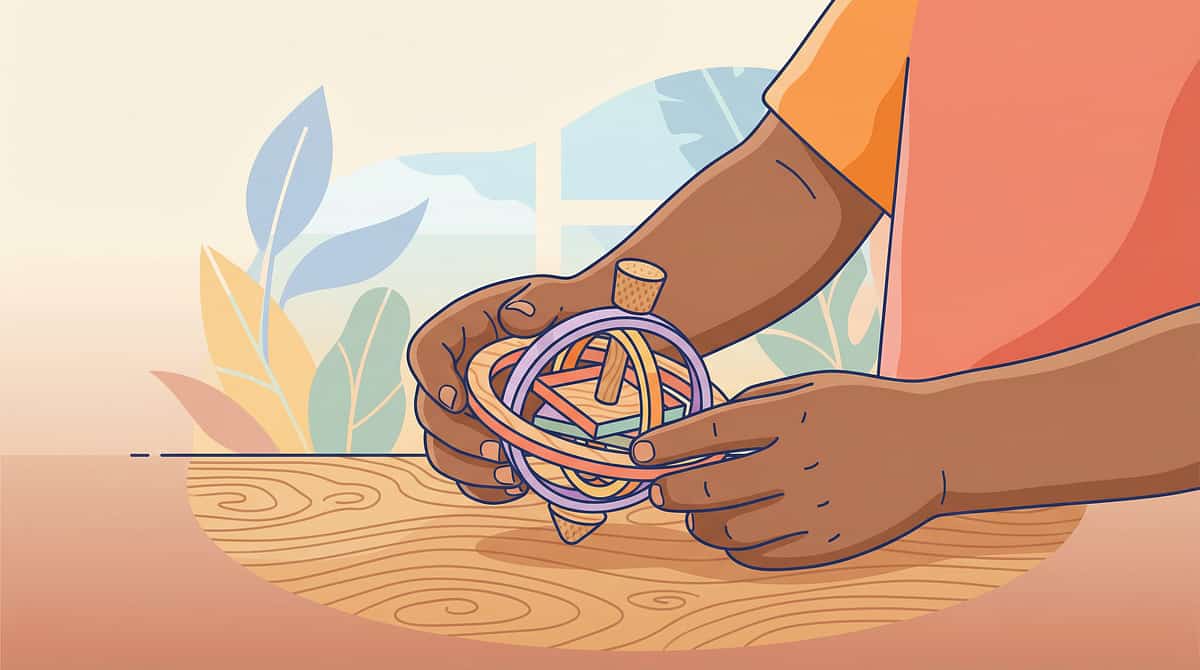
Object Spinning: One of the Most Common Repetitive Behaviors in Autism — and One of the Most Misunderstood
When your child spins objects — wheels, tops, coins, lids — they are in extremely common company. Object spinning is among the most frequently documented repetitive behaviors in autism, classified by researchers as a "motor stereotypy" or restricted and repetitive behavior (RRB). PRISMA systematic reviews confirm that 80% of children diagnosed with autism display some form of repetitive sensory behavior — and object-specific fascination is near the top of every list.
60–80%
Display Object-Spinning
Children with ASD demonstrate object-spinning or repetitive manipulation behaviors
1 in 36
Diagnosed in India
Children in India are now diagnosed with autism spectrum disorder
21M+
Therapy Sessions
Delivered by Pinnacle Blooms Network® — with evidence from children who spin, rock, flap, and stim
In India, with a population of 1.4 billion and autism prevalence at 1 in 36, we are talking about millions of families watching their child spin something — and wondering what to do next. You are among millions of families navigating this exact experience. The path forward is clearer than you think.
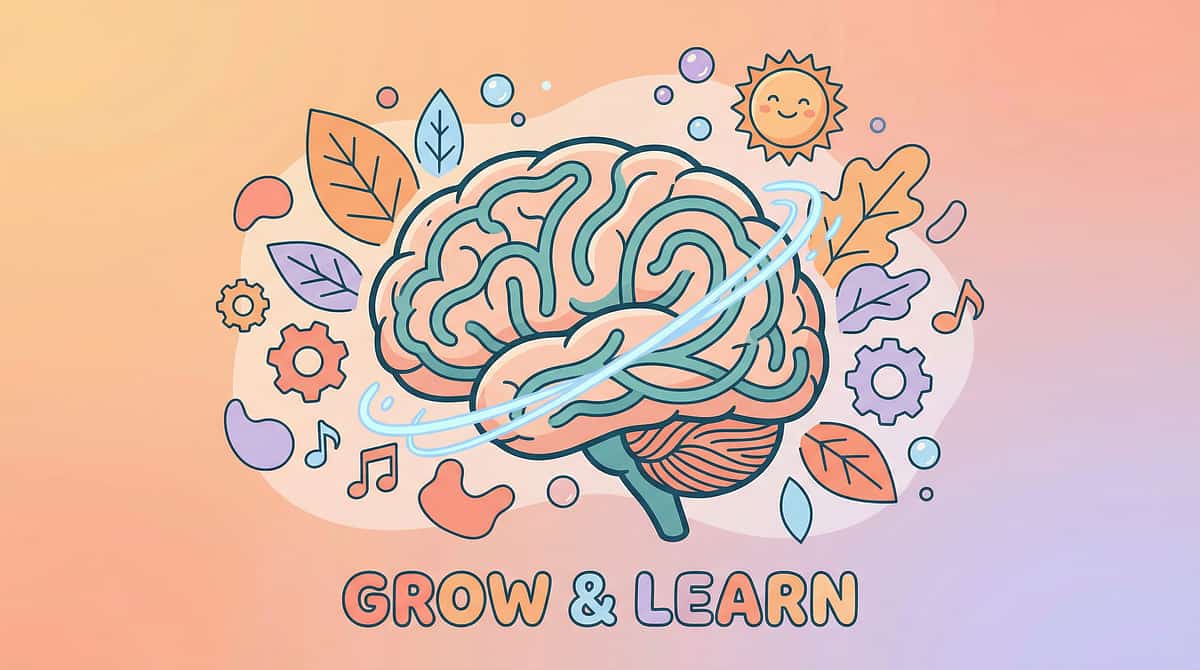
Object Spinning Is Not Random. It Is a Neurologically Organized Behavior.
When your child spins an object, at least four distinct neurological systems activate simultaneously. This is a wiring difference — not a behavior problem.
The Visual Tracking System
The visual cortex tracks the spinning object with high precision. For children with heightened visual processing, the predictable, continuous rotation creates a deeply satisfying visual feedback loop — consistent, controllable, beautiful.
The Proprioceptive System
The fingertips and wrists receive rich sensory input as they maintain contact with the spinning object. This joint-and-muscle feedback is organizing for the nervous system.
The Basal Ganglia (Motor Loop)
The basal ganglia governs repetitive motor patterns. In many autistic children, this circuit runs with higher activation — meaning repetitive, precise motor patterns feel deeply rewarding and regulating.
The Vestibular System
The gentle circular motion activates the vestibular (balance) system, providing input that can calm an over-aroused nervous system or stimulate an under-aroused one.
"Your child is not being naughty. Their brain is organizing itself through a system that works for their neurology."
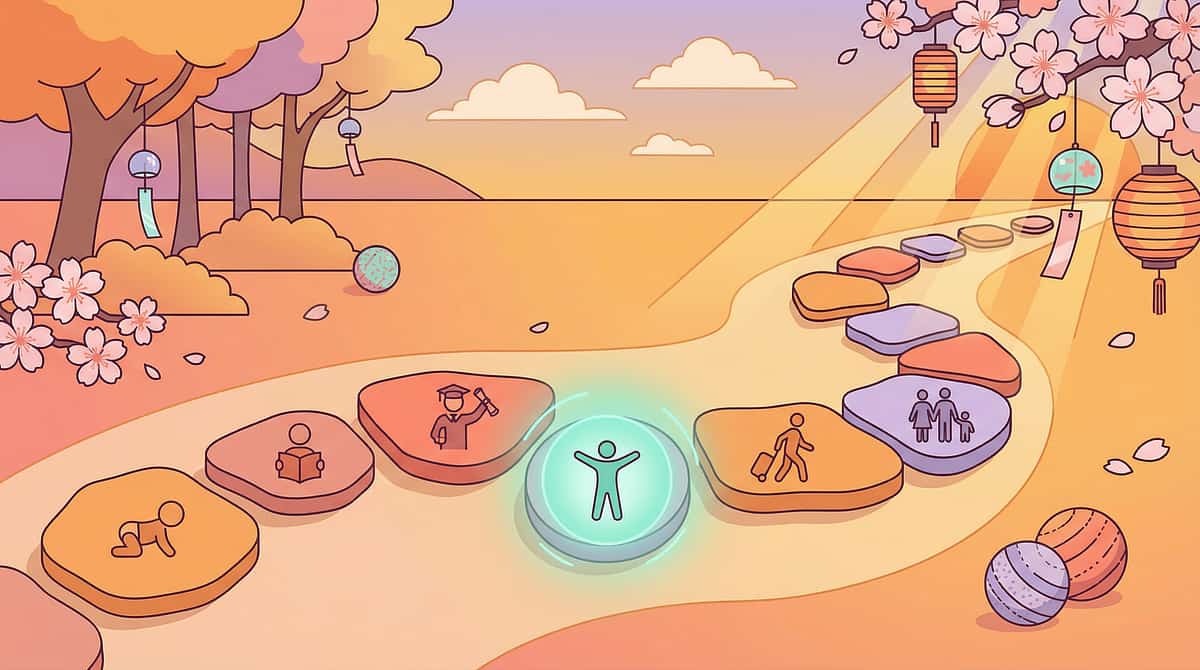
Object Spinning Is a Developmental Waypoint — Not a Dead End
1
0–18 Months
All typically developing children spin objects to some degree. Object permanence, cause-effect, and visual tracking develop through object manipulation.
2
18–36 Months ⭐ Key Zone
In children with autism, object spinning often intensifies — preference for wheels, lids, circular items, extended duration, and strong emotional response to interruption.
3
3–5 Years
Without functional intervention, spinning may increase. With the right materials and supports, the child's sensory needs become understood and channeled.
4
5–8 Years
Children who receive sensory-based intervention often develop greater regulatory flexibility — they still spin when needed, but also access alternative regulatory tools.
Comorbidity Awareness: Object spinning frequently co-occurs with tactile seeking, visual sensory differences, vestibular seeking, fine motor precision strengths, and occasionally restricted food preferences linked to oral sensory differences.
"Your child is here. Here is where we are heading: a child who regulates powerfully, has expanded choices, and is understood by everyone around them."

Clinically Validated. Home-Applicable. Parent-Proven.
Evidence Grade: Level II
Multiple RCTs + Systematic Review
These 9 materials are not products of internet trends. They are the distillation of 20 million therapy sessions, evidence-based practice reviews, and the lived expertise of India's largest consortium of pediatric therapists.
📄 PRISMA Systematic Review (2024) — Children
16 studies (2013–2023) confirm sensory integration intervention meets evidence-based practice criteria for children with ASD, including for repetitive and restricted behaviors. PMC11506176
📄 Meta-analysis (World J Clin Cases, 2024)
24 studies confirm sensory integration therapy promotes adaptive behavior, sensory processing, and motor skills — the exact domains disrupted by compulsive object spinning. PMC10955541
📄 Indian RCT — Padmanabha et al. (2019)
Home-based sensory interventions demonstrated significant outcomes in Indian pediatric populations — directly applicable to families across India. DOI: 10.1007/s12098-018-2747-4
📄 WHO Nurturing Care Framework (2018)
Responsive caregiving + early learning + safe environments = optimal developmental outcomes. The materials on this page operationalize all three. nurturing-care.org
The Technique: What It Is
Domain D: Behavior & Flexibility
Age Range: 2–12 Years
10–20 min/session
Formal Name: Sensory-Based Regulatory Material Substitution Protocol for Object Spinning (Motor Stereotypy — Visual/Proprioceptive Subtype)
Parent-Friendly Name: "The 9 Materials That Meet the Spinning Need"
Object spinning in autism is a form of self-regulatory behavior serving visual, proprioceptive, and vestibular sensory needs. This technique uses nine clinically selected material categories that provide equivalent or superior sensory input — expanding the child's regulatory toolkit without suppressing their natural coping mechanisms.
🏷️ Setting
Home + School + Community + Therapy
🏷️ Frequency
Daily | Multiple sensory opportunities
🎬 Connected Reel
D-363 | Episode 363 | Sensory & Self-Regulation Support
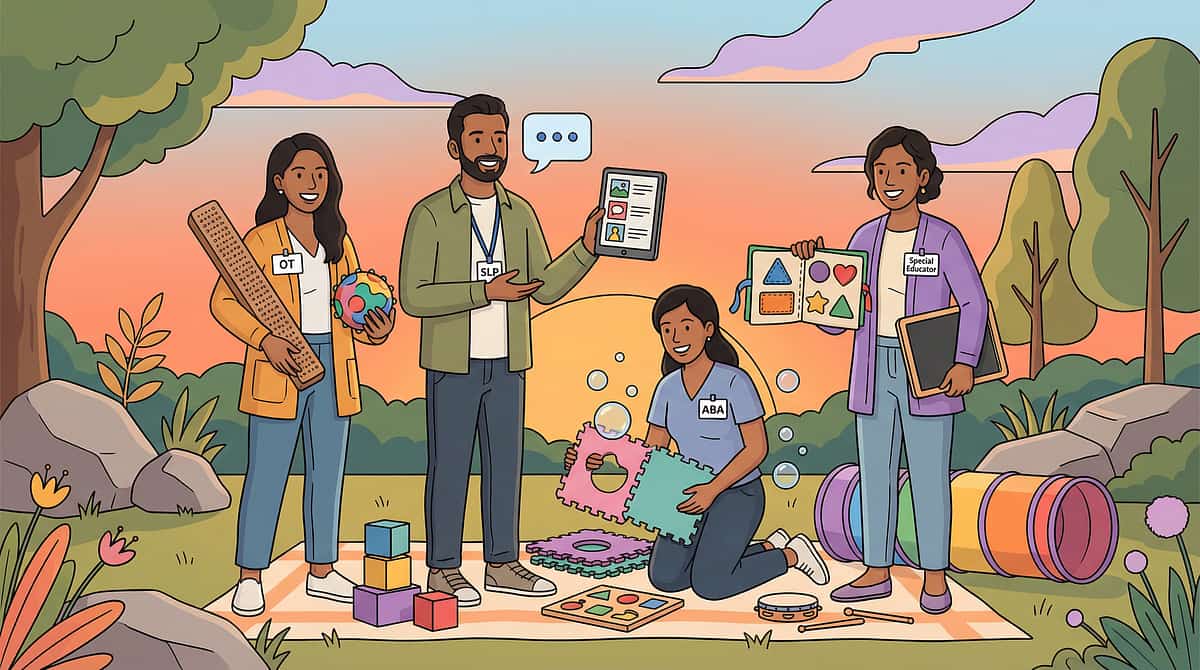
This Technique Lives at the Intersection of Five Clinical Disciplines
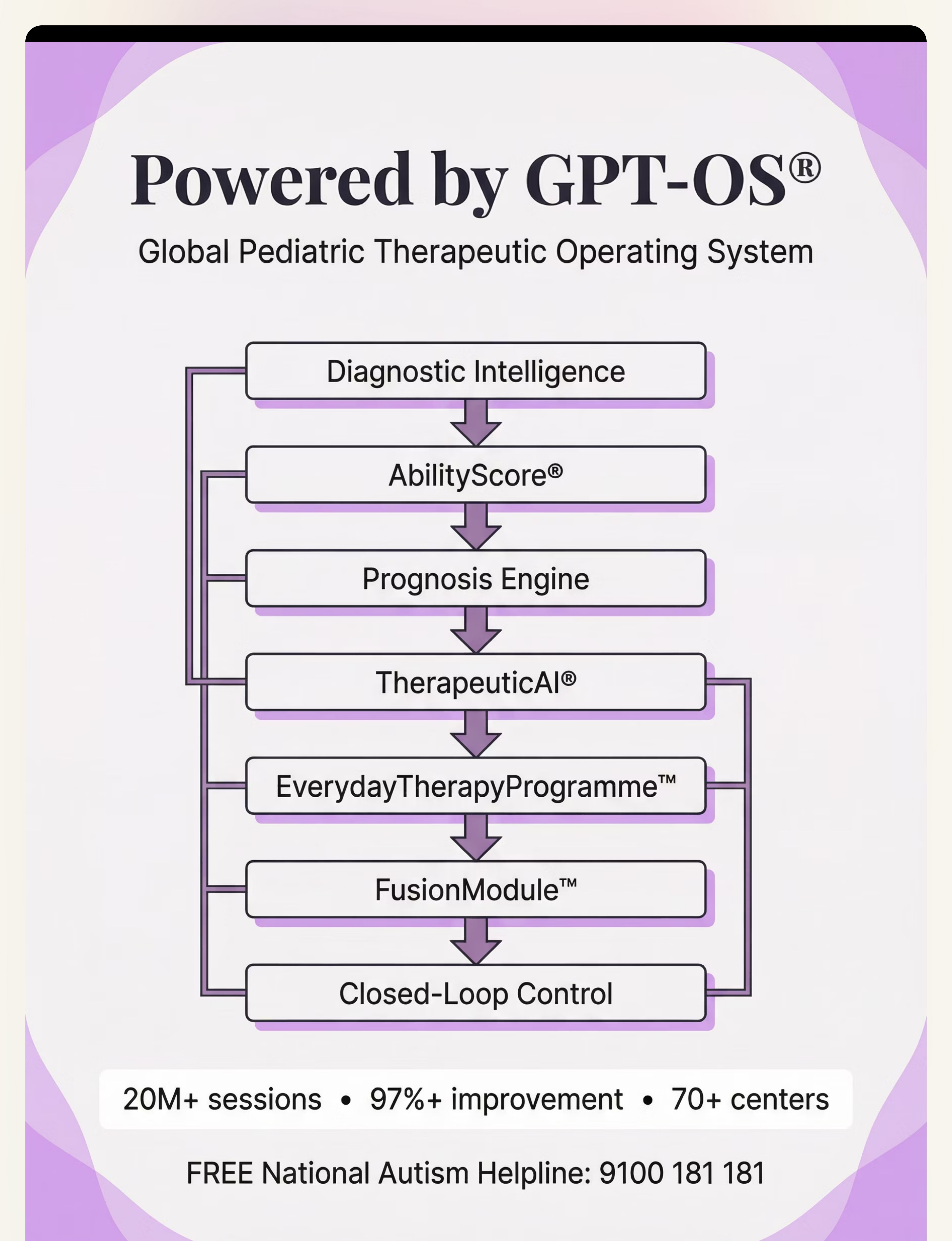
Because your child's nervous system doesn't organize by therapy type. At Pinnacle's 70+ centers, these five disciplines review every child's profile together — no silo, no contradiction, one converged plan executed through GPT-OS®.
🟠 Occupational Therapist (Primary Lead)
Leads sensory assessment and material selection. Conducts the Sensory Processing Measure (SPM), identifies the specific function of the child's object spinning, and designs the sensory diet these 9 materials will populate.
🔵 Board Certified Behavior Analyst (BCBA)
Conducts functional behavior assessment (FBA) to determine antecedents and consequences maintaining spinning. Designs reinforcement schedules and context-specific protocols for when spinning is acceptable and when alternatives are offered.
🟢 Special Educator
Implements material access protocols in classroom settings, builds visual supports for material use, and trains teaching assistants on consistency across the school environment.
🟡 Neurodevelopmental Pediatrician
Rules out medical contributors — vision differences, vestibular disorders, metabolic conditions — and provides diagnostic context for the sensory profile driving spinning behavior.
🟣 Speech-Language Pathologist
When spinning serves a communication function — expressing excitement, requesting preferred activity, signaling overwhelm — the SLP addresses the communication component so the child has words alongside tools.
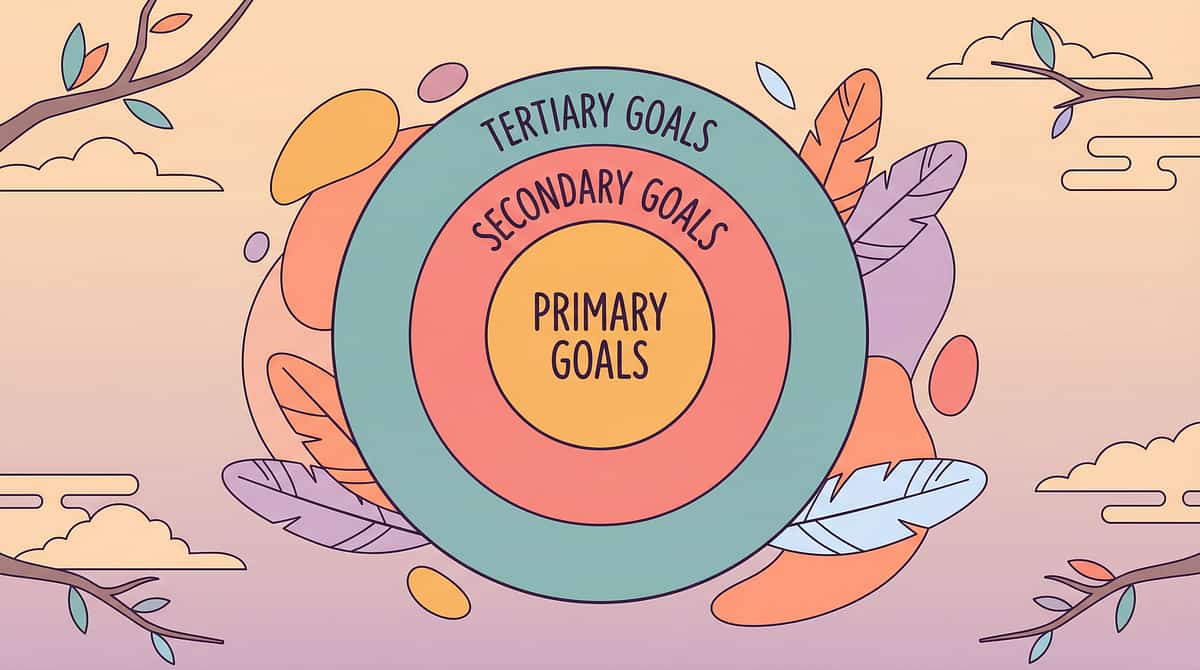
Object Spinning Has Multiple Underlying Needs. Each Material Targets a Different Layer.
🎯 Primary Targets
- Reduction in compulsive, distress-triggering spinning episodes
- Expansion of self-regulatory material repertoire
- Proprioceptive regulation through hands and wrists
- Visual-vestibular integration through sanctioned tools
🎯 Secondary & Tertiary Targets
- Increased task engagement and reduced anxiety
- Improved fine motor precision
- Social participation and academic readiness
- Self-advocacy — child communicates sensory need
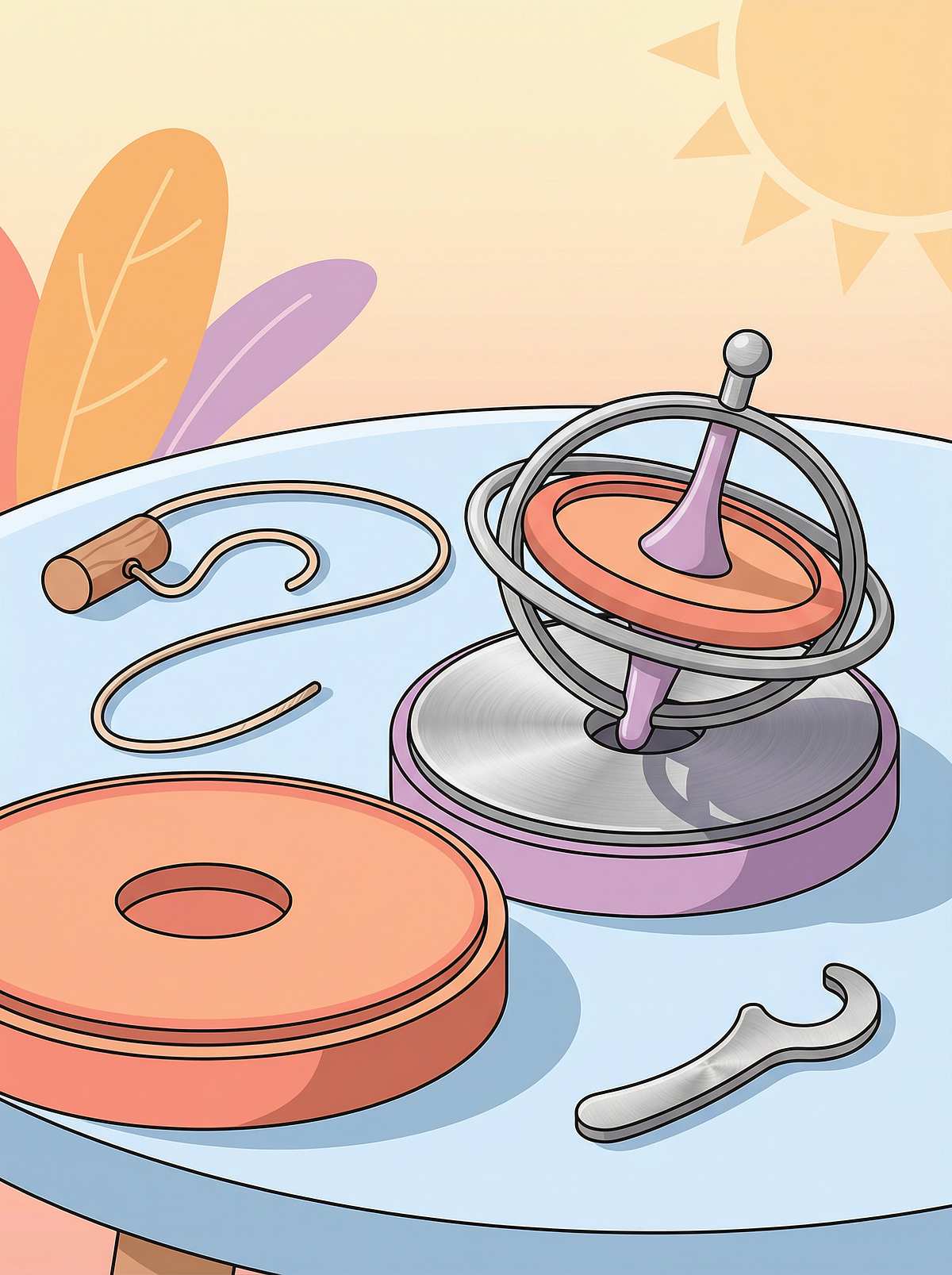
Material 1: Spinning Tops & High-Quality Gyroscopes
Material 1 of 9
Visual + Proprioceptive
Why It Works
Meets the visual tracking + rotational feedback need directly. Provides a "legitimate" spinning object that builds fine motor precision while satisfying the regulatory need. The exact visual and proprioceptive need your child meets through object spinning — now channeled into a purposeful tool with mastery potential.
Getting Started
Price Range: ₹150–800
Pinnacle Recommends: Precision metal spinning tops | Gyroscope kits with launcher
DIY: Homemade top from a pencil and cardboard disk. Spin on smooth surfaces. Make multiple sizes for different fingertip pressures.
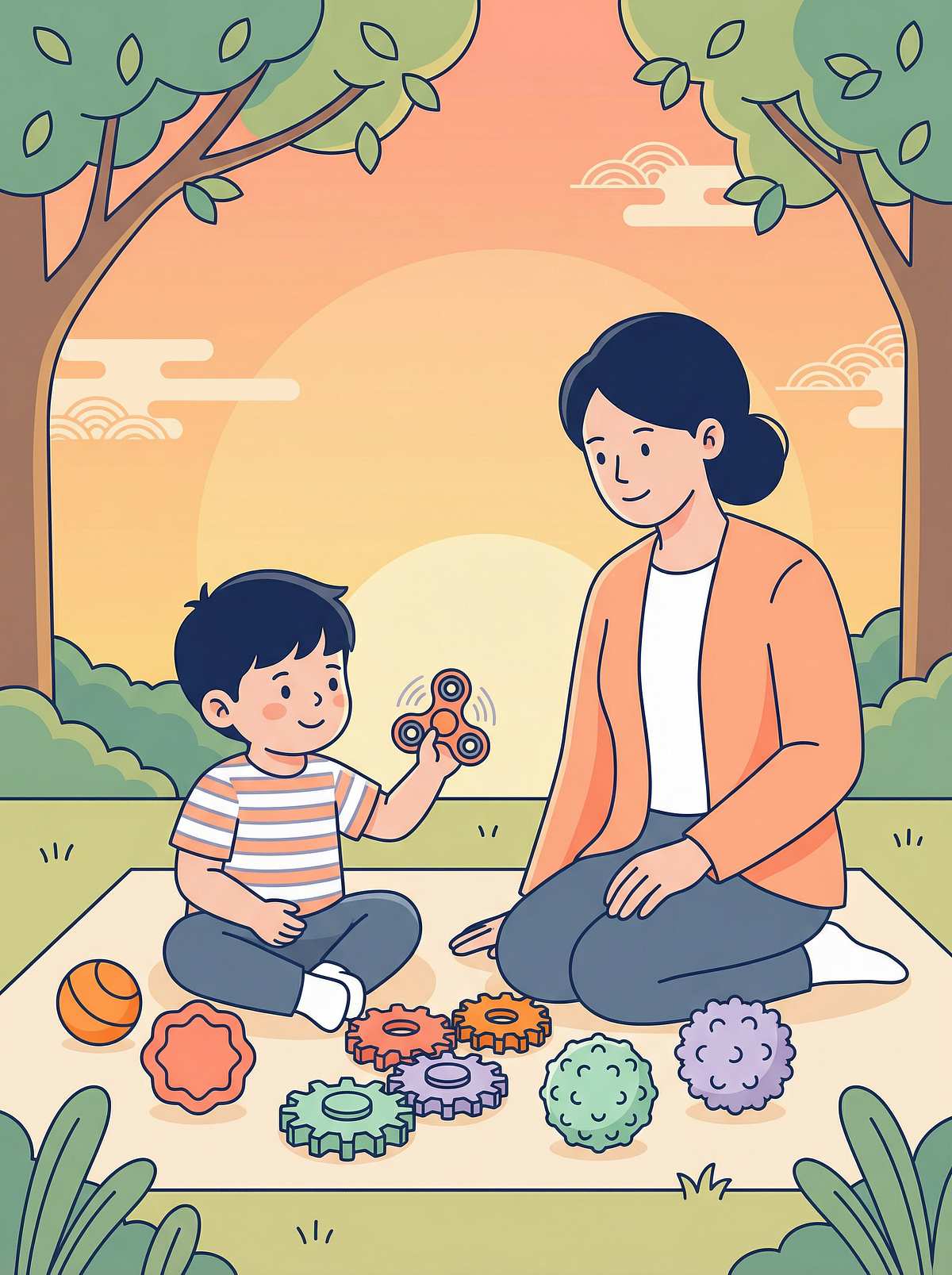
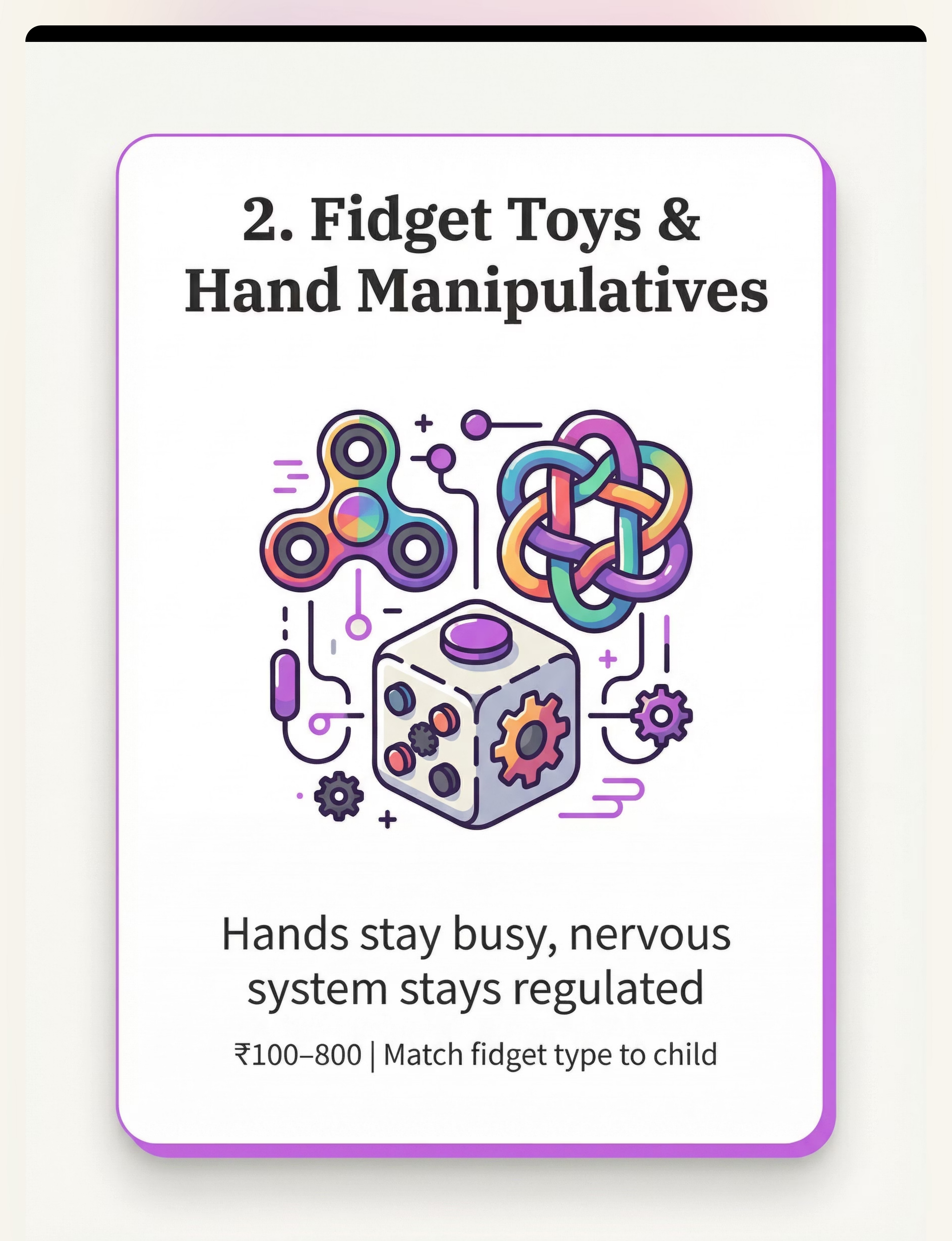
Material 2: Fidget Spinners & Rotational Hand Manipulatives
Material 2 of 9
Proprioceptive + Visual
Why It Works
Fidget spinners are literally engineered around the same rotational mechanism children seek. When used purposefully, they channel the seeking behavior into a portable, socially manageable tool. The bearing mechanism provides proprioceptive feedback + visual spinning + rhythmic regulation.
Getting Started
Price Range: ₹80–400
Pinnacle Recommends: Quality bearing fidget spinners | Gear fidgets | Tangle Jr. rotational fidgets
DIY: Smooth coin balanced on fingertip. Paper pinwheels. Pencil-and-disk spinner.
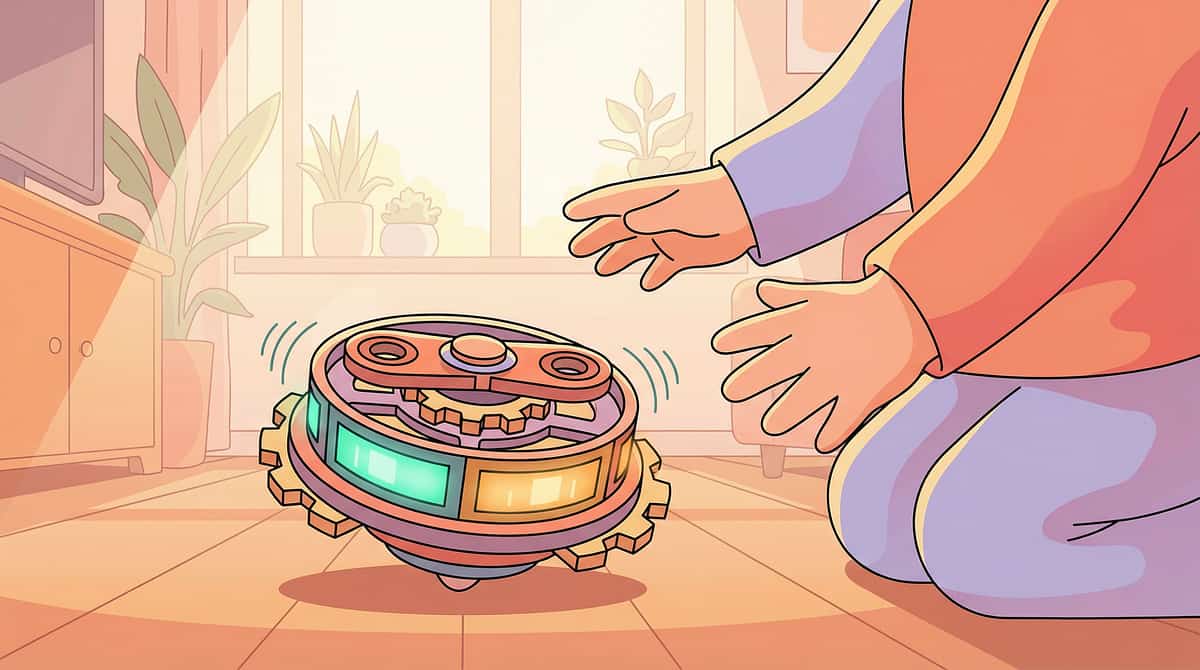
Material 3: Cause-and-Effect Spinning Toys (Light + Sound)
Material 3 of 9
Multi-Sensory
Why It Works
Enhances the spinning experience with multi-sensory reward layers — visual (light patterns), auditory (sound effects), proprioceptive (push mechanism) — building engagement duration and tool-to-spinning transfer. The cause-effect mechanism teaches intentionality.
Getting Started
Price Range: ₹300–1,200
Pinnacle Recommends: Light-up spinning tops | Electronic cause-effect spinners | LED gyroscope toys
DIY: Attach small LED fairy lights to a cardboard pinwheel. Fan on low speed for visual tracking practice.
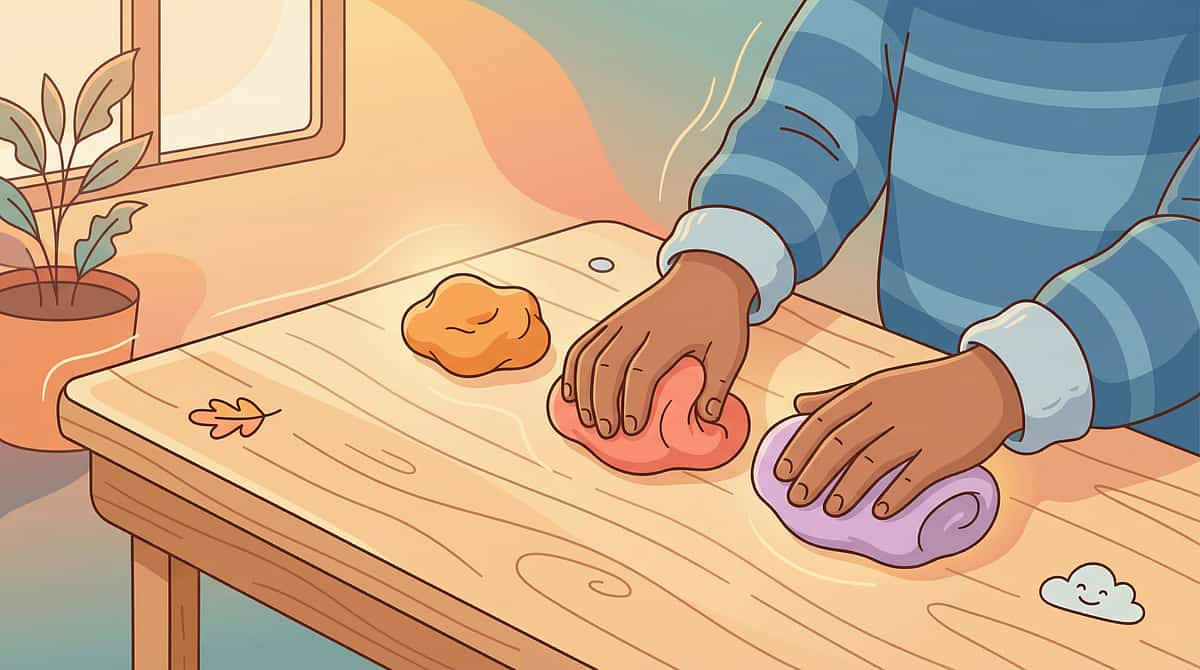
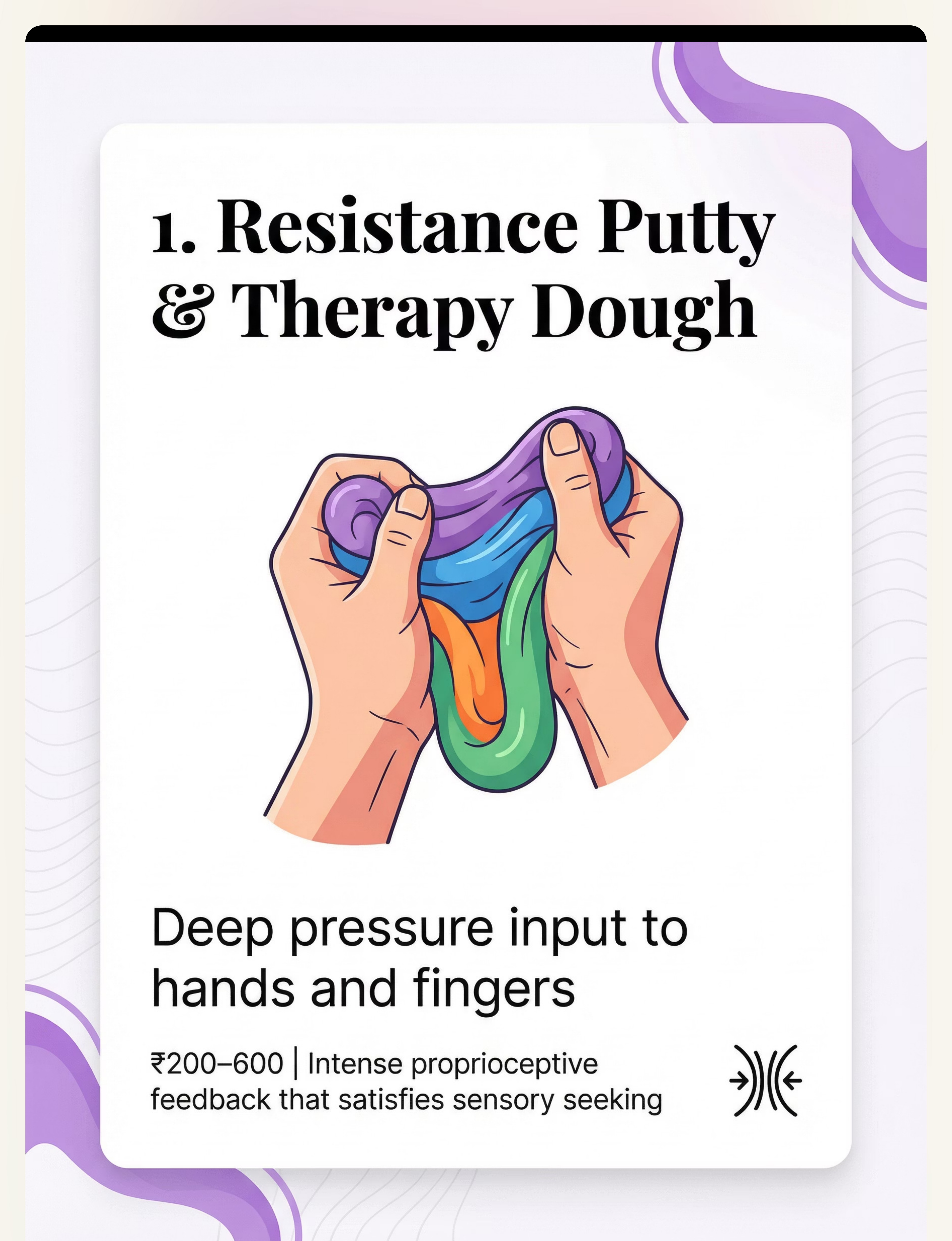
Material 4: Resistance Putty & Therapy Dough (Rotational Rolling)
Material 4 of 9
Deep Proprioceptive
Why It Works
Rolling putty in circles between palms or on a table activates the same wrist and finger receptors engaged in object spinning. Resistance adds depth of proprioceptive input — same joint feedback as spinning, delivered through resistance for intense organizing input.
Getting Started
Price Range: ₹200–600
Pinnacle Recommends: Therapy putty (medium-firm resistance) | Sensory dough kits
DIY: 2 cups flour + 1 cup salt + 2 tbsp cream of tartar + 2 tbsp oil + 2 cups water. Cook until dough forms. Roll into balls and circles.
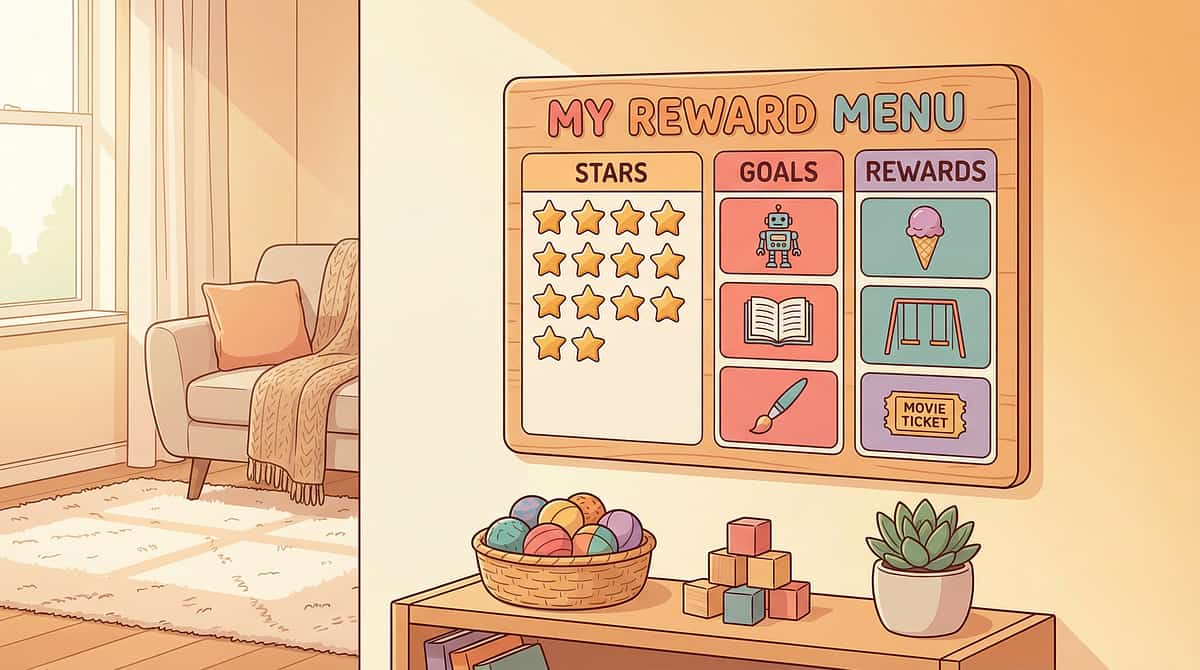
Material 5: Reinforcement Menu System (Motivation Architecture)
Material 5 of 9
✅ Pinnacle Canon Verified
Why It Works
The BCBA principle: any new behavior competes with the reinforcement value of the existing behavior (spinning). A robust reinforcement menu ensures alternative material use is as rewarding as spinning — then progressively more so. Structured reward systems make engaging with alternative materials intrinsically motivating.
Getting Started
Price Range: ₹400–700
Pinnacle Recommends: Reward jar + token system | Visual reinforcement menu board
Canon Active Product:The Rosette Imprint Reward Jar — ₹589✅ Pinnacle Canon Verified
DIY: Hand-drawn reward chart. Sticker system. Photo cards of preferred activities as visual rewards.

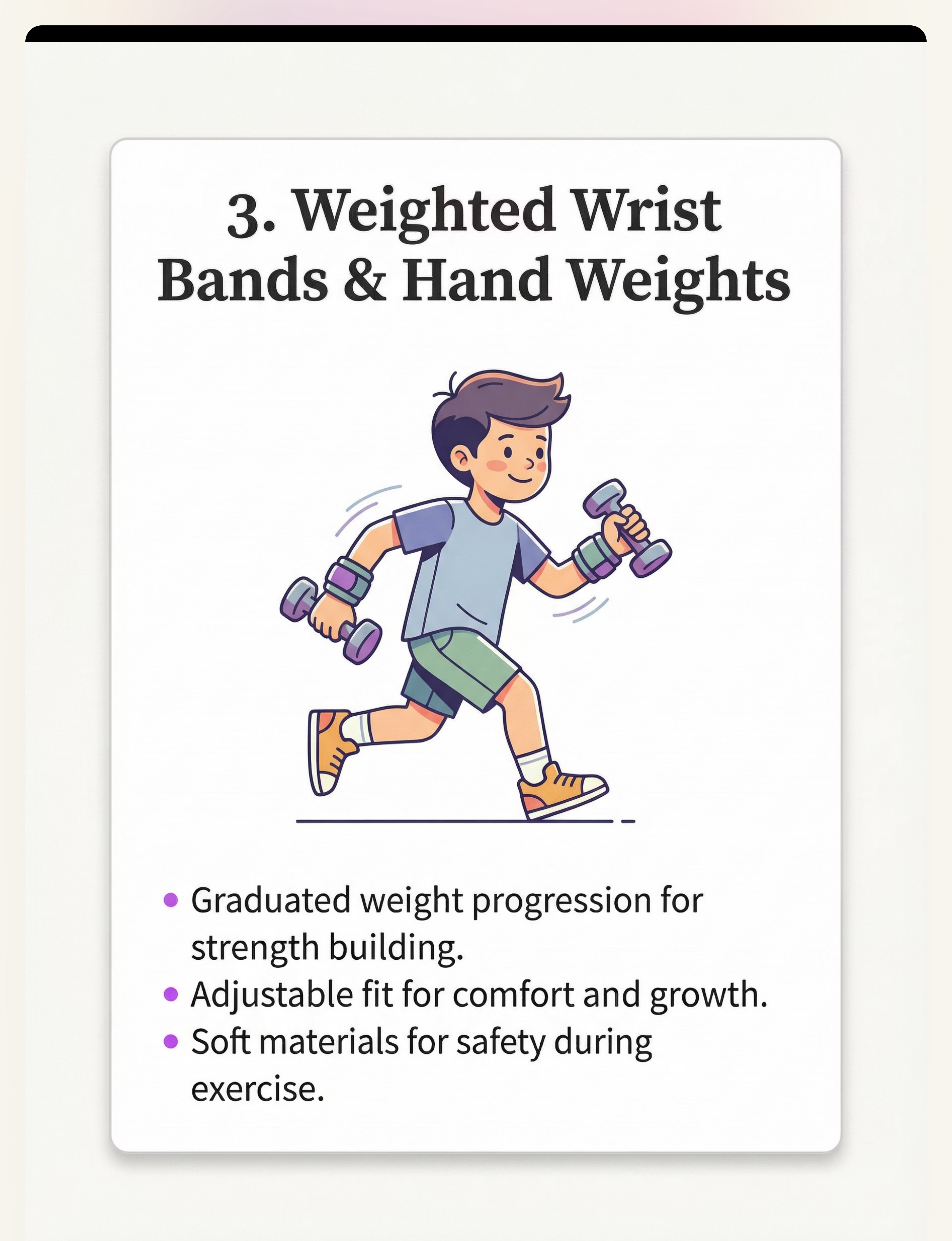
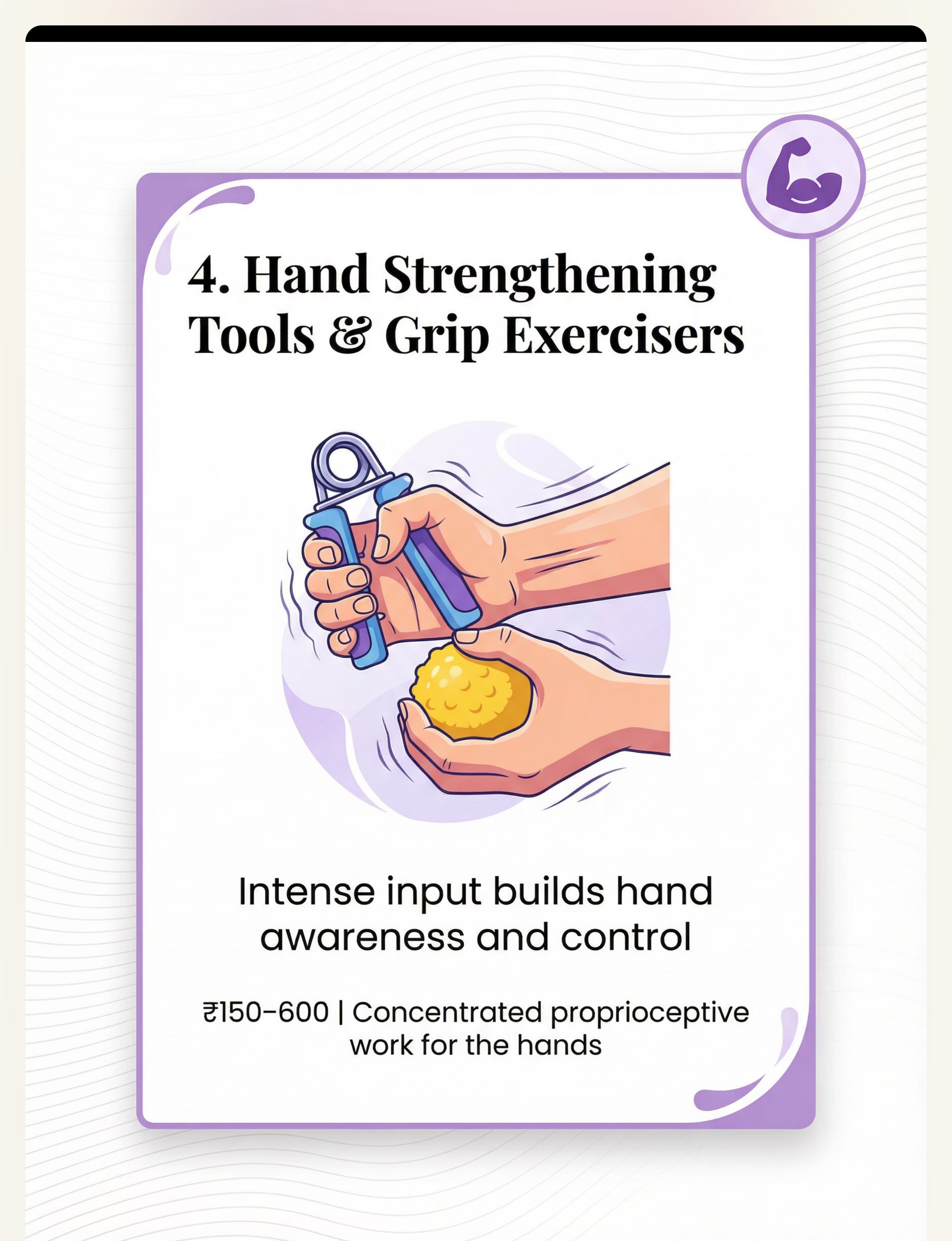
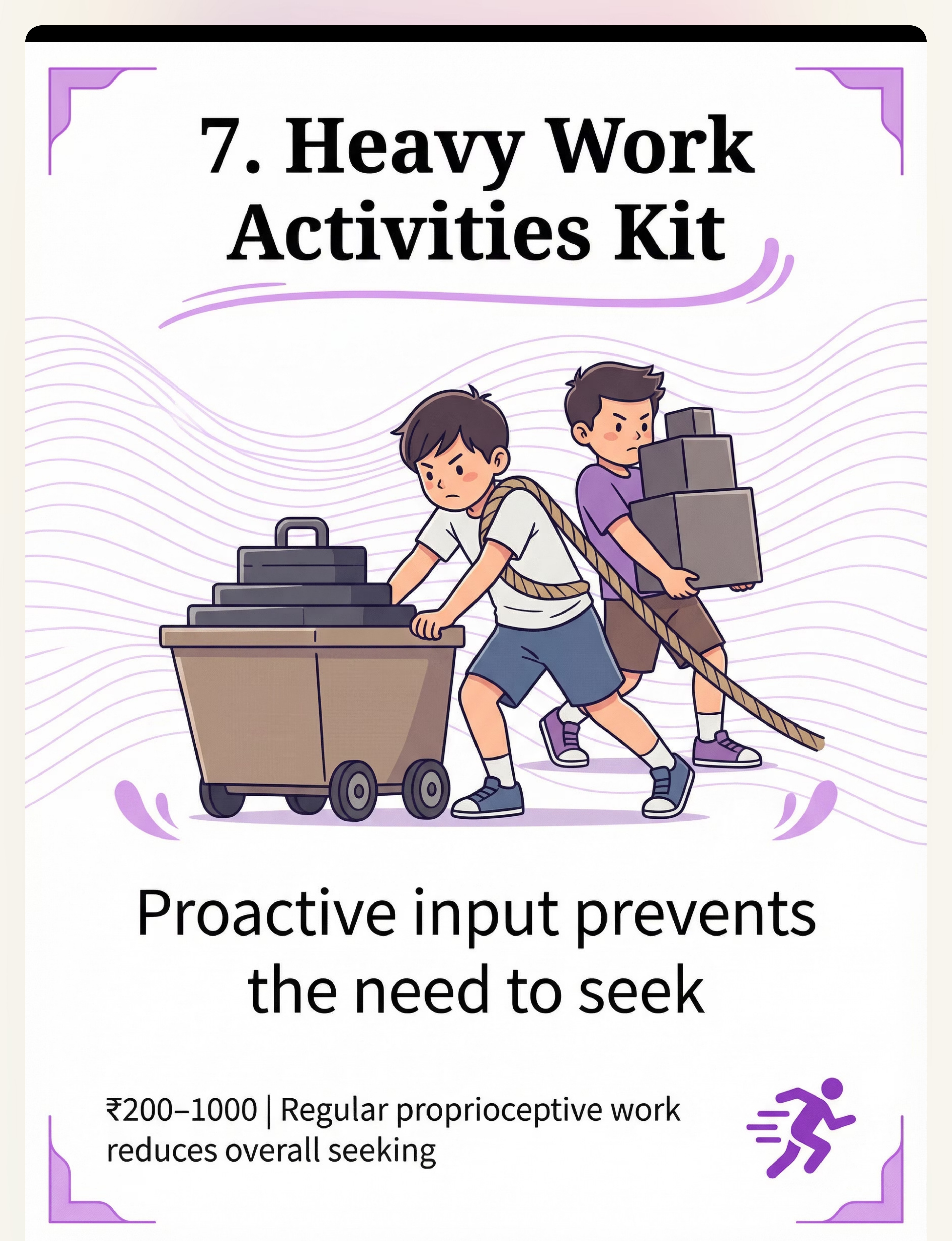
Material 6: Heavy Work & Proprioceptive Tools
Material 6 of 9
Whole-Body Regulation
Why It Works
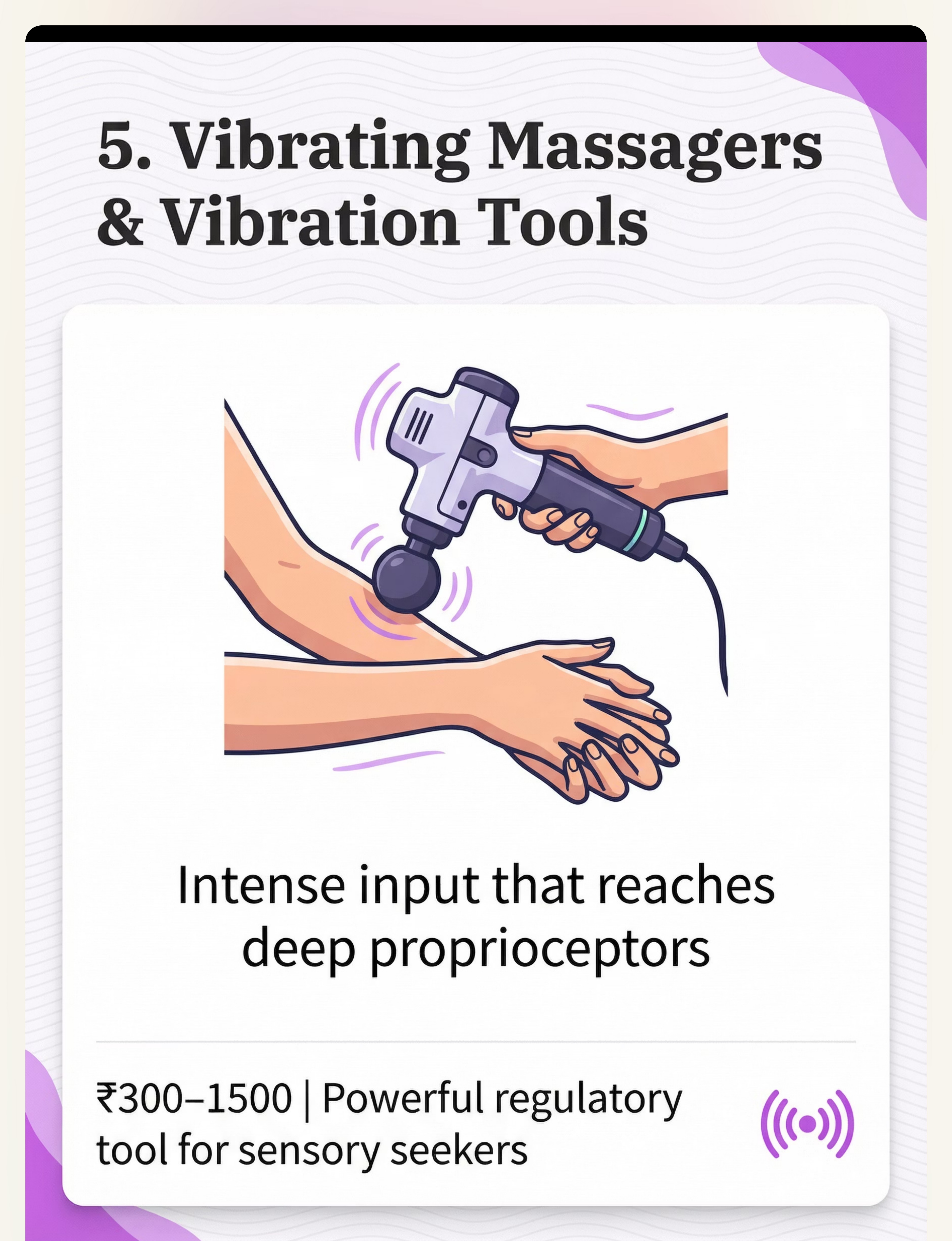
When the proprioceptive system receives sufficient "heavy work" input — pushing, pulling, carrying, squeezing — its overall arousal need reduces. Spinning frequency drops proactively. The "big input" that reduces the nervous system's need to seek through object spinning.
Getting Started
Price Range: ₹200–1,000
Pinnacle Recommends: Resistance bands | Weighted carry bags | Grip exercisers | Push-pull tools
DIY: Water bottle carrying. Book bag loading. Wall push-ups. Tug-of-war with old rope.
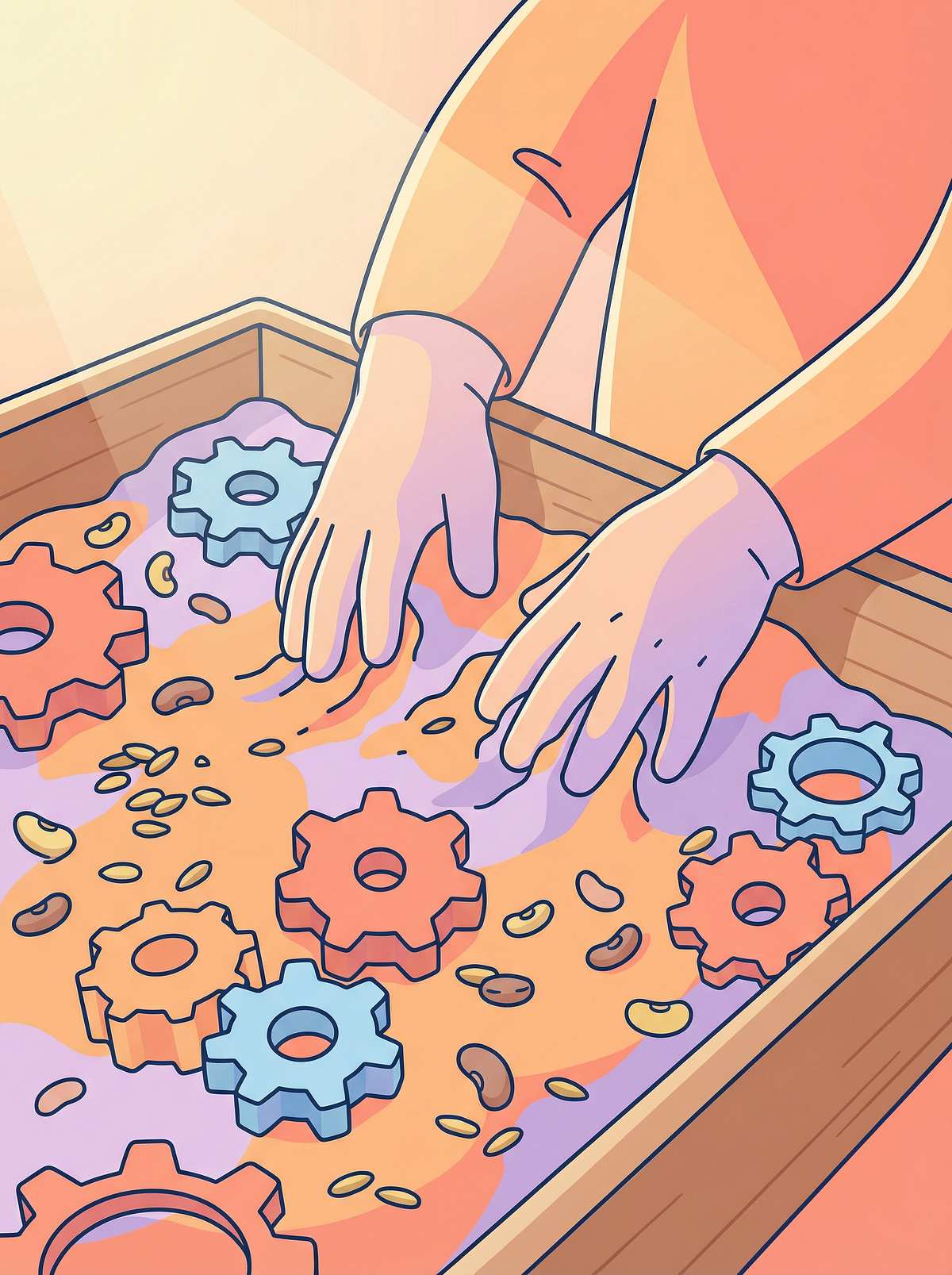
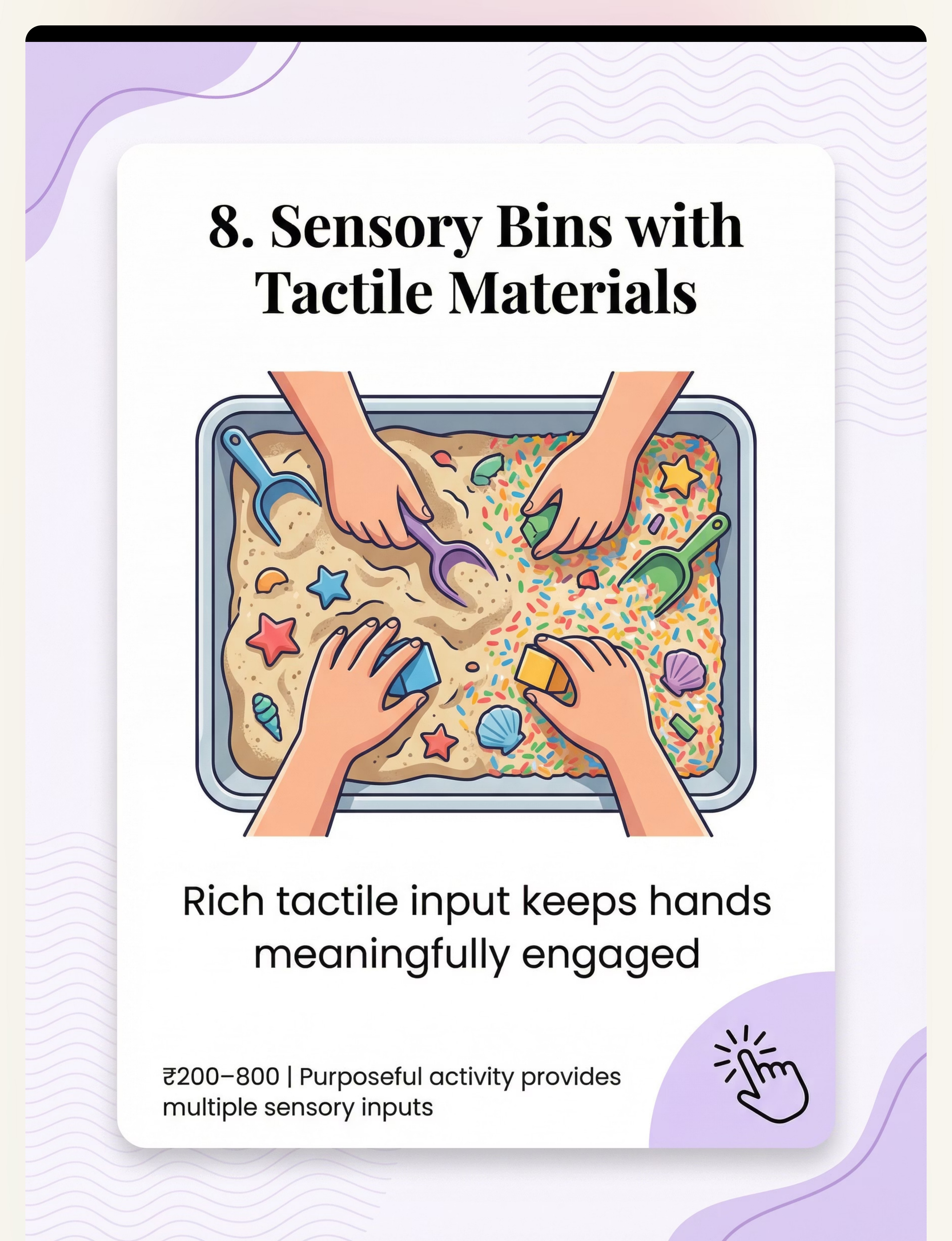
Material 7: Sensory Bins with Rotational Elements
Material 7 of 9
Tactile + Visual + Proprioceptive
Why It Works
Sensory bins with stir sticks, gear toys, or rotational scoops allow the child to engage in rotational motion in a contained, purposeful, and socially appropriate context. Rich tactile + proprioceptive + visual input through hands-in materials + spinning/stirring tools.
Getting Started
Price Range: ₹200–800
Pinnacle Recommends: Kinetic sand bins | Rice/bean bins with gear scoops | Sand and water table with wheel elements
DIY: Plastic tote + rice + wooden spoon + hidden small wheels/gears to find and spin. Endless engagement.

Material 8: Visual Tracking & Kaleidoscope Tools
Material 8 of 9
Visual Rotational Stimulation
Why It Works
For children whose object spinning is primarily visually driven — the pattern, the light, the predictable rotation — kaleidoscopes and visual spinning tools provide equivalent visual input without the object-attachment. Pure visual rotational stimulation through a purposeful, beautiful tool.
Getting Started
Price Range: ₹100–600
Pinnacle Recommends: Kaleidoscopes | Visual spinners/wands | Lava lamp equivalents | Light-refraction tools
DIY: Fill clear plastic bottle with water, glitter, and small objects. Seal tightly. Child shakes and watches it settle — visual regulation through observation.

Material 9: Transition Objects & Comfort Spinning Items
Material 9 of 9
✅ Pinnacle Canon Verified
Why It Works
Part of the intervention is not eliminating spinning but making it contextually appropriate and intentional. A designated "spinning kit" the child owns and controls provides security, reduces compulsive seeking, and creates transition stability across all settings.
Getting Started
Price Range: ₹200–600
Pinnacle Recommends: Soft sensory animal transitional toys | Designated spinning object kit | Comfort bag system
Canon Active Product:Soft Animal Transition Toys — ₹425✅ Pinnacle Canon Verified
DIY: Old favourite household object designated as "spinning kit" item in a small zip pouch. Child carries it. Ownership = regulation.
Total Starter Kit Estimate: ₹500–2,000 for a complete 9-material toolkit | Essential Three to Start: Material 1 (Spinning Top) + Material 5 (Reward System) + Material 6 (Heavy Work)
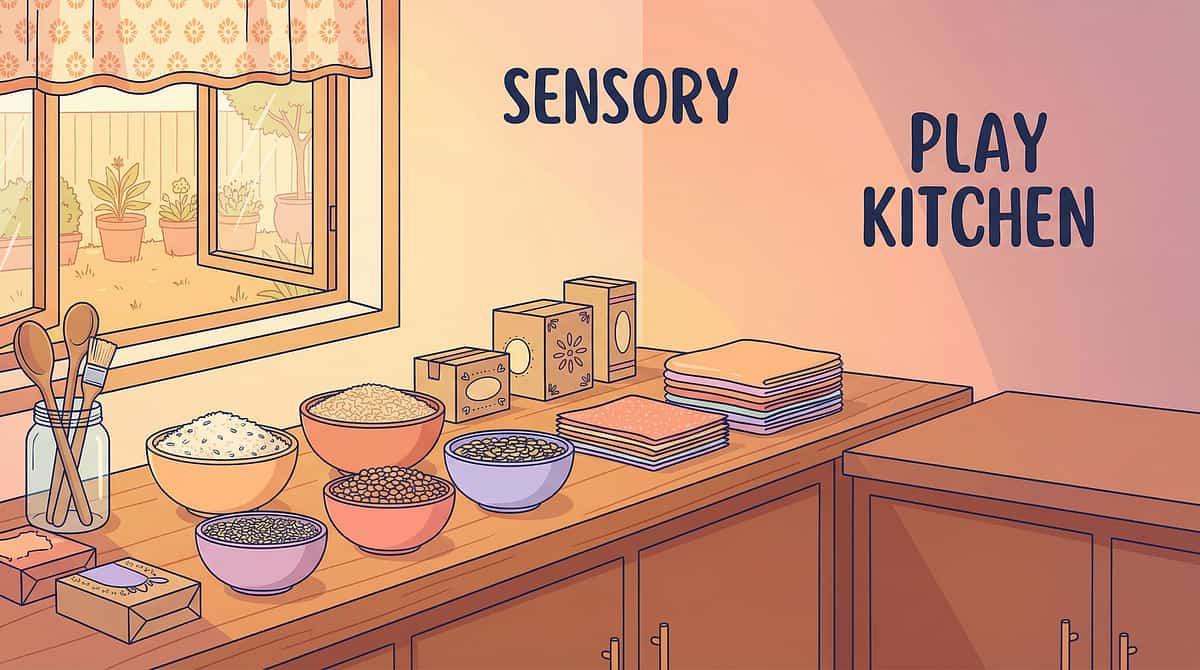
Every Family. Every Budget. Every Village. This Technique Works with Household Items.
"Context-specific, equity-focused interventions. No family should be excluded from evidence-based practice because of economic constraints." — WHO Nurturing Care Framework (2018)
Material | Budget Buy | Free DIY Alternative | |
Spinning Tops | ₹150 | Pencil + cardboard disk — spin on tile | |
Fidget Spinners | ₹80 | Smooth river stone balanced on fingertip | |
Cause-Effect Toys | ₹300 | Paper pinwheel in front of table fan | |
Resistance Putty | ₹200 | Flour + salt + water homemade dough | |
Reward System | ₹589 | Sticker chart on paper + rubber stamp | |
Heavy Work Kit | ₹200 | Rice bag carrying + wall push-ups | |
Sensory Bin | ₹200 | Plastic tote + dry rice + wooden spoon | |
Visual Tracker | ₹100 | Glitter bottle (water + glitter + sealed) | |
Transition Kit | ₹425 | Favourite small object in named zip pouch |
Why Substitutes Work: The therapeutic principle is the delivery mechanism — not the brand. Proprioceptive input through homemade putty is neurologically equivalent to commercial therapy putty. The brain doesn't read the label; it reads the sensation.
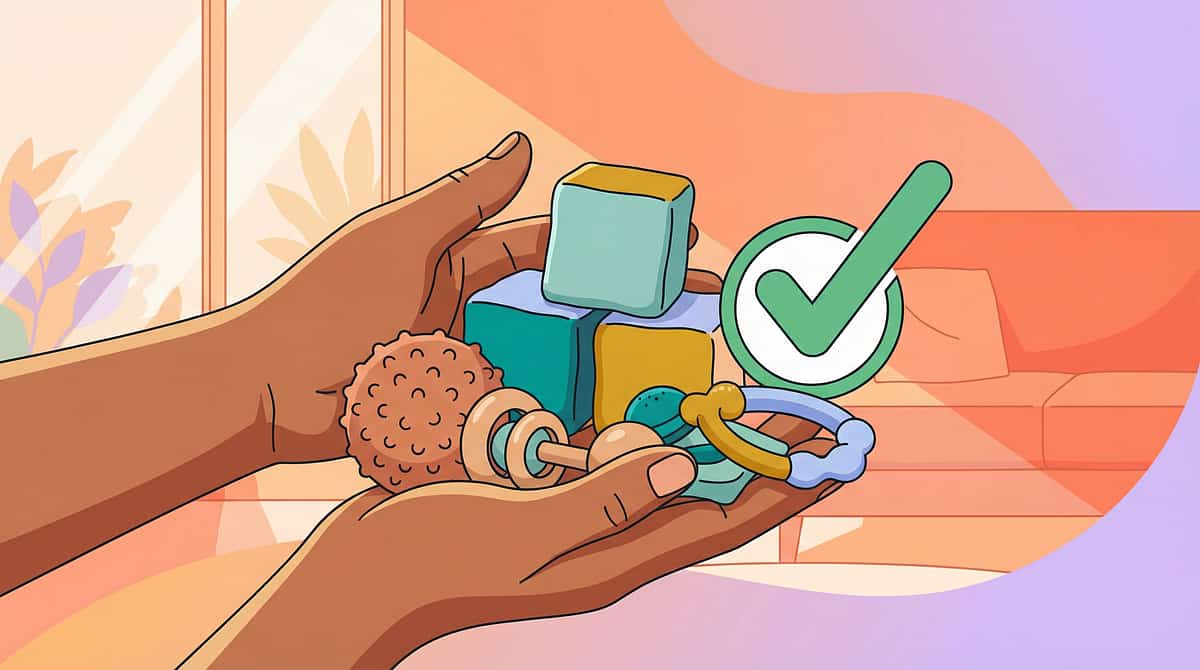
The Pinnacle Clinical Safety Gate. Read Before Every Session.
🔴 RED — DO NOT PROCEED if:
- Child is acutely ill, feverish, or has an active ear infection
- Child has open wounds or skin irritation on hands
- Child has had a severe meltdown within the past 2 hours
- Child shows extreme distress when any spinning object is removed
- Materials contain known allergens (wheat in DIY dough, latex in some putties)
🟡 AMBER — MODIFY if:
- Child is tired or post-nap (reduce duration by 50%)
- Environment is already high-stimulation
- Child is showing early dysregulation signs
- Introducing a new material (start with just 5 minutes)
🟢 GREEN — PROCEED when:
- Child is fed, rested, and in baseline regulated state
- Environment is prepared (see Card 12)
- You have 15–20 uninterrupted minutes
- You have read the full protocol
🔍Material Safety Notes: Spinning tops — sharp edge risk under age 4, check for choking hazards. DIY putty — check for gluten allergy, wash hands after. Sensory bins — rice/beans are choking hazards under age 3, mold risk in wet bins. Resistance bands — not for children under 3, replace if frayed.
📞 If you're unsure, call: 9100 181 181 — Our OT helpline team will guide you. FREE.
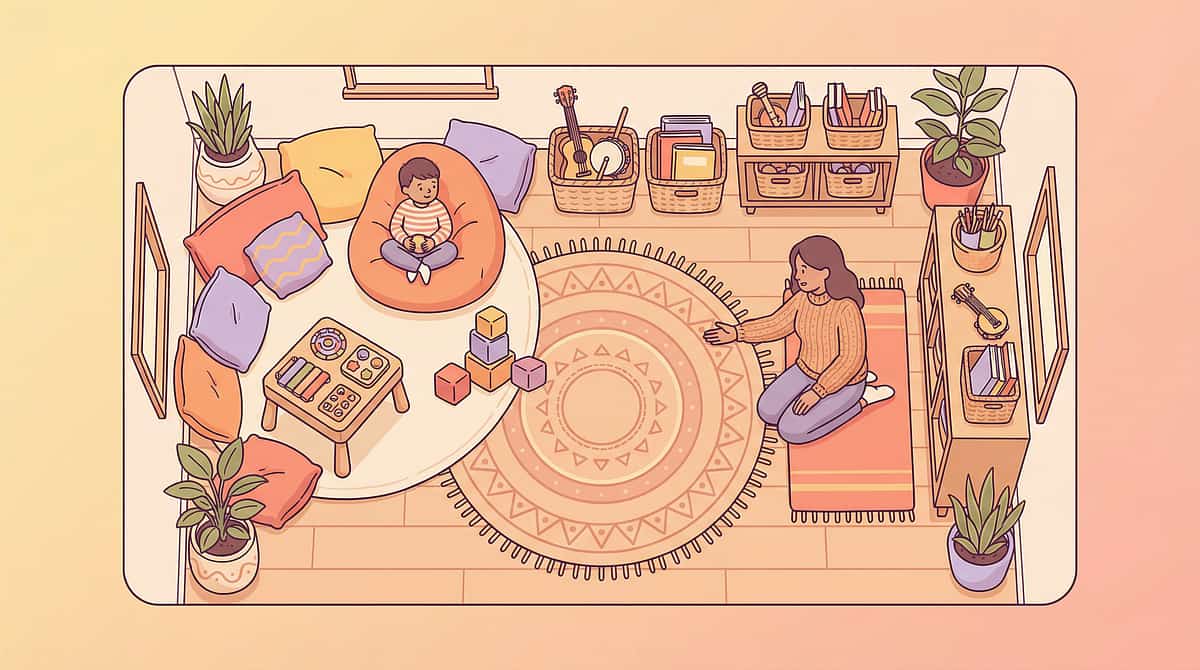
The Right Environment Prevents 80% of Session Failures.
✅ Space Setup Checklist
- Floor mat or low table — child at ground level for stability
- Materials within arm's reach but not all visible at once
- Reward chart visible from child's position
- TV off | Music off or soft instrumental only | Notifications silenced
- Other spinning objects temporarily out of sight
- Visual timer set
- Water available for child
- Parent seated at child's level — not standing above
Environment Details
Lighting: Warm, moderate. Not fluorescent overhead. Natural light or warm lamp.
Sound: Silent or soft instrumental music at <40 decibels.
Temperature: Comfortable. Cold hands reduce proprioceptive sensitivity.
Duration: 15–20 minutes maximum for sessions 1–4. Increase to 30 minutes by week 4.

60 Seconds Now Saves 20 Minutes of Session Frustration.
Readiness Check — Observe Before Beginning
Indicator | ✅ Go | 🔄 Modify | ❌ Postpone | |
Hunger level | Fed within 90 min | Snack first, then begin | Visibly hungry — feed first | |
Energy level | Alert, mobile | Tired but manageable | Falling asleep or post-meltdown | |
Current stimming | Mild spinning | Active spinning | Severe/distressed spinning | |
Eye contact | Some available | Fleeting | None / fully shutdown | |
Physical state | Healthy | Mild runny nose | Fever, ear pain, ill | |
Recent events | Calm morning | Slight upset earlier | Major meltdown <2 hours | |
Environment noise | Quiet | Some background | Loud / chaotic |
3+ ✅ → GO
Proceed to Step 1: The Invitation
2+ 🔄 → MODIFY
Begin with sensory bin or heavy work only. 5-minute session.
Any ❌ → POSTPONE
Do a calming activity instead. Try again in 1–2 hours or tomorrow.
"The best session is one that starts right. A postponed session is not a failed session — it is a data point."

Step 1 of 6
Step 1: The Invitation — Every Session Begins with an Invitation, Not a Command.
"Hey [child's name] — look at this. Want to see what this does?" — Then spin the top yourself, slowly. Let the child watch.
Body Language Guidelines
- Sit at child's level (floor or low chair)
- Gentle, open posture — no crossed arms
- Hold material at child's visual field (not forcing eye contact)
- Tone: curious and warm, not instructional or pressured
Reading the Response
Acceptance: Child moves toward material, reaches for it, looks at your hands, vocalizes interest.
Resistance: Child moves away → give space, keep spinning yourself. Child ignores → place material in visual field and wait. Child takes it and spins → ✅ This IS engagement!
Timing: 30–60 seconds. If no response, shift to sensory bin.

Step 2 of 6
Step 2: The Engagement — The Child Is In. Now Deepen the Connection.
Once the child shows interest, introduce a genuine choice: "You can spin this one [top] — or feel this one [putty] — which one do you want?" Honor the choice completely.
Spinning Top
Place in child's palm, curl their fingers around the stem, gently demonstrate launch motion.
Putty
Roll into a ball in your own hands first. Show the child the ball, then hand it. Let them discover the resistance.
Sensory Bin
Say "What's hiding in here?" — hands in first yourself, model searching.
Visual Tool (Kaleidoscope)
Hold up to your own eye first. Smile. Hand it to child.
Reinforcement Cue: The moment the child engages for 3+ seconds — praise immediately and specifically: "Yes! You're using the [top/putty]! Great job!"
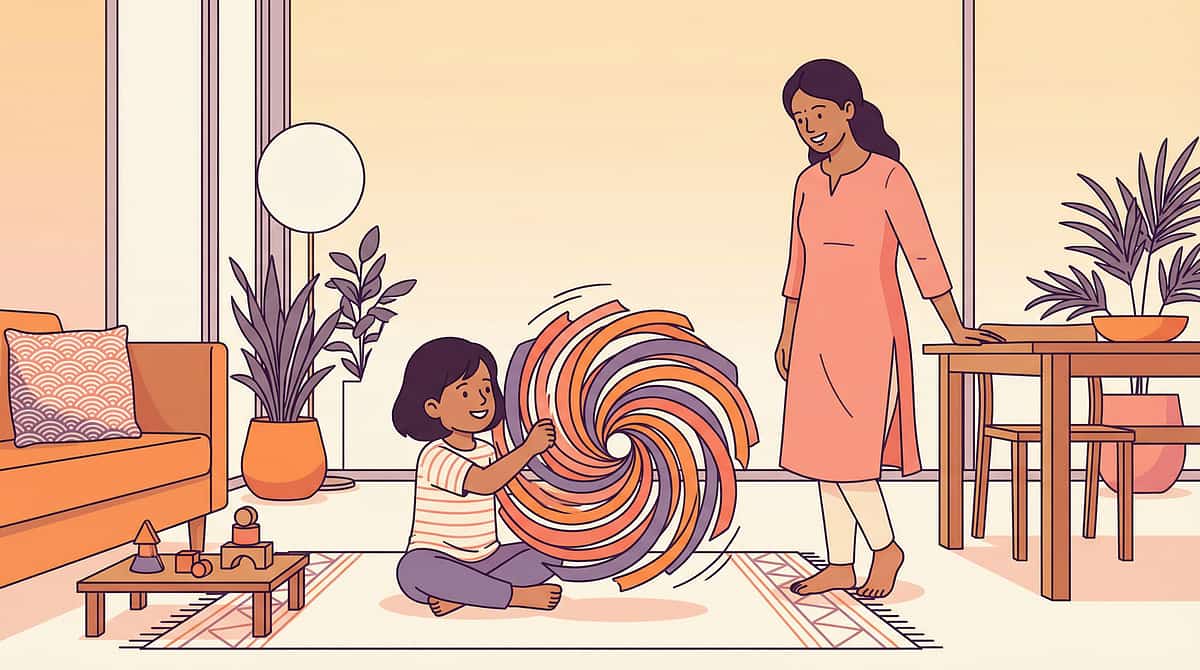
Step 3 of 6
Step 3: The Therapeutic Action — This Is the Active Ingredient.
The therapeutic event is matched sensory substitution — offering materials that deliver the same (or superior) sensory input that object spinning provides, in a purposeful, skill-building context.
🎯 Visual-Seeking Spinners
Guide child to use spinning top or kaleidoscope for 3–5 minutes. Narrate what they see: "Look at it spin! Watch the color go round..." Introduce variations: spin faster, slower, on different surfaces.
🎯 Proprioceptive-Seeking Spinners
Guide child to roll putty in circles on table (same wrist motion, resistance added). Move to grip exerciser or heavy work after 2 minutes. Narrate: "Feel how strong your hands are!"
🎯 Mixed-Profile Spinners
Begin with spinning top (visual) → transition to putty (proprioceptive) after 3 minutes. Sensory bin with rotational stirring bridges both. Duration of therapeutic exposure: 8–12 minutes.
Common Errors to Avoid: Interrupting child's engagement to redirect (WAIT — let the engagement develop). Offering too many materials at once (maximum two at a time). Using instructional tone (maintain playful, curious narration throughout).
Step 4 of 6
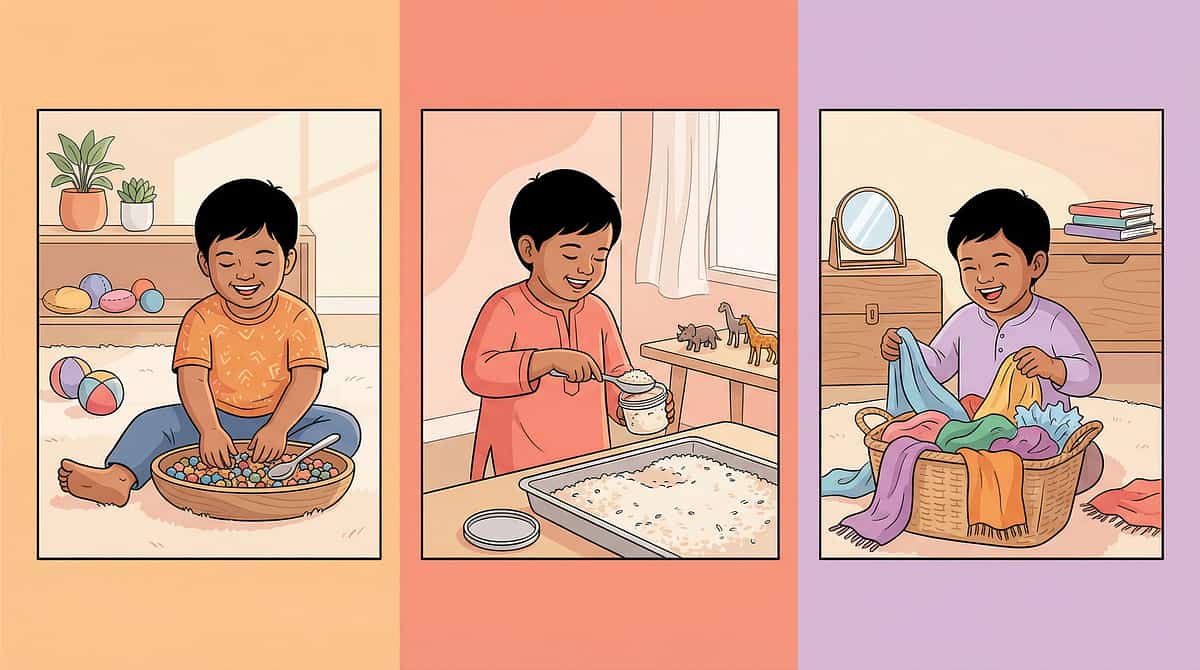
Step 4: Repeat & Vary — 3 Good Repetitions Are Worth More Than 10 Forced Ones.
Variation Options
Spinning Top: Spin on different surfaces, time the spin, spin two at once, spin with non-dominant hand.
Putty: Roll forward then backward, make a snake and curl it, hide small objects inside, change putty temperature.
Sensory Bin: Change the medium (rice → beans → kinetic sand), add new hidden objects weekly, use different tools.
Satiation Indicators
- Pushes material away
- Looks away repeatedly
- Lies down or goes limp
- Seeks a different activity independently
Do NOT force continuation. Say: "All done! Great work today." Move to cool-down.
Step 5 of 6
Step 5: Reinforce & Celebrate — Timing Matters More Than Magnitude.
"Celebrate the attempt, not just the success. Every moment of engagement is a win."
The ABA 3-Second Rule: Reinforcement delivered more than 3 seconds after the behavior loses its learning power. Keep praise ready and immediate.
For Material Engagement
"Amazing! You used the [top/putty] for so long! I'm so proud!"
For Completing a Variation
"Wow — you spun it with the other hand! That was INCREDIBLE!"
For Tolerating Transition
"You chose the putty instead of [the wheel/lid]! That's your SUPERPOWER!"
Reinforcement Menu:🏷️ Social — High five | 🏷️ Tangible — Sticker on chart | 🏷️ Activity — 5 minutes preferred activity | 🏷️ Sensory — Brief spin of preferred object
✅The Rosette Imprint Reward Jar | ₹589 | Pinnacle Canon Verified
📞9100 181 181 — Ask our BCBA team how to build the right reinforcement system for YOUR child. FREE.
Step 6 of 6
Step 6: The Cool-Down — No Session Ends Abruptly.
The cool-down prevents post-session dysregulation. Always give a 3–5 minute transition warning before ending.
Transition Scripts
"Two more spins, then we put it away."
"One more time with the putty — then the timer will ring."
Use a visual timer so the transition is predictable.
If Child Resists Ending
- Extend cool-down by 2 minutes only
- Do NOT reintroduce core materials (this reinforces prolonging)
- "One more minute. Then we're done." (show timer)
- Use preferred transition activity as bridge

Capture the Data: 60 Seconds of Data Now Saves Hours of Guessing Later.
Record three fields only — immediately after the session while impressions are fresh. Your data feeds GPT-OS®, which learns from 21 million sessions to help every child like yours.
Session Date & Duration
Date: _______ | Duration: _______ minutes
Materials Used
☐ Spinning Top ☐ Fidget Spinner ☐ Cause-Effect Toy ☐ Putty ☐ Reward System ☐ Heavy Work ☐ Sensory Bin ☐ Visual Tool ☐ Comfort Kit
Child Response Rating
1 = Refused all | 2 = <2 min | 3 = 2–5 min | 4 = 5–10 min | 5 = 10+ min, low compulsive spinning
Bonus: Note anything remarkable — did the child spontaneously request a material? Use one independently? Transition without distress? These micro-milestones are the real evidence. 📥Download the D-363 Printable Session Tracker (PDF)

What If It Didn't Go as Planned? Most Sessions Don't Go Perfectly. That's Not Failure. That's Data.
Problem 1: Child refused all materials, kept going back to the spinning lid
Why: Reinforcement value of the spinning lid was higher. Solution: Conduct a preference assessment. Use what your child loves most as reinforcers for the first 10 seconds of material contact.
Problem 2: Child engaged 2 minutes then became aggressive
Why: Demand to engage may have triggered frustration, or session extended past regulation window. Solution: Reduce demand immediately, end session warmly. Consult BCBA if aggression continues: 9100 181 181.
Problem 3: Child wanted to spin the top the whole session
Why: The spinning top is meeting the spinning need — which IS the therapeutic goal. Solution: Let them spin the top. Narrate it. Celebrate it. Introduce putty as an "addition" not a "replacement" in session 3–4.
Problem 4: Child wouldn't stop spinning after cool-down
Why: The proprioceptive/vestibular need was not fully met, or transition was too abrupt. Solution: Offer 3 minutes of heavy work as part of cool-down before transition. This saturates the proprioceptive need.
Problem 5: Reward jar isn't working / child doesn't care about stickers
Why: Reinforcer doesn't match the child's preference profile. Solution: Watch what the child naturally seeks in free time. That is your reinforcer. The reward is what the child values — not what seems appropriate.
Problem 6: Spouse keeps letting child spin freely
Why: Caregiver inconsistency is one of the most common intervention barriers. Solution: Share this page. The goal isn't eliminating spinning — it's expanding options. Freedom to spin + access to materials = the dual goal.
No Two Children Are Identical. Here Is How to Tune This Protocol to Your Child.
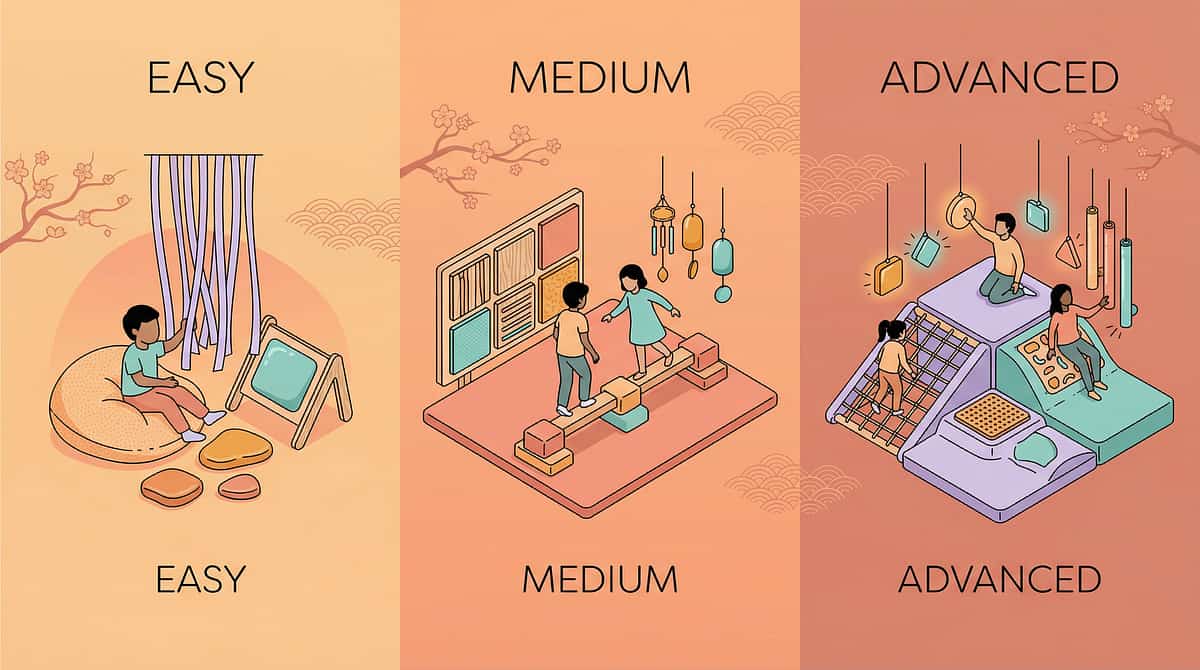
Difficulty Levels
Level 1 — Easier (Initial Resistance High): Use only Material 9 (comfort spinning item) in sessions 1–3. No demand — pure exposure. Duration: 5–7 minutes. One material only.
Level 2 — Standard (Moderate Engagement): Full protocol as written. 2 material choices per session. 15-minute sessions. Praise every 60 seconds of engagement.
Level 3 — Advanced (Strong Engagement): 3–4 material rotations per session. Child leads material selection. Introduce in new settings. Begin reducing parental narration.
Profile-Based Variations
🎯Visual-Dominant: Begin every session with visual tools. Add tactile materials only after 5+ minutes of visual engagement.
🎯Proprioceptive-Dominant: Begin with heavy work (5 min push-pull) BEFORE any spinning material to reduce intensity of spinning need.
🎯Vestibular-Dominant (also rocks/sways): Combine with D-364 (Body Rocking) materials. Vestibular needs require movement tools alongside hand-based materials.
🎯High-Anxiety Spinner: Use the spinning material as the reward — "First putty, then spinning top." Anxiety-driven spinning requires the material to be a comfort, not competed against.
Ages 2–4
7–10 min sessions. Caregiver-led entirely. Prioritize engagement over independence.
Ages 5–8
15–20 min sessions. Introduce self-selection from 3-material toolkit.
Ages 9–12
20–25 min sessions. Child manages own toolkit. Data self-recording possible.

Week 1–2: In the First Two Weeks, You Are Planting Seeds. Don't Look for the Tree Yet.
Progress: ~15%
You Are Here
✅ Child tolerates presence of alternative materials without distress
Even passive tolerance is progress — the nervous system is beginning to register these materials as safe.
✅ Child engages with at least one material for 30+ seconds in any session
If your child looks at the spinning top once in session 1 and touches it in session 2 — that is real, measurable progress.
✅ Parent feels more confident reading child's sensory signals
Your observation skills are sharpening. You are beginning to anticipate before the spin starts — that is co-regulation emerging.
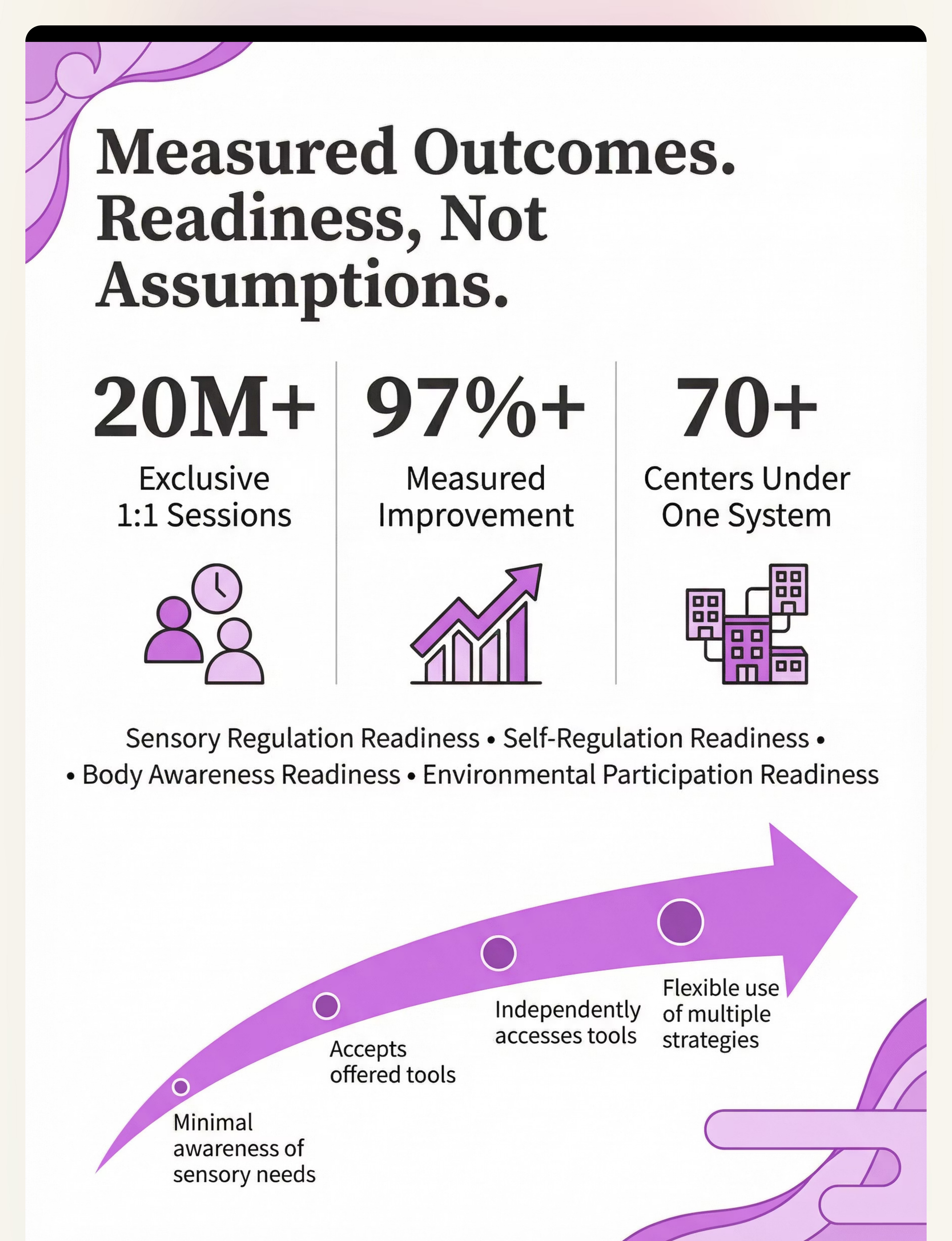
Weeks 1–2 are the hardest. Things are changing — at the neurological level, where you can't see them yet. In our 21M+ session database, families who maintained consistent practice through weeks 1–3 reported 97%+ improvement in regulation outcomes by week 8. Stay consistent. The research is with you.
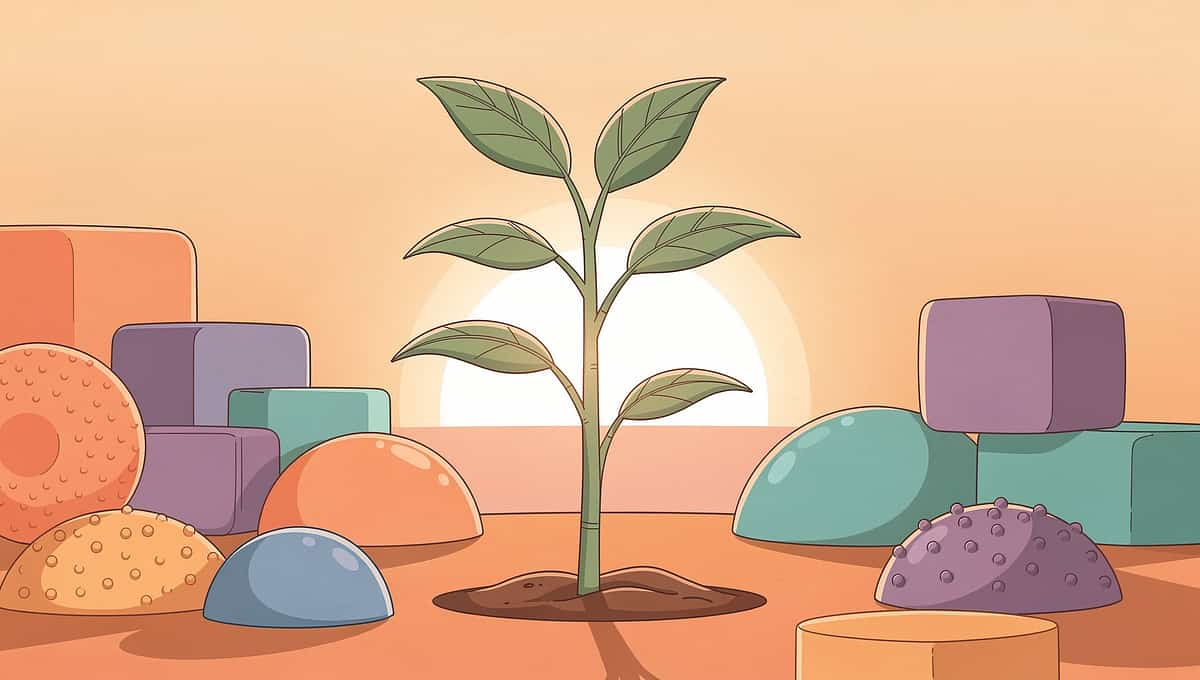
Week 3–4: The Child Begins to Anticipate. The Nervous System Is Reorganizing.
Progress: ~40%
Momentum Building
✅ Child moves toward the material kit when session begins
Anticipatory behavior signals the basal ganglia is beginning to associate the alternative material with the same reward circuitry as spinning. This is not behavioral — it is neuroplastic change.
✅ Engagement duration increases — average 4–6 minutes
Child begins to request specific materials ("spin?" or pointing to top). First instances of spontaneous material use without parent prompting appear.
✅ Spinning episodes show more context-specificity
Triggered moments rather than constant spinning. Parent reports feeling "in sync" with child's sensory signals.
"You may notice you're more confident too. You're reading your child's sensory signals. You're anticipating the spin before it starts. That's co-regulation — one of the most powerful tools in autism parenting."
When to Increase Intensity: If child consistently engages for 8+ minutes → increase session to 25 minutes. If child spontaneously requests → honor immediately and celebrate.

Week 5–8: The Toolkit Is Alive. The Child Is Building Self-Regulation.
Progress: ~75%
🏆 Regulation Toolkit Active
Mastery criteria are specific, observable, and measurable — not vague impressions but concrete behaviors you can see and document.
✅ Child independently selects from 3+ materials in the toolkit
Child uses at least one material in a natural, unprompted context at home, before sessions.
✅ Spinning frequency reduced in at least one context
Meals, school, or community — a measurable reduction in at least one setting shows generalization beginning.
✅ Child tolerates brief interruption without major distress
Less than 30-second recovery shows the nervous system has built alternative pathways — not just suppression.
✅ Child shows pride or awareness of their toolkit
"My toys" — when a child claims ownership of their regulatory tools, self-advocacy has begun.
"Mastery Unlocked" Badge Criteria: 3 consecutive sessions with 8+ minutes engagement + independent material selection + at least one generalization event
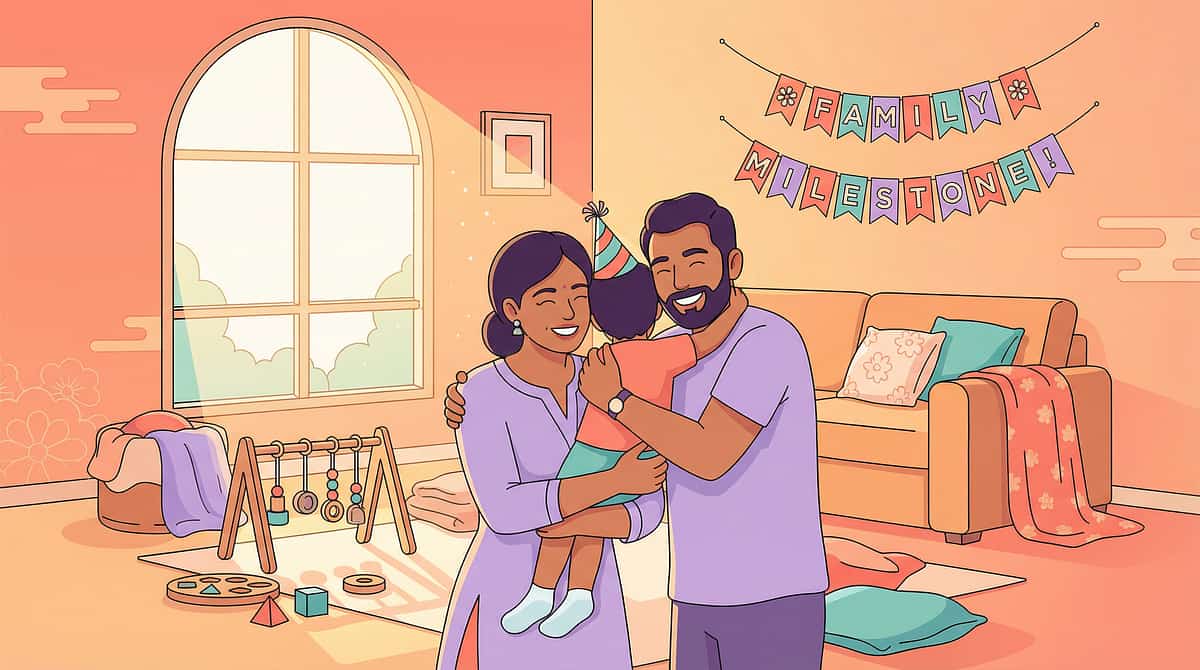
You Did This. Your Child Grew Because of Your Commitment. That Is Not a Small Thing.
"You walked into this technique watching your child spin objects in ways that worried or confused you. You have now built a sensory toolkit, executed a therapeutic protocol, collected data, adapted the approach to your child's unique profile, and watched your child begin to access their own regulatory system with expanding tools. That is clinical-grade parenting."
🎉 Let the Child Choose
Next activity is their choice — their reinforcer, their agency. Honor it fully.
📸 Photo Moment
Child with their toolkit. A photo for the journal. Document Week 8.
🤝 Share the Journey
Share with the Pinnacle community (anonymously). Your journey helps another family begin theirs.
Journal Prompt: "What did spinning look like in Week 1? What does the toolkit look like now? Write 3 sentences. That is your child's story."
📞9100 181 181 | Share your milestone. Our team wants to hear from you.
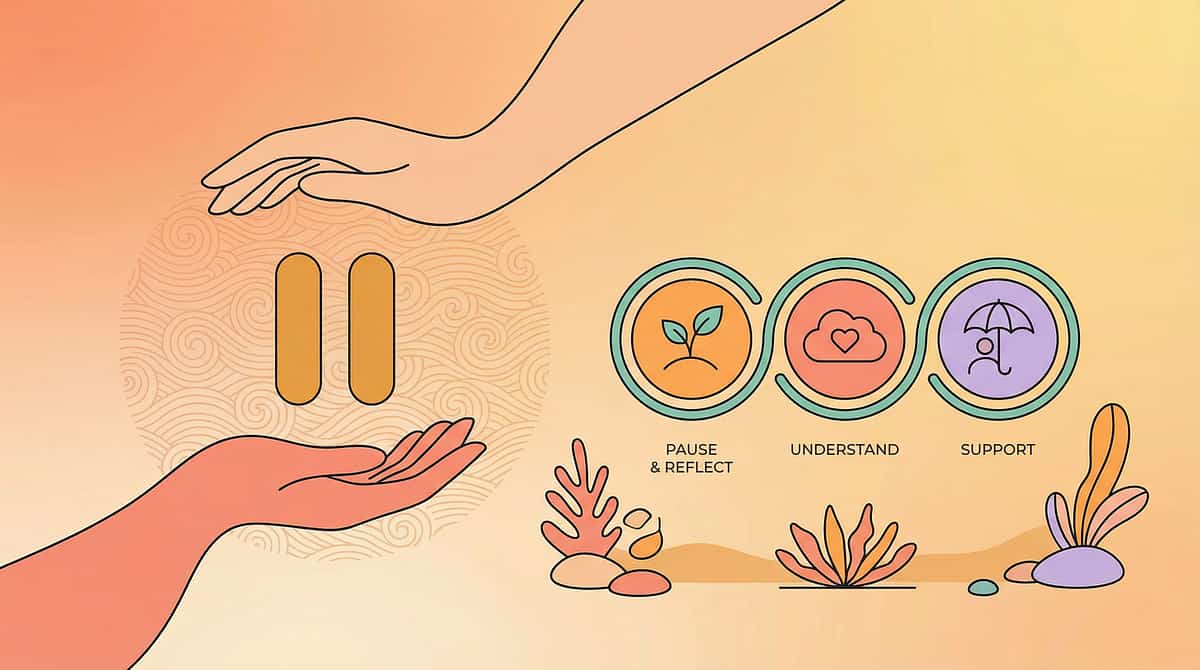
Red Flags: Trust Your Instincts. If Something Feels Wrong, Pause and Ask.
Red Flag | What It Looks Like | Why It Matters | What To Do | |
Self-injury | Child hits head, bites hand, scratches during spinning episodes | Spinning may be serving a pain-regulation function | Stop protocol. Consult BCBA + Pediatrician urgently | |
Escalating frequency | Spinning significantly worsens over 4+ weeks | May indicate increasing anxiety or sensory need | Consult OT for sensory profile reassessment | |
Object specificity intensifies | Child becomes more narrow and distressed about specific objects | May indicate rigidity increasing | BCBA consultation for functional assessment | |
Seizure-like activity | Brief staring episodes during or after spinning | Vestibular input can occasionally trigger neurological events | Medical evaluation urgently — consult pediatrician | |
Regression | Previously mastered skills are lost alongside worsening spinning | May signal medical or environmental change | Developmental pediatrician consultation |
Step 1: Self-Resolve
Brief session failure → skip a day, try modified version
Step 2: Teleconsult
Any red flag → call 9100 181 181 for immediate guidance
Step 3: Clinic Visit
Persistent red flags → book OT/BCBA assessment at nearest Pinnacle center
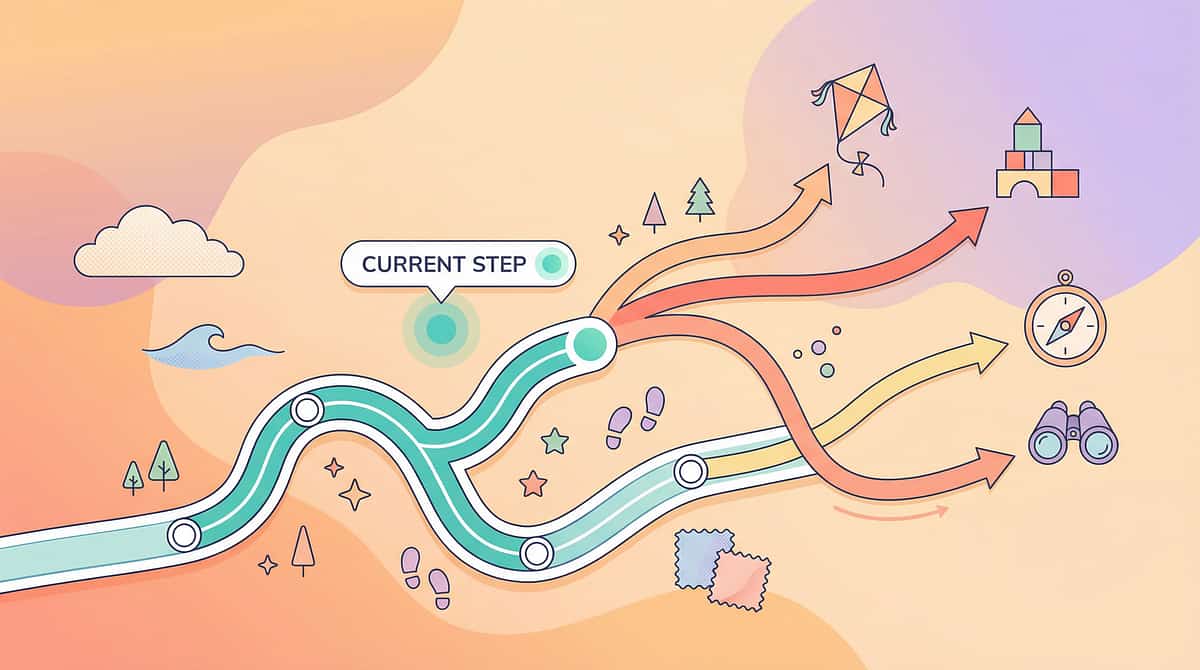
You Are Not Done — You Are on a Journey. Here Is What Comes Next.
Where You Were (Prerequisites)
- D-362: 9 Materials That Help With Hand Flapping (foundational sensory seeking protocol)
- A-084: 9 Materials That Help With Constant Rocking (vestibular baseline)
- Domain A — Sensory Processing foundational techniques
Where You Are Going
- Option A: D-364 Body Rocking — adds vestibular dimension to what you've built here
- Option B: D-370 Sensory Diet Planning — integrates all materials from D-362 through D-370
- Option C: Domain E Social Communication & Inclusion — regulatory foundation feeds school participation
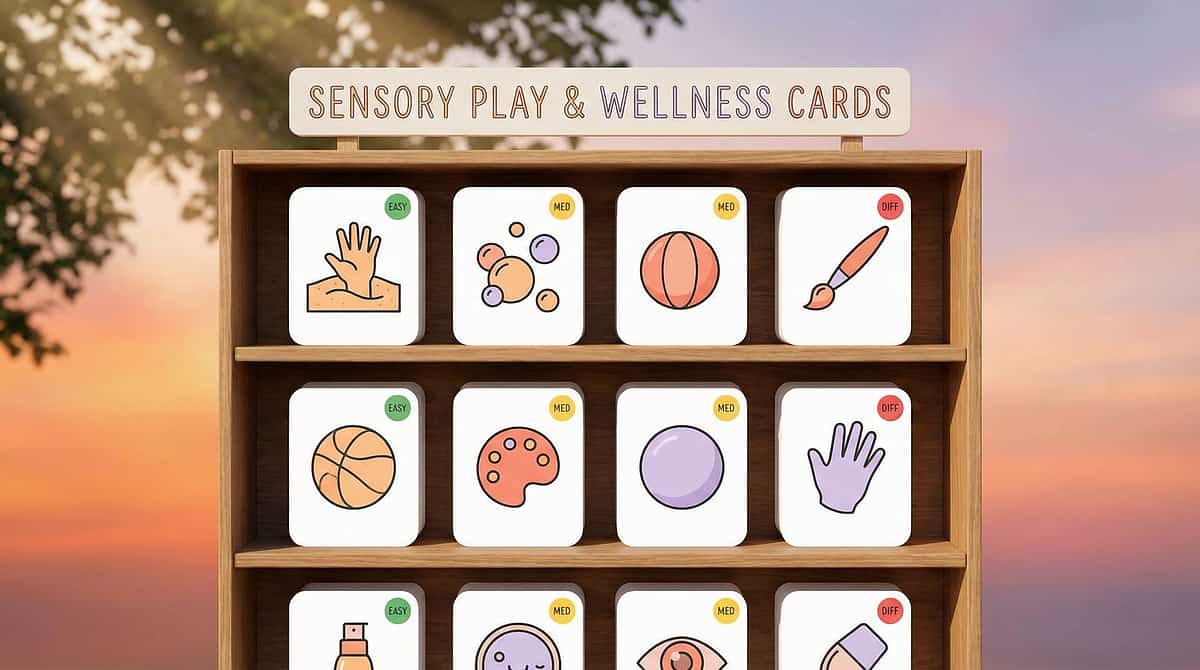
You Already Have the Materials. Here Are the Techniques That Use Them.
Browse Full Domain D:techniques.pinnacleblooms.org/behavior-flexibility/
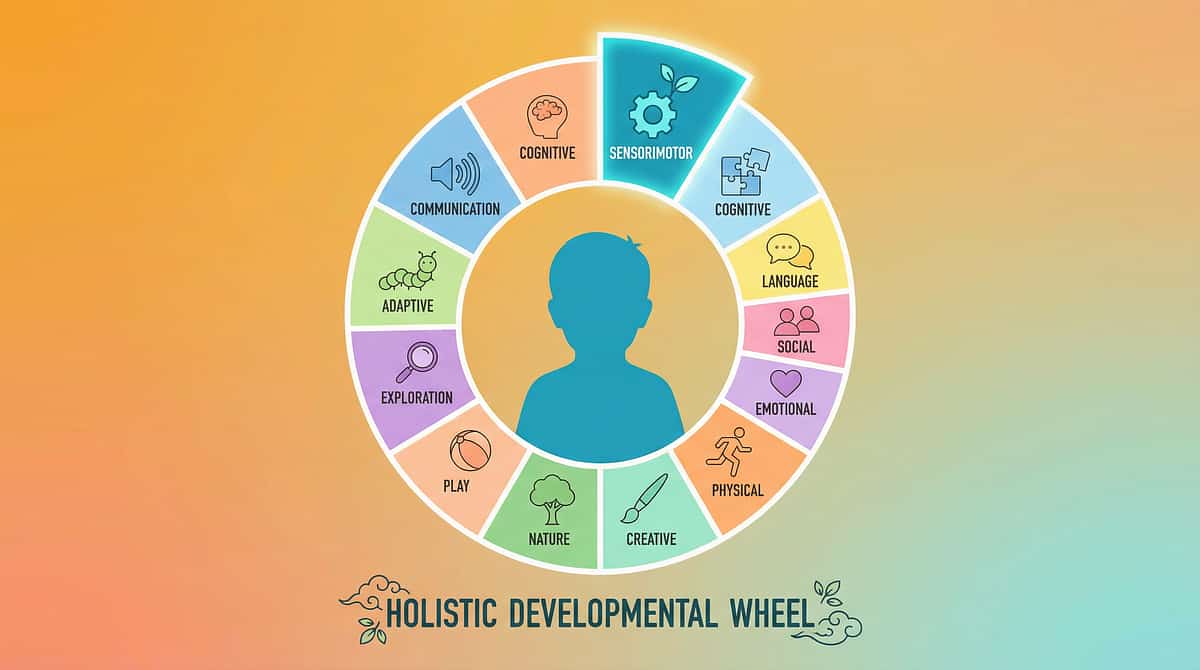
This Technique Is One Piece of a Larger Plan. Here Is the Full Picture.
With D-363, you have addressed a core Behavior & Flexibility challenge. This work feeds directly into Domain C (Emotional Regulation) and Domain E (Social Participation) — because a regulated nervous system is the prerequisite for both.
GPT-OS® tracks 349 developmental skills across all 12 domains. What you are building through D-363 is registered as progress in: Sensory Regulation Readiness Index + Self-Regulation Readiness Index + Adaptive Behavior Readiness Index. View Your Child's Full Developmental Profile →

You Have Everything You Need. The Only Thing Left Is to Begin.
▶️ START THIS TECHNIQUE TODAY
Launch GPT-OS® guided session → Build your first D-363 session plan in 3 minutes
📞 Book a Consultation with a Pinnacle OT or BCBA
Get professional assessment before you begin — recommended for children with high spinning intensity
pinnacleblooms.org/book | OR CALL 9100 181 181
→ Explore the Next Technique: D-364 Body Rocking
Build on your D-363 toolkit with the vestibular regulation layer
✅ Clinically Validated
🔵 OT
🟣 SLP
🔴 ABA
🟢 SpEd
🟡 NeuroDev
📞FREE 24×7 Autism Helpline: 9100 181 181 | 16+ languages | India's #1
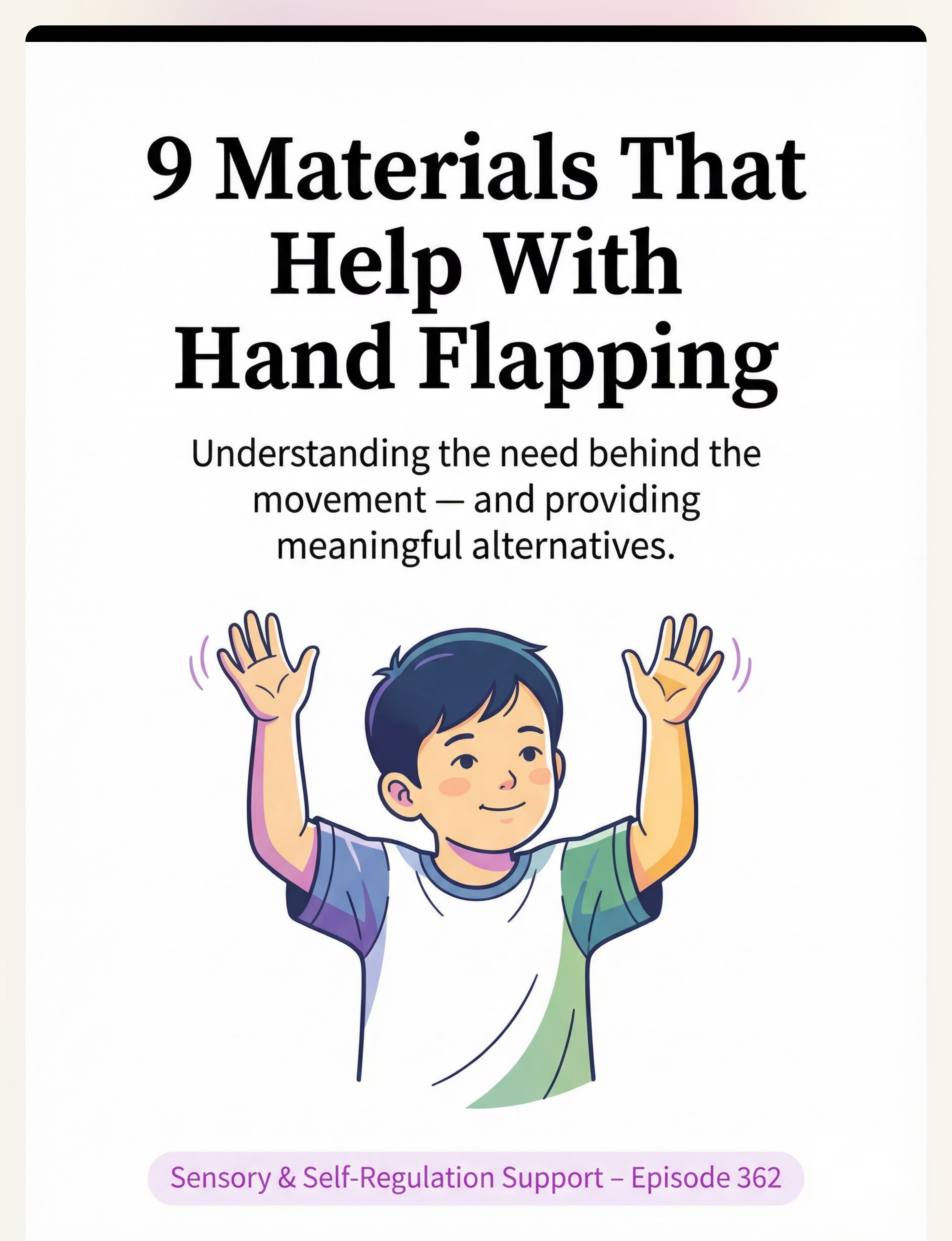
Preview of 9 materials that help with object spinning Therapy Material
Below is a visual preview of 9 materials that help with object spinning therapy material. The pages shown help educators, therapists, and caregivers understand the structure and content of the resource before use. Materials should be used under appropriate professional guidance.



Link copied!
"From Fear to Mastery. One Technique at a Time."
— The Pinnacle Blooms Consortium
You arrived on Card 01 with a question about your child's spinning. You leave with: a clinical understanding of why your child spins, 9 evidence-based materials to expand their regulatory toolkit, a step-by-step protocol you can execute at home, a progress arc across 8 weeks, connection to a community of families on the same journey, and access to India's largest autism therapy consortium. The spinner isn't the problem. The system around the spinner — the materials, the understanding, the consistency — is the solution. You now have the system.
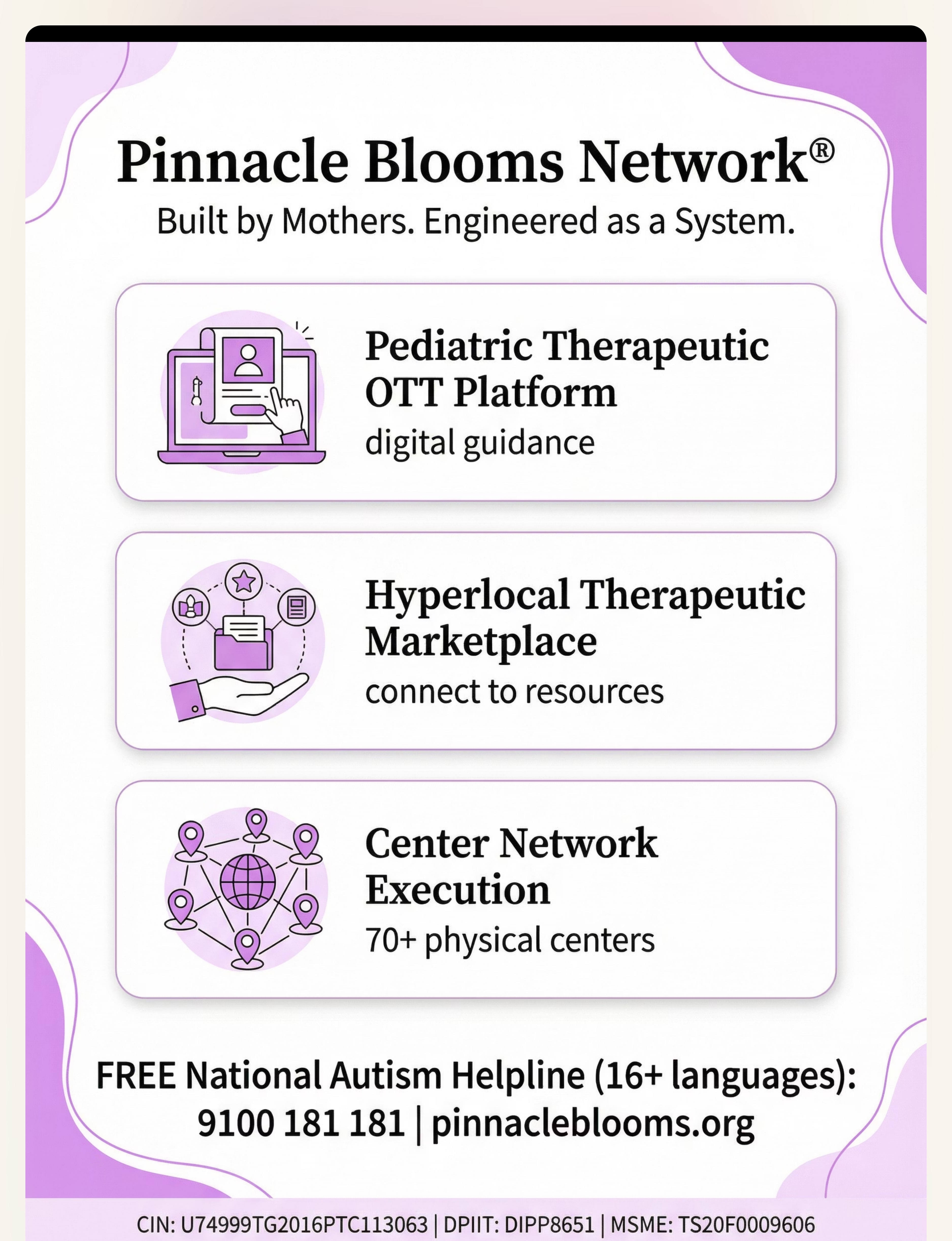
🏛️ Pinnacle Blooms Network®
Pediatric OT | SLP | ABA/BCBA | Special Education | NeuroDev Pediatrics | CRO
Built by Mothers. Engineered as a System.
Built by Mothers. Engineered as a System.
📋 Statutory Identifiers
CIN: U74999TG2016PTC113063 | DPIIT: DIPP8651 | MSME: TS20F0009606 | GSTIN: 36AAGCB9722P1Z2
Medical Disclaimer: This content is educational and does not replace individualized assessment by licensed occupational therapists, behavior analysts, or developmental specialists. Object spinning and motor stereotypies can be associated with various conditions. Professional evaluation is recommended to understand your child's unique sensory profile. Results vary by sensory profile, underlying diagnosis, implementation consistency, and individual factors.
Copyright
© 2025–2026 Pinnacle Blooms Network®, unit of Bharath Healthcare Laboratories Pvt. Ltd. All rights reserved.
D-363 | Pinnacle Blooms Network® | GPT-OS® Content Engine | February 2026