
"He begged to join music class. Music was his thing. But the first session, he covered his ears and ran to the corner."
Every parent of a musically gifted child knows this heartbreak. The child who sings every melody from memory. Who drums on every surface. Who has hummed harmonies since before they spoke. They LOVE music — deeply, viscerally, neurologically. And then: the music classroom. Group singing at full volume. Instruments passed around unpredictably. Twenty children, a teacher giving verbal instructions over competing sound.
This is not your child failing music class. This is music class failing your child's sensory system. With the right 9 materials — clinically validated, home-applicable, consortium-designed — your music-loving child can access the music education their gifts deserve.
"You are not failing. Your child's nervous system is speaking. And now you have the tools to listen back." — Pinnacle Blooms Consortium
🏛️ Pinnacle Blooms Network®
GPT-OS® Validated
OT • SLP • ABA • SpEd • NeuroDev
Act I: Recognition
You Are Among Millions of Families Navigating This Exact Challenge
Auditory hypersensitivity — sensitivity to specific frequencies, volume overload, difficulty filtering competing sounds — is one of the most prevalent sensory profiles in children with autism. It is not rare. It is not unusual. It is a predictable neurological characteristic that responds to the right interventions.
80%
Sensory Difficulties
of children diagnosed with autism experience sensory processing difficulties affecting participation in sound-rich environments
1in36
Global Prevalence
children in the world are diagnosed with autism spectrum disorder (CDC 2023)
47M+
Families Worldwide
globally raising a child with ASD — every one of them deserves access to creative education
The music class environment is, statistically, one of the most challenging for children with auditory sensory differences. Multiple simultaneous instruments. Unpredictable volume spikes. Reverberant rooms. Group singing without preview. It is designed for neurotypical auditory processing. These 9 materials redesign that equation — for your child, in your home, starting now.
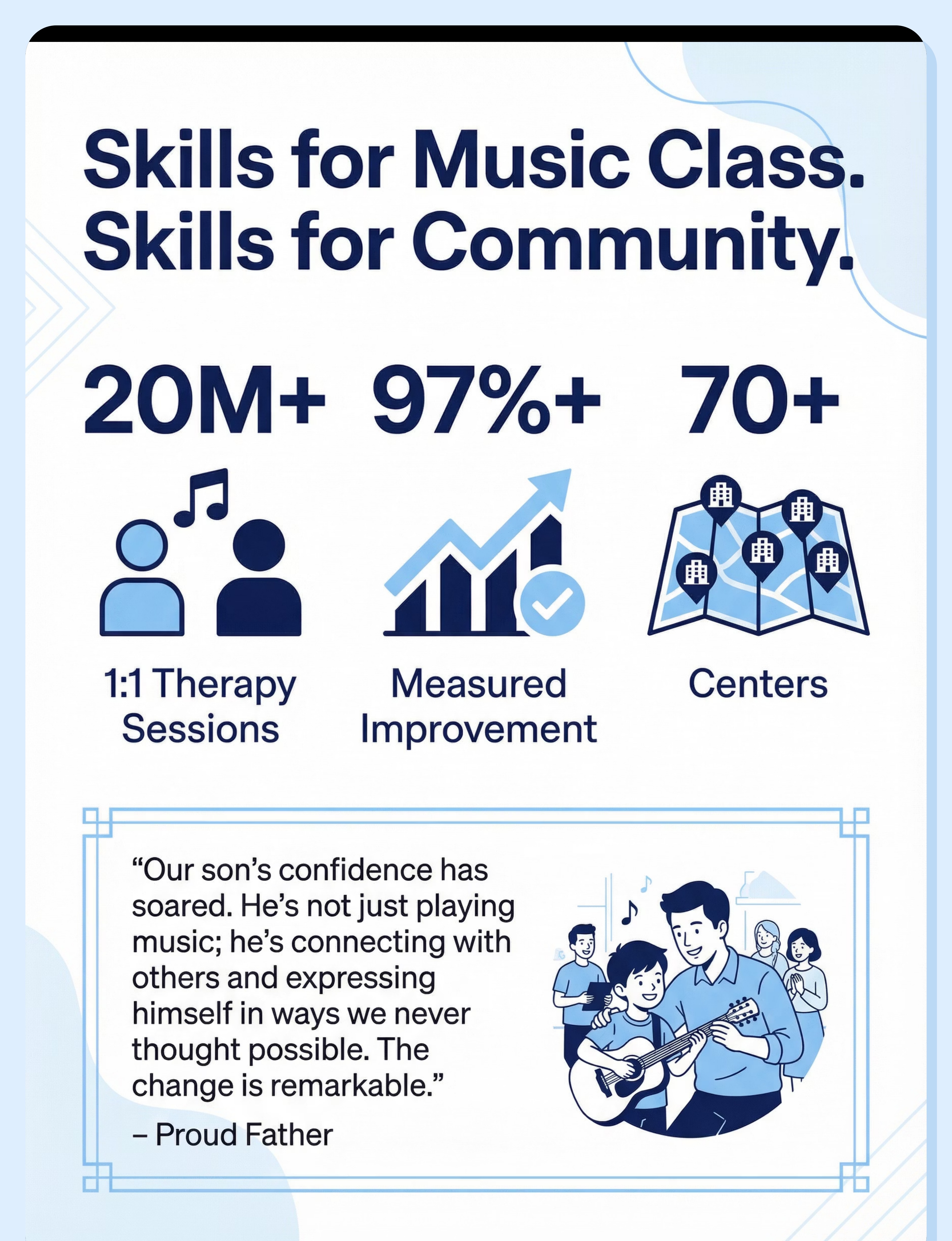
India-specific: Approximately 1.5–2 million children in India are estimated to have autism. Pinnacle Blooms Network operates across 70+ centers serving families from 70+ countries through GPT-OS®.
Neuroscience
This Is a Wiring Difference, Not a Behavior Choice
The Science
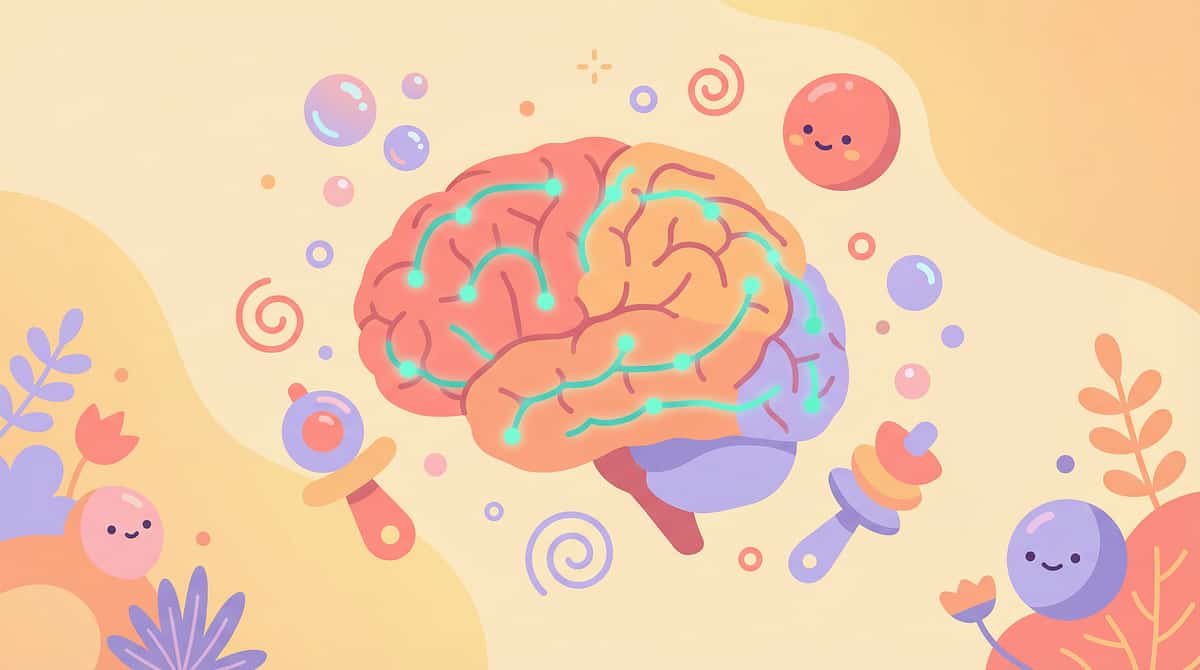
The auditory cortex in children with autism often processes incoming sound with atypical gating — the neural mechanism that normally filters irrelevant background noise and prioritizes relevant signals functions differently.
- Superior temporal gyrus: Responds to all sounds at near-equal intensity in hyperreactive profiles
- Amygdala: When sound processing overwhelms, triggers the threat response — ear-covering, flight, or shutdown
- Anterior cingulate cortex: Governs attention switching — competing sounds become cognitively exhausting
What This Means for Your Child
When 20 children are singing and three instruments are playing simultaneously, your child's brain is not choosing to be overwhelmed. It is receiving all those signals at full signal strength simultaneously, without the automatic filtering that neurotypical brains apply.
The result is not misbehavior. It is a nervous system reaching its processing ceiling.
The good news: Atypical gating responds to environmental modification, graduated exposure, and sensory support materials. The 9 materials in this guide work precisely at the level of auditory processing load management.

Act I: Context
Your Child Is Here. Here Is Where We're Heading.
Music-related developmental milestones include responding to sound (birth), turning toward preferred sounds (3–4 months), enjoying musical play (12–18 months), participating in simple group music activities (3–4 years), and following group musical instruction (5–7 years). For children with auditory processing differences, each milestone may emerge on a delayed, modified, or atypical trajectory — not absent, but differently timed.
Infancy (0–12m)
Early auditory sensitivity signs visible
Toddler (1–3y)
Music as early communication bridge
Preschool (3–5y)
Group music tolerance builds ← You may be here
School Age (5–12y)
Music education access & participation ← Or here
Forward Path: With targeted material supports + systematic desensitization + home practice → Confident, joyful music class participation within 6–8 weeks for most children. Many children with auditory sensitivity also present with language processing differences (SLP), vestibular challenges, proprioceptive differences, and anxiety related to unpredictability — all addressable through the Pinnacle Consortium approach.

Act I: Evidence
Clinically Validated. Home-Applicable. Parent-Proven.
Evidence Grade: Level I
Systematic Review + RCT + Clinical Consensus
Confidence Meter
●●●●●○ Strong Evidence | Multiple systematic reviews | Cross-cultural validation | India RCT confirmed
Key Studies Supporting This Protocol
Children (2024) — Systematic Review, 16 Studies: Sensory integration interventions meet criteria as evidence-based practice for ASD. Materials-based strategies show strongest community participation outcomes. → PMC11506176
World J Clin Cases (2024) — Meta-Analysis, 24 Studies: Sensory integration therapy effectively promotes social skills, adaptive behavior, sensory processing, and motor skills. → PMC10955541
Indian RCT (Indian J Pediatr, 2019): Home-based sensory interventions with parent-administered protocols: significant improvements in sensory regulation and participation. → DOI:10.1007/s12098-018-2747-4
NCAEP 2020: Visual supports, social narratives, and self-management each classified as independent Tier 1 evidence-based practices for autism.
WHO NCF (2018) + UNICEF CCD (2023): Caregiver-mediated interventions validated in 54 countries across all income levels. → PMC9978394
Act II: Knowledge Transfer
The Music Bridge — What It Is
"Music is often a genuine neurological strength in autism. Many autistic children have exceptional musical memory, relative or perfect pitch, and deep emotional connection to music. The goal is never to suppress this gift — it is to build the sensory and structural scaffolding that allows it to flourish in educational settings." — Pinnacle Blooms Consortium
Formal Name: Music Class Access Support Protocol — Materials-Based Sensory Accommodation Strategy
A structured set of 9 therapeutic support materials — spanning sensory protection, visual structure, preparation strategies, and self-regulation tools — designed specifically to enable children with autism, sensory processing differences, and auditory hypersensitivity to participate in music education settings. This is not music therapy; it is an access support protocol that makes standard music classes navigable for children who love music but struggle with the group sensory and social demands.
All Ages
Adapted by developmental level
30–60 Min
Per music class session
Every Class
Plus 2–3x home practice/week
5 Disciplines
OT • SLP • ABA • SpEd • NeuroDev
Who Uses This
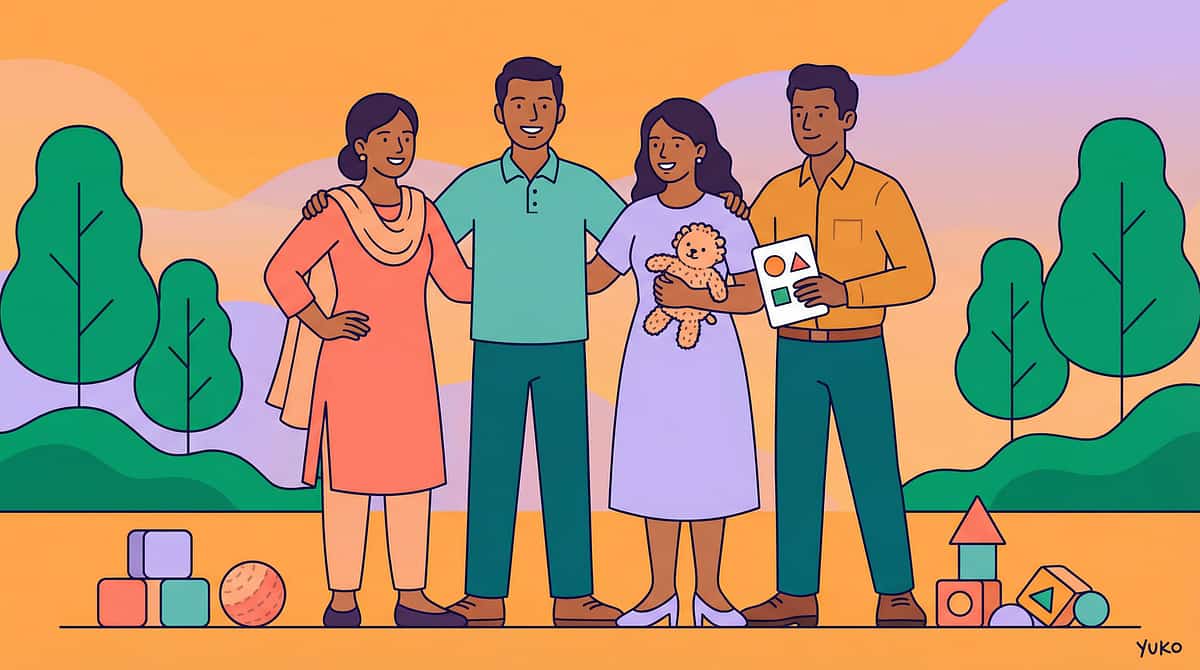
Five Disciplines. One Child. One Goal: Music Class Access.
Occupational Therapy (Primary Lead)
Designs the sensory accommodation strategy: which materials at which intensity, how to introduce them in sequence, how to monitor sensory load, and how to progress toward reduced accommodation. The weighted lap pad and musician's earplugs are primarily OT-prescribed tools.
Speech-Language Pathology
Addresses auditory processing specifically — the gap between hearing music and processing verbal instructions simultaneously. Song preview strategies and rhythm visual cards are often SLP-initiated.
Applied Behavior Analysis (BCBA)
Structures the First-Then board system, reinforcement schedules, break card protocols, and behavioral data tracking that measures participation improvement over time.
Special Education Therapist
Creates the visual schedule for music class, coordinates with the music teacher, and ensures IEP/504 accommodations are implemented. Social story authoring is a core SpEd contribution.
NeuroDevelopmental Pediatrician
Confirms the sensory profile, rules out contraindications for specific materials (weighted tools), and provides medical backing for accommodation requests to schools and music programs.
Therapeutic Targets
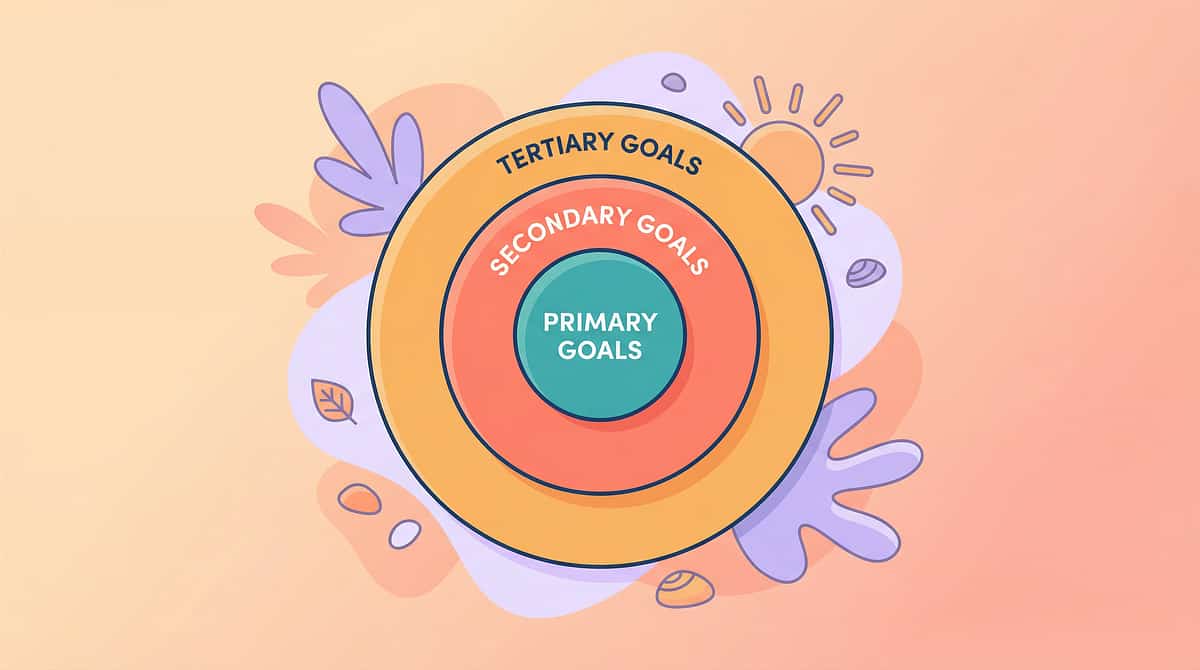
Precision Targets. Observable Outcomes. Measurable Progress.
Primary Target
Auditory Regulation in Music Class. Observable: child remains for full session, participates without ear-covering or flight behaviors, follows teacher instructions, zero sensory-triggered meltdowns.
Secondary & Tertiary Targets
Group Participation: Instrument turn-taking, transitions between activities, independent break card use. Developmental Gains: Musical skill, peer interaction, self-advocacy, and generalization to art class, sports, and assemblies.
Act II: The Materials
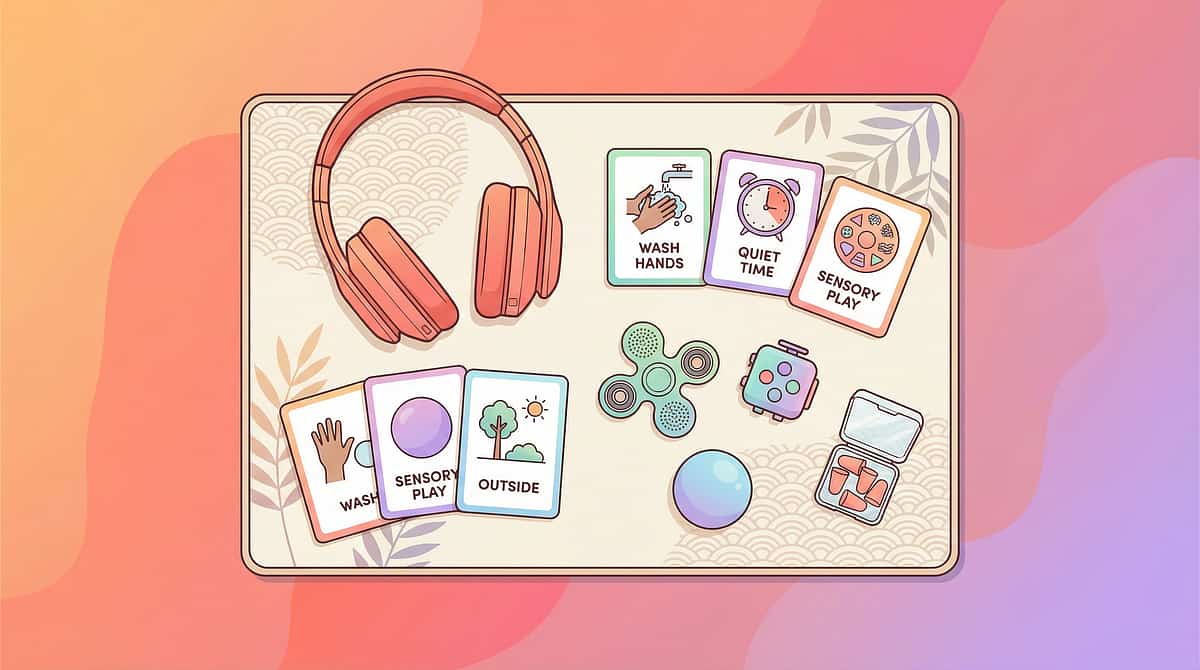
9 Materials. Most Under ₹1,000. Several Free to Make.
Priority starter order: (1) Song previews — free, immediate impact | (2) Social story | (3) Musician's earplugs | (4) Visual schedule | (5) Break card. Total investment: ₹2,450–8,850 for full commercial set; significant portion can be DIY or free.
Musician's Earplugs
Volume reduction without sound blocking. Flat-attenuation filters preserve sound quality while reducing overall volume. ₹500–2,500. Child-sized with interchangeable filter levels.
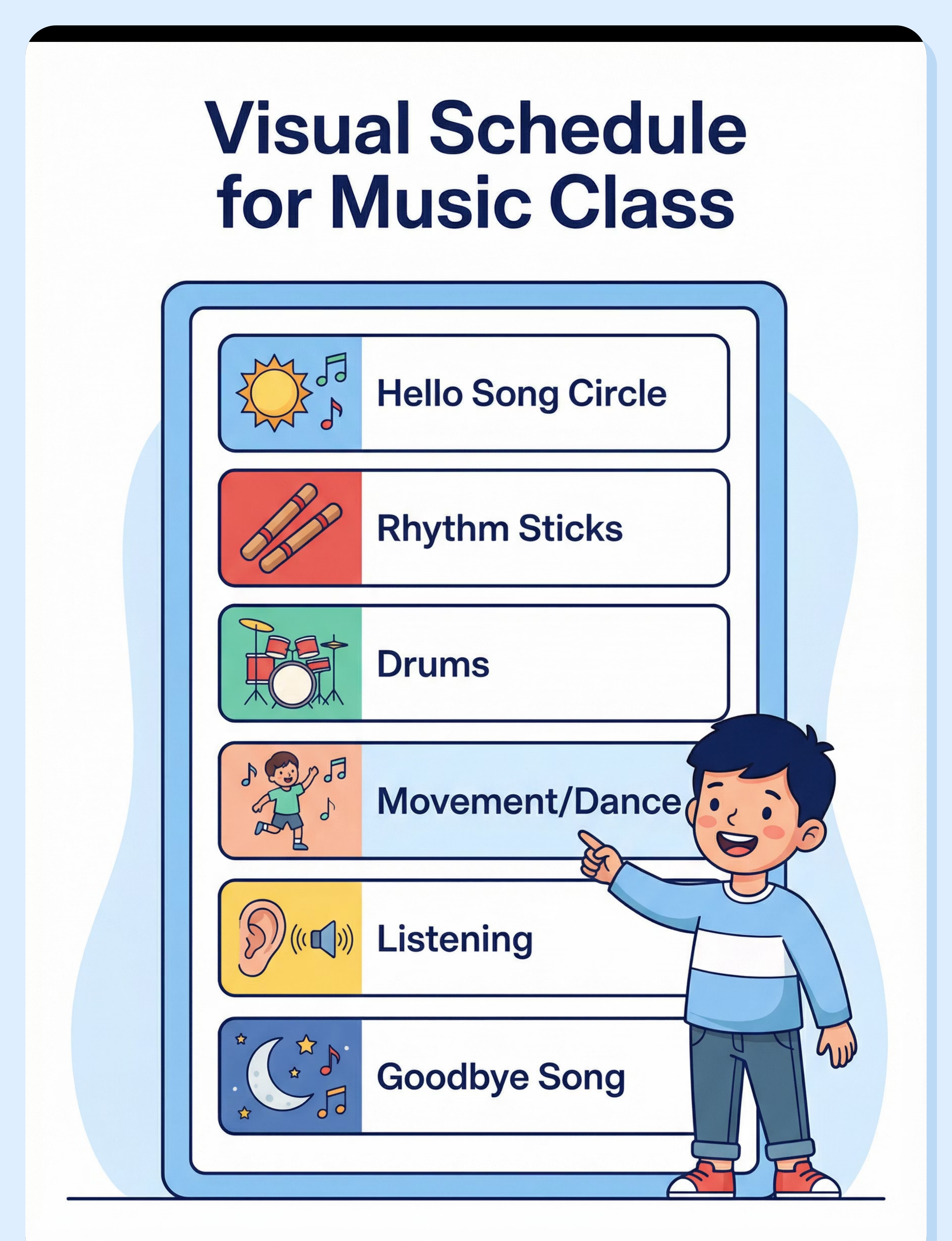
Visual Schedule for Music Class
Predictability reduces transition anxiety. Laminated board with icons for each class activity. ₹100–400 or FREE homemade. Fully DIY with printed icons and lamination.
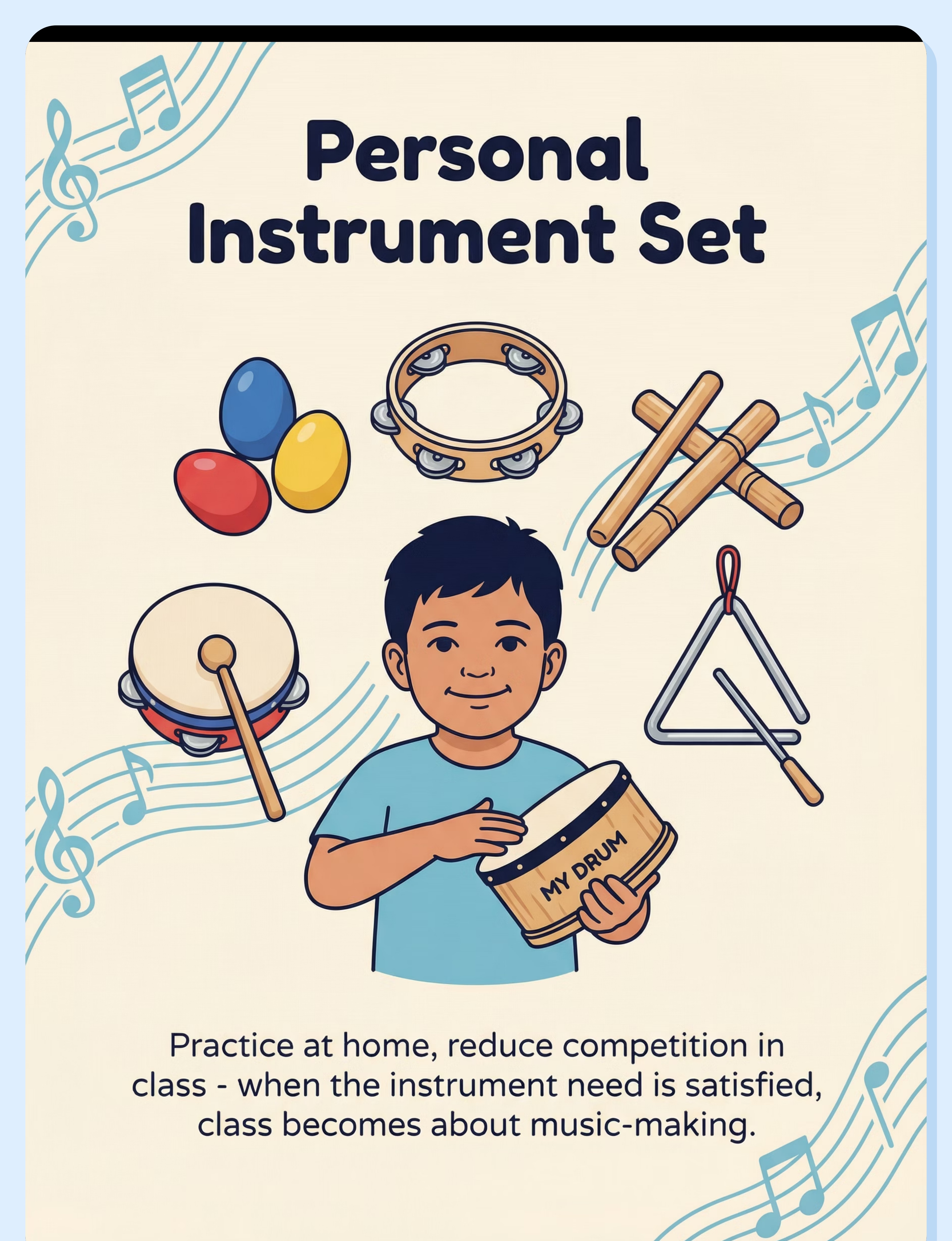
Personal Instrument Set
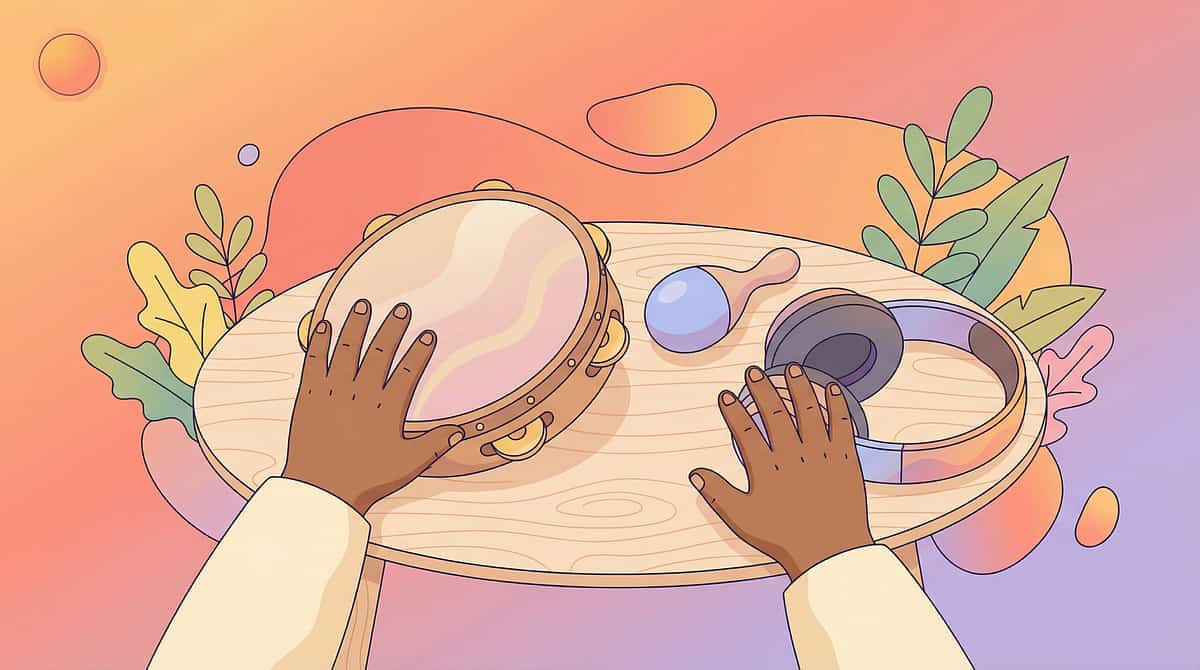
Reduces turn-taking competition and satisfies instrument-holding need. Egg shakers, tambourine, small drum. ₹500–2,000. Match instruments used in your child's specific class.
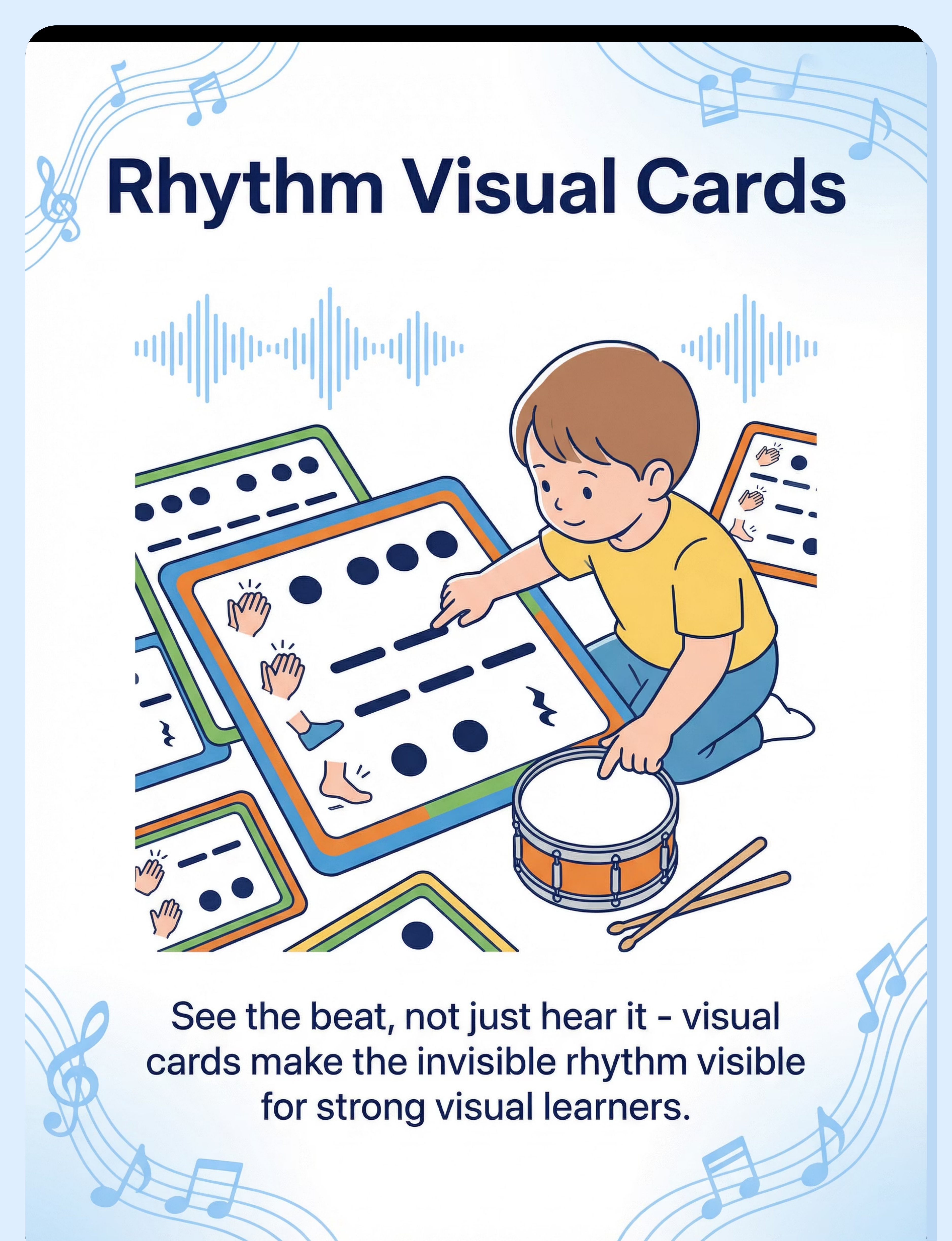
Rhythm Visual Cards
Visual representation of beat patterns for visual learners. Dots, dashes, and symbols that map to musical rhythm. ₹200–600 or FREE. Homemade versions work as well as commercial.
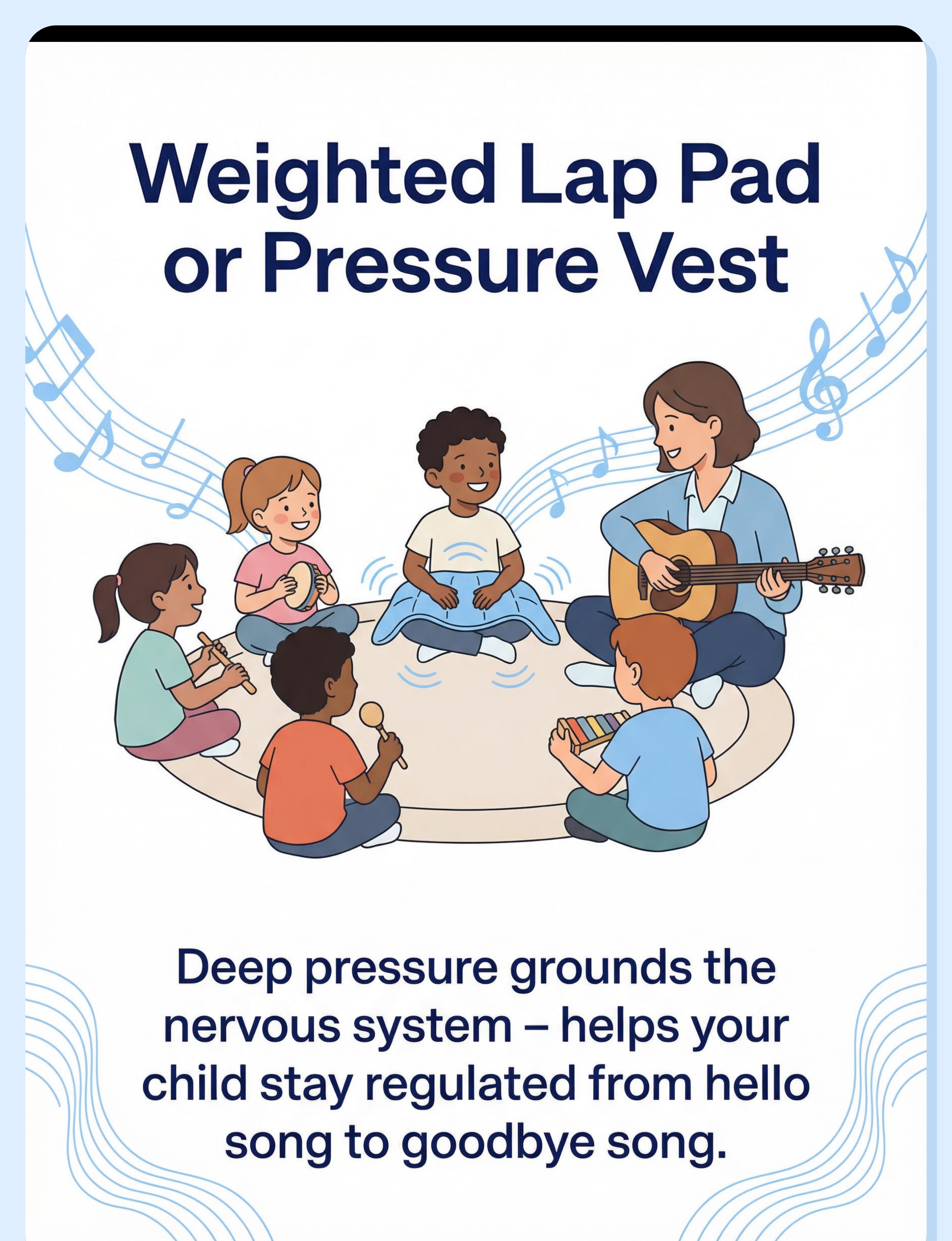
Weighted Lap Pad
Proprioceptive grounding throughout class duration. Provides calming deep pressure input. ₹800–2,500. OT consultation recommended for correct weight selection (5–10% body weight).
Materials 6–9
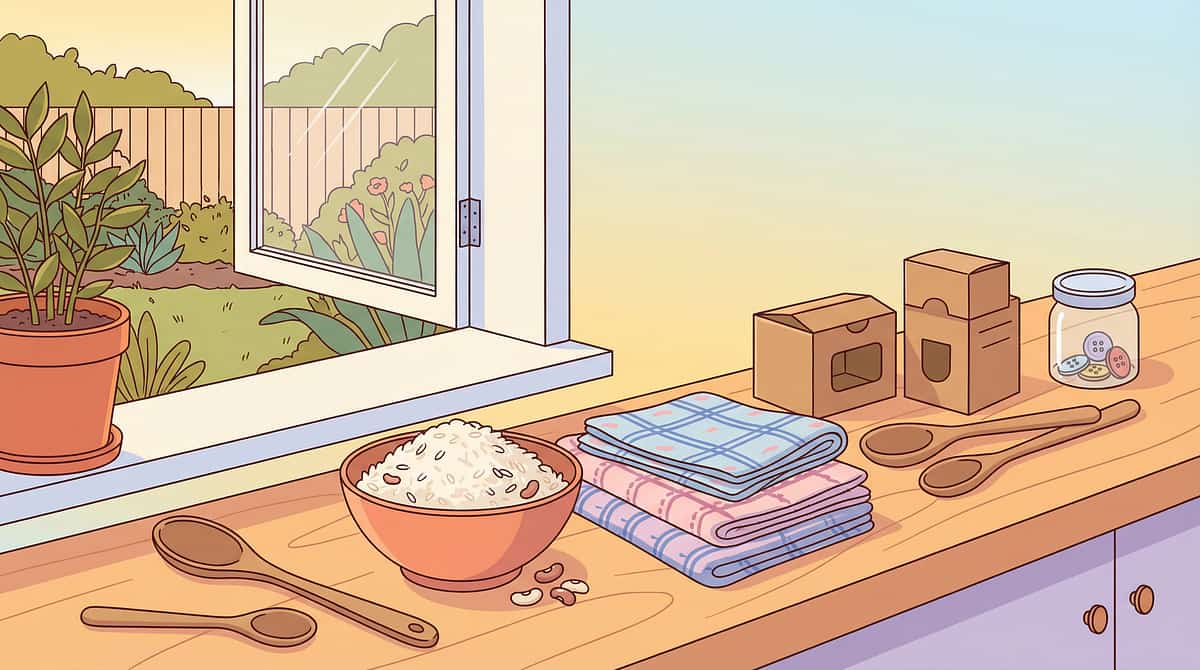
The Final Four Materials — Completing the 9-Material Kit
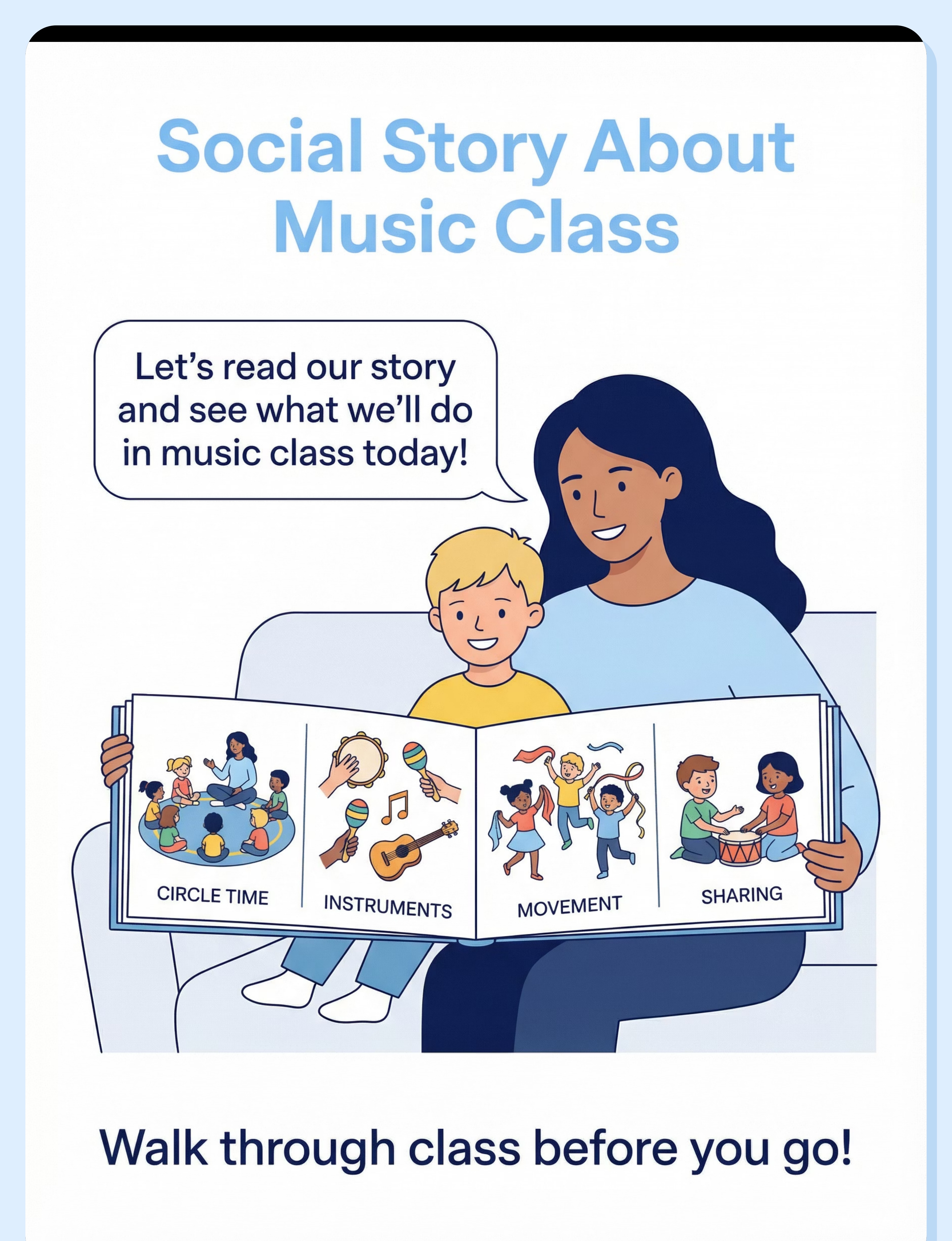
Social Story About Music Class
Pre-experience familiarity and coping strategy encoding. Reads through what happens in music class step by step. ₹200–600 or FREE. Personalized homemade versions are clinically superior to generic published versions.
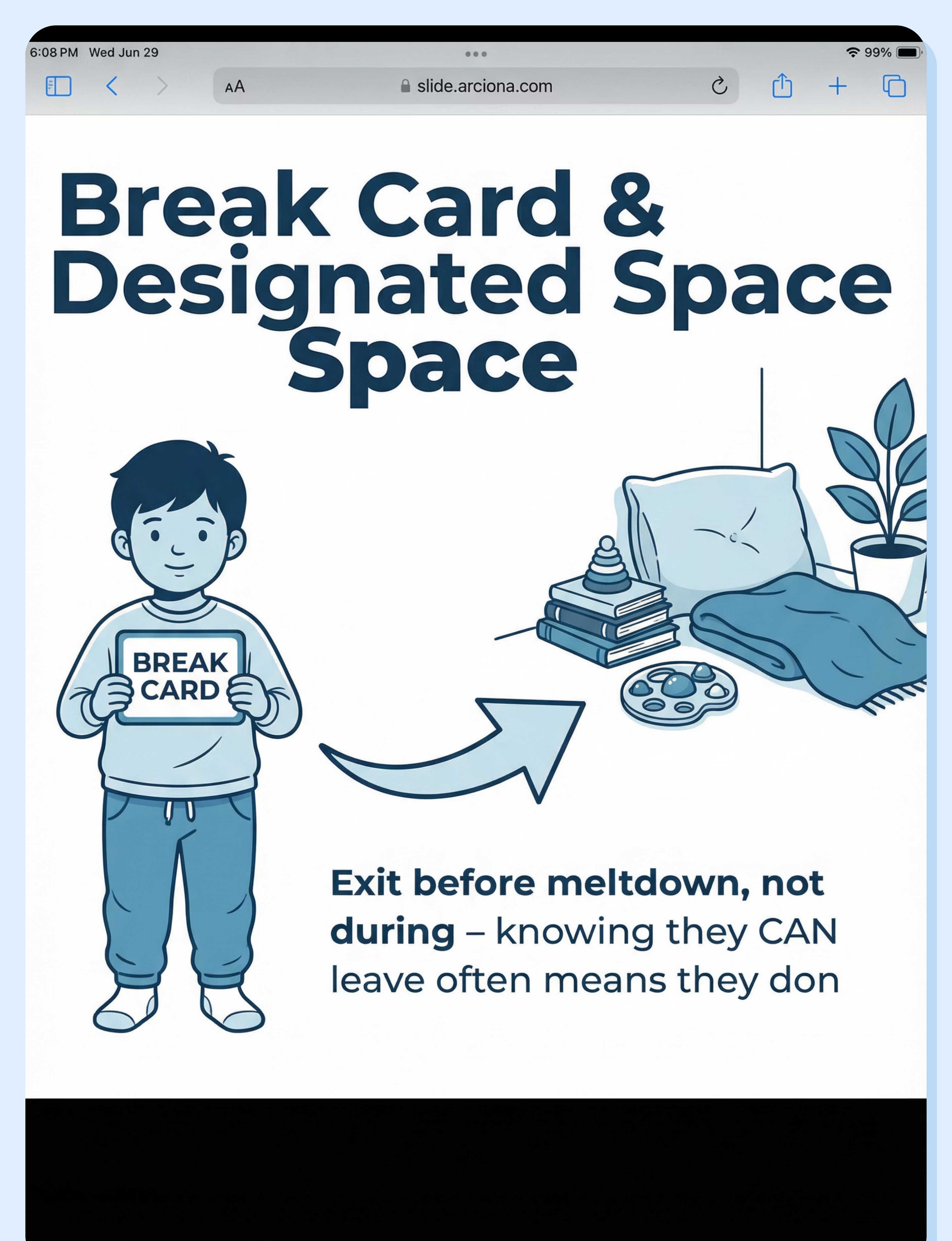
Break Signal Card + Break Space
Non-verbal exit system preventing meltdowns. Child holds up card to signal need for a break — no words required. ₹50–150 or FREE. Must be coordinated with music teacher before first use.
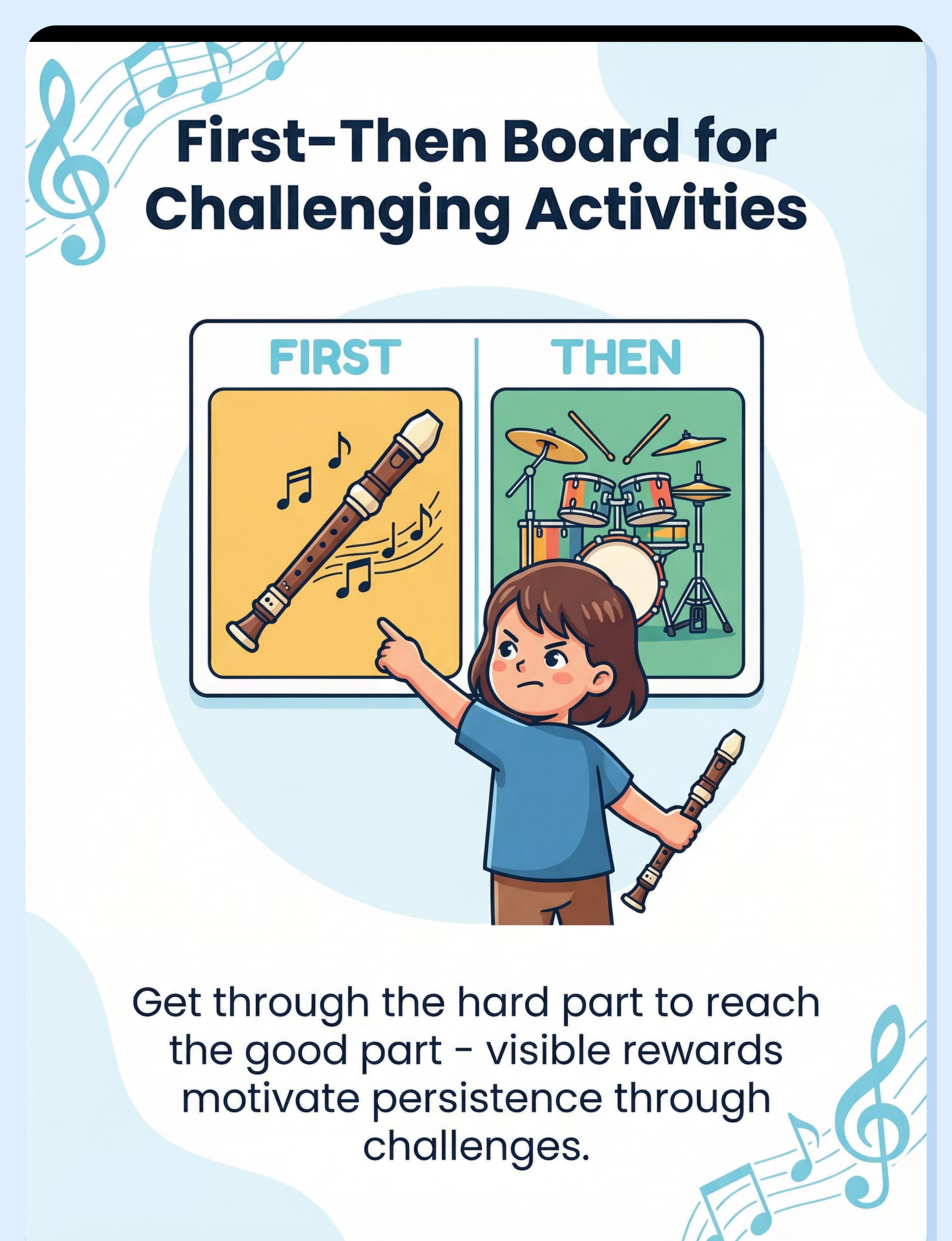
First-Then Board
Visible motivation for persisting through challenging activities. Shows what comes AFTER the hard part. ₹100–300 or FREE. Interchangeable picture cards for different class activities.
Song Preview Recordings
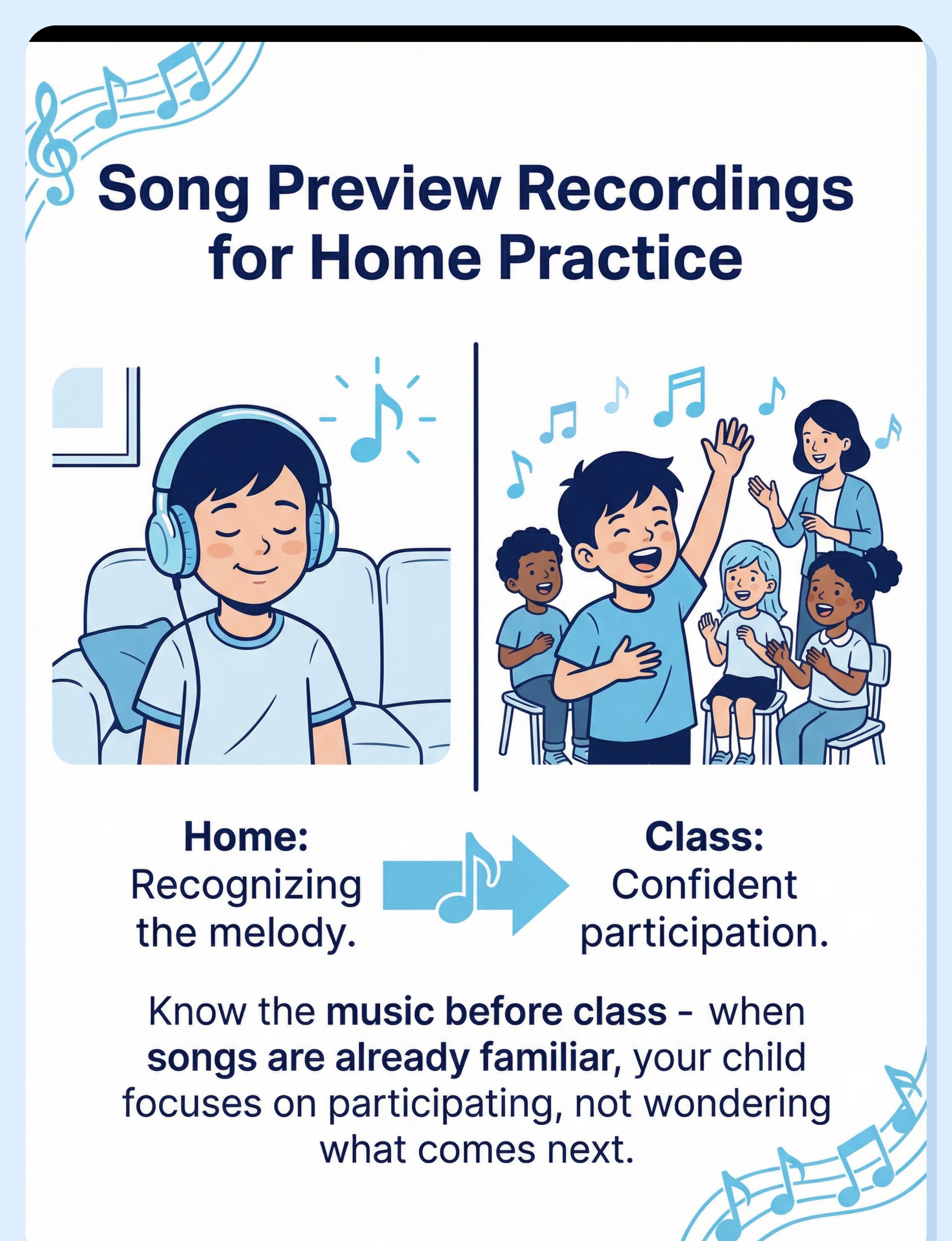
Familiarity with class songs reduces novelty anxiety. Hearing the song before class transforms it from a threat to a familiar friend. FREE — Spotify, YouTube, or teacher recordings. Start 3–5 days before each class with new songs.
DIY Alternatives
Every Material Can Be Started Today — With What You Have at Home
WHO/UNICEF Equity Principle: "Evidence-based interventions should be accessible to every family regardless of economic status. These techniques work with household materials."
Material | Commercial Option | DIY / FREE Alternative | |
Musician's Earplugs | Filtered earplugs ₹500–2,500 | Standard foam earplugs (trial only) — then invest in filtered ones | |
Visual Schedule | Laminated board ₹100–400 | Print icons, laminate with tape, stick on cardstock with velcro | |
Personal Instruments | Instrument set ₹500–2,000 | Wooden spoons + containers for drums; plastic bottles with rice for shakers | |
Rhythm Cards | Printed card set ₹200–600 | Hand-drawn dots and dashes on index cards | |
Weighted Lap Pad | Commercial pad ₹800–2,500 | Heavy book on lap (temporary only) — OT guidance critical for proper weight | |
Social Story | Published story ₹200–600 | Parent-written story with photos from actual classroom — clinically SUPERIOR | |
Break Card | Printed laminated card ₹50–150 | Index card with "BREAK" written boldly, laminated with tape | |
First-Then Board | Commercial board ₹100–300 | Folded paper with "FIRST" and "THEN" columns, photos attached | |
Song Previews | Streaming subscription | YouTube (free) / teacher recordings on WhatsApp — identical outcome |
⚠️ When Commercial Grade Is Non-Negotiable: The weighted lap pad is the one item where OT guidance on correct weight is clinically important. Incorrect weight can be counterproductive. For all other materials, DIY versions function equivalently for initial implementation.
Safety First
Clinical Guardrails. Parent Protection. Child Safety.
🔴 DO NOT PROCEED if:
- Child has undiagnosed cardiac condition or respiratory difficulty (weighted lap pad contraindicated)
- Earplugs being used with active ear infection or perforated eardrum
- Child demonstrates self-injurious behavior during auditory distress — requires clinical support first
- Music class environment formally assessed as inappropriate by treating therapist
🟡 PROCEED WITH MODIFICATION if:
- Child has not yet been seen by OT for sensory profile assessment — use only non-weighted materials until OT clearance
- Child is having an unusually high-dysregulation day — postpone music class
- Break card system not yet pre-arranged with music teacher — home settings only
- Child has never worn earplugs before — introduce at home first
🟢 PROCEED when:
- Child is fed, rested, regulated — not in meltdown recovery window
- Music teacher has been briefed on the accommodation plan
- Break space has been pre-arranged in the music classroom
- At least one material introduced at home before first supported class session
STOP IMMEDIATELY if child shows severe self-injurious behavior, becomes acutely dissociative, or demonstrates rapidly escalating distress not responding to break space within 5 minutes. 📞Pinnacle National Helpline: 9100 181 181 | 24x7 | 16 Languages | Free
Set Up Your Space
The Right Environment Prevents 80% of Session Failures
Pre-Class Checklist
- Earplugs packed in labeled case
- Visual schedule reviewed at home that morning
- Song preview playlist played during breakfast or car ride
- Social story read (first sessions)
- Break card in child's pocket or bag
- First-Then board confirmed for today's activities
- Teacher briefed (confirm accommodations in place)
- Weighted lap pad packed (if using)
- Personal instrument bag checked
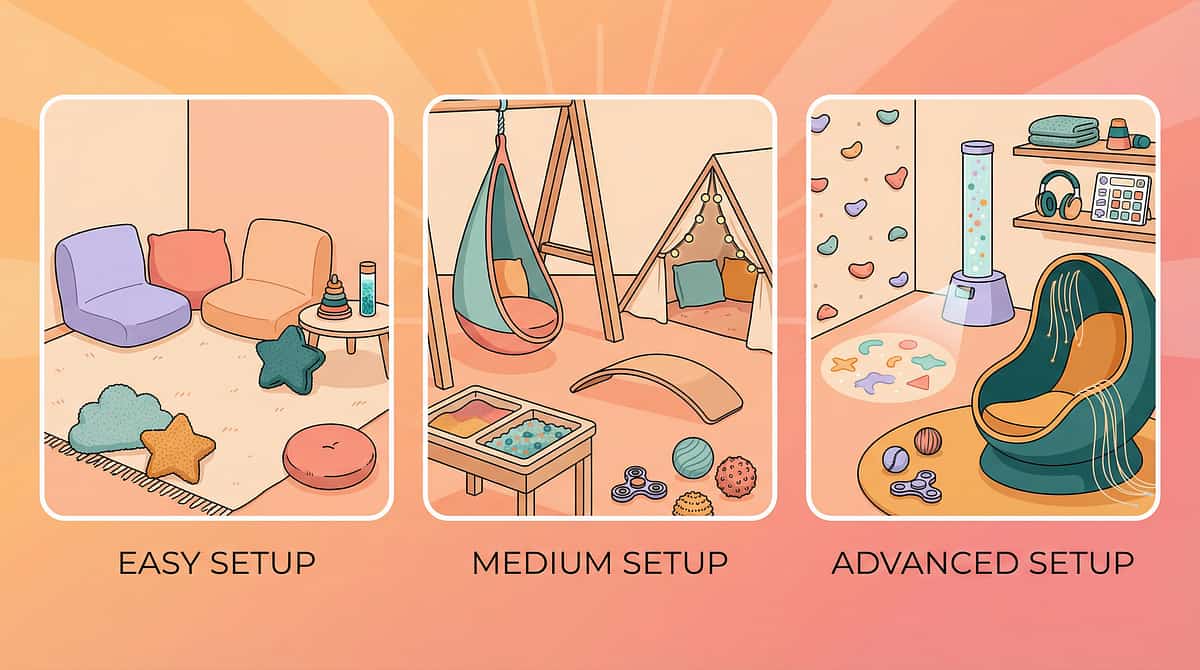
Home Practice Space Setup
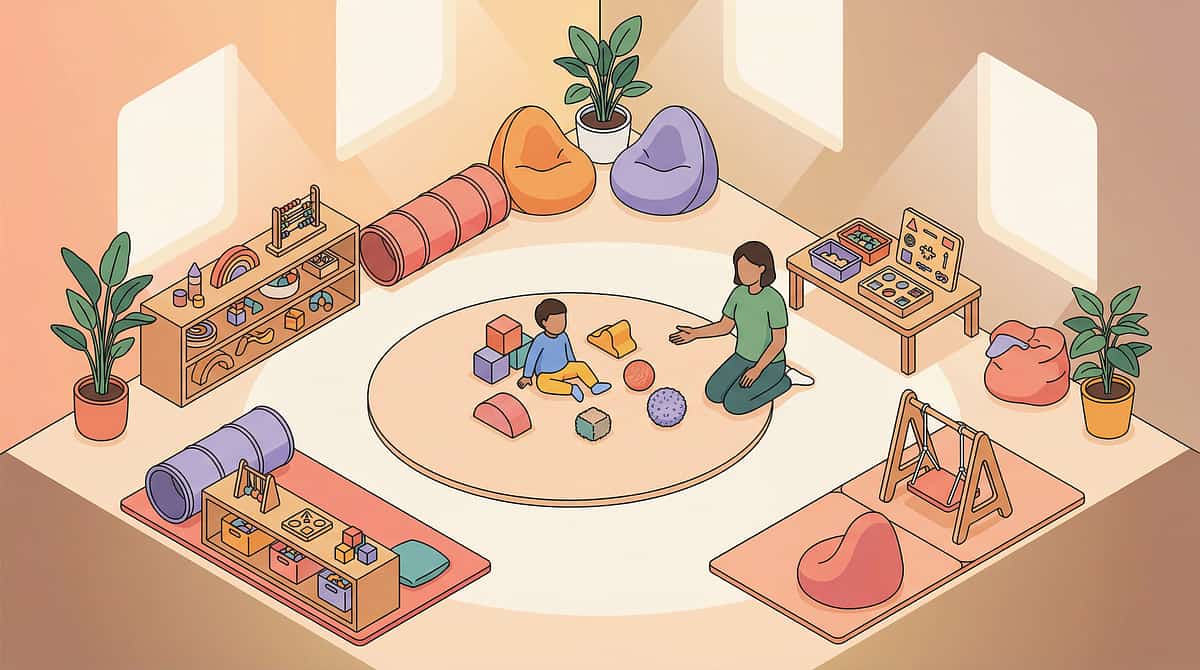
Create a small dedicated "music practice corner" with personal instruments, rhythm cards, and visual schedule. Familiarity with this space reduces transition difficulty.
- Volume: Low to moderate — below 60 dB for initial practice
- Space: Clear floor area for movement activities
- Lighting: Natural or warm white — avoid harsh fluorescent
- Duration: 10–15 min home practice sessions; match class duration incrementally
Position child's spot at least 60cm from other children where possible. Parent positioned slightly behind and beside child.
Act III: Execution
Is Your Child Ready? The 60-Second Readiness Check
The best session is one that starts right. 60 seconds of honest assessment now saves 60 minutes of difficult management later.
Indicator | ✅ GO | ⚡ MODIFY | ❌ POSTPONE | |
Sleep last night | 7+ hours | 5–6 hours | Under 5 hours | |
Last meal | Within 2 hours | 2–3 hours ago | Over 3 hours / skipped | |
Current regulation | Calm / alert | Slightly elevated | Dysregulated / meltdown recovery | |
Recent illness | None | Recovering (mild) | Active fever / ear pain | |
Sensory load so far | Low–moderate | Moderate–high | High (busy morning) | |
Response to song preview | Engaged / happy | Neutral | Refused / distressed |
✅ GO
All/most indicators green. Proceed with full materials kit. Standard session.
⚡ MODIFY
Mixed indicators. Consider shorter duration, observer mode first, or reduced participation expectations today.
❌ POSTPONE
Multiple red indicators. Skip class. Listen to songs at home. Reset readiness for next session.
"Postponing is not failing. It is preventing a negative association that could take weeks to reverse."
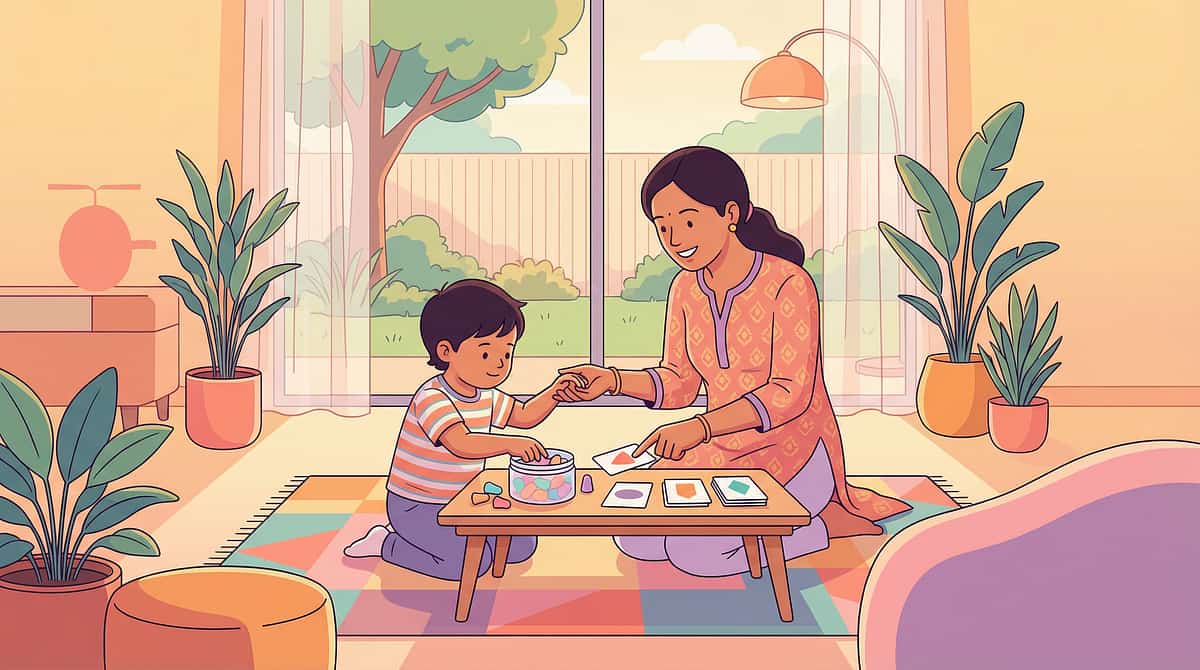
Step 1 of 6
Step 1: The Invitation
The Night Before / Morning Of
"Tomorrow we're going to music class! Do you remember [teacher's name]? She does [specific activity your child loves]. Let's listen to one of the songs we'll sing." Play one familiar song. Keep it positive — no pressure about behavior expectations.
15 Minutes Before Class
"Time to get our music bag ready! Let's check: earplugs ✓, schedule ✓, break card ✓, [child's instrument]. You're ready!" Review visual schedule together — point to each activity in sequence.
At the Classroom Door
"Here we are! Remember — if it gets too loud, you have your earplugs. If you need a break, you have your card. You know these songs. You've got this." Keep tone calm and confident — your anxiety transfers directly to your child.
✅ Acceptance Cues to Watch For
- Child picks up their bag or instrument independently
- Child moves toward classroom without being pulled
- Child references something they like about music class
- Child shows neutral-to-positive facial expression
⚠️ Resistance Cues and How to Respond
- Physical refusal to enter → Offer "Let's watch from the door first"
- Distress at door → Postpone this session; reschedule readiness check
- Enters but immediately seeks break space → Correct protocol; support the break
OT Voice: "Successful invitation is 50% of the session. If the child enters voluntarily, they've already demonstrated regulation. Protect that success."
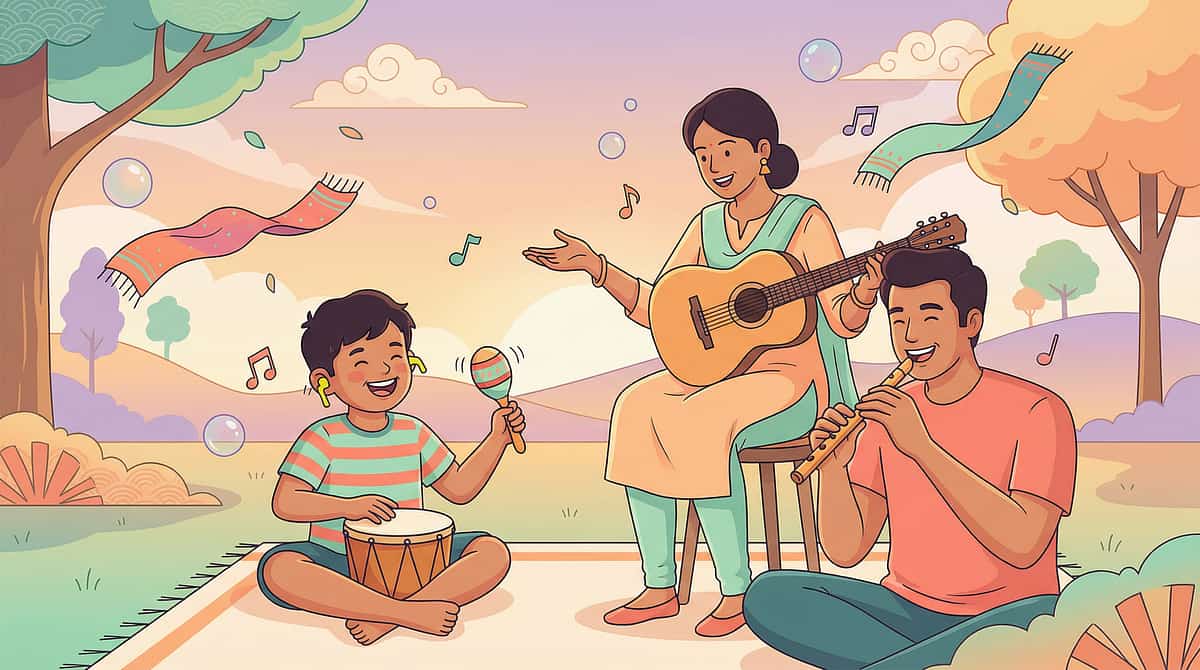
Step 2 of 6
Step 2: The Engagement
Earplugs
Insert before class begins or at first sign of volume increase. Do not wait for distress — preventive insertion is more effective than reactive. "Let's put our earplugs in before we start — then you can hear the music just right."
Visual Schedule
Post on child's knee or hold in hand. Reference at each transition: "Look — we just finished the hello song. ✓ Next is rhythm sticks! Can you find it on your schedule?"
Weighted Lap Pad
Place before seated activities begin. No announcement needed — simply settle it on child's lap naturally. Remove during active movement (dance, freeze dance).
Personal Instruments
Have accessible in their bag before group instrument sharing begins. "Your shaker is in your bag if you need it. Let's try the class ones first."
Reinforcement Cue: When child tolerates even 30 seconds more than last session → specific, immediate praise: "You stayed for the whole hello song! That's amazing. Your earplugs really helped today."
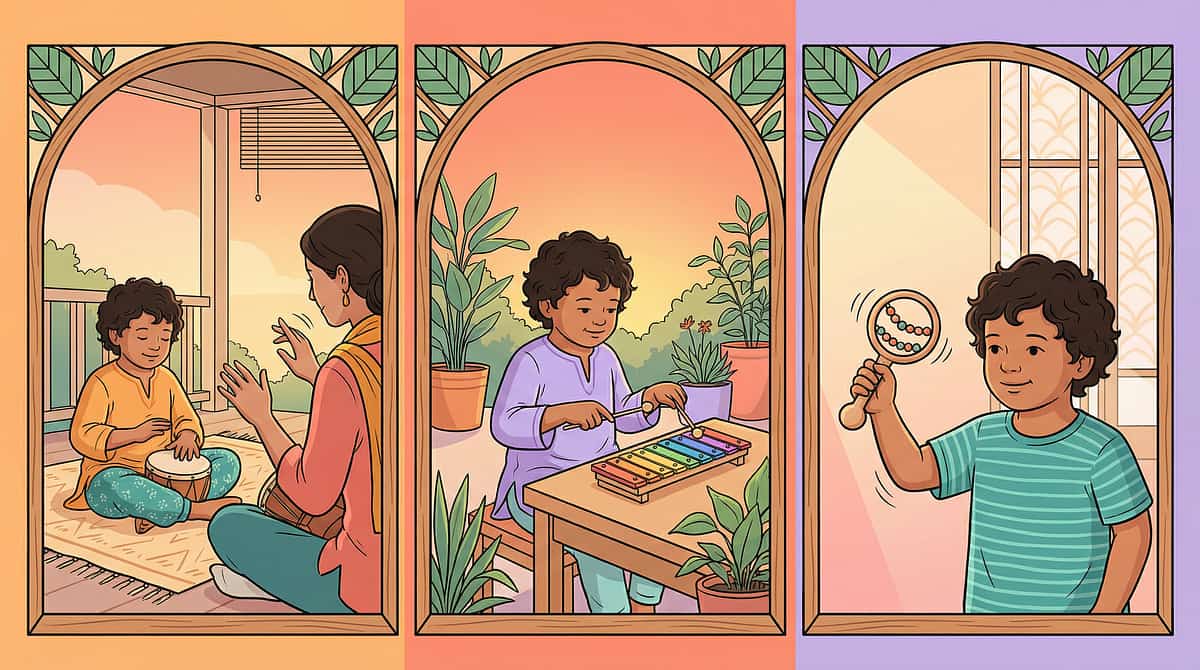
Step 3 of 6
Step 3: The Therapeutic Action
The therapeutic event is not the materials themselves — it is the graduated exposure to music class auditory input while the nervous system is adequately supported. Each session where the child remains regulated for longer than the last session is a therapeutic success, even if no specific skill was demonstrated.
During Rhythm Activities
Present rhythm visual card while the activity is happening: "Big dot = hit HARD, small dot = hit soft, dash = wait. Let's follow the card together." Child follows visual while hearing auditory pattern → multi-modal encoding → stronger rhythm processing.
During Instrument Sharing
Use First-Then board: "FIRST take turns with the class drum. THEN free drum time on your own drum." Set visual timer for 2 minutes. When done: "Your turn is done. The drum is going to [peer name] now. THEN is coming."
During Overwhelming Moments
Child uses break card → Honor immediately, no negotiation: "You used your break card — excellent self-advocacy. Go to the break corner. I'll come check in 2 minutes." Return expected after 2–3 minutes using visual timer.
Weeks 1–2
10–15 min in class = success
Weeks 3–4
20–25 minutes target
Weeks 5–8
Full class duration target (with materials in place)

Step 4 of 6
Step 4: Repeat & Vary
The Dosage Principle: Therapeutic benefit accumulates through repeated sessions, not within single sessions. Each music class attended with material support is a therapeutic dose.
Target Repetitions
- Classes per week: 1–2 (match child's actual schedule)
- Home practice: 2–3 times per week (10–15 min each)
- Song preview: Daily in the week before each class
- Visual schedule review: Every class day morning
"3 Good Reps > 10 Forced Reps"
A session where the child actively participates in 3 activities is therapeutically more valuable than one where they endure 10 in distress. End on a positive note.
Weekly Variation Plan
Weeks 1–2 | Song preview only + social story. Low demand. | |
Weeks 3–4 | Add earplugs + visual schedule. Introduce break card. | |
Weeks 5–6 | Add personal instruments. Trial First-Then board. | |
Weeks 7–8 | Add weighted lap pad. Introduce rhythm cards for home practice. | |
Week 9+ | Begin gradual fading of some supports as child demonstrates tolerance. |
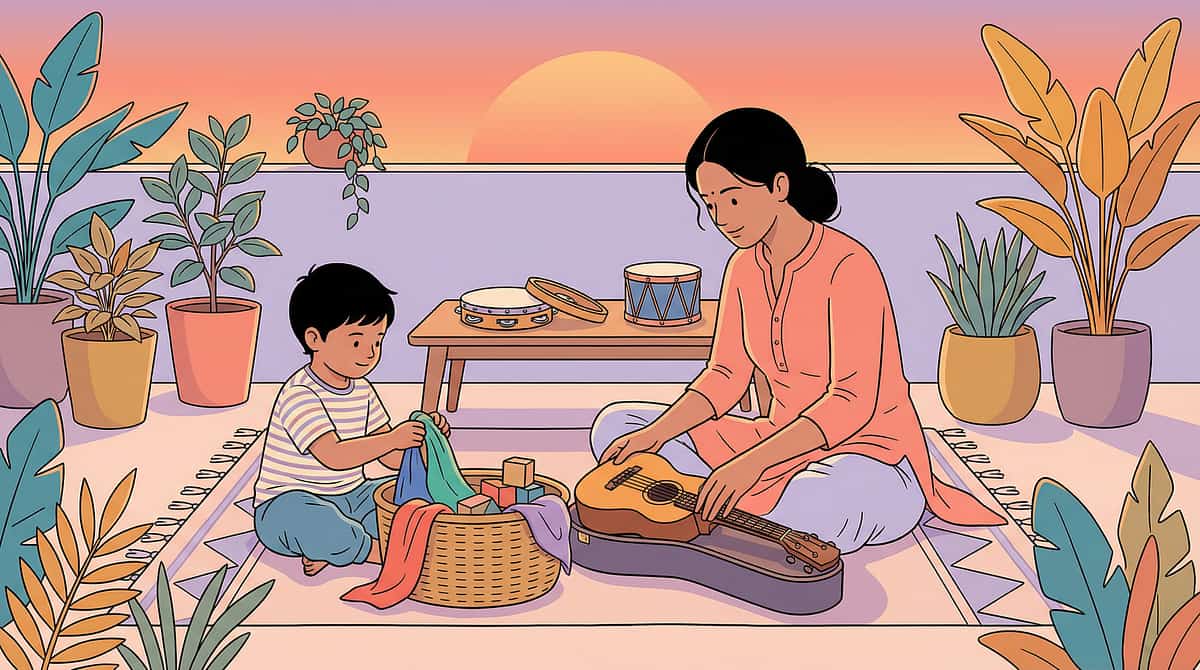
Step 5 of 6
Step 5: Reinforce & Celebrate
ABA Reinforcement Principle: "Reinforcement delivered within 3 seconds of desired behavior increases the probability of that behavior recurring. The magnitude matters less than the specificity and timing."
What to Reinforce: Do NOT wait for "perfect" participation. Reinforce entering voluntarily, putting earplugs in independently, staying 5 minutes longer than last week, using break card instead of running, returning from break, making any sound with an instrument, and tolerating another child playing "wrong."
For entering:
"You walked right in! I'm so proud of you. You knew what to do."
For earplug use:
"You put your earplugs in yourself! That was brilliant — you know what helps you."
For full session:
"You stayed for the WHOLE class today. You ARE a musician."
Verbal Praise
Specific, enthusiastic, immediate — within 3 seconds
Token Economy
Collect tokens during class, exchange for reward after
Preferred Song Choice
Child picks the song for home practice tonight
Extended Instrument Time
10 extra minutes with favorite instrument at home
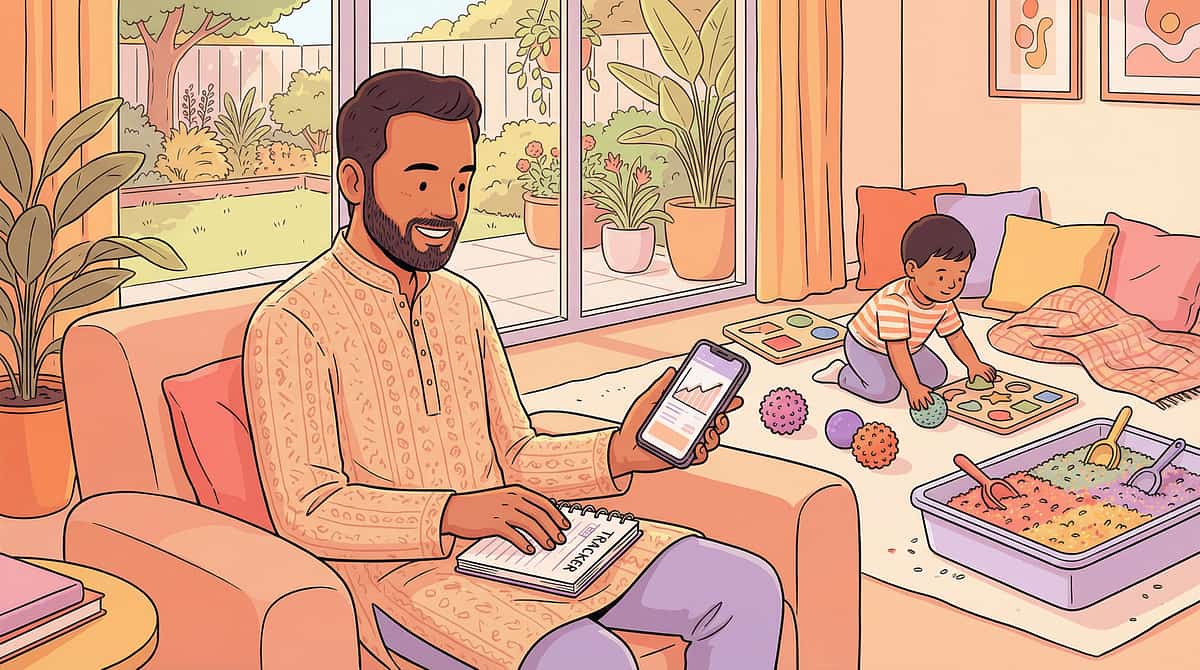
Step 6 of 6
Step 6: The Cool-Down
No session ends abruptly. The transition from music class back to regular life is a vulnerable moment — the child's nervous system has been working hard. A structured cool-down prevents post-session dysregulation (the "parking lot meltdown" that many parents know well).
Last 5 Minutes of Class
"Two more songs, then music class is finished. Look — goodbye song is next on your schedule. You did it!" Reference visual schedule — point to final activity being checked off.
Immediately After Class
Remove earplugs together (make it a ritual). Pack instruments back in their case. Give child 2–3 minutes of quiet with no conversation pressure. Offer a sensory break: slow walk, preferred fidget, quiet space.
If Child Is Dysregulated Post-Class
"Let's take our quiet time now. No talking needed. [Offer weighted blanket or preferred fidget.] When you're ready, we'll talk about what was fun."
Cool-Down Activities (5–10 min post-class)
Quiet car ride with familiar non-class music at low volume. Heavy work: carrying bag, climbing stairs slowly. Preferred sensory input: cool drink, chewy snack, proprioceptive squeeze.
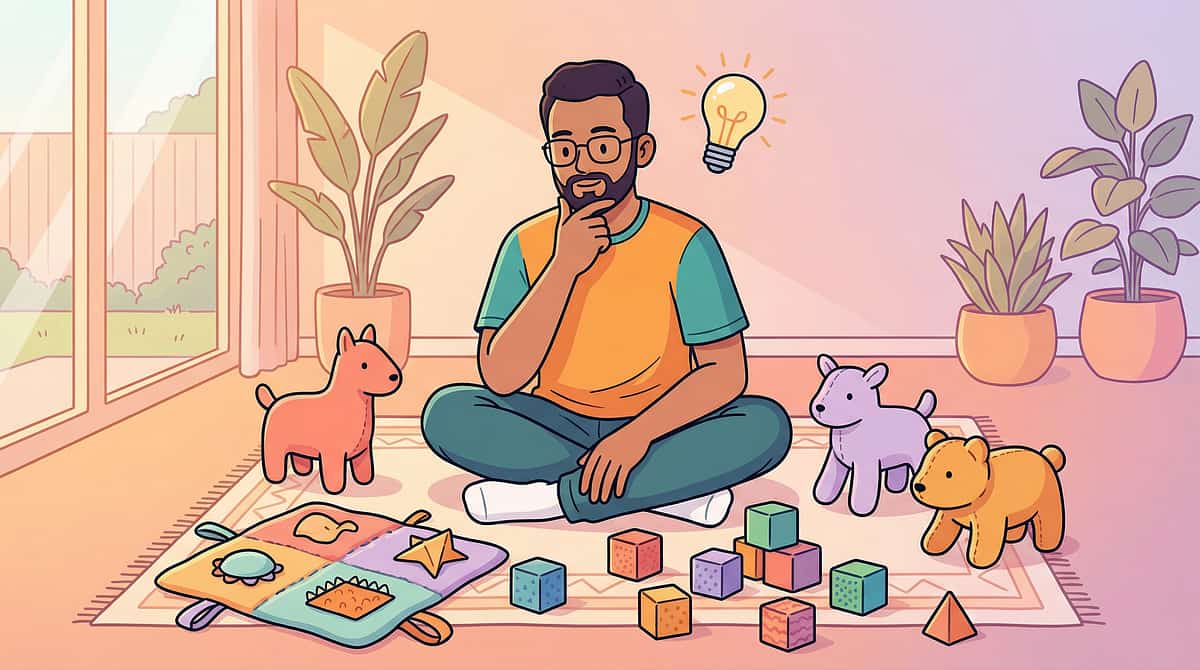
Data Capture
Capture the Data: Right Now
60 seconds of data now saves hours of guessing later. Record within 10 minutes of class ending. Week-over-week duration data is the most powerful early indicator of progress — this data informs your therapist's decisions, tracks material effectiveness, and motivates you during hard weeks.
3-Point Tracker — Music Class Session
1. DURATION stayed in class: _____ min
(Target: increasing each week)
(Target: increasing each week)
2. MELTDOWNS during class: 0 / 1 / 2 / 3+
(Target: decreasing; 0 = mastery)
(Target: decreasing; 0 = mastery)
3. BREAK CARD used: Yes / No — _____ times
How long break lasted: _____ min
How long break lasted: _____ min
Bonus (circle): Used earplugs independently / Used visual schedule / Shared instrument without issue / Used break card proactively / Requested to go to music / Returned from break successfully
Overall Session Rating: ★☆☆☆ Difficult | ★★★☆ OK | ★★★★★ Great!
Data Tools
Ask your Pinnacle therapist for your child's personalized Google Form session tracking link.
Example Therapeutic Trajectory:
Class 1: 12 min → Class 2: 15 min → Class 3: 18 min → Class 4: 20 min = documented progress. This is evidence. This is your proof.
Class 1: 12 min → Class 2: 15 min → Class 3: 18 min → Class 4: 20 min = documented progress. This is evidence. This is your proof.
Troubleshooting
Session Abandonment Is Not Failure. It Is Data.
Every difficult session contains information. Use this guide to decode it, adapt, and try again. Seven of the most common challenges — and exactly what to do.
Problem 1: Child refused to wear earplugs in class
Why: Novel sensation; not introduced in a low-demand setting first.
Fix: Practice earplug insertion during preferred music at home for 1–2 weeks before expecting class use. Make it a fun routine, not a demand.
Fix: Practice earplug insertion during preferred music at home for 1–2 weeks before expecting class use. Make it a fun routine, not a demand.
Problem 2: Meltdown when another child played "wrong"
Why: Auditory perfectionism is common in musical autism profiles.
Fix: Musician's earplugs partially address this. Add a social story about "everyone learns at their own speed." Discuss with BCBA for tolerance-building protocol.
Fix: Musician's earplugs partially address this. Add a social story about "everyone learns at their own speed." Discuss with BCBA for tolerance-building protocol.
Problem 3: Child took 5+ breaks and barely participated
Why: Sensory load exceeded current capacity — this is information, not failure.
Fix: Check readiness indicators for patterns. Consider abbreviated sessions or observation mode for this phase.
Fix: Check readiness indicators for patterns. Consider abbreviated sessions or observation mode for this phase.
Problem 4: Child won't give up instrument when turn is over
Why: Instrument represents both security object and sensory regulation tool.
Fix: Accelerate personal instrument set. Use visual timer for turns. First-Then: "FIRST give the drum back, THEN get your own drum from your bag."
Fix: Accelerate personal instrument set. Use visual timer for turns. First-Then: "FIRST give the drum back, THEN get your own drum from your bag."
Problem 5: Child was fine in class but had meltdown in the car
Why: Classic delayed dysregulation — they held it together during class and released afterward. This is actually regulation progress.
Fix: Extend cool-down protocol. Quiet car ride. Heavy snack. Don't discuss class immediately post-meltdown.
Fix: Extend cool-down protocol. Quiet car ride. Heavy snack. Don't discuss class immediately post-meltdown.
Problem 6: Music teacher won't accommodate the supports
Why: Teacher lacks training or understanding of sensory needs.
Fix: Request a meeting. Frame as "disability access." If school context, initiate IEP/504 process. Pinnacle can provide a therapist support letter. Call 9100 181 181.
Fix: Request a meeting. Frame as "disability access." If school context, initiate IEP/504 process. Pinnacle can provide a therapist support letter. Call 9100 181 181.
Problem 7: Child refuses to go to music class altogether
Why: The association with the environment has become negative.
Fix: Complete reset. Don't force attendance for 2–4 weeks. Visit the empty classroom. When child expresses interest in music at home, use that as the re-entry point. Consult OT + BCBA for graduated re-exposure plan.
Fix: Complete reset. Don't force attendance for 2–4 weeks. Visit the empty classroom. When child expresses interest in music at home, use that as the re-entry point. Consult OT + BCBA for graduated re-exposure plan.

Adapt & Personalize
No Two Children Are the Same. Here's How to Tune.
For Harder Days (Slider Left)
- Attend only first 10 minutes; exit plan pre-arranged
- Use ALL 9 materials simultaneously (maximum support)
- Pre-expose to ALL class songs that morning
- Parent stays in classroom if policy allows
- Take break proactively before distress — not reactively
For Breakthrough Days (Slider Right)
- Try one session without weighted lap pad to test underlying tolerance
- Fade First-Then board — present verbally instead of visually
- Extend class duration by 5 minutes beyond current comfort zone
- Let child lead the pacing
Sensory Profile Variations
Auditory Hypersensitive (most common): Lead with musician's earplugs + seating away from loudest instruments.
Auditory Hyposensitive (seeks intense sound): Drums and percussion are this child's natural habitat — use as primary reinforcer.
Auditory Processing Differences (hears but doesn't process): Lead with rhythm visual cards + song preview. Pause music when giving instructions.
Age-Based Modifications
- Under 5: Parent-present; shorter sessions; simpler instruments; social story with more pictures
- 5–10: Full protocol as described; peer interaction goals added
- 10+: Self-advocacy focus; child manages own materials; independence goals

Act IV: Progress Arc
Weeks 1–2: Tolerance, Not Mastery. That Is the Goal.
PROGRESS: ██░░░░░░░░░░░░░░░░░░ 15% — The Tolerance Phase
✅ What You Will Likely See
- Child enters the classroom (even with reluctance) — this IS success
- Child uses earplugs for at least part of the session
- Child uses break card at least once — correct protocol, not failure
- Session duration may be short (10–20 min) — that's the starting point
- Child talks about music class at home, even negatively — engagement, not avoidance
- Child recognizes at least one song — song preview working
❌ What You Will NOT See Yet (and that's okay)
- Calm, effortless participation throughout full class
- Independent instrument sharing without adult support
- Spontaneous use of all materials without prompting
- Zero breaks taken
"If your child stayed in music class for 5 minutes longer than last week without full meltdown — that is a measurable neurological advancement. Document it. Celebrate it."
Parent Emotional Preparation: This phase requires the most patience. You may feel like nothing is working. The data will tell a different story. Keep logging. Keep attending. The nervous system is recalibrating slowly and invisibly before visible behavior changes appear.

Consolidation Phase
Weeks 3–4: The Neural Pathways Are Forming. Watch for These Signs.
PROGRESS: ████████░░░░░░░░░░░░ 40% — The Consolidation Phase
🔵 Anticipatory Engagement
Child asks about music class (what songs are today, who will be there) — anticipatory engagement replacing anxiety
🔵 Material Internalization
Child requests their earplugs or visual schedule without being reminded — beginning of self-directed use
🔵 Regulation Growing
Child's break duration is getting shorter — self-regulation capacity measurably increasing
🔵 Musical Absorption
Child sings or hums class songs at home — musical content is being absorbed and retained
What Parents Often Miss: The child who now argues about WHICH instrument they want (rather than refusing all instruments) has made enormous progress. The child who uses their break card once (rather than three times) has demonstrated measurable regulation improvement. Look for what has CHANGED, not just what isn't perfect yet.
"You may notice you're more confident too. You know what to pack. You know what to expect. You're reading your child's signals accurately. You've become their expert."

Mastery Phase
Weeks 5–8: Mastery Is Consistent Regulated Participation.
PROGRESS: ███████████████░░░░░ 75% — The Mastery Phase
🏆 Mastery Criteria (Observable & Measurable)
Child attends full class duration (with materials in place) for 3 consecutive sessions
Child uses break card proactively (before distress) consistently
Child shares instruments with peers with only verbal prompting — no meltdowns
Child independently requests and applies earplugs and visual schedule
Post-class dysregulation duration has measurably decreased from baseline
Generalization Indicators — Mastery Is Spreading
Child applies earplugs at other noisy events (birthday party, assembly) → Child uses break card behavior in other contexts → Child demonstrates rhythm awareness during home music listening → Child asks for a specific instrument or song (preference formation).
🏆Mastery Unlocked: Your child has developed measurable auditory tolerance in group settings, demonstrated self-advocacy for sensory needs, and built the neurological foundation for continued music education. Musical gifts + right supports = music class success.
You Did This. Your Child Grew Because of Your Commitment.
This was not a simple journey. You packed the bag before every class. You briefed the teacher. You sat through the hard sessions. You logged the data when you felt like giving up. You told yourself on week three that nothing was working — and then watched your child reach for their earplugs without being asked on week four.
Your child did not fail music class. You found the key. And now the door is open.
✨ 9 Materials
Identified and implemented systematically over 8 weeks
✨ Teacher Partnership
Built an accommodation relationship with your child's music educator
✨ Music Access
Your child now participates in music education where their gifts can be seen
Family Celebration Suggestion: Host a mini music performance at home. Set up the "stage" — child's personal instruments, their visual schedule on the wall, their favorite song queued up. Let them perform. Invite grandparents. Record it. This is reinforcement of identity: "I am a musician."
Journal Prompt: Write down: "The moment I knew it was working was when ___________." That moment is your data. That moment is your proof. That moment belongs to your child forever.
📱 Tag @pinnacleblooms
#MusicBridge
Safety Check
Trust Your Instincts. If Something Feels Wrong, Pause and Ask.
🚨 Sign | What to Watch For | Action | |
Auditory pain | Child reports ear pain or headache during/after class — not just discomfort but pain | Pause class; check with ENT + OT; review earplug fit | |
Self-injury escalating | Ear-hitting, head-banging in response to music sounds despite all supports in place | Exit class; urgent BCBA + OT consultation; do not continue without clinical guidance | |
Regression after progress | 3+ consecutive sessions with significant regression after consolidation | Clinical re-assessment; sensory profile may have changed; OT review needed | |
New aversion to music at home | Child who previously loved music at home is now refusing all music | Possible negative conditioning; remove music class pressure; assess | |
Physical symptoms | Nausea, vomiting, loss of balance during music activities | Medical assessment needed; possible undiagnosed vestibular processing disorder | |
Social withdrawal worsening | Child becoming more socially isolated; music class appears to be a source of shame or stigma | Assess peer dynamics; possible bullying; school counselor involvement |
📞9100 181 181 | Free | 24x7 | 16 Languages | No appointment needed for helpline. Find Your Nearest Pinnacle Center
Progression Pathway
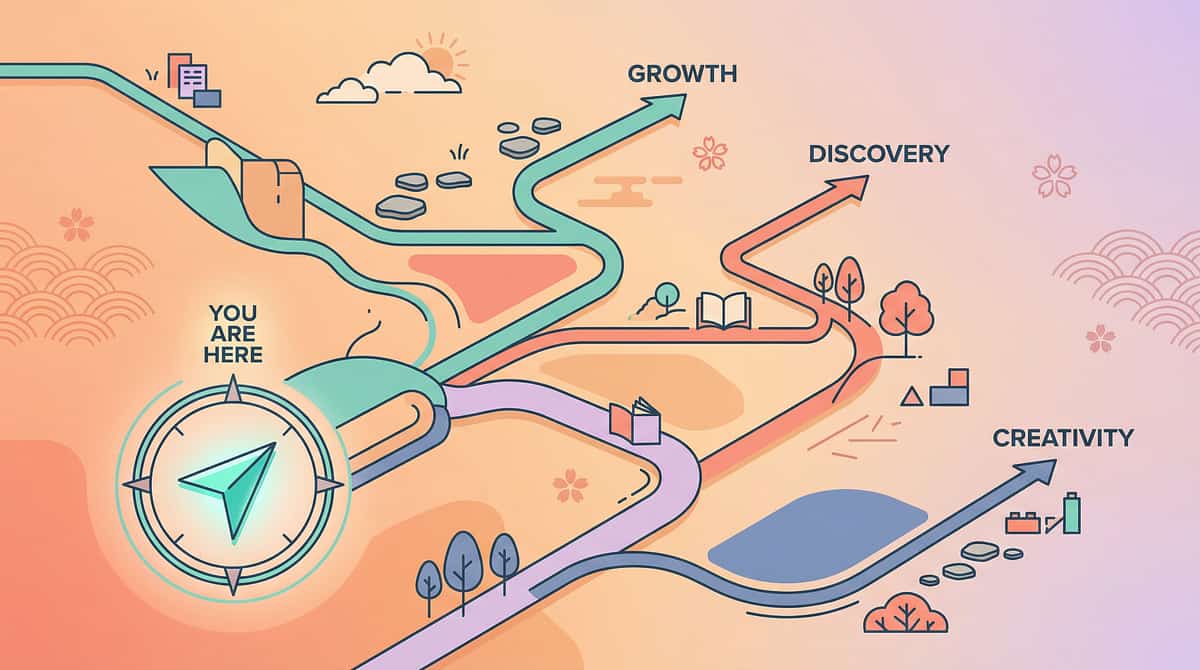
You Are Not Done. You Are on a Journey. Here Is the GPS.
Prerequisite Techniques
If music class remains extremely challenging after 8 weeks of full protocol, the following foundational skills may need development first:
- Auditory processing foundational work (Domain A — Pinnacle OT + SLP)
- Group participation skills in lower-demand settings (small social groups, 2–3 children)
- Turn-taking fundamentals (ABA protocol — Domain B)
Lateral Alternatives
If the group approach isn't working right now:
- Individual music lessons (one-on-one with sensory-aware teacher)
- Music therapy with a credentialed music therapist
- Adaptive music programs designed for children with developmental differences
Related Techniques
More Techniques in Your Child's Journey — Using Materials You May Already Own
🏊 J-871: Swimming Classes Support
Difficulty: Core | Domain: Community Participation
Canon Materials: Sensory Tools + Visual Supports
You own materials for this if you have: visual schedule + break card
Canon Materials: Sensory Tools + Visual Supports
You own materials for this if you have: visual schedule + break card
💃 J-872: Dance Classes Support
Difficulty: Core | Domain: Community Participation + Motor
Canon Materials: Sensory Tools + Rhythm Materials
You own materials for this if you have: earplugs + weighted lap pad
Canon Materials: Sensory Tools + Rhythm Materials
You own materials for this if you have: earplugs + weighted lap pad
🎨 J-874: Art Classes Support
Difficulty: Intro | Domain: Community Participation + Creative Expression
Canon Materials: Sensory Tools + Visual Supports
Usually easier than music class — good next step
Canon Materials: Sensory Tools + Visual Supports
Usually easier than music class — good next step
⚽ J-875: Sports Teams Support
Difficulty: Advanced | Domain: Community Participation + Physical
Canon Materials: Sensory Tools + ABA Supports
Higher social demands — build music class mastery first
Canon Materials: Sensory Tools + ABA Supports
Higher social demands — build music class mastery first
🎵 A-040: Music Class Distress Reel
Difficulty: Awareness | Domain: Sensory — Auditory
The video reel that maps directly to this technique page
The video reel that maps directly to this technique page
👂 CP-Auditory-01: Auditory Processing Foundations
Difficulty: Foundational | Domain: Sensory — Auditory
If music class is extremely challenging, start here first
If music class is extremely challenging, start here first
Act IV: Full Map
This Technique Is One Piece of a Larger Plan. Here Is the Whole Picture.
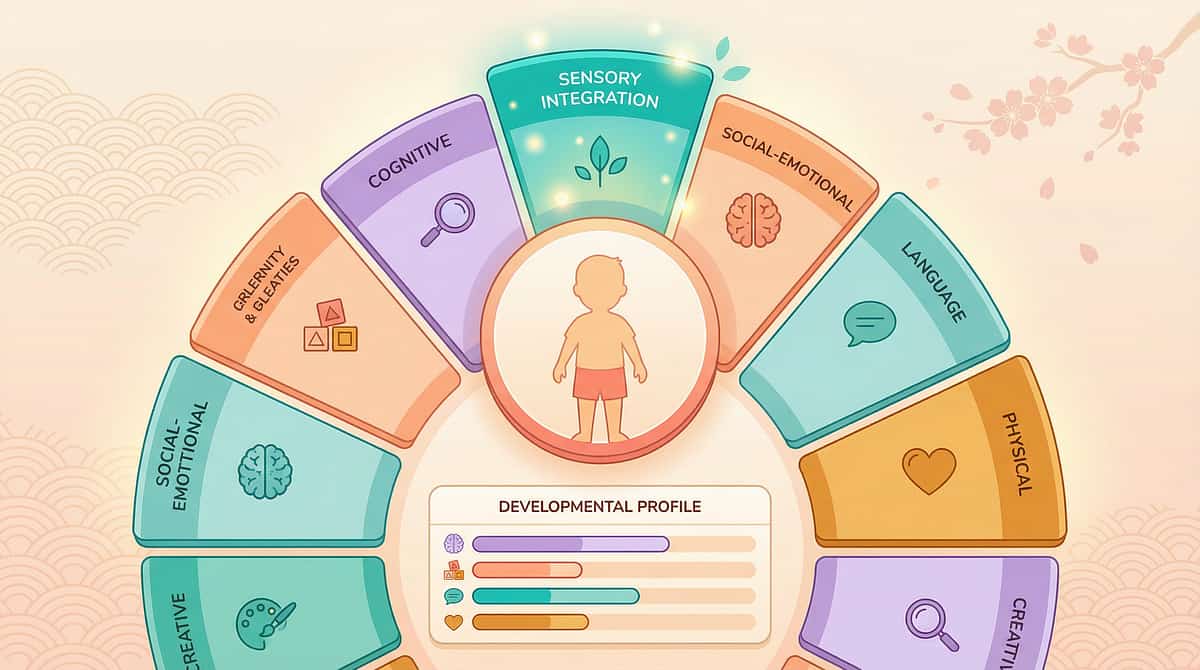
Music class access sits primarily in Domain A: Sensory Processing (auditory regulation) and Community Participation (extracurricular). Techniques from Domains B (social communication) and D (behavioral flexibility/turn-taking) are also active in this work.
Domain A: Sensory Processing
◉ ACTIVE — Music Class sits here
Domain B: Social Communication
Active through peer instrument sharing and group participation goals
Domain C: Emotional Regulation
Break card system and cool-down protocol build regulation capacity
Domain D: Behavior & Flexibility
Turn-taking with instruments; tolerance of unpredictability in class
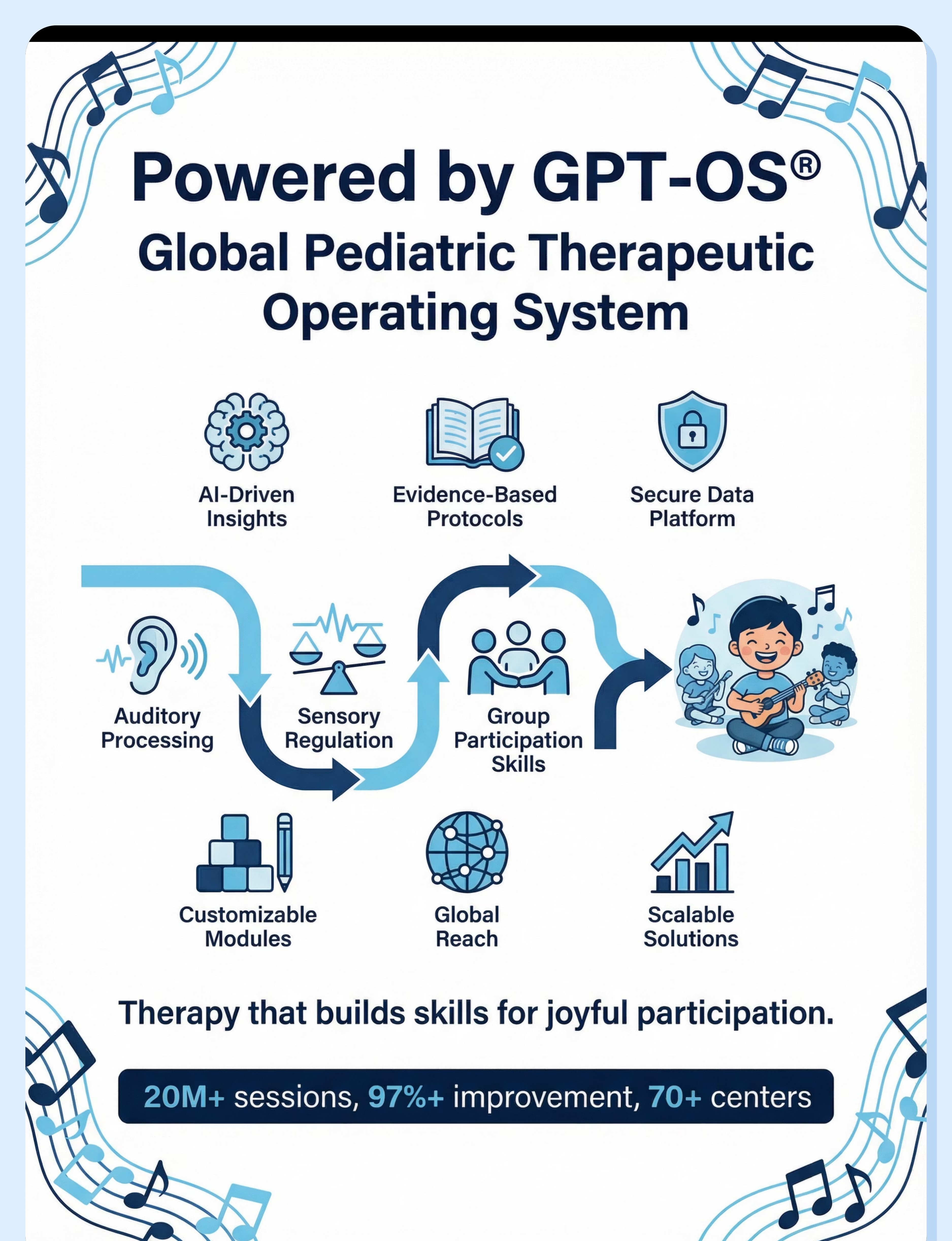
Every session data point you log contributes to your child's personalized development profile in GPT-OS®. As music class tolerance improves, GPT-OS® tracks cross-domain improvements: social participation (Domain B) improving alongside sensory regulation (Domain A) is a common positive cascade.

Act V: Community
From the Pinnacle Network: Families Who Have Walked This Path
Arnav, 7 years | Chennai, Tamil Nadu — ASD + Auditory Hypersensitivity
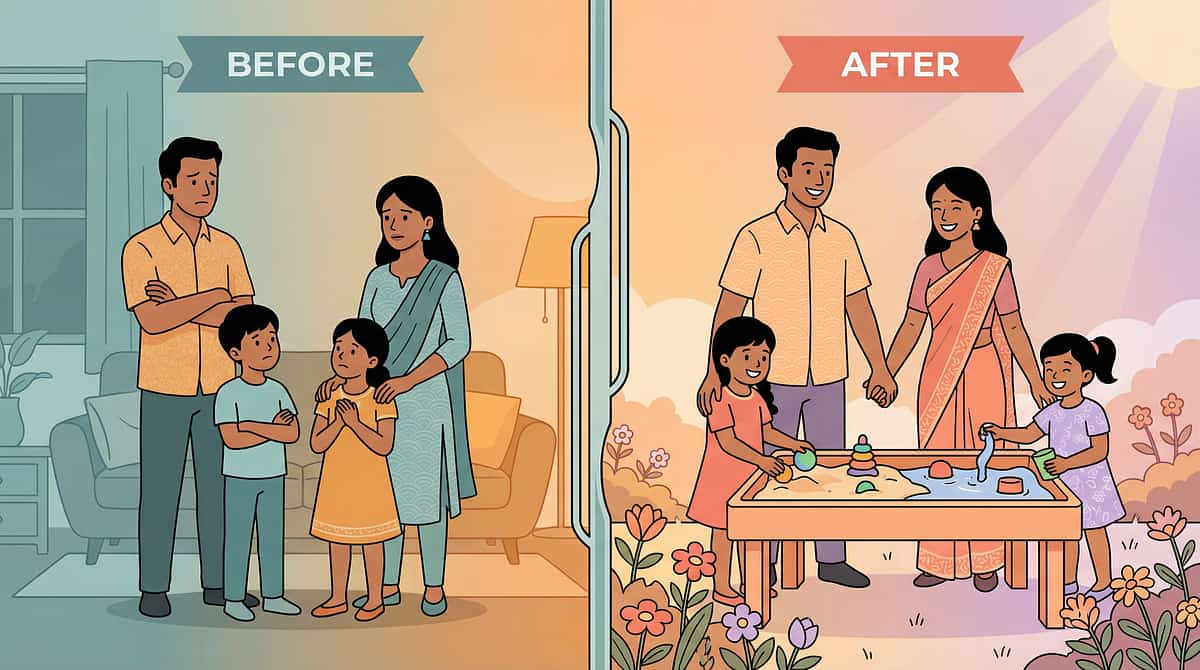
Before: Arnav was removed from school music class after three sessions. He would scream when the recorder was played and run out. His teacher described him as "not ready." He had sung commercial jingles perfectly from age 2.
After (10 weeks): With musician's earplugs, a visual schedule, and a personal tambourine set, Arnav returned. By week 10, he was playing school rhythm instruments alongside peers. His teacher said: "He has the best sense of rhythm in the class. We just needed to find the right volume for him."
"Music class was never the wrong place for Arnav. The volume was just wrong. The earplugs were 11 centimeters of rubber that changed everything." — Arnav's Mother, Pinnacle Chennai
Priya, 9 years | Bangalore, Karnataka — ASD + Auditory Processing Difference
Before: Priya loved music deeply but couldn't follow music class instruction. She was labeled "inattentive." Her parents suspected something more was happening.
After (8 weeks): Rhythm visual cards made at home on index cards transformed her class experience. Her SLP noted: "Priya doesn't have an attention problem. She has an auditory processing profile. The visual cards gave her a second channel." She now plays keyboard and reads simplified sheet music.
"The children who love music most often struggle with music class most intensely. The very sensitivity that gives them exceptional musical perception is the same sensitivity that makes the class environment overwhelming. With material support, that sensitivity becomes a superpower." — Pinnacle OT Lead
Illustrative cases based on Pinnacle clinical outcomes. Individual names changed. Outcomes vary based on child's specific profile and intervention intensity.
Connect
Isolation Is the Enemy of Adherence. You Don't Have to Navigate This Alone.
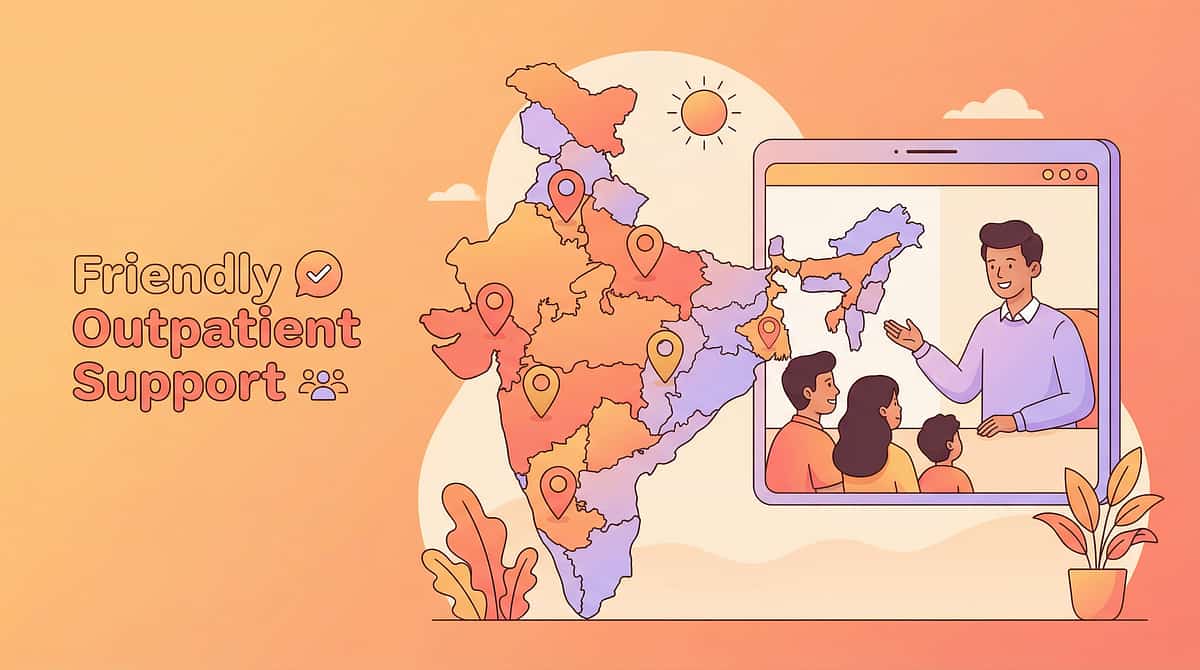
WhatsApp Group: Music Class + Autism Support
Parents navigating music education with sensory and developmental differences. Peer advice, material reviews, and teacher communication templates. Join at pinnacleblooms.org/community/music-class-whatsapp
Online Forum: Community Participation
Pinnacle GPT-OS® Parent Community — dedicated thread for extracurricular activities. pinnacleblooms.org/community/forum
Peer Mentoring
Match with a Pinnacle parent who has navigated music class successfully. One-on-one peer support. Request a peer mentor
Local Parent Meetups
Pinnacle centers across 70+ locations organize monthly parent support meetings. Music class and extracurricular topics are frequently discussed. Find your local meeting schedule
"Your experience helps others. A parent who successfully navigated music class with their child holds the exact knowledge that another family needs right now."
Professional Support
Home + Clinic = Maximum Impact.
🔵 Occupational Therapist (Primary)
Sensory profile assessment, material selection, weighted tool guidance, sensory diet for music class preparation.
Book OT Appointment
Book OT Appointment
🔴 BCBA / ABA Therapist
Turn-taking protocol, break card system design, reinforcement schedule, behavioral data analysis.
Book ABA Appointment
Book ABA Appointment
🟢 Speech-Language Pathologist
Auditory processing assessment, rhythm visual card design, verbal instruction processing strategies.
Book SLP Appointment
Book SLP Appointment
🟡 Special Education Therapist
Visual schedule creation, music teacher communication, IEP/504 accommodation documentation.
Book SpEd Appointment
Book SpEd Appointment
⚪ NeuroDev Pediatrician
Sensory profile confirmation, weighted tool medical clearance, school accommodation letters.
Book NeuroDev Appointment
Book NeuroDev Appointment
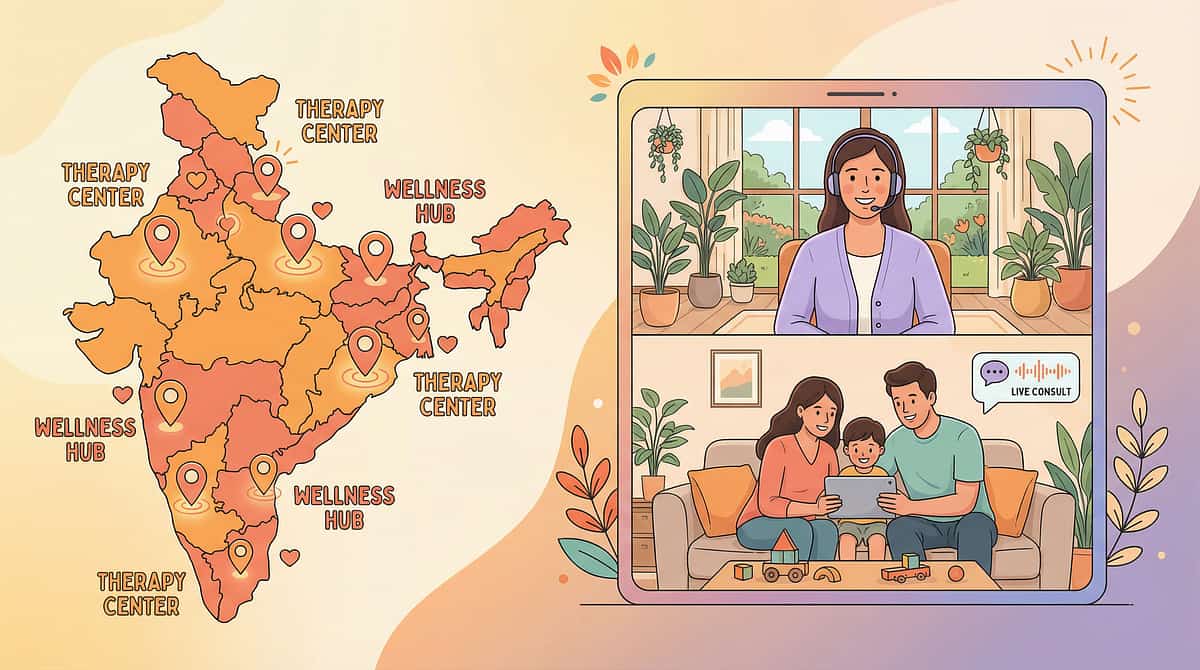
70+ centers across India | Teleconsultation available for all locations | Remote families in 70+ countries served. Book teleconsult at pinnacleblooms.org/teleconsult
📞National Autism Helpline: 9100 181 181 | FREE | 24x7 | 16 Languages — "Describe your child's music class challenges. We'll match you with the right specialist within 24 hours."
Research Library
Deeper Reading for the Curious Parent. Every Claim. Every Source.
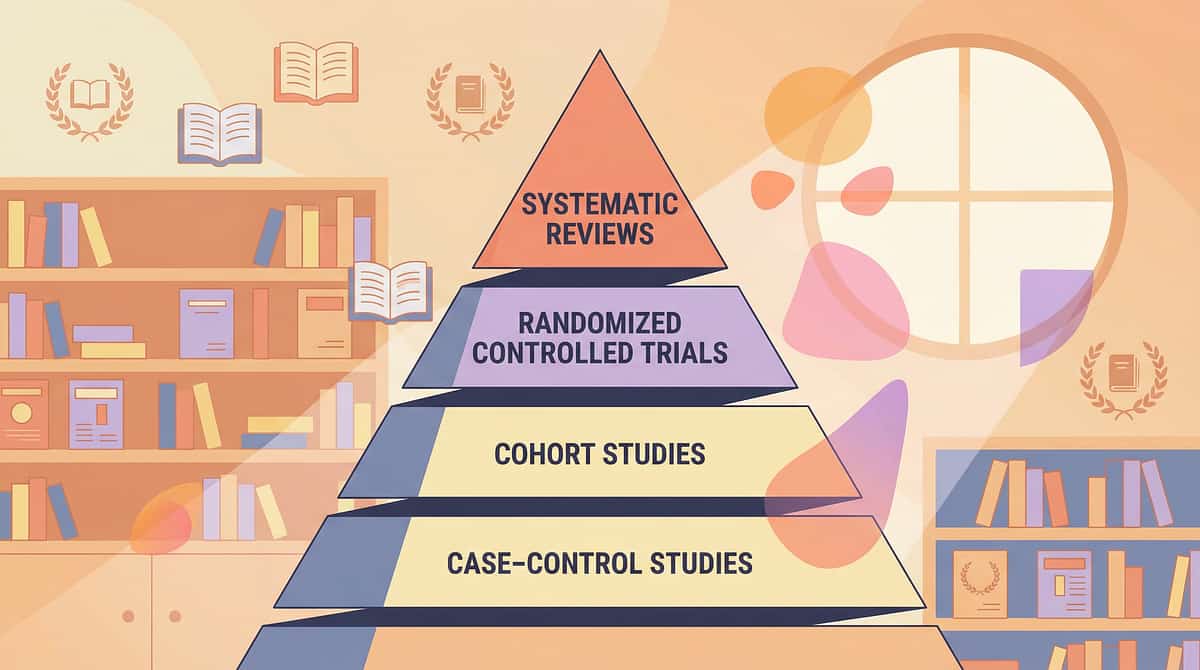
Children (2024) — Systematic Review, 16 Studies | Level I Evidence
Confirms sensory integration interventions as evidence-based practice for ASD. Materials-based sensory support strategies show strongest community participation outcomes. → PMC11506176
World J Clin Cases (2024) — Meta-Analysis, 24 Studies | Level III Evidence
Sensory integration therapy effectively promotes social skills, adaptive behavior, sensory processing, and motor skills. Community setting generalization documented. → PMC10955541 | DOI:10.12998/wjcc.v12.i7.1260
Indian J Pediatr (2019) — Indian RCT | Level II Evidence
Home-based sensory interventions with parent-administered protocols: significant improvements in sensory regulation and participation. India-specific population validity established. → DOI:10.1007/s12098-018-2747-4
NCAEP Evidence-Based Practices Report (2020) | Level IV
Visual supports, social narratives, and self-management: each independently classified as Tier 1 evidence-based practice for autism. → NCAEP 2020 Report
Frontiers in Integrative Neuroscience (2020)
Neurological framework establishing sensory integration basis for sensory-based interventions in ASD. → DOI:10.3389/fnint.2020.556660
WHO Nurturing Care Framework (2018) + UNICEF CCD Package (2023)
Caregiver-mediated interventions: recommended across all income levels, validated in 54+ countries. → nurturing-care.org | PMC9978394
GPT-OS® Technology
Your Data Helps Every Child Like Yours. Here's How.
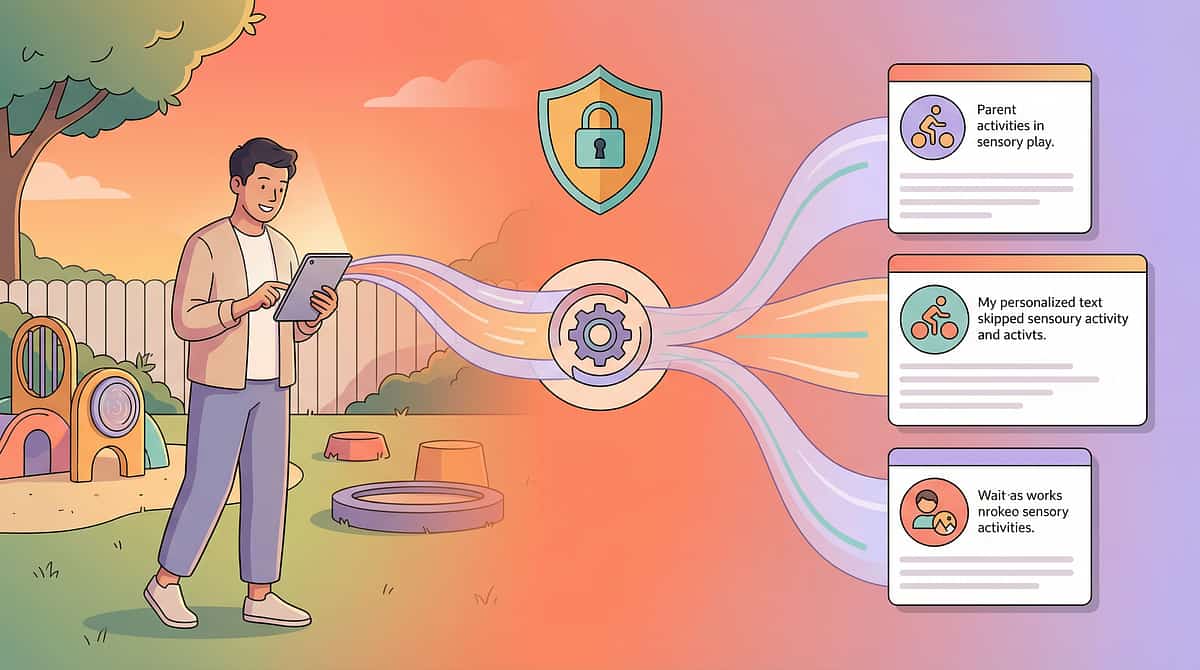
What GPT-OS® Learns — For Your Child
- Which of the 9 materials is producing the most impact for your specific child
- How music class progress compares to progress in other sensory domains
- When to recommend transitioning from maximum-support to fading-support phase
- Early detection of regression patterns before they become entrenched
Privacy Assurance
- All data anonymized before population-level analysis
- No personally identifiable information shared without explicit consent
- DPIIT-registered, MSME-certified Indian corporate entity
- Compliant with Indian IT Act and international standards
Watch the Reel
See It in Motion. Watch the Reel That Maps to This Page.
Reel A-040
Title: "9 Materials That Help During Music Class Distress"
Domain: Community Participation / Sensory — Auditory Processing
Duration: 60–75 seconds
Presenting: Pinnacle Blooms Consortium — OT + SLP Lead Disciplines
Related Reels:
A-039: Swimming Classes
A-040: Music Classes ← THIS
A-041: Dance Activities
A-042: Art Classes
A-039: Swimming Classes
A-040: Music Classes ← THIS
A-041: Dance Activities
A-042: Art Classes
Reel Content Overview
This Reel walks through all 9 materials visually, demonstrating: how musician's earplugs look in use, a sample visual schedule for music class, the First-Then board during a challenging activity, and a child successfully using the break card system. The voiceover is in the parent's voice with clinical validation interspersed.
Multi-Modal Learning: Research confirms that text + visual + video demonstration produces stronger parent skill acquisition than any single modality alone. This technique page (text) + the Reel (video) = maximum learning impact. NCAEP 2020 classifies video modeling as an evidence-based practice for autism.
Share with Your Family
Consistency Across Caregivers Multiplies Impact. Share This Now.
Consistency across caregivers is one of the most powerful predictors of intervention success. When grandparents, school aides, music teachers, and extended family all understand and support the materials, your child receives a consistent, regulated environment everywhere they go.
📥 J-873 Family Guide (1-Page PDF)
The entire protocol on one page — materials list, safety checklist, progress tracker, and the 9 materials explained in simple language. Designed for grandparents, school aides, and other caregivers. Download at pinnacleblooms.org/tools/J873-family-guide
For Grandparents — "Explain It Simply" Version
"[Child's name] uses some special tools in music class. Earplugs that let them hear music without being overwhelmed. A picture card that shows what happens next in class. Their own small drum so they don't have to compete for the class instruments. Please support these tools — they're not a crutch, they're a bridge."
For the Music Teacher — Communication Template
"Dear [Teacher's Name], my child [name] has sensory processing differences that affect their experience in music class. With your permission, I'd like to implement: (1) Musician's earplugs during class, (2) a personal visual schedule of class activities, (3) a break card system with a designated quiet corner. These accommodations are consistent with [child's IEP/504 plan if applicable]. I'd love to meet briefly to discuss. Pinnacle Blooms Network (9100 181 181) can provide a therapist consultation if useful. Thank you for creating a space where my child's musical gifts can shine."
Act VI: FAQ
Your Questions. Clinical Answers. Preemptive Clarity.
Q1: My child loves music at home but hates music class. Is this normal?
Extremely common. At home, your child controls the volume, tempo, instrument, and duration. Music class removes all of those controls simultaneously. The love of music is real; the difficulty is with the group music class environment, not music itself. These 9 materials specifically address the environmental factors.
Q2: Will my child need these supports forever?
Many children progressively reduce dependence on supports as tolerance builds. Some always prefer some supports — professional musicians routinely perform with earplugs. The goal is not removal of all supports; it is confident, joyful participation with whatever supports work. There is no shame in a musician who performs with earplugs.
Q3: Should I tell the music teacher about my child's diagnosis?
Disclosure is a personal decision. More important than the diagnostic label is sharing the functional impact and specific accommodations: "My child has sensory sensitivities that affect music class. These tools help them participate successfully." You don't need to disclose the diagnosis to request reasonable accommodations.
Q4: What if my child's school won't allow these accommodations?
In India, children with autism have rights under the Rights of Persons with Disabilities Act (RPWD) 2016, which requires reasonable accommodations in educational settings. Pinnacle can provide a therapist letter supporting your accommodation requests. Call 9100 181 181 for guidance on disability rights in educational settings.
Q5: My child fixates on ONE instrument and won't try others. What do I do?
First, honor the fixation — it is often a genuine musical strength seeking expression. Use the personal instrument set to satisfy the fixation at home, then reduce the desperate need for that specific instrument in class. Use First-Then: "FIRST try the maracas for 2 minutes, THEN your favorite instrument." Over time, the fixation usually moderates as the underlying sensory need is met.
Q6: Can music therapy replace music class?
They serve different goals. Music therapy uses music as a therapeutic medium to achieve developmental and behavioral goals. Music class is educational and social. Music therapy can be excellent preparation for music class. They are complementary, not interchangeable. Many children benefit from both simultaneously.
Q7: My child is nonverbal — can they still benefit from music class?
Absolutely. Rhythm, movement, instrument play, and musical response are all forms of musical communication that don't require words. Many nonverbal children demonstrate exceptional musical abilities. All material accommodations in this guide are fully applicable regardless of verbal ability. Consult your SLP for modifications to social story and visual schedule for nonverbal learners.
Q8: Are there music programs in India specifically for autistic children?
Yes, and they are growing. Pinnacle's EverydayTherapyProgramme™ includes musical activities designed for autistic children. Some Pinnacle centers connect families to adaptive music instructors. Call 9100 181 181 to ask about music-specific programming in your area.
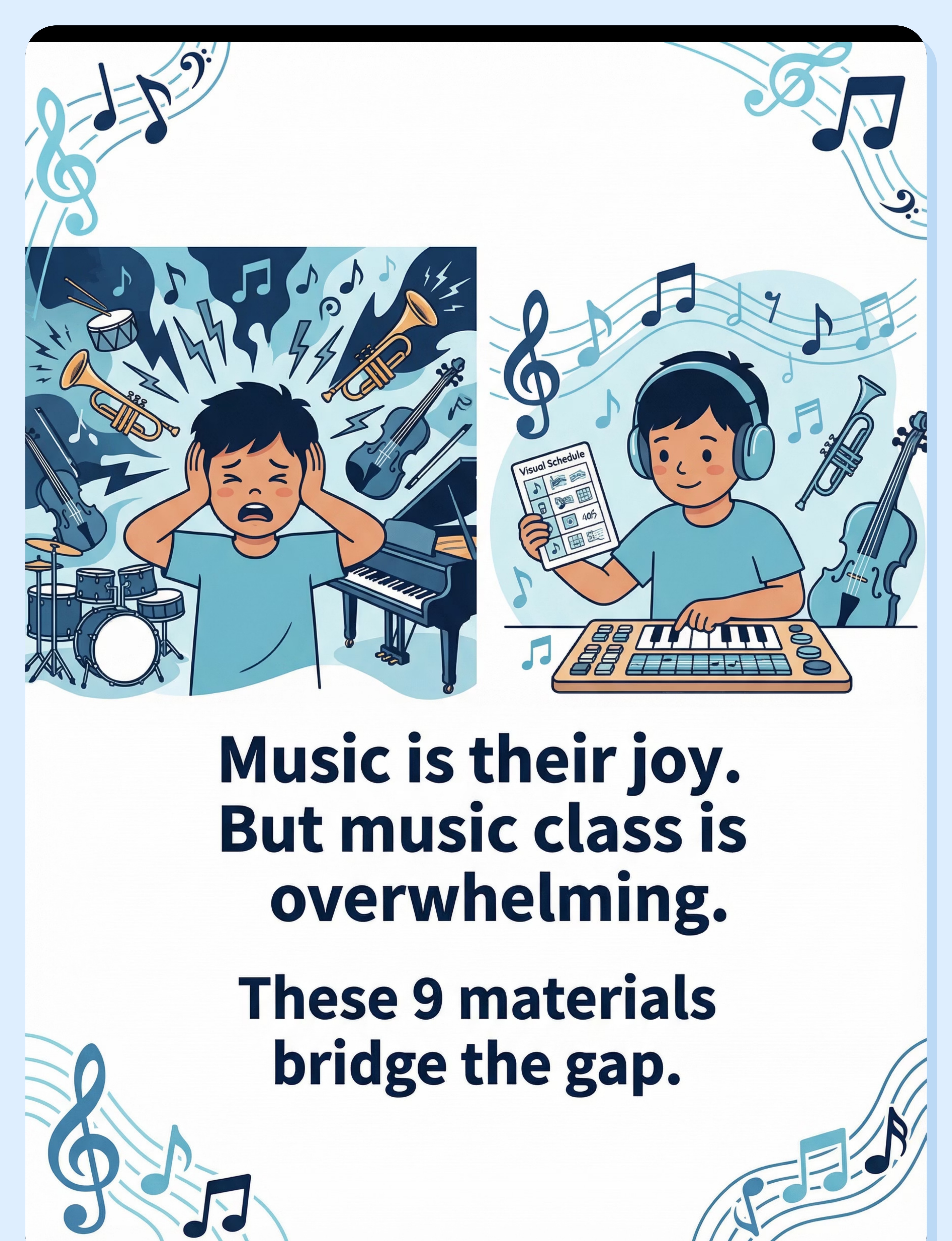
Preview of 9 materials that help with music classes Therapy Material
Below is a visual preview of 9 materials that help with music classes therapy material. The pages shown help educators, therapists, and caregivers understand the structure and content of the resource before use. Materials should be used under appropriate professional guidance.



Link copied!
You Have Read. You Are Ready. One Step Changes Everything.
The session you start this week is the session your child will benefit from next week. Every week of delay is a week your child's musical gifts wait for the environment they deserve. The materials are available. The protocol is validated. The helpline is free. The only remaining step is yours.
🔵 OT
🟢 SLP
🔴 ABA
🟡 SpEd
⚪ NeuroDev
🏛️ CRO
"From fear to mastery. One technique at a time." — The Pinnacle Blooms Consortium
We exist to transform every home in the world into a proven, scientific, 24x7, personalized, multi-sensory, multi-disciplinary pediatric therapy environment — accessible to every family, regardless of geography, language, or economic status. Your child's musical gifts are not exceptions to development. They are proof of potential waiting for the right door.
Evidence Base: PMC11506176 | PMC10955541 | PMC9978394 | DOI:10.1007/s12098-018-2747-4 | DOI:10.3389/fnint.2020.556660 | WHO NCF 2018 | UNICEF CCD 2023 | NCAEP 2020 | BACB Guidelines
Medical Disclaimer: This content is educational. Strategies should be adapted to your child's specific sensory profile and developmental level, in coordination with qualified therapists. This content does not replace professional therapeutic advice. Individual outcomes vary.
CIN: U74999TG2016PTC113063 | DPIIT: DIPP8651 | MSME: TS20F0009606 | GSTIN: 36AAGCB9722P1Z2
© 2025 Pinnacle Blooms Network®, unit of Bharath Healthcare Laboratories Pvt. Ltd. | techniques.pinnacleblooms.org
© 2025 Pinnacle Blooms Network®, unit of Bharath Healthcare Laboratories Pvt. Ltd. | techniques.pinnacleblooms.org