
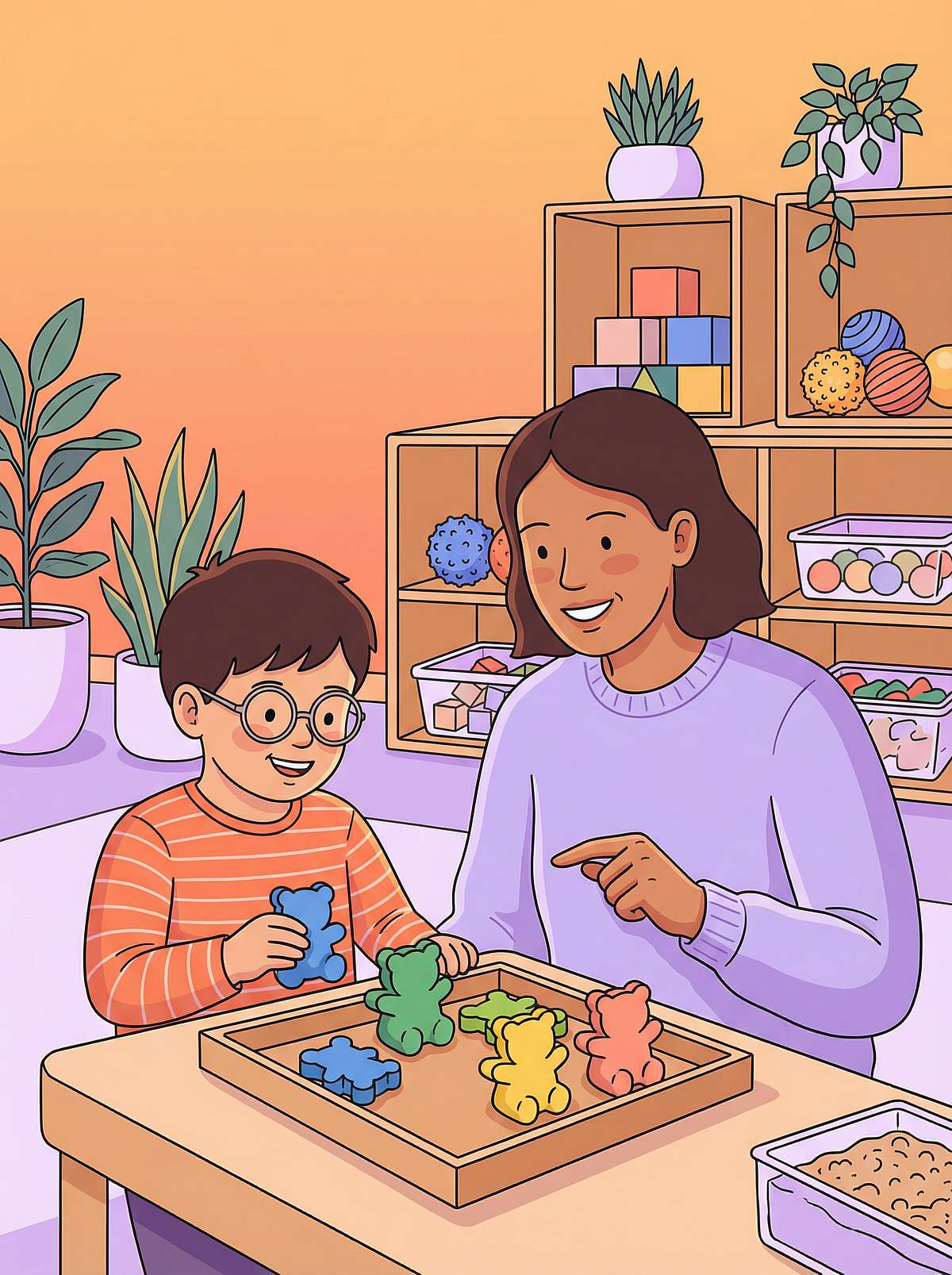
"My daughter can count to twenty perfectly. But she doesn't know that 'five' means five things."
Numbers That Are Only Sounds — Not Quantities
H-740 · Academic Readiness Series
Pinnacle Blooms Network®

Production Metadata
H-740 | 9 Materials That Help With Math Concepts
Technique Details
Technique Code: H-740 Series: Academic Readiness | Episode 740 Domain: ACAD-MATH Sub-Domain: Number Sense / Counting / Operations Age Band: 3–8 years
Consortium & Publishing
Consortium Lead: Special Education + Occupational Therapy + ABA/BCBA Gamma Mode: Site Publishing | Mobile-First | Fluid Cards Primary Color: #6A1B9A (Academic Purple) Total Cards: 40 content cards
Canonical URL: techniques.pinnacleblooms.org/academic-readiness/math-concepts-H-740
ACT I
Why
ACT II
What
ACT III
How
ACT IV
Progress
ACT V
Support
ACT VI
Start

ACT I: THE EMOTIONAL ENTRY
The Recognition Moment
It's 8 AM. Breakfast is on the table. You put four crackers on her plate and say "take three." She grabs a random handful — sometimes two, sometimes all of them. She knows the word "three." She can write the numeral 3 beautifully. But three things? That connection doesn't exist yet.
She counts perfectly. One, two, three, four, five — up to twenty, perfectly sequenced. She'll count when asked. But the counting is a song. The numbers are sounds. When you ask how many blocks are in the pile, she counts them and immediately forgets the answer. "How many?" "I don't know."
"You are not failing your child. Her brain is doing exactly what it needs to do — waiting for the right concrete experiences to make numbers real." — Pinnacle Blooms Consortium, SpEd + OT + NeuroDev Team
WHO Nurturing Care Framework (2018): Early identification and parental awareness directly impact developmental outcomes. The period from birth to age 8 is critical for numeracy foundation-building. | https://nurturing-care.org/ncf-for-ecd/
Pinnacle Blooms Network®
CRO · SpEd · OT · SLP · ABA · NeuroDev

ACT I · Card 02
You Are Among Millions of Families Navigating This Exact Challenge
1 in 5
Numeracy Delays
Children show significant numeracy delays before age 8
60–80%
Autism / Dev Differences
Of children with autism/developmental differences show number sense challenges
20M+
Therapy Sessions
Delivered by Pinnacle — mathematical reasoning tracked in AbilityScore®
Number sense — the deep, intuitive understanding of what quantities mean — is not automatic for every child. The ability to touch five blocks and know that is five, to look at two groups and instantly see which is more, to understand that adding means "getting bigger" — these develop through concrete experience, not through counting songs or worksheets.
In India alone, conservative estimates suggest over 8 million children between ages 3–10 are navigating early numeracy challenges — including those with autism spectrum conditions, specific learning differences, ADHD-associated processing difficulties, or simply insufficient concrete math experience at critical developmental windows.
You are not looking at a rare problem. You are looking at one of the most common — and most actionable — challenges in pediatric development.
"When a child recites numbers without understanding quantity, the solution is not more counting practice. The solution is concrete quantity experience — touching, moving, and comparing real amounts." — Pinnacle NeuroDev & SpEd Consortium
Systematic review (PMC11506176, 2024): PRISMA analysis confirms developmental delays significantly impact foundational numeracy. | Meta-analysis (World J Clin Cases, 2024, PMC10955541): Multi-disciplinary intervention showed measurable improvements in quantitative reasoning in 24 studies.

ACT I · Card 03
The Neuroscience of Number Sense — Explained for Parents
The Intraparietal Sulcus (IPS)
The IPS is the brain's "quantity processor" — it's where numbers get their meaning. In typically developing children, the IPS activates when they encounter quantities, linking the symbolic "5" to the concept of five-ness. In children with number sense difficulties, this activation is underconnected — the numeral arrives at the brain but doesn't reach the quantity system.
Why Concrete Materials Work
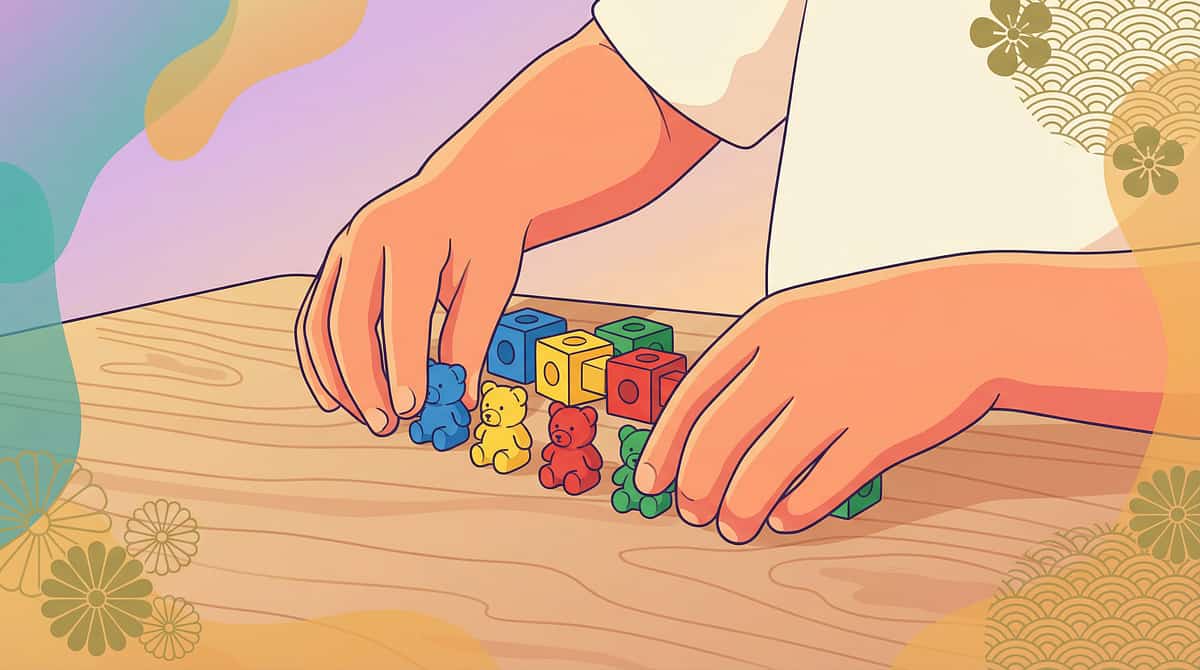
When a child physically touches five bears and counts them one by one, they activate the motor cortex, the tactile sensory system, the visual cortex, AND the IPS simultaneously. This multi-channel activation builds the neural bridges that symbolic practice alone cannot create. This is not a learning style preference. This is neuroscience.
The CRA Bridge
All pediatric math neuroscience points to the same progression:
- Concrete — touch, move, feel quantities
- Representational — draw, picture quantities
- Abstract — symbols, numerals, equations
Children who skip Concrete → Representational → Abstract are building on sand. Children who spend time in Concrete build on bedrock.
This is wiring to be developed, not a deficiency to be fixed.
Frontiers in Integrative Neuroscience (2020): Neurological framework for number sense — IPS connectivity and multi-sensory quantity processing. DOI: 10.3389/fnint.2020.556660
ACT I · Card 04
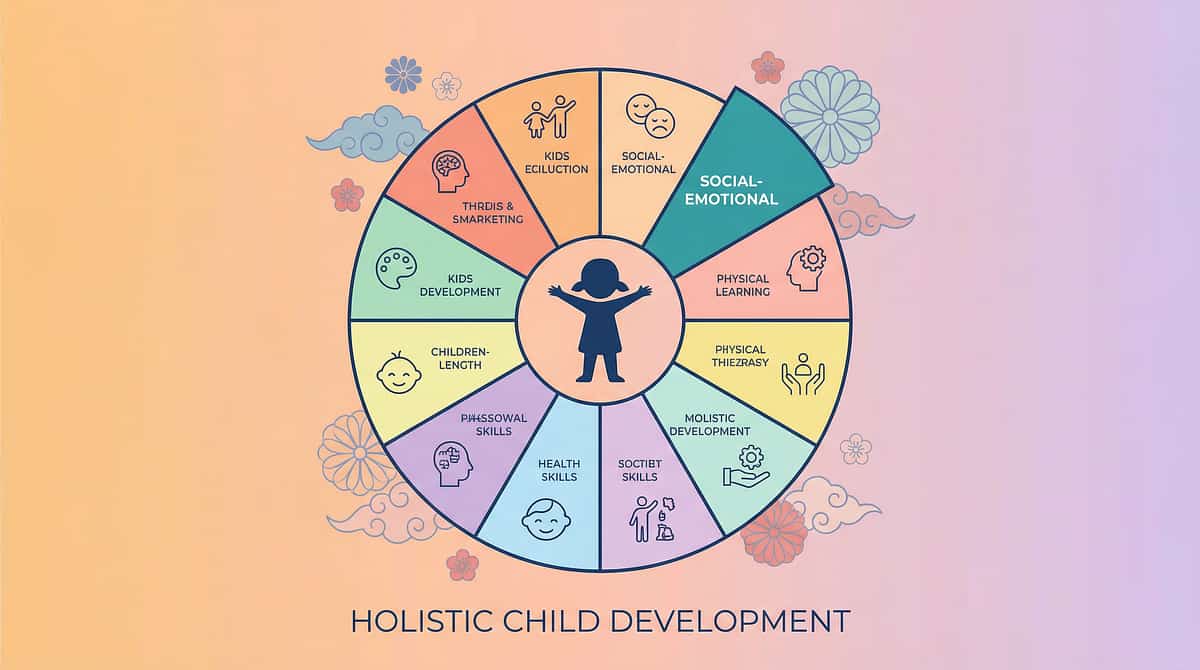
Your Child's Mathematical Development — A WHO/UNICEF-Aligned Roadmap
Age 2–3
Recognizes "more" vs "less"; subitizes 1–3
Age 3–4
One-to-one correspondence develops
Age 4–5
Cardinality: "How many?" = last number counted
Age 5–6
Number bonds to 10; place value emerging
Age 6–8
Flexible mental math, estimation, functional numeracy
Mathematical development doesn't follow a calendar — it follows experience. A six-year-old who has had rich, concrete number experiences will outperform an eight-year-old who has only had symbolic practice. Age-based anxiety is not helpful. Experience-based intervention is.
Autism Spectrum
Number sense often delayed due to reduced spontaneous categorization
ADHD
Attention limitations reduce quantity-of-exposure needed for cardinality to consolidate
Language Disorders
Math vocabulary (more, fewer, equal) must be explicitly taught
Fine Motor Challenges
Impact counting manipulations — OT + SpEd crossover essential
Working Memory
Number fact retention impacts operations even when quantity is understood
"Your child is here. Here is where we're heading." The next 8 weeks of consistent, concrete practice will shift your child's mathematical brain — not by rushing development, but by providing the experiences development requires.
WHO Care for Child Development (CCD) Package (2023) · UNICEF MICS developmental monitoring indicators · PMC9978394

ACT I · Card 05
Clinically Validated. Home-Applicable. Parent-Proven.
★★★★★
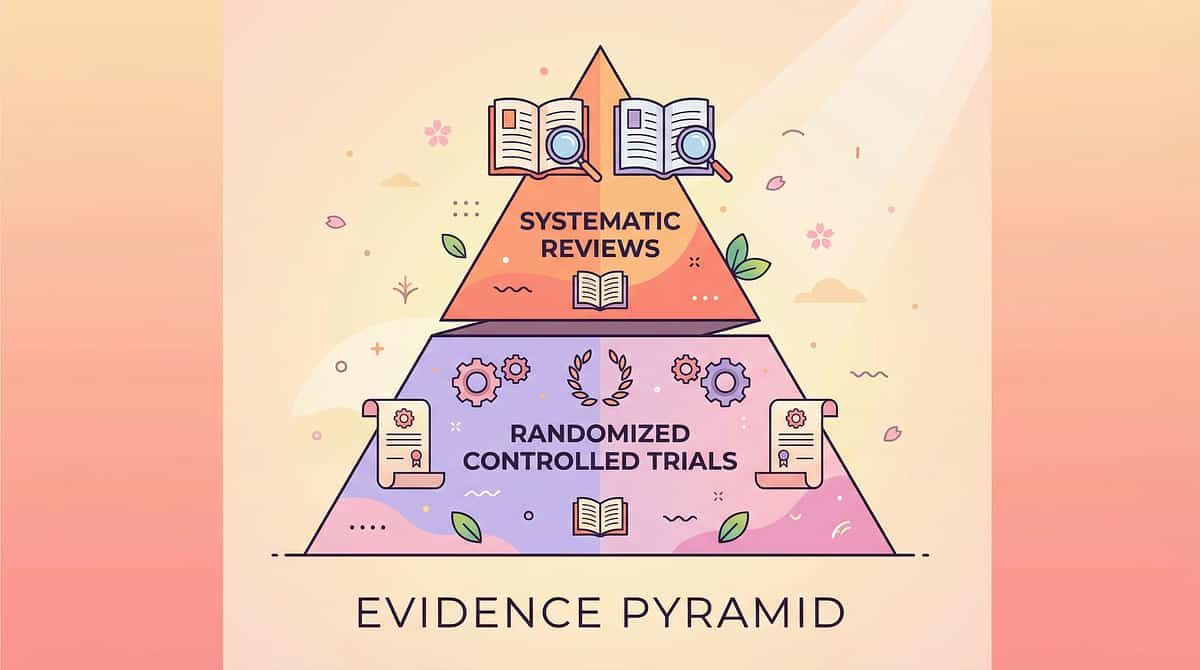
EVIDENCE GRADE: LEVEL I Systematic Review + RCT Supported. Concrete manipulatives for number sense: highest-grade evidence in math intervention.
What Works Clearinghouse (IES, US Dept. of Education)
Concrete manipulative-based instruction classified as "Strong Evidence" for foundational number sense across 47 studies.
Meta-Analysis — World J Clin Cases (2024, PMC10955541)
Multi-disciplinary sensory-integrated + concrete learning intervention across 24 studies: effective promotion of cognitive, adaptive, and academic skills in pediatric populations.
NCAEP Evidence-Based Practices Report (2020)
Visual supports + concrete manipulatives + structured learning environments: all classified as evidence-based practices for children with autism and developmental differences.
Padmanabha et al. (2019) — Indian Journal of Pediatrics
Home-based structured interventions with concrete materials demonstrated significant developmental outcomes in Indian pediatric populations. DOI: 10.1007/s12098-018-2747-4
"These 9 materials are not experimental. They represent the consensus of decades of pediatric math education research, autism intervention science, occupational therapy, and special education. When Pinnacle's consortium designs an at-home number sense programme, this is the evidence stack we build on." — Pinnacle Blooms CRO & Special Education Team
Standard Citations: PMC11506176 | PMC10955541 | PMC9978394 | WHO NCF 2018 | NCAEP 2020 | Padmanabha, Indian J Pediatr 2019
ACT II: THE KNOWLEDGE TRANSFER
9 Materials That Help With Math Concepts
The Concrete Number Toolkit
Technique Code: H-740 | Academic Readiness Series | Reel ID: 895
Domain: Academic Readiness Sub-Domain: Number Sense + Numeracy Age Range: 3–8 years Session Duration: 10–20 min Frequency: Daily
What This Technique Is
This technique introduces nine specific, evidence-selected materials that build number sense — the deep, intuitive understanding of what numbers mean, how quantities compare, and how mathematical operations work. Unlike flashcards and worksheets that target symbolic memorization, these materials engage a child's hands, eyes, and body to create concrete quantity experiences that form the neurological foundation for all future mathematics.
Number sense is not a skill taught in isolation — it is an understanding that emerges through repeated physical contact with quantities. These 9 materials provide structured pathways through the Concrete→Representational→Abstract learning progression.
🔷 Number/Counting Materials
🔷 Sorting Activities
🔷 Problem-Solving Toys
🔷 Matching Games
Pinnacle Active Product — Canon: Number/Counting MaterialsSmartivity DIY Interactive Clock | ₹673 | Buy on Amazon.in → | Pinnacle Recommends — Number/Counting Canon
ACT II · Card 07
4 Disciplines. One Technique. Each With a Different Lens.
Special Education (Lead)
The primary driver of math concept instruction. SpEd therapists use these 9 materials to build the Concrete→Representational→Abstract sequence systematically, assessing number sense components (subitizing, cardinality, magnitude, composition) and targeting specific gaps.
Occupational Therapy
OT integrates these materials for children with fine motor, visual-perceptual, or sensory processing challenges. Weighted counting objects, textured ten frames, and proprioceptive number lines are OT adaptations of these core materials.
ABA / BCBA
Applied Behavior Analysis uses these materials within structured teaching trials and natural environment teaching. Counting bears and ten frames become stimulus materials for discrete trial instruction on cardinality, "give me X" tasks, and number discrimination.
Speech-Language Pathology
SLPs address the language of mathematics — more, fewer, equal, greater than, less than, one more, one less. These materials provide the concrete referents for math vocabulary intervention. Word problem manipulatives are a direct SLP tool.
"A child's brain doesn't organize learning by therapy type. Number sense improvement is simultaneously a SpEd goal, an OT motor goal, an ABA program target, and an SLP vocabulary objective. These materials cross every boundary." — Pinnacle FusionModule™ Consortium

ACT II · Card 08
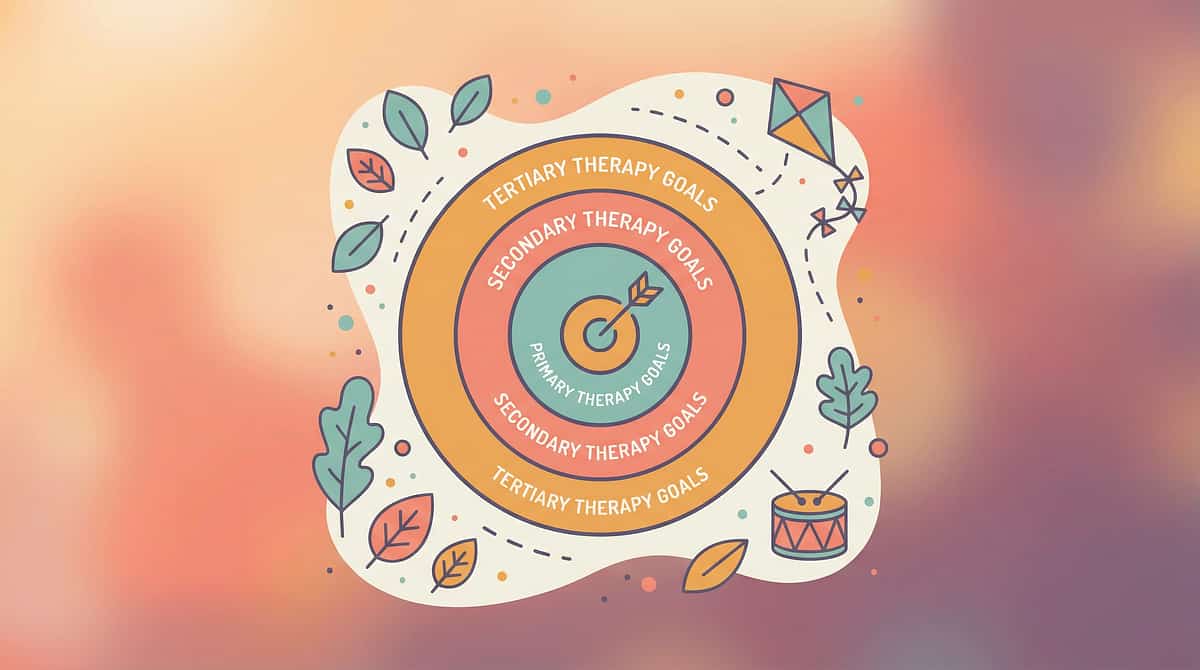
This Technique Is a Precision Tool, Not a General Activity
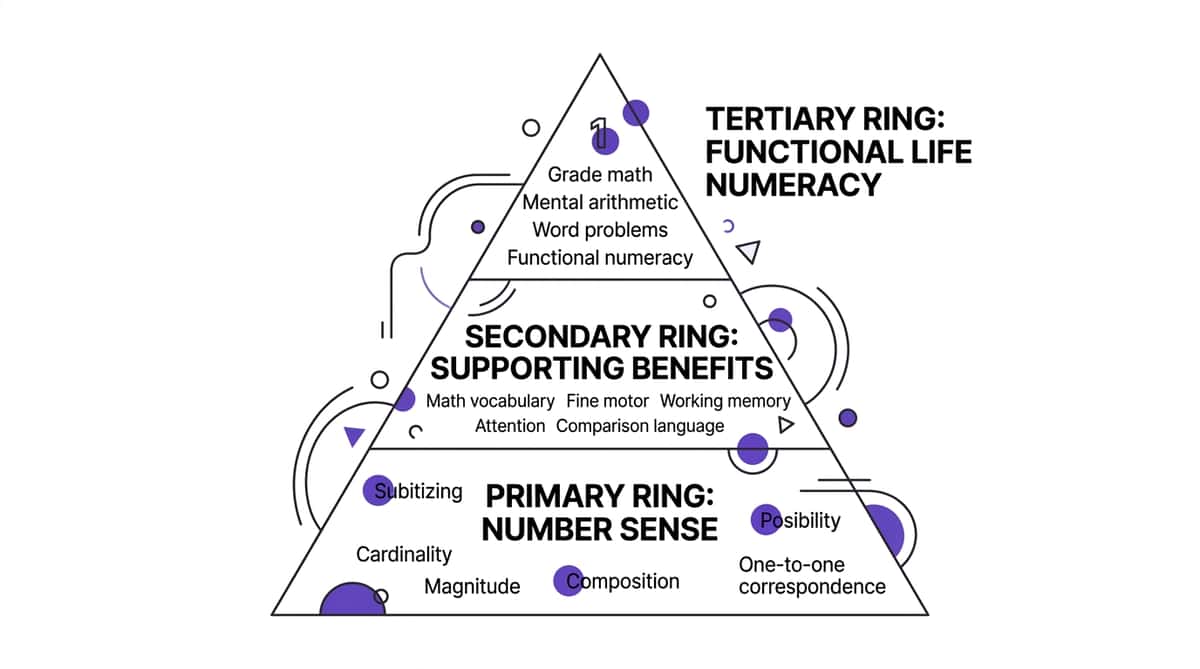
✅ Primary Targets
- Subitizing: instantly recognizing small quantities (1–6) without counting
- One-to-one correspondence: touching each object exactly once while counting
- Cardinality: the last number counted = total quantity
- Magnitude: knowing which number is bigger/smaller without counting
- Number composition: 5 = 2+3 = 4+1 = 5+0
→ Secondary & Tertiary Targets
- Mathematical vocabulary (more, fewer, equal, greater, less)
- Sustained attention during structured tasks
- Fine motor coordination during counting
- Working memory: holding quantity while manipulating
- Grade-level mathematics achievement
- Mental arithmetic and estimation
- Functional numeracy (money, time, measurement)
Observable Behavior Indicators
When these targets are being hit, you will see your child: produce the correct number of objects when asked ("give me four"); compare two groups correctly without counting each one; maintain cardinality even when arrangement changes; recognize dice/domino/finger patterns without counting; begin using "one more" / "one less" language spontaneously.

ACT II · Card 09 — Primary Materials
Your Complete Math Concepts Toolkit — Buy or Make
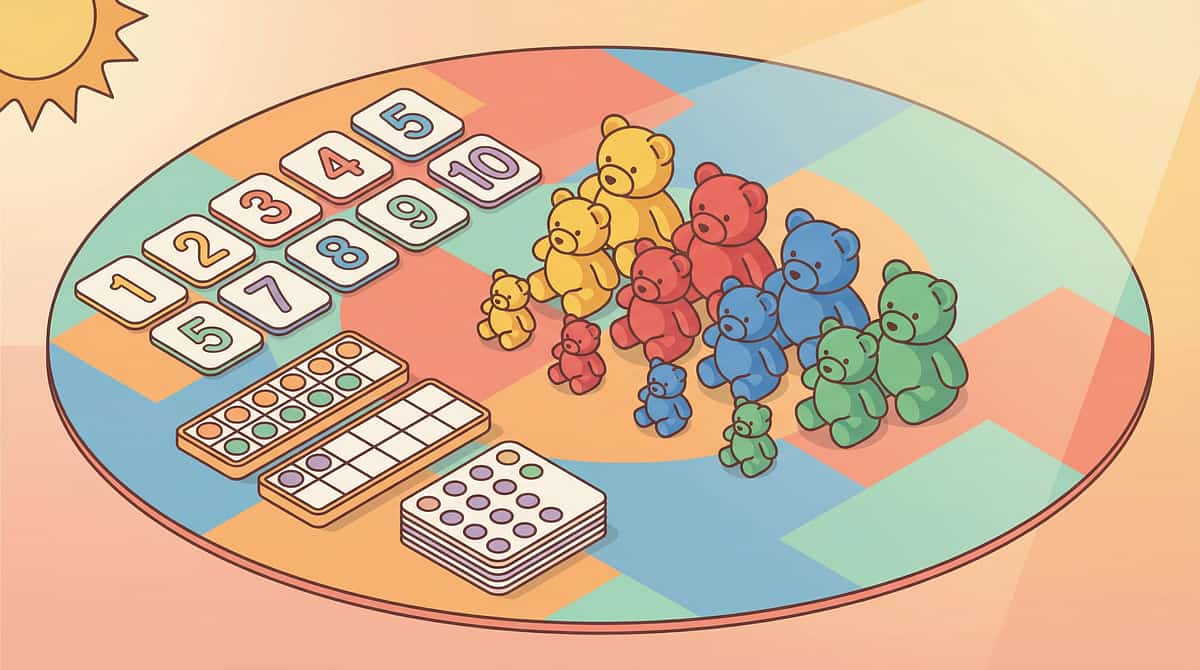
🔷 Smartivity DIY Interactive Clock
Canon: Number/Counting Materials | ₹673 | Pinnacle Recommends → Buy on Amazon.inSpEd/OT Use: Introduces counting, number recognition, number sequence through interactive build-it model
🔷 Lattooland Rainbow Sorting Activity Set
Canon: Sorting Activities / Categorization | ₹628 | Pinnacle Recommends → Buy on Amazon.inSpEd/OT Use: Sorting by color/quantity — foundational for cardinality and set comparison
🔷 SHINETOY 8 Dice Shut The Box Game
Canon: Problem-Solving Toys | ₹428 | Pinnacle Recommends → Buy on Amazon.inSpEd/ABA Use: Subitizing practice — recognizing dice patterns without counting
🔷 Dyomnizy Educational Memory Game
Canon: Matching Games / Memory Games | ₹519 → Buy on Amazon.inSpEd Use: Quantity matching and pattern recognition; cause-effect numerical responses
🔷 Brainy Bug Resources Flashcards
Canon: Sorting Activities / Categorization | ₹305 → Buy on Amazon.inSpEd/SLP Use: Visual-audio number-quantity matching; vocabulary reinforcement
🔷 1800+ Reward Stickers
Canon: Reinforcement Menus | ₹364 | Pinnacle Recommends → Buy on Amazon.inABA Use: Reinforcement delivery during counting bear and ten frame sessions
Additional Recommended Materials (Amazon.in)
Total Starter Kit Estimate: ₹1,500–5,200 for a comprehensive math manipulative toolkit
ACT II · Card 10
Zero Budget. Full Therapy. The WHO Equity Principle in Action.
Every material in this programme has a free version made from household items.
Material | Buy Version | DIY Version | Why It Works | |
Counting Bears | ₹300–600 | Buttons, bottle caps, pom poms, dried beans (₹0) | Uniform small objects for one-to-one correspondence | |
Ten Frames | ₹100–400 | Egg carton (cut to 10 spaces), OR paper + marker (₹0) | 2×5 grid provides the visual structure of base-10 | |
Number Line | ₹100–500 | Tape on floor + numbered cards, OR chalk on ground (₹0) | Linear representation of magnitude and sequence | |
Base-10 Blocks | ₹300–900 | Craft sticks (1s), bundled sticks tied with rubber band (10s) (₹20) | The bundle visually contains 10 units | |
Dot Cards | ₹100–350 | Index cards + marker using dice/domino patterns (₹20) | Patterned arrangements support subitizing | |
Balance Scale | ₹300–800 | Clothes hanger + identical cups on string (₹0–50) | Physical balance = visual equality | |
Part-Part-Whole Mat | ₹100 | Two small paper plates + one large plate (₹10) | Visual structure for decomposition | |
Cuisenaire Rods | ₹400–900 | Paper strips cut in proportional lengths, color-coded (₹20) | Proportional lengths show number relationships | |
Story Manipulatives | ₹200–700 | Any small household objects — buttons for bears, coins for people (₹0) | Physical enactment of story problems |
"Therapeutic quality is determined by structured use and consistency, not by whether the material comes from a toy store or a kitchen drawer. The WHO/UNICEF CCD Package is implemented in 54 low-income countries using household materials." — Pinnacle Blooms Consortium, Equity in Therapy Division
When Commercial Grade Is Non-Negotiable
- Cuisenaire rods for precise ratio/fraction work (DIY paper strips introduce measurement error)
- Balance scales for formal equality exploration (the balance must be sensitive and accurate)
- Base-10 blocks for multi-digit operations above 99 (craft sticks become unwieldy)
ACT II · Card 11 — SAFETY FIRST
Pre-Session Safety Gate — Read This First
🟢 GREEN — Safe to Proceed
- Child is fed, rested, and in a regulated (calm-alert) state
- No illness symptoms (fever, ear infection, stomach upset)
- No major meltdown in the past 2 hours
- Space is clear; child can sit or be on floor safely
- All materials checked for size appropriateness — no choking risk
🟡 AMBER — Modify the Session
- Child is tired but not dysregulated (use 3 materials instead of all 9)
- Child had a difficult morning (use favorite material only)
- Limited time available (run a 5-minute "just one material" session)
- Sensory sensitivity high today (skip balance scale, stick to soft materials)
🔴 RED STOP — Do Not Proceed
- Child is in full meltdown or severe dysregulation
- Child is unwell (fever above 37.5°C, visible distress)
- Child has not eaten in 3+ hours
- Parent/caregiver is also dysregulated (your state transfers to the child)
⚠️ Material Safety Checklist
- Counting bears and small counters: choking hazard for children under 4 — use larger objects for toddlers
- Craft stick bundles with rubber bands: check rubber bands — no snapping risk in eyes
- Balance scale: stable base required before placing on any elevated surface
- Small dice: choking hazard — supervise at all times; consider foam dice for young children
RED LINE — Stop Immediately If: Child attempts to put any counting material in mouth or nose | Child shows escalating distress signs | Child's hands or gaze are rigidly fixed (transition anxiety spike)

ACT II · Card 12
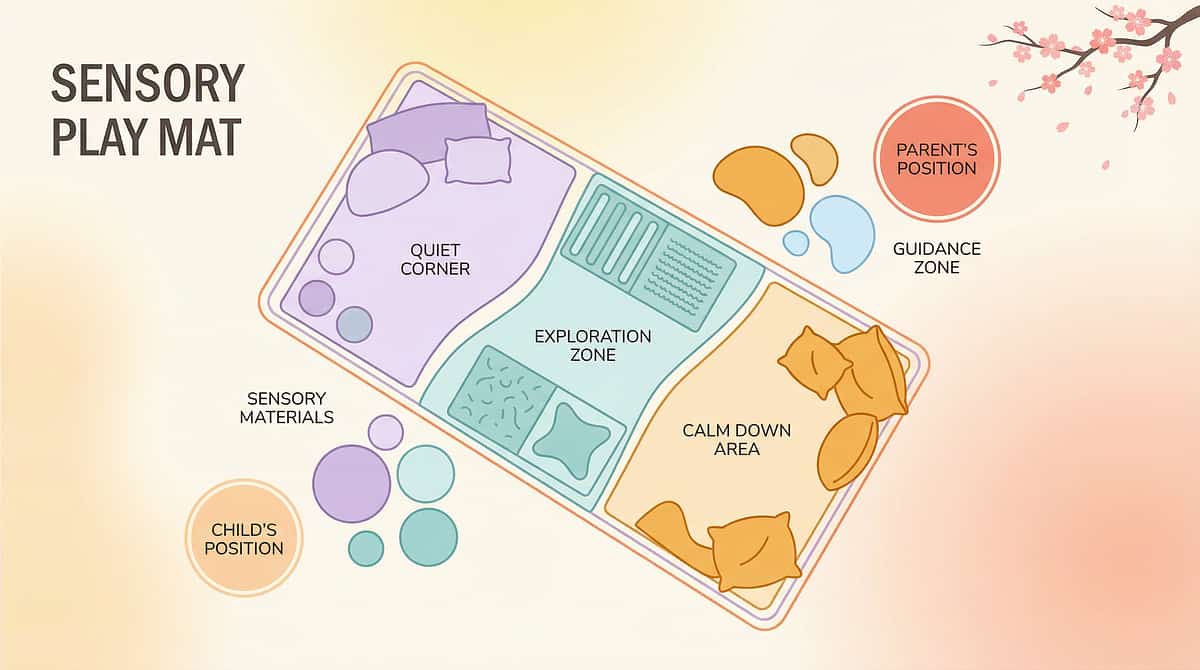
The Right Environment Prevents 80% of Session Failures
Materials Tray
Within child's reach but slightly angled so child must orient toward it — builds purposeful attention
Parent Position
Side-by-side or slightly behind child — NEVER directly opposite, which creates test anxiety
Child Position
Seated comfortably — chair with feet flat, or floor mat with back support
Reward Tray
Visible but separate from materials — prevents reward-grabbing that interrupts the session
Data Tracker
Parent's phone or notebook within easy reach for post-session recording
Pre-Session Setup (5 Minutes)
- Select today's 1–3 materials — don't introduce all 9 in one session
- Count out the correct number of counters/bears needed
- Place ten frame on flat surface with counters ready
- Lay out number line with movable marker at zero
- Prepare reward menu (2–3 options child can choose from)
- Turn off background audio; put your phone on silent
Session Rotation Suggestion
Mon | Tue | Wed | Thu | Fri | Sat | |
Counting Bears + Ten Frame | Number Line + Dot Cards | Base-10 Blocks | Part-Part-Whole Mat | Balance Scale | Cuisenaire Rods + Story Manipulatives |
ACT III: THE EXECUTION
60-Second Readiness Check — Before Every Session
Eyes: Alert and scanning
Not glazed, not fixated
Body: Settled
Not bouncing, not rigid — regulated tone
Hunger: Fed within 2 hours
Blood sugar matters for learning
Rest: Not visibly fatigued
Yawning heavily = postpone
Previous 2 hours: Calm
No major meltdown or trauma event
Willingness cue: Responds to name
Even a glance = sufficient
Sensory state: Regulated
No obvious over- or under-stimulation signs
🟢 6–7 checks: GO
Full session — proceed as planned
🟡 4–5 checks: MODIFY
1 material, 5 minutes, no new introduction. Use child's FAVORITE material only.
🔴 0–3 checks: POSTPONE
Do a calming activity instead. This is not failure — this is data.
"The best session is one that starts right." — Pinnacle Blooms SpEd + ABA Consortium. A postponed session never counts against progress.
ACT III · STEP 1 of 6
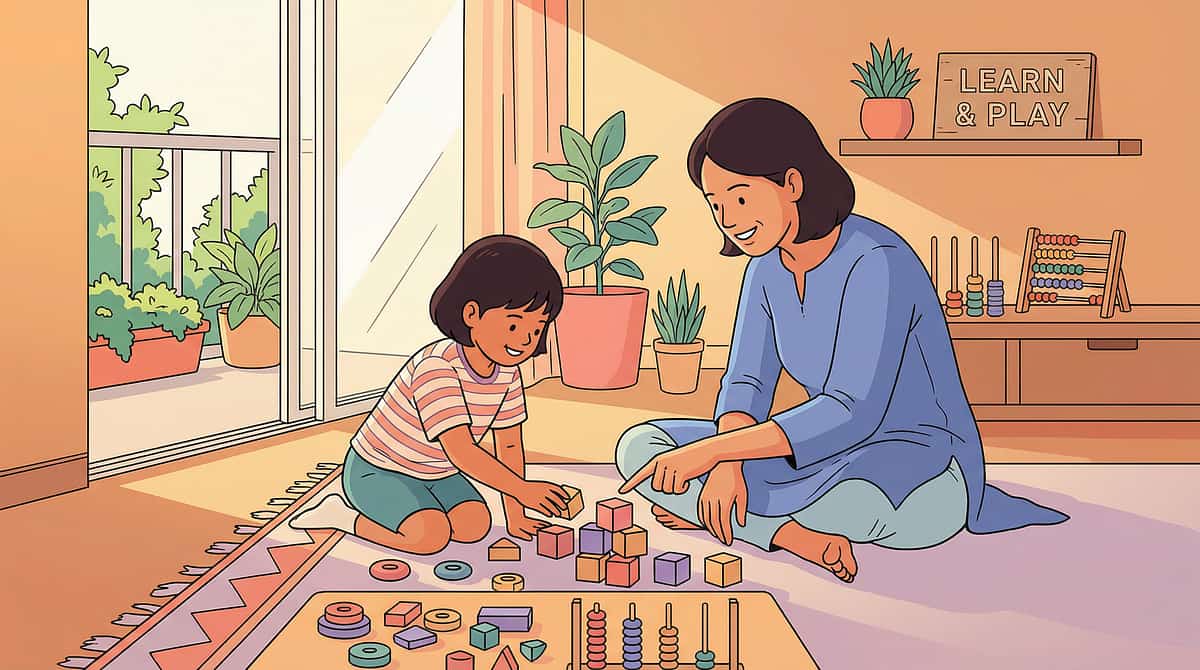
Begin With an Invitation, Not a Command
⬤ STEP 1
The Invitation | Timing: 30–60 seconds
"Hey — I found something interesting. Want to come see?" OR: "I need your help counting these bears. Can you help me?" OR (for reluctant starters): "I'm going to play with these by myself. You can watch if you want."
What to Do
- Bring out one material only — the one selected for today
- Place it on the mat with genuine curiosity in your body language
- Use a low-demand opener — "want to see?" not "it's time to learn"
- Wait up to 30 seconds for the child to orient before repeating
- If resistance after 2 invitations → move to MODIFY mode
✅ What Acceptance Looks Like
- Child looks at the material (even briefly)
- Child moves toward the table
- Child reaches out to touch
- Child makes a sound or gesture toward the material
How to Handle Resistance
- Child walks away → Follow naturally, don't chase
- Child pushes material away → Say "ok" cheerfully, wait 30 seconds, re-offer
- Child ignores → Narrate what YOU are doing to build interest
ACT III · STEP 2 of 6
Introduce the Material — Let Them Discover, Not Perform
⬤ STEP 2
The Engagement | Timing: 1–3 minutes
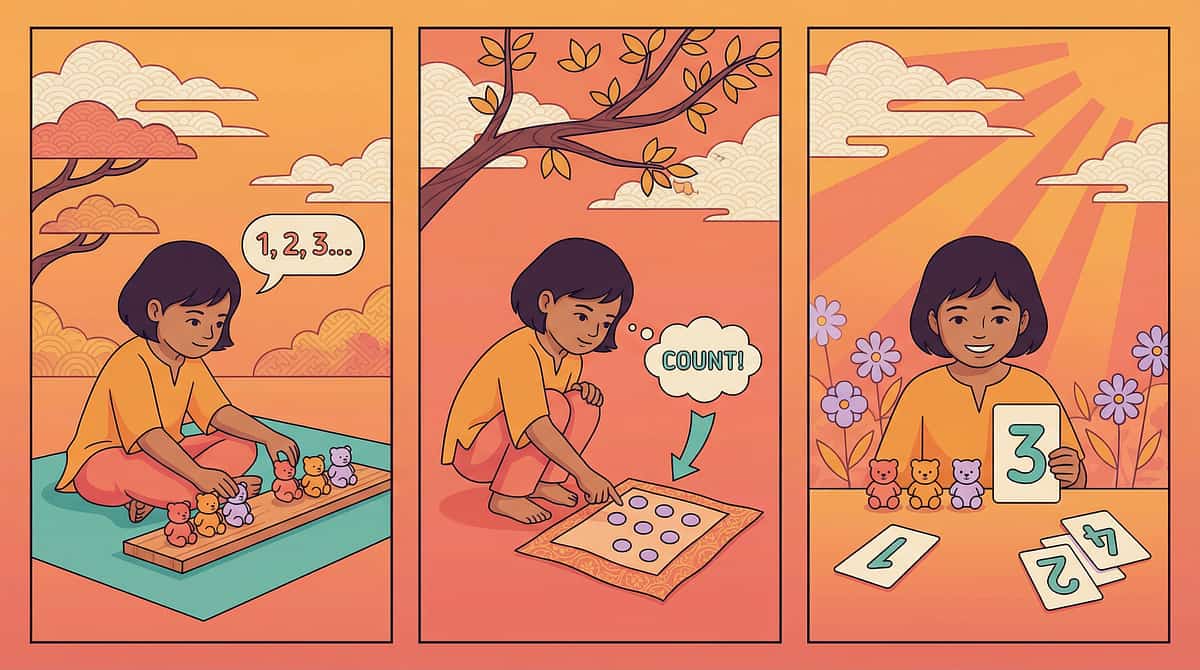
"These are counting bears. Let's just see what we can do with them." [Ten Frame]: "This is a special grid. There are 10 spaces. Let's put things in it." [Number Line]: "There's a path here. Each square is a number. Let's walk along it together."
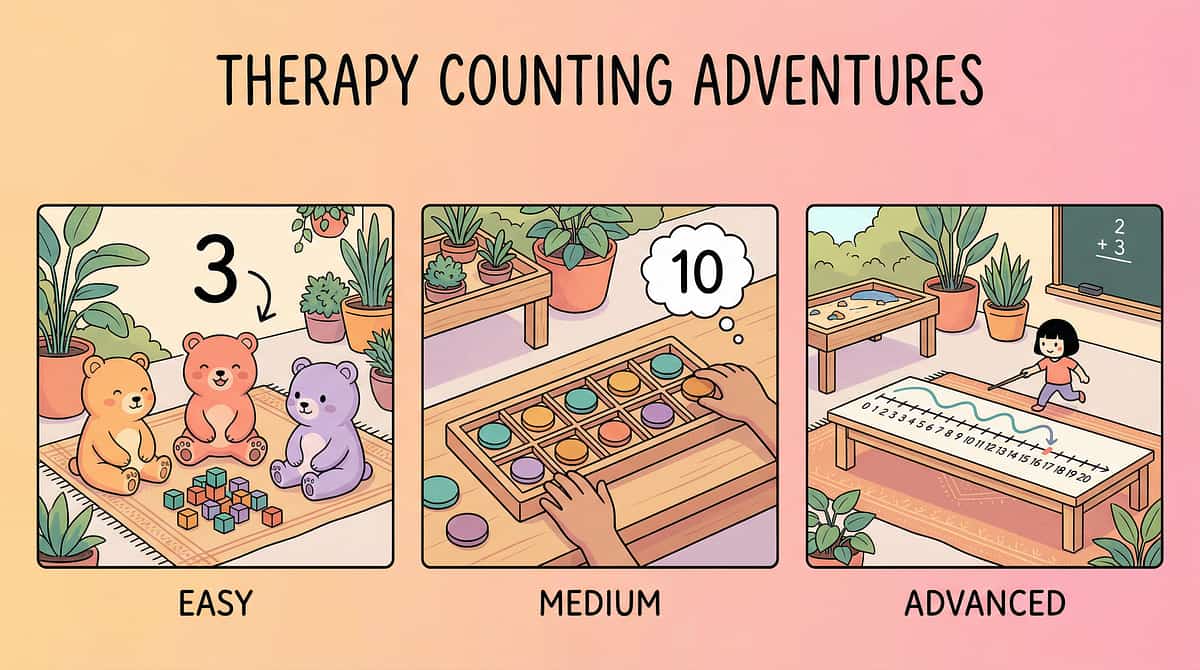
Counting Bears
Pour 10–15 bears onto the mat. Let child explore freely for 60 seconds before introducing structure. Count bears together using full hand: point-touch-say.
Ten Frame
Place ten frame on table. Hand child counters one at a time. Say "can you put one in here?" Let child fill at their pace. Count filled spaces together when done.
Number Line
Place the number line in front of child. Put the marker at zero. Say "start here." Move marker to 1, saying "1." Hand marker to child.
Dot Cards
Hold up card. Ask "how many?" — wait 3 seconds. If counting, that's fine. If instant recognition, celebrate it.
Balance Scale
Put 3 bears on one side. Say "now you put some on the other side. Can you make it balance?"
Reinforcement Begins Here: Any interaction with material = praise. Specific, immediate, enthusiastic: "You did it! You put the bear there!" | Research: PMC11506176 (2024): Structured material introduction meets evidence-based practice criteria.
ACT III · STEP 3 of 6 — Material 1 & 2
The Core Therapeutic Moment — Materials 1 & 2
⬤ STEP 3
The Therapeutic Action | 5–12 minutes focused time | This is the active ingredient.
1. Counting Bears — One-to-One Correspondence
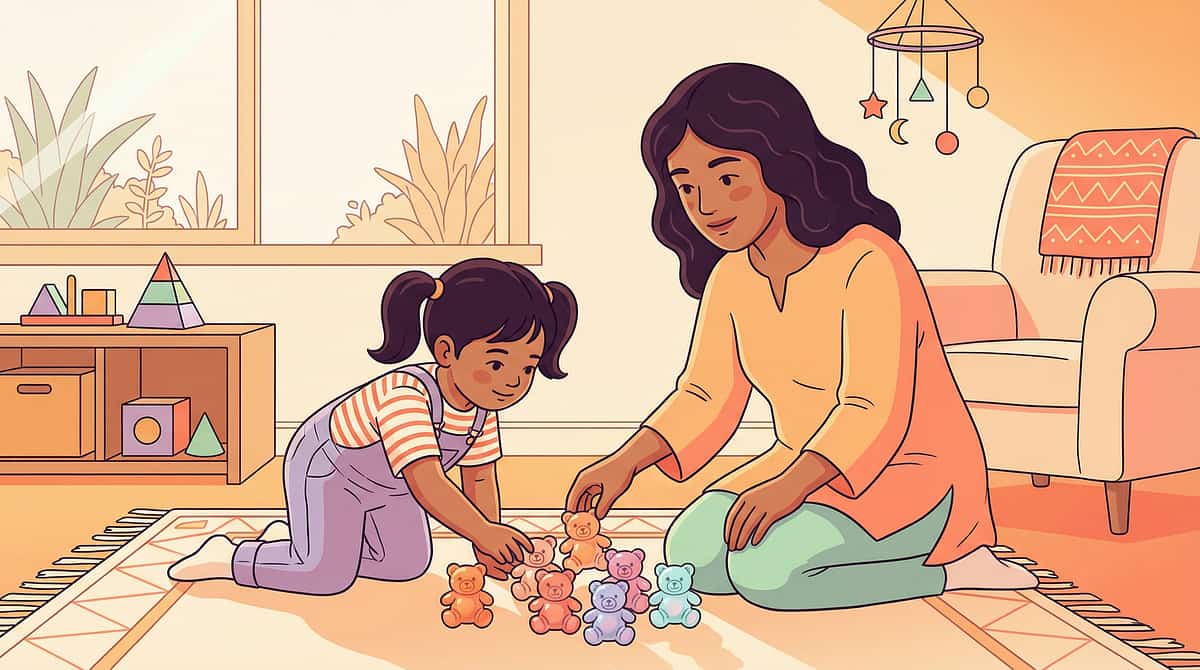
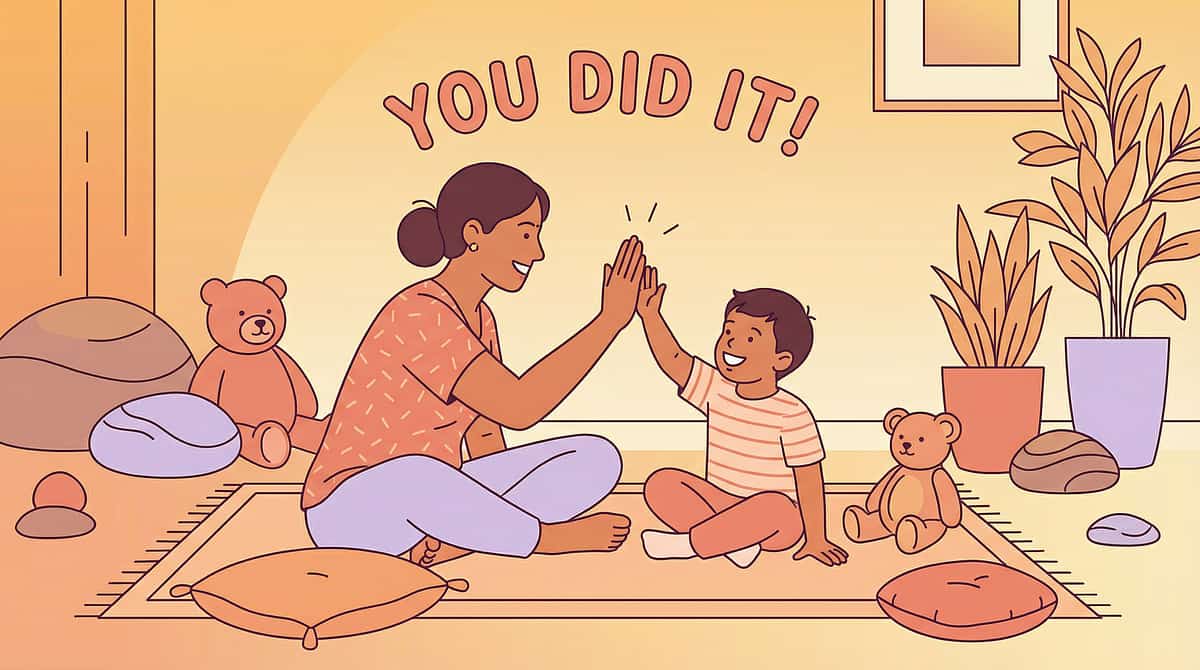
Place 6 bears in a line. Point to each one, touch it, and say the number: "ONE (touch) TWO (touch) THREE..." Ask child to count with you — touching each bear as they say the number. Then ask: "How many bears?" Expected mastery = child says "six" (not re-counts). This is cardinality.
~3 minutes | Target: cardinality, one-to-one correspondence
2. Ten Frame — Number Sense Structure
Fill the ten frame with counters up to a given number (start with 5). Count filled spaces. Push counters to one side. Ask "how many empty spaces?" — answer should come from the visual, not counting. Introduce "5 and 1 more = 6."
~3 minutes | Target: subitizing, number bonds to 10
ACT III · STEP 3 of 6 — Material 3 & 4
The Core Therapeutic Moment — Materials 3 & 4
3. Number Line — Magnitude and Operations
Put marker at 3. Ask "can you jump two more?" Child moves marker 2 spaces forward. Ask "where did you land?" (answer: 5). Then: "jump back one" (answer: 4). This is addition and subtraction as movement.
~4 minutes | Target: magnitude, addition/subtraction as direction
4. Base-10 Blocks — Place Value
Build the number 13: 1 rod (ten) + 3 units. Say "one ten and three ones." Trade 10 units for 1 rod together. Ask "are these the same?" (yes). Build another number — let child choose.
~5 minutes | Target: place value, regrouping concept

ACT III · STEP 3 of 6 — Material 5 & 6
The Core Therapeutic Moment — Materials 5 & 6
5. Dot Cards — Subitizing
Flash a dot card for 2 seconds (cover it with your hand after). Ask "how many?" If child counts — that's fine, let them. Over time, the goal is instant recognition. Build from 1–3 to 4–6 to compound patterns.
~3 minutes | Target: subitizing, automatic number knowledge
6. Balance Scale — Equality
Put 5 counters on one side. Ask "how many do I need on this side to make it balance?" Let child experiment. When balanced: "That means five equals...?" Help them form the sentence: "5 equals 3 plus 2."
~4 minutes | Target: equality concept, early algebra thinking

ACT III · STEP 3 of 6 — Materials 7, 8 & 9
The Core Therapeutic Moment — Materials 7, 8 & 9
7. Part-Part-Whole Mat — Decomposition
Put 5 bears in the "whole" circle. Move 2 to one "part" circle. Ask "how many are in the other part?" Let child move bears to find out. Repeat with different splits: 4+1, 3+2, 5+0.
~4 minutes | Target: number bonds, decomposition, mental math foundation
8. Cuisenaire Rods — Relationships
Line up rods from 1–5 as a staircase. Ask "which is longer, the red (2) or the light green (3)?" Place orange rod (10) and ask "can you find two rods that reach the same length?" Explore equivalencies.
~5 minutes | Target: magnitude comparison, number relationships, proportional thinking
9. Story Manipulatives — Word Problems
Use toy animals: "There were 4 birds on the tree. 2 flew away. How many are left?" Child acts out the story with physical objects. Solution emerges from the action, not calculation. Build to addition stories too.
~4 minutes | Target: word problem comprehension, operations as real events
Child Response Spectrum: Ideal = correct response + engagement | Acceptable = attempts + approximation (70–80% is mastery working) | Concerning = rigid fixation or escalating distress → shift to Step 4. Research: PMC10955541: Core therapeutic action occupies 40–60% of session time.
ACT III · STEP 4 of 6
3 Good Repetitions Beat 10 Forced Ones
⬤ STEP 4
Repeat & Vary
Counting Bears
3–5 counting sequences per session
Ten Frame
Build and clear 3–4 different numbers
Dot Cards
10–15 quick flashes per session
Number Line
3–4 addition/subtraction "jumps"
Balance Scale
2–3 equality discoveries
Part-Part-Whole
4–5 different decompositions of the same target number
Variation to Maintain Engagement
- Change the color of counters used
- Change the number being worked on
- Change the child's role (now you pour, I'll count)
- Change the question asked (count vs. "how many?" vs. "give me five")
- Add a playful element (race the timer, beat the parent)
⚠️ Satiation Indicators — child is done: Turning away from material | Starting to bat or throw objects | Vocal protest increasing | Eyes glazing or losing focus. When satiation shows: complete the current repetition and move to Cool-Down. Do not add one more.

ACT III · STEP 5 of 6
Timing Is Everything — Reinforce Within 3 Seconds
⬤ STEP 5
Reinforce & Celebrate
The ABA Reinforcement Rule
Effective reinforcement must be:
- Immediate — within 3 seconds of the target behavior
- Specific — name what the child did ("You counted five bears!")
- Genuine — your enthusiasm is the biggest reinforcer
Reinforcement Scripts — Copy These
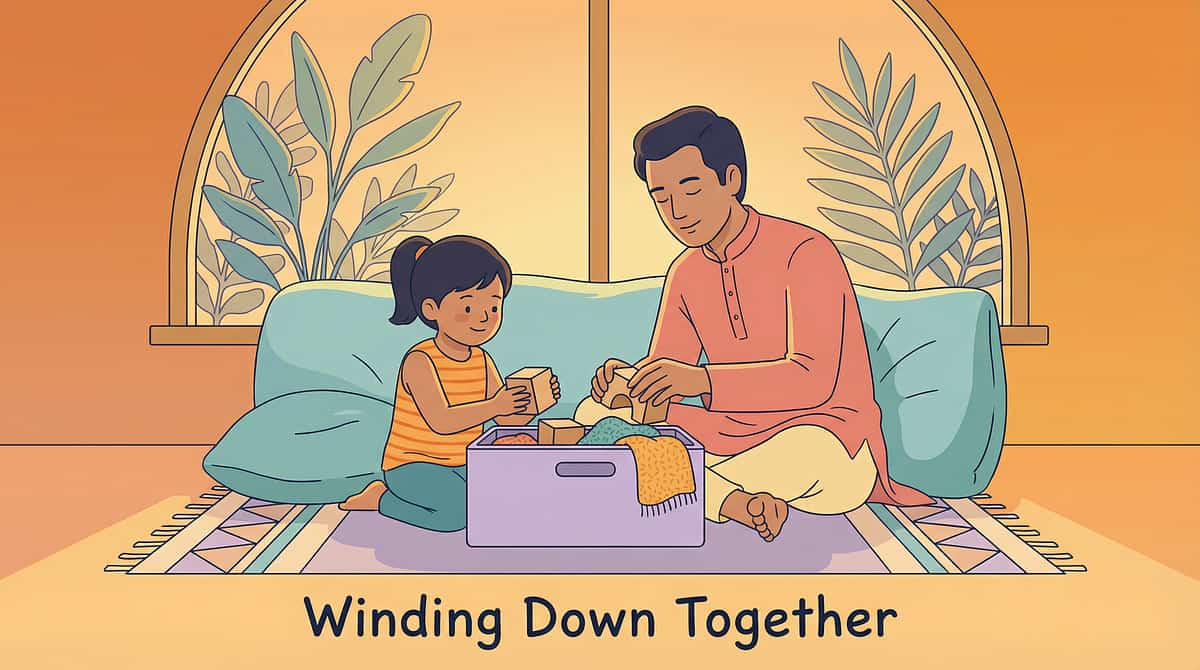
"YES! You did it! You put five there — that's exactly right!" "I love how you counted them all! One…two…three…four…five — FIVE!" "You matched them perfectly! You're a counting champion!"
Social Reinforcers (Free, Powerful)
High five, thumbs up, victory dance together | Phone video showing child their correct answer | Verbal praise with specific description
Token Economy
Counting bear chart: earn one "special bear" per correct cardinality response. After 5 earned bears → preferred activity for 5 minutes. → Reward Jar ₹589 | → 1800+ Stickers ₹364
Natural Consequence
"You got it right — you can pick which material we use next" | "You counted perfectly — here are 3 more bears to work with"
Critical Rule: Celebrate the attempt, not just the success. A child who reaches for the material and tries deserves reinforcement. Effort is the behavior we're building first.

ACT III · STEP 6 of 6
No Session Ends Abruptly — Transitions Prevent Dysregulation
⬤ STEP 6
The Cool-Down | 2 minutes
Transition Warning Script — say exactly this: "Two more bears to count, then we're all done!" [After two:] "All done with the bears! Great counting today!"
Announce the End
"We're almost done" — prepare the child 1–2 minutes early
Child Participates in Put-Away
"Can you put the bears back in the cup?" — makes the ending a task, not an abrupt stop
Brief Calming Activity
60 seconds of the child's choice: a specific preferred toy, gentle movement, looking at a book
Transition Cue to Next Activity
"After this, we're going to [X]" — what comes next, named clearly
If Child Resists Ending: Do NOT extend the session to accommodate (reinforces resistance). Calmly state: "Bears are sleeping now. We'll see them again tomorrow." Offer the transition object as bridge. → Animal soft toys as transition objects ₹425 — Canon: Transition Objects
Post-Session Parent Action: Within 60 seconds of cool-down completion → capture today's data.
Visual timer and transition support: NCAEP 2020 — visual supports classified as evidence-based practice for autism.

ACT III · Card 20
60 Seconds of Data Now Saves Hours of Guessing Later
Field 1 — Cardinality Check
When I asked "how many?" after counting — did my child answer with the last number counted? YES / NO / SOMETIMES
Field 2 — Engagement Duration
How many total minutes was my child actively engaged with materials? _____ minutes
Field 3 — Best Moment
What's the one thing my child did today that showed number sense? (Write one sentence)
Tracking Options
- 📥 Download H-740 Math Concepts Weekly Tracker PDF (link to Pinnacle resource)
- 📱 Log in GPT-OS® App → AbilityScore® → Academic Readiness → H-740
- 📓 Paper notebook — any format works; consistency matters more than format
Weekly Pattern Analysis
After 5 sessions, look at Field 1 (cardinality). If YES is increasing week-over-week: you are building number sense. If SOMETIMES is common: you are in the consolidation phase. If NO after 3 weeks: move to adapt the technique.
"Your data is not just a record. It is intelligence that drives your child's personalized programme."
ABA Data Collection Standards: Continuous measurement as standard practice. BACB Guidelines + Cooper, Heron & Heward (Applied Behavior Analysis, 8th ed.)

ACT III · Card 21 — Troubleshooting
Most Sessions Aren't Perfect. That's Normal. Here's What to Do.
My child refused to touch the counting bears at all.
Normal for first 3–5 sessions. Use parallel play — count the bears yourself, narrating aloud. Proximity to the activity without demand is still exposure. Over 3–5 sessions, the child's curiosity often draws them in without invitation.
My child counted correctly but couldn't answer "how many?"
This is a cardinality gap — not understanding that the last number = total. It's exactly what this technique addresses. Keep reinforcing: after counting to 5, say "and that means FIVE — five bears!" Repeat this connection thousands of times.
My child scattered all the materials and ran.
Session abandonment is data: either (1) child was not in a ready state, (2) demand was too high, or (3) material needs more pairing with reinforcement. Next session: reduce to just looking at one material, no task.
My child fixated on sorting by color instead of counting.
Go with it — color sorting IS categorization, which IS mathematical thinking. Record it. Next session, after sorting, count each color group together.
The number line is confusing my child.
Start with a shorter number line (0–5 only). Place the child's physical body ON a floor number line — movement helps. Walk the line together, parent first, child second.
My child knows all answers but seems bored.
Excellent problem — it means cardinality is consolidating. Increase difficulty: work with larger numbers (7–10). Introduce part-part-whole for the same numbers. Move to Cuisenaire rods for ratio exploration.
I feel like we're not making progress after 2 weeks.
Two weeks is too early to assess progress. The consolidation phase begins week 3–4. Compare week 1 to week 4, not day to day. If genuinely no movement after 6 weeks: call Pinnacle Helpline 9100 181 181 for a session review.
📞 FREE National Autism Helpline: 9100 181 181 | Available 24×7 | 16+ languages

ACT III · Card 22 — Adapt & Personalize
No Two Children Are Identical. Your Technique Should Reflect That.
For the Sensory Seeker
- Weighted counting bears (add small pebbles inside a pouch)
- Floor number line with full-body jumping
- Large foam ten frame with whole-body placement
- Textured objects for counting (rough stones, soft pom poms)
For the Sensory Avoider
- All materials at child-controlled distance
- Let child use a pointer stick rather than touching directly
- Introduce materials in see-through bags first
- Use dot cards (visual-only) as starting point
For the Visual Learner
- Color-code everything: each number has its own color across all materials
- Photographs of counting sequences on the wall
- Number-quantity anchor chart visible during all sessions
For the Language-Limited Child
- Remove ALL verbal demands for first month — accept pointing, touching, reaching
- Use gesture + material: hold up 3 fingers + 3 bears simultaneously
- Pair SLP on this technique specifically for math vocabulary building
For the High-Functioning / Understimulated Child
Jump directly to Cuisenaire rods and balance scale. Introduce number composition to 20, then to 100. Move toward story problems with multi-step scenarios. Link to H-741 (Reading Readiness) — math vocabulary through text.
3–4 years | 5–6 years | 7–8 years | |
Focus: 1–5 only; subitizing 1–3; color sorting | Focus: 1–10; cardinality; ten frame bonds | Focus: 1–20; place value; operations; word problems |

ACT IV: THE PROGRESS ARC
Weeks 1–2: The Foundation Phase — Tolerance, Not Mastery
15%
Foundation Phase
Weeks 1–2 progress milestone
✅ What You'll Likely See
- Child tolerates being near the materials (was refusing before)
- Child touches materials even briefly (engagement emerging)
- Child completes 1–2 counting sequences (vs. zero before)
- Some correct "how many?" responses on small numbers (1–3)
- One subitizing success — instant recognition of 2 without counting
❌ What Is NOT Progress Yet (and that's normal)
- Not yet: consistent cardinality on all numbers
- Not yet: spontaneous counting of environmental objects
- Not yet: accurate "give me X" for all numbers
- Not yet: understanding "more" and "less" reliably
"Last week she pushed the bears away immediately. Today she let me count three of them and she watched. That is real progress." | "He counted to 4 and when I asked 'how many?' he said 'four' instead of starting to count again. Just once — but once is the beginning."
Parent Emotional Check: These two weeks are the hardest. You're investing without visible return. Trust the CRA process. The concrete experience you're providing is building neural pathways that will not become visible as behavior for another 2–4 weeks. Stay consistent. 📞Struggling? Call 9100 181 181 — FREE helpline, available 24×7
ACT IV · Card 24
Weeks 3–4: The Neural Pathway Is Forming — Watch For These Signs
40%
Consolidation Phase
Weeks 3–4 progress milestone
🧠 Anticipates the session
Child moves toward the materials when you prepare them — showing memory and expectation
🧠 Asks for a specific material
"Bears? Bears?" — showing preference, memory, and emerging attachment to the activity
🧠 Answers "how many?" consistently on 1–5
4 out of 5 correct = consolidation indicator — the cardinality bridge is forming
🧠 Begins to subitize 1–3
Instant visual recognition without counting — the brain is beginning to pattern-match
🧠 Counting becomes more deliberate
Slower, more careful touching — one-to-one correspondence maturing
Generalization Seeds — Watch for These
- Spontaneously counting stairs, crackers on a plate, cars in the car park
- Saying "more" or "less" in natural contexts
- Showing awareness of quantity differences between two sets
Parent Milestone: "You may notice you're more confident too. The uncertainty of week 1 is replaced by a developing sense of what works for YOUR child. That is your therapeutic intelligence developing."
ACT IV · Card 25
Weeks 5–8: The Mastery Phase — Specific Milestones to Watch
75%
Mastery Phase
Weeks 5–8 progress milestone
Skill | 🏆 Mastery Criterion | |
Cardinality (1–10) | Correctly answers "how many?" after counting on 9 of 10 trials for 3 consecutive sessions | |
Give-Me Task | Produces exact number of objects requested (1–5) without re-counting on 4 of 5 trials | |
Subitizing | Instantly recognizes 1–6 on dot cards without counting on 8 of 10 presentations | |
Magnitude | Correctly identifies "more" and "less" between two sets (1–10) on 9 of 10 comparisons | |
Number Bonds to 5 | Can find all combinations that make 5 using part-part-whole mat on 4 of 5 attempts |
Generalization Check
- Does the skill appear WITHOUT the materials? (spontaneous cardinality in daily life)
- Does it appear in NEW settings? (at grandparent's house, at school)
- Does it MAINTAIN over 2 weeks without daily practice?
"Mastery Unlocked" → When to Progress: When 3 of 5 mastery criteria above are met → child is ready for H-741 (Reading Readiness) as a parallel track, OR deeper number sense work: number bonds to 10, place value with base-10 blocks, beginning addition/subtraction with manipulatives.
PMC10955541 + BACB mastery criteria standards. Meta-analysis across 24 studies showing measurable skill outcomes.

ACT IV · Card 26
You Did This. Your Child Grew Because of Your Commitment.
You Showed Up Every Day
- Showed up daily with counting bears and ten frames when you didn't know if it was working
- Learned to read your child's readiness state before every session
- Recorded data when you were tired
- Adapted when sessions failed and tried again the next day
- Stayed consistent when other caregivers didn't understand what you were doing
And Your Child…
- Made the shift from rote counting to genuine quantity understanding
- Began to see "five" as five things, not just a sound
- Started to compare quantities and know which is more
- Laid the neurological foundation for all future mathematics
This is not a small win. This is a foundational developmental shift that will impact your child's academic trajectory for years.
📸 Photo Milestone
Make a "number sense milestone" photo — child counting their favorite 5 objects
📖 Document It
Write three sentences about where your child started vs. now
🏆 Share
Share in the Pinnacle parent community — your story keeps another parent going
🎉 Celebrate
Let the child choose tonight's activity as a milestone celebration
"The most undervalued thing in pediatric therapy is what parents do between clinic sessions. Every counting session you ran at home was a clinical intervention. You are your child's most important therapist." — Pinnacle Blooms Consortium

ACT IV · Card 27 — Red Flags
Even in the Success Zone — Know These Signals
🚨 Red Flag 1: Regression Without Explanation
Child was demonstrating cardinality consistently and suddenly regresses to rote counting. Check: illness, sleep disruption, major life change, new anxiety. Regression ≠ failure but regression lasting more than 10 days warrants a phone consultation.
🚨 Red Flag 2: No Progress After 8 Weeks
If cardinality has not consolidated at all after 8 weeks of daily 15-minute sessions — this warrants formal assessment. Formal dyscalculia or specific learning disability evaluation is recommended.
🚨 Red Flag 3: Math Anxiety Escalating
If the child's distress when presented with any number-related activity is increasing (not decreasing) over 4+ weeks — pause home sessions. Book a formal evaluation. Pushing through escalating anxiety can create avoidance harder to treat than the original deficit.
🚨 Red Flag 4: Extreme Discrepancy
Child is reading well, communicating well, has strong memory — but shows zero number sense development after 8 weeks. This contrast profile warrants dyscalculia screening.
🚨 Red Flag 5: Session Abandonment Increasing
If by week 6 the child is refusing sessions more frequently than week 1, something fundamental needs to change — motivation, material, time of day, setting, or a professional assessment of underlying factors.
Self-Resolve (1 week)
Pause, adjust one variable, retry
Teleconsult (under 2 weeks)
WhatsApp or video with Pinnacle therapist — FREE first consult: 9100 181 181
Clinic Visit
Book AbilityScore® assessment + academic screening
Trust your instincts. If something consistently feels wrong, it probably needs professional eyes. 📞9100 181 181 | FREE | 24×7 | 16+ languages

ACT IV · Card 28
H-740 Is One Step on a Longer Journey. Here's the Full Map.
Path A — Master This First
Deepen H-740 → Number bonds to 10 → Place value → Addition/subtraction operations with manipulatives → H-745 (Problem Solving)
Path B — Parallel Track
H-741 Reading Readiness runs alongside math work. Language development and math development reinforce each other.
Path C — If H-740 Didn't Resonate
Return to H-738 (pre-academic foundations: sorting, matching, categorization) and rebuild with stronger sensory integration support. OT referral recommended.
Long-Term Goal: Grade-level academic readiness → Functional numeracy for daily life → The ability to use mathematics as a tool rather than endure it as an obstacle.
ACT IV · Card 29
In the Academic Readiness Domain — Techniques You Can Use Alongside H-740
Technique | Code | Level | Canon Material | Materials You Have | |
Pre-Math Skills | H-738 | 🔵 Intro | Sorting Activities | Sorting Set ✅ | |
Literacy Foundations | H-739 | 🔵 Intro | Flashcards | Brainy Bug ✅ | |
Math Concepts | H-740 | 🟢 Core | Number/Counting | Full Kit ✅ | |
Reading Readiness | H-741 | 🟢 Core | Language Cards | — | |
Writing Foundations | H-742 | 🟢 Core | Fine Motor Tools | — | |
Problem Solving Skills | H-745 | 🟡 Advanced | Problem-Solving Toys | Dice Game ✅ |
✅ Sorting Set from H-740 works for H-738 | ✅ Dice Game (Shut The Box) works for H-745 | ✅ Brainy Bug Flashcards work for H-739 — you already own materials for multiple techniques!
ACT V: THE COMMUNITY & ECOSYSTEM
Three Families. Three Starting Points. One Foundation Built.
Arjun, Age 5 — Hyderabad (SLP + SpEd Case)
Before: Could count to 50 but couldn't give his mother 4 crackers. "Three" meant nothing to him as a quantity. SpEd assessment showed rote counting with no cardinality.
The Intervention: 6 weeks of daily counting bears + ten frame sessions, 15 minutes each morning before school. Parent kept data in a simple notebook.
After: By week 6, Arjun was spontaneously counting the steps at his building: "One, two, three, four — FOUR steps!" and then looking to his mother to confirm. Cardinality had arrived.
"The counting bears seemed so simple I almost didn't trust them. But when I saw him hold up four fingers and say 'four' — for real, not just reciting — I cried."
Diya, Age 6.5 — Autism Spectrum (OT Case)
Before: Significant math language delay. Could write "8" beautifully but had zero sense of what eight things looked like.
The Intervention: OT recommended sensory-weighted counting objects, floor number line for proprioceptive input. 8 weeks.
After: Diya began requesting the floor number line by jumping on the zero spot. Magnitude comparison developed — "more" became meaningful.
From the Therapist's Notes: "What we're building is not a math skill — it's a numerical world for Diya. Before intervention, numbers existed in a kind of sensory void. Now they have weight, position, and relationship."
Rahul, Age 7 — Rajasthan (Home-Based, Rural India)
Before: Limited clinic access. Mother had no therapy training. Teacher said he was "not good at math" and had given up.
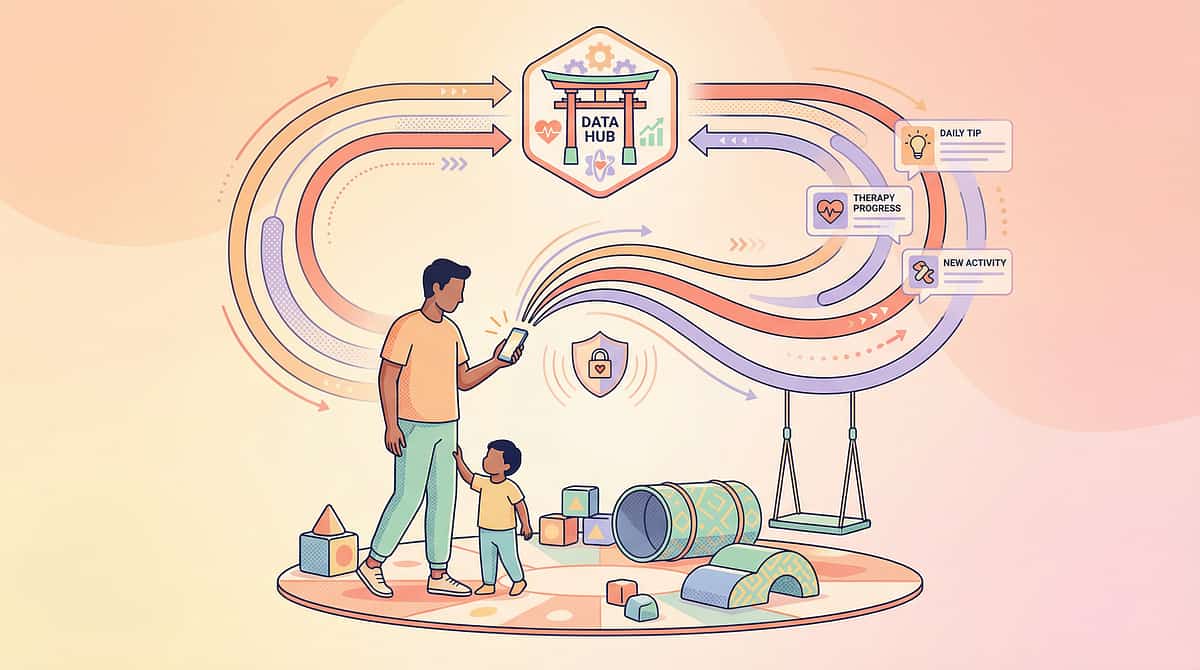
The Intervention: Mother used the DIY kit — bottle caps as counters, chalk on floor as number line, egg carton as ten frame. Following GPT-OS® EverydayTherapyProgramme™ via phone app.
After: 10 weeks. Rahul passed his class 2 mathematics assessment. His mother called the Pinnacle helpline to report: "He told his teacher 'I know how to make ten different ways.'"
Note: Illustrative case composites. Individual outcomes vary by profile, consistency, and underlying factors.
ACT V · Card 32
You Are Not Doing This Alone — Join the Community
📱 Math Concepts Parent Group (WhatsApp)
H-740 specific parent group — parents executing this exact technique, sharing data, troubleshooting together, celebrating milestones. Join the H-740 WhatsApp Parent Group →
💬 Academic Readiness Forum
Online community for all H-domain techniques — literacy, math, writing, reading readiness families. Join at pinnacleblooms.org/community →
🏠 Local Parent Meetups
Pinnacle centers across 70+ locations organize monthly parent workshops for academic readiness techniques. Free for enrolled families, open to community. Find Your Nearest Center →
🤝 Peer Mentoring Program
Connect with a parent who has already completed H-740 and is 3–4 months ahead of your journey. Mentors are trained by Pinnacle staff. Request a Peer Mentor: 9100 181 181 →
"Over 1,000 individuals from 111 countries contributed to the WHO Nurturing Care Framework. Community engagement is not supplementary — it is therapeutic infrastructure." — WHO NCF Community Engagement Principles
Your Experience Helps Others: Consider documenting your H-740 journey and sharing with the Pinnacle community. Your one-sentence description of your child's "four crackers moment" might be the story that keeps another parent going in their week 2.

ACT V · Card 33
Home + Clinic = Maximum Impact
🎓 Primary: Special Educator
School-based or clinic-based SpEd assessment of number sense components, formal dyscalculia screening if indicated, curriculum-aligned math intervention planning.
🖐️ Supporting: Occupational Therapist
Fine motor evaluation for counting manipulation, sensory profile assessment for material customization, visual-perceptual skills for ten frame and dot card work.
🗣️ Supporting: Speech-Language Pathologist
Mathematical vocabulary assessment, word problem comprehension, language of quantity (more, fewer, equal), narrative math discourse.
📞Teleconsultation Available: Remote families can access all three disciplines via GPT-OS® video platform. First 15-minute H-740 review call is FREE via Pinnacle helpline. 9100 181 181 | FREE | 24×7 | 16+ languages
Insurance / Funding Information
- DPIIT-recognized startup: eligible for government scheme support
- RCI-registered therapists: insurance reimbursement applicable in select plans
WHO NCF Progress Report (2023): 48% increase in countries adopting ECD policies. Primary health care as key platform for reaching all families.

ACT V · Card 37
Consistency Across Every Caregiver Multiplies Impact
If one parent runs the technique but grandparents think it's "just playing" — the generalization breaks. Share this page.
📱 Share via WhatsApp
Pre-filled message: "This is the math technique our child is working on — H-740 from Pinnacle. Read this page to understand how to help: techniques.pinnacleblooms.org/academic-readiness/math-concepts-H-740"
📧 Share via Email
Subject: "H-740 — How to Help [child's name] with Math" | Include the page link for full protocol details
🔗 Copy Link
techniques.pinnacleblooms.org/academic-readiness/math-concepts-H-740 | Share directly with teachers, grandparents, co-parents
📥 Family Guide PDF
Simplified one-page summary for grandparents, teachers, and co-parents who won't read 40 cards
"Explain to Grandparents" Version: "Your grandchild is learning what numbers actually mean — not just how to count, but what 'five' looks like, feels like, and means. These colored bears and grids are not toys — they're therapy materials. The most important thing: after counting, always ask 'how many?' and wait for her to answer with the total."
Teacher/School Communication Template
"Dear [Teacher], Our child is currently working on the H-740 Math Concepts programme at home with Pinnacle Blooms Network guidance. This programme focuses on building number sense through concrete manipulatives (counting bears, ten frames, number lines). At school, opportunities to count real objects, use manipulatives rather than just worksheets, and practice 'give me X' tasks would reinforce home therapy. I'm happy to share the full programme details. — [Parent name]"
WHO CCD Package: Multi-caregiver training is critical for intervention generalization and maintenance. PMC9978394

ACT VI: THE CLOSE & LOOP
Every Question a Parent Has Asked About H-740 — Answered
Q: How long before I see results?
Tolerance and engagement changes typically appear in weeks 1–2. Cardinality consolidation typically appears in weeks 3–5. Consistent daily practice (15 min/day) produces visible results for most children within 6–8 weeks. Children with dyscalculia risk profiles may require 12+ weeks of intensive intervention.
Q: How is this different from what they do at school?
School math typically begins with symbolic and representational (pencil and paper) approaches. H-740 is entirely Concrete — physical manipulation before any symbolic work. Most school environments don't have time for the depth of concrete experience required to build genuine number sense. H-740 fills this gap.
Q: My child can already count to 100 — do they still need this?
Very likely yes, if cardinality is not solid. Counting to 100 (rote sequence) is a memory task. Cardinality is a conceptual task. The definitive test: if your child cannot reliably produce a specific number of objects on request, number sense work is still needed regardless of how high they can count.
Q: Can I do multiple materials in one session?
Yes — but introduce one material at a time over the first 2 weeks. By week 3, a session can cycle through 2–3 materials (10 minutes total). See the rotation schedule in the Setup card.
Q: My child has dyscalculia — will this still help?
Concrete manipulative instruction is the gold-standard first intervention for dyscalculia. The difference is intensity and duration — a child with dyscalculia may need 12–18 months of consistent concrete instruction rather than 8 weeks. H-740 is appropriate as a starting framework, but professional assessment is essential.
Q: My child got it right once — does that mean they've learned it?
One correct trial is an emergence, not mastery. The rule of thumb: 4 of 5 correct responses for 3 consecutive sessions. One trial is the beginning of the learning curve.
Q: What if I don't have 15 minutes every day?
5 minutes daily beats 30 minutes twice a week. Even a single counting interaction at dinner counts. Mathematical exposure is cumulative — what matters is total number of concrete quantity experiences, not session duration.
Q: Where can I get more help?
FREE National Autism Helpline: 9100 181 181 | 24×7 | 16+ languages | pinnacleblooms.org
Preview of 9 materials that help with math concepts Therapy Material
Below is a visual preview of 9 materials that help with math concepts therapy material. The pages shown help educators, therapists, and caregivers understand the structure and content of the resource before use. Materials should be used under appropriate professional guidance.


Link copied!
"From fear to mastery. One technique at a time."
— The Pinnacle Blooms Consortium
← H-739: Literacy Foundations
↑ Back to Top
H-741: Reading Readiness →
This content is educational and informational. It does not replace individualized assessment and intervention from qualified special educators, educational psychologists, or developmental specialists. Math learning difficulties may be part of broader learning, cognitive, or developmental profiles requiring comprehensive evaluation. Dyscalculia and specific learning disabilities require formal assessment. Consult your child's educational and clinical team for personalized guidance. Individual results may vary. Statistics represent aggregate outcomes across the Pinnacle Blooms Network®.
Pinnacle Blooms Network® | Multi-Disciplinary Pediatric Therapy Consortium CRO · Pediatric OT · Pediatric SLP · ABA/BCBA · Special Education · NeuroDev Pediatrics · Pediatricians
CIN U74999TG2016PTC113063 | DPIIT DIPP8651 (Govt. of India) | MSME Udyog Aadhaar: TS20F0009606 | GSTIN 36AAGCB9722P1Z2 |
© 2025–2026 Pinnacle Blooms Network®, a unit of Bharath Healthcare Laboratories Pvt. Ltd. All rights reserved. GPT-OS®, AbilityScore®, TherapeuticAI®, FusionModule™, EverydayTherapyProgramme™ are registered marks of Bharath Healthcare Laboratories Pvt. Ltd.
📞 FREE National Autism Helpline: 9100 181 181 | 16+ languages | 24×7 🌐pinnacleblooms.org | care@pinnacleblooms.org📍 70+ centers across India | Empowering families in 70+ countries
techniques.pinnacleblooms.org/academic-readiness/math-concepts-H-740