
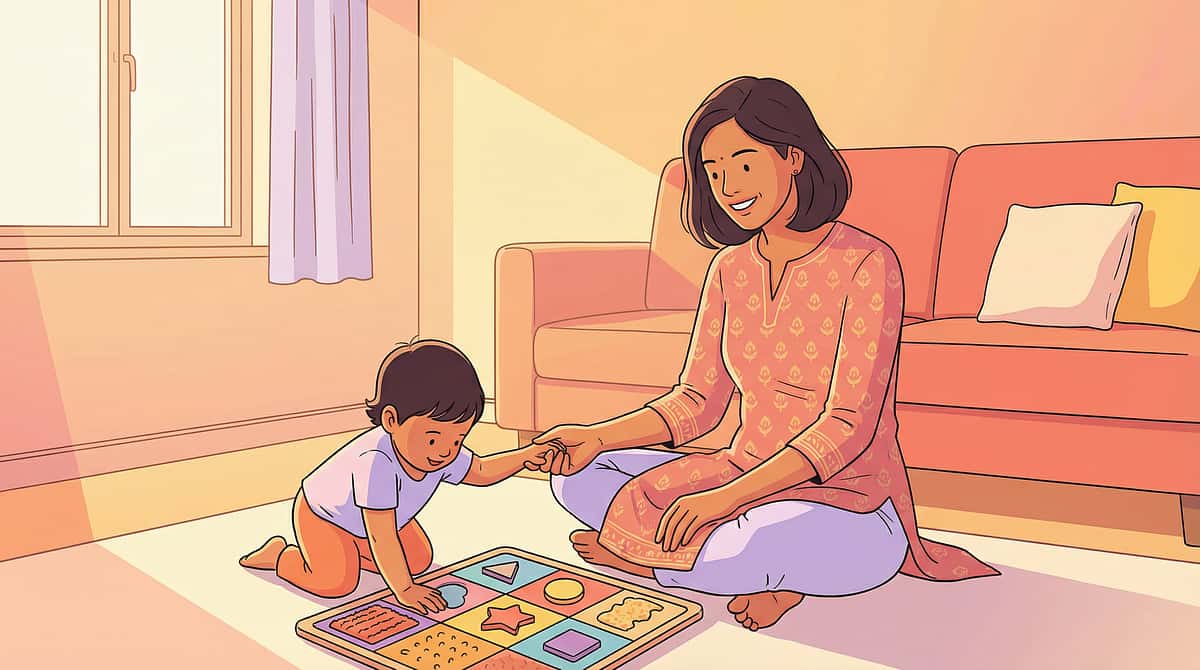
9 Materials That Help With Joint Attention
Building the Foundation of Shared Experience
You are not failing. Your child's brain coordinates attention between objects and people differently — and the pathways for shared looking can absolutely be built. This page exists to show you exactly how.

C-336 | Social Communication | Joint Attention
The Moment That Stayed With You All Day
"You spotted the most beautiful bird on the fence. You grabbed your little one's shoulder — 'Look! Look at that!' — and pointed with everything you had. They glanced at your finger. Then went back to their toy. The bird flew away. And that small, lonely moment stayed with you all day."
That moment — the longing for a shared glance, a shared delight — is the very heart of what joint attention is. It is one of the most universal, most quietly painful experiences for families navigating early autism. And it is also one of the most responsive to structured, loving, consistent practice.
This technique page — C-336 — gives you everything: the science, the materials, the exact steps, the troubleshooting, and the community. Built by the Pinnacle Blooms Consortium of OTs, SLPs, ABA/BCBAs, Special Educators, and NeuroDevelopmental Paediatricians.
🏛️ Consortium Validated
OT • SLP • ABA/BCBA • SpEd • NeuroDev
👶 Age Band
1–6 years | Domain: SOC-JA
📋 Episode
C-336 | Social Communication Foundations Series
WHO Nurturing Care Framework (2018): "Responsive caregiving — including shared attention and interaction — in the period from birth to age 3 is among the most critical investments a family can make."

80 Million Families Are Navigating This. Right Now.
Joint attention difficulties are not a rare edge case. They are among the most universal early markers in autism spectrum development — reported across every culture, every country, and every socioeconomic context studied.
1 in 36
ASD Diagnosis
Children diagnosed with ASD globally (CDC 2023)
80%
Show Differences
Of children with autism show joint attention differences as an early marker
21M+
Sessions Delivered
Therapy sessions by Pinnacle Network — joint attention is in the top 3 intervention targets
The PRISMA systematic review (2024, PMC11506176) covering 24 studies confirms: joint attention intervention delivers measurable, replicable outcomes. Per NIMHANS and RCI-affiliated research, India has an estimated 7–10 million children with autism, with joint attention delays appearing in more than 85% of referred cases. Pinnacle Network's 70+ centres serve families across 16 Indian states.
"You are among millions of families experiencing the exact same longing for that 'Look at that!' moment. And you are on the right page."
ACT I — Knowledge
What's Happening in Your Child's Brain
The Joint Attention Network
Joint attention requires three brain systems to work in concert:
- Superior Temporal Sulcus (STS) — processes biological motion and gaze direction
- Frontal-Parietal Attention Network — coordinates voluntary attention shifting
- Mirror Neuron System (MNS) — maps the other person's attention state onto the self
In autism, the integration between these systems develops on a different timeline. The child has not yet built the automatic bridge that says: "They are looking at something. I should look too. And then look back at them to share it."
What This Means for Your Child
Your child is not ignoring you. Their visual attention system works. Their interest in objects works. What is still developing is the triangle: the automatic, fluid coordination between themselves → you → the thing you're both seeing.
This is a wiring integration difference — not an attention deficit, not a behaviour problem, not a choice.
The good news: The frontal-parietal attention network retains significant neuroplasticity through early childhood. Structured, repeated, motivating practice — exactly what these 9 materials create — directly stimulates the synaptic connections that build joint attention.
Frontiers in Integrative Neuroscience (2020), DOI:10.3389/fnint.2020.556660 | Mundy P & Newell L (2007), Current Directions in Psychological Science, 16(5)

Your Child Is Here. Here Is Where We're Heading.
Joint attention develops along a predictable trajectory — and for children with autism, these same developmental steps occur on a wider, more variable timeline that responds dramatically to structured, targeted intervention.
Every week of structured joint attention practice in the 1–4 year window is investing directly in language, social learning, and relationship capacity. Joint attention difficulties commonly co-occur with language delay, social referencing challenges, gaze avoidance, pointing development delay, and emotion recognition difficulties. The window is open — let's use it.
Research: WHO Care for Child Development (CCD) Package 2023 | UNICEF MICS developmental monitoring indicators | PMC9978394
The Evidence Behind This Technique
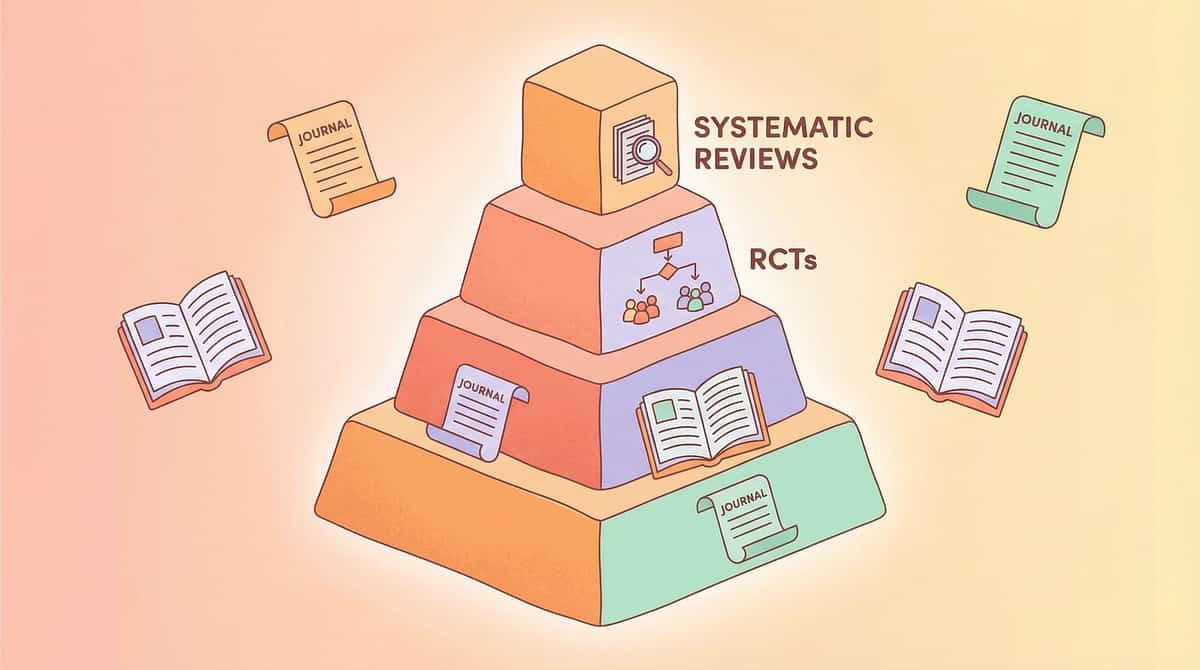
🛡️ LEVEL I — SYSTEMATIC REVIEW + RCT EVIDENCE
Key Finding: Structured joint attention intervention using motivating materials produces measurable improvement in both Responding to Joint Attention (RJA) and Initiating Joint Attention (IJA) in children ages 1–6 with autism — with effects appearing across home, clinic, and community settings.
Study | Design | Finding | |
Kasari et al. (2006), J Child Psychol Psychiatry 47(6) | RCT, 58 children | JASPER joint attention intervention significantly improved IJA and symbolic play | |
Charman T (2003), Phil Trans Royal Society B | Systematic Review | Joint attention is the pivotal skill in autism — most predictive of language and social outcomes | |
PMC11506176 (2024) | PRISMA Systematic Review, 16 studies | Structured intervention for joint attention meets evidence-based practice criteria | |
Padmanabha et al., Indian J Pediatr (2019) | Indian RCT, home-based | Home-administered structured play significantly improved joint attention in Indian children |
1
Evidence Strength
Level I systematic review and RCT support
2
Home Applicability
Validated for parent-led home delivery
3
Parent Execution
High feasibility for caregiver implementation
ACT II — Technique Overview
Joint Attention Building Through Motivating Materials
Parent-friendly alias: "Learning to Look Together"
Definition
Joint attention is the shared focus of two people on the same object or event — achieved through pointing, showing, gazing, and the crucial "check-back" (looking at the other person to confirm they are seeing the same thing). It is the foundation upon which language, social learning, imitation, and relationship all rest.
This technique uses nine categories of motivating materials to create repeated, natural, intrinsically rewarding opportunities for the joint attention triangle: Self → Object → Other Person.
Technique Badges
🟣 Social Communication | Joint Attention (SOC-JA)
🟠 Early Intervention | Foundational Skills
🔵 Language Precursors | Social Referencing
📦 Canon Materials: Cause-Effect Toys / Switch Toys | Problem-Solving Toys | Matching Games
👶Age: 1–6 years
⏱️Session: 10–20 min
📅Frequency: 2–3× daily (embedded in play)
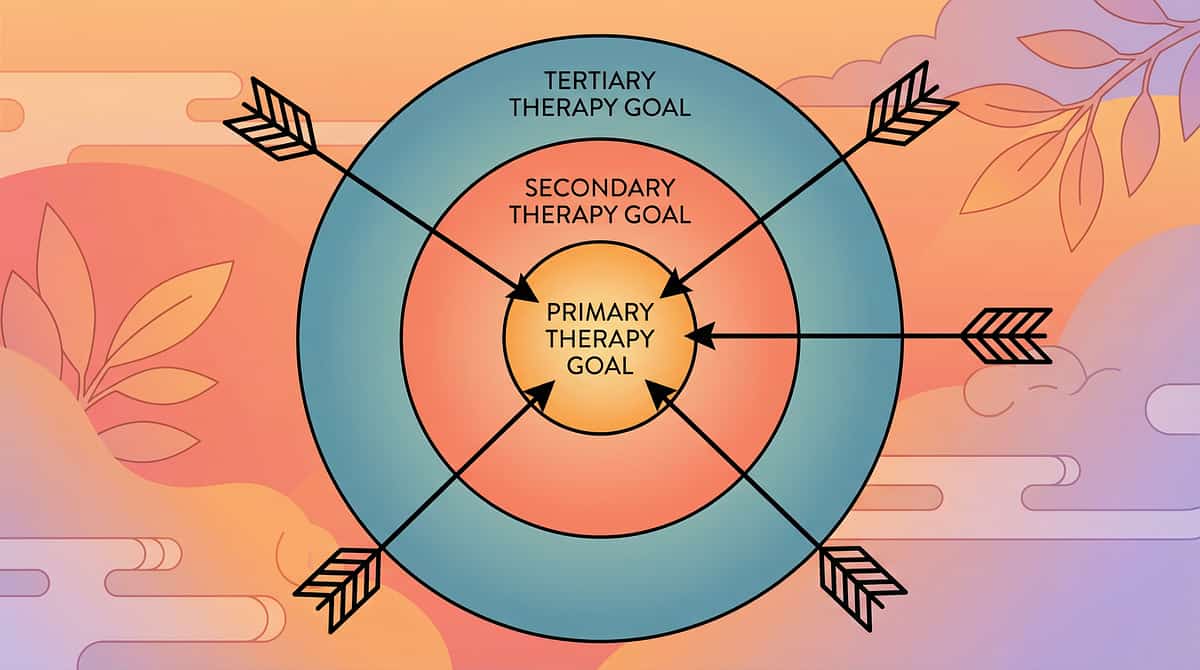
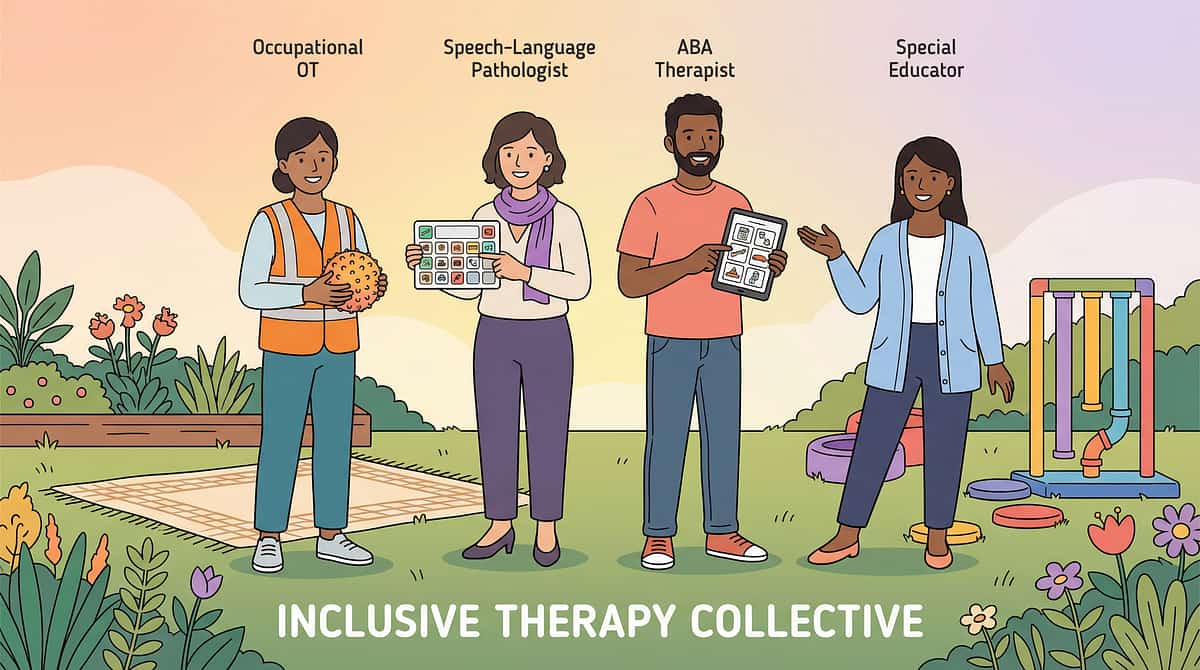
Five Disciplines. One Shared Goal: The Triangle of Shared Attention.
Speech-Language Pathologist (SLP) — Primary Lead
SLPs use joint attention materials as the gateway intervention before language targets. Joint attention is the prerequisite for intentional communication. SLPs structure the triangle (child → object → parent) to activate proto-communicative behaviours.
Occupational Therapist (OT)
OTs embed joint attention materials within sensory-motor play. Light-up toys, movement-based toys, and building sets serve dual roles: sensory regulation AND shared attention scaffolding. OTs ensure the sensory environment supports — not disrupts — joint attention.
ABA/BCBA Therapist
ABA therapists apply joint attention protocols using Natural Environment Training (NET). Materials are used within DTT and incidental teaching formats. Reinforcement schedules are precisely calibrated to reward each successful gaze-shift and check-back behaviour.
Special Educator (SpEd)
SpEds integrate joint attention materials into structured learning routines. Point-and-find books and interactive learning toys create academic bridging — joint attention practice embedded in pre-literacy and cognitive tasks.
NeuroDevelopmental Paediatrician
NeuroDev physicians use joint attention assessment as a core diagnostic indicator (M-CHAT-R/F, ADOS-2) and monitor joint attention progression as a primary readiness outcome for school and social inclusion.
"The brain doesn't organise by therapy type. Joint attention requires the whole consortium working as one."
This Is Not a Random Activity. This Is a Precision Tool.
🎯 Primary Target
Responding to Joint Attention (RJA): Child follows parent's point, gaze, or head turn to look at a shared object.
Initiating Joint Attention (IJA): Child points, shows, or uses gaze to bring parent's attention to something interesting.
Observable indicator: child makes gaze shift from object → parent face, or follows parent's extended finger to a distant object.
🟡 Secondary & 🟢 Tertiary Targets
- Social referencing and gaze shifting
- Proto-declarative pointing
- Language acquisition (most predictive precursor to first words)
- Theory of Mind foundations
- Social play progression
- School readiness and group learning
ACT III — The 9 Materials
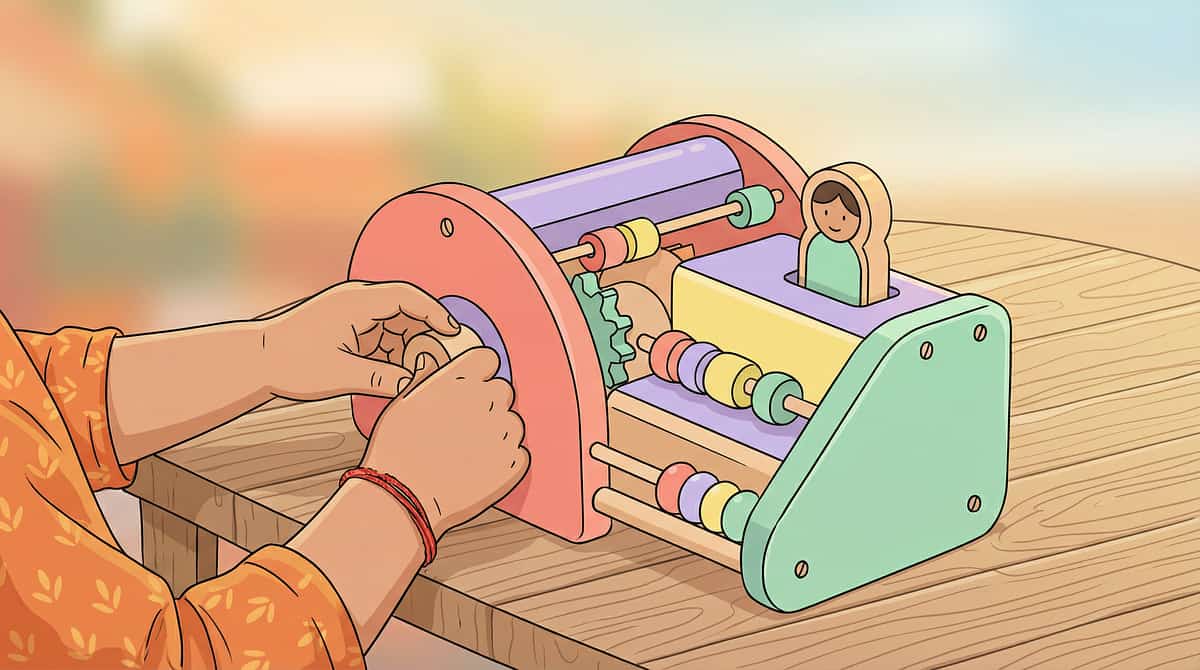
9 Materials. Every One Available Today.
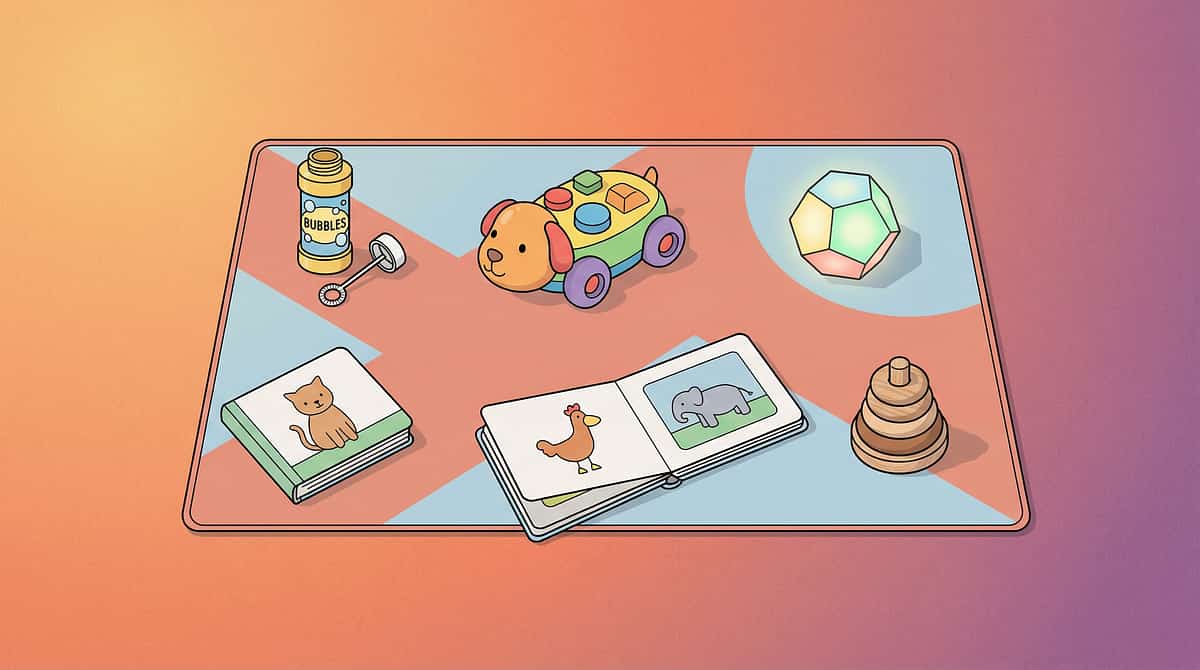
Each of the nine material categories below has been clinically validated through the Pinnacle 128 Canon Materials taxonomy. Every item is available in India, with affordable DIY alternatives for every family.
1
1. Cause-and-Effect Surprise Toys
Surprise naturally triggers social referencing — the instinct to look at another person and share the reaction.
2
2. Bubbles & Bubble Machines
Slow-moving, visually compelling shared targets. Both child and parent track the same floating wonder.
3
3. Point-and-Find Interactive Books
Structured joint attention practice embedded in shared reading. Point → follow → find → celebrate.
4
4. Light-Up & Glow Toys
Light draws both eyes naturally. In a dimmed room, shared gaze becomes effortless.
5
5. Wind-Up & Moving Toys
Anticipation while winding → shared tracking during movement → shared moment when it stops.
6
6. Musical & Sound-Making Toys
Joint attention through the auditory pathway. Both orient to the same sound source together.
7
7. Peek-a-Boo & Hiding Games
Hiding creates anticipation. Revealing creates the peak moment — naturally oriented toward your face.
8
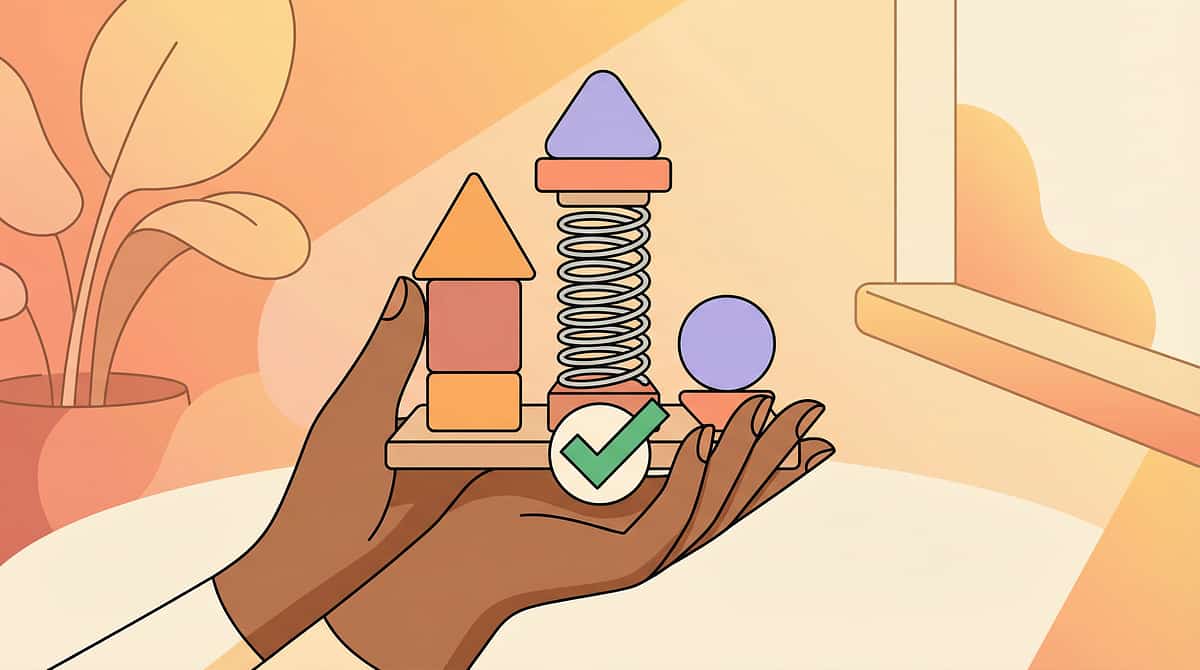
8. Shared Construction & Building Sets
Joint action requiring shared focus. Building together demands looking at the same thing together.
9
9. Interactive Electronic Learning Toys
Technology as bridge — shared device, shared reactions, social moments around tech.
💰Complete Kit Price Range: ₹2,750–8,100 for all 9 material categories | Starter kit (Materials 1, 2, 7): ₹300–1,200
Material 1: Cause-and-Effect Surprise Toys
Canon Category: Cause-Effect Toys / Switch Toys
Surprise toys are among the most powerful joint attention elicitors available. The moment a jack-in-the-box pops, a ball shoots from a launcher, or a lid flips open — the child's instinct is not just to look at the object. It is to look at you. That instinctive turn to share the surprise is the joint attention moment in its purest form.
The surprise mechanism reliably triggers social referencing — the neurological impulse to check another person's face when something unexpected happens. Use this to your advantage: build the anticipation slowly ("Ready? Ready? Watch..."), pause, then let the surprise happen — and catch their eyes as they turn to you.
✅ DIY Alternative
Hide a small toy under a cloth. Say "Ready?" and reveal with delight. The same surprise mechanism triggers social referencing regardless of material cost.
DIY Cost: ₹0
Material 2: Bubbles & Bubble Machines
Canon Category: Sensory Play Materials
Bubbles are arguably the single most accessible and universally effective joint attention material. Their slow, drifting, unpredictable movement captures attention effortlessly — and because both child and parent track the same floating target through the same visual space, the shared gaze emerges almost without effort.
The key technique: blow a bubble, pause, then track it yourself with exaggerated delight while staying positioned so your face is visible when your child looks up. Comment as you go: "Look at that one — it's so big! Where is it going?" When the bubble pops, react expressively. That reaction is your face becoming the reward.
✅ DIY Alternative (₹0)
Mix dish soap + water + glycerin. Blow with a straw loop. Identical visual tracking stimulus — and the homemade version is often more flexible and refillable.
Ensure ventilation during bubble sessions. Rinse if bubble solution enters eyes. Some children dislike the texture on skin — observe carefully.

Material 3: Point-and-Find Interactive Books
Canon Category: Problem-Solving Toys / Cognitive Materials
Point-and-find books — I-Spy books, Where's Waldo, illustrated search books — create structured joint attention practice embedded in shared reading. The protocol is beautifully simple: point clearly to a zone of the page, look at your child to confirm they saw your point, wait for them to follow it, then celebrate the find together.
This material is particularly powerful for Responding to Joint Attention (RJA) development — the child learns that your extended finger is a directional signal worth following. The book provides a finite, manageable shared visual space that is less overwhelming than a whole room.
✅ DIY Alternative
Create a "finding page" with magazine cutouts on cardboard. The same pointing practice structure applies — and the homemade version may be more motivating because it uses your child's preferred images (trains, animals, food).
Material 4: Light-Up & Glow Toys
Canon Category: Sensory — Visual
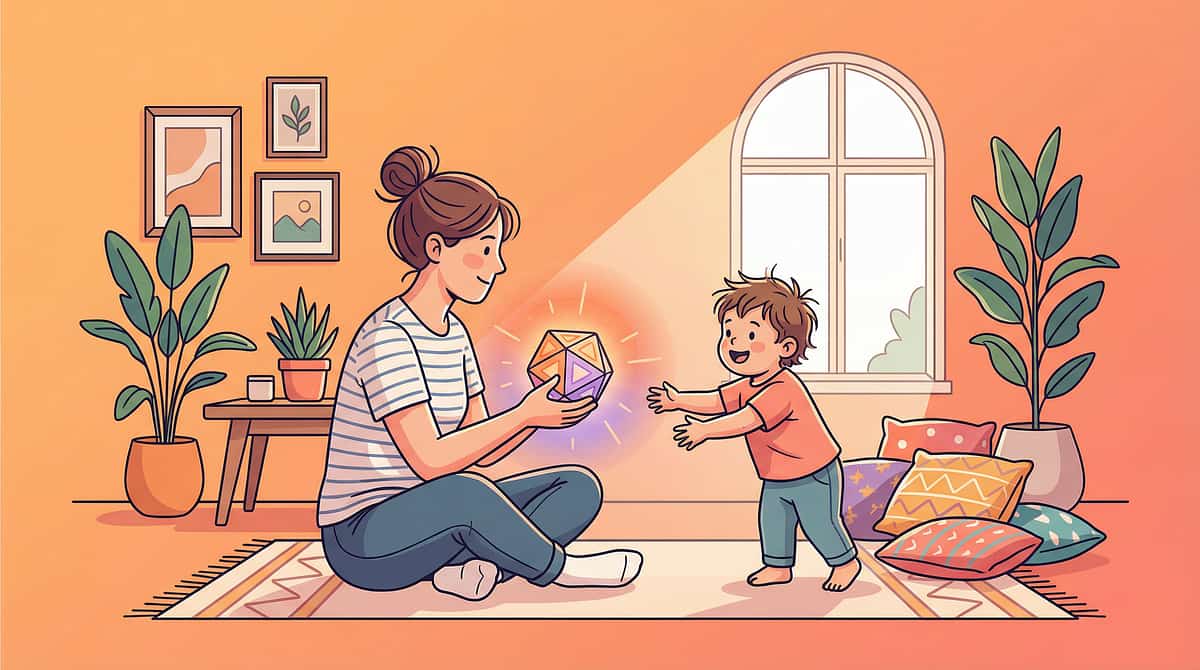
Light is one of the most powerful natural attention-draws available. In a slightly dimmed room, a fibre-optic wand, LED spinner, or glow ball commands both sets of eyes instantly — creating a naturally shared visual target without any demand or instruction.
The technique: dim the room slightly, introduce the light-up toy, and position yourself so that when your child tracks the light, your face is in their peripheral field. React to the light as if you are also discovering it: "Oh WOW, look at that glow! Look how it changes colour!" When your child's eyes drift to your face in the dim light — that is the joint attention moment. Celebrate it warmly.
✅ DIY Alternative
A torch or phone flashlight in a darkened bathroom. Parent controls the beam. Even more dramatic than a commercial light toy — and entirely free.
⚠️ No strobe effects or rapid flashing — seizure risk and sensory overwhelm. Use only steady or slowly changing light.
Material 5: Wind-Up & Moving Toys
Canon Category: Cause-Effect Toys
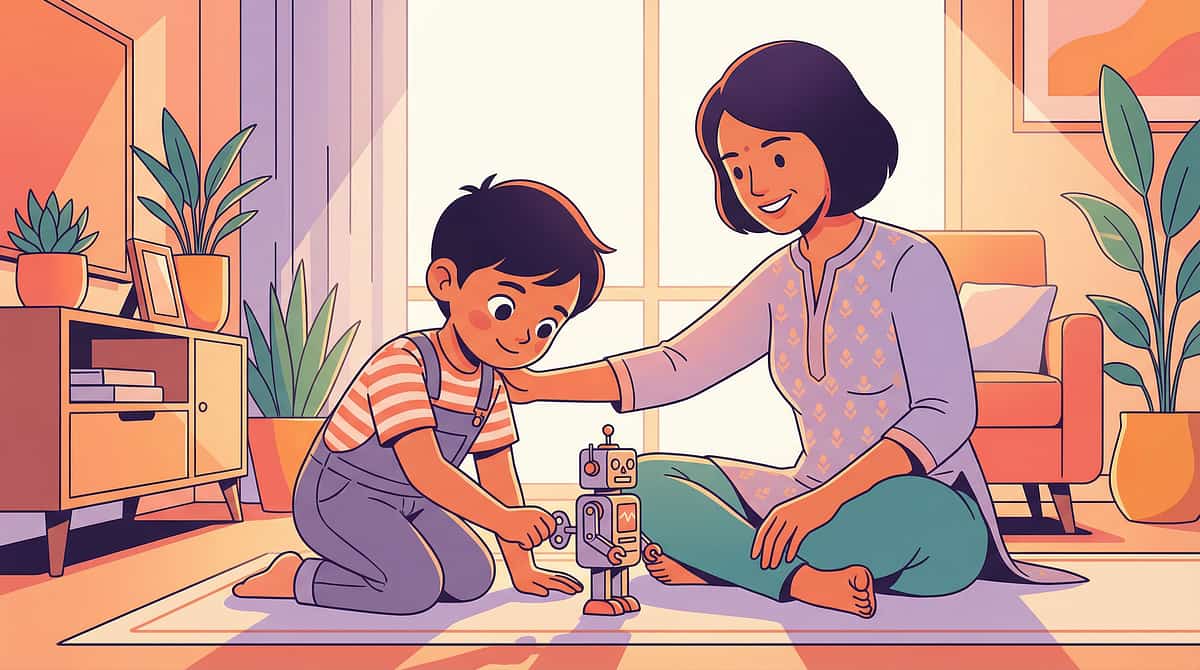
Wind-up toys create a uniquely powerful joint attention sequence through three phases: anticipation (winding creates suspense — look at your child during this phase), shared tracking (both follow the toy's movement together), and the natural pause when the toy winds down — a built-in moment of mutual regard as both of you wait to see if it will move again.
Build the anticipation deliberately: wind it slowly, narrate ("It's getting ready... almost... almost..."), and look at your child's face during the wind-up. The gaze-check during anticipation is an often-missed joint attention opportunity. The pause when the toy stops is gold: your expressions of surprise and delight draw the child's eyes naturally.
✅ DIY Alternative
Roll a ball slowly across the floor. Build the anticipation before releasing it. The same shared tracking structure applies — with natural pause points where you and your child check each other's reactions.
Material 6: Musical & Sound-Making Toys
Canon Category: Sensory — Auditory
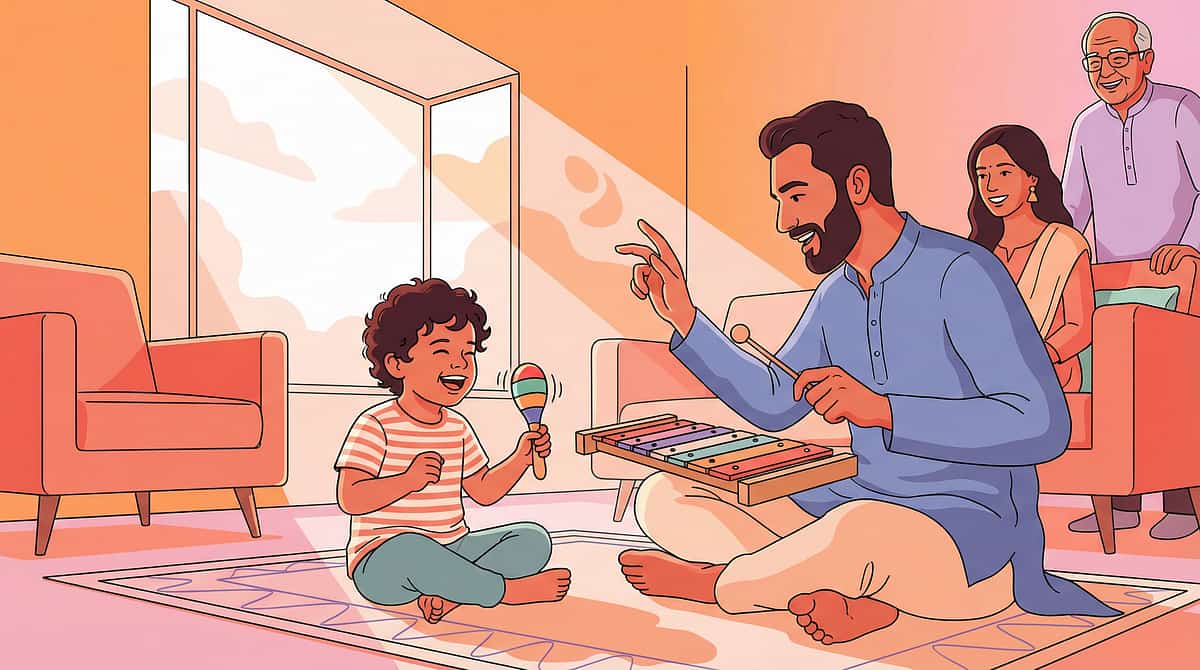
Musical and sound-making toys open the auditory pathway to joint attention. When a xylophone note rings out, a shaker rattles, or a drum is struck, both parent and child orient automatically toward the same sound source. This shared auditory orientation is joint attention through a different sensory channel — and for children with strong auditory processing, it may emerge more readily than visual joint attention.
Technique: produce the sound, pause, react to it expressively ("Oh! That was loud! Did you hear that?"), and catch your child's gaze as they orient toward you. Take turns — child produces sound, parent reacts; parent produces sound, child reacts. This reciprocity is the auditory version of the joint attention triangle.
✅ DIY Alternative (₹0)
Two spoons + pot = drums. Shaker = rice in a sealed bottle. Auditory joint attention works identically with homemade instruments — the togetherness of the sound experience is what matters.
Material 7: Peek-a-Boo & Hiding Game Materials
Canon Category: Transition Objects / Comfort Items (related)
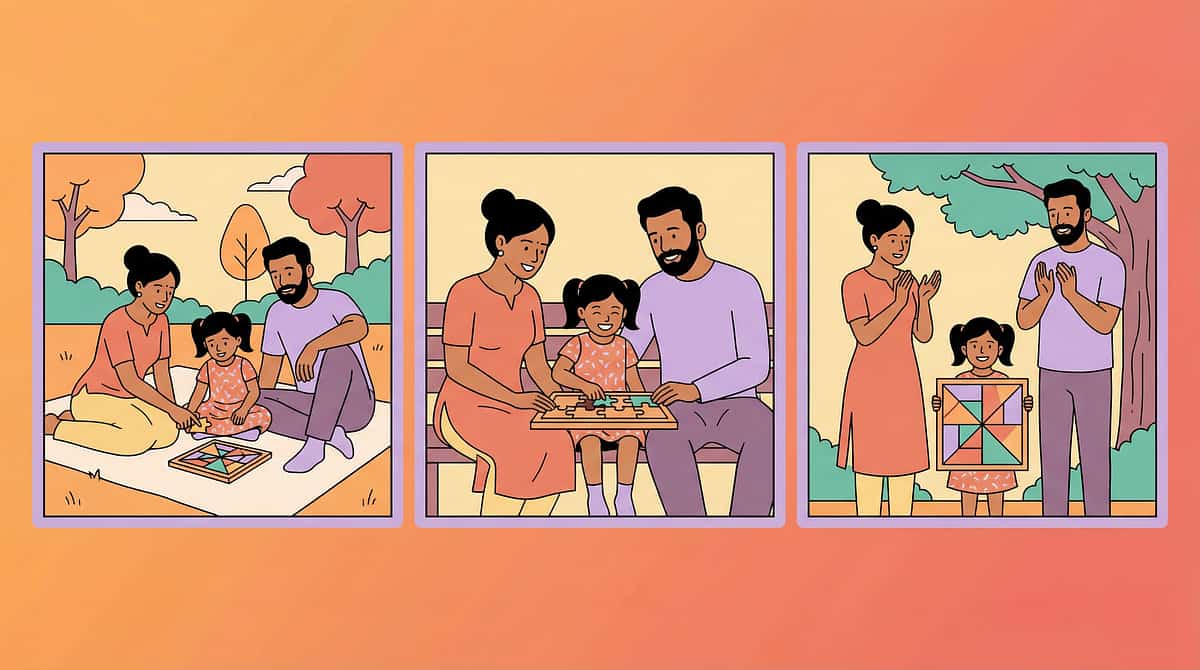
Peek-a-boo is one of humanity's oldest joint attention games — and it remains clinically powerful precisely because it was designed, by generations of caregivers, to create exactly the sequence we are targeting. Hiding creates anticipation and suspense. Revealing creates the peak moment of shared delight. And that peak moment — the "BOO!" — is naturally oriented toward your face.
The technique: hide your face or the toy, build the suspense verbally ("Where did it go? Is it here? Or... HERE?"), then reveal with maximum expressiveness. The child's instinct at the reveal is to look at your face. That fraction-of-a-second gaze-check is the joint attention moment — meet it with joy.
✅ DIY Alternative (₹0)
Any dupatta, kitchen towel, or bedsheet. The hide-and-reveal mechanism is what matters, not the fabric. This is among the highest DIY-viability materials in the entire kit.

Material 8: Shared Construction & Building Sets
Canon Category: Problem-Solving Toys / Sorting Activities
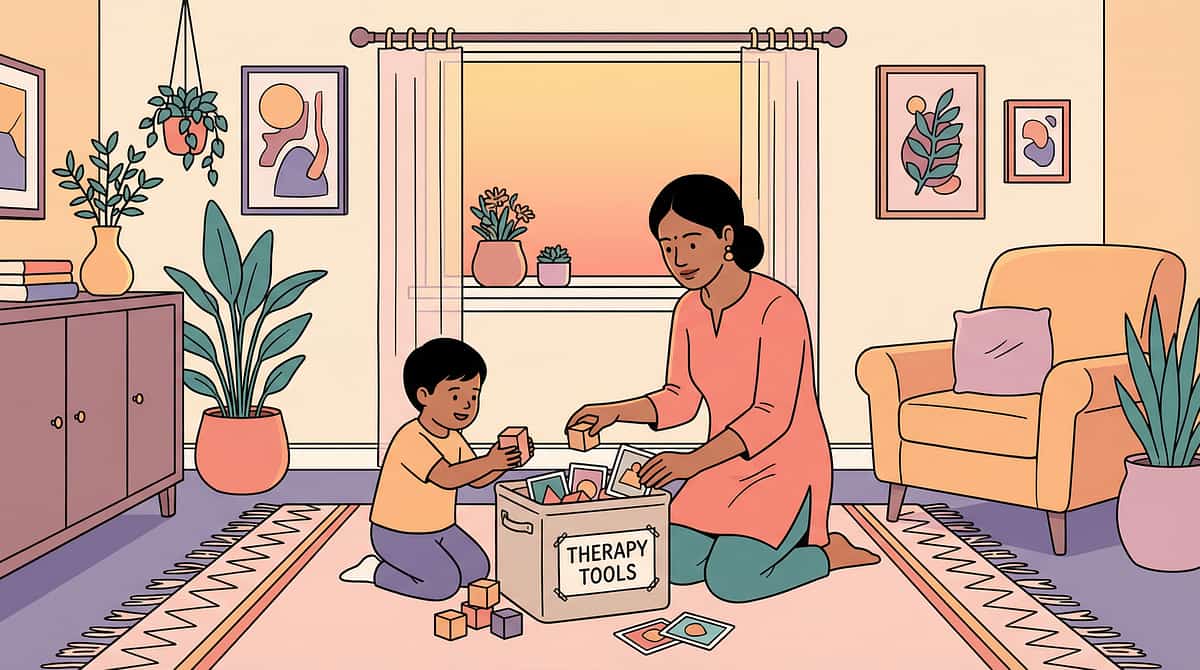
Building sets introduce a critical element that simpler materials do not: joint action. When two people build something together, they cannot avoid sharing attention — each piece requires looking at the same structure, the same space, the same problem. "Where does this go?" requires both people to look at the same spot simultaneously. That is joint attention as a functional, embedded, intrinsically motivated activity.
Technique: place the building material between you, work on a structure together, and narrate shared attention moments ("I'm going to put this one here — can you see? Your turn!"). The natural problem-solving rhythm of construction creates repeated, low-pressure joint attention opportunities throughout the session.
✅ DIY Alternative
Stacking kitchen containers, toilet roll towers, or nested bowls. Shared focus on joint construction — the material is entirely irrelevant. The togetherness of building is the intervention.
Material 9: Interactive Electronic Learning Toys
Canon Category: Problem-Solving Toys / Cognitive & Learning
Technology, used correctly, becomes a joint attention bridge rather than a solitary distraction. The critical distinction is togetherness: when parent and child interact with the same electronic device as a shared object — both looking at it, both reacting to it, both commenting on it — the device functions as a joint attention target just as effectively as a bubble or a surprise toy.
Technique: sit beside your child (not behind), control the interaction as a turn-taking exercise, react expressively to what appears on-screen, and narrate: "Oh look — there's the elephant! Can you see it? Show me!" The device is the object. Your relationship is the therapy.
🛒 Pinnacle Recommends
Price Range: ₹1,000–3,000
✅ DIY Alternative
Any family smartphone with a child-appropriate app — used together. The togetherness principle applies to any screen used as a shared object. The device does not need to be specialised.
Equity Principle
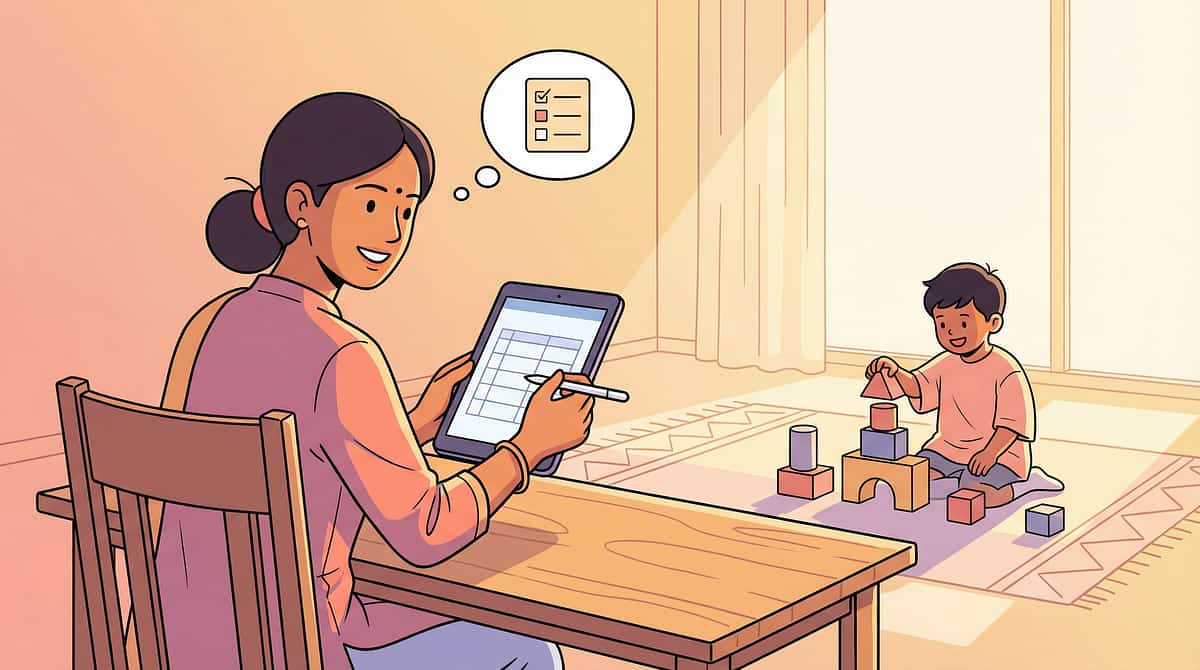
Every Family Can Start Today. Zero Rupees Required.
The WHO Nurturing Care Framework is explicit: every family, regardless of geography or income, deserves access to effective early childhood intervention. Below is a complete DIY substitute for every material in the C-336 kit.
Material | Buy This | Make This (₹0) | Why the Substitute Works | |
Cause-Effect Toy | Pop-up toy, ₹300+ | Hide a small toy under a cloth; reveal with delight | Same surprise mechanism triggers social referencing regardless of cost | |
Bubbles | Bubble machine, ₹200+ | Dish soap + water + glycerin, blow with straw loop | Identical visual tracking stimulus | |
Point-and-Find Books | I-Spy book, ₹200+ | Magazine cutouts on cardboard | Same pointing practice structure; homemade may be more motivating | |
Light-Up Toys | LED wand, ₹300+ | Torch in a dark bathroom | Same attentional pull — even more dramatic | |
Wind-Up Toys | Wind-up car, ₹150+ | Roll a ball slowly across the floor | Shared tracking with natural pause points | |
Musical Toys | Xylophone, ₹200+ | Two spoons + pot; rice in a sealed bottle | Auditory joint attention works identically | |
Peek-a-Boo | Peek-a-boo scarf, ₹200+ | Any dupatta, kitchen towel, or bedsheet | The hide/reveal mechanism is what matters, not the fabric | |
Building Sets | Commercial blocks, ₹400+ | Stacking kitchen containers, toilet roll towers | Shared focus on joint construction — material is irrelevant | |
Electronic Toy | Learning tablet, ₹1,000+ | Family smartphone with child-appropriate app used together | The togetherness principle applies to any shared screen |
⚠️ When clinical-grade material IS non-negotiable: Children with severe sensory processing differences may require specific material textures, weights, or sensory profiles. Consult your OT or SLP.

⚠️ Safety First
Read Before Every Session. No Exceptions.
🟢 Green — Proceed When:
- Child has eaten within the last 2 hours
- Child is in a calm-alert state
- Environment is prepared (Card 12 setup complete)
- No recent illness, fever, or ear infection
- Parent is regulated and present
🟡 Amber — Modify When:
- Child seems tired → shorten to 5 minutes
- Child had a difficult morning → start with most preferred material
- Unfamiliar environment → use only familiar materials
- Mild sensory sensitisation → avoid light-up or musical toys; use bubbles or building sets
🔴 Red — Stop Immediately: Active meltdown or distress | Signs of illness | Seizure in the previous 24 hours (avoid flashing/strobing light toys) | Fear or panic response to any material → remove and do not force.
⚠️ CONTRAINDICATIONS: Never attempt to force eye contact. Ensure vision and hearing have been assessed before beginning — joint attention difficulties may have a sensory basis.
⚠️ CONTRAINDICATIONS: Never attempt to force eye contact. Ensure vision and hearing have been assessed before beginning — joint attention difficulties may have a sensory basis.
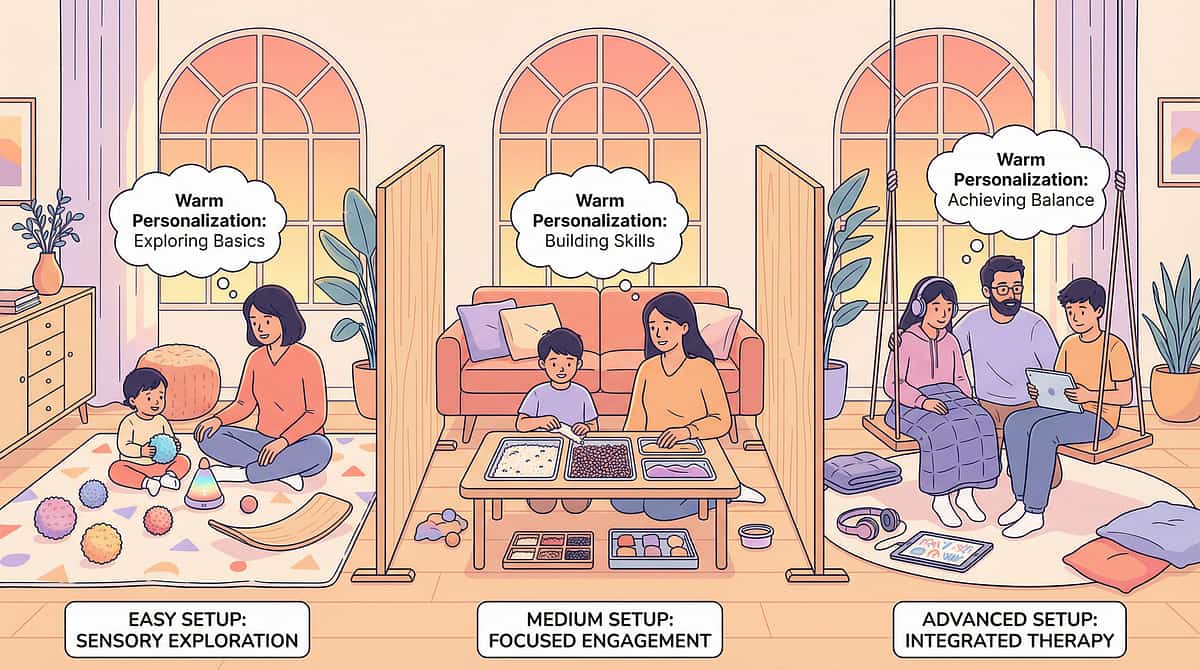
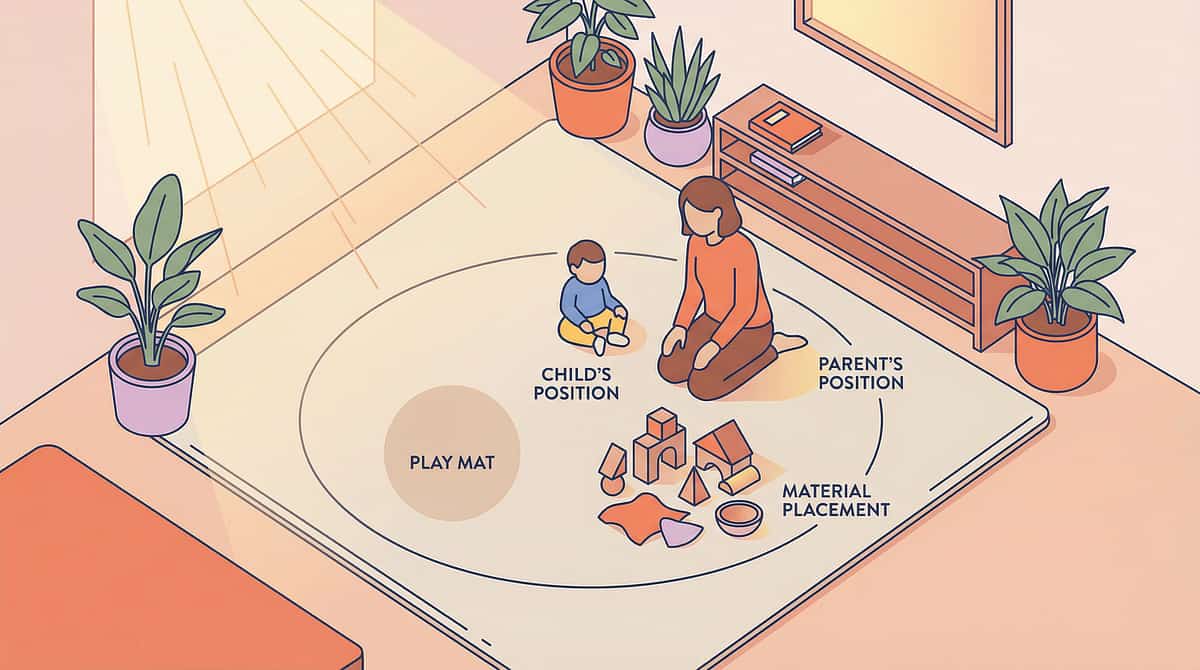
The Right Environment Makes Joint Attention 3× More Likely to Emerge.
Spatial and environmental precision is not optional — it is a clinical variable. Studies show that a carefully prepared space directly increases the frequency of joint attention bids and reduces session failures. Set up before your child enters the room.
1
Turn Off the TV, Silence Devices
Auditory competition kills joint attention emergence. Create an acoustic clean room for the session.
2
Position Yourself at Child's Eye Level
Sit on the floor, not above. Joint attention requires accessible, readable faces.
3
Face-to-Face or 45° Angle
Position yourself so your face is always in the child's peripheral field when they look at the material.
4
Place Material Between You
Not in front of child with you behind. The triangle (child-material-parent) must be geometrically possible.
5
Remove Competing Toys
Only the session material should be visible. Cluttered space = divided attention. Pre-select 3–5 materials before the session begins.
6
Lighting: Soft and Even
For light-up toys, dim the room slightly. For other materials, natural daylight or warm white. Temperature should be comfortable — sensory discomfort competes with attention.
"Spatial precision prevents 80% of session failures. The space is set. Now check the child."

60 Seconds. Right Now. Before You Begin.
Before every session, run through this readiness check. It takes under one minute and dramatically improves session outcomes by ensuring you begin only when conditions are optimal.
Readiness Indicator | Check | |
Child is calm (not post-meltdown, not crying) | Yes / No | |
Child is alert (not drowsy, not over-excited) | Yes / No | |
Child has been fed in the last 2 hours | Yes / No | |
No illness signs in the last 24 hours | Yes / No | |
You (parent) are calm and present | Yes / No | |
Materials are pre-selected and within reach | Yes / No | |
Space is set up | Yes / No |
🟢 5–7 YES → GO
Begin the session as planned. Optimal conditions are met.
🟡 3–4 YES → MODIFY
Shorten to 5–10 minutes. Use only the highest-motivation material. Reduce demands.
🔴 0–2 YES → POSTPONE
Skip today. Offer a calming activity instead. Session abandonment is excellent clinical judgement.
"On postpone days, still make it a connection day. Sit near your child during their preferred activity. Be present without demands. Joint attention seeds can be planted even in unstructured moments."

Step 1 of 6
The Invitation
"Hey, come see what I found!" OR: "[Child's name], look what I have..." OR: Simply hold up the material at eye level between you and wait. Say nothing. Let curiosity work.
Body Language Guidance
- Get to child's level — sit on the floor, not standing over them
- Hold material in the space between you — not in front of them, not in your lap
- Use a warm, slightly surprised tone — as if YOU are also discovering the object for the first time
- Keep your face animated and readable — slightly exaggerated expression helps
- Do NOT demand eye contact: "Look at me" is counterproductive
Reading the Response
✅ Acceptance: Child orients toward the material, moves closer, reaches toward it, or pauses their current activity.
⚠️ Resistance: Child moves away → follow gently; try a different material. Child ignores → animate the material more, wait 30 seconds. Child protests → reduce demand immediately; return to preferred activity for 2 minutes, then re-offer.
Timing: 30–60 seconds

Step 2 of 6
The Engagement
Once the child has accepted the invitation, introduce the material with slow, deliberate, warm presentation. Rushed presentation misses the joint attention window. Your goal in this step is to create shared interest — not to demand a response.
1
🎁 For Surprise Toys
"Ooooh, what's going to happen? Watch... watch... [pause] BOO!" → Immediately look at child's face with delight. This is the joint attention moment.
2
🫧 For Bubbles
"Ready? Look at the bubbles... [blow slowly] ...there they go! Look! Look at that one!" → Point to each bubble. Track with your eyes. Then check child's face.
3
📖 For Point-and-Find Books
"Can you find the dog? [point clearly to a zone of the page] Is it here? Or... here?" → Wait for child to look at your point, not just the page.
🟢 Engagement
Reaches, vocalises, tracks material, gaze shifts to parent face
🟡 Tolerance
Watches but does not react. Continue gently — this is still learning.
🔴 Avoidance
Pushes material away, turns body. Reduce demand immediately.
The moment child looks at YOUR FACE after looking at the material — even for 0.5 seconds — that is the joint attention moment. Respond immediately with warm verbal praise and a smile. Timing is everything.

Step 3 of 6
The Therapeutic Action: The Joint Attention Triangle
This is the active ingredient. The core therapeutic sequence, repeated and varied throughout the session:
1
❌ Common Error 1
Parent looks ONLY at the material, not at the child → Fix: Parent must be an attention-splitting presence — material AND child simultaneously
2
❌ Common Error 2
Parent does not react expressively → Fix: Exaggerate your reaction; your face IS the reward
3
❌ Common Error 3
Demanding "look at me" verbally → Fix: Never verbalise the demand; let the triangle emerge naturally
Duration: 40–60% of total session time
Step 4 of 6
Repeat & Vary
Dosage Principle: 3 high-quality joint attention triangles > 10 distracted trials. Quality of engagement matters infinitely more than quantity of attempts.
Week | Target Triangles Per Session | Session Length | |
Week 1–2 | 3–5 clear triangles (any material) | 5–10 min | |
Week 3–4 | 5–8 triangles across 2 materials | 10–15 min | |
Week 5–8 | 8–12 triangles, child initiating some | 15–20 min |
Keep the material, vary the action
Same surprise toy, but parent now looks away before the reveal — does child tap parent to draw attention?
Keep the action, vary the material
Same "build anticipation → release → celebrate" structure with different material each time.
Add social complexity
Introduce a doll or soft toy as a "third party" — can child include the toy in the joint attention triangle?
Environmental variation
Move from floor to table to outdoor garden — same technique, new context for generalisation.
"3 good reps done with love will always outperform 10 forced reps done under pressure."

Step 5 of 6
Reinforce & Celebrate
Timing matters infinitely more than magnitude. The joint attention moment lasts 0.5–2 seconds. Your reinforcement must land within 3 seconds.
When child looks at your face (joint attention moment):
"YES! You saw it! We SAW it together!" | "You looked at me! I love that!" | "We're looking together — did you see that?!"
When child follows your point (RJA):
"You found it! You looked where I pointed!"
When child points to show you something (IJA):
"Oh WOW — you're showing me! Thank you for showing me!" (Even if you don't know what they're pointing at — celebrate the act of sharing.)
Reinforcer Type | Example | When to Use | |
Social reinforcement | Animated praise + big smile | Every trial, immediately | |
Physical affirmation | High-five, gentle touch, fist bump | Child-specific tolerance | |
Token system | Star sticker on a chart | For children with developed token understanding | |
Preferred item access | Brief access to preferred toy | For lower-response children needing stronger motivation | |
Natural consequence | Continue playing with the material | Embedded natural reinforcement |
"Celebrate the attempt. Not just the perfect triangle. Every approximation of joint attention is a synapse strengthening."
Step 6 of 6
The Cool-Down
No session ends abruptly. The cool-down is the 2-minute bridge that prevents post-session dysregulation and makes the child want to come back tomorrow.
1
Warning Signal
Visual timer if available, verbal countdown if not. "Two more bubbles, then all done." "One more block, then we put them away together."
2
Final 1–2 Repetitions
Child-led, low demand. Let the child feel in control of the ending.
3
Material Put-Away Ritual
Child places material in bin/box if able — this is a transition anchor that builds predictability.
4
Calming Bridge Activity
2–3 minutes of preferred quiet play — books, simple sensory play, or outdoor movement.
5
Closing Ritual
Consistent closing phrase: "Good work together today." Ritual and predictability build safety.
If child resists ending: extend by exactly one repetition — no more. Never abruptly remove the material — this causes transition distress that carries into the next session. Use the material as a transitional object: "You can hold the bubble wand while we go wash hands."
🛒Hourglass Visual Timer — Amazon.in search | ₹150–400
ACT IV — Progress Tracking
60 Seconds of Data Now = Months of Clarity Later.
Consistent data collection — even a simple pencil mark — is what transforms your sessions from daily activity into a developmental trajectory. Three data points is all you need.
1
Joint Attention Triangles Today
How many times did child look from object → to your face? Circle: 0 | 1–2 | 3–5 | 6–10 | 10+
2
Initiations Today
How many times did child point, show, or direct your attention unprompted? Circle: 0 | 1 | 2–3 | 4+
3
Child Engagement State
Overall session quality: Reluctant | Tolerating | Engaged | Enthusiastically Engaged
How This Feeds GPT-OS®
Your session data contributes to your child's Communication Readiness Index (Joint Attention sub-track), personalised technique sequencing recommendations, therapist session preparation when you visit a Pinnacle centre, and India-level joint attention outcome data that improves all families' care.
Parent Reminder
"You don't need a perfect data point — you need a consistent one. Even a pencil mark on the fridge counts. Patterns across 30 days will tell you more than any single session."
📞9100 181 181 | Free National Autism Helpline | 16+ languages | 24×7

The Session Is Data. Not a Report Card.
Every session that doesn't go as planned is telling you something clinically valuable about your child's sensory profile, motivation, readiness, or the technique calibration. Use these 7 common problems as diagnostic guides.
"My child showed zero interest in any material"
Why: Materials may not be sufficiently motivating for this child's sensory profile. Fix: Observe what captures your child's attention naturally — light? Sound? Movement? Surprise? Choose the material from the 9 categories that maps to their natural sensory attraction. Consult your OT or SLP for sensory profile-based material selection.
"My child looked at the material but never looked at me"
Why: Gaze shifting (object → person) is a learned behaviour — in early stages, children may fix on the object. Fix: Position yourself directly in the child's gaze path to the object. If they look at the toy, your face should be just above or beside it. Make your facial expression unmissable.
"My child looked at me immediately without looking at the material"
Why: This is actually advanced joint attention behaviour — social referencing of YOU. Fix: Accept this as progress. Gradually extend the object focus period before the check-back by making the material more animated before looking at the child.
"The session lasted 2 minutes and fell apart"
Why: Session was too long, demand too high, or readiness was amber not green. Fix: Celebrate the 2 minutes. One triangle counts. Try again at a different time of day — some children are more receptive post-nap or post-outdoor play.
"My child became frustrated with the point-and-find book"
Why: Cognitive complexity too high, or demand felt evaluative. Fix: Remove time pressure entirely. There is no right answer — exploring the page together IS the joint attention activity. Reduce pointing demands to simply commenting: "Oh look, a dog! I see you're looking at the cars."
"The bubble session became a meltdown when bubbles stopped"
Why: Abrupt ending of a highly preferred activity. Fix: Use the "all done" ritual from Step 6 before bubbles run out — not after. Transition while some bubbles remain. Let child hold the wand as the transition object.
"My partner says this isn't working and it's not real therapy"
Why: Understandable scepticism, especially when progress is invisible to untrained observers. Fix: Share Card 05 (evidence grade) with your partner. Take a short video of a successful triangle moment — seeing the gaze shift is often the moment scepticism converts to advocacy.
📞9100 181 181 — Call our helpline if you're stuck. Our therapists speak your language.
No Two Children Learn the Same Way. This Technique Bends to Your Child.
⬅️ Easier — Use on Challenging Days
- Use only bubbles or peek-a-boo (lowest material demand)
- Reduce triangle to 2 steps: object → your face
- Accept any eye-contact movement as joint attention — even a glance
- Side-by-side rather than face-to-face (less social pressure)
- Duration: 3–5 minutes maximum
- Use gentle physical prompt: tap object to draw gaze
➡️ Harder — Use When Mastery Is Emerging
- Introduce distractor toys — can child maintain joint attention?
- Increase distance: point to objects across the room
- Add communicative expectation: wait for vocalization + gaze shift
- New person: practice with another caregiver, then unfamiliar adult
- New setting: park, supermarket, family gathering
Sensory Profile Adaptations
Profile | Best Materials | Avoid | |
Sensory Seeker (high input) | Wind-up toys, musical instruments, building sets | Calm activities that don't meet sensory threshold | |
Sensory Avoider (low tolerance) | Bubbles, point-and-find books, peek-a-boo scarves | Loud musical toys, sudden surprise toys | |
Visual Dominant | Light-up toys, point-and-find books, bubbles | Auditory-primary materials | |
Auditory Responsive | Musical toys, cause-effect sound toys | Visual-only materials |
📞9100 181 181 for personalised adaptation guidance from a Pinnacle therapist.

ACT IV — Progress Arc
Weeks 1–2: You're Building the Foundation. Don't Expect the House Yet.
✅ What IS Progress at Weeks 1–2
- Child tolerates your proximity to the material
- Child does not immediately leave the space
- Occasional brief eye contact during material presentation
- Reduced startle or resistance when material is introduced
- Parent has established their session rhythm and feels more confident
The Micro-Win Marker
"If your child tolerates the material for 3 seconds longer than they did in Session 1 — that is measurable neurological progress. Write it down."
Weeks 1–2 can feel invisible. The changes happening in your child's brain during this phase are not visible to the naked eye. Trust the process. The consolidation signs in Weeks 3–4 will make this phase feel worth every session.
Weeks 3–4: The Brain Is Wiring. Look for These Signs.
40%
Neural Pathways Forming
Progress milestone at Weeks 3–4
3/5
Gaze Shifts Per Session
Object → parent face appearing 3–5 times per session
60%
Anticipation Building
Child begins to anticipate session routine and moves toward materials
Consolidation Indicators — Week 3–4
Child anticipates the session routine
Moves toward the materials spontaneously before the session begins — early conditioned response forming.
Gaze shifts appearing 3–5 times per session
Object → parent face becoming more consistent. The frontal-parietal network is learning to integrate the "look at them" signal.
First proto-declarative moments
Child holds up object or vocalises while looking at parent. Peek-a-boo and surprise games producing natural "reveal face-check" behaviours.
Reduced scaffolding needed
Some joint attention moments emerge naturally — parent no longer needs to manufacture every triangle.
"You may notice that you too are becoming more fluent — reading your child's attention rhythms, positioning more naturally, celebrating more spontaneously. This parent skill development is as important as the child's progress."
Weeks 5–8: These Behaviours Signal You're Ready to Advance.
🏆 Joint Attention: Responding & Initiating — Emerging Mastery
✅ RJA Mastery
Child follows parent's point reliably (>80% of trials) across 3 different materials
✅ IJA Emergence
Child spontaneously points to or holds up objects at least 3× per session WITHOUT prompting
✅ Gaze Shifting Fluency
Smooth, natural alternation between object and parent face during play
✅ Social Referencing
Child checks parent's face in new or uncertain situations outside of structured sessions
✅ Generalisation
Joint attention behaviours appearing outside structured sessions — mealtimes, outdoor play, car journeys, with a second adult
When to Move to the Next Level: Advance to C-337 (Pointing Development) when child consistently initiates joint attention during unstructured play (≥5 times/day observed naturally). Consider adding C-338 (Social Referencing) as a simultaneous target.

You Did This.
You spent 5–8 weeks showing up — on tired days, on frustrating sessions, on days when the bubbles popped too fast and the book wasn't interesting and you wondered if any of this was working.
And your child grew. Because of your commitment to learning to look together. The gaze shift they are showing today — that fraction-of-a-second where their eyes go from the toy to your face — represents new neural pathways that did not exist when you started. That is not small. That is one of the most meaningful things a human being can do.
Specific Achievement
Your child has progressed from:
"Shows no response to joint attention bids"
To:
"Responds to joint attention bids reliably and shows emerging initiation"
On the Communication Readiness Index, this represents the transition from Stage 1 (Pre-Attentional) to Stage 2 (Responsive Joint Attention) — a foundational milestone in the GPT-OS® developmental pathway.
Family Celebration Suggestion
Tonight, have a "Joint Attention Dinner" — point to each dish, point to each family member, make it a celebration of looking together. Notice how many times the joint attention triangle lights up naturally.
Journal Prompt
"Write down: 'The first time I saw [child's name] look from the toy to my face and back again.' Keep it. Read it on the hard days."
⚠️ Safety Alert
These Signs Mean: Pause and Seek Professional Input. Today.
1
🚨 1. No response to name by 12 months
Child shows no behavioural change when their name is called. Name response is a prerequisite for joint attention — requires both hearing and social attention. Do: Book audiological assessment immediately and contact Pinnacle.
2
🚨 2. No pointing to share or show by 16 months
Child may point to request but never to share interest. Absence of declarative pointing at 16 months is a primary M-CHAT-R red flag. Do: Formal developmental assessment required.
3
🚨 3. Regression in joint attention previously observed
Child was making eye contact and following points — and has stopped. Developmental regression in social communication requires immediate evaluation. Do: Contact NeuroDev Paediatrician or Pinnacle immediately.
4
🚨 4. Complete absence of social referencing by 18 months
Child never checks parent's face when encountering new situations. This is a significant developmental concern at 18 months. Do: Formal developmental evaluation.
5
🚨 5. Significant increase in self-stimulatory behaviour during intervention
Stimming behaviours markedly increase when joint attention demands are present — may indicate sensory overload, not joint attention opportunities. Do: Pause the technique. Consult OT for sensory profile assessment. Call 9100 181 181.
6
🚨 6. Parent emotional burnout and session avoidance
Parent dreading sessions, feeling hopeless, or showing significant distress. Parent mental health IS child developmental health. Do: Contact Pinnacle for parent support services. This is a clinical concern equally important as the child's progress.
Escalation Pathway: Self-observe → 📞 9100 181 181 (teleconsult) → Pinnacle Centre visit → NeuroDev referral
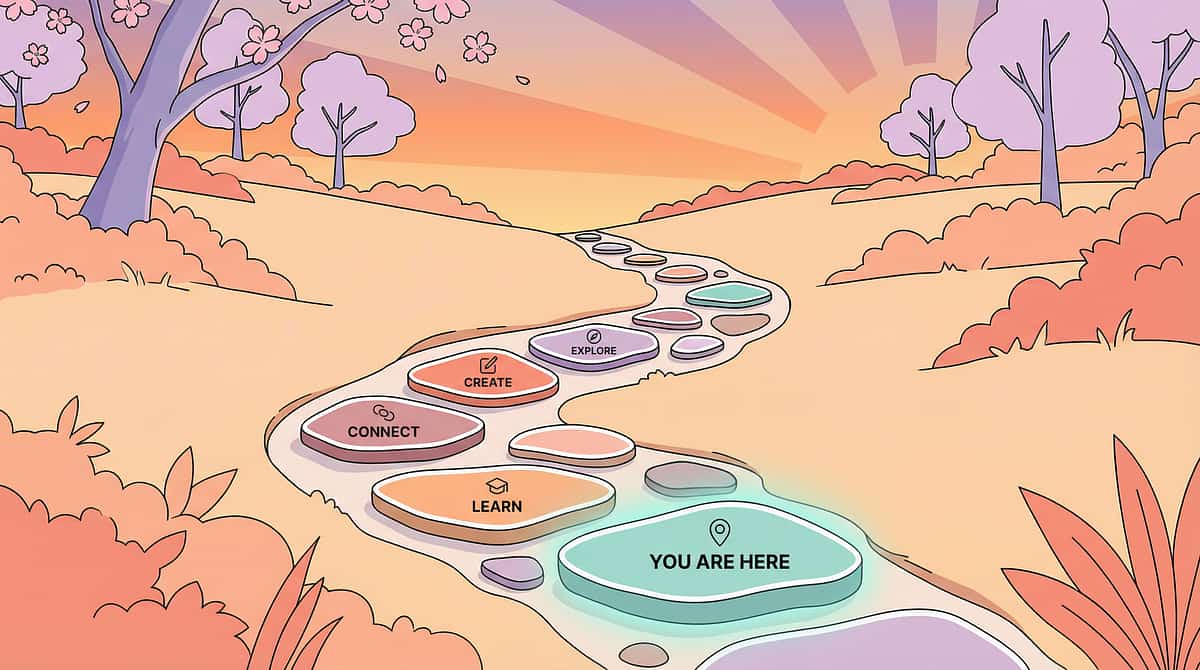
You Are Here. Here Is Where You're Going.
C-336 sits within a carefully sequenced developmental pathway. Understanding where this technique fits in the broader architecture helps you plan the journey ahead with confidence.
Long-Term Developmental Goal
Joint attention mastery feeds directly into:
- First words and vocabulary explosion (language)
- Reciprocal play development (social)
- Classroom learning readiness (academic)
- Friendship formation (relational)
- Theory of Mind development (cognitive)
Lateral Alternatives
If this approach didn't fully resonate:
- B-135 — Building Joint Attention (materials-parallel approach using the same Canon materials)
- If the primary challenge is sensory, not attentional: See sensory domain techniques (Domain A)

ACT V — Community & Ecosystem
More Tools in the Joint Attention & Social Communication Toolkit
The materials you have gathered for C-336 unlock access to five additional techniques immediately — you already own the materials. This is the canon material advantage.
Technique Code | Name | Level | Canon Material | Materials Owned? | |
B-135 | Building Joint Attention | 🟡 Core | Cause-Effect Toys | ✓ Same as C-336 | |
C-337 | Pointing Development | 🟡 Core | Point-and-Find Books | ✓ | |
C-338 | Social Referencing | 🟡 Core | Reinforcement Materials | ✓ | |
C-340 | Gaze Avoidance | 🟠 Advanced | Light/Visual Materials | ✓ | |
C-334 | Extreme Clinginess | 🟢 Intro | Transition Objects | ✓ | |
C-345 | Language Delays | 🟠 Advanced | Language + Literacy | New purchase needed |
✓ You already own materials for B-135, C-337, C-338, C-340, and C-334 from your C-336 kit. → Browse all Social Communication techniques: techniques.pinnacleblooms.org/social-communication/n
Preview of 9 materials that help with joint attention Therapy Material
Below is a visual preview of 9 materials that help with joint attention therapy material. The pages shown help educators, therapists, and caregivers understand the structure and content of the resource before use. Materials should be used under appropriate professional guidance.


Link copied!
C-336 Is One Piece. Here Is the Whole Map.
Joint attention is one of 36 techniques in the Social Communication domain within GPT-OS®. Understanding its place within the full developmental architecture shows you how deeply this work echoes across your child's entire growth.
A: Sensory Processing
B: Social Communication ← C-336 Here
C: Emotional Regulation
D: Behaviour & Flexibility
F: Language
G: Play & Leisure
"This technique is not isolated work. Joint attention progress directly accelerates Language (Domain F), Social Communication (Domain B), Play (Domain G), and Academic Readiness (Domain K). Every triangle built today echoes across your child's entire developmental landscape."
Your child's AbilityScore® — tracking joint attention progress within the Communication Readiness Index — is available at: pinnacleblooms.org/ability-score
📞9100 181 181 — Request your child's AbilityScore® assessment