

"You sat across from eight professionals and felt completely alone."
That IEP meeting where everyone used acronyms you didn't know. Where they seemed to have already decided. Where you left wondering: Did I just fail my child? You didn't. The system failed to prepare you. This page changes that.
K-911
Parent Empowerment Series
GPT-OS® Validated

Millions of Parents Are Navigating This Exact System. Right Now.
1 in 36
Children on the Autism Spectrum
WHO Global Autism Data 2023
80%
Unprepared at First IEP Meeting
Pinnacle Network Parent Survey 2024
97%+
Show Measurable Improvement
When parents become active, informed advocates — GPT-OS® Outcomes Data
Across India, an estimated 18 million children live with developmental differences requiring educational support. The Rights of Persons with Disabilities Act (RPwD) 2016 guarantees every one of them the right to inclusive education. Under Sections 16–17, Indian schools are legally obligated to provide free education for children with disabilities aged 6–18, reasonable accommodation, individualised educational planning, and non-discriminatory access to all activities. You have legal standing. These materials give you practical standing.

The School System Was Not Designed to Be Navigated by Outsiders. But You Are Not an Outsider Anymore.
How School Advocacy Systems Work
Parent Concern
Informal teacher discussion
Formal Assessment Request
Evaluation and documentation begins
IEP / Support Plan Meeting
⚠️ Most parents feel most unprepared HERE
Review & Revision
⚠️ And here, when supports aren't working
Why Advocacy Feels So Hard
The school meeting room activates the same neurological stress response as any high-stakes evaluation. Research on parental advocacy stress shows three critical effects:
Cognitive Narrowing
Under stress, working memory reduces by 30–40%. You forget your questions.
Social Compliance Pressure
Faced with a room of experts, the brain defaults to deference.
Emotional Flooding
Fear for your child bypasses rational processing entirely.
These materials are designed to counteract all three effects. Written preparation overcomes cognitive narrowing. Documentation creates equal standing.

Advocacy Is Not a One-Time Event. It's a Skill You Build Across Your Child's Entire School Journey.
Each phase brings unique advocacy priorities. Ages 3–6 focus on assessment access and first IEP — priority materials are Child Profile and Rights Guide. Ages 6–10 center on goal setting and teacher relationships. Ages 10–14 add social inclusion and mental health integration. Ages 14–18 bring full transition planning — all 9 materials at full deployment. Children with ASD frequently present with co-occurring ADHD, Sensory Processing Disorder, anxiety, and communication differences, each requiring its own cross-disciplinary advocacy strategy.

Parent Advocacy Is Clinically Evidenced as the Single Greatest Driver of Educational Outcomes.
Finding 1 — Stronger IEP Outcomes
Active parent participation in IEP meetings is associated with more ambitious goals, better implementation rates, and stronger child outcomes. Passive presence correlates with lower-quality plans.
Finding 2 — Prepared Parents Get More
Parents who bring written documentation and prepared questions achieve 40–60% more accommodations than unprepared parents presenting identical needs.
Finding 3 — Rights Knowledge Transforms Quality
Parents who understand their legal rights under disability education law report significantly lower anxiety, higher confidence, and better meeting outcomes.
Finding 4 — Documentation Creates Accountability
Schools with documented communication trails demonstrate higher IEP implementation rates compared to schools where communication is primarily verbal.
Evidence Grade: Level I — Systematic Review + Multiple RCTs ★★★★★
PRISMA Systematic Review (2024): Parent-professional partnership in educational planning. Padmanabha et al. (Indian J Pediatr, 2019): Home-based family interventions with school coordination showed significant developmental outcomes in Indian pediatric populations.
School Advocacy Materials — K-911
Parent Education
IEP Navigation
Educational Rights
Ages 3–18
School Advocacy Materials is a system of 9 structured tools that equips parents and caregivers of children with autism, developmental differences, and special educational needs to participate effectively in school meetings, understand their rights, document their child's needs and progress, communicate clearly with school professionals, and escalate concerns when necessary.
Unlike passive participation, advocacy using these materials transforms the parent from an observer of the school system into an equal partner within it. These tools don't make advocacy adversarial — they make it effective.
Documentation Systems
Structured records and binders that create institutional-level evidence
Communication Templates
Ready-to-use scripts, question banks, and follow-up letter frameworks
Tracking & Monitoring
Goal-level data collection tools that turn observation into evidence
Rights Reference Materials
Plain-language guides to RPwD Act 2016 and RTE Act 2009
GPT-OS® Classification: AbilityScore® Domain — Parent Empowerment Index | Progression: Emerging → Active → Proficient → Expert

Your Child Is Served by a Multi-Disciplinary Team. So Is Your Advocacy.

Special Educator (SpEd)
Primary Lead — Develops IEP structure, writes educational goals, translates assessment reports, and reviews IEP documents before you sign. Your primary educational ally.

Occupational Therapist (OT)
Environmental Advocate — Documents sensory and functional needs in school-actionable language. Advocates for movement breaks, adaptive seating, and fine motor support.

Speech-Language Pathologist (SLP)
Communication Advocate — Advocates for AAC access, speech therapy frequency, and language-based learning support. An SLP report can be decisive in securing services.

BCBA / ABA Therapist
Behavioral Advocate — Provides FBA documentation and behavior support plans. Their reports carry legal weight for behavioral support requests.

NeuroDev Pediatrician
Medical Authority — Diagnostic reports are often the cornerstone document. Their functional impact assessment carries institutional weight that parent communication alone may not.
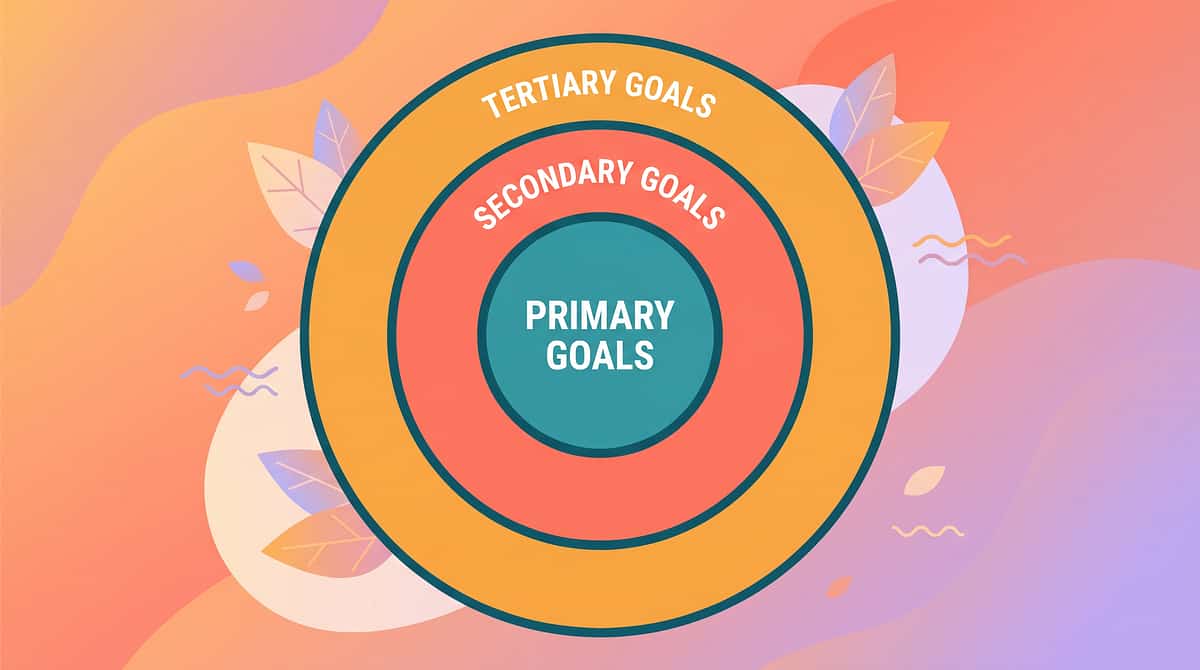
Precision Targets. Each Material Addresses a Specific Barrier to Effective Advocacy.
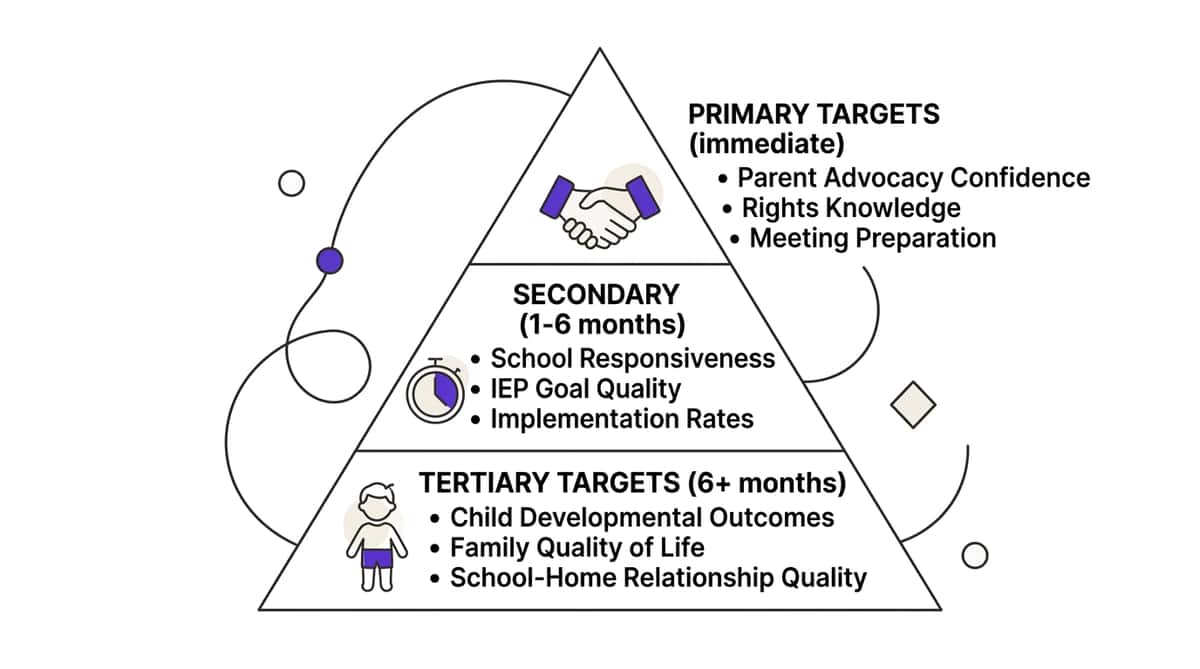
Primary Targets — Immediate
- Parent transitions from reactive to prepared in school meetings
- Parent articulates child's needs in specific, clinical, and legal language
- Parent understands core rights under RPwD Act 2016
- Written materials reduce stress-related memory failure in meetings
Secondary & Tertiary Targets
- School responsiveness increases with documented, organised parent
- IEP goals become more specific and measurable
- Child receives appropriate supports and accommodations
- Parent-school relationship evolves from adversarial to collaborative
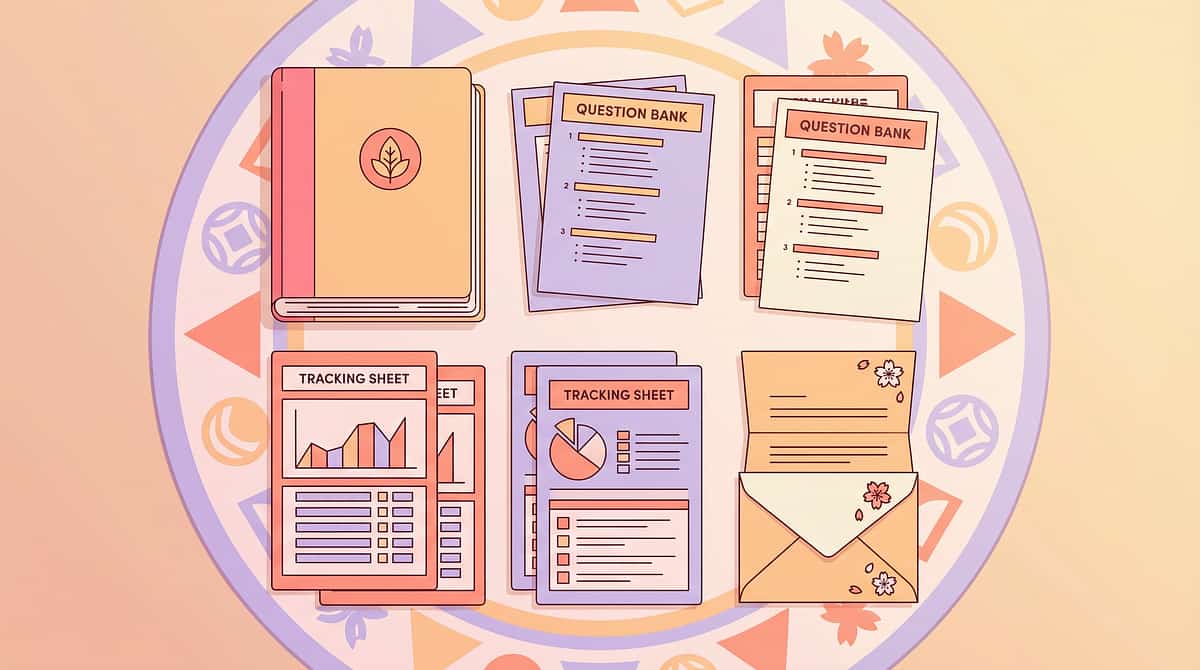
9 Materials. One System. Your Child's Educational Future Protected.
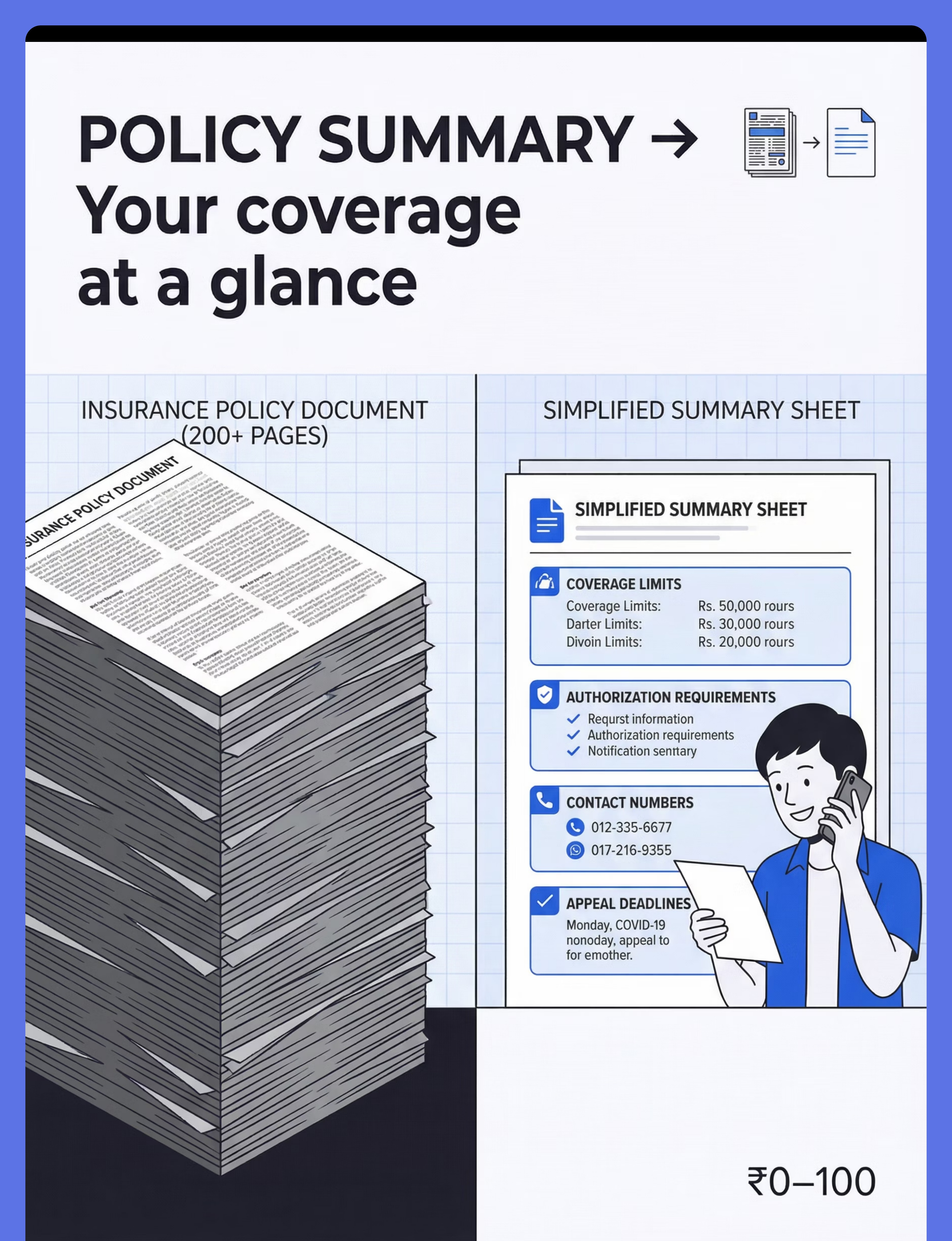
These are not expensive products. 7 of 9 are free DIY tools. The entire system can be built for ₹200–₹1,300. What they require is time, intention, and the guidance on this page.
Child Profile Summary Document
📋Category: Documentation | Cost: ₹0 DIY
A 1–2 page structured snapshot: strengths, diagnosis, challenges, what works, what to avoid, and current goals. Your anchor in every school conversation.
A 1–2 page structured snapshot: strengths, diagnosis, challenges, what works, what to avoid, and current goals. Your anchor in every school conversation.
Rights & Regulations Reference Guide
⚖️Category: Knowledge | Cost: ₹0–₹500
Plain-language summary of RPwD Act 2016 and RTE Act 2009. School obligations, parent rights, timelines, escalation contacts. Rights unknown are rights unused.
Plain-language summary of RPwD Act 2016 and RTE Act 2009. School obligations, parent rights, timelines, escalation contacts. Rights unknown are rights unused.
Meeting Preparation Checklist
✅Category: Preparation | Cost: ₹0 DIY
Pre-meeting protocol: clarify purpose, review documents, prepare questions, identify goals, assign roles. Transforms anxiety into structured action.
Pre-meeting protocol: clarify purpose, review documents, prepare questions, identify goals, assign roles. Transforms anxiety into structured action.
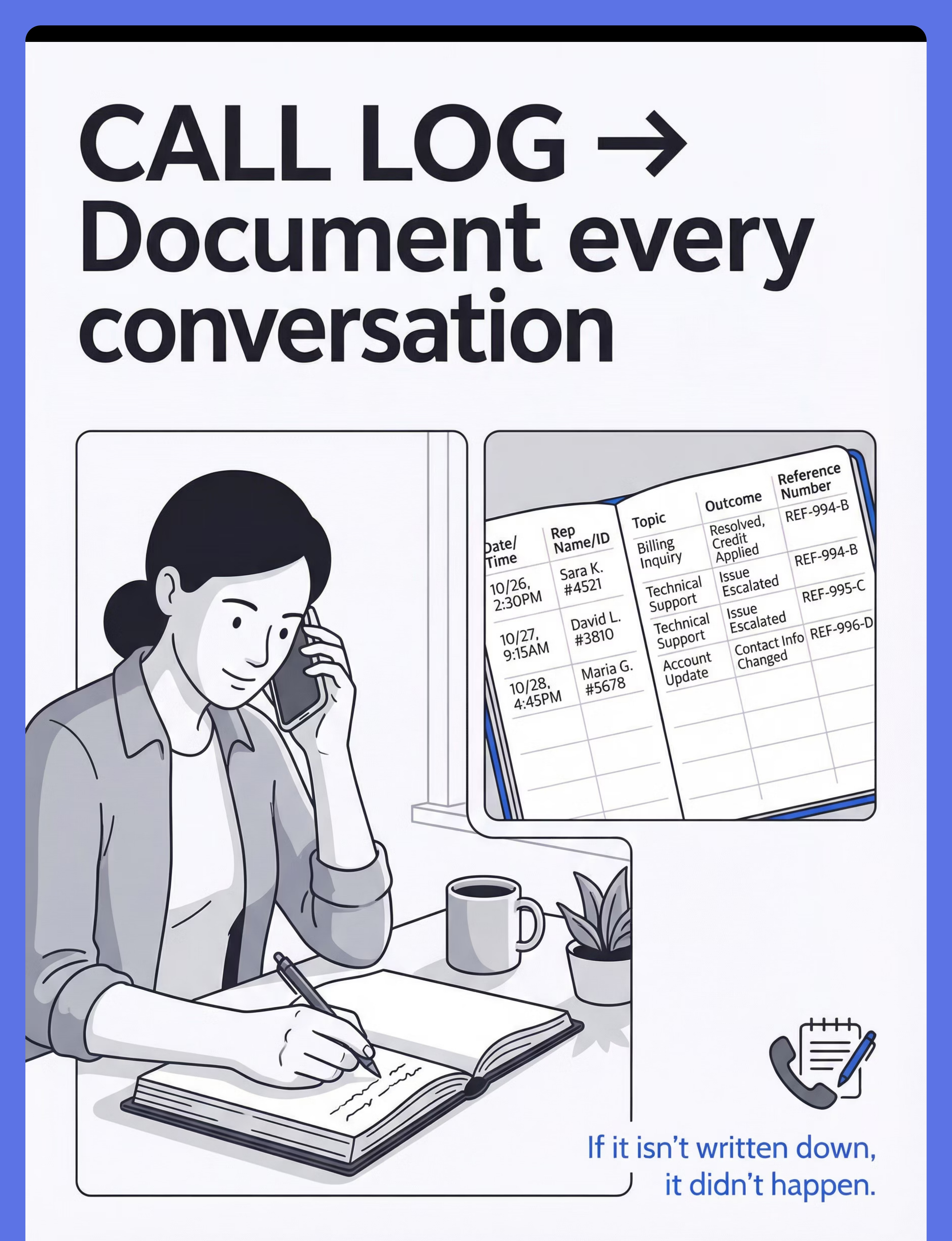
Documentation & Communication Binder
📁Category: Documentation | Cost: ₹200–₹500
Tabbed binder: evaluations, therapy notes, IEP documents, communication log. When schools say "we never agreed to that" — your binder answers.
Tabbed binder: evaluations, therapy notes, IEP documents, communication log. When schools say "we never agreed to that" — your binder answers.
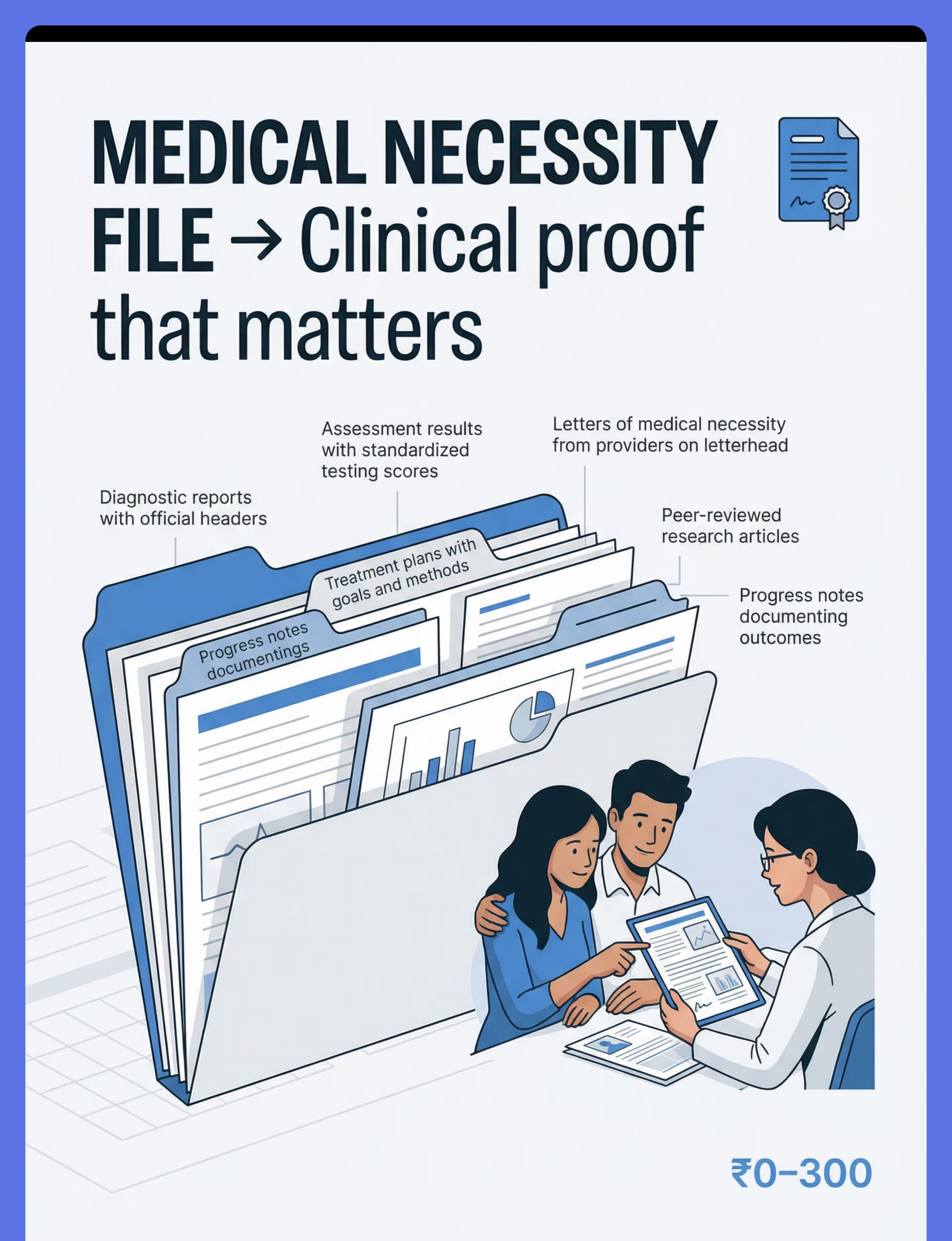
Goal Tracking & Progress Monitoring Tools
📊Category: Monitoring | Cost: ₹0–₹300
Simple weekly tracking against IEP goals. When the school says "doing fine" and your data says otherwise — your tracking wins the conversation.
Simple weekly tracking against IEP goals. When the school says "doing fine" and your data says otherwise — your tracking wins the conversation.
Question Bank & Phrase Guide
💬Category: Communication | Cost: ₹0 DIY
Pre-prepared questions by topic. Phrase guide for difficult situations: how to disagree without confrontation, how to request time before signing.
Pre-prepared questions by topic. Phrase guide for difficult situations: how to disagree without confrontation, how to request time before signing.
Support Person Briefing Guide
🤝Category: Preparation | Cost: ₹0 DIY
Prepares your spouse or family member for their meeting role: note-taker, question-asker, emotional support. Two prepared people outperform one expert.
Prepares your spouse or family member for their meeting role: note-taker, question-asker, emotional support. Two prepared people outperform one expert.
Follow-Up Letter Templates
✉️Category: Communication | Cost: ₹0 DIY
Post-meeting email templates: "Per our meeting, we agreed…" Creates timestamped records. Changes how schools respond to subsequent meetings.
Post-meeting email templates: "Per our meeting, we agreed…" Creates timestamped records. Changes how schools respond to subsequent meetings.
Escalation Pathway Map
🗺️Category: Knowledge | Cost: ₹0 DIY
Your school-specific escalation chain: Teacher → Principal → BEO/DEO → State Commissioner for PwD → National Trust. Knowing you have options reduces desperation.
Your school-specific escalation chain: Teacher → Principal → BEO/DEO → State Commissioner for PwD → National Trust. Knowing you have options reduces desperation.

7 of 9 Materials Cost ₹0. The Equity Is the Point.
Every parent, regardless of economic status, internet access, or location across India's 70+ regions Pinnacle serves, can build this complete advocacy toolkit. This is the Nurturing Care Framework's inclusion principle — not aspirational, operational.
DIY Material 1 — Child Profile
What you need: Google Docs (free) or pen and paper
Build it in 60 minutes: One page maximum. Sections: Basic Info → Diagnosis → Strengths (3–5 bullets) → Challenges → What Helps → What to Avoid → Current Supports → Goals This Year. Use bullet points, not paragraphs. Include one recent photo. Update annually.
Tip: "Needs movement breaks every 45 minutes" is better than "has ADHD." Focus on actionable information, not labels.
DIY Material 2 — Rights Reference Guide
What you need: Government websites (free), 2 hours
Download RPwD Act 2016 Sections 16–18 and RTE Act 2009 Chapter II. Summarise: What schools MUST do | Parent rights | Timelines | Escalation contacts. Add your district BEO/DEO contact. Free: disability.ncog.gov.in | nhrc.nic.in
DIY Material 3 — Meeting Checklist
Build in 20 minutes on pen and paper:
✅ Confirm meeting purpose in writing | ✅ Review last meeting notes | ✅ List 3 main points | ✅ Prepare 5 written questions | ✅ Confirm support person role | During: ✅ Take notes | ✅ Do not sign same-day if uncertain | After: ✅ Follow-up email within 48 hours
✅ Confirm meeting purpose in writing | ✅ Review last meeting notes | ✅ List 3 main points | ✅ Prepare 5 written questions | ✅ Confirm support person role | During: ✅ Take notes | ✅ Do not sign same-day if uncertain | After: ✅ Follow-up email within 48 hours
DIY Material 4 — Documentation Binder
What you need: Any binder + divider tabs (₹150–₹300)
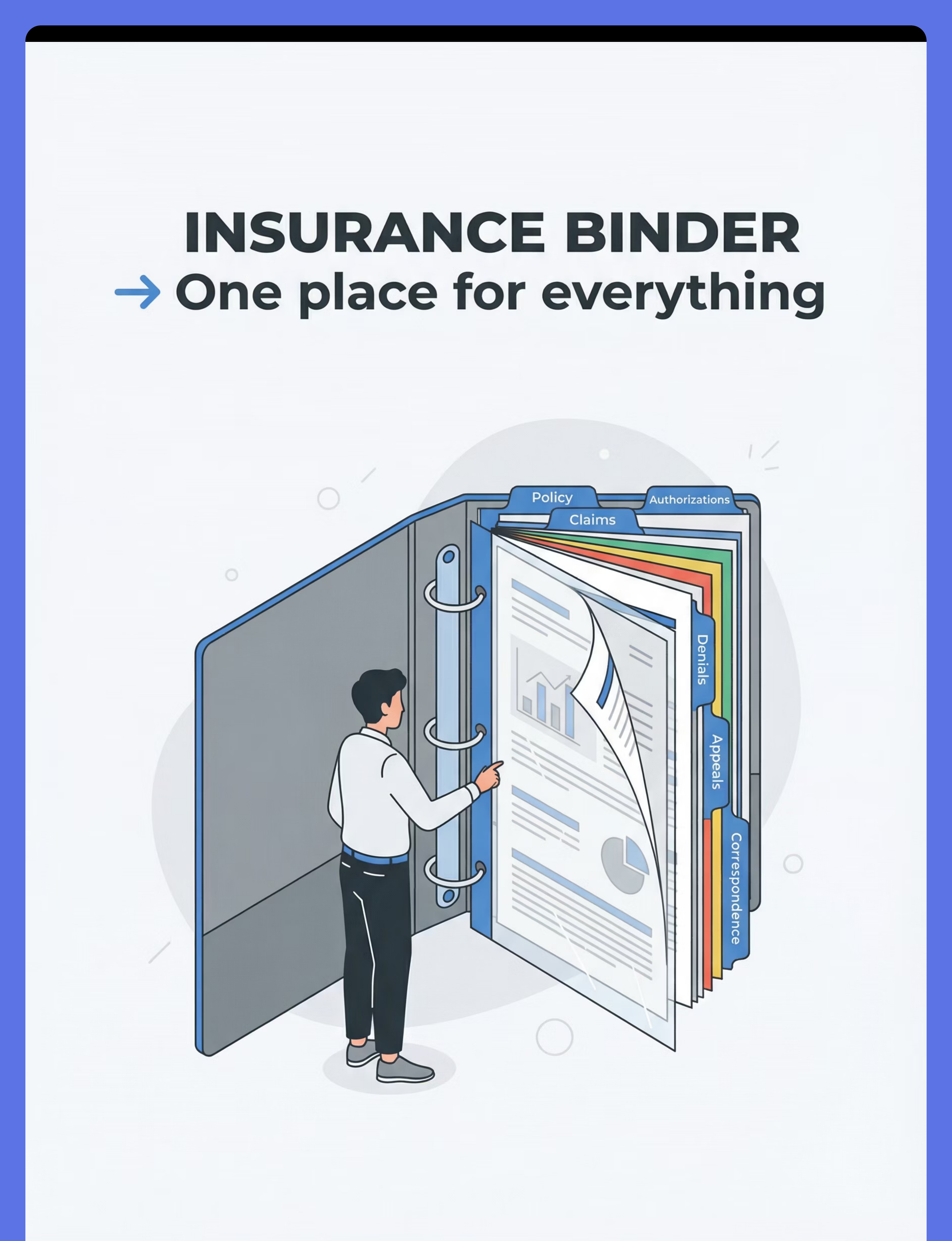
Sections: 1) Evaluations & Diagnoses | 2) Medical Records | 3) Therapy Reports | 4) School Reports | 5) IEP/Support Plans | 6) Meeting Notes | 7) Communication Log | 8) Email Printouts | 9) Work Samples
Critical addition: Communication Log — every school contact: Date | Who | What discussed | What was agreed | Follow-up needed.
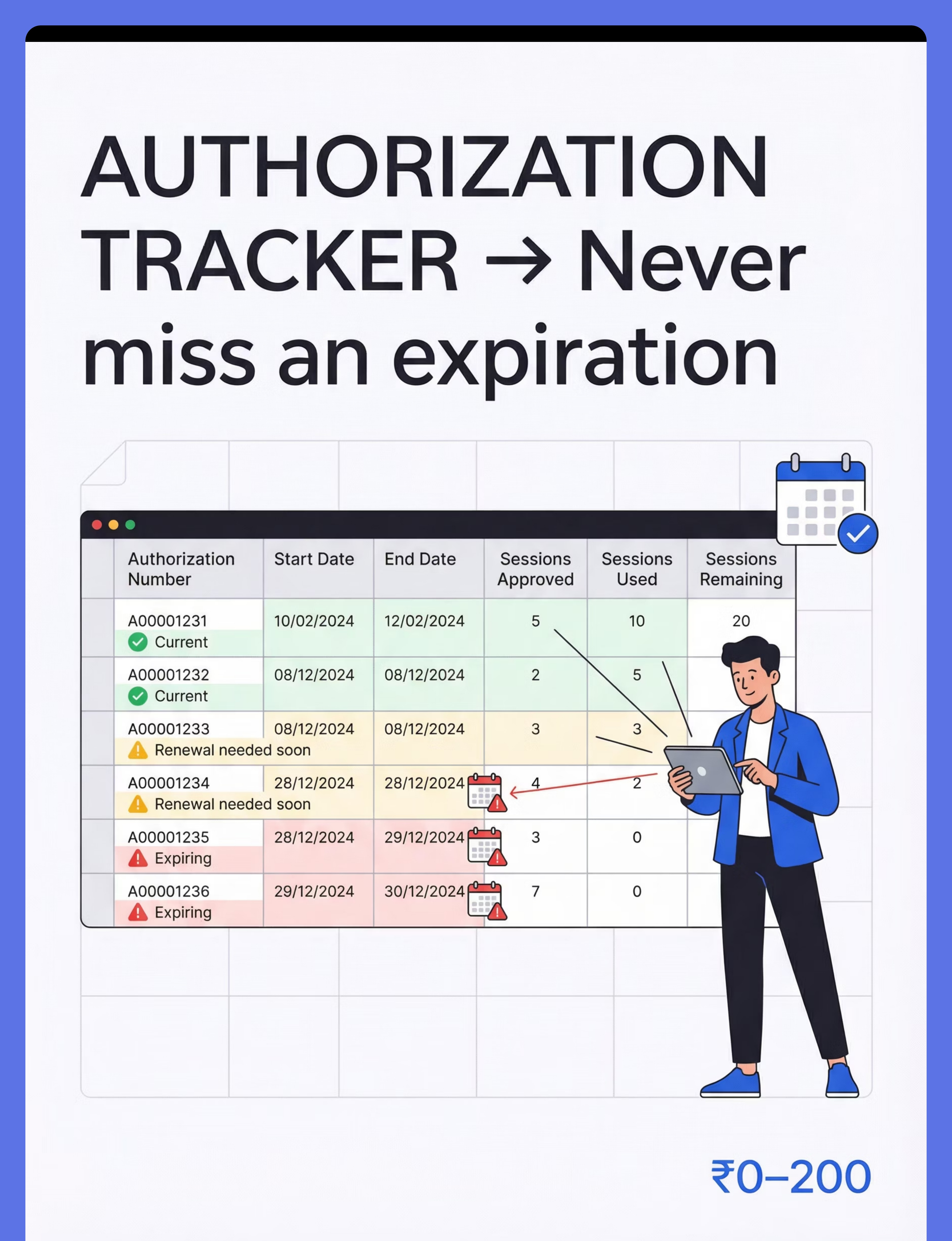
DIY Material 5 — Goal Tracking Sheet
What you need: Notebook or spreadsheet (₹0–₹50)
Columns: Date | IEP Goal | Observation/Evidence | Progress (1–5) | Notes. Track minimum weekly. Bring last 4 weeks of data to every meeting. Date-stamp photo evidence of work samples.
DIY Materials 6, 7, 8, 9
- Question Bank: Write 5 questions per meeting topic. Practice saying them aloud.
- Support Briefing: 1-page doc: Meeting purpose + goals + their role + key history
- Follow-Up Template: Subject: "Follow-Up: [Meeting Date] re: [Child Name]" + numbered agreements with responsible person and date
- Escalation Map: Draw your school's chain of command. Add contact numbers and State Commissioner contact.
Advocacy Done Right Is Safe Advocacy. Know These Gates Before You Begin.
🟢 GREEN — Safe to Proceed
- You are requesting evaluation, assessment, or support plan development
- You are requesting copies of records (ALWAYS your right)
- You are bringing a support person to a meeting
- You are requesting time before signing documents
- You are following up after meetings in writing
🟡 AMBER — Proceed with Caution
- Concerns involve a specific named teacher → Document carefully, communicate to principal first
- Child may have experienced physical restraint → Consult NHRC guidelines before proceeding
- Considering changing schools → Consult therapy team first
- Preparing to escalate beyond school level → Give school reasonable response time first
🔴 RED — Stop and Seek Professional Support
- Child has experienced physical safety risk at school
- Child is being denied access to education
- Communication has become hostile or threatening from school side
- You have received any form of legal correspondence
In RED situations: Contact Pinnacle Helpline 9100 181 181 | Contact State Commissioner for Persons with Disabilities | Contact legal aid or disability rights organisation. Schools must respond to records requests within 30 days under the RPwD Act.
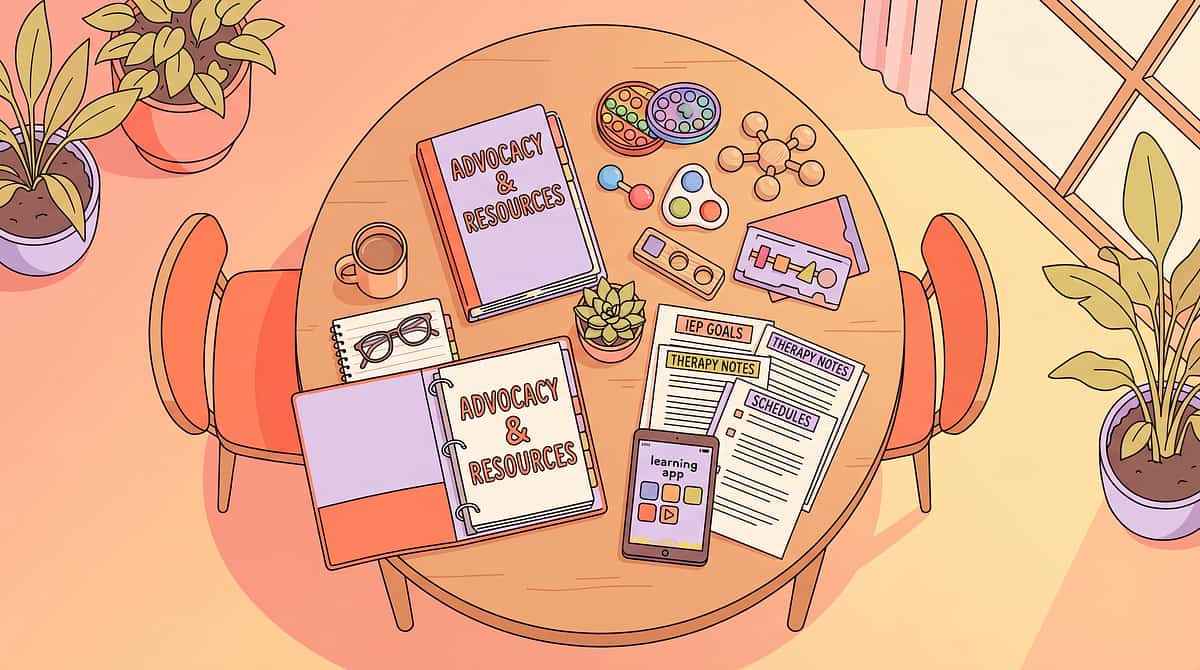
Your Kitchen Table Is Your War Room. Set It Up.
Zone 1 — Home Preparation Space
Set up 30–60 minutes before every meeting. Remove TV and background noise. This is clinical preparation time.
- 📱 Computer or phone for email and templates
- 📁 Binder — open, relevant section on top
- 📋 Child Profile — printed copies (3)
- 📊 Tracking Sheets — last 4 weeks of data
- ✅ Meeting Checklist — reviewed
- 💬 Question Bank — re-read within the hour
Zone 2 — Meeting-Day Physical Setup
Arrive 5–10 minutes early to settle and orient.
- Bag with full binder + 3 copies of child profile
- Question card in hand, pen and notebook ready
- Support person briefed the night before, role confirmed
- Follow-up email template pre-loaded in drafts
The "Right Before You Enter" Protocol — 90 Seconds
Remind Yourself
"I am the expert on my child. They are the experts on their systems."
Breathe
4 counts in, 4 hold, 4 out.
Open Your Question List
Hold it in your hand from minute one.
Remember
"I can always ask for time before signing."
📞9100 181 181 — Call for personalised meeting preparation coaching

The Best Advocacy Meeting Is One That Starts Right. Check Your Readiness First.
Indicator | ✅ Go | 🟡 Modify | 🔴 Postpone | |
Documentation — binder + profile | All present | Some present | Missing key documents | |
Emotional state — calm enough to listen | Yes, centred | Anxious but manageable | Distressed / flooded | |
Questions — written list ready | Written and reviewed | Mental notes only | Not prepared | |
Support person — briefed | Fully briefed | Partially briefed | Absent / unbriefed | |
Meeting purpose — confirmed | Confirmed in writing | Assumed | Unclear | |
Goals — 3 non-negotiables defined | Written down | General idea | Not defined | |
Follow-up plan — email template ready | Yes, template ready | Will do after | Not planned |
5–7 GO ✅
Proceed with full confidence.
3–4 GO 🟡
Proceed with awareness of gaps; note what to clarify.
0–2 GO 🔴
Consider requesting to reschedule. If impossible, prioritise written note-taking and request time before signing anything.
It is always acceptable to say: "I need to reschedule — I'm not adequately prepared." Request 5 additional business days minimum. Your right to prepare cannot be waived.

Step 01 of 06
⏱️ First 5 Minutes
The Invitation: Opening the Meeting Right
How you open the meeting determines its entire trajectory. A strong, collaborative opening signals preparation, establishes shared purpose, and creates the conversational space your questions need.
"Thank you all for being here. I'm [Name], [child's] parent/caregiver. I want to say upfront that I see all of us as working toward the same goal — [child's name] having the educational experience they deserve and are capable of. I've prepared a few materials to help our conversation. I also have some specific questions I'd like to make sure we cover. Is there a point in the agenda where those would fit best?"
Why This Opening Works
- Establishes shared purpose — not adversarial framing
- Signals preparation — immediate credibility shift
- Claims conversational space without dominance
- Creates an opening for your questions
Body Language Guidance
- Sit across from the most senior person in the room
- Place binder visibly on the table — open, not closed
- Distribute eye contact across all participants
- Notebook and pen in hand from the first moment
✅ Acceptance Cues — Meeting Is Going Well
- Questions answered with specific information
- You are addressed by name, not "mom" or "dad"
- Your documents are being referenced
⚠️ Resistance Signs — Modify Your Approach
- Answers are vague or deflecting
- You are being rushed toward signing
- Your questions are being minimised
Response to resistance: Slow down. Write. Ask: "Can I get that confirmed in writing?"

Step 02 of 06
⏱️ 5–25 Minutes Into Meeting
The Engagement: Using Your Question Bank
Prepared questions are not aggressive. They are professional. They are expected. Ask one question at a time. Take written notes on every answer. Do not rely on memory.
Category A — About Goals
- "How will we measure progress toward this goal? What does success look like?"
- "What is the timeline, and how will we know if the goal is not reached?"
Category B — About Services
- "How often will this service be provided, and by whom specifically?"
- "What qualifications does the person delivering this service have?"
Category C — About Progress Data
- "What data are you collecting to track [child's name]'s progress?"
- "Can I receive copies of progress monitoring data? How often?"
Category D — About Accommodations
- "What accommodations are in the current plan? Are they being implemented consistently?"
- "What happens in subjects where the teacher is unfamiliar with the plan?"
Category E — About Your Rights
- "I'd like to request [specific service]. What is the process for adding that to the plan?"
- "I need time to review this document. What is the process for responding?"
Situation | What to Say | |
Don't understand a term | "Could you explain what [term] means in practical terms for my child?" | |
Feel rushed to sign | "I need [X days] to review this before signing. That's my right." | |
Politely disagree | "I understand your perspective. I'd like to share what I'm observing at home." | |
Request written follow-up | "Could we put that in writing before the meeting ends?" |

Step 03 of 06
⏱️ Throughout Meeting
The Therapeutic Action: Presenting Your Documentation
Your binder is your equal standing at the table. Use it deliberately — not defensively. The act of opening a well-organised binder in a school meeting communicates institutional-level preparation before you say a word.
Share Child Profile at Opening
"I've brought copies of [child's name]'s profile summary for each of you." Distribute copies. "It gives everyone the same starting point." This establishes shared facts immediately.
Reference Therapy Reports When Claims Are Made
"Our occupational therapist has documented [specific observation] in the most recent report. I have a copy here if that would be helpful for this discussion."
Present Your Goal Tracking Data
"I've been tracking [child's name]'s progress at home over the past four weeks and I've observed [specific data]. Does this align with what you're seeing?"
Note and Document Discrepancies
If the school's characterisation differs from your tracking: Write it down immediately. "You've said [X]. My tracking shows [Y]. I'd like to explore that discrepancy — can we schedule time to compare data?"
Common Error | Correction | |
Presenting emotional evidence only ("I feel he's not learning") | Pair with documented evidence ("My tracking shows zero progress on reading fluency for 6 weeks") | |
Leaving documentation in bag | Place binder on table at meeting start | |
Accepting verbal agreements | After every agreement: "Can we note that in the meeting summary?" |
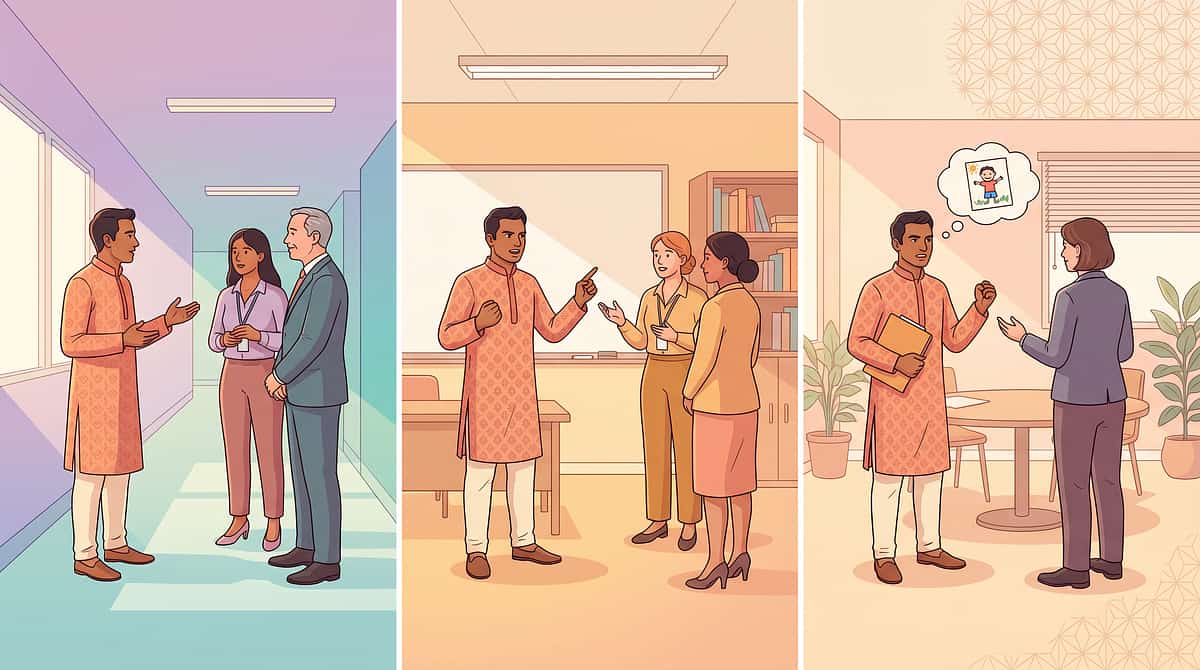
Step 04 of 06
⏱️ Across Multiple Meetings
Repeat & Vary: Advocacy Is a Marathon
"One meeting is a drop. A system of meetings is an ocean." School advocacy produces outcomes through consistency and documentation quality — not through single-session heroics.
Monthly Informal Check-In
Brief email or 5-minute hallway conversation with teacher
Termly Progress Review
Goal tracking review meeting — bring 4+ weeks of data
Annual IEP/Support Plan Review
Full documentation deployment — legally required
Transition Meetings
At each school stage — full re-engagement of all 9 materials
Variation Protocol
- Productive & collegial: Maintain approach. Build relationship.
- Neutral but ineffective: Increase documentation density. Add follow-up specificity.
- Resistant or adversarial: Escalate documentation. Bring support person.
- Unresponsive: Trigger formal written requests. Initiate escalation pathway.
"After 2–3 prepared meetings, you may notice: 'I'm no longer afraid of these meetings. I know what to ask. I know what to expect. I know what I'm looking for.' That shift is the goal of this entire material system."
The "3 Good Meetings" Principle: Three productive, documented meetings with clear follow-up are worth more than ten tense, adversarial meetings with no documentation.
Step 05 of 06
Reinforce & Celebrate Your Own Advocacy
The ABA principle that powers every technique in this network applies to you too: Immediate, specific reinforcement of desired behaviour increases its recurrence. Advocating for your child is hard. It must be celebrated specifically, not generically.
⏱️ Within 1 Hour
Acknowledge to your support person: "I asked the three questions I needed to ask." Specific credit, specific behaviour.
📅 Same Day
Write in your communication log. The act of recording is evidence of your system working.
✉️ Within 48 Hours
Send your follow-up email. The discipline of documentation is itself a reinforcer — it closes the loop.
📊 Weekly
Review your goal tracking data. See what changed because of your advocacy. Data is your reinforcement.
Advocacy Milestone | Celebrate With | |
First meeting with binder | ⭐ "I showed up prepared" | |
First follow-up email sent | ⭐ "I created a record" | |
First time school changed plan because of your data | ⭐ "My tracking made a difference" | |
First time you cited your rights | ⭐ "I knew my rights and used them" | |
First time you brought a support person | ⭐ "I didn't go alone" |

Step 06 of 06
⏱️ Within 48 Hours of Meeting
The Cool-Down: Post-Meeting Protocol
The meeting doesn't end when you leave the room. It ends when agreements are in writing. Structured post-meeting steps reduce emotional residue and lock in accountability before memories fade.
If the meeting was difficult or produced no progress: Wait 24 hours before sending ANY written communication to the school. Contact Pinnacle Helpline 9100 181 181 for guidance on next steps.

Capture Your Data — Right Now
60 seconds of data now saves hours of guessing later. Track these 5 advocacy metrics after every school interaction.
3
Fields to Log Every Session
Date + Who met | What was agreed | Progress rating on your top goal (1–5)
5
Metrics to Track Ongoing
Goals agreed vs. implemented | Meeting quality | Your confidence rating | School response time | Child's school distress indicators
30
Days — School Response Deadline
Under RPwD Act, schools must respond to records requests within 30 days. Set a calendar reminder the moment you submit any written request.
GPT-OS® Integration: Your session data connects to your child's AbilityScore® profile under Parent Empowerment Index → Educational Advocacy Competence. Data tracked here feeds personalised next-step recommendations and escalation triggers.
📞9100 181 181 | pinnacleblooms.org

What If It Didn't Go As Planned?
Most advocacy journeys hit walls. Here is how to move through the six most common failure modes — each with a specific, practical response.
Problem 1: "The school agreed to everything but nothing happened."
Why: Verbal agreements without documentation or deadlines. What to do: Send follow-up email stating specific agreements. At 30 days with no action: email for update. At 45 days with no response: reference your written agreement and request a meeting.
Problem 2: "I went blank and couldn't ask my questions."
Why: Cognitive narrowing under stress (see Card 3). Normal. Not failure. What to do: Next meeting, hold your written question list in your hand from minute one. Give a copy to your support person: "If I stop asking, prompt me with the next question."
Problem 3: "They said 'doing fine' but supports aren't working."
Why: Schools often assess against a low baseline. "Fine" relative to a chaotic classroom is not "fine" relative to your child's potential. What to do: Bring your goal tracking data. Ask: "Fine relative to what benchmark? Can you show me the data?"
Problem 4: "The school dismissed me as over-involved."
Why: Some school cultures are unaccustomed to well-prepared parents. What to do: Reframe: "I'm not trying to interfere — I'm trying to collaborate." Document the dismissal. Consider bringing a therapist or advocate to the next meeting.
Problem 5: "I'm afraid of being labelled 'that difficult parent.'"
What to do: The "difficult parent" label attaches to aggression — not to documentation and preparation. Prepared, polite parents are routinely treated with significantly more respect. Your child's needs matter more than your social anxiety about the label.
Problem 6: "The school is simply refusing to provide what my child needs."
What to do: Trigger formal written request. Document refusal. Engage escalation pathway. Contact disability rights organisation. Consider formal complaint to BEO/DEO or State Commissioner for PwD.
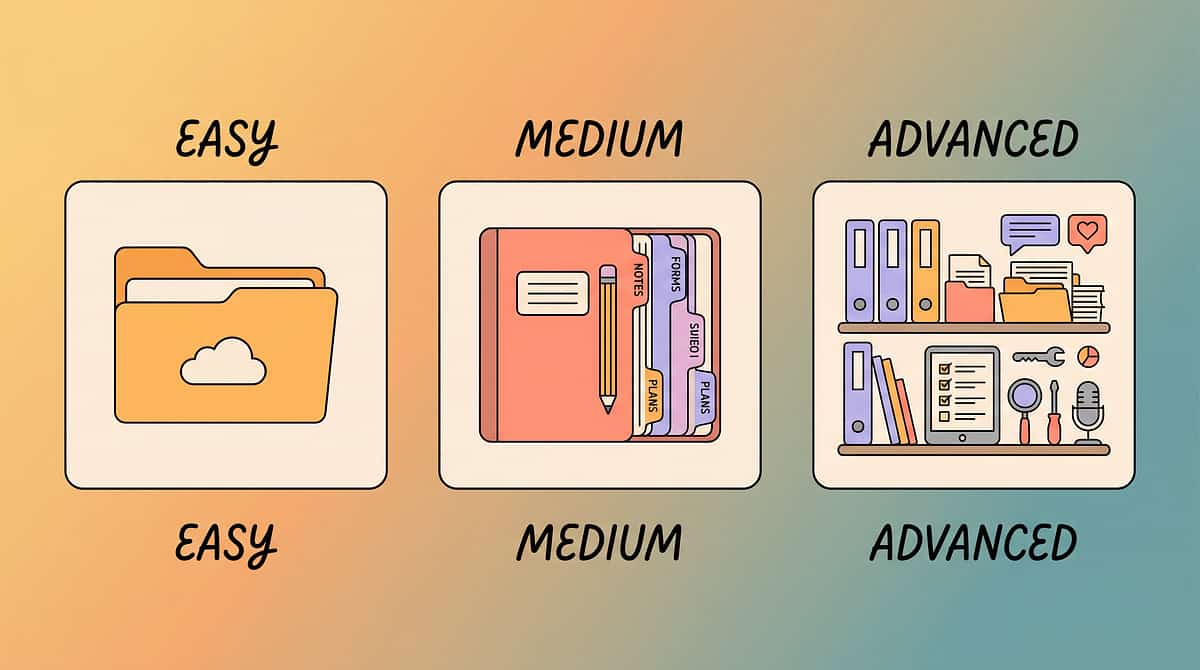
Adapt & Personalise for Your Child
Every child's advocacy needs are different. This system is a framework — personalise it to fit your child's diagnosis, age, school type, and current advocacy stage.
Newly Diagnosed — First Advocacy
Priority materials: Child Profile (immediate) + Documentation Binder (start now) + Rights Guide (before first meeting). Sequence: Build profile week 1 → Study rights week 2 → First meeting with checklist week 3.
Child in School Without Supports
Priority: Documentation audit (what exists vs. missing) + Goal Tracking (immediate baseline) + Meeting Checklist. Most important question: "What formal assessment has been done? Can I have copies?"
Changing Schools
Priority: Complete documentation transfer. Request formal records transfer. Bring full binder to first meeting at new school. Child Profile is your introduction — bring 5 copies.
Non-Verbal or AAC-Using Children
Add to all documentation: specific AAC system details, communication access requirements, SLP letter. Every school professional interacting with your child must know how your child communicates.
Age-Based Modifications
Ages 3–6
Assessment access and preschool inclusion. Simple one-page Child Profile.
Ages 6–12
Full toolkit deployment. IEP goal tracking central to every meeting.
Ages 12–18
Add transition planning materials. Involve child in advocacy conversations at age-appropriate level.

Week 1–2: Building Foundations, Not Winning Battles
Progress: 15%
Infrastructure Phase
In weeks 1–2, your work is infrastructure. Like planting seeds — you don't see the plant yet, but the soil preparation is the work. Building a school advocacy system is a 6–12 month project.
✅ Child Profile document is drafted
Imperfect is fine — you will iterate. One page, bullet points, recent photo included.
✅ Documentation Binder started
At least 2 sections populated — evaluations and meeting notes as the minimum starting point.
✅ First rights reference research completed
You know Section 16 of the RPwD Act and what your school is legally obligated to provide.
✅ Requested copies of child's school records
Or you have a plan to do so in writing within the next 5 business days.
"You may feel impatient in these first two weeks. You've identified the problem and want it solved. Channel that impatience into document preparation — not into premature confrontation. The system rewards preparation, not urgency."

Week 3–4: Your System Is Functional. Your First Real Advocacy Meeting Is Approaching.
Progress: 40%
Consolidation Phase
40%
System Consolidation
First formal meeting completed with binder and checklist
48
Hours — Follow-Up Email
Sent within 48 hours of your first meeting — on time and documented
2+
Weeks of Tracking Data
Goal tracking started — minimum 2 weeks of consistent observations
Behavioural Changes Signalling Consolidation
- You no longer panic when the school calls — you reach for your binder
- You find yourself explaining your child's profile from memory — because you wrote it
- School staff may begin addressing you differently: more specifically, with more preparation of their own
- At least one question from your Question Bank has been asked and answered in a real meeting
"You may notice your confidence has increased. You walked into a meeting with materials and survived — or thrived. That is a skill you have now built. It compounds."

Week 5–8: You Are Operating as a Skilled Advocate. The System Is Responding to You.
Progress: 75%
🏆 Mastery Zone
Accommodation Secured
Child has received at least one new or improved accommodation as a direct result of your advocacy
Follow-Up Is Habitual
You send post-meeting emails automatically — without deliberate effort. It's your standard practice.
Rights From Memory
You can state your child's key rights under the RPwD Act 2016 from memory, without checking your notes.
Generalisation Achieved
You advocate with your child's therapy team using the same skills. You have shared materials with another parent.
🏆 Mastery Badge Achieved — School Advocacy Foundation
Parent Empowerment Index: Level 3 | GPT-OS® AbilityScore® Updated
Next Level: Advanced complaint processes | Transition planning advocacy | Peer mentoring
Parent Empowerment Index: Level 3 | GPT-OS® AbilityScore® Updated
Next Level: Advanced complaint processes | Transition planning advocacy | Peer mentoring

You Did This. Your Child Has Better Supports at School Because You Showed Up Prepared.
In 5–8 weeks, you constructed an institutional-quality advocacy system from scratch — on top of your existing caregiving responsibilities, your emotional load, your work, your family, and your fear. You learned your rights. You organised your evidence. You asked the hard questions. You followed up. You stayed collaborative when it would have been easier to be angry.
That is not ordinary. That is extraordinary parental love, engineered as a system.
Tonight, Tell Your Child
"I went to your school today and made sure they know how amazing you are and what you need to grow. You are being taken care of." Even if your child doesn't understand the words, they feel the steadiness in you.
Journal Prompt
"Before I started this, I felt [___]. After 6 weeks of advocacy work, I now feel [___]. The most important thing I learned is [___]. The next thing I'll do for my child's education is [___]."
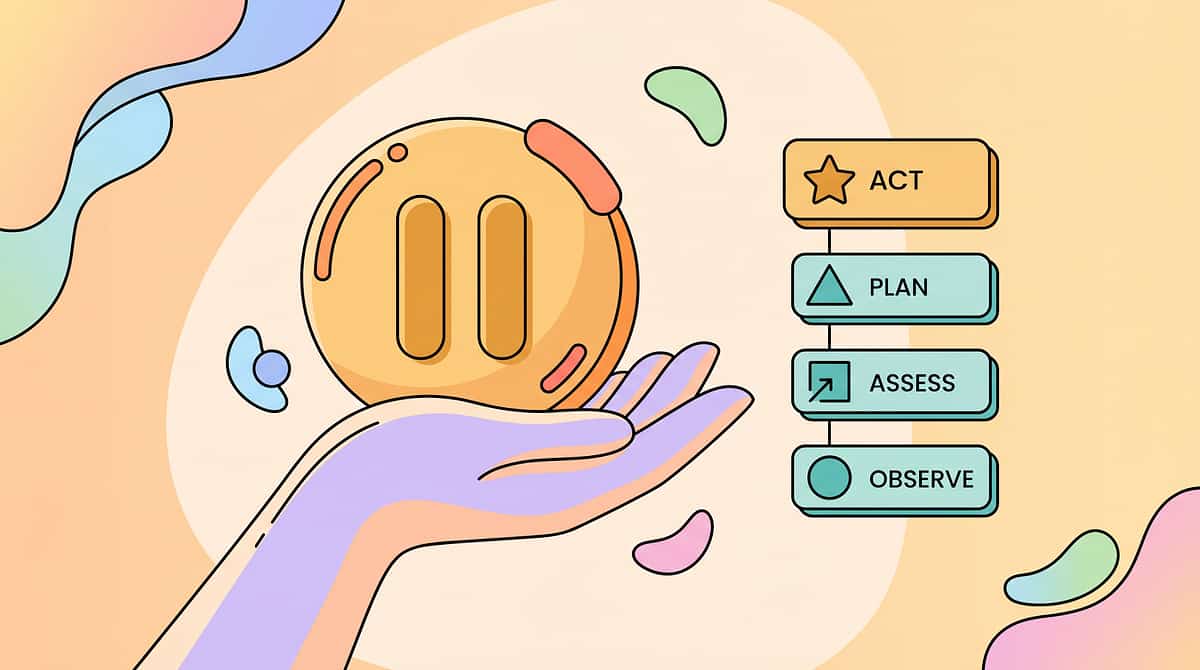
Red Flags — When to Pause and Escalate
Knowing when to escalate is as important as knowing how to advocate. Trust your instincts. If something feels wrong — your child is distressed, regressing, or afraid of school in a way that is new — seek professional consultation immediately.
🔴 Physical Safety — Immediate Response
- Child reports or shows signs of physical restraint or injury at school
- Child is being secluded without notification
- School is refusing to implement emergency protocols
Action: Document. Contact school principal AND BEO/DEO the same day. Call 9100 181 181 immediately.
🔴 Educational Access — Formal Complaint Threshold
- Child regularly sent home without formal notification
- Child denied access to curriculum due to disability
- School refuses evaluation despite written requests
Action: Written formal complaint to Principal. If no response in 10 days: BEO/DEO. Simultaneously: disability rights organisation.
🟡 Warning Signs — Accelerate Advocacy
- 60+ days since IEP review with no progress updates
- Multiple agreed accommodations confirmed not implemented
- Staff making derogatory statements about disability
- Records requests unanswered past 30 days
Action: Escalation email + meeting request + consideration of outside advocate.
Level | Contact | |
School | Principal (written formal complaint) | |
District | Block Education Officer (BEO) / District Education Officer (DEO) | |
State | State Commissioner for Persons with Disabilities | |
National | Rehabilitation Council of India | National Trust |
📞9100 181 181 — FREE | 24×7 | 16+ Languages — Call before escalating if unsure of next step.
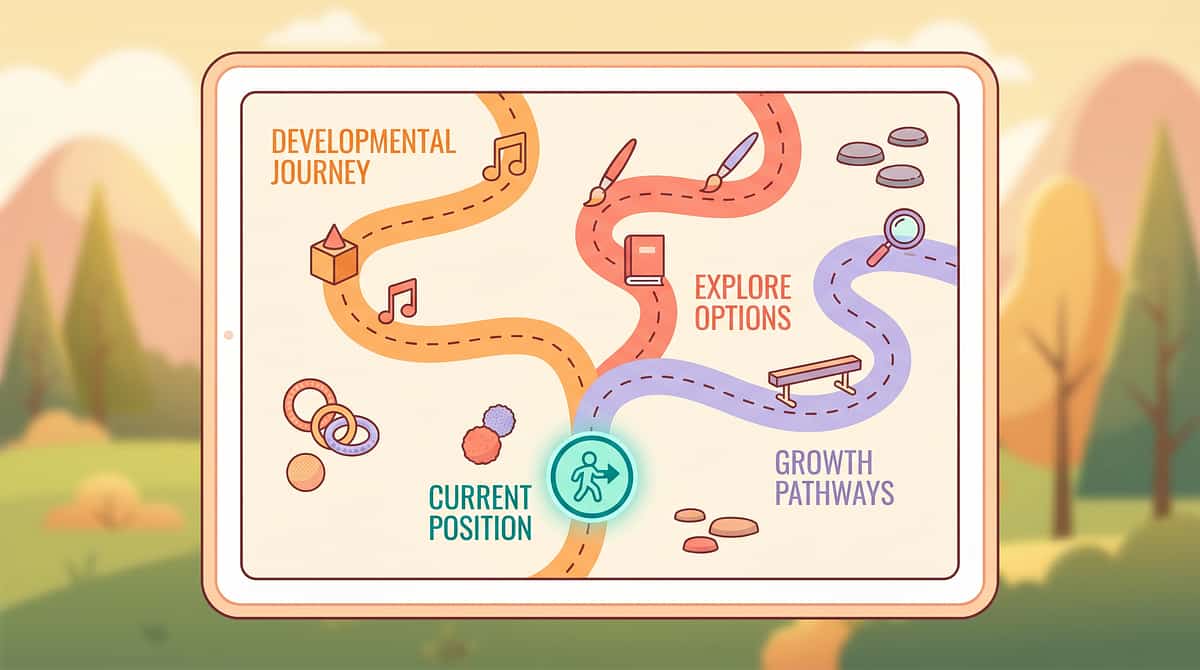
The Progression Pathway: School Advocacy K-911 Is Your Foundation.
Here is where you go next, based on your child's response and your current advocacy stage.
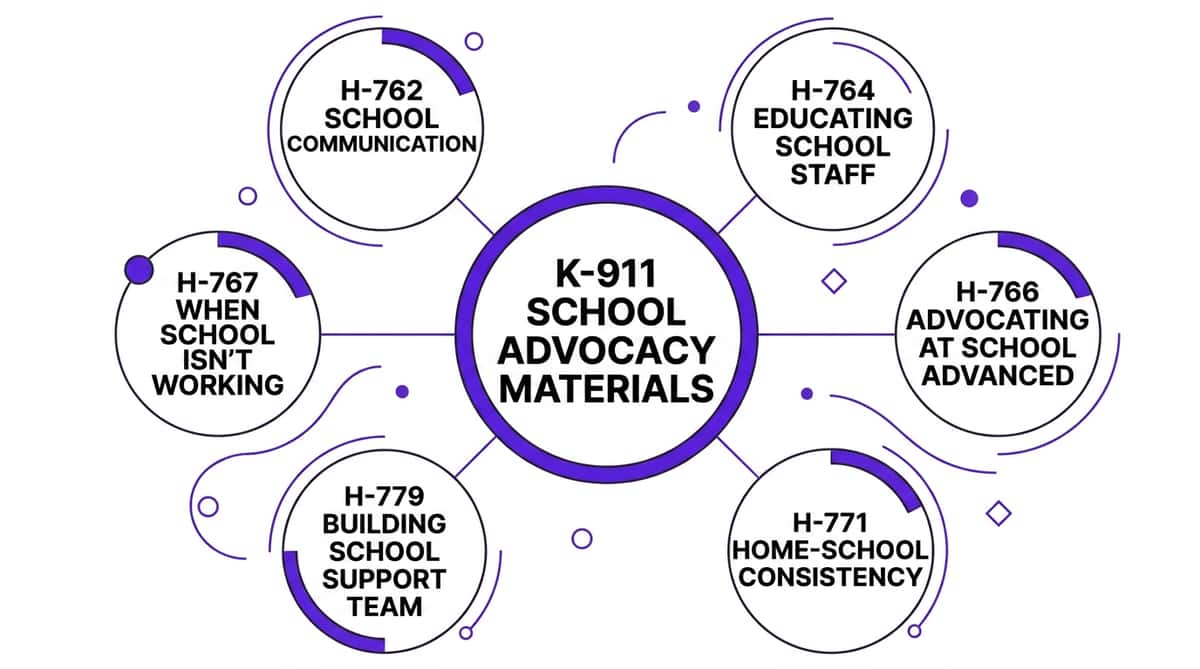
School Is Collaborative
→ H-771: Home-School Consistency Materials
School Is Resistant
→ H-766: Advocating at School — Formal Rights Track
Child Struggling with Transitions
→ H-711: School Transition Materials
Need Professional Backup
→ H-764: Educating School Staff Materials
Long-Term Developmental Goal This Feeds: School Advocacy → Educational Access → Academic Progress → Social Integration → Transition to Post-School Life → Independent Living Readiness
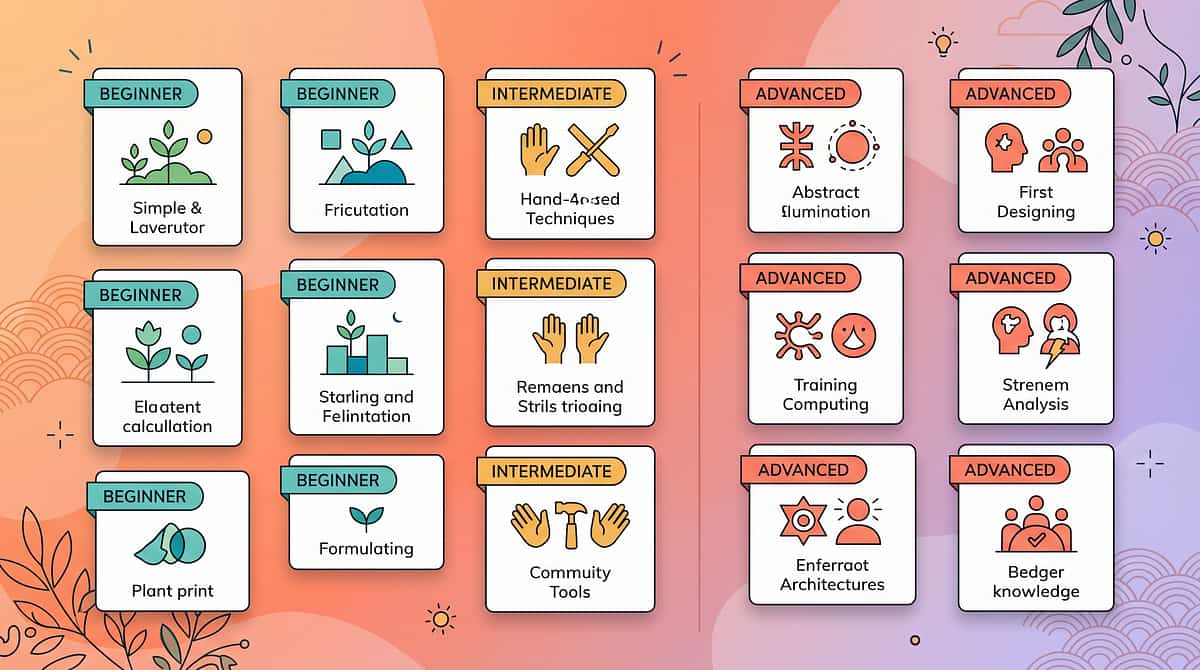
You're Building a Complete Parent Empowerment System. These Are Your Adjacent Techniques.
Technique | Code | Level | Key Material | |
9 Materials That Help Advocating at School | H-766 | 🔵 Advanced | Full IEP Rights Toolkit | |
9 Materials That Help With School Communication | H-762 | 🟢 Core | Communication Templates | |
9 Materials That Help Educating School Staff | H-764 | 🟡 Intermediate | Staff Briefing Materials | |
9 Materials That Help With Home-School Consistency | H-771 | 🟢 Core | Joint Planning Tools | |
9 Materials That Help Building School Support Team | H-779 | 🔵 Advanced | Team Coordination System | |
9 Materials That Help When School Isn't Working | H-767 | 🔵 Advanced | Escalation + Alternative Planning |
"You Already Own Materials For These": If you've built the 9 materials in K-911, you already have the core infrastructure for H-762, H-764, and H-771. Those techniques use subsets and extensions of what you've built here.
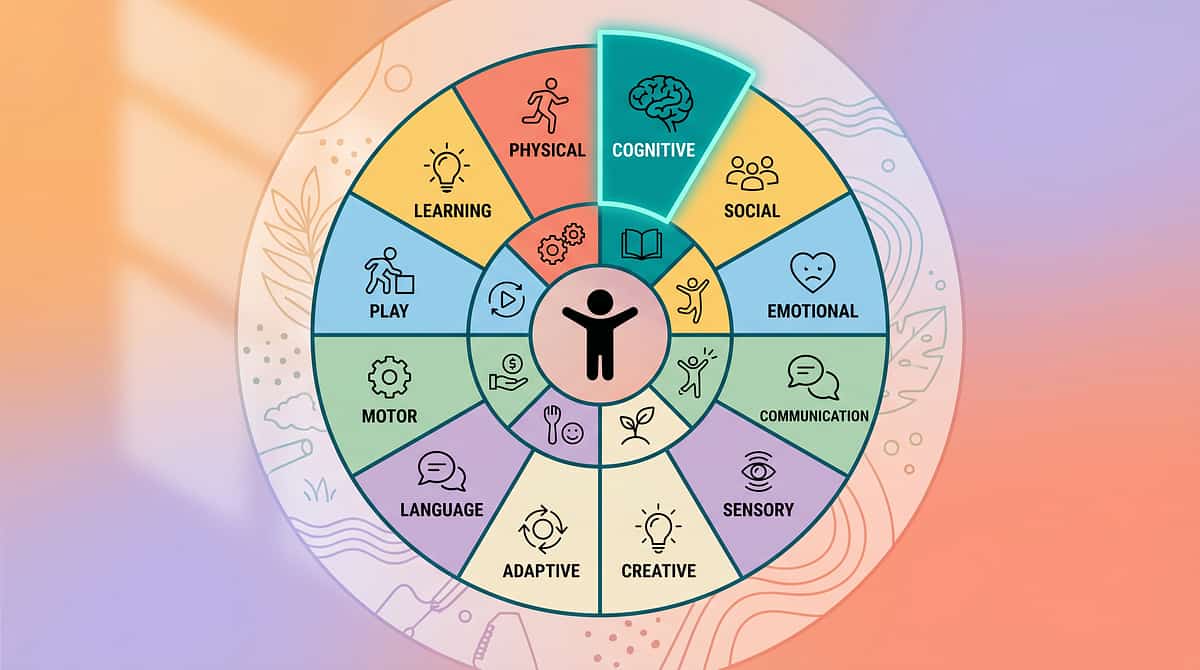
School Advocacy Is One Spoke in a 12-Domain Developmental Wheel. See the Full Picture.
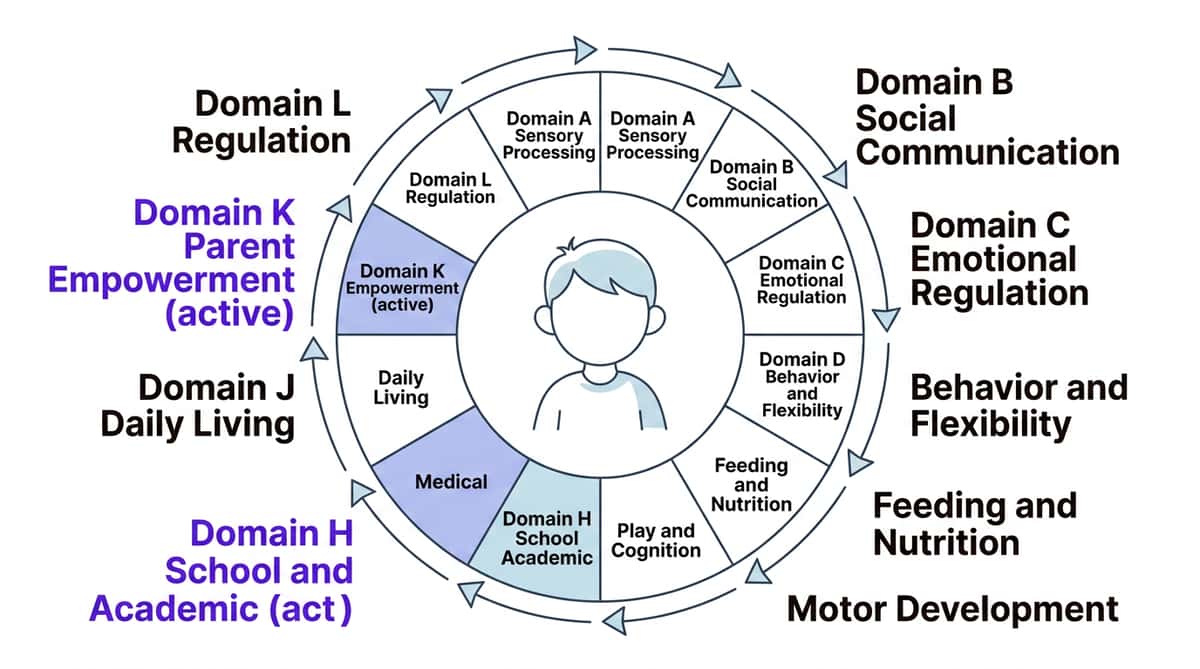
K-911 Domain Position
Primary Domain: K — Parent Empowerment & Navigation
Secondary Domain: H — School & Academic
Both domains are simultaneously active in this technique. Parent Empowerment (K) is the multiplier domain — a more empowered parent produces better outcomes across all 11 child-facing domains.
GPT-OS® Integration
Your child's AbilityScore® across all 12 domains is visible in GPT-OS®. The Parent Empowerment Index in Domain K directly correlates with outcome improvements across Domains B, C, D, and H in Pinnacle's 20M+ session data.
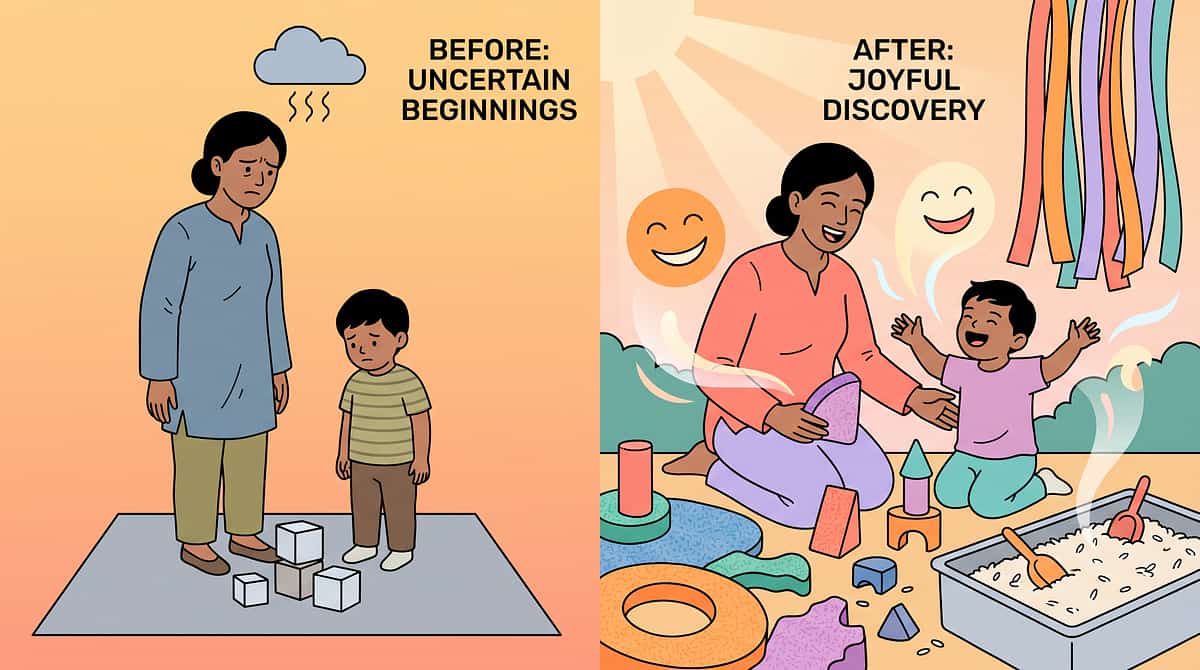
From Feeling Lost to Fighting Effectively. Three Families. Three Journeys.
Hyderabad | Child: 8 years | ASD Level 2
Before: "I sat in six IEP meetings and signed whatever they put in front of me. My son's reading was getting worse, not better, but they kept saying 'he's making progress.' I felt stupid every time I asked a question."
After (8 months with K-911 materials): "I walked into the review meeting with 4 months of goal tracking data showing zero progress on the reading goal. I asked: 'What data shows this intervention is working?' The room went quiet. We redesigned the goal that day. My son now has a specialist reading teacher."
Bengaluru | Child: 12 years | ADHD + Learning Disability
Before: "My daughter was being told to 'try harder' for three years. Teachers thought she wasn't motivated. Every meeting I came home crying."
After: "Once I understood Section 16 of the RPwD Act, I knew she had a right to accommodation. I requested reduced workload and extended time in writing. They implemented it. Her grades improved within one term."
Mumbai | Child: 6 years | First IEP
Before: "We got the autism diagnosis at 5 and within months were in an IEP meeting. We had no idea what to say. We agreed to everything. Six months later, nothing was different."
After: "The second IEP, we came with a child profile, a binder with all therapy reports, 10 questions, and my mother as note-taker. Every goal was specific. Every service had a frequency. We finally felt like partners, not outsiders."

You Are Not Navigating This Alone. 18 Million Families in India Are on This Path With You.
WhatsApp Groups (Pinnacle Network)
School Advocacy Parents India | IEP Navigation India | RPwD Act Parents Network. All groups are moderated by SpEd professionals — active, supportive, and confidential. Join via Helpline: 9100 181 181
Online Forums
pinnacleblooms.org/community | Special Saathi (India autism parent community) | Action for Autism India: autism-india.org
Local Pinnacle Parent Meetups
Monthly parent empowerment workshops at 70+ Pinnacle centers. "Advocacy Prep Workshops" — bring your binder, practice your questions in a safe environment before the real meeting.
Peer Mentoring
Connect with a parent who has successfully navigated advocacy at your child's current stage. Once your system is working, your journey becomes a map for families just starting. Request via Helpline: 9100 181 181
Home Advocacy + Professional Support = Maximum Impact.
Building your 9 materials is powerful. Adding professional clinical support to your advocacy amplifies your effectiveness and carries institutional weight that parent communication alone cannot always achieve.
🎓 What a Pinnacle SpEd Can Do
- Review your child's IEP and flag inadequate goals
- Write letters supporting specific accommodations
- Attend meetings as your professional advocate (select centers)
- Translate assessment reports into actionable meeting language
- Review proposed educational plans before you sign
🖐️ What a Pinnacle OT Can Do
- Document sensory and functional needs in school-actionable language
- Provide OT assessment report for school accommodation requests
- Recommend specific classroom modifications with clinical authority
📊 What a Pinnacle BCBA Can Do
- Provide Functional Behavior Assessment (FBA) for school concerns
- Write Behavior Support Plans in school-compatible format
- Advocate for positive behavior intervention approaches in the classroom
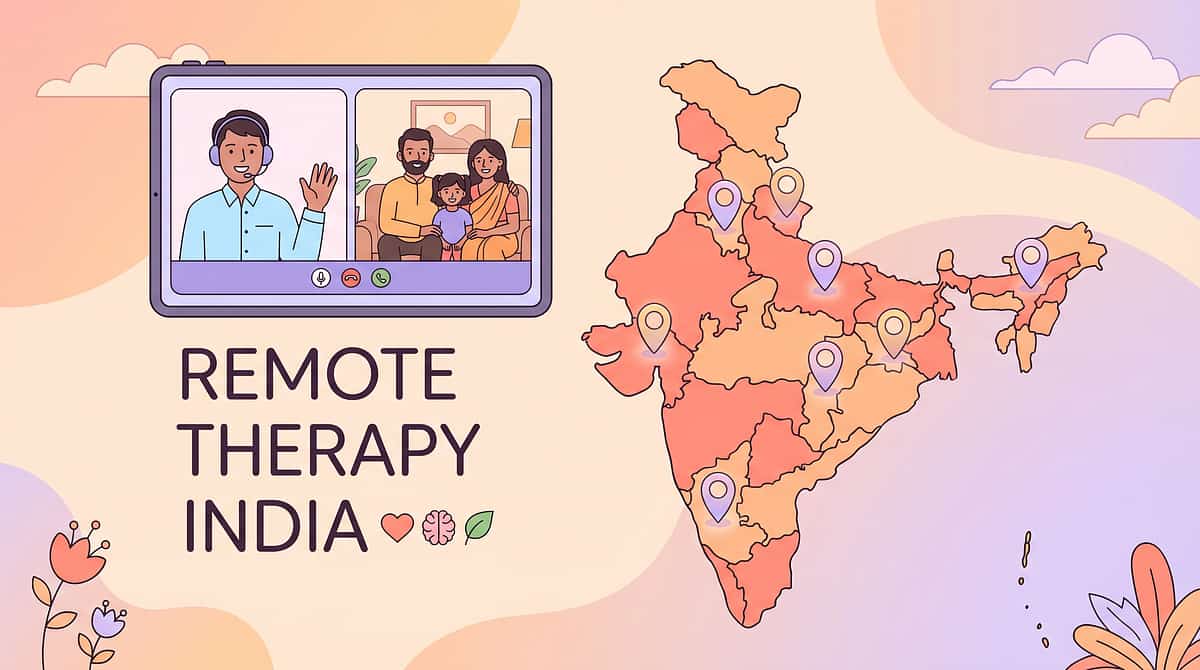
Teleconsultation for Remote Families
Can't reach a center? Book a teleconsultation with a Pinnacle SpEd for meeting preparation support, IEP review, and advocacy coaching from anywhere in India.
Find Your Nearest Center
70+ centers across India. Walk in with your binder. Leave with a professional advocacy plan.
📞9100 181 181 | FREE | 16+ Languages | 24×7
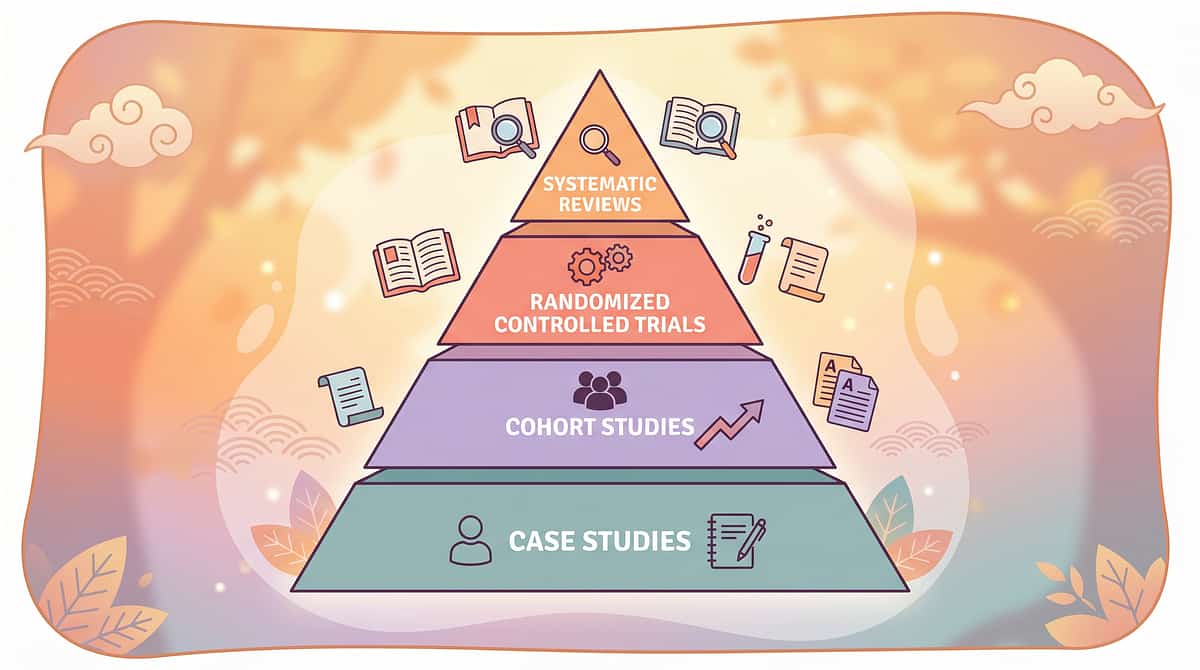
Evidence-Based. Not Opinion-Based. The Science Supports This System.
Systematic Reviews
Multiple RCTs pooled — Highest Evidence
RCTs
Controlled trials — High Evidence
Cohort Studies
Observational — Moderate Evidence
Case Studies
Clinical reports — Baseline Evidence
1. Parent Participation in IEP Processes
Parent Center Hub Systematic Review: Active parent involvement is associated with higher quality educational plans and better child outcomes across all disability categories. → parentcenterhub.org
2. RPwD Act 2016 — India
Legal basis for all school advocacy rights for children with disabilities in India. Sections 16–18 specifically address inclusive education obligations. → disability.ncog.gov.in
3. Padmanabha et al. (Indian J Pediatr, 2019)
Indian RCT: Family-based interventions integrated with school coordination demonstrated significant developmental outcomes. Parent-professional collaboration was the critical moderating variable. → DOI: 10.1007/s12098-018-2747-4
4. WHO Nurturing Care Framework (2018)
Population-level evidence for parental capacity as primary driver of child developmental outcomes. Implemented across 54 LMICs. → nurturing-care.org
5. NCAEP Evidence-Based Practices Report (2020)
Visual supports and structured advocacy tools classified as evidence-based practices for autism. Parent-mediated interventions show strong evidence across multiple studies. | PMC11506176 | PMC10955541
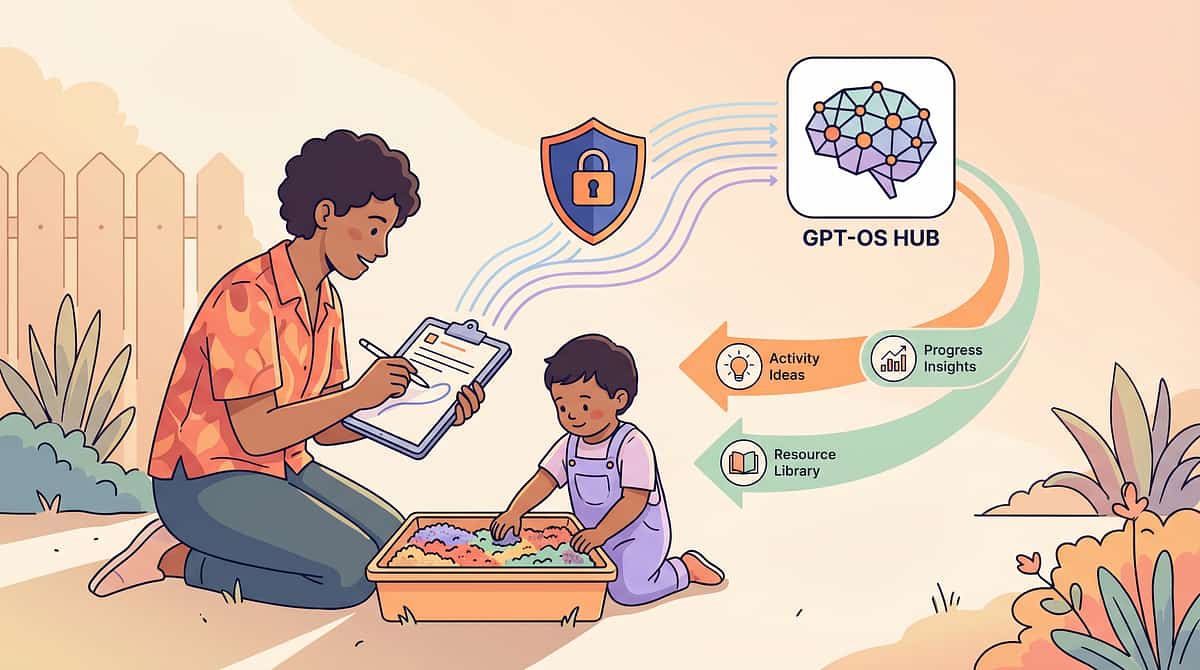
Your Advocacy Data Makes Your Child's Therapy Smarter — and Helps Millions of Children Like Yours.
What GPT-OS® Learns From K-911
- Which advocacy tools correlate with faster school responsiveness
- Which meeting preparation approaches reduce conflict while increasing outcomes
- Which escalation pathways are most effective in different school types across India
- Which parent empowerment materials predict strongest child educational outcomes
Privacy & Data Protection
- All data is anonymised at the population analysis level
- Individual family data is private — accessible only to your designated Pinnacle therapist team
- Compliant with Indian IT Act data protection provisions
- You own your data. You can request deletion at any time.
"Every K-911 session tracked in GPT-OS® contributes to the population-level learning engine that makes recommendations better for the next family, the next city, the next generation of parents navigating this system."
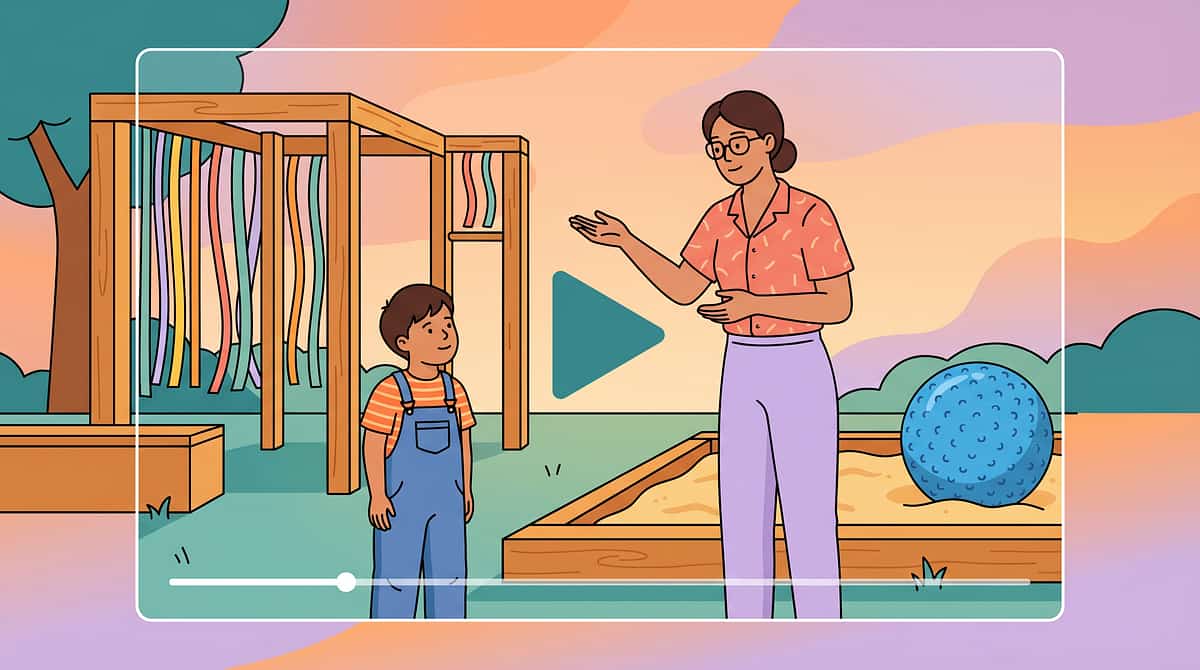
See the Advocacy Materials Demonstrated. Watch a Pinnacle SpEd Walk Through All 9 Tools.
H-766
School Partnership Reel Series
60–90 Seconds
In this reel, our Lead Special Educator at Pinnacle walks through the 9 materials that transform school advocacy from overwhelming to systematic. Watch the binder build. See the question bank in action. This is what prepared looks like.
Related Reels in the School Advocacy Series
H-762
9 Materials That Help With School Communication
H-764
9 Materials That Help Educating School Staff
H-766
Advocating at School ← You are here
H-771
9 Materials That Help With Home-School Consistency
H-779
Building School Support Team
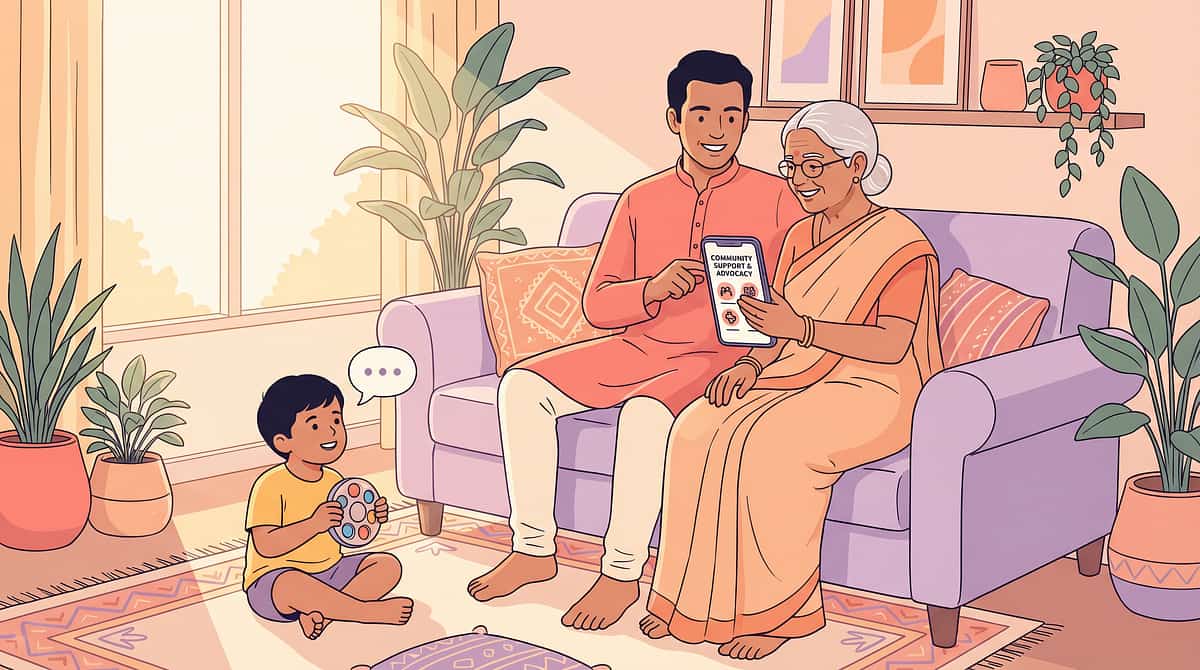
Advocacy Works Best When the Whole Family Speaks the Same Language.
For Spouses & Co-Parents
Your co-parent needs to understand the advocacy system too. If they attend meetings without the same preparation, you lose half your advocacy power. Share this page. Brief them using the Support Person Briefing Guide (Material 7).
For Grandparents — Simplified Version
"Here's what you need to know: [Child's name] has rights at school. Their parents are building a system to make sure those rights are honoured. You can help by: (1) Supporting the parent advocate before and after meetings. (2) Trusting the system — don't question the approach. (3) Asking: 'How did the meeting go? What can I do to help?'"
For Teachers and School Staff
"This page exists to help parents become better partners for you. Prepared parents don't create conflict — they create clarity. If a parent comes to your meeting with a binder and prepared questions, they are trying to collaborate with you, not confront you."

Frequently Asked Questions
Your questions, answered — before you need to ask. These are the questions most commonly raised by families across Pinnacle's 70+ centers and 9100 helpline.
Q1: My child goes to a private school. Do these rights still apply?
Yes. The RPwD Act 2016 applies to all schools in India — government and private, aided and unaided. Escalation for private schools goes through the CBSE/ICSE board complaint mechanism and then the State Commissioner for PwD.
Q2: The school says they need a formal diagnosis before providing any support. Is that correct?
Partially. While a formal diagnosis strengthens your position, schools cannot refuse all support pending diagnosis. Under RTE and RPwD frameworks, a child showing signs of disability is entitled to assessment and preliminary support. Request assessment in writing.
Q3: I've already signed the IEP. Can I change my mind?
Yes. Parent consent to an IEP or support plan can be withdrawn or modified at any time. Request a review meeting in writing and state that you'd like to revisit goals based on new information or concerns.
Q4: The school says they don't have resources for the accommodation I'm requesting. What do I do?
Document the refusal immediately. Resource limitations do not override legal obligations under the RPwD Act. Schools must provide "reasonable accommodation." This is a trigger for escalation: BEO/DEO → State Commissioner for PwD.
Q5: Can I record the meeting?
Recording laws vary by state. In most Indian states, you may record with the informed consent of all participants. If refused, take detailed handwritten notes — and your post-meeting follow-up email serves the same accountability function.
Q6: How do I find a special education advocate in India?
Contact: National Trust → nationaltrust.gov.in | Disability Rights India Foundation → drif.org.in | Action for Autism → autism-india.org | Your nearest Pinnacle center → 9100 181 181
Q7: My child's teacher makes dismissive comments about autism. What do I do?
Document exact words, date, and context immediately. Speak to the teacher first. If it continues: written complaint to principal. If no change: BEO/DEO. Schools have obligations under RPwD Act to prevent discrimination.
Q8: I feel like I'm fighting alone. Is there a community?
Yes. See Card 32. Pinnacle's WhatsApp groups and parent meetup network connect families navigating identical challenges. You are not alone. 18+ million families in India are on this journey.
Your Child's Next School Year Doesn't Have to Look Like the Last One.
Every week without a functioning advocacy system is a week your child's educational rights may go unmet. Start today. Start with one document. Build one section of one binder. Ask one question in writing. The system starts with your first act.
📞9100 181 181 | Free | 24×7 | 16+ Languages | National Autism Helpline — Always available.
🌸 Validated by the Pinnacle Blooms Consortium — OT • SLP • ABA/BCBA • SpEd • NeuroDev Pediatrics • CRO • Regulatory • WHO/UNICEF-Aligned
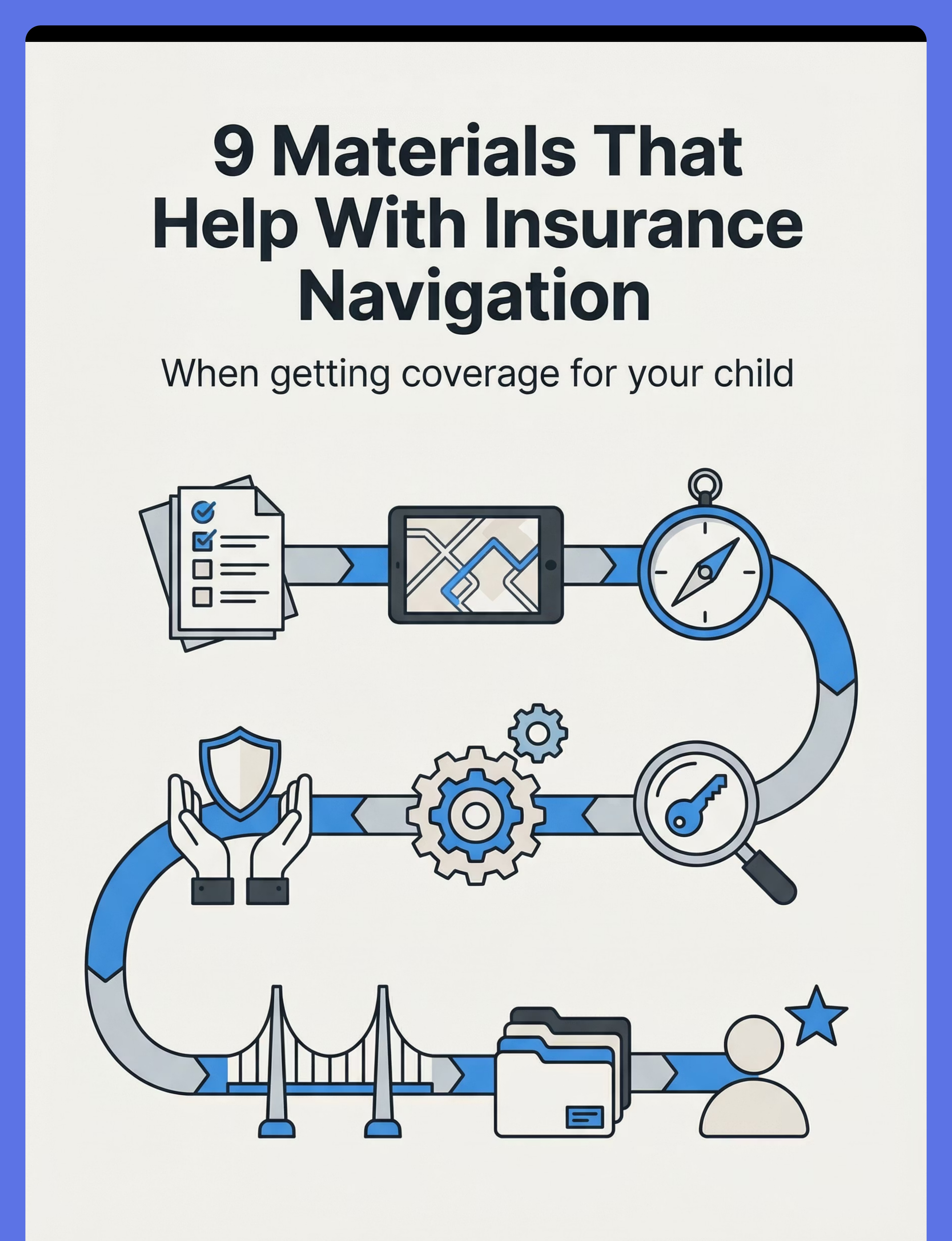
Preview of 9 materials that help with insurance navigation Therapy Material
Below is a visual preview of 9 materials that help with insurance navigation therapy material. The pages shown help educators, therapists, and caregivers understand the structure and content of the resource before use. Materials should be used under appropriate professional guidance.









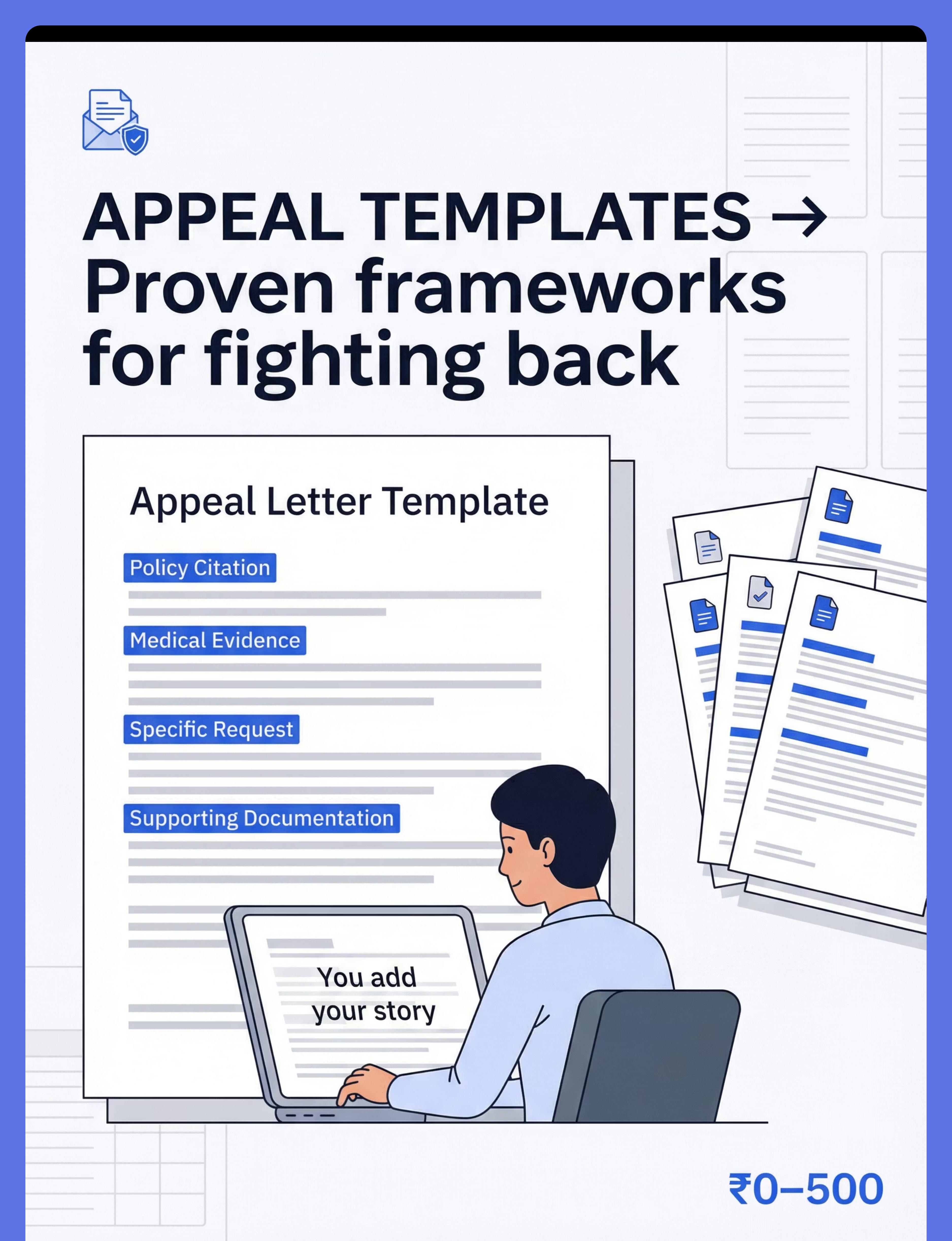
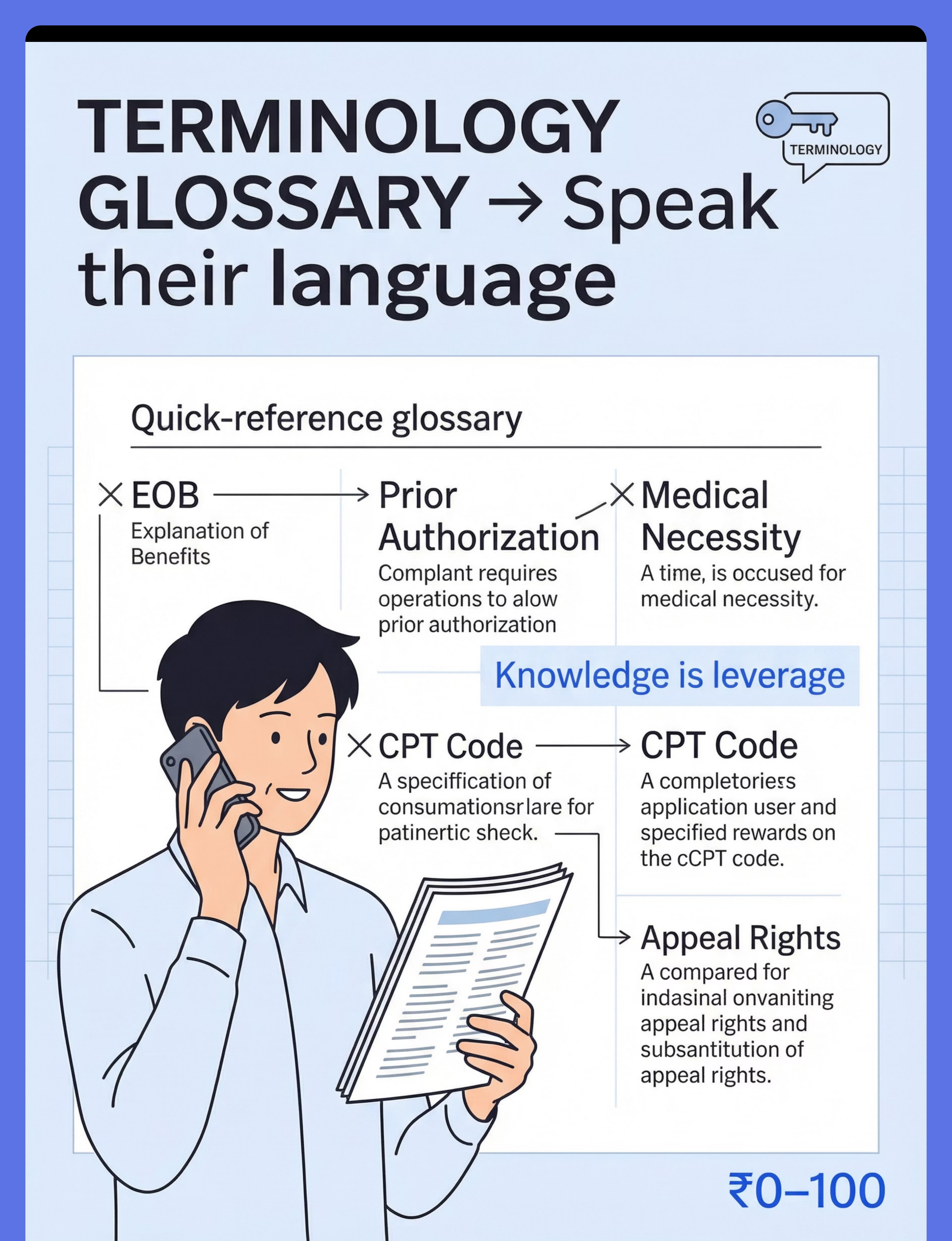
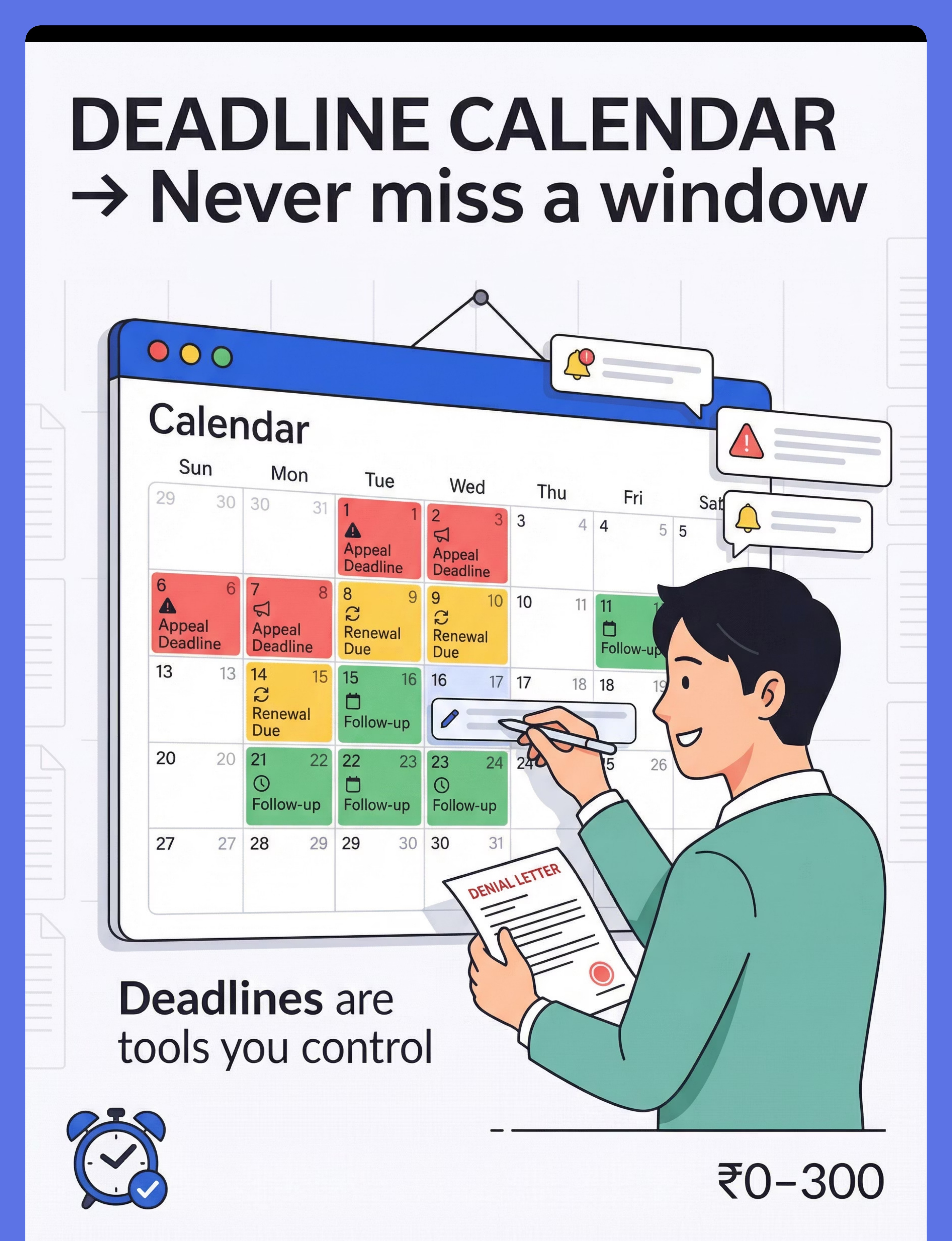
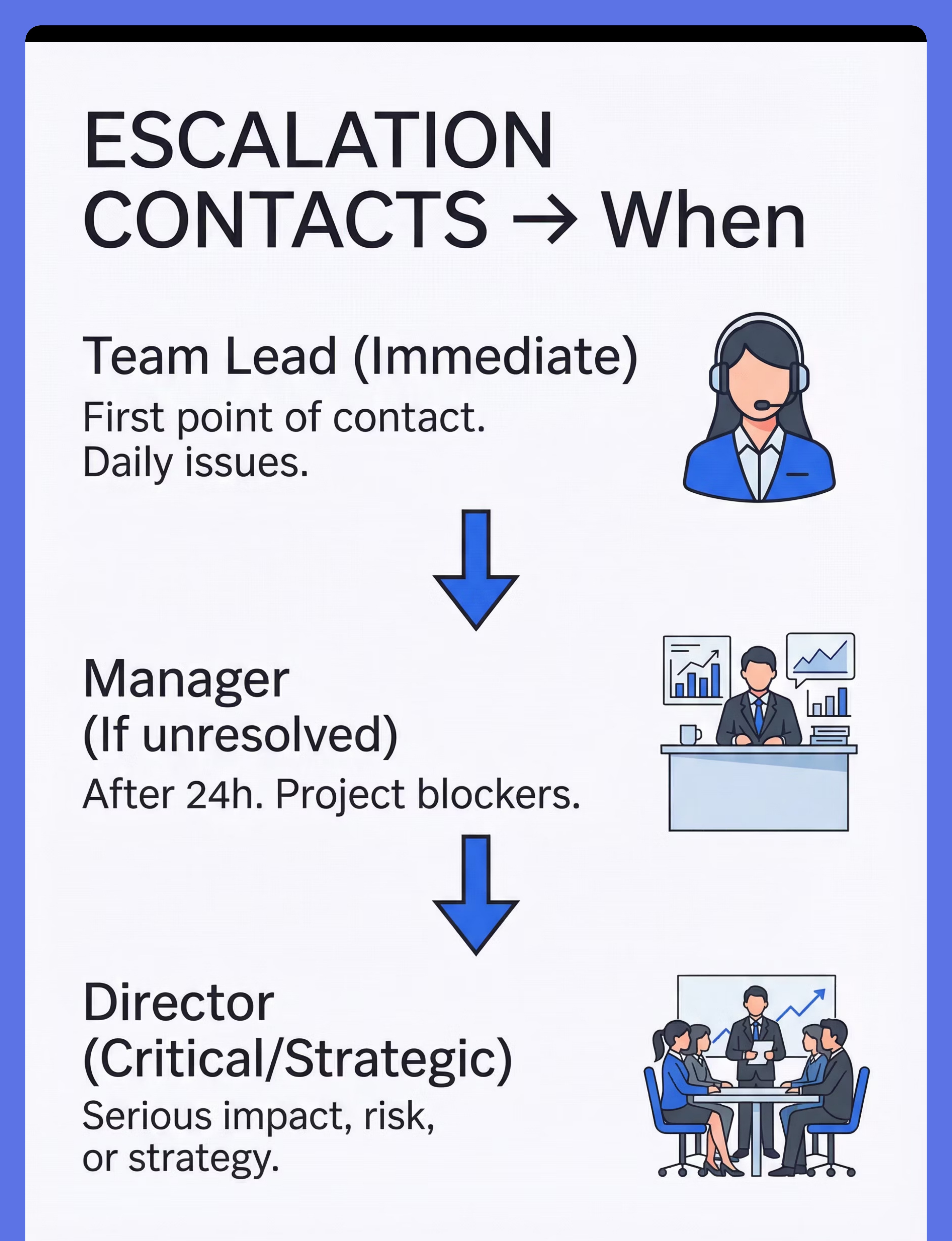

Link copied!

🌸 Pinnacle Blooms Network®
Built by Mothers. Engineered as a System.
🖐️ OT
💬 SLP
📊 ABA/BCBA
🎓 SpEd
🧠 NeuroDev
🔬 CRO
⚖️ Regulatory
"From fear to mastery. One technique at a time."
You arrived on this page afraid of the school system, uncertain of your rights, and unsure of your voice. You leave with a complete advocacy system — 9 materials, a clear legal framework, a professional support network, and the confidence that comes from knowing exactly what to do next. Your child's educational rights are not negotiable. Your voice is the mechanism that protects them. And now, that voice is equipped.
Medical & Legal Disclaimer: This content is educational and does not replace individualised legal advice from special education advocates or attorneys. Educational rights and processes vary by country, state, and school type. For therapeutic and developmental assessment, contact qualified professionals. Individual results may vary. Statistics represent aggregate outcomes across the Pinnacle Blooms Network®.
CIN | DPIIT | MSME | GSTIN | |
U74999TG2016PTC113063 | DIPP8651 | TS20F0009606 | 36AAGCB9722P1Z2 |
© 2026 Pinnacle Blooms Network®, unit of Bharath Healthcare Laboratories Pvt. Ltd. All rights reserved.
📞9100 181 181 | FREE | 24×7 | 16+ Languages
The National Autism Helpline. For every family. At every hour.
The National Autism Helpline. For every family. At every hour.