

When the skills are there but the independence isn't
Independent meals aren't just about utensil skills — they're about executive function, self-regulation, and routines working together.
Daily Living Skills — Episode 490
Age 3–10 Years
Pinnacle Blooms Consortium®
"My child is 5. Can use a spoon and fork perfectly — when I'm sitting right there. But the moment I step away, it's chaos. Food gets cold because they're distracted. Two bites in and they say they're done. They can't open their juice box. Breakfast takes 45 minutes of constant reminders. They have all the skills — they just can't put them together into an actual meal. What's missing?"
You are not failing. Your child's executive brain is still building its scaffold.

You are among millions of families navigating this exact challenge.
1 in 36
Executive Function Differences
Children in India show developmental differences in executive function by age 5. CDC/ICMR data 2023
72%
Daily Mealtime Burden
Of parents report mealtime management consuming 30+ minutes of active supervision daily. Pinnacle Center Survey 2024
20M+
Therapy Sessions Delivered
1:1 therapy sessions delivered by Pinnacle across feeding and daily living domains. GPT-OS® Outcomes Database
Independent mealtime failures are not behavioral — they are neurological. A child who can use utensils perfectly under supervision but fails to string together a complete meal is showing a classic executive function gap: the motor scaffold is in place; the brain's sequencing, initiation, and self-regulation architecture is still under construction.
Globally, 1 in 100 children are diagnosed with autism spectrum disorder (WHO, 2023). Executive function delays affect children across ASD, ADHD, developmental delays, and sensory processing differences. Across these populations, mealtime independence is among the top 5 functional skill goals reported by families. You are not alone — and this is precisely what structured, material-supported home intervention resolves.

This is not defiance. This is neurology.
What's Happening in the Brain
🧠 Prefrontal Cortex — Executive function command center. Responsible for task initiation, sequencing, working memory, time perception, impulse control. Fully matures at age 25. Develops unevenly in children with ASD, ADHD, or developmental differences.
🧠 Working Memory Circuit — Holds "what comes next" during a meal sequence. When taxed, children forget napkins, skip bites, say "done" too early — not because they don't know, but because they can't hold the sequence.
🧠 Interoceptive Pathways — Hunger and fullness signals. When underdeveloped, children don't feel hungry, don't recognize satiety, and cannot self-pace a meal.
What You See vs. What's Happening
What you see: "They know how to use a fork but won't eat." What's happening: The prefrontal cortex isn't fully routing the initiation signal. The child needs an external cue to start.
What you see: "They forget the napkin every single time." What's happening: Working memory is occupied with eating mechanics. The napkin step falls off the stack.
What you see: "They say done after 2 bites." What's happening: Interoceptive awareness is incomplete — they can't feel "still hungry." A portioned plate fills this gap.
This is a wiring difference, not a willpower problem. External supports don't replace brain development — they run parallel to it, enabling practice until the wiring catches up.

Your child is here. Here is where we're heading.
Age 1–2 | Toddler
Self-feeding with mess. Basic exploration of utensils and food.
Age 3–4 | Preschool
Basic routine with prompting. Sits at table, beginning awareness of meal steps.
Age 5–6 ⭐ Primary Intervention Window
Skills present — moderate supervision gap common. Motor skills established; EF architecture under construction. Optimal time for E-490.
Age 7–10 | School Age
Full independence for familiar meals, basic setup and cleanup. Social dining begins.
Age 10+ | Adolescent
Independence across all settings. Social dining with age-appropriate behavior.
Ages 5–7 represent the primary intervention window. Children who show mealtime independence gaps at this age commonly also experience difficulty with morning routines, homework initiation, transitioning between activities, and school cafeteria independence. These co-occurrences confirm a domain-level executive function pattern. The materials on this page address the underlying pattern.

Clinically validated. Home-applicable. Parent-proven.
⬡ LEVEL I EVIDENCE
Pinnacle Consortium Verified
Systematic Reviews + RCTs
Pillar 1 — Visual Supports (Level I)
PRISMA systematic review (2024) across 16 studies: Visual support systems are classified as an evidence-based practice for children with ASD by NCAEP (2020). Effect demonstrated across mealtime sequencing, self-monitoring, and routine adherence. PMC11506176
Pillar 2 — Self-Monitoring (Level I–II)
Multiple systematic reviews demonstrate that child-directed self-monitoring shifts internal regulation, reduces adult prompting dependency, and builds metacognitive awareness — the foundation of true independence in daily living skills.
Pillar 3 — Environmental Scaffolding (Level II)
Organized environments reduce cognitive load, allowing developing executive function capacity to be directed at task execution. Portioned plates, visual placemats, and cleanup stations have a direct evidence base. PMC10955541
Pillar 4 — Indian RCT (2019)
Home-based structured interventions with parent-administered visual supports demonstrated significant outcomes in Indian pediatric populations specifically. Padmanabha et al., Indian Journal of Pediatrics. DOI: 10.1007/s12098-018-2747-4
8/10
Evidence Strength
9/10
Home Applicability
9/10
Parent Delivery
10/10
Age 3–10 Appropriateness
📞 Questions about your child's profile? FREE: 9100 181 181 (16+ languages, 24×7)
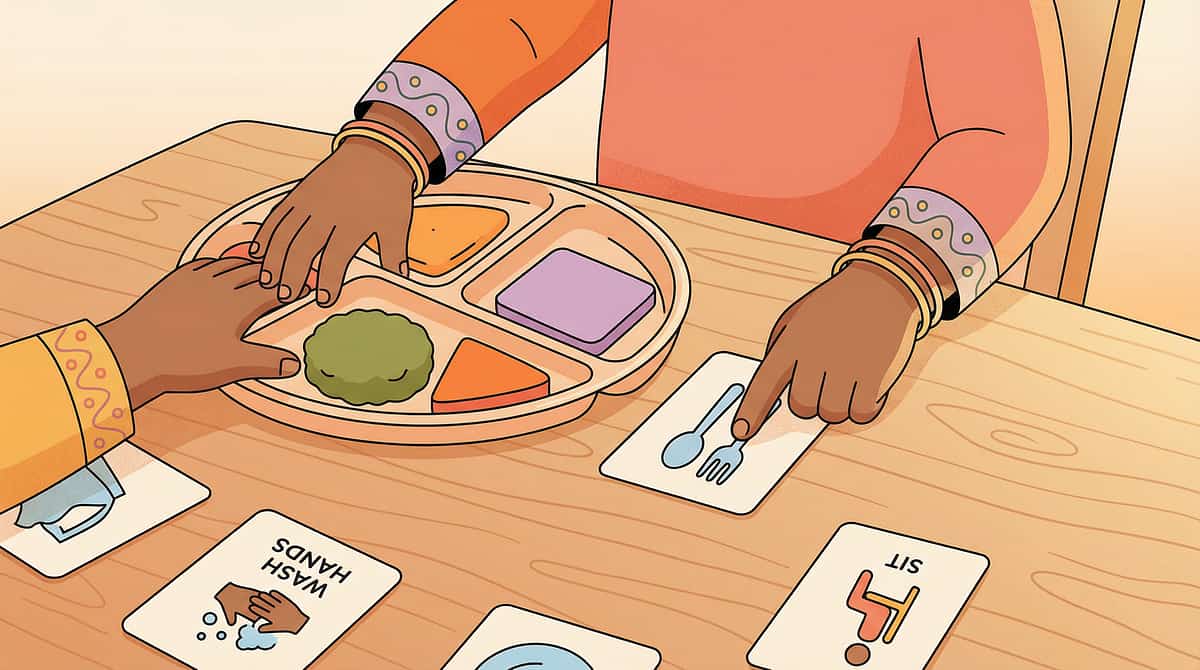
E-490: The Independence Kitchen
Domain E: Daily Living Skills
Episode 490
Formal Definition
Independent Meals (Mealtime Independence / Feeding Autonomy) refers to the child's capacity to manage a complete meal — from sitting down to cleanup — with minimal adult intervention, across familiar settings. It requires integration of: motor skills (utensil use, container access, pouring), executive function (initiation, sequencing, pacing, completion monitoring), self-regulation (sustained attention, hunger/satiety awareness, impulse control), and organizational abilities (spatial arrangement, routine following, cleanup).
In Plain Parent Language
"It's the difference between a child who can use a fork and a child who can sit down, eat a full meal at an appropriate pace, manage their drink without spills, use their napkin, recognize when they're done, and clear their plate — all without you standing over them."
Age: 3–10 years Sessions: Built into mealtimes — 3×/day Programme: 6–8 weeks for internalization Target: Full mealtime autonomy across settings
🍽 Feeding Independence
🧠 Executive Function
⚙️ Self-Regulation
🏡 Daily Living Skills
🎓 School Readiness

This technique crosses therapy boundaries — because the brain doesn't organize by therapy type.
🔵 Occupational Therapy (Primary Lead)
OT owns material selection, environmental setup, and executive function scaffolding. The portioned plate, placemat, and cleanup station are therapeutic tools, not convenience items. Each targets a specific independence barrier.
Primary application: Environmental scaffolding, tool selection, self-care skill sequencing, adaptive equipment prescription.
🟣 ABA / BCBA
Behavior analysis addresses the reinforcement architecture. The First-Then Board is ABA's contingency made visible. The self-monitoring checklist is ABA's self-management procedure applied to mealtime.
Primary application: Self-monitoring systems, reinforcement scheduling, prompting hierarchy, behavioral data collection.
🟠 Special Education
SpEd brings the visual literacy framework. Following a visual schedule at mealtime is the same skill used in classroom activity schedules. Mealtime independence IS school readiness.
Primary application: Visual schedule construction, symbol selection, routine instruction, generalization programming.
🟢 Neurodevelopmental Pediatrics
NeuroDev provides the clinical overlay. ADHD requires time-perception tools. Autism requires predictability and visual structure. DCD requires motor access tools. The materials are prescribed, not guessed.
Primary application: Profile diagnosis, contraindication review, medication timing, developmental prognosis.

E-490 is a precision intervention. Here is exactly what it hits.
Before E-490
"BITE. BITE. Take a bite. Use your napkin. NAPKIN. Take a drink. Are you done? You're not done." — Repeated 10+ times per meal, every meal, every day.
After E-490 (Week 6–8)
Child sits, references visual schedule, eats at timer pace, self-checks with checklist, clears plate unprompted. Parent is eating their own breakfast.
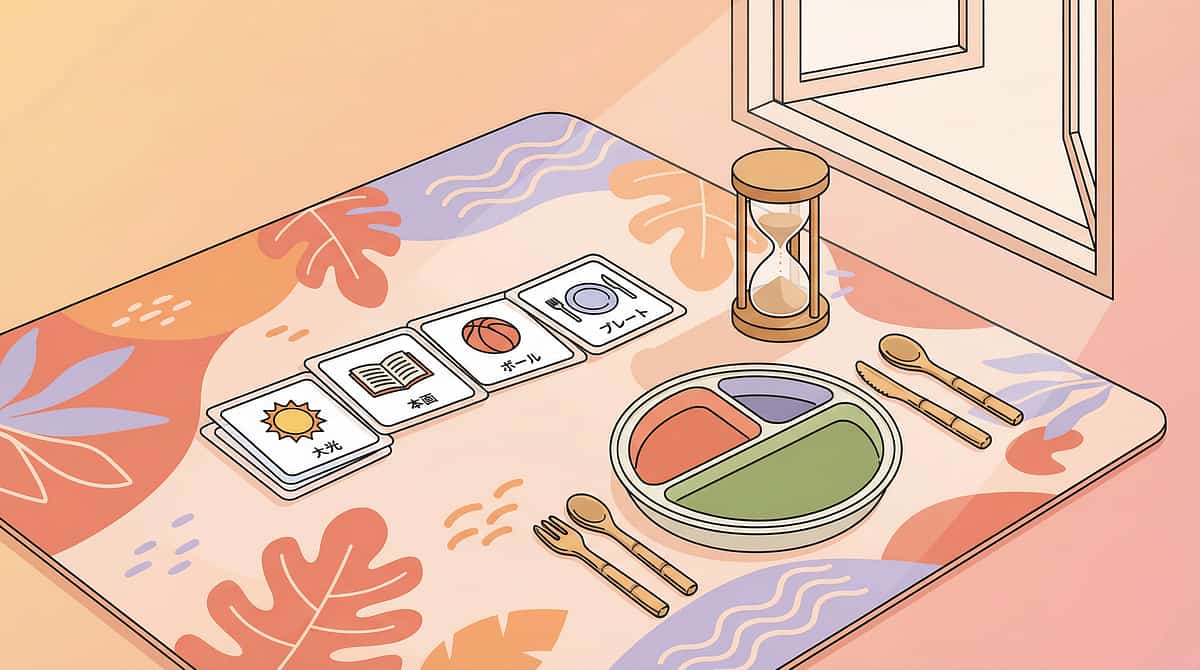
9 clinician-selected materials. Every independence barrier addressed.
These materials are prescribed by the Pinnacle OT + ABA + SpEd Consortium. Each targets a specific, identified independence barrier. Not a shopping list — a therapeutic toolkit.
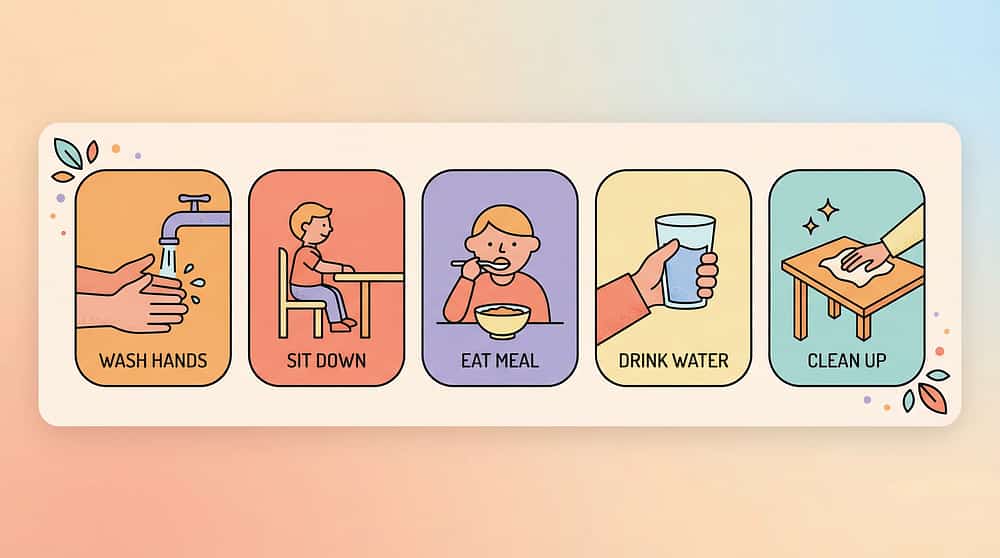
1. Visual Mealtime Schedule
Targets: Sequencing failure, initiation difficulty, working memory gaps. Externalizes the mealtime sequence so working memory isn't overwhelmed.
₹200–600 (printable) | ₹500–1,500 (laminated)
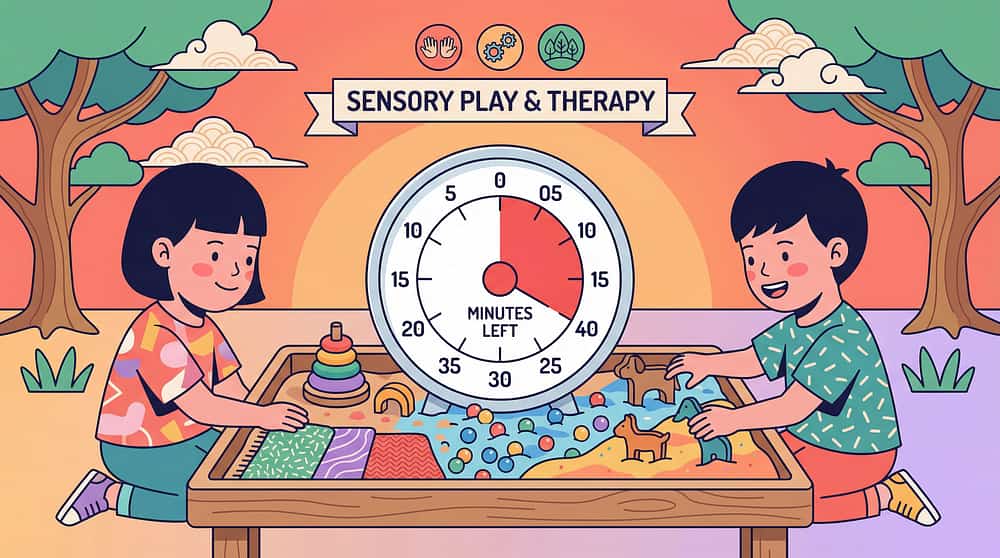
2. Visual Timer / Time Timer
Targets: Time blindness, slow eating, fast eating. Makes abstract time concrete and visible.
₹800–2,500

3. Portioned / Divided Plate
Targets: Portion overwhelm, "done after 2 bites," unclear meal endpoint. Shows exactly what "enough" looks like.
₹300–1,000

4. Smart Drink Container / No-Spill Cup
Targets: Drink access failures, spill anxiety. Enables self-managed drinking without parent monitoring.
₹250–800

5. Easy-Open Containers
Targets: Container access failures — the #1 barrier to school lunch independence. Every accessible container is one less request for help.
₹400–1,200 (set)

6. Self-Monitoring Checklist / Token Board
Targets: Attention drift, behavior monitoring dependency. Shifts monitoring from parent to child — this IS the independence building.
₹100–400 (printable) | ₹300–800 (commercial)

7. Visual Placemat with Spatial Cues
Targets: Spatial disorganization, chaotic eating space. Makes invisible organizational expectations explicit — plate goes here, cup goes there.
₹150–500
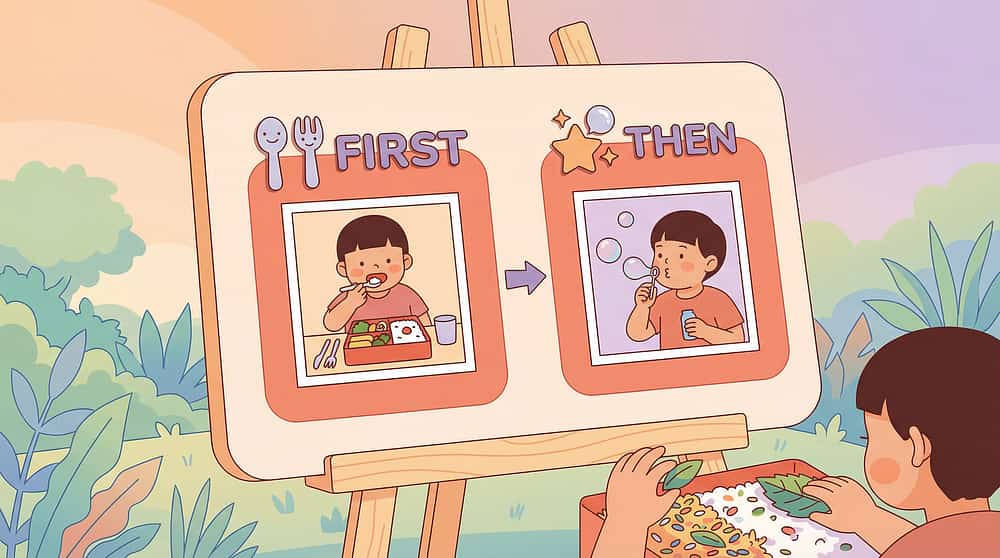
8. First-Then Board / Meal Reward Visual
Targets: Low internal motivation, premature meal abandonment. Externalizes motivation and keeps the contingency visible throughout the meal.
₹150–500
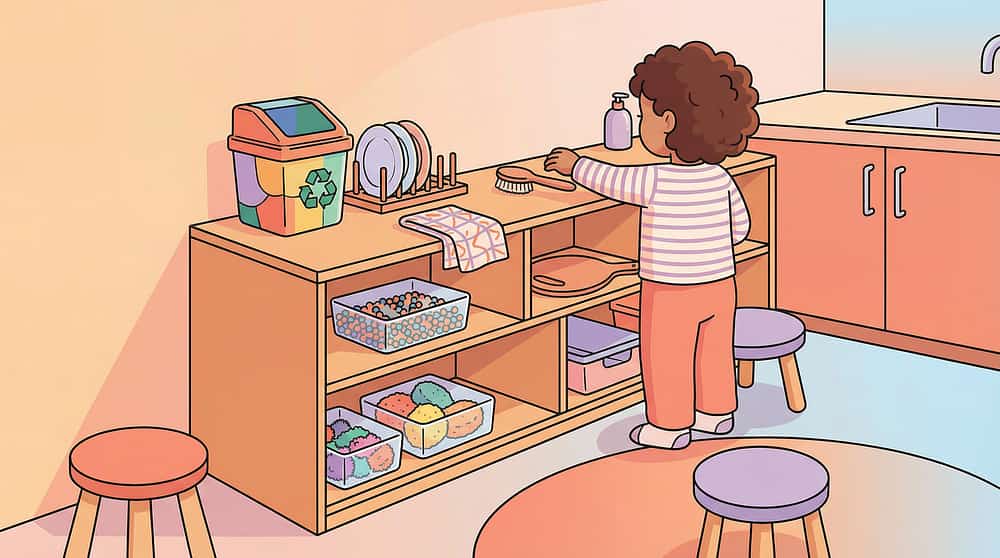
9. Mealtime Cleanup Station
Targets: Incomplete meal routines. True independence extends to cleanup — the meal isn't finished until it's truly finished.
₹300–800 (station setup)
Total Investment: Comprehensive setup ₹2,000–7,000 | Essential Starter Kit (Materials 1+2+3+5): ₹1,700–4,300 | Zero-cost DIY version: ₹0 — See next card.

Every family can start today. Including yours.
WHO/UNICEF equity principle: Every child deserves access to evidence-based intervention regardless of economic context. These substitutes work on identical therapeutic principles.
Material | 🛒 Purchase Option | 🔧 DIY / Household Substitute | |
Visual Schedule | Printed/laminated card set ₹200–600 | Print free templates + page protector + dry-erase marker. OR: Draw stick figures on index cards + binder ring. | |
Visual Timer | Time Timer brand ₹800–2,500 | Free phone app "Visual Timer for Kids" OR: Sand timer (₹50 at stationery shop). | |
Portioned Plate | Divided plate ₹300–1,000 | Regular plate + small bowl for one food group OR: Draw portion divisions on plate with food-safe marker. | |
Smart Cup | Adaptive no-spill cup ₹250–800 | Travel mug with secure lid + straw OR: Any cup with a lid the child can independently manage. | |
Easy-Open Containers | Flip-lid lunch containers ₹400–1,200 | Pre-loosen all lids before packing. Cut snack bag corners. Use ziplock bags (easier than clip-lock). | |
Self-Monitoring Checklist | Laminated board ₹100–400 | Index card + pencil OR: A4 sheet in page protector + dry-erase marker. Completely free. | |
Visual Placemat | Commercial placemat ₹150–500 | Draw plate/cup/utensil outlines on paper, laminate or slip into A3 page protector. | |
First-Then Board | Commercial board ₹150–500 | Fold paper in half: write "FIRST" on left, "THEN" on right. Tape photos. | |
Cleanup Station | Organized station setup ₹300–800 | Small dustbin at child height. Dish rack on low shelf. Hand towel on low hook. Total cost: ₹0. |
Each material targets a specific neurological mechanism — not a specific product. The visual schedule works because it externalizes sequence, not because it's laminated. The timer works because it makes time visible, not because it costs ₹2,500. The therapeutic principle is the product. The material is the vehicle.
For children with severe sensory sensitivities, specific adaptive equipment may be medically indicated. Call 9100 181 181 for a clinical recommendation.
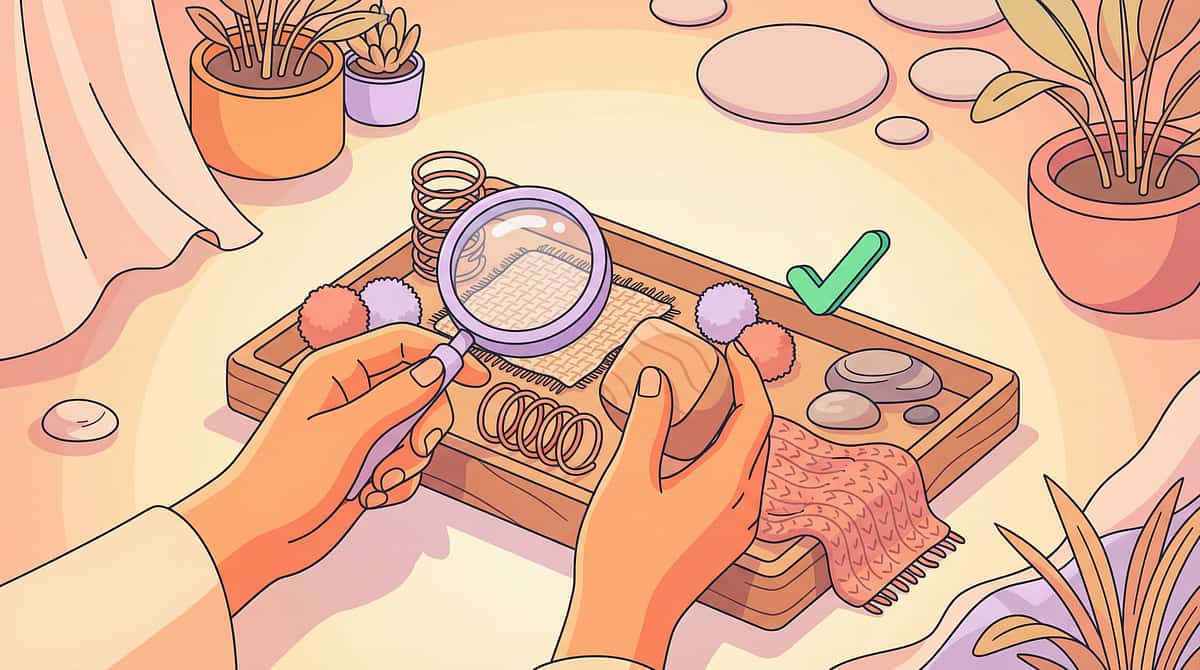
Every session begins with this card. Every time.
🔴 RED — Do NOT Proceed If:
- Child has a known swallowing disorder (dysphagia) — seek SLP evaluation first
- Child has a diagnosed feeding or active eating disorder — work with specialist only
- Child is showing signs of failure to thrive or significant weight loss
- Child had a severe mealtime meltdown in the last 2 hours
- Any material presents a choking hazard for child's developmental level
- Child appears ill, feverish, or in pain
🟡 AMBER — Modify Before Proceeding:
- Child is mildly dysregulated — simplify to 1–2 goals only
- New food items on plate — do not introduce new independence demands simultaneously
- Unfamiliar environment — implement supports but lower expectations
- Child is overtired — shorten session, reduce cleanup expectations
- Multiple new materials — introduce ONE new material per week maximum
🟢 GREEN — Proceed With:
- Child is calm and regulated
- Environment is set up per Card 12
- ONE new material introduced this week (others already established)
- Parent is calm with 45–60 minutes available without additional demands
🛑STOP IMMEDIATELY IF: Child becomes severely distressed (crying, self-harm, throwing food) | Choking occurs — clear airway, call emergency services | Child shows signs of allergic reaction | Behavior escalates beyond safe management. 📞 Safety concerns? FREE 24×7: 9100 181 181
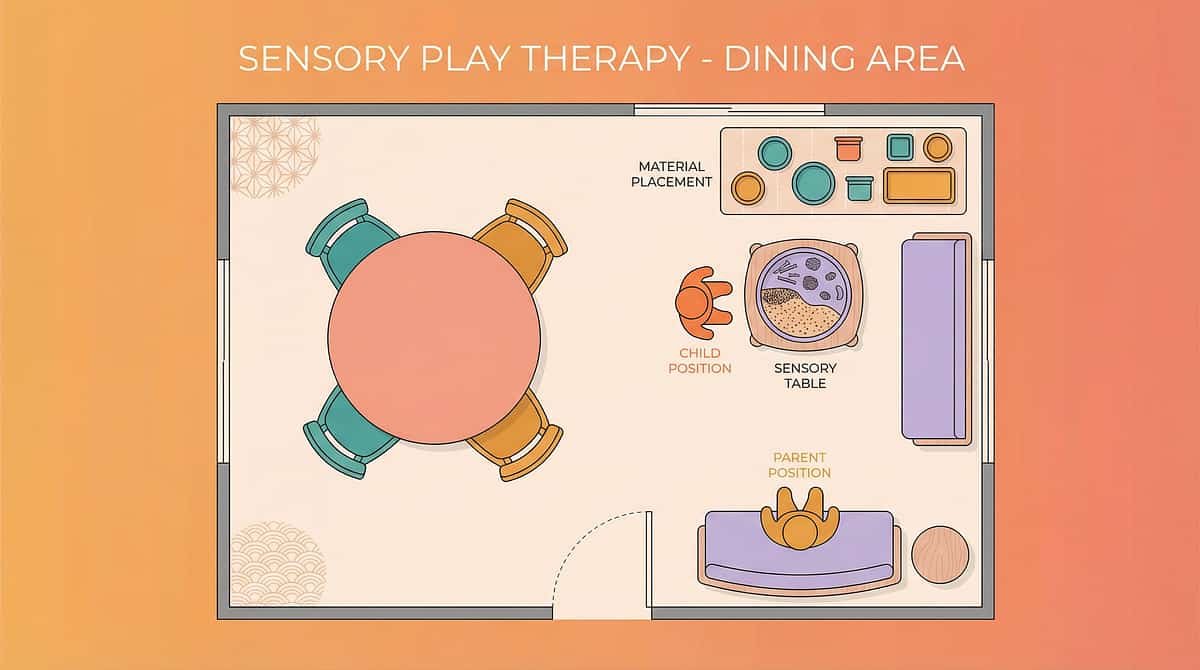
The right environment eliminates 80% of session problems before they start.
Position Guide
Position 1 — Visual Schedule: Wall-mounted at child's eye level when seated. Minimum 60cm from plate. Steps visible without turning head more than 30°.
Position 2 — Visual Timer: On table corner or nearby shelf. Visible throughout meal. Not reachable for play. Sound: OFF or very quiet.
Position 3 — Child's Placemat: Consistent position every meal. Non-slip underside. Plate, cup, utensils in assigned positions.
Position 4 — First-Then Board: Eye level, adjacent to visual schedule. Must be visible throughout entire meal.
Position 5 — Cleanup Station: Child-height, within 3 steps of eating area. Trash bin, dish area, cloth — all reachable independently.
Remove From Space ❌
- Screens (TV, tablet, phone) during teaching phase
- Toys visible from eating area
- Excessive table clutter
- Overwhelming visual stimuli competing with schedule
Sensory Environment ✅
- Lighting: Bright enough to see schedule clearly. Not harsh or flickering.
- Sound: Background music acceptable at low volume. No TV.
- Temperature: Comfortable. Discomfort competes with eating focus.
- Seating: Chair height allows feet flat on floor. Footrest if needed.

60 seconds before every session. Non-negotiable.
Use this readiness check before every meal. The best session is one that starts right. A successful 15-minute modified session builds more than a failed 45-minute forced one.
Indicator | ✅ GO | ⚠️ MODIFY | ❌ POSTPONE | |
Child's energy level | Alert, calm | Tired but manageable | Overtired, hyperaroused | |
Last meal/snack | 2+ hours ago (hungry) | 3+ hours (very hungry) | Just ate (not hungry) | |
Emotional state | Settled, regulated | Mild frustration | Dysregulated, recent meltdown | |
Physical state | Well | Mildly unwell | Ill, in pain | |
Time available | 45–60 min undisturbed | 30 min with some interruption | Under 20 min | |
Sensory state | Regulated | Mild seeking/avoiding | Significantly dysregulated |
✅ GREEN LIGHT (6–7 checks)
Proceed with full session using all active materials.
⚠️ AMBER LIGHT (4–5 checks)
Simplified version — visual schedule + portioned plate only. Skip timer and checklist today.
❌ RED LIGHT (3 or fewer)
Postpone. Alternative: 10-minute calm snack using just the placemat. No performance expectations.

Step 01
Timing: 30–60 seconds
The Invitation
The Principle
Every mealtime begins with an invitation, not a command. You are signaling to your child's nervous system: "This is a safe, predictable space. I know what comes next." Calm initiation sets the entire tone for the meal.
What to Say — Exact Script
"[Child's name], it's mealtime. Let's check our schedule together."
Point to the visual schedule. Walk to the table together. Do NOT say "sit down NOW" or "come eat." The invitation is calm, predictable, and paired with the visual cue.
Body Language
- Kneel or sit at child's eye level when inviting
- Neutral, warm expression — not anxious about compliance
- Slow movement toward the table — no urgency conveyed
Acceptance Cues ✅
- Child moves toward table
- Child looks at the visual schedule
- Child picks up utensil or sits
- Child makes eye contact or says "okay"
Resistance Response
If child resists: "First eat, then [preferred activity]" — point to First-Then Board. If still refusing: check hunger level and emotional state. Do not force.

Step 02
Timing: 1–3 minutes
The Engagement
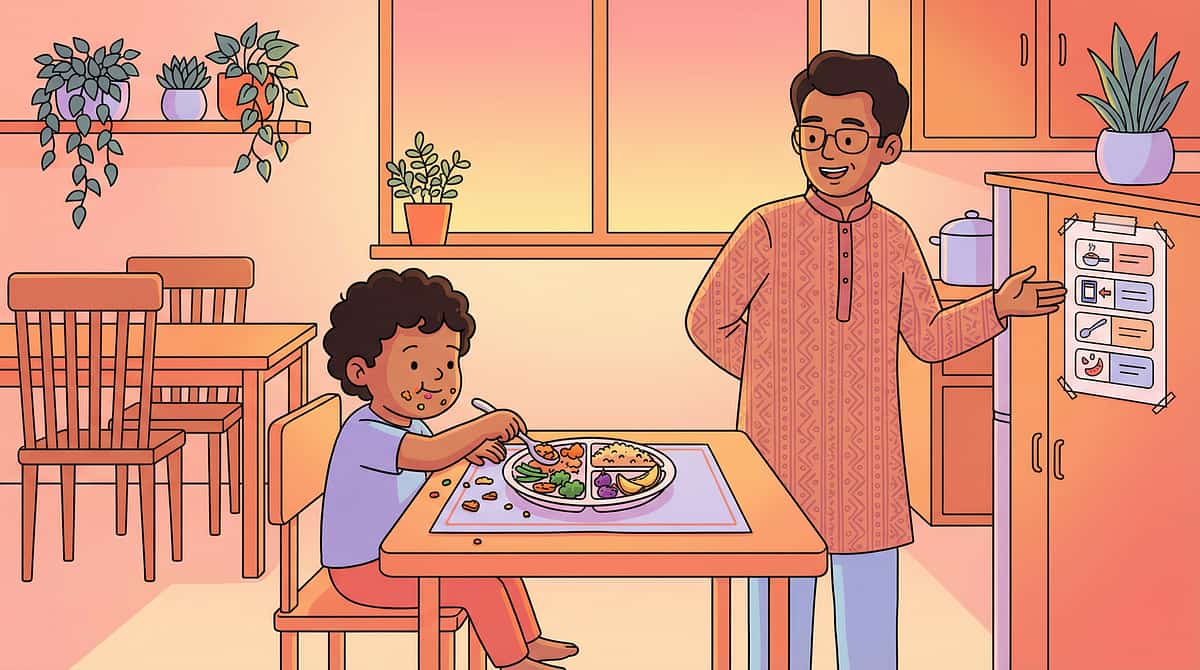
Child is at the table. Now deepen engagement by connecting them to the visual supports — not just the food. The system IS the therapeutic material.
"Let's look at your schedule. Step 1 — what does it say?" Wait. Child identifies "sit down." Praise immediately: "Yes! You're sitting. Great start!" Continue: "Step 2 — napkin on lap. Can you do that?" Praise specifically: "You put your napkin on your lap all by yourself!"
Engagement Indicators
- Child is referencing the visual schedule (even if prompted)
- Child is placing food/utensils as per placemat guide
- Child glances at timer — means they're tracking time
Reinforcement Schedule
- Days 1–3: Praise every correct step
- Week 2: Intermittent praise (every 2–3 steps)
- Week 4: Praise at meal completion only
Why This Works
Connecting children to their support system before demanding eating performance activates the prefrontal cortex's sequencing pathways. The schedule becomes the prompt, not the parent.
Step 03
Timing: 15–25 minutes
The Therapeutic Action — The Independent Meal
The child manages the meal using the visual supports. Your role shifts from director to observer. This is the hardest step for parents — stepping back while the systems do the work.
Child's Actions (supported by materials)
- References visual schedule for each step
- Eats from portioned plate — one section at a time
- Manages drink independently from their cup
- Watches timer for pacing cues
- Self-checks checklist periodically (Week 2+)
- Opens own containers independently
Parent's Position
- Seated at same table, eating own meal
- NOT looking at child's plate, counting bites, or reminding
- Available for genuine questions ("I can't open this")
- Recording observations — NOT intervening
Common Error | Why It Happens | Correction | |
Parent can't stop prompting | Habit + anxiety | Set a rule: "I do not speak about food during the meal unless safety is at risk" | |
Child ignores schedule | Schedule not yet taught as routine | Practice schedule use at non-meal times first | |
Child eats 2 bites and stops | Portioned plate sections too large | Reduce to 3 bites per section — this is a valid portion | |
Child stares at timer | Timer is too novel | Use timer for 1 week before adding other supports |
Step 04
Target: 3 meals/day × 6–8 weeks
Dosage — Consistency Across Meals
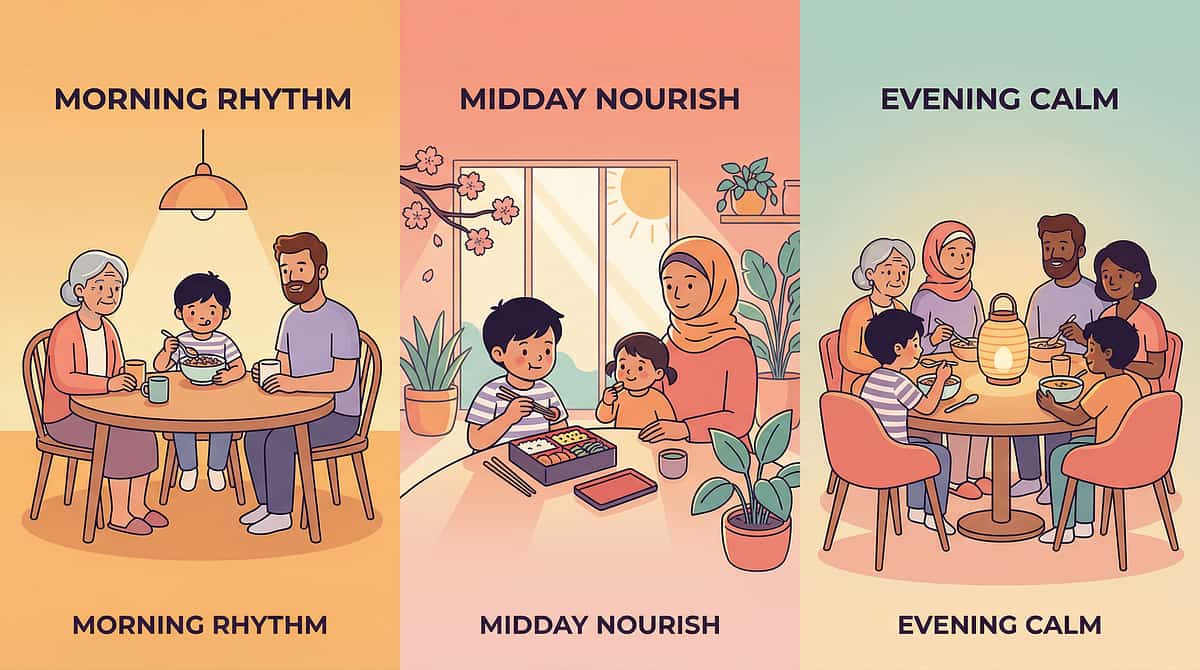
Mealtime independence is not built in a single session — it's built through accumulated practice across 3 meals per day, 7 days per week. The materials must be present at every meal, not just "practice meals." Consistency across meals is the therapeutic dose.
Week 1
Visual Schedule + Portioned Plate. Child learns to reference schedule. No other expectations.
Week 2
+ Visual Timer. Child begins self-pacing with visible time.
Week 3
+ No-Spill Cup + Easy-Open Containers. Child manages drink and food access.
Week 4
+ Visual Placemat. Child organizes eating space independently.
Week 5
+ Self-Monitoring Checklist. Child begins self-checking behavior.
Week 6
+ First-Then Board (if motivation needed). Child drives meal completion.
Week 7
+ Cleanup Station. Complete independence through cleanup.
Week 8
Review: which supports still needed? Begin fading least-needed supports.
3 good meals > 10 exhausted meals. If child is significantly distressed, ill, or in a new setting — scale back to 2 materials only. Quality of engagement beats quantity every time.

Step 05
Within 3 seconds of success
Reinforce and Celebrate
Reinforcement delivered within 3 seconds of behavior has 10× the effect of delayed reinforcement. "You were so good at dinner" at bedtime means nothing to the behavior that occurred at 7pm. The connection must be immediate.
Tier 1 — Verbal (Always, Immediate)
Specific, enthusiastic, accurate. ✅ "You checked your schedule and took your bites all by yourself! That's real independence!" ❌ "Good job" (too vague — doesn't tell child what they did correctly).
Tier 2 — Token Economy (Weeks 2–4)
One token per completed section of portioned plate. 3 tokens = preferred activity choice after meal. Use Pinnacle Reinforcement Menu or DIY version.
Tier 3 — Natural Reinforcement (Week 4+ Primary)
The meal is complete → access to post-meal preferred activity. This is the First-Then system in action — natural consequence, not added reward.
What NOT to do:❌ Do not withhold food as punishment — this causes harm. ❌ Do not use mealtime favorites as bribes — this creates food anxiety. ❌ Do not ignore effort in early weeks — early reinforcement builds the habit.

Step 06
Timing: 2–3 minutes
Meal Completion and Transition
Mealtime doesn't end when the last bite is taken — it ends when the cleanup is complete. This step makes the meal ending predictable and signals successful completion to the child's nervous system.
"Timer going off — let's check your checklist. Did you finish all your sections? Great. Now it's cleanup time — let's look at the cleanup steps."
Cleanup Sequence
- Scrape plate into bin
- Place dish in sink/dish rack
- Wipe table with cloth
- Push in chair
Transition Warning (Critical for ASD)
At 2 minutes remaining on timer: "2 more minutes. Then we'll do cleanup and you can [preferred activity]." This prevents the shock of "mealtime is over now" — a common trigger for transition meltdowns.
If Child Resists Ending
Point to First-Then Board: "First cleanup, then [preferred activity]." Do not negotiate. Complete the sequence calmly. Natural consequence: delay of preferred activity until cleanup is done.
Optional but powerful: Have child move the completed visual schedule steps to a "done" pocket. This physical completion ritual signals FINISHED to the nervous system.

60 seconds of data now saves hours of guessing later.
Record these 3 data points immediately after each meal. This tracking reveals whether prompting is decreasing, portions are sized correctly, and which days trigger regressions.
Field 1 — Prompting Level Today
Circle one: 0 prompts | 1–2 prompts | 3–5 prompts | 5+ prompts
Field 2 — Meal Completion
Circle one: Full meal | 75% completed | 50% completed | Less than 50%
Field 3 — Cleanup Completed
Circle one: Fully independent | One verbal prompt | Physical guidance | Not completed
Date | Prompts | Completion | Cleanup | Notes | |
Mon | 3 | 75% | ✅ | Used schedule independently | |
Tue | 2 | 90% | ✅ | First time no timer reminder needed | |
Wed | 5 | 50% | ❌ | Dysregulated day — simplified | |
Thu | 1 | 100% | ✅ | BREAKTHROUGH — full meal, no prompts! |
Take a photo once a week. Document the meal setup. Progress photos motivate during the hard weeks. Decreasing prompt count = increasing independence (expected Week 2–3). Cleanup failures = cleanup station needs re-teaching.

Session abandonment is not failure — it's data.
Problem 1: "My child completely ignores the visual schedule."
Why: Schedule use hasn't been taught — only introduced. Solution: Practice schedule following at non-mealtime first. Play "follow the picture steps" as a game before expecting independent use at meals.
Problem 2: "The timer makes my child more anxious."
Why: Timer is being used as a threat. Solution: Reframe as informational, not punitive. "The timer shows how much time we have — it's not a race." If anxiety persists, switch to a longer duration or sand timer.
Problem 3: "Still saying 'done' after 2 bites despite the portioned plate."
Why: Sections too large, or "done" behavior has been historically reinforced. Solution: Reduce each section to 2–3 bites maximum. If persisting, consult feeding therapist — may be sensory/medical.
Problem 4: "Can open containers at home but not at school."
Why: Skills haven't generalized across settings. Solution: Practice with school containers specifically. Same brand/type at home as at school. Send a note to school staff about which containers to use.
Problem 5: "Child uses the checklist to 'game' the system."
Why: Child is socially motivated — actually positive. Solution: Make criteria observable and specific ("I stayed seated the whole meal"). Add a "confirm with parent" step for disputed items.
Problem 6: "First-Then Board is causing mealtime meltdowns."
Why: The "first" demand is too high, or "then" is too motivating. Solution: Reduce "first" expectation. Or move First-Then Board out of constant sight — introduce only when motivation is needed.
Problem 7: "Everything was working and now it isn't — Week 5 regression."
Why: Normal. Regression at Week 4–6 is neurologically predictable during skill internalization. Solution: Return to Week 2 support level for 3–4 days. Do not remove all supports at once. Regression is not failure.
No two children are identical. Here is your customization guide.
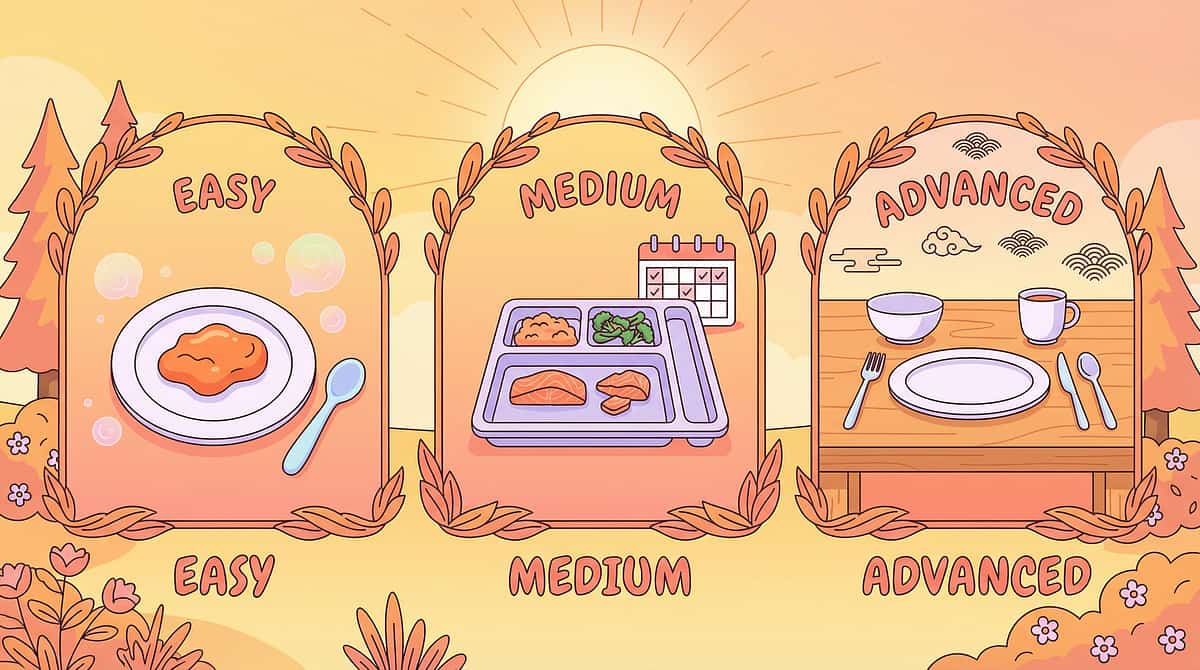
Easier Version
Visual Schedule + Portioned Plate only. Goal: 2 steps without reminders. 10 minutes. No cleanup expectation. For challenging days or new children.
Standard E-490
Materials 1–4 + Cleanup Station. Goal: references schedule, paces with timer, manages drink. 20–25 minutes.
Advanced Version
All 9 materials + beginning fading. Start removing steps that become automatic. Introduce meal in different settings (grandparents, cafeteria).
Child Profile | Priority Materials | Modification | |
ASD — routine preference | Visual Schedule #1 priority | Same routine EVERY meal. Do NOT vary schedule steps until system is established. | |
ADHD — time blindness | Visual Timer #1 priority | Set timer for 5-minute chunks within meal, not full meal duration. | |
Sensory sensitivity | Portioned plate keeps foods separated | Gradually allow foods to touch as tolerance develops. | |
DCD (coordination) | Easy-open containers are essential | Adaptive utensils may also be needed — OT assessment recommended. | |
Low motivation | First-Then Board is core | Rotate rewards frequently — motivation drops for stale rewards. |
Age-Based: Ages 3–4: Start with only 3 materials, max 2 steps on schedule. Ages 5–6: Full system as described — core implementation age. Ages 7–10: Introduce self-monitoring checklist earlier; begin transfer to school settings in Week 4.

Week 1–2
Progress: ~15%
You've started. That's real.
15%
Programme Progress
The hardest fortnight. Your systems are new and your child is testing them.
Realistic Week 1–2 Indicators ✅
- Child tolerates visual schedule on the wall
- Child sits at placemat position without resistance
- Child glances at timer at least once during meal
- Prompting still needed — but perhaps 3 prompts instead of 10
- Portioned plate reduces portion overwhelm
- Parent completes data tracking for 5 of 7 days
What Week 1–2 Is NOT ❌
- Full independent meal (this takes 6–8 weeks)
- Zero prompting needed
- Cleanup happening independently
- Child using checklist independently
Key Data Point
Is prompting decreasing (even by 1–2)? If yes: you're on track. If no: check implementation fidelity — is the visual schedule truly at eye level? Is the timer visible? Is the cleanup station accessible?
"If your child tolerates the placemat and visual schedule for 5 minutes without removing them, that is genuine neurological progress in Week 1."