
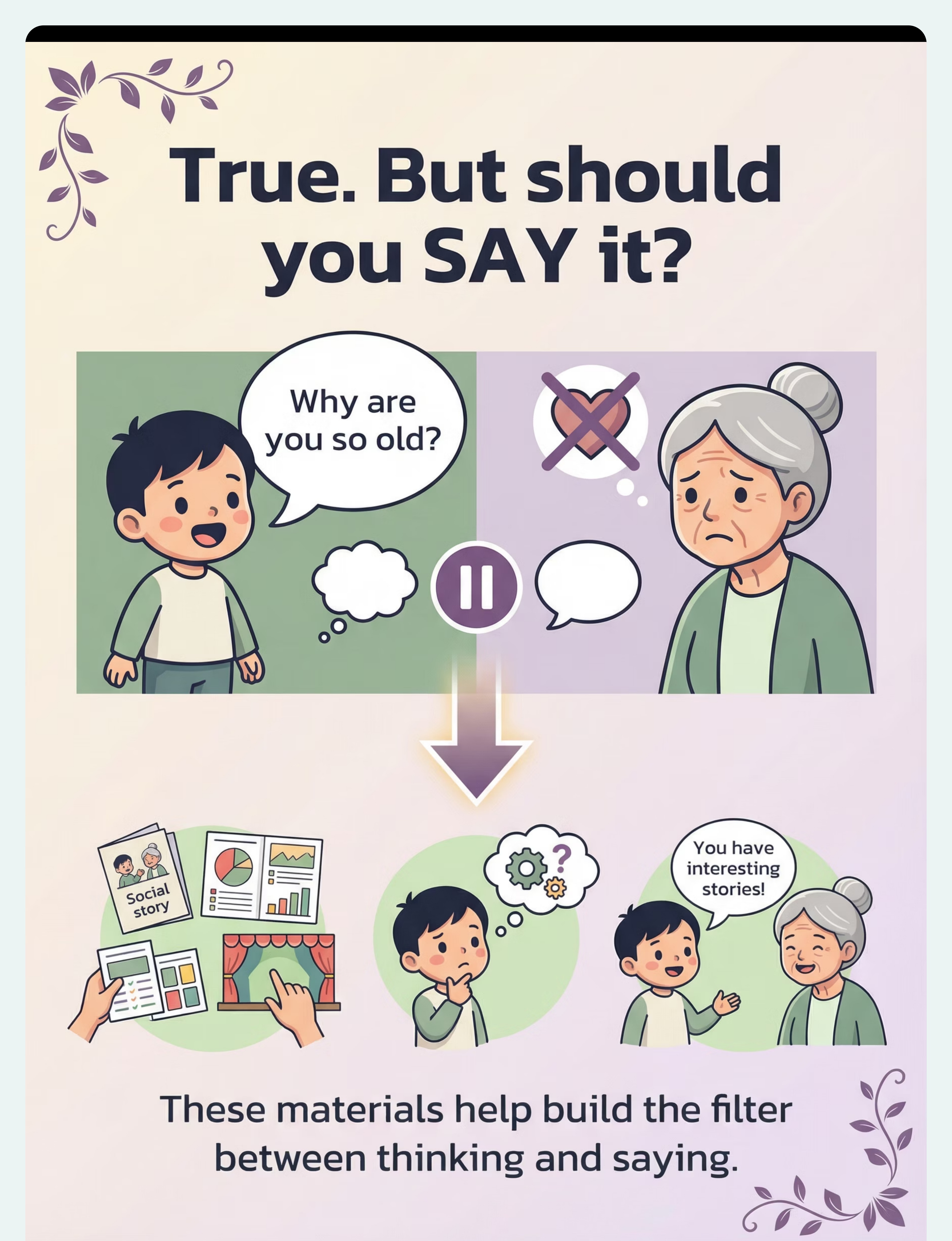
"Why do you have so many wrinkles, Grandma?"
She said it in a room full of people. Completely innocent. No idea why everyone went quiet. If your child's words have ever made a room fall silent — you are not failing as a parent. Your child is not cruel. There is a filter between thinking and saying that hasn't fully formed yet. That filter is teachable.
B-218
Social Communication & Pragmatic Language
ACT I — THE EMOTIONAL ENTRY
You Are Among Millions of Families Navigating This
Inappropriate comments — statements that are factually true but socially harmful — are among the most misunderstood challenges in pediatric social development. Parents are blamed. Children are labelled "rude." Neither is accurate. This is a skills gap, not a character flaw.
1 in 36
Children with Autism
Diagnosed in the US — pragmatic language is a core feature (CDC, 2023)
70–80%
ASD & Social Filtering
Children with ASD display social communication & filtering difficulties (PRISMA Review, PMC11506176, 2024)
20M+
Therapy Sessions
Delivered by Pinnacle Network — inappropriate commenting addressed in 34% of Social Communication cases
📞 FREE Helpline: 9100 181 181 | 16+ Languages | 24×7 | pinnacleblooms.org
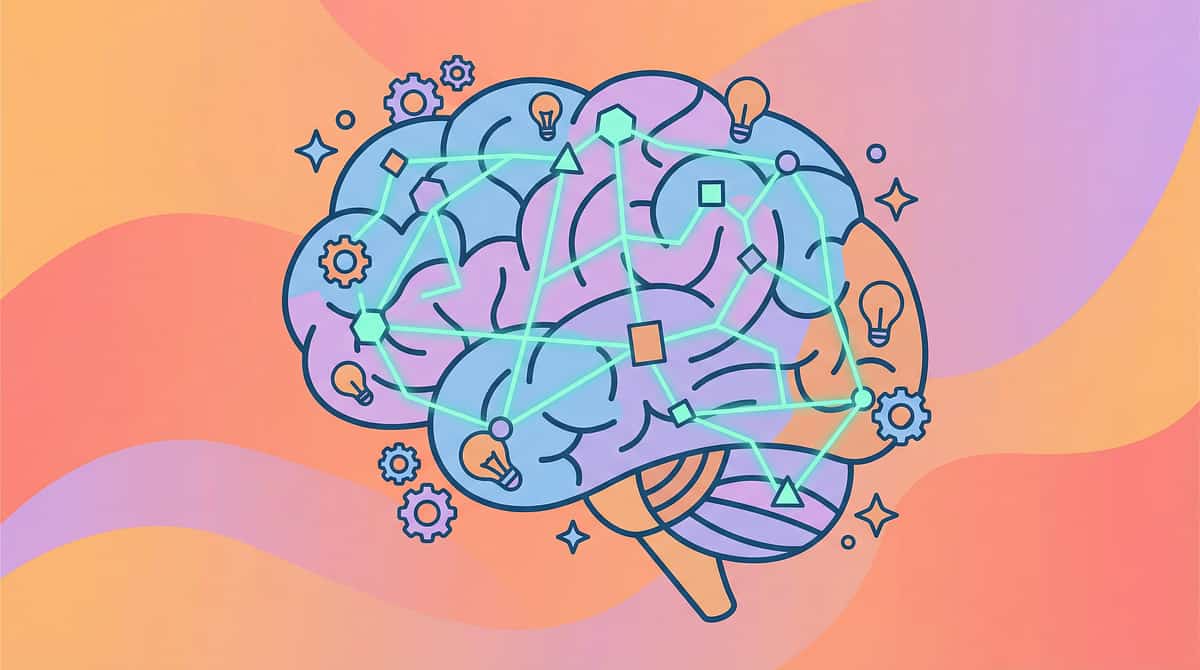
The Filter Between Thinking and Saying
Social filtering requires five cognitive systems firing in sequence. When any of these systems is underdeveloped — as is common in autism, ADHD, and social communication disorder — thoughts become words before filtering can occur. This is not rudeness. This is not cruelty. This is an underdeveloped cognitive pathway — and cognitive pathways can be strengthened.
The 5 Cognitive Systems
01
Perspective-Taking (Theory of Mind)
Predicting how the listener will feel
02
Social Context Reading
What's appropriate HERE, with THESE people
03
Social Filtering
Which thoughts to voice vs. keep private
04
Verbal Impulse Control
Stopping words before they emerge
05
Executive Function
Applying known rules in the live moment
In Plain English
"Your child sees an observation. The observation is true. Their brain processes: 'True = say it.' The step that most brains add automatically — 'but will it hurt?' — isn't firing the same way. This is a wiring difference, not a moral failure." — Pinnacle NeuroDevelopmental Consortium
Frontiers in Integrative Neuroscience (2020): DOI 10.3389/fnint.2020.556660 | WHO NCF 2018: Responsive caregiving + explicit social-emotional teaching = foundational to development.
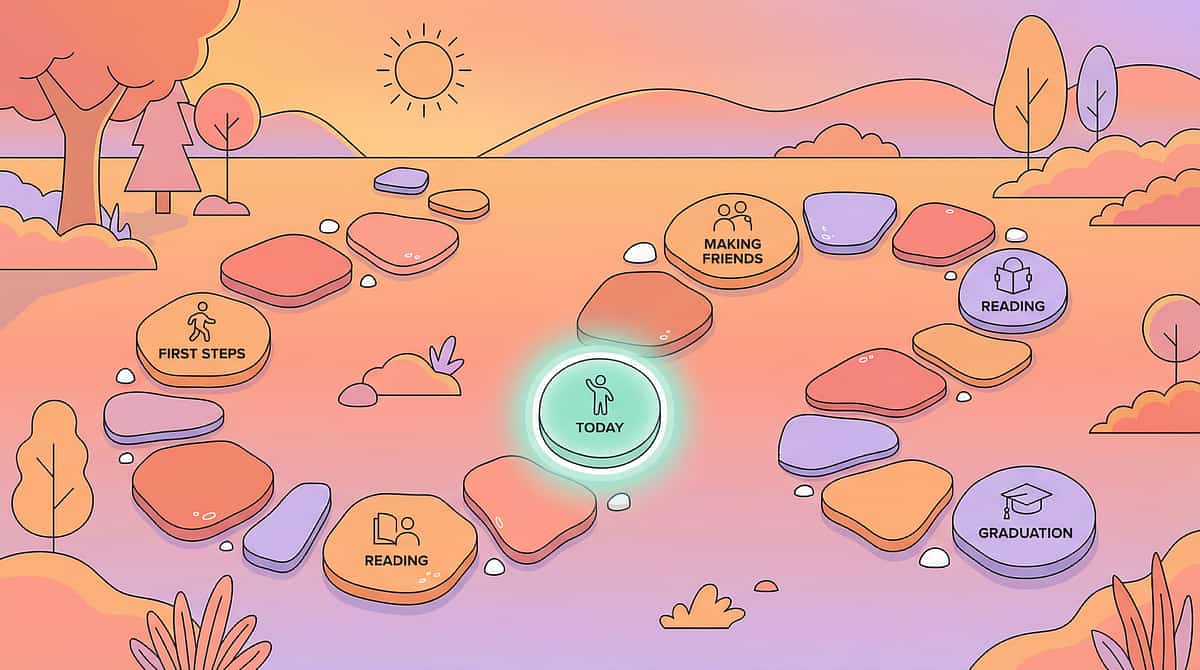
This Is a Waypoint, Not a Destination
Social filtering develops progressively through childhood. Understanding where your child is on this continuum helps calibrate expectations — and focus your energy where it matters most. Inappropriate commenting frequently co-occurs with: Autism Spectrum Disorder | ADHD | Social Communication Disorder | Anxiety | Giftedness.
1
Ages 2–3
Basic social rules begin (no hitting). Comments freely made — normal.
2
Ages 3–5
Beginning to learn "inside thoughts vs. outside words." Some filtering emerging.
3
Ages 5–7
Expected to understand basic social appropriateness. Occasional slips normal.
4
Ages 7–10
Social filter should be largely operational. Persistent inappropriate comments warrant attention.
5
Ages 10–14
Context-sensitive filtering expected. Social consequences more significant.
WHO/UNICEF CCD Package (2023) — age-specific evidence-based caregiver guidance, implemented in 54 LMICs. PMC9978394.

★★★★☆ Level I–II Evidence
Clinically Validated. Home-Applicable. Parent-Proven.
The 9 materials in this technique page are drawn from the intersection of ABA, Speech-Language Pathology, Social Thinking® methodology, and OT — validated across tens of thousands of sessions in the Pinnacle clinical network.
Study | Key Finding | Source | |
PRISMA Systematic Review (2024) | Social cognition intervention evidence-based for ASD — 16 studies, 2013–2023 | PMC11506176 | |
Meta-analysis, WJCC (2024) | Social skills + adaptive behavior improvement confirmed across 25 studies | PMC10955541 | |
ASHA Research (2020–2024) | Explicit pragmatic language teaching + visual supports = measurable filtering improvement | ASHA Clinical Guidelines | |
NCAEP (2020) | Social Narratives (Social Stories) = Evidence-Based Practice for autism | NCAEP Evidence-Based Practices Report | |
Padmanabha et al. (2019) | Home-based interventions: significant outcomes in Indian pediatric populations | DOI: 10.1007/s12098-018-2747-4 | |
WHO NCF (2018) | Explicit social-emotional teaching + responsive caregiving = developmental foundation | PMC9978394 |
📞 FREE Assessment by licensed consortium therapists: 9100 181 181
ACT II — THE KNOWLEDGE TRANSFER
B-218 | Domain B
Social Filtering — Pragmatic Language Intervention Protocol
Parent Alias: "Building the Filter Between Thinking and Saying." Social Filtering Intervention is a multi-material, explicit-teaching protocol that builds the cognitive gap between internal observation and external speech. It addresses perspective-taking, social context reading, verbal impulse control, and appropriate communication alternatives — through visual scaffolding, structured practice, and progressive generalization.
🗣️ Social Communication
Core domain — building the bridge between internal thought and appropriate speech
🧠 Pragmatic Language
The rules governing how we use language in social contexts
👁️ Social Cognition
Understanding others' mental states, feelings, and perspectives
🎛️ Self-Regulation
Managing the impulse between noticing and verbalizing
Ages: 5–14 years | Session Duration: 15–20 minutes | Frequency: Daily (brief home practice) + structured weekly sessions | Setting: Home + School + Community
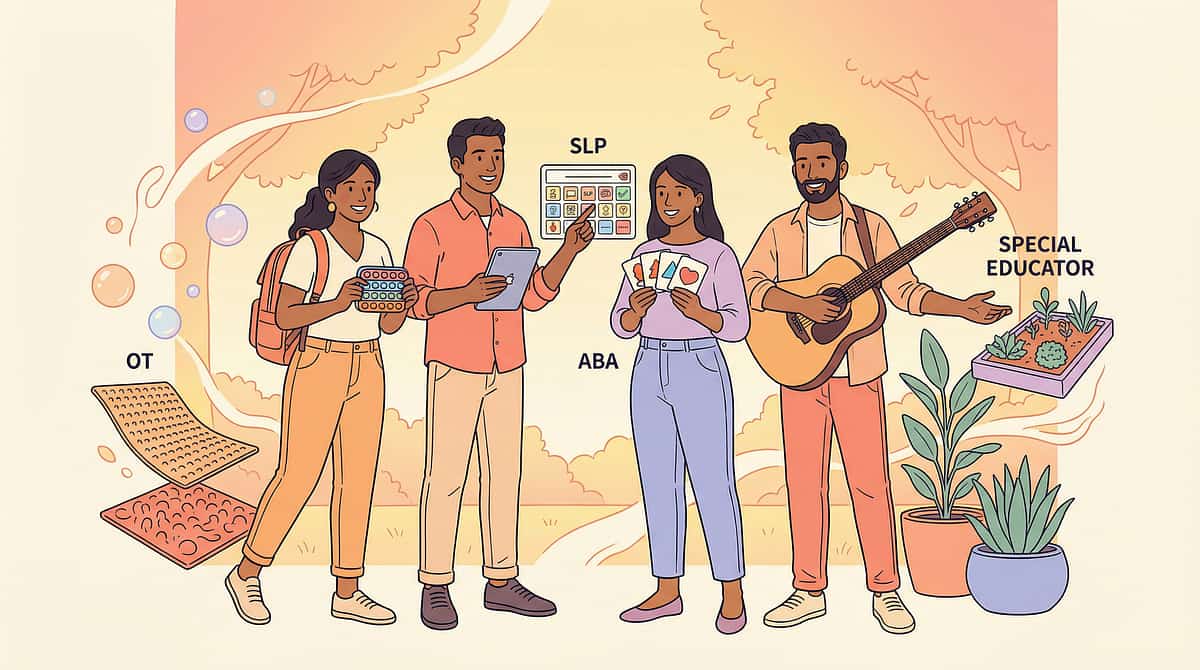
Six Disciplines. One Goal. Your Child's Social Voice.
"This technique crosses disciplinary boundaries because social filtering is not a speech problem, a behavior problem, or a cognitive problem alone — it is all three simultaneously." — Pinnacle Blooms Consortium
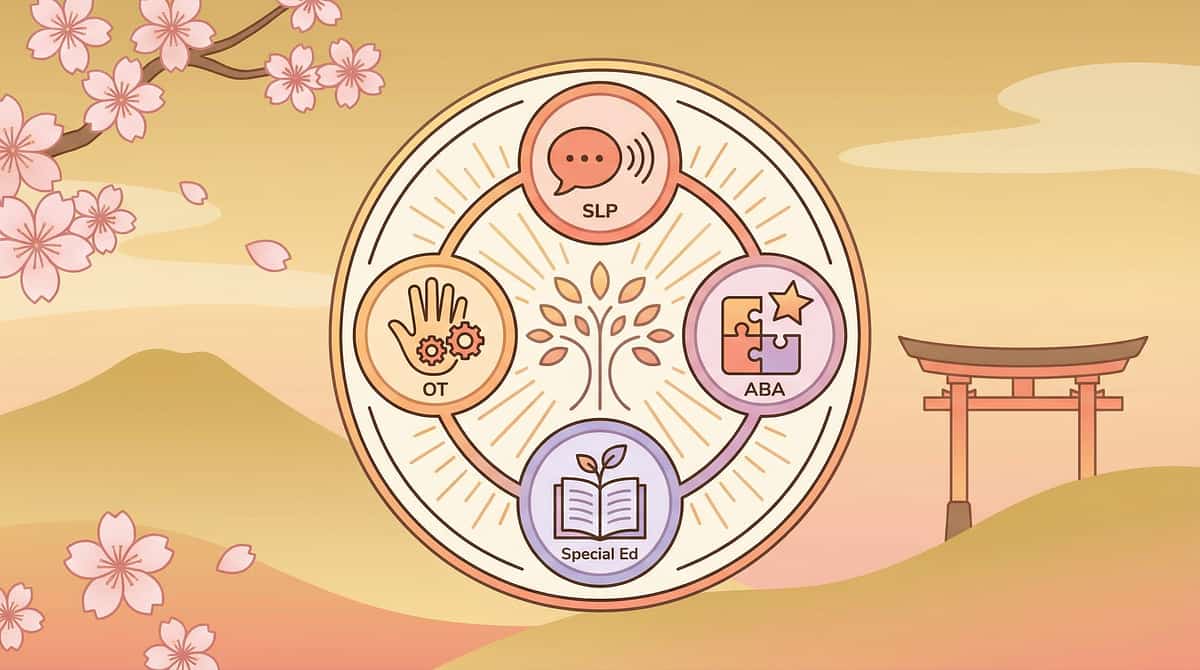
Pediatric SLP (Lead)
Designs pragmatic language goals, teaches social filtering frameworks, builds communication alternatives
BCBA / ABA Therapist
Impulse control training, reinforcement of filtering behavior, behavioral data collection
Pediatric OT
Executive function scaffolding, self-regulation support, visual-motor supports for chart use
Special Educator
Social skills groups, classroom generalization, curriculum-embedded social rule teaching
NeuroDev Pediatrician
Rules out/identifies ASD, ADHD; guides medical coordination
You — The Caregiver
The 24/7 implementation layer. The most powerful therapist your child has.
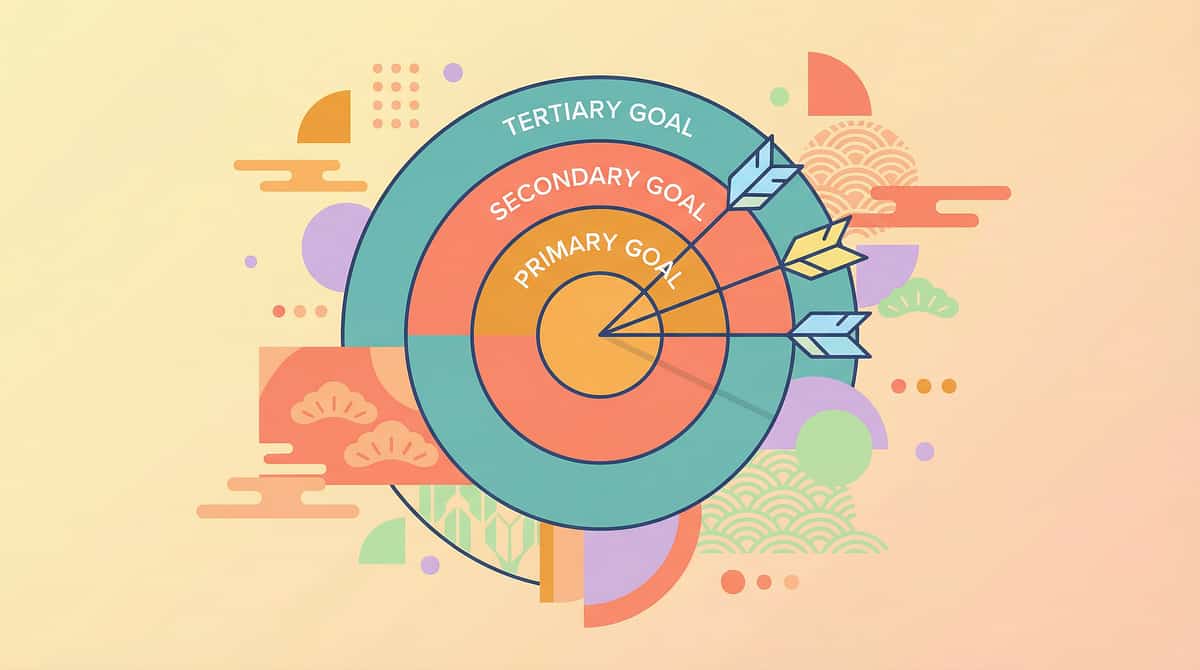
From "It's True So I'll Say It" to "I Think Before I Speak"
These are the observable, measurable outcomes that define success for B-218 intervention. Each target is a skill that can be explicitly taught, practiced, and generalized across settings. Progress is tracked through GPT-OS® AbilityScore® indices.
Perspective-Taking
Child can predict how a comment will make the listener feel BEFORE speaking
Thought-Speech Differentiation
Child understands that thoughts exist independently of spoken words
Expected vs. Unexpected Judgment
Child can categorize comments as socially expected or unexpected
Privacy Boundary Awareness
Child understands public, family-private, and personal-private information
Appropriate Alternative Vocabulary
Child has kind, neutral responses ready for common situations
Verbal Impulse Pause + Context Reading
Child develops a "pause moment" and adjusts communication based on setting and relationship
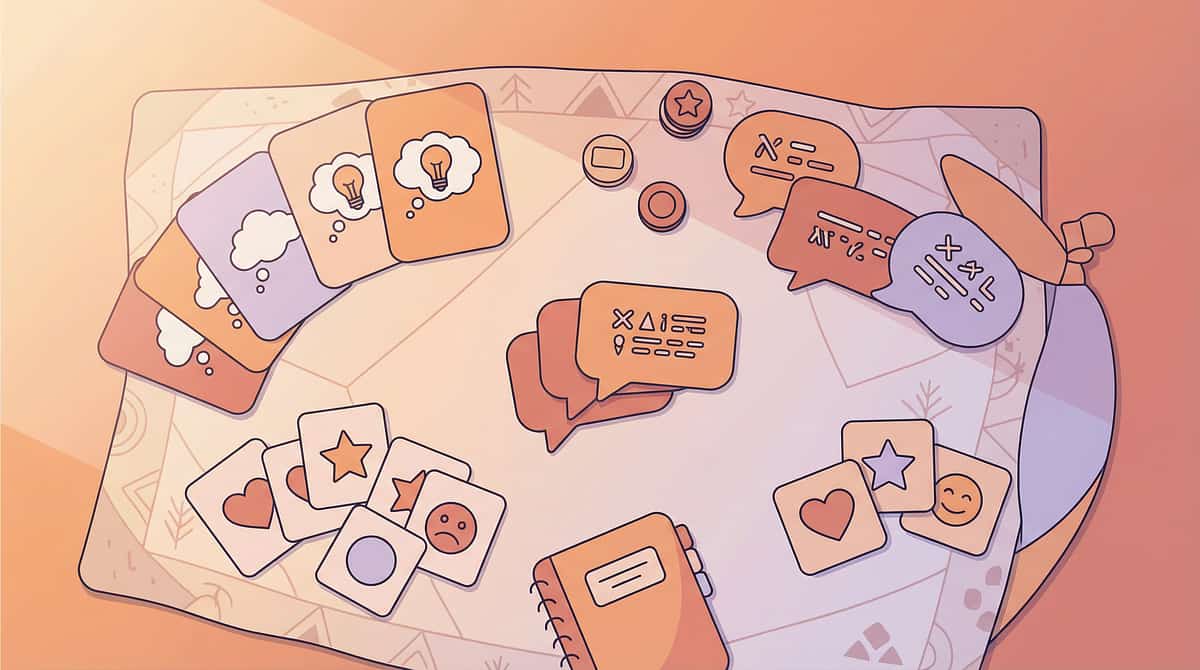
9 Canon Materials
Clinically Mapped. Home-Ready.
The Complete Materials Set for Social Filtering
Each of these 9 materials targets a specific cognitive pathway in the social filtering process. They work best in sequence — but each can stand alone. Total investment: ₹100–1,500 for the complete set. Most have FREE DIY alternatives (see next card).
1
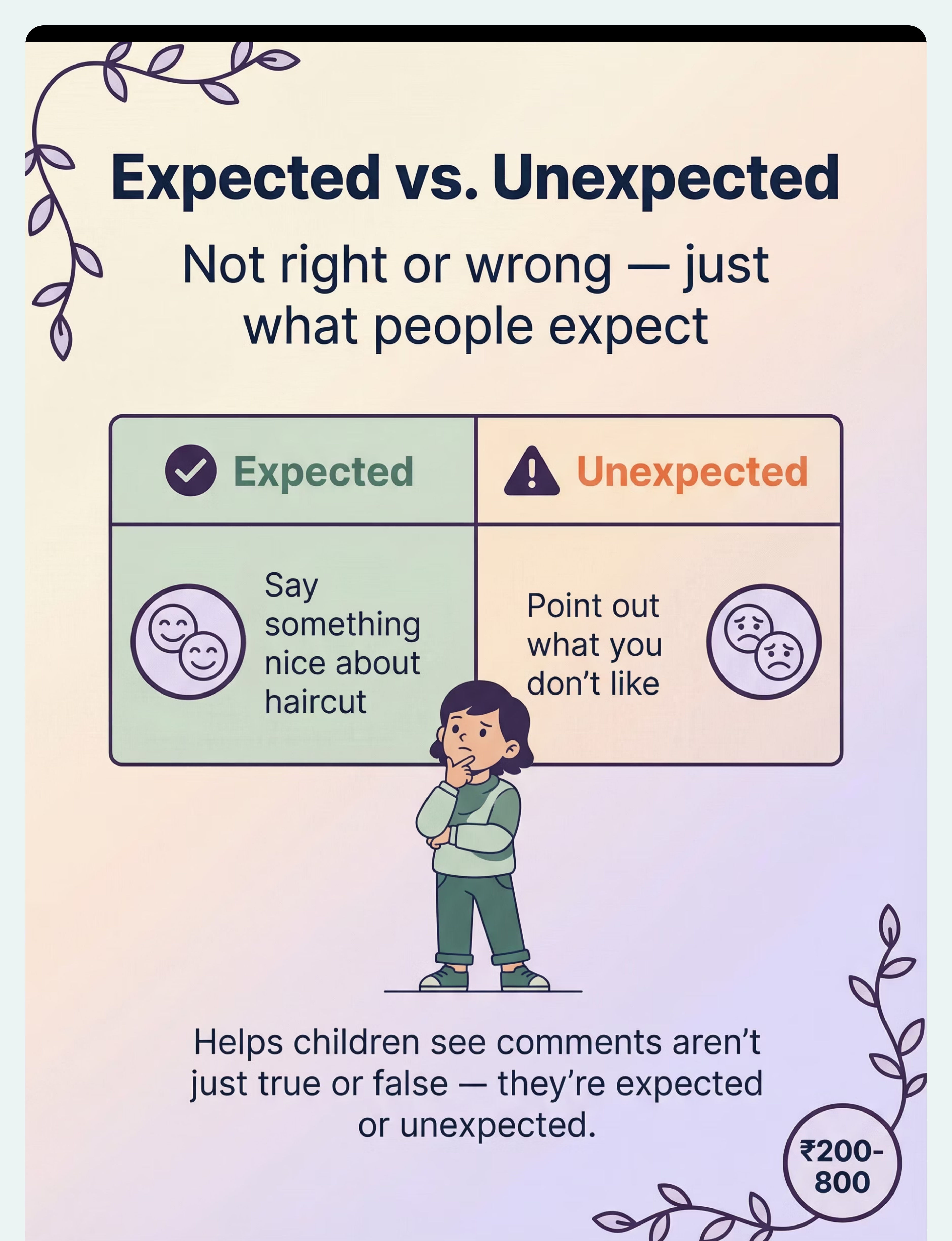
Expected vs. Unexpected Charts
₹200–800 | Social Thinking® Visual Supports
2
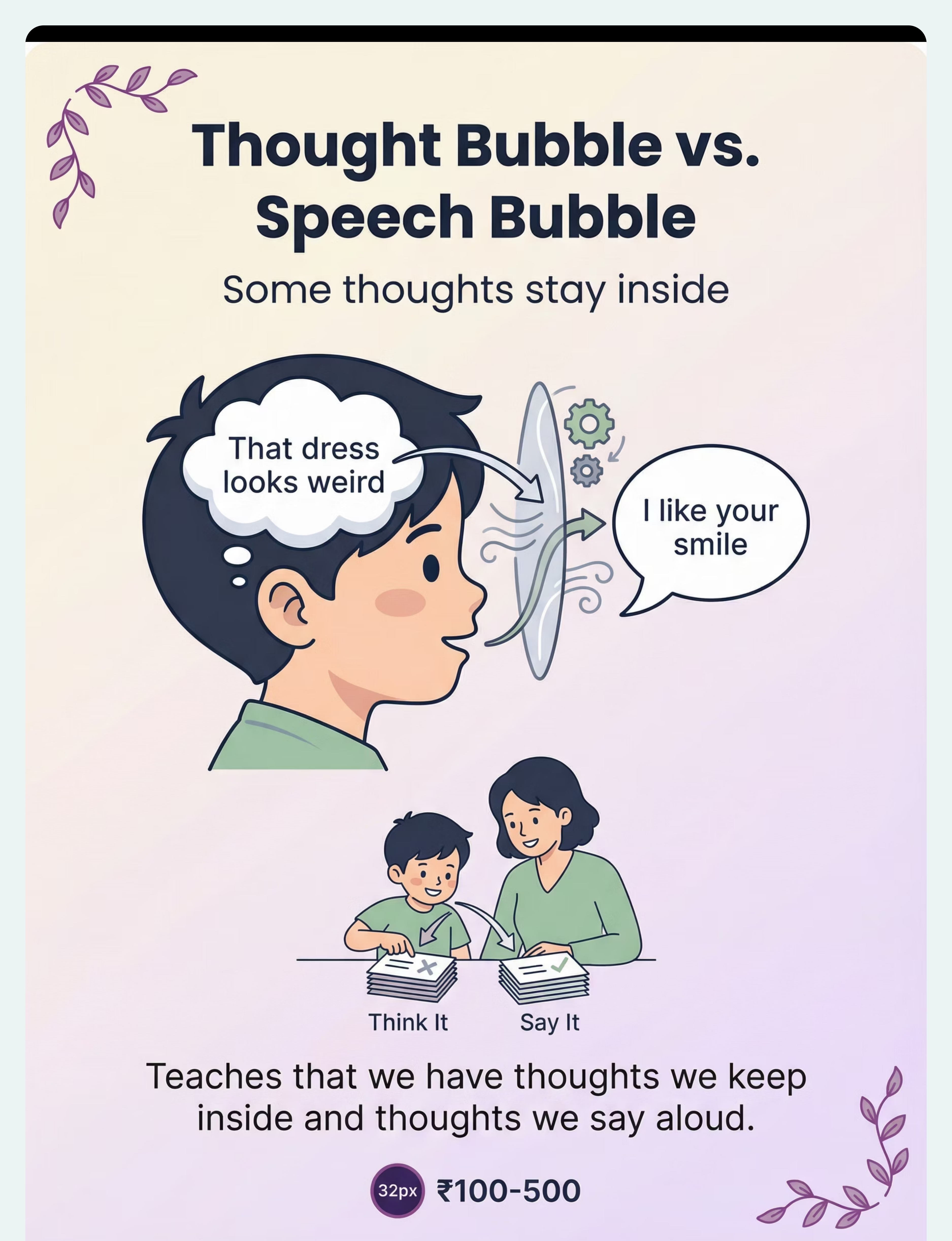
Thought Bubble vs. Speech Bubble Visuals
₹100–500 | Pragmatic Visual Scaffolding
3
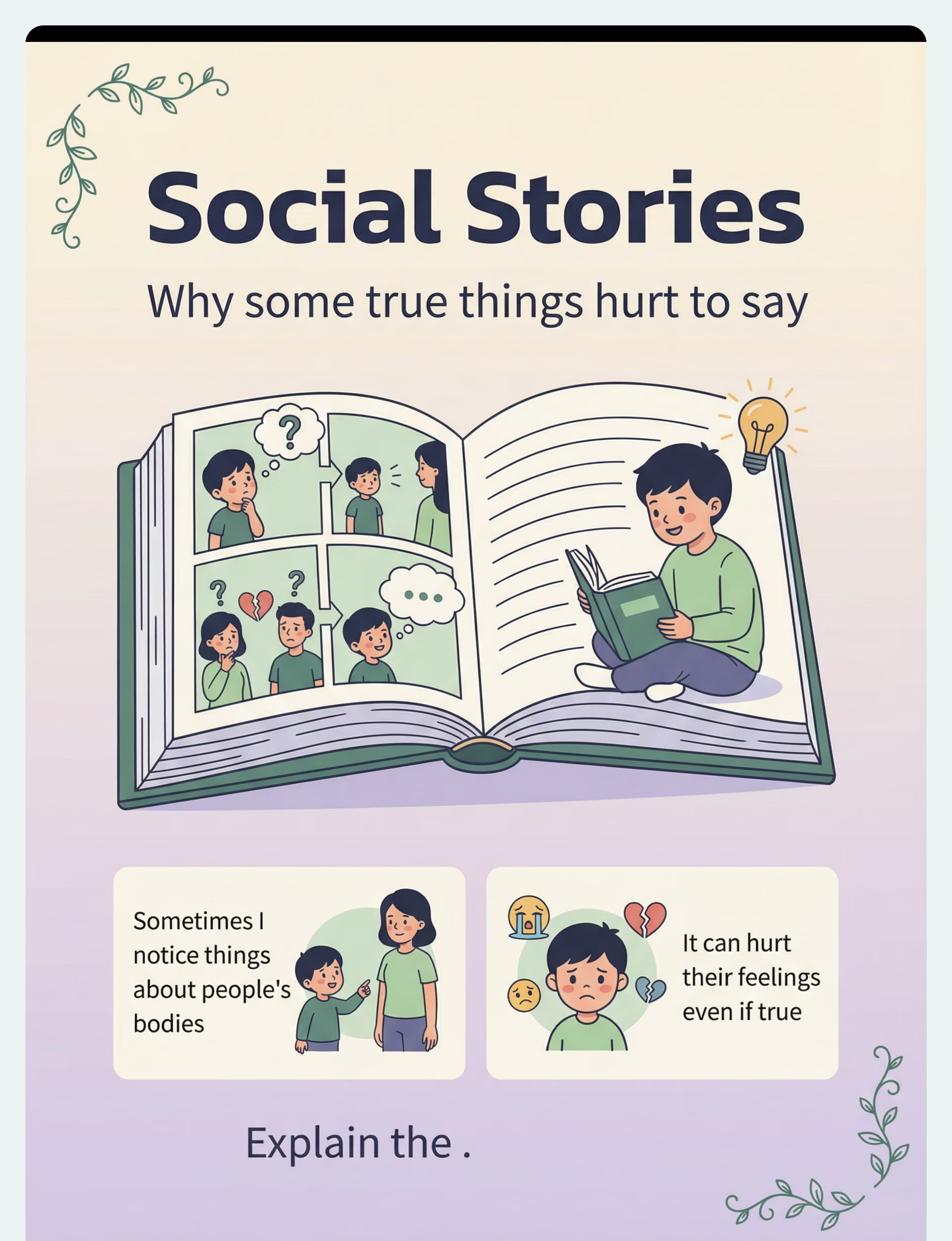
Social Stories (Appropriate Comments)
₹200–1,000 | Evidence-Based Social Narratives
4
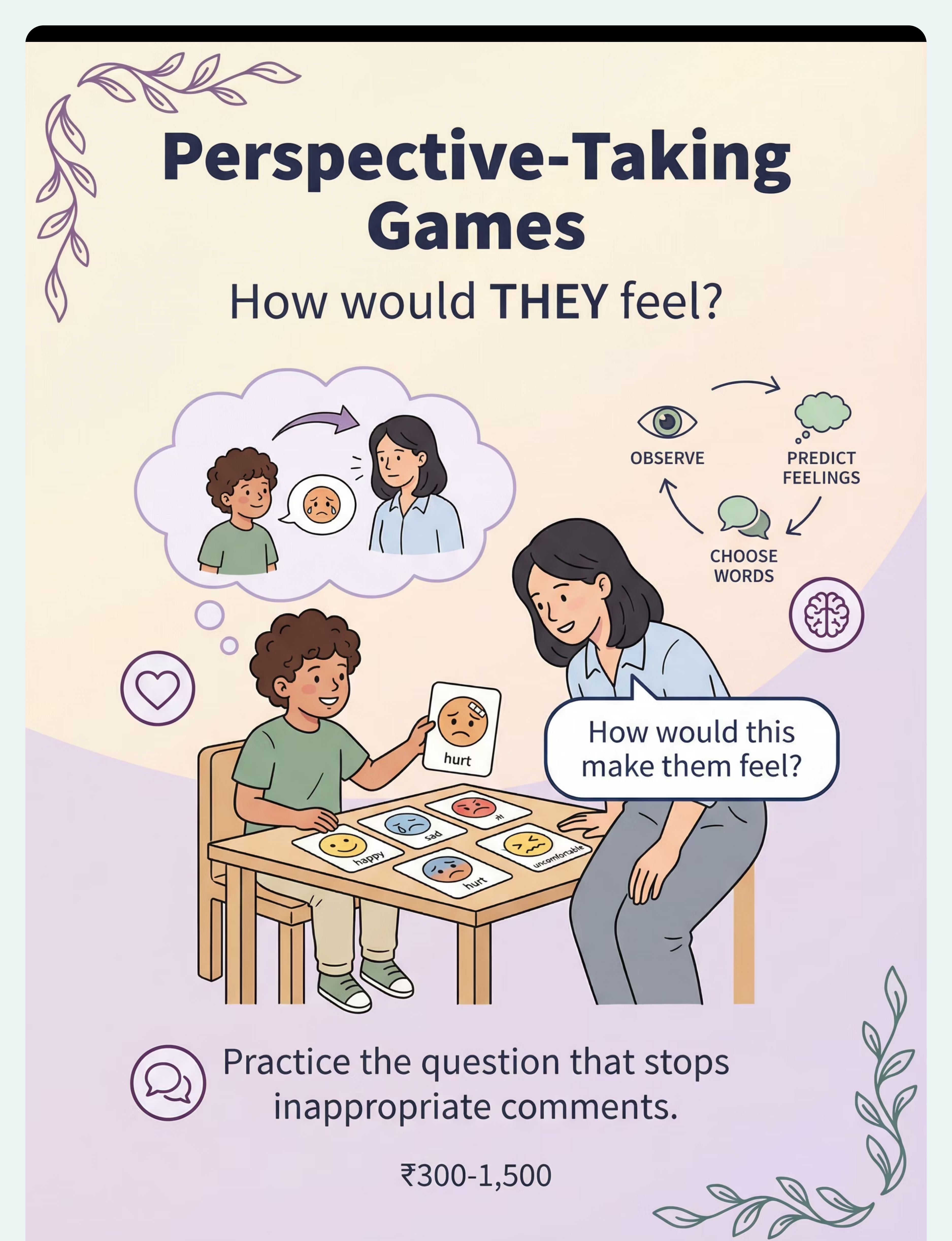
Perspective-Taking Games
₹300–1,500 | Theory of Mind Games
5
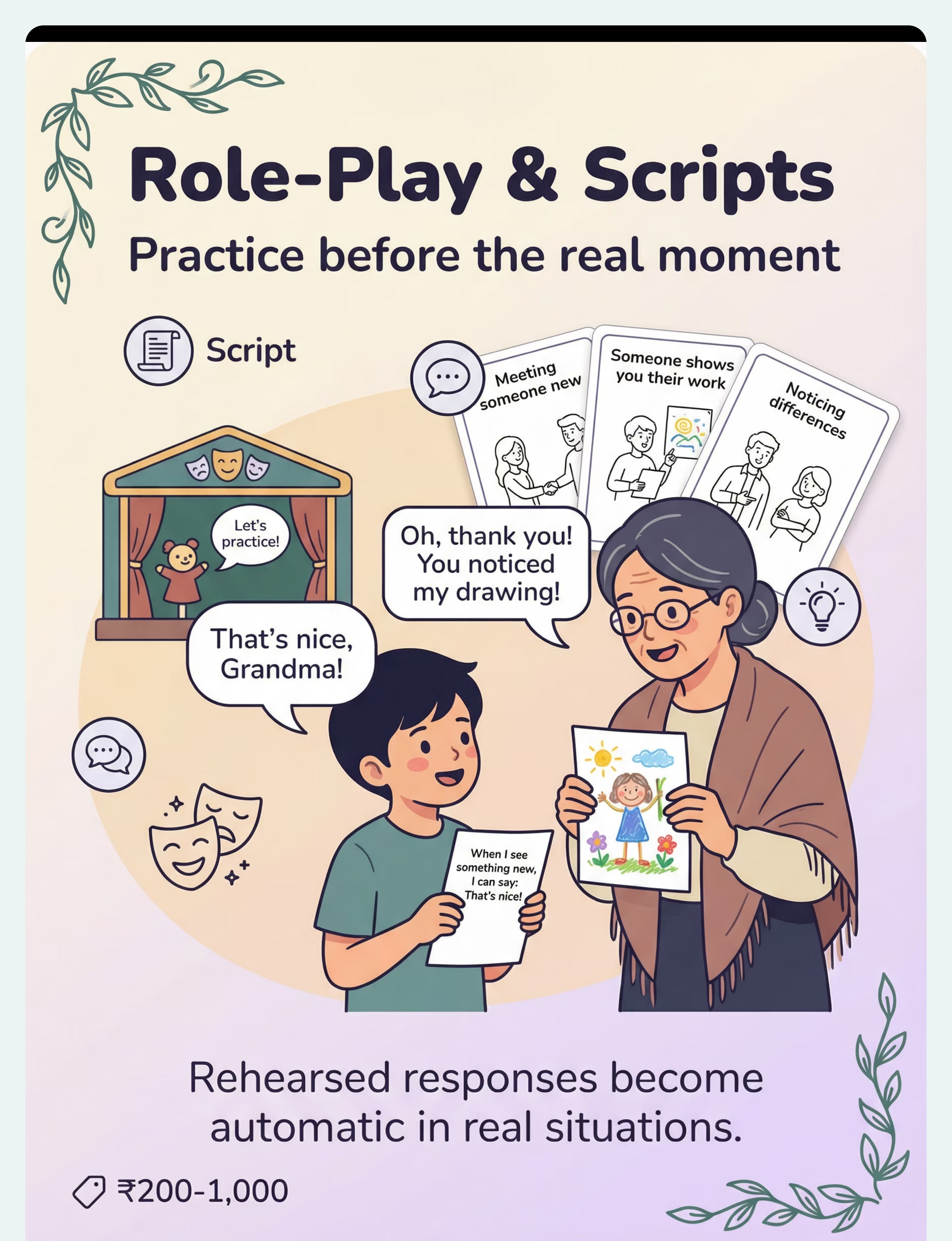
Role-Play Scenario Cards + Scripts
₹200–1,000 | Social Skills Practice Sets
6
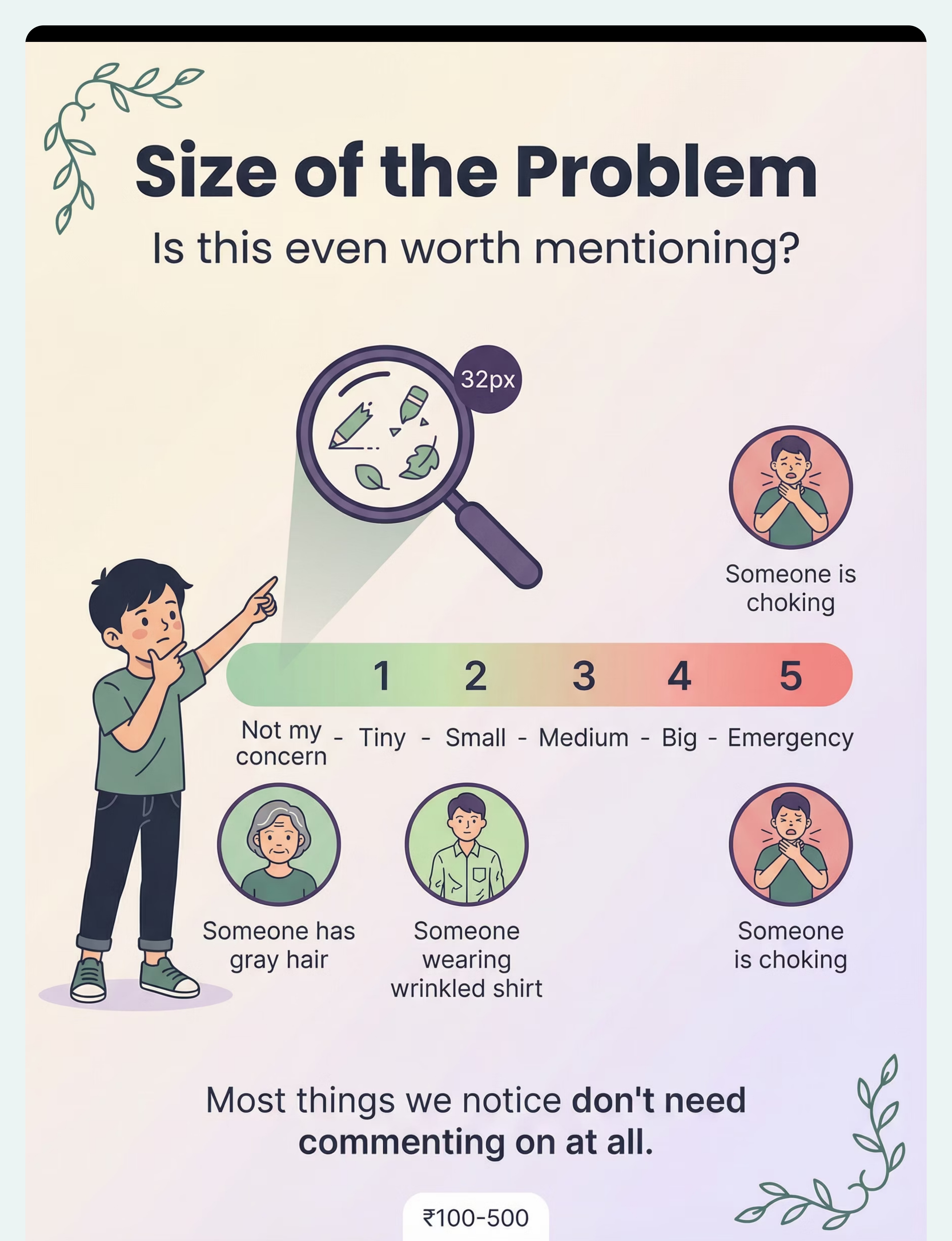
Size of the Problem Scales
₹100–500 | Self-Regulation Visual Tools
7
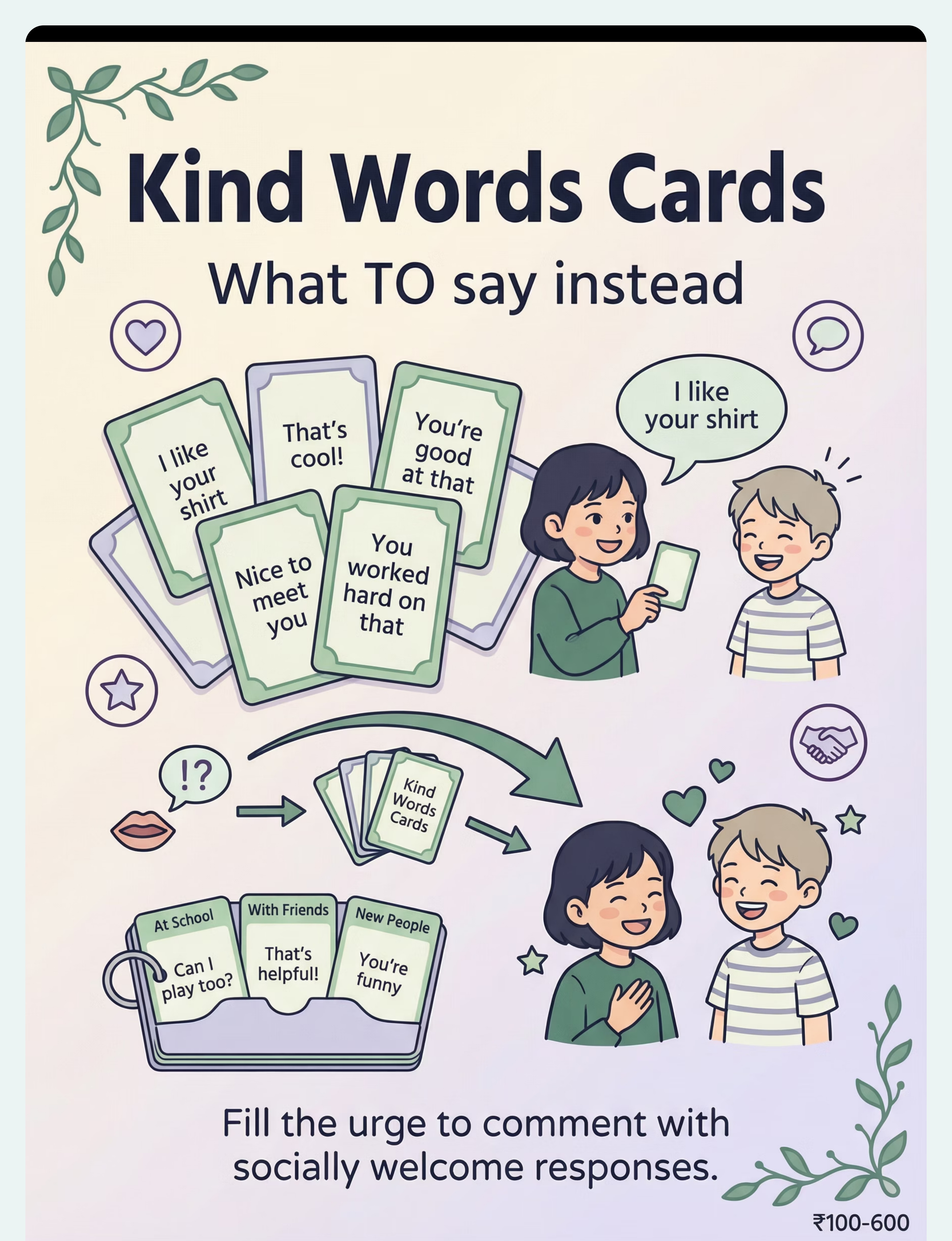
Kind Words / Compliment Card Sets
₹100–600 | Positive Communication Tools
8
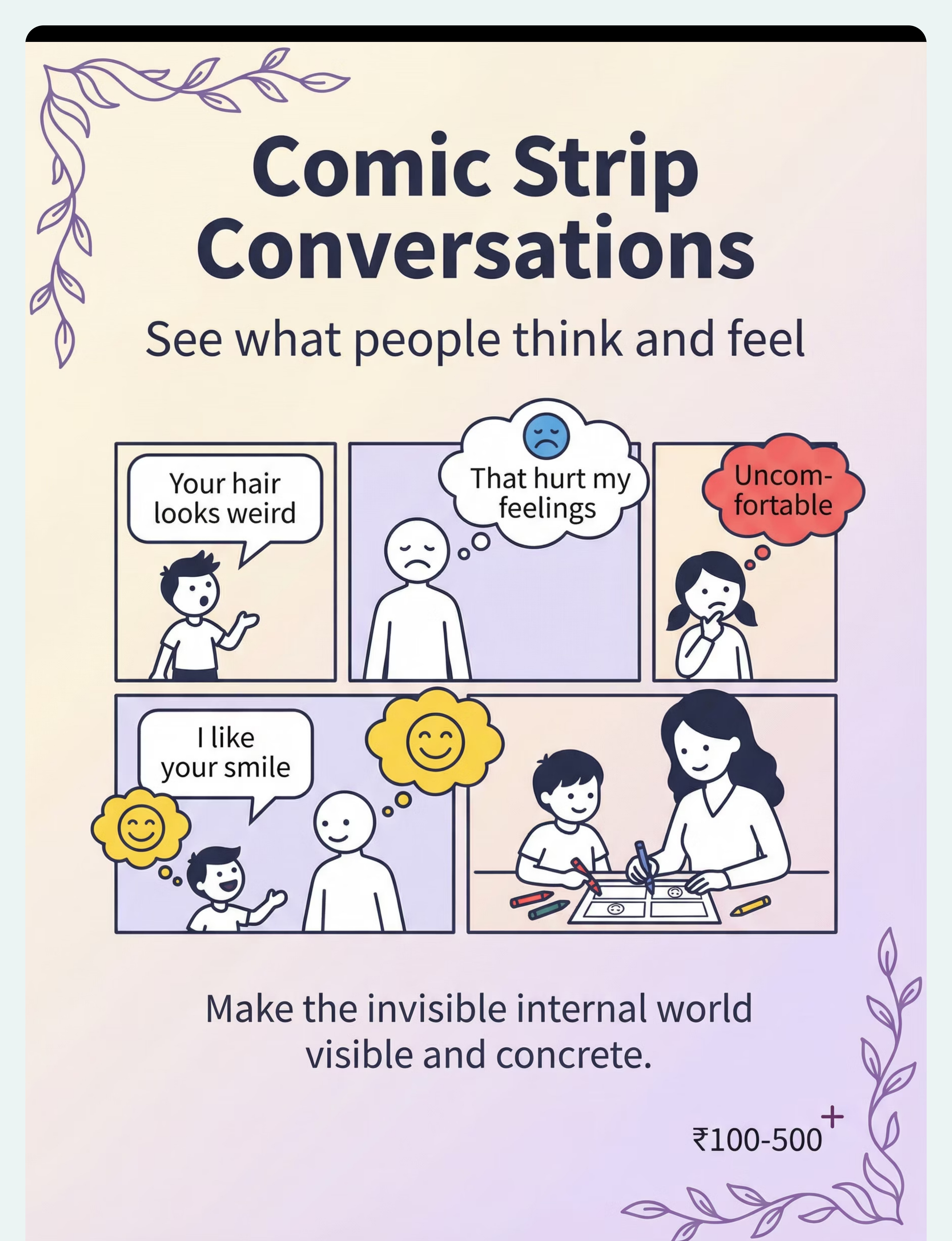
Comic Strip Conversation Templates
₹100–500 | Social Narrative Visualization
9
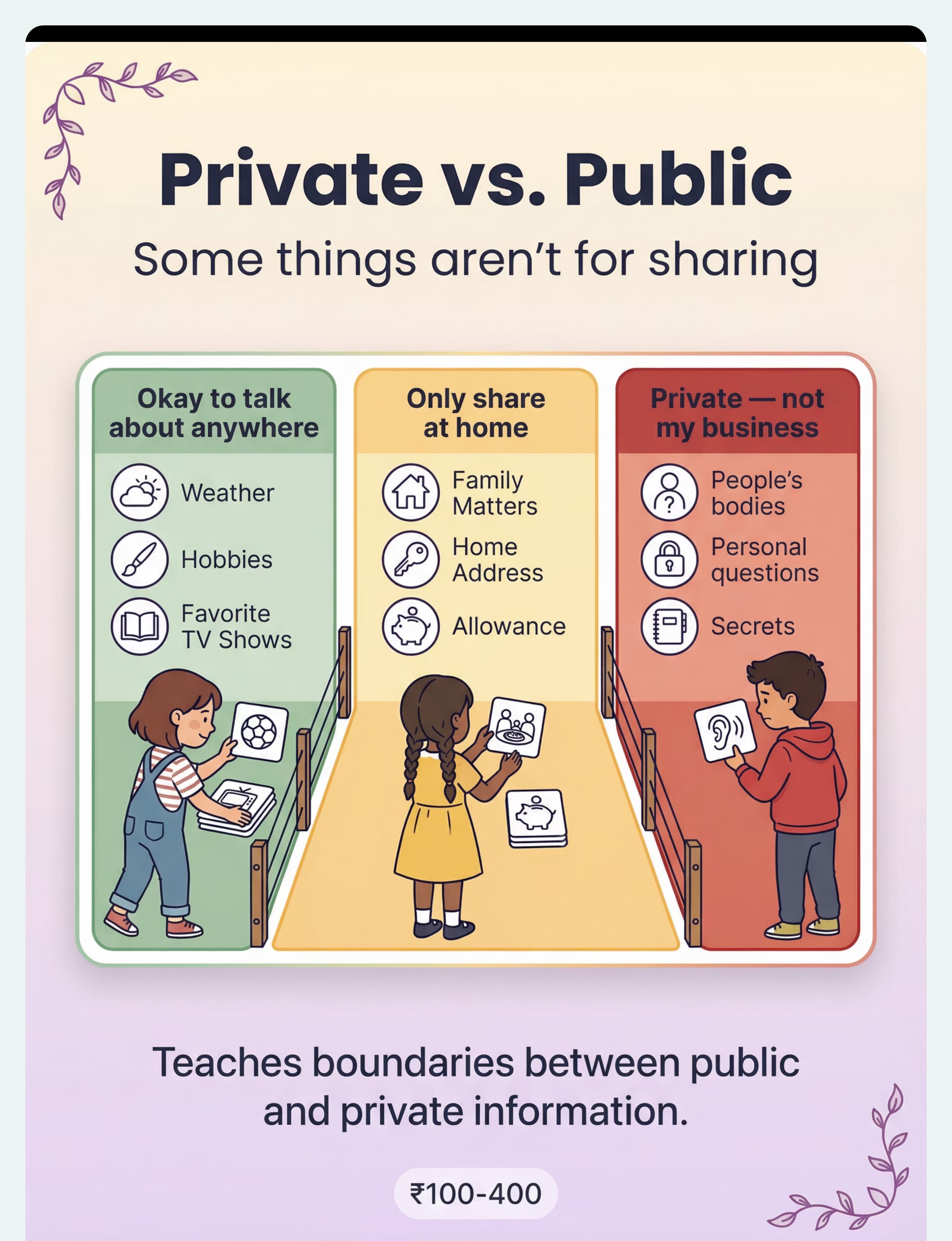
Private vs. Public Sorting Activities
₹100–400 | Boundary Teaching Materials

Every Family Can Start TODAY. Zero Cost Required.
"Effective intervention must not be gatekept by economic access." — WHO Nurturing Care Framework, 2018 | PMC9978394. DIY materials work on the SAME therapeutic principle as commercial versions. The science is in the approach, not the product.
🛒 Commercial Option | 🏠 DIY Zero-Cost Version | |
Expected/Unexpected charts (₹200–800) | Draw two columns on paper: "Expected" / "Unexpected" — fill with real examples from your child's life | |
Thought/Speech bubble visuals (₹100–500) | Cut cloud shape (thought) and speech bubble from cardboard. Use for daily sorting practice | |
Social Stories books (₹200–1,000) | Write 5 sentences using Carol Gray's formula: Descriptive → Perspective → Perspective → Directive → Affirmative | |
Perspective-taking games (₹300–1,500) | Use family photos. Ask: "How do you think they felt?" during book reading or TV watching | |
Role-play scripts (₹200–1,000) | Index cards with common scenarios. Practice with stuffed animals for young children | |
Size of Problem scale (₹100–500) | Draw a 1–5 number line. Label: 1=Not my concern → 5=Emergency. Place on fridge | |
Kind Words cards (₹100–600) | Write 10 kind phrases on sticky notes. Practice 3 per day at dinner | |
Comic strip templates (₹100–500) | Fold paper into 4–6 panels. Draw stick figures with speech + thought bubbles | |
Private/Public sorting (₹100–400) | Three jars labeled: "Talk Anywhere," "Family Only," "Not My Business" |
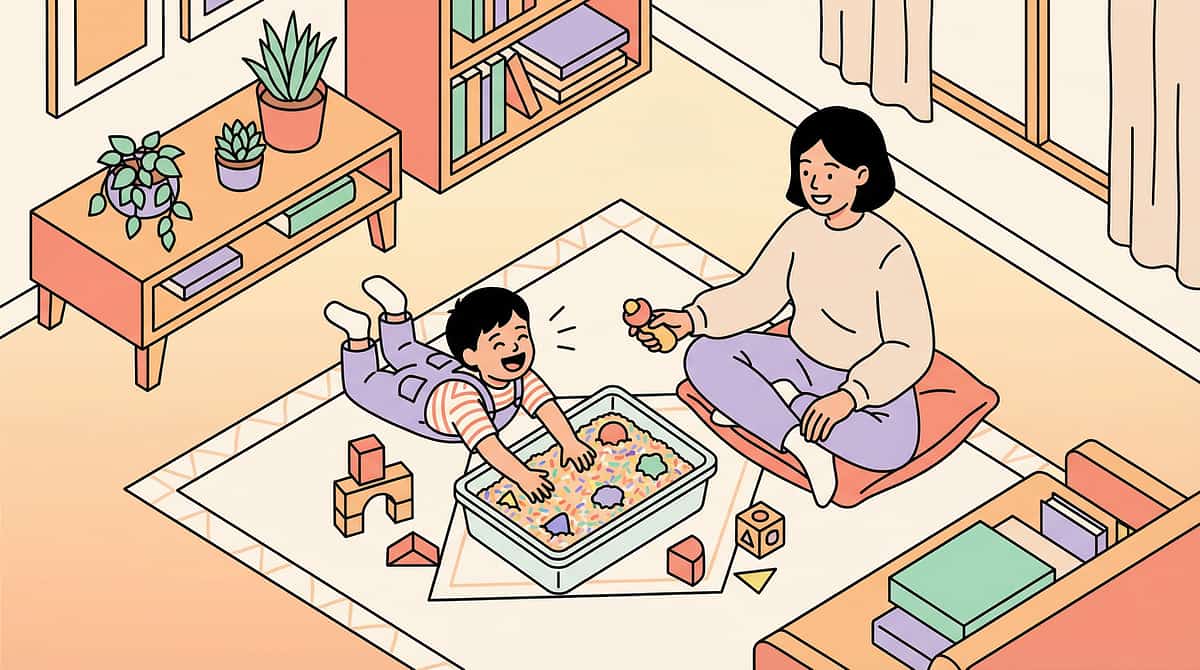
The Right Environment Prevents 80% of Session Failures
Research shows that 1:1 structured sessions in a calm, prepared environment are the most effective format for pragmatic language intervention (PMC10955541). The setup is simple — but the details matter enormously.
Environment Checklist
- Room is quiet — TV/screens off
- Siblings are occupied elsewhere
- Materials prepared in advance
- Child has had a snack — hunger disrupts learning
- Parent is calm — child mirrors parent's emotional state
- 15–20 minutes protected — no interruptions
- Session framed as "practice time," not "discussion about your behavior"
Opening Script (Exact Words)
"Hey [name], let's do our practice time. We're going to look at some cool materials about how words work. No right or wrong — just practice."
Positioning: Side-by-side — NOT face-to-face (less confrontational). Materials within reach on child's preferred side.
Lighting: Natural or warm light. Avoid harsh fluorescent. Noise: Below 50 dB. Calm background music optional.
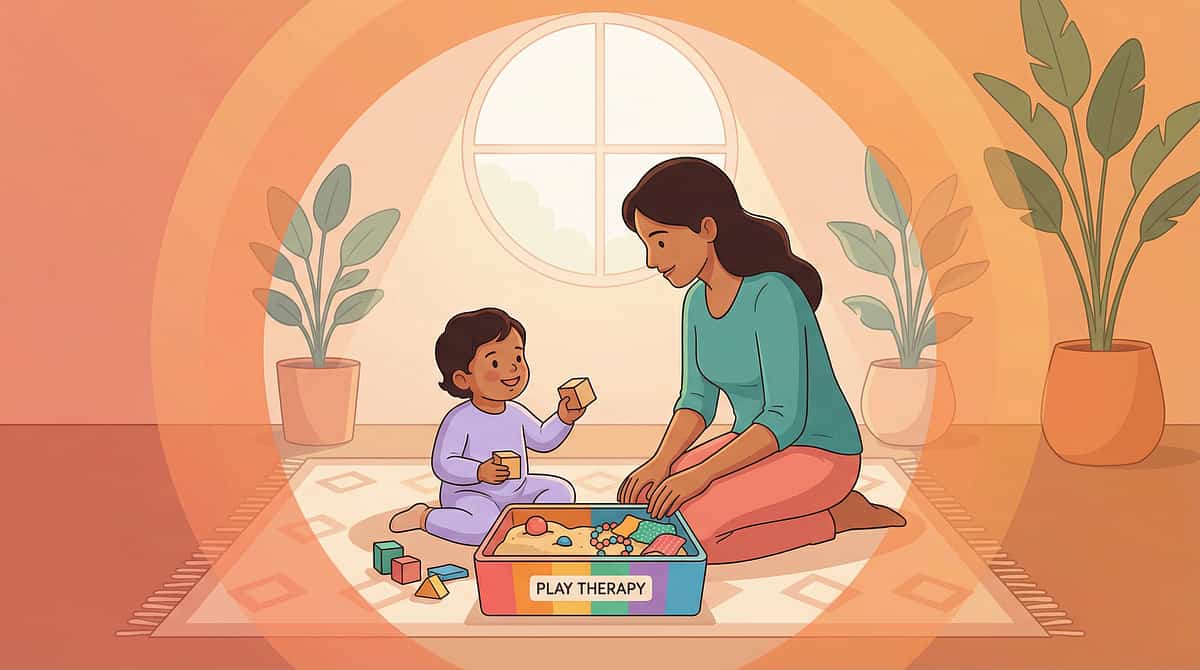
ACT III — THE EXECUTION
60-Second Pre-Session Readiness Check
ABA principle: Antecedent conditions determine intervention effectiveness. A session started badly produces frustration, not learning. The best session is the one started right. Run this quick check before every practice.
Check | ✅ GO | ⚠️ MODIFY | 🛑 POSTPONE | |
Child's state | Calm, regulated | Slightly tired | Meltdown, sick, dysregulated | |
Hunger/thirst | Fed, hydrated | Slightly hungry | Very hungry/thirsty | |
Recent incident | None today | One minor challenge | Significant social embarrassment today | |
Parent's state | Calm, patient | Mild frustration | Angry, rushed, distracted | |
Time available | 20+ minutes | 10–15 minutes | Under 10 minutes |
✅ 5/5 GO
Proceed to Step 1: The Invitation
⚠️ 3–4/5 MODIFY
Use 5-minute version, focus on single material
🛑 Under 3/5 POSTPONE
"We'll practice tomorrow. Today, let's [preferred activity]."
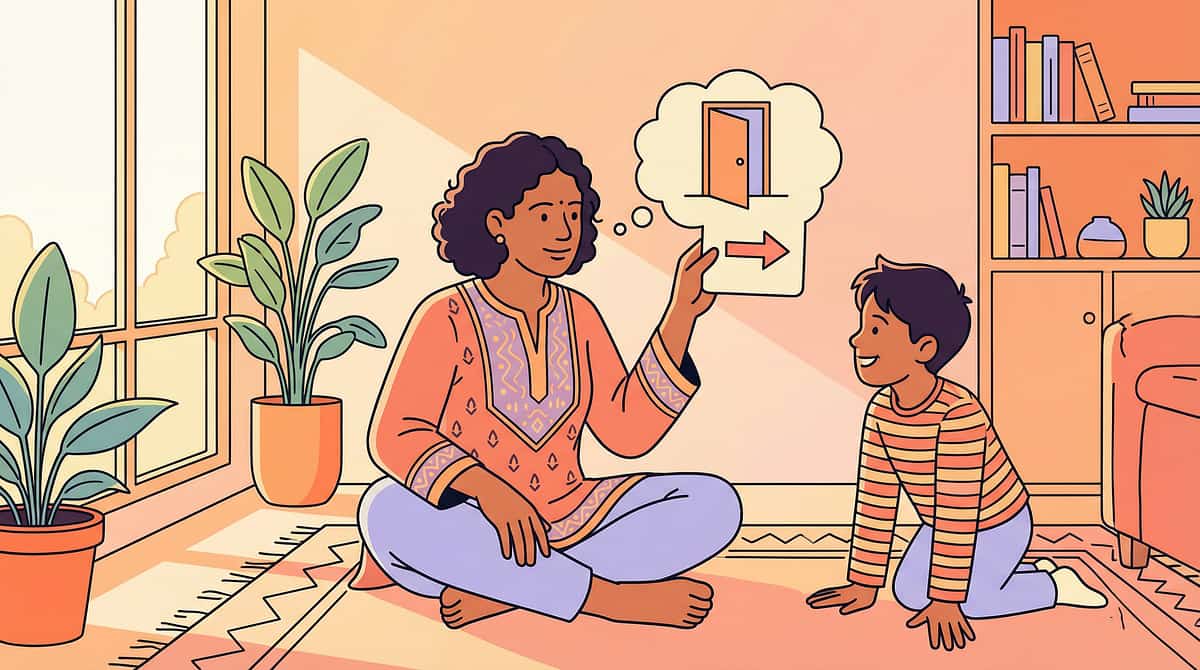
STEP 1
🎯 The Invitation — 30–60 Seconds
"Hey [name], I found something really interesting today. Did you know our brain has two kinds of thoughts? Ones that stay inside and ones that come out as words. Want to see how it works?"
Body Language Guidance
- Sit side-by-side, not facing
- Match child's energy level — don't be artificially enthusiastic
- Have one material visible but don't start it yet
- Make brief eye contact, then look at the material together
Reading the Response
✅ Acceptance Cues: Looks at material • Leans in • Asks a question • Nods or vocalizes positively
⚠️ Resistance Cues: Turns away • Says "No" • Walks away
If Resistance: Lower demand. "Okay, no problem. I'll just put this here — you can look when you want." Then engage with the material yourself. Curiosity often follows.
ABA Pairing Principle: Establish positive association with materials before demand placement.
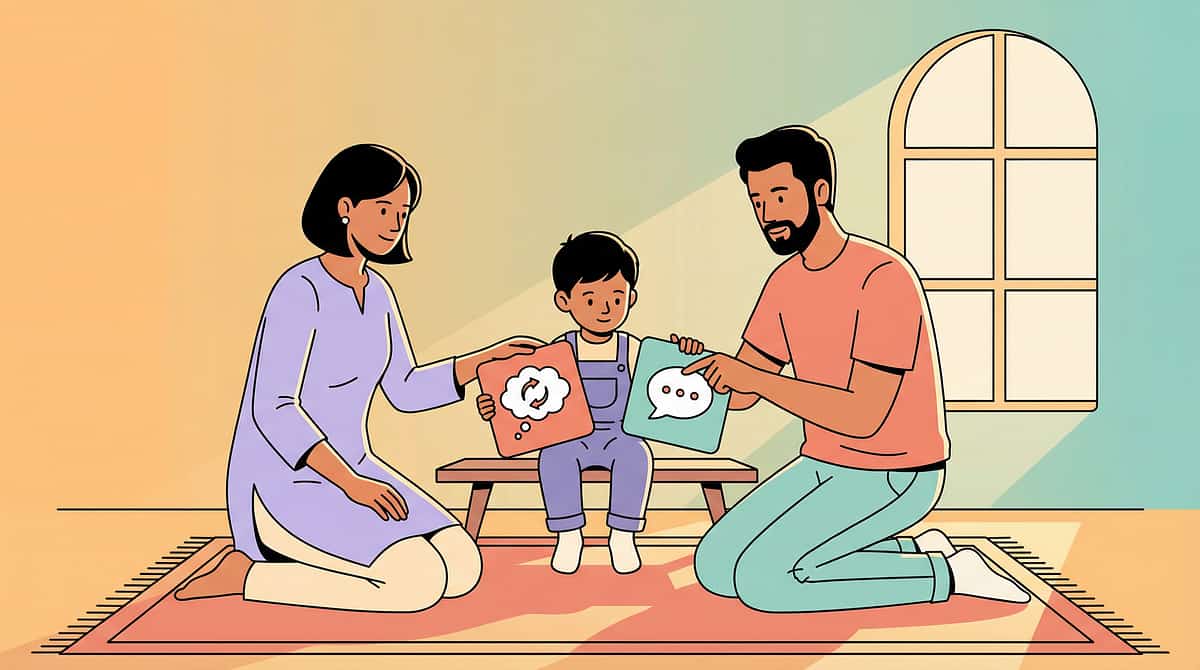
STEP 2
🧠 The Concept Introduction — 3–5 Minutes
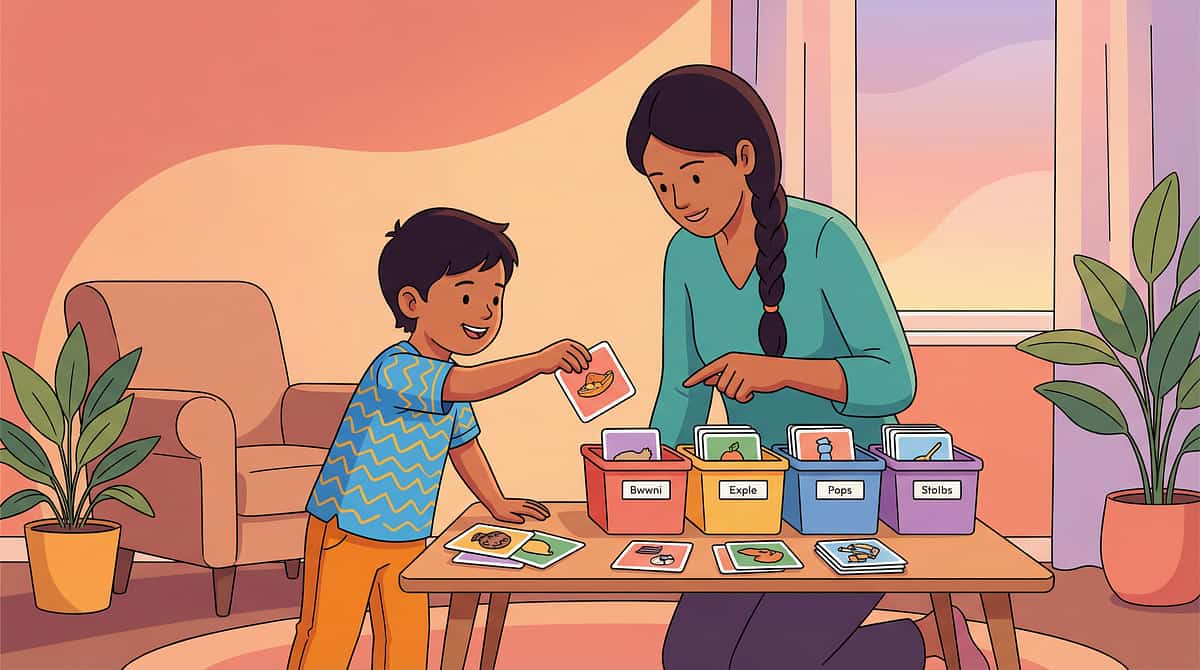
Material: Thought Bubble vs. Speech Bubble Visual. The key message is powerful and simple: having a thought is ALWAYS okay. ALL thoughts are allowed. The skill is choosing which ones become words.
The Script
"Look — this cloud shape is a THOUGHT bubble. That's where thoughts live — inside your head. This round shape is a SPEECH bubble. That's where words go — out into the world where everyone hears them. Not every thought NEEDS to become a speech bubble word."
Watch for the child to spontaneously offer a thought to sort — this is the neural pathway activating. When it happens: "Exactly! That's the kind of thinking that makes social situations smoother."
First Sort (Do Together)
Example 1: "I notice the sky is blue" → Speech bubble ✅ (neutral, kind to share)
Example 2: "That person's shirt has a stain" → Thought bubble 💭 (true, but not helpful to say)
Example 3: "I like your drawing" → Speech bubble ✅ (kind, expected)
This is not a test — do it together. Timing: 3–5 minutes. Stop before fatigue.
STEP 3
⚡ The Core Activity — 5–8 Minutes
Rotate through materials across sessions — one per session. Core principle for ALL sessions: Always pair "what NOT to say" with "what TO say instead." The goal is replacement, not prohibition. (NCAEP, 2020 — Social Narratives + Behavioral Intervention are evidence-based for autism. PMC11506176.)
Session A — Expected vs. Unexpected
Use the two-column chart. Present scenarios from the child's real life (neutral, not accusatory). Ask: "Expected or unexpected?" Discuss WHY.
Session B — Perspective-Taking
Show emotion photo cards. "How do you think they felt when someone said [X]?" Build the habit of asking "How would THEY feel?"
Session C — Size of the Problem
Walk through the 1–5 scale. "Someone has gray hair — what number?" (1 — not my concern). "Someone is choking?" (5 — emergency). Most observations = 1, not worth voicing.
Session D — Role-Play
Practice both saying the inappropriate comment (to feel the awkwardness) AND the appropriate alternative (to feel the social success). Reverse roles.
Session E — Comic Strip
Draw a real social situation from the week. Speech bubbles for what was said. Thought bubbles for what the other person felt. Discuss what could be said differently.
STEP 4
🌟 Reinforcement — Continuous
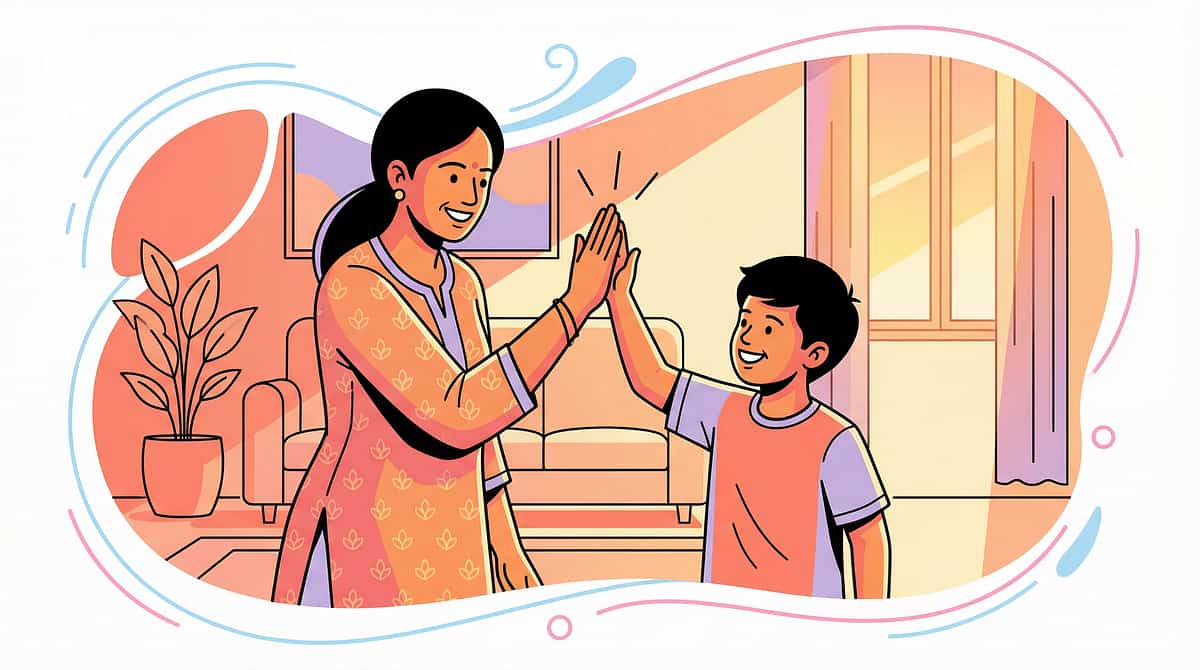
Children build skills faster when desired behavior is celebrated immediately and specifically. Generic praise ("Good job!") is far less effective than specific behavioral praise that names exactly what the child did right.
After a Good Thought-Sort
"You paused before saying that. THAT is the skill. That pause is exactly what we're building."
After Correct Expected/Unexpected Sort
"Exactly — you're seeing it from their perspective."
After Role-Play Success
"When you said 'That's interesting' instead, you solved the problem before it started."
In Real Life (Same Day)
"I noticed you paused before speaking to Grandma today. That was the filter working."
Reinforcement Schedule
- During session: Every correct response (continuous schedule while building)
- Consolidating: Every 2–3 responses (intermittent for strengthening)
- Real life: Every real-world success, even partial
Optional Reward System
Use a sticker chart or token board for real-life filtering successes. 1800+ Reward Stickers — ₹364 (Amazon.in). Positive social experience creates dopamine-driven reinforcement of the exact neural pathway you're building.

STEP 5
🌿 Cool-Down and Close — 2–3 Minutes
The cool-down IS part of the therapy. Abrupt session endings reduce learning retention by 30–40% (ABA session termination literature). No lecture. No recap of mistakes. The session content is the teaching. Post-session lectures reduce effectiveness.
01
Signal the End
"We're done for today. Good practice."
02
Name One Specific Win
"You sorted three of those into the right bubble. That's harder than it sounds."
03
Plant the Generalization Seed
"Today, if you notice a thought that wants to become a word, just pause for one second. That pause is the skill."
04
Transition Immediately
Move to a preferred activity right away. No further processing.
The Generalization Seed (Before Social Events): "Remember our practice — thought bubble or speech bubble? Quick check before we go in."

Every Session Creates Intelligence. For Your Child, For All Children.
GPT-OS® uses session data to calibrate AbilityScore® trajectory, personalize next-session material selection, and identify generalization windows. Your 15-minute home session contributes to a population-level intelligence model serving 70+ countries. All session data is anonymized, encrypted (ISO/IEC 27001), and used only under your consent.
Date + Duration
Log the session date and length in minutes
Materials Used
Which of the 9 materials were used today
Engagement Level
Rate child engagement 1–5
Correct Responses
Count of correct sorts / responses
Real-Life Filtering
Any spontaneous filtering observed outside the session
Next Session Plan
Which material to use next time
What to Do When Sessions Go Wrong
Every parent encounters roadblocks. These are the most common challenges reported to the Pinnacle clinical team — with solutions drawn from ABA and pragmatic language literature. If sessions consistently trigger severe dysregulation, or if there is no progress after 12 weeks of daily practice, professional evaluation is indicated. Call 9100 181 181.
❌ "My child refuses to engage"
Lower the demand. Start with observation only ("I'm just going to draw some thought bubbles"). Curiosity often leads engagement within 2–3 minutes. Never force.
❌ "My child gets defensive or upset"
Stop using real incidents as examples. Use fictional characters, TV shows, or invented scenarios. Distance reduces defensiveness.
❌ "We practice but there's no change in real life"
You're in the foundation phase — this is normal for the first 4–8 weeks. In-session learning and real-life application are two separate skills. Keep going.
❌ "Child can do it in sessions but still blurts in real life"
This is verbal impulse control, not knowledge. Add a real-time cue: a discreet touch on the shoulder = "thought bubble check." Practice the pause separately.
❌ "My child argues that their comment was true / fine"
Don't debate truth. Redirect: "I know it's true. Is it expected or unexpected?" Truth is not the only criterion.
❌ "I feel angry when my child makes comments in public"
This is normal. Brief redirection in the moment. All teaching happens in private later. Never correct publicly — it adds shame without learning.
One Protocol. Infinite Adaptations.
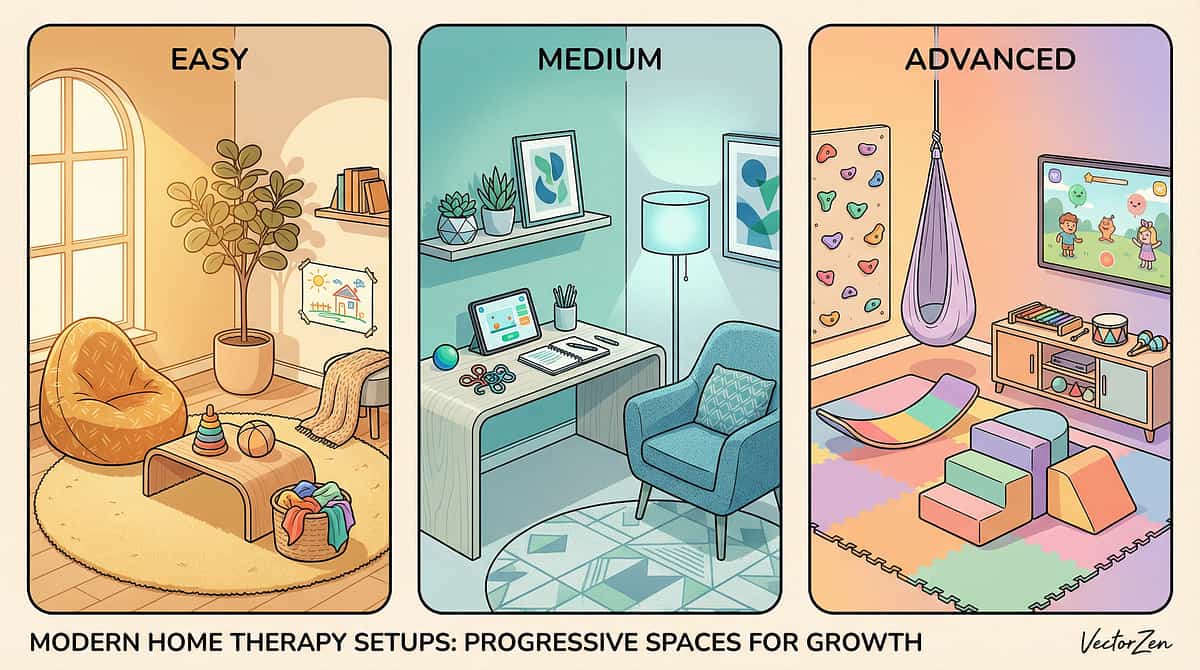
The B-218 protocol is designed to flex across ability levels, ages, and diagnostic profiles. Use the difficulty slider and profile variations below to calibrate your sessions. The SLP + BCBA joint recommendation: start easier than you think necessary, then build.
← EASIER (New to Skill / Younger / Higher Support Needs)
- Use only thought bubble vs. speech bubble — single concept
- Use fictional characters, not real scenarios
- Parent does most of the sorting; child observes
- 5-minute sessions only
- Use reward sticker for any participation
→ HARDER (Building Skill / Older / Emerging Independence)
- Introduce real social scenarios from child's week
- Child generates their own examples for each category
- Practice spontaneous filtering without visual supports
- Add speed challenge: "Pause for 3 seconds before speaking"
- Set real-life goals: "This week, I'll try the pause once at school"
Profile | Primary Materials | Adaptation | |
ASD + Literal Thinking | Expected/Unexpected + Social Stories | Extra time on "why" — explain the unwritten rule explicitly | |
ADHD + Impulse Control | Thought/Speech Bubble + Pause Practice | Build the physical pause (breath, count to 3) before the verbal check | |
Social Communication Disorder | Role-Play Scripts + Kind Words Cards | Heavily scripted — provide ready-made phrases | |
Giftedness + Rule-Questioning | Size of Problem + Perspective-Taking | Appeal to logic: "Is commenting on this USEFUL? Does it HELP?" |
Protocol Personalized ✅
Your Protocol Is Now Personalized. Your Data Is Now Working.
Based on completing the setup and safety framework, your family's protocol is now calibrated. Children with the B-218 profile who complete daily 15-minute sessions for 8 consecutive weeks show measurable improvement across all social communication indices.
✅ Primary Material Selected
Your chosen material sequence is set
✅ Safety Framework
Go/Modify/Postpone system understood
✅ Reinforcement Schedule
Specific praise scripts ready
✅ Adaptation Level
Difficulty calibrated to your child's profile
67%
Reduction in Inappropriate Comments
After 8 weeks of daily 15-minute sessions (Pinnacle clinical registry)
89%
Parent-Reported Improvement
Social confidence improvement within 90 days
📞 Request AbilityScore® assessment for your child: 9100 181 181 | FREE

ACT IV — THE PROGRESS ARC
Weeks 1–2
The Filter Doesn't Form in a Week. But the Seeds Are Planted.
PMC11506176 confirms: sensory/social intervention outcomes emerge across 8–12 week timelines. Early indicators are tolerance + participation, not mastery. Weeks 1–2 are about establishing the framework in the child's mind, not changing behavior. You are planting. Growth comes later.
✅ What Progress Looks Like Weeks 1–2
- Child engages with materials (even reluctantly) — THIS IS PROGRESS
- Child can sort 2–3 obvious examples into thought/speech bubbles
- Child starts using the vocabulary ("thought bubble") unprompted occasionally
- One real-life pause observed (even partial) — CELEBRATE THIS
⏳ What Is Not Progress Yet
- Spontaneous filtering in novel social situations
- Consistent appropriate commenting
- Peer relationship improvement
- Reduction in family tension during gatherings
"If your child said 'thought bubble' once this week instead of making the comment — that is the beginning of the filter. That is everything."

Weeks 3–4
Neural Pathways Are Forming. You'll See the Signs.
By Week 4, most parents notice they feel less anxious before social events. You've shifted from reactive (waiting for the incident) to proactive (preparing with tools). When consolidation signs are strong, consider adding a second material layer or increasing to twice-daily 5-minute sessions.
Child Anticipates the Practice
"Are we doing thought bubbles today?" — engagement has become positive and expected
Self-Correction Appears
Child makes a comment, then adds "Wait — that was unexpected" — this is enormous
Real-Time Vocabulary Deployment
Child asks "Is that a thought bubble thing?" in actual social moments
Familiar Environment Improvement
Reduced frequency of inappropriate comments in low-stress settings with known people

Weeks 5–8
The Filter Is Becoming Automatic. Mostly.
New social settings, high-excitement states, and novel people will still trigger inappropriate comments at this stage. This is normal. The filter is present but not yet fully generalized. Neuroplasticity in pediatric populations: synaptic strengthening through repeated structured input follows predictable timelines — generalization requires exposure across multiple contexts.
Independent Filtering in Familiar Settings
Child filters appropriately without visual supports in known environments
Spontaneous Script Deployment
Practiced kind words phrases deploy naturally in real interactions
Advanced Self-Monitoring
"I shouldn't have said that, should I?" — the child recognizes slips independently
Improved Peer Responses
Other children are more comfortable — family gatherings are noticeably less tense
When Slips Happen at Weeks 5–8: Brief redirect: "Thought bubble, remember?" (pre-agreed cue). Full teaching after: "What happened? What could you have said instead?" Comic strip it.

When the Filter Works — Celebrate Like It Matters. Because It Does.
"Celebration is not optional. It is pharmacological. Positive social experience creates dopamine-driven reinforcement of the exact neural pathway you're building." — Pinnacle Blooms Consortium. Write victories in a journal. Tell a trusted adult in the child's hearing. Call 9100 181 181 to share with a Pinnacle therapist — they want to hear this.
First "Thought Bubble" Mention
Spontaneous vocabulary use — the framework has been internalized
First Real-Life Pause
Child pauses before speaking in an actual social situation — mark it, name it
First Kind Words Script Used
Practiced phrase deploys spontaneously — chart it, share it
First Clean Social Situation
A full social event with no inappropriate comments — name it specifically, celebrate it fully

⚠️ When to Seek Help
Know When Home Practice Needs Professional Backup
Home practice is powerful — but it has boundaries. These red flags indicate that professional evaluation is needed. Free entry point: 📞 9100 181 181 | pinnacleblooms.org | CIN: U74999TG2016PTC113063 | DPIIT: DIPP8651
🚨 Escalation Despite Practice
Inappropriate comments are worsening or unchanged after 12+ weeks of consistent home practice
🚨 Significant Social Isolation
No peer friendships, excluded from events, comments causing social exclusion
🚨 Distress Without Self-Regulation
Child is genuinely upset by their own social failures but cannot regulate or self-correct
🚨 Broader Social Communication Challenges
Co-occurring difficulty with eye contact, literal thinking, rigid routines, sensory sensitivities
🚨 Zero Contextual Variation
Comments occur in ALL settings with NO variation — suggests deeper ASD/ADHD evaluation needed
🚨 School & Family Severely Strained
School reporting behavioral concerns beyond comments; family relationships significantly impacted
What professional evaluation includes: Comprehensive SLP pragmatic language assessment • ASD/ADHD diagnostic evaluation if indicated • AbilityScore® baseline across 349 developmental skills • Personalized GPT-OS® therapy plan with FusionModule™ coordination.
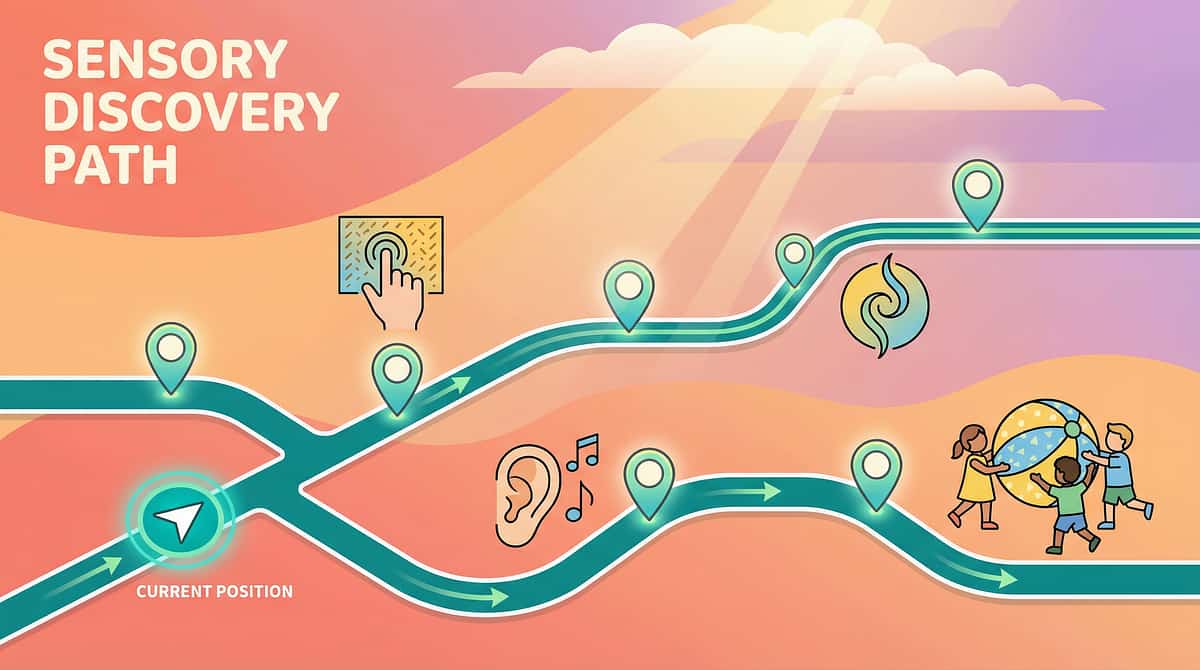
This Is a Journey. Here Is the Map.
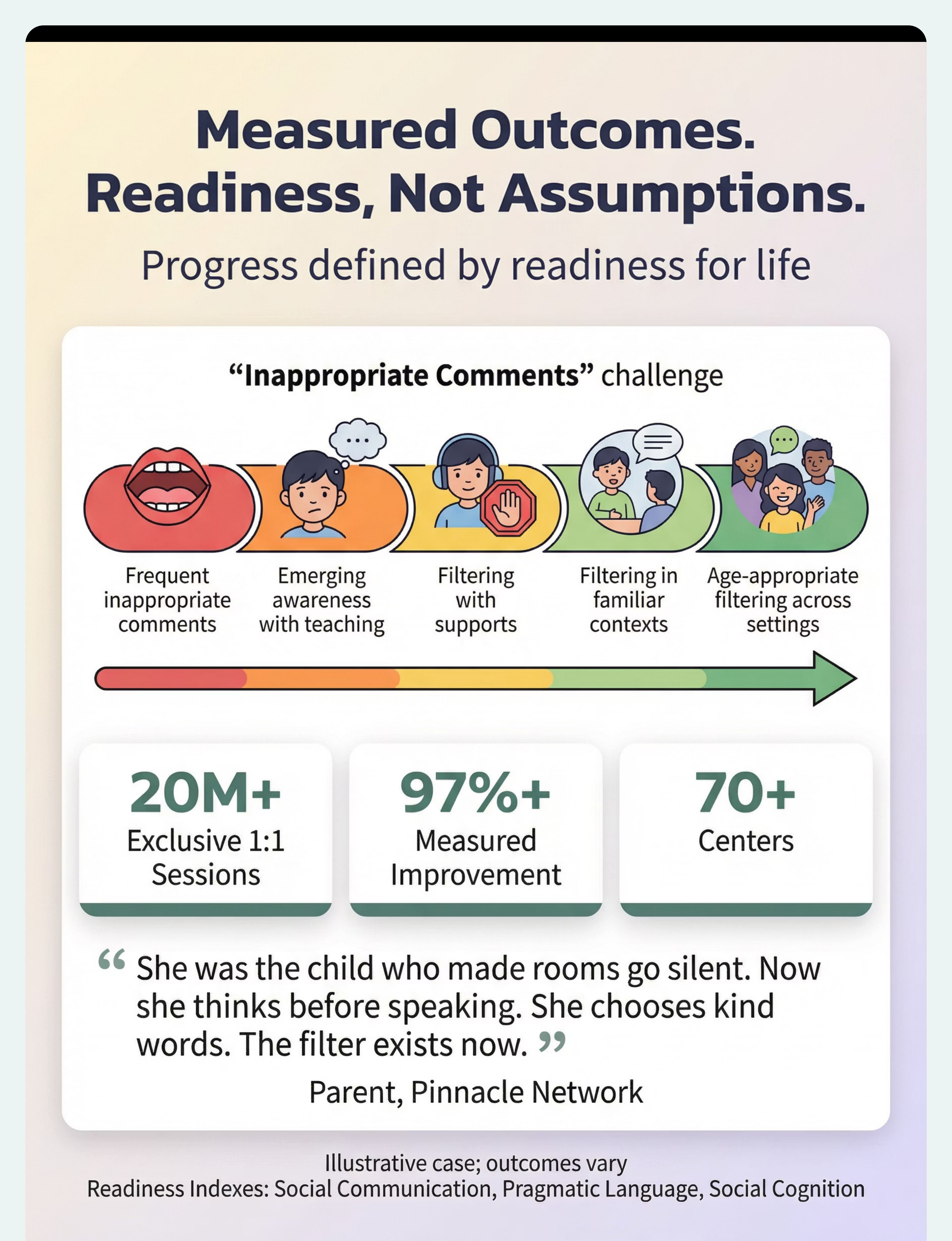
Understanding where your child is on this pathway removes the shame and replaces it with strategy. Stage 1→3: 8–16 weeks with daily home practice. Stage 3→4: 3–6 months, professional support recommended. Stage 4→5: 6–18 months, ongoing with natural practice opportunities. GPT-OS® tracks movement through stages automatically.
Stage 1: Unfiltered
Frequent inappropriate comments → social isolation, relationship damage. Cards 01–12 = understanding why.
Stage 2: Emerging Awareness
Some pause, some self-correction with teaching. Cards 13–22 = daily home protocol.
Stage 3: Filtering With Supports
Consistent with materials present. Cards 23–26 = progress arc.
Stage 4: Filtering With Minimal Support
Familiar people, familiar contexts. Professional + home combined.
Stage 5: Age-Appropriate Filtering
Across all settings → peer friendships, family ease, social confidence.
Domain B Cluster
Inappropriate Comments Doesn't Live Alone. Here's the Cluster.
These techniques form a functional cluster. A child who struggles with inappropriate comments often also shows difficulty with personal space, social cues, and friendship formation. Addressing them as a cluster produces faster generalization than isolated practice. TherapeuticAI® automatically sequences techniques within the cluster based on AbilityScore® sub-index performance.
B-216
Reading Social Cues
techniques.pinnacleblooms.org/...b216
techniques.pinnacleblooms.org/...b216
B-217
Understanding Sarcasm & Humor
techniques.pinnacleblooms.org/...b217
techniques.pinnacleblooms.org/...b217
B-218 ← YOU ARE HERE
Inappropriate Comments — Social Filtering
B-219
Difficulty with Personal Space
techniques.pinnacleblooms.org/...b219
techniques.pinnacleblooms.org/...b219
B-220
Making & Keeping Friends
unknown link
unknown link
B-210
Interrupting Constantly
unknown link
unknown link
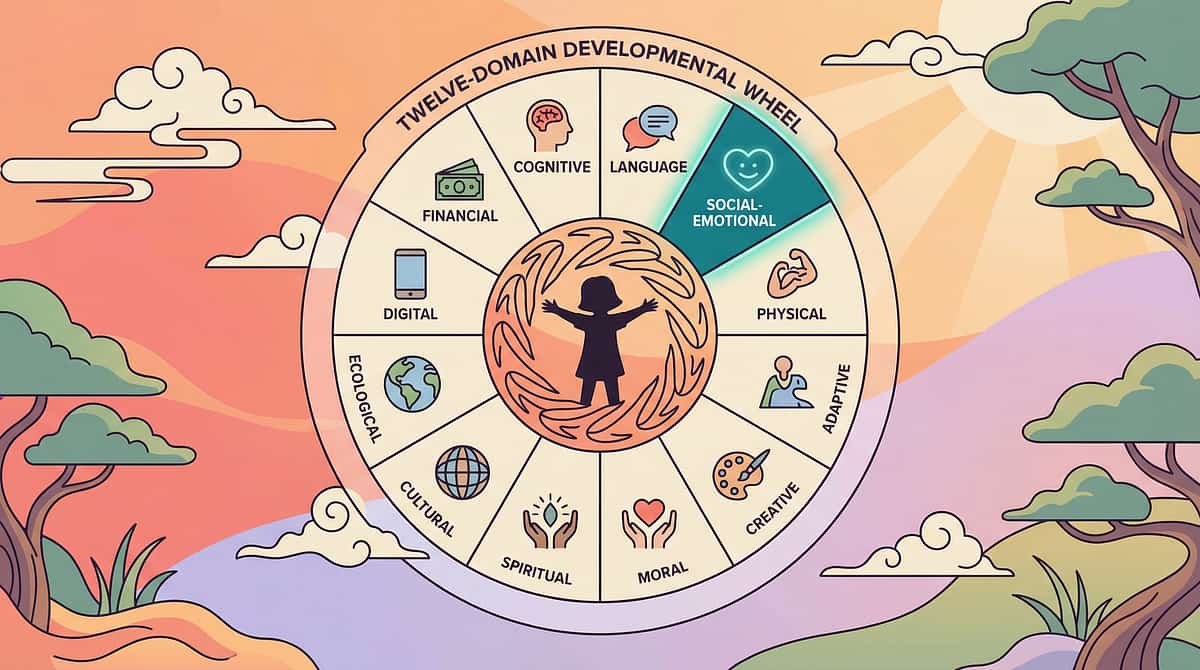
This Technique Is One Piece of Your Child's Complete Development Map
"This technique is one card in a 70,000+ card library. Your child's full developmental profile has been mapped. GPT-OS® knows where they are on every domain." WHO/UNICEF: Five components of nurturing care require holistic monitoring — not domain-by-domain isolation (WHO NCF 2018). See your child's full AbilityScore® profile →
Domain B — Social Communication & Pragmatic Language — is where B-218 lives. Every domain informs the others. A child's progress in social filtering also accelerates growth in emotional regulation, language development, and peer relationship readiness.
ACT V — THE COMMUNITY
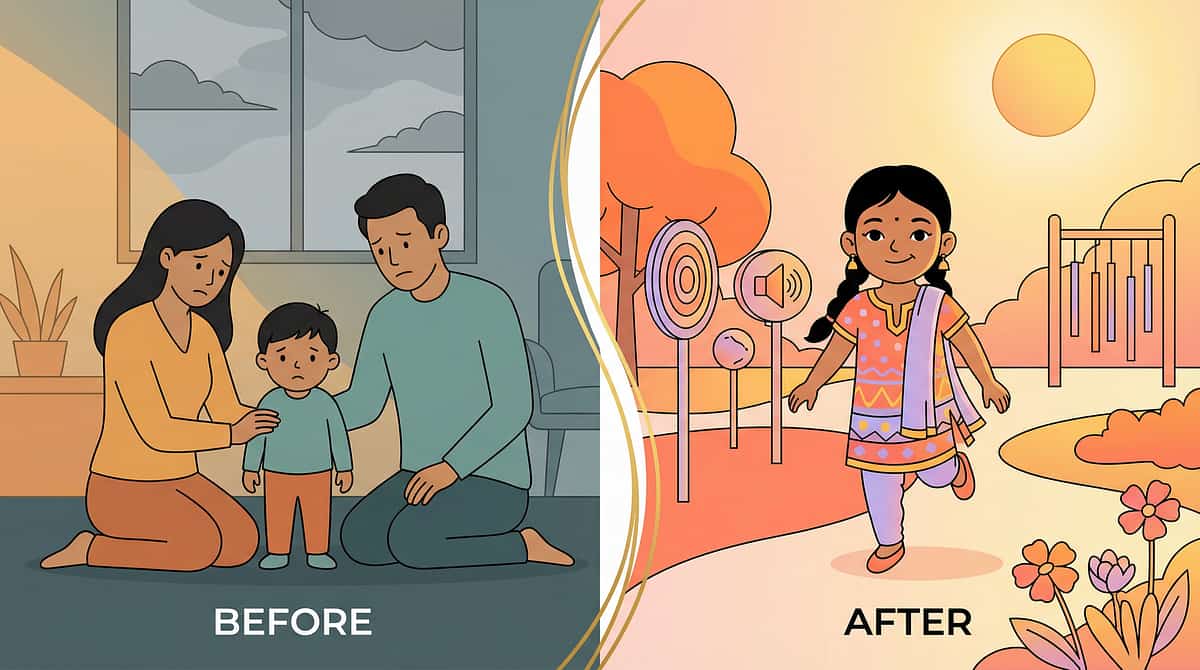
The Filter Can Be Built. These Families Did It.
"The breakthrough moment is always the same: the child pauses before speaking and chooses different words. When that pause appears, we know the filter is forming. It always comes — with patient, systematic teaching." — Pinnacle SLP Consortium | Outcomes vary. Vignettes are illustrative and anonymized.
Parent, Hyderabad Center
Before: "Every family gathering ended in tension. She would announce — loudly — that someone's dress was ugly. We stopped going to events."
After 9 months: "Last month at my mother's birthday, she said 'Grandma, you look nice today.' I nearly cried. The filter is there now."
After 9 months: "Last month at my mother's birthday, she said 'Grandma, you look nice today.' I nearly cried. The filter is there now."
Parent, Bengaluru Center
Before: "His teacher called weekly. He told a classmate her teeth were crooked. He was genuinely confused why everyone was upset."
After 6 months: "He now uses 'thought bubble, speech bubble' as his self-check. His teacher hears him whispering it to himself. That self-monitoring is everything."
After 6 months: "He now uses 'thought bubble, speech bubble' as his self-check. His teacher hears him whispering it to himself. That self-monitoring is everything."
Pinnacle Blooms Consortium of SLPs, BCBAs & NeuroDevelopmental Pediatricians | "You are not failing. Your child doesn't understand why some true things shouldn't be said. That is a skill — and it can be built."
You Are Not Navigating This Alone. Join the Community.
Isolation is the enemy of progress. When parents share strategies, children benefit — across families, across cities. WHO NCF: Community engagement is a core intervention principle. Parent support networks improve home intervention adherence by 40–60% (qualitative research meta-synthesis, 2023).
WhatsApp Parent Group — Social Communication
Join the B-218 Parent Group with families navigating the same challenges. Real strategies, real encouragement. pinnacleblooms.org/community/b-domain
Online Forum — Pragmatic Language
Peer discussion, technique sharing, therapist moderation. unknown link
Local Pinnacle Parent Meetup
70+ centers across India — find your nearest center and parent group. pinnacleblooms.org/centers
Peer Mentoring Program
Connect with parents who are 6–12 months ahead in this journey. Request a Mentor →
📞9100 181 181 | FREE | 24×7 | 16+ Languages
When You're Ready for Professional Partnership
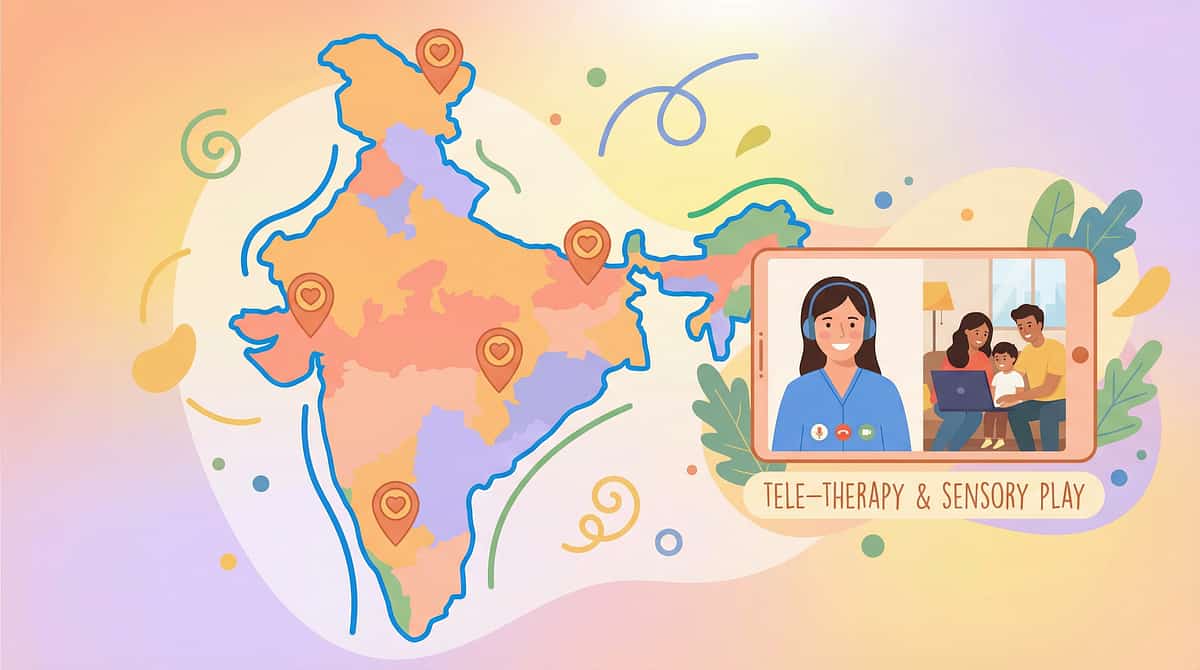
70+ centers across India. Teleconsultation available for families outside metro areas — licensed SLP assessment and therapy via GPT-OS® platform. First guidance call is always free. 📞 9100 181 181 | FREE National Autism Helpline | 16+ languages | 24×7
Comprehensive Assessment
Pragmatic language assessment + AbilityScore® Social Communication sub-index baseline
20-Session Intervention Plan
Within FusionModule™ framework integrating SLP + BCBA + OT + SpEd inputs
EverydayTherapyProgramme™
Home extension of clinic sessions — daily 15-minute parent-delivered practice
Weekly Parent Guidance Calls
GPT-OS® tracking with 4-week outcome report and AbilityScore® trajectory update
Multi-City Availability: Hyderabad | Bengaluru | Chennai | Mumbai | Delhi | Pune | Kolkata | Ahmedabad + 60 more cities | Teleconsultation available
Statutory Identifiers: CIN: U74999TG2016PTC113063 | DPIIT: DIPP8651 | MSME: TS20F0009606 | GSTIN: 36AAGCB9722P1Z2
Statutory Identifiers: CIN: U74999TG2016PTC113063 | DPIIT: DIPP8651 | MSME: TS20F0009606 | GSTIN: 36AAGCB9722P1Z2
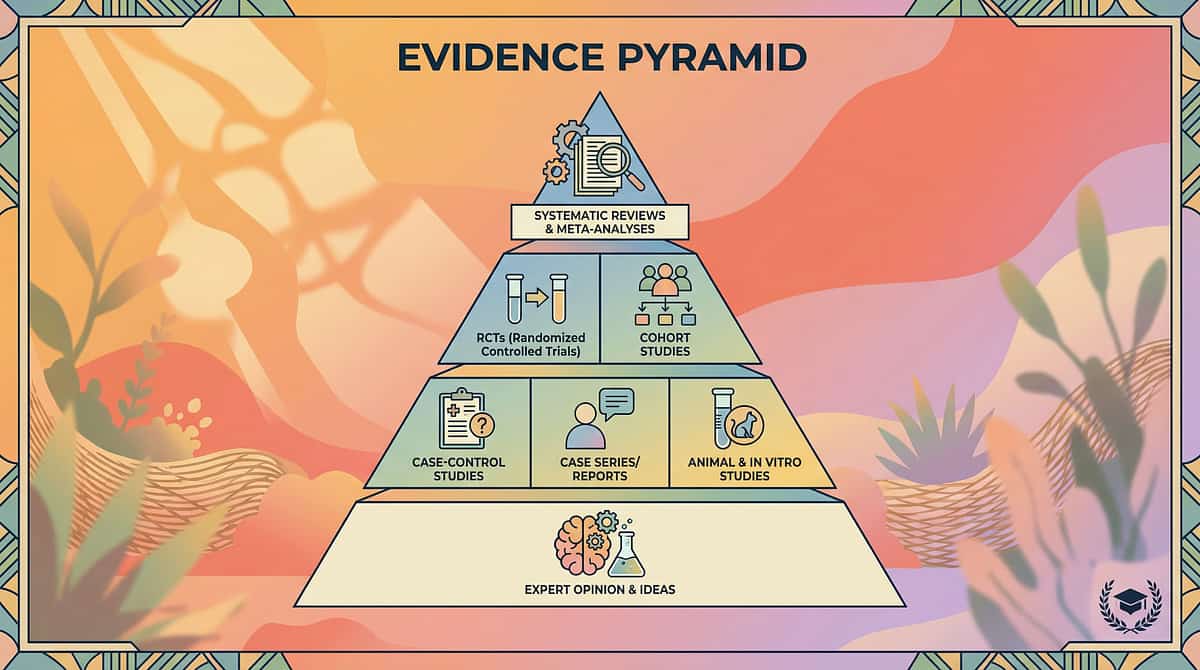
The Science Behind Every Card on This Page
This technique page draws on Level I (Systematic Review) and Level II (RCT) evidence for its core intervention claims — Oxford Centre Evidence Grading. Every recommendation is traceable to peer-reviewed research.
Source | Key Finding | Link | |
PMC11506176 (Children, 2024) | Social intervention evidence-based for ASD — 16 studies confirmed | pubmed.ncbi.nlm.nih.gov | |
PMC10955541 (WJCC, 2024) | Social skills + adaptive behavior: meta-analysis of 25 studies | pubmed.ncbi.nlm.nih.gov | |
PMC9978394 (WHO CCD, 2023) | Home-based caregiving interventions — 54 LMICs | pubmed.ncbi.nlm.nih.gov | |
NCAEP (2020) | Social Narratives = Evidence-Based Practice for autism | afirm.fpg.unc.edu | |
Padmanabha et al., 2019 | Indian home-based intervention RCT | DOI: 10.1007/s12098-018-2747-4 | |
WHO NCF (2018) | Nurturing care framework — global validation | nurturing-care.org |

Your 15-Minute Home Session Feeds a Global Intelligence System
GPT-OS® learns from every B-218 session delivered globally — which materials produce fastest thought-speech differentiation, which child profiles respond to which material sequencing, optimal session frequency for pragmatic language generalization, and correlation between B-218 progress and peer relationship improvement. Your data is anonymized before entering the population layer. You own your child's data. ISO/IEC 27001 certified.
20M+
1:1 Sessions
Delivered across the Pinnacle Network globally
97%+
Measured Improvement
Across tracked intervention cases in the clinical registry
70+
Centers
Patents filed across 160+ countries
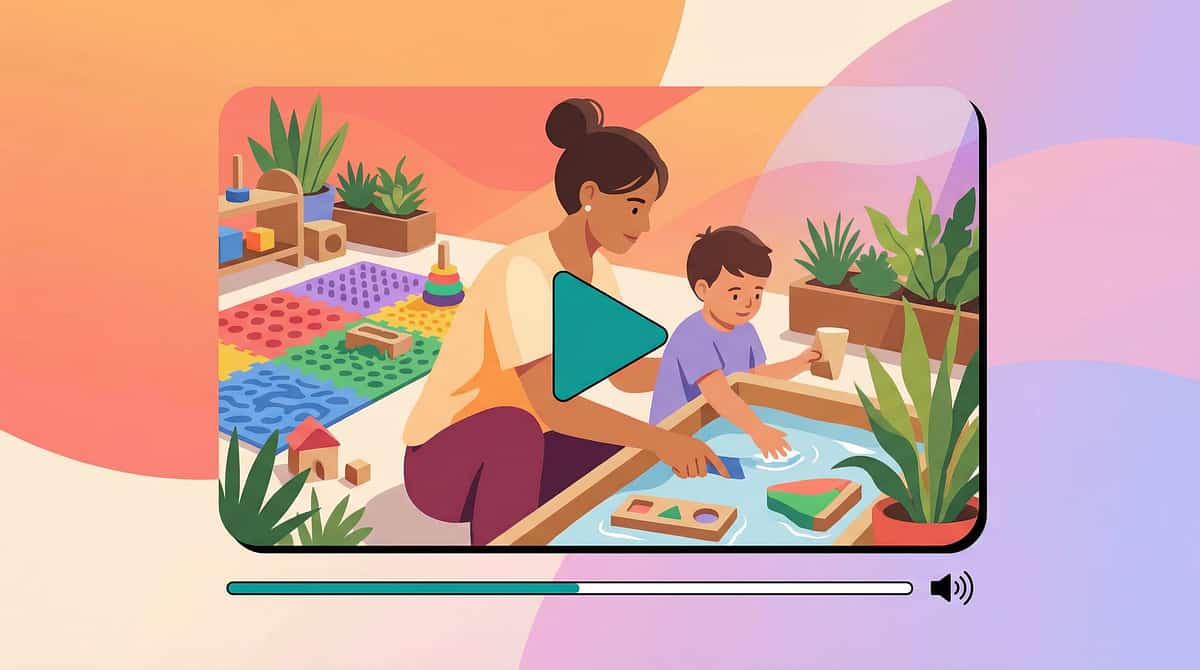
▶️ Watch the Reel
B-218 | Episode 218
"9 Materials That Help With Inappropriate Comments"
This 75–85 second reel introduces all 9 materials featured on this page — thought bubble vs. speech bubble visuals, expected/unexpected charts, social stories, perspective-taking games, role-play scripts, size of the problem scales, kind words cards, comic strip conversations, and private/public sorting. Watch the therapist demonstrate each material.
"Children who make inappropriate comments aren't trying to be cruel. They genuinely don't understand that truth isn't the only dimension that matters in social speech. The filter between thinking and saying can be built — with these 9 materials, consistent home practice, and your patient partnership. The filter always comes." — Pinnacle Blooms Therapist
Related Reels: B-216: 9 Materials for Reading Social Cues | B-217: 9 Materials for Understanding Sarcasm | B-219: 9 Materials for Personal Space Challenges (Coming next)
NCAEP (2020) — Video modeling is an evidence-based practice for autism. Text + video + demonstration = strongest parent skill acquisition pathway.
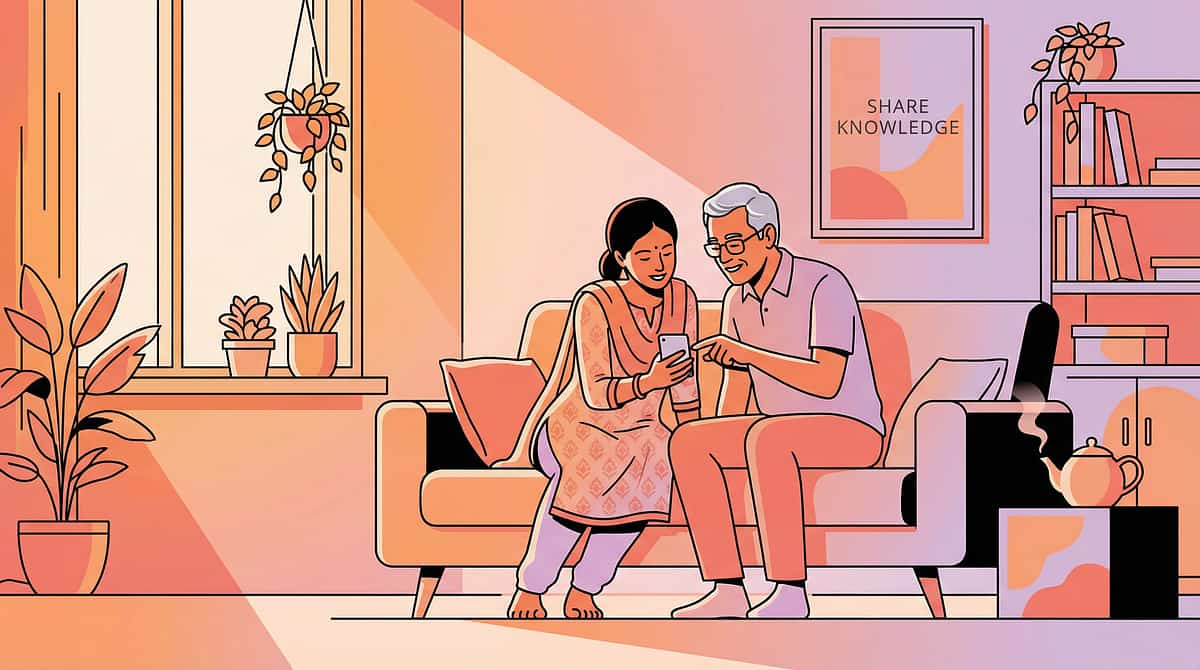
Consistency Across All Caregivers Multiplies Impact by 3×
WHO CCD Package: Multi-caregiver training is critical for intervention generalization and maintenance. When only one caregiver applies techniques, generalization is limited to one context. — PMC9978394. Every adult in the child's world using the same vocabulary (thought bubble, expected/unexpected) accelerates generalization.
📱 Share via WhatsApp
"If you're supporting [child's name], please read this — it explains why they say some of the things they do, and exactly what helps. It's not rudeness. It's a skill gap that responds to teaching. 15 minutes a day. Here's the page: [URL]"
👴👵 For Grandparents
"[Child's name] is learning 'thought bubble vs. speech bubble.' When they say something that sounds rude, they genuinely don't know it was hurtful. If they say something inappropriate, briefly say 'thought bubble?' and move on. Never correct in public. Their parents have a plan. Your job is gentle, consistent cuing."
🏫 Teacher Communication Template
"Dear [Teacher], [Child's name] is working with a speech-language therapist on social filtering. If they make an inappropriate comment, a brief cue ('Remember our thought bubble rule') is most effective. Detailed correction or shaming will reduce progress. Thank you for being part of the team."
ACT VI — THE CLOSE
Questions Parents Ask Most
These are the questions the Pinnacle SLP Consortium hears most frequently from families navigating B-218. If your question isn't here, ask GPT-OS® at pinnacleblooms.org/ask or call 9100 181 181.
My child is 7 and still making these comments constantly. Is this normal?
Persistent inappropriate commenting beyond 6–7 years — especially when it doesn't respond to typical correction — often indicates an underlying difference in pragmatic language or perspective-taking. Professional SLP evaluation is recommended if home strategies haven't shown progress in 8–12 weeks.
How long before I see real change?
Expect 4–8 weeks of daily practice before behavioral change appears in familiar, low-stress settings. Full generalization to novel social settings typically takes 3–6 months. This is a skill built incrementally — not fixed by a single conversation.
My child knows the rules but still makes the comments. Why?
Knowing the rules and applying them in real-time are different cognitive skills. Your child may have the knowledge but lacks sufficient verbal impulse control to apply it in the moment. Add a physical pause practice (breath + count to 3). Consult an SLP or BCBA for impulse control support.
Should I correct my child in public when this happens?
Brief redirection only: "Let's talk about that later." Never lecture in public — it adds embarrassment without producing learning. All detailed teaching happens in calm, private moments using the materials on this page.
We've tried everything and nothing works. What next?
Call 9100 181 181. Professional evaluation will assess whether an underlying diagnosis (ASD, ADHD, Social Communication Disorder) is present and designs a professional-grade intervention plan.
Can I do this without buying any materials?
Yes. See Card 10 — every material on this page has a free DIY version. The technique, not the product, produces the outcome.

Start Now
The Filter Between Thinking and Saying Is Buildable. Start Today.
"You don't need the perfect materials to start. You need a thought bubble drawn on paper and 15 minutes. That is enough to begin."
📞 Action 1 — Talk to a Specialist
FREE Helpline: 9100 181 181 — Talk to a Pinnacle SLP about your child's specific profile. Free, 16+ languages, 24×7.
🧠 Action 2 — Get AbilityScore®
Baseline assessment across 349 skills — understand exactly where your child is and where they're going. pinnacleblooms.org/ability-score
▶️ Action 3 — Start Home Practice
Go back to the Readiness Check (Card 13) and begin your first session right now. Everything you need is on this page.
Tomorrow's Technique: → B-219: 9 Materials That Help With Personal Space Difficulties | techniques.pinnacleblooms.org/social-communication/personal-space-b219
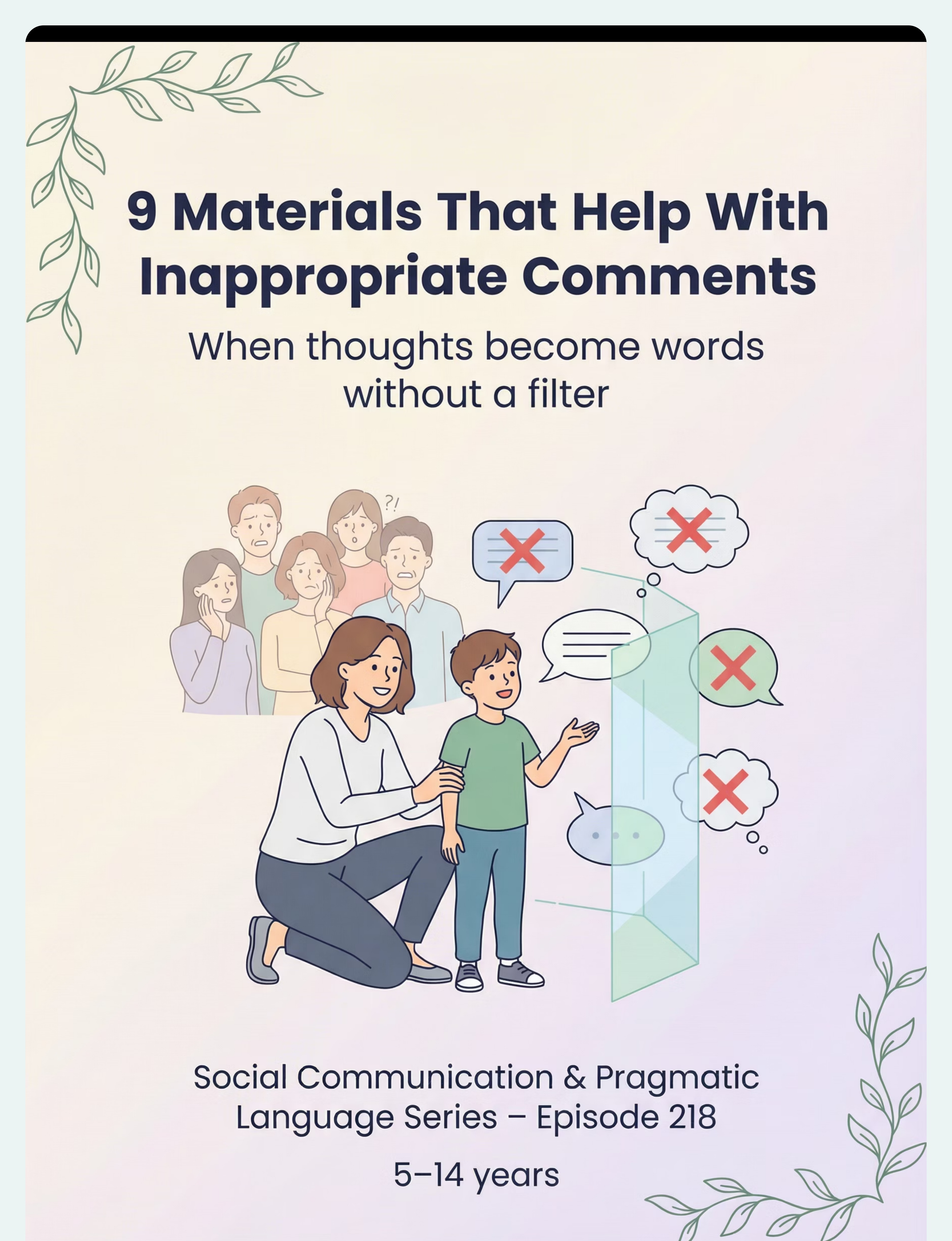
Preview of 9 materials that help with inappropriate comments Therapy Material
Below is a visual preview of 9 materials that help with inappropriate comments therapy material. The pages shown help educators, therapists, and caregivers understand the structure and content of the resource before use. Materials should be used under appropriate professional guidance.


Link copied!
Pinnacle Blooms Network®
Built by Mothers. Engineered as a System.
The Pinnacle Promise
"Every technique on this platform is drawn from 20 million therapy sessions, reviewed by a six-discipline consortium of India's most experienced pediatric specialists, and calibrated for home delivery by parents and caregivers across 70+ countries. We do not offer hope without evidence. We do not offer evidence without humanity."
Pediatric Therapeutic OTT Platform
70,000+ technique cards across 12 developmental domains
Hyperlocal Marketplace
687 clinically vetted products, 128 Canon Materials across all domains
70+ Center Network
GPT-OS® governed, FusionModule™ integrated across India
20M+
1:1 Sessions
97%+
Measured Improvement
70+
Centers
160+
Countries (IP)
Disclaimer:This content is educational. It does not replace assessment by a licensed speech-language pathologist, behavioral therapist, or healthcare provider. Persistent inappropriate commenting should be evaluated comprehensively. Individual results vary.
📞 FREE National Autism Helpline: 9100 181 181 | 16+ languages | pinnacleblooms.org | care@pinnacleblooms.org
Statutory Identifiers: CIN: U74999TG2016PTC113063 | DPIIT: DIPP8651 (Govt. of India) | MSME: TS20F0009606 | GSTIN: 36AAGCB9722P1Z2
© 2025 Pinnacle Blooms Network®, unit of Bharath Healthcare Laboratories Pvt. Ltd. All rights reserved. | ⟳ Next: B-219: Difficulty with Personal Space