

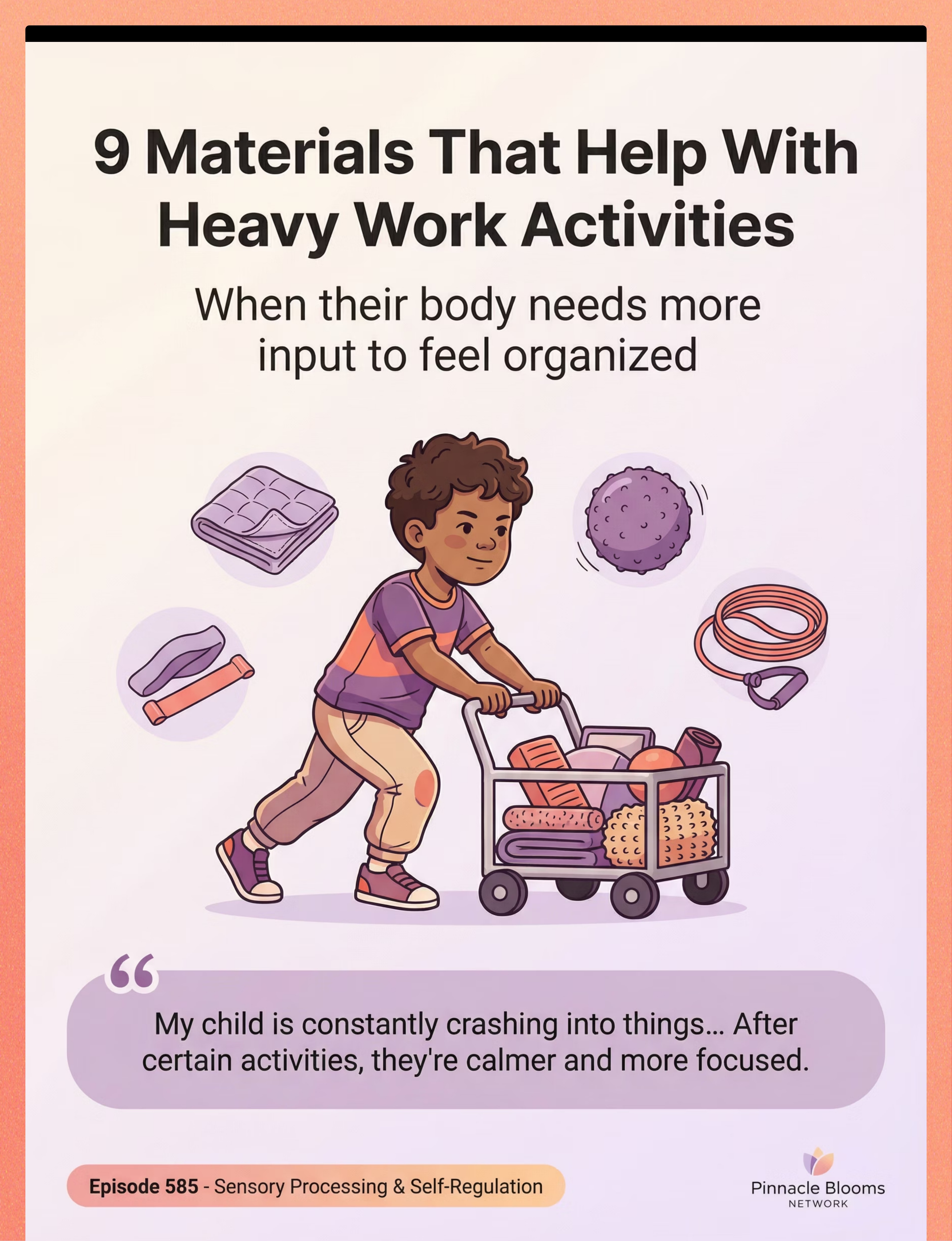
9 Materials That Help With Heavy Work Activities
When their body needs more input to feel organized — you are not failing. Your child's nervous system is speaking. And now, you will know how to answer.
Episode F-585
Sensory Processing Series
Consortium Validated

Act I — The Recognition Moment
Does This Sound Like Your Morning?
"It was a Tuesday morning. He had already jumped off the bed twice, knocked over his cereal, crashed shoulder-first into the hallway wall — and it wasn't 8am yet. His teacher texted again: 'He can't stay in his seat. It's becoming disruptive.' But I could see it in his eyes — it wasn't defiance. His body was searching for something."
If this story feels familiar, you are not alone. Across India and around the world, millions of families wake up to a child whose body seems to be on a relentless, urgent search — for something they cannot name, cannot explain, and cannot stop seeking. The crashing, the jumping, the squeezing-too-hard: this is one of the most universally reported challenges among parents of neurodivergent children.
What you are witnessing is not defiance. It is not attention-seeking. It is a nervous system asking — loudly, physically, urgently — for a specific type of input it is not receiving. And the remarkable truth is: when you know what the input is, you can deliver it.
🧠 OT
Occupational Therapy
🔬 ABA
Behavioral Support
🧬 NeuroDev
Developmental Pediatrics
📚 SpEd
Special Education
🗣️ SLP
Speech-Language Pathology

You Are Not Alone
The Numbers Behind This Challenge
The crashing, the jumping, the squeezing too hard — this is documented, researched, and — crucially — addressable. You are among millions of families navigating this exact challenge right now, across every country on Earth.
80%
Sensory Differences
of children with ASD show sensory processing differences
1in36
Children in India
identified with autism spectrum condition
20M+
Therapy Sessions
in Pinnacle's GPT-OS® data showing proprioceptive seeking as the #1 regulatory challenge
📚Evidence Base: PRISMA Systematic Review (2024): 80% of children diagnosed with autism display sensory processing difficulties. World J Clin Cases, 2024: Meta-analysis of 24 studies confirms sensory integration therapy effectiveness. PMC11506176 | PMC10955541

The Neuroscience
What's Happening in Your Child's Brain — In Plain English
The Clinical Reality
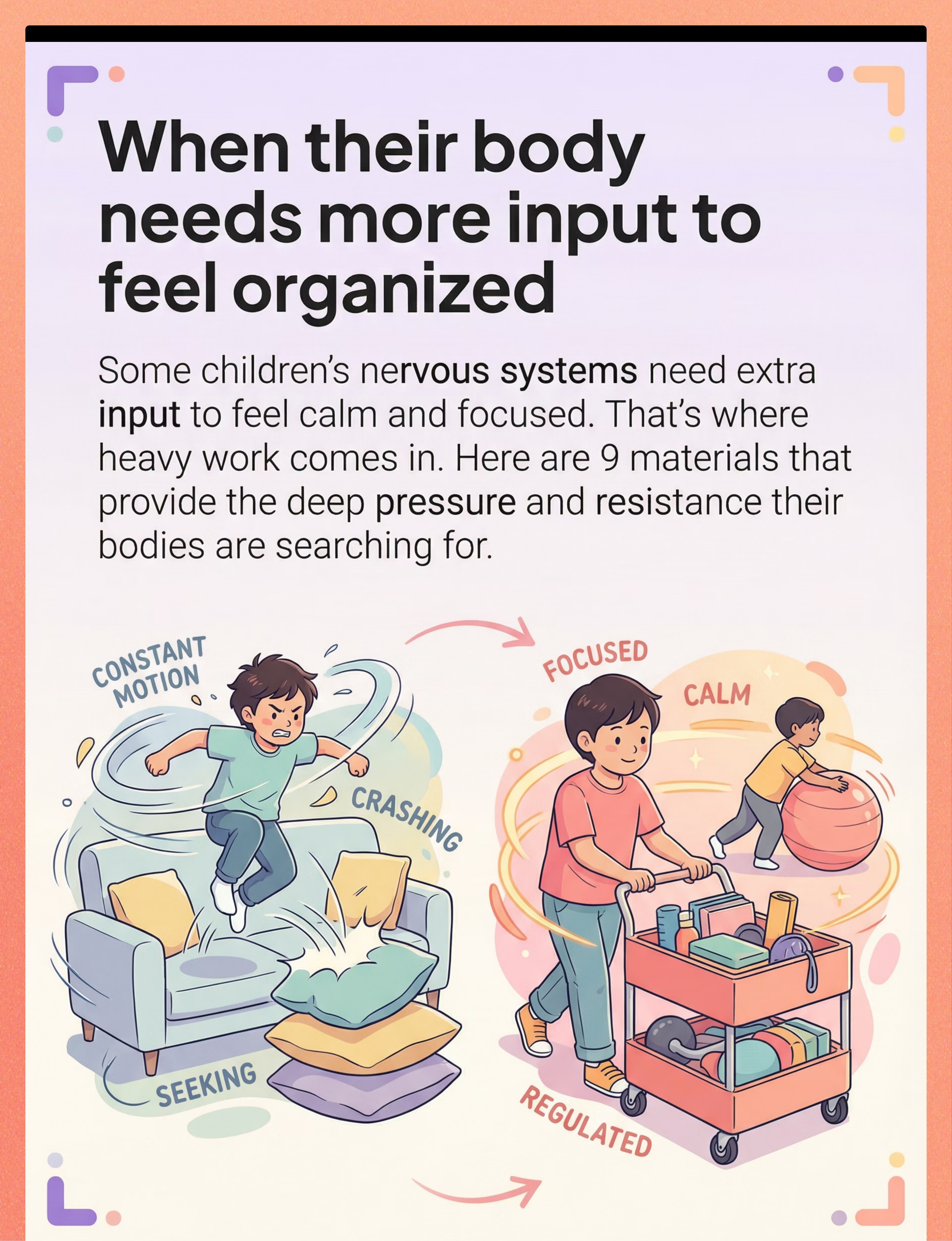
Your child's proprioceptive system — the network of receptors in muscles, joints, and tendons — is under-responsive. When a typical nervous system receives normal movement input (sitting, walking, writing), it feels enough. Your child's nervous system requires significantly more input to reach the same "organized" state.
The brain's ascending pathways, particularly the dorsal column-medial lemniscal system and spinocerebellar tracts, are not registering standard sensory signals with sufficient amplitude. The result: the brain sends an urgent signal — seek more input, now.
What This Means at Home
- Crashing into walls = the body desperately loading its joints for information
- Jumping off furniture = intense proprioceptive hit through the legs and spine
- Squeezing too hard = hands trying to feel their own strength
- Can't sit still = chair provides zero proprioceptive feedback; the body revolts
This is not defiance. This is not attention-seeking. This is a wiring difference — and wiring differences respond to the right input.
📚Frontiers in Integrative Neuroscience (2020): Comprehensive neurological framework for sensory integration in ASD established the neural basis for heavy work interventions.🔗 DOI: 10.3389/fnint.2020.556660

Developmental Context
Your Child's Developmental Position
Understanding where your child sits on the developmental arc is the first step toward knowing where you're heading. The proprioceptive system is uniquely regulating in both directions — it can both calm an over-aroused child AND alert an under-aroused one, making heavy work one of the most versatile tools in the therapeutic toolkit.
0–12 months
Tactile and proprioceptive foundations established
1–2 years
Seeking behaviors emerge as normal exploration
2–5 years ⚡
PEAK IDENTIFICATION WINDOW — Seeking vs. regulation gap becomes visible
5–8 years
School demands expose under-responsive proprioceptive systems
8–14 years
Self-regulation strategies can be internalized with proper support

Act I — Evidence Base
Evidence Grade: Level I
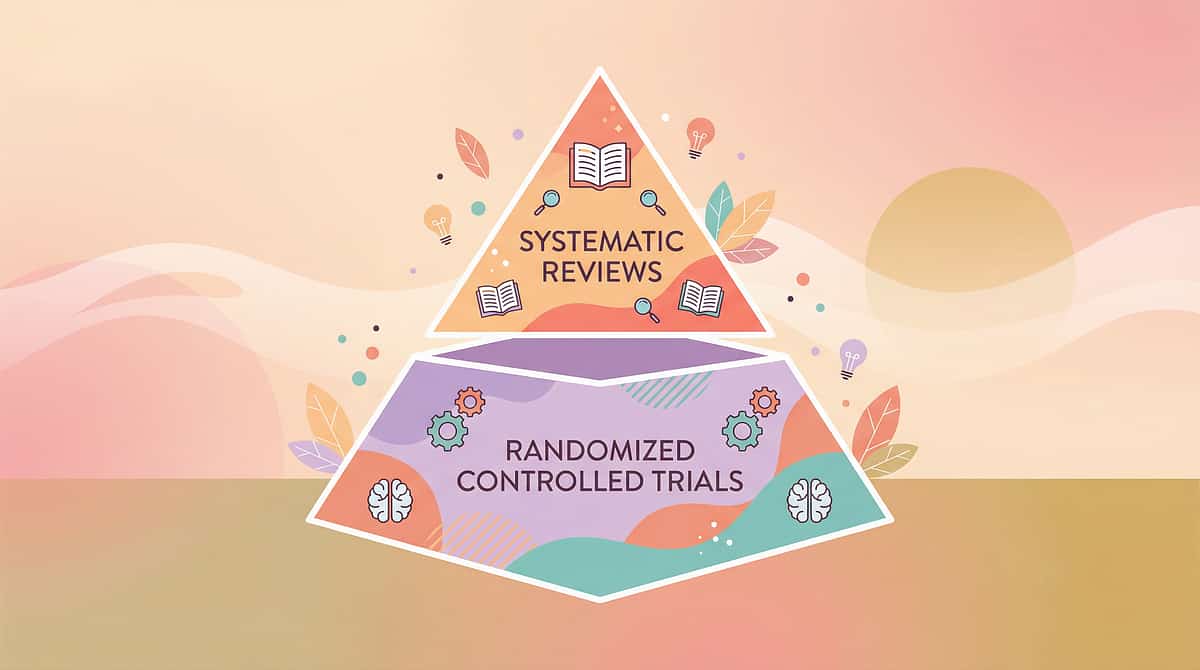
Heavy work for proprioceptive regulation is not a trend. It is one of the most rigorously studied domains in pediatric occupational therapy, supported by systematic reviews, meta-analyses, and randomized controlled trials across international populations.
Study Type | Key Finding | Scale | |
PRISMA Systematic Review (2024) | Sensory integration intervention meets criteria as evidence-based practice for ASD children | 16 studies, 2013–2023 | |
Meta-Analysis (World J Clin Cases, 2024) | Effectively promotes social skills, adaptive behavior, sensory processing, and motor skills | 24 studies | |
Indian RCT (Indian J Pediatr, 2019) | Home-based sensory interventions showed significant outcomes in Indian pediatric populations | RCT design | |
WHO NCF (2018) | Early caregiver-implemented sensory and motor input directly impacts developmental trajectories | 197-country framework |
"Clinically validated. Home-applicable. Parent-proven."
📚 PMC11506176 | PMC10955541 | DOI: 10.1007/s12098-018-2747-4 | WHO Nurturing Care Framework (2018)
Act II — What It Is
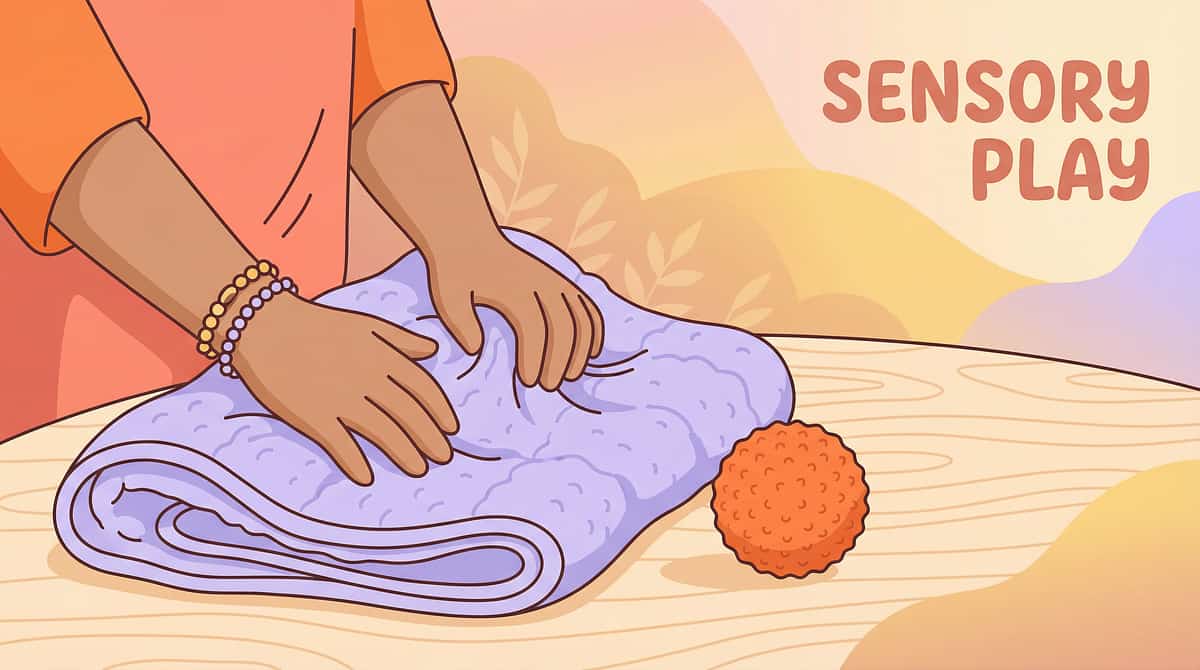
Heavy Work Activities — Proprioceptive Input Therapy
Formal Name: Sensory Diet Heavy Work Protocol | Parent-Friendly Name: "Body Fuel Activities"
Heavy work refers to any physical activity that involves pushing, pulling, carrying, lifting, squeezing, or moving against resistance — activities that intensely load muscles and joints, sending powerful proprioceptive signals to the brain. Heavy work is not exercise for fitness — it is therapeutic sensory input delivered at the right intensity, at the right time, with the right materials.
🟣 Sensory Processing
🟤 Self-Regulation
🔵 Occupational Therapy
🟡 Body Awareness
🟢 Behavioral Support
Age Range
2–14 years
Session Duration
5–20 minutes
Frequency
3–6 times daily (sensory diet)
Effect Duration
1–2 hours per session

The Consortium Team
Who Uses This Technique
Heavy work crosses therapy boundaries because the brain doesn't organize by therapy type — it responds to the right input regardless of which clinician prescribes it. Five disciplines collaborate to make this technique work for your child.
🔵 Occupational Therapist (PRIMARY LEAD)
Designs the full sensory diet, prescribes heavy work frequency and intensity, selects materials based on the child's sensory profile, trains parents in protocol delivery, and monitors regulation outcomes using the Sensory Processing Readiness Index.
🟤 ABA / BCBA Therapist
Integrates heavy work into behavioral programming as an antecedent strategy — providing heavy work before demanding sessions to optimize arousal level, reduce escape-maintained behavior, and create conditions for learning.
🟢 Special Educator
Embeds heavy work into classroom and learning routines — chair resistance bands, carrying tasks, movement breaks — making sensory diet sustainable in school environments without disrupting academic participation.
🔴 NeuroDevelopmental Pediatrician
Diagnoses underlying proprioceptive processing differences, rules out medical contraindications, and coordinates the therapeutic prescription with the family's broader developmental plan within GPT-OS®.
🟡 Speech-Language Pathologist
Uses heavy work as a regulatory precursor — a brief heavy work burst before communication therapy sessions dramatically improves attention, engagement, and language output in many children.
What Heavy Work Targets
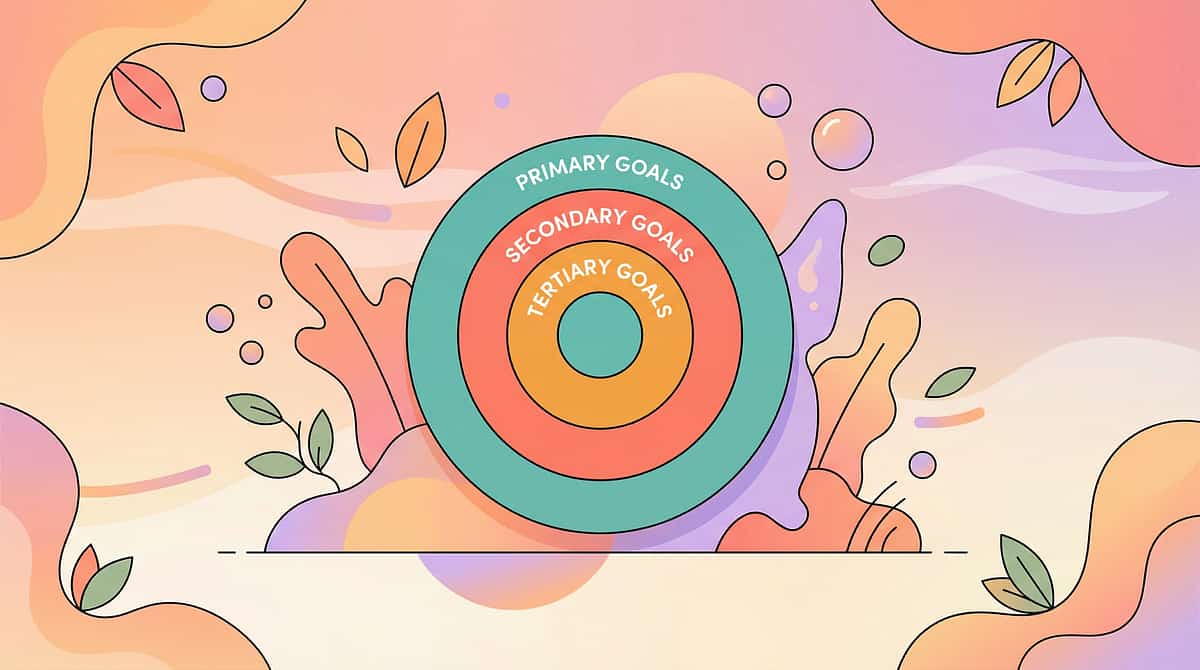
What Heavy Work Precisely Targets
🎯 Primary Target
Proprioceptive Regulation and Arousal Modulation
- Reduction in crashing, jumping, and squeezing seeking behaviors
- Ability to remain seated for increasing durations
- Improved force grading in everyday activities (writing, hugging, handling objects)
⭕ Secondary + Tertiary
Behavioral, Attentional, and Developmental Gains
- Improved on-task duration following heavy work sessions
- Reduced meltdown frequency through proactive sensory diet
- Body awareness and spatial orientation
- Motor planning and execution (praxis)
- Academic readiness — focused body = learning-ready brain
📚Meta-analysis (World J Clin Cases, 2024): Sensory integration therapy effectively promoted social skills (primary), adaptive behavior (secondary), sensory processing, and motor skills (tertiary) across 24 studies.🔗 PMC10955541
Act II — The 9 Materials
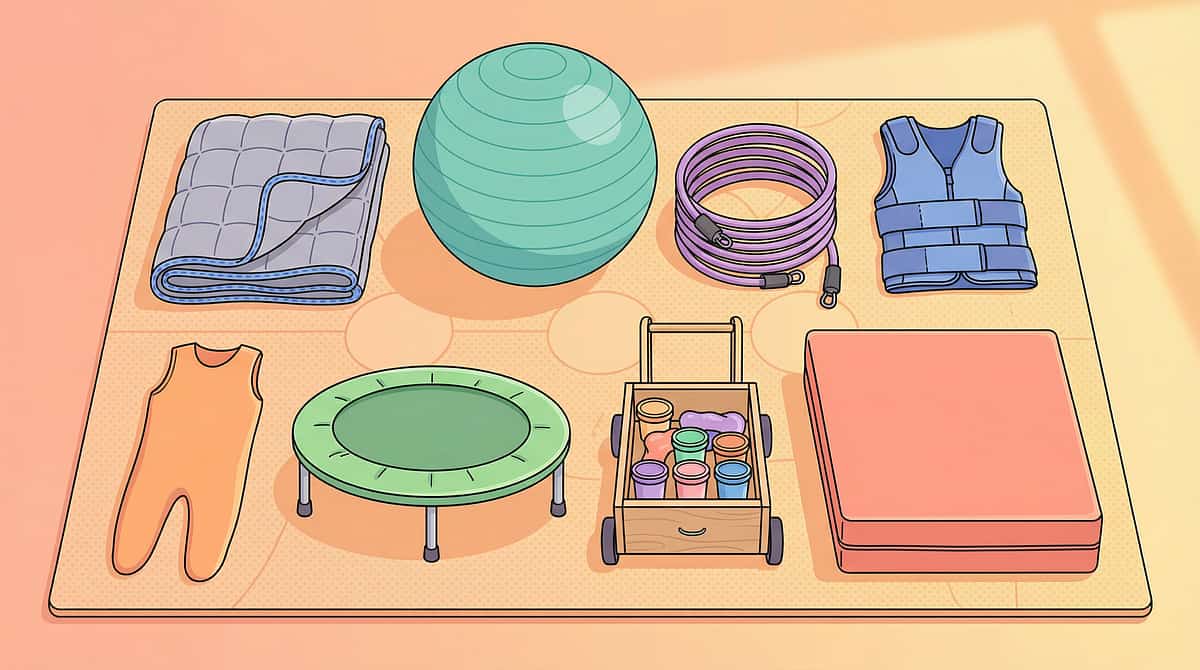
The 9 Heavy Work Materials
🏷️ Pinnacle Recommends | Canon-Validated | Evidence-Linked. These nine materials form the complete proprioceptive toolkit — from passive deep pressure to active joint-loading impact. Each addresses the same underlying need through a different delivery mechanism.
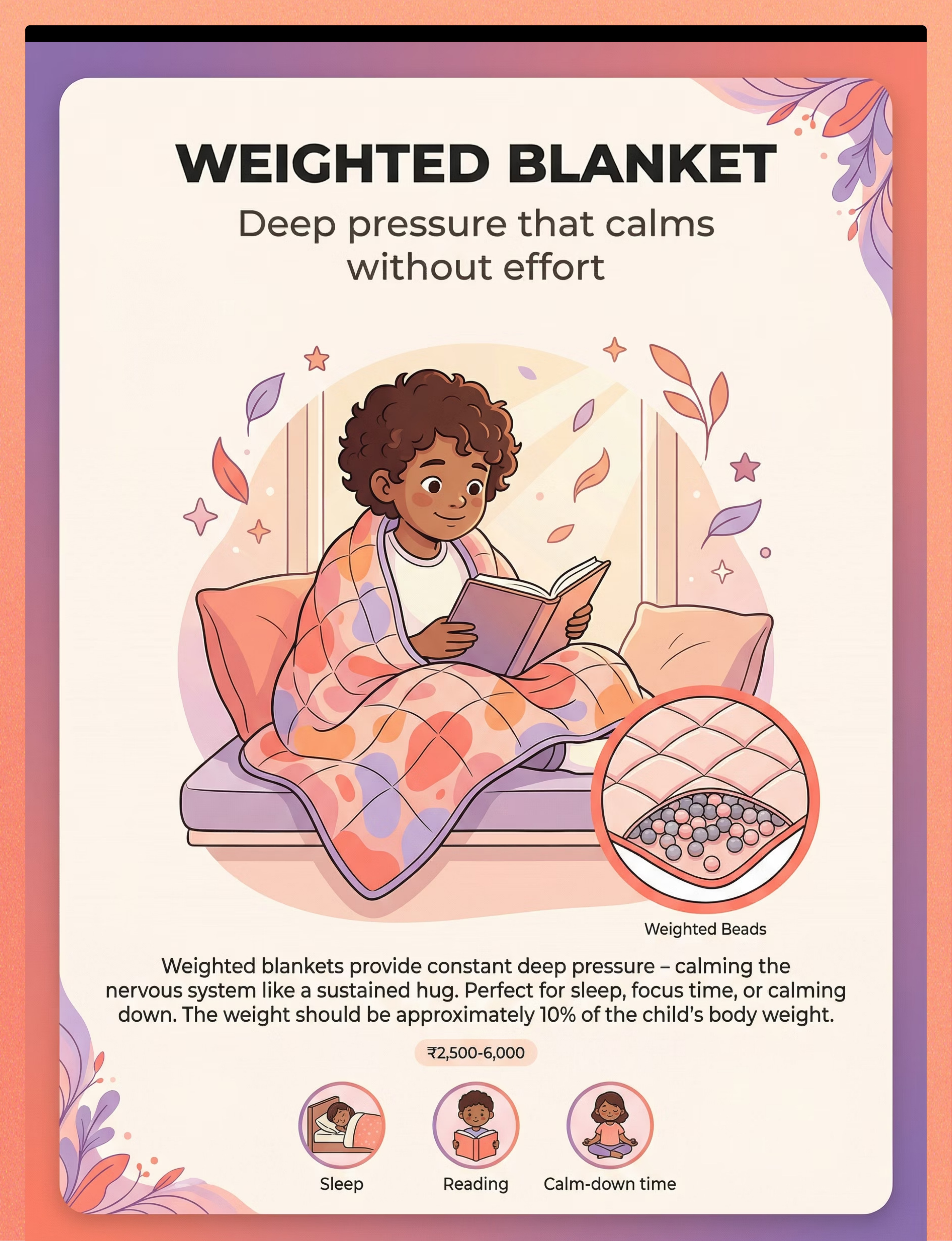
1. Weighted Blanket
Deep pressure that calms without effort — like a sustained hug from the nervous system. Weight = 10% of child's body weight.
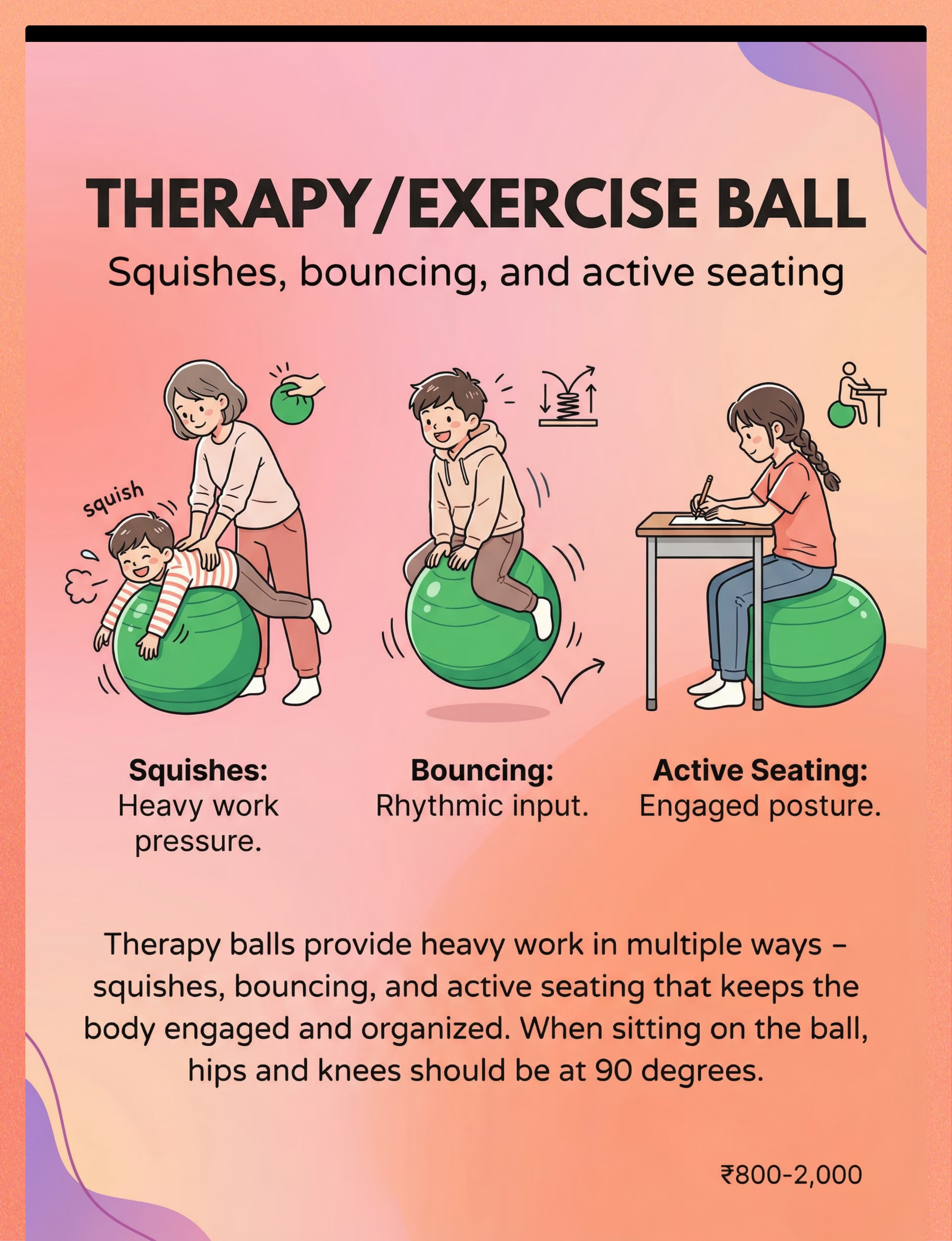
2. Therapy / Exercise Ball
Squishes, bouncing, and active seating — three heavy work modes in one tool. Size: hips and knees at 90° when seated.
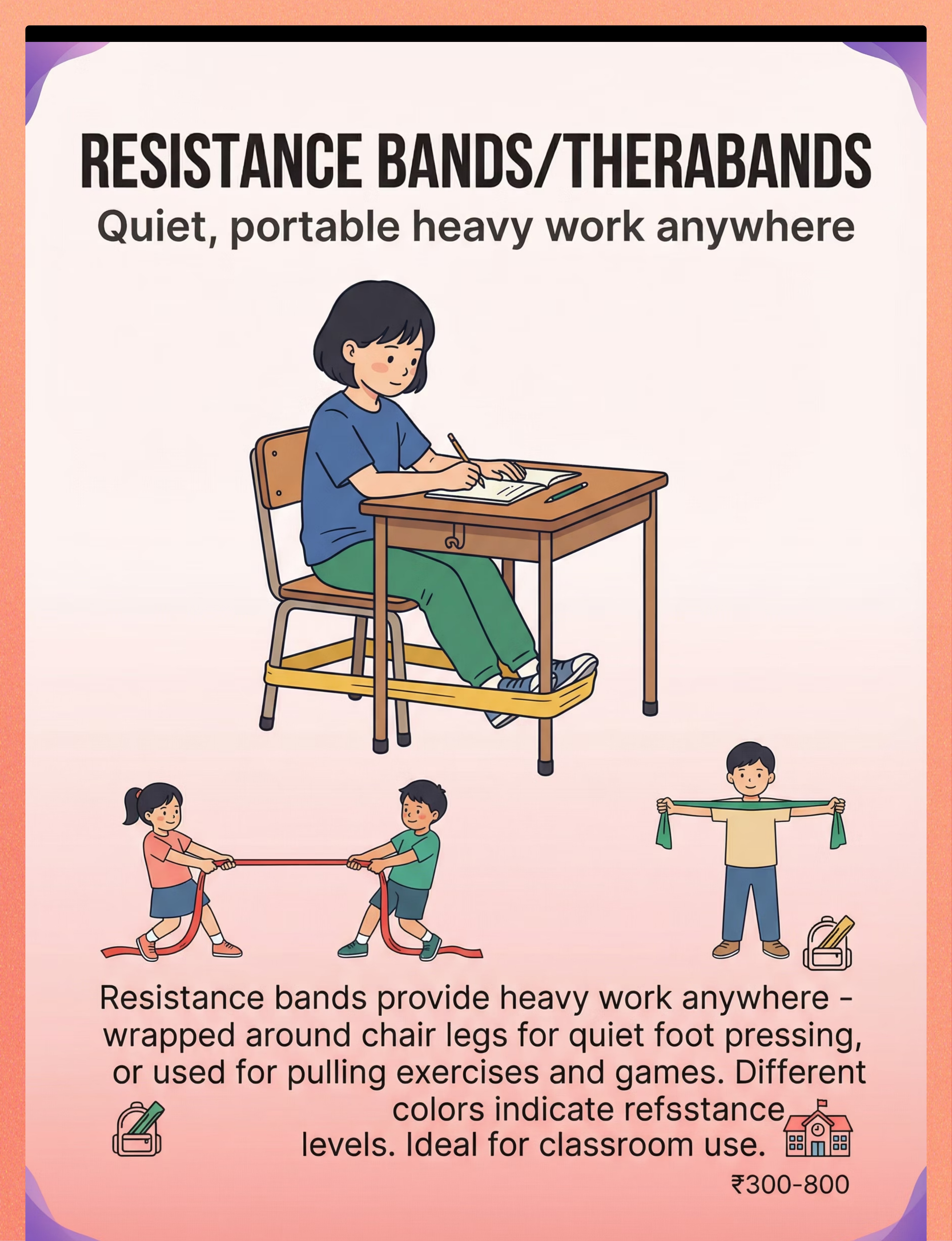
3. Resistance Bands / Therabands
Quiet, portable heavy work anywhere — chair legs, pulling games, arm exercises. Colors indicate resistance level.
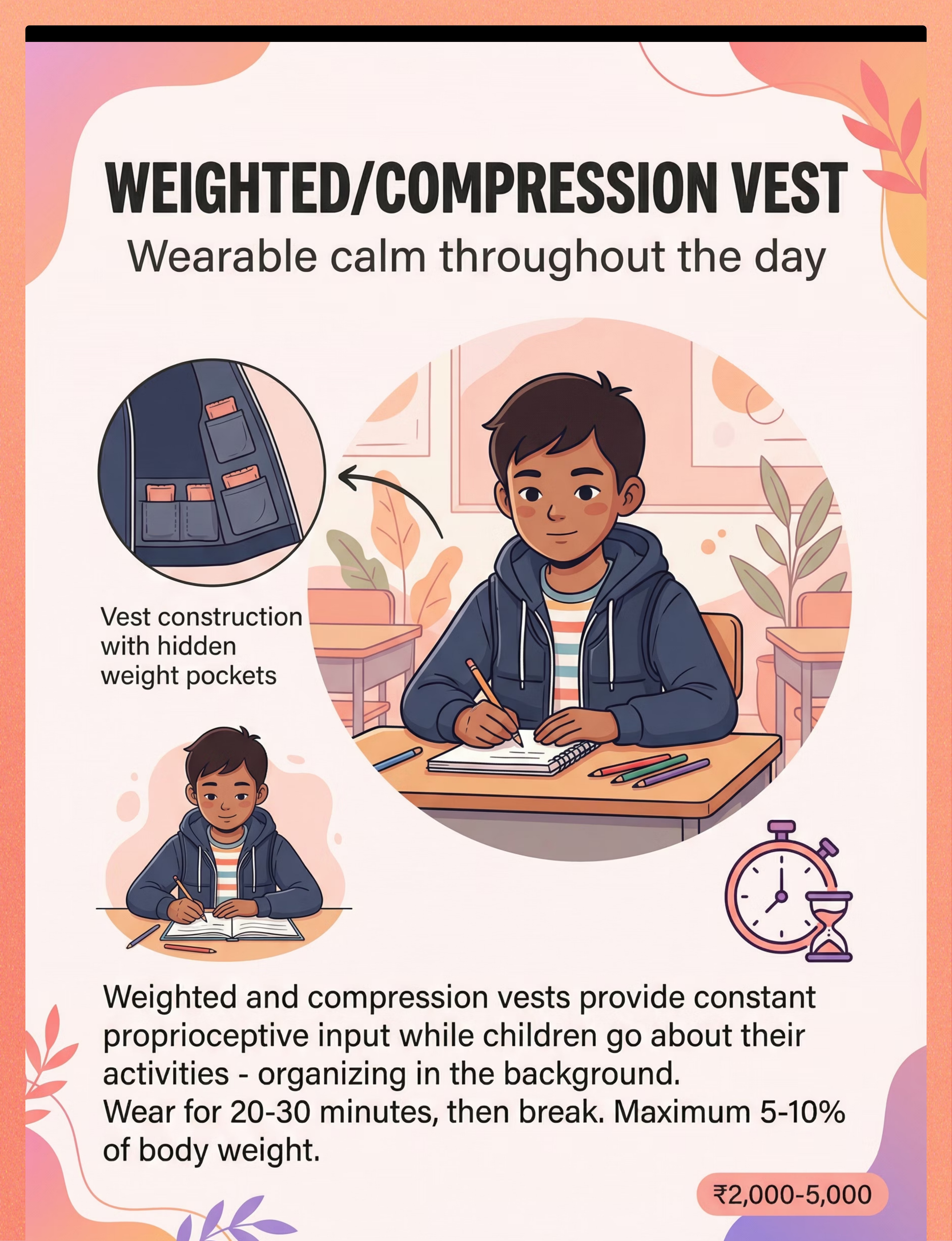
4. Weighted / Compression Vest
Wearable calm throughout the day — regulating in the background. Wear 20–30 min on / 20–30 min off schedule.
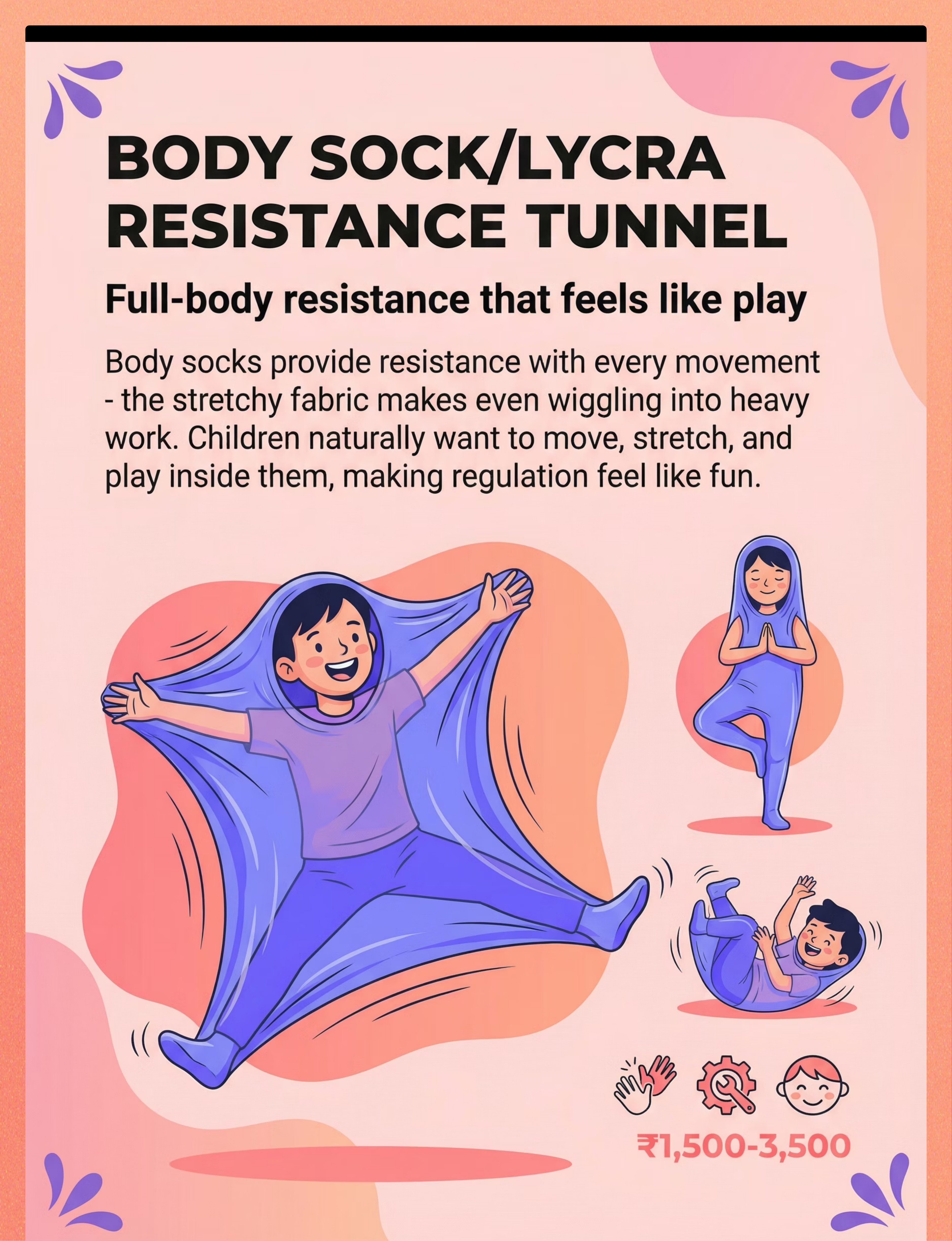
5. Body Sock / Lycra Tunnel
Full-body resistance that feels like play — every movement becomes heavy work. Children self-direct duration.
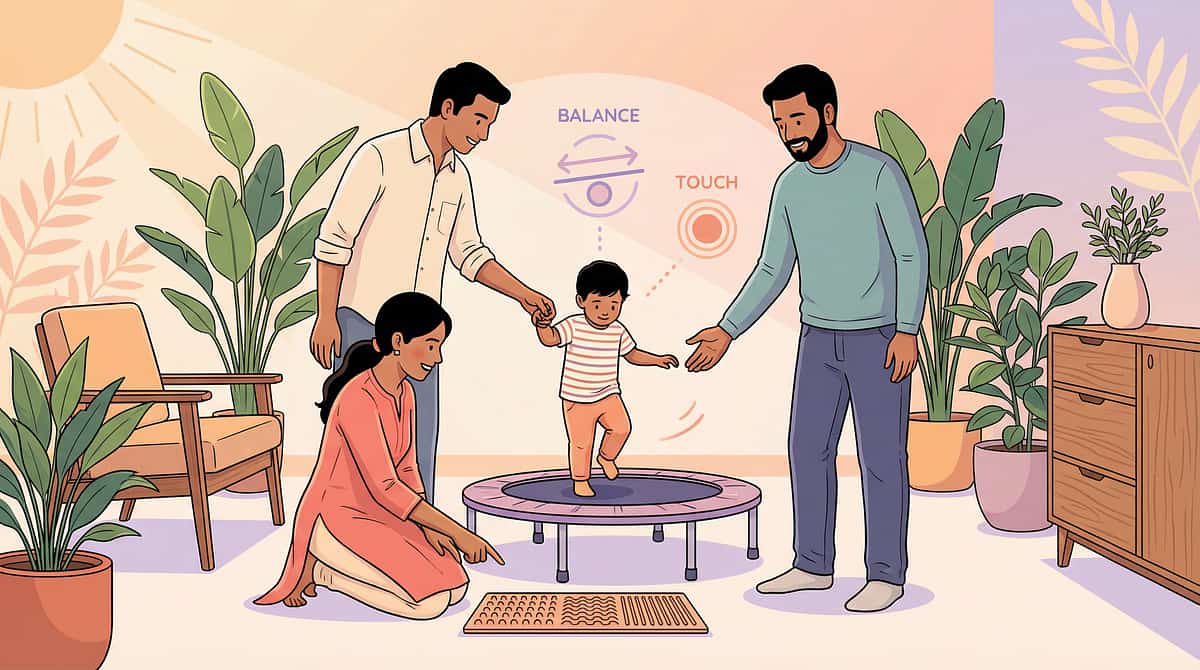
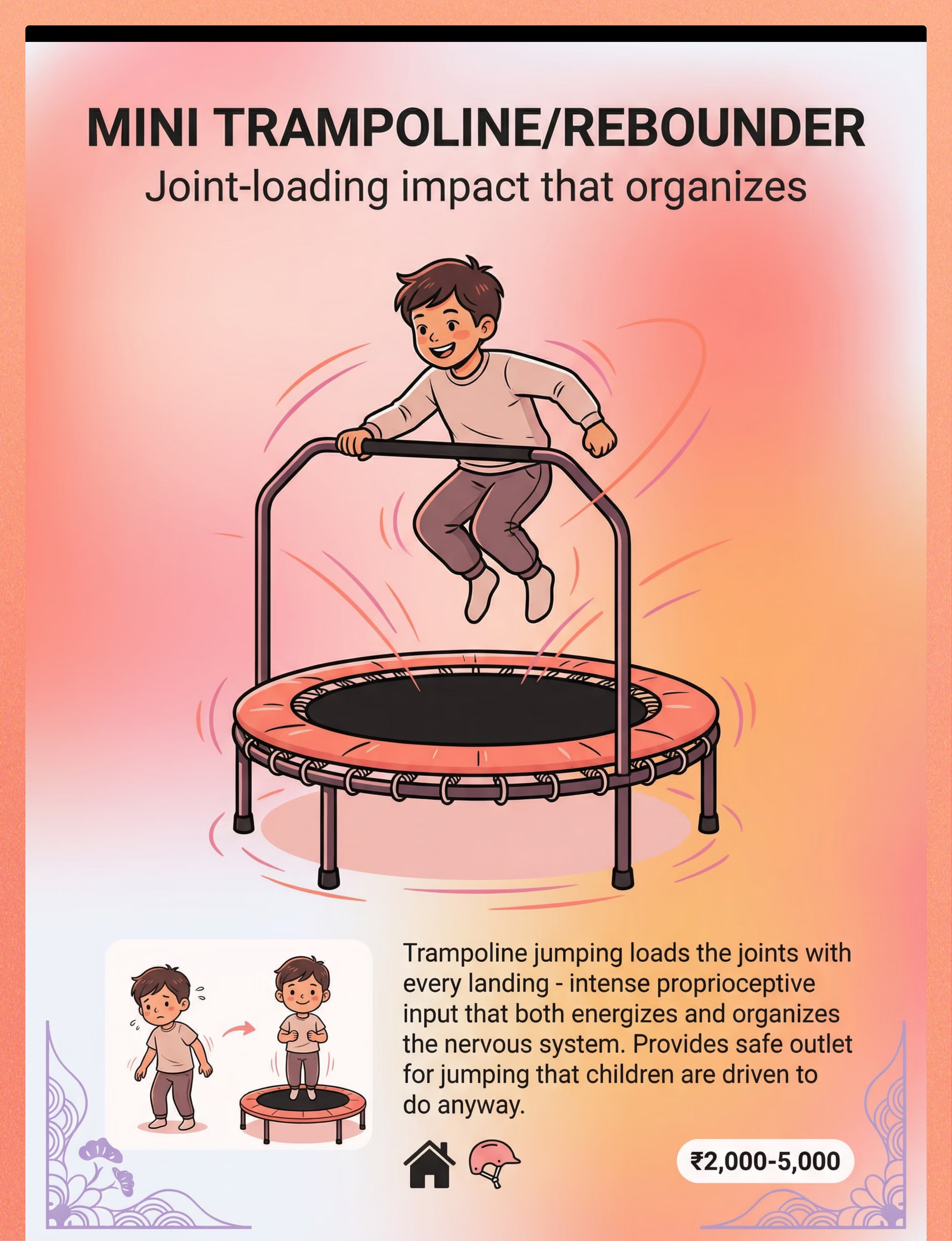
6. Mini Trampoline / Rebounder
Joint-loading impact that organizes — the safe outlet for the jumping they're driven to do. Use handlebar model for safety.
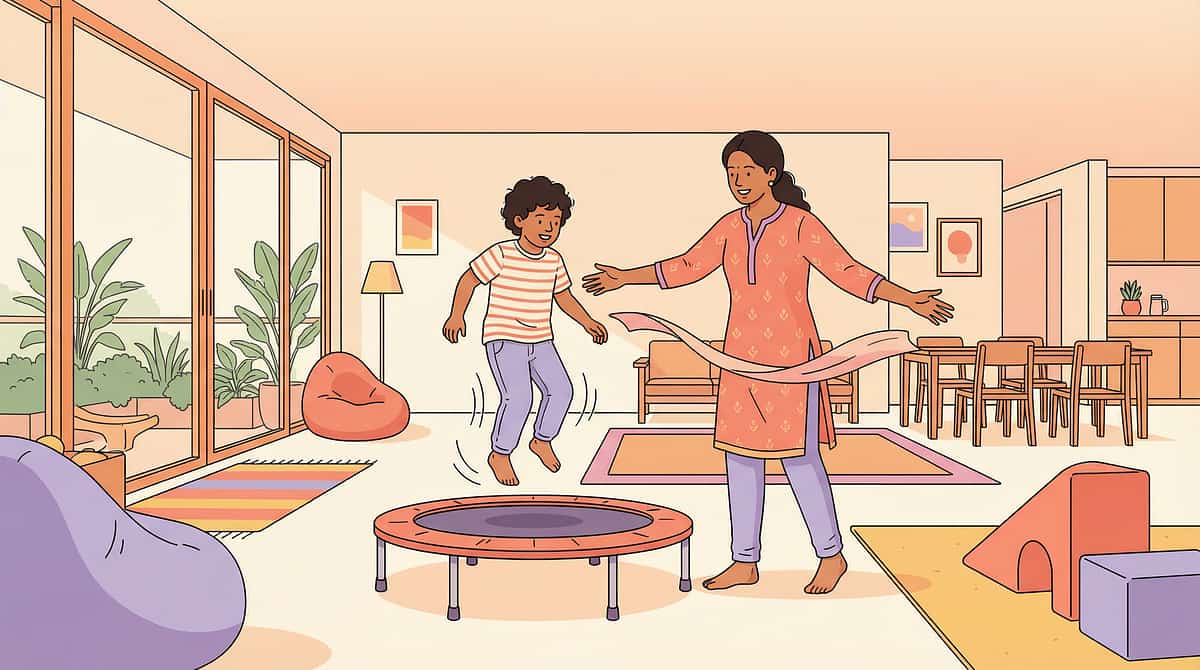
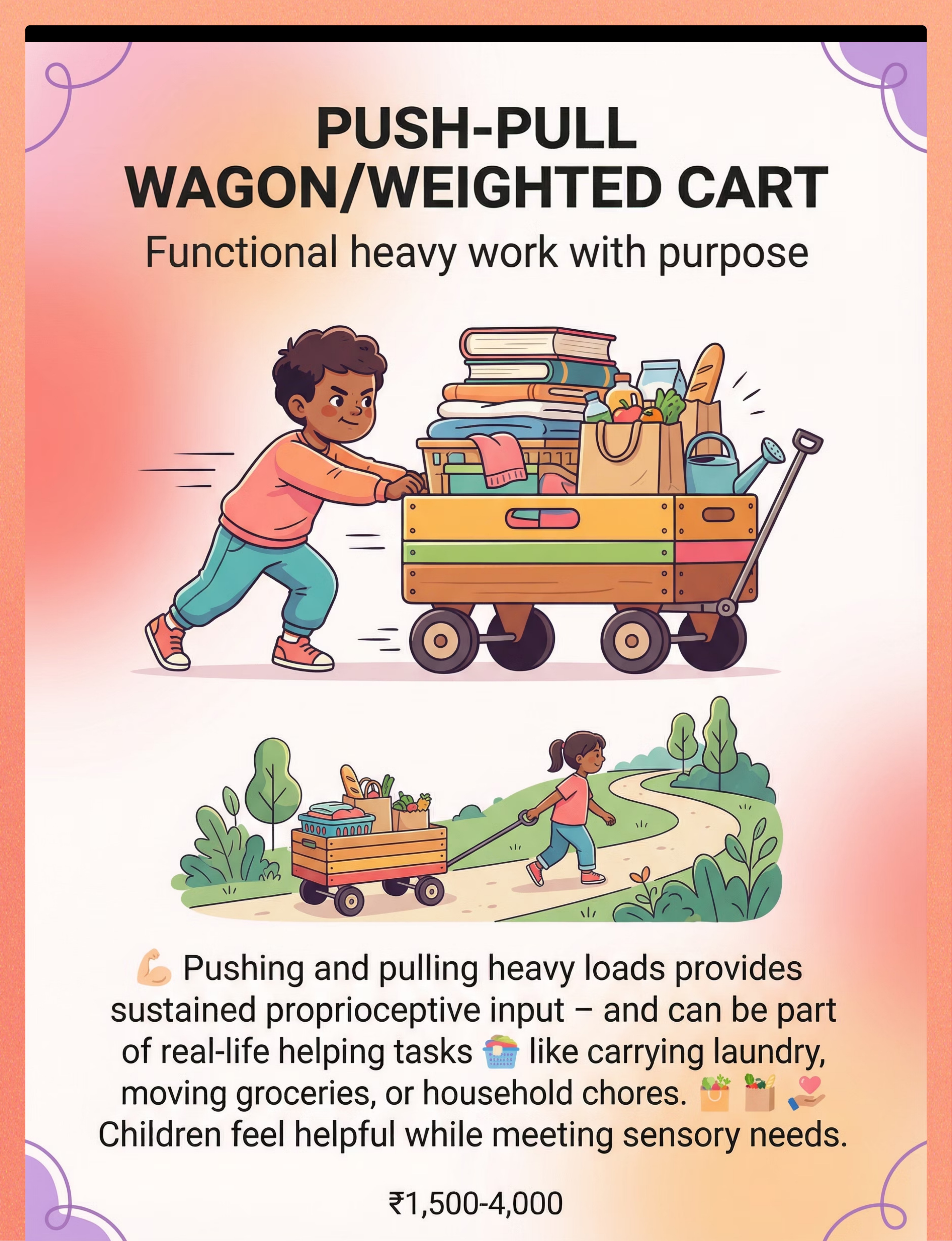
7. Push-Pull Wagon / Weighted Cart
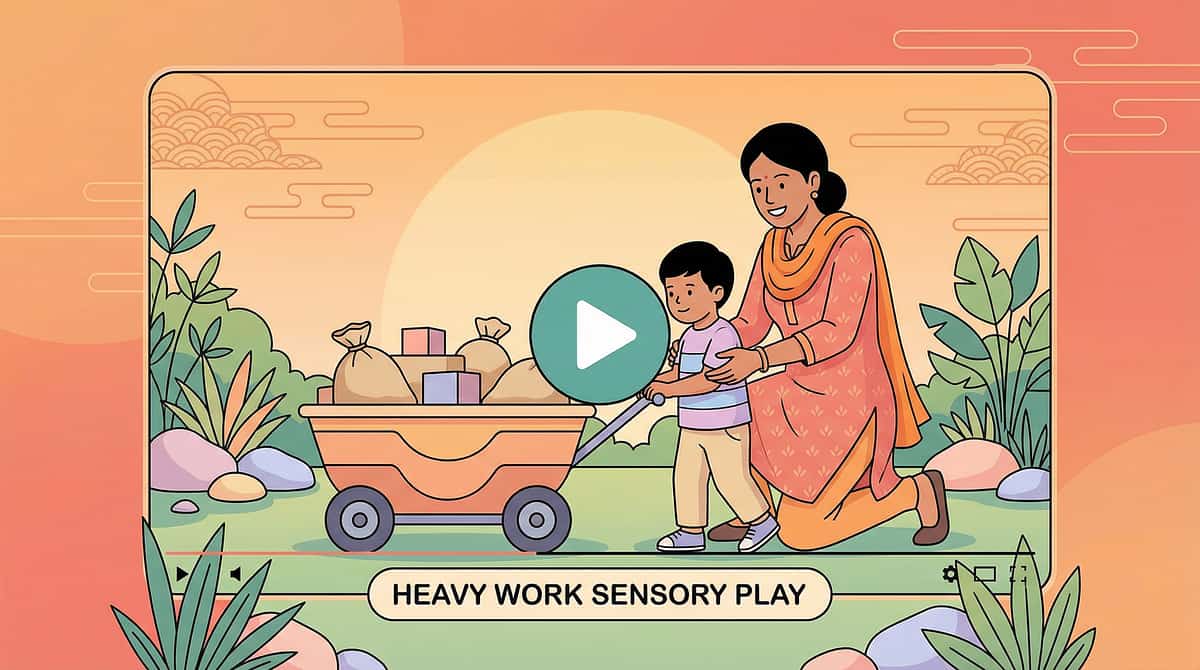
Functional heavy work with purpose — meets sensory needs while building contribution. Embed in daily chores.
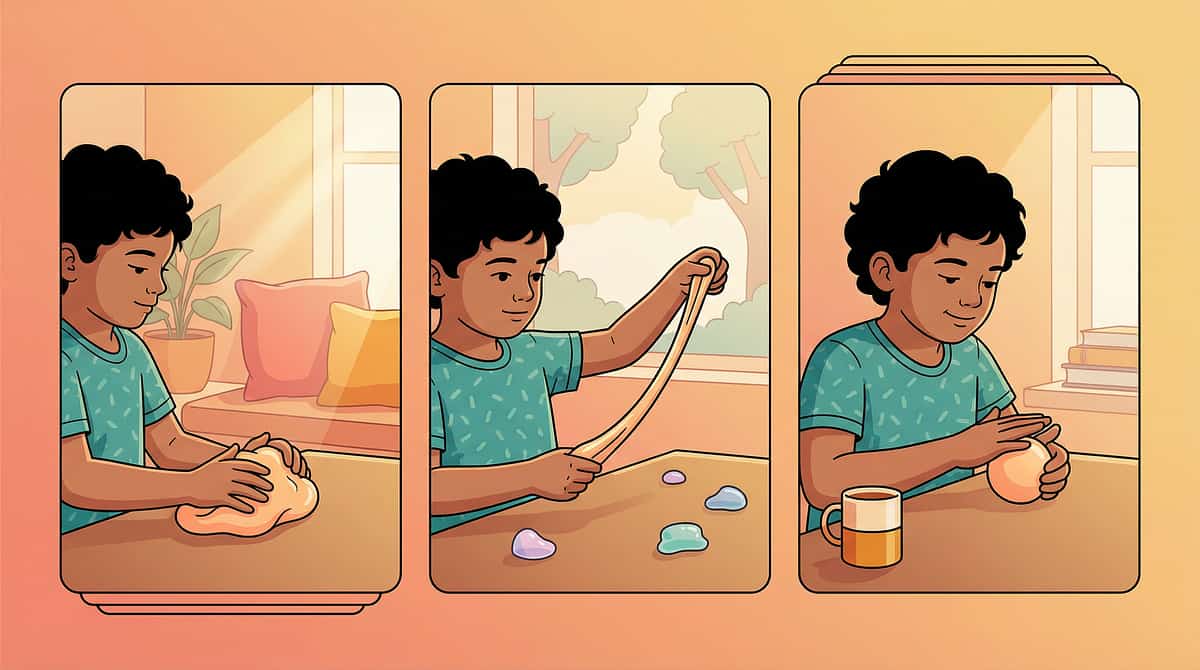
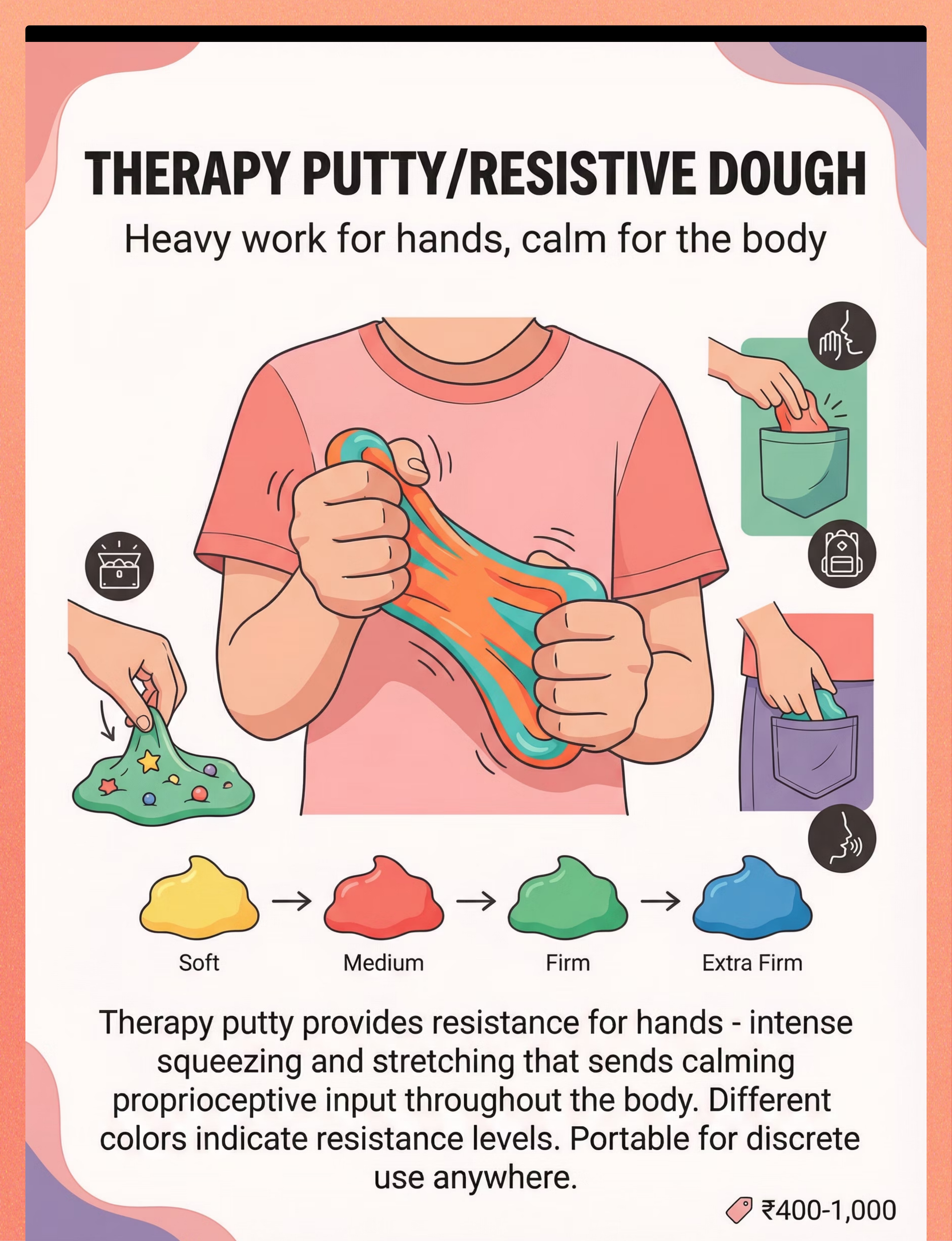
8. Therapy Putty / Resistive Dough
Heavy work for hands, calm for the body — discrete, portable, powerful. 4 resistance levels by color.
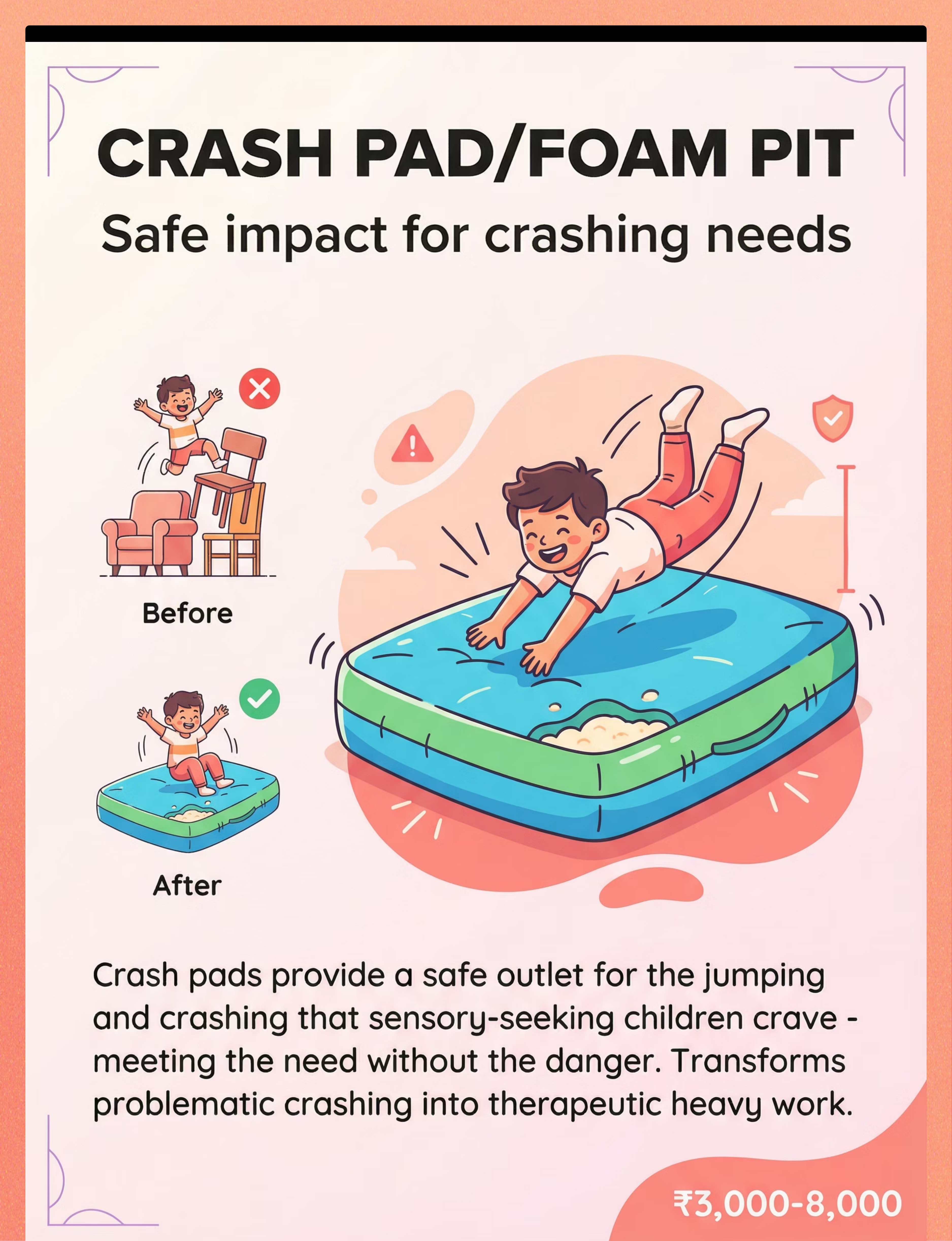
9. Crash Pad / Foam Pit
Safe impact for crashing needs — transforms dangerous behavior into therapeutic input. The need is real; the pad makes it safe.
Material 1 of 9
Material 1: Weighted Blanket
Canon Category: Resistance and Pressure Materials | "Deep pressure that calms without effort — like a sustained hug from the nervous system"
Key Specifications
- Weight: 10% of child's body weight
- Best for: Sleep, focus time, calm-down
- Duration: Minimum 5 minutes for regulation effect
- Price range: ₹2,500–6,000
How It Works
The weighted blanket delivers Deep Touch Pressure (DTP) — distributed, even weight across the body that activates the parasympathetic nervous system. It requires no effort from the child and works even during sleep, making it the most passive and universally accessible heavy work tool.
Check blanket weight every 3 months as the child grows — the therapeutic weight needs adjustment as body weight increases.

Material 2 of 9
Material 2: Therapy / Exercise Ball
Canon Category: Proprioceptive Input Tools | "Squishes, bouncing, and active seating — three heavy work modes in one"
Key Specifications
- Size: Hips and knees at 90° when seated
- Best for: Home, therapy room, desk use
- 3 Modes: Squishes · Bouncing · Active seating
- Price range: ₹800–2,000
How It Works
The therapy ball is the most versatile single tool in the heavy work toolkit. In "squish mode," the adult applies firm rhythmic compressions through the ball onto the child's back. In "bounce mode," the child loads their own joints with every impact. As active seating, it provides constant subtle proprioceptive feedback that a standard chair cannot.
Correct squish form: Hands flat on child's back, press down and slightly forward through the ball. Watch for exhalation — the calming sign.

Material 3 of 9
Material 3: Resistance Bands / Therabands
Canon Category: Resistance and Pressure Materials | "Quiet, portable heavy work anywhere — chair legs, pulling games, arm exercises"
Key Specifications
- Colors: Indicate resistance level (light → heavy)
- Best for: Classroom, travel, quiet settings
- Duration: Entire seated work period
- Price range: ₹300–800
Why This Is the School Game-Changer
Resistance bands tied to chair legs at foot height are invisible, silent, and require no adult facilitation once in place. The child presses feet outward or inward against the bands during any seated activity. The proprioceptive input works in the background while the child participates in class — zero disruption.
This is one of the most commonly recommended classroom accommodations by Pinnacle OTs. Replace when stretched. Start with lightest resistance level.

Material 4 of 9
Material 4: Weighted / Compression Vest
Canon Category: Resistance and Pressure Materials | "Wearable calm throughout the day — regulating in the background"
Key Specifications
- Schedule: 20–30 min on / 20–30 min off
- Best for: School, homework, high-demand activities
- Weight: 5–10% of child's body weight
- Price range: ₹2,000–5,000
How It Works
The compression vest delivers continuous proprioceptive input through the trunk — the largest proprioceptive surface on the body. Unlike the blanket, it is wearable during all activities: meals, class, homework. The 20/20 on/off cycle prevents the nervous system from habituating and losing the regulatory effect.
Set a visual timer for wear periods so the child understands the schedule. Many schools can accommodate a compression vest under a school uniform.

Material 5 of 9
Material 5: Body Sock / Lycra Resistance Tunnel
Canon Category: Proprioceptive Input Tools | "Full-body resistance that feels like play — every movement becomes heavy work"
Key Specifications
- Duration: Child-directed, typically 10–20 minutes
- Best for: Home play area, therapy room
- Key rule: Must allow full independent exit
- Price range: ₹1,500–3,500
Why Children Love This One
The body sock is uniquely child-directed — it doesn't feel like therapy; it feels like play. The Lycra fabric provides resistance against every movement the child makes inside it, delivering continuous proprioceptive input through joints, muscles, and skin simultaneously.
Adult engagement cue: call out gentle shapes — "Can you make a star? Can you touch the floor?" This adds purposeful motor planning on top of the sensory input. Always ensure the child can exit independently — this is a safety non-negotiable.
Material 6 of 9
Material 6: Mini Trampoline / Rebounder
Canon Category: Proprioceptive Input Tools | "Joint-loading impact that organizes — the safe outlet for the jumping they're driven to do"
Key Specifications
- Safety: Use handlebar model for children
- Best for: Home corner, morning routine, pre-homework
- Correct form: Two-footed landing, soft knees
- Price range: ₹2,000–5,000
Transform the Jumping Drive
Your child is going to jump. The question is only where. The mini trampoline redirects an urgent neurological drive into a safe, structured, therapeutic format. Every two-footed landing loads the joints with powerful proprioceptive input — exactly what the nervous system is seeking.
Add rhythm and counting: "Jump time! Let's see how high you can go. Count with me — 1, 2, 3…" Counting transforms jumping from chaos into organized, purposeful sensory input. Ideal as the first activity in a morning sensory diet routine before school.
Material 7 of 9
Material 7: Push-Pull Wagon / Weighted Cart
Canon Category: Proprioceptive Input Tools | "Functional heavy work with purpose — meets sensory needs while building contribution"
Key Specifications
- Load: Child's body weight × 20–30%
- Best for: Outdoor, household tasks, community
- Variation: Uphill routes add intensity
- Price range: ₹1,500–4,000
Heavy Work With a Purpose
The push-pull wagon is the most socially normalized heavy work tool in the kit. To the outside world, a child helping carry groceries or moving boxes is simply being helpful. To the nervous system, it is high-intensity proprioceptive loading through arms, shoulders, and core.
Always give the child a purpose: "Can you bring the groceries from the door?" Purposeful heavy work builds contribution alongside regulation — a double developmental win. Vary distances and surfaces for progression.
Material 8 of 9
Material 8: Therapy Putty / Resistive Dough
Canon Category: Resistance and Pressure Materials | "Heavy work for hands, calm for the body — discrete, portable, powerful"
Key Specifications
- Levels: 4 resistance levels by color
- Best for: Classroom, waiting, quiet settings
- Duration: 5–10 minutes of continuous engagement
- Price range: ₹400–1,000
The Pocket-Sized Regulator
Therapy putty is the most portable and discreet tool in the entire toolkit. It fits in a pocket, makes no sound, and can be used in any environment — classroom, restaurant, car, waiting room. The resistive properties of the putty load the hand's proprioceptors with each squeeze, stretch, and flatten action.
Progression: squeeze only → stretch → hide-and-find → shape-making. Match resistance level to child's hand strength — starting too hard creates aversion. As one parent discovered, therapy putty changed her son's social life by improving his force grading in hugs.

Material 9 of 9
Material 9: Crash Pad / Foam Pit
Canon Category: Proprioceptive Input Tools | "Safe impact for crashing needs — transforms dangerous behavior into therapeutic input"
Key Specifications
- Space: Minimum 2m × 2m clear floor area
- Best for: Home sensory room, play area
- Duration: Child-directed, 5–15 minutes
- Price range: ₹3,000–8,000
The Need Is Real — Make It Safe
Children who crash into walls are not being destructive. Their nervous system is generating an urgent, undeniable command: load your joints NOW. The crash pad takes this neurological imperative and gives it a safe, soft, structured landing zone.
Protocol: clear runway → child runs and jumps/dives/belly-flops onto pad → observe regulation shift after each crash → repeat 10–20 times or until child self-exits. The moment your child runs to the crash pad instead of the wall is a neurologically significant milestone. Celebrate it.

Starter Kits
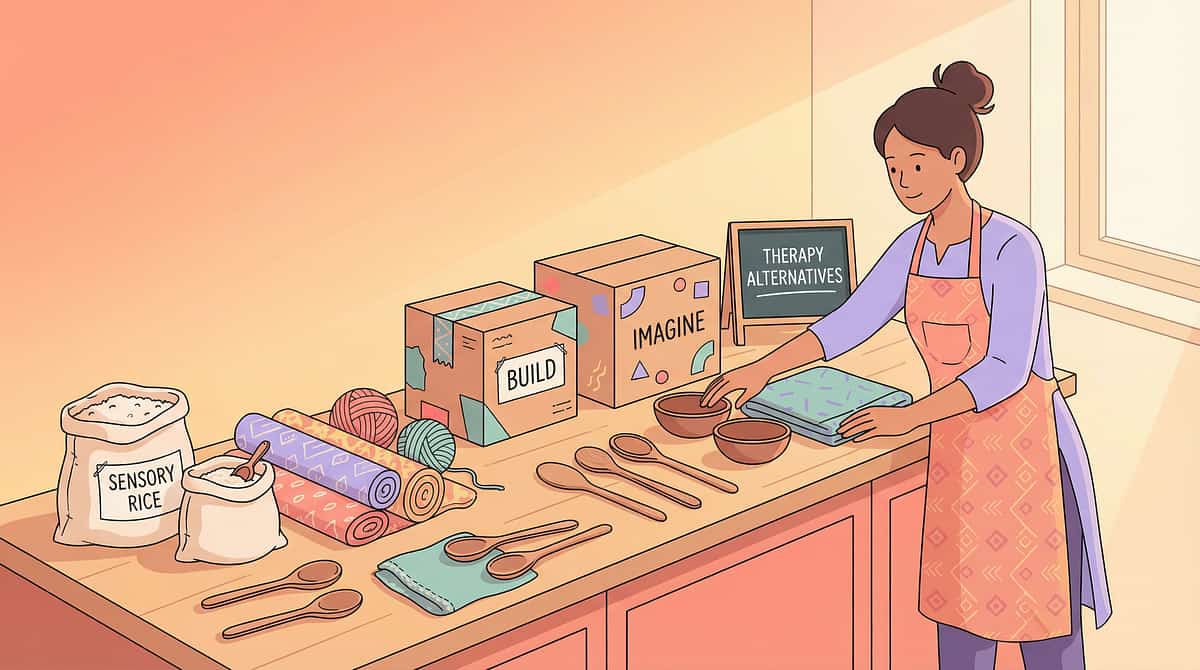
Build Your Toolkit — Budget Options
You do not need all nine materials on day one. Start with the Essential 4 and add materials as your understanding of your child's sensory profile deepens. Every addition to the toolkit expands the regulatory options available to your child's nervous system.
💜 Essential Starter Kit
Weighted Blanket + Therapy Ball + Resistance Bands + Therapy Putty
₹4,000–9,800
Covers passive deep pressure, active joint loading, seated input, and hand-based regulation.
🏆 Full Therapeutic Toolkit
All 9 materials — complete proprioceptive input coverage across all settings
₹12,000–35,000
Home, school, outdoor, and clinic-grade support for the full sensory diet.
📞FREE National Autism Helpline: 9100 181 181 — 16+ languages | 24×7 | Always free. Call to discuss which materials are the right starting point for your child's specific profile.

Act II — DIY Options
Zero-Cost Heavy Work — WHO Equity Principle
"Every child deserves therapy, regardless of family income." — WHO Nurturing Care Framework, adapted by Pinnacle Blooms Consortium
Material | ₹0 DIY / Household Substitute | Why It Works | |
Weighted Blanket | Fill old pillowcases with rice or pulses (sealed), layer under bedsheet | Same distributed pressure principle; monitor total weight | |
Therapy Ball | Large beach ball slightly underinflated | Provides bouncing and squish input; replace when worn | |
Resistance Bands | Old bicycle inner tubes cut into loops | Same resistance principle; check elasticity regularly | |
Compression Vest | Tight-fitting rash guard or layered athletic wear | Proprioceptive pressure through trunk; less intense | |
Body Sock | Large stretchy pillowcase; Lycra tube sewn at home | Same resistance principle; must allow full exit easily | |
Mini Trampoline | Firm sofa cushion on floor for bouncing; outdoor jumping on grass | Lower intensity; still provides joint loading | |
Weighted Cart | Laundry basket loaded with books; trolley bag | Classic heavy work — carry laundry, move groceries | |
Therapy Putty | Homemade dough: 2c flour + 1c salt + 2 Tbsp oil + water, cook to ball | Less stretch than commercial but provides resistance | |
Crash Pad | Pile of sofa cushions + pillows + old mattress on floor | Same principle; rebuild ritual adds engagement |
⚠️When clinical-grade materials are non-negotiable: For children with severe dysregulation, dangerous crashing, or pre-existing medical conditions — commercial-grade materials with verified weight/resistance specifications are required. Consult your Pinnacle OT before substituting.

Safety First
Safety Protocol — Heavy Work Materials
1
🔴 RED — DO NOT PROCEED
- Child has a known joint, bone, or muscle medical condition
- Child is in acute distress, meltdown, or post-meltdown exhaustion
- Child has not eaten in 3+ hours
- Child has expressed clear verbal/non-verbal refusal
- Weighted items: child cannot independently remove the item
- Crash activities: insufficient clear floor space (min. 2m × 2m)
- Child is under 2 years for any weighted items
2
🟡 AMBER — MODIFY FIRST
- Mildly fussy → reduce intensity, shorten duration, offer choice
- Fever or illness → skip active work; gentle weighted blanket only
- Post-vaccination within 24 hours → avoid resistance band arm work
- New material introduction → always start with 2–3 minutes maximum
3
🟢 GREEN — PROCEED
- Child is fed, rested, in regulated or mildly dysregulated state
- Space is clear, materials are checked
- Blanket = 10% body weight; Vest = 5–10% body weight verified
- Safety supervision confirmed for crash activities and trampoline
🛑STOP IMMEDIATELY IF: Child becomes more dysregulated after 5 minutes | Signs of pain | Breathing distress | Child requests to stop (any communication form) | Redness or marks from weighted items
Environment Setup
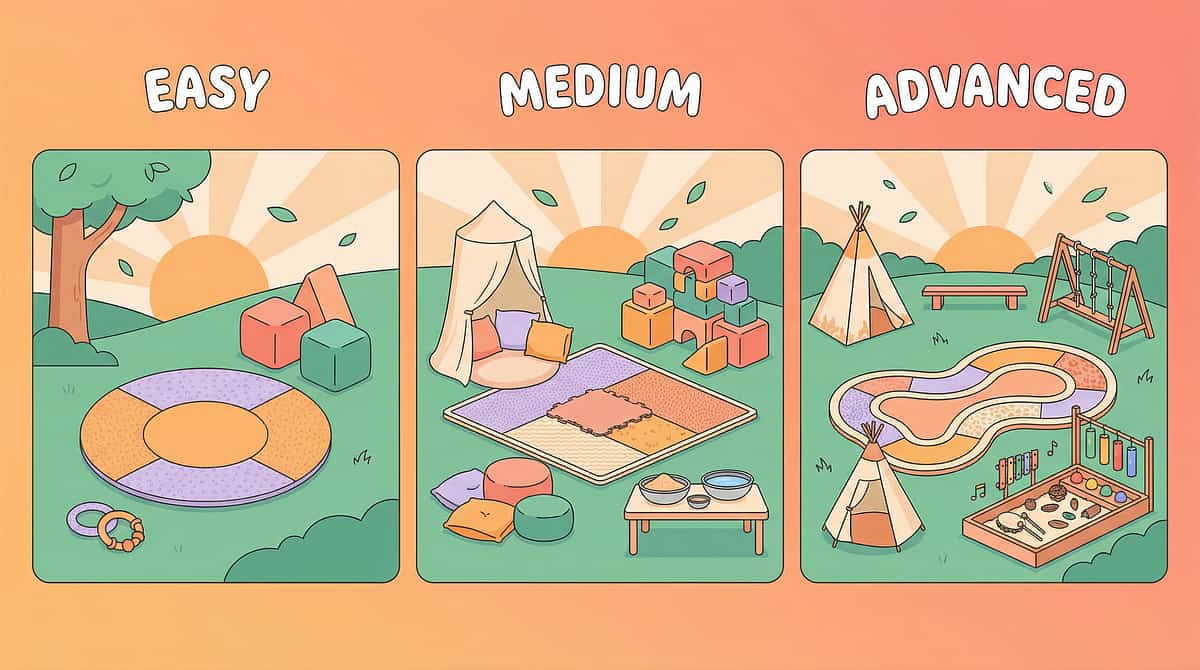
Your Heavy Work Environment — The 4-Zone Home Setup
The physical environment is not incidental to heavy work — it is the therapy. A well-configured home sensory space communicates safety, predictability, and purpose to a child's nervous system before a single activity begins.
1
🟣 Zone 1: IMPACT ZONE (min. 2m × 2m)
Crash pad/foam pit · Mini trampoline · Body sock. Remove coffee tables, hard-edge furniture, anything breakable. Carpet or soft mat surface preferred.
2
🔵 Zone 2: RESISTANCE STATION
Resistance bands tied to chair legs · Therapy putty on table. This is the "regulation-while-working" station — can be the child's homework or activity table.
3
🟤 Zone 3: DEEP PRESSURE CORNER
Weighted blanket · Compression vest storage. Low lighting preferred. Child-named and child-owned: "My calm-down corner." A calming visual anchor helps.
4
🟢 Zone 4: FUNCTIONAL HEAVY WORK PATHS
Push-pull wagon route · Carrying task routes through home and outdoor spaces. No special setup needed — embedded in daily life and chores.
Environment Settings: Temperature comfortable (avoid heavy work above 30°C) · Dimmed lighting for calm-down zones · Low background sound or preferred music for active zones · Remove screens during structured sessions

Act III — Readiness Check
60-Second Pre-Session Readiness Check
Run through this before every heavy work session. The best session is one that starts right. A postponed session is not a failed session — it is a smart clinical decision.
1
Fed?
Last meal or snack within 90 minutes → ✅ GO. If no → feed first, wait 20 minutes.
2
Rested?
Not immediately post-nap (30 min buffer) and not overtired → ✅ GO.
3
Medically Clear?
No fever, injury, or post-vaccination concern today → ✅ GO.
4
Emotional Baseline?
Mildly dysregulated to neutral is IDEAL. Severe meltdown state = POSTPONE.
5
Communication Signal?
Child can signal stop/done (word, sign, PECS card, gesture) → ✅ GO.
6
Space Confirmed?
Zone cleared, materials checked, supervision in place → ✅ GO.
✅ ALL GREEN
→ GO — Begin with the invitation (Step 1)
🟡 1–2 AMBER
→ MODIFY — Weighted blanket only, or 3-min putty only
🔴 ANY RED
→ POSTPONE — Offer water, food, or rest. Retry in 30–45 minutes.

Step 1 of 6
Step 1: The Invitation (30–60 seconds)
"Hey [name], your body looks like it needs some POWER. Want to do some heavy work with me? I've got the [crash pad / trampoline / putty] ready."
For Non-Verbal / Limited Verbal Children
Show the material → point to the activity zone → give a 5-second wait for response. For visual support learners, show a "Heavy Work Now" visual schedule card before the verbal invitation.
Acceptance Looks Like
Moving toward the material · Eye contact shift toward zone · Body posture opening · Vocalizations of interest · Reaching toward material
Resistance Looks Like
Turning away · Pushing the material · Verbal refusal · Increased withdrawal
If Resistance Occurs
Do NOT push. Say: "Okay, we can try later. The [material] is ready when you are." Try again in 15–20 minutes or offer an alternative material.
Your Body Language
Kneel to child's level. Open palms. Relaxed face. Excited energy — not anxious urgency.

Step 2 of 6
Step 2: The Engagement (1–3 minutes)
Once the child moves toward the material, introduce it with energy and specificity. Your enthusiasm calibrates their nervous system's expectation of what's coming.
Crash Pad
"This is your CRASHING SPOT. You can jump right into it — ready? 3… 2… 1… JUMP!" Jump with them the first time if safe. Name the landing: "BOOM! That was a GOOD one!"
Therapy Ball (Squishes)
"Come lie on the ball, face down, and I'm going to give you some squishes. Tell me if you want more or stop." Hands flat on back, firm downward pressure through ball. Watch for relaxation signs.
Trampoline
"Jump time! Let's see how high you can go. Count with me — 1, 2, 3…" Rhythm and counting transform jumping from chaos into organized proprioceptive input.
Therapy Putty
"Can you make this putty flat? Squeeze it as hard as you can. Like you're the strongest person in the world."
🟢 Ideal
Visible engagement, body calming mid-activity, seeking more
🟡 Acceptable
Tolerance without enthusiasm — proprioceptive input is still working
🔴 Concerning
Escalating distress, crying, physical avoidance — reduce or stop

Step 3 of 6
Step 3: The Therapeutic Action (5–15 minutes)
This is the active ingredient. The body is now receiving organized proprioceptive input. Each protocol below describes the core action for each of the 9 materials.
Weighted Blanket
Child lies or sits under blanket. Minimum 5 minutes for regulation effect. No additional action required. Monitor for comfort and temperature.
Therapy Ball — Squishes
Child prone over ball. Adult applies 10–20 firm rhythmic compressions. Hands flat on child's back, press down and slightly forward. Watch for exhalation. Duration: 3–5 minutes.
Resistance Bands — Chair
Bands tied at child's foot height around chair legs. Child presses feet outward or inward during seated activity. Duration: entire seated work period.
Compression Vest
Put on as per 20–30 minute schedule. Continue regular activities during wear — input works in the background. Set visual timer.
Body Sock
Child climbs in, explores movement. Call out gentle shapes: "Can you make a star? Touch the floor?" Duration: child-directed, typically 10–20 minutes.
Step 3 of 6 — Continued
Step 3 (Continued): Protocols 6–9
Mini Trampoline
Child bounces with handlebar support. Count jumps, jump to music, play "freeze jumping." Correct form: two-footed landing, soft knees. Duration: 5–15 minutes.
Push-Pull Wagon
Load wagon at child's weight × 20–30%. Give the child a purpose: "Can you bring the groceries?" Vary distances; uphill adds intensity. Duration: 10–20 minutes.
Therapy Putty
Squeeze, stretch, flatten, roll, hide objects to retrieve. Resistance level matched to hand strength. Duration: 5–10 minutes of continuous engagement.
Crash Pad
Clear runway. Child runs and jumps/dives/belly-flops onto pad. Observe regulation shift after each crash. Repeat 10–20 times or until child self-exits. Duration: 5–15 minutes.
⚠️Common execution errors:❌ Too gentle → no therapeutic effect; heavy work must feel effortful. ❌ Too brief → 2-minute sessions rarely achieve regulation; minimum 5 minutes. ❌ Reactive only → heavy work given AFTER dysregulation is less effective than BEFORE.
📚Meta-analysis (2024): 40-minute therapy sessions showed maximum effectiveness. Home-based sessions of 10–20 minutes are optimal.🔗 PMC10955541

Step 4 of 6
Step 4: Repeat and Vary (3–5 minutes)
Therapeutic dosage matters. More is not always better — the right number of quality repetitions matters far more than forcing extended sessions. Learn your child's satiation signals.
Material | Target Reps / Duration | Satiation Signal | |
Crash Pad | 10–20 crashes | Child stops self-initiating, lies calmly | |
Therapy Ball Squishes | 10–20 squishes | Visible muscle relaxation, sighing | |
Trampoline | 50–100 jumps or 5–15 min | Child slows naturally, steps off | |
Resistance Bands | Full seated period | Child stops pressing voluntarily | |
Therapy Putty | 5–10 min sustained | Hand fatigue, reduced grip force |
Signs the Body Has Received Enough
- Slower movements · Longer eye contact
- Reduced fidgeting · Spontaneous sitting
- Quieter vocalizations · Smile or sighing
Signs You Need MORE Intensity
Child escalating — more crashing, more jumping after 5 minutes — increase intensity or switch to a more intense material. Don't reduce when escalation signals unmet need.
The "3 good reps > 10 forced reps" principle: If a child is truly engaged and regulated in 3 repetitions, stop and celebrate. Forcing reps when the nervous system has had enough creates aversion to the material.
Step 5 of 6
Step 5: Reinforce and Celebrate
Timing is everything. The reinforcement window is within 3 seconds of desired behavior. Every reinforcement builds the neural association between the heavy work activity and the calm, organized feeling that follows it.
1
"I can see your body feels SO MUCH better right now. You did that beautifully."
2
"Look how calm your hands are now! That's what heavy work does."
3
"You listened to what your body needed. That's such a big skill."
For Non-Verbal / Limited Verbal Children
- High five immediately after engagement
- Preferred sensory treat (brief tactile, visual, or auditory input)
- Token or sticker on regulation chart
- Animated facial expression and thumbs up
Key Reinforcement Principles
- Reinforce the attempt, not just the outcome
- Reinforce the regulation effect: "Your body is calm. That's what we're building."
- Never withhold reinforcement punitively during sensory activities
Step 6 of 6
Step 6: The Cool-Down (2–3 minutes)
No session ends abruptly. The transition is part of the therapy. A well-executed cool-down teaches the child that regulation is a cycle — not a state they can only access through heavy work, but one they can carry into whatever comes next.
2-Minute Warning Scripts
"Two more jumps, then we're done with trampoline for now."
"One more crash, then the crash pad goes to sleep."
"The putty goes back in her home now. Can you help me put it away?"
Show visual timer if used. Consistency in the warning ritual reduces end-of-session resistance dramatically over time.
Cool-Down Activities (choose one)
- Deep pressure: firm hand squeeze, joint compressions on arms
- Heavy lift: carry the materials to their storage spot
- Proprioceptive breath: "Push your hands together as hard as you can while we breathe in…"
- Weighted blanket wrap for 2 minutes if transitioning to seated activity
Transition Cues
→ To homework: "Your body is organized. Let's see what that brain can do now."
→ To meal: "Your power tank is full. Go play!"
→ To meal: "Your power tank is full. Go play!"

Act III — Data Tracking
Track It — Within 60 Seconds of Session End
"60 seconds of data now saves hours of guessing later. Your data makes your child's sensory diet smarter." Three data points are all you need to build a clear, actionable picture of what works for your child's unique nervous system.
1
Dysregulation Level (Before)
Rate 1–5: 1 = calm · 3 = moderate seeking · 5 = severe dysregulation or crashing
2
Regulation Shift (After)
Rate 1–5: Did the child's regulation improve? 1 = no change · 3 = moderate · 5 = significant improvement
3
Duration of Effect
How long did the calmer state last? Under 30 min · 30–60 min · 60–90 min · 90+ min
Optional — Material Used Today: ☐ Weighted Blanket ☐ Therapy Ball ☐ Trampoline ☐ Crash Pad ☐ Body Sock ☐ Resistance Bands ☐ Vest ☐ Putty ☐ Wagon
📥Download PDF Tracking Sheet:pinnacleblooms.org/resources/heavy-work-tracker · 📞 Call 9100 181 181 to access the GPT-OS® Heavy Work Tracker remotely.

Troubleshooting
When Things Don't Go as Expected
Session abandonment is not failure — it is data. Every unexpected outcome tells you something specific and actionable about your child's nervous system that day. Here is what the data means and exactly what to do next.
Child got MORE dysregulated, not calmer
Why: Input was too intense, wrong type, or wrong timing. Fix: Switch to passive input (weighted blanket only). Reduce duration by 50%. Try tomorrow at a different time of day.
Child refused all materials
Why: Post-meltdown exhaustion, sensory aversion day, or needs choice. Fix: Offer choice between 2 materials only. Embed heavy work invisibly in a preferred activity (carry heavy toy box to play area).
Effect lasted less than 20 minutes
Why: Nervous system requires higher frequency. Fix: Increase to every 90 minutes rather than 3× daily. Add passive background input (compression vest, resistance bands on chair) between sessions.
Child seeks materials obsessively, won't stop
Why: Sensory diet not yet meeting full need. Fix: Increase total daily dose. Add more variety. Consult OT to reassess if sensory diet needs recalibration.
Weighted blanket seems to have no effect
Why: May need more weight or child needs active rather than passive input. Fix: Re-verify 10% body weight. Try brief active heavy work first, then blanket for maintenance.
Child became severely distressed
Immediately: Stop all heavy work. Move to calm-down corner. Offer water. No demands for 15+ minutes. Next: Call 9100 181 181 for clinical consultation before resuming.

Adapt and Personalize
Calibrate for Your Child
No two nervous systems are identical. The 9 materials provide options — your job is to find the combination, intensity, and timing that works specifically for your child. The difficulty dial and profile-based variations below are your personalization framework.
⬅ EASIER (difficult days, new materials, post-illness)
- Weighted blanket only (passive, zero demand)
- 3-minute putty (low intensity, child's own pace)
- Resistance bands during preferred activity
- Parent-guided squishes on therapy ball
➡ HARDER (high-seeking days, pre-demanding activities)
- Crash pad + trampoline combination
- Loaded wagon push (maximum functional heavy work)
- Body sock obstacle course
- 20-minute full sensory diet circuit
Sensory Seeker Profile
Emphasize active materials: trampoline, crash pad, wagon. Increase intensity and duration. Provide more frequent, shorter bursts throughout day. Use impact-based materials.
Sensory Avoider Profile
Emphasize passive materials: weighted blanket, compression vest. Child-directed duration always. Introduce gradually over days/weeks. Use compression clothing as constant low-level input.
Age-Based Modifications
- 2–4 years: Play-based; crash pad and ball; sessions 2–5 min
- 5–8 years: All 9 materials; build routine; introduce self-regulation language
- 9–14 years: Self-advocacy; child learns to request heavy work; portable tools for school
Act IV — Progress Arc
Weeks 1–2: The Foundation Phase
Progress: ████░░░░░░░░░░░ 15%
The first two weeks are about building tolerance, familiarity, and the earliest hints of voluntary engagement. Neural change is happening at the microscopic level — you may not see dramatic shifts yet, and that is completely normal. Stay consistent.
✅ What You ARE Likely to See
- Child tolerates materials slightly longer than Day 1
- Reduced resistance to activities that match their seeking pattern
- Brief moments of visible calming post-session
- Child begins moving toward materials spontaneously — this is huge
- Parent confidence growing with script and protocol familiarity
❌ Not Seeing Yet (And That's Normal)
- Sustained classroom attention changes (too early)
- Complete elimination of crashing or jumping behavior
- Generalization to other settings
- Child requesting heavy work by name
"If your child tolerates 3 additional seconds of engagement compared to Week 1 Day 1 — that is real, measurable neural progress."
Some days will feel like regression. The nervous system is recalibrating. Stay consistent with the schedule. Trust the data, not the day. 📞9100 181 181 — If you're unsure whether sessions are having any effect, call us. Your GPT-OS® team can review your tracking data remotely.

Progress Arc
Weeks 3–4: The Consolidation Phase
Progress: ████████░░░░░░░ 40%
Weeks 3 and 4 bring the indicators that most parents miss — subtle behavioral shifts that signal the nervous system is beginning to build new regulatory pathways. Watch for these green shoots carefully.
Anticipation Emerges
Child begins to anticipate heavy work time — moves to the zone before being asked. This signals the brain has begun associating the space with regulation.
Behavioral Redirect
Seeking behaviors begin to shift to appropriate materials — crashing on the pad, not walls. When this happens, it is a neurologically significant event. The brain has learned: THIS is where I get that input.
Regulation Windows Extending
Post-session regulation windows are growing (was 20 min; now 45 min). This is direct evidence of increasing neural efficiency in processing proprioceptive input.
School Reports First Signs
Teacher reports mild improvement in seated attention — the regulation effect is beginning to generalize beyond the home environment.
"You may notice you're more confident too. You've learned to read your child's nervous system. That is a clinical skill. Own it."
Progress Arc
Weeks 5–8: The Mastery Phase
Progress: ████████████░░░ 75% | 🏆 MASTERY BADGE UNLOCKING
Mastery means the nervous system has built new regulatory pathways. The child is not "fixed" — the child is wired differently and now has a working toolkit. Maintenance sensory diet continues indefinitely.
🥇 Level 1 Mastery (Weeks 5–6)
- Child initiates access to heavy work without adult prompting on 3 of 5 consecutive days
- Post-session regulation windows consistently exceed 60 minutes
- Dangerous seeking behaviors reduced by 50%+ from baseline
🏆 Level 2 Mastery (Weeks 7–8)
- Child uses language or AAC to request heavy work ("I need jump" / pointing to trampoline)
- Technique generalizes to at least one non-home setting (school, grandparents' home)
- Child participates in sensory diet routine with minimal adult prompting
When to Move to the Next Level
- Add cognitive overlay to heavy work (counting, categories, language practice during putty)
- Introduce peer-based heavy work activities (social regulation)
- Progress to F-587: Building a Full Sensory Diet
📚PMC10955541: Mastery criteria derived from behavioral measurement standards. Meta-analysis confirms 8-week outcomes.

Celebrate This Win
You Did This. Your Child Grew Because of You.
"From fear to mastery. One technique at a time." — Pinnacle Blooms Consortium
To the parent reading this at Week 8: You started with a child whose body was desperately seeking input in ways that looked like chaos, defiance, and danger. You chose to understand rather than discipline. You chose to support rather than restrain. You researched, you called the helpline, you set up the zones, you ran the protocols on tired evenings — and then you ran them again.
🎯 Your Child's Win
Can now self-select a crash pad over a wall. Goes to their blanket when their body needs to calm. Their teacher has noticed something shifting.
📸 Journal Prompt
"On [date], my child first [spontaneously went to their heavy work tool / asked for the trampoline / used the putty at school]. I want to remember this moment."
🏆 Celebrate Together
Let your child choose a celebration activity. Their nervous system has literally been rewiring. They have worked as hard as you have.
📞9100 181 181 — Tell us your win. We celebrate every one.

Act IV — Developmental GPS
Your Developmental GPS — You Are Here
F-585 Heavy Work Activities does not exist in isolation. It sits within a carefully sequenced developmental pathway. Understanding where you came from and where mastery here leads is the map that prevents you from getting lost.
← F-583
Vestibular Processing Activities — movement sense as regulatory foundation
← F-584
Tactile Sensitivity and Tolerance — sensory system calibration
📍 F-585
YOU ARE HERE — Heavy Work Activities
→ F-586
Calming Meltdown Strategies — use new regulation skills in crisis
→ F-587
Sensory Diet Planning — build a full daily sensory architecture
Long-Term Developmental Goal This Feeds
Sensory Self-Regulation → Behavioral Self-Control → Attention → Learning Readiness → Social Participation → Life Skills Independence
📞9100 181 181 — Ask your GPT-OS® OT which pathway is right for your child specifically.
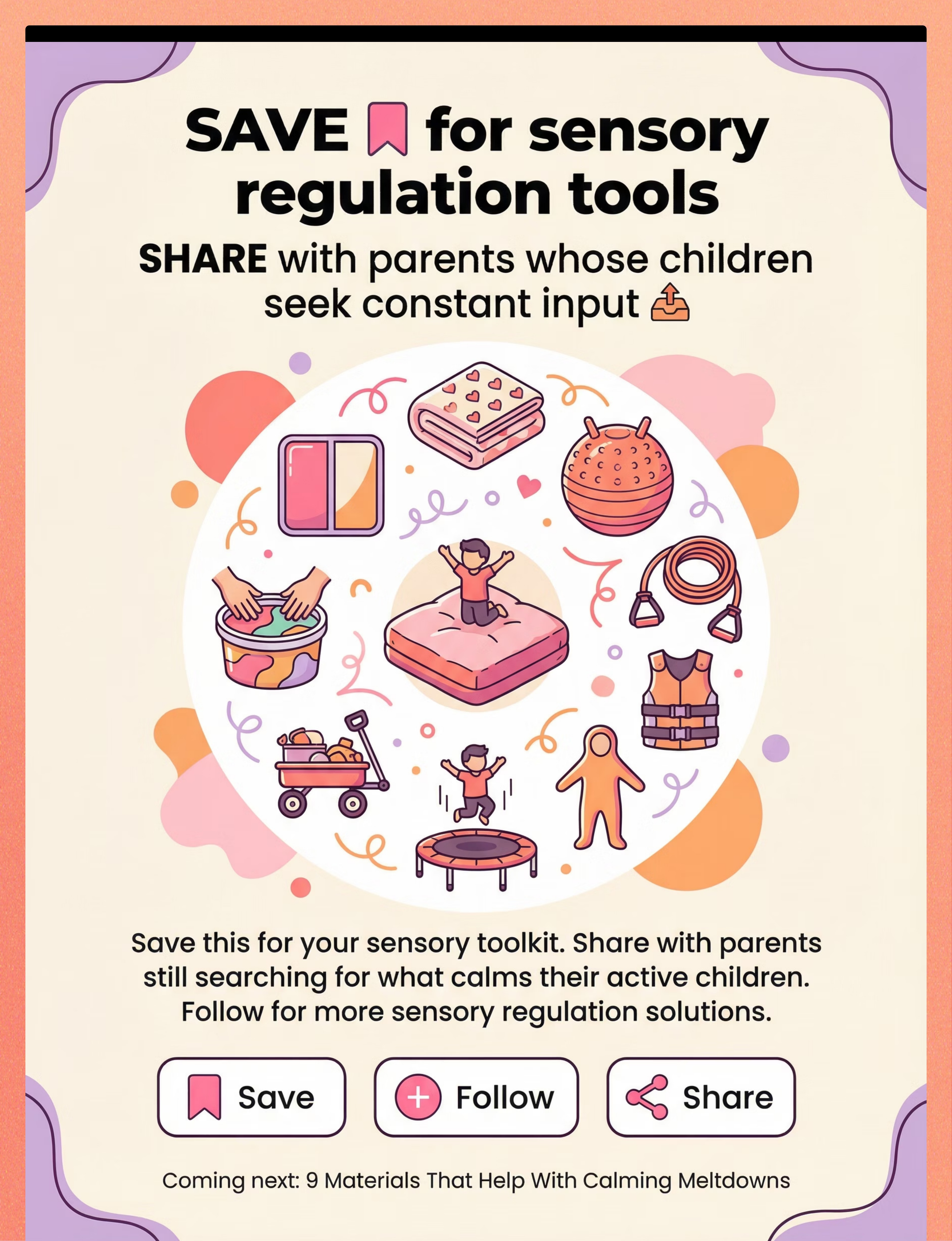
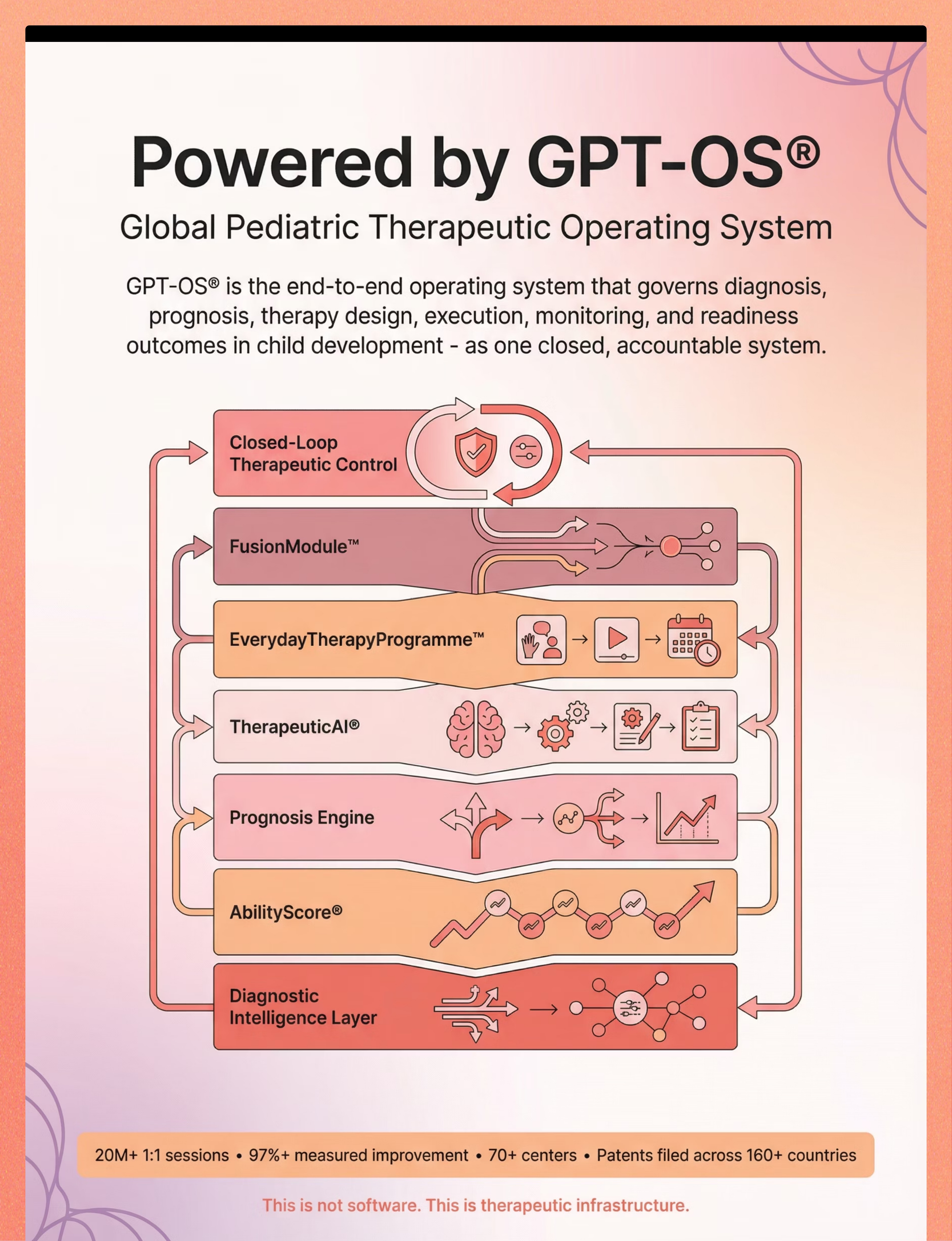
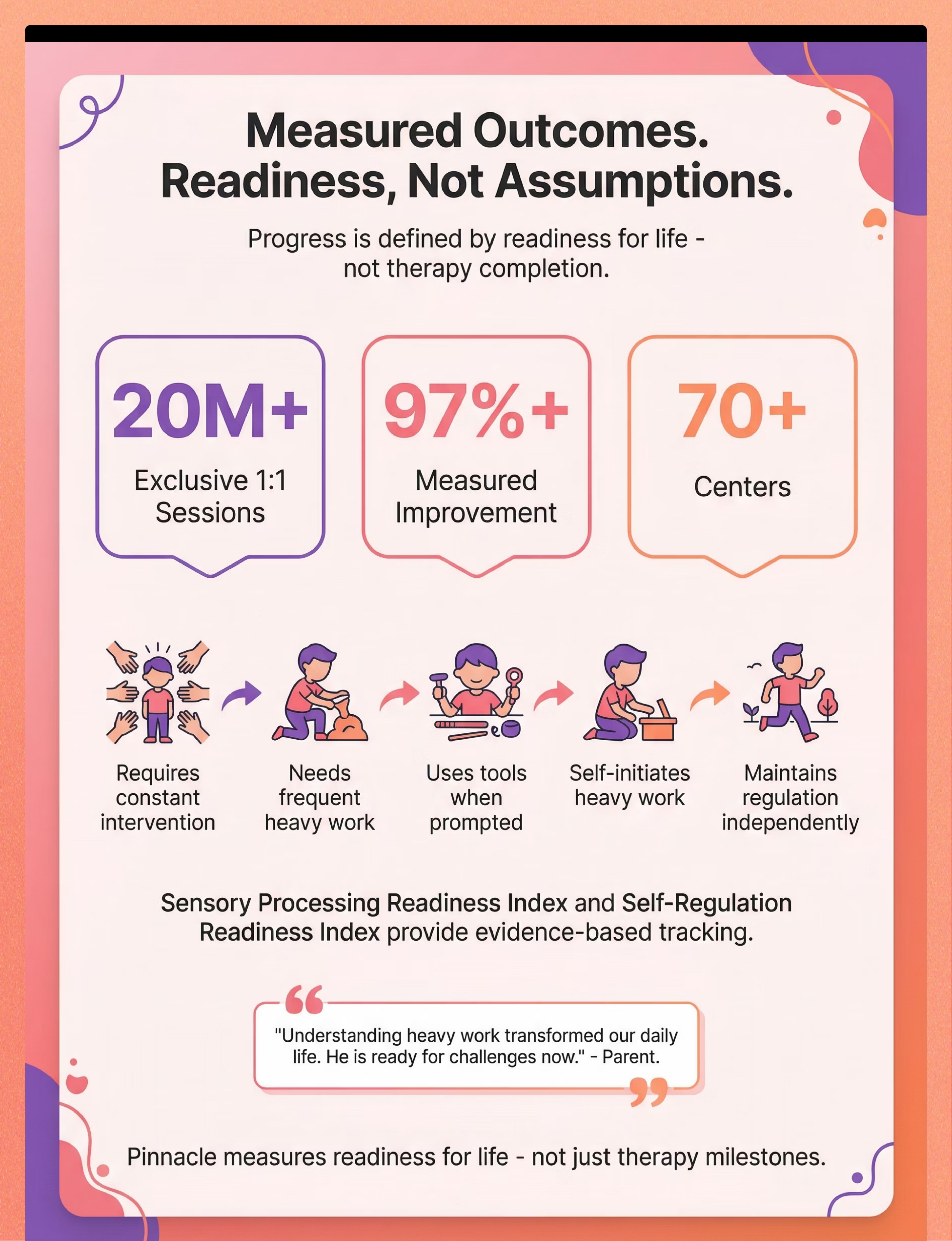
Preview of 9 materials that help with heavy work activities Therapy Material
Below is a visual preview of 9 materials that help with heavy work activities therapy material. The pages shown help educators, therapists, and caregivers understand the structure and content of the resource before use. Materials should be used under appropriate professional guidance.


Link copied!

The Pinnacle Promise
The Pinnacle Promise
"Built by Mothers. Engineered as a System. From fear to mastery — one technique at a time."
🔵 Occupational Therapy
🔴 Speech-Language Pathology
🟤 ABA / BCBA
🟢 Special Education
🔴 NeuroDev Pediatrics
⚫ CRO Research Division
Our Mission:"To transform every home on Earth into a 24×7, personalized, multi-sensory, multi-disciplinary, evidence-based therapeutic environment — for every child, regardless of geography, income, or diagnosis."
Contact Pinnacle Blooms Network®
📞 9100 181 181 (FREE | 16+ languages | 24×7)
🌐pinnacleblooms.org
📧care@pinnacleblooms.org
🗺️techniques.pinnacleblooms.org
🌐pinnacleblooms.org
📧care@pinnacleblooms.org
🗺️techniques.pinnacleblooms.org
Medical Disclaimer: This content is educational and does not replace individualized assessment and intervention from licensed occupational therapists or developmental specialists. Sensory processing differences vary significantly between individuals. Always introduce new sensory input gradually and observe responses. Never use weighted or restrictive items for restraint. Individual readiness for self-regulation varies — follow professional guidance for your child's specific profile.
Individual results may vary. Statistics represent aggregate outcomes across the Pinnacle Blooms Network® GPT-OS® system. © 2025 Pinnacle Blooms Network®, unit of Bharath Healthcare Laboratories Pvt. Ltd. All rights reserved. CIN: U74999TG2016PTC113063 | DPIIT: DIPP8651 | MSME: TS20F0009606 | GSTIN: 36AAGCB9722P1Z2