
🏥 Pinnacle Blooms Consortium — OT • SLP • ABA • SpEd • NeuroDev
"He's trying with everything he has. The classroom isn't letting him."
You've watched him sit down with good intentions — and lose the battle against his own body within minutes. Fidgeting. Looking around. Missing the instruction that just changed his grade. This is not laziness. This is a nervous system that needs different tools.
✦ H-750 | 9 Materials That Help With Focus in Classroom
"You are not failing. His brain is wired differently — and science has built real solutions."
Attention Regulation
Self-Regulation
Classroom Readiness
Sensory-Motor Integration
Executive Function
Age 4–12
WHO Nurturing Care Framework (2018) • Evidence Grade: Level I Systematic Review

ACT I: THE EMOTIONAL ENTRY
Millions of families. One shared struggle.
Every morning, across 197 countries, parents watch their child walk into a classroom carrying a nervous system that wasn't built for that environment. The noise. The movement. The competing demands. This is not rare. This is not your fault. This is documented, studied, and — critically — addressable.
1 in 6
Children Affected
Children have sensory processing differences affecting their classroom attention — CDC Developmental Disabilities Report 2023
80%
Autism + Sensory
Of children with autism experience significant sensory processing challenges affecting learning — PRISMA Systematic Review, PMC11506176, 2024
3–4 yrs
Development Gap
The gap in attention regulation development between neurodiverse children and peers — bridgeable with the right tools
📍India Context: With 18 million children on the autism spectrum and 50M+ managing ADHD-profile attention difficulties, India's classrooms serve the world's largest population of children who focus differently. Pinnacle Blooms Network operates across 70+ centres serving this population — across 16+ languages — backed by 20M+ therapy sessions.
"You are among millions of families navigating this. You are not alone. And you are not out of options."
PMC11506176 | PMC10955541 | WHO NCF 2018 | CDC Developmental Disabilities Report 2023

ACT I: THE EMOTIONAL ENTRY | The Neuroscience — Plain English
This is a wiring difference. Not a behaviour problem.
The Reticular Activating System (RAS)
The RAS is the brain's alertness regulator — the gatekeeper that determines which sensory signals reach conscious attention. In children who struggle to focus in classrooms, the RAS is often over-amplifying irrelevant inputs or under-filtering, creating a nervous system that cannot prioritise.
The Proprioceptive Highway
Children who fidget constantly are doing something neurologically intelligent: self-generating the proprioceptive input their nervous system needs to achieve the calm-alert state required for learning. Fidgeting is not defiance — it is the nervous system's attempt at self-regulation.
Executive Function: The Prefrontal Bottleneck
The prefrontal cortex governs sustained attention, impulse inhibition, and working memory. In children with ADHD profiles and autism, this region matures later and processes differently — creating real, measurable differences in how long attention can be sustained before the system demands a reset.
In plain language:
🔴"He isn't listening" → His auditory cortex cannot filter the classroom's competing sounds to prioritise the teacher's voice
🔴"She won't sit still" → Her vestibular and proprioceptive systems are deficit-seeking movement to maintain alertness — without it, her brain drowses into inattention
🔴"He makes careless mistakes" → His working memory is taxed by the effort of self-regulation, leaving fewer cognitive resources for the academic task itself
🔴"She knows the material at home but fails tests" → The familiar, low-stimulation home environment supports her regulation; the classroom's sensory load consumes the regulatory bandwidth she needs for learning
"Focus tools work because they address the brain's actual needs — not the behaviour's surface appearance. A wobble cushion isn't furniture. It's proprioceptive medicine."
Frontiers in Integrative Neuroscience (2020): Neurological basis for sensory-based interventions in ASD | DOI: 10.3389/fnint.2020.556660 | PMC10955541
ACT I: THE EMOTIONAL ENTRY | Developmental Context
Your child is here. Here is where we're heading.
Age 3–4
Attention span: 6–12 min | Classroom demand: 15+ min | Gap: Manageable with tools
Age 5–6
Attention span: 12–18 min | Classroom demand: 20–30 min | Gap: Significant for many
Age 7–8
Attention span: 16–24 min | Classroom demand: 30–45 min | Gap: Critical intervention window
Age 9–12
Attention span: 20–35 min | Classroom demand: 45–60 min | Gap: Tools + skill building essential
🎯 Most children using H-750 are in the 5–10 year window — the critical period where the right tools build self-regulation skills that last a lifetime.
What commonly co-occurs with classroom focus difficulties:
Autism Spectrum
Sensory + attention differences
ADHD
Attention regulation + impulse control
Sensory Processing
Sensory filtering differences
Anxiety
Hypervigilance consuming attention resources
DCD
Motor demands diverting cognitive bandwidth
Learning Disabilities
Academic difficulty masking as inattention
Note: Children may have one or several overlapping conditions. Professional evaluation is valuable.
WHO Care for Child Development (CCD) Package | PMC9978394 | UNICEF MICS Developmental Indicators 2023

ACT I: THE EMOTIONAL ENTRY | Clinical Evidence Grade
🛡️ Evidence Grade: Level I
Systematic Review + Meta-Analysis Support. Clinically validated. Home-applicable. Parent-proven.
Study 1 — PRISMA Systematic Review (2024)
16 studies (2013–2023) confirm sensory-based classroom tools meet criteria for evidence-based practice in autism. Wobble cushions, weighted inputs, and noise reduction tools demonstrated measurable improvement in on-task behaviour.
📎 PMC11506176 | Children, 2024
Study 2 — Meta-Analysis (World J Clin Cases, 2024)
24 studies confirm sensory integration therapy promotes social skills, adaptive behaviour, sensory processing, and motor skills — the exact developmental domains that underpin classroom focus.
📎 PMC10955541 | DOI: 10.12998/wjcc.v12.i7.1260
Study 3 — Indian RCT (Indian J Pediatr, 2019)
Home-based sensory interventions delivered by trained parents demonstrated significant outcomes in Indian paediatric populations — confirming that parent-executed home programmes work.
📎 DOI: 10.1007/s12098-018-2747-4 | Padmanabha et al.
82%
Research Confidence
Based on Oxford CEBM Level I–II evidence
20M+
NCAEP Evidence-Based Practices Report (2020): Visual supports, sensory-based interventions, and movement-based supports are classified as Evidence-Based Practices for autism.
🌍 WHO Aligned
🌐 UNICEF Endorsed
📊 NCAEP EBP
🏥 AOTA Supported
🇮🇳 India RCT Validated
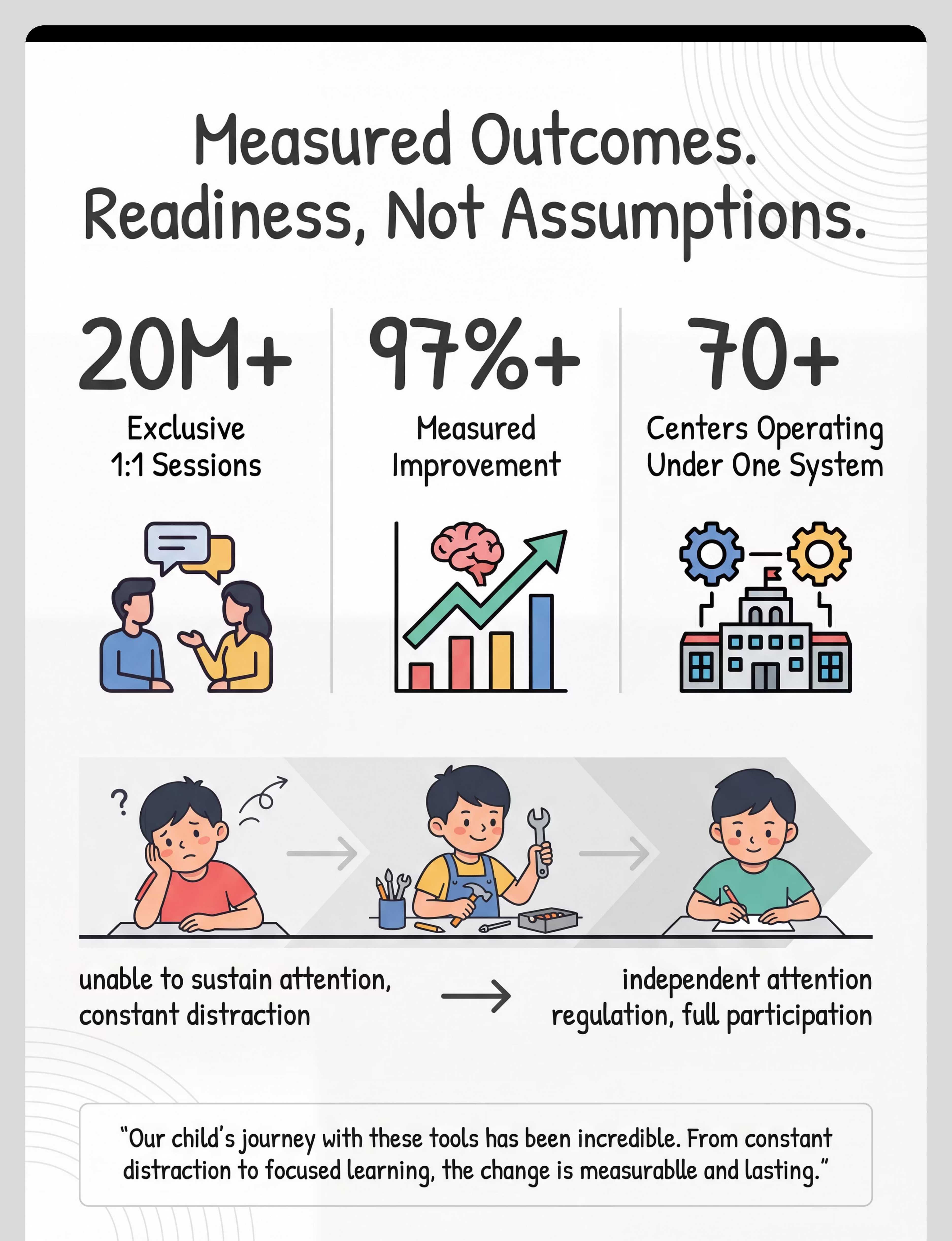
Across 20M+ therapy sessions in Pinnacle's network: Children using sensory classroom supports showed measurable improvement in the Classroom Functioning Readiness Index — tracked through GPT-OS® AbilityScore® methodology.
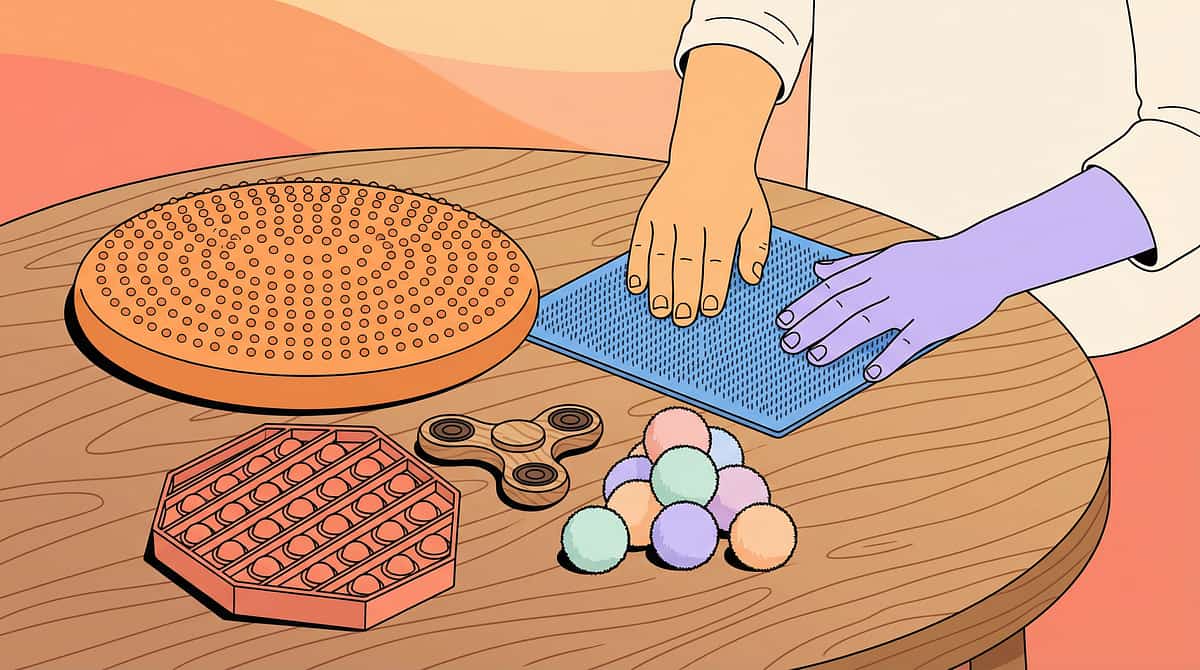
ACT II: THE KNOWLEDGE TRANSFER | Technique Definition
H-750 | Classroom Readiness Series | Episode 750 of 999
9 Materials That Help With Focus in Classroom
"The Classroom Focus Tool Kit"
These 9 clinician-selected materials address the four root causes of classroom attention difficulties: proprioceptive deprivation (the body's need for movement and pressure), auditory overwhelm (too many sounds competing for attention), visual distraction (too much to look at), and time blindness (inability to perceive how long a task takes). Each material is a precision tool mapped to one or more of these underlying neurological needs — not a behavioural intervention, but a sensory-regulation infrastructure that enables learning to occur.
📌 Primary Domain
Attention & Self-Regulation
📌 Sub-Domains
Sustained Attention | Selective Attention | Fidget Management | Sensory Regulation | On-Task Behaviour | Executive Function Support
📌 Canon Classification
Sensory-Motor + Environmental Modification + Structural Support
🎂 Age: 4–12 years
⏱️ Ongoing (integrated into school day)
📅 Frequency: Daily
🏫 Classroom + Home Learning
Taxonomy: Pinnacle 128 Canon Materials System | NCAEP EBP Classification 2020

ACT II: THE KNOWLEDGE TRANSFER | Multi-Disciplinary Application
"This technique crosses therapy boundaries — because the brain doesn't organise by therapy type."
🟣 Occupational Therapist (OT) — PRIMARY LEAD
The OT prescribes and calibrates sensory tools based on the child's Sensory Profile assessment. Selects wobble cushion inflation level, weighted pad weight, fidget type, and noise-reduction rating. Monitors sensory diet integration and school-home consistency.
🔵 ABA/BCBA Therapist — BEHAVIOURAL ARCHITECTURE
The BCBA establishes reinforcement schedules around tool use, monitors on-task behaviour data, and designs movement break protocols as structured behavioural supports. Tracks attention duration as a measurable outcome across sessions.
🟢 Special Educator (SpEd) — CLASSROOM INTEGRATION
The Special Educator negotiates tool use with classroom teachers, documents accommodations in IEP/504 plans, and monitors academic performance data in relation to tool implementation. Ensures tools are classroom-normalised, not stigmatising.
🟡 NeuroDevelopmental Paediatrician — MEDICAL OVERSIGHT
The NeuroDev physician confirms the neurological basis for tool prescription, rules out medical contraindications, and coordinates with school health systems for formal accommodation documentation.
"At Pinnacle, these four disciplines converge through the FusionModule™ — ensuring that the wobble cushion your OT prescribes is coordinated with the attention data your BCBA tracks, the IEP your SpEd drafts, and the medical clearance your NeuroDev provides. This is what integrated therapy looks like."
DOI: 10.1080/17549507.2022.2141327 | WHO/UNICEF Nurturing Care Framework multi-disciplinary model
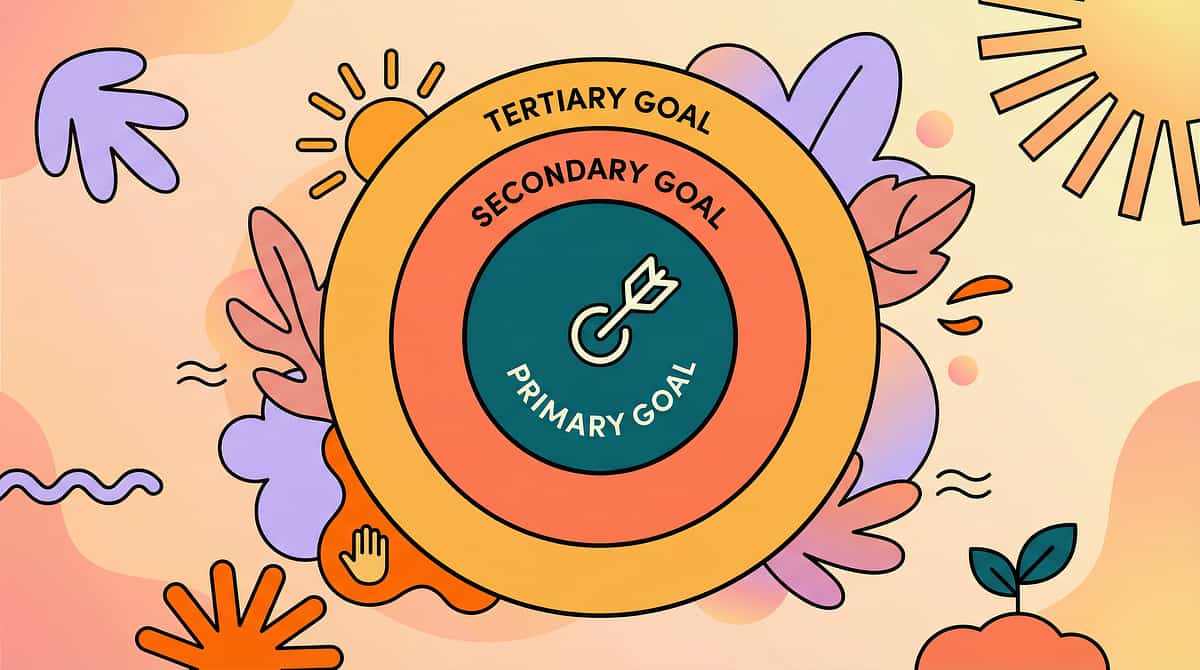
ACT II: THE KNOWLEDGE TRANSFER | Therapeutic Targets
What These Materials Target
The centre target — sustained on-task behaviour — is the observable outcome that teachers and parents measure daily. Every secondary target (reduced fidgeting, improved seated tolerance, fewer redirections) feeds directly into it. Long-term gains including executive function development and academic confidence emerge as the child's regulatory systems are scaffolded over weeks and months of consistent tool use.
Domain | Before Tools | With Tools | Mastery | |
Seated duration | < 5 min | 10–15 min | Age-appropriate | |
Teacher redirections | 8–12/hour | 3–5/hour | 0–2/hour | |
Task completion | < 40% | 60–75% | 85%+ | |
Self-regulation requests | 0 (no awareness) | With prompts | Independent |
PMC10955541 | NCAEP EBP Report 2020 | Pinnacle Classroom Functioning Readiness Index

ACT II: THE KNOWLEDGE TRANSFER | Primary Materials — H-750 Classroom Focus Kit
9 Materials. 4 Neurological Needs Addressed. Every Tool Clinician-Validated.
The following materials form the complete H-750 Classroom Focus Kit. Each tool is mapped to a specific neurological need — begin with the one that most closely matches your child's most visible challenge.
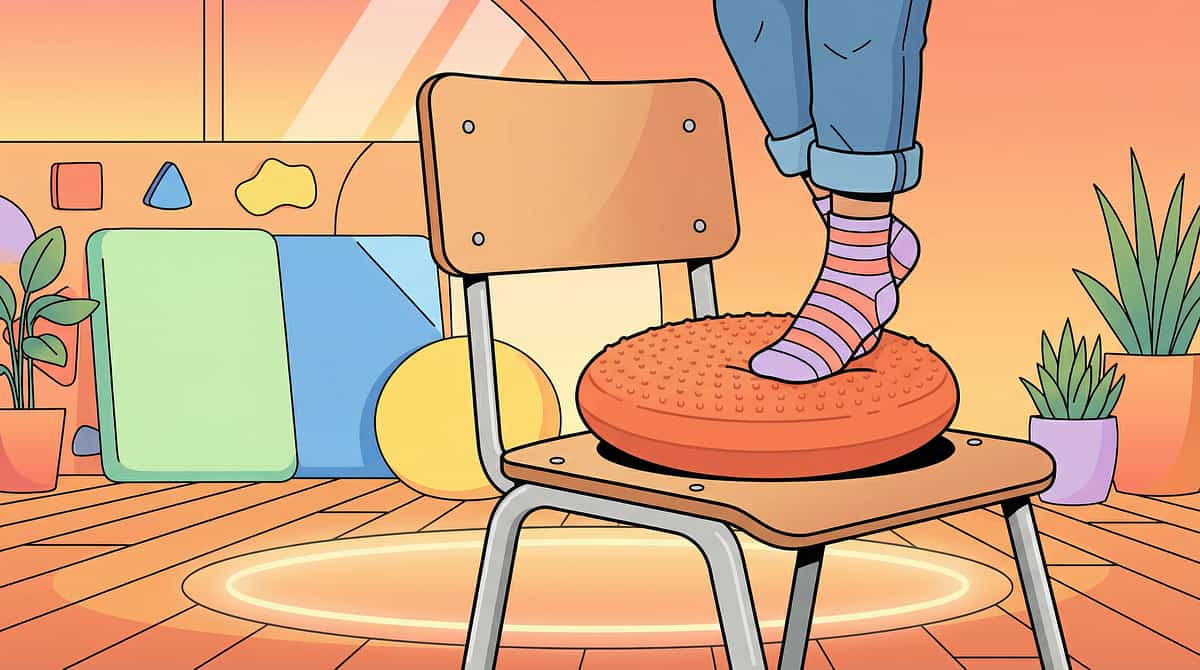
Material 1 of 9
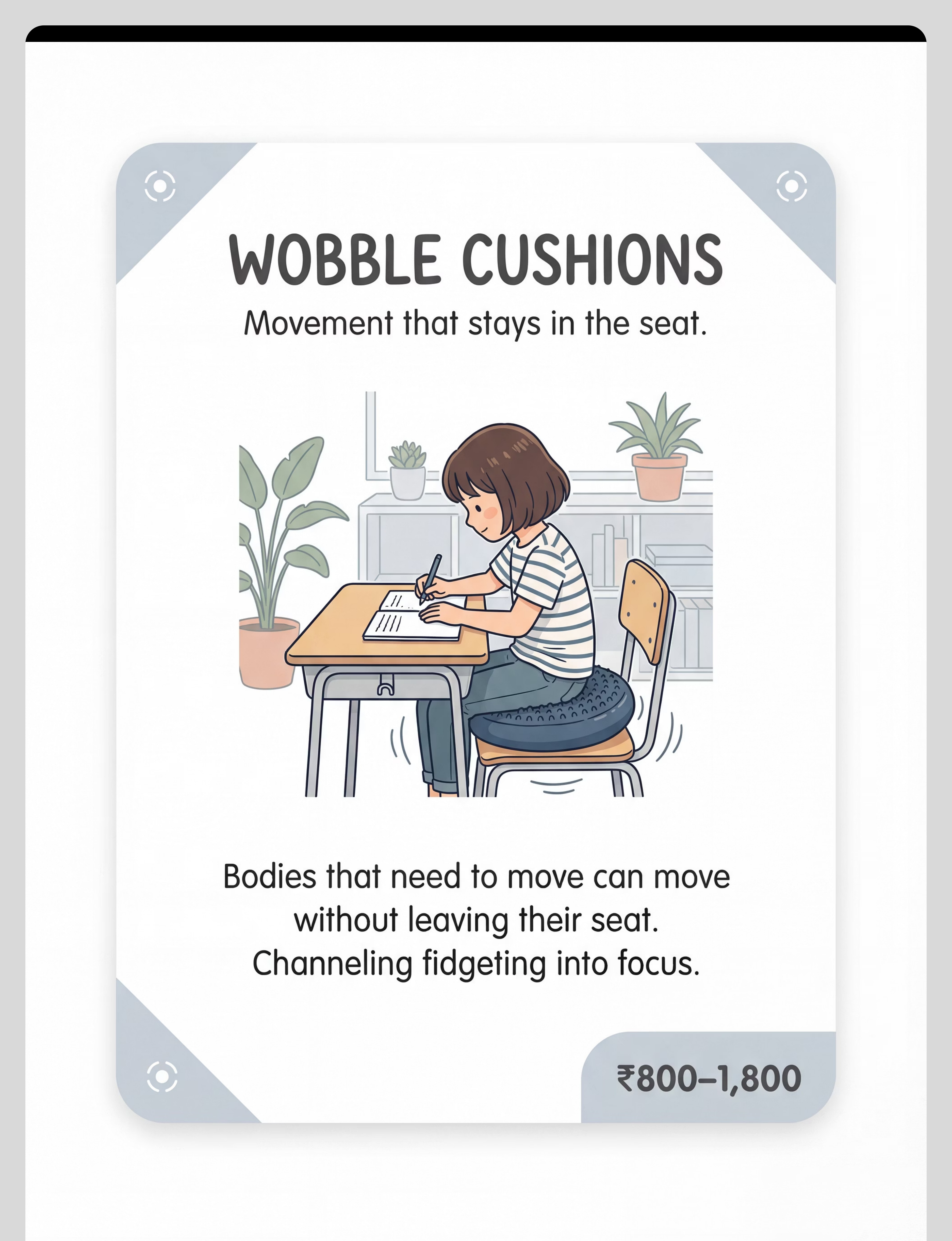
Wobble Cushions
Why It Works
📦Category: Sensory-Motor / Proprioceptive Seating
💡Neurological Need: Vestibular + proprioceptive input (movement regulation). The constant micro-movement satisfies the nervous system's input demands without the child needing to leave their seat.
Pinnacle Recommendation
⭐ Textured disc, 33cm diameter, 5–10cm inflation
💰Price Range: ₹800–1,800
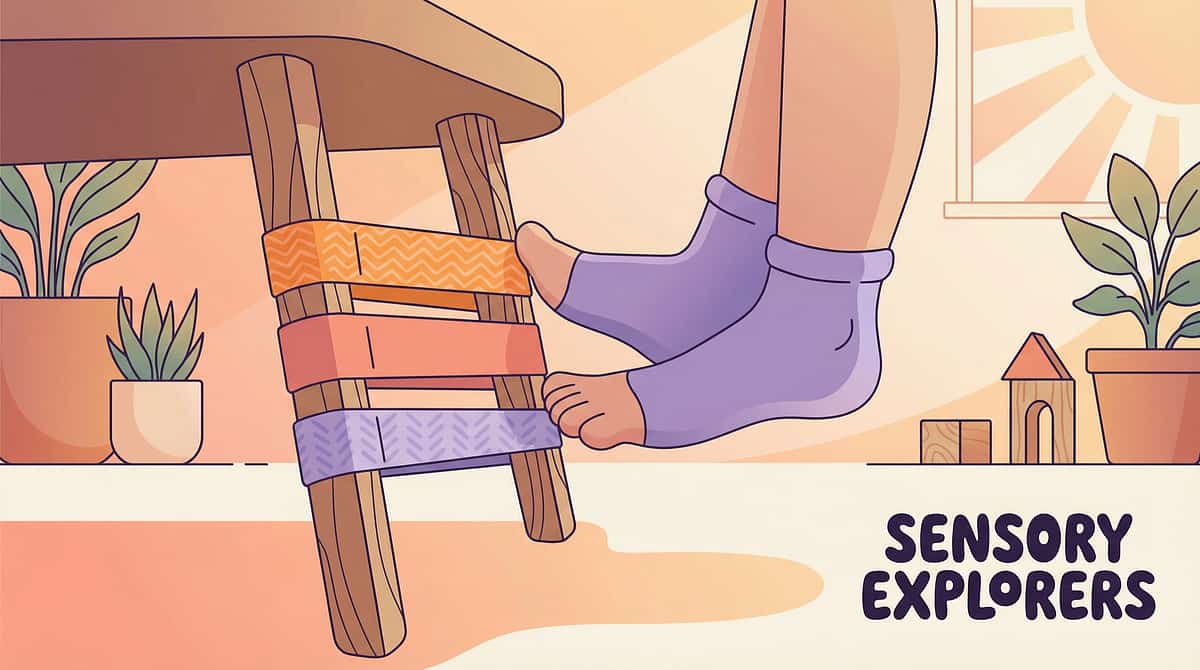
Material 2 of 9
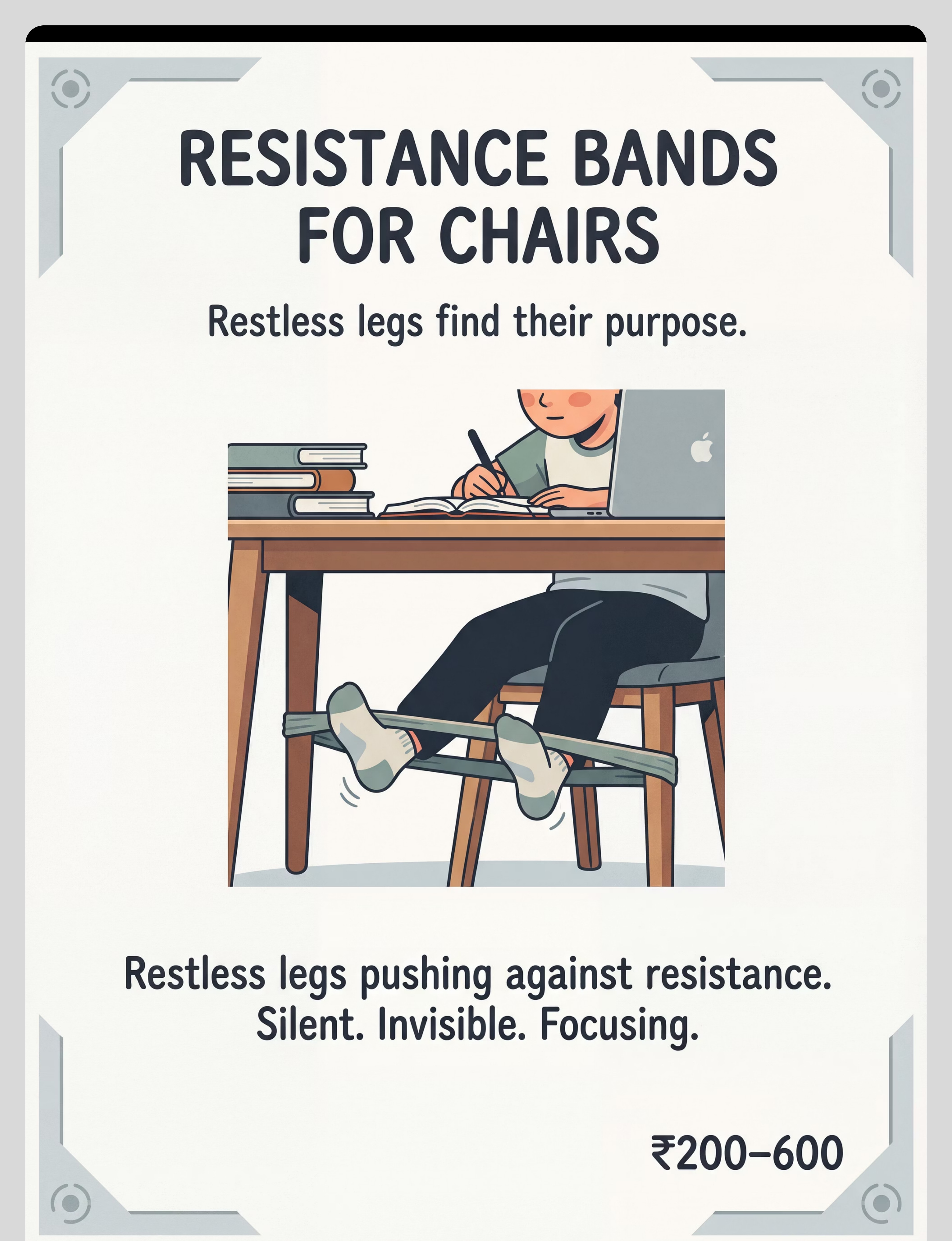
Resistance Bands for Chairs
Why It Works
📦Category: Proprioceptive / Leg-Fidget Management
💡Neurological Need: Proprioceptive input for legs / restless movement management. The child's feet push and release against the band — providing continuous grounding feedback that channels restless energy constructively.
Pinnacle Recommendation
⭐ Medium-resistance therapy band, 100cm × 15cm
💰Price Range: ₹200–600
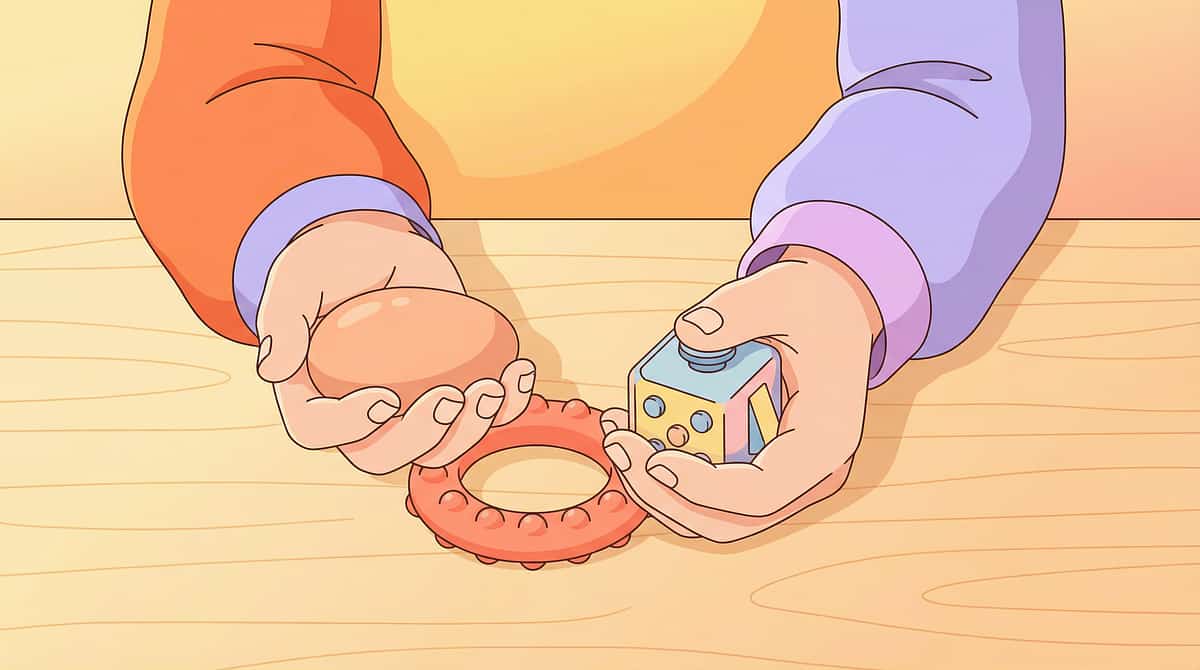
Material 3 of 9
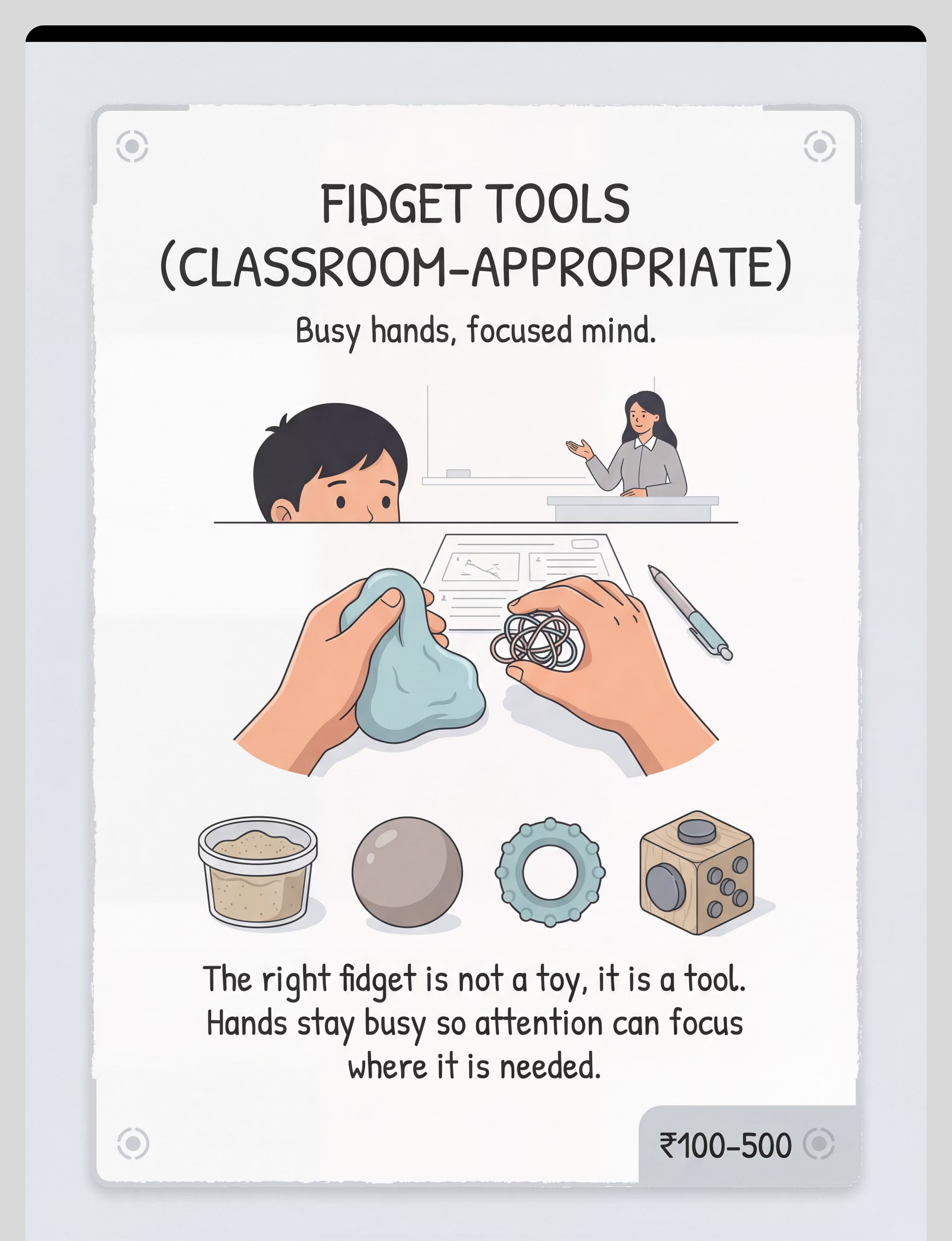
Fidget Tools (Classroom-Appropriate)
Why It Works
📦Category: Tactile Regulation / Hand-Fidget Management
💡Neurological Need: Tactile + proprioceptive input for hands. The tactile cortex is engaged by the fidget, reducing the drive to touch everything in the environment. Hands become "busy enough" to free the attention system for the task.
Pinnacle Recommendation
⭐ Therapy putty (medium resistance) + Tangle Jr.
💰Price Range: ₹100–500

Material 4 of 9
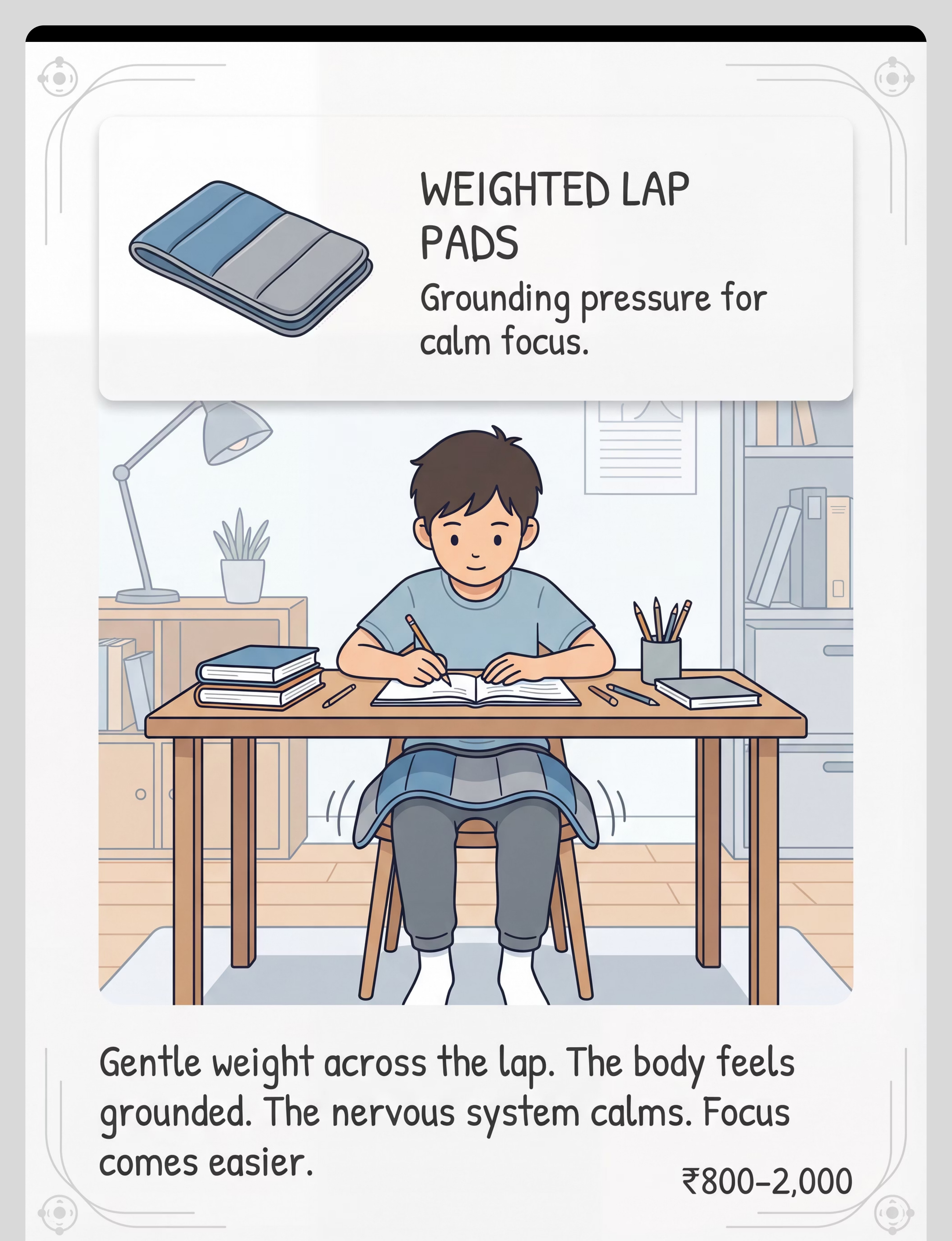
Weighted Lap Pads
Why It Works
📦Category: Deep Pressure / Proprioceptive Grounding
💡Neurological Need: Deep pressure proprioception (nervous system calming). The continuous proprioceptive input from weight across the lap promotes parasympathetic activation — the "calm-alert" neurological state optimal for learning.
Pinnacle Recommendation
⭐ 1.0–1.5kg for 20–30kg child
⚠️Consult your OT for exact weight — this is a clinically prescribed tool.
💰Price Range: ₹800–2,000
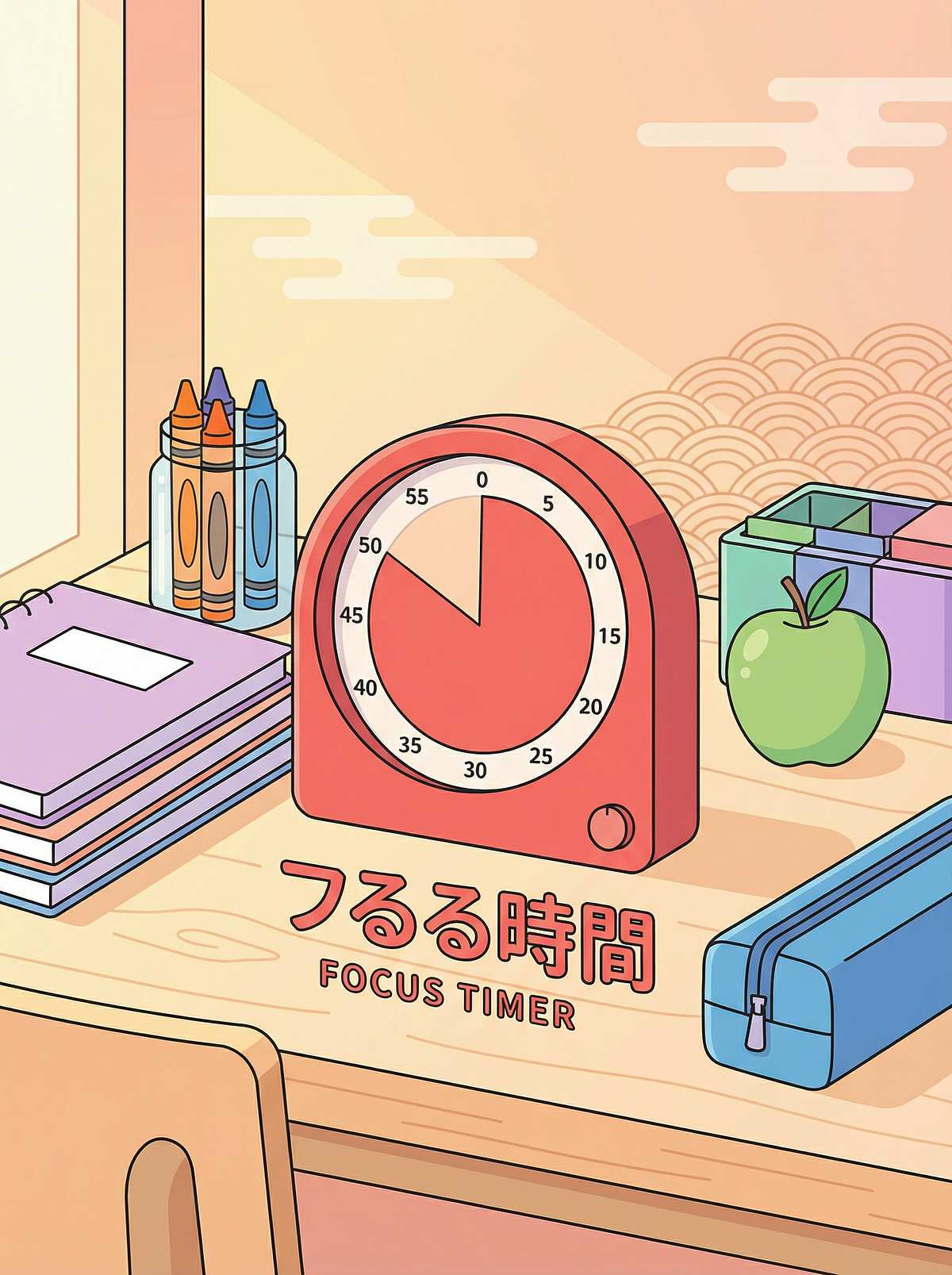
Material 5 of 9
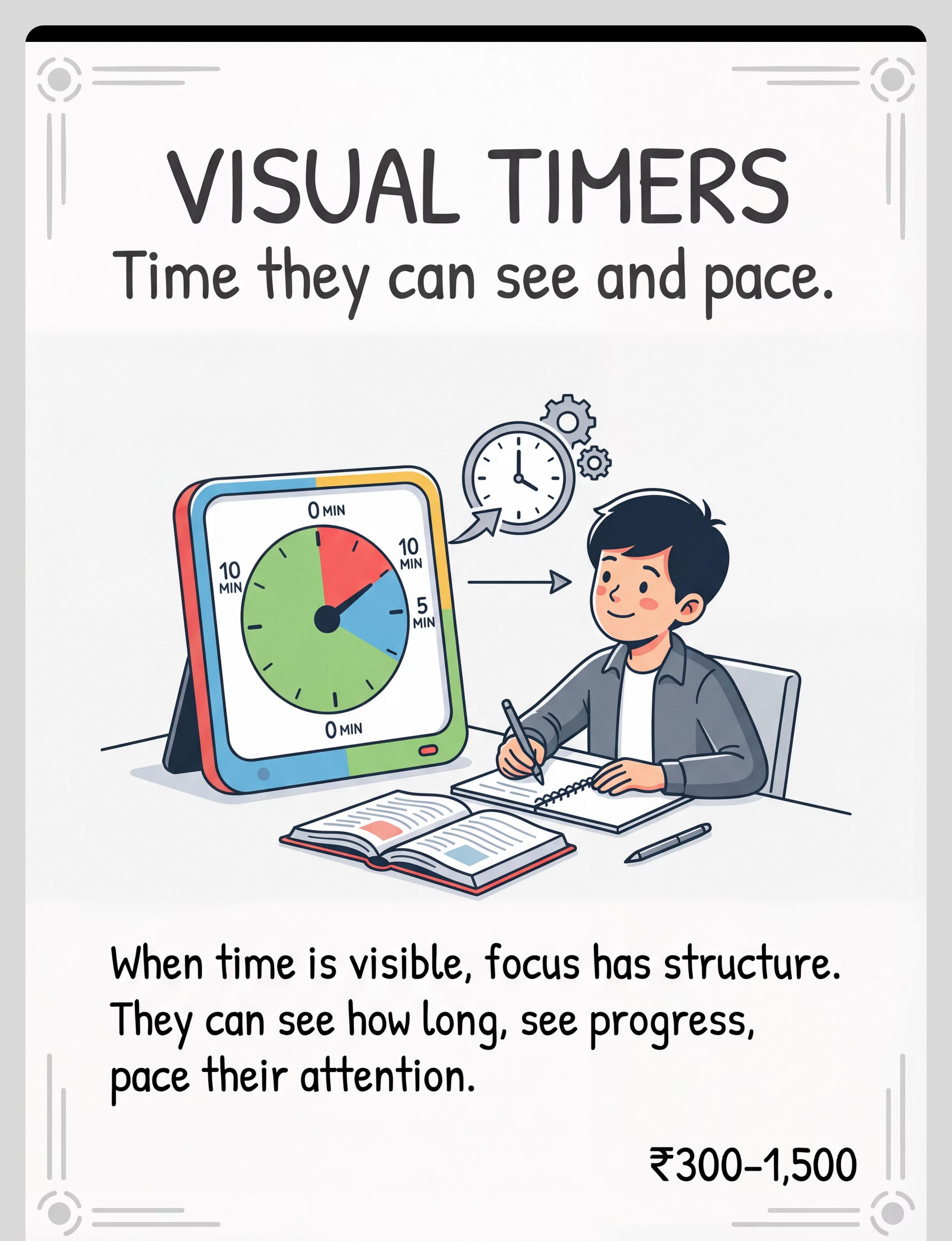
Visual Timers
Why It Works
📦Category: Time Visualisation / Executive Function Support
💡Neurological Need: Time perception externalisation. Children with ADHD and autism often experience "time blindness" — an inability to feel how much time has passed. The shrinking red disc makes abstract time concrete and visible, reducing anxiety and supporting task completion.
Pinnacle Recommendation
⭐ Time Timer-style (shrinking red disc), 60-minute range
💰Price Range: ₹300–1,500
Material 6 of 9
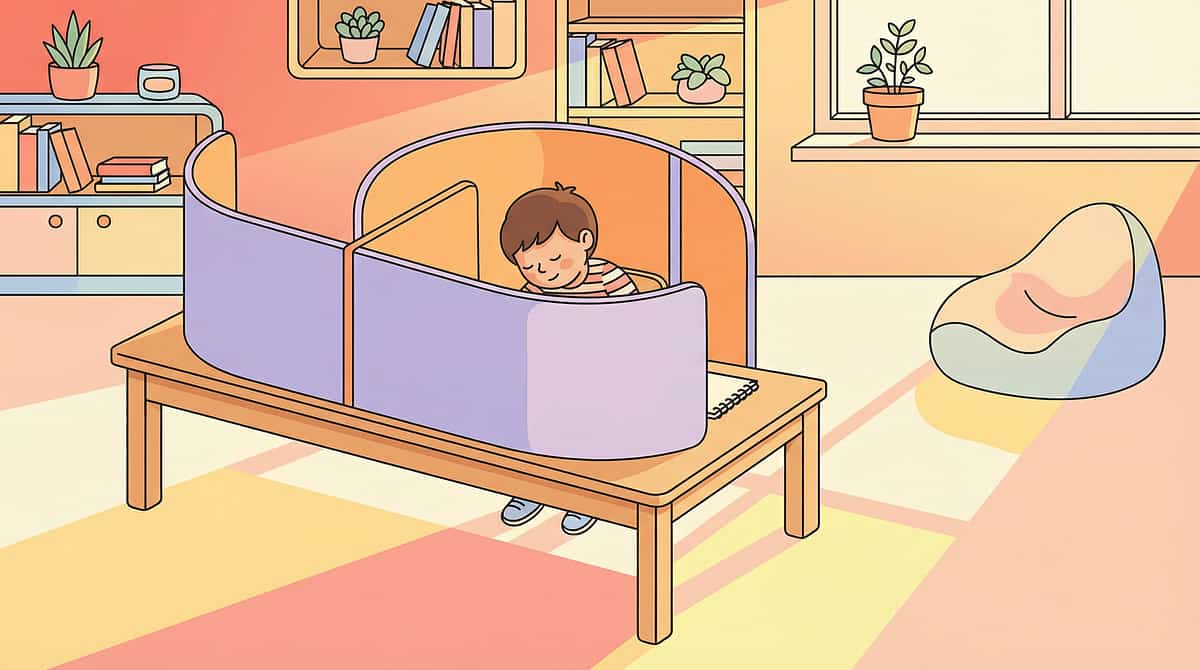
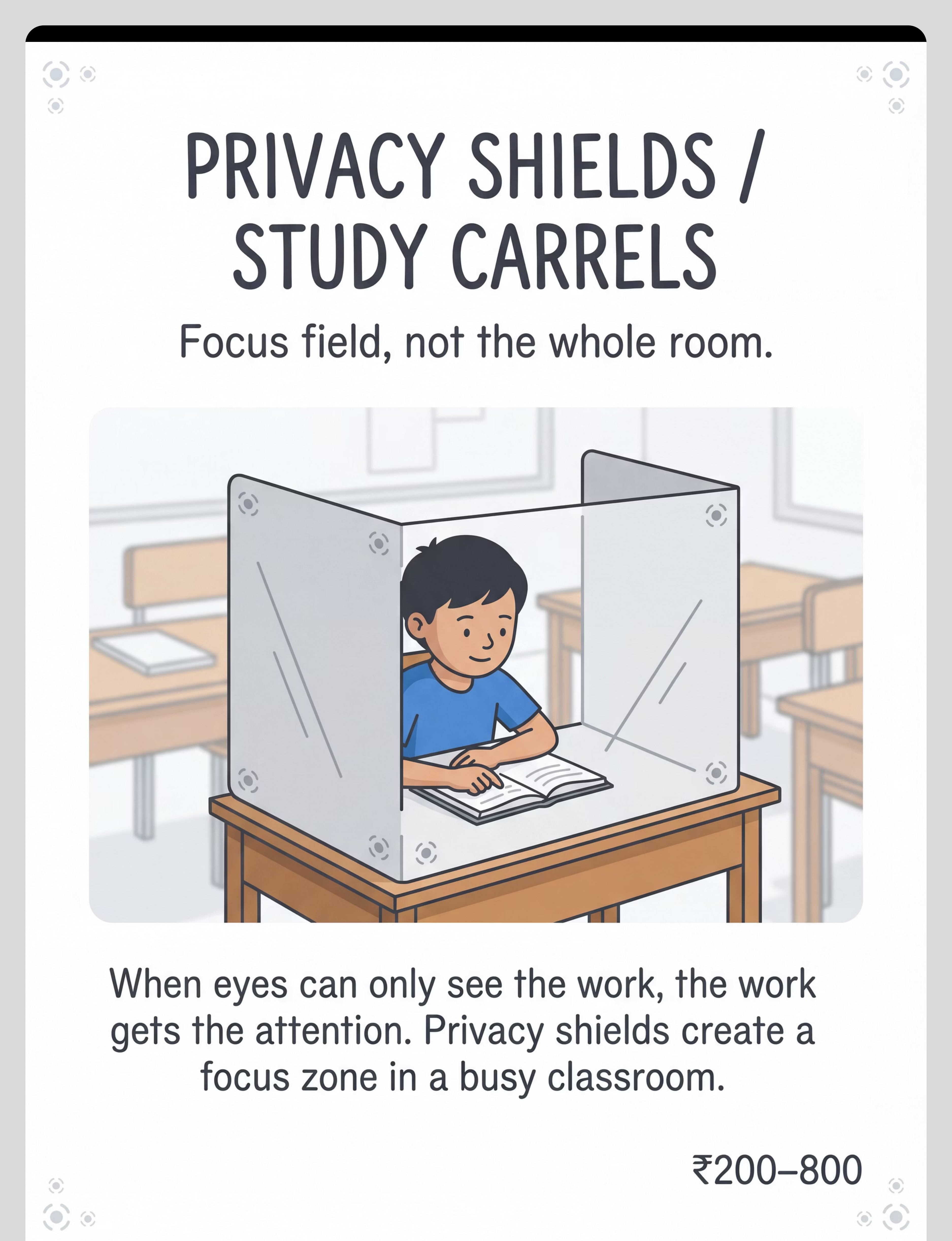
Privacy Shields / Study Carrels
Why It Works
📦Category: Visual Field Reduction / Environmental Modification
💡Neurological Need: Selective attention support. By reducing the volume of competing visual stimuli in the child's peripheral field, the shield lowers the cognitive load required to filter the environment — leaving more bandwidth available for the actual learning task.
Pinnacle Recommendation
⭐ Tri-fold cardboard or acrylic, 45cm height
💡 Introduce as "your focus office" — gives it positive framing rather than isolation connotation.
💰Price Range: ₹200–800

Material 7 of 9
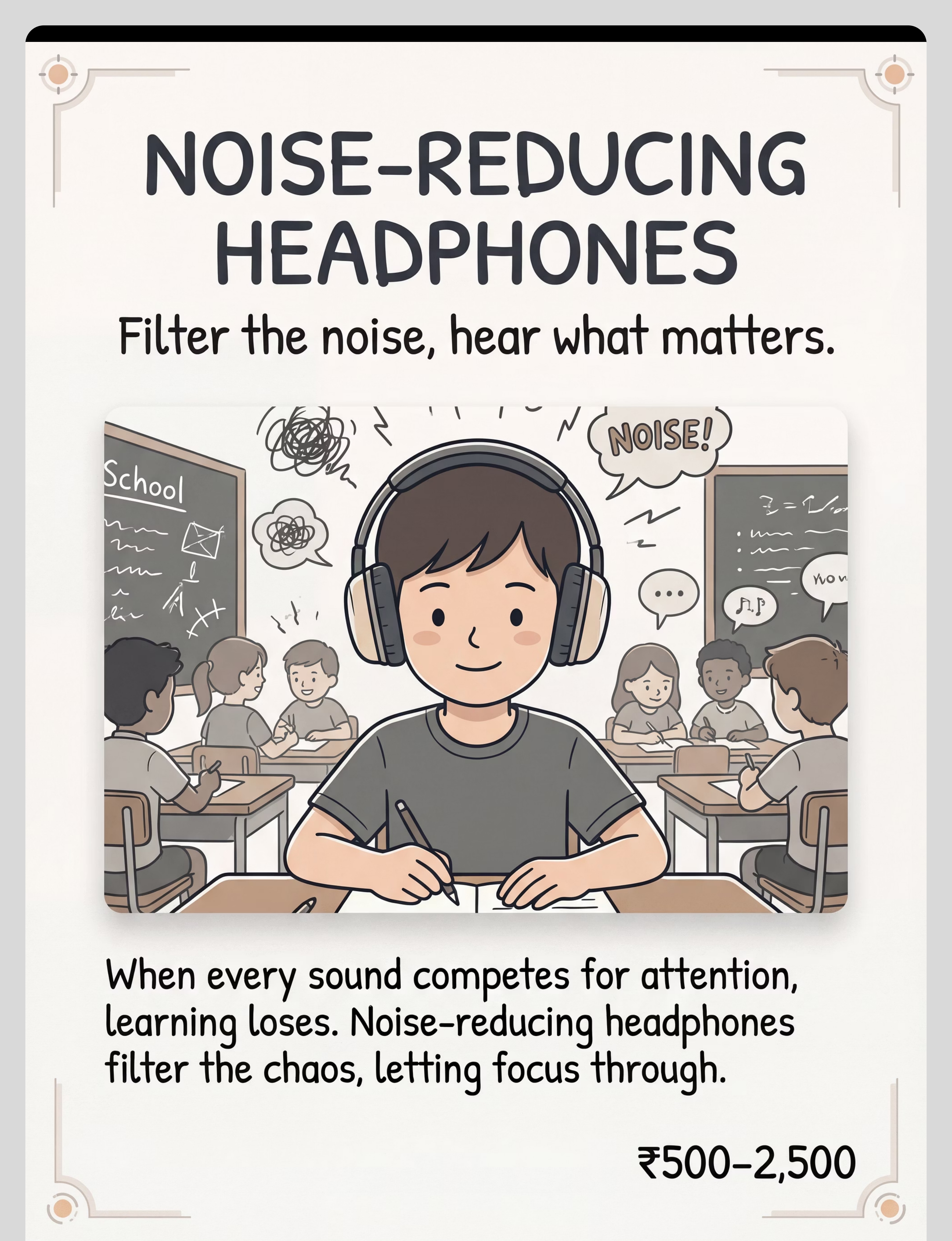
Noise-Reducing Headphones
Why It Works
📦Category: Auditory Regulation / Sensory Filtering
💡Neurological Need: Auditory overwhelm reduction. By filtering competing sound signals, headphones improve the signal-to-noise ratio between the teacher's voice and background sound — allowing the auditory cortex to process instruction rather than continuously triaging environmental noise.
Pinnacle Recommendation
⭐ Passive noise-reducing earmuffs, NRR 22–27 dB
⚠️If child has hearing aids or cochlear implants, consult audiologist before use.
💰Price Range: ₹500–2,500

Material 8 of 9
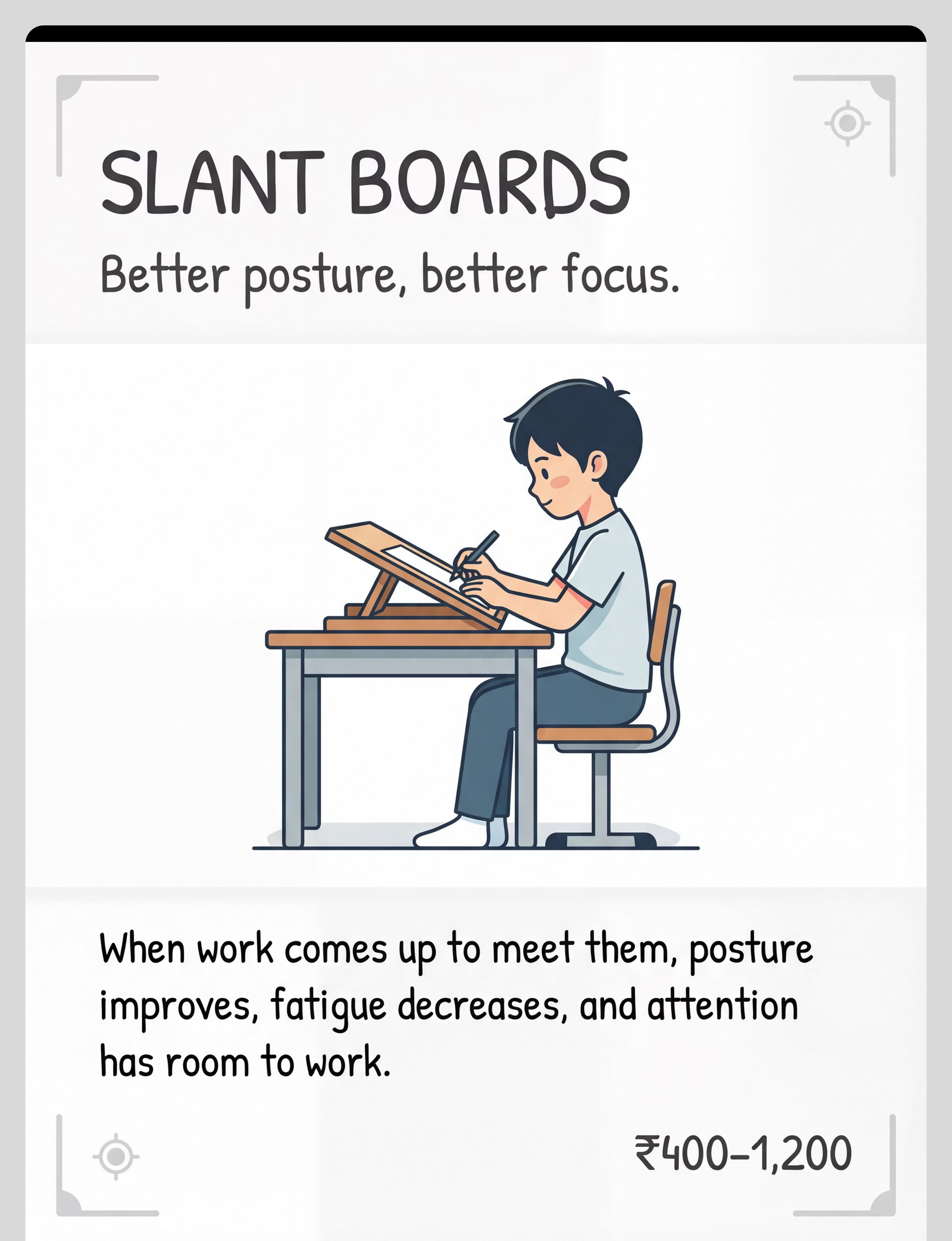
Slant Boards
Why It Works
📦Category: Postural Support / Ergonomic Alignment
💡Neurological Need: Postural alignment → improved core engagement → reduced cognitive fatigue. When a child writes at a flat surface, the head drops forward, compressing the airway and increasing spinal load. The slant restores neutral posture, reducing the physical effort of writing and freeing cognitive resources for the task.
Pinnacle Recommendation
⭐ 20° angle, A4-sized surface, non-slip base
💰Price Range: ₹400–1,200
Material 9 of 9
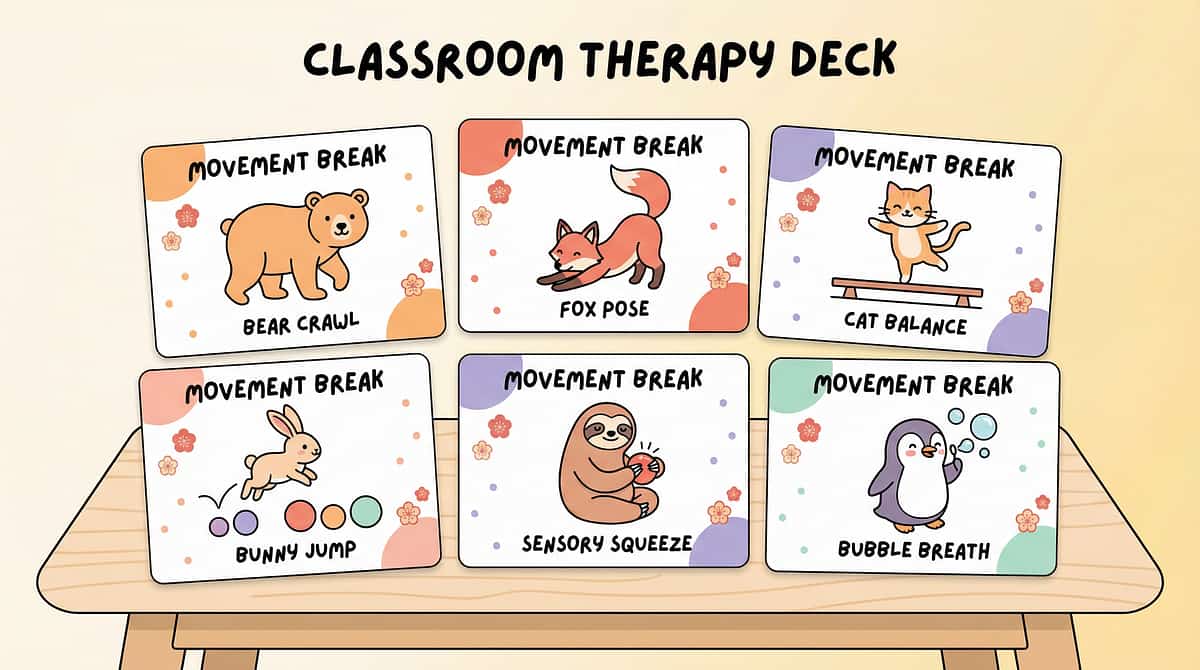
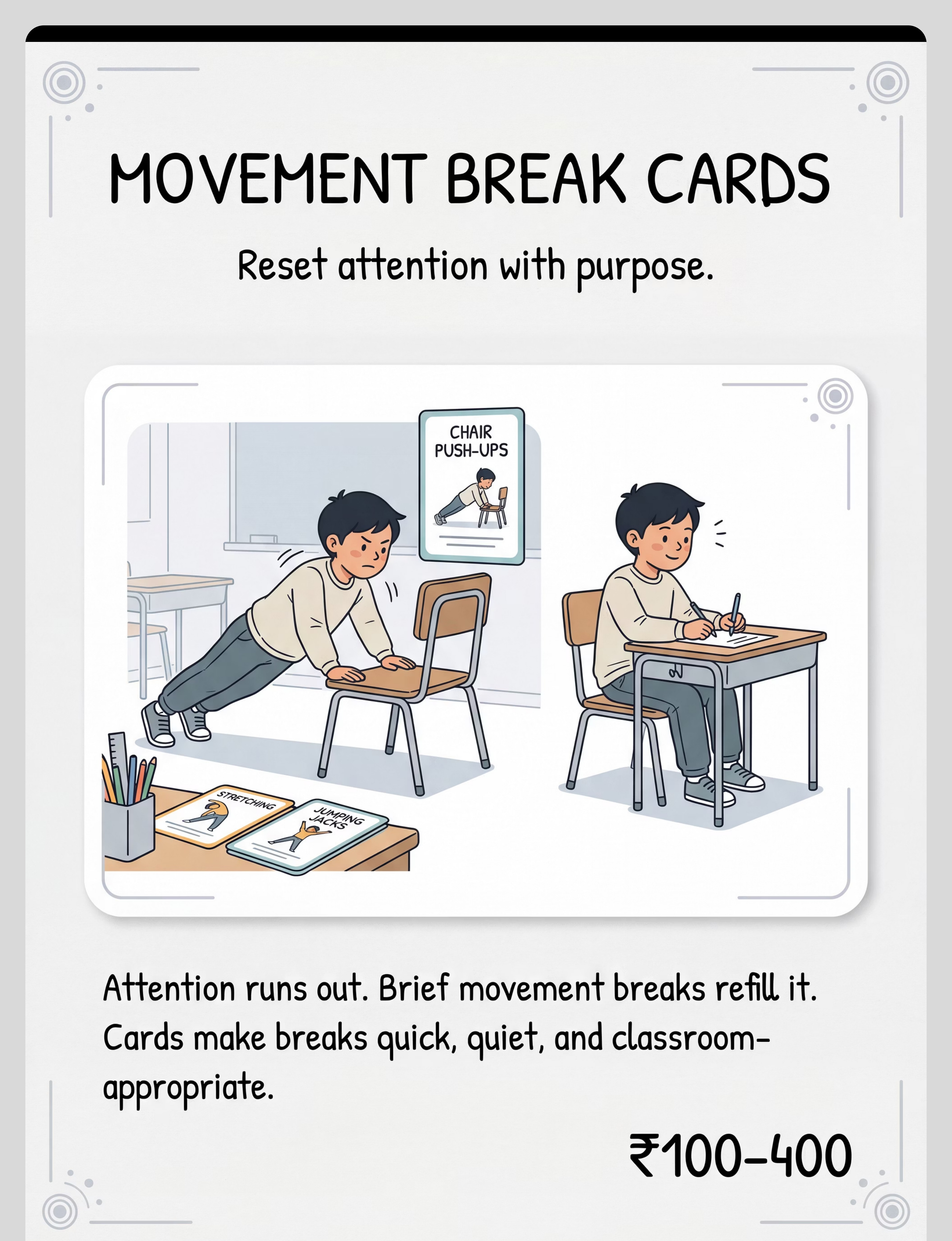
Movement Break Cards
Why It Works
📦Category: Structured Movement / Attention Reset
💡Neurological Need: Proprioceptive reset. When a child's attention capacity is exhausted, a structured 2–3 minute movement break replenishes it by delivering a burst of vestibular and proprioceptive input. The card format makes the break predictable, time-limited, and teacher-manageable — not an excuse to roam freely.
Pinnacle Recommendation
⭐ Visual card deck with 12–20 movements, classroom-safe
💰Price Range: ₹100–400
📦 Complete H-750 Classroom Focus Kit: ₹3,400–10,300
🎯 Essential Starter (4 core materials): ₹1,400–4,300
💚 Budget Version (DIY alternatives): ₹0–800 — see the next card for free alternatives to every material.
🎯 Essential Starter (4 core materials): ₹1,400–4,300
💚 Budget Version (DIY alternatives): ₹0–800 — see the next card for free alternatives to every material.
ACT II: THE KNOWLEDGE TRANSFER | WHO/UNICEF Equity Principle — Access for Every Family
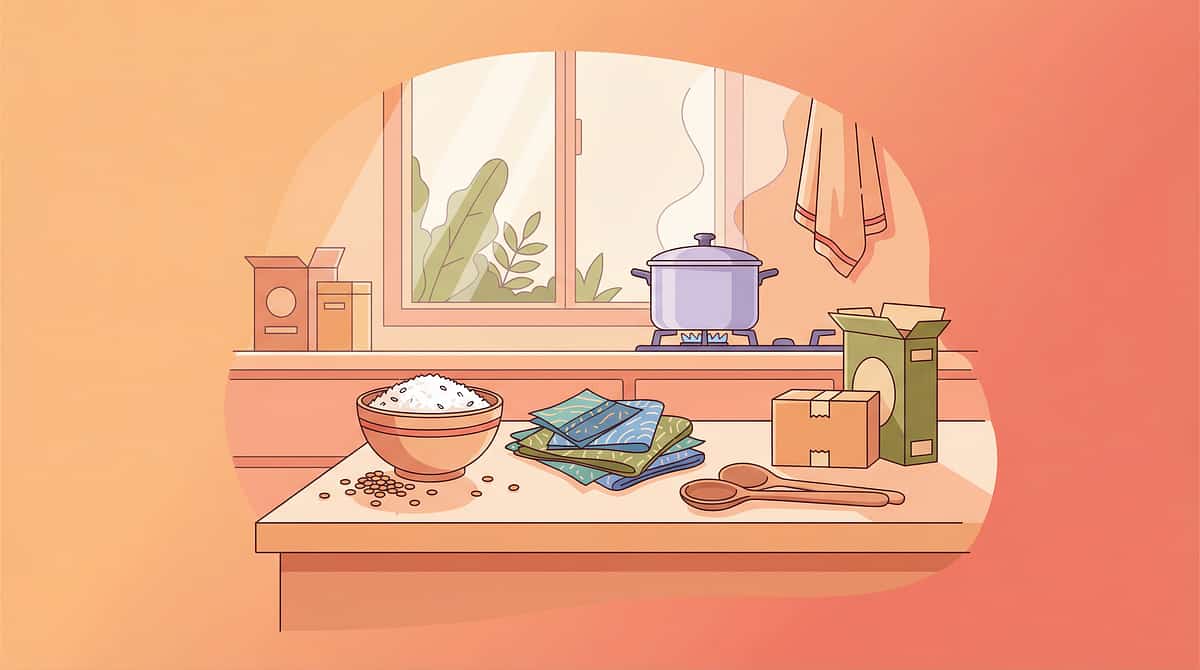
Every intervention on this page has a zero-cost version.
"Access should never be a barrier to your child's progress."
Commercial Version | DIY / Household Alternative | Why It Works | |
Wobble Cushion ₹800–1,800 | Partially deflated beach ball in pillowcase on chair | Same vestibular instability, same proprioceptive engagement | |
Resistance Chair Band ₹200–600 | Bicycle inner tube, cut and tied between front chair legs | Same proprioceptive resistance for feet/legs | |
Fidget Tools ₹100–500 | Velcro strip stuck under desk edge | Same tactile input — silent, invisible, free | |
Weighted Lap Pad ₹800–2,000 | Rice in ziplock bag inside a small fabric pouch on lap | Same deep pressure — verify weight = 5–10% body weight | |
Visual Timer ₹300–1,500 | Sand timer (any duration) | Same visible time countdown principle | |
Privacy Shield ₹200–800 | Three cardboard panels taped together as trifold | Same visual field reduction — child can decorate it | |
Noise-Reducing Headphones ₹500–2,500 | Foam ear plugs (with teacher awareness) | Reduces auditory overwhelm — lower NRR but functional | |
Slant Board ₹400–1,200 | Large 3-ring binder turned landscape as writing surface | Same ~20° angle, same postural benefit | |
Movement Break Cards ₹100–400 | Printed/hand-drawn index cards with movement stick figures | Same attention reset — free to create |
⚠️When Clinical-Grade Material Is Non-Negotiable: Weighted items (lap pads) should be precisely weighted per OT guidance. A commercially graded lap pad ensures consistent, safe weight distribution. DIY rice bags can be used temporarily but should be professionally verified.
"The WHO Nurturing Care Framework emphasises context-specific, equity-focused interventions. The evidence for these sensory supports holds regardless of material cost — it is the neurological principle, not the price tag, that drives the outcome." — PMC9978394 | WHO NCF Handbook 2022

ACT II: THE KNOWLEDGE TRANSFER | Safety Protocol — Read Before Executing
Safety First: Before You Begin
🔴 RED — DO NOT PROCEED
Stop. Consult a professional first if:
- Child has a vestibular disorder diagnosis (wobble cushion contraindicated without OT clearance)
- Child has a cardiac condition or orthopedic joint hypermobility (weighted items require physician approval)
- Child has a history of severe sensory aversion (forced exposure can cause acute distress)
- Child is currently in a meltdown, dysregulated, or acutely anxious state
- Child is unwell (fever, ear infection, recent injury)
🟡 AMBER — PROCEED WITH MODIFICATION
Use caution and reduce intensity if:
- Child has latex allergy (select latex-free resistance bands and cushions)
- Child is very young (under 5): reduce weighted pad to minimum, start with 2–3 min use
- Child resists any tool introduction — do not force; introduce gradually over days
- First-time use: always begin with shortest duration and least intensity
- Child has hearing aids or cochlear implants (consult audiologist before noise-reducing headphones)
🟢 GREEN — GO CHECKLIST
Proceed when:
- Child is fed, rested, and in a baseline-regulated state
- Materials have been checked for quality and safety (no sharp edges, correct weight)
- Teacher/school has been informed and has approved tool use
- Child has had a brief explanation of each tool
- Emergency exit plan exists: child knows they can signal for a break
🛑Stop the session if: Child removes a material in distress (don't force it back) | Child shows acute emotional escalation linked to tool use | Any physical discomfort reported by child | Tool appears to increase, not decrease, dysregulation after 3+ days
DOI: 10.1007/s12098-018-2747-4 | Pinnacle Clinical Safety Protocols | AOTA Sensory Integration Safety Guidelines
ACT II: THE KNOWLEDGE TRANSFER | Environmental Preparation
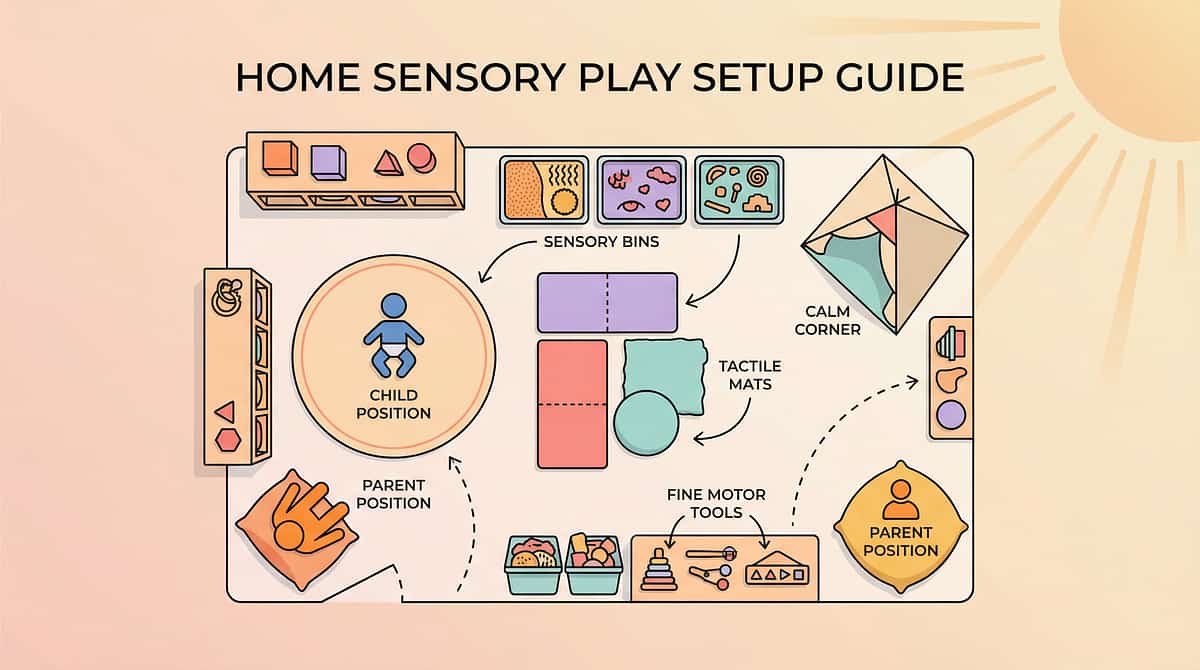
"The right environment activates the tools. The wrong environment defeats them."
1
Child's Chair
Wobble cushion installed (textured side up for tactile input, smooth side up for pure movement). Resistance band stretched between front chair legs at ankle height.
2
Child's Desk Surface
Slant board placed for writing tasks. Privacy shield stored nearby (introduce as "your focus office"). Visual timer visible from child's seated position.
3
Sensory Toolkit Box
Small container within arm's reach containing today's fidget tool, ear plugs (backup for headphones), movement break cards.
4
Parent Position
Slightly behind and to the side — close enough to observe, far enough not to hover.
5
Movement Break Zone
Designated clear floor space (1.5m × 1.5m) for movement breaks — marked with tape or a rug.
What to Remove
- Extra toys from the learning desk surface
- Competing visual displays (excessive posters/decorations) from immediate sightline
- Background TV or media
- Additional people moving through the space during focus sessions
Environment Calibration
💡Lighting: Natural light preferred. Avoid fluorescent flicker (common dysregulation trigger for sensitive children).
🔊Sound: Background noise below 50dB during focus sessions. White noise machine optional for auditory-sensitive children.
🌡️Temperature: 20–22°C optimal for sustained cognitive engagement.
Classroom Coordination Note: "If replicating this for school: Share this card with your child's teacher. Many accommodations are simple — the wobble cushion goes on the chair, the fidget stays in the desk, the visual timer sits at the corner. The teacher doesn't need to manage the tools — the child does."

ACT III: THE EXECUTION | Pre-Session Readiness Assessment
Is Your Child Ready? The Readiness Check
"60 seconds. 7 questions. A better session."
Check each indicator. Honest answers only.
Child has eaten within the last 2 hours
YES = point toward GO
Child has slept adequately (not overtired)
YES = point toward GO
Child is not showing active signs of illness
YES = point toward GO
Child has not experienced a major upset in the last 30 minutes
YES = point toward GO
Child's baseline arousal appears calm-to-moderate
YES = point toward GO
Environment is set up per the space guide
YES = point toward GO
You (the parent/caregiver) are calm and have 20–30 minutes available
YES = point toward GO
🟢 6–7 YES: GO
Proceed to Step 1 at full protocol
🟡 4–5 YES: MODIFY
Use shortened version — one material, 10 minutes, low demand
🔴 0–3 YES: POSTPONE
Today is not the day. Use a calming activity instead. Try again tomorrow.
If MODIFY: Skip the protocol. Set up the wobble cushion only, put on calm music, and sit alongside your child in an unstructured 10-minute co-regulation session. This counts. This matters. This is still therapy.
If POSTPONE: Try a sensory diet activity (deep pressure, heavy work, proprioceptive input) to support regulation. Document: "Postponed H-750 — child state: [description]." This data is valuable.
If POSTPONE: Try a sensory diet activity (deep pressure, heavy work, proprioceptive input) to support regulation. Document: "Postponed H-750 — child state: [description]." This data is valuable.
"The best session is one that starts right. A forced session on a bad day creates negative associations with the tools — and sets the programme back further than postponement ever would." — Pinnacle Clinical Protocol, GPT-OS® Session Standards

Step 1 of 6
ACT III: THE EXECUTION
The Invitation
"Begin with an invitation, never a command."
"Hey [name], I've got something really cool to show you. Want to try it? You don't have to — but I think you'll like it."For non-verbal or minimally verbal children: present the wobble cushion at eye level, demonstrate by sitting on it yourself, smile. The invitation is non-verbal.
Body Language Guidance
🧍 Parent position: At child's level (sit, don't stand over)
😊 Expression: Genuinely curious — your energy is the child's first cue
🗣️ Tone: Light, playful, zero pressure
⏱️ Time: Maximum 60 seconds. If no engagement: take 5 minutes and try again
Acceptance Cues
- Child looks at the material with interest
- Child moves toward the chair or touches the cushion
- Child copies your demonstration
- Child is physically calm and makes eye contact or joint attention
Resistance Cues — and How to Respond
⚠️Child ignores: Set down the material. Say: "That's okay. It'll be here when you want it." Wait.
⚠️Child pushes it away: Say "Got it" and move it aside. Don't reintroduce for 10 minutes.
⚠️Child vocalises distress: Honour it immediately. Today is not the day for this tool.
⏱️ Timing: 30–60 seconds

Step 2 of 6
ACT III: THE EXECUTION
The Engagement
"The body settles. The mind prepares."
Once the child is seated on the wobble cushion (or using the first tool):
1
Unstructured Exploration
Allow 2–3 minutes of unstructured exploration. The child may rock, bounce, shift. This is correct. Do not redirect the movement — it is the therapeutic mechanism.
2
Introduce the Resistance Band
"See this band? Your feet can push against it while you work — like a secret workout under your desk."
3
Offer the Fidget Tool
"Here's something for your hands. You can use it whenever you want." Place it on the desk within reach. Do not instruct use — let it be discovered.
4
Position the Visual Timer
"We're going to do [task] until this much red is gone. See how much? Just until here." Point to a 5–10 minute mark for first sessions.
Material Introduction Sequence: Start with ONE material. Add subsequent materials after 3–5 sessions of successful single-tool use. Tool overload is real — and it defeats the purpose.
🟢 Engagement
Child is using the tool, appears calmer, begins task
🟡 Tolerance
Child allows the tool but isn't actively using it — acceptable, don't comment
🔴 Avoidance
Child moves away from tool — honour it, don't force
The moment you see the child settle and begin work (even 30 seconds): specific, immediate verbal praise: "I love watching you work. Your focus is incredible right now."
⏱️ Timing: 1–3 minutes (transition into the task)
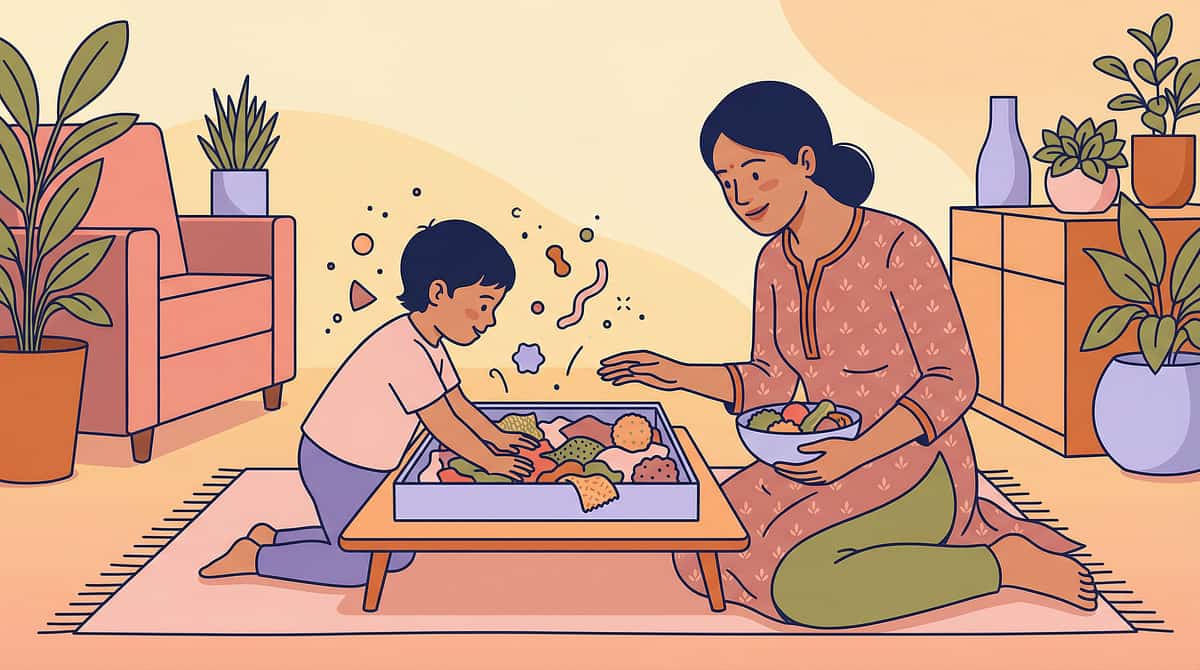
Step 3 of 6
ACT III: THE EXECUTION | The Core Therapeutic Event
The Therapeutic Action
"This is where the nervous system learns a new normal."
The child is now seated with their tools in place. The actual therapeutic work is a structured academic or learning activity during which the sensory tools provide continuous background regulation support.
Vestibular/Proprioceptive Input
The wobble cushion and resistance band provide constant movement feedback, satisfying the nervous system's input demands without requiring the child to stand up, walk around, or disrupt the class.
Tactile Regulation
The tactile cortex is engaged by the fidget, reducing the drive to touch everything in the environment. Hands are "busy enough" to free the attention system.
Deep Pressure Grounding
The continuous proprioceptive input from weight across the lap promotes parasympathetic activation — the "calm-alert" neurological state optimal for learning.
Environmental Noise Reduction
The auditory cortex receives a filtered, lower-competition input environment, improving signal-to-noise ratio between teacher's voice and background sound.
Week 1–2
5–10 minute focused task sessions with built-in breaks
Week 3–4
10–15 minutes
Week 5–8
15–25 minutes (toward age-appropriate range)
Long-term
Full classroom periods with minimal tool dependence as self-regulation internalises
❌ Error: Requiring the child to sit absolutely still on the wobble cushion
✓ Correct: The movement IS the therapy. Let the body move.
❌ Error: Calling attention to the fidget in front of other children
✓ Correct: Ignore the fidget. It is working when you can't see it.
❌ Error: Setting the visual timer beyond the child's current attention capacity
✓ Correct: Start at 50–60% of observed attention limit. Success first.
PMC10955541 | Meta-analysis: 40-minute professional sessions; 10–20 minute home sessions optimal for maintenance and generalisation
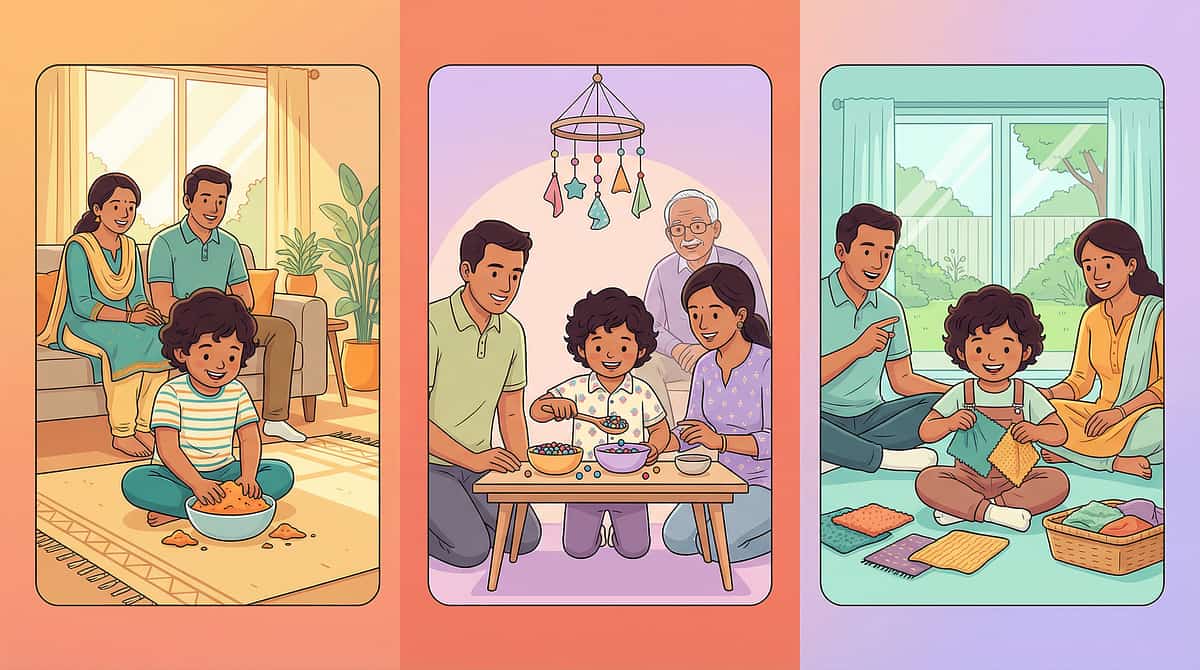
Step 4 of 6
ACT III: THE EXECUTION
Repeat and Vary
"3 good sessions beat 10 forced ones. Every time."
These tools are used daily — but their therapeutic value increases with consistency, not with duration. The target is daily exposure at comfortable intensity levels.
Daily Pattern
🌅Morning homework/study: Full tool kit active
🏠After-school learning tasks: Visual timer + 1 chosen fidget
🌙Pre-bedtime reading: Weighted lap pad only (calming proprioception)
Weekly Variation to Maintain Engagement
Week 1: Wobble cushion + visual timer as anchors
Week 2: Add resistance band
Week 3: Add noise-reducing headphones for reading tasks
Week 4: Child selects their own daily tool combination
Satiation Indicators — when the child has had "enough" for today:
Child spontaneously removes a tool
They're self-regulating without it now — that's mastery
Child begins working without needing the timer reminder
Internal time awareness is developing
Movement reduces naturally
Proprioceptive input need is met
"The goal is NOT permanent tool dependence. The goal is that these tools scaffold self-regulation skill development until the child's own regulatory systems mature. Tools should be faded gradually and celebrate each fade as a win."
⏱️ Timing: Daily, integrated into learning routine
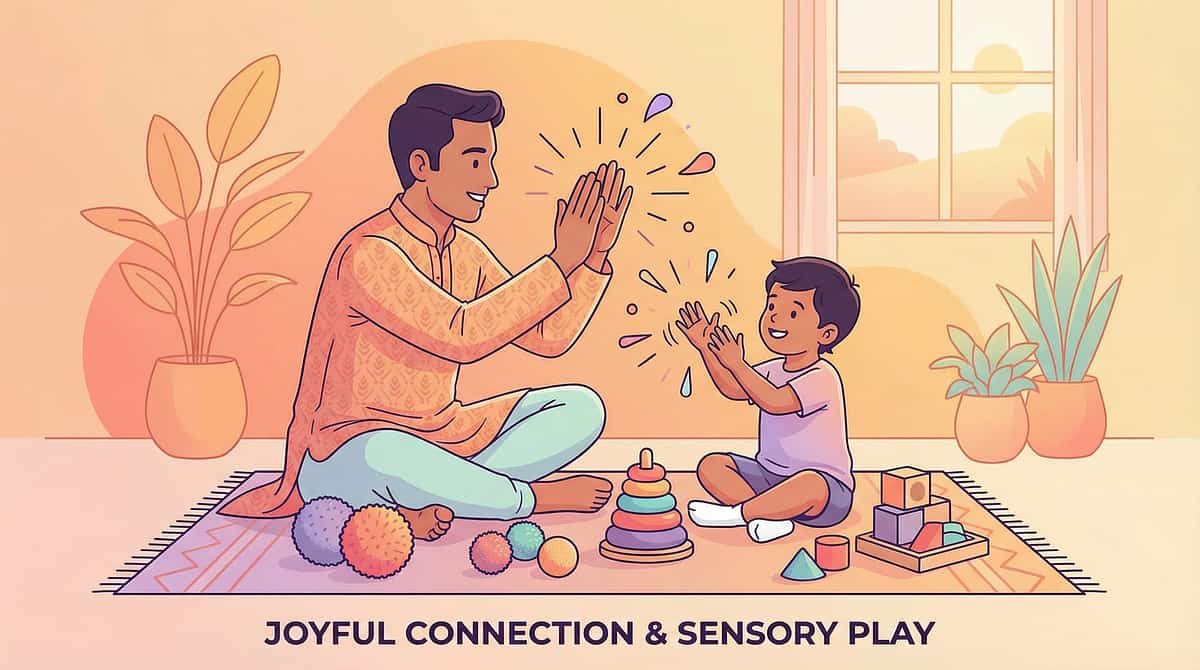
Step 5 of 6
ACT III: THE EXECUTION
Reinforce and Celebrate
"Timing matters more than magnitude. Immediate. Specific. Enthusiastic."
"You stayed focused until the timer was done — that took real brain power. I'm proud of you."
"I noticed you used the wobble cushion to help yourself settle. That was so smart."
"That was your best focus session this week. You're getting stronger every day."
⚡The 3-Second Rule: Deliver reinforcement within 3 seconds of observing the target behaviour (sustained focus, completed task, self-initiated tool use). Delayed reinforcement loses its neurological conditioning power.
Reinforcement Menu — 3 Tiers
Social Reinforcement
Always available, always first: Specific verbal praise | High five | Thumbs up | Written "great focus today!" note
Activity Reinforcement
Earned: 5 minutes of preferred activity after focus session | Choice of tomorrow's fidget tool | Choice of movement break type
Token Economy
Focus Stars chart: earn a star for each session. 5 stars = special family activity. Consult your BCBA for individualised system design.
Celebrate the attempt, not just the success: If the child tried but didn't reach the full timer: "You tried. That's what matters. Tomorrow we'll do it again."
"Reinforcement doesn't create artificial motivation — it maps the child's existing motivation onto the therapeutic target. When the right behaviour reliably predicts the right consequence, the brain strengthens that neural pathway. This is how skill becomes habit." — Applied Behaviour Analysis | BACB Clinical Standards
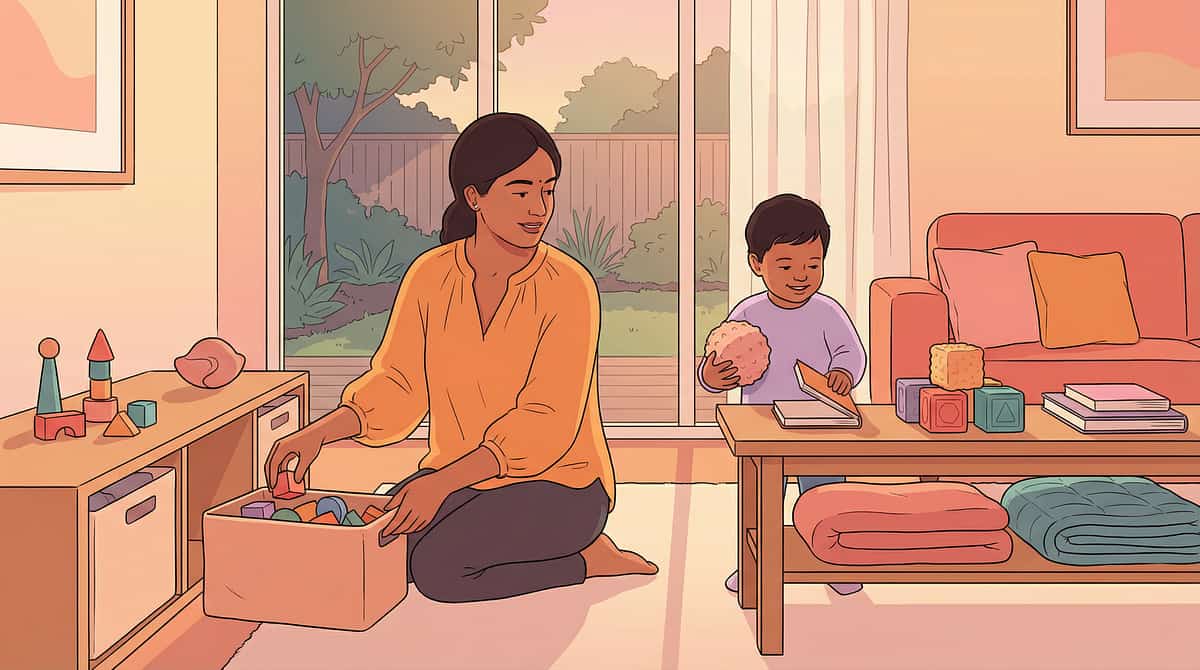
Step 6 of 6
ACT III: THE EXECUTION
The Cool-Down
"No session ends abruptly. The transition is part of the therapy."
The transition protocol closes each session with the same neurological intentionality it was opened with. The cool-down activity — wall push-ups, heavy book carry, bilateral hand squeeze, or slow deep breathing — delivers a proprioceptive reset before the child moves to the next activity. This prevents the dysregulation that occurs when high-engagement states end abruptly.
Material Put-Away Ritual: Child (if able) places fidget in box, removes headphones, slides slant board to the side. Making the child an agent of the transition builds self-efficacy and signals closure to the nervous system.
"I know you want to keep going — that's wonderful. We'll do it again tomorrow. Same time. Same tools. I promise."
NCAEP EBP Report 2020: Visual supports + transition warnings classified as evidence-based practices for autism | Sensory diet cool-down principles from OT literature

ACT III: THE EXECUTION | Session Data Capture
"60 seconds of data now saves hours of guessing later."
Quick Session Tracker — 4 Fields
Field 1: Date and tool used today
e.g., "March 10 — wobble cushion + timer + fidget"
e.g., "March 10 — wobble cushion + timer + fidget"
Field 2: Focus duration achieved (minutes)
Slider: 0–60 minutes
Slider: 0–60 minutes
Field 3: Session quality rating
⭐ 1 = Very difficult | ⭐⭐⭐ 3 = Moderate | ⭐⭐⭐⭐⭐ 5 = Excellent
⭐ 1 = Very difficult | ⭐⭐⭐ 3 = Moderate | ⭐⭐⭐⭐⭐ 5 = Excellent
Field 4: Notable observation (optional)
e.g., "Sat for 12 min without redirection — new record"
e.g., "Sat for 12 min without redirection — new record"
Why This Data Matters
GPT-OS® uses your session data to:
- Track your child's Attention Regulation Index over time
- Adjust recommendations based on real response patterns
- Alert you when progression indicators suggest it's time to level up
- Provide evidence for school accommodation conversations
Your 60 seconds of data contributes to 20M+ sessions of intelligence.
📞 Need to discuss your data? FREE Pinnacle Helpline: 9100 181 181 (16+ languages, 24×7)

ACT III: THE EXECUTION | Troubleshooting
"Session abandonment is not failure — it's data. Every difficult session teaches you something."
Problem 1: Child refuses to sit on the wobble cushion
Why: Novel sensory stimulus + change resistance (common in autism)
Fix: Leave cushion on the floor as a "stepping stone game" for 3–5 days before introducing it to the chair. Let the child discover it rather than placing it for them.
Problem 2: Fidget tool becomes a distraction
Why: Tool is too visually interesting, too novel, or wrong sensory match
Fix: Switch to a less visually stimulating fidget (velcro strip under desk instead of spinner). Test at home before introducing at school. One fidget at a time.
Problem 3: Child removes weighted lap pad immediately
Why: Weight may be too heavy, too warm, or the sensation is aversive for this child
Fix: Reduce weight. Try weighted stuffed animal instead. If persistent aversion, consult OT — weighted input may not be appropriate for this sensory profile.
Problem 4: Visual timer creates anxiety
Why: Timer has become a stressor rather than a support for time-anxious children
Fix: Remove the timer. Replace with "we'll stop when you've answered 5 questions" — quantity-based instead of time-based. Reintroduce timer when anxiety reduces.
Problem 5: Child has 2 great days then refuses all tools
Why: Normal regulatory fluctuation; also possible — novelty wearing off, child asserting autonomy
Fix: Offer choice: "Today — wobble cushion or resistance band? You pick." Autonomy over HOW, not WHETHER, to use a support tool.
Problem 6: Noise-reducing headphones cause more distress
Why: Some children find the physical sensation of headphones aversive, or the reduction in sound is disorienting
Fix: Start with very brief wearing time (1 minute). Use headphone-style earmuffs rather than in-ear. Some children never adapt — this tool is not universal.
Problem 7: Teacher is resistant to allowing tools in the classroom
Why: Unfamiliarity, concern about classroom equity, management concerns
Fix: Request an OT letter recommending specific accommodations. Ask for a 2-week trial with data. Offer to send this page as background. Many teachers become advocates once they see the outcome.
ABA antecedent modification + OT sensory profile matching principles | Pinnacle clinical problem-solving database
ACT III: THE EXECUTION | Personalisation Layer
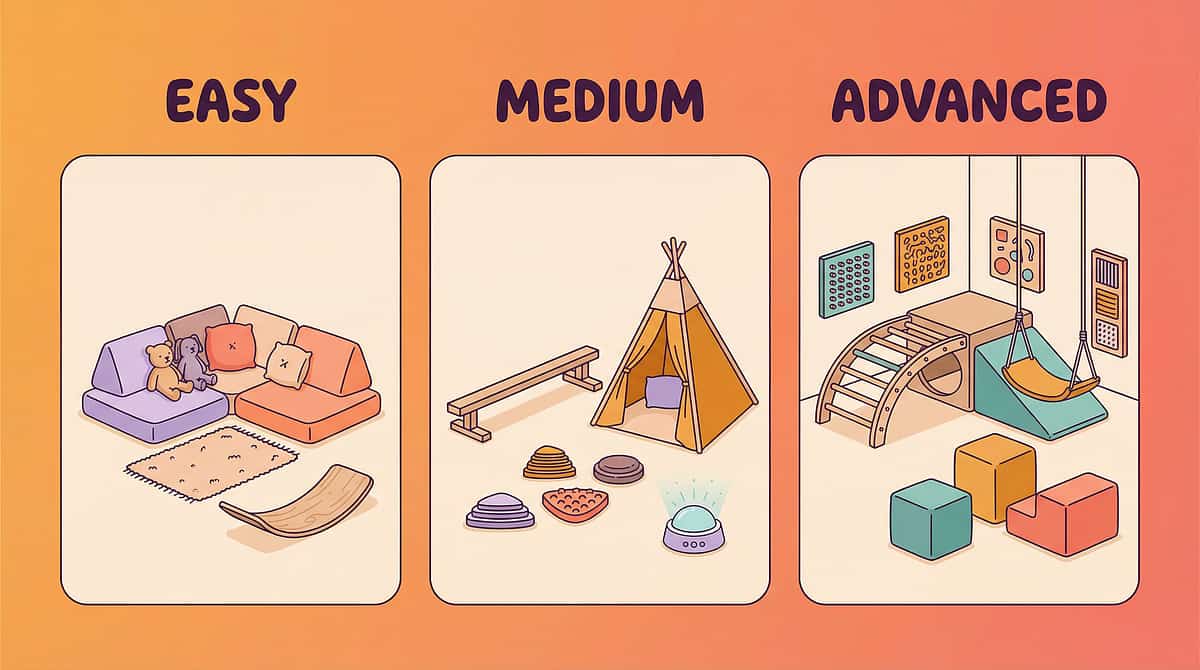
"No two nervous systems are identical. These adaptations make H-750 your child's technique."
For Sensory-Seeking Children
Crave MORE input
- Maximise: Wobble cushion + resistance band + textured fidget + weighted lap pad (all simultaneously after individual introduction)
- Add: Seat wedge to further increase vestibular demand
- Movement breaks: Every 15 minutes, proprioceptive heavy work (wall push-ups, carrying books)
For Sensory-Sensitive Children
Overwhelmed by input
- Minimise tool set: Start with ONLY privacy shield + noise-reducing headphones
- Introduce each additional tool one per week minimum
- Ensure all tools are soft-textured, quiet, and visually non-stimulating
For Low-Registration Children
Sensory input doesn't reach them
- Prioritise alerting inputs: bouncy wobble cushion, higher-resistance chair band, stronger-textured fidget
- Frequent movement breaks (every 10 minutes) to raise arousal level
- Vibrating alerting tools where appropriate (consult OT)
Age-Based Modifications
Age | Tools & Task Duration | Support Level | |
4–6 years | Maximum 2 tools simultaneously | 5–8 minute focus tasks | Heavy parental support | |
7–9 years | 3–4 tools | 10–20 minute tasks | Parent prompts then fades | |
10–12 years | Full kit | 20–30 minute tasks | Child-initiated tool selection |
Curious/Exploratory
Present tools as "experiments" — "Let's test which helps you focus most"
Routine-Preferring
Same tools, same sequence, same position, every session
Competitive
Focus duration tracking as personal best records
OT Sensory Profile (Dunn) | ABA individualised function-based analysis | Pinnacle GPT-OS® personalisation protocols

ACT IV: THE PROGRESS ARC | Phase 1: Foundation
Week 1–2: What to Expect
"If your child tolerates the material for 3 seconds longer than last week — that is real, measurable progress."
What You Will Realistically See
- Child allows the wobble cushion without immediately removing it
- Resistance to tool use decreases from session 1 to session 5
- 1–2 sessions per week where focus duration exceeds baseline by any amount
- Parent becomes more comfortable with the protocol
What Is NOT Expected Yet
- Dramatic focus improvement
- Zero redirection from teacher
- Child independently using tools without adult support
- Generalisation to school (home consolidation comes first)
"The first two weeks are the hardest. You will question whether it's working. The nervous system is adapting beneath what you can see. Trust the protocol. Trust the data. Trust the science."
Data Milestone: By end of Week 2, you should have at minimum 6 data points (daily sessions). Look for trend direction, not absolute numbers.
PMC11506176: Early-phase intervention outcomes focus on tolerance and participation (weeks 1–4) before skill mastery (weeks 5–12)

ACT IV: THE PROGRESS ARC | Phase 2: Consolidation
Week 3–4: Consolidation Signs
"Neural pathways are forming. Look for these specific signs."
The child begins to anticipate:
Child asks for the wobble cushion before you offer it
Anticipatory tool-seeking — a key sign of internalisation
Child reminds YOU about the visual timer
Taking ownership of the regulatory structure
Resistance band use is no longer noticed — it's background
The tool has been absorbed into routine
Fidget tool use is becoming habitual, not conscious
Exactly as intended — automatic regulation
2–3 sessions per week meet or exceed the target focus duration
Consistent performance emerging
Behavioural Changes Signalling Pathway Formation
- Child's movement during work is more organised (purposeful rocking vs. random fidgeting)
- Child self-reports: "The cushion helps me think" — metacognitive emergence
- Teacher begins to comment on improvement (independent validation)
- Child requests movement breaks before reaching escalation point (beginning of self-regulation)
When to Increase Intensity: If consolidation indicators appear — add one new tool. Extend timer by 3–5 minutes. Introduce privacy shield during homework.
"You may notice you're more confident. You know when your child is about to lose focus and you have a tool ready. That is a skill you built. Honour it."

ACT IV: THE PROGRESS ARC | Phase 3: Mastery
Week 5–8: Mastery Indicators
"Mastery is not perfection. It is consistent, independent, generalisable function."
1
Sustained on-task behaviour
Child sustains on-task behaviour for age-appropriate duration on 4 of 5 consecutive school days
2
Independent tool set-up
Child independently selects and sets up their own tool combination without adult prompting
3
School generalisation
Child uses tools at school with teacher reporting noticeable attention improvement
4
Proactive self-regulation
Child requests movement breaks before dysregulation — a key self-regulation milestone
5
Task completion
Task completion rates reach 75%+ of assigned work
Generalisation Indicators
- Tools are now being used in settings beyond the initial practice environment
- Child explains to a sibling or friend what the wobble cushion does ("it helps me think")
- Child adapts tool use independently (e.g., increases wiggling when task is harder)
Maintenance Check: "If you removed all tools today, would the skills hold for 3–5 minutes? 10 minutes? The answer tells you where you are in the fading process — and fading is a milestone, not a regression."
🥇H-750 CLASSROOM FOCUS MASTERY UNLOCKED
"This family has built the neurological foundation for independent attention regulation."

ACT IV: THE PROGRESS ARC | Milestone Celebration
"You did this. Your child grew because of your commitment."
You spent 5–8 weeks showing up for your child's nervous system when it couldn't show up for itself. You sat through difficult sessions, adapted when things didn't work, captured data at 7pm when you were exhausted, and kept going. This milestone belongs to you as much as it belongs to your child.
What You've Accomplished with H-750
- Built the proprioceptive regulation infrastructure your child's classroom experience runs on
- Extended your child's independent focus duration measurably
- Reduced teacher redirections per session
- Gave your child the metacognitive vocabulary to understand their own regulatory needs
🎉Family Celebration Suggestion: Celebrate the way YOUR family celebrates — a special meal, a family outing, a framed "Focus Champion" certificate, a letter from you to your child documenting what you watched them achieve. Make it real. Make it memorable.
📷Document this: Take a photo of your child using their focus tools today. In a year, you'll show them what they overcame and how far they've come.
📷Document this: Take a photo of your child using their focus tools today. In a year, you'll show them what they overcame and how far they've come.
ACT IV: THE PROGRESS ARC | Clinical Guardrails
🚨 Red Flags: When to Pause
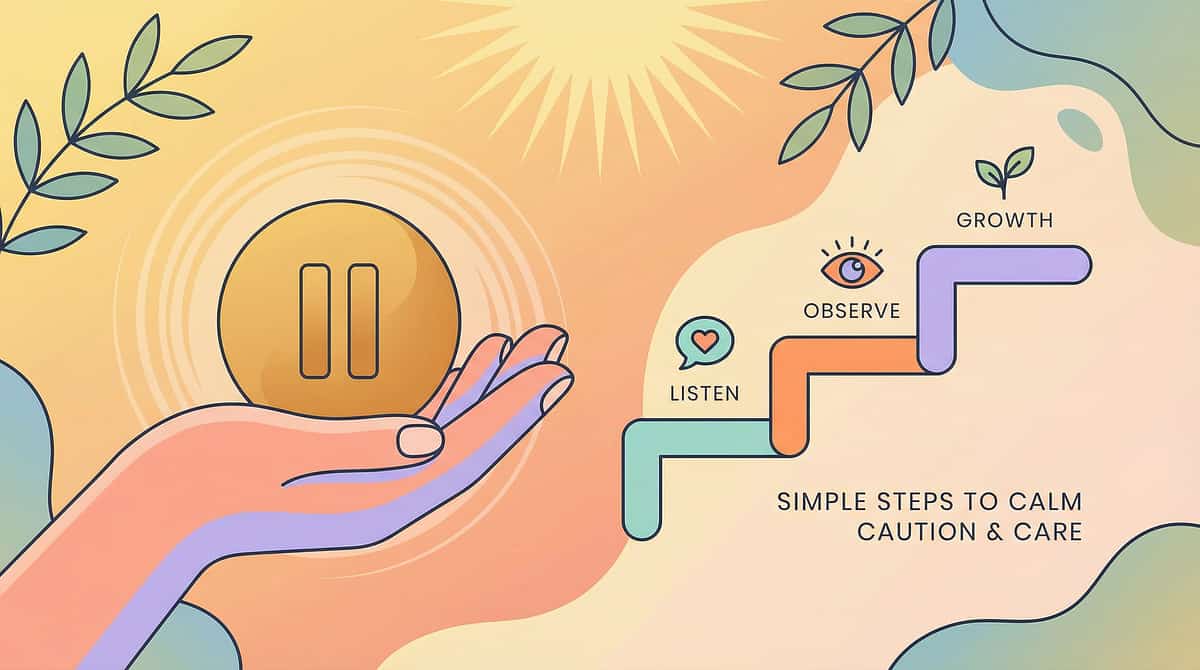
"Trust your instincts. If something feels wrong, pause and ask."
🚨 Red Flag 1: Worsening behaviour after 3+ weeks
What it looks like: Focus duration declining, dysregulation increasing despite consistent tool use
Why it matters: May indicate wrong tool match, sensory profile misread, or underlying condition requiring formal evaluation
Do: Contact Pinnacle helpline (9100 181 181) for OT teleconsultation
🚨 Red Flag 2: Self-injurious behaviour emerging or increasing
What it looks like: Head banging, hand biting, scratching in relation to tool use or session time
Why it matters: Possible acute sensory aversion or communication of distress
Do: Stop all tools immediately. Seek clinical assessment within 1 week.
🚨 Red Flag 3: Sleep disruption linked to tool use
What it looks like: Child unable to sleep after weighted tool sessions; increased night arousal
Why it matters: Weighted items may have been used at wrong time of day (avoid evening for alerting children)
Do: Move weighted tool use to morning/midday sessions only. Monitor for 5 days.
🚨 Red Flag 4: Physical complaints related to tool use
What it looks like: Neck/back pain from slant board angle, skin irritation from cushion texture, ear pain from headphones
Why it matters: Physical discomfort will create aversion that destroys programme adherence
Do: Modify or remove the specific tool. Consult OT for ergonomic adjustment.
🚨 Red Flag 5: No improvement after 8 weeks of consistent daily use
What it looks like: Data shows flat trend — no measurable improvement in any tracked indicator
Why it matters: Tools may not be addressing the root cause; formal assessment may reveal a different intervention need
Do: Book AbilityScore® assessment at nearest Pinnacle centre.
🚨 Red Flag 6: Child becomes significantly distressed at the mention of school
What it looks like: School refusal, somatic complaints, acute anxiety about classroom environment
Why it matters: Focus difficulties may be comorbid with significant anxiety requiring professional support beyond tool-based intervention
Do: Comprehensive evaluation including anxiety assessment.
ACT IV: THE PROGRESS ARC | Domain Navigation
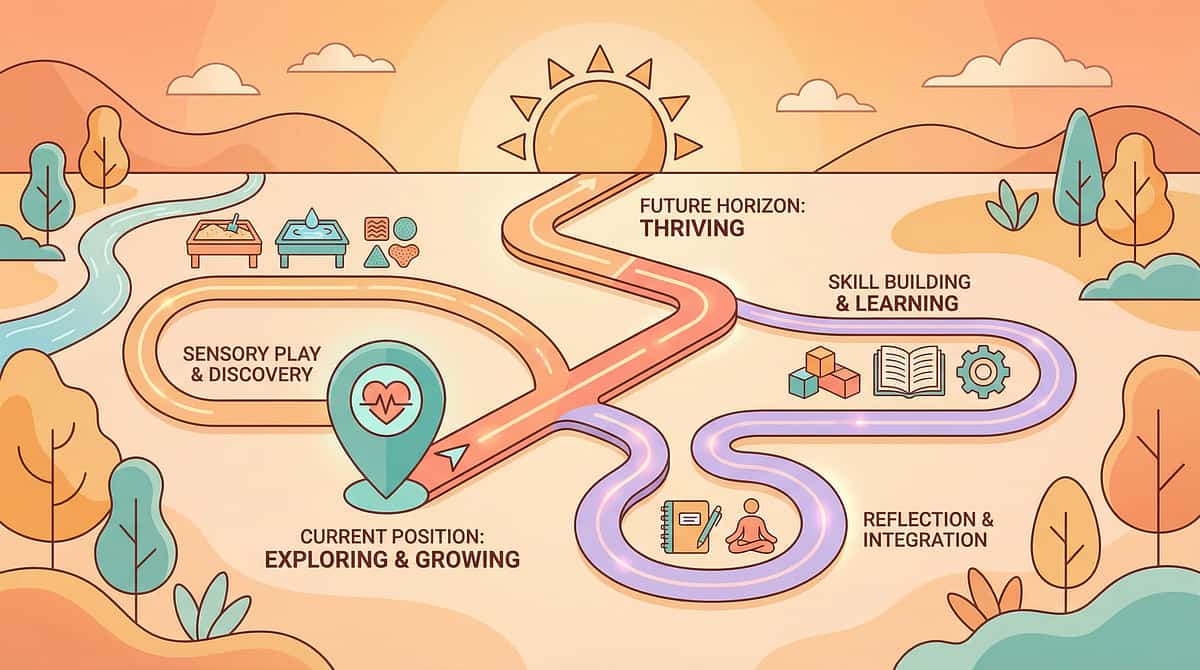
"Explore related techniques — you may already own the materials."
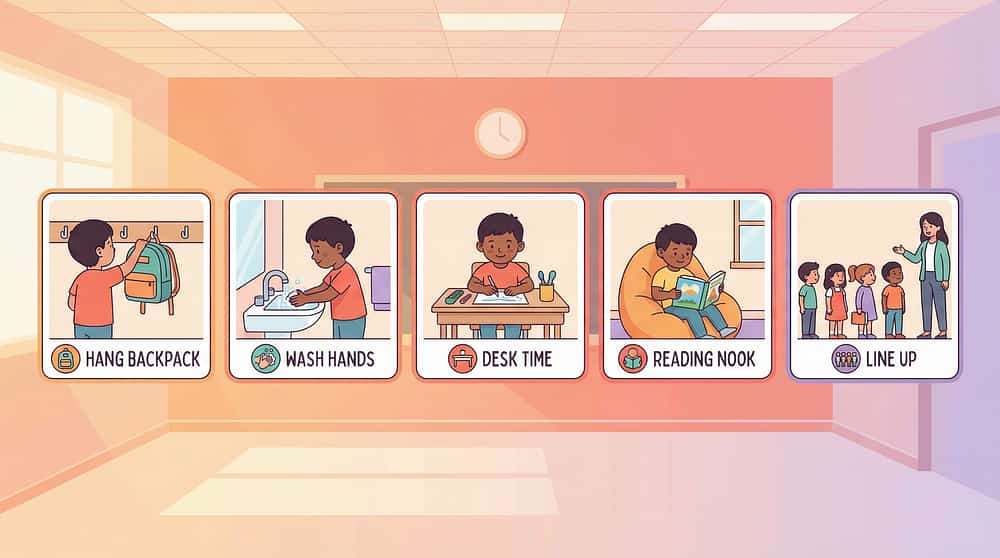
H-706 — Classroom Routines
🏷️ Classroom Readiness | 🎯 Difficulty: INTRO | 🔧 Materials you have: Visual timer ✓
H-720 — Classroom Visuals
🏷️ Classroom Readiness | 🎯 Difficulty: INTRO | 🔧 Materials you have: Privacy shield ✓
H-727 — Classroom Behaviour
🏷️ Classroom Readiness | 🎯 Difficulty: CORE | 🔧 Materials you have: Movement cards ✓
H-749 — Sitting Tolerance
🏷️ Classroom Readiness | 🎯 Difficulty: INTRO | 🔧 Materials you have: Wobble cushion ✓
H-751 — Handwriting Skills
🏷️ Academic Readiness | 🎯 Difficulty: CORE | 🔧 Materials you have: Slant board ✓
H-752 — Following Group Instructions
🏷️ Classroom Readiness | 🎯 Difficulty: ADVANCED | 🔧 Materials you have: Visual timer ✓ | Headphones ✓

ACT V: THE COMMUNITY & ECOSYSTEM | Technology Transparency
"Your data. Your child. Your privacy. Your impact on every child like yours."
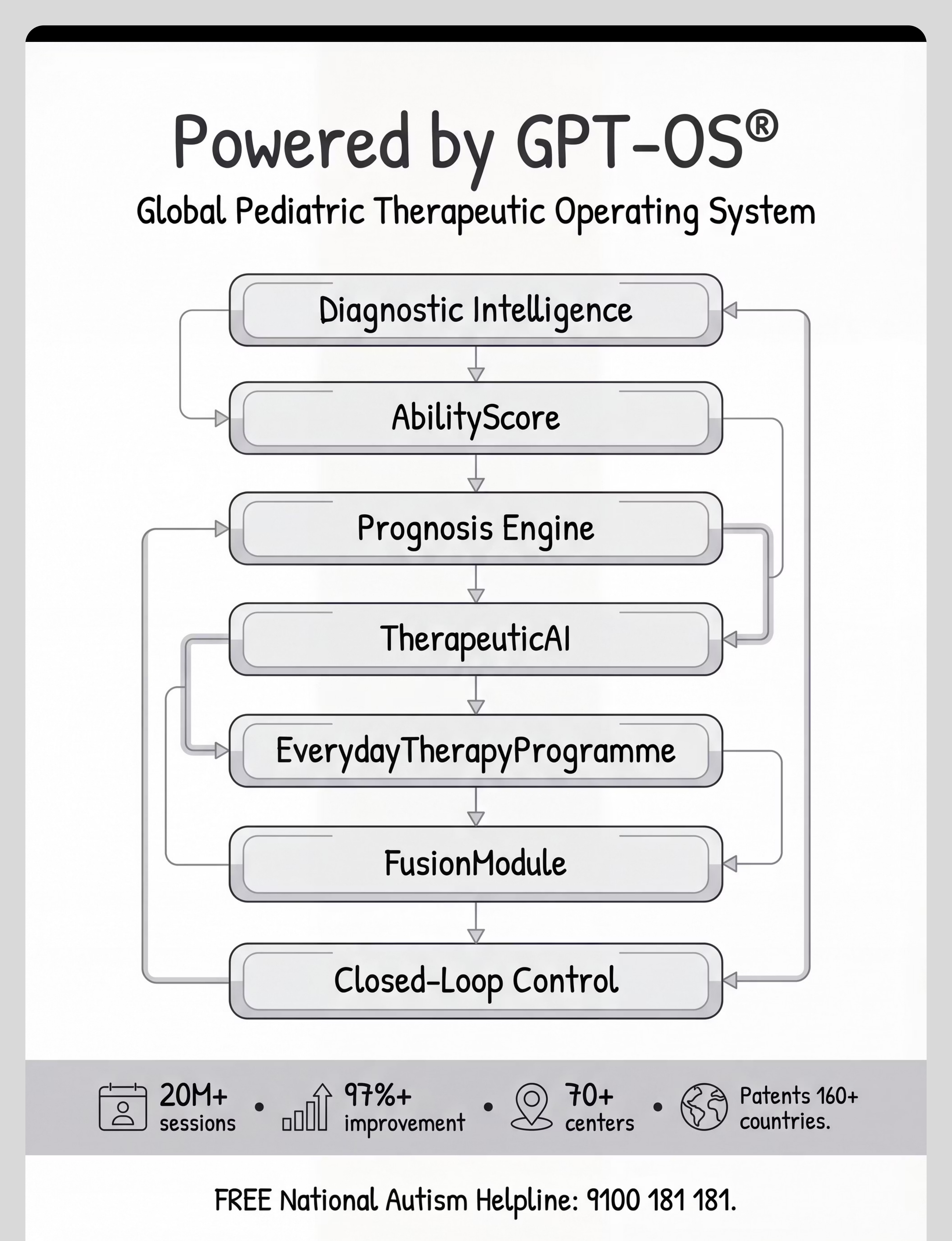
Every session you track feeds a closed-loop intelligence system that learns from your child's actual responses — not population averages. The more consistently you track, the more precisely GPT-OS® can distinguish which of the 9 materials are producing the highest gain for this specific nervous system.
What GPT-OS® Learns from H-750 Data
- Your child's attention duration baseline and growth curve
- Which materials produced the highest improvement
- Saturation point (when the current tool set needs evolution)
- Comparison with anonymised population data from 20M+ sessions
🔒 Privacy Assurance
Your data belongs to you. GPT-OS® uses aggregate, anonymised population data to improve recommendations. Your child's identifiable data is never shared with third parties. Protected under Indian Data Protection standards.
Population-Level Impact
"When 500,000 families track H-750 sessions, GPT-OS® can identify with statistical precision which tools work best for which sensory profiles, which age ranges, which comorbidity combinations. Your data makes the recommendations for the next family measurably better."
Digital health + ASD systematic reviews (2024): 21 RCTs, 1,050+ participants confirm gamified/digital health interventions for ASD show clinical promise
ACT V: THE COMMUNITY & ECOSYSTEM | Content Ecosystem Connection
Watch the H-750 Reel
Reel Metadata
📺Reel ID: H-750
📌Series: 9 Materials That Help With…
🏷️Episode: Classroom Readiness — Episode 750 of 999
🎯Domain: H — Classroom & Academic Readiness
👤Presenter: Pinnacle Consortium OT + SLP Team
In this 60-second clinical reel, Pinnacle's OT and SLP consortium demonstrates all 9 materials in action — showing real-world classroom setup, correct tool introduction technique, and observable child outcomes. Watch a child transform from constant distraction to focused engagement using the tools described on this page.
"This page gives you the science and the steps. The reel shows you what it looks like in motion. Both together accelerate your confidence and your child's outcomes." Video modelling is classified as evidence-based practice for autism (NCAEP 2020)
🎥 H-750 Video — "9 Materials That Help With Focus in Classroom"
Watch the full clinical demonstration on the Pinnacle YouTube channel.
Reel Series Navigation
← Previous: H-749 — Sitting Tolerance
→ Next: H-751 — Handwriting Skills
Follow Pinnacle
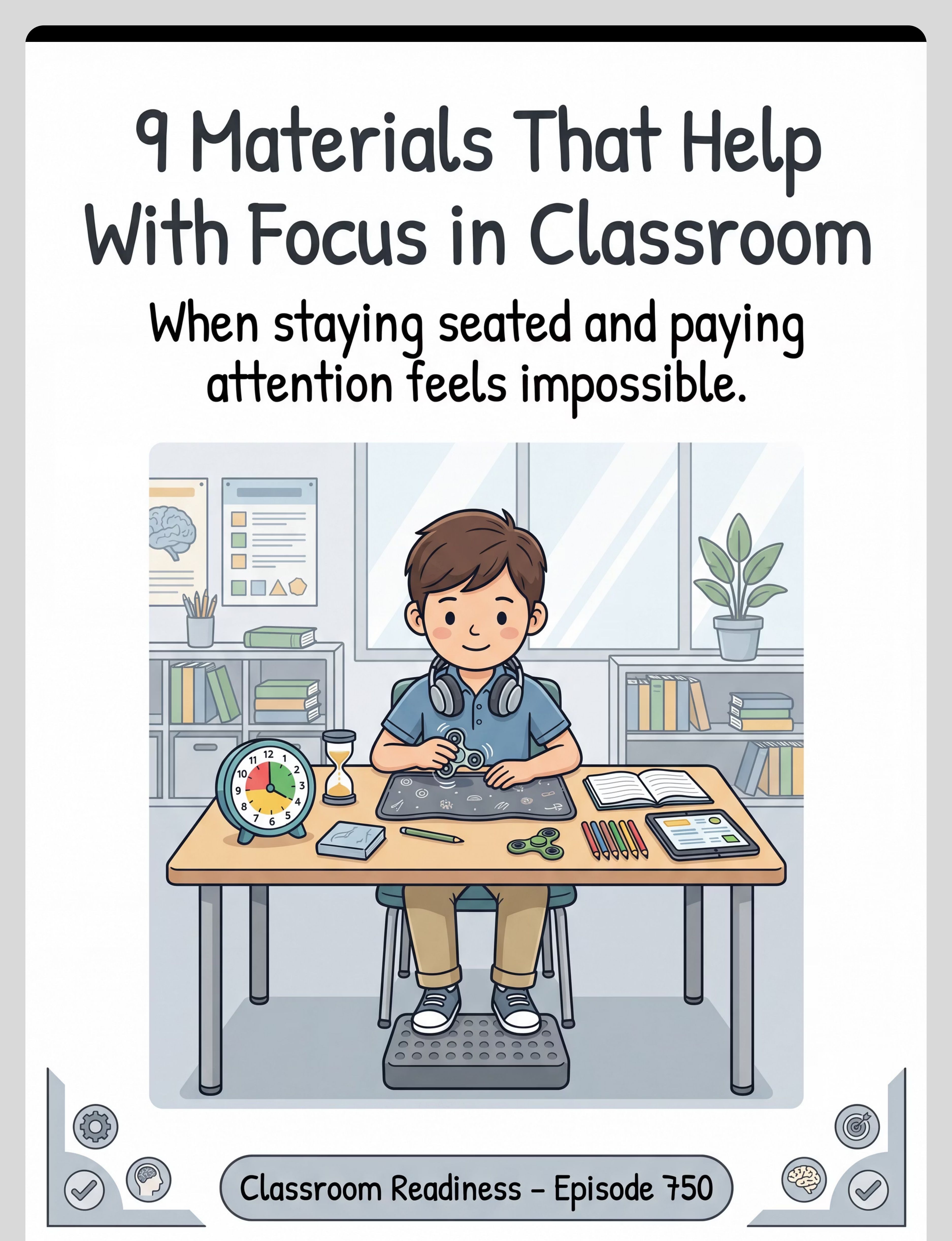
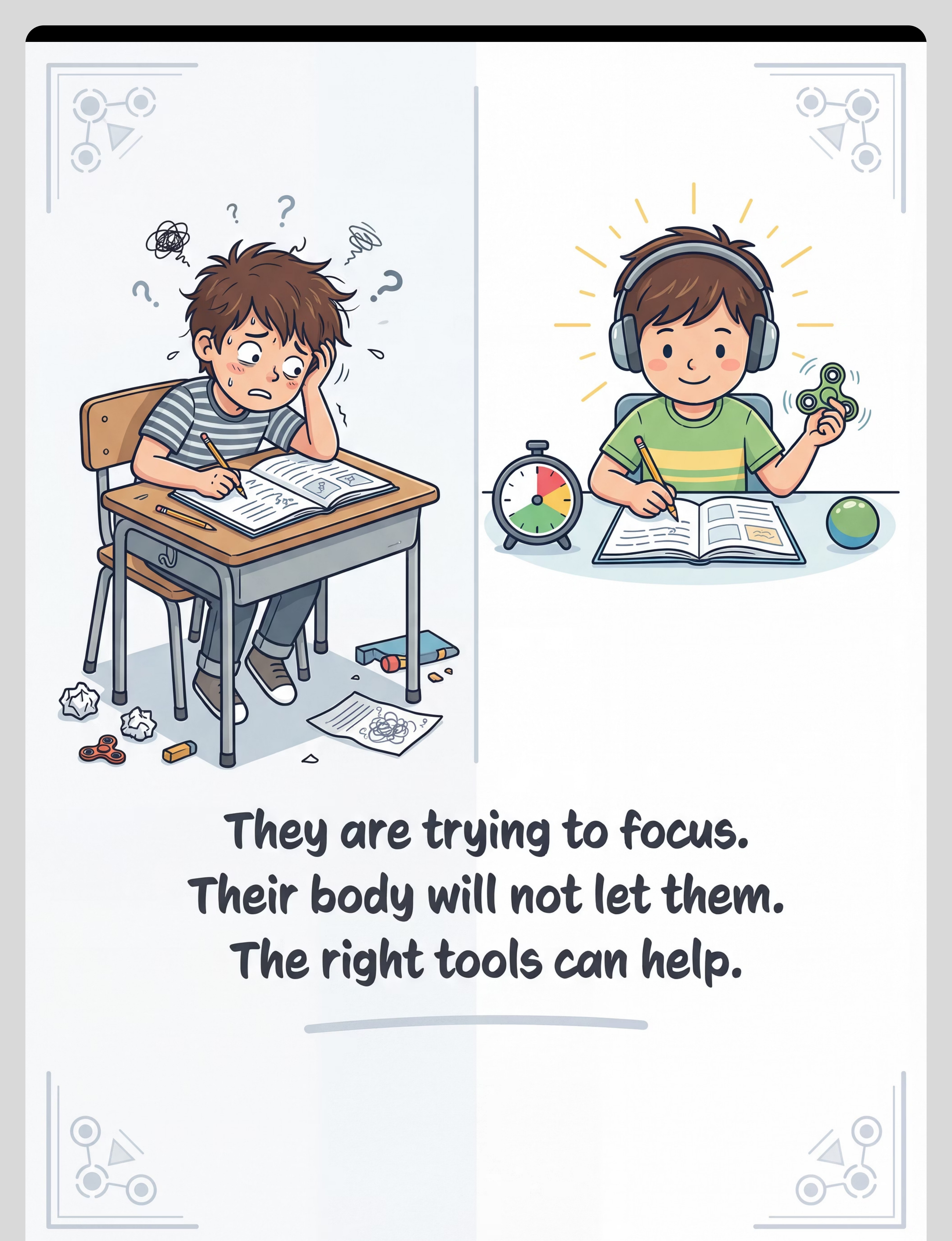
Preview of 9 materials that help with focus in classroom Therapy Material
Below is a visual preview of 9 materials that help with focus in classroom therapy material. The pages shown help educators, therapists, and caregivers understand the structure and content of the resource before use. Materials should be used under appropriate professional guidance.


Link copied!
ACT VI: THE CLOSE & LOOP | Institutional Closure
⚜️ The Pinnacle Promise
"From fear to mastery. One technique at a time."
⚜️PINNACLE BLOOMS CONSORTIUM®
OT | SLP | ABA/BCBA | Special Education | NeuroDevelopmental Medicine | Paediatrics | CRO | WHO/UNICEF Aligned
OT | SLP | ABA/BCBA | Special Education | NeuroDevelopmental Medicine | Paediatrics | CRO | WHO/UNICEF Aligned
H-750 is one of 70,000+ techniques built on the GPT-OS® Global Paediatric Therapeutic Operating System — the world's largest structured paediatric intervention knowledge infrastructure, powered by 20M+ real therapy sessions, governed by multi-disciplinary clinical consensus, and delivered to families across 70+ countries.
Bharath Healthcare Laboratories Pvt. Ltd.
CIN: U74999TG2016PTC113063
DPIIT Startup India
DIPP8651
MSME
Udyog Aadhaar TS20F0009606
GSTIN
36AAGCB9722P1Z2
This content is educational. It does not replace individualised assessment and intervention from qualified occupational therapists, developmental specialists, or educational professionals. Attention and focus difficulties may require comprehensive evaluation for underlying conditions including ADHD, sensory processing differences, anxiety, or learning disabilities. Consult your child's therapist, physician, or educational team for personalised guidance. Individual outcomes vary based on child profile, underlying condition, and intervention consistency. Statistics represent aggregate outcomes across Pinnacle Blooms Network.
© 2025–2026 Pinnacle Blooms Network®. All rights reserved.
"You arrived on this page looking for answers. You leave with tools, science, and a community. Your child's classroom story is not over — it's just beginning to be written differently. Next: H-751 awaits."
techniques.pinnacleblooms.org | pinnacleblooms.org | 📞 9100 181 181 | FREE • 24×7 • 16+ Languages