

When Focus Keeps Slipping Away
You sit down for homework. Two minutes in — your child is somewhere else entirely. This page is your answer: 9 scientifically validated materials that anchor attention and build concentration in children ages 3–12.
Pinnacle Blooms Consortium
OT + ABA + NeuroDev
Ages 3–12

ACT I: UNDERSTAND
You Are Among Millions of Families Navigating This
Attention and concentration difficulties are among the most prevalent developmental challenges in childhood — not rare, not your parenting failure, not your child's character flaw. The science is clear and the numbers are staggering. Over 50 million families across India are sitting at the same table, watching the same drift, feeling the same worry.
30–50%
OT Referrals
of children referred to pediatric OT clinics present with attention regulation as a primary concern
80%
ASD + Sensory
of children diagnosed with ASD display sensory processing difficulties — the same system that regulates focused attention
1 in 10
School-Age Children
in India show clinically significant attention difficulties requiring structured support
Sources: American Journal of Occupational Therapy; PRISMA Systematic Review 2024 (PMC11506176); Padmanabha et al., Indian Journal of Pediatrics, 2019

The Neuroscience of Attention — Translated for You
Sustained attention isn't one thing — it's a system. For your child to focus on a worksheet, their brain must simultaneously maintain arousal, filter distractions, hold instructions in working memory, inhibit impulses, and self-monitor. When any one of these systems is developing differently, focus becomes genuinely hard.
Key Brain Regions
- Prefrontal Cortex — the CEO: initiating, sustaining, and shifting focus
- Anterior Cingulate Cortex — the filter: deciding what matters and what to ignore
- Reticular Activating System — the alarm: regulating alertness levels
- Cerebellum — the coordinator: when movement regulation is offline, attention suffers
What Focus Actually Requires
- Maintain arousal — stay alert without being overwhelmed
- Filter distractions — block the bird, the fan, the itch
- Hold instructions in working memory
- Inhibit impulses — don't tap the pencil, don't follow that thought
- Self-monitor — am I still on task?
This is a wiring difference, not a behavior choice. The right materials regulate the system from the outside in.
Research: Frontiers in Integrative Neuroscience (2020) — DOI: 10.3389/fnint.2020.556660

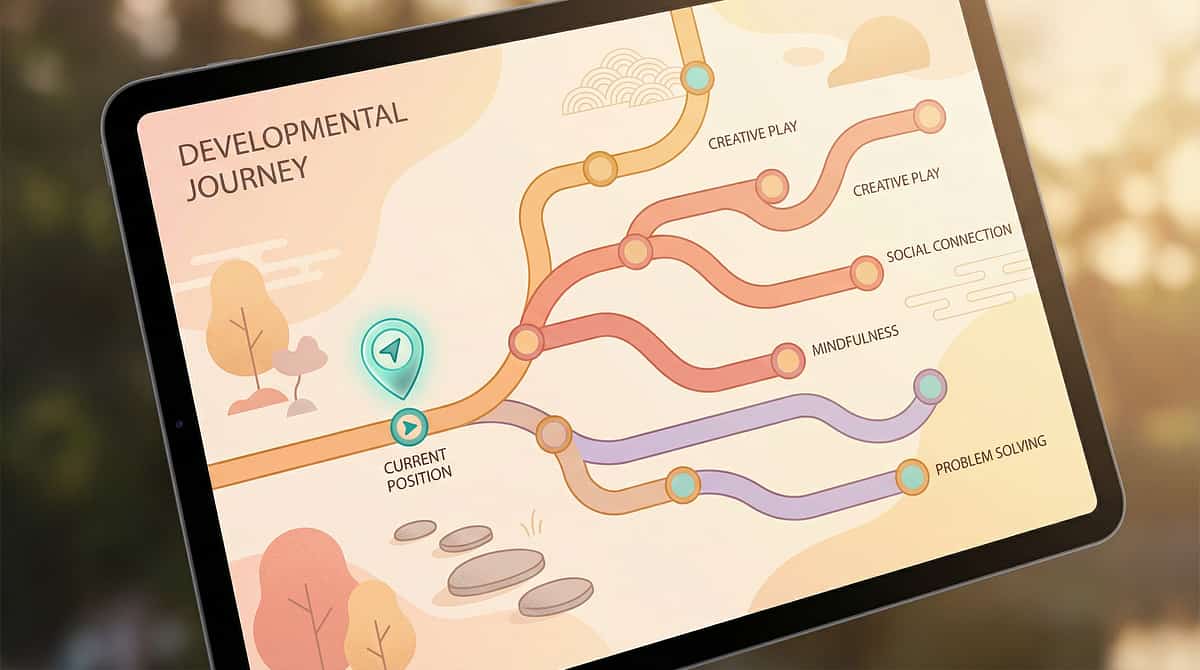
Your Child Is Here. Here Is Where We're Heading.
Understanding where your child sits on the developmental attention timeline transforms your expectations — and your strategy. The G-662 intervention zone spans the critical window from ages 3 to 12, precisely when external scaffolding produces the greatest neurological return.
Ages 1–2
Brief stimulus-driven attention. Externally controlled.
Ages 3–5
5–15 min on engaging tasks. External control dominant. G-662 Zone begins.
Ages 6–8
15–25 min with structure. Beginning internal control. Some wandering: common, not disorder.
Ages 9–12
25–45 min with self-regulation. Consistent difficulty across settings warrants assessment. G-662 Zone closes.
Age 12+
Internal attention control. Executive function established.
Red Flags (Empowerment, Not Fear): Attention difficulties present before age 12 · Symptoms in multiple settings (home AND school) · Causing real functional impairment despite genuine effort · Not explained by anxiety, sleep, or nutrition. These patterns warrant a professional assessment. Call 9100 181 181.

Clinically Validated. Home-Applicable. Parent-Proven.
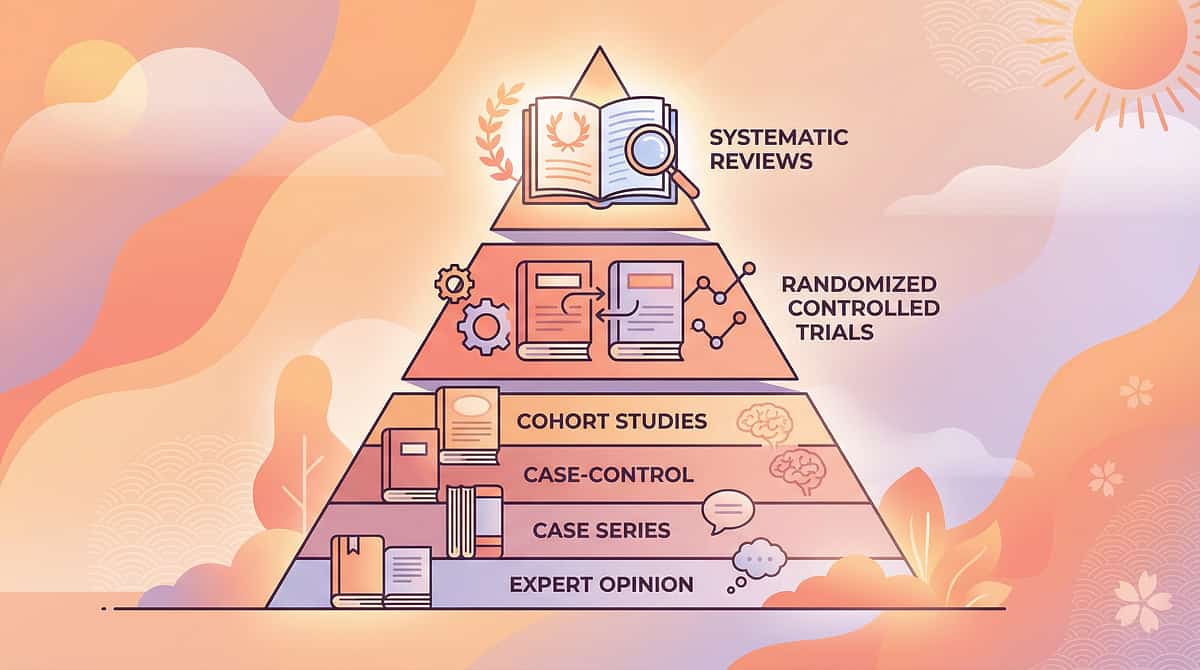
Five convergent evidence streams — from systematic reviews to Indian RCTs to WHO implementation science — confirm that the materials on this page are not wellness trends. They are precision tools with a documented mechanism of action and measurable outcomes. — Pinnacle Blooms Research Consortium
PRISMA Review 2024
16 articles confirm sensory-cognitive integration meets evidence-based practice criteria for ASD + attention. PMC11506176
Meta-Analysis 2024
24 studies. Medium-large effect size across attention and regulation domains. PMC10955541
Indian RCT 2019
Padmanabha et al. Home-based interventions: significant outcomes in Indian pediatric populations. DOI Link
NCAEP Report 2020
Visual supports, structured environment, and self-monitoring classified as evidence-based practices across attention domains.
WHO/UNICEF CCD
Home-based caregiver interventions validated across 54 low- and middle-income countries. PMC9978394
Evidence Grade: Level I–II
Oxford CEBM Standard
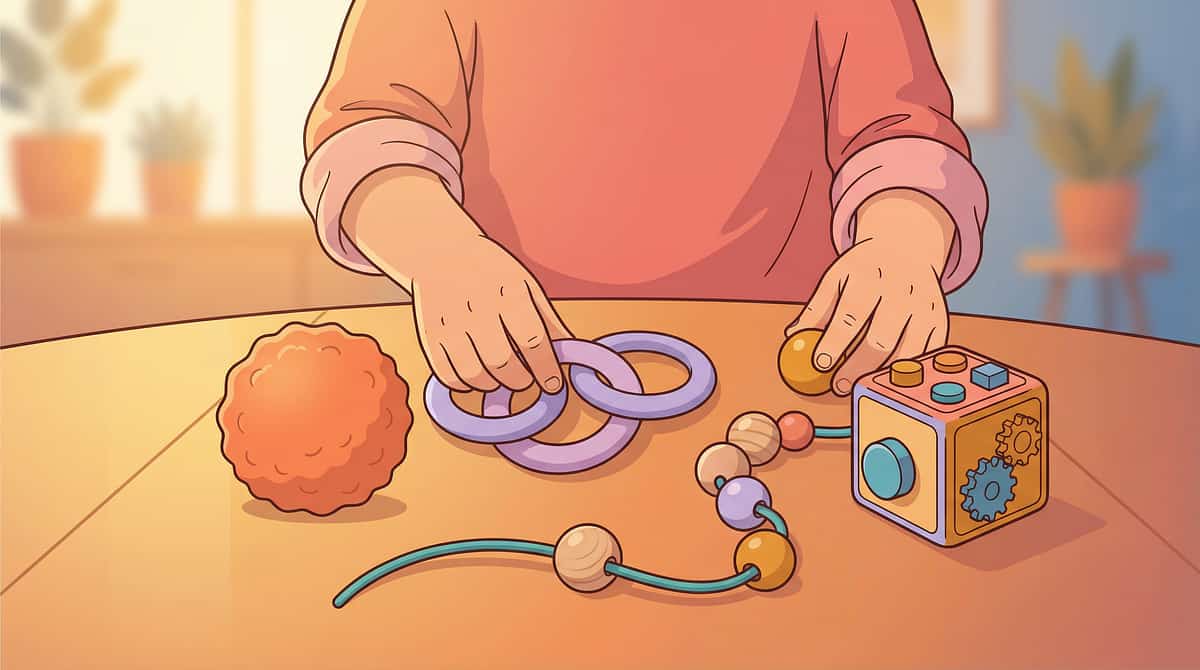
ACT II: LEARN
🧠 9 Materials That Help With Focus and Concentration
Attention Regulation Support via Multi-Modal Environmental Scaffolding
What it is: A curated, evidence-based system of 9 material categories that work through distinct neurological pathways to support sustained attention, selective attention, working memory, and self-monitoring in children ages 3–12 who struggle with focus and concentration.
What it does: These materials don't make a child focus — they create the conditions for focus to become possible. Each material works on a different part of the attention system, addressing sensory, regulatory, cognitive-load, and metacognitive factors.
Domain Code | OT-COG-ATT | |
Series | Cognitive & Attention Development | |
Age Range | 3–12 years | |
Session Duration | 15–45 minutes (context-dependent) | |
Frequency | Daily integration across learning tasks | |
Reel ID | G-662 (Episode 662) |

The Consortium Behind These 9 Materials
This is not a single-discipline recommendation. These materials are validated and applied across five distinct therapy disciplines — each targeting a different facet of the attention system. "The brain doesn't organize by therapy type." — GPT-OS® FusionModule™ Clinical Protocol
🟦 Pediatric OT
Assesses sensory processing profile. Selects fidget tools, weighted items, movement seating. Designs the physical environment for optimal attention conditions.
🟩 ABA / BCBA
Designs reinforcement menus. Implements task organization and chunking to reduce avoidance. Trains self-monitoring data systems.
🟨 Special Educator
Modifies materials for reduced cognitive demand. Implements visual schedules aligned with academic routines. Trains task chunking for school settings.
🟥 NeuroDev Pediatrician
Evaluates for ADHD, anxiety, sleep, and nutrition factors. Provides diagnostic clarity that guides material selection. Monitors pharmacological interventions.
Research: DOI: 10.1080/17549507.2022.2141327 — Multi-disciplinary approaches to nurturing care

Precision Targets: What Each Layer of These Materials Addresses
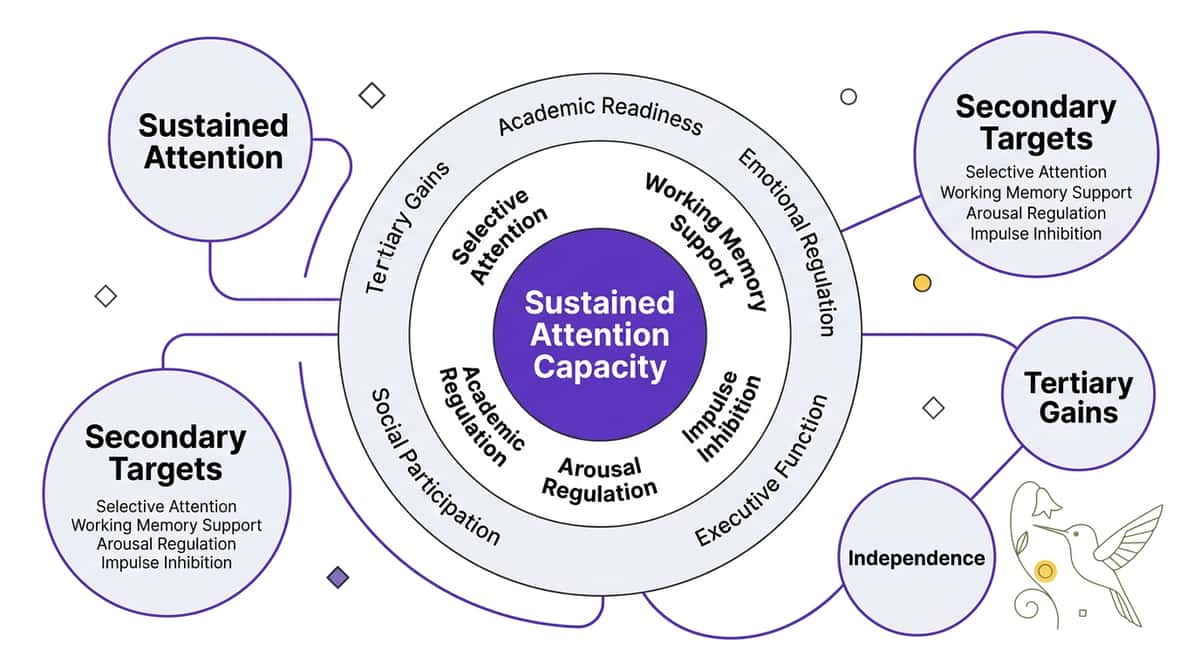
Primary Target: Sustained Attention Capacity — the ability to maintain cognitive engagement for age-appropriate duration. Observable indicator: Child completes a 5–15 min structured task with minimal redirections. Secondary: Selective attention, working memory support, arousal regulation, impulse inhibition. Tertiary: Academic readiness, emotional regulation, executive function, independence, social participation.
Research: PMC10955541 — Meta-analysis confirming primary and secondary target outcomes
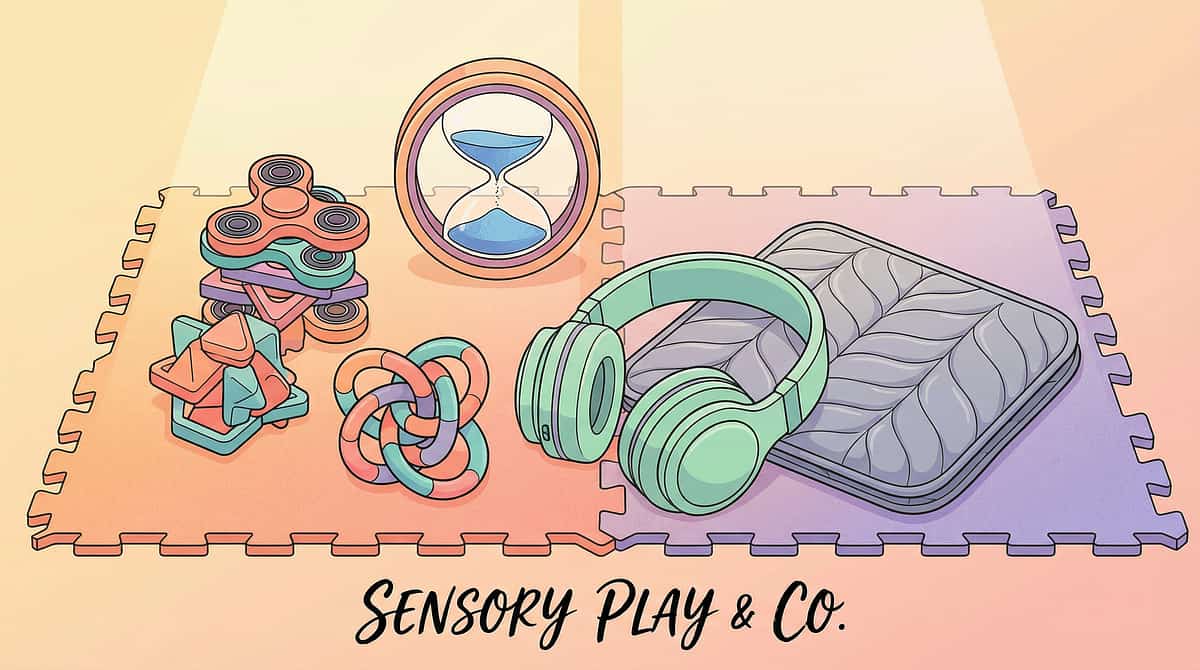
The 9 Materials — Your Complete Procurement Guide
Material 1: Fidget Tools
What It Does
Fidget tools provide controlled proprioceptive and tactile input through the non-dominant hand, freeing the prefrontal cortex to engage with the task rather than manage restlessness. The sensory input satisfies the nervous system's movement need without disrupting the work surface.
- Pinnacle Recommends: Textured stress balls, quiet fidget cubes, therapy putty
- Canon Category: Cognitive & Learning / Sensory-Motor
- Price Range: ₹150–800
Get It
Key Rule
The fidget goes in the non-dominant hand and stays in the background. If it becomes the primary focus, switch to a less stimulating option (smooth stone vs. spinner).
Age Guidance
Ages 3–5: No small parts (choking hazard). Ages 6+: Quiet, non-distracting types only in shared spaces.

Material 2
Visual Timers
What It Does
Visual timers make abstract time concrete. Children cannot mentally represent "10 minutes" — but they can see the orange disk shrinking. This transforms an invisible cognitive demand into a visible, manageable structure. Time becomes something they can watch, not just endure.
- Pinnacle Recommends: Time Timer® style — shows time as shrinking visual disk
- Canon Category: Cognitive & Learning
- Price Range: ₹400–1,500
DIY Option (₹0)
Two identical 500ml plastic bottles filled with fine sand or salt (~150g for a 3-minute flow). Connect mouth-to-mouth with duct tape. Test flow time; adjust sand for 3/5/10-minute intervals.
Safety Note
If child becomes timer-anxious (elevated distress at countdown), switch to an upward-counting timer — frames the session as achievement, not deadline. Sand timers are less alarming for anxiety-prone children.

Material 3
Noise-Reducing Headphones
What It Does
Selective attention requires the brain to filter relevant from irrelevant stimuli. For children with auditory hypersensitivity or weak auditory filtering, ambient sound (traffic, siblings, fans) consumes cognitive bandwidth that should be allocated to the task. Noise-reducing headphones provide the filtering the nervous system cannot yet do independently.
- Pinnacle Recommends: Over-ear passive noise-blocking; child-safe size
- Canon Category: Sensory-Motor / Auditory Management
- Price Range: ₹800–4,000
DIY Option (₹0)
Cotton-wool ear covers, a quiet corner with a blanket tent, or white noise via free YouTube. These reduce ambient sound without full isolation.
🔴 Safety Rule
Never use at volumes that could damage hearing. Child must retain awareness of emergency sounds (fire alarm). For severe auditory hypersensitivity, OT assessment is required before introducing headphones.
Material 4
Weighted Lap Pad / Weighted Tools
What It Does
Deep pressure input through a weighted lap pad activates the proprioceptive system, producing a calming, organizing effect on the nervous system — similar to the comfort of a firm hug. For sensory-seeking children who rock, bounce, or cannot sit still, it satisfies the proprioceptive hunger that was disrupting focus.
- Pinnacle Recommends: 5–10% of child's body weight; tested by OT
- Canon Category: Sensory-Motor / Proprioceptive
- Price Range: ₹600–2,500
DIY Option (₹0)
Pillowcase or fabric bag filled with 1–1.5 kg dry rice (for a 15–20 kg child). Sew or knot shut securely. Optional: add lavender for calming effect. Place on lap during desk work. Remove after 15–20 minutes.
🔴 Non-Negotiable Safety Rules
- NEVER exceed 10% of child's body weight
- NEVER place on chest
- NEVER restrict movement
- Supervised continuously for ages 3–5

Material 5
Task Organization & Chunking System
What It Does
Working memory is the mental sticky note that holds instructions while the child works. When a task has multiple steps, the cognitive load of remembering what to do next competes with the cognitive effort of doing it. Chunking offloads that memory demand onto paper — each step is visible, checkable, and finite. The child's working memory is freed to focus on execution.
- Pinnacle Recommends: Visual checklists, first-then boards, task baskets
- Canon Category: Cognitive & Learning / Problem-Solving
- Price Range: ₹200–800
DIY Option (₹0)
Paper cut into strips — one step per strip. Recycled cardboard as task board. Child checks off or moves each strip to a "done" pocket when complete.
How to Write Chunks
- Each chunk = one action only ("Read paragraph 1")
- Maximum 3–5 words per strip for young children
- Pictures alongside text for ages 3–6
- Child checks off each step — the checkmark is a micro-reinforcer

Material 6
Movement / Alternative Seating
What It Does
Some children regulate best when their bodies can move — not in spite of it, but because of it. Vestibular and proprioceptive input from a wobble cushion or balance disc continuously stimulates the sensory system in a low-level, non-disruptive way. This satisfies the movement need that would otherwise manifest as rocking, chair-tilting, or leaving the seat — without requiring the child to leave the desk.
- Pinnacle Recommends: Wobble cushion (balance disc) — least disruptive starting point
- Canon Category: Sensory-Motor / Postural
- Price Range: ₹500–3,000
DIY Option (₹0)
Folded thick blanket under child, a T-shirt stuffed with fabric, or a small cushion slightly off-center. Creates mild instability that activates core postural muscles and vestibular input.
Setup Rule
Correct size: thighs parallel to floor. Supervised initially. Ensure stable desk so child doesn't tip forward. If child is falling off rather than balancing — cushion is too unstable; use a flatter option.

Material 7
Visual Schedules & Transition Supports
What It Does
Transitions are among the highest-demand moments for executive function. When a child doesn't know what comes next, their attention cannot settle on what's happening now — they're mentally managing the unknown. A visual schedule externalizes the sequence, reducing the cognitive load of anticipation and making transitions predictable, not threatening.
- Pinnacle Recommends: Printable visual schedule + done-pocket system
- Canon Category: Cognitive & Learning / Behavior Support
- Price Range: ₹200–600
DIY Option (₹0)
Hand-drawn pictures on cardboard, cut-out magazine images, or drawings made by the child. A "done pocket" can be an envelope taped to the wall — child moves picture cards from "today" column to "done" after each activity completes.
Key Principle
The schedule answers the question "what's next?" — not you. When the child asks, point to the schedule. This shifts authority from parent to system, reducing argument and increasing predictability.

Material 8
Focus-Designed Learning Materials
What It Does
Standard worksheets and textbooks are visually busy — multiple problems visible simultaneously, competing for attention. Reading guides, graphic organizers, and uncluttered worksheets reduce visual field demands, isolating the single item the child needs to engage with now. This is cognitive load management at the environmental level.
- Pinnacle Recommends: Reading windows, graphic organizers, uncluttered worksheets
- Canon Category: Cognitive & Learning (Matched: Sorting / Problem-Solving)
- Price Range: ₹150–700
DIY Option (₹0)
Index card with a rectangular window cut out — slides down the page to reveal one problem at a time. Highlighter strips made from colored paper. Blank paper placed over the portion of the worksheet not yet being worked on.
For Academic Tasks Specifically
- One math problem visible at a time
- Reading: one paragraph exposed, rest covered
- Graphic organizer: pre-drawn boxes for each answer
- Uncluttered font: minimum 14pt, generous line spacing

Material 9
Self-Monitoring & Attention Awareness Tools
What It Does
Metacognition — the ability to think about one's own thinking — is the long-term goal. Self-monitoring tools build this capacity incrementally. An attention cue card prompts the child to check their own focus state at regular intervals, building the internal habit that will eventually not need an external prompt. This is the bridge from external regulation to internal regulation.
- Pinnacle Recommends: Attention cue cards + random-interval timer system
- Canon Category: Behavior Support / Cognitive
- Price Range: ₹100–1,500
DIY Attention Cue Card (₹0)
Write or print on an index card and place at top of desk:
AM I FOCUSED?
👁 Eyes on work? 🧠 Mind on task? ✋ Body in position? ✓ YES → Keep going! ✗ NO → Restart! 🔄
Set a phone alarm at 5-minute intervals. At each alarm, child checks the card. Over weeks, the check becomes internalized.

Pinnacle Canon Active Products
These clinician-selected products are directly linked and available on Amazon.in. Each is Canon-classified and aligned with the G-662 protocol's cognitive and behavior support domains.
Product | Canon Category | Price | Link | |
Problem-Solving Toy (SKU 68) | Cognitive & Learning — Problem-Solving | ₹428 | ||
Problem-Solving Toy (SKU 760) | Cognitive & Learning — Problem-Solving | ₹199 | ||
Problem-Solving Toy (SKU 791) | Cognitive & Learning — Problem-Solving | ₹579 | ||
Problem-Solving Toy (SKU 691) | Cognitive & Learning — Problem-Solving | ₹296 | ||
Problem-Solving Toy (SKU 162) | Cognitive & Learning — Problem-Solving | ₹380 | ||
Sorting/Categorization Set (SKU 577) | Cognitive & Learning — Sorting | ₹628 | ||
Sorting Set (SKU 614) | Cognitive & Learning — Sorting | ₹305 | ||
Number/Counting Materials (SKU 0) | Cognitive & Learning — Number/Counting | ₹673 | ||
Multi-Function Cognitive Toy (SKU 722) | Matching / Memory / Cause-Effect | ₹519 | ||
Reinforcement Menu (SKU 803) | Behavior Support — Reinforcement | ₹589 | ||
Reinforcement Menu (SKU 390) | Behavior Support — Reinforcement | ₹364 | ||
Transition Object (SKU 118) | Behavior Support — Transition Objects | ₹425 |
Starter Kit Total (Essential 4): ₹800–2,500 | Full Toolkit: ₹3,000–15,000 | 📞9100 181 181 — Ask our therapists which materials your child needs first.

Safety First — Before You Place a Single Material
"The best session starts with a 60-second safety check. A moment of preparation prevents hours of setback." — Pinnacle Blooms Consortium OT Team
🔴 Do Not Proceed
- Medical contraindications for weighted materials (cardiac, respiratory, spinal) — consult pediatrician first
- Severe adverse reactions to any sensory input — OT assessment required before materials
- Child currently in acute distress, illness, or medically unwell
- Headphones: never at hearing-damaging volumes; child must hear emergency sounds
🟡 Modify Before Proceeding
- Weighted tools: NEVER exceed 10% body weight; NEVER on chest; NEVER restrict movement
- Fidget: remove if it becomes primary focus or disrupts others
- Movement seating: correct size (thighs parallel to floor); supervised initially
- Timer: if child becomes anxious at countdown → switch to upward-counting or sand timer
🟢 Proceed When
- Child is fed, rested, and in a regulated state
- Materials assessed for this child's sensory profile
- Environment is prepared (see Card 20)
- Parent/caregiver has read this page fully
- Professional consultation available if uncertain: 9100 181 181
⛔STOP if you see: Escalating distress, crying, or self-injury · Physical discomfort with weighted tools · Child removing headphones forcefully · Hyperfocus on fidget replacing task engagement · Any allergic reaction to materials. 📞Questions? Call FREE: 9100 181 181

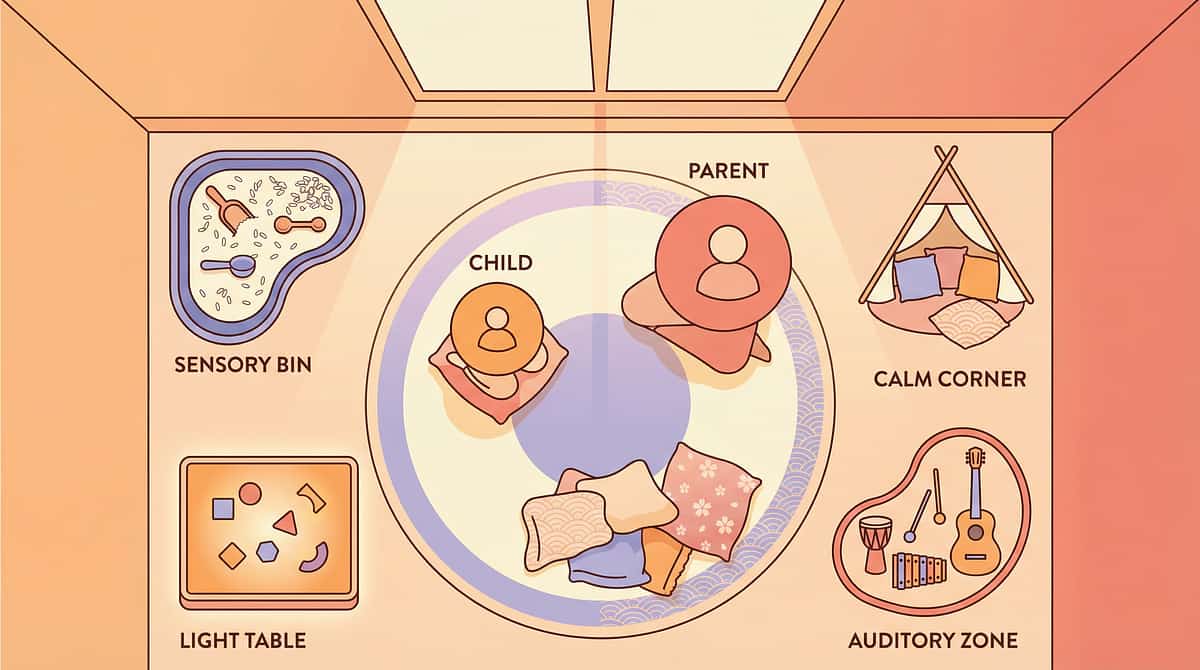
The Focus-Ready Environment — Before Any Session Begins
Spatial precision prevents 80% of session failures. An incorrectly set up space can neutralize even the best materials.
Setup Checklist
- Child at desk, feet flat or on footrest. Thighs parallel to floor.
- Desk clear of all non-task materials. Only current task + fidget visible.
- Visual timer at eye level, dominant-hand side. Visible without neck movement.
- Fidget beside non-dominant hand. One only.
- Visual schedule on wall or clip stand at eye level to child's left.
- Weighted lap pad on chair BEFORE child sits.
- Parent seated beside at 90° — close enough to support, far enough for independence.
- Headphones ready on desk; child puts on themselves.
Remove From the Space
- All screens (TV, tablet, phone face-up)
- Unrelated toys within visual field
- Clutter on desk surfaces
- Background TV or conversations from adjacent rooms
- Any recent distraction triggers
Setup Time
3–5 minutes. Involve the child — ownership of the space increases investment in using it.

Step 1 of 6 · The Invitation
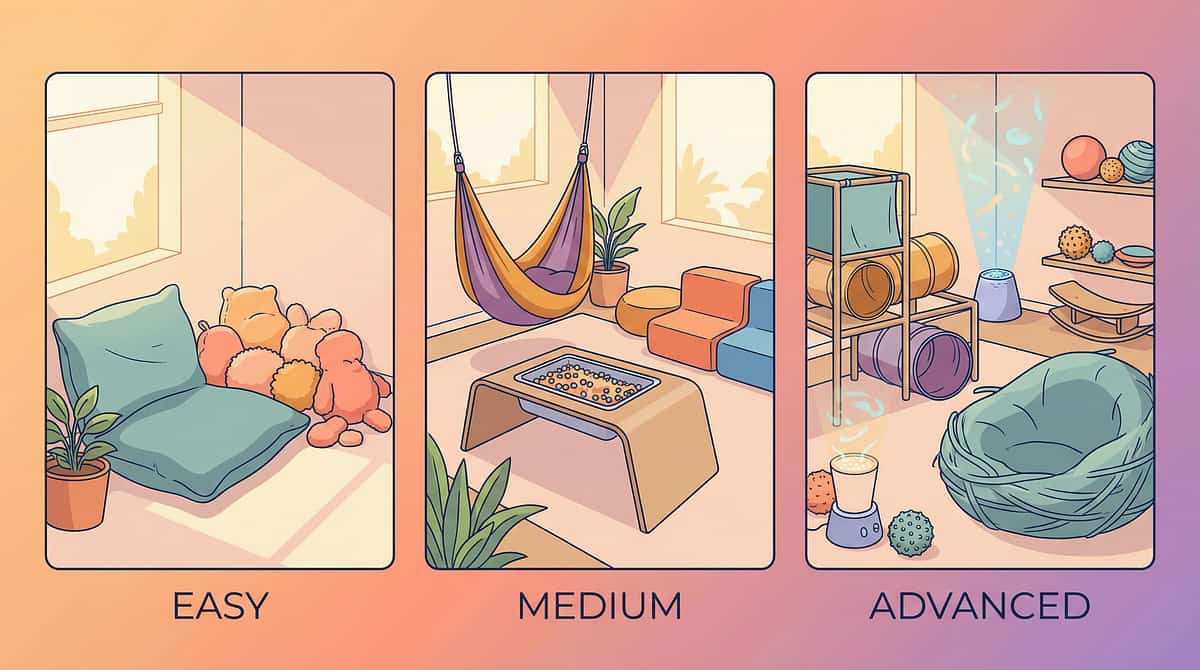
Open the Door — Every Session Begins with an Invitation
Every session begins with an invitation, not a command. The child is brought in through play, curiosity, or familiarity — never through demand. Crouch or sit at child's level, warm smile, relaxed posture.
Standard Invitation
"Hey [name], I've got something for your desk. Want to pick which one you want today?" (Let the child select their fidget from 2 options — not open-ended choice.)
For Ages 3–6
"It's our special focus time! Look what I set up — can you come see?"
For the Resistant Child
"I'm going to be right here doing my thing. You can just sit with me — no work yet."
Acceptance Cues ✓
- Child approaches the desk
- Child picks up or examines a material
- Body language: loose, curious, not braced
- Even brief eye contact with you or materials
Resistance — What to Do
- Child moves away → Don't follow immediately. Try again in 5 min.
- Child throws material → Quietly return it. "I'll leave it here in case you want it."
- Child says "no" → "Okay, no work yet. I'm going to sit here for a minute."
ABA Principle: Pairing — establish yourself and the space as positive before placing demands. Timing: 30–90 seconds maximum.
Step 2 of 6 · The Engagement
Deepen the Connection Before Academic Demands Arrive
Child is now at the desk. Materials are in place. Now deepen the engagement. Giving choice transfers ownership — the child becomes co-creator of the session.
"Let's set the timer. How many minutes do you think you can go today? You pick — 5 or 10?"
Fidget First
Let child handle the fidget freely for 30–60 seconds. No instruction. Let the nervous system meet the object.
Set the Timer
Child sets (or watches parent set) the timer. "When the orange runs out, that's our break."
Show the Schedule
"Here's what we're doing — first this worksheet, then 5 minutes of [preferred activity]."
Headphones / Weighted Pad
Child puts on themselves. "You want to try the headphones today?" Ownership matters.
Reinforcement cue begins now:"I see you sitting ready — that's amazing focus position already." Praise the preparation, not just the output. Timing: 1–3 minutes — this is the investment phase. Research: PMC11506176 — structured material introduction meets evidence-based practice criteria.

Step 3 of 6 · The Focus Session
The Core Therapeutic Action — The Session Is Now Live
This is the therapeutic event — the period of structured, supported, timed attention practice. Parent role: nearby but silent. Not hovering. Available for prompts, not doing the work.
🔵 Fidget + Timer + Chunking (Most Common)
Child works on task with fidget in non-dominant hand, visual timer counting down at eye level, task broken into numbered steps with checkoffs, and visual schedule showing first→then sequence.
🔵 If Using Headphones
Put on before task begins. Child selects: silence OR white noise/instrumental music. No lyrics (lyrics compete with reading/writing attention). Remove for verbal instruction or discussion.
🔵 If Using Weighted Lap Pad
Already in place from setup. Observe: does body posture improve? Does seeking behavior (chair-rocking, leg-bouncing) reduce? Child should not need to fidget with the pad itself.
Age | Starting Duration | Build To (4–6 weeks) | |
3–5 yrs | 3–5 minutes | 10 minutes | |
6–8 yrs | 8–10 minutes | 20 minutes | |
9–12 yrs | 12–15 minutes | 35 minutes |

Step 4 of 6 · Repeat & Vary
Build the Practice — Repetition Without Rigidity
For focus sessions, "repetition" means 1 focused work interval → break → 1 focused work interval → break → optional final interval. This is the Pomodoro principle adapted for children. Three good intervals are worth more than ten forced ones.
5:00 PM
Setup + readiness check (5 min)
5:05 PM
Interval 1: 10 min focused work
5:15 PM
Break: 3 min physical movement
5:18 PM
Interval 2: 10 min focused work
5:28 PM
Break: 3 min preferred activity
5:41 PM
Cool-down + data capture
Variation to Maintain Engagement
- Vary the fidget each week (novelty sustains; rotation prevents habituation)
- Vary the chunking system (strips vs. checklist vs. whiteboard vs. cards)
- Vary sound environment (silence day vs. white noise vs. instrumental)
- Keep structure consistent; vary materials slightly
Satiation Indicators
These are neurological signals, not defiance. Honor them.
- Increased fidgeting beyond the fidget tool
- Staring into space despite prompts
- Emotional escalation or tearfulness
- Dramatic slouching or head on desk

Step 5 of 6 · Reinforce & Celebrate
The Power of Precise Reinforcement
The 3-Second Rule: Reinforcement must arrive within 3 seconds of the desired behavior. Not at the end of the worksheet. Not when homework is done. In the moment — when you see the child redirect their attention back, complete one chunk, or make it to the timer.
Behavior | Reinforcement Script | |
Child redirects attention without prompt | "I just saw you bring your focus back all by yourself — that's real growth." | |
Child completes one chunk/step | "One done! ✓ Check it off. You earned that check." | |
Child makes it through a full timer interval | "The whole timer? That's [X] minutes of focused work. How does that feel?" | |
Child uses fidget correctly (background) | "Your hands were helping your brain there — that's exactly right." | |
Child asks for a break appropriately | "Great job asking! Let's take that break — you earned it." |
Natural Reinforcers
Access to preferred activity after work · Choice of break activity · Extra time with parent
Social Reinforcers
High five, fist bump, specific verbal praise · "Show Daddy/Nana what you did" — pride sharing
Token Economy
1 token per completed interval · 5 tokens = 1 chosen reward · Board visible at desk
"Celebrate the attempt, not just the success."

Step 6 of 6 · The Cool-Down
Close the Session Cleanly — No Session Ends Abruptly
An abrupt ending creates transition anxiety for the next session. A clean cool-down makes tomorrow easier. The session structure is non-negotiable; the content can be celebrated.
Two-Minute Warning
"Two more minutes on the timer — then we're all done for today." (Show visual: 2 fingers, or point to timer.)
One-Minute Warning
"One more minute — you're almost there."
Timer Ends
"That's it! Session done. You worked hard today." (Remove weighted pad; child places fidget in its spot; headphones off and hung up.)
Cool-Down Activity (1–2 min)
🌊 3 slow deep breaths · 🤸 Shake hands/feet loose 30 sec · 💧 Drink water · ✋ Palm press 10 sec (proprioceptive reset)
Material Put-Away Ritual
Fidget in container · Timer reset · Checklist in "done" folder · Weighted pad folded aside. This creates closure and ownership — these are MY tools.
Transition to Next Activity
"What's on the schedule next? Let's check." (Point to visual schedule — the schedule answers, not you.)
Research: NCAEP (2020) — visual supports and transition systems classified as evidence-based practice
60 Seconds of Data Now Saves Hours of Guessing Later
This is the most important 60 seconds of the entire session. Data captured immediately is data that works. Data remembered later is data that drifts.
What to Record: 3 Data Points Only
Field 1: Focus Duration □ Less than 5 min □ 5–10 min □ 10–15 min □ 15+ min
Field 2: Redirections Needed □ 5+ times □ 3–4 times □ 1–2 times □ 0 times (independent!)
Field 3: What worked best today? □ Fidget tool □ Visual timer □ Weighted pad □ Headphones □ Chunking system □ Visual schedule □ Movement seating □ Cue cards
What This Data Does
- Week 1–2: Establishes your child's baseline attention duration and support needs
- Week 3–4: First trends visible — duration increasing, redirections decreasing, best materials identified
- Week 5–8: Mastery trajectory clear; GPT-OS® recommends material adjustments
"60 seconds of data now. Months of evidence later."
Research: BACB Guidelines + Cooper, Heron & Heward (Applied Behavior Analysis, 8th ed.) — continuous measurement standards
Session Troubleshooting — The Reality Card
Most sessions don't go perfectly. This card addresses the 7 most common failure modes for focus support sessions — and what to do about each. "Session abandonment is not failure — it's data."
Problem 1: Child refused to sit at the desk at all
Why: Transition resistance; previous negative association with desk. Do: Reduce the demand — bring ONE material to where the child is. Start with 2 minutes of undemanding proximity. Next session: Add a preferred object to the desk setup.
Problem 2: Fidget became the only focus
Why: Wrong fidget type; too novel. Do: Allow 5 full minutes of free fidget time BEFORE tasks. Try a less interesting fidget (smooth stone vs. spinner). Next session: Test a different fidget.
Problem 3: Timer caused anxiety or meltdown
Why: Countdown pressure; timer associated with punishment. Do: Remove countdown timer. Use upward-counting ("how long you stayed focused") or sand timer. Next session: Frame as achievement, not deadline.
Problem 4: Weighted lap pad was rejected
Why: Tactile sensitivity; unfamiliar sensation. Do: Don't force. Desensitize — let child hold pad off-task first. Next session: Offer a lighter version before reintroducing.
Problem 5: Child completed task too quickly
Why: Task too easy; over-scaffolding. Do: Celebrate! Reduce support to find true baseline. Next session: Remove one support at a time.
Problem 6: Focused but retained nothing
Why: Compliance without engagement; working memory failure. Do: Add active retrieval after each chunk — "Tell me what you just learned." Next session: Add a verbal recap step.
Problem 7: Child became severely distressed
Do: Stop session immediately. Implement calming protocol. Do NOT re-attempt today. If this recurs: Call 9100 181 181 for professional assessment.
ACT IV: PROGRESS
Weeks 1–2: The Tolerance Phase
Most parents expect dramatic change immediately. This card calibrates what progress actually looks like in the first two weeks — so you don't mistake real progress for no progress.
What You Will Likely See
- Child accepts setup with less resistance than Day 1
- Fidget tool is explored freely; may not yet serve as background tool
- Timer is tolerated, perhaps watched frequently (still novel)
- Focus duration improves by 1–3 minutes from baseline
- Slight reduction in redirections (6 → 4 per interval)
What You Will NOT See Yet — And That's Normal
- Independent, unprompted use of self-monitoring tools
- Spontaneous material use without parent setup
- Dramatic homework completion time reduction
- Generalization to school without supports there
"If your child tolerates the session setup for 3 seconds longer than last week — that is real, measurable progress. Neural pathways don't announce themselves. Watch for the small shifts."
Patience Metric: 3 sessions/week × 2 weeks = 6 sessions. Six sessions is not enough for mastery. It's enough for first signals. Research: PMC11506176 — outcomes emerge across 8–12 week timelines.
Weeks 3–4: The Consolidation Phase
The child begins to anticipate. That's the first sign that neural pathways are forming.
Reduced Resistance
Child approaches the desk with less resistance than week 1. The space has become familiar — even expected.
Initiating Materials
Child asks for the fidget tool before you offer it. This is a generalization seed — the behavior is becoming self-generated.
Longer Focus Duration
10 min where 5 was the max before. Redirections decreasing — child may redirect themselves once without prompting.
Spontaneous Checklist Use
Child starts checking off steps without prompting. Task initiation becomes faster — less staring at the blank page.
"You may notice you're more confident too. Your prompts are more precise, your timing is better, your anxiety at the start of sessions has reduced. That's parallel development — your therapeutic competence growing alongside your child's attention."
When to increase: If child completes all intervals with only 1 redirection → add 2 minutes per interval. If materials working well → try removing one support to test independent capacity.
Weeks 5–8: The Mastery Phase
Mastery criteria — specific, observable, measurable. The child demonstrates mastery of focus support when they consistently meet the following indicators across two consecutive weeks:
Age-Appropriate Duration
Sustains attention for age-appropriate duration with minimal external support (see Card 4 table).
Independent Setup
Independently selects and sets up their focus tool(s) before a task begins.
Self-Redirection
Redirects after attention drift without verbal prompting from parent or caregiver.
Minimal Redirection
Completes structured tasks with ≤1 redirection per 15-minute interval.
Appropriate Break Requests
Requests breaks appropriately vs. disengaging without communication.
Generalization indicators: Teacher reports improved task completion at school · Child asks for headphones independently · Child sets own timer for reading · Siblings/parents notice: "They seem more settled lately." Research: PMC10955541 | BACB mastery criteria standards.

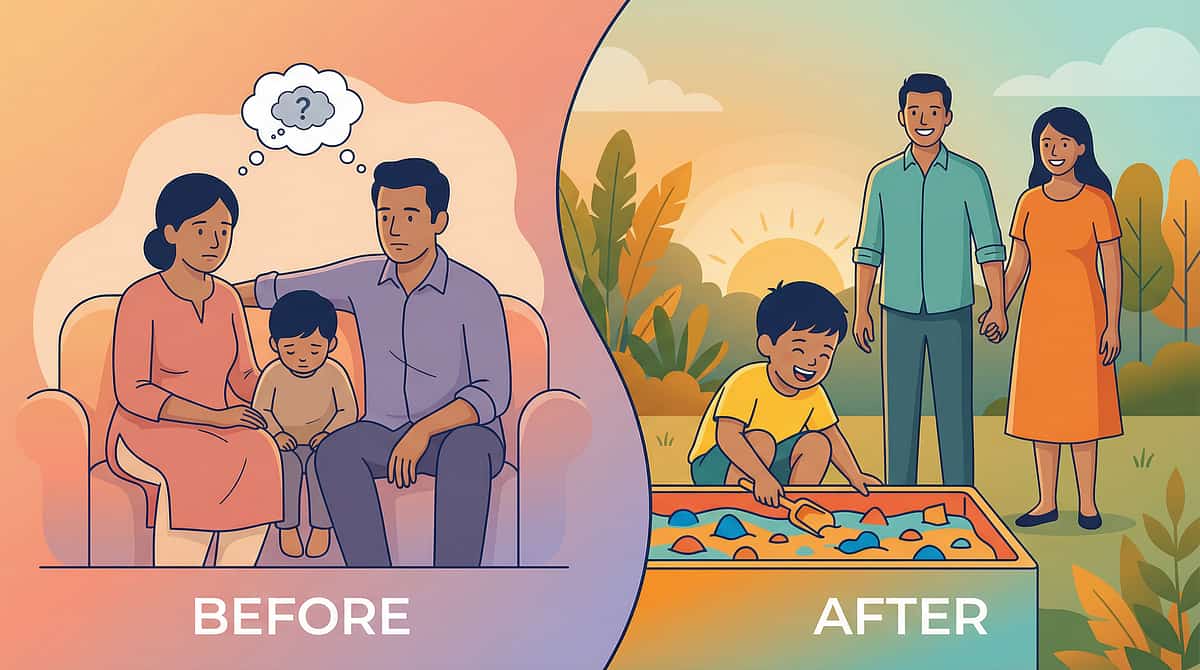
🎉 You Did This. Your Child Grew Because of Your Commitment.
Over 5–8 weeks, you have created a structured, evidence-based focus environment at home, executed 20–30 focus sessions using validated therapeutic materials, built a data record documenting your child's attention development, and taught your child that focused work is achievable — and worth celebrating.
Your Child Has...
- Developed a sensory-regulatory toolkit to carry forward
- Experienced success at a task that felt impossible
- Built early metacognitive awareness ("I know when I drift")
- Made measurable progress on the Cognitive Readiness Index
Family Celebration
🎂 Mark this milestone together. Let your child choose a family activity. Show them the data chart — "Look how your focus time grew from [X] to [Y] minutes." Take a photo of the full toolkit set up — document the chapter.
Journal Prompts
"What I noticed most in my child during these 8 weeks was...""The moment I knew it was working was...""What surprised me most was..."
⚠️ Even in the Celebration Zone — Know When to Pause
This is not fear. This is empowerment. Specific thresholds — not vague worries. Five red flags for focus support — pause and seek professional consultation.
🚨 Red Flag 1: No Progress After 8 Consistent Weeks
Focus duration unchanged, redirections unchanged, materials making no difference. Suggests an underlying factor not addressed by environmental supports alone. Do: AbilityScore® assessment + full attention evaluation → 9100 181 181
🚨 Red Flag 2: Increasing Behavioral Escalation
Sessions becoming progressively more difficult; meltdowns increasing. Materials may be mismatched; underlying anxiety or sensory profile needs clinical assessment. Do: Pause sessions. Teleconsultation with OT or behavioral specialist.
🚨 Red Flag 3: Hyperfocus on Materials
Child engages with fidget/timer/weighted pad but never with the actual task. Materials have become the preferred activity, not the scaffold. Do: Systematically remove materials; rebuild using reinforcement-first approach.
🚨 Red Flag 4: Physical Complaints During Sessions
Headaches or stomach aches reliably appearing at session time. May indicate anxiety, visual processing issues, or sensory overload. Do: Rule out medical causes first; then OT/psychological assessment.
🚨 Red Flag 5: Regression After Gains
Child showing mastery indicators, now back to baseline. May indicate a life stressor, sleep disruption, or developmental shift. Do: Investigate environmental changes. If no obvious cause → clinical reassessment.
📞FREE 24×7 Helpline: 9100 181 181 — "Trust your instincts. If something feels wrong, pause and ask."
ACT V: COMMUNITY
From the Therapist's Notes — Families Who Walked This Path
These are clinical narratives, not marketing testimonials. Behavioral specificity, honest timelines, real journeys. Outcomes vary by child profile and intervention consistency.

Arjun, Age 7 — Hyderabad
Before: Homework took 2.5 hours. OT identified sensory-seeking profile with vestibular dysregulation. Intervention: Wobble cushion + visual timer (10-min intervals) + task chunking. Week 2: Homework under 90 minutes. Week 6: Average 45 minutes. 2 redirections/session (down from 12+). Arjun now sets his own timer. "The wobble cushion was the piece we were missing. His body needed to move to let his brain work."

Priya, Age 9 — Bengaluru
Before: Reading comprehension collapsed despite word decoding ability. Selective attention couldn't filter ambient classroom sound. Intervention: Noise-reducing headphones + reading guide window + attention check every 7 minutes. Week 3: Comprehension improved 2 grade levels. Week 7: Using headphones independently at library. "She was bright but drowning in noise. The headphones gave her brain the silence it needed."

Rafi, Age 5 — Chennai
Before: 2-minute maximum on any non-preferred task. Preschool reporting difficulty at circle time. Intervention: Sand timer (2 min, building to 5) + small weighted stuffed animal + first-then visual board. Week 4: 5-minute focus. Week 8: 12 minutes on age-appropriate activities. Preschool circle time improved. "We started with 2 minutes and celebrated every single one. I cried at week 6 when he asked to do his activities."
"The breakthrough came when we stopped asking the child to adapt to the environment, and started adapting the environment to the child. The materials are the environment." — Pinnacle Blooms OT Consortium
Connect with Other Parents — Isolation Is the Enemy of Adherence
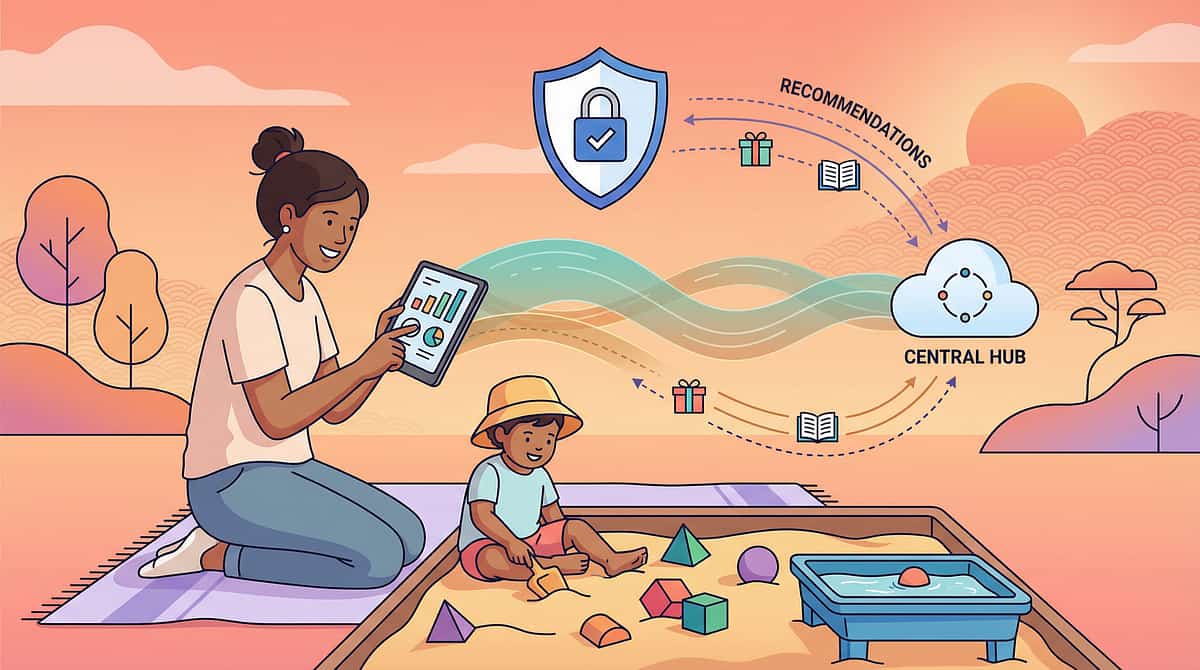
You don't have to do this alone. 50,000+ Pinnacle families are navigating focus challenges right now. Your experience helps others — if these materials have made a difference, consider sharing your journey. Another parent is sitting where you were sitting 8 weeks ago.
WhatsApp Communities
unknown linkunknown linkunknown link
Online Forum
Pinnacle Parent Forum — Cognitive Development → Ask questions, share sessions, celebrate milestones, and get peer support from families who understand.
Peer Mentoring
Connect with an experienced Pinnacle parent who has navigated focus challenges. They've been where you are. Request a Peer Mentor →
Share Your Story
Submit to Pinnacle Family Stories → Your narrative is someone else's roadmap.
Research: WHO NCF Community Engagement Principles — parent support networks improve intervention outcomes.📞9100 181 181 — Community team available 9 AM–6 PM | 7 days

Home + Clinic = Maximum Impact
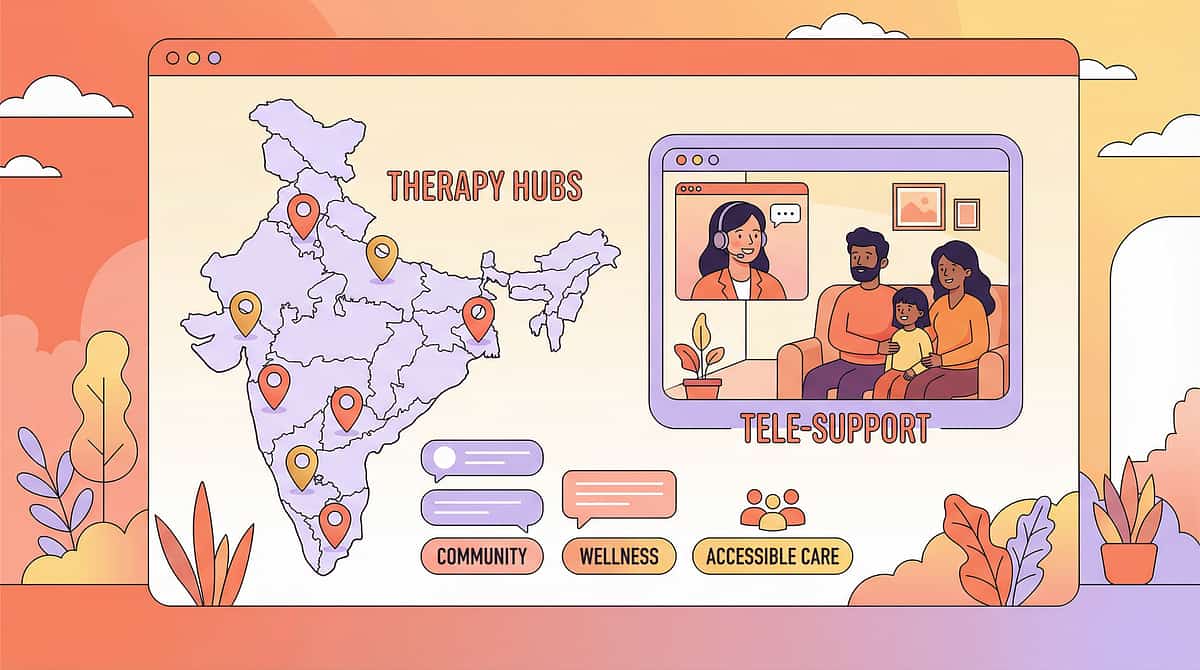
Home-based intervention works best when supported by professional guidance. You execute daily; the therapist navigates. Pinnacle's 70+ centers span OT, ABA, SLP, SpEd, and NeuroDev — all under one clinical system (GPT-OS®).
Your Child's Profile | Recommended Specialist | |
Sensory-driven attention difficulties | Pediatric Occupational Therapist | |
Behavioral avoidance of tasks | ABA / BCBA Therapist | |
Academic performance concern | Special Educator / Learning Specialist | |
Possible ADHD; no diagnosis yet | NeuroDev Pediatrician / Developmental Pediatrics | |
Anxiety component affecting focus | Child Psychologist |
70+ centers | OT • ABA • SLP • SpEd • NeuroDev | Under one clinical system (GPT-OS®)📞FREE National Helpline: 9100 181 181 — Available 24×7 | 16 languages | No appointment needed to call. Insurance/funding: Pinnacle's care coordinators assist with insurance claims and government scheme navigation.

The Research Library
The Evidence Behind These 9 Materials — For the Curious Parent
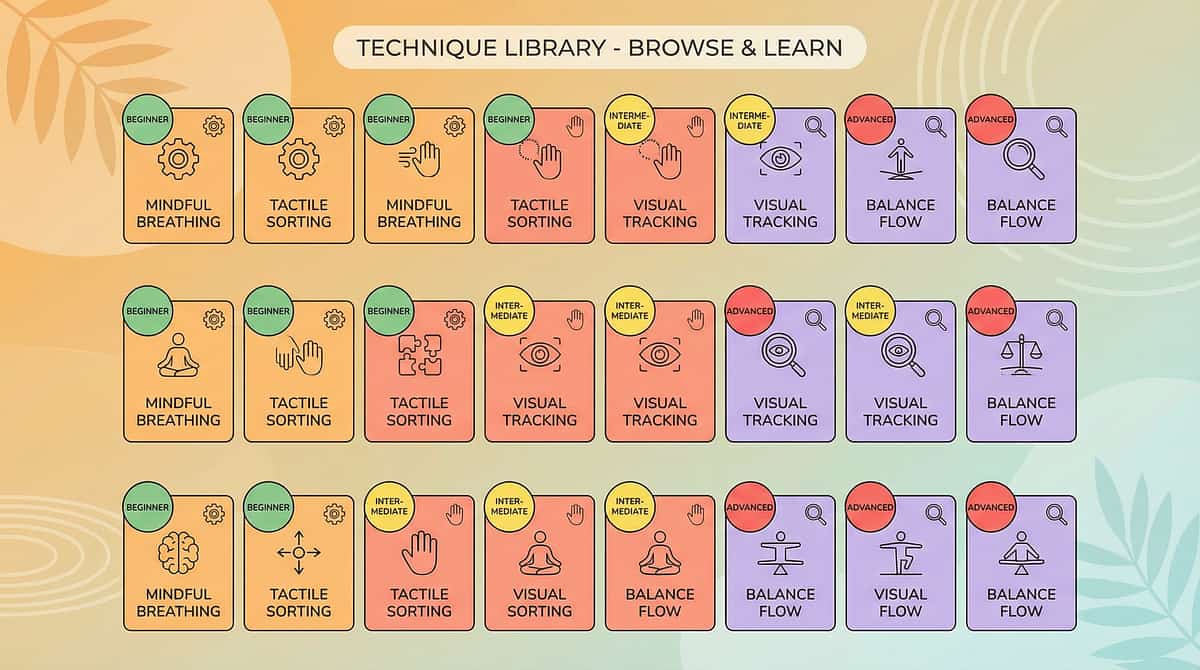
Every technique in the GPT-OS® library is evidence-anchored. Deeper reading is available for families who want to understand the science fully. "Deeper reading available at your request. Call 9100 181 181 — our research team can guide you."
📄 PRISMA Systematic Review (2024)
16 articles, 2013–2023. Confirms sensory integration intervention meets evidence-based practice criteria for children with ASD and attention difficulties. Fidget tools, weighted items, and environmental modifications directly referenced. PubMed: PMC11506176
📄 Meta-Analysis WJCC (2024)
24 studies. Sensory integration therapy effectively promotes adaptive behavior, sensory processing, and motor skills. Effect size: medium-large. DOI: 10.12998/wjcc.v12.i7.1260 PubMed: PMC10955541
📄 Indian RCT 2019 — Padmanabha et al.
Indian Journal of Pediatrics. Home-based sensory and attention interventions produce significant functional outcomes in Indian children. Parent-administered. Gold-standard methodology. DOI: 10.1007/s12098-018-2747-4
📄 WHO/UNICEF CCD Package
Care for Child Development Package across 54 countries. Home-based caregiver interventions, including attention scaffolding, validated in diverse populations. PubMed: PMC9978394
📄 NCAEP EBP Report (2020)
Visual supports, structured environmental modification, self-monitoring, and video modeling classified as evidence-based practices for autism across attention and executive function domains. NCAEP Report (2020)
📄 WHO Nurturing Care Framework (2018)
Foundation framework for early childhood intervention, emphasizing responsive caregiving, equity of access, and caregiver-implemented strategies. nurturing-care.org

Your Data Helps Every Child Like Yours
Transparency card: here is exactly what happens when you record session data. Every data point you contribute makes GPT-OS® recommendations more precise — not just for your child, but for every child with a similar profile in the network.
What GPT-OS® Learns From G-662 Data
- Which of the 9 materials produced the greatest attention improvement
- Optimal session duration for this child's current developmental stage
- Rate of attention duration growth toward Cognitive Readiness Index milestone
- Correlation between sensory profile and material effectiveness
Privacy & Data Protection
- All data encrypted at rest and in transit
- Individual data never shared without explicit consent
- Aggregate, anonymized data for population-level improvement only
- GDPR + India PDPA aligned data handling
"20+ million sessions have built the intelligence that makes GPT-OS® recommendations more precise than any single therapist's experience alone."

ACT VI: ACT NOW
Frequently Asked Questions — Your Questions, Answered
Generated from actual parent queries at Pinnacle centers and online communities. Eight of the most common questions our therapists receive about G-662.
My child doesn't have an autism diagnosis — are these materials still relevant?
Yes. The attention regulation challenges these materials address occur across a wide range of profiles — ADHD, sensory processing differences, anxiety, developmental delays, and in typically developing children who are simply at the younger end of the attention development curve. These are general pediatric attention supports, not autism-specific. If uncertain: call 9100 181 181.
How do I know which of the 9 materials to start with?
Start with the easiest: visual timer + simple task chunking. These require no special equipment, introduce the concept of focused intervals, and work across almost all profiles. If you notice specific patterns (fidgeting constantly → fidget tool; noise sensitivity → headphones; slumping → weighted pad), layer in additional materials one at a time.
My child's school says no fidget tools — what do I do?
Invisible fidgets exist: smooth stone in the pocket, textured sticker on underside of desk, hair tie on the wrist. Many teachers are open when parents share the clinical rationale (download teacher template, Card 37). For formal accommodations, a Pinnacle therapist's letter requesting fidget tools as an IEP/504 accommodation is available.
How long before I see results?
Tolerance (reduced resistance) typically within 1–2 weeks. Measurable focus duration improvement typically within 3–4 weeks of consistent use. Generalization to other settings typically within 6–8 weeks. Individual variation is significant — sensory-seeking children respond faster to physical tools; auditory-sensitive children respond faster to headphones.
Preview of 9 materials that help with focus and concentration Therapy Material
Below is a visual preview of 9 materials that help with focus and concentration therapy material. The pages shown help educators, therapists, and caregivers understand the structure and content of the resource before use. Materials should be used under appropriate professional guidance.


Link copied!

More Frequently Asked Questions
Is the weighted lap pad safe for young children?
Weight must never exceed 10% of the child's body weight. For a 15 kg child, maximum 1.5 kg. Never place on chest. Never restrict movement. Supervised for the first 5 sessions. If in doubt, consult a pediatric OT before introducing weighted tools. Call 9100 181 181 for free guidance.
My child hyperfocuses on some things but can't focus on others — which category is this?
This pattern is characteristic of ADHD (attention dysregulation, not deficit) and sensory processing profiles where high-dopamine activities sustain attention effortlessly. The materials on this page specifically help with "effortful attention" — attention on tasks requiring cognitive work rather than intrinsic reward. The goal is building access to effortful focus when needed.
Can I use these materials at their childcare center / preschool?
Yes — with teacher alignment. Print the Family Guide, share the teacher communication template (Card 37), and offer to demonstrate the materials. Preschools in the Pinnacle network already implement these protocols. If your preschool is not yet aligned, ask them to contact: care@pinnacleblooms.org
My child is 12+ years old — is this still relevant?
Yes. The upper age range in clinical research extends to adolescence. For 12+ year-olds, materials shift toward self-monitoring, metacognitive tools, and study environment design — less about fidgets and more about self-regulation strategy. The principles are identical. Call 9100 181 181 for adolescent-specific guidance.