

9 Materials That Help With Flexibility Training
From rigid routines to adaptive resilience — a systematic guide for parents, caregivers, and therapists building flexibility skills in children ages 3–12.
Behavioral Flexibility & Cognitive Adaptability
Episode 975

The Problem
When ANY Change Triggers Crisis Mode
"My son is seven years old, and our entire family lives in terror of the unexpected. The meltdown when his blue cup was in the dishwasher and we offered the green one. The forty-five minute screaming episode when we took a different route because of road construction. Every single day, we walk on eggshells, trying to anticipate what might go wrong."
This experience is more common — and more exhausting — than most families talk about. Rigidity in children with developmental differences isn't stubbornness. It's a nervous system seeking safety in a world that feels unpredictable and overwhelming.

Parent Voice
"She Can't Hold Two Possibilities in Her Mind"
"It's not just routines. It's rules. It's categories. It's expectations. If we always go to the park on Saturday, then Saturday IS park day, and any other plan is wrong, bad, unacceptable. She can't hold two possibilities in her mind. She can't consider that something could be done differently and still be okay. She can't problem-solve when Plan A fails because there IS no Plan B in her world."
1
If we always go to the park on Saturday, then Saturday IS park day.
2
Any other plan is wrong, bad, unacceptable.
3
There is no Plan B in her world.
If this sounds familiar, you are not alone — and your child is not choosing this. The rigidity reflects genuine neurological differences in how the brain processes uncertainty and novelty. Can flexibility be taught? Yes. It can.
Flexibility training must be done carefully and gradually. Forcing flexibility too rapidly creates trauma and often increases rigidity as a protective response.

Clinical Context
Understanding Cognitive & Behavioral Rigidity
Clinical Term
Cognitive/Behavioral Rigidity · Insistence on Sameness · Inflexible Thinking · Executive Function – Cognitive Flexibility Deficit
Age Band
3–12 years (materials adaptable for younger and older)
Settings
Home · Therapy · School · Community
What It Is
Cognitive and behavioral rigidity refers to difficulty adapting thinking and behavior in response to changing circumstances, new information, or unexpected situations. It is a core feature of autism spectrum disorder, associated with executive function differences — particularly in cognitive flexibility, the ability to shift between different thoughts, tasks, or strategies.
The underlying mechanisms involve differences in predictive processing, intolerance of uncertainty, and anxiety about unpredictability. For many individuals, rigidity serves an adaptive function — creating predictability and reducing cognitive load in an overwhelming world.

Common Signs of Rigidity — Does This Look Familiar?
1
🔄 Routine Rigidity
- Insistence on specific routines with distress when varied
- Requiring specific items, foods, or conditions
- Difficulty transitioning between activities
2
🧠 Thinking Rigidity
- Black-and-white thinking without gray areas
- Applying rules rigidly without considering context
- Difficulty generating alternative solutions
3
😰 Emotional Rigidity
- Meltdowns when plans change unexpectedly
- Anxiety about upcoming changes or new situations
- Perseverating on how things "should" be
4
🔁 Behavioral Patterns
- Repeating the same approach even when it's not working
- Distress when objects are moved or environments change
- Literal interpretation without flexibility for context
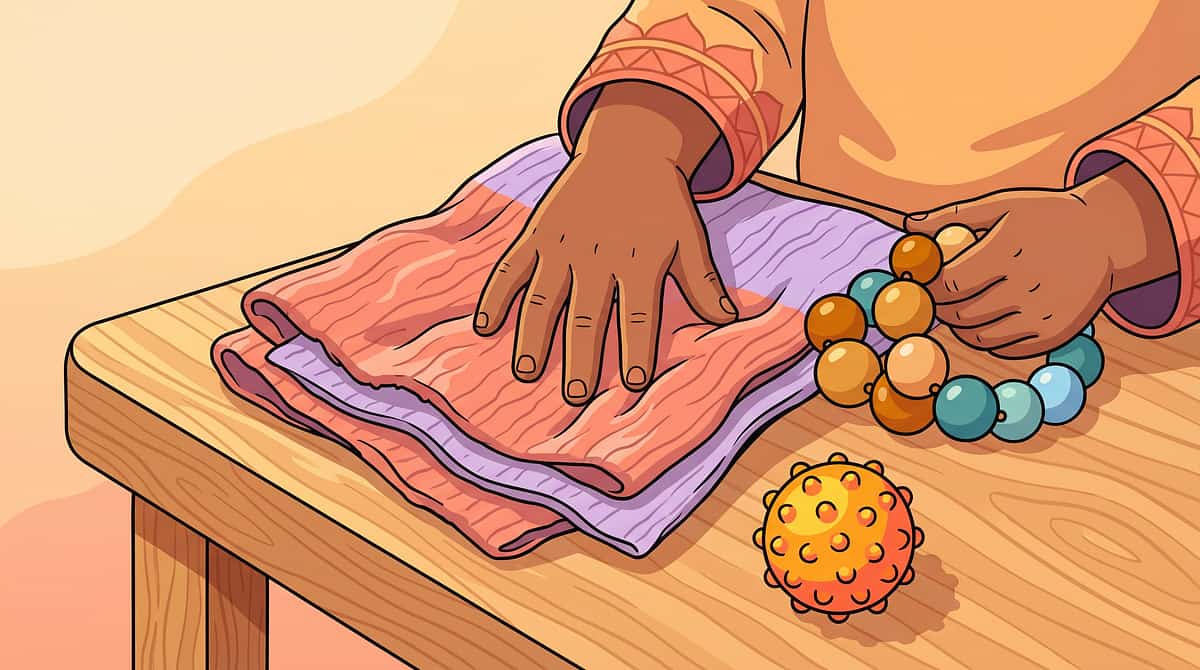
Developmental Context: Why Rigidity Grows
Some preference for routine and predictability is developmentally typical, especially in toddlerhood when children are mastering a complex world. However, the intensity and persistence of rigidity in autism significantly exceeds typical development and often increases rather than decreases with age if not addressed.
Rigidity serves important functions: it reduces cognitive load, creates predictability, and provides a sense of control. These are not pathological needs — they are legitimate coping strategies for a nervous system that processes the world differently. Flexibility training must respect these needs while gradually expanding the child's tolerance and capacity.
The goal is not to eliminate preferences for sameness — it's to build enough flexibility that the child can adapt when needed without extreme distress. This is a long-term developmental process requiring patience and careful calibration.

The 9 Materials
A Systematic Approach to Building Flexibility
No single material is magic. Together, implemented consistently over time, they build the capacity for adaptive responding that will serve your child throughout their life.

Material 1 of 9
Flexible vs. Stuck Visual Scale
Making the invisible visible with concrete vocabulary. Before children can work on flexibility, they need language to understand and identify it. A visual scale showing the spectrum from "stuck" (rigid, only one way) to "flexible" (bendy, multiple options) provides concrete vocabulary for an abstract concept.
The scale uses visual metaphors children can understand: a stick that breaks vs. a bendy straw that bends; a rock that can't change shape vs. play-dough that can become anything. Self-awareness precedes self-regulation. When a child can identify "I'm feeling really stuck about this," they can then access strategies for becoming more flexible.

Flexible vs. Stuck Scale — The Science Behind It
Why It Works
The visual nature of the scale accommodates the visual learning style common in autism, making the abstract concept of cognitive flexibility concrete and memorable. The scale also provides language for adults to use without judgment: "I notice you're feeling pretty stuck right now. What would help you bend a little?" — vastly more effective than "stop being so stubborn."
Key Insight
You can't change what you can't name. The scale makes the abstract concept of flexibility concrete and identifiable.
5-Point Scale Format
5 — Very Flexible
Play-dough / Bendy straw
4 — Pretty Flexible
Flowing water
3 — In Between
Curvy road
2 — Pretty Stuck
Straight road
1 — Very Stuck
Rock / Stick

How to Make & Use the Flexible vs. Stuck Scale
1
Choose Visual Metaphors
Select metaphors your child understands. Options: Stick vs. Bendy Straw, Rock vs. Play-Dough, Straight Road vs. Curvy Road, Frozen vs. Flowing Water.
2
Color Code the Scale
Red for stuck, green for flexible, yellow for the middle. This matches common emotion regulation colors your child may already know.
3
Add Body Sensations
Stuck = tight, tense, frustrated. Flexible = relaxed, open, calm. Connecting physical cues builds interoceptive awareness.
4
Practice Labeling — Start With Observation
"You seem pretty flexible right now!" — before expecting self-identification. Build positive associations first, then gradually expect the child to self-identify.
5
Post It and Use It Consistently
Make the scale visible and use it consistently across all settings: home, school, therapy. Cross-setting use builds generalization.
Safety Note: The scale is for awareness, not judgment. Avoid using it to shame ("you're being so stuck!"). Keep it neutral and supportive at all times.

Material 2 of 9
Change Cards & Surprise Practice Deck
Practicing flexibility with safe, small steps. Flexibility is built through practice, but practice must be carefully calibrated. Change cards provide structured opportunities to practice tolerating small, manageable changes before encountering larger, unexpected ones — building the neural pathways and coping strategies that generalize to real-life changes over time.
Surprise practice cards add playful unpredictability: "Surprise! We're going to do something different," followed by a small, manageable change. The child learns that surprises can be okay, that they can cope with the unexpected, and that flexibility feels manageable rather than threatening.
Key Insight: Flexibility is a skill built through practice. Like any skill, start with what's achievable and gradually increase difficulty.
Change Cards — 4 Levels of Practice
1
Level 1 — Very Small
Use a different spoon · Sit in a different chair · Listen to different music · Take stairs instead of lift
2
Level 2 — Small
Brush teeth in different order · Wear a different shirt · Eat snack in different location · Take different route inside home
3
Level 3 — Medium
Do homework before play · Go to a different park · Eat something different for breakfast · Skip one step in routine
4
Surprise Cards
"Surprise Change!" on front, specific change on back. Practice the feeling of surprise itself — in a safe, controlled way.
Safety Note: If a change consistently triggers significant distress, it's too big — go smaller. The goal is building success, not creating stress.
How to Build Your Change Card Deck
Personalize for Your Child
Include changes specific to your child's rigidities. If they're rigid about cups, include cup variations. If about routes, include route changes. Personalized practice accelerates generalization.
Control & Choice First
Initially, let the child draw the card — they know a change is coming. Predictable practice of unpredictability reduces the threat response and builds early success.
Game Format
"Let's play the flexibility game!" reduces the threat response. Regular practice (daily if possible) builds skill faster than occasional practice.
Materials Needed
- Index cards or card stock
- Markers or printed changes
- Card box or ring to hold the deck
- Optional: level system with different colored cards
Reinforcement
Celebrate successful flexibility practice. Small reward, praise, or points toward something desired. Confidence comes from accumulated success — build many easy wins before increasing difficulty.

Material 3 of 9
Plan B Visual Problem-Solving Board
Seeing that alternatives exist — and practicing finding them. Rigid thinkers often get stuck on Plan A because they literally cannot envision alternatives. When Plan A fails — the park is closed, the pizza place is out of pepperoni, the friend can't come — they have nowhere to go mentally. There IS no Plan B in their cognitive landscape.
A Plan B board teaches the fundamental concept that multiple solutions exist for any situation and provides a visual structure for generating them. Seeing that alternatives literally exist — written or drawn on the board — makes the concept concrete. When a real situation arises, the child has both the concept and practiced alternatives already available.

Plan B Board — What, Why, Where, How & When
What It Is
A visual board with Plan A at the top, arrows pointing to Plan B, Plan C, and Plan D slots. Includes emotion space to acknowledge feelings before problem-solving begins.
Why It Works
Rigid thinkers don't see alternatives because they literally can't envision them. Making alternatives visible on paper makes them cognitively accessible in the moment of need.
Where to Use It
Post at home in a visible location. Create a portable card version for community and school use. Use across all settings where Plan A rigidity shows up.
When to Introduce
Introduce during calm times — NOT during crisis. Skill must be built before it is needed. Regularly pre-brainstorm alternatives for frequently rigid situations.
Safety Note: Using the board during a meltdown is too late. Build the skill during calm, neutral moments so it is available when change actually occurs.

Building Your Plan B Board — Step by Step
Create the Basic Format
Large board or paper with Plan A at top, arrows pointing down to Plan B, C, D slots. Visual clarity is key — use pictures or icons for alternatives alongside written words.
Add Emotion Space
Include space to acknowledge feelings: "It's okay to feel ___ about Plan A not working." Validate before problem-solving — emotional validation opens the door to cognitive flexibility.
Pre-Brainstorm Common Scenarios
For frequently rigid situations, brainstorm alternatives in advance and keep the list visible. "If park is closed..." options already exist before the crisis moment.
Make It Collaborative
"Let's figure out options together." Initially accept any alternative, even imperfect ones — build the skill of generating options. Quality refines over time.
Celebrate Plan B Successes
"You used Plan B and it was still fun!" Build positive associations. Create a portable pocket version for use in real situations outside the home.
Material 4 of 9
Routine Variation Visual Schedule
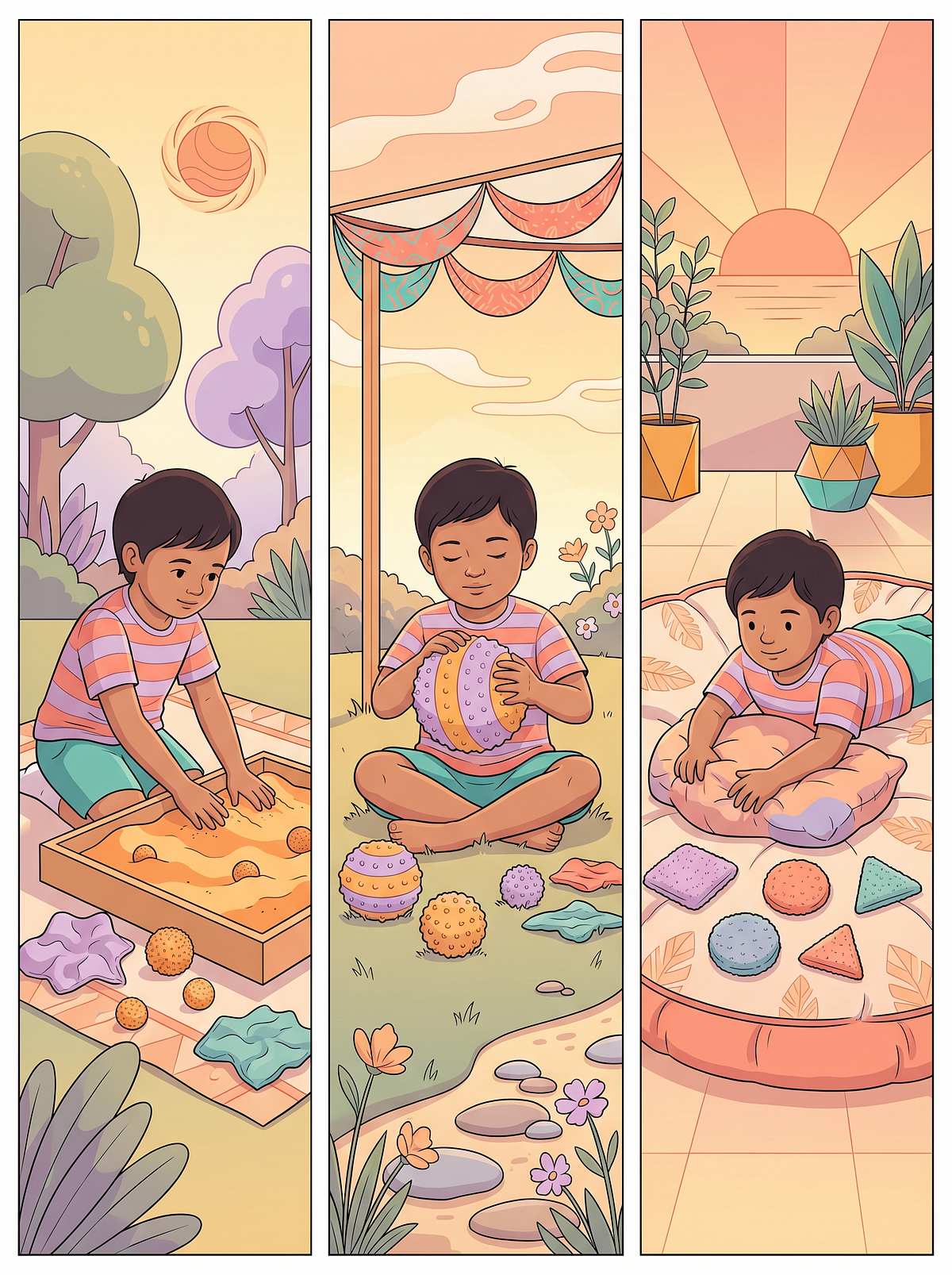
Planned flexibility within predictable structure. For children who are rigidly attached to routines, changing the entire routine at once is overwhelming. A routine variation schedule introduces small, controlled variations within a predictable structure — so the child knows a variation is coming (predictable unpredictability), knows when it will occur, and experiences that routines can include variation and still be okay.
The key insight: predictable unpredictability — knowing that something will be different, even if you don't know exactly what — is far easier to tolerate than pure surprise. The child learns that routines can flex without breaking, and that different doesn't mean bad.

Variation Schedule — How to Build It Gradually
Phase 1: Base Routine
Start with the child's actual current routine. Don't change the overall structure. Maintain predictability as the foundation.
Phase 2: Mark Flex Spots
Identify 1–2 places in the routine for variation. Mark with a star, question mark, or "flex" icon. Show the schedule before the routine begins.
Phase 3: Child-Chosen Variations
Let child choose the variation from acceptable options. "Something will be different at snack — different location or different food?" Choice reduces threat significantly.
Phase 4: Adult-Chosen Variations
Gradually shift to adult-chosen variations with advance notice. "Today's flexibility spot is: different seat at dinner." Predictable but no longer child-directed.
Phase 5: Surprise Flex
Include occasional surprise flexibility spots not announced in advance. "Surprise flex!" Practice unexpected variation within the safety of a familiar routine context.
Safety Note: Variations should not undermine the child's sense of safety. If distress is significant, reduce variation size. Progress slowly based on the child's demonstrated success.

Variation Schedule — Materials & Success Tracking
What You Need
- Visual schedule materials (Velcro, pictures, laminated cards)
- Flexibility spot markers (star, question mark, "flex" icon)
- Variation option cards (acceptable options to choose from)
- Success tracking system to document wins
Key Insight
After successful flexibility, note it on the schedule: "We did a different seat — and it was okay!" This visual record of success becomes evidence the brain can file away.
Building Flexibility Identity
Gradually increase number of flex spots, decrease advance warning, and expand the size of variations over time. Progress slowly based on the child's actual response — not an assumed timeline.
The ultimate goal is for the child to begin identifying themselves as "someone who can be flexible." This identity shift is more powerful than any external reinforcement and represents genuine internalization of the skill.
Celebrate every successful flexibility moment — especially naturally occurring ones outside of structured practice. These are gold.
Material 5 of 9
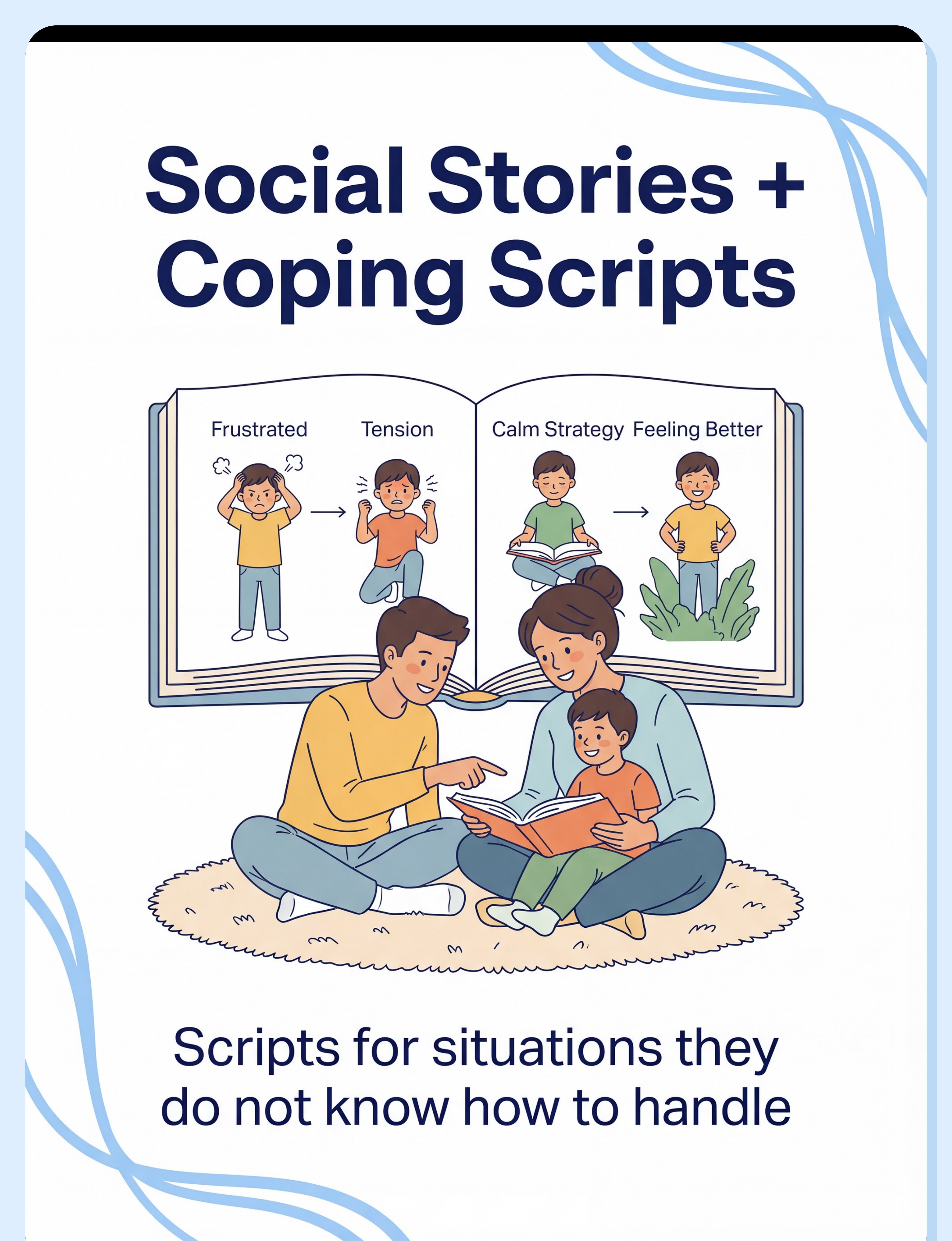
Social Stories About Flexibility & Change
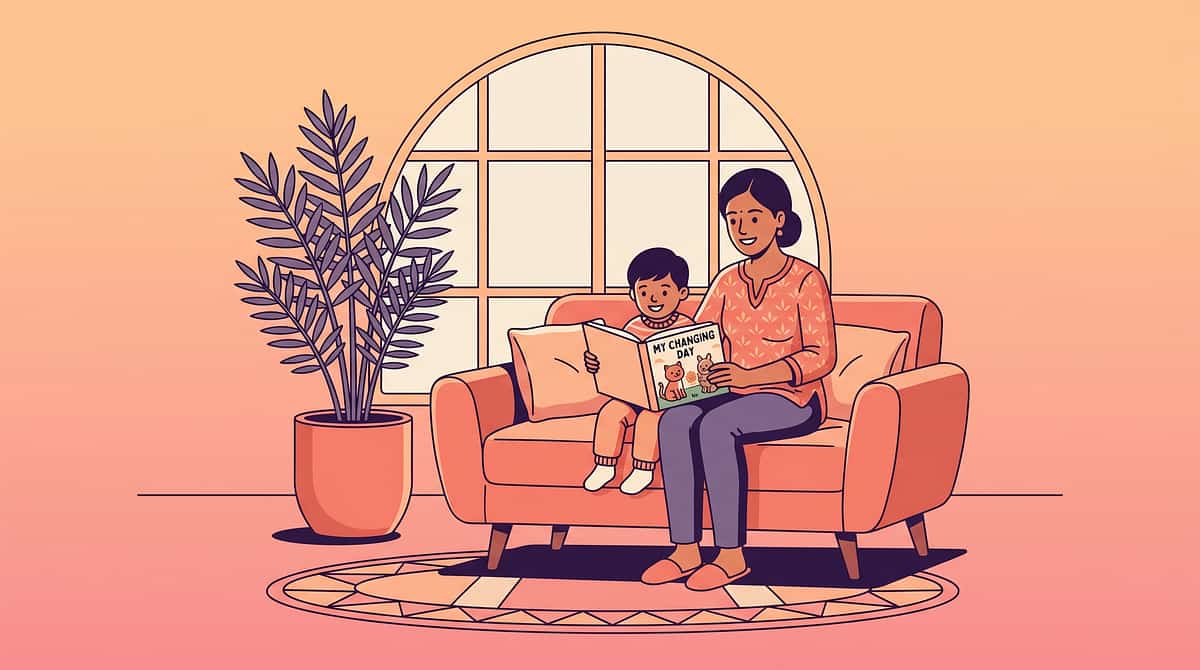
Narrative frameworks for understanding and coping with change. Social stories provide narrative frameworks for understanding experiences — and flexibility social stories specifically address why changes happen, how to cope with them, and that being flexible is okay and even positive.
Unlike direct instruction ("you need to be more flexible"), social stories create understanding through perspective-taking and narrative. The key elements are: normalizing change, validating the feelings that come with change, providing coping strategies, and reinforcing a positive identity as someone who can be flexible. Reading them regularly — not just when change is imminent — builds these concepts into the child's everyday understanding.

Social Story Structure — The 7 Essential Elements
1
Introduction
"Sometimes things change." Set the context — normalizing that change is a part of life, not an exception to it.
2
Why It Happens
"Things change because..." Giving reasons reduces the sense of arbitrary unfairness that fuels distress. Understanding enables tolerance.
3
Feelings
"When things change, I might feel worried or upset." Name the emotional response before it becomes overwhelming — anticipation reduces reactivity.
4
Validation
"It's okay to feel this way." This single element may be the most important. Validation opens the door to coping; dismissal closes it.
5
Strategy
"I can take a deep breath. I can try Plan B. I can be flexible." Concrete, actionable steps the child can actually do in the moment.
6
Positive Outcome
"When I'm flexible, things usually work out." Build positive associations — flexibility is not just survivable, it can lead to good outcomes.
7
Identity Affirmation
"I am getting better at being flexible. This is growing up!" Reinforce flexibility as a strength and a developing identity, not a demand.
Making Social Stories Work for Your Child
1
Personalize It
Use the child's name, their specific situations, their language level. Generic stories work far less well than personalized ones tailored to real experiences.
2
Use Visuals
Include photos or illustrations. Social stories are enhanced by visuals, especially for visual learners. Images can cue the narrative even before reading.
3
Favorite Characters
For some children, stories featuring their favorite character being flexible are more engaging than stories about themselves. Use what motivates.
4
Read Regularly
Don't wait for crisis. Read during calm times to build understanding. The story should be familiar — a known tool — when it is actually needed.
Safety Note: Stories must validate feelings, not dismiss them. "It's okay to feel upset about changes" is essential — not "you shouldn't feel upset."

Material 6 of 9
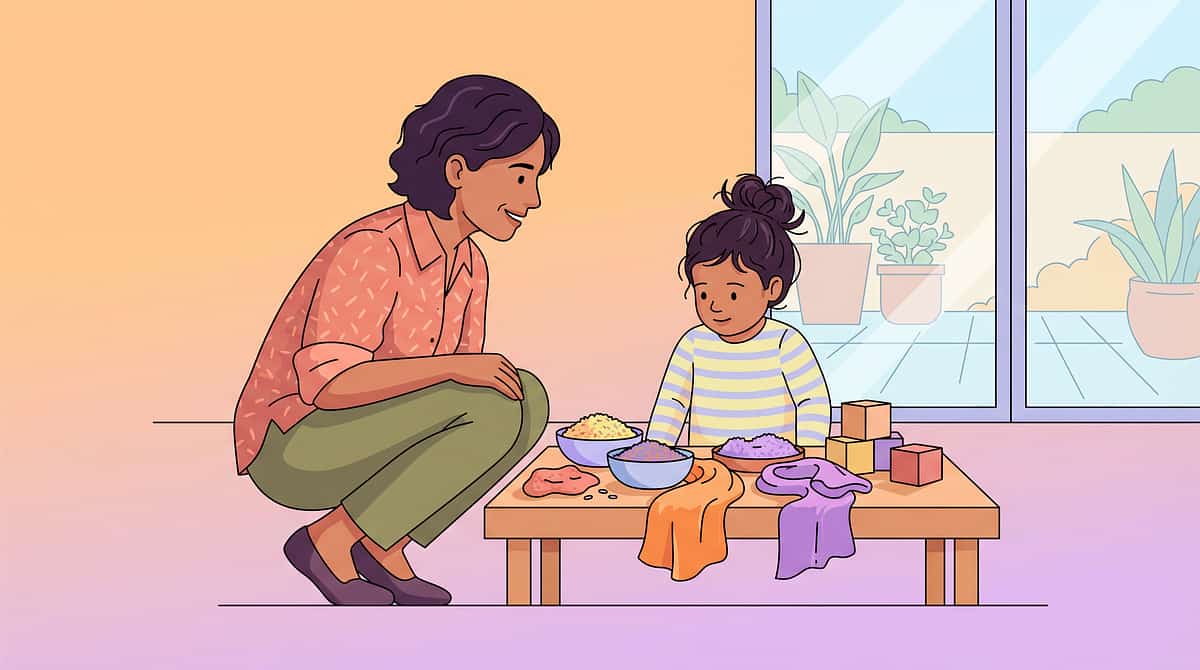
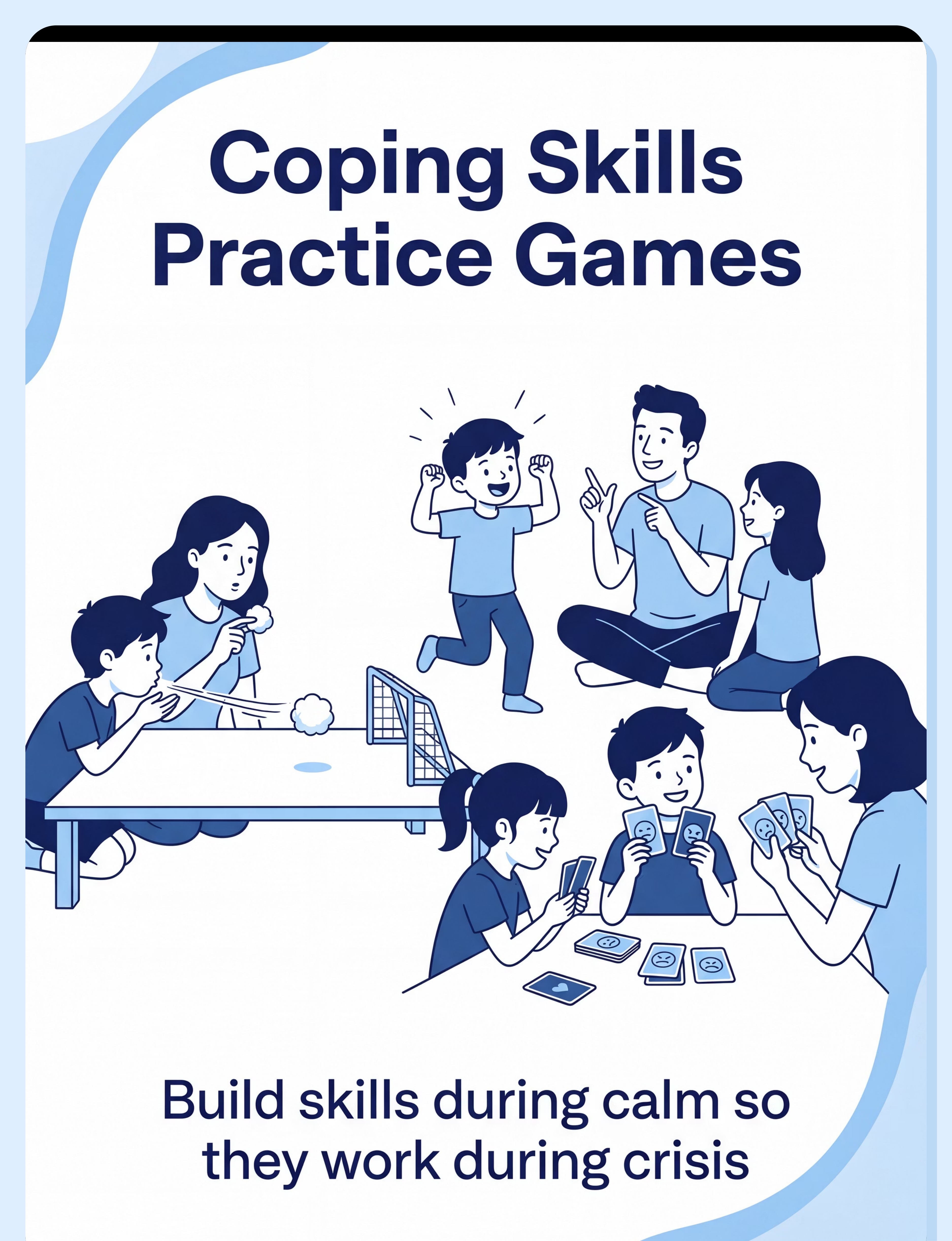
Flexibility Games & Playful Practice Materials
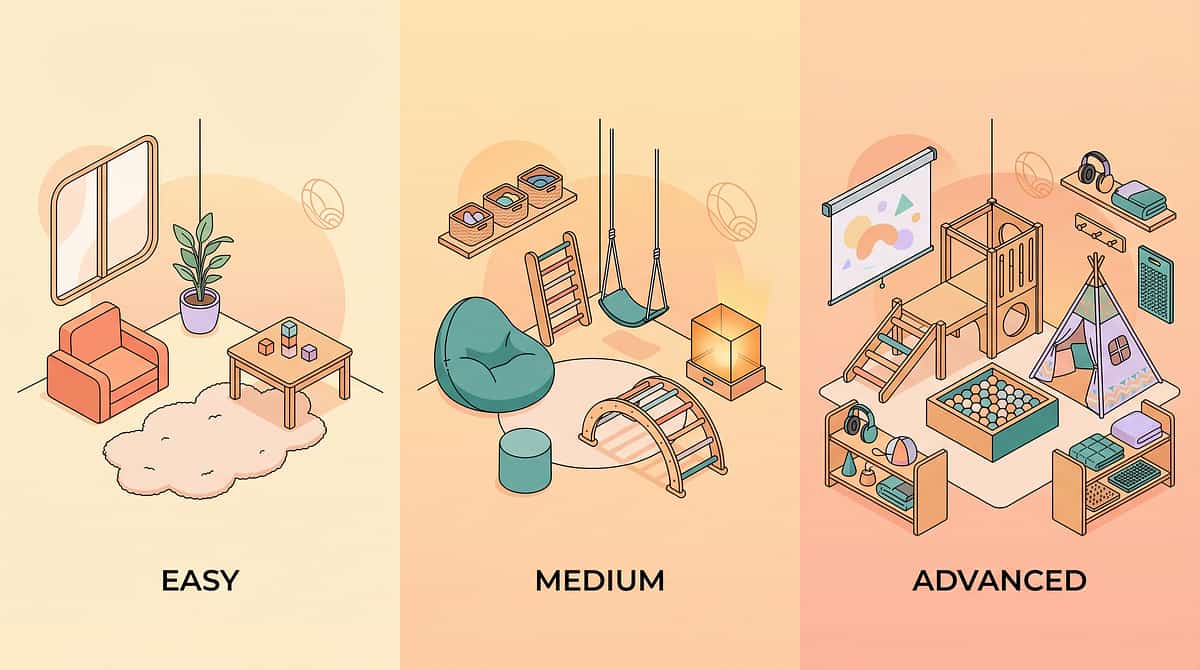
Making adaptability fun through playful practice. Learning happens best through play, and flexibility games provide opportunities to practice adaptability in low-stakes, enjoyable contexts. When flexibility is fun rather than threatening, children build positive associations with the concept and develop skills without the resistance that comes from direct instruction.
The playful context reduces the threat response that changes typically trigger. The child experiences being flexible and having it be okay — even enjoyable. These experiences accumulate into a new relationship with flexibility: it's not always threatening, it can be fun, I can do it.
Key Insight: What we learn through play, we learn deeply. Flexibility practiced in games generalizes to flexibility in life.

Flexibility Game Ideas — From Easy to Challenging

Opposite Day Games
Everything is backwards — walk backwards, talk in opposite words, do routine in reverse. Playful rule-breaking in a safe, contained way builds comfort with "different."

Build & Adapt Challenges
Building challenges where something changes partway through: "We were making a tower — now let's turn it into a bridge." Requires real-time cognitive flexibility.

Story Twist Games
Storytelling games where the plot changes unexpectedly: "And then, surprise! The dragon was actually friendly." Practices narrative flexibility and perspective shifts.
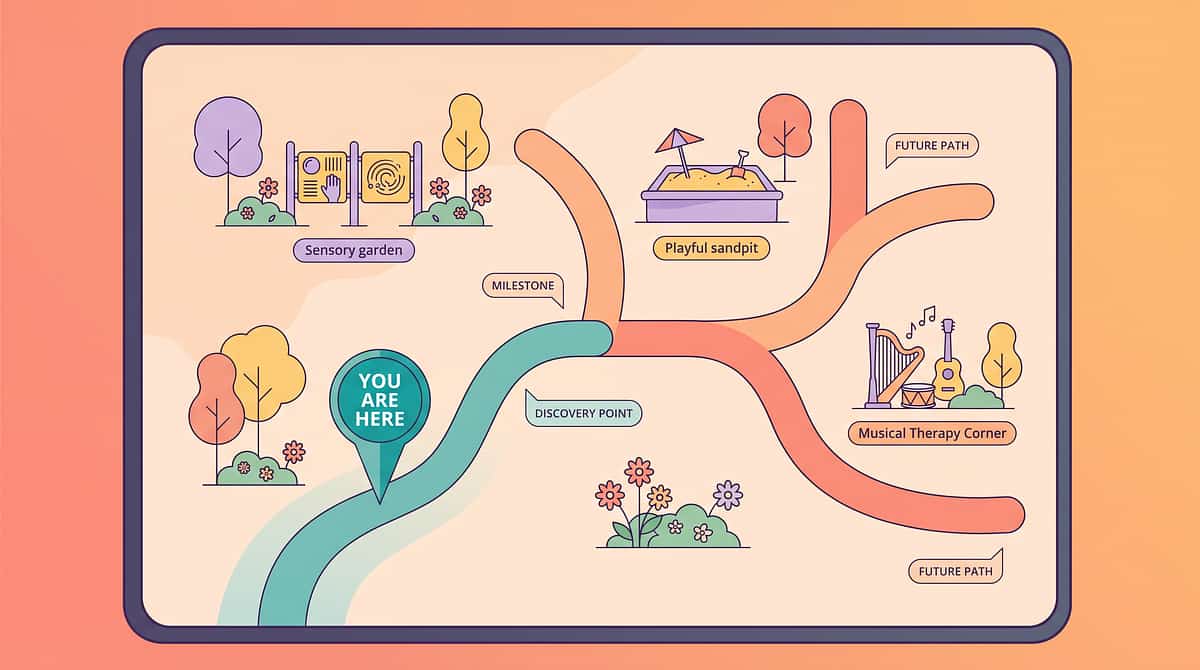
Role Reversal Play
Switch roles in pretend play: "Now you be the teacher and I'll be the student." Practices perspective flexibility and challenges fixed self-concepts around roles.
Safety Note: Games must remain genuinely fun. If the child becomes distressed, the flexibility challenge is too high — reduce it and rebuild positive associations before progressing.
More Game Formats for Flexibility Practice
1
"What If" Scenario Games
Pose hypothetical scenarios: "What if we couldn't use the door — how would we get outside?" Playful problem-solving builds cognitive flexibility without real-world stakes or pressure.
2
Improv-Style Games
Simple "Yes, And..." improv games where players build on each other's ideas. Requires accepting the unexpected and adapting — the core skill of flexibility in a playful wrapper.
3
Modified Board Games
Add flexibility cards to familiar games — draw a card, something changes about the game. Familiar structure with an element of unpredictability; safe container for practicing surprise.
Start with very easy flexibility challenges and increase difficulty only as the child shows genuine tolerance and positive engagement. Laughing together at unexpected changes is among the most powerful flexibility-building experiences available.
Material 7 of 9
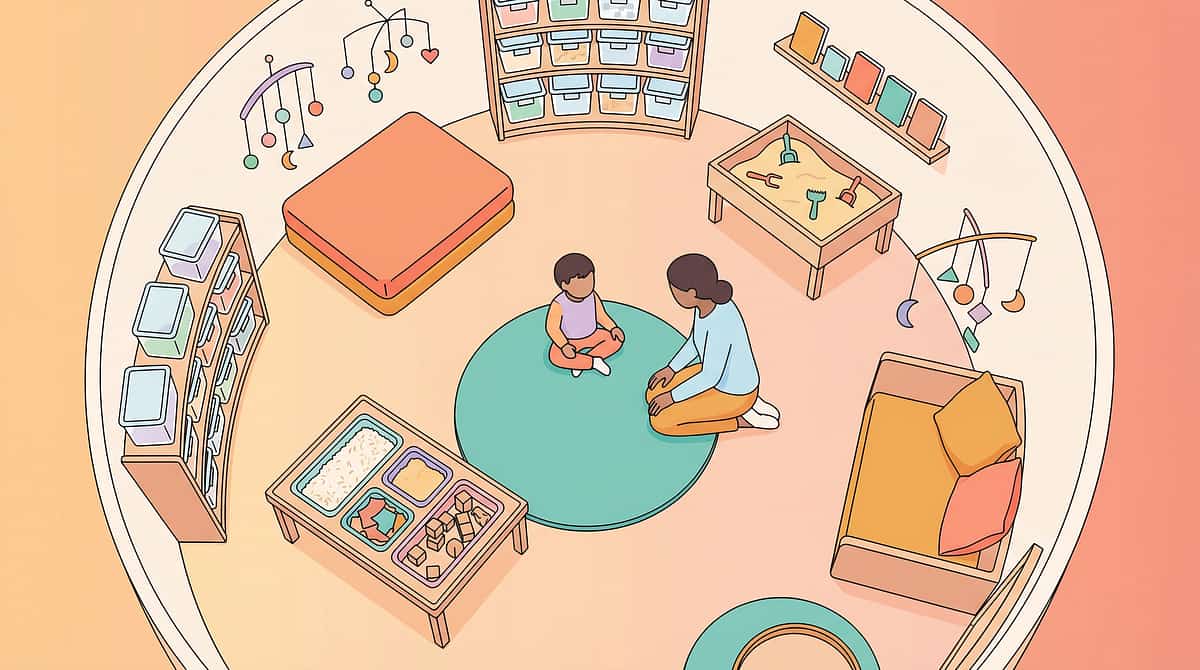
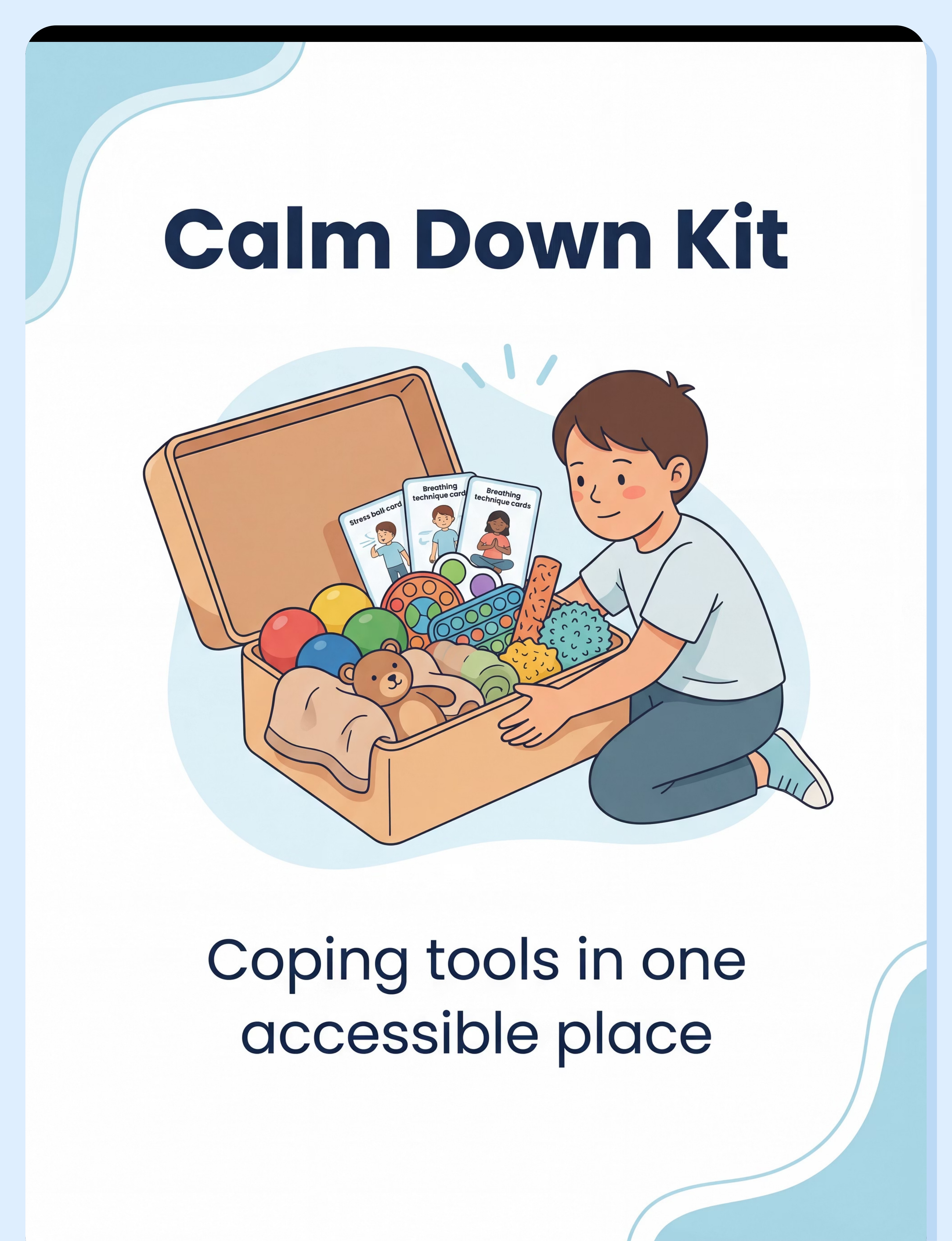
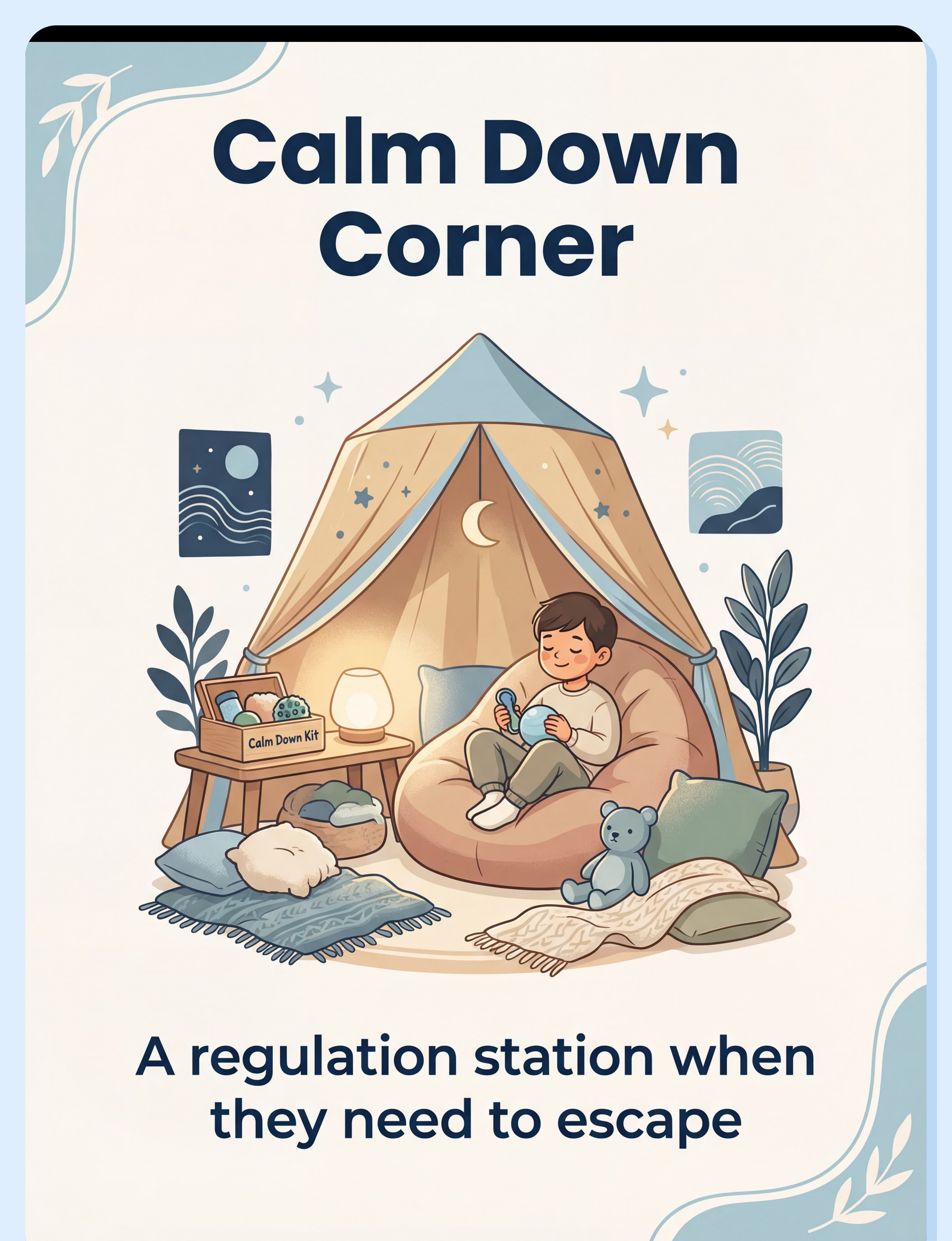
Calm-Down Kit for Change-Related Distress
Regulating the nervous system so flexibility becomes possible. Even with preparation and practice, changes will sometimes trigger significant distress. A calm-down kit provides immediate, accessible tools for regulating the nervous system when flexibility is demanded but distress is high.
The kit bridges the gap between knowing you should be flexible and being able to be flexible — because when the nervous system is in threat mode, cognitive flexibility is neurologically impossible. You have to calm the body before the brain can think flexibly. Regulation is not a shortcut around flexibility training — it is a prerequisite to it.
Building a Change-Distress Calm-Down Kit
Sensory Tools
Stress ball, fidget, weighted lap pad, soft fabric, chewy, noise-cancelling headphones, sunglasses. Choose what provides calming input for YOUR child — observe what actually works, not what should work.
Visual Supports
Calming images (favorite places, comforting photos), breathing guide cards, visual reminders: "I can be flexible" and "Plan B can be good." Visuals work when words fail.
Breathing Tools
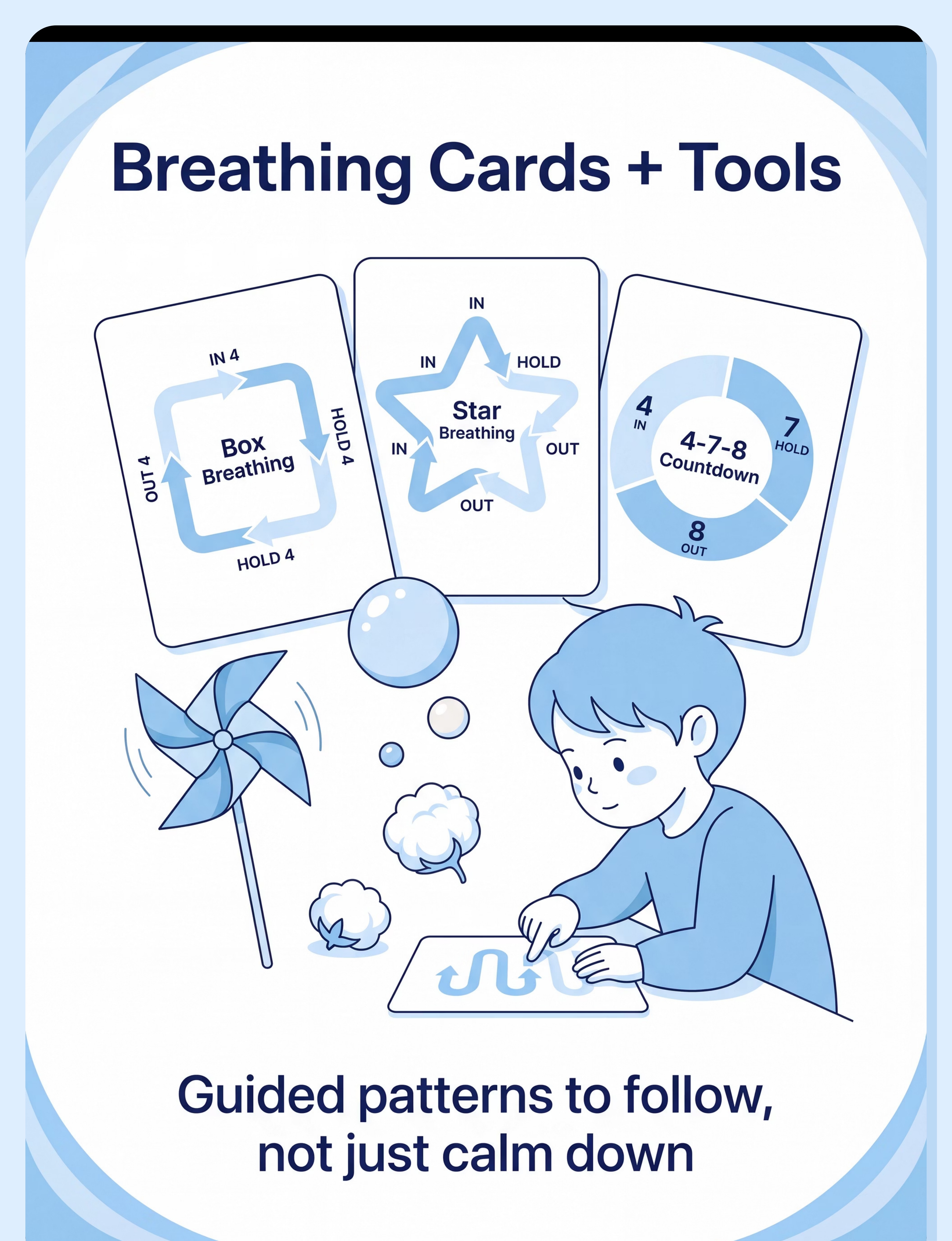
Pinwheel to blow, bubbles, or structured breathing card. Slow exhale activates the parasympathetic (calm-down) response. This is physiological regulation, not distraction.
Flexibility Reminder Card
"Things changed. I feel ___. I can take a breath. I can try Plan B." A specific card for change situations that bridges regulation back to flexibility practice.

Calm-Down Kit — Implementation Guide
Key Insight
The brain can't think flexibly when it's in threat mode. Calming the nervous system is a prerequisite to flexible thinking, not a replacement for it. Calm down first (kit), then problem-solve (Plan B board). Sequence matters.
Portability
Kit should travel. Small bag or pouch in backpack or parent's bag. Home kit can be larger. School kit stays at school. The kit is only useful when it is accessible.
Teaching Self-Initiation
Start with adult cuing: "I think you might need your calm-down kit." Gradually fade toward child self-initiation: "I need my kit before I can think about Plan B." Self-awareness of rising distress is a skill that develops over time with consistent practice.
What to Watch For
- Replenish the kit regularly — dried-out play-dough or lost fidgets reduce effectiveness
- Personalize based on observation, not assumption
- Some children need movement; some need stillness
The kit is not a substitute for teaching flexibility — it's a co-regulation tool that makes flexibility possible.
Material 8 of 9
Flexibility Tracking & Reward System
Making flexibility progress visible and rewarded. Building flexibility is hard work, and children benefit from visible recognition of their efforts and progress. A tracking and reward system provides external motivation during the difficult process of developing a new skill and creates visible evidence of growth that builds internal motivation over time.
Each tracked instance of flexibility is a deposit in the "I can be flexible" belief bank. The tracking itself is also deeply valuable: it makes flexibility visible, helps the child and adults see patterns and progress, and creates a record of success that can be referenced during difficult moments — "Look how many times you've been flexible this week!"
Key Insight: Recognition builds repetition. When flexibility is tracked and celebrated, it becomes part of identity: "I am someone who can be flexible."
Flexibility Tracking — What to Track & How
1
Level 1 — Prompted With Support
Child uses flexibility with adult guidance and co-regulation. Still earns recognition — this is real work at the foundation level. Every effort counts.
2
Level 2 — Prompted Independently
Child responds to flexibility prompt without needing co-regulation support. A meaningful step forward that demonstrates growing internalized capacity.
3
Level 3 — Spontaneous Flexibility
Child demonstrates flexibility without any prompting. This is the gold standard — worth celebrating significantly when it occurs, even if rarely at first.
All three levels count. Harder ones might be worth more points or stickers. Never remove points for inflexibility — the system is for recognizing flexibility, not punishing rigidity. Inflexibility is a skill deficit being worked on, not misbehavior to be penalized.
Building Your Tracking System
Choose Your Format
Chart, token jar, sticker book, or app. Visual accumulation is powerful — seeing the jar fill up or the chart fill in creates tangible evidence of progress.
Recognize Immediately
"That was flexibility! You get a point/sticker." Immediate reinforcement is most effective. Don't delay — the recognition needs to be tied directly to the behavior.
Set a Low Initial Threshold
Start with an easy-to-reach reward threshold to build early momentum. Success breeds motivation for more success.
Track Natural Flexibility Too
"You handled that change at the store — that's a sticker!" Naturally occurring flexibility counts — this is the real-world generalization that matters most.
Build Internal Recognition
"How did it feel when you were flexible? Were you proud of yourself?" Alongside external rewards, build internal awareness. Gradually fade external rewards as intrinsic motivation develops.
Safety Note: The system should feel positive, not pressuring. If it becomes a source of stress rather than motivation, adjust the threshold or format immediately.
Material 9 of 9
Flexibility Scripts & Self-Talk Prompt Cards
Words to say to yourself when change feels hard. Internal dialogue shapes how we experience situations. Children with flexibility challenges often have internal scripts that reinforce rigidity: "This is wrong," "It has to be the other way," "I can't handle this." Flexibility scripts provide alternative internal dialogue that supports adaptive responding.
The cards externalize what will eventually become internalized self-talk. As children become familiar with the scripts, they can access them mentally without needing the physical cards. The scripts address both cognitive and emotional aspects: acknowledging feelings, normalizing difficulty, and reinforcing capability.

Sample Flexibility Scripts — Words That Work
"Things changed. I can handle this."
"I feel upset, and that's okay. I can still try."
"Plan B might be good too."
"Different isn't bad — just different."
"I've been flexible before. I can do it again."
"Take a breath. Try something new. I'm proud of myself."
Safety Note: Scripts must not dismiss feelings. Avoid anything that implies the child shouldn't feel upset. Valid scripts acknowledge feelings AND support coping — both parts are essential.

Flexibility Script Cards — How to Build & Use Them
Build the Script Structure
Each card follows a sequence: Acknowledge feeling → Normalize difficulty → State capability → Reframe change → Action prompt → Outcome reminder. This structure mirrors the therapeutic process in miniature.
Personalize the Language
Use your child's language and level. Scripts should feel natural, not like adult therapy jargon imposed from outside. Co-create with older children — ownership increases engagement dramatically.
Practice During Calm Times
Rehearse scripts during neutral moments. Role-play using them in imagined change situations. Never introduce them for the first time during a crisis — the skill must exist before the need arises.
Make Them Accessible Everywhere
Pocket size on a ring, in the calm-down kit, posted in common areas at home. The card needs to be where the child is when change happens — not on a shelf somewhere.

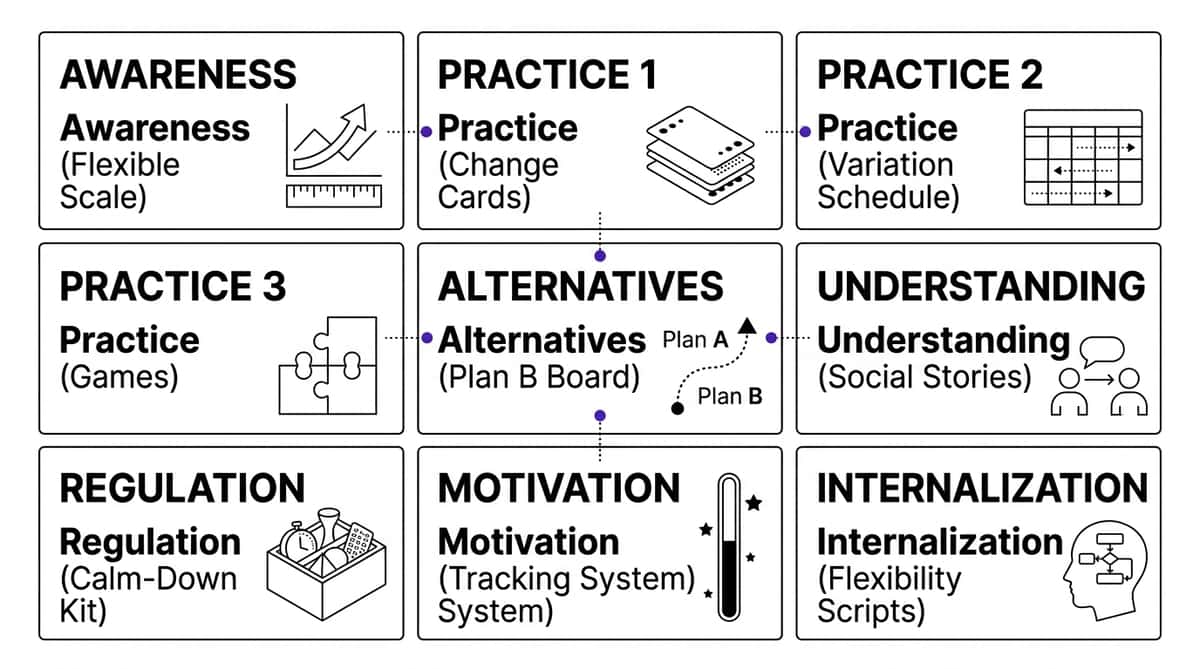
The Full System
How the 9 Materials Work Together
No single material delivers flexibility. The power is in the integrated system — each material addressing a different dimension of what flexibility training requires.
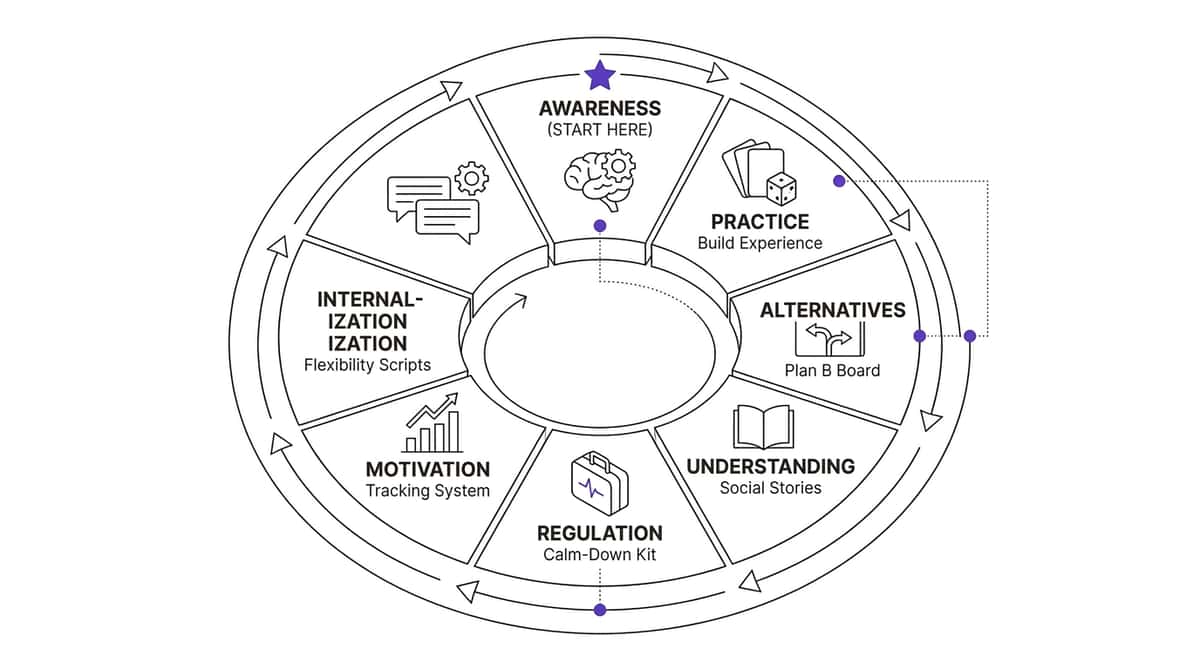
Start with awareness, add regulation support, introduce practice materials, then build toward internalized scripts. Progress slowly — let the child's actual response guide your pace, not an assumed timeline.

Implementation Principles — What Every Parent & Therapist Must Know
Start Small — Very Small
Begin with changes so small they're almost unnoticeable. Build extensive success with easy changes before increasing difficulty. Confidence comes from accumulated wins, not from forcing difficult challenges.
Regulate First, Then Flex
When distress is high, support regulation before expecting flexibility. The brain cannot think flexibly in survival mode. This is neuroscience, not permissiveness.
Celebrate Effort, Not Just Success
Recognize trying, not just succeeding. Effort toward flexibility deserves acknowledgment. The child trying hard to bend — even unsuccessfully — is doing real therapeutic work.
Never Punish Inflexibility
Rigidity is not a choice — it's a capacity difference being worked on. Punitive approaches increase rigidity and anxiety, backfiring on the very goal you are trying to reach.
Take the Long View
Flexibility development takes months to years, not weeks. Maintain consistent practice and patient expectations. Every small success is a building block — it all compounds.

Common Mistakes to Avoid in Flexibility Training
⚠️ Too Much, Too Fast
Increasing flexibility demands faster than the child's capacity grows. Creates trauma, not skill. Always let the child's actual response — not your timeline — guide progression.
⚠️ Flooding Approach
Exposing the child to maximum variability expecting them to "just deal with it." This approach almost always backfires, increasing rigidity as a protective response.
⚠️ No Practice When Calm
Only working on flexibility during crisis instead of during calm times. Must build the skill before needing it. Crisis is too late for first teaching.
⚠️ Ignoring Anxiety
Addressing rigidity without addressing underlying anxiety. Both need attention — they are closely linked, and anxiety treatment often directly improves flexibility.
⚠️ Expecting Quick Results
Expecting rapid change when flexibility development is genuinely a long-term process. Maintain realistic expectations and celebrate incremental progress consistently.

When to Seek Professional Help
These materials are powerful tools for home and school use — but some levels of rigidity require comprehensive professional assessment and individualized treatment planning. Seek professional support when:
Rigidity significantly impairs daily functioning or family life and has not responded to consistent home efforts
The child shows signs of significant anxiety or depression alongside the rigidity
Rigidities involve safety concerns — the child must do things that are dangerous
The child is unable to participate in school or community due to inflexibility
Meltdowns are frequent, prolonged, or involve aggression toward self or others
Family relationships are severely strained and the situation is not improving

Real-World Evidence
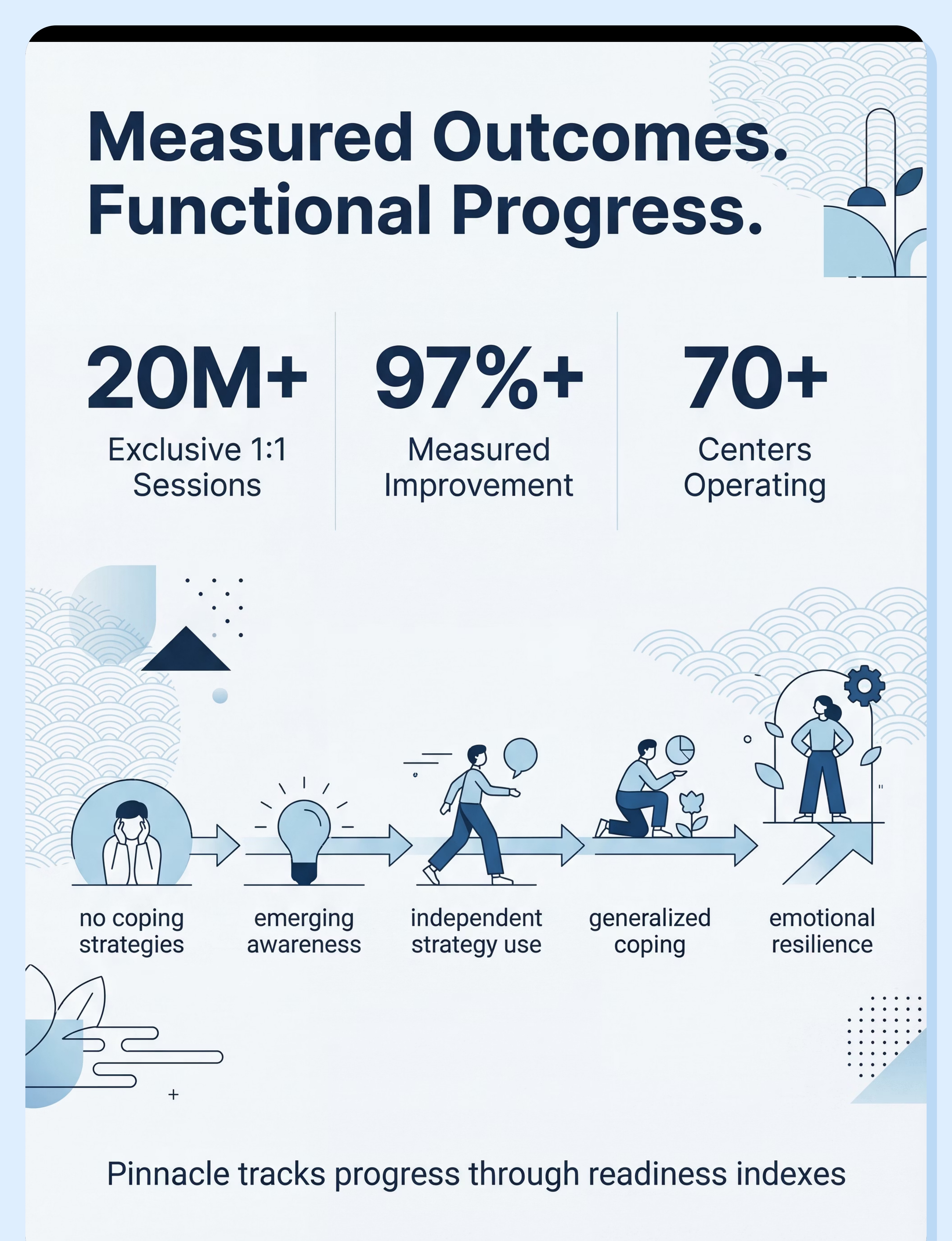
Measured Outcomes. Real Progress.
20M+
Exclusive 1:1 Sessions
Across converged therapy disciplines — speech, OT, behavior, and special education working as one system.
97%+
Measured Improvement
Across one or more readiness indexes, tracked using standardized assessment methodology.
70+
Centers
Operating under a single GPT-OS® clinical system — consistent standards across every location.
Flexibility is measurable. At Pinnacle, we track real progress using standardized readiness indexes: Behavioral Flexibility Readiness Index · Transition Tolerance Readiness Index · Problem-Solving Adaptability Index · Change Tolerance Readiness Index · Cognitive Flexibility Index.
Preview of 9 materials that help with flexibility training Therapy Material
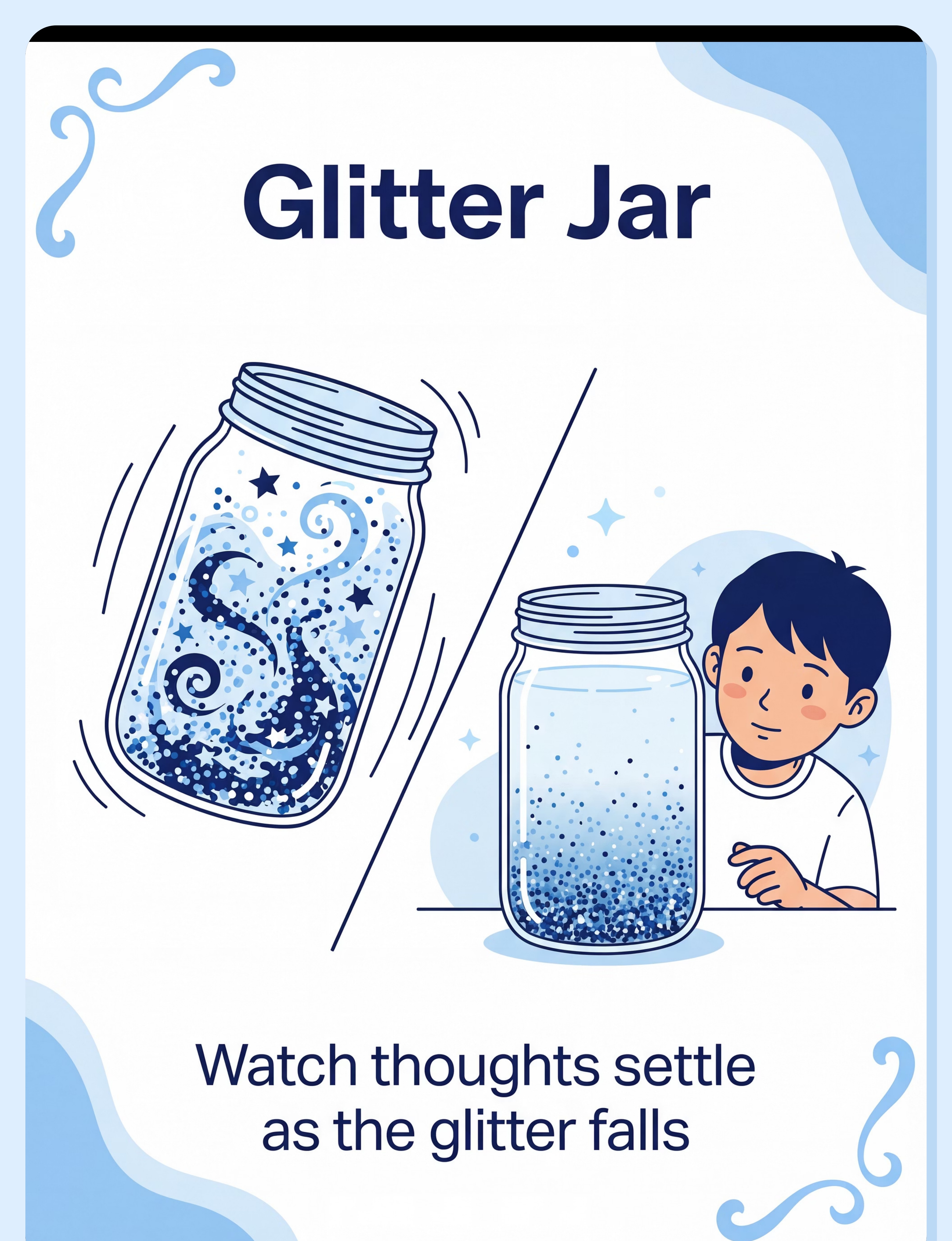
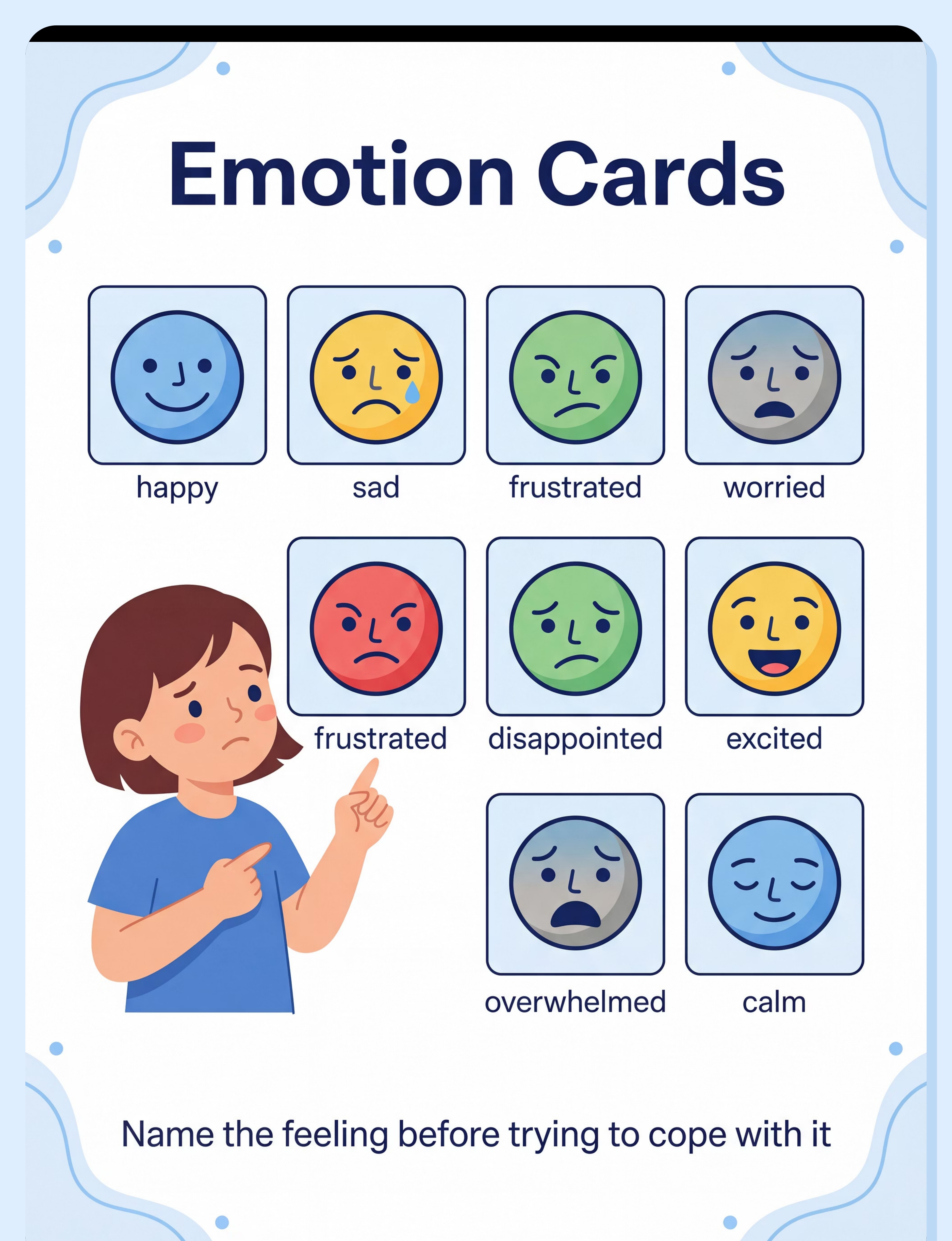
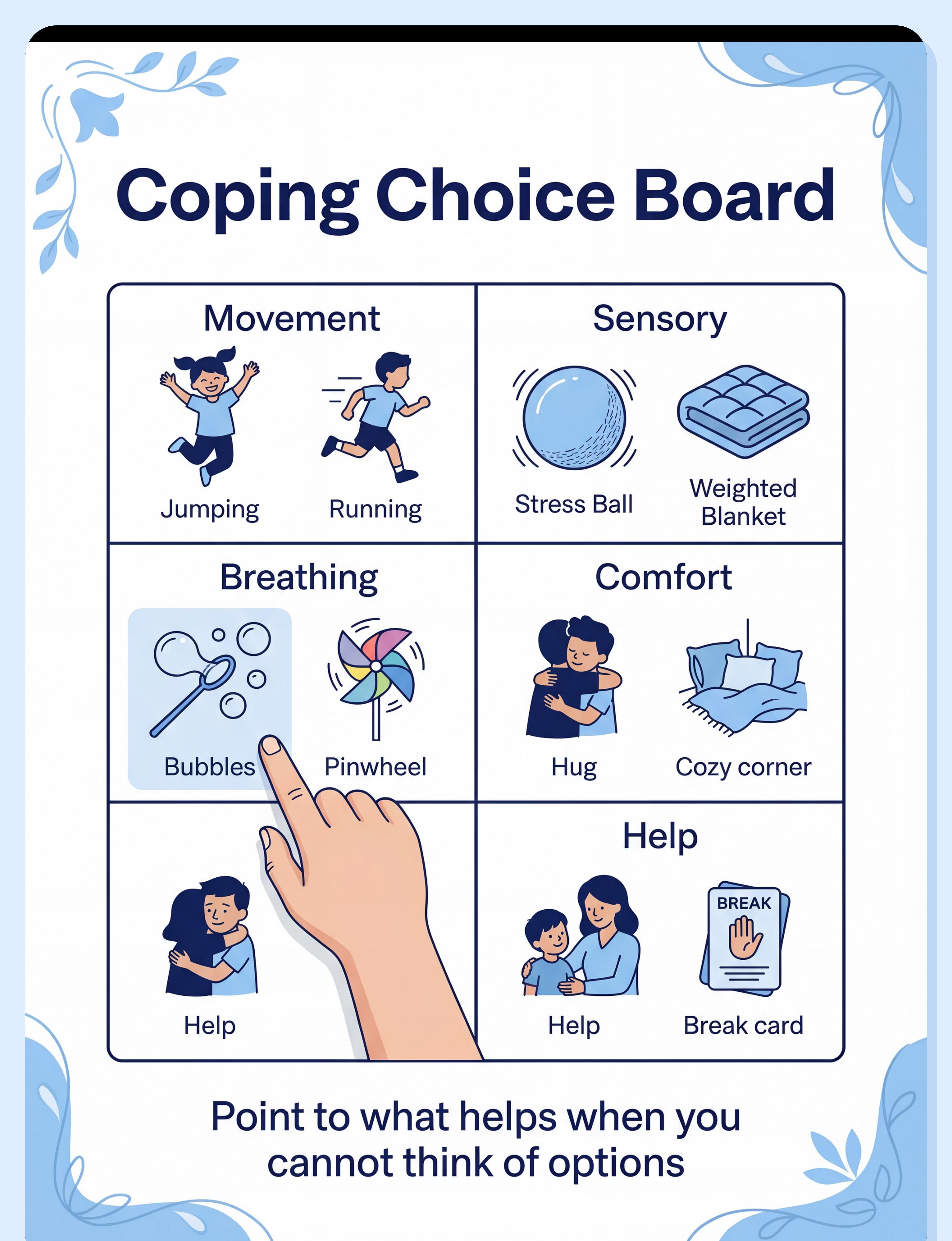
Below is a visual preview of 9 materials that help with flexibility training therapy material. The pages shown help educators, therapists, and caregivers understand the structure and content of the resource before use. Materials should be used under appropriate professional guidance.



Link copied!

A Family's Journey: From Rigid to Resilient
"Our daughter lived by rigid rules that controlled our entire family. Any deviation triggered hours of distress. We couldn't be spontaneous, couldn't adapt to circumstances, couldn't live normally. The flexibility training approach started small — tiny variations within her routines that she could tolerate. The Plan B board helped her see that alternatives existed. The games made flexibility feel fun instead of threatening. It took months, but she started to bend. Now, at 8, she can handle most changes with some warning. She still prefers predictability, and that's okay. But she no longer breaks when things don't go perfectly. She bends. And so do we — we can live again."
— Parent, Pinnacle Network. Illustrative case; individual outcomes vary based on many factors including age, intervention intensity, and individual differences.