
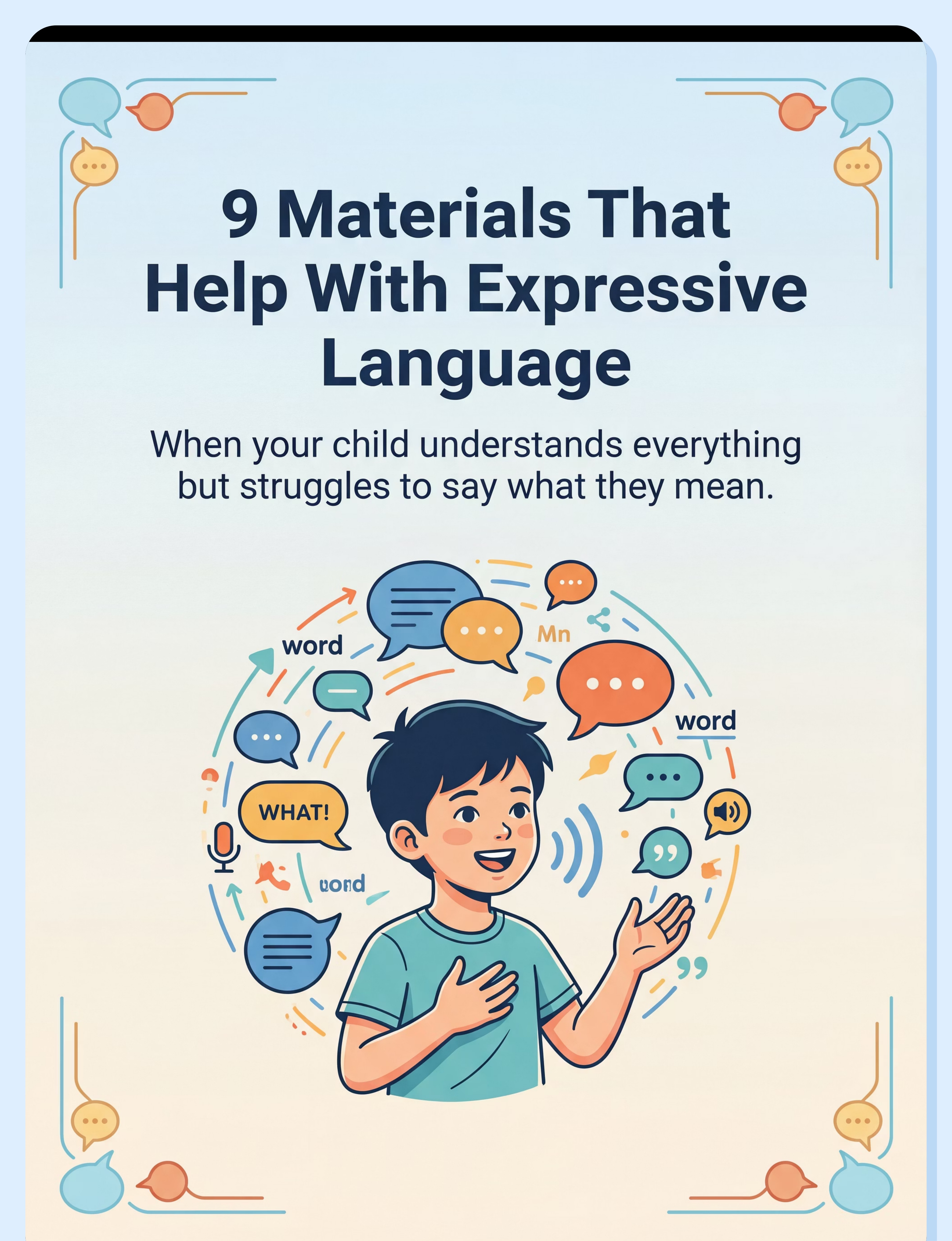
9 Materials That Help With Expressive Language
When your child understands everything but struggles to say what they mean — these 9 therapy-backed materials help the words flow.
Speech & Language – Episode 969
Expressive Language + Verbal Communication + Word Retrieval + Sentence Building + Narrative Skills
Understanding Expressive Language Delay
What Is Expressive Language?
Expressive language refers to the ability to use words, sentences, gestures, and writing to communicate meaning to others. Children with expressive language difficulties understand more than they can express — they have thoughts, ideas, and knowledge but struggle to translate these into spoken or written words.
Clinical Terms
Expressive Language Delay/Disorder · Language Production Difficulties · Verbal Expression Challenges · Word Retrieval Difficulties · Sentence Formulation Challenges
The Gap That Hurts
Expressive language often lags behind receptive language. The child has complete thoughts but can only produce fragments — leading to frequent miscommunication and emotional distress.
Common Challenges Children Face
Expressive language difficulties can take many forms. Recognizing these patterns is the first step toward finding the right support.
Word Retrieval
Difficulty finding the right word — knowing what they want to say but not accessing it in the moment ("tip of the tongue" feeling).
Telegraphic Speech
Using single words when sentences are needed. Missing grammatical elements — "Mama car go" instead of "Mama, can we go in the car?"
Narrative Difficulty
Trouble telling stories or explaining events in sequence. Can't share what happened at school or describe their day.
Conversational Struggles
Difficulty starting, maintaining, and elaborating in conversations. By the time they find their words, the moment has passed.
Question Challenges
Trouble forming questions and answering open-ended questions. Reduced verbal output and reliance on pointing or gesturing.
Emotional Impact
Frustration when unable to express thoughts, sometimes leading to behavioral outbursts or withdrawal from communication situations.

A Parent's Voice
"My daughter is four, and she understands absolutely everything. Complex instructions, subtle emotions in voices, the plots of her favorite shows — she gets it all. But when she opens her mouth to speak, it's like watching someone try to push through a locked door. She knows what she wants to say. I can see the thought forming. But between her mind and her mouth, something breaks down. Last week, she tried to tell me about something that happened at school. 'The boy... he... it was...' She couldn't finish. She started crying — not from sadness, but from pure frustration that her words wouldn't come. What materials help bridge this gap? What helps children move from thinking words to speaking them?"
The Receptive–Expressive Gap
When receptive language (understanding) is significantly more advanced than expressive language (speaking), this indicates expressive language difficulty — not a problem with intelligence or effort. Active intervention accelerates expressive development; children don't simply "catch up" on their own.
Intelligence Is Intact
A child who understands but cannot express themselves may be mislabeled as shy, stubborn, or intellectually delayed — when the actual challenge is language production, not comprehension or intelligence. The challenge is the output channel, not the cognitive processing.
9 Materials That Help — At a Glance
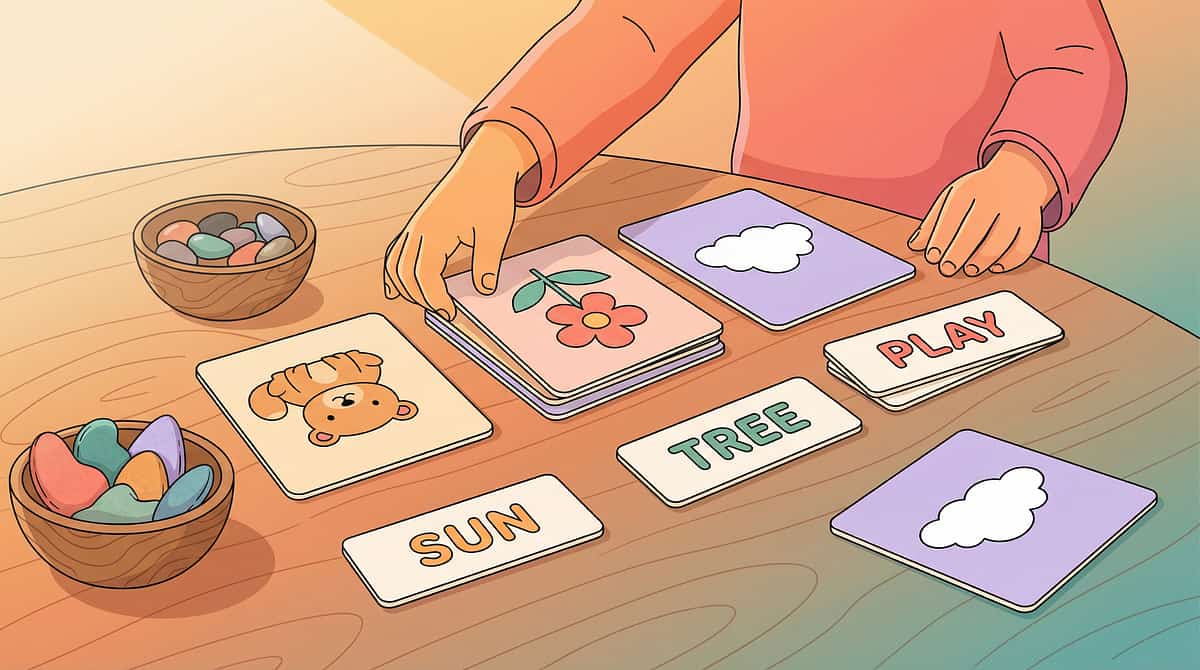
Each material targets specific skills in the expressive language pathway — from retrieving individual words to telling complete personal stories.
1
Picture-Word Cards with Sentence Builders
See it, say it, build sentences
2
Story Sequencing Cards
First, then, finally — narrative language
3
Wh-Question Visuals
Who, what, where, when, why, how
4
Verb Action Cards with Tense Markers
Actions + tenses for complete sentences
5
Carrier Phrase Strips
Sentence starters that reduce cognitive load
1
Category Sorting Boxes
Organized vocabulary = faster word finding
2
Describing Mats
Category, features, function — rich expression
3
Conversation Starter Cards
Practice the give-and-take of talking
4
Personal Narrative Photo Books
Tell your own story with visual support

Material 1 of 9
Picture-Word Cards with Sentence Builders
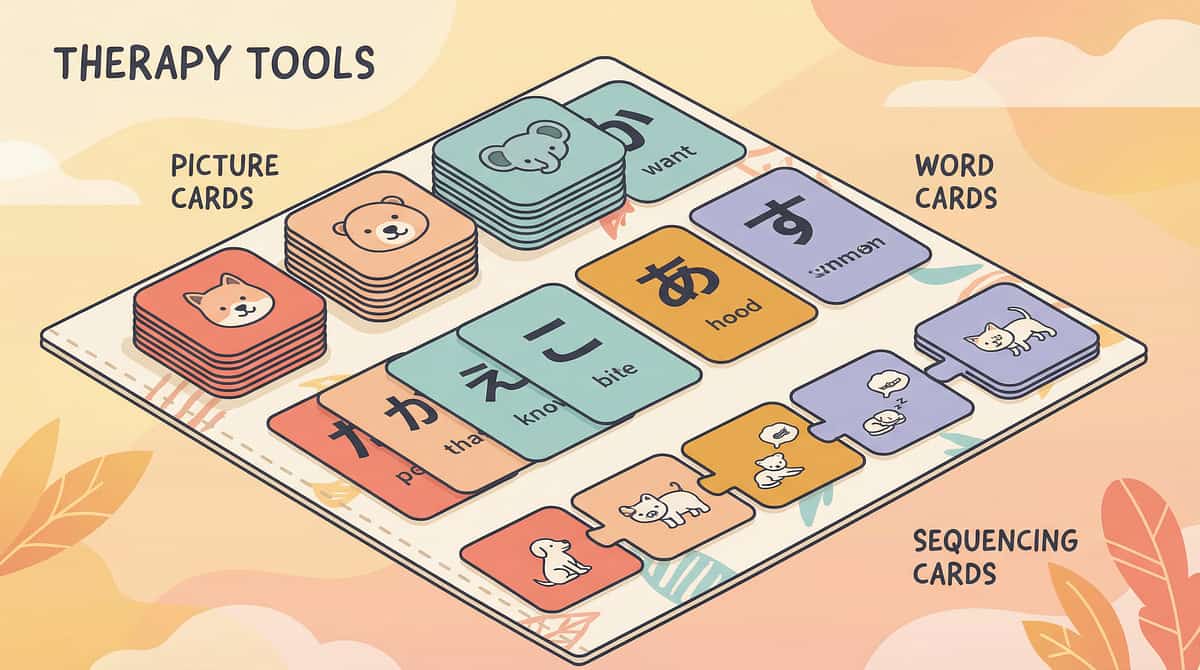
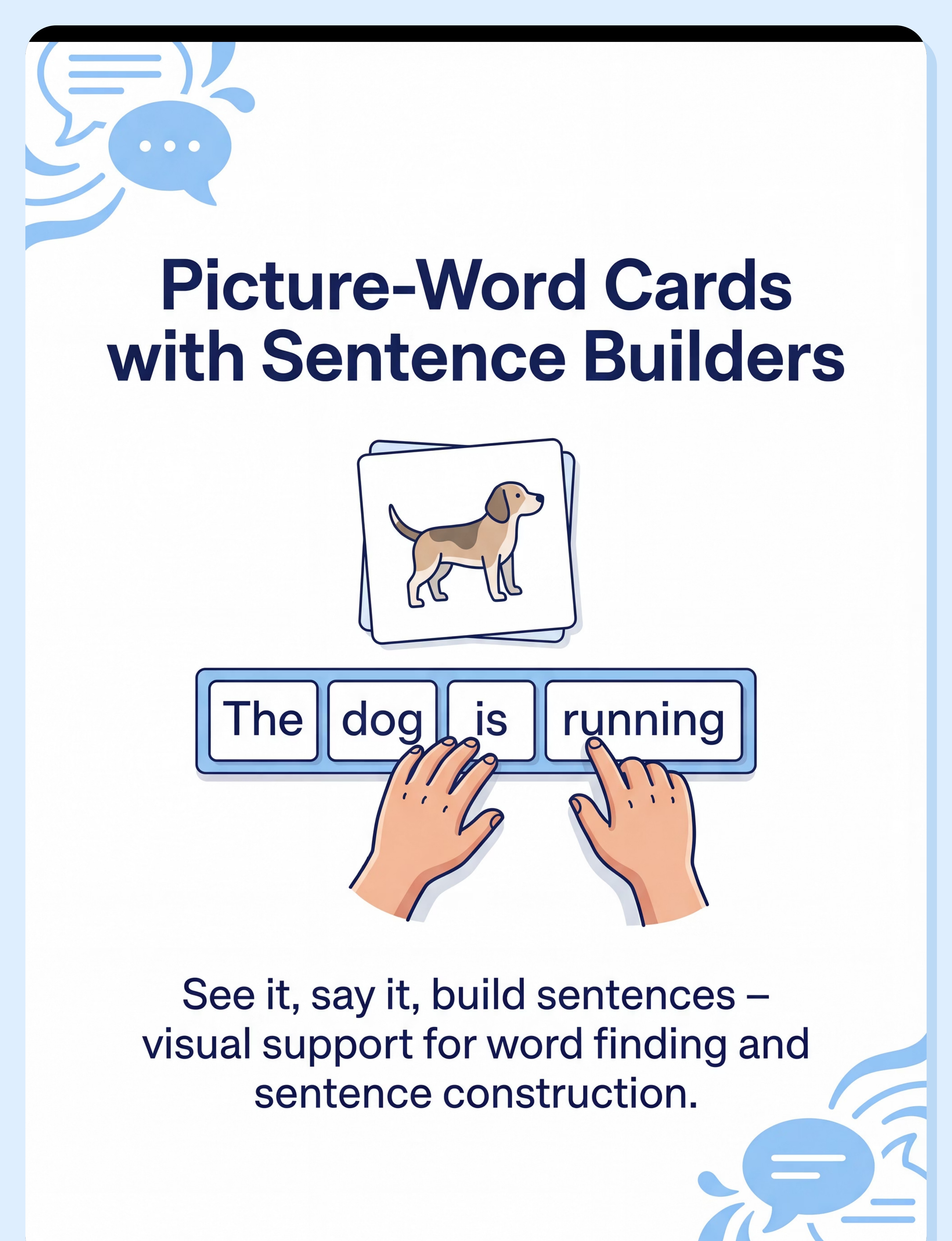
See it. Say it. Build sentences. Expressive language requires two skills working together: retrieving the right word and organizing words into sentences. Picture-word cards provide visual support for word retrieval — the child sees the image and practices producing the label. Sentence builders add the next layer — combining words into grammatically correct sentences.
A card set might show a picture of a dog running with word cards for "The," "dog," "is," "running" that the child arranges and then reads aloud. This visual support reduces the cognitive load of both word finding and sentence construction, allowing practice of complete thoughts. Over time, visual scaffolding fades as language patterns become internalized.
Key Insight: Visual support reduces the cognitive load of word retrieval AND sentence construction, allowing children to practice complete expression simultaneously.
Picture-Word Cards: DIY Guide
Basic Picture-Word Cards
Collect or print clear images representing nouns, verbs, adjectives, and prepositions. Each card: image on top, word written below. Start with 50–100 core vocabulary words across categories:
- People: boy, girl, mama, papa, baby
- Actions: running, eating, sleeping, jumping, reading
- Objects: ball, cup, book, car, apple
- Places: home, school, park, shop
- Descriptors: big, small, happy, sad, red, blue
Make cards playing-card size or larger. Laminate for durability.
Sentence Builder Strips
Create word cards for sentence elements:
- Articles: "The," "A," "An"
- Verbs: "is," "are," "was," "will"
- Action words: "-ing" forms (running, eating)
- Locations: "in the park," "at home," "on the table"
Progression
- 2-word: "Dog running"
- 3-word: "The dog running"
- 4-word: "The dog is running"
- Expanded: "The big dog is running fast"
Materials Needed
Pictures, word cards, sentence element cards, laminating supplies, sentence strip or board
Price Range
₹300–1,200 or fully DIY with printed pictures and index cards
Safety Note
All cards should be appropriately sized to prevent choking hazards for young children
Material 2 of 9
Story Sequencing Cards
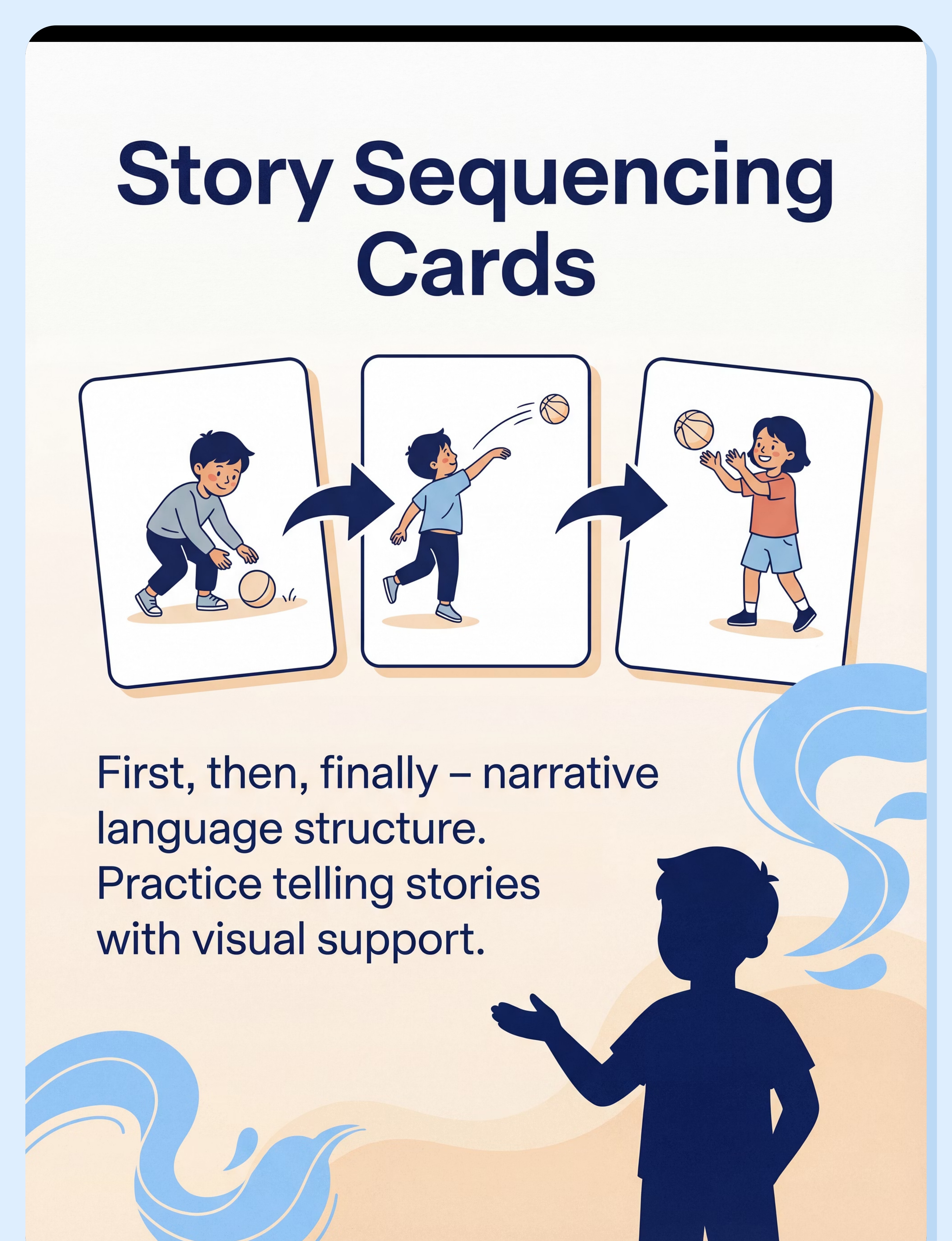
First, then, finally — narrative language. Telling a story or explaining an event requires expressive language at its most complex — vocabulary, sentence structure, sequencing, connecting ideas, maintaining a narrative thread. Story sequencing cards break this overwhelming task into visual steps.
The child sees three to six cards showing a story in order — a boy picking up a ball, throwing it, catching it — and practices narrating the sequence. This supports both the structure of narrative (beginning, middle, end) and the language of connection: "First... then... finally..." For children who can't yet tell you about their day, these cards provide the visual scaffold to practice narrative expression before transferring skills to personal storytelling.
Key Insight: Stories have structure. Visual sequences teach that structure while reducing the cognitive load of remembering and organizing narrative.

Story Sequencing Cards: DIY Guide
01
Sequence Length
Start with 3-card sequences for beginners. Progress to 4, then 5, then 6-card sequences. Eventually 8–10 card sequences for complex narratives.
02
Story Types
Daily routines (waking up, brushing teeth), simple events (getting a snack, going to the park), problem-resolution stories, social scenarios, and familiar story retellings.
03
Narrative Language Scaffolds
Create cue cards with sequence words: "First," "Then," "Next," "After that," "Finally." Practice using these connectors between cards. Eventually, sequence words are used without visual cues.
04
Personal Story Cards
Take photos of your child's daily activities. Create sequence cards from their real life. "Tell me about going to Grandma's house" — with photos of the actual visit. This bridges story cards to personal narrative.
Creating the Cards
Draw simple stick figures (clarity over artistry), print images from royalty-free sources, cut from magazines, or take photos of family members acting out sequences. Each card should show a clear, distinct step with the same characters and setting for visual continuity.
Quick Reference
Price: ₹200–800 or free with photos and home printing Materials: Sequence images, card stock, laminating supplies, sequence word cue cards, storage by complexity level Safety: Ensure card edges are smooth and size is appropriate for age

Material 3 of 9
Question Word Visuals (Wh-Question Cards)
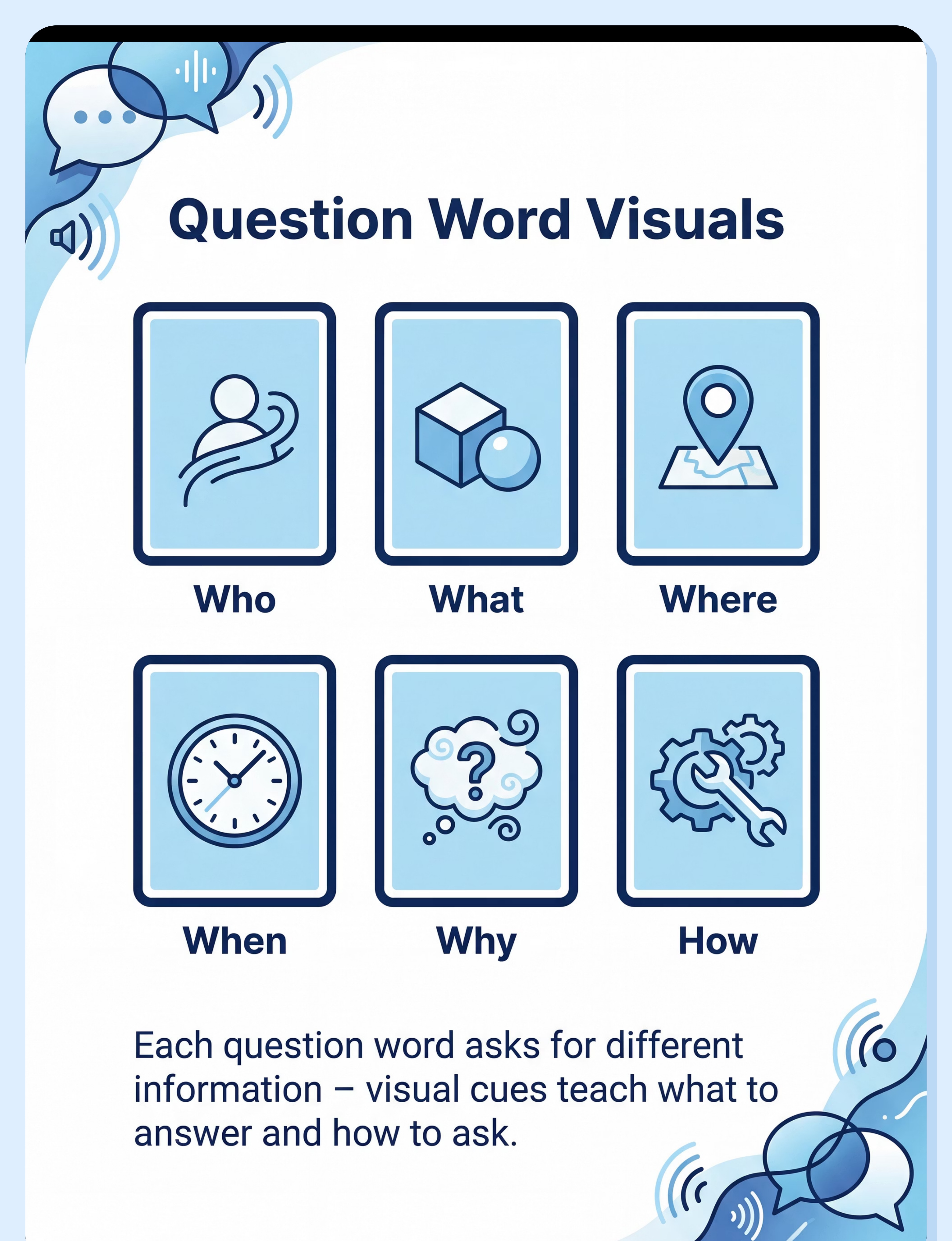
Who, what, where, when, why, how. Asking and answering questions is fundamental to expressive language and conversation. Wh-questions each require different information types and sentence structures. Question word visuals provide visual cues for understanding what each question word means and how to formulate both answers and questions.
"Who" shows a person icon — the answer will be a person. "Where" shows a location symbol — the answer will be a place. "Why" shows a thought bubble — the answer will be a reason. These visuals teach the question-answer correspondence and support children in both responding and generating their own questions — a crucial expressive skill for conversation and learning.
Key Insight: Questions are the engine of conversation and learning. Visual cues teach the structure of asking and answering with confidence.

Wh-Question Cards: DIY Guide
WHO
Icon of person/people. Asks about people. Answer will be a person's name or role. Practice: "Who is at the door?" → child responds with a person.
WHAT
Icon of object or action. Asks about things or actions. Practice: "What is the dog doing?" → child responds with an action or object.
WHERE
Icon of location/map pin. Asks about places. Practice: "Where is the ball?" → child responds with a location: "Under the table."
WHEN
Icon of clock or calendar. Asks about time. Practice: "When do we eat lunch?" → child responds with a time reference.
WHY
Icon of thought bubble with question mark. Asks about reasons. Practice: "Why is she crying?" → child responds with a reason.
HOW
Icon of gears or steps. Asks about method or process. Practice: "How do you make a sandwich?" → child responds with a sequence of steps.
Price Range: ₹150–500 | Format: Cards on a ring for portability, plus a wall poster version | Advanced Practice: Match question word cards to answer type cards (person, place, time, object, reason) to build deep question-answer understanding

Material 4 of 9
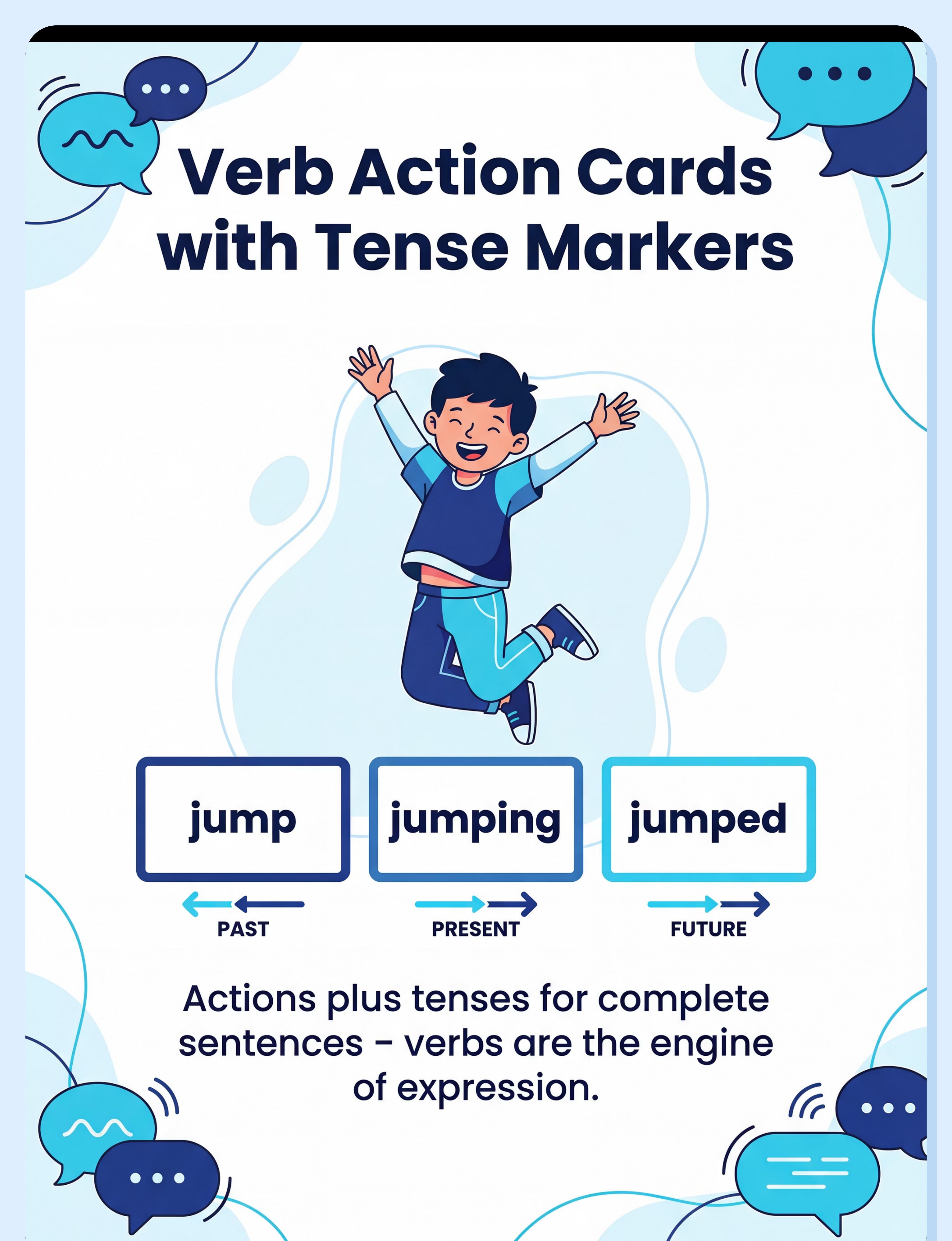
Verb Action Cards with Tense Markers
Actions + tenses for complete sentences. Verbs are the engine of sentences — you cannot express action, change, or events without them. Many children with expressive language difficulties struggle with verb use, verb tenses, and verb forms. Verb action cards provide pictures of actions with associated word cards for different tenses: "jump," "jumping," "jumped," "will jump."
The child sees the action, produces the verb, and practices using correct tense forms. Tense markers — visual symbols for past, present, and future — help children understand when to use each form. This systematic approach builds the verb vocabulary and grammatical accuracy that complex expression requires.
Key Insight: Verbs carry meaning and grammar simultaneously. Systematic verb practice builds both vocabulary and grammatical accuracy in one activity.
Verb Action Cards: DIY Guide
Action Picture Card Categories
- Movement: running, jumping, walking, swimming, climbing
- Daily activities: eating, drinking, sleeping, brushing, washing
- Play actions: throwing, catching, kicking, drawing, building
- Social actions: hugging, waving, sharing, helping, talking
50–100 verb cards is a strong set. Clear images showing single actions in progress.
Tense Marker Visuals
Create visual symbols for time:
- Past: Arrow pointing backward or "yesterday" symbol
- Present: Circle or "now" symbol
- Future: Arrow pointing forward or "tomorrow" symbol
Teaching Progression
- Start with present progressive: "The boy is running"
- Add past tense: "Yesterday, the boy ran"
- Add future: "Tomorrow, the boy will run"
- Focus extra time on irregular verbs: go/went, eat/ate, see/saw
Game Formats
Verb charades: act out the verb, others say it in different tenses. Tense dice: roll for past/present/future, say the sentence.
Price Range
₹250–700 or fully DIY with printed action images and hand-written word cards
Safety Note
Standard card safety — size appropriate for age group
Material 5 of 9
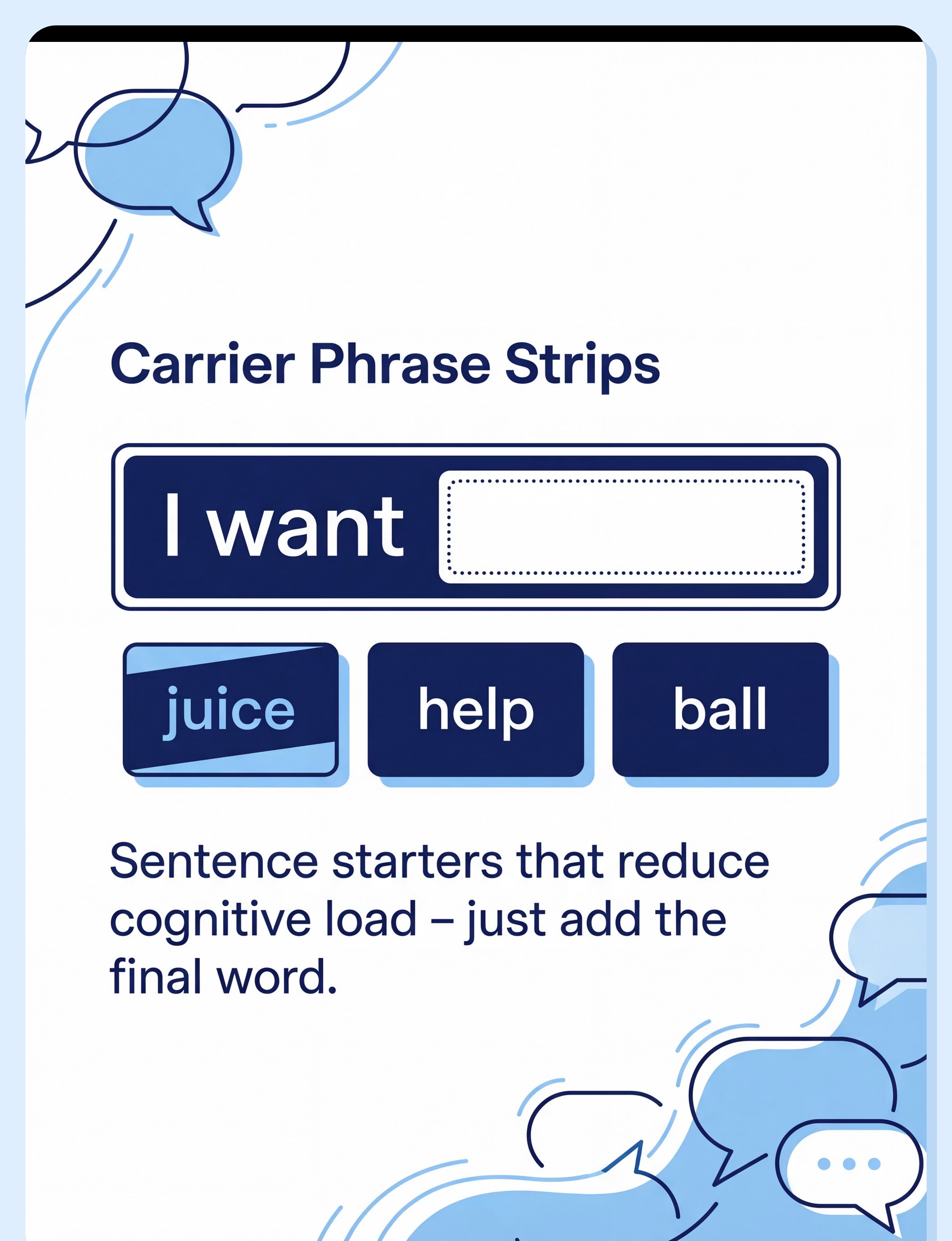
Carrier Phrase Strips
I want _____. I see a _____. I like _____. Children with expressive language difficulties often get stuck at the very start of a sentence — they have a word they want to say but can't initiate the sentence structure around it. Carrier phrases are sentence starters that provide the grammatical framework, leaving just the final word to fill in.
The child learns these phrases as chunks, reducing the demand of sentence construction. Once carrier phrases are automatic, expression becomes easier because the child only needs to add the specific content word — not build the entire sentence from scratch. These phrases become the launching pads for more complex expression over time.
Key Insight: Sentence starters reduce cognitive load. When children don't have to build the whole sentence, they can focus on expressing their specific message.
Carrier Phrase Strips: DIY Guide
Requesting Phrases
"I want ____." · "I need ____." · "Can I have ____?" · "Help me ____."
Commenting Phrases
"I see a ____." · "Look at the ____." · "This is a ____." · "There's a ____."
Describing Phrases
"It's ____." · "The ____ is ____." · "I like ____." · "It looks ____."
Social Phrases
"My name is ____." · "I feel ____." · "I'm going to ____."
Teaching Approach
Start with one phrase: "I want ____." Practice with many different endings — "I want ball," "I want juice," "I want Mama." When that phrase is automatic, add another. Build up a repertoire of 5–10 carrier phrases. Once basic phrases are mastered, expand: "I want the big ball" → "I want to go outside" → "I want Mama to help me."
Situation-Specific Sets
Mealtime: "I want ____." "More ____ please." "I don't like ____." Playtime: "Let's play ____." "My turn to ____." "I made a ____." School: "I need help with ____." "I don't understand ____."
Price Range: ₹100–400 or free with index cards and a marker
Material 6 of 9
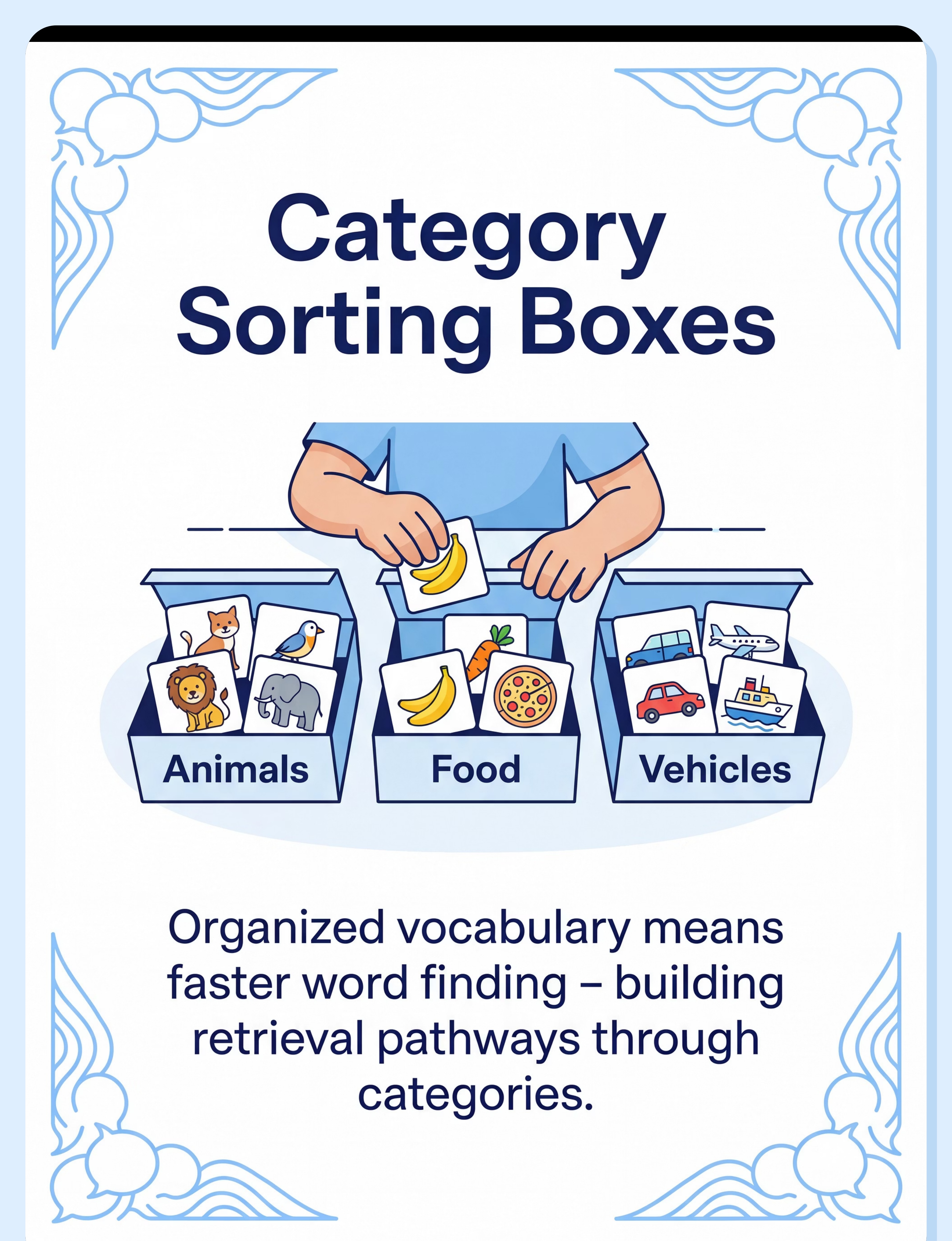
Category Sorting Boxes with Labels
Organized vocabulary = faster word finding. Word retrieval — finding the word you want to say — is easier when vocabulary is organized in the brain. Category sorting teaches children to organize words by type: animals, foods, vehicles, clothing, actions. When words are categorized, retrieval becomes more efficient because the child can mentally search one category rather than their entire vocabulary.
Sorting boxes with labels provide hands-on practice with categorization. The child sorts picture cards or objects into labeled boxes — all animals here, all foods here — while saying each word. This builds both vocabulary breadth and the organizational structures that support faster, more accurate word retrieval in real conversation.
Key Insight: Categorization builds retrieval pathways. When vocabulary is organized, the right word is easier to find when you need it most.

Category Sorting Boxes: DIY Guide
Basic Categories
- Animals (pets, farm, wild)
- Food (fruits, vegetables, snacks, drinks)
- Clothing (shirt, pants, shoes, hat)
- Vehicles (car, bus, train, airplane)
- Household objects (furniture, kitchen, toys)
- People (family, community helpers)
- Actions (things you do)
- Places (locations)
Sorting Practice
Child picks one item, names it, decides category, places in container.
"Apple. Apple is a food. Goes in the food box."
Naming is essential — sorting alone doesn't build expression. The verbal labeling during sorting is where language development happens.
Word Retrieval Games
After sorting, practice retrieval: "Tell me three animals from the animal box." "What food starts with 'a'?" "Name something you wear on your feet." Category membership helps word retrieval during this game phase.
Expanding Categories
Start with concrete, familiar categories. Add subcategories: "Animals that live in water," "Foods that are sweet." Then abstract categories: "Things that are soft," "Things we use outside."
Daily life connection: Sort actual groceries and laundry while naming each item — categories in real life, not just therapy.
Price Range: ₹200–600 | Containers: Small boxes, bins, divided trays, labeled paper plates, or sections of an egg carton | Safety: For young children, ensure sorting objects are not choking hazards

Material 7 of 9
Describing Mats (Feature, Function, Class)
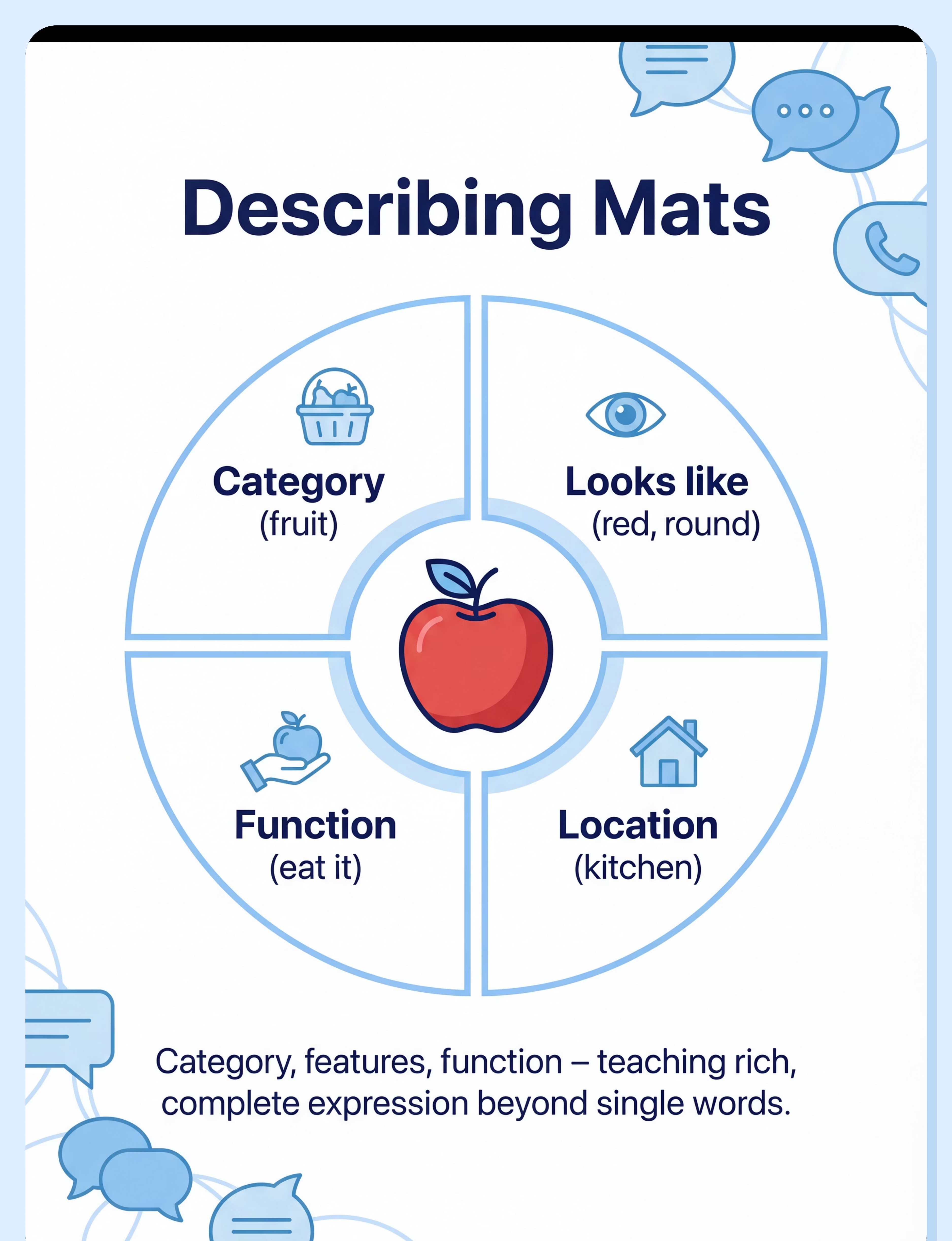
Category, features, function — rich expression. Rich expressive language means being able to describe things fully — not just naming them, but explaining what they look like, what they do, and what category they belong to. Describing mats (also called semantic feature analysis mats) provide a visual framework for comprehensive description.
"What category is it?" (It's a fruit.) "What does it look like?" (It's red and round.) "What do you do with it?" (You eat it.) "Where do you find it?" (In the kitchen.) This structure teaches children how to provide complete descriptions rather than single-word labels — building the detailed expressive language needed for conversation, explanation, and storytelling.
Key Insight: Description structure teaches elaboration. When children know what information to include, they can express themselves more completely and with confidence.

Describing Mats: DIY Guide
Mat Structure
Large sheet or laminated poster with sections. Center: space for object picture. Surrounding sections for description categories:
- Category/Group: "It's a ____." (animal, food, vehicle)
- Appearance: "It looks like ____." (color, size, shape)
- Function: "You use it to ____." (what you do with it)
- Location: "You find it in ____."
- Parts: "It has ____." (parts, made of)
- Optional: "It sounds like ____." "It feels like ____."
Teaching Process
Place picture in center of mat. Work through each section together: "First, what group does this belong to? It's a fruit." "What does it look like? It's yellow and curved." "What do you do with it? You peel it and eat it."
Goal: child produces full description without mat: "A banana is a fruit. It's yellow and curved. You peel it and eat it. You find it in the kitchen."
Game Version
Describe without showing. One child describes using mat format, others guess. Builds rich expressive language AND listening comprehension simultaneously.
Price Range: ₹150–500 | Format options: Paper mat with writing spaces, mat with Velcro for attaching answer cards, dry-erase laminated version, or digital on tablet | Word Retrieval Support: When a child can't find a word, mat categories prompt retrieval by providing an alternative pathway
Material 8 of 9
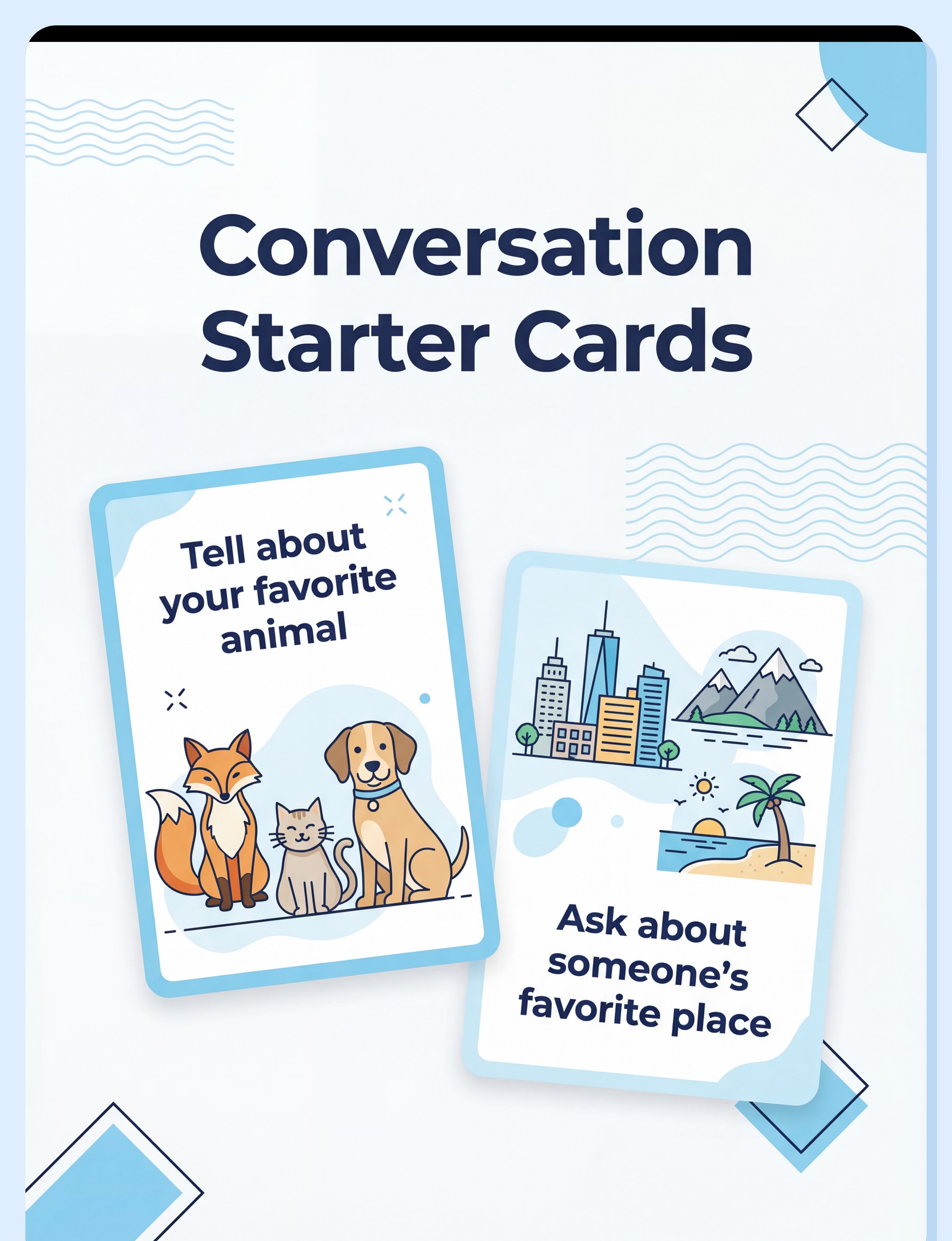
Conversation Starter Cards
Practice the give-and-take of talking. Conversation requires expressive language in its most dynamic form — initiating topics, responding to others, asking follow-up questions, sharing related information. Conversation starter cards give children practice phrases and topics to launch and maintain conversations.
Cards might include: "Ask someone about their favorite food," "Tell about something fun you did," "Ask a question about someone's pet," "Share something you're good at." The cards reduce the anxiety of not knowing what to say and provide structured practice in the give-and-take of conversation — building the social expressive language skills that enable connection and friendship.
Key Insight: Conversation is a skill that can be practiced and learned. Starter cards reduce the anxiety of "not knowing what to say" by providing a structured launch point.
Conversation Starter Cards: DIY Guide
Questions to Ask
"What's your favorite animal?" · "Do you have any pets?" · "What do you like to play?" These help children practice initiating and asking follow-up questions naturally.
Things to Share
"Tell about your family." · "Share something funny that happened." · "Describe your favorite food." These build topic initiation and elaboration skills.
Follow-Up Prompts
"Ask a question about what they said." · "Tell something similar." · "Say something you found interesting." These teach conversation maintenance — keeping topics alive.
Conversation Skills Targeted
Topic initiation · Topic maintenance · Turn-taking · Asking follow-up questions · Sharing related information · Ending conversations gracefully: "It was nice talking to you!"
Situation-Specific Sets
Create separate sets for: meeting new people, family dinner, playdates, and classroom conversations. This helps children generalize conversation skills across different settings and social contexts.
Quick Reference
Price Range: ₹150–400 Daily Practice: Mealtime, car ride, and bedtime conversation cards make practice routine Safety Note: Content should be age-appropriate and culturally sensitive
Material 9 of 9
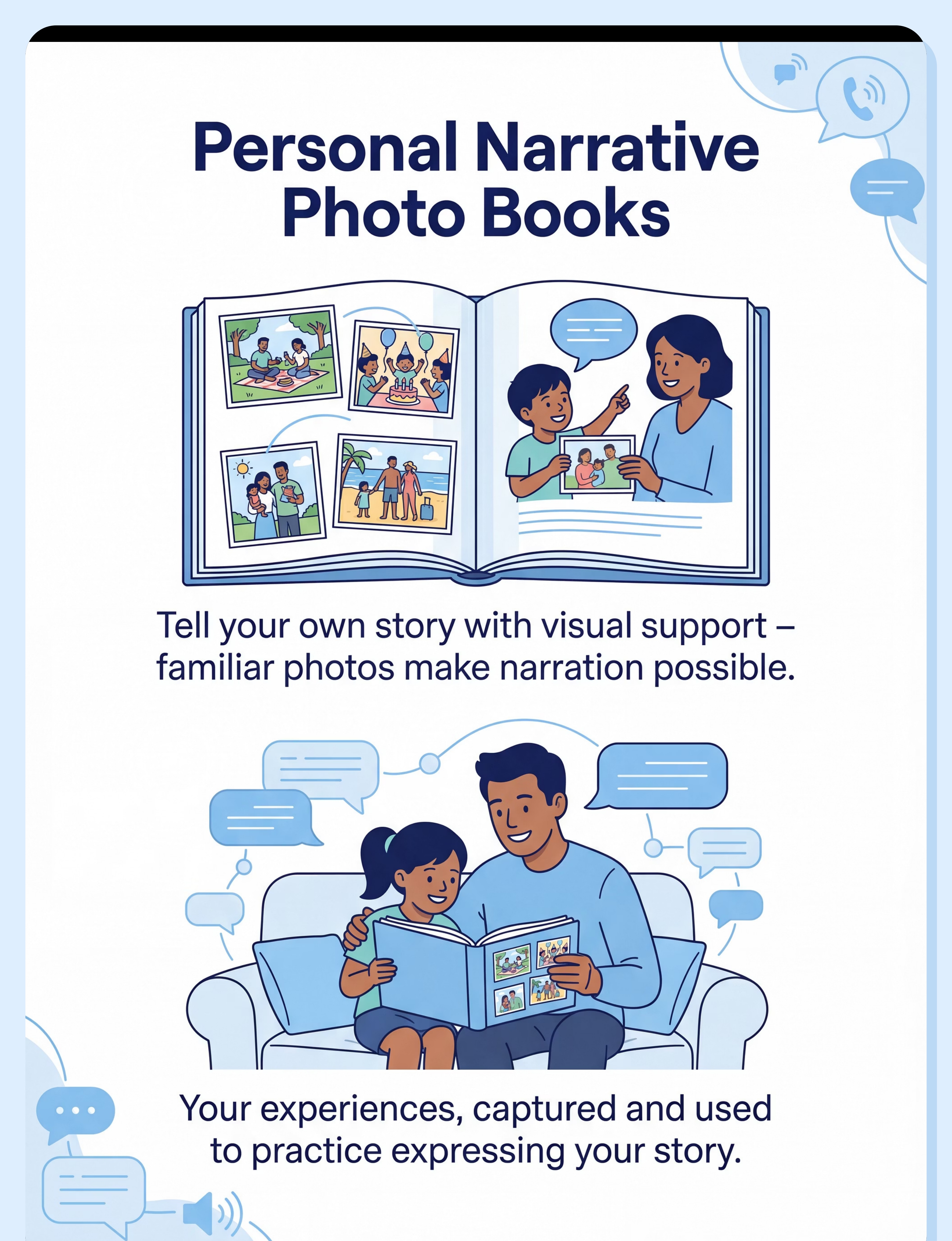
Personal Narrative Photo Books
Tell your own story with visual support. The ultimate goal of expressive language is telling others about your own experiences — personal narrative. But for children who struggle with expression, narrating their own lives is the hardest task of all. Personal narrative photo books bridge this gap by using photos of the child's actual experiences as visual supports.
A photo book of the child's birthday party, a family trip, or even just "yesterday" provides visual cues for practice. "Look, here you are opening presents. What happened here? What did you say?" The familiar photos reduce the memory load, allowing the child to focus on language production. This is where all expressive skills come together — in telling their own story.
Key Insight: Personal narrative is the ultimate expressive language goal. Photo books provide the scaffolding to practice telling your own story — the foundation of all human connection.

Personal Narrative Photo Books: DIY Guide
1
Capture Photos
Take photos during family activities. Capture sequences: beginning, middle, end of events. Include the child when possible. Photograph familiar daily routines AND special events.
2
Create the Book
Print and create simple albums, or use a digital slideshow on a tablet. Organize chronologically. Simple captions are optional — the child provides the words.
3
Practice Narrating
"Tell me about this picture. What's happening here?" Prompt with questions: "Who is that? What are you doing? How did you feel?" Use sequence words: "First, then, next, finally."
4
Build Independence
Initially ask many prompt questions. Reduce prompts over time. Goal: child narrates from photos with minimal prompting, then without photos. "Can you tell Grandma about your birthday?"
Event Book Examples
- Birthday party: getting ready → guests arriving → cake → presents → goodbye
- Trip: packing → traveling → arrival → activities → going home
- Playdate: friend arriving → playing → snack → goodbye
- My morning routine (with child's actual photos)
Quick Reference
Price Range: ₹200–800 printed, or FREE with a digital album Privacy Note: Be thoughtful about which photos are used and where books are shared, maintaining appropriate privacy. Generalization: Transfer from book-supported narration to independent telling by phone or in person to relatives who weren't there

The Complete Progression Order
Use this recommended sequence to build expressive language skills systematically — each material prepares the child for the next level of expression.
This progression moves from foundational word production through sentence construction, grammar, organization, elaboration, and finally to the full integration of skills in personal narrative. Each step is meaningful — and each step builds on the last.

Essential Starter Kit
If you're just beginning, these four materials give you the highest impact entry point for supporting expressive language at home or in therapy.
Picture-Word Cards
Build vocabulary production — the foundation of all expression. Start with 50 core words across people, actions, objects, and places.
Carrier Phrase Strips
Provide sentence structure so children can launch expression. Start with "I want ____" and build from there.
3-Step Story Sequence Cards
Begin narrative skill development with simple 3-card sequences before moving to longer, more complex stories.
Wh-Question Visuals
Teach the structure of asking and answering — the engine of conversation, learning, and social connection.
Budget Note: All 9 materials can be homemade with printed pictures, index cards, and laminating. Digital versions cost nothing if a tablet is available. Full set price range: ₹1,500–5,500; much of this can be DIY or free.
Materials by Skill Target
Match the material to the specific breakdown point in your child's expressive language — because targeted practice is always more effective than general exposure.
Skill Target | Primary Materials | Supporting Materials | |
Vocabulary Production | Picture-Word Cards, Category Sorting Boxes | Describing Mats | |
Word Retrieval | Category Sorting Boxes, Describing Mats | Picture-Word Cards | |
Sentence Formulation | Carrier Phrase Strips, Picture-Word Cards with Sentence Builders | Verb Action Cards | |
Grammar & Verb Tenses | Verb Action Cards with Tense Markers | Sentence Builders | |
Narrative Language | Story Sequencing Cards, Personal Narrative Photo Books | Describing Mats | |
Conversation Skills | Conversation Starter Cards, Wh-Question Visuals | Carrier Phrase Strips |
Home Carry-Over: Supporting Expression Every Day
What happens between therapy sessions matters as much as the sessions themselves. These daily strategies help build expressive language in real life — without making every moment feel like a therapy exercise.
Create Communicative Temptation
Make situations where the child is motivated to communicate — place desired items visible but out of reach, offer choices, pause and wait. Motivation drives expression.
Give Extra Wait Time
Allow extra time for your child to formulate their expression. Resist the urge to jump in and speak for them. The struggle time is where language learning happens.
Expand and Recast
When your child says "Ball," respond with: "Yes! The big red ball is rolling!" You're modeling rich language without requiring imitation or making them feel corrected.
Daily Narrative Practice
Practice telling about the day, upcoming events, and past experiences with photo support. "Tell me three things that happened today." Make it a warm ritual, not a test.
Pitfalls to Avoid at Home
Well-meaning responses can sometimes accidentally reduce a child's motivation to express themselves. Here's what to watch for:
❌ Avoid Constant Testing
Don't repeatedly ask "What's this? What's that?" in a quiz format. It increases pressure and decreases spontaneous, motivated expression. Children express more when they feel safe, not evaluated.
❌ Avoid Explicit Correction
Avoid saying "No, don't say it that way." Instead, use modeling and recasting. Child: "He goed to school." Adult: "Yes! He went to school, didn't he?" The child hears the correct form without shame.
❌ Avoid Speaking for Them
Don't always answer for your child in social situations. Allow struggle time for expression. Others can wait — and your child's confidence grows each time they successfully express themselves.
❌ Avoid Comparison
Avoid comparing your child to siblings or peers in front of them. Every child's language development path is individual, and comparison adds pressure that inhibits, rather than encourages, expression.
AAC & These Materials: Working Together
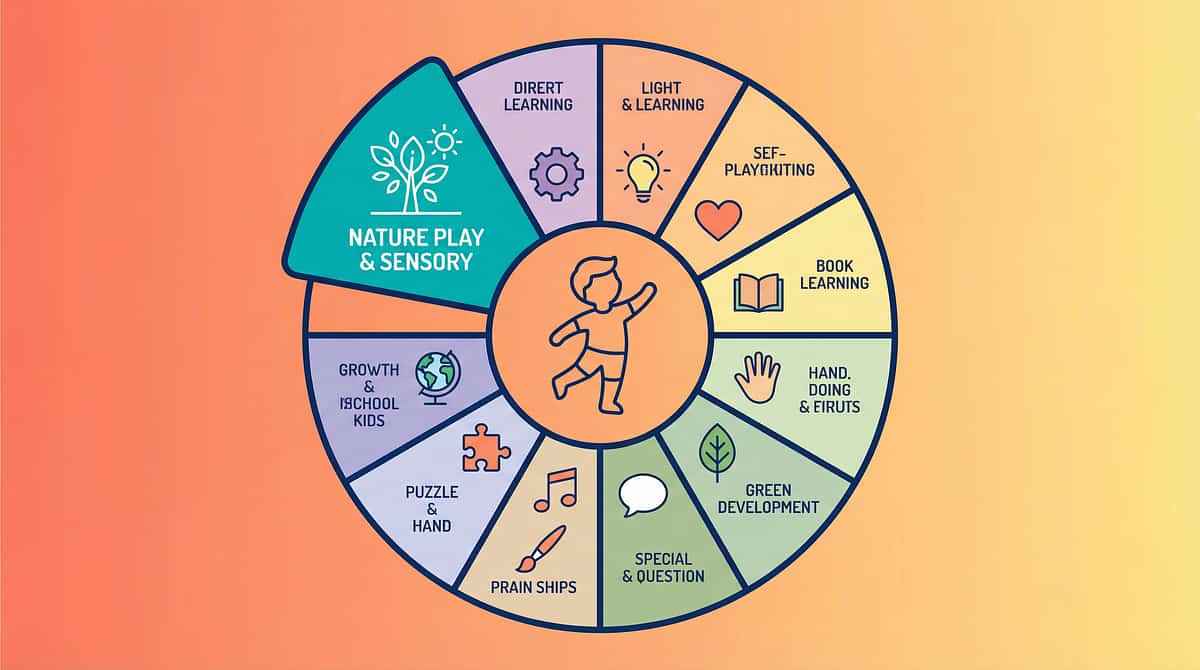
When to Consider AAC
Augmentative and Alternative Communication (AAC) does NOT hinder speech development — it often supports it by providing successful communication experience and reducing frustration. Consider AAC when:
- Severe expressive limitation with significant communicative frustration
- Speech production not keeping pace with communicative needs
- Child has more to say than current verbal abilities allow
- Motor speech difficulties limiting verbal output
Integration with These Materials
The materials in this guide — picture cards, communication boards, carrier phrase strips — can bridge to or complement AAC systems. AAC can be temporary scaffolding that supports expression while verbal skills develop, or long-term support for children whose verbal expression remains more limited.
The core principle: Successful communication always comes first, regardless of the modality. Every successful expression builds confidence and motivation for more.
Realistic Expectations: Progress Over Time
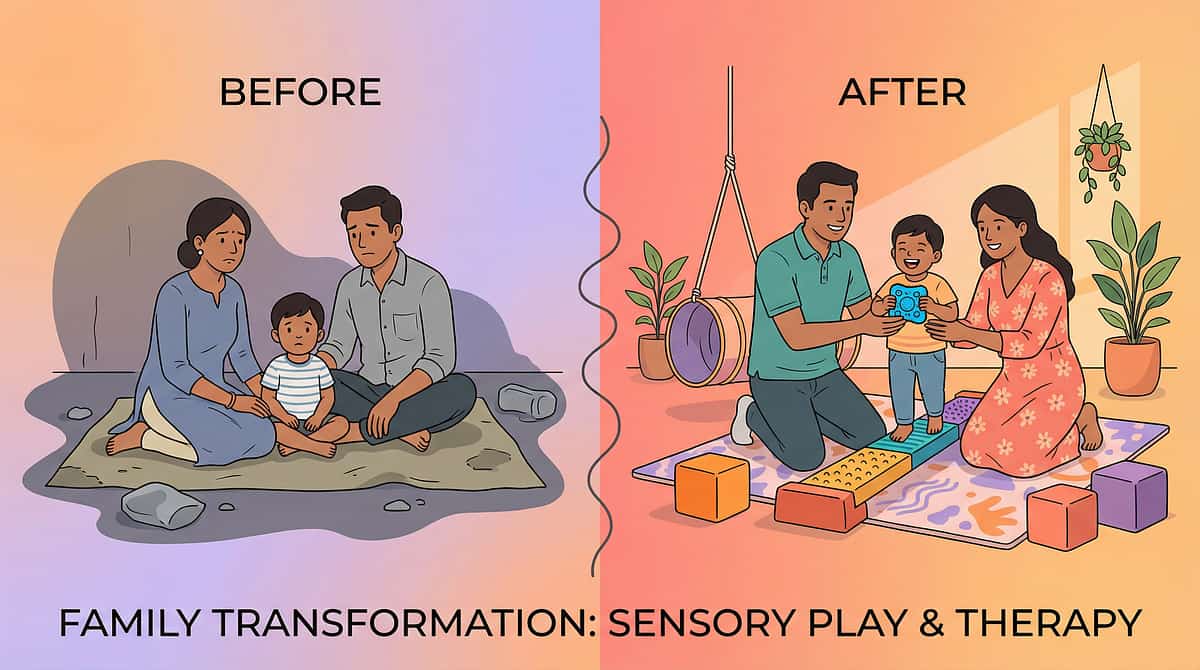
Expressive language development with intervention is real, measurable, and hopeful — and understanding realistic timelines helps families stay encouraged through the process.
Short-Term: 2–4 Months
Increased vocabulary production, longer utterances in therapy context. Early use of carrier phrases and word retrieval improvements with support. Reduced frustration during structured activities.
Medium-Term: 4–8 Months
Generalization to home and school settings. More spontaneous expression without prompting. Improved sentence structure and growing use of verb tenses. Beginnings of narrative sequencing.
Long-Term: 8–12+ Months
Improved narrative skills, conversational participation, and reduced frustration overall. Personal storytelling becomes possible. Greater confidence and willingness to attempt communication in new situations.
Important: Progress varies significantly based on underlying cause, severity, age at intervention, and therapy intensity. More sessions and consistent daily home practice accelerates development. Some children need years of therapy for significant gains — and those gains are worth every step.
Save 🔖 for Language Development · Share with Families Seeking Expression 📤
Save this for expressive language support. Share with families whose children have words trapped inside. Follow Pinnacle Blooms Network for more language development strategies and therapy resources.
Coming next: 9 Materials That Help With Receptive Language (Episode L-970)
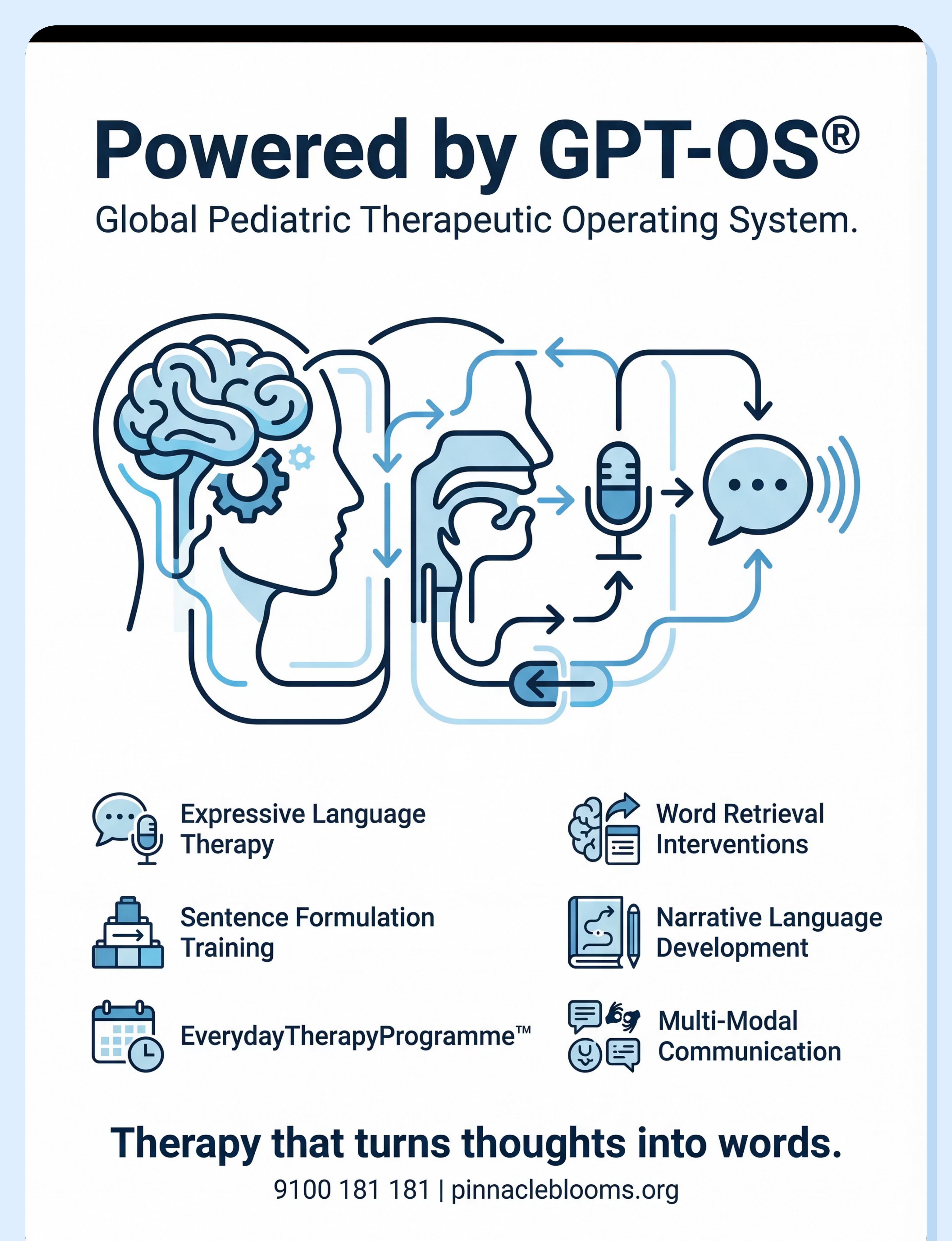
Powered by GPT-OS®
Global Pediatric Therapeutic Operating System
GPT-OS® develops expressive language through systematic skill-building: from word retrieval to sentence construction to narrative competence — turning understanding into expression. Every component of expressive language is addressed in sequence, with consistency and clinical precision.
Expressive Language Therapy
Systematic vocabulary development, sentence building, and verbal expression training tailored to the child's specific profile.
Word Retrieval Interventions
Building pathways from thought to word through categorization, association, and targeted retrieval practice.
Sentence Formulation Training
Grammatical structures, verb forms, and sentence patterns for complete and confident expression.
Narrative Language Development
Sequencing, storytelling, and personal narrative skills for connected, coherent discourse.
EverydayTherapyProgramme™
Home practice activities that build expressive language in daily life — reinforcing every session between visits.
Multi-Modal Communication
Supporting expression through speech, AAC, gesture, and writing as needed — because every voice deserves to be heard.
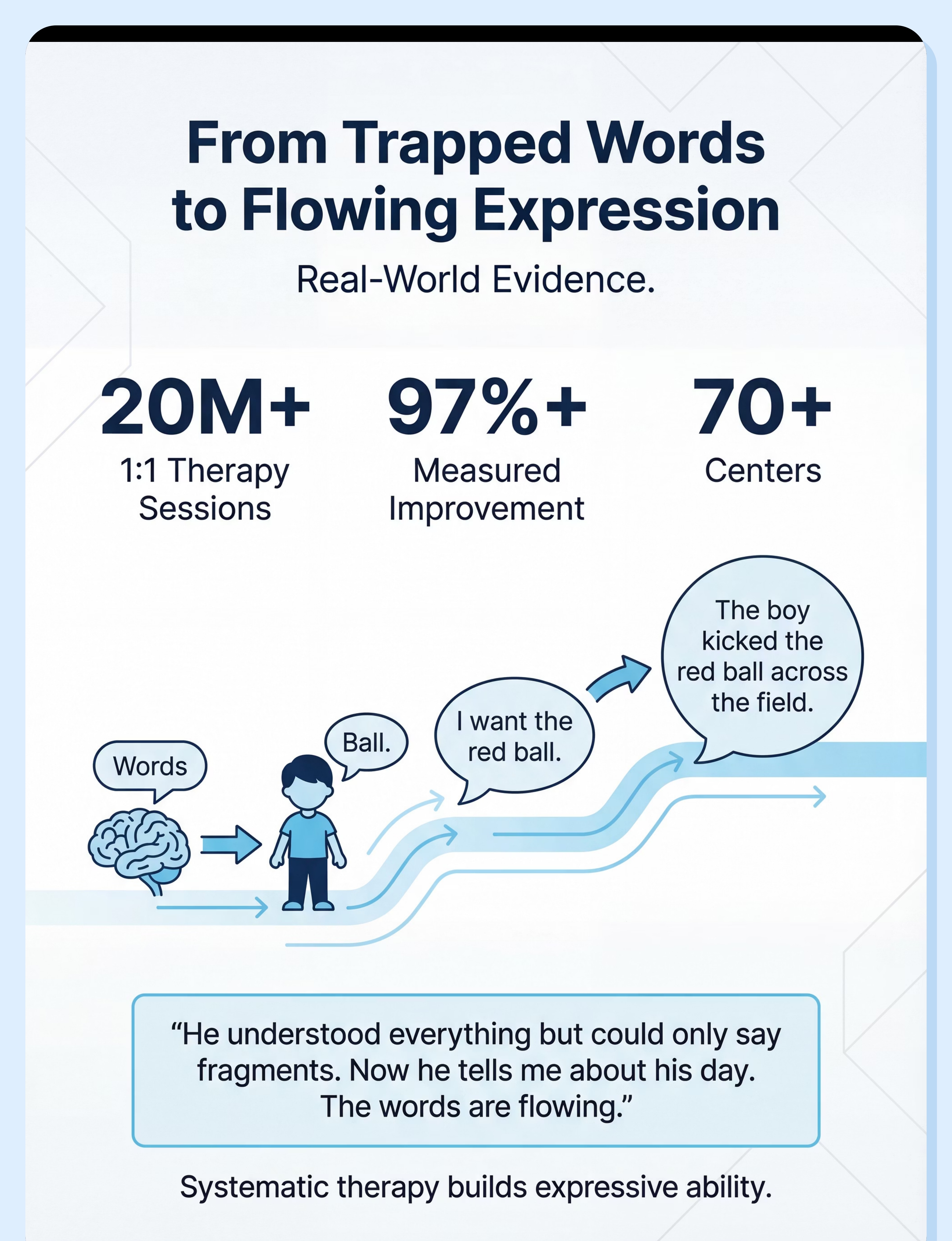
20M+
1:1 Therapy Sessions
Building expressive language skills across the Pinnacle Blooms Network
97%+
Measured Improvement
Documented progress in expressive language, vocabulary, and sentence production
70+
Specialist Centers
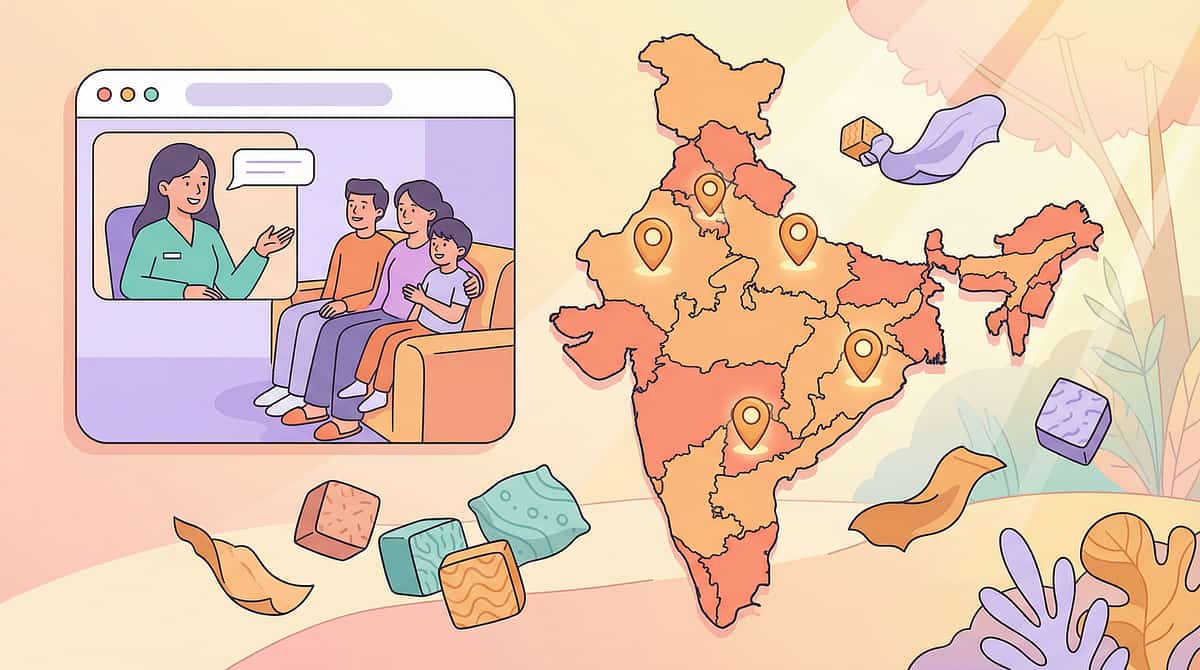
Specialized speech-language therapy locations across India
16+
Languages Supported
Free National Autism Helpline available in 16+ languages, 24x7
Therapy that turns thoughts into words — because every child deserves to express themselves. Children move from single words to sentences, from fragments to narratives, from frustration to confident expression when therapy builds skills systematically and practice is consistent.
Real-World Evidence
From Trapped Words to Flowing Expression
"When we started, my son could say about 20 words. Just words — no sentences. He would point, grunt, pull me toward things. He understood everything — followed complex instructions, got jokes, knew exactly what was happening around him. But expressing? Almost nothing came out. His speech therapist started with picture cards and carrier phrases. 'I want ____.' Over and over until those frames were automatic. Then verb cards for action words. Sentence builders for combining. Story cards for sequencing. Every session built on the last. At home, we practiced with the materials the therapist showed us. It was slow. Then it wasn't. One day he said 'I want the big red ball, please.' A full sentence. With an adjective. And manners. Now he tells me about his day. Not perfectly — we're still working on grammar and narrative. But the words are flowing. He can express himself. He's not trapped anymore."
— Mother, Pinnacle Network. Illustrative case; individual outcomes may vary based on child's specific needs and intervention intensity.
Children with expressive language delays show measurable improvement in vocabulary production, sentence length, grammatical accuracy, and narrative skills when therapy is intensive, systematic, and reinforced through daily practice.
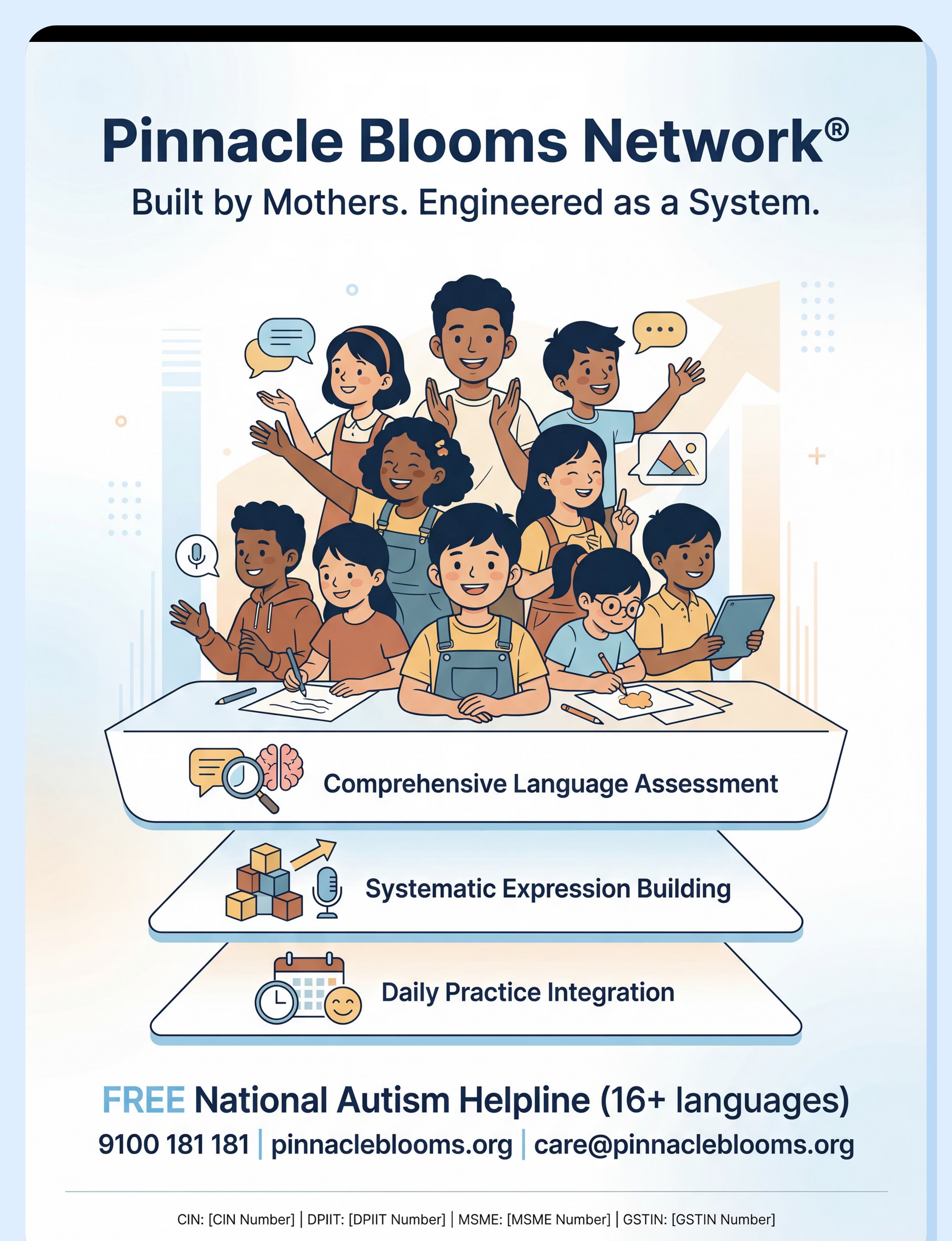
Pinnacle Blooms Network®
Built by Mothers. Engineered as a System.
Pinnacle delivers speech-language therapy that builds expressive ability systematically — giving children the words to share their thoughts, needs, and stories. Every service layer is designed to work together, from clinical assessment through daily home practice.
Comprehensive Language Assessment
Identifying specific expressive language gaps and strengths — so therapy targets exactly what each child needs, nothing generic.
Systematic Expression Building
Vocabulary, grammar, sentence structure, and narrative development — built in sequence, with progress tracked at every step.
Daily Practice Integration
Home activities that reinforce therapy and build expression in real life — because the hours between sessions are where generalization happens.
Contact Us
FREE National Autism Helpline (16+ languages)📞 9100 181 181 🌐 pinnacleblooms.org ✉ care@pinnacleblooms.org
Statutory Identifiers
CIN: U74999TG2016PTC113063 DPIIT: DIPP8651 (Govt. of India) MSME: Udyog Aadhaar: TS20F0009606 GSTIN: 36AAGCB9722P1Z2
Unit of Bharath Healthcare Laboratories Pvt. Ltd.

Disclaimer
This content is educational and addresses expressive language development in children with communication differences. Strategies and materials should be implemented with guidance from a qualified speech-language pathologist who can assess your child's specific needs and tailor interventions appropriately. Expressive language development varies by child, and intensive, consistent therapy typically yields the best outcomes. This content does not replace professional speech-language evaluation and therapy.
Individual outcomes vary based on child's profile and intervention. Statistics represent aggregate outcomes across the Pinnacle Blooms Network.
© 2025 Pinnacle Blooms Network®, unit of Bharath Healthcare Laboratories Pvt. Ltd. All rights reserved. | Speech & Language Series – Episode 969 | Domain: SL-EL | Sources: ASHA Clinical Practice Guidelines; Paul, R., & Norbury, C. (2012). Language Disorders from Infancy Through Adolescence; Pinnacle Blooms Network® GPT-OS® Expressive Language Development Frameworks.
#ExpressiveLanguage
#SpeechTherapy
#LanguageDevelopment
#WordFinding
#PinnacleBlooms
Speech & Language Support
When to Seek Professional Help
Recognizing signs of expressive language delay early is crucial for effective intervention. If your child struggles to put their thoughts into words, it can lead to frustration and impact their social and academic development.
Limited Vocabulary for Age
Using fewer words than expected for their age group, or relying on gestures instead of words.
Frustration During Communication
Exhibiting anger, tantrums, or withdrawing when unable to express needs or ideas verbally.
Difficulty Forming Sentences
Struggling to combine words into phrases or sentences, or consistently using incorrect grammar.
Peers Outpacing Development
Noticeable difference in language ability compared to same-age children, making it hard to interact.
If any of these indicators resonate, trust your instincts. Reaching out to a qualified speech-language pathologist can provide clarity and a personalized path forward for your child's communication journey.

Parent Support
Frequently Asked Questions
Understanding expressive language therapy can bring clarity and peace of mind. Here are common questions parents ask.
1
How long does therapy take to show results?
Progress varies, but consistent, intensive therapy often shows initial improvements within 3-6 months. Long-term gains depend on individual needs and continued practice.
2
Can I do these activities without a therapist?
While home practice is vital, a qualified therapist diagnoses specific needs and tailors interventions. Attempting complex strategies without guidance may not be effective or could be counterproductive.
3
What's the difference between expressive and receptive language?
Expressive language is about speaking or writing (output). Receptive language is understanding what's heard or read (input). Both are crucial, but a child can have delays in one and not the other.
4
Is expressive language delay related to autism?
Expressive language delay can be a feature of autism, but also occurs independently. A professional evaluation helps differentiate causes and guides appropriate support.
5
At what age should I be concerned?
Concerns can arise if a 12-month-old isn't babbling, an 18-month-old isn't using single words, or a 2-year-old isn't combining two words. Trust your intuition and seek evaluation.
Preview of 9 materials that help with expressive language Therapy Material
Below is a visual preview of 9 materials that help with expressive language therapy material. The pages shown help educators, therapists, and caregivers understand the structure and content of the resource before use. Materials should be used under appropriate professional guidance.


Link copied!

Speech & Language – Episode 969
Your Child's Voice Is Worth Fighting For
The journey to unlock a child's voice is a profound act of love and commitment. Every sound, every word, every sentence is a step toward greater connection and self-expression. At Pinnacle Blooms Network®, we believe in the power of every child's unique voice and are dedicated to empowering them to share their world.
Start Early
Timely intervention can significantly improve outcomes, building foundational skills when young minds are most receptive.
Stay Consistent
Regular practice and consistent reinforcement are key to solidifying new language skills and fostering lasting progress.
Celebrate Every Word
Acknowledge and cherish each communicative effort; every word is a triumph on the path to fluent expression.
For personalized guidance and support on your child's communication journey, connect with Pinnacle Blooms Network® today.
Free National Autism Helpline: 9100 181 181 | Website: pinnacleblooms.org