
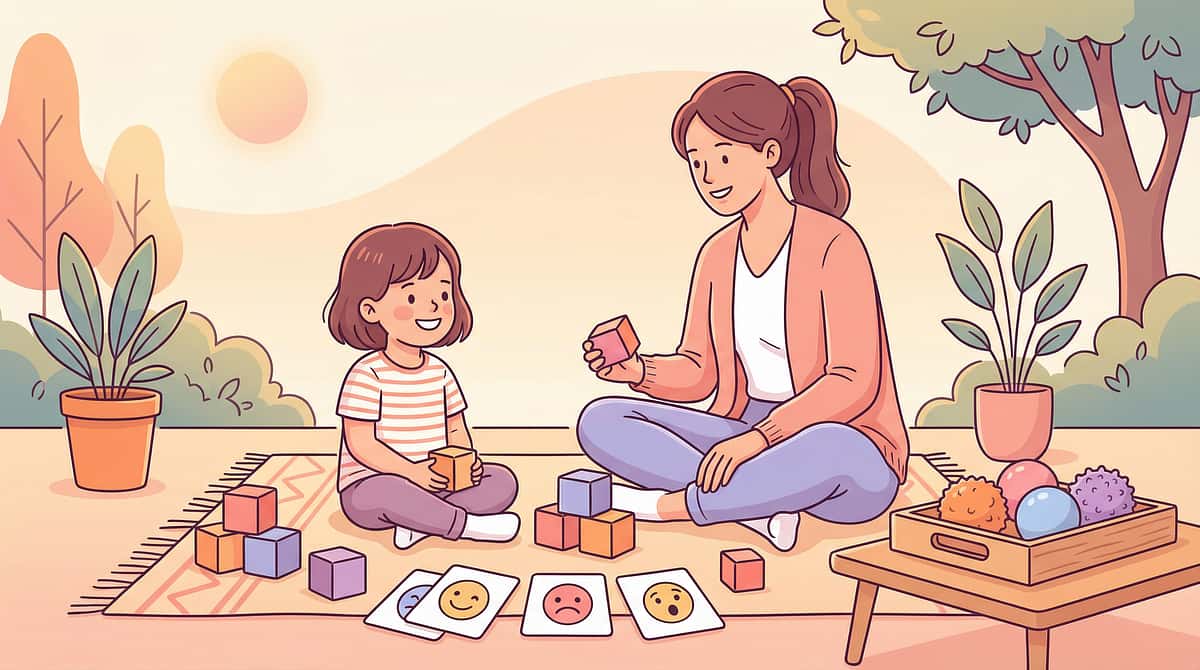
9 Materials That Help With Emotion Recognition
From "I don't know what they're feeling" to reading emotional cues — a practical guide for parents, caregivers, and therapists.
Social-Emotional Development
Episode 971
Ages 3–12

Parent Voice
"Every social interaction is like walking into a room where everyone is speaking a language he doesn't understand."
"My son is the sweetest boy in the world. He'll share his last cookie, he'll hug you when you're sick, he genuinely wants to connect with people. But he can't read faces. At all. His teacher was crying after receiving sad news, and he walked up to her and said 'Why is water coming out of your eyes?' He wasn't being cruel — he genuinely didn't recognize that she was sad. His classmate was furious with him for taking a toy, face red, fists clenched, yelling — and my son just stood there confused, asking 'Why are you making that loud voice?'
He doesn't recognize happy versus sad versus angry versus scared. He can't tell when someone is bored or interested, annoyed or amused, sincere or sarcastic. He wants friends so badly. He just can't read the emotional map that helps you navigate relationships.
The Problem
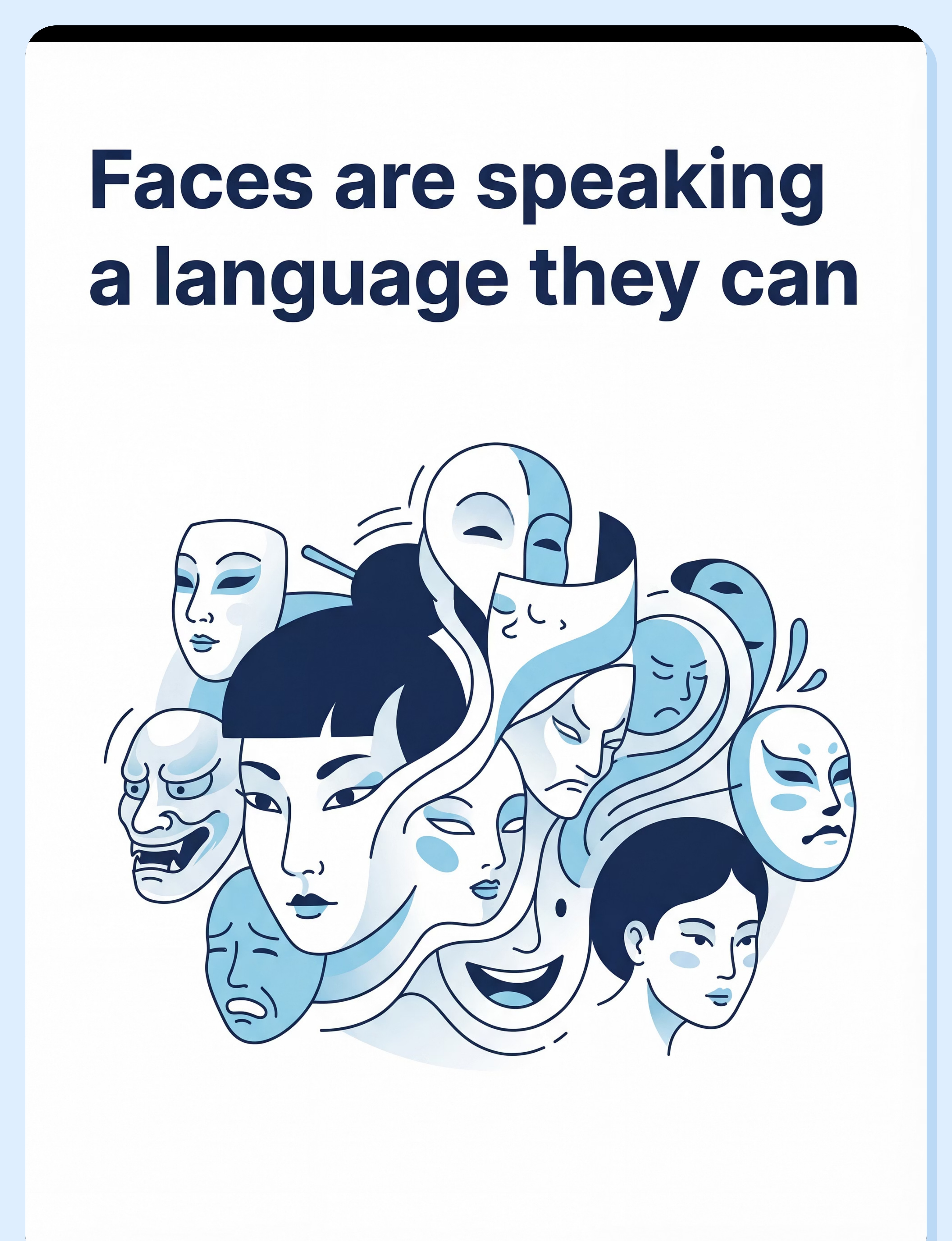
Faces Are Speaking a Language They Can't Understand
What Is Emotion Recognition?
Emotion recognition is the ability to identify and interpret emotional states in oneself and others based on facial expressions, body language, vocal tone, and contextual cues.
Deficits in emotion recognition are common in autism spectrum disorder, affecting an estimated 50–80% of individuals on the spectrum to varying degrees.
Clinical Terms You May Hear
- Emotion Recognition Deficit
- Alexithymia (difficulty identifying one's own emotions)
- Affect Recognition Impairment
- Social Cognition Deficit
- Facial Expression Processing Difficulty
Importantly, emotion recognition is a learnable skill. With systematic, multi-modal instruction, many children can significantly improve their ability to identify and respond to emotional cues.
A Second Parent's Story
"The birthday party was supposed to be fun. Twelve kids, cake, games — everything a 7-year-old could want. But my daughter spent the whole party confused. When a child fell and started crying, my daughter asked 'Is she laughing? Her mouth is open and there's sound coming out.' When kids were whispering and giggling about her, she walked right up to them thinking they were inviting her to join."
She relies entirely on words, but people don't always say what they feel. They say "I'm fine" when they're not. They say "Sure, that's okay" when they're annoyed. And my daughter takes it all at face value, missing the emotional truth beneath. She's navigating social life without the most essential map.

Common Signs
Recognizing Emotion Recognition Challenges in Your Child
1
Misreads Basic Emotions
Cannot reliably identify happy, sad, angry, or scared from faces — even in obvious, exaggerated expressions.
2
Cartoons ≠ Real Life
Can identify emotions in cartoon faces but struggles to generalize that skill to actual people with naturalistic expressions.
3
Misses Subtle Cues
Raised eyebrows, slight smiles, tightened jaws — micro-expressions that carry emotional truth are invisible.
4
Takes Literal Meaning
Cannot detect sarcasm, irony, or social deception. Takes "I'm fine" at face value when the speaker is clearly not.
1
Responds Inappropriately
Appears insensitive or uncaring despite genuinely good intentions — simply cannot read the emotional signals that guide appropriate response.
2
Misses Intensity
Confuses mildly annoyed with furious, or slightly disappointed with devastated — missing the degree matters as much as the category.
3
Confuses Similar Emotions
Sad and tired look the same. Angry and frustrated blur together. Scared and surprised are indistinguishable.
4
Doesn't Adjust Behavior
Cannot predict emotional reactions to events, and doesn't modify their own behavior based on what others are feeling.
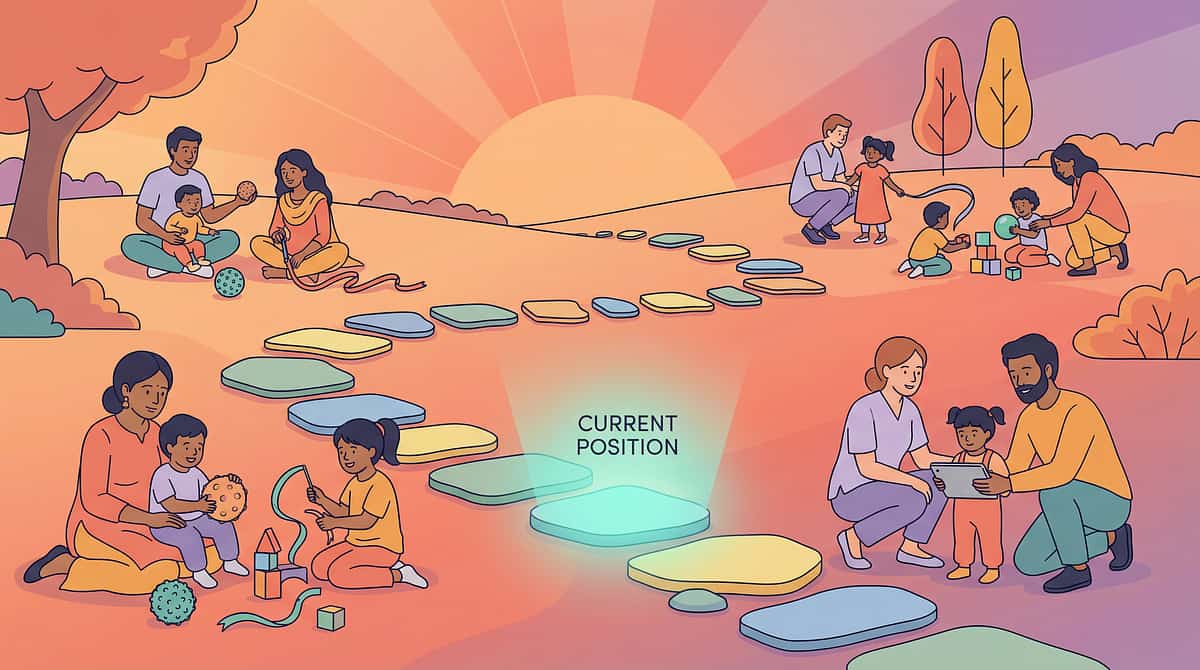
Developmental Context
How Emotion Recognition Normally Develops
Understanding where typical development diverges helps identify the right starting point for intervention. Children with emotion recognition deficits may be delayed at any stage — often stuck identifying only the most basic, exaggerated expressions.
1
0–12 Months
Preference for faces; early emotional responsiveness; social referencing begins
2
2–3 Years
Basic emotion labeling: happy, sad, angry, scared in exaggerated expressions
3
4–5 Years
Understands emotion-situation connections; can predict emotional responses
4
6–7 Years
Complex emotions: embarrassed, proud, jealous; multiple simultaneous emotions
5
8–10 Years
Masked emotions, subtle expressions; understands people may hide true feelings
6
10+ Years
Nuanced social-emotional reading; sarcasm detection; advanced perspective-taking
Intervention is most effective when matched to the child's current level. Build foundational skills before advancing to complexity. Always start by assessing what the child can currently do.

The Good News
Emotion Recognition Can Be Taught
This is not a fixed trait. Emotion recognition is a learnable skill — and with systematic, multi-modal instruction using appropriate materials, many children can significantly improve their ability to identify and respond to emotional cues.
The goal isn't to replicate the automatic, unconscious recognition that neurotypical individuals experience. The goal is to build compensatory strategies that provide access to emotional information through deliberate analysis — strategies that work even when intuition doesn't.
1
Real Photographs
Authentic faces that generalize to real life
2
Mirror Work
Embodied learning from the inside out
3
Detective Strategies
Analytical routes to recognition
4
Games & Apps
Volume and engagement for skill-building
Overview
9 Materials at a Glance
Real Photo Flashcards
Learning emotions from actual human faces
Emotion Mirror & Facial Feature Cards
Learning from the inside out
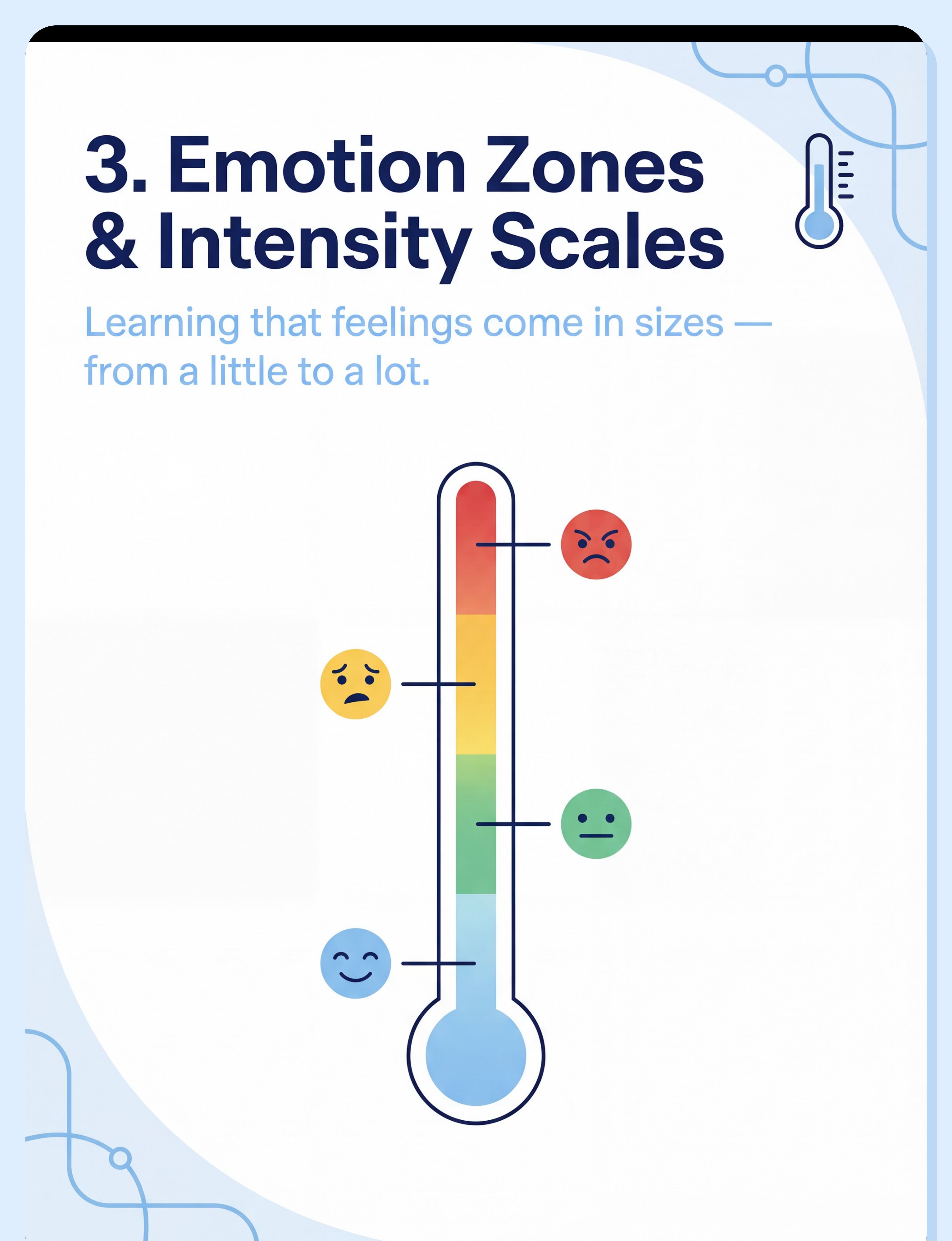
Emotion Zones & Intensity Scales
Learning that feelings come in sizes
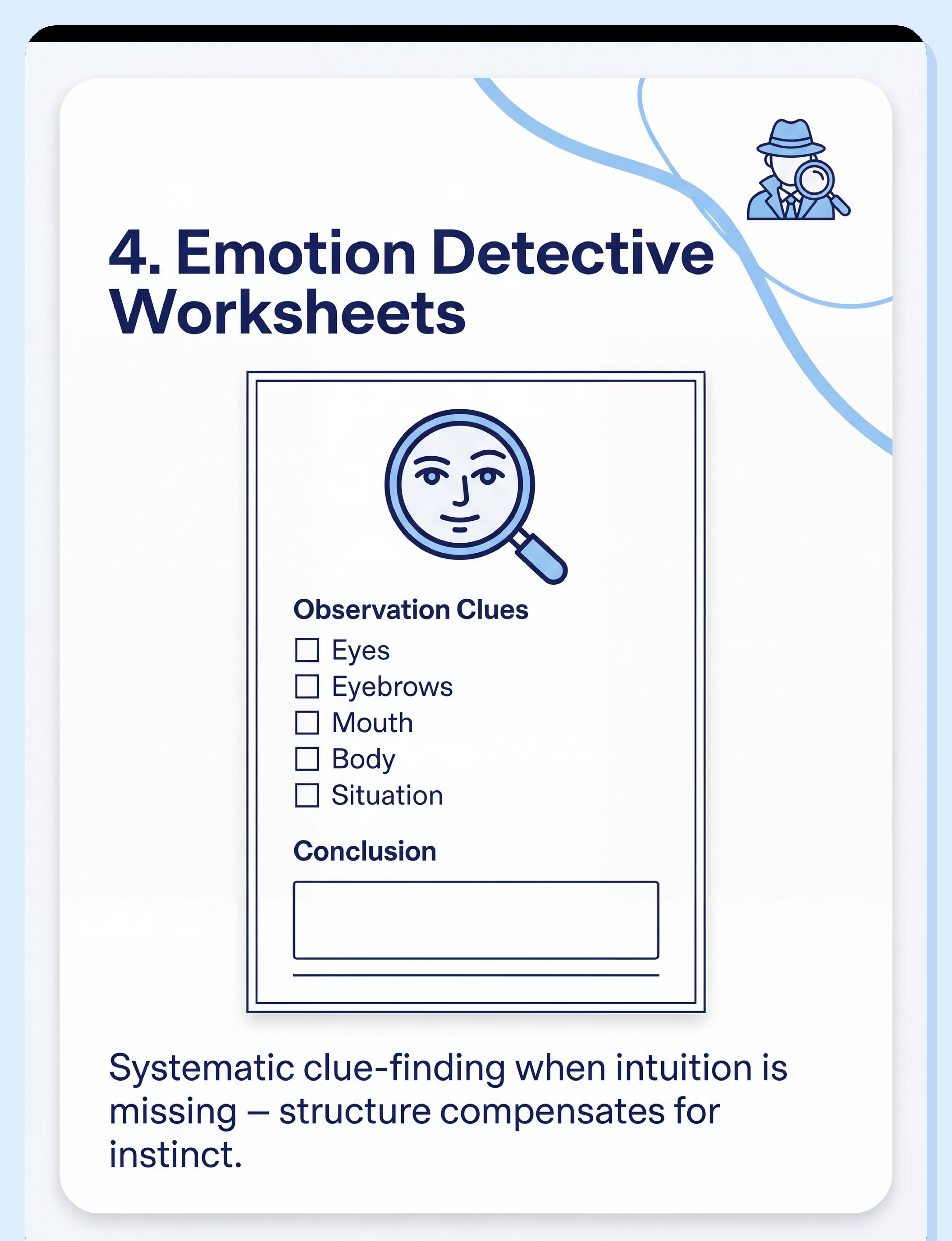
Emotion Detective Worksheets
Systematic clue-finding when intuition is missing
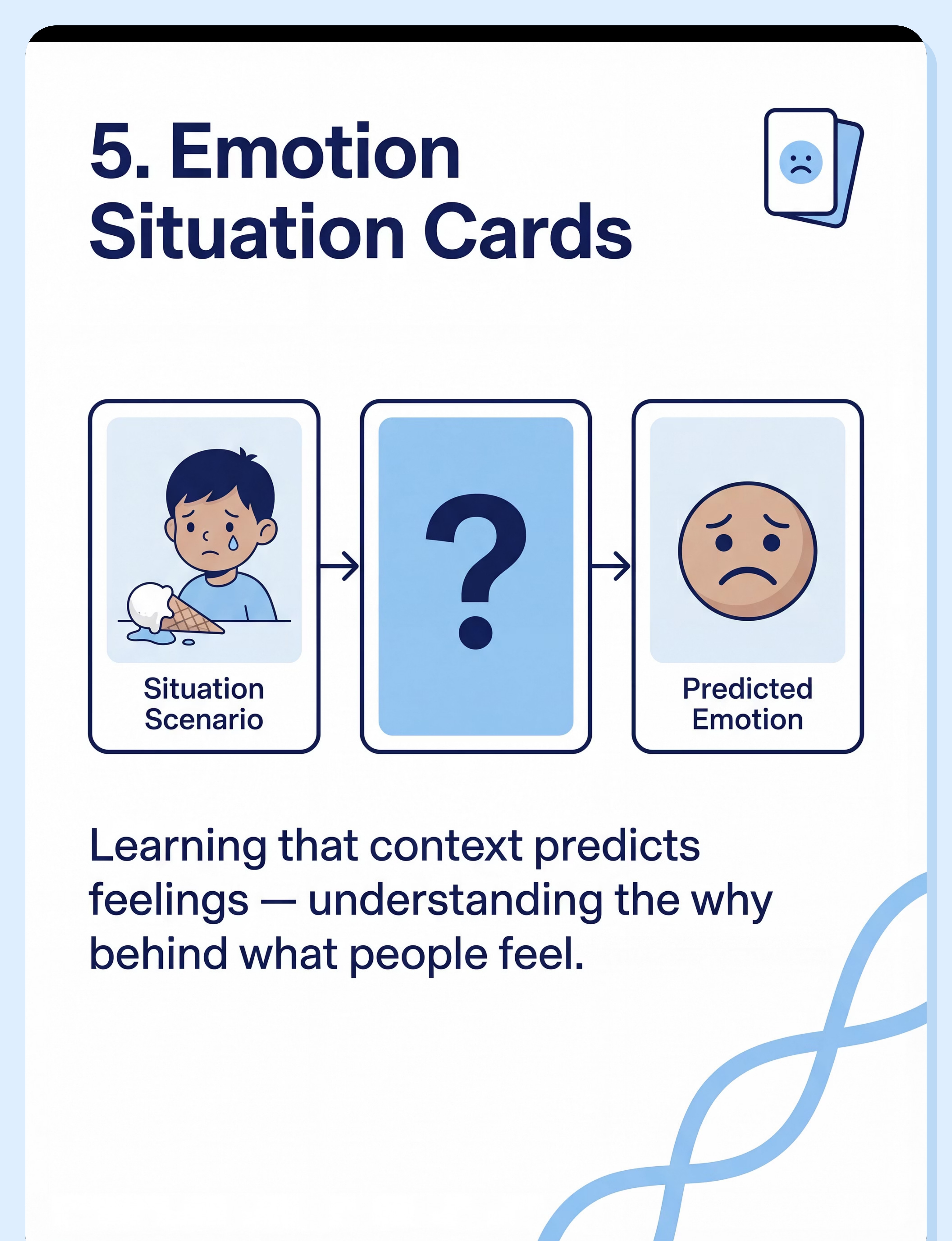
Emotion Situation Cards
Learning that context predicts feelings
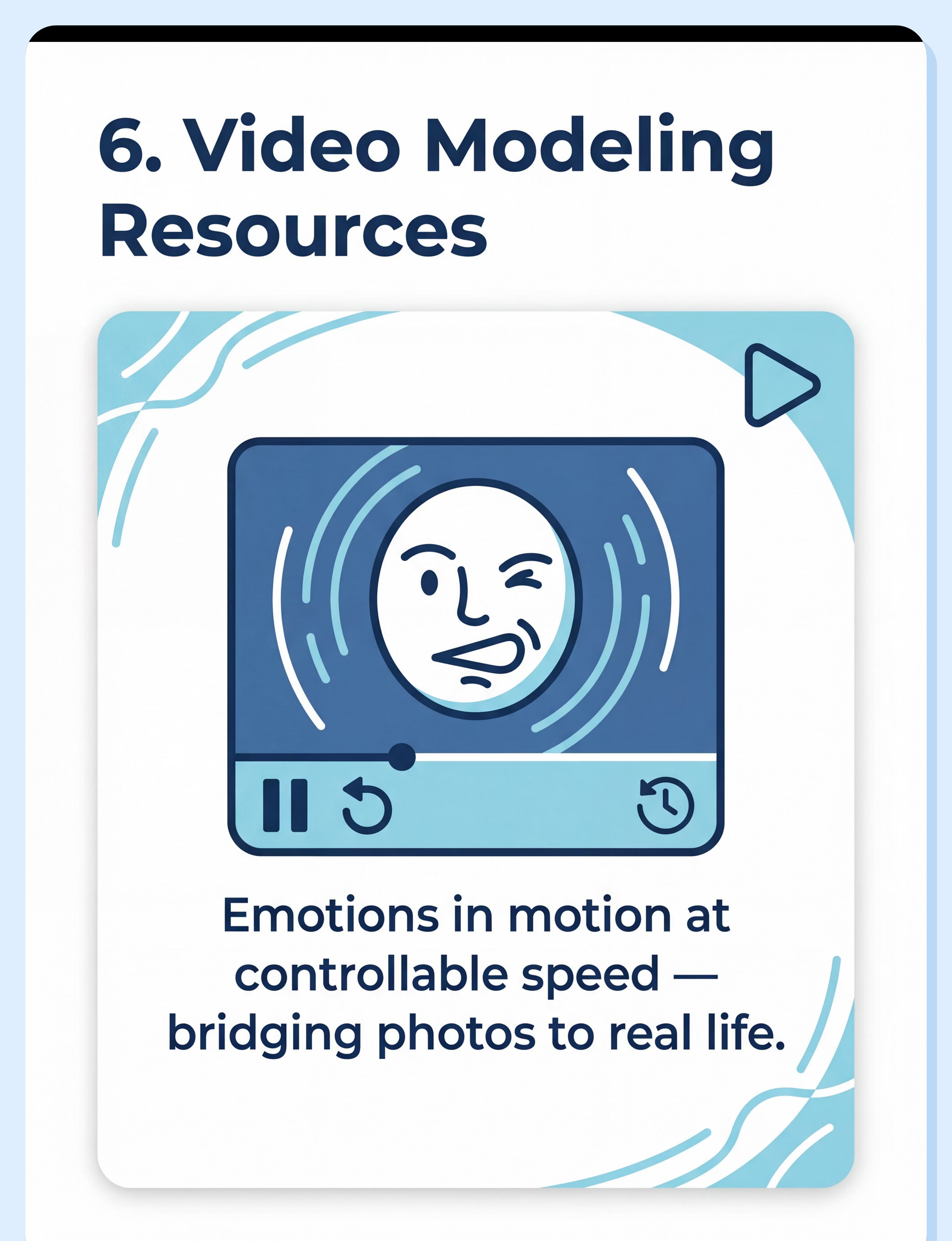
Video Modeling Resources
Emotions in motion, at controllable speed
Emotion-Themed Games
Making practice fun and repeatable
Cause-Effect Cards & Social Scripts
Understanding the why and what next
Digital Apps & Technology
Technology-assisted practice and tracking
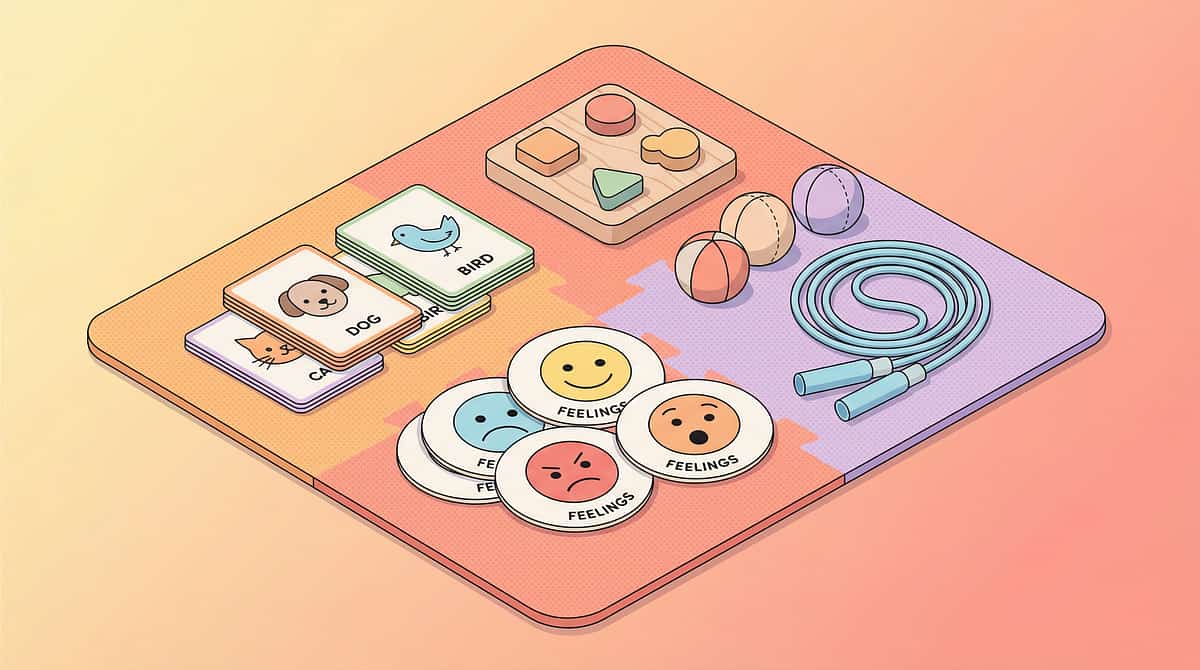
Material 1 of 9
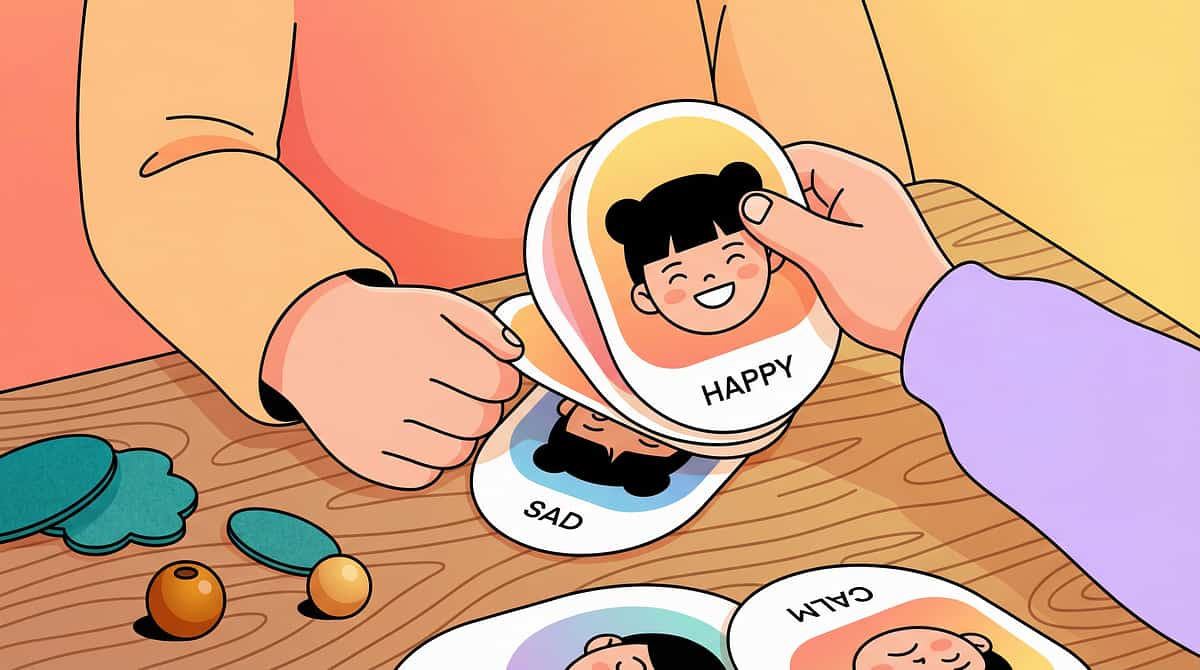
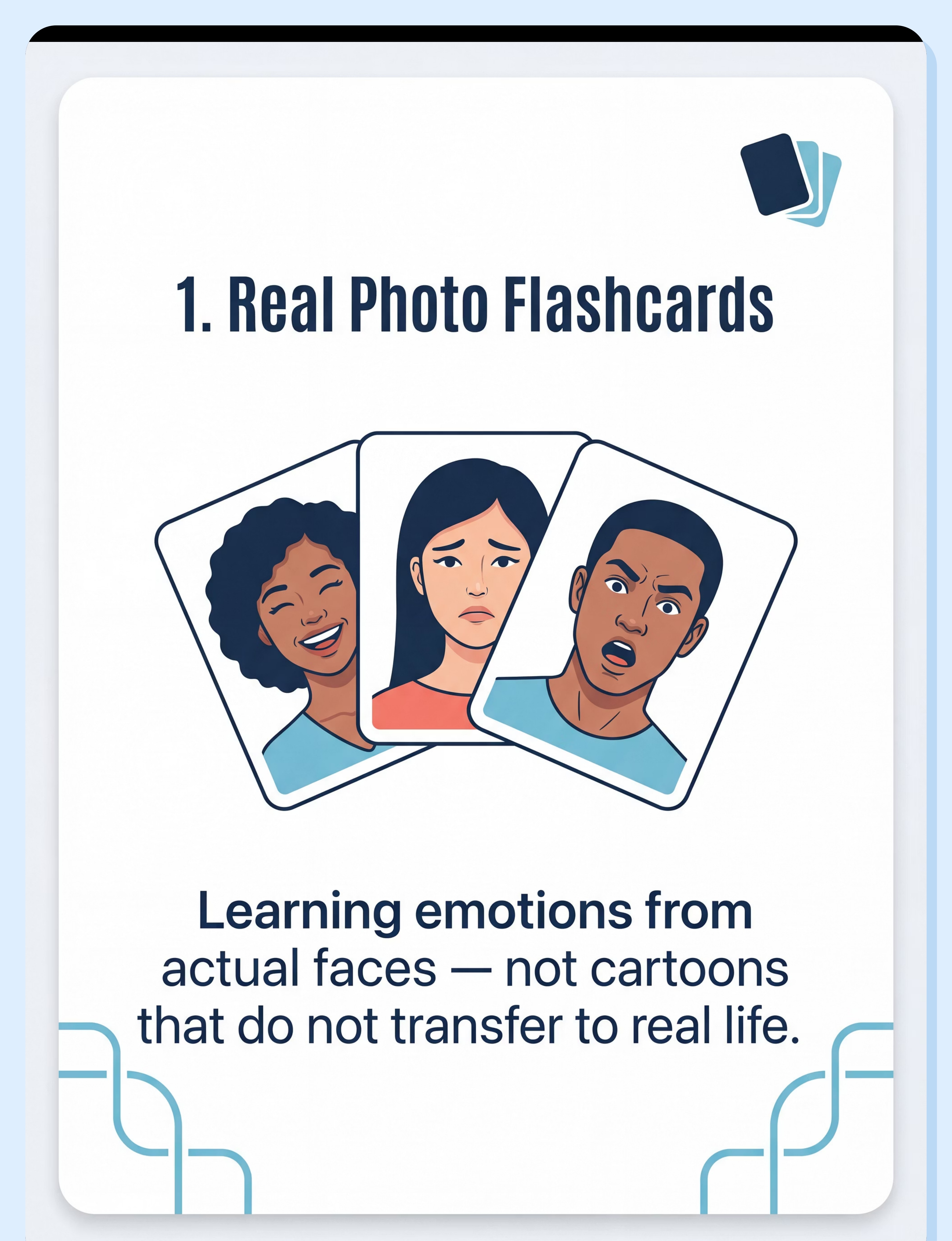
Real Photo Flashcards with Photographs
Why real photos matter: Many programs use cartoon faces or exaggerated expressions, which children learn to identify without transferring that skill to actual people. Flashcards featuring real photographs of diverse people expressing emotions provide the authentic visual input needed for real-world recognition.
The best sets include multiple people expressing each emotion — showing that "happy" looks slightly different on different faces while sharing core features. They include diverse ages, genders, and ethnicities, building recognition across all human variation. They progress from obvious, prototypical expressions to more subtle, naturalistic ones.
1
Basic Emotions to Start
Happy · Sad · Angry · Scared · Surprised · Disgusted
2
Complex Emotions to Build Toward
Confused · Embarrassed · Proud · Worried · Bored · Excited · Frustrated · Jealous · Nervous · Calm
3
Key Insight
Recognition must transfer to real faces. Authentic photographs build skills that work in real-world social situations.

Material 1 — DIY Guide
Creating Real Photo Flashcards at Home
Building Your Photo Collection
- Photograph family members expressing emotions, or use royalty-free image sources
- Aim for 5–10 different people per emotion
- Include diverse ages, genders, and ethnicities
- Include both straight-on and slight-angle shots
Expression Levels (3 per emotion)
- Obvious / exaggerated
- Moderate / clear
- Subtle / naturalistic
Card Format & Activities
- Print on cardstock, approx. 4×6 inches
- Label emotion on the back only — child identifies without prompt
- Laminate for durability and repeated handling
Practice Activities
- Sorting: Child sorts cards by emotion — start with 2, add more as skill develops
- Feature Focus: "See the corners of the mouth going up? That's part of happy."
- Matching Games: Find all the 'happy' faces; memory-style pairs
- Speed Building: Quick flash, quick naming — building automatic recognition
Safety Note: Obtain permission before using photographs of recognizable individuals. Use family photos or royalty-free resources.
Material 2 of 9
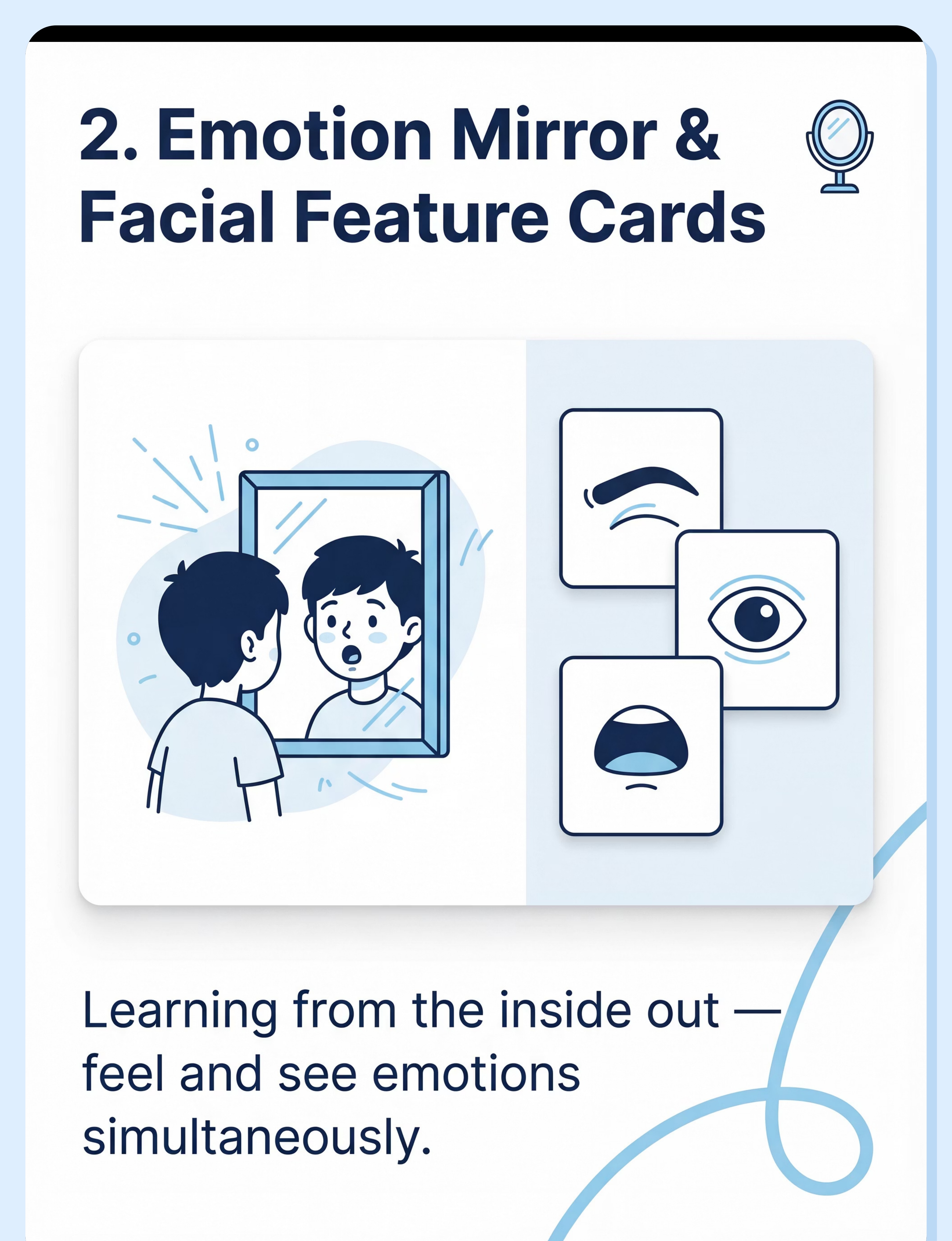
Emotion Mirror & Facial Feature Cards
Learning from the inside out: Many children with emotion recognition deficits don't connect what they see on others' faces with what they experience on their own. Mirror work bridges this gap — when a child makes a happy face in the mirror, they both feel the muscular experience of smiling and see the visual result. This creates embodied understanding that purely observational learning doesn't provide.
Facial feature cards break down expressions into learnable components: eyebrows (raised, lowered, furrowed), eyes (wide, narrow, tearful, crinkled), mouth (smiling, frowning, open, tight), and overall face (tense, relaxed). This analytical approach is particularly effective for children who struggle with whole-gestalt face processing.
1
Eyebrows
Raised · Furrowed · Neutral · One up (quizzical)
2
Eyes
Wide · Narrow · Crinkled · Tearful
3
Mouth
Smile · Frown · Open · Tight · Wobbly
4
Key Insight
Embodied learning sticks. Feeling an expression while seeing it creates deeper understanding than observation alone.

Material 2 — DIY Guide
Setting Up Emotion Mirror Work
Mirror Setup
- Use an unbreakable mirror at child's face height with good lighting
- Secure placement — no tipping hazard; consider a hand mirror as alternative
- Large enough to see the full face
Component Practice Sequence
- "Can you make your eyebrows go up like this?"
- "Surprised has eyebrows UP and mouth OPEN. Can you make that?"
- "Look in the mirror — does your face match the happy picture? What needs to change?"
Advanced Mirror Activities
- Expression Matching: Therapist makes expression; child tries to match in mirror
- Photo Comparison: Make expression → take photo → compare to flashcard
- Emotion Charades: Pick emotion card, make face, other person guesses
- Speed Transitions: "Show me happy — now angry — now surprised — now sad"
- Feeling Connection: "When you make that angry face, do you notice anything in your body?"
Safety Note: Use unbreakable mirrors. Ensure secure mounting if wall-mounted. Supervise younger children during mirror activities.

Material 3 of 9
Emotion Zones & Intensity Scales
Feelings come in sizes: Children often struggle not just with identifying which emotion someone is feeling, but with recognizing the intensity of that emotion. The difference between "a little annoyed" and "absolutely furious" matters enormously for social navigation — but children with emotion recognition deficits may miss these gradations entirely.
Zones of Regulation and similar intensity scales teach that emotions exist on a continuum. This has direct practical applications: knowing someone is "mildly annoyed" versus "very angry" changes how you should respond. Scales also help children recognize and communicate their own emotional intensity, building self-awareness alongside other-recognition skills.
🔵 Blue Zone
Low energy: sad, tired, sick, bored
🟢 Green Zone
Calm alert: happy, focused, calm, ready to learn
🟡 Yellow Zone
Heightened: frustrated, worried, silly, excited
🔴 Red Zone
Extreme: angry, terrified, out of control
Material 3 — Intensity Vocabulary
Building a Gradient Vocabulary for Each Emotion
Each emotion exists on a scale from barely perceptible to overwhelming. Teaching the words for each level expands emotional vocabulary and precision far beyond basic category labels.
Emotion | Level 1 (Lowest) | Level 3 (Mid) | Level 5–7 (Highest) | |
Angry | Calm / Irritated | Frustrated / Angry | Furious / Enraged | |
Sad | Content / Disappointed | Sad / Very Sad | Heartbroken / Devastated | |
Scared | Calm / Uneasy | Worried / Scared | Terrified / Panicked | |
Happy | Neutral / Pleased | Happy / Very Happy | Joyful / Ecstatic |
Safety Note: Never use scales to invalidate a child's emotions ("You're only at a 2, so calm down"). Scales are for learning and communication — not for dismissing feelings.
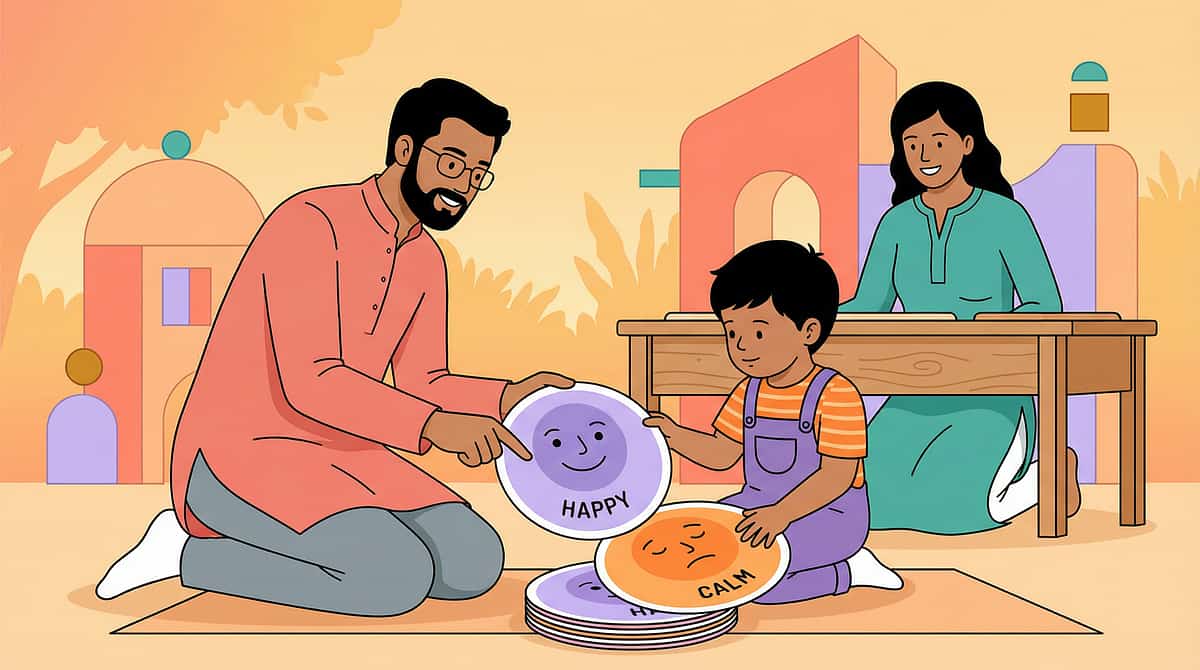
Material 4 of 9
Emotion Detective Worksheets & Clue Cards
When intuition is missing, build a system: Children who can't intuitively read emotions can learn to be "emotion detectives" — systematically looking for clues that reveal what someone is feeling. This analytical approach provides a structured strategy that compensates for missing intuition.
Over time and with practice, the detective process becomes faster and more automatic. But even when it remains conscious and deliberate, it provides access to emotional information that would otherwise be missed entirely. Structure compensates for intuition.
Step 1 — Look at the FACE
Eyebrows: up, down, or neutral? Eyes: wide, narrow, or crinkled? Mouth: smiling, frowning, tight, or open?
Step 2 — Look at the BODY
Posture: slumped (sad), tense (angry/scared), open (happy/relaxed)? Gestures: fists (angry), arms crossed, fidgeting (nervous)?
Step 3 — Listen to the VOICE
Volume, speed, pitch, and tone all carry emotional information. Loud/fast often signals intensity. Quiet/slow may signal sadness or calm.
Step 4 — Consider the SITUATION
What just happened? What would most people feel if this happened to them?
Step 5 — Put CLUES TOGETHER
What do they add up to? Make your best guess: what emotion? How certain are you?
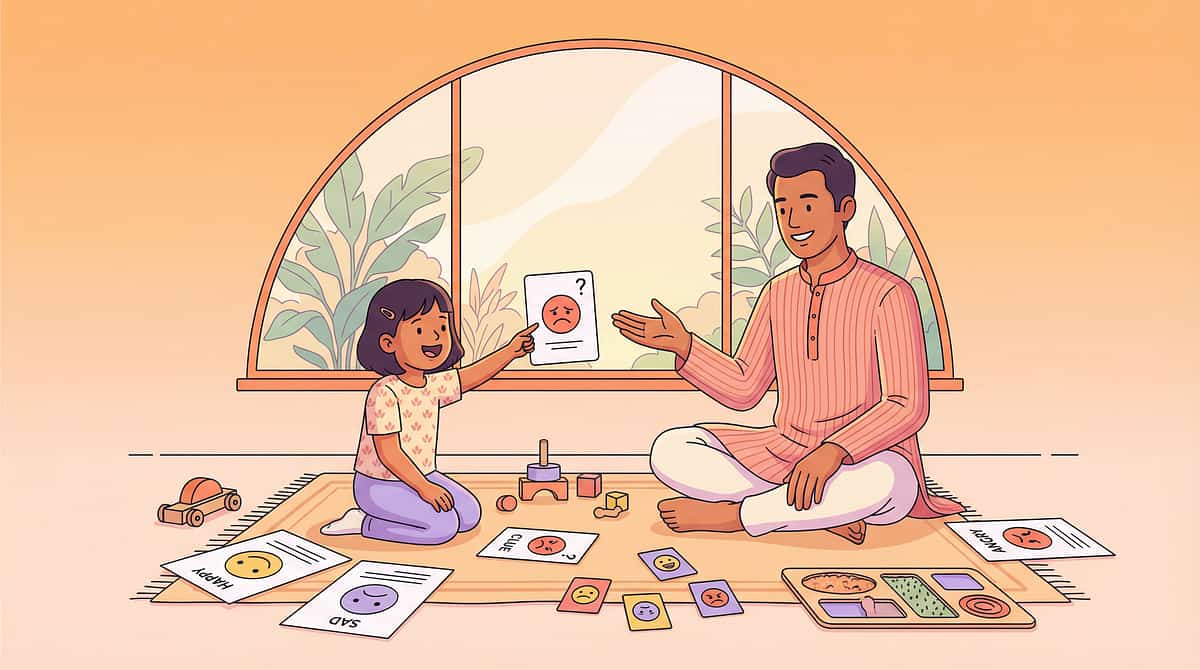
Material 4 — DIY Guide
Creating Emotion Detective Materials
Detective Worksheet Structure
- Section: Face Clues (eyebrows, eyes, mouth)
- Section: Body Clues (posture, gestures)
- Section: Voice Clues (volume, speed, tone)
- Section: Situation Clues (what happened?)
- Section: Final Analysis — What emotion? How sure am I?
Magnifying Glass Prop
A physical magnifying glass makes the "investigation" tangible and motivating for children. Use it as a fun tool for examining emotion photos.
Clue Card Examples
EYEBROWS clue card: "Up = surprised or scared. Furrowed/down = angry or worried. Neutral = calm."
EYES clue card: "Wide = surprised or scared. Narrow = angry or suspicious. Crinkled = happy or amused."
MOUTH clue card: "Corners up = happy. Corners down = sad. Tight/pressed = angry or determined. Open = surprised or scared."
Practice Progression
- Apply detective process to flashcard photos
- Pause videos and apply analysis
- Practice at the playground: "Let's be emotion detectives — what clues do you see?"
Safety Note: Teach children not to stare at people or make others uncomfortable while "detecting." Discrete observation skills matter.
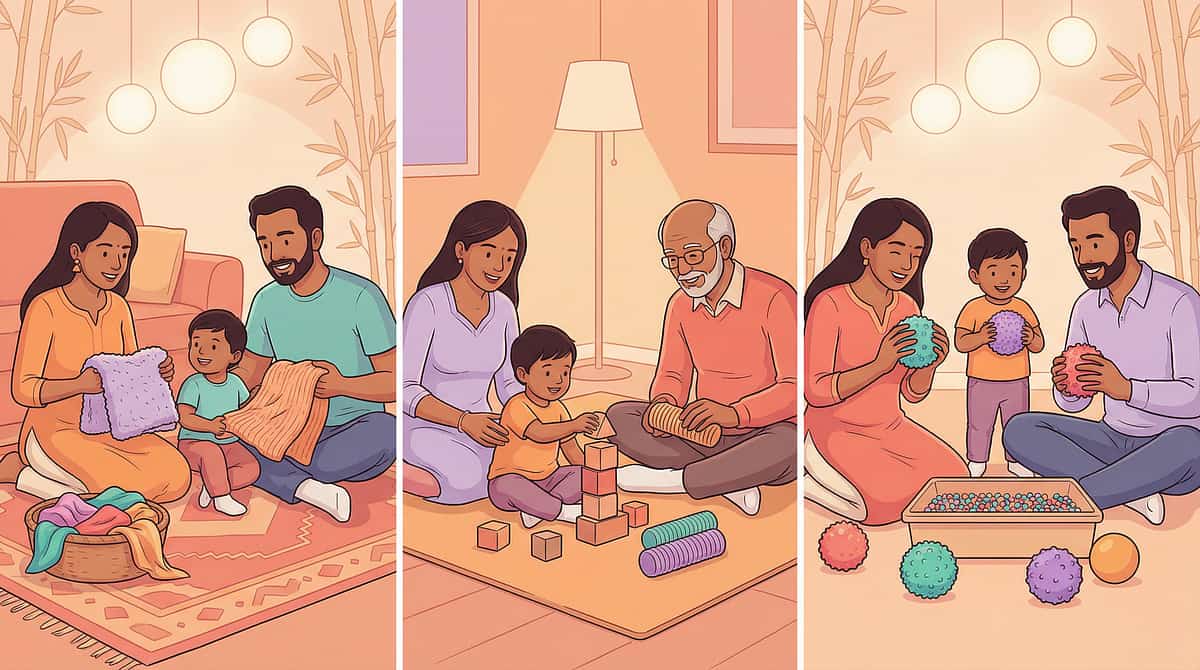
Material 5 of 9
Emotion Situation Cards & Prediction Practice
Context shapes emotion: Part of recognizing emotions involves understanding that certain situations typically produce certain feelings. Children with emotion recognition deficits often miss these situation-emotion connections, unable to predict or understand why someone would feel a particular way.
Situation cards present scenarios without showing the person's expression, asking the child to predict what emotion would result. This builds the cognitive framework for understanding emotions — the "why" behind the "what." When children understand that situations cause emotions in predictable ways, they have additional context for interpreting expressions they observe. If one channel is weak, the other can compensate.
1
Example Scenarios
"Raj's best friend moved to another city." · "Priya found a puppy in the park." · "The teacher said Amit's story was the best in the class."
2
Ambiguous Situations
"Dev's family is moving to a new city." — Could be sad (leaving friends), excited (new adventure), scared (unknown), or mixed. Teaches emotional complexity and flexibility.
3
Key Insight
Context provides clues. Understanding why people feel emotions helps predict and recognize what they feel — a redundant channel when facial reading is weak.

Material 5 — DIY Guide
Creating Emotion Situation Cards
Card Design Tips
- Write brief scenarios with clear emotional implications
- Include situations for all basic emotions first
- Add complex emotions as skill develops
- Include some ambiguous situations to teach flexibility
Multiple Choice Option
For children who struggle, offer options: "Does Priya feel sad, happy, or scared about finding the puppy?" Reduce cognitive load while still building the skill.
Activity Progressions
- Intensity included: "How MUCH do you think they feel that way? A little, medium, or a lot?"
- Reveal & discuss: After prediction, reveal a picture of the person's face. Did expression match prediction?
- Multiple perspectives: "How might Raj feel? How might Raj's friend feel? How might Raj's parents feel?"
- Personal connection: "How would YOU feel if this happened to you? Is that the same?"
- Real-life extension: "Yesterday, Maya's goldfish died. How do you think she's feeling today?"
Safety Note: Include situations where emotions differ from expectations — teach that predictions are a starting point, not a certainty. Flexibility matters.

Material 6 of 9
Video Modeling & Dynamic Expression Resources
Emotions move: Real-world emotions are not static photographs — they're dynamic, changing, unfolding over time. A person might shift from surprised to happy when receiving a gift, or from calm to frustrated as a problem persists. Static images capture a moment; video shows the flow of emotional expression.
Video resources might include short clips showing single clear emotions, scenes of emotional transitions, and people describing their feelings while showing corresponding expressions. For children who struggle with the speed of real-world processing, video provides a bridge — more realistic than photos, but more controllable than live interaction. Pause. Slow down. Replay. Discuss.
Pause & Analyze
Pause video, apply emotion detective analysis. What clues do you see? What emotion? Resume to confirm.
Slow Motion
Slow down clips to observe how an expression develops. How did the emotion build? What changed in the face?
Predict Before Play
Pause before the emotional moment. "What do you think she'll feel when she opens the box?" Play to see.
Sound On / Off
Watch clips with sound, then without. Can you still identify the emotion? Visual reading should work independently.

Material 6 — Resources & Tips
Using Video for Emotion Recognition Practice
Recommended Video Resources
- Mind Reading DVD/App — Cambridge research-based, comprehensive emotion library
- Educational emotion YouTube channels — free, accessible, varied
- Social skill video modeling resources — many designed specifically for autism
- Age-appropriate TV shows with clear, naturalistic emotional expression
- Family home videos — familiar faces aid recognition transfer
Practice Tips
- Curated clips: Build a library of 10–30 second clips labeled by emotion and intensity
- Transition focus: Find clips showing emotional change — how does the face shift from one emotion to another?
- Self-recording: Record the child expressing emotions, watch together, analyze — "What makes your happy face look happy?"
- Real-time building: As skill develops, reduce pausing — build processing speed gradually
Safety Note: Preview all videos for appropriate content. Educational emotion videos are ideal. If using entertainment media, select age-appropriate scenes with clearly expressed emotions.
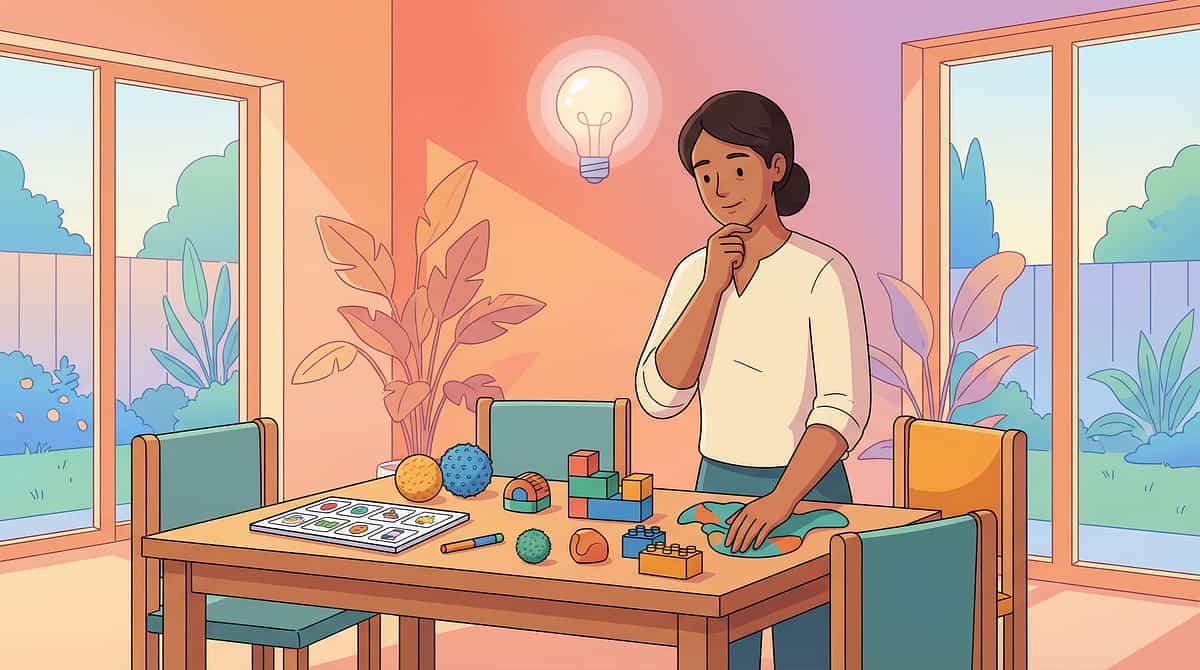
Material 7 of 9
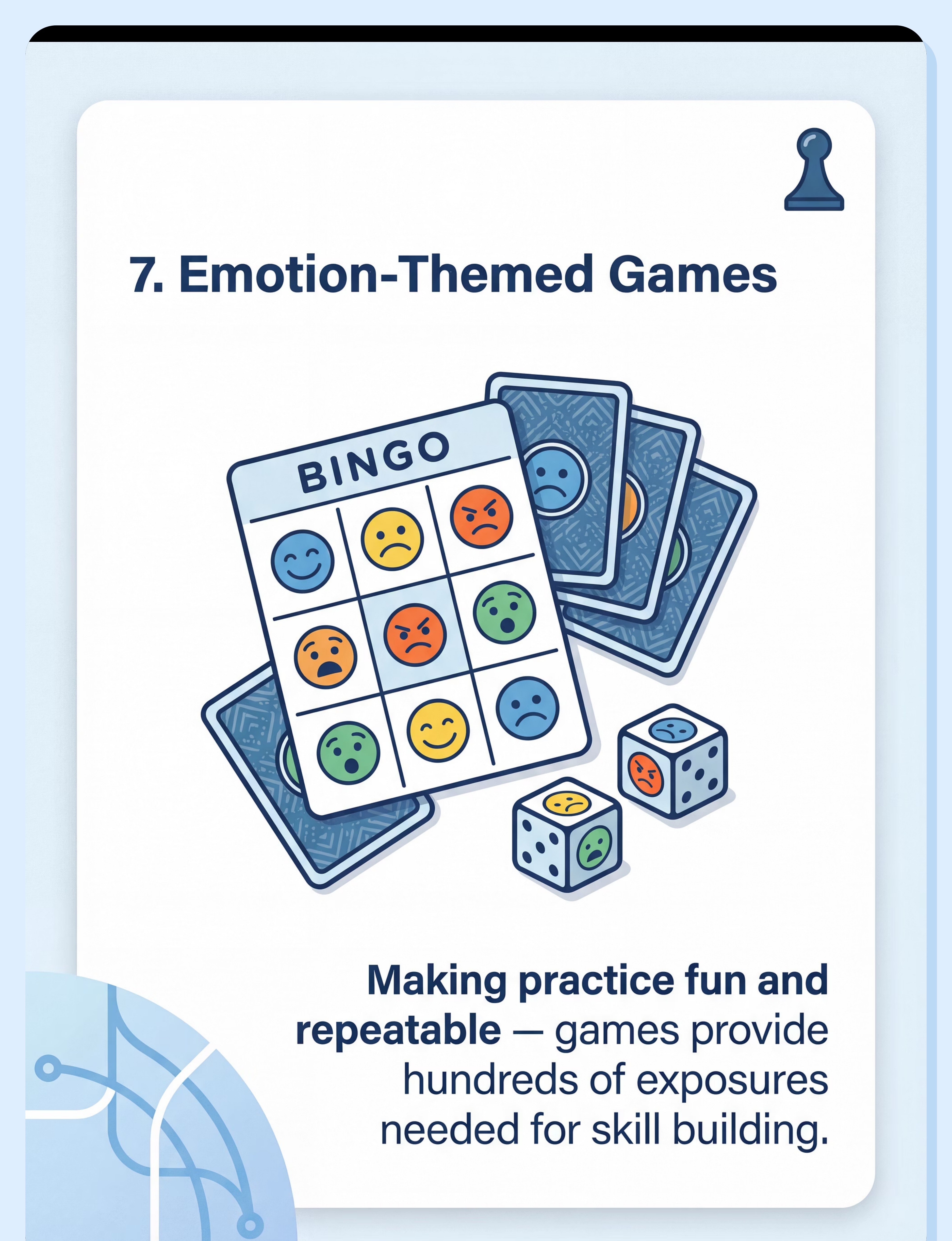
Emotion-Themed Games & Interactive Practice
Fun enables repetition: Repetition builds recognition, but repetition must be engaging to be sustained. Emotion-themed games make practice fun and motivating, allowing children to accumulate the hundreds of exposures needed to build recognition skills without the tedium of drill.
Games create natural context for identifying emotions: matching games, bingo, charades, board games where emotion recognition is required to advance. The game format also introduces real-time emotional interaction while focusing on emotions as the content. Competition, turn-taking, and shared fun create emotional experiences that further reinforce learning. Games can be adapted to different skill levels, making them useful across the full development arc.
Emotion Memory
Pairs of cards with same emotion on different faces. Find matches — builds repeated comparison exposure.
Emotion Bingo
Bingo cards with emotion faces. Call out emotions or describe situations — cover the matching face.
Emotion Charades
Draw emotion card, act it out, others guess. Builds expression production as well as recognition.
Emotion Dice
Roll and identify, roll and make that face, roll and describe a time you felt that way. Multiple skill layers in one tool.
Emotion Spinner
Spin, identify or express whatever emotion comes up. Simple to make at home with cardstock and a brad fastener.
Guess My Feeling
Think of an emotion; others ask yes/no questions. "Does it feel good? Do you feel it when something bad happens?"
Key Insight: Games provide the practice volume needed for skill building without burnout from drill. Difficulty progression: easy (basic emotions, clear expressions) → hard (complex emotions, subtle expressions).
Material 8 of 9
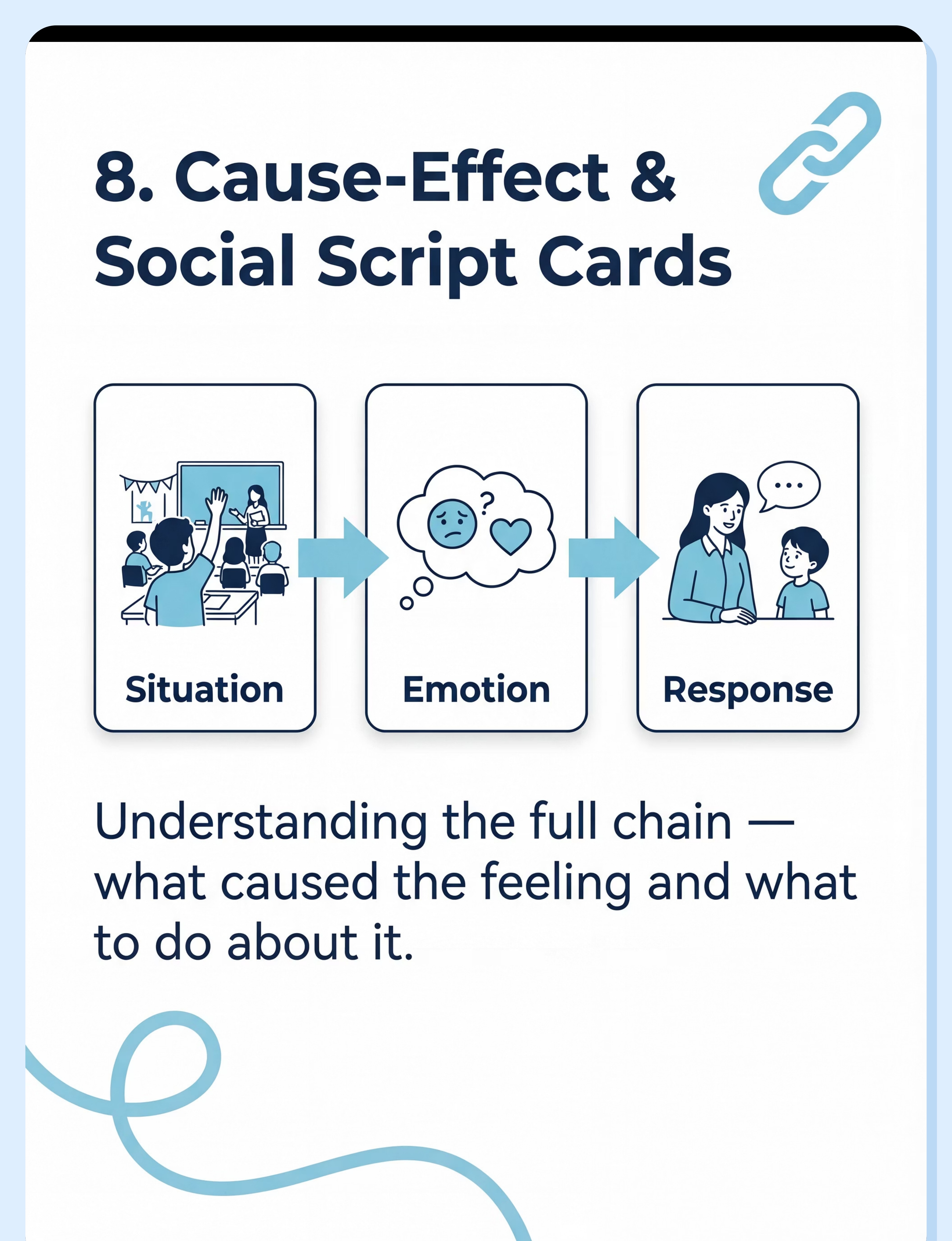
Emotion Cause-Effect Cards & Social Scripts
Recognition leads to response: Understanding the chain from situation to emotion to behavior helps children make sense of social interactions they might otherwise find confusing. Emotion-cause-effect cards explicitly teach: "When X happens → Person feels Y → Person might do Z."
Social scripts extend this by teaching appropriate responses to recognized emotions. The recognition skill becomes useful only when linked to appropriate response. Children who learn recognition without response remain socially uncertain — linking recognition to action creates complete social competence. These materials address the "so what" of emotion recognition.
1
CAUSE
Something happens in the world: "Ice cream fell on the ground"
2
EMOTION
Person experiences a feeling: Sad, Embarrassed, Disappointed
3
EFFECT
Person shows and acts on that feeling: "Might cry or ask for more"
4
YOUR RESPONSE
What you should do when you recognize the emotion in someone else

Material 8 — Social Response Scripts
What to Do When You Recognize an Emotion
Scripts are starting points, not rigid rules. Teach children that responses should be flexible — different people may prefer different kinds of comfort or support.
When Someone Looks SAD 😢
- Ask "Are you okay?"
- Offer comfort (pat, hug if appropriate)
- Stay nearby — don't walk away
- Get adult help if needed
When Someone Looks ANGRY 😠
- Give them space
- Stay calm yourself
- Ask calmly "What's wrong?"
- Don't argue or escalate
- Get adult help if needed
When Someone Looks SCARED 😨
- Stay calm — your calm helps them
- Reassure: "It's okay"
- Offer to help
- Remove from scary situation if possible
When Someone Looks HAPPY 😊
- Smile back
- Share their excitement
- Ask about what made them happy
- Celebrate with them

Material 8 — DIY Guide
Creating Cause-Effect Cards at Home
Three-Part Card Format
Create cards with three connected boxes: CAUSE → EMOTION → EFFECT. Use both pictures and words.
Matching Activities
- Mix up causes, emotions, and effects — child matches them correctly
- Sequencing: put three parts in correct order
- Incomplete chains: give two parts, child provides the third
Script Practice Activities
- Response practice: "I notice Maya looks sad. What's a good response?" Role-play it.
- Inappropriate responses: Discuss what NOT to do and why. "If someone looks sad, what should you NOT do?"
- Real situation application: "Your brother is crying because he fell. What should you do?"
- Personalization: "When YOU feel sad, what helps? Maybe that would help others too."
Material 9 of 9
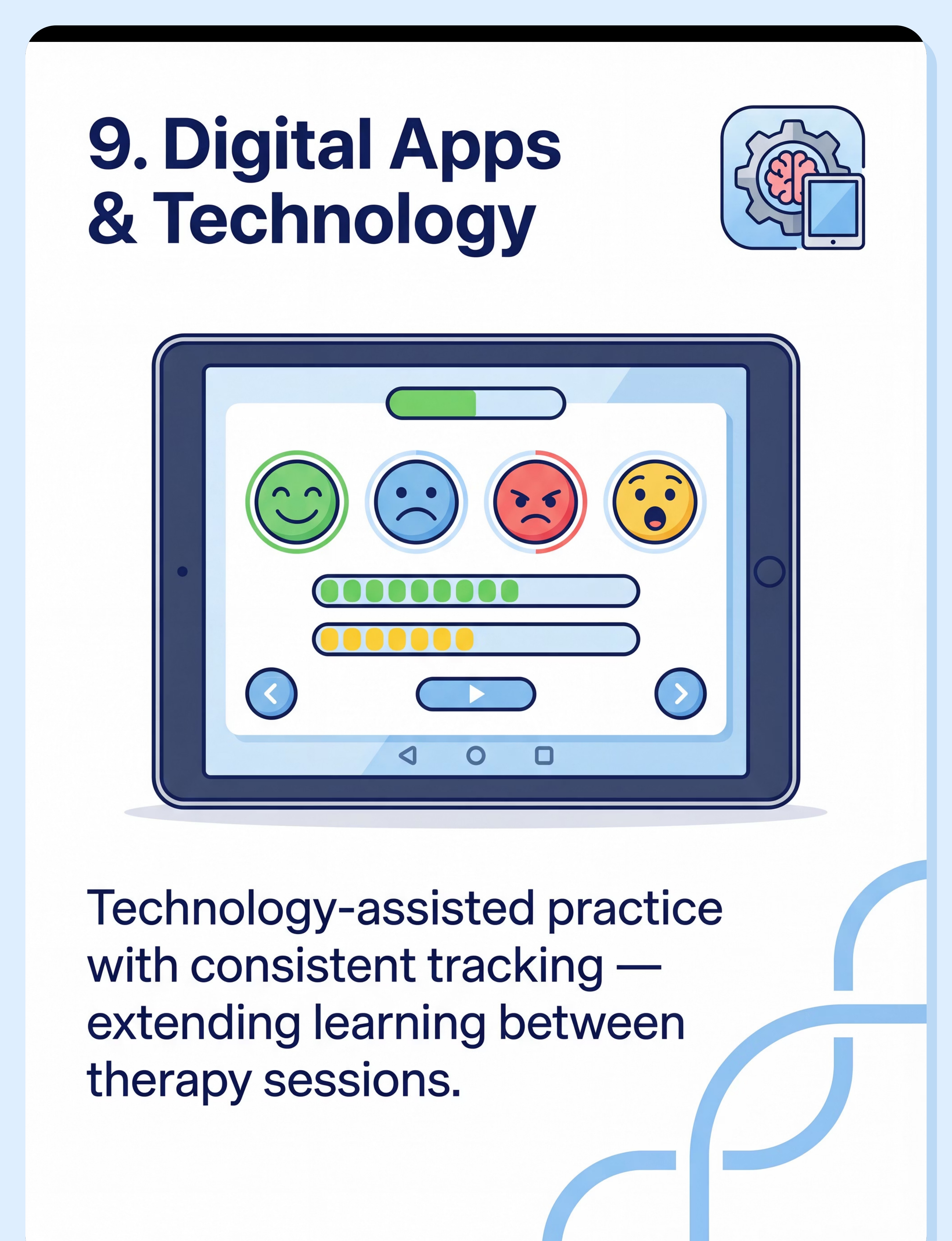
Digital Apps & Technology-Assisted Emotion Learning
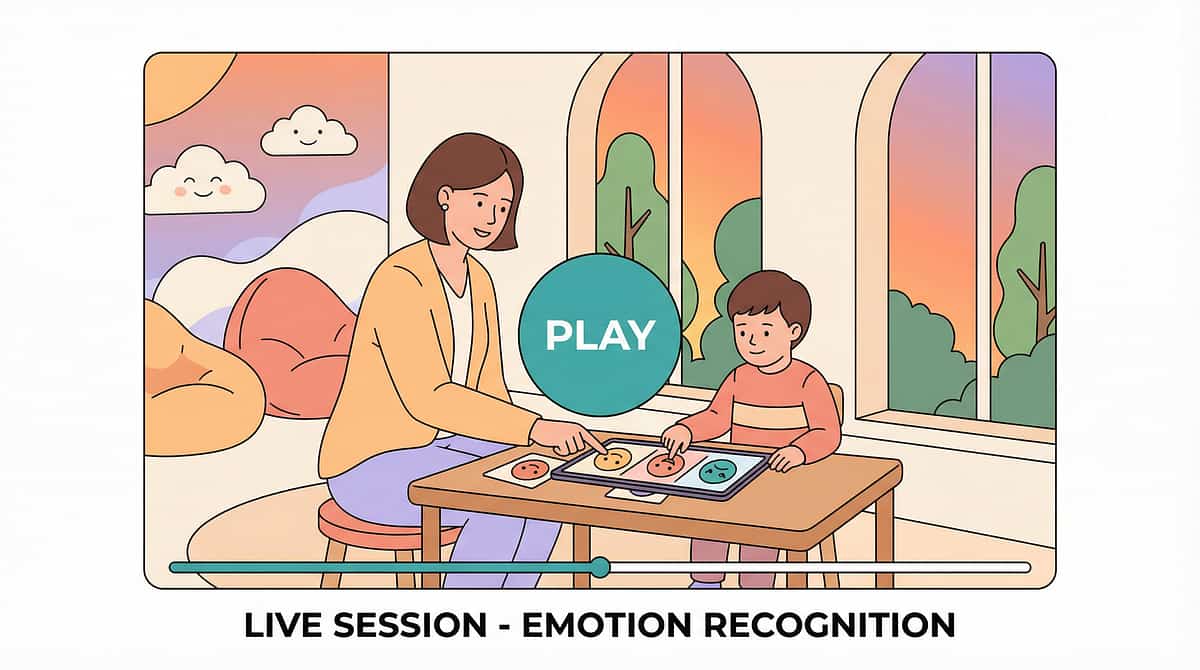
Technology extends practice: Apps designed for emotion recognition offer unique advantages — consistency (same quality every session), patience (unlimited practice without fatigue), data tracking (progress monitored systematically), and engagement (interactive formats that motivate continued practice).
While technology should supplement rather than replace human interaction and teaching, it provides a practice platform that extends learning beyond therapy sessions. Children can accumulate exposure and practice between appointments, building skill through volume that in-person therapy alone can't provide.
Mind Reading
Cambridge research-based. Comprehensive emotion library with video examples and interactive quiz.
Emotiplay
Video-based social-emotional learning. Engaging game format with adaptive difficulty.
FaceSay
Avatar-based social skills training. Reduces anxiety by starting with non-real faces before progressing.
Autism Emotion
Basic emotion practice. Accessible, simple interface good for beginning learners.
Avaz
AAC app with emotion expression component, useful for children who also have communication support needs.

Material 9 — Selection & Usage Guide
Choosing and Using Emotion Recognition Technology
App Evaluation Checklist
- Uses real photographs (not just cartoons)
- Includes a range of emotions and intensities
- Offers progressive difficulty
- Designed based on research
- Diverse and realistic faces
- Progress tracking for caregivers/therapists
Session Structure
10–15 minutes daily is more effective than longer sporadic sessions. Set a consistent practice schedule and rotate between apps to maintain engagement.
Integration Tips
- Preview first: Try apps yourself before your child uses them
- Supplement, don't replace: Apps work alongside human-led sessions, not instead of them
- Generalization check: Regularly check whether app learning transfers to real faces in real life
- Joint practice: Sometimes use apps together — adds social learning to digital practice
- Share data: Use app tracking to inform therapist about what's improving
Safety Note: Monitor screen time and ensure balanced use. Apps are tools, not babysitters. Supervise to ensure appropriate, targeted use.
Material Roadmap
Where to Start: A Prioritized Approach
Not all 9 materials need to be introduced at once. Match the materials to the child's current level and build systematically from foundation to application.
1
🏆 Application Layer
Cause-Effect Cards · Social Scripts — connect recognition to appropriate response
2
📈 Depth Layer
Intensity Scales · Situation Cards · Detective Worksheets — add nuance and context
3
🔄 Practice Layer
Games · Video Modeling · Digital Apps — volume and generalization throughout
4
🏗️ Foundation Layer
Real Photo Flashcards · Emotion Mirror — start here for all children
Budget Starter Kit: Family photos showing emotions + household mirror + DIY matching card game + one free emotion app. This is enough to begin building real skills today.
Teaching Strategies
5 Evidence-Based Teaching Approaches
Feature-Based Approach
Break the face into components (eyebrows, eyes, mouth) and teach features associated with each emotion. Compensates for difficulty with whole-gestalt processing. Especially useful for children who confuse similar emotions.
Context-Based Approach
Teach situation-emotion connections; use context to predict and confirm expression reading. Provides a redundant channel when facial recognition is weak.
Embodied Approach
Have the child make expressions and feel the muscular experience while seeing the visual result. Creates an internal reference for external observation.
Analytical Approach
Teach a systematic observation process (face → body → voice → situation → conclusion). Provides explicit strategy when intuition is absent.
Repetition-Based Approach
High-volume practice across many examples and variations. Recognition improves with exposure; games and apps facilitate the volume needed without burnout.
Generalization
Making Skills Stick in Real Life
The most common pitfall in emotion recognition training is teaching a skill in one context that never transfers to the real world. Generalization must be planned for deliberately — it rarely happens automatically.
Diverse Exemplars
Use many different faces for each emotion — different people, ages, genders, ethnicities. The skill must generalize across all of human variation.
Intensity Variation
Practice with both obvious and subtle expressions, not just prototypical "textbook" faces. Real life is mostly subtle.
Mode Bridging
Move deliberately from photos → video → real people; static → dynamic → real-time. Bridge the gap step by step.
Real-World Practice
Regularly practice identifying emotions in real life, not just materials. "Let's be emotion detectives at the playground."
Check & Correct
Verify regularly that in-session learning transfers to home, school, and community. If it hasn't, generalization training needs to be explicit.
Context Variation
Practice in different settings, with different people, and in various situational contexts. Recognition shouldn't be tied to one place or familiar faces only.
Progress Indicators
What Progress Looks Like: From Emerging to Advanced
Emerging
Attends to faces when asked · Can identify happy vs. not-happy · Recognizes extreme expressions in familiar people
Developing
Identifies basic four emotions in photos · Beginning to notice expressions in real life · Uses detective strategies with prompting
Established
Identifies basic emotions reliably across different faces · Beginning to recognize complex emotions · Uses detective strategies independently
Proficient
Reads emotions in real-time in real people · Recognizes subtle and mixed expressions · Responds appropriately to recognized emotions
Advanced
Reads complex social situations accurately · Detects masked emotions · Uses emotional information flexibly in social navigation
Intervention is most effective when matched to the child's current stage. Always ensure basic emotions are solid before advancing to complex; static recognition before dynamic; recognition before response training.
Getting Started
Your Step-by-Step Implementation Guide
Daily practice is recommended. 15–20 minutes per day is more effective than longer sporadic sessions. Aim for 100+ exposures per emotion during the initial learning phase. Patience and consistency matter more than intensity.
Common Mistakes
What NOT to Do: Pitfalls to Avoid
❌ Using Only Cartoon Faces
Cartoon recognition doesn't generalize to real people. Start with real photographs from the beginning, even if cartoons seem easier at first.
❌ Advancing Too Quickly
Moving to complex emotions before basic emotions are solid. Ensure the foundation is genuinely established before building on it.
❌ Teaching Recognition Without Response
Identifying an emotion is only useful if the child knows what to do with that information. Always connect recognition to appropriate response.
❌ Insufficient Repetition
Recognition requires volume. 2–3 exposures per emotion is not enough. Games, apps, and daily practice are essential for building the pattern library needed.
❌ Only Practicing in Therapy
Skills must generalize to real life. Home practice, community practice, and school application are non-negotiable components.
❌ Expecting Automatic Recognition
Many children may always require some deliberate effort to read emotions. That's a success — compensatory strategies that work are the goal, not neurotypical-style intuition.
Note on Alexithymia
When Your Child Also Struggles to Identify Their Own Emotions
What Is Alexithymia?
Alexithymia is difficulty identifying and describing emotions in oneself. It frequently co-occurs with emotion recognition deficits in autism — meaning a child may struggle both to recognize emotions in others and to access their own emotional states.
If a child can't identify their own emotions, it becomes harder to recognize them in others. The internal reference point is missing.
How to Adapt Your Approach
- Combine other-emotion recognition work with self-emotion identification activities
- Mirror work and embodied approaches are particularly helpful — they connect internal experience to external expression
- Use body-based cues: "When you feel angry, what happens in your body? Does your chest feel tight? Do your fists clench?"
- Build a body-sensation vocabulary alongside an emotion vocabulary
- Emotional check-ins: "What zone are you in right now? How does your body feel right now?"
A Parent's Letter
To the Parent Who Watches Their Child Struggle Every Day
"I know how heartbreaking it is to watch your child miss what other children see effortlessly. To see them offend people they don't mean to offend, miss social cues that seem obvious, navigate social situations like a foreign country without a map. He wants friends so badly. He just can't read the emotional map that helps you navigate relationships. But this can be taught. Emotion recognition isn't an innate gift — it's a skill built through exposure, practice, and systematic learning."
Start with the flashcards. Practice daily. Add the mirror work and the detective strategies. Build from obvious to subtle, from photos to real people. Progress may be slow, but with consistent practice, your child will start seeing what they've been missing. And when that happens — when they notice someone is sad and offer comfort, when they read a room and respond appropriately — you'll know the work was worth it.
CTA
Save This. Share This. Start Today.
These 9 materials provide multiple pathways into emotion recognition: real photographs for authentic learning, mirrors for embodied understanding, detective strategies for analytical recognition, games for engaging practice, and technology for consistent repetition.
🔖 Save
Bookmark this resource to return to as you work through each material with your child.
📤 Share
Know a parent whose child struggles to read faces? Share this with them. Every family deserves to know these tools exist.
▶️ Coming Next
9 Materials That Help With Perspective Taking — the next step in the social-emotional development journey.
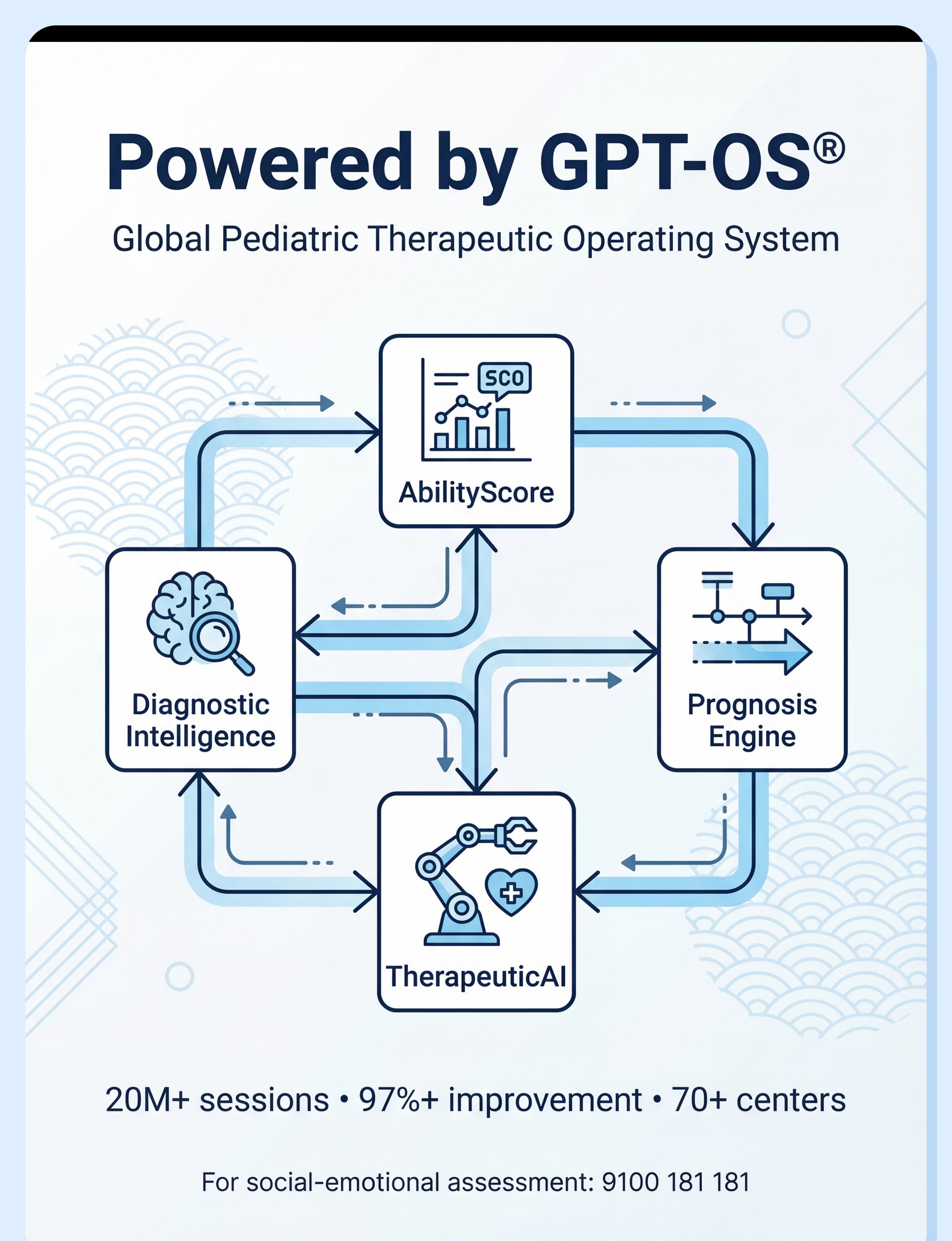
Powered by GPT-OS®
Powered by GPT-OS® — Global Pediatric Therapeutic Operating System
GPT-OS® is the end-to-end operating system that governs diagnosis, prognosis, therapy design, execution, monitoring, and readiness outcomes in child development — as one closed, accountable system.
Diagnostic Intelligence Layer
Converts 591+ structured observations across 349 skills and 79 developmental abilities into standardized diagnostic clarity.
AbilityScore®
A patented universal developmental score (0–1000) establishing baseline, severity, and longitudinal change across all domains.
Prognosis Engine
Predicts developmental trajectories and risk windows using historical response patterns from 20M+ real therapy sessions.
TherapeuticAI®
Determines therapy focus, intensity, sequencing, reinforcement logic, and escalation thresholds.
EverydayTherapyProgramme™
Translates clinical plans into daily, home-executable micro-interventions — including emotion recognition activities.
FusionModule™
Coordinates speech, OT, behavior, special education, and medical inputs into a single converged therapeutic pathway.
This is not software. This is therapeutic infrastructure. Closed-Loop Therapeutic Control: Observation → Score → Plan → Execute → Re-measure → Adapt.
GPT-OS® Proof
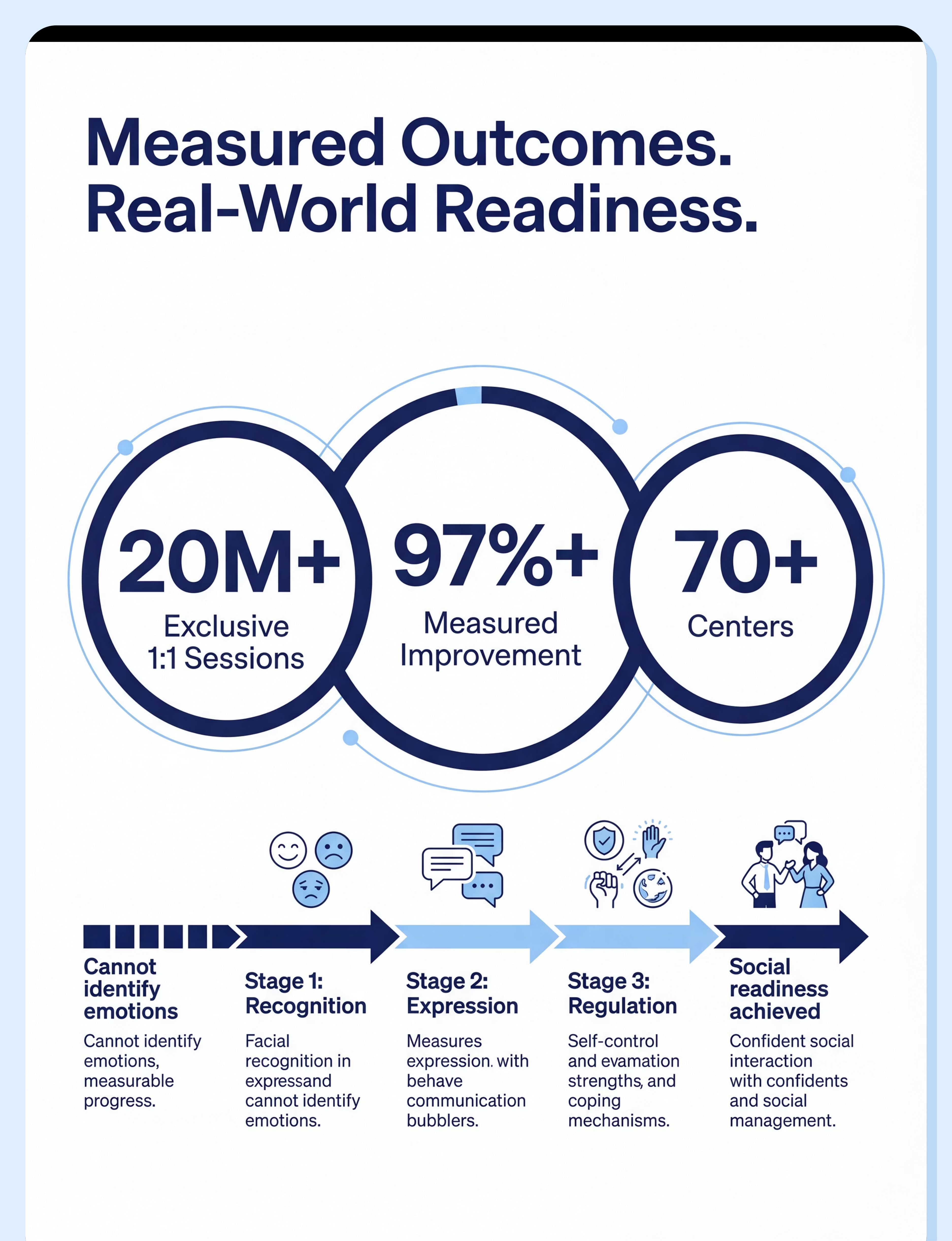
The Numbers Behind the System
20M+
Exclusive 1:1 Sessions
Across converged therapy disciplines including speech, OT, behavior, and special education
97%+
Measured Improvement
Across one or more readiness indexes, systematically tracked and reported
70+
Centers
Operating under a single clinical system, with consistent GPT-OS® standards
160+
Countries
Patents filed across jurisdictions, protecting the intellectual infrastructure of GPT-OS®
For social-emotional assessment and intervention, call the FREE National Autism Helpline: 9100 181 181 · pinnacleblooms.org

Real-World Evidence
Measured Outcomes. Real-World Readiness.
Emotion recognition is tracked and improved systematically within the GPT-OS® framework, using standardized readiness indexes that reflect real-world functional capability.
Readiness Indexes Tracked
- Social Readiness Index
- Emotional Intelligence Index
- Peer Relationship Readiness Index
- Communication Readiness Index
- Behavioral Regulation Readiness Index
Functional Progression Tracked
Cannot identify any basic emotions → Identifies basic emotions in exaggerated photos → Identifies emotions in realistic photos → Identifies emotions in real people → Recognizes subtle and mixed expressions → Uses emotion recognition to guide social interaction → Demonstrates real-world social readiness.
A Parent's Testimony
"Ananya couldn't tell happy from sad at seven years old. Every face looked the same to her. We started with flashcards — real photographs, lots of practice, slowly building recognition. Then mirrors, making expressions herself to feel what they look like. Then video clips, seeing emotions in motion. Then the detective worksheets, learning to look for clues systematically. It took months. Hundreds of repetitions. But slowly, she started seeing what she'd been missing. Yesterday her grandmother was upset, and Ananya walked over, patted her arm, and said 'Nani, you look sad. Are you okay?' I cried. She SAW it."
— Parent, Pinnacle Network. Illustrative case; individual outcomes depend on multiple factors and consistent intervention.

About Pinnacle
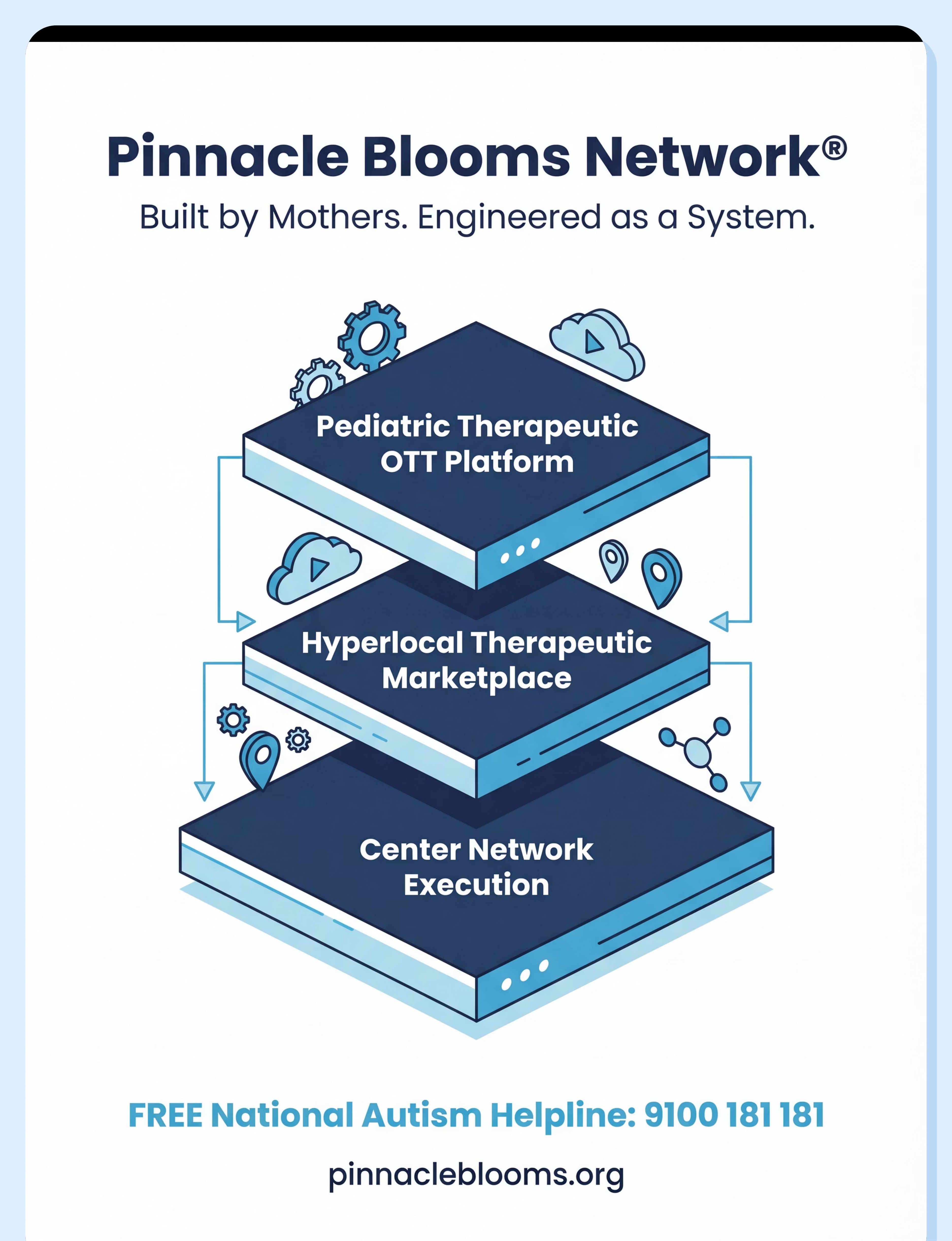
Pinnacle Blooms Network®
Built by Mothers. Engineered as a System.
Pinnacle is the execution layer of GPT-OS® — delivering therapy, daily programs, and digital continuity at population scale.
Pediatric Therapeutic OTT Platform
On-demand therapy guidance, parent education, and EverydayTherapyProgramme™ delivery.
Hyperlocal Therapeutic Marketplace
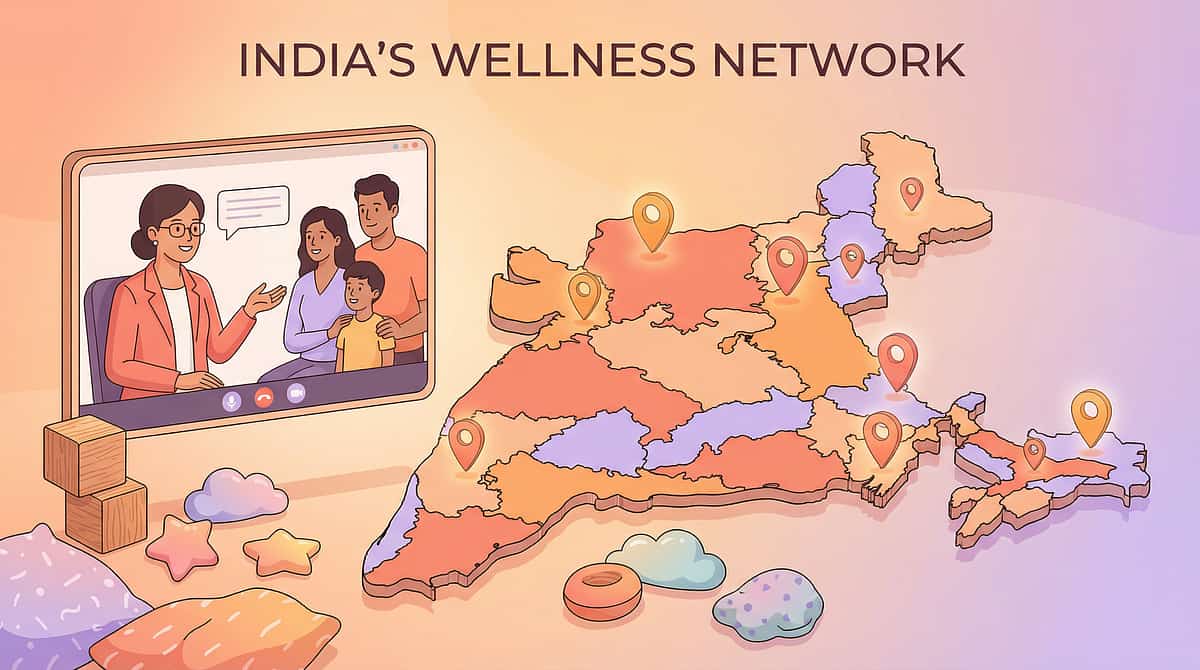
Connects families to verified therapists, centers, and specialized programs across India.
Center Network Execution
70+ physical centers operating under GPT-OS® standards — consistent clinical quality everywhere.
FREE National Autism Helpline (16+ languages, 24×7):9100 181 181 · pinnacleblooms.org · care@pinnacleblooms.org
Preview of 9 materials that help with emotion recognition Therapy Material
Below is a visual preview of 9 materials that help with emotion recognition therapy material. The pages shown help educators, therapists, and caregivers understand the structure and content of the resource before use. Materials should be used under appropriate professional guidance.


Link copied!

Statutory Information
Pinnacle Blooms Network® — Statutory Identifiers
Company | Bharath Healthcare Laboratories Pvt. Ltd. | |
CIN | U74999TG2016PTC113063 | |
DPIIT | DIPP8651 (Govt. of India) | |
MSME | Udyog Aadhaar: TS20F0009606 | |
GSTIN | 36AAGCB9722P1Z2 |
Disclaimer: This content is educational. Emotion recognition difficulties may be part of autism, social communication disorder, or other conditions. Professional assessment is essential. Progress depends on individual factors and consistent intervention. Individual results may vary. Statistics represent aggregate outcomes across the Pinnacle Blooms Network. © 2025 Pinnacle Blooms Network®, unit of Bharath Healthcare Laboratories Pvt. Ltd. All rights reserved.
Series: Social-Emotional Development · Episode 971 · Domain: SOC-EMO · Related: L-970 Identifying Own Emotions | L-972 Perspective Taking | L-973 Empathy Development