

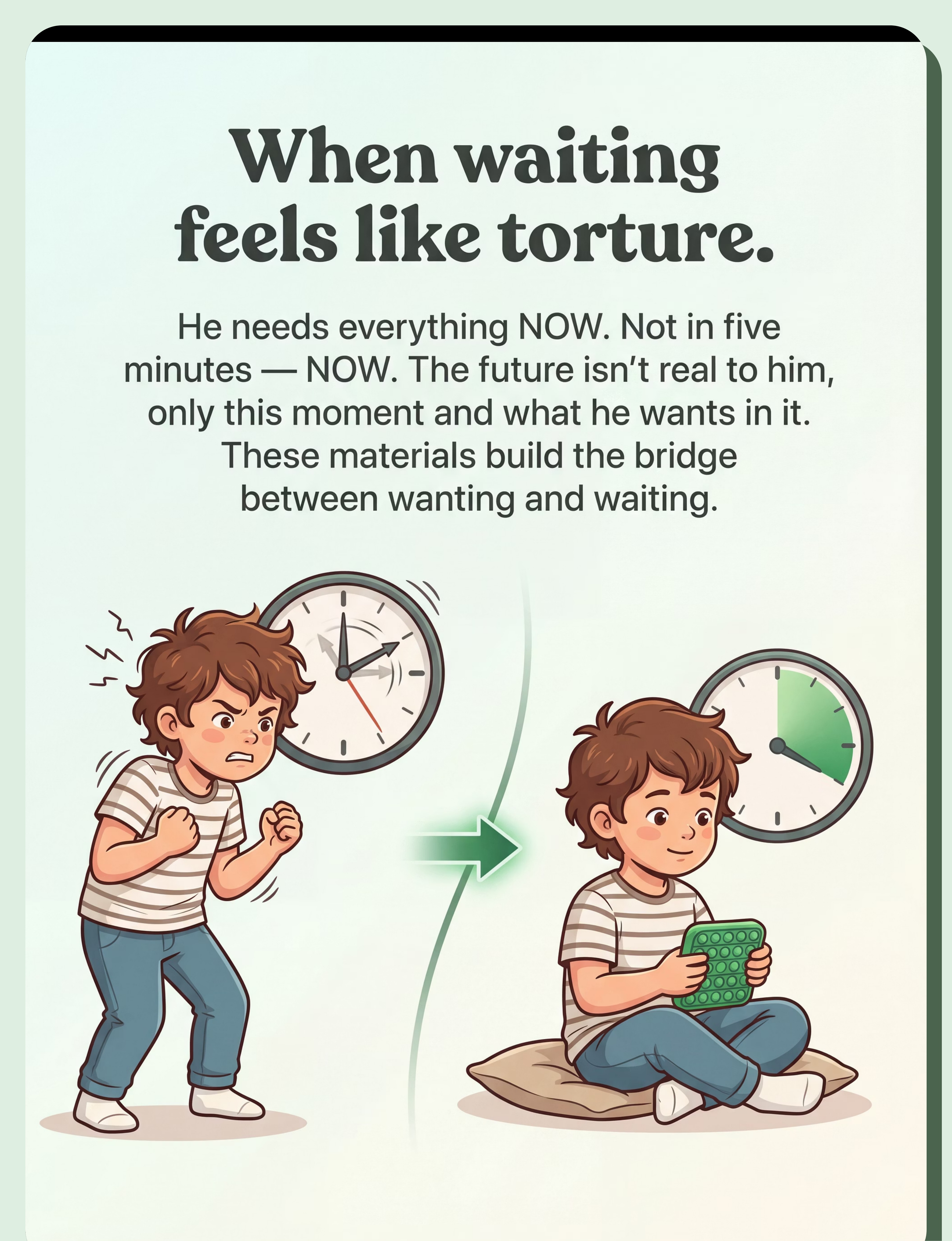
"When waiting feels like torture."
He needs everything NOW. Not in five minutes — NOW. The future isn't real to him, only this moment and what he wants in it. You are not failing. Your child's brain is not broken. Delayed gratification is a skill — and skills can be taught.
ACT I — RECOGNITION
You Are Not Alone — The Numbers
If your child melts down when asked to wait — for a snack, a turn, a screen, a reward — you are not alone. Difficulties with delayed gratification are among the most common and most impactful challenges in childhood neurodevelopment. The research is unambiguous: this is a widespread, well-documented, and highly treatable developmental difference.
1 in 3
Neurodevelopmental Context
Children with ADHD show clinically significant delayed gratification deficits (Barkley, 2012 — Executive Functions, Guilford Press).
67%
Autism Spectrum Data
Of children on the autism spectrum demonstrate difficulty tolerating reward delay beyond 30 seconds (Geurts et al., 2014 — Journal of Autism and Developmental Disorders).
4–6 years
Developmental Window
The developmental window when delayed gratification capacity grows fastest — and when intervention has the highest ROI (Mischel et al., Stanford Longitudinal Study).
8–12 weeks
Typical Intervention
Average time for measurable improvement with structured home-based intervention (PMC11506176 — Executive Function Outcomes).

The marshmallow test wasn't just about willpower. It was about whether a child had the cognitive scaffolding to hold a future reward in mind. That scaffolding can be built. That is exactly what this programme does.
You noticed. You searched. You found this. That already puts your child ahead.
THE SCIENCE
This Is Not a Behaviour Problem. This Is a Brain Wiring Difference.
The Prefrontal Cortex (PFC)
Delayed gratification requires the PFC to suppress the limbic system's demand for immediate reward. In children with executive function challenges, ADHD, or autism, the PFC-limbic signalling pathway matures more slowly — sometimes years behind typical timelines.
5 Components That Must ALL Work Together
  1. Inhibitory Control — stopping the impulse to grab
  1. Working Memory — holding the future reward in mind
  1. Temporal Processing — understanding time will pass
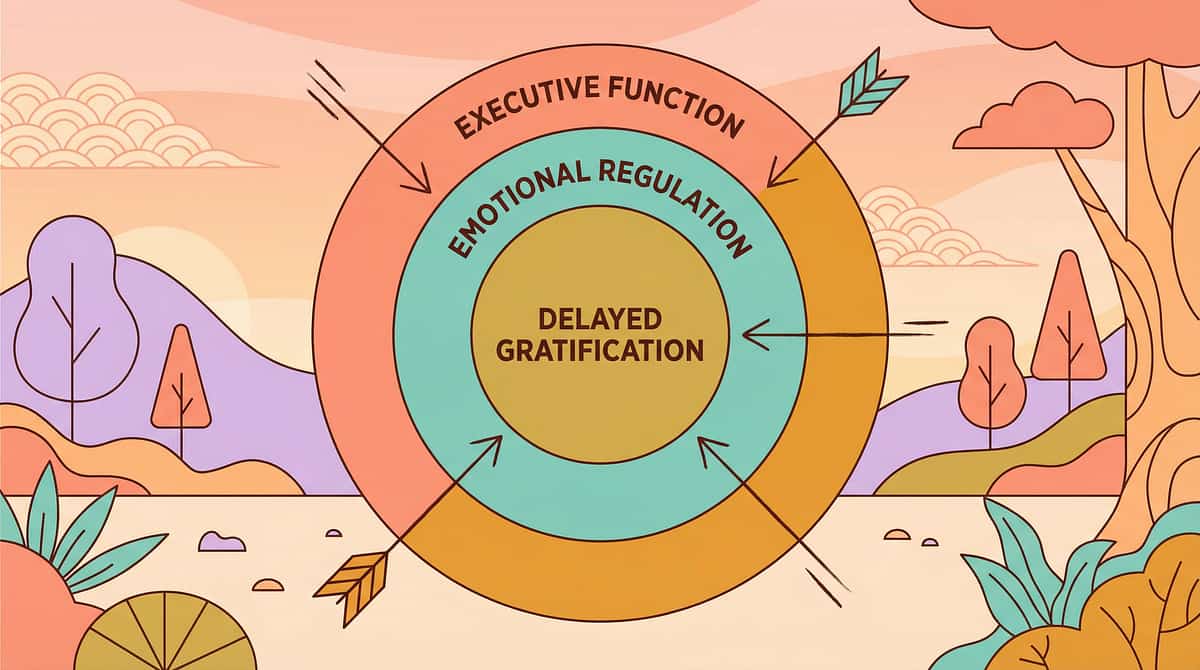
  1. Emotional Regulation — tolerating the discomfort of wanting
  1. Future Orientation — valuing what hasn't happened yet
Parent Translation
"Your child isn't being defiant. His brain genuinely cannot hold the future reward in mind while managing the intensity of wanting right now. The executive control systems that enable 'I'll wait' are still under construction. With the right scaffolding, they build faster."

9-materials-that-help-with-delayed-gratification therapy material
Frontiers in Integrative Neuroscience (2020) — DOI: 10.3389/fnint.2020.556660 | Harvard Center on the Developing Child
DEVELOPMENTAL CONTEXT
Every Child's Waiting Ability Grows on a Timeline. Here's Where Yours Is.
Birth–2 yrs
No delay capacity — immediate response only
3–4 yrs
Seconds of delay with significant distress
5–7 yrs
Minutes with adult support and visual aids
8–10 yrs
Emerging independent strategies
11–12 yrs
Independent self-selected delay strategies
Adolescence
Flexible delay capacity across contexts

Your child may be here — and that is exactly where these materials meet them. Children with ASD or ADHD may trail typical milestones by 2–4 years in executive function domains. This is not a ceiling — it is a starting point.
Commonly co-occurs with: ADHD | Autism Spectrum | Anxiety Disorders | Developmental Language Disorder | Sensory Processing Differences
PMC9978394 | WHO/UNICEF Care for Child Development Package (2023) | WHO Developmental Milestones Framework
EVIDENCE
Clinically Validated. Home-Applicable. Parent-Proven.
🔬 Marshmallow Test Legacy
Stanford/Columbia Research — Delayed gratification is trainable through strategy instruction and environmental scaffolding, not a fixed trait.
📊 Harvard Center on Developing Child
Executive function skills including inhibitory control are built through supportive scaffolding and structured practice across all developmental contexts.
🇮🇳 Indian RCT — Padmanabha et al. (2019)
Home-based executive function interventions show significant outcomes in Indian paediatric populations. Culturally validated. Home-replicable.

LEVEL I EVIDENCE — Systematic Reviews + RCTs + Population Data. Children taught explicit waiting strategies using visual supports demonstrate measurable improvements in delay capacity within 4–8 weeks.
PMC4359073 | PMC11506176 | NCAEP 2020 | DOI: 10.1007/s12098-018-2747-4
ACT II — KNOWLEDGE TRANSFER
The Technique: Delayed Gratification Building
Parent-friendly alias: "Teaching Your Child to Wait"
Delayed gratification is the ability to resist an immediate, smaller reward in favour of a larger, more meaningful reward that requires waiting. It is not a personality trait. It is not willpower. It is a trainable cognitive skill — one that depends on five distinct brain systems working in coordination. When those systems are immature or differently wired, the child is not being difficult. They are being neurologically honest.
What It Is — Precisely
  • A structured, scaffolded practice of tolerating reward delay using external supports (visual timers, token boards, strategy cards) to replace the internal cognitive load the child cannot yet carry independently.
  • Duration: 10–20 minutes per session
  • Frequency: 4–5 sessions per week
  • Setting: Home, quiet familiar space
  • Who delivers it: Parent or caregiver — no therapist required in the room
What It Is NOT
  • Not punishment or withholding
  • Not "making the child suffer to build character"
  • Not a test of the child's love or trust
  • Not a behaviour management technique
  • Not a replacement for professional therapy — it is a home extension of it
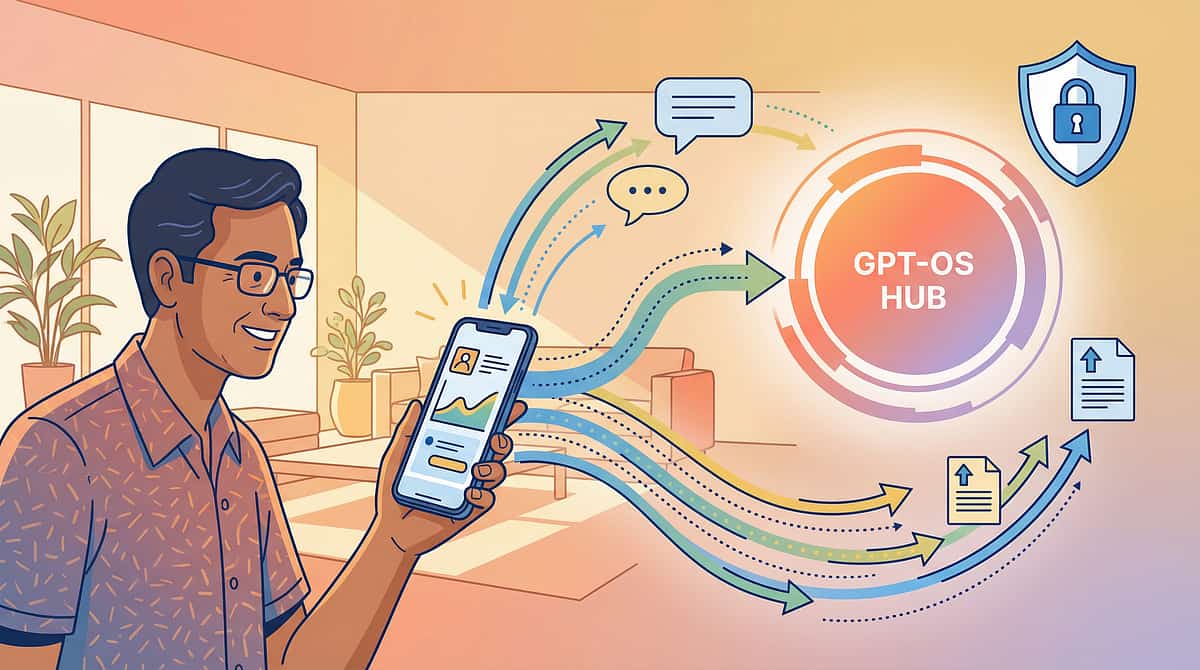
The science is clear: children do not learn to wait by being forced to wait. They learn to wait by being scaffolded through waiting — with visible supports, predictable sequences, and immediate celebration of every successful delay. That is exactly what this technique does.
10–20 min
Ideal session length for maximum neural consolidation without fatigue
4–5×/week
Minimum frequency for measurable progress within 8 weeks
₹0–500
Cost to implement with DIY materials from home
Technique validated across OT, ABA, SLP, and Special Education frameworks. Evidence base: PMC4359073 | Barkley (2012) | NCAEP (2020)
ACT II — KNOWLEDGE TRANSFER
The Technique: Delayed Gratification Building
Parent-friendly alias: "Teaching Your Child to Wait"
Delayed gratification is the ability to resist an immediate, smaller reward in favour of a later, larger, or more meaningful one. It requires five cognitive skills working together: inhibitory control, working memory, temporal processing, emotional regulation, and future orientation. When children struggle to wait, it is rarely defiance — it is one or more of these components being underdeveloped or dysregulated.
Delayed Gratification Building as a therapeutic approach uses structured visual materials, behavioural scaffolding, and strategy instruction to systematically develop each component in the home environment.
🧠 Domain
Emotional Regulation / Executive Function (Domain C)
👶 Age Range
3–12 years
⏱️ Duration
5–15 minutes per session
📅 Frequency
2–3× daily practice opportunities
🏠 Setting
Home + School + Community
Canon Material Cluster
Visual Schedules | Reinforcement Systems | Behavioural Support Tools | Regulation Materials | Reel Reference: C-254 | Executive Function & Self-Regulation Series — Episode 254
Who Uses This Technique?
This technique crosses therapy boundaries — because the brain doesn't organise by therapy type. Every specialist brings a distinct lens to the same core challenge.
Occupational Therapist (Lead)
Leads executive function work; assesses sensory and motor contributors to delay difficulty; designs the waiting protocol from the ground up.
Speech-Language Pathologist
Addresses turn-taking, conversational delay, and narrative comprehension of "waiting" concepts. Builds language around future orientation.
BCBA / ABA Therapist
Designs token economy systems, reinforcement schedules, and data collection protocols. Conducts functional analysis of delay breakdown patterns.
Special Educator
Adapts delay activities for school settings; integrates IEP goal planning; builds classroom waiting strategies with teacher collaboration.
NeuroDev Paediatrician
Rules out ADHD requiring pharmacological support; monitors executive function development longitudinally; coordinates multi-disciplinary planning.
Pinnacle Blooms Network® — OT • SLP • ABA • SpEd • NeuroDev | UNICEF/WHO Nurturing Care Framework (Int J Speech-Lang Pathol, 2022) — DOI: 10.1080/17549507.2022.2141327
What This Technique Targets
This isn't a random activity. It's a precision developmental tool with layered, measurable outcomes across three levels of impact. Every session simultaneously trains multiple brain systems — because the brain doesn't develop in silos.
🎯 PRIMARY TARGET
Delayed Gratification Capacity
  • Tolerance of reward delay: 30 sec → 2 min → 5 min → 15 min
  • Reduction in meltdown frequency during waiting periods
  • Increased use of self-initiated waiting strategies
  • Measurable via: Delay Tolerance Assessment (DTA) | Session data logs
Clinical benchmark: Child tolerates 2-minute delay without adult prompting by Week 6
🔄 SECONDARY TARGET
Emotional Regulation
  • Reduced emotional intensity during frustration peaks
  • Faster recovery time after delay-triggered dysregulation
  • Increased use of regulation tools (breathing, fidgets, calm-down jar) independently
  • Measurable via: Emotion Regulation Checklist (ERC) | Parent-rated dysregulation frequency
Clinical benchmark: 30% reduction in meltdown duration by Week 8
🧠 TERTIARY TARGET
Executive Function Domain
  • Working memory: holding future reward in mind while managing present discomfort
  • Inhibitory control: suppressing impulse to grab/demand immediate reward
  • Cognitive flexibility: accepting variation in waiting duration without shutdown
  • Future orientation: valuing delayed outcomes over immediate ones
  • Measurable via: BRIEF-2 Parent Form | AbilityScore® Executive Function Index
Clinical benchmark: Measurable BRIEF-2 shift in Inhibit and Working Memory subscales by Week 12

These three targets are not sequential — they build simultaneously. Every successful wait trains all three systems at once. That is why even one good session per day compounds into significant developmental change over 8 weeks.
Targets validated across: Barkley Executive Function Model (2012) | Zelazo & Carlson (2012) — Advances in Child Development | PMC11506176 | BRIEF-2 Normative Data (PAR, 2015)
What This Technique Targets
This isn't a random activity. It's a precision developmental tool with layered, measurable outcomes across three levels of impact.
🎯 Primary Target
Delay of Gratification Capacity — child tolerates wait periods without meltdown; uses strategies during delay; accepts "after dinner" without crisis.
🔵 Secondary Targets
Inhibitory Control • Emotional Regulation • Future Orientation • Temporal Processing
🟢 Tertiary Developmental Gains
School Readiness • Peer Relationships • Self-Efficacy • Academic Achievement
GPT-OS® Tracking: Executive Function Readiness Index | Self-Regulation Readiness Index | Impulse Control Development Index | PMC10955541 | Mischel Marshmallow Research
9 MATERIALS
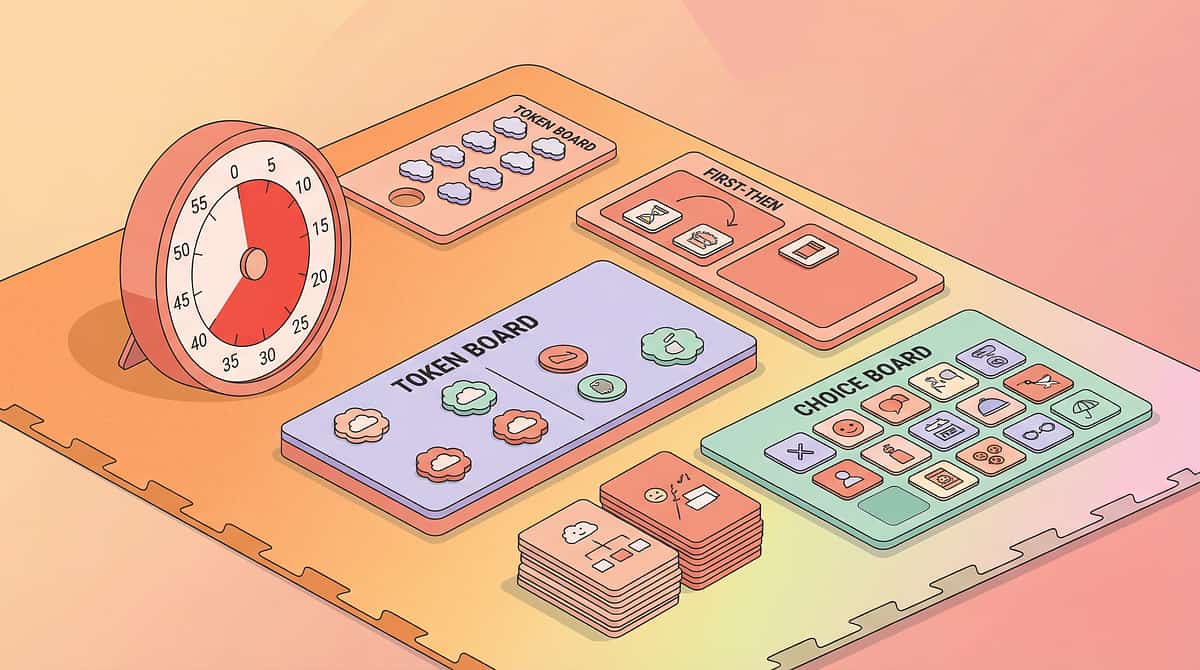
9 Materials That Build the Bridge Between Wanting and Waiting
Each material targets a specific cognitive mechanism. Start with 2–3. Add as competency grows. Total starter kit: ₹500–3,000 | DIY zero-cost version available for every item.
1
⏱️ Visual Timers
Makes time concrete and visible. ₹300–2,500
2
🎯 Token Boards
Transforms passive waiting into active progress. ₹100–800
3
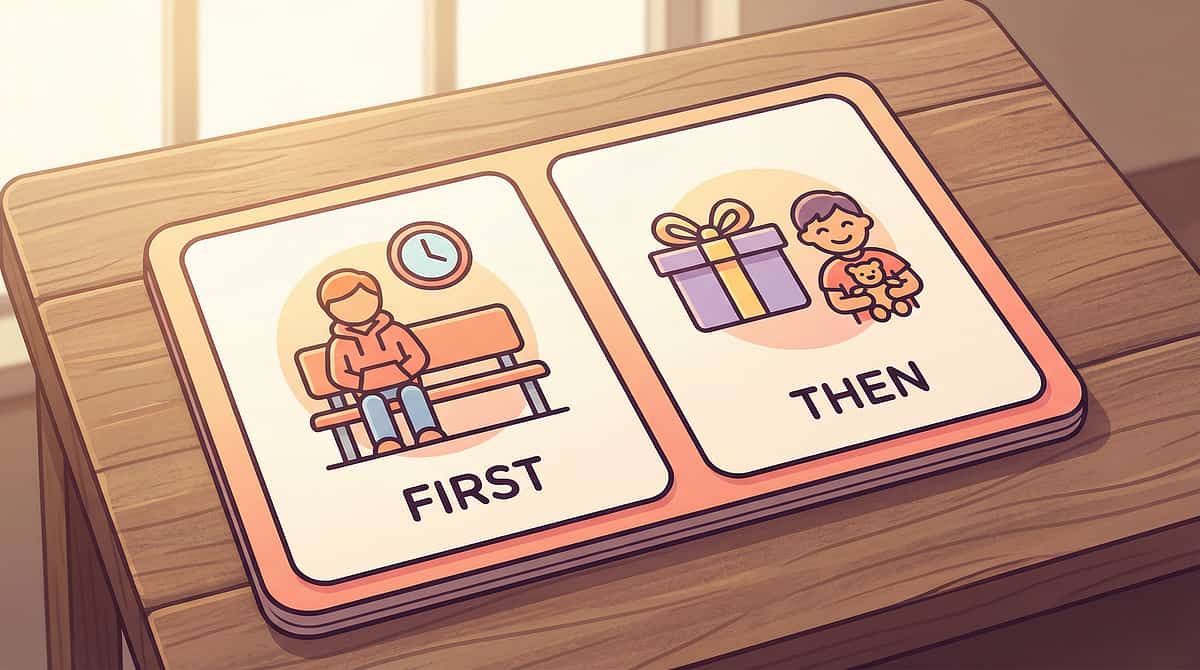
📋 First-Then Boards
Makes sequence visible and predictable. ₹200–600
4
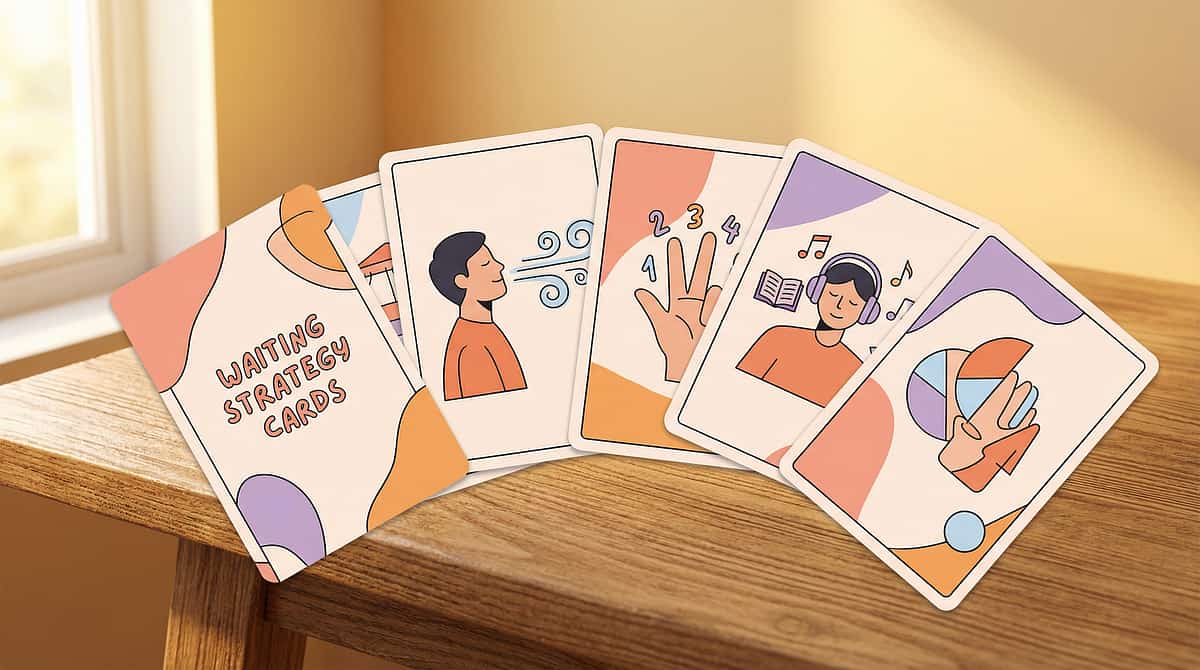
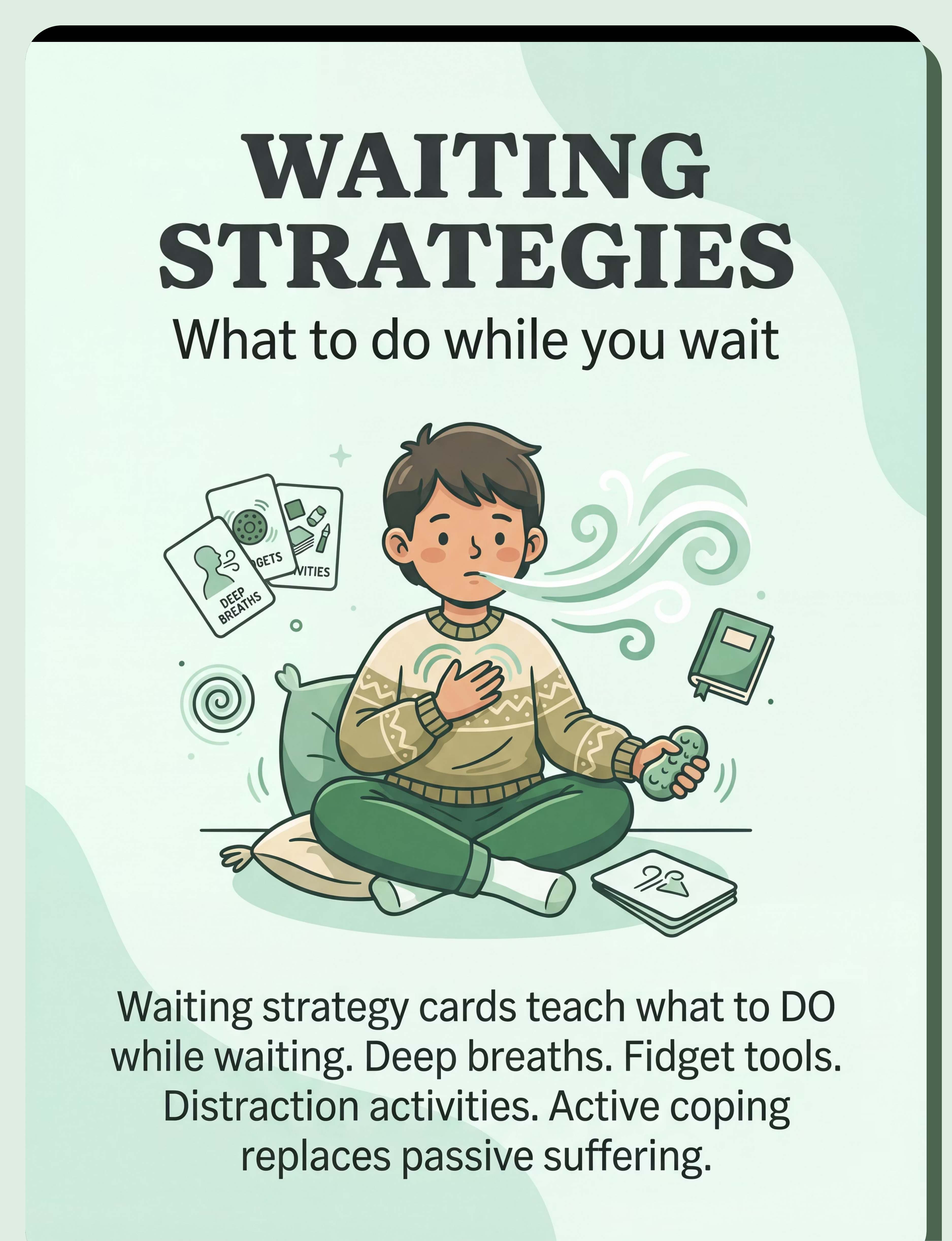
🃏 Waiting Strategy Cards
Fills the waiting gap with active coping. ₹200–1,000
5
🔀 Choice Boards
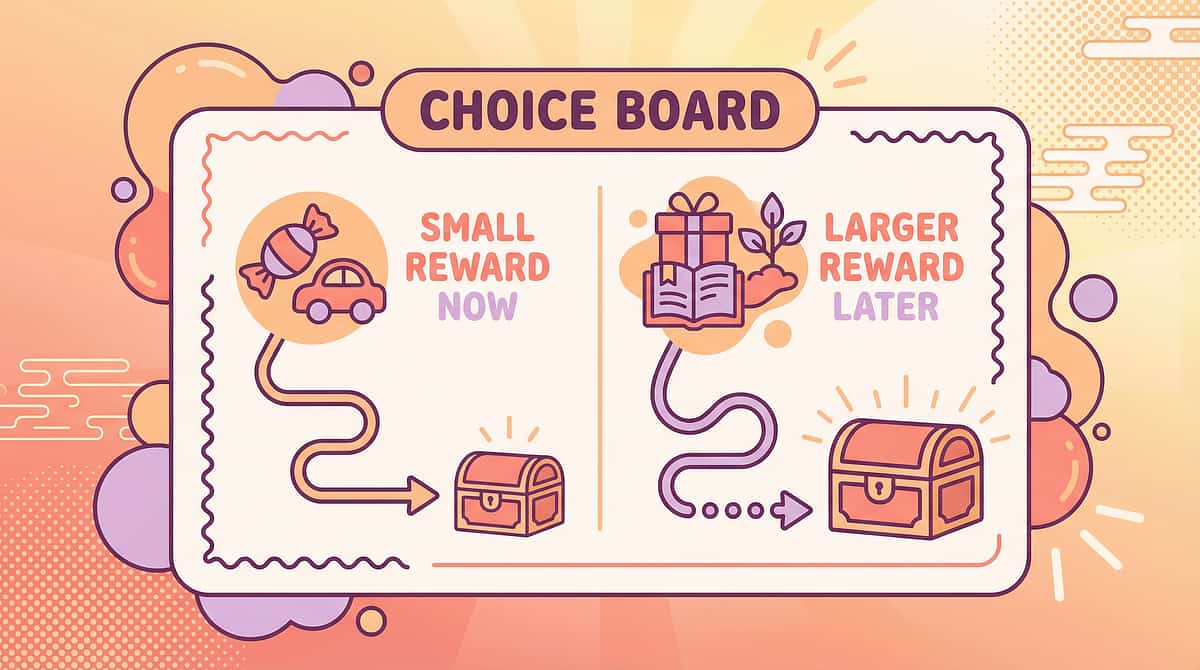
Teaches the trade-off explicitly. ₹100–400
6
📖 Social Stories
Builds the mental framework for waiting. ₹200–800
7
🐷 Savings Games
Practice waiting through accumulation. ₹200–1,500
8
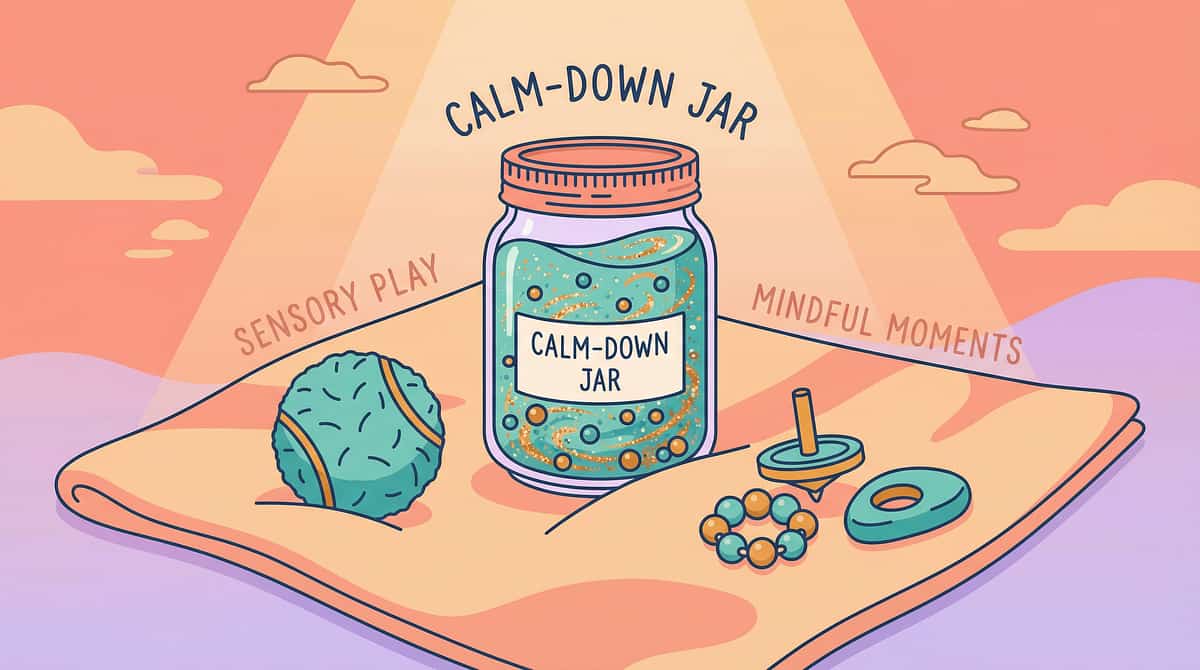
🫙 Regulation Tools
Regulate the emotional storm of wanting. ₹200–1,200
9
🎯 Future Visualisation
Makes the future real enough to wait for. ₹100–500
Material 1: Visual Timers
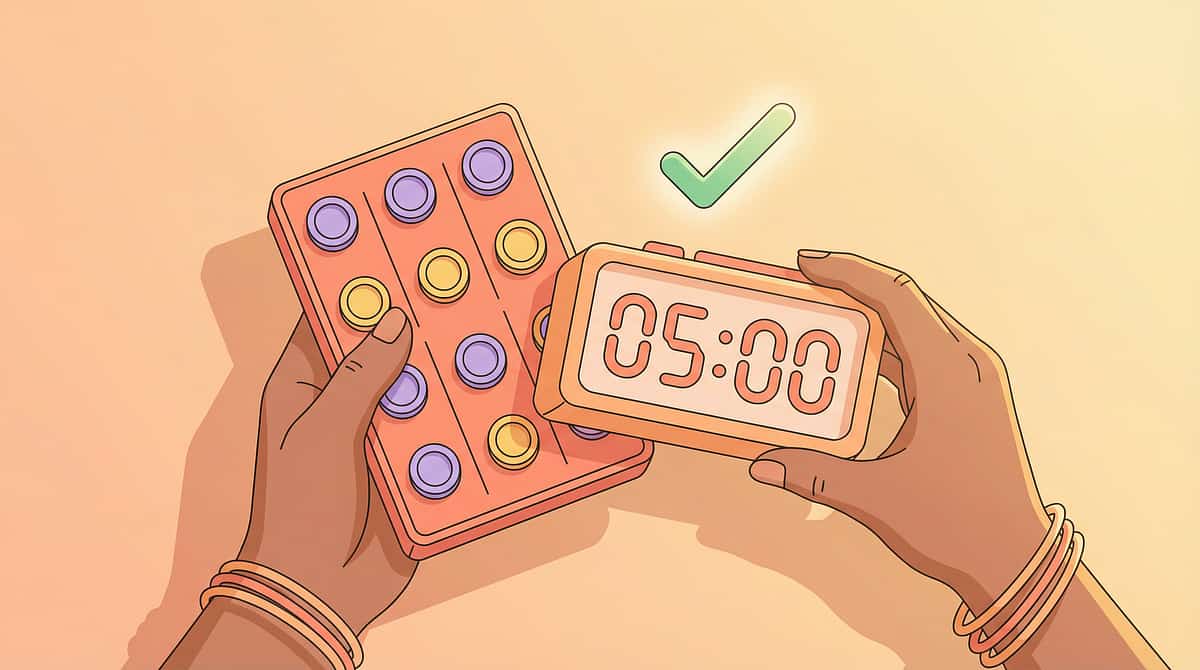
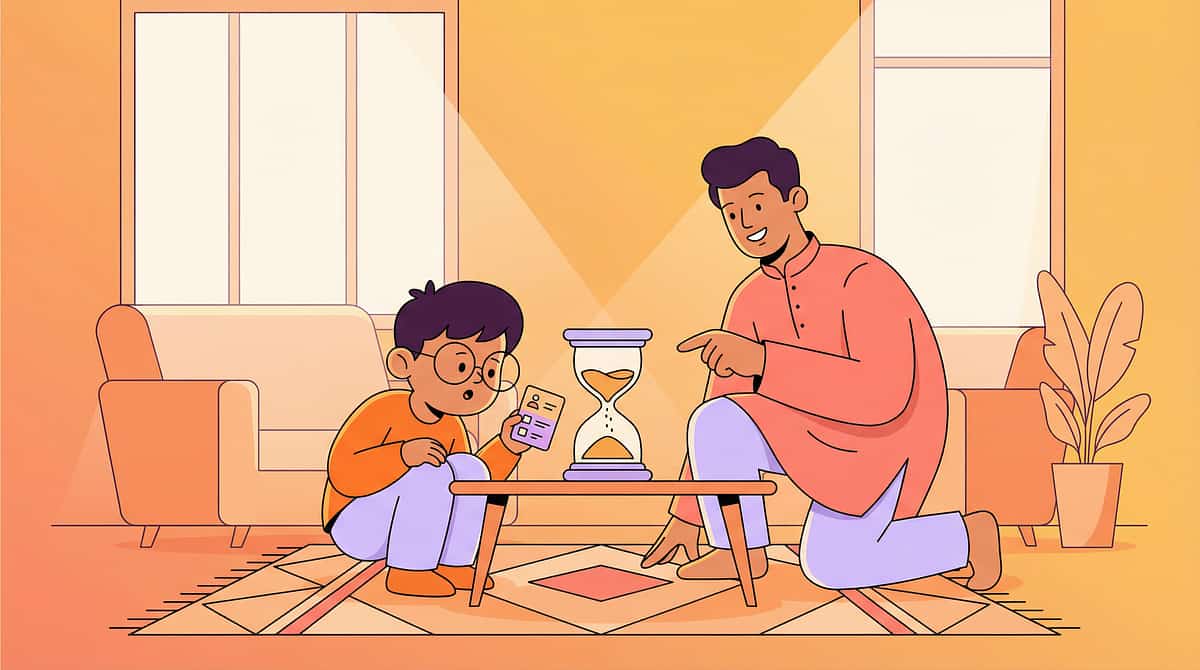
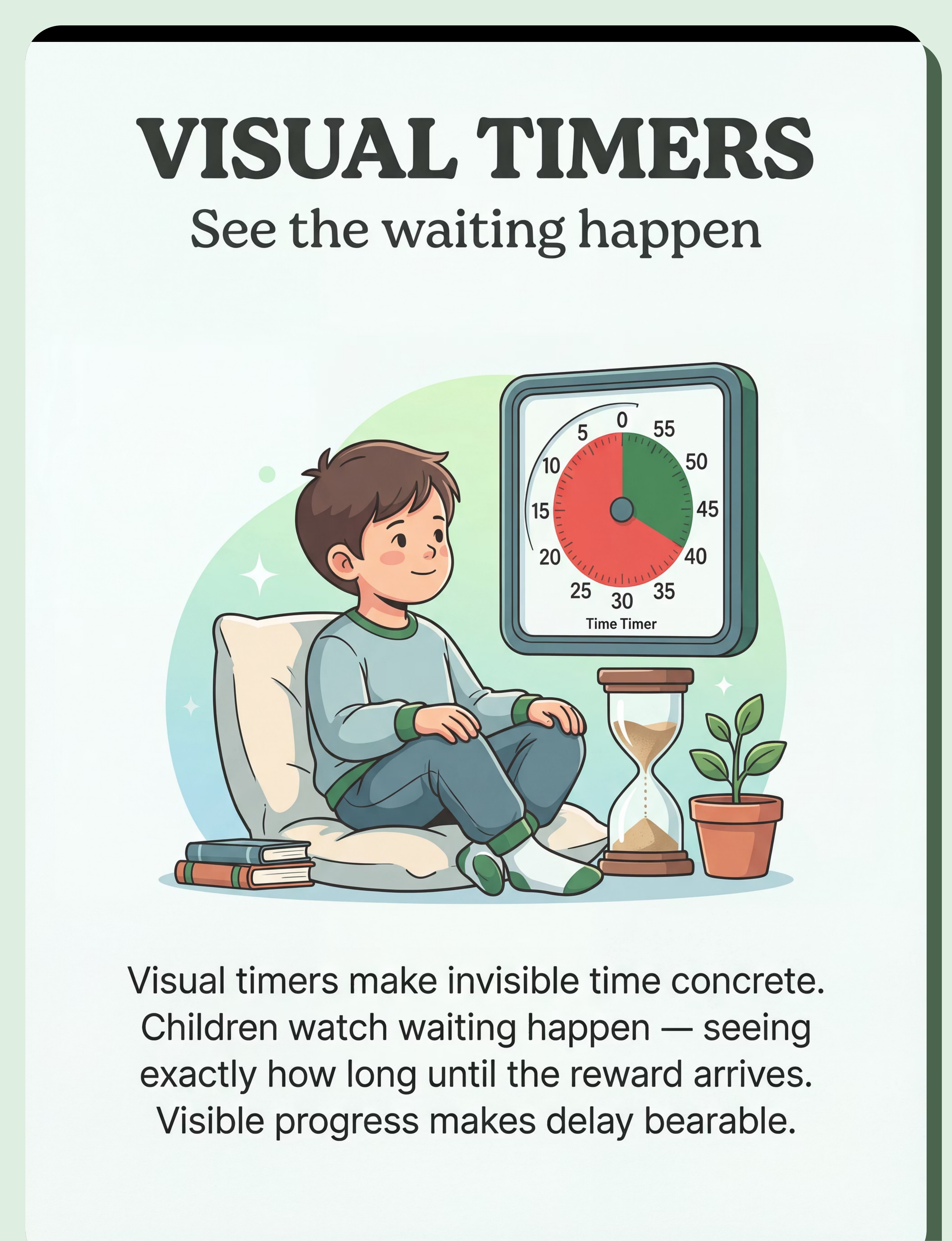
Visual timers make the abstract concept of time concrete and visible. When a child can see time passing — sand falling, a red disc shrinking, a digital countdown — waiting transforms from an invisible torture into a manageable, finite experience. This is the single most important material in a delay-building toolkit.
What to Buy
Time Timer® ₹1,500–2,500 | Smartivity DIY Interactive Clock ₹673 | Sand timers ₹300–800
DIY (₹0)
Sand jar + water in a bottle | Phone countdown app | Paper "waiting chain" — tear one link per minute
Start below current capacity. If child can wait 1 minute, set timer to 30 seconds. Build success before building duration.
Let the child see it begin. The starting moment anchors the waiting sequence cognitively.
Never reset mid-session if child asks. Redirect to strategy: "Keep watching — almost there!"
Success criterion: Timer completes without meltdown. That is the only goal at the start.
🏆 Canon Product: Smartivity DIY Interactive Clock ₹673 | Visual supports — NCAEP 2020 Evidence-Based Practice
Material 2: Token Boards
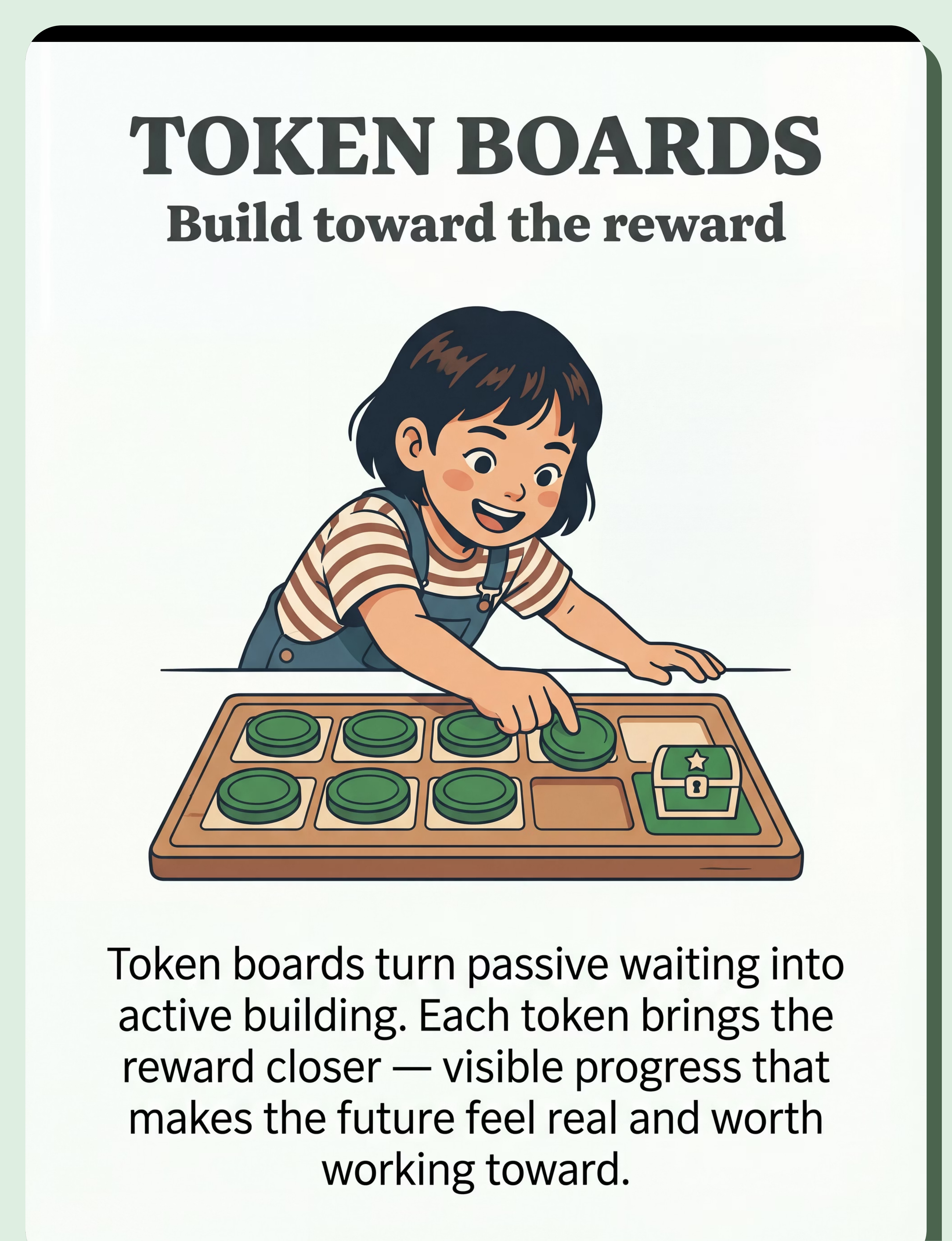
Token boards transform passive, uncomfortable waiting into active, visible progress. Instead of enduring empty time, the child earns tangible tokens toward a visible goal. Each token placed is a mini-victory — a dopamine moment that sustains motivation across the full delay period.
What to Buy
Commercial velcro board ₹400–800 | Rosette Imprint Reward Jar ₹589 | 1800+ Reward Stickers ₹364
DIY (₹0)
Paper + stickers | Marbles in a glass jar | Tower of blocks (one block per successful wait)
Start with 2–3 tokens only. Twenty tokens to a goal = failure guaranteed. Keep the finish line close.
Token placement IS the reinforcement. Make it celebratory: "One more token — look how close you are!"
Tokens are NEVER removed. Taking tokens away destroys trust in the system — and in you.
Success = completing the token set and receiving the pre-agreed reward promptly.
🏆Rosette Imprint Reward Jar ₹589 | 1800+ Reward Stickers ₹364 | Token economy systematic reviews — ABA literature
Material 3: First-Then Boards
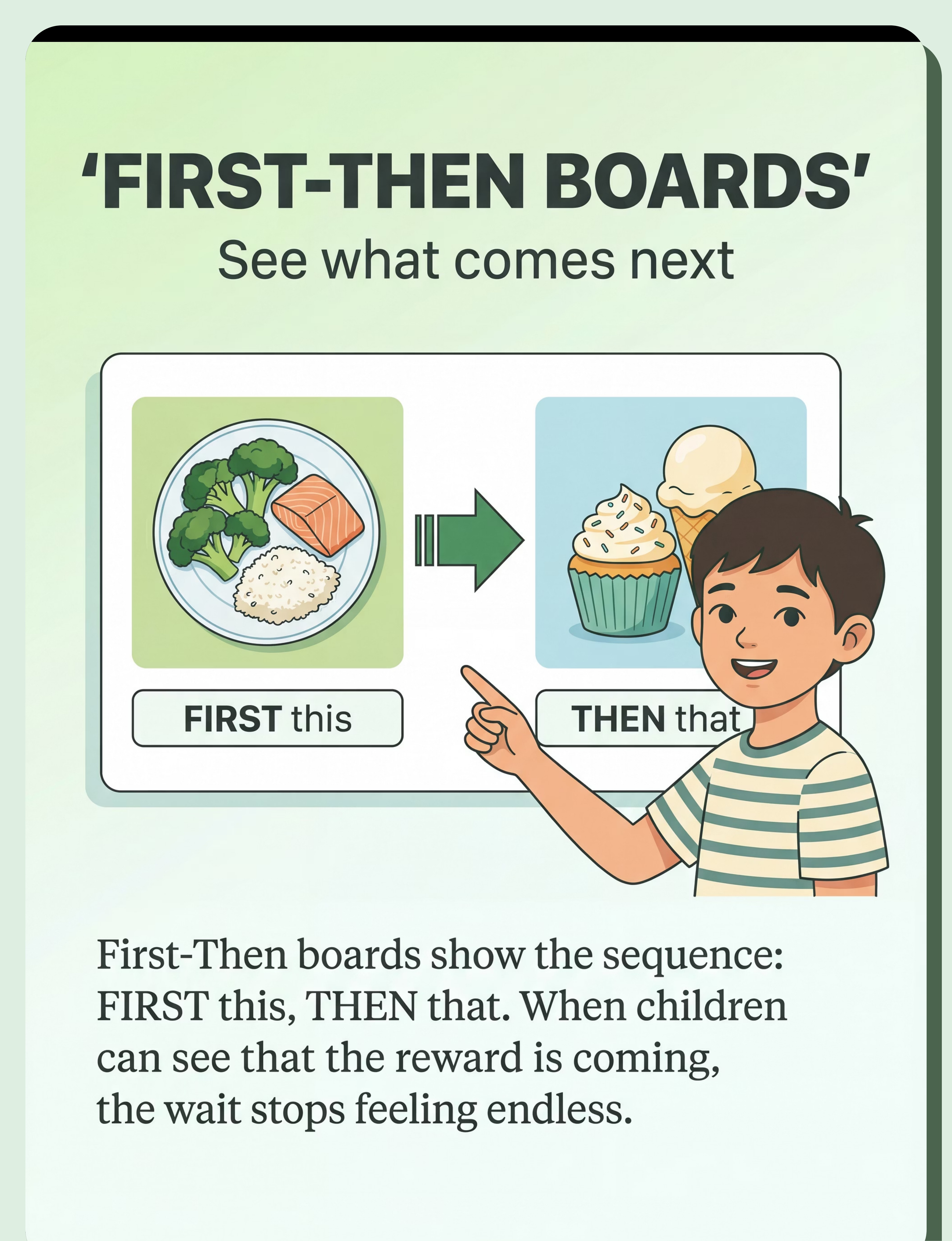
The First-Then board makes the sequence visible, predictable, and non-negotiable — in the most supportive way possible. It externalises the cognitive load of holding a future reward in mind, replacing the internal struggle with an external reference point the child can return to again and again.
What to Buy
Laminated board ₹200–600 | Download free printable templates online
DIY (₹0)
Two sticky notes on the fridge | Drawn picture cards | Printed photos of task and reward
Post at child's eye level BEFORE the session starts. The board should already be there when waiting begins.
When child asks "Is it time yet?" — point to the board."What does the board say? FIRST ___. THEN ___." Let the board answer — not your voice.
This reduces verbal negotiation by replacing it with a trusted visual system. Fewer words, less conflict.
Success signal: child references the board independently without prompting.
🏆 Canon: First-Then Board — materials.pinnacleblooms.org | NCAEP 2020 — visual supports EBP
Material 4: Waiting Strategy Cards
Waiting strategy cards bridge the gap between the emotional storm of wanting and the cognitive capacity to wait. Without an active strategy, children are left to white-knuckle through delay. Strategy cards give them something real to do — transforming passive suffering into active coping.
What to Buy
Printed kit ₹300–1,000 | Laminated card sets from therapy suppliers
DIY (₹0)
Handwritten index cards with 5 strategies | Selfie photos for each strategy | Child draws their own cards
Top 5 waiting strategies to include on cards:
  1. Belly breathing (visual prompt with in/out arrows)
  1. Count backwards from 10 slowly
  1. Gentle squeeze-release hands (or stress ball)
  1. Look at something interesting — not the desired reward
  1. Hum a favourite song quietly

⚠️Critical: Practice strategies during CALM times first — not mid-meltdown. Build the skill when there is no demand, so the child has it available when waiting is hard. If a child throws the card, it means the strategy wasn't practised enough outside of waiting contexts.
Material 5: Choice Boards
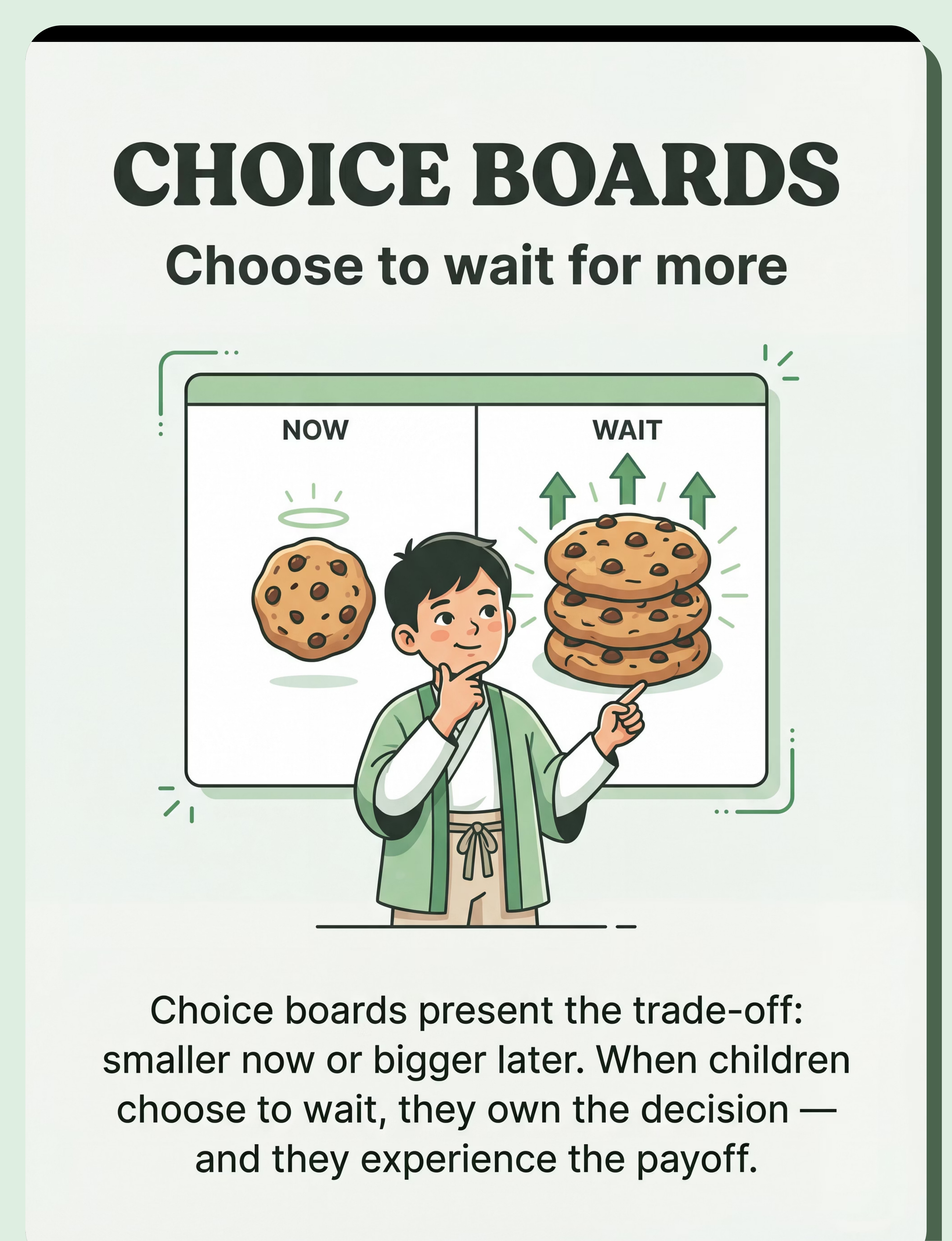
Choice boards make the delayed gratification trade-off explicit and visible. Instead of an abstract lesson about patience, the child sees — concretely — the difference between a smaller reward now and a larger reward later. This is the marshmallow test made into a teachable, supported activity.
What to Buy
Commercial choice board ₹200–400 | Velcro-ready picture sets
DIY (₹0)
Fold paper in half — draw NOW reward on left, WAIT reward on right | Use actual objects to show the difference
Present the choice BEFORE distress begins. A calm child can make a genuine trade-off. A dysregulated child cannot.
Honour both choices without judgment. Choosing the immediate reward is valid — never punish it. Learning happens through both choices.
When child waits and receives the larger reward, celebrate the payoff explicitly:"You waited — and got THREE! Remember that feeling." This builds future orientation from lived experience.
Material 6: Social Stories
Social stories build the mental framework for waiting before the waiting moment arrives. A child who has read a story about a character who waited successfully — and whose waiting was rewarded — has a cognitive template to draw on. Stories are the brain's rehearsal space for real life.
What to Buy
Published stories ₹300–800 | Specialist social story books on waiting and patience
DIY (₹0)
Handwrite a 5-page story with your child's name substituted | Use photos of your child | Free templates available at Carol Gray's Social Stories website
Read during calm pre-session time — never mid-meltdown. Stories prime the brain; they cannot rescue it mid-crisis.
Connect the story to upcoming real situations:"Like [character], what will you do when waiting is hard tomorrow at the shops?"
Personalise whenever possible. Child's own name, photos of their home, their preferred rewards — specificity increases neural engagement dramatically.
Social stories classified as EBP for autism — NCAEP 2020
Material 7: Savings Games
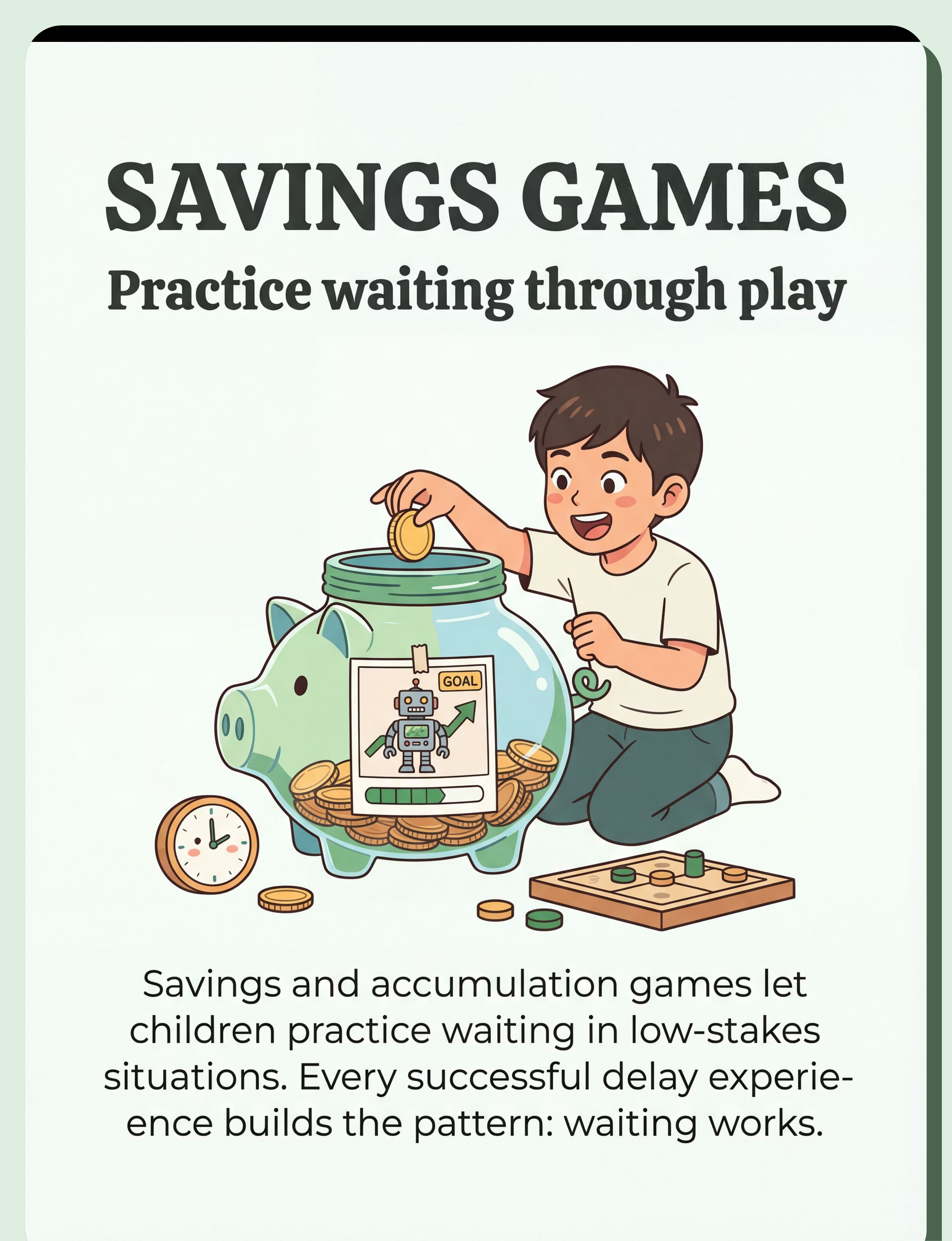
Savings games teach delayed gratification through accumulation and anticipation. Each successful wait earns a coin, a marble, or a sticker. The visible progress toward a visible goal makes the future reward feel real and achievable — building future orientation one deposit at a time.
What to Buy
Piggy bank + goal chart ₹400–1,500 | Rosette Imprint Reward Jar ₹589 | SHINETOY Shut The Box ₹428
DIY (₹0)
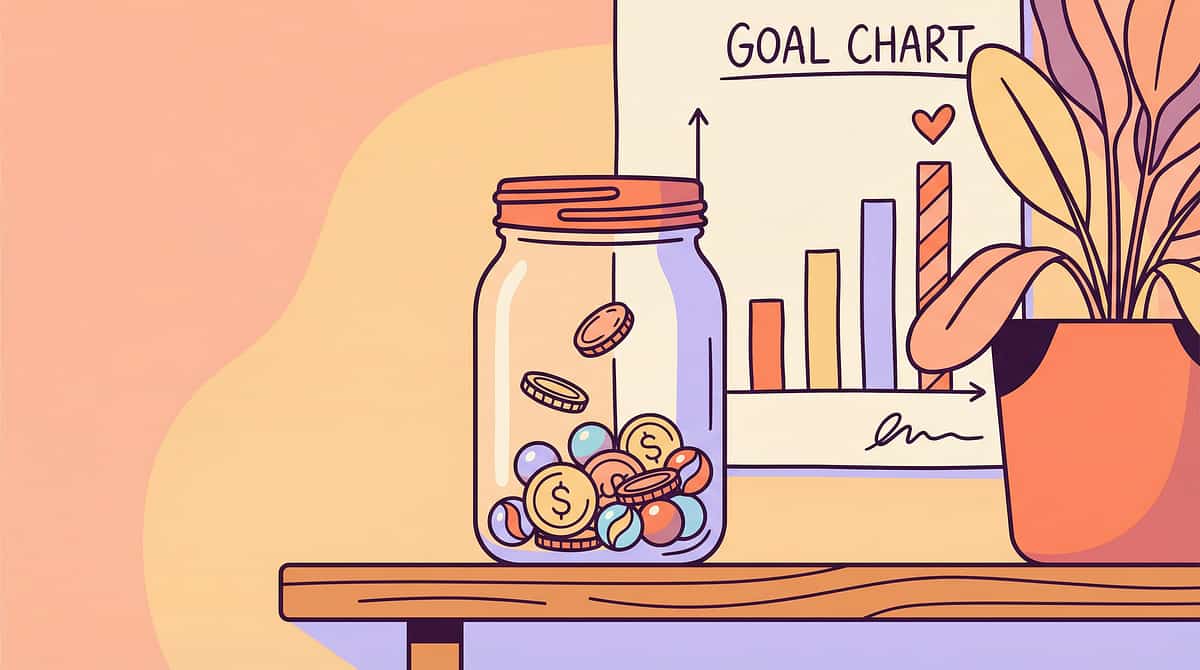
Clear glass jar + goal picture taped on the outside | Coin or marble collection challenge | Sticker chart toward a goal outing or activity
Make the goal picture visible on the jar/container. Seeing what they're saving for strengthens future orientation daily.
When the jar is full: immediate delivery of the goal reward. The payoff teaches the pattern — waiting works, and it's worth it.
Match difficulty to current capacity. A jar that takes one month to fill is too abstract. Start with 5–10 deposits.
Material 8: Regulation Tools
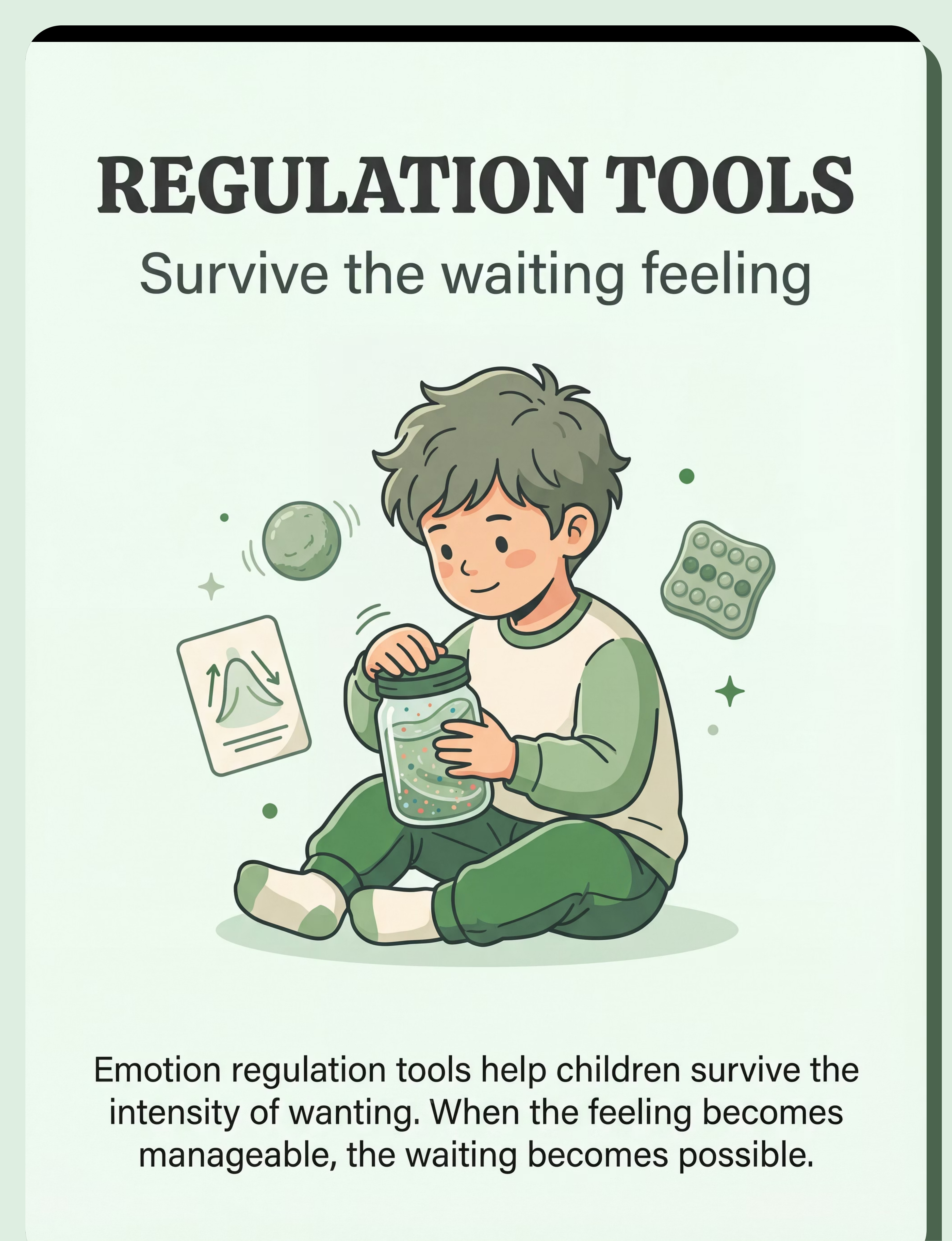
Regulation tools address the emotional storm that precedes and accompanies waiting. Before a child can use a cognitive strategy, the nervous system needs to be regulated enough to access it. Calm-down jars, stress balls, and fidget tools lower physiological arousal, creating the regulatory window in which delay becomes possible.
What to Buy
Regulation kit ₹400–1,200 | Animal Soft Toys (comfort transition object) ₹425
DIY (₹0)
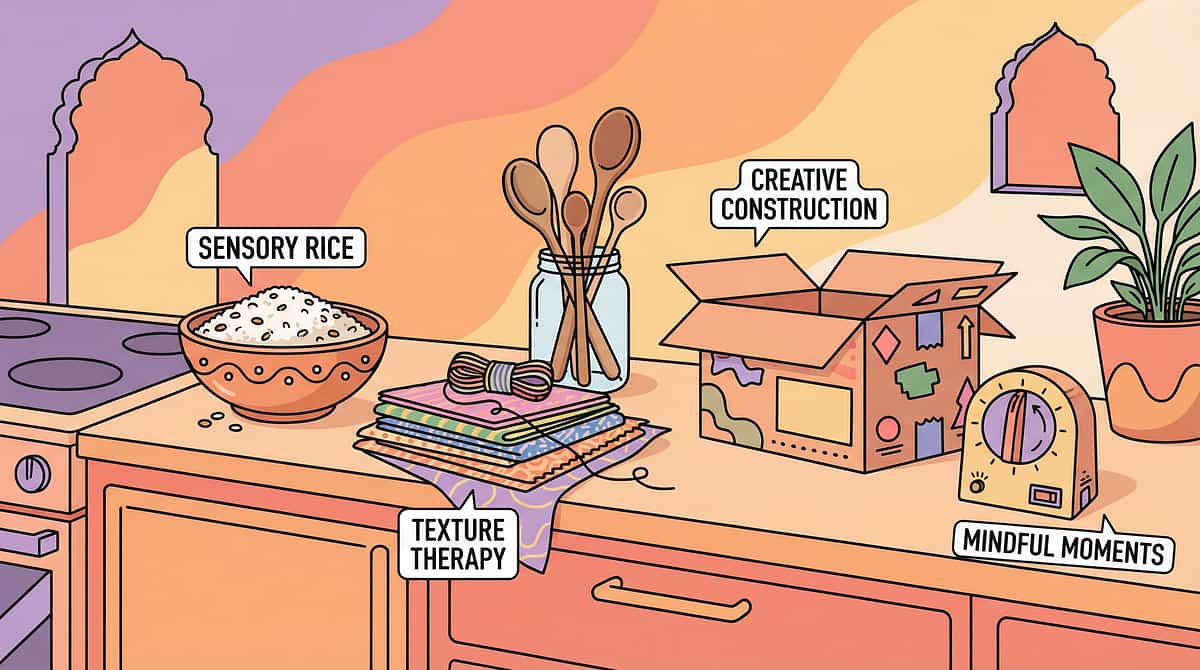
Glitter bottle: water + glitter glue + clear hair gel in a sealed bottle | DIY stress ball: balloon filled with flour or sand | Sensory bin with rice or kinetic sand
Introduce tools during calm times — not during meltdown. Practice: "Let's try the calm-down jar when everything is okay so you know how it works."
During waiting:"This is a good time for your [tool]." Use the tool as a bridge to the cognitive strategy.
Comfort transition objects are particularly effective for children who find waiting destabilising — the familiar object provides co-regulation through sensory input.
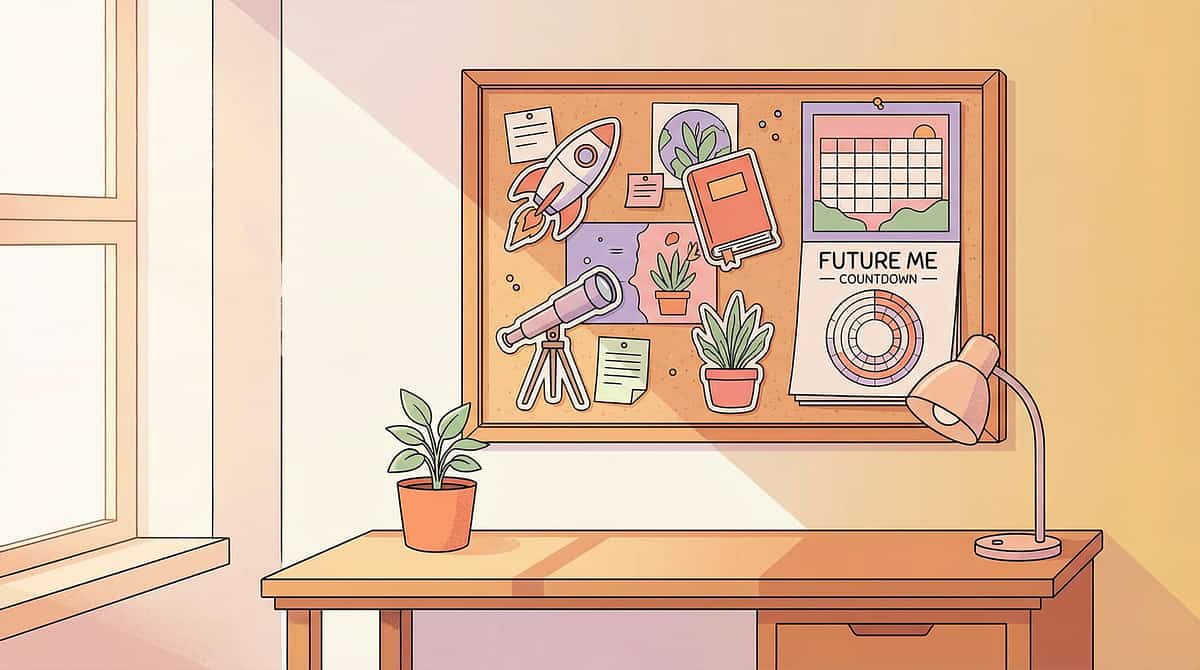
Material 9: Future Visualisation
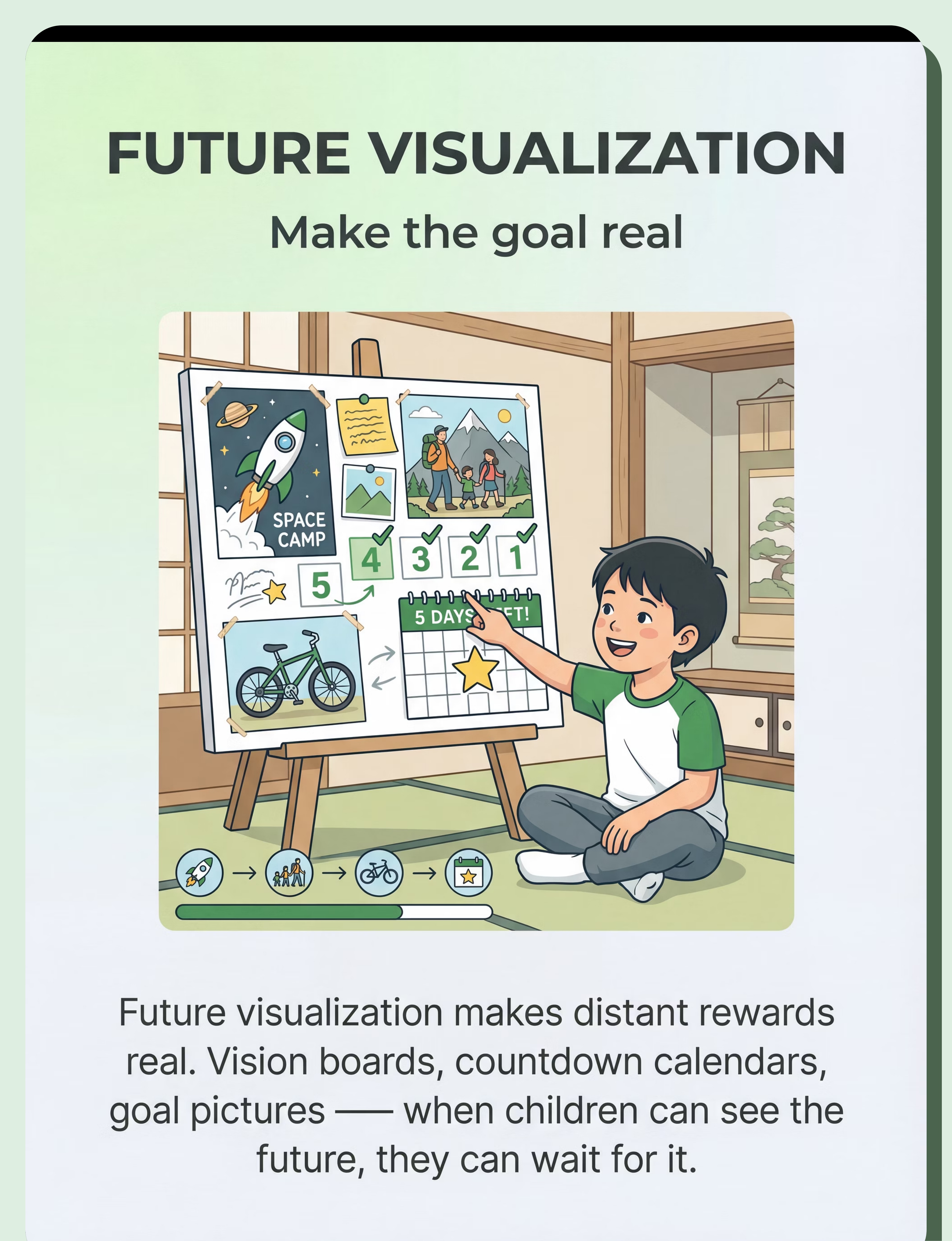
Future visualisation makes the reward real enough to wait for. Abstract future goals are neurologically invisible to young children and many children with ASD or ADHD. Vision boards, countdown calendars, and goal drawings convert the invisible future into something tangible — something the child can see, touch, and count toward every day.
What to Buy
Vision board kit ₹200–500 | Calendar materials | Countdown craft kits
DIY (₹0)
Cut magazine pictures + paste on paper | Countdown paper chain — tear one link per day | Goal drawing created together | Daily ritual calendar marking
Make countdown a daily ritual:"Let's count how many days until [event]." Repetition builds temporal processing — understanding that time is passing toward something real.
Child creates the vision board themselves — cutting, pasting, drawing. Ownership increases emotional investment in the goal.
Connect present waiting to the visible future daily: every small wait is linked to the larger goal on the board. This is future orientation made concrete.
ACT II — MATERIALS
DIY & Substitute Options for All 9 Materials
You do not need to spend a rupee to start this programme. Every single material in this technique has a zero-cost home alternative that works just as well — because the therapeutic mechanism is the visual structure and the predictable sequence, not the product. Here is your complete DIY substitution guide.
Material
Official Item (Cost)
DIY Alternative (Cost)
What to Use / How to Make It
1. Visual Timer
Sand timer or Time Timer (₹300–800)
Phone timer + paper clock face
Set phone timer. Draw a clock face on paper, move a paper hand to show time passing. Or fill a clear bottle with coloured water and flip it.
2. Token Board
Laminated token board + velcro tokens (₹200–400)
Paper + stickers or coins
Draw 5 boxes on paper. Each successful wait = one sticker placed. 5 stickers = reward. Laminate with tape for durability.
3. First-Then Board
Printed picture board (₹150–300)
Paper folded in half + drawn pictures
Fold A4 paper. Left side: draw "FIRST" activity. Right side: draw "THEN" reward. Child can help draw — increases ownership.
4. Waiting Strategy Cards
Printed card set (₹200–500)
Index cards + drawings
Write/draw one strategy per card: deep breath, count to 10, squeeze hands, hum a song, look at the timer. Laminate with tape.
5. Choice Board
Laminated choice board (₹200–400)
Two pictures on paper
Draw or cut out two reward options. Child points to their choice. Rotate options weekly to maintain motivation.
6. Social Story
Printed booklet (₹300–600)
Handmade stapled booklet
6 pages, one sentence each. Draw stick figures. Story: "I want [reward]. I wait. I use my timer. I feel proud. I get [reward]. I did it!" Read before every session.
7. Savings Game
Savings jar kit (₹200–500)
Any jar + coins or marbles
Each successful wait = one marble in the jar. When jar is full = big reward. Draw a goal line on the jar with a marker.
8. Regulation Tools
Glitter calm-down jar + fidgets (₹300–700)
Glitter bottle + rice bag + rubber band ball
Fill a plastic bottle with water, glitter glue, and glitter. Shake and watch. Fill a small cloth bag with rice for a squeeze tool.
9. Future Visualisation Board
Vision board kit (₹200–500)
Magazine cutouts + paper + tape
Cut pictures of the goal reward from magazines or print from phone. Paste on paper. Hang at child's eye level. Add countdown paper chain.

Pro tip from Pinnacle therapists: DIY materials often work better than purchased ones — because the child helped make them. Ownership increases emotional investment. A token board the child coloured themselves is worth more than a laminated one from a store.
Total cost to implement this full programme with DIY materials: ₹0. Time to make all 9 materials: approximately 45 minutes.
SAFETY FIRST
Read Before Every Session. Takes 60 Seconds. Prevents 90% of Problems.
This is your pre-session protocol. Run it every single time — even on days when you're confident. The most common cause of session failure is not technique error. It is launching when the child was not ready. This checklist takes 60 seconds and eliminates that risk entirely.
🔴 RED LIGHT — Do Not Start
Reschedule. No exceptions.
  • Child had a meltdown or emotional dysregulation episode in the past 30 minutes
  • Child is hungry, thirsty, or needs the bathroom — check before every session
  • Child is unwell, feverish, or in any physical pain or discomfort
  • The planned reward is a basic need (food when genuinely hungry, a comfort object they need for safety)
  • You are emotionally dysregulated, rushed, or frustrated — your nervous system is the co-regulation anchor
  • Child has had a traumatic or highly distressing event today (medical procedure, conflict at school, loss)
What to do: Postpone by 2–4 hours or to tomorrow. Log "session not held — child/parent not ready" in your tracker. This is not failure. This is clinical judgment.
🟡 AMBER LIGHT — Modify Before Starting
Proceed with adjustments only.
  • Child slept fewer than 8 hours last night
  • Child reported a difficult or stressful day at school
  • Child is showing mild sensory sensitivity (covering ears, avoiding touch, seeking pressure)
  • Child is in a slightly elevated arousal state — not dysregulated, but not calm-alert
  • You have less than 20 minutes available — shortened session is better than no session
Modifications required:
→ Reduce delay target by 50% (if planned 2 min, do 1 min)
→ Add one extra regulation tool to the waiting kit
→ Use maximum visual supports — all 3 boards visible simultaneously
→ Increase token density — award tokens more frequently
→ Have the reward immediately visible and accessible
🟢 GREEN LIGHT — Proceed as Planned
All conditions met. Full protocol.
  • Child is fed and hydrated — last meal within 2 hours
  • Child has used the bathroom in the past 30 minutes
  • Child is in calm-alert state: engaged, responsive, not seeking sensory input
  • Child slept adequately the previous night (8+ hours for under-10s)
  • Reward has been confirmed as desirable today — ask: "What do you want to work for?"
  • All 9 materials are set up and ready before the child enters the space
  • You have 20–30 uninterrupted minutes available
  • You are regulated, present, and not distracted
⚙️ 60-Second Material Safety Check
Visual timer: Sand flowing freely, no cracks, no sharp edges. Digital timer: charged and working.
Token board: Tokens secure, no small pieces that could be swallowed (for children under 5 or with oral sensory needs).
First-Then board: Pictures clear and recognisable to this child. Not faded or torn.
Waiting kit: Fidget tools intact, no broken parts. Calm-down jar sealed tightly.
Reward: Confirmed available and accessible. Not something the child already has free access to today.
Space: Distractions removed. Siblings managed. TV/screens off. Phone on silent.

⚠️THE CARDINAL RULE: Never use delay training for basic needs. Delay training is for WANTS, not NEEDS. A child who is hungry must be fed. A child who needs comfort must be comforted. The moment a basic need becomes a bargaining chip, the therapeutic relationship is damaged and the technique fails. If in doubt — meet the need first, train the want later.
Week 1–2 Starting Parameters
  • Delay duration: 30 seconds → 1 minute
  • Tokens to reward: 2–3 tokens maximum
  • Reward size: Small, immediate, highly motivating
  • Support level: Maximum — all boards visible, parent close
Common Setup Mistakes
  • Starting with 5+ minute delays → child fails, loses trust in the system
  • Using 10–20 token boards in Week 1 → too far from reward, motivation collapses
  • Choosing a reward the child doesn't actually want today → no motivation to wait
  • Setting up materials after the child is already in the room → creates anticipatory dysregulation
Pre-session readiness protocol adapted from: Koegel & Koegel PRT Framework (2006) | Padmanabha et al., Indian J Pediatr (2019) DOI: 10.1007/s12098-018-2747-4 | Pinnacle Clinical Protocol v4.2 | Helpline: 📞 9100 181 181
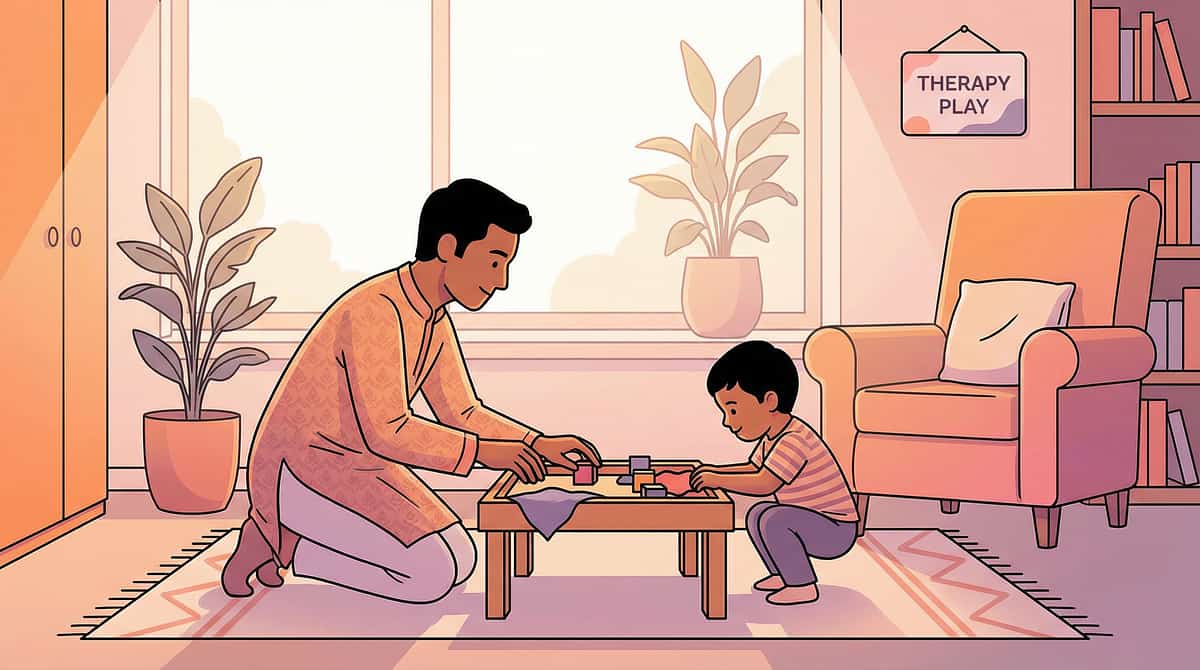
Set Up Your Space — The Environment Is the Intervention
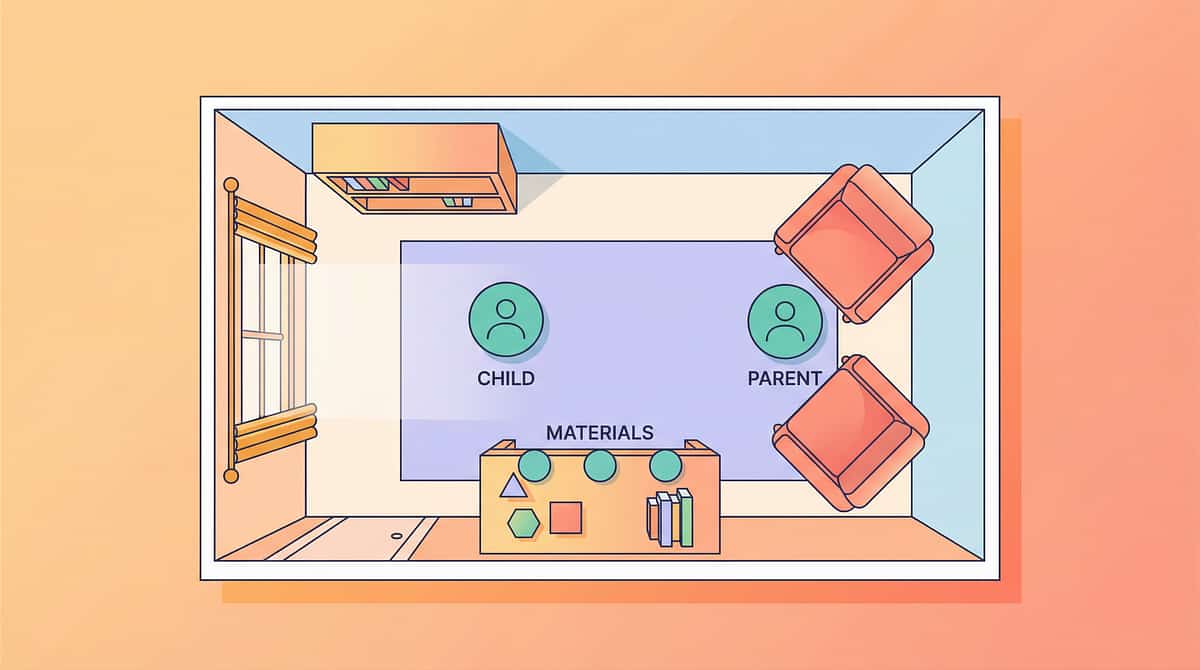
Room Setup Positions
  • Distraction-free zone — screens off, siblings settled
  • Child's preferred seat — familiar and comfortable
  • Visual Timer — at child's eye level, in direct sightline
  • Token Board — visible from seated position
  • First-Then Board — on wall or fridge, child's eye level
  • Waiting Kit basket — within arm's reach
  • Reward — visible but not immediately accessible
  • Parent — beside child, not opposite (collaborative, not confrontational)
8-Point Pre-Session Checklist
  1. Remove competing distractions
  1. Post First-Then board at child's eye level BEFORE starting
  1. Place visual timer in direct sightline
  1. Token board accessible — child places tokens themselves
  1. Waiting kit within reach (fidget, calm-down jar, strategy cards)
  1. Desired reward visible but out of direct reach
  1. Lighting: calm, not harsh. Sound: quiet or soft background
  1. Parent: seated beside child

Spatial precision prevents 80% of session failures.
PMC10955541 — structured individual sessions with environmental setup confirmed as most effective protocol

Readiness Check: 60-Second Pre-Flight

ACT III — EXECUTION The best session starts right. A brief readiness check prevents launching into a session when conditions guarantee failure. Session abandonment is not failure — it is clinical wisdom. Child fed in past 2 hours ✅ Go No meltdown in past 30 minutes ✅ Go Child in calm-alert state ✅ Go Materials ready before child arrives ✅ Go Reward confirmed desirable ✅ Go Environment set up ✅ Go Parent is regulated ✅ Go ✅ All 7 → GO Full protocol ⚠️ 4–6 → MODIFY Shorter timer, fewer tokens, simpler reward ❌ 3 or fewer → POSTPONE Do a calming activity instead. Today is not the day.

STEP 1
Step 1: The Invitation to Engage
Start with choice and invitation — never demand. Voluntary participation builds buy-in from the very first moment. The child understands the deal before committing, the reward is stated clearly upfront, and the parent is positioned as a collaborative partner.
"Hey, I have something fun for us to try together. See this timer? When all the sand falls down / when the red goes away, you get [REWARD]. Want to try?"

Enthusiastic
Proceed to Step 2
Neutral/curious
Mild interest is enough — proceed
⚠️ Hesitant
Show reward more prominently, shorten timer setting
Refusal
Respect it. Do the calming activity. Try later.
ABA Principle: Motivation Operation (MO) — establish the reward's value before requesting effort. PMC11506176
Step 2: Establish Engagement — The Waiting Begins
STEP 2
Make the waiting visible and active from the very first second. This is the protocol activation — the moment the child moves from invitation into the actual therapeutic work.
1
Point to First-Then Board
"FIRST we wait for the timer, THEN you get [reward]."
2
Start the Visual Timer
Let the child see it begin — the starting moment anchors the cognitive sequence.
3
Place Token Board in View
"Each time you wait nicely, you get a token."
4
Hand the Waiting Kit
Fidget, strategy card, or calm activity — child selects their tool.
5
Prompt Strategy Selection
"What are you going to do while you wait?" — this transfers from passive endurance to active coping.
Beginning
30 sec → 1 min
Developing
2–5 minutes
Consolidating
5–15 minutes
Mastery
15–30+ minutes
Visual supports — NCAEP 2020 evidence-based practice classification
STEP 3
Step 3: The Active Wait — Where the Brain Builds
This is the therapeutic core. The timer is running. The reward is visible but out of reach. The child is now doing the actual neural work — holding a future outcome in mind while managing present discomfort. Your job as the parent is not to fill the silence. It is to hold the space.
1
Stay Present, Stay Quiet
Sit nearby at the child's level. No prompting, no reassuring, no filling the silence. Your calm presence is the co-regulation scaffold. Let the brain work.
2
Watch for Strategy Use
Is the child using their waiting tool — fidget, breathing, strategy card? If yes: silent nod or thumbs up. If no: gently point to the waiting kit without speaking.
3
Narrate the Timer (Once Only)
When the timer is halfway: "You're doing it. Look — halfway there." One sentence. Then silence again. Over-narrating breaks the child's internal focus.
4
Manage Escalation Without Ending the Wait
If the child shows mild distress (fidgeting, whining): move closer, point to strategy card, use a calm hand gesture. Only end the wait early if escalation reaches Level 3 (see Red Flags card). A shortened successful wait is better than an abandoned one.
5
The Final 10 Seconds
Count down softly: "10… 9… 8…" — this builds anticipatory regulation, a critical executive function sub-skill. The child learns that discomfort has a predictable end.
Parent DO List
  • Stay at child's eye level
  • Keep face calm and neutral
  • Use silent gestures only
  • Let the child struggle slightly — that's the growth
  • Count down the final 10 seconds
Parent AVOID List
  • Don't offer the reward early
  • Don't say "almost done" repeatedly
  • Don't remove the timer if child protests
  • Don't check your phone
  • Don't let siblings interrupt the space
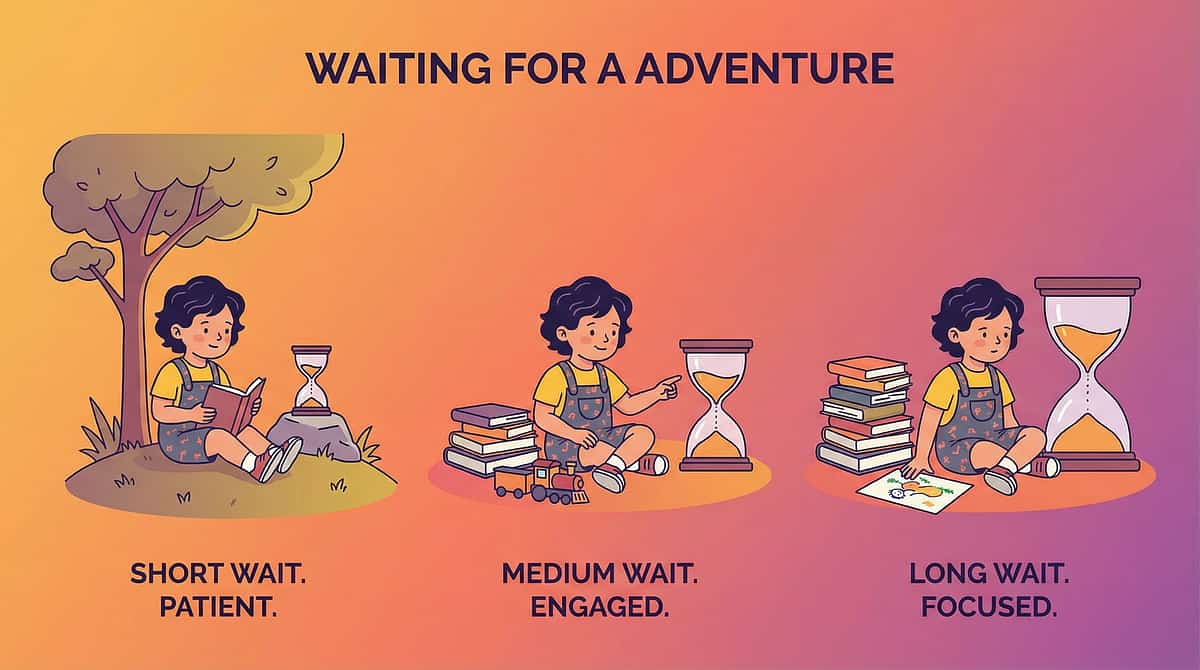
The discomfort the child feels during the wait is not a problem to be solved. It is the stimulus that triggers neural adaptation. Every second of managed discomfort is a rep in the gym for the prefrontal cortex.
Active waiting protocol adapted from: Barkley Delay Aversion Model (2012) | Zelazo Cognitive Complexity & Control Theory | NCAEP Visual Supports Practice (2020)
Step 3: The Active Wait — Where the Brain Builds
STEP 3
The therapeutic action IS the waiting period itself — the child actively managing delay using their chosen material. This is not passive endurance. It is neurological skill-building in real time. The prefrontal cortex is exercising inhibitory control, working memory, and emotional regulation simultaneously. Each successful second of managed waiting is a neural pathway being strengthened.
Duration of therapeutic exposure: 80–90% of the session time is this active waiting period.
Ideal
Child uses strategy, remains regulated, timer completes
Acceptable
Mild distress but child recovers and continues
⚠️ Concerning
Escalating distress — shorten timer, add support immediately
Stop
Severe distress — end session with dignity, zero judgment
PMC10955541 — home sessions 10–20 min optimal | NCAEP 2020 | Helpline: 📞 9100 181 181
Step 4: Repeat & Vary — 3 Good Reps Beat 10 Forced Ones
STEP 4
Starting
1–2 repetitions per session (success > volume)
Developing
2–3 repetitions per session
Consolidating
3–5 embedded opportunities throughout the day (not formal sessions)
Frequency
2–3× per week formal sessions; natural embedding daily
Variation Menu — Keep Child Engaged, Prevent Habituation
  1. Change the visual timer type (sand → digital → phone app)
  1. Change the reward category while keeping delay constant
  1. Change delay duration (shorten on hard days, extend on breakthrough days)
  1. Change waiting strategy (breathing today, counting tomorrow)
  1. Change setting (home → grandparent's house → community waiting)

👁️Satiation indicators — end the session gracefully when you see: eyes glazing, body becoming tense, engagement dropping, asking multiple times per minute. One more successful rep, then close with dignity.
Dosage: 2–3 sessions/week, 8–12 weeks typical protocol | PMC11506176
Step 5: Reinforce & Celebrate — The Celebration IS the Therapy
STEP 5
Timing > Magnitude. Deliver reinforcement within 3 seconds of the desired behaviour. Enthusiasm > quantity. The celebration anchors the memory of success — and that memory is what drives future waiting choices.
"You waited! You did it! The timer went off and you waited the WHOLE time!"
1
Natural consequence
The waited-for reward itself — most powerful reinforcer available
2
Specific verbal praise
Immediate, enthusiastic, named: "You used your breathing card and waited!"
3
Token completion
Full board → exchange for reward — the visual completion is itself reinforcing
4
Social + physical celebration
High five, hug, shared joy — social connection amplifies reward
"You waited — and it was worth it! Remember this feeling." ← This builds future orientation. The payoff becomes memory. Memory drives future delay choices.

Step 6: The Cool-Down — No Session Ends Abruptly
STEP 6
Post-session dysregulation — crashing after effort — is prevented by a deliberate 2–3 minute transition. The nervous system needs a bridge back to baseline. Abrupt endings undo the calm that was just built.
01
Give Advance Warning
"2 more minutes, then we're all done for today."
02
Material Put-Away Ritual
Child participates: "Let's put the timer away together."
03
One Calming Sensory Input
Soft music, gentle pressure, or comfort object.
04
Transition Cue
"Great session! Now we're going to [next activity]."

🔄If child resists ending: Offer choice — "Do you want to put the timer away OR the token board away first?" Choice restores agency. Do not extend the session as a reward for resistance — this inadvertently reinforces the resistance.
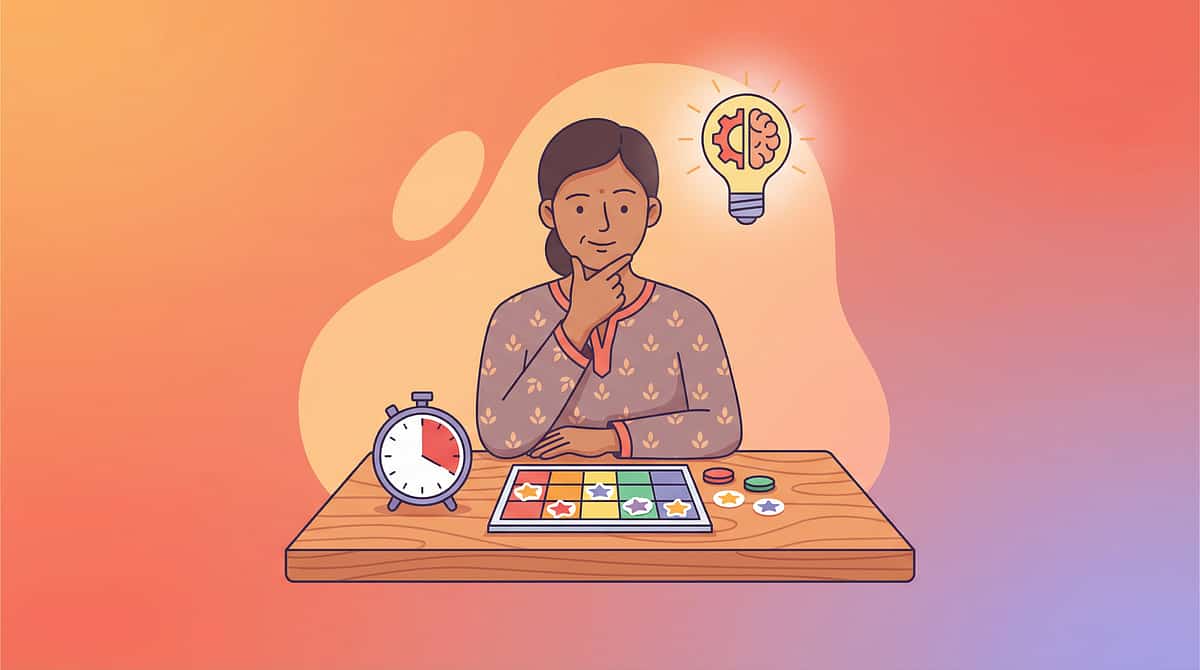
Capture the Data — Right Now
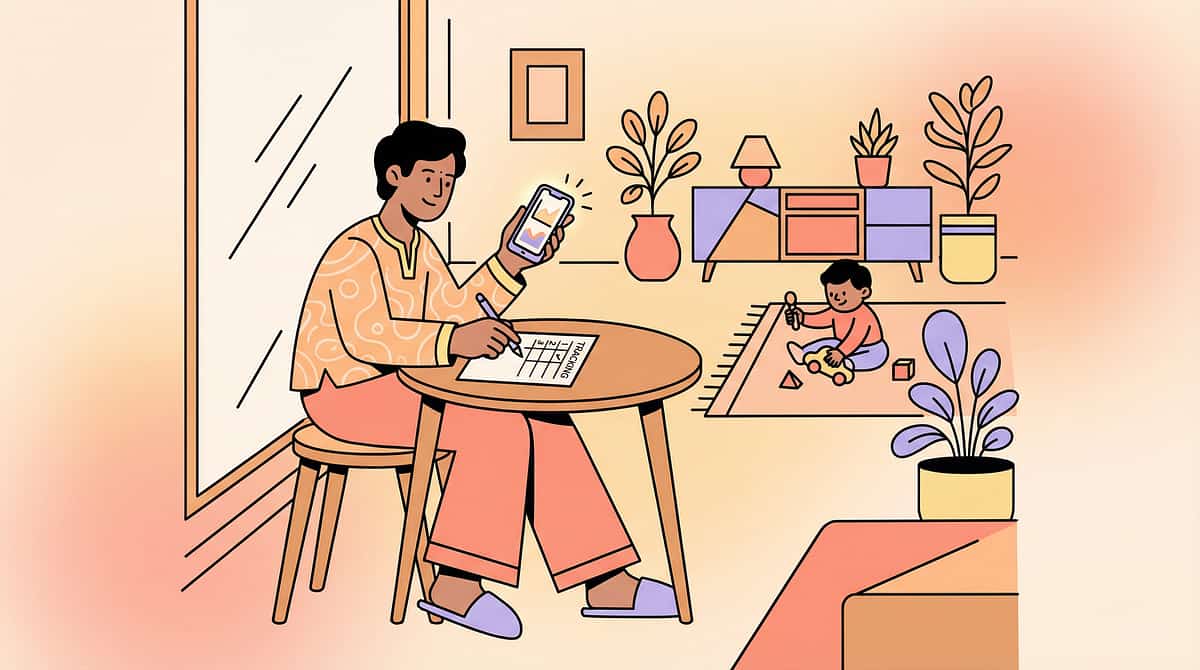
60 seconds of data now saves hours of guessing later. Data captured immediately after a session is more accurate, more actionable, and more valuable than recalled data. It is the foundation of your child's personalised progress plan.
1
Session Date
___________________
2
Delay Duration Achieved
_____ minutes / seconds
3
Material(s) Used
___________________
4
Strategy Child Selected
___________________
5
Regulation Rating (1–5)
6
Notes (what worked / what didn't)
___________________
GPT-OS® Readiness Index domains to track:
  • Executive Function Readiness Index: delay duration achieved
  • Self-Regulation Readiness Index: regulation rating (1–5 scale)
  • Impulse Control Development Index: strategy use — prompted vs. independent
ABA Data Collection Standards — BACB Guidelines + Cooper, Heron & Heward (Applied Behavior Analysis, 8th ed.)
What If It Didn't Go as Planned?
Most sessions don't go perfectly. That is normal. That is data. Every imperfect session tells you something clinically important about your child's current capacity and what needs to be adjusted.
🔴 Child melted down the moment the timer started
Why: Timer duration too long; reward not motivating enough; child not regulated to begin.
Fix: Cut timer to 20 seconds. Confirm reward desirability. Recheck readiness. One tiny success resets the session's emotional register.
🟡 Child asked "Is it time yet?" every 10 seconds
Why: No active coping strategy in use; temporal anxiety without anchor.
Fix: Point to First-Then board each time. Hand strategy card. "Let's count to 10 together."
🟡 Child grabbed reward before timer ended
Why: Impulse overwhelmed strategy; future orientation not yet built.
Fix: No punishment. Calmly: "The timer wasn't done yet. We'll try again with a shorter timer." Same reward still available — teach that it wasn't lost.
🟡 Waiting strategy cards ignored or thrown
Why: Strategies not practised during calm times first.
Fix: Practice NOW, during a non-demanding moment: "Let's practice breathing — ready? In… and out…"
🟡 Fine the first time, fell apart on the second attempt
Why: Session too long; child reached satiation/fatigue.
Fix: End at the first success. "Perfect! We're done for today." One great rep ends on a win.
Adapt & Personalise — No Two Children Are Identical

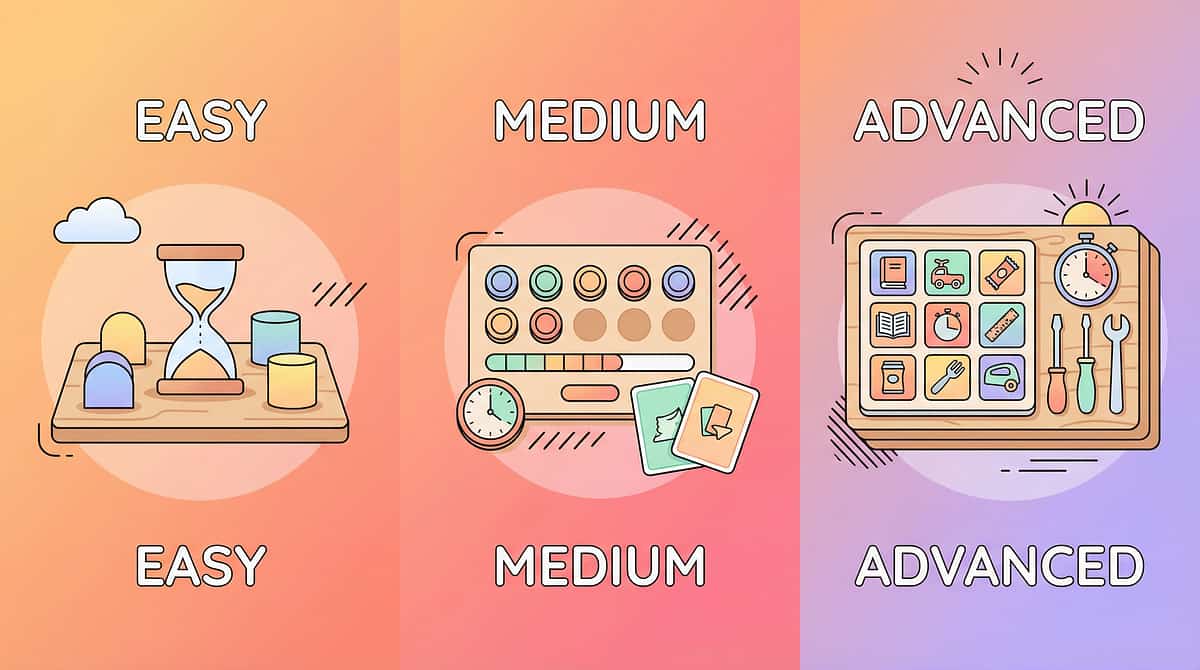
The materials and steps are a framework. Your job is to bend the framework to fit your child — not bend your child to fit the framework. Adjust until it fits. Start where your child succeeds, then advance when they succeed 3 consecutive sessions. Every 20–30% increase in duration is a clinical step forward. Sensory Seeker Add a physical activity DURING the wait — bouncing on cushion, wall push-ups. Movement provides regulatory input that makes delay tolerable. Sensory activities can be used as rewards. Highly Anxious Child Add extra predictability — First-Then-THEN board (three steps). Show exactly what happens after the reward too. Read social stories about waiting daily. Child with ADHD Start at seconds, not minutes. Token boards with physical token placement. Shorter sessions more often. Discuss medication timing with psychiatrist. Child with ASD Highly visual supports. Same sequence every time. Connect to special interest: "First dinner, THEN Minecraft." Never break a promised sequence.

ACT IV — PROGRESS ARC
Weeks 1–2: Building the Foundation
Expect tolerance, not mastery. These first two weeks are about establishing the routine, building trust in the materials, and achieving even one tiny successful wait. Every second of managed waiting counts.
15%
Progress Milestone
Foundation stage — tolerance and participation are the goals
Slightly reduced resistance to visual timer being started
Child begins to reference First-Then board (even if agitated)
One or two successful short delays without meltdown
Child tolerates waiting kit being offered
Parent feels more confident initiating sessions

📌Not progress yet (and that is completely normal): Independent strategy use (still prompted) | Long delays (keep short) | Generalisation to new settings (building one setting first). Expect inconsistency. Trust the process.
If your child tolerates a 30-second timer this week when last week they couldn't wait 5 seconds — that is real, measurable, clinical progress.
PMC11506176 — executive function intervention outcomes emerge over 8–12 week timelines; early phase = tolerance and participation
Weeks 3–4: Consolidation Signs
The neural pathways begin to form. You will see subtle but unmistakeable signs that the brain is reorganising around the new skill. Watch for these signals — they are the evidence that the scaffolding is working.
40%
Progress Milestone
Consolidation — neural pathways forming
Child ANTICIPATES the waiting routine (gets the timer themselves)
References First-Then board spontaneously without prompt
Shows preference for their favourite waiting strategy
Reduced frequency of "Is it time yet?" questions
Measurably longer successful delay duration
Child sometimes says "Okay, I'll wait" to small delays without materials
"You may notice you are more confident starting a delay opportunity. Your body language communicates that waiting is safe — and children read this."

When to increase duration/complexity: When child succeeds at current level 3 consecutive sessions → increase by 20–30%.
Weeks 5–8: Mastery Indicators
From strategy-dependent to strategy-selecting. At this stage, the child is beginning to internalise the skills — using strategies not because they are prompted to, but because the strategies have become part of how they navigate wanting.
70%
Progress Milestone
Strategy integration — independence emerging
Child selects waiting strategies independently — no prompt needed
Consistently chooses larger delayed reward on choice board
Can wait 10–20+ minutes in structured home setting
References the future spontaneously: "I'm saving this for later"
Token boards needed less frequently — internal motivation increasing
First generalisation emerging to other settings (grandparents, school)

📌Still expected at this stage: Community settings harder than home (this is normal) | High-demand items still challenging | Off days when regulation is low (recovers faster now).
PMC11506176 | Neuroplasticity timeline — 8-week milestone for strategy integration
Stop. Celebrate. This Milestone Was Earned.
The celebration IS therapy. It anchors the memory of success. That memory is the neural foundation for every future waiting choice. Never rush past a milestone. Never diminish it. Mark it deliberately.
🎉 First success without meltdown
🎉 First independent strategy use
🎉 First delayed reward chosen on choice board
🎉 First spontaneous "I can wait"
🎉 First community setting success
"You used your breathing card today and waited until the timer finished. THAT is a big deal."
Make it specific. Document it. Tell the extended family. Never diminish it: "Finally!" or "About time" erases the achievement entirely.

RED FLAGS
When to Call for Help — Act, Don't Wait
🔴 Immediate — Call Now
  • Self-injury during waiting periods (hitting head, biting self)
  • Aggression toward others during any delay
  • Complete inability to tolerate ANY delay after 4+ weeks of consistent practice
  • Regression: previously achieved skills disappearing
🟡 Consult Within 2 Weeks
  • No measurable progress after 6 weeks of consistent practice
  • Significant impact on school functioning
  • Suspected ADHD — ask your paediatrician
  • Anxiety symptoms co-occurring and escalating
🧩 Occupational Therapist
Executive function evaluation and protocol design
🧠 Psychologist / Child Psychiatrist
ADHD assessment, anxiety evaluation
📞 FREE Helpline
9100 181 181 — 16+ languages, 24×7
🌐 pinnacleblooms.org
AbilityScore® assessment → personalised plan
NCAEP 2020 | Clinical escalation guidelines across OT/ABA/psychology practice

Preview of 9 materials that help with delayed gratification Therapy Material

Below is a visual preview of 9 materials that help with delayed gratification therapy material. The pages shown help educators, therapists, and caregivers understand the structure and content of the resource before use. Materials should be used under appropriate professional guidance.
Page 1
Page 2
Page 3
Page 4
Page 5
Page 6
Page 7
Page 8
Page 9
Page 10
Page 11
Page 12
Page 13
Page 14
Page 15
Page 16
Page 17
Page 18
Page 19
Page 20
Link copied!
Your Progression Pathway
Delayed gratification is one step on a longer journey through the executive function domain. Each technique builds the next — because the brain builds these skills in sequence, not in isolation.
1
C-252 Inhibitory Control
Stopping the impulse — the foundation
2
C-253 Working Memory
Holding the future reward in mind
3
C-254 ★ Delayed Gratification
YOU ARE HERE
4
C-255 Frustration Tolerance
Managing the hard feelings
5
C-256 Flexible Thinking
Shifting plans — the destination
Inhibitory control (stopping) must develop before sustained waiting can be maintained. Working memory (holding the future reward) is the cognitive scaffold. Frustration tolerance deepens delay capacity. Each technique builds the next.
🎯 School Readiness
🎯 Peer Relationships
🎯 Academic Achievement
🎯 Life Skills
WHO Developmental Milestones Framework + domain-specific executive function sequencing literature