

Your child isn’t ignoring the signal — their brain isn’t receiving it yet.
“My 4-year-old will be deep in play on the floor or watching a screen, insist they don’t need to go, and then suddenly look down in shock when they’ve already had an accident. We’ve tried reminders every 30 minutes. We’ve tried sticker charts. Nothing works — and honestly, I’m exhausted, confused, and starting to feel helpless.”
E-501 from Pinnacle Blooms Network® is a complete 9-material home intervention protocol for daytime accidents in children aged 3–8. Built by India’s largest pediatric therapy consortium — OT, SLP, ABA, Special Education, NeuroDev, and Pediatrics — it brings expert support home in a calm, practical way.

E-501 | Pinnacle Blooms Network®
This Is Not Defiance. This Is Neuroscience.
This is not defiance. This is not laziness. This is not a parenting failure. What you are witnessing is a nervous system that hasn't yet learned to send — or receive — the signals that most of us take for granted.
Your child's body IS generating bladder-fullness sensations. But for reasons rooted in neurodevelopment, sensory processing, or simply developmental timing, those signals are not reaching conscious awareness clearly enough to trigger action. You are not failing. Your child's interoceptive nervous system is still learning to speak.
This page equips you — today — with 9 evidence-validated materials and a complete home-executable intervention protocol built by India's largest pediatric therapy consortium.
🏛 Pinnacle Blooms Consortium®
OT · SLP · ABA · SpEd · NeuroDev · Pediatrics
Helpline 9100 181 181 | pinnacleblooms.org
📖 Research Backed
WHO Nurturing Care Framework (2018) | AOTA Practice Guidelines | ICCS Daytime Incontinence Standards

You Are Not Alone
Millions of Families Are Navigating This Exact Challenge
20%
4-Year-Olds
of 4-year-olds still have regular daytime accidents
1 in 10
Age 6
children aged 6 still experience daytime wetting episodes
80%+
No Medical Cause
of children with daytime wetting show no identifiable medical cause — it's developmental
Globally, functional daytime wetting (diurnal enuresis) affects an estimated 2–3% of school-age children — and significantly more in the preschool years. In India, families often navigate this without professional guidance for months or years. In children with sensory processing differences, ADHD, or autism, rates of delayed bladder awareness climb significantly higher — with interoceptive processing challenges at the neurological root.
The International Children's Continence Society (ICCS) classifies functional daytime wetting as a recognized clinical entity — not a behavioral problem, not a parenting problem, and not something children choose. "The difference between families who break through and those who don't? Evidence-based materials and a structured approach."
📖 PMC11506176 | PMC10955541 | International Children's Continence Society (ICCS) Guidelines | WHO Global Developmental Monitoring Data

The Interoception Gap: Why Your Child Doesn't "Feel" It
The Science
Interoception is the eighth sense — the brain's ability to perceive internal body signals. Bladder fullness, hunger, heartbeat, temperature: all transmitted via the vagus nerve and spinothalamic tracts to the insular cortex, the brain's internal signal processor.
In many children — particularly those with sensory processing differences, autism, or ADHD — the insular cortex processes these signals at lower gain. The signal exists. The volume is simply too low.
The bladder sends its message. The brain doesn't amplify it above the threshold of conscious awareness. By the time a strong enough signal breaks through — the bladder is already emptying. This is a neurological wiring difference, not a behavioral choice.
What This Means at Home
- When your child says "I don't need to go" — they are telling the truth as they experience it
- Their prefrontal cortex never received a "bathroom needed" alert loud enough to override current activity
- Hyperfocus (play, screen, excitement) actively suppresses interoceptive signal processing
- The fix is not more reminders — it's building the neural pathway that delivers the signal AND providing external bridges while it develops
"Interoception is trainable. Like any neural pathway, the bladder-awareness circuit strengthens with structured, repeated practice. This page shows you exactly how."
📖 Frontiers in Integrative Neuroscience (2020) DOI: 10.3389/fnint.2020.556660 | Craig (2003) Nature Reviews Neuroscience | PMC10955541

The Bladder-Awareness Developmental Continuum
True daytime continence requires five converging systems to operate in sync: bladder capacity sufficient for 2–3 hour intervals, nervous system maturation for sphincter voluntary control, interoceptive awareness to detect fullness before urgency, cognitive planning to interrupt activity, and motor independence for clothing management. A developmental delay in any single system produces accidents — even in a child who has "been toilet trained."
Autism Spectrum Disorder
Interoceptive processing differences
ADHD
Attentional override of body signals
Sensory Processing Disorder
Signal amplification differences
Constipation
Full bowel compresses bladder, reduces functional capacity
Anxiety
Avoidance of unfamiliar bathrooms
📖 WHO Care for Child Development Package (2023) | UNICEF MICS Developmental Indicators | PMC9978394 | ICCS Pediatric Bladder Development Guidelines

Clinically Validated. Home-Applicable. Parent-Proven.
⭐⭐⭐⭐ Level II–III Evidence
Systematic Reviews + Multiple RCTs + ICCS Clinical Consensus
Study | Finding | Source | |
AOTA Practice Guidelines (2020) | OT interventions for toileting and interoception show strong evidence for children with developmental differences | AOTA | |
ICCS Consensus Guidelines | Timed voiding + bladder training significantly reduces daytime wetting vs. no intervention | Int J Urol 2019 | |
Interoception Intervention RCT | Structured interoception practice builds body awareness measurable on standardized instruments within 8 weeks | Body Awareness Research 2021 | |
ABA Reinforcement Studies | Immediate reinforcement of bathroom-going behavior accelerates skill acquisition vs. outcome-only reward | Multiple RCTs | |
Indian Pediatrics Home Intervention Study | Home-based structured interventions demonstrate significant outcomes in Indian pediatric populations | DOI:10.1007/s12098-018-2747-4 |
This is not guesswork. This is the convergence of OT, ABA, SLP, and pediatric urology into one home-executable system. The multi-component approach on this page represents the highest-evidence intervention stack for functional daytime wetting in children with developmental differences.
📖 PMC11506176 | DOI: 10.1007/s12098-018-2747-4 | NCAEP 2020 | ICCS Guidelines | AOTA Practice Framework 4th Ed.
ACT II — KNOWLEDGE TRANSFER
Daytime Accident Intervention Protocol
Parent alias: "Body Signal Training + Home Dryness System"
1
What It Is
A structured, multi-component home intervention combining interoception training (building the child's ability to notice internal bladder signals), timed voiding schedules (external structure while awareness develops), environmental optimization, and behavioral reinforcement.
2
What It Does
Systematically addresses every root cause of daytime accidents — from muted interoceptive signals to attentional override to incomplete emptying to clothing barriers — through a layered material-and-practice approach.
3
Who It's For
Children aged 3–8 who are "toilet trained" in theory but continue to have daytime accidents, particularly those with sensory processing differences, ADHD, autism, developmental delays, or simply delayed interoceptive maturation.
🏷 Domain
SC-TOILET | Toileting & Self-Care Independence
🏷 Age Range
3–8 years
🏷 Frequency
Daily, consistently for 8–12 weeks minimum
🏷 Episode
E-501 | Toileting & Self-Care Series

The Consortium Approach: Every Discipline Has a Role
Occupational Therapy (Lead)
OT leads this intervention. Occupational therapists assess interoceptive awareness, sensory processing profiles, and self-care skill sequences. They design the interoception training progression and adapt the protocol to the child's sensory profile.
Behavioral Support (ABA/BCBA)
ABA drives the reinforcement architecture. Behavior analysts design the reward system, establish the timed voiding schedule as a behavioral routine, and analyze accident patterns to identify antecedents.
Speech-Language Pathology
SLP supports the language layer — creating social stories, building vocabulary for body sensations ("full," "empty," "a little bit full"), and scripting verbal protocols parents use to guide interoception practice without creating anxiety.
Special Education
SpEd supports school coordination — creating IEP/504 accommodations, communicating with classroom teachers, designing school-based visual schedules, and ensuring the home protocol is mirrored in the educational environment.
Neurodevelopmental Pediatrics
NeuroDev rules out medical causes and manages co-occurring conditions (constipation, UTI, structural issues). Medical clearance before behavioral intervention is non-negotiable.
"The brain doesn't organize by therapy type. Daytime accidents sit at the intersection of sensory processing, behavioral learning, language development, and medical oversight. That's why the consortium approach produces outcomes that single-discipline intervention cannot."
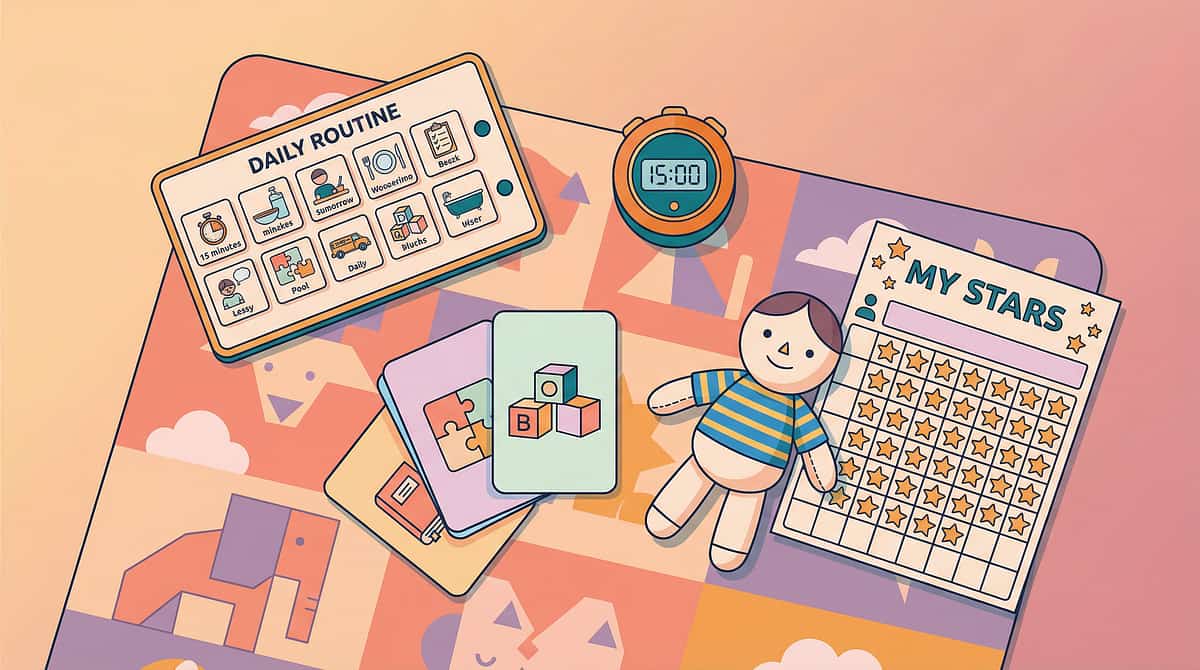
The 9 Materials
Your Complete Daytime Dryness Arsenal
Each material addresses a specific failure point in the daytime continence system.
1
Material 1
Visual Toileting Schedule Boards
2
Material 2
Vibrating Reminder Watch or Timer
3
Material 3
Interoception Activity Cards
4
Material 4
Toilet Training Doll with Wetting Function
5
Material 5
Moisture-Sensing Alarm Underwear
6
Material 6
Child-Sized Step Stool + Toilet Seat Insert
7
Material 7
Social Stories About Toileting
8
Material 8
Easy-Access Clothing Set
9
Material 9
Reward Charts + Immediate Reinforcement System
Material 1 of 9
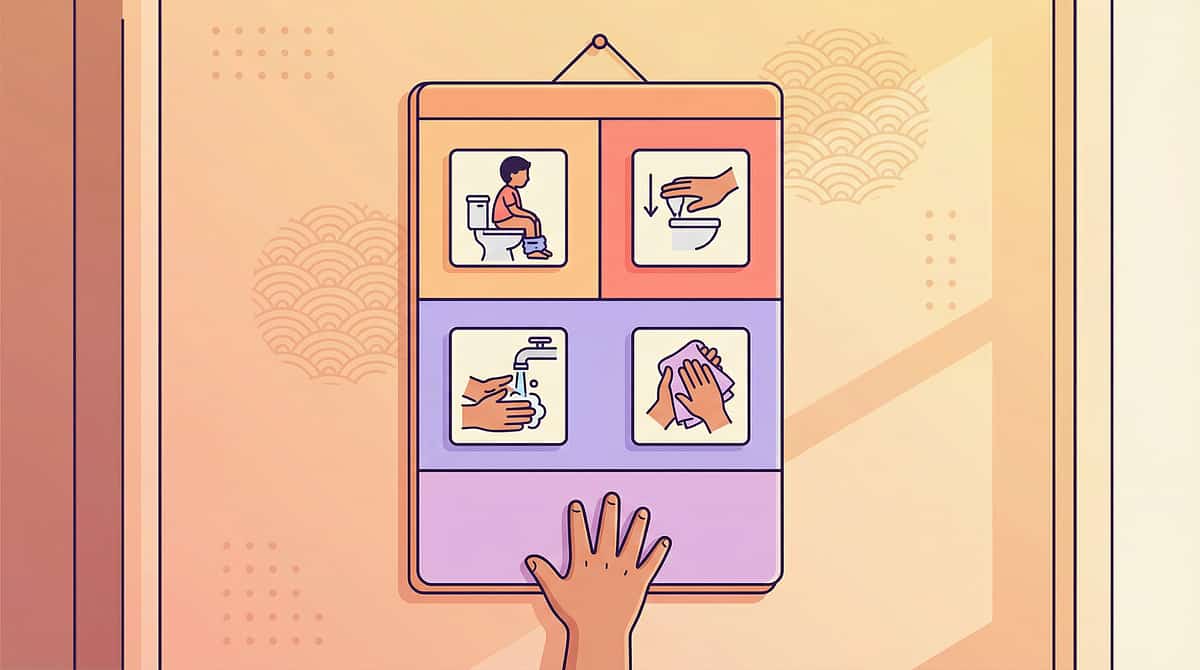
📋 Visual Toileting Schedule Boards
Canon Category
Visual Schedules
Price Range
₹200–600
Where to Find
Search on Amazon.in: "visual schedule board children"
Pinnacle Recommends: Velcro-backed picture schedule boards with bathroom pictograms
What It Does
Provides external structure that compensates for unreliable internal signals. Establishes predictable bathroom timing so the bladder never reaches emergency fullness.
When a child's internal signal system is underdeveloped, an external visual anchor creates the predictability that keeps accidents from happening. The schedule becomes the child's "body clock" made visible — mounted at eye level, checked naturally, consulted without stress.
The visual format is especially effective for children with autism, ADHD, or language processing differences, where verbal reminders alone are insufficient to change behavior.

Material 2 of 9
⌚ Vibrating Reminder Watch or Timer
Canon Category
Attention/Regulation Supports
Price Range
₹800–3,000
Where to Find
Search on Amazon.in: "vibrating reminder watch children timer"
Look for: Waterproof, programmable intervals, child-sized band
What It Does
Delivers private, sensory-based reminders that interrupt hyperfocus without public embarrassment. The child owns their toileting independence.
For children with ADHD and high hyperfocus profiles, the vibrating watch is often the single highest-impact material on this list. It transforms "nagging parent" into "my watch told me" — shifting ownership from caregiver to child. The vibration is discreet enough for school use, strong enough to penetrate deep play states.
When the child responds to their watch rather than a parent's voice, the skill begins to internalize as theirs — not an externally imposed routine.
Material 3 of 9
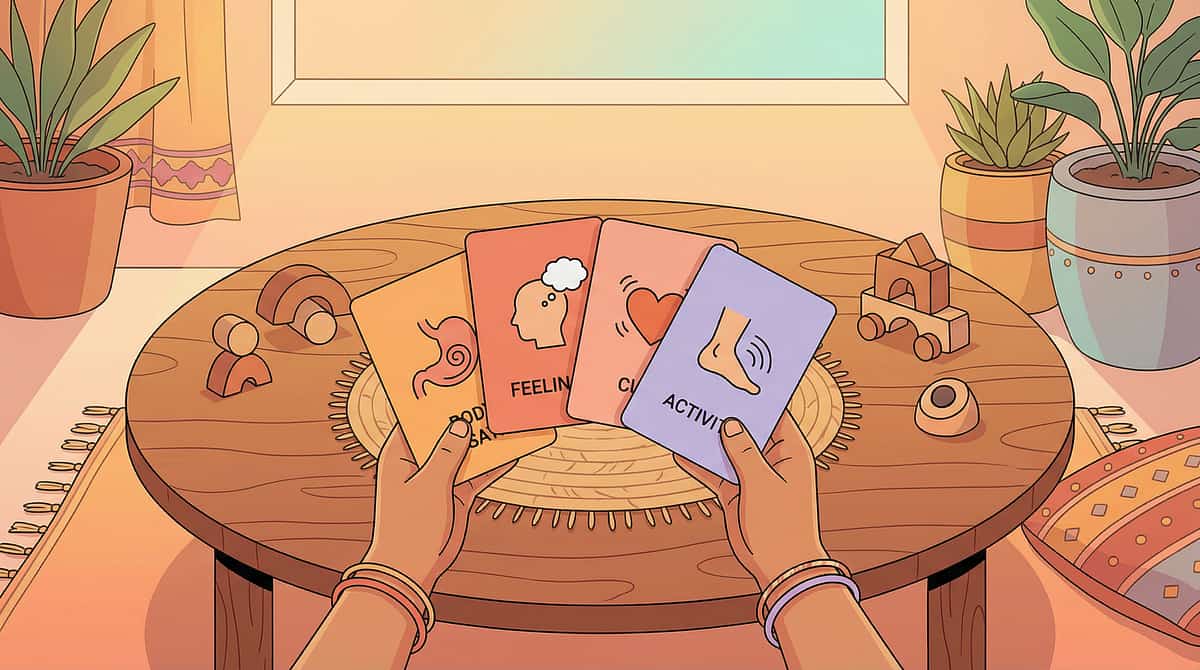
🃏 Interoception Activity Cards
Canon Category
Body Awareness / Interoception Tools
Price Range
₹300–800
Where to Find
Search on Amazon.in: "interoception activity cards children body awareness"
What It Does
Builds body awareness through structured practice with progressively subtle sensations — from heartbeat after jumping to bladder fullness detection.
Interoception cards work through the principle of graduated exposure — starting with large, easily noticed body signals (heart pounding after exercise) and slowly progressing toward smaller, more subtle ones (mild bladder fullness). Each card is a structured practice repetition. Over weeks, the neural pathway carrying body signals grows stronger.
The card format makes the practice feel like a game, not therapy — critical for maintaining daily engagement across the 8–12 week protocol window.

Material 4 of 9
🪆 Toilet Training Doll with Wetting Function
Canon Category
Concept Learning / Play-Based Therapy Tools
Price Range
₹500–1,500
Where to Find
Search on Amazon.in: "toilet training doll drinks wets"
What It Does
Externalizes the cause-and-effect of drinking and voiding through play. The child teaches the doll, internalizing the body process without direct pressure.
Play-based learning removes the emotional charge from toileting. When a child teaches a doll to drink, feel full, and use the bathroom, they are rehearsing the entire body-signal sequence in a zero-stakes, child-directed environment. The narrative the child creates — "The doll's tummy is saying something" — becomes the template for their own internal dialogue.
Particularly effective for ages 3–5 and for children who experience anxiety or resistance around direct toileting instruction.
Material 5 of 9
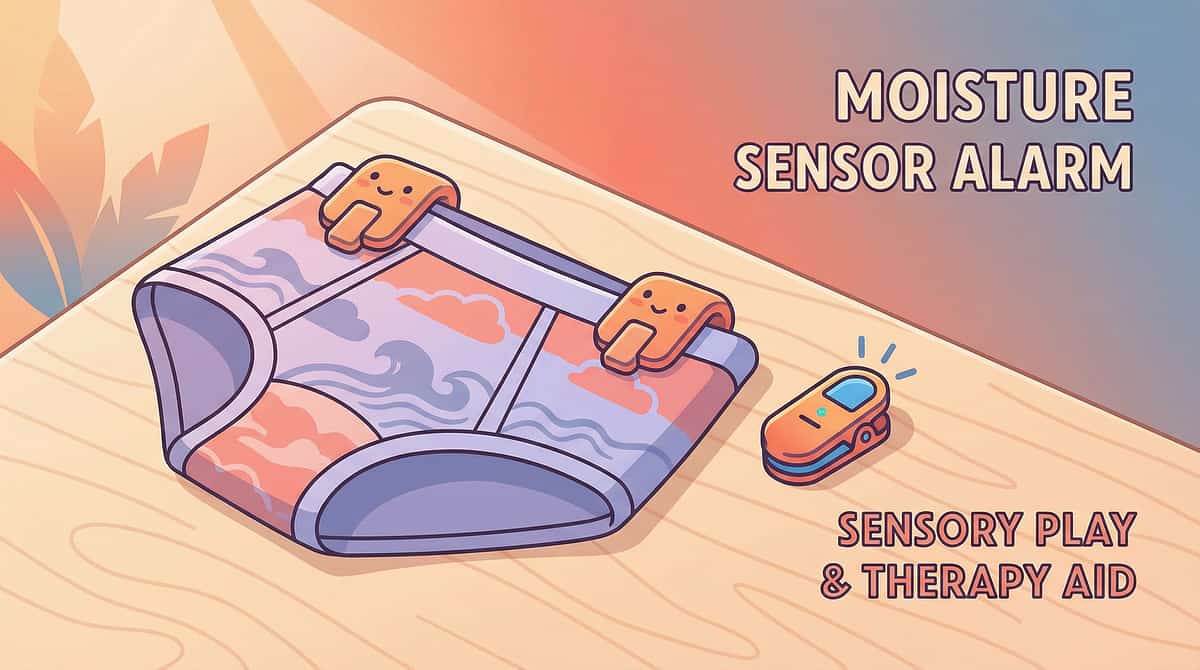
🔔 Moisture-Sensing Alarm Underwear
Canon Category
Biofeedback / Sensory Alert Devices
Price Range
₹1,000–4,000
Where to Find
Search on Amazon.in: "bedwetting alarm children moisture sensor"
Note: Effective for daytime use with proper response protocol
What It Does
Detects first drops instantly, creating real-time feedback that trains the brain to notice the sensation that precedes moisture. Accelerates the body-signal loop.
The moisture alarm is the most evidence-intensive material on this list. Its mechanism of action is classical conditioning — the alarm fires at the moment voiding begins, creating a repeated association between the preceding internal sensation and an external alert. Over time, the brain anticipates the alarm and generates a conscious signal before voiding starts.
This is the material with the strongest individual evidence base for accelerating the biofeedback loop. If resources allow only one purchase, clinical evidence favors this one.
Material 6 of 9
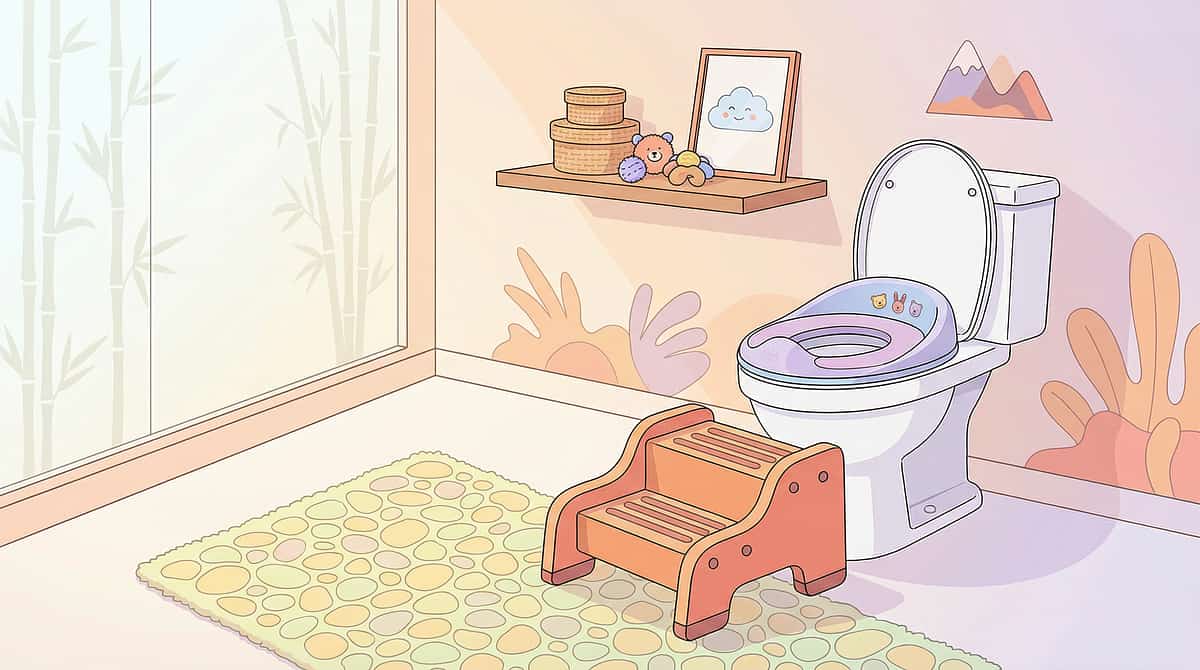
🚽 Child-Sized Step Stool + Toilet Seat Insert
Canon Category
Adaptive Equipment / Environmental Modification
Price Range
₹400–1,200
Where to Find
Search on Amazon.in: "toilet step stool children toilet seat insert"
What It Does
Restores physiologically optimal voiding position (knees above hips), enables complete emptying, and eliminates fear-of-falling that causes rushed, incomplete toileting.
This is the most overlooked material in home toileting programs. A child whose feet dangle above the floor cannot fully relax the puborectalis muscle — the muscular structure whose relaxation enables complete bladder emptying. Dangling feet create ongoing pelvic floor tension that results in frequent small-volume voids and persistent accidents.
The step stool is a biomechanical correction, not an accessory. Paired with a seat insert that eliminates the fear of falling in, this combination makes the toilet physically comfortable — a prerequisite for calm, complete voiding.

Material 7 of 9
📖 Social Stories About Toileting
Canon Category
Social Stories / Narrative Supports
Price Range
₹200–500
Where to Find
Search on Amazon.in: "social story toileting autism children"
Or create personalized versions — see Card 10 for DIY guidance
What It Does
Explains body signals, bathroom routines, and accident responses in non-threatening, child-appropriate language. Reduces anxiety, provides clear behavioral scripts.
Social stories, developed by Carol Gray and validated extensively in autism research, work by pre-loading the brain with a script for navigating situations that feel uncertain or aversive. A toileting social story tells the child, in advance, what their body will feel, what that means, and exactly what to do next — removing the cognitive demand of deciding in the moment.
Read daily during low-stress windows (before bed, after breakfast). The story's repeated rehearsal is the intervention, not a single reading.

Material 8 of 9
👖 Easy-Access Clothing Set
Canon Category
Adaptive Clothing / Self-Care Independence
Price Range
₹300–800 per outfit
Where to Find
Search on Amazon.in: "elastic waist pants children pull-on"
Key: Elastic waist, no buttons/belts, smooth pull-down motion
What It Does
Eliminates the clothing barrier between urge and toilet. When urgency hits late, zero obstacles mean the difference between success and an accident.
This material addresses a failure point that is entirely separate from awareness or scheduling: the mechanical barrier. A child who receives a bladder signal late — as many children with interoception differences do — has seconds to act. Every second spent wrestling with a button, belt, or zipper is a second the bladder is emptying.
Elastic waistbands and pull-on designs can be implemented immediately, at zero cost if your existing wardrobe allows, and they produce instantaneous improvement in outcomes for late-signaling children.
Material 9 of 9
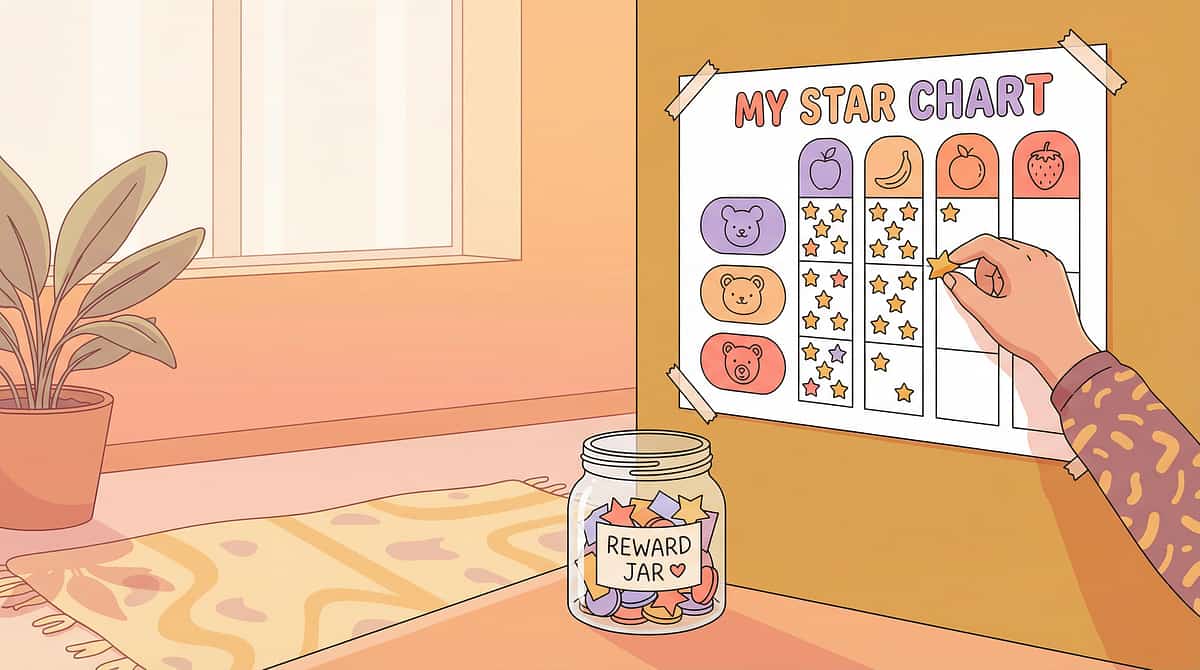
🏆 Reward Charts + Immediate Reinforcement System
Canon Category
Reinforcement Menus
Price Range
₹150–400
Pinnacle Recommends
Rosette Imprint Reward Jar — ₹589✅Active Canon SKU
1800+ Reward Stickers — ₹364✅Active Canon SKU
What It Does
Builds positive associations with toileting process (not just outcomes). Immediate reinforcement of effort — trying, responding to reminders, initiating — accelerates skill acquisition.
The most common reinforcement error in home toileting programs is rewarding only dry days. This approach makes the child helpless during the learning period — they receive no reward for effort when accidents are still occurring. Reinforcing the process (sitting, trying, responding to the watch) produces learning during the lag period before full awareness develops.
Sticker delivered within 3 seconds of a bathroom attempt. Chart visible at the child's eye level. Progress visually accumulating. This is the architecture of behavioral momentum.

Every Material Has a ₹0 Version
WHO/UNICEF Inclusion Principle: No child should miss therapy because of cost
Material | Purchased Version | ₹0 DIY Version | Why the DIY Works | |
Visual Schedule Board | Laminated picture board ₹200–600 | Print bathroom pictures from Google, tape to wall at child's eye height, use crayon check marks | Same external cuing mechanism — visual predictability doesn't require lamination | |
Vibrating Watch | Commercial timer watch ₹800–3,000 | Parent phone timer set to vibrate every 90 min, handed to child with "your body clock" framing | Same interval interruption — child ownership requires only reframing | |
Interoception Cards | Commercial card deck ₹300–800 | Write 10 activities on index cards: "Jump 10 times, find your heartbeat"; "Drink water, feel it"; "Empty tummy or full?" | Identical neural pathway activation through structured body-noticing practice | |
Toilet Training Doll | Commercial wetting doll ₹500–1,500 | Any doll + bowl of water + narrated play sequence about "doll needs bathroom" | Cause-effect learning mechanism is in the narration and play, not the mechanism | |
Moisture Alarm | Commercial sensor ₹1,000–4,000 | Strip of absorbent fabric in underwear + parent check every 30 min during high-risk periods | Reduced immediacy, but same pattern-tracking objective | |
Step Stool + Seat | Commercial set ₹400–1,200 | Stack of sturdy hardcover books (secured with tape) + adult holds child's knees at right angle initially | Biomechanical principle (knees above hips) achievable without purchase | |
Social Story | Commercial book ₹200–500 | Write 6-sentence story: "[Child's name] feels something in their tummy. That means the bathroom is calling..." with stick figures | Personalization makes the DIY version MORE effective than commercial | |
Easy Clothing | New purchase ₹300–800 | Audit existing wardrobe — every household has at least 2 elastic-waist bottoms; designate these as "school days clothes" | Zero cost version exists in every home already | |
Reward Chart | Commercial chart ₹150–400 | Grid drawn on paper + sticker squares from any stationary shop ₹10 | Behavioral mechanism is identical — child sees progress accumulate |
⚠When the clinical-grade material IS non-negotiable: The moisture-sensing alarm produces meaningfully faster learning than manual monitoring. If resources allow one purchase, this has the strongest evidence for accelerating the feedback loop.
Safety Gate: Read Before Starting
1
🔴 RED: Do NOT Proceed Without Medical Clearance If:
- Child experiences pain or burning during urination (possible UTI — requires antibiotic treatment)
- Child has constant dribbling between voids (possible structural issue — requires pediatric urology)
- Child had previously dry periods followed by sudden regression at age 5+ (warrants developmental assessment)
- Child has bowel accidents in addition to bladder (encopresis — medical and behavioral co-management required)
- Constipation is present (bowel impaction compresses bladder and DIRECTLY causes accidents — must be treated medically first)
- Child shows signs of distress, pain, or fever — any active illness is a postponement signal
2
🟡 AMBER: Modify Approach If:
- Child is currently upset, dysregulated, or in post-meltdown state — reschedule interoception practice to calm window
- Child shows strong anxiety around bathroom — use social stories and gradual exposure first
- Child is hypersensitive to vibration — test watch vibration tolerance before programming routine intervals
- Moisture alarm causes distress rather than neutral response — suspend alarm use and consult OT
3
🟢 GREEN: Safe to Proceed When:
- Medical causes ruled out by pediatrician
- Child is fed, rested, and in regulated baseline state
- All materials verified age-appropriate (no small parts for children under 3)
- Parent is in calm, patient emotional state
- Response protocol for accidents is shame-free (critical — shame increases anxiety, anxiety worsens interoception)
🛑 Absolute Red Lines
Never punish accidents. Ever. Punishment activates shame pathways that neurologically suppress interoceptive awareness.
If moisture alarm causes panic or severe distress — remove immediately. It is a tool, not a requirement.
If constipation is present — do NOT begin behavioral toileting intervention until medically addressed.
📖 ICCS Guidelines on Daytime Wetting | DOI: 10.1007/s12098-018-2747-4 | NCAEP 2020 Safety Monitoring Standards
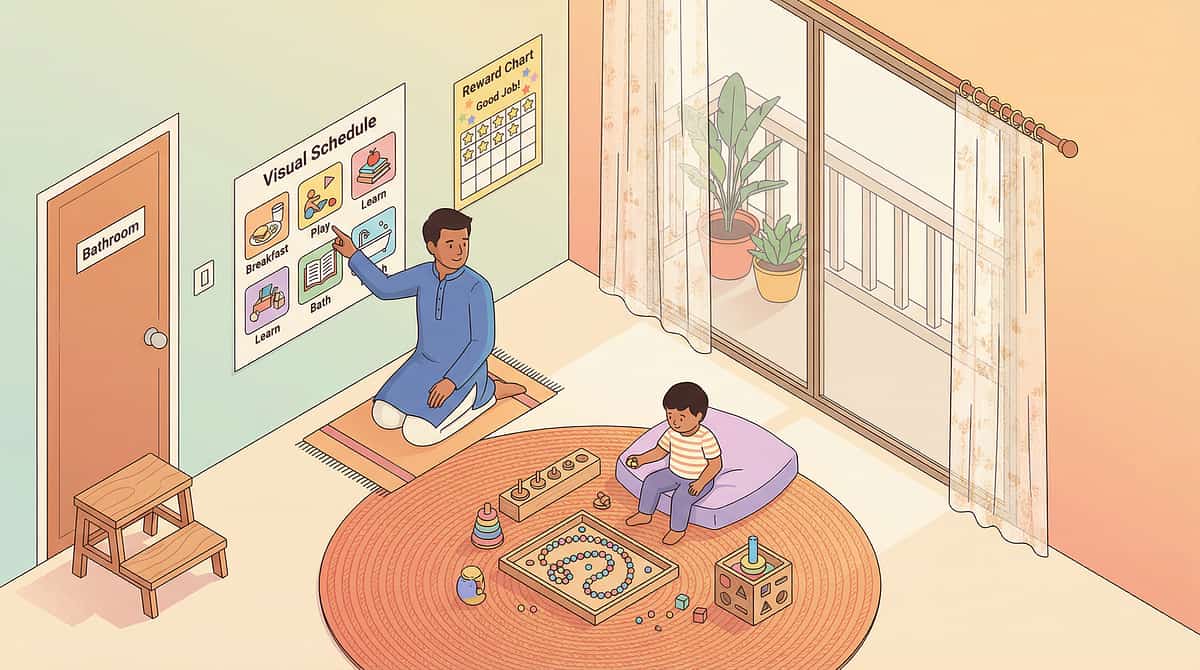
The Daytime Dryness Environment Setup
Bathroom Setup
Step Stool
In front of toilet, flush against base — restores physiological voiding posture
Toilet Seat Insert
Secured on toilet seat — eliminates fear of falling, provides warmth
Social Story Book
On bathroom counter/shelf within reach — reduces anxiety at point of use
Reward Chart
Mounted at child's eye level OUTSIDE bathroom door — visible from play area
Hand-Washing Materials
At reachable height — completing the full toileting sequence matters
Whole-Home Setup
Visual Schedule Placement: Mount at child's eye level (approx. 90cm from floor) in a location they pass naturally — kitchen hallway, bedroom door, or living room wall. NOT inside the bathroom (where avoidance occurs).
Watch Station: Designate one location (breakfast table or beside the bed) where the vibrating watch is charged and put on each morning. Make this a ritual.
Reward Chart Station: High-visibility, parent-managed area where stickers are stored and chart is immediately accessible for instant reinforcement within 10 seconds of successful bathroom attempt.
Sound Level: Bathroom fan noise can be aversive. Test child's tolerance. A quiet bathroom is more likely to produce relaxed, complete voiding.
Temperature: Cold toilet seats cause pelvic floor tension. Seat insert solves this. In cold climates, consider warming the bathroom before scheduled sit times.

ACT III — EXECUTION
Pre-Session Readiness Assessment (60 seconds)
Physical Readiness
- Child is fed and not hungry (hunger increases dysregulation)
- Child has had adequate sleep (overtired children have reduced interoceptive awareness)
- No signs of illness, fever, or physical discomfort
- Child has been awake for at least 30 minutes (sleep inertia affects interoception)
Behavioral Readiness
- Child is in regulated baseline state (not post-meltdown, not highly anxious)
- Child is not in mid-engrossing activity that will cause high resistance to transition
- No major transitions or stressors in the next 30 minutes
- Parent is calm and regulated (this is non-negotiable)
Environment Readiness
- Visual schedule is in place and visible
- Vibrating watch is charged and set
- Step stool and toilet seat insert are positioned
- Reward materials are ready and accessible
- Interoception cards are nearby for practice session
Decision Gate
🟢 GO — 8–9 Checks
Proceed with full protocol
🟡 MODIFY — 5–7 Checks
Use simplified version: scheduled sit only, no interoception practice today
🔴 POSTPONE — Under 5
Calming activity first; retry in 20 minutes
"The best session is one that starts right. A 10-minute great session beats a 30-minute resistant one. Always."

Step 1 of 6
The Invitation
Timing: 30–60 seconds
THE PRINCIPLE: Every protocol begins with invitation, not command. The child is brought into the activity through playful, low-demand engagement. This is where ABA's pairing principle meets OT's just-right challenge.
For Interoception Practice:
"Hey, want to do our body detective game? We're going to see if your body is sending any messages."
For Scheduled Bathroom Visit:
"The [watch/timer] went off — that means it's your body clock saying 'let's check in.' Walk with me?"
For the Timed Sit:
"Let's give the bathroom 2 minutes. You don't have to go — just sit and check. Bring [favorite small toy/object] if you want."
Body Language Guidance
- Get to child's physical level (crouch or sit)
- Warm, matter-of-fact tone — not urgent, not pressured
- Offer choice where possible: "Do you want to walk or hop to the bathroom?"
- Avoid: "You NEED to go," "Don't have an accident," "Are you sure you don't need to go?"
Reading Your Child's Response
Acceptance Cues: Child moves toward bathroom, asks clarifying questions, picks up favorite object to bring, maintains eye contact.
Resistance Cues: Turning away, protest, rigid body. Response: "Okay, the timer will buzz again in 45 minutes. Your body clock will remind us." — then let it go.
📖 ABA Pairing Procedures | OT Just-Right Challenge Principle | NCAEP 2020

Step 2 of 6
The Engagement: Interoception Practice
Timing: 3–5 minutes | Daily practice, outside toilet context
THE PRINCIPLE: Interoception is trained most effectively in low-stakes, playful contexts — NOT during accident crises or forced bathroom sits. Daily practice with easy-to-notice sensations builds the neural pathway that eventually carries bladder signals.
Week 1–2: Big Signals (Easy Wins)
"Jump 10 times — now put your hand on your chest. Can you feel your heart knocking?"
"Take a big breath and hold it 3 seconds. What does your chest feel like?"
"Drink half a glass of water. Can you feel it going down?"
"Take a big breath and hold it 3 seconds. What does your chest feel like?"
"Drink half a glass of water. Can you feel it going down?"
Week 3–4: Medium Signals
"Before breakfast — is your tummy empty, a little hungry, or very hungry? Point on the scale."
"After running: are you hot or cool? Where do you feel it?"
"Squeeze your hands tight, then let go. What does 'relaxed' feel like?"
"After running: are you hot or cool? Where do you feel it?"
"Squeeze your hands tight, then let go. What does 'relaxed' feel like?"
Week 5+: Bladder-Specific Signals
"Before the timer goes off — right now, does your bladder feel empty, a little full, or very full?"
"After you use the bathroom: now your bladder is empty. What does that feel like?"
"We're going to guess: do you need to go? Then we'll check if you were right."
"After you use the bathroom: now your bladder is empty. What does that feel like?"
"We're going to guess: do you need to go? Then we'll check if you were right."
Body Feeling Scale (printable): EMPTY ————————————— FULL | 0 (nothing) · 1 (maybe) · 2 (yes) · 3 (soon!) · 4 (now!) · 5 (too late) |
Practice predicting before scheduled bathroom visits. Celebrate accuracy — this builds the neural pathway.
Practice predicting before scheduled bathroom visits. Celebrate accuracy — this builds the neural pathway.
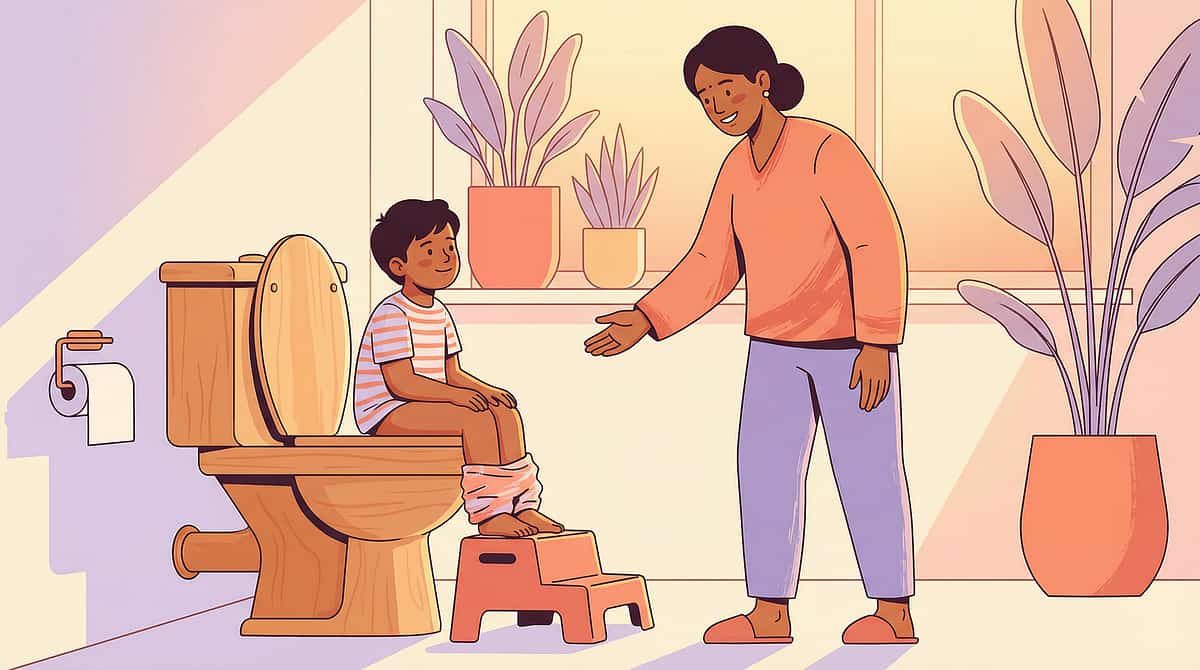
Step 3 of 6
The Scheduled Toilet Sit
Timing: 2–5 minutes per sit | 6–8 times daily
THE PRINCIPLE: When internal signals are unreliable, external timing ensures the bladder never reaches emergency capacity. The scheduled sit does two jobs simultaneously: prevents accidents NOW and provides the repeated association between sitting and voiding that strengthens the neural habit.
Time | Occasion | Priority | |
Upon waking | Immediate — bladder always full after sleep | 🔴 Non-negotiable | |
After breakfast | Gastrocolic reflex active | 🔴 Non-negotiable | |
Before leaving home | Never leave without attempting | 🔴 Non-negotiable | |
Mid-morning | 90–120 min after last void | 🟡 High priority | |
Before lunch | Pre-mealtime sit | 🟡 High priority | |
After lunch | Gastrocolic reflex again | 🟡 High priority | |
Mid-afternoon | High-risk play period | 🟡 High priority | |
Before dinner | Transition sit | 🟢 Standard | |
After dinner | Pre-bedtime routine begins | 🟢 Standard | |
Before bed | Final void of the day | 🔴 Non-negotiable |
1
Position Feet Flat
Step stool positions feet flat, knees at or slightly above hip level
2
Slight Forward Lean
Elbows on thighs — opens anorectal angle for complete emptying
3
Relax and Breathe
Relax shoulders, breathe slowly. Allow 2–5 minutes — do not rush.
4
The Instruction
"Just sit and check. You don't have to go. Just check."
This posture physiologically relaxes the puborectalis muscle and enables complete bladder emptying. Dangling feet create muscular tension that prevents complete voiding and causes frequent small-volume accidents.
📖 PMC10955541 | ICCS Voiding Position Guidelines | Pediatric Urology Continence Management Standards
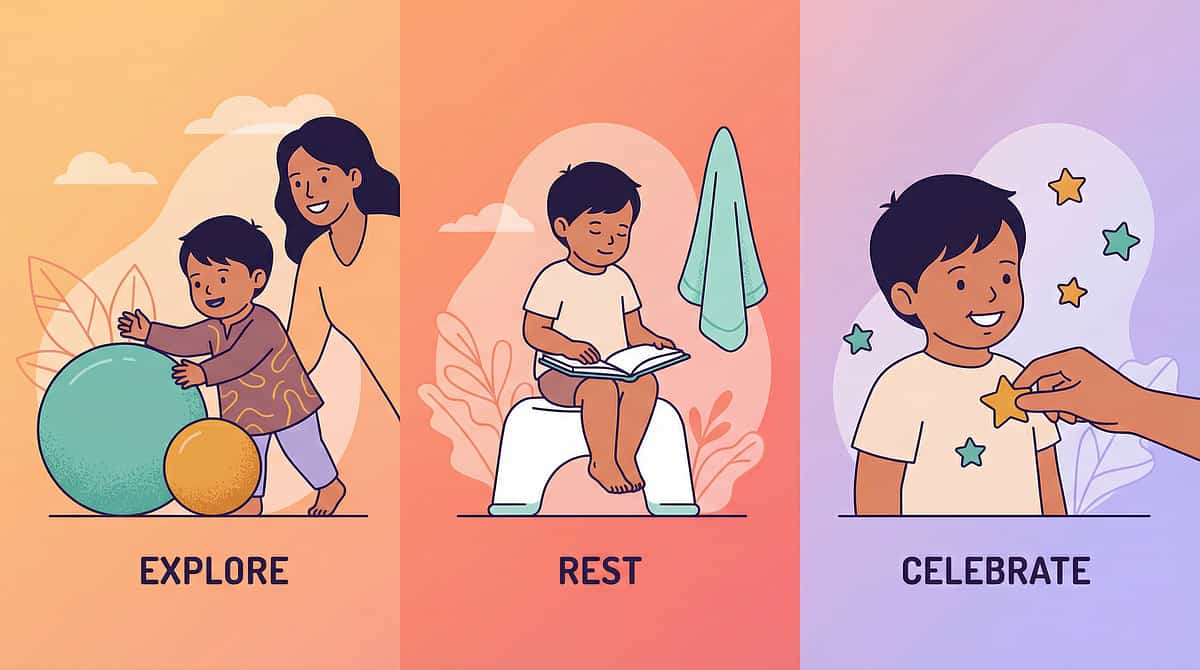
Step 4 of 6
Sustaining the Protocol: Repeat & Vary
Timing: Weeks, not days — consistency is the active ingredient
THE PRINCIPLE: Interoception training follows neuroplasticity timelines. Meaningful change in body-signal processing requires 40–80 structured repetitions across 4–8 weeks. The parent's greatest therapeutic tool is consistency.
Vary the Interoception Practice
- Body detective game (card-based)
- "Body scan" before meals — name 3 body sensations right now
- "Prediction game" before bathroom sits — guess empty/full, then verify
- Drawing how the bladder feels at different times of day
Vary the Social Story
- New character, same concept
- Child helps "write" their own story as they progress
- Story evolves to match actual progress ("I used to not notice. Now I notice sometimes. Soon I'll notice every time.")
Vary the Reinforcement
- Week 1–2: Sticker for every sit attempt (high frequency, low value)
- Week 3–4: Star chart — 5 stars = small preferred activity
- Week 5+: Pride chart — child tracks own dry days (intrinsic motivation building)
Satiation Indicators
- Increased protest at bathroom attempts (common 3–4 weeks in — normal consolidation resistance)
- Boredom with current interoception activity (vary immediately)
- Routine refusal despite previous compliance (reinforce novelty, check for medical causes)
3 good, willing sits > 10 forced, resistant ones. Always.

Step 5 of 6
The Reinforcement Architecture
Timing: Within 3 seconds of the desired behavior
THE PRINCIPLE: Immediate, specific, enthusiastic reinforcement of the PROCESS (sitting, trying, responding to the watch) — not just the OUTCOME (staying dry) — produces faster learning. A child who gets a reward for TRYING learns they have agency.
"You felt the watch buzz and you went! That's your body and your watch working as a team."
"You sat on the toilet even though you didn't feel like you needed to go. That's exactly right."
"You told me you needed to go! Your bladder sent you a message and you heard it!"
Token System
Sticker per attempt → Reward Jar — Canon SKU ₹589
Star per successful void → 1800+ Reward Stickers — Canon SKU ₹364
Points → preferred activity (screen time, special game, park trip)
Star per successful void → 1800+ Reward Stickers — Canon SKU ₹364
Points → preferred activity (screen time, special game, park trip)
Natural Reinforcement
Pride chart visible to family ("Look how many times I tried this week")
Call/video grandparent to share achievement
Child chooses dinner / activity after a fully dry day
Call/video grandparent to share achievement
Child chooses dinner / activity after a fully dry day
⚠CRITICAL: Never remove earned rewards for accidents. Accidents are information, not infractions. The reinforcement system collapses if rewards can be taken away. Celebrate the attempt. Celebrate the awareness. Celebrate the try. Results follow from these.
📖 ABA Reinforcement Principles | BACB Ethical Guidelines | Token Economy Systematic Reviews (Multiple)
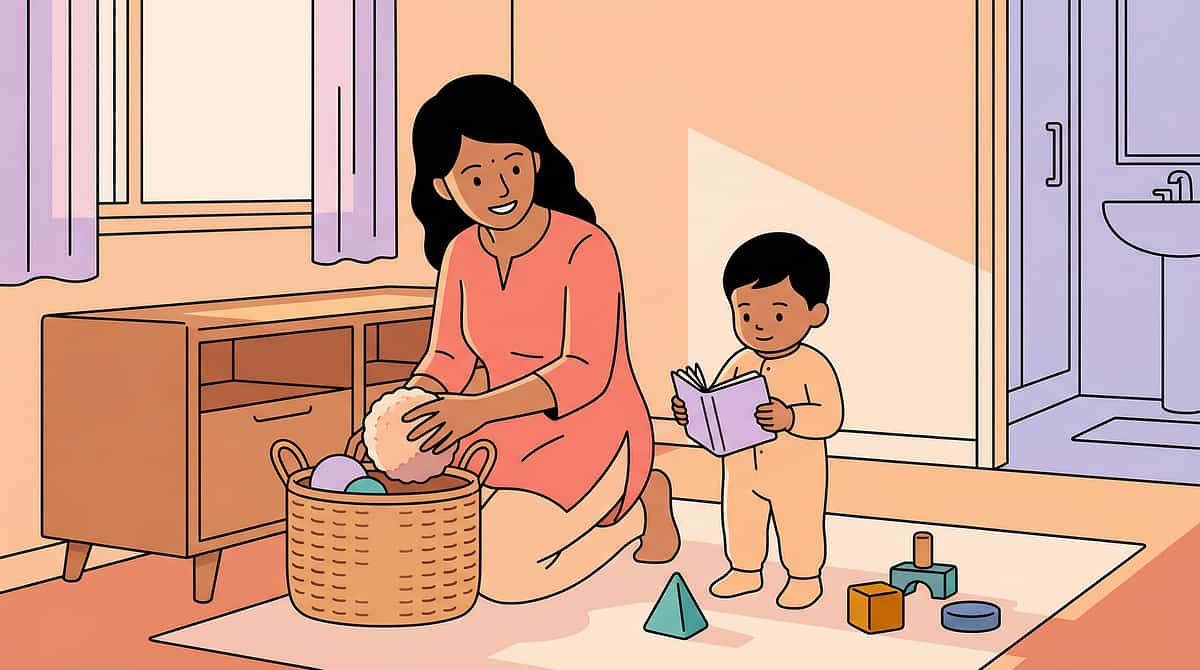
Step 6 of 6
The Transition Close
Timing: 1–2 minutes after each bathroom visit
THE PRINCIPLE: The toilet should end as a neutral-positive experience, not abruptly or anxiously. The child's final emotional association with each bathroom visit determines their motivation for the next one.
After a Successful Void
"Body clock worked perfectly. All done — hands washed, back to [activity]."
[Deliver reinforcement within 3 seconds] → sticker, verbal praise, chart marking
[Deliver reinforcement within 3 seconds] → sticker, verbal praise, chart marking
After a Sit Without Voiding
"Good check-in. Nothing to go right now — that's useful information. Next check in [time]."
[Small reinforcement for trying] → one sticker, one verbal acknowledgment
[Small reinforcement for trying] → one sticker, one verbal acknowledgment
After an Accident
"[Name], you had an accident. That happens. Bodies are still learning. Let's get changed — and next time the watch buzzes, we'll try together."
Calm, matter-of-fact tone. No disappointment display. No extra attention to the accident.
Calm, matter-of-fact tone. No disappointment display. No extra attention to the accident.
Post-Accident Protocol
1
Matter-of-Fact
"Time to change."
2
Participate in Cleanup
Child participates at appropriate level (wipes self, brings fresh clothes)
3
No Consequence
No shame language, no time-out, no consequence
4
Reset
"Watch is set. Next try in [interval]."
5
Record the Data
Time of day, activity, interval since last void
❌ What NOT to Say After Accidents
- "How many times do I have to remind you?"
- "You're too old for this"
- "You need to try harder"
- "Why didn't you feel it coming?"
✅ What to Say Instead
"Your body is still learning. So are we."

60 Seconds of Data Now Saves Hours of Guessing Later
Field | What to Record | Why | |
Time | Clock time of accident or successful void | Identifies high-risk time windows | |
Activity | What child was doing (play, screen, eating, transition) | Identifies context-specific patterns | |
Interval | Minutes since last bathroom visit | Reveals functional bladder capacity | |
Awareness | Did child show any signal beforehand? (Y/N/Partial) | Tracks interoception development |
Weekly Review — Every Sunday, 5 Minutes
Count accidents this week vs. last week
Identify the highest-frequency accident time windows → increase schedule density there
Count self-initiated bathroom trips (even one is meaningful progress)
Record any "I need to go" statements — these are the most important data points
GPT-OS® Data Connection: When this data enters the GPT-OS® system, it feeds individualized schedule optimization, progress trajectory modeling, and red flag detection — patterns that warrant professional escalation. Your daily 60 seconds of tracking becomes a precision clinical tool.
📖 ABA Data Collection Standards | BACB Guidelines | Cooper, Heron & Heward (Applied Behavior Analysis, 8th Ed.)

The Reality Card: Session Troubleshooting
Most sessions don't go perfectly. This is normal. Here are the 7 most common failure modes and their exact fixes.
❓ Child refuses all scheduled bathroom trips
What happened: Autonomy resistance — the schedule feels like control, not care.
Fix: Offer radical choice within the non-negotiable: "Do you want to walk or be carried? Do you want to bring your dinosaur or your car? Do you want to sit for 1 minute or 2?" The sit is non-negotiable. Everything else is their choice.
Fix: Offer radical choice within the non-negotiable: "Do you want to walk or be carried? Do you want to bring your dinosaur or your car? Do you want to sit for 1 minute or 2?" The sit is non-negotiable. Everything else is their choice.
❓ Moisture alarm causes significant distress
What happened: The alarm itself is an aversive sensory event overriding its educational purpose.
Fix: Suspend alarm. Begin desensitization: child practices turning the alarm off while it rests on the table (not worn). Gradual approach to wearing. Consult OT for sensory-graded introduction if distress persists.
Fix: Suspend alarm. Begin desensitization: child practices turning the alarm off while it rests on the table (not worn). Gradual approach to wearing. Consult OT for sensory-graded introduction if distress persists.
❓ Child is dry with schedule but no self-initiation develops
What happened: External scaffold is working but interoceptive training hasn't transferred.
Fix: Intensify daily interoception practice (especially the prediction game before sits). Increase the interval between scheduled sits by 15 minutes to create mild urgency experience. Delay the schedule slightly on weekends to create natural self-initiation opportunities.
Fix: Intensify daily interoception practice (especially the prediction game before sits). Increase the interval between scheduled sits by 15 minutes to create mild urgency experience. Delay the schedule slightly on weekends to create natural self-initiation opportunities.
❓ Accidents only happen at school, not at home
What happened: Schedule isn't being mirrored at school, or school bathroom is an avoidance trigger.
Fix: See Card 37 (Teacher communication template). Share the exact home schedule with the teacher. Address school bathroom anxiety with social story specific to the school bathroom.
Fix: See Card 37 (Teacher communication template). Share the exact home schedule with the teacher. Address school bathroom anxiety with social story specific to the school bathroom.
❓ Reward system has stopped working
What happened: Habituation — the same reward has lost its motivating value.
Fix: Change the reinforcer, not the system. Rotate stickers → small toys → screen time → special activity. Involve the child in choosing next reward. Shift toward intrinsic motivation markers (pride chart, family recognition).
Fix: Change the reinforcer, not the system. Rotate stickers → small toys → screen time → special activity. Involve the child in choosing next reward. Shift toward intrinsic motivation markers (pride chart, family recognition).
❓ Good progress, then regression
What happened: Normal developmental pattern. Stress (new sibling, school change, illness) commonly triggers regression. Also check: constipation returned?
Fix: Return to previous successful level without drama. Regression is not backward — it's the normal consolidation wave. Do not reduce expectations permanently.
Fix: Return to previous successful level without drama. Regression is not backward — it's the normal consolidation wave. Do not reduce expectations permanently.
❓ Child is embarrassed and doesn't want to talk about accidents
What happened: Social awareness is developing; child is experiencing shame.
Fix: Private, matter-of-fact protocol. Change clothes privately. No family discussion of accidents. Frame as a "body learning" process — completely separate from character, intelligence, or effort.
Fix: Private, matter-of-fact protocol. Change clothes privately. No family discussion of accidents. Frame as a "body learning" process — completely separate from character, intelligence, or effort.

ACT IV — THE PROGRESS ARC
Week 1–2: Laying the Neural Foundation
15%
Progress Complete
Foundation phase — the protocol is being installed, not yet visible in outcomes
✅ What "Progress" Actually Looks Like in Weeks 1–2
- Child tolerates scheduled sits without major resistance (tolerance is the goal)
- Child engages with at least one interoception practice activity per day
- Accident frequency has NOT increased (stability = success at this stage)
- Child is wearing the vibrating watch without removing it
- Parent is implementing the protocol consistently
⚠ Do Not Mistake These As Failure
What You See | What It Actually Means | |
Child tolerates sit but doesn't void | Exactly right — this is the goal at this stage | |
2 accidents per day instead of 4 | Meaningful improvement — not "no change" | |
Child resists some sits | Normal resistance phase — not failure | |
No visible awareness yet | Neural pathway is forming invisibly |
"If your child tolerates the bathroom sit for 30 seconds longer than last week without protest — that's a measurable neural change. You may not see it yet. It's happening."
Parent Preparation: Weeks 1–2 are the hardest. The protocol feels effortful with no visible return. This is normal. The return comes in weeks 3–4. Stay consistent.
📖 PMC11506176 | Neuroplasticity Consolidation Literature | Behavioral Intervention Timeline Meta-analyses

Week 3–4: The Neural Pathways Are Forming
Progress Complete
Consolidation phase — the routine is becoming familiar and behavioral signals of learning are emerging
✅ Scheduled sits are accepted with less resistance (routine is becoming familiar)
✅ At least one predictive accuracy on body-feeling scale per day ("I thought I needed to go... and I did!")
✅ Accident frequency measurably down from baseline
✅ Child responds to vibrating watch with 30–60 second response time
✅ At least 1–2 self-initiated bathroom trips per week
Behavioral Signals of Neural Pathway Formation
Spontaneous Mention
Child spontaneously mentions needing to go — even once. This is significant.
Scale Accuracy
Child predicts correctly on the body-feeling scale more than 50% of the time
Readiness Posture
Child shows holding or leg-crossing — the signal they're starting to feel it
Anticipation
Child anticipates the scheduled sit BEFORE the timer — the external rhythm is being internalized
"You may notice you're less anxious too. When the protocol is working, the emotional weight of constant vigilance begins to lift. Trust the system."

Week 5–8: The Mastery Phase Unlocks
75%
Progress Complete
Mastery phase — observable, measurable criteria being met consistently
🏆 Self-Initiation
Child self-initiates bathroom visits on most days (>70% of total bathroom trips are self-initiated, not reminder-triggered)
🏆 Accident Frequency
Accident frequency reduced to ≤1 per week consistently
🏆 Predictive Accuracy
Child correctly predicts bladder fullness before bathroom visit >80% of the time
🏆 Generalization
Child maintains dryness across different settings — home, school, social situations
Generalization Indicators
- Skill appearing in novel environments without parent prompting
- Child asks for bathroom in social situations without cues
- Child communicates bladder status spontaneously ("I need to go soon")
Maintenance Check
When schedule is briefly reduced (holiday, travel), does the skill maintain? If yes → mastery is genuine. If regression occurs → skill needs more consolidation before fading support.
When to move forward: Achieve mastery criteria + skill maintained for 3+ weeks → begin formal fade of external supports.
📖 PMC10955541 | BACB Mastery Criteria Standards | ABA Generalization Research

You Did This. Your Child Grew Because of Your Commitment.
You showed up — consistently, patiently, without shortcuts — through weeks when no visible progress came. Through nights when you questioned the protocol. Through moments when you cleaned up the fourth accident of the day and found the grace to say, calmly, "Let's get changed."
That is therapeutic intervention. That is what changes lives.
→ A Neural Pathway Built
Your child now has a brain circuit that didn't exist before this protocol began
→ A Body Trusted
Your child learned to listen to a body signal that was previously inaudible — and learned that their body can be understood
→ Dignity Gained
Your child gained independence in a domain that affects every single day of their life
Family Celebration Suggestion: Let your child choose — one special activity, one meal, one outing that marks this milestone. Make it memorable. This is not a reward — it's a recognition of a real developmental achievement.
"Write down the moment you first realized the protocol was working. What did you see? What did your child say? Keep this moment — you'll want it when the next challenge arrives."

Clinical Guardrails: When to Pause and Seek Consultation
These are not fear-inducing — they are empowering. Specific knowledge means confident, appropriate action.
🚨 Red Flag | What It Looks Like | Why It Matters | Action | |
Pain during urination | Child cries, holds genitals, distressed face during voiding | UTI possible — cannot be addressed behaviorally | Pediatrician same day | |
Constant dribbling | Continuous small moisture between voids | Possible structural/neurological cause | Pediatric urology consult | |
Significant regression after dryness at 5+ | Fully dry for months, then sudden return to multiple accidents | Warrants developmental + medical assessment | Developmental pediatrician | |
No improvement after 8–10 weeks consistent implementation | Protocol followed faithfully, accidents unchanged or worse | Possible underlying cause not yet identified | OT assessment + pediatric urology | |
Bowel accidents alongside bladder | Soiling + wetting occurring together | Encopresis requires co-management | Pediatric GI + OT + behavioral | |
Child showing signs of shame/social withdrawal | Refusing school, avoiding playdates, acute distress about accidents | Psychological impact requires immediate support | School counselor + therapist |
1
Self-Monitor
Track data consistently using the E-501 tracking sheet
2
GPT-OS® Data Review
Pattern analysis flags concerns automatically
3
Teleconsultation
Free 30-min video consult with Pinnacle OT
4
Center Visit
In-person assessment at nearest Pinnacle center
5
Specialist Referral
Pediatric urology, GI, or developmental pediatrics as indicated
📞FREE Helpline: 9100 181 181 — 24x7, 16+ languages | 🌐pinnacleblooms.org
📖 WHO NCF Referral Pathway Standards | ICCS Escalation Guidelines | Pinnacle Clinical Protocols
Related Techniques: SC-TOILET Domain
Using materials you may already have from E-501
Level | Technique | Difficulty | Canon Materials You Already Own | |
🟢 | E-499: Toileting Readiness Overview | INTRO | Visual Schedules, Reward Charts | |
🟡 | E-500: Nighttime Dryness Development | CORE | Moisture Alarm, Visual Schedules | |
🟡 | E-502: Independent Dressing | CORE | Easy-Access Clothing, Visual Schedules | |
🟡 | E-503: Self-Feeding Independence | CORE | Visual Schedules, Reward Charts | |
🔴 | E-520: Interoception Expansion Program | ADVANCED | Interoception Cards | |
🟢 | E-510: Sensory Processing & Self-Care | INTRO | All materials from this page |
"You already own materials for 5 of 6 related techniques. Your investment in E-501 has equipped you for the entire SC-TOILET domain."
ACT V — COMMUNITY & ECOSYSTEM
From the Families Who Walked This Path First
Anonymized. Behavioral specificity preserved. These are clinical narratives, not marketing.
Family A | Chennai | Child age 5, autism diagnosis
Before: "He was having 3–4 accidents per day despite being 'potty trained' for 18 months. He genuinely looked surprised every time. School was calling us weekly. We'd tried everything — rewards, punishments, taking away privileges. Nothing worked."
After (Week 12): Accidents reduced to 1–2 per week by week 8. By week 12 — self-initiating 70% of bathroom trips. "He said one day, 'Amma, my tummy is telling me something.' I cried right there in the kitchen."
Therapist's Notes: Primary barrier was interoceptive awareness, not behavioral resistance. Interoception practice combined with timed voiding was the active ingredient.
Family B | Hyderabad | Child age 4, developmental delay
Before: "Four years old, multiple accidents every single day. Preschool asked us to keep her home until she was 'more reliably trained.' That broke my heart."
After (Week 8): "The visual schedule was the turning point. She started anticipating the bathroom times herself by week 4. By week 8, dry most school days. She came home with a note from her teacher: 'She asked to go to the bathroom herself today.' I still have that note."
Family C | Bengaluru | Child age 6, ADHD
Before: "He knew exactly how to use the toilet. He'd just get so absorbed in whatever he was doing that the signal got completely buried. By the time he noticed — it was too late. Every. Single. Time."
After (Week 10):"The vibrating watch changed everything. It became HIS responsibility. Not me nagging, not him failing. Him and his watch, working together. Accidents went from daily to once a week in two months."
Note: Outcomes vary by child profile, underlying factors, and intervention consistency. These narratives represent observed case patterns, not guaranteed results.

Home + Clinic = Maximum Impact
Specialty | What They Do | How to Access | |
Occupational Therapist | Interoception assessment, sensory profile, protocol personalization | 9100 181 181 | |
ABA/BCBA | Behavioral analysis of accident patterns, reinforcement system design | 9100 181 181 | |
Developmental Pediatrician | Rule out medical causes, co-occurring condition management | 9100 181 181 | |
Pediatric Neurologist | For complex interoception presentations | Referral via center | |
School Support Specialist | IEP/504 accommodations, teacher training | 9100 181 181 |
📞 FREE National Helpline
9100 181 181
24x7 | 16+ languages | No appointment needed for initial consultation
24x7 | 16+ languages | No appointment needed for initial consultation
📊 Assessment
Start with AbilityScore® for your child's complete developmental profile
"Home-based intervention is powerful. Clinic-supported home intervention is transformative."
📖 WHO NCF Progress Report (2023) | 48% increase in countries adopting ECD policies | Primary care as ECD platform

Watch: 9 Materials That Help With Daytime Accidents
🎬 Reel E-501
9 Materials That Help With Daytime Accidents
Series: Toileting & Self-Care Independence — Episode 501
Domain: SC-TOILET | Duration: 75–85 seconds
Series: Toileting & Self-Care Independence — Episode 501
Domain: SC-TOILET | Duration: 75–85 seconds
In this reel you'll see: the 9 materials introduced in visual context, a licensed occupational therapist explaining the interoception gap, each material demonstrated with real-world application, the GPT-OS® system architecture, and how to begin today.
← E-500
Nighttime Dryness Development
► E-501
Daytime Accidents — You Are Here
→ E-502
Independent Dressing
→ E-520
Interoception Expansion Program
📖 NCAEP 2020: Video modeling classified as evidence-based practice for autism | Multi-modal learning literature
Preview of 9 materials that help with daytime accidents Therapy Material
Below is a visual preview of 9 materials that help with daytime accidents therapy material. The pages shown help educators, therapists, and caregivers understand the structure and content of the resource before use. Materials should be used under appropriate professional guidance.


Link copied!

The Pinnacle Promise
🏛 Pinnacle Blooms Network®
Built by Mothers. Engineered as a System.
OT • SLP • ABA/BCBA • Special Education • NeuroDevelopmental Pediatrics • Pediatricians • CRO • Regulatory Experts • WHO/UNICEF Aligned • Parent-Validated
"From fear to mastery. One technique at a time."
Pinnacle Blooms Network® exists to transform every home into a proven, scientific, 24×7, personalized, multi-sensory, multi-disciplinary pediatric therapy environment — accessible to every family, regardless of geography or economic status.
20M+
Exclusive 1:1 Sessions
97%+
Measured Improvement
70+
Centers Nationwide
70K+
Technique Pages
This content is educational and informational. It does not replace individualized assessment and intervention planning with licensed occupational therapists, pediatric physicians, urologists, or other qualified healthcare professionals. Persistent daytime wetting warrants medical evaluation to rule out urological, neurological, or other physical causes. Always consult qualified professionals for persistent toileting concerns. Individual outcomes vary based on child profile, underlying factors, and intervention consistency.
CIN: U74999TG2016PTC113063 | DPIIT: DIPP8651 | MSME: TS20F0009606 | GSTIN: 36AAGCB9722P1Z2
© 2025 Pinnacle Blooms Network®, unit of Bharath Healthcare Laboratories Pvt. Ltd. All rights reserved. | techniques.pinnacleblooms.org | pinnacleblooms.org | care@pinnacleblooms.org