
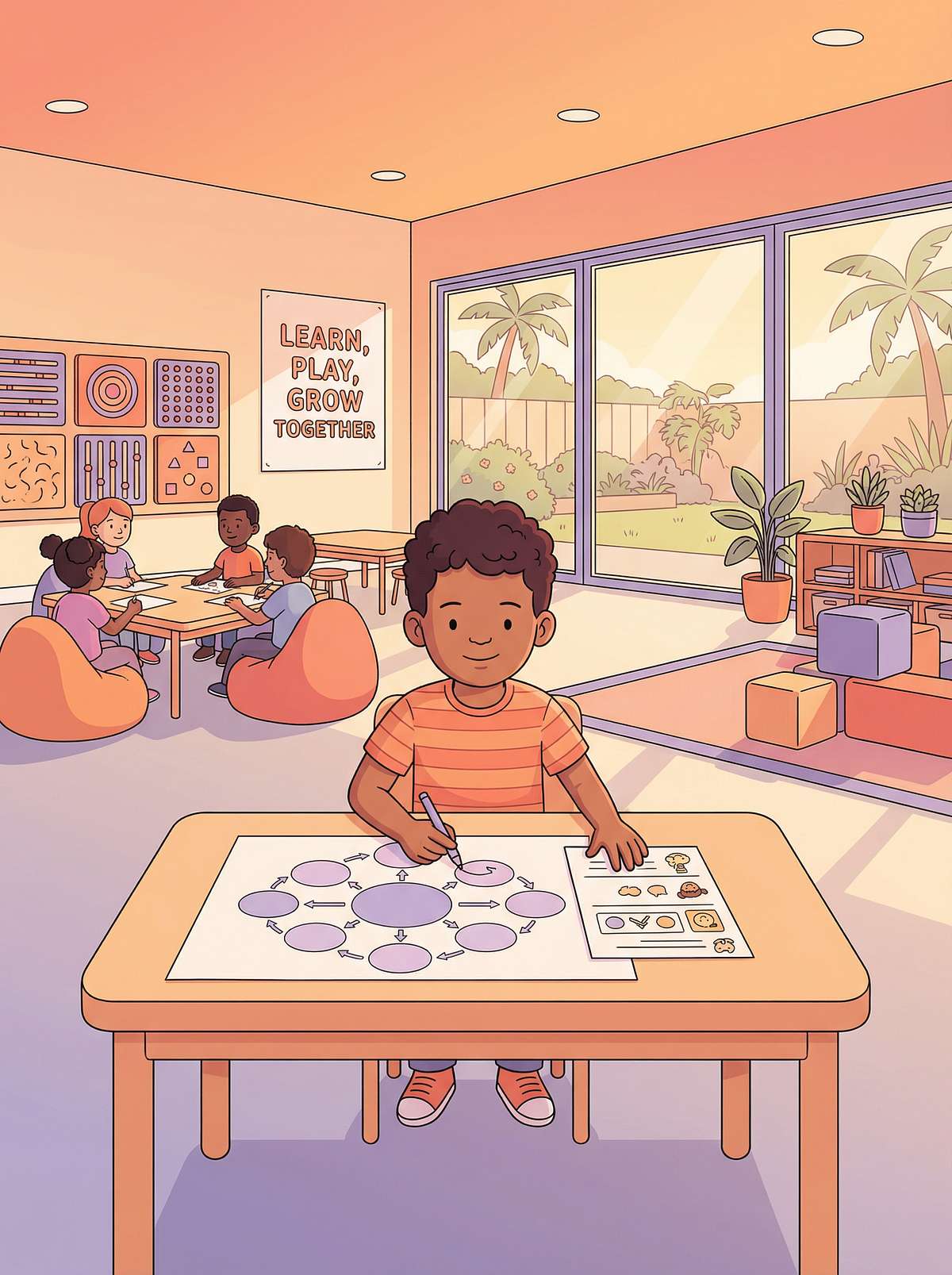
"His teacher sent home the same worksheet as the other 30 kids. He sat there crying for 45 minutes and still couldn't start."
Curriculum Modifications: The Right Door to the Same Room
It's Sunday night. The school bag is open. The worksheet is out. And your child — who you know is smart, who you've watched figure out how the TV remote works, who recites entire dialogue from his favourite cartoon — is staring at a page of tiny print and 25 maths problems and shutting down completely.
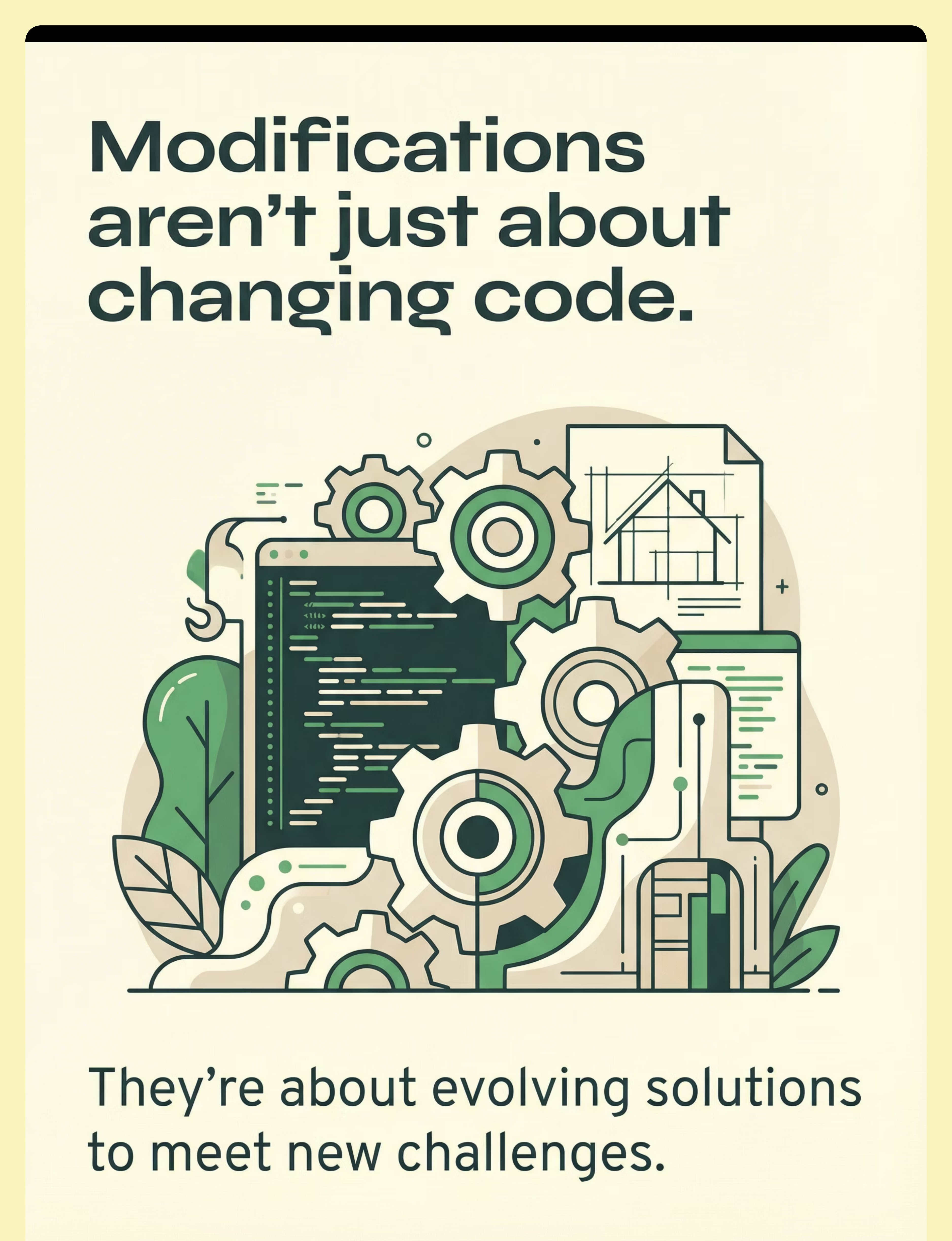
This isn't a learning failure. This is an access failure. Curriculum modifications are not about lowering what your child can achieve. They are about removing the barriers that sit between your child's brain and the learning it is absolutely ready to do.
"You are not failing. Your child's curriculum is failing them. Let's fix the curriculum." — Pinnacle Blooms Network® Special Education Consortium
🏛️ Pinnacle Blooms Network®
Episode H-751
Age Band: 4–16 years
SpEd • OT • SLP • ABA
WHO Nurturing Care Framework (2018): "Early identification and caregiver awareness directly impacts developmental outcomes."

Millions of Families Are Navigating This. Right Now.
1 in 36
Children in India
diagnosed with a neurodevelopmental condition that affects learning access
80%
Children with Autism
experience significant challenges with standard curriculum formats
70%
Can Access Grade-Level
concepts when the FORMAT is right — not a different destination, a different door
When you sat with your child at that table last night, struggling to break down an impossible worksheet, there were millions of other parents across India doing the same thing — and most of them didn't know that what their child needs isn't more effort. It's a different door.
The global research is unambiguous: children's learning differences do not reflect their intellectual capacity. They reflect a mismatch between how the curriculum is presented and how a specific child's brain processes information. India has over 8 million school-age children with IEPs or identified special education needs:
- Less than 12% have access to meaningfully modified curriculum materials
- Over 60% of parents report not understanding what "modified curriculum" looks like in practice
- Children who receive appropriate modifications show learning rate equivalent to peers on core concepts (NCAEP 2020)
"The barrier is not your child's brain. The barrier is a format that was never designed for their brain." — Pinnacle Blooms SpEd Consortium Lead
📞9100 181 181 | Questions? Call FREE. | PRISMA Systematic Review (PMC11506176, 2024) • NCAEP EBP Report 2020 • WHO NCF Progress Report 2023

Reading Level ≠ Thinking Level. Science Explains Why.
The Neuroscience
In children with autism, ADHD, dyslexia, or intellectual disabilities, one or more neural pathways processes information differently:
- Working Memory (Prefrontal Cortex): Holds fewer items simultaneously — a page of 25 problems overloads this system entirely
- Phonological Processing (Left Temporal): Decoding written text requires more cognitive effort — leaving less capacity for comprehension
- Executive Function (Frontal Lobe): Organising multi-step tasks, planning responses, filtering distractions — all effortful when these circuits are under-resourced
- Processing Speed: The time from input to output is simply longer — standard tests punish speed, not knowledge
What This Means at the Kitchen Table
Your child's brain is not broken. It is wired to process information through specific channels that standard curriculum formats often block.
When you simplify the text format — same concept, shorter sentence — the working memory pathway has room to actually think. When you present ideas visually through a graphic organiser, the phonological processing bottleneck is bypassed entirely. When you chunk a worksheet into five items instead of twenty-five, the executive function circuit can complete the task successfully.
The concept is exactly the same. The door is different. And a different door is not a lesser door.
"Every child deserves curriculum that fits their brain — not a curriculum designed for a statistical average that doesn't include theirs."
Frontiers in Integrative Neuroscience (2020): DOI: 10.3389/fnint.2020.556660
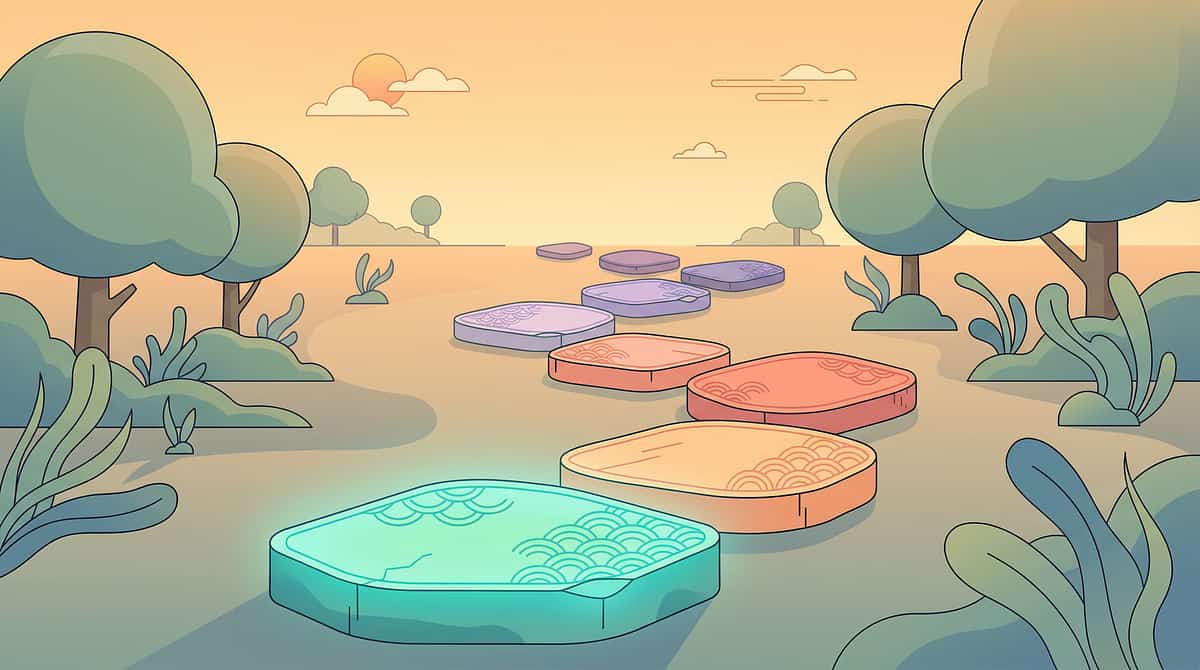
Curriculum Access: Where Your Child Is, and Where They're Going
Age 4–6
Foundation Readiness
Concept Pre-teaching
Concept Pre-teaching
Age 6–9
Early Academic Access
Modified Formats
Modified Formats
Age 9–12
Core Academic Independence
Scaffolded Materials
Scaffolded Materials
Age 12–16
Advanced Preparation
Self-Advocated Accommodations
Self-Advocated Accommodations
According to WHO developmental guidelines and the UNICEF MICS framework, curriculum accessibility is a developmental domain in its own right — not a remediation measure. Children who receive appropriate curriculum modifications at ages 4–9 show faster conceptual acquisition, significantly lower rates of school avoidance, and higher parent-reported confidence by age 10–12.
Common Co-Occurrences with Curriculum Access Challenges
Autism Spectrum Disorder
ADHD & Attention-Based Processing
Dyslexia, Dysgraphia, Dyscalculia
Intellectual Disability (mild–moderate)
Language Processing Disorders
Developmental Delays
"Your child is here. The path is clear. The modifications are the vehicles."
WHO CCD Package (PMC9978394) • UNICEF MICS indicators across 197 countries

Evidence Grade: LEVEL I — Systematic Review Support
🏆 Evidence Grade I
Systematic Review
Clinically Validated
Study | Key Finding | Reference | |
NCAEP Systematic Review (2020) | Curriculum modifications, graphic organisers, and visual supports classified as evidence-based practices for learners with autism | NCAEP 2020 EBP | |
CAST/UDL Research Corpus | Universal Design for Learning improves outcomes across disability categories | CAST.org | |
PMC11506176 (Children, 2024) | 16 studies confirm structured material modifications meet evidence-based practice criteria | PMC11506176 | |
Padmanabha et al. (2019) | Home-based modified learning interventions show significant outcomes in Indian pediatric populations | DOI:10.1007/s12098-018-2747-4 | |
Council for Exceptional Children | Evidence-based practices in differentiated instruction with fidelity show peer-equivalent concept acquisition | CEC 2023 |
"When curriculum format matches a child's cognitive profile, learning rate is equivalent to typically developing peers on core concepts. The variable is the door — not the destination."
✅ Validated by Pinnacle SpEd, OT, SLP, ABA, NeuroDev consortium
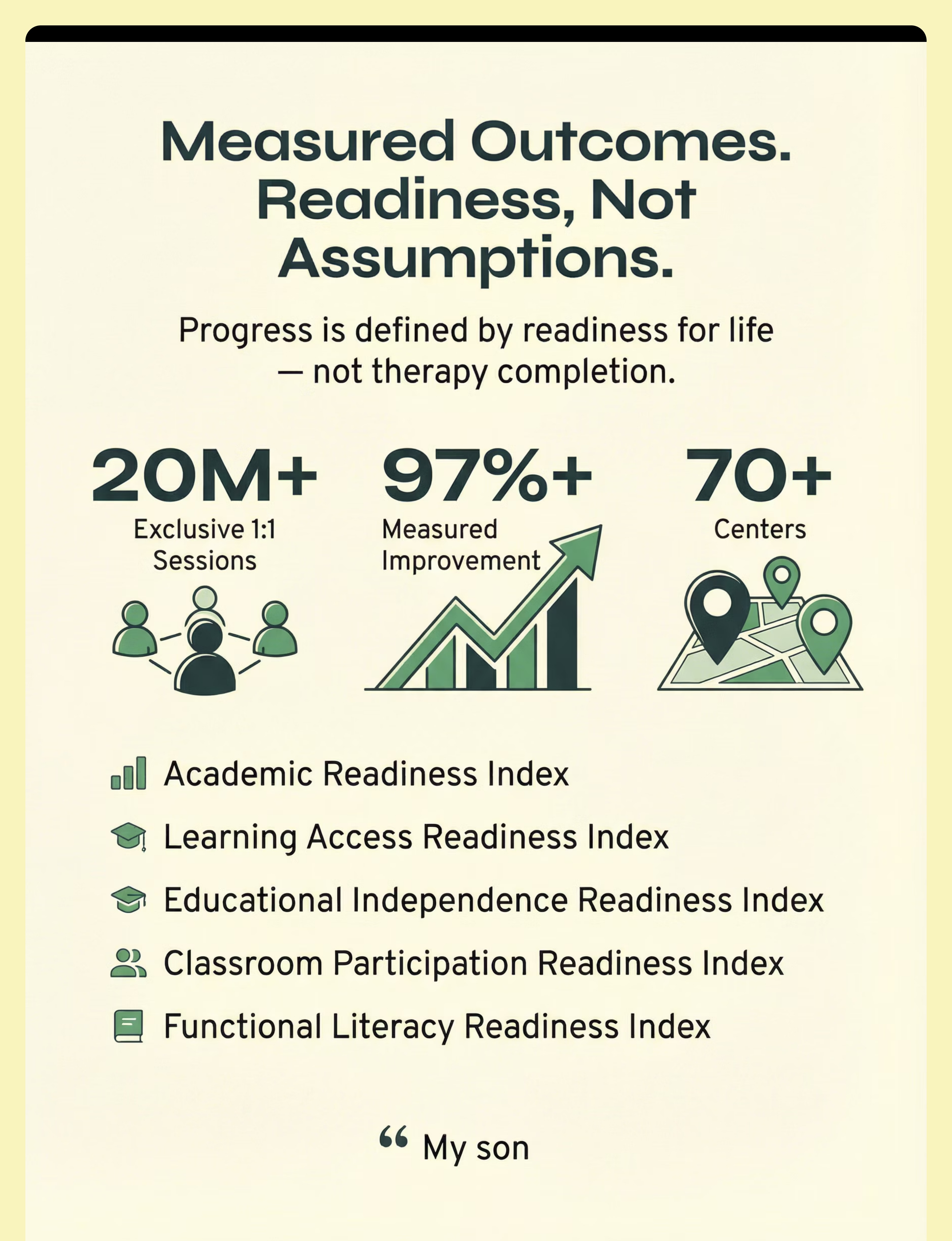
✅ Applied across 20M+ therapy sessions, 97%+ improvement outcomes
✅ WHO/UNICEF equity principles: accessible curriculum for all learners
✅ India-specific evidence base confirmed
📞9100 181 181 — Call FREE for assessment guidance
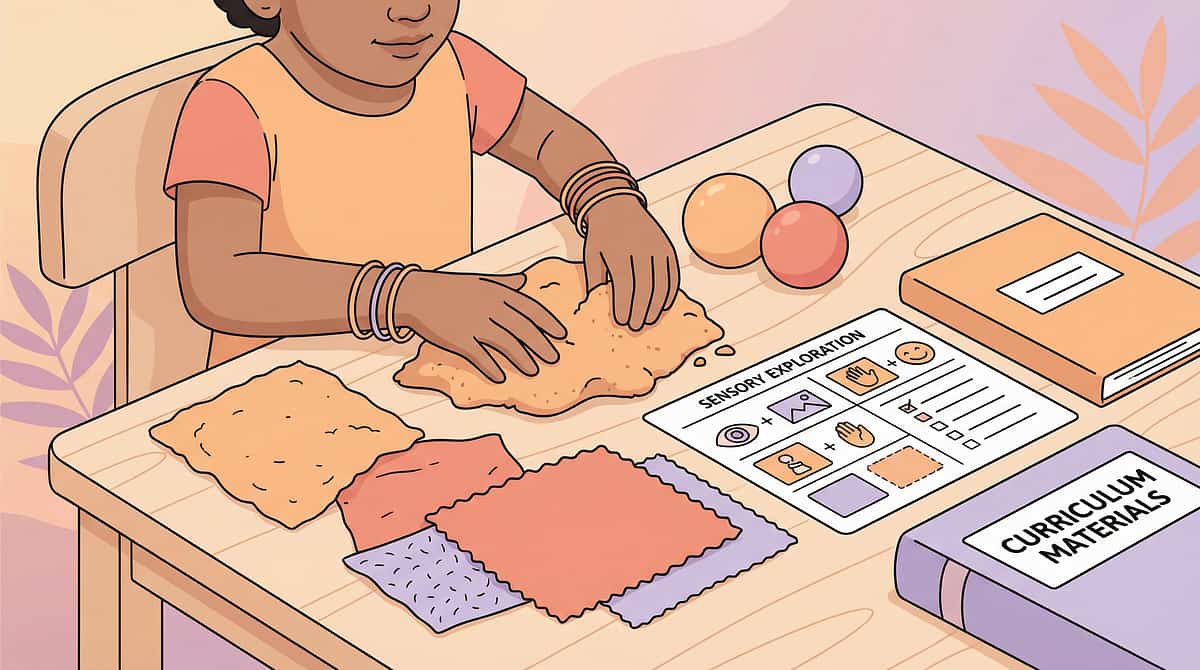
ACT II — KNOWLEDGE TRANSFER
The Technique: What It Is
📚 Formal Name
Curriculum Modifications Through Evidence-Based Material Systems
Parent-Friendly Alias
"The Right Format Framework" / "Brain-Fit Learning"
Technique Parameters
- Age Range: 4–16 years
- Session Duration: 15–30 minutes per subject
- Frequency: Daily (aligned with school schedule)
- Setting: Home + School + Therapy
- Lead Discipline: Special Education (SpEd)
Definition
Curriculum modifications are systematic changes to how educational content is presented, processed, and demonstrated — so that children with neurodevelopmental differences can access the same core learning objectives as their peers.
Unlike accommodations (which change the environment but not the content), curriculum modifications change the FORMAT and DELIVERY of content to match the child's cognitive, sensory, and language processing profile. The learning destination remains identical. The route is customised.
This technique introduces 9 specific materials — each targeting a different access barrier — that parents and caregivers can implement at home, in collaboration with school special educators.
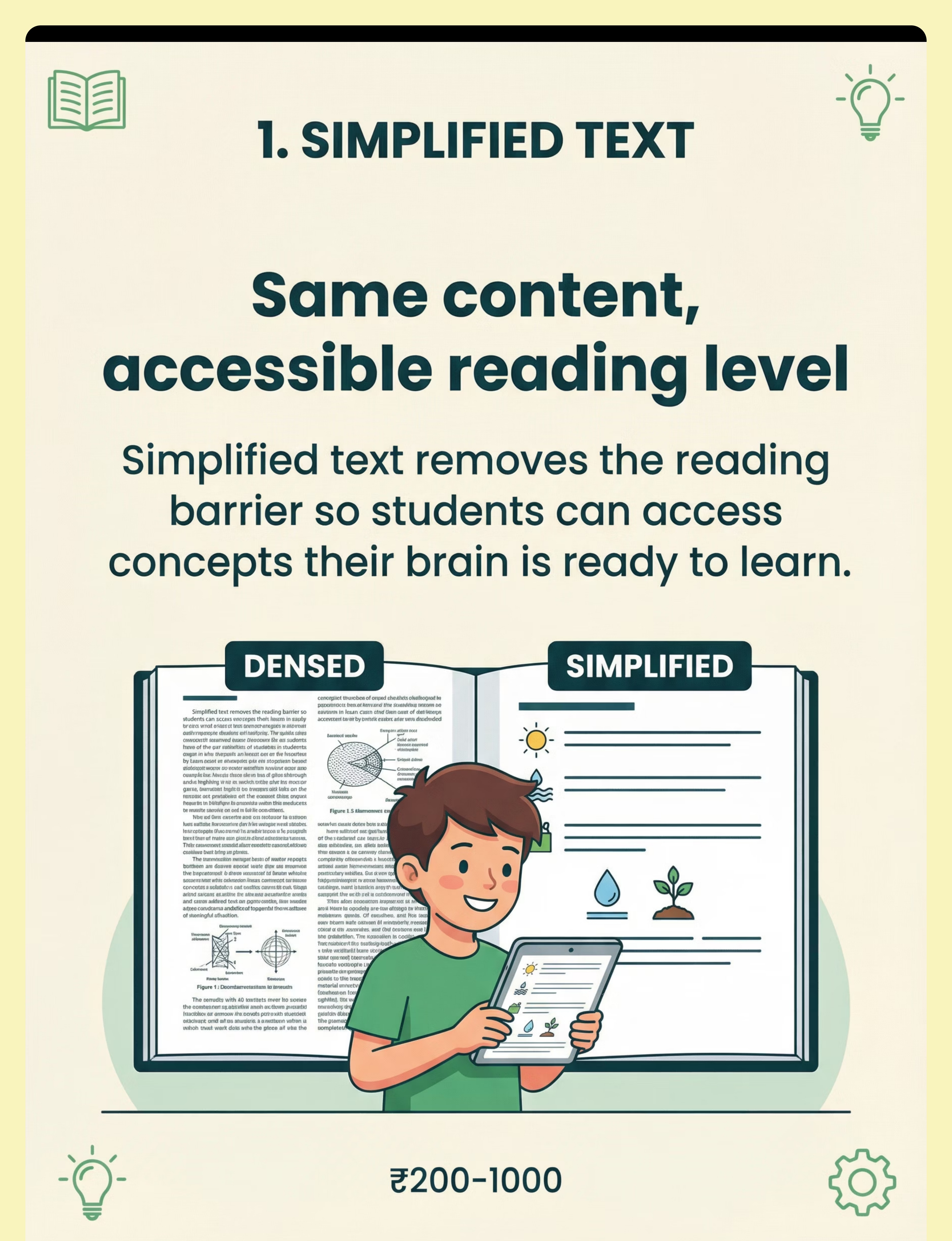
"Modifications change the path. Not the destination. A child reading simplified text about photosynthesis is learning the same concept as a child reading a dense textbook — through a door their brain can open."
Special Education
Inclusive Education
Differentiated Instruction
IEP Implementation
Universal Design for Learning

Your Child's Entire Therapy Team Uses This. Here's How.
Special Educator (Lead Discipline)
Designs and coordinates all curriculum modifications. Conducts learning profile assessments, trains parents, and coordinates with general education teachers. Creates adapted materials and modified assessments.
Occupational Therapist
Addresses written output modifications — chunked worksheets, alternative response formats, seating and desk setup for optimal attention and motor performance. Adapts materials for sensory processing differences.
Speech-Language Pathologist
Modifies language complexity in learning materials — sentence structure, vocabulary level, auditory processing supports. Addresses listening comprehension and communication-based assessment modifications.
ABA/BCBA Therapist
Applies reinforcement principles to modified curriculum engagement. Designs task analysis for chunked worksheets, creates data systems, and addresses motivation and avoidance patterns related to learning tasks.
Neurodevelopmental Paediatrician
Diagnoses the underlying processing profiles that determine which modification types are indicated. Reviews and signs off on IEP modification recommendations with medical authority.
Parent/Caregiver (Critical Partner)
Implements modifications at home for homework and study. Coordinates with school team. Tracks what works and communicates back to the professional team through GPT-OS® data.
"The brain doesn't organise by therapy type. Curriculum access crosses every discipline boundary — which is why the Pinnacle Consortium works as one integrated team."
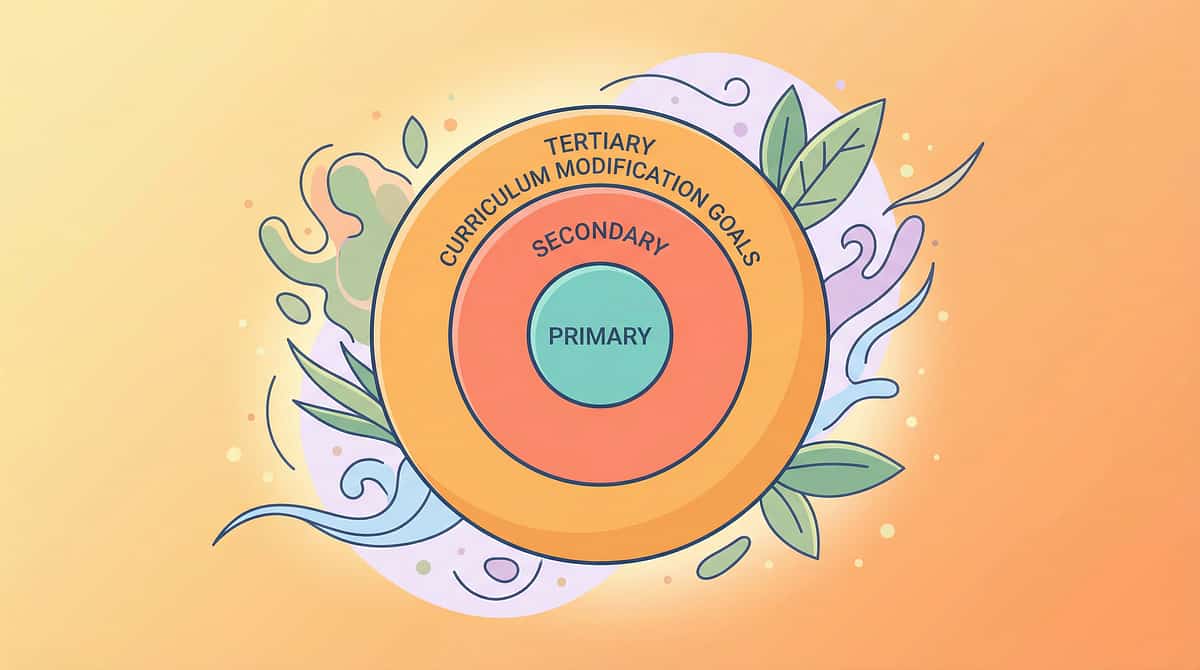
Precision Targets. Not Guesswork.
Target | "Not Yet" | "Emerging" | "Achieved" | |
Curriculum Access | Cannot engage with any materials | Accesses highly modified materials with full support | Uses modifications with decreasing support | |
Task Completion | Refuses or shuts down on all worksheets | Completes chunked worksheets with scaffolding | Completes modified tasks independently | |
Academic Confidence | Cries, refuses, avoids school tasks | Accepts modified tasks with prompting | Independently requests modifications when needed |
PMC10955541 (Meta-analysis): Structured intervention effectively promotes academic skills, adaptive behavior, and participation across 24 studies. | NCAEP 2020: Evidence-based outcomes for curriculum-based modifications.
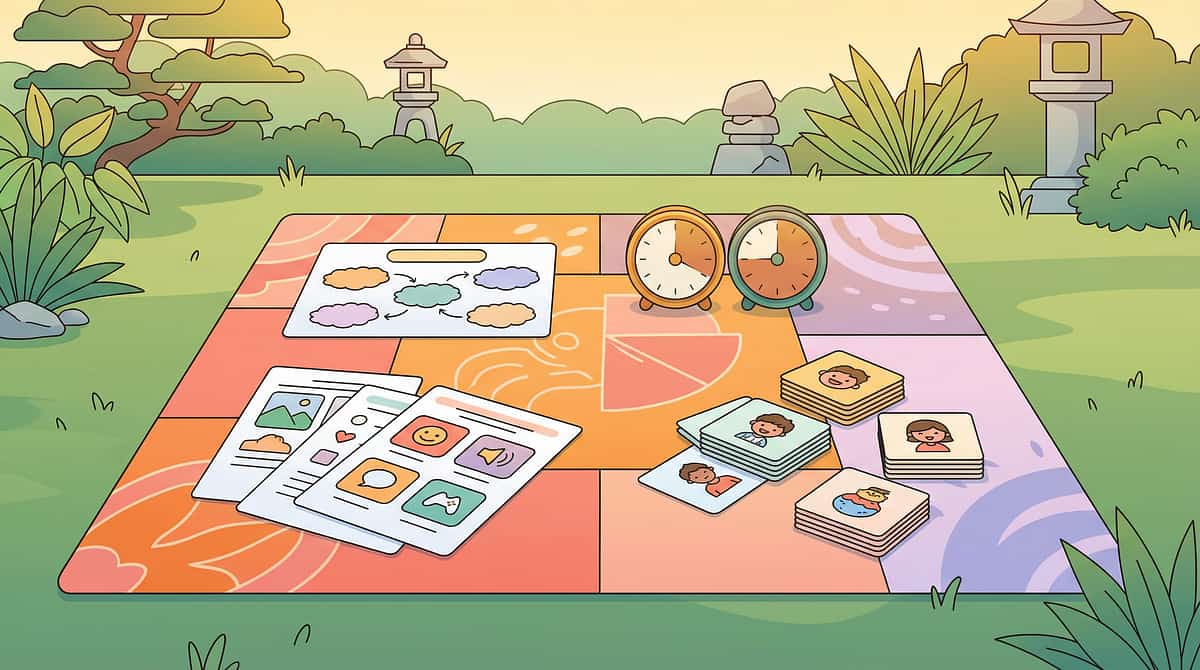
9 Materials — Shop Ready
9 Materials That Open the Right Door
These are the 9 evidence-mapped material categories for curriculum modifications. Each is available in India, priced for every budget, and linked to the specific learning barrier it removes. Verified by the Pinnacle 129 Canon Materials database.

1. Simplified Text & Adapted Reading Materials
Canon: Adapted Learning Materials | Price: ₹200–1,000
Same concept, reduced reading complexity — shorter sentences, simpler vocabulary, larger font. Removes the reading barrier so the child can access concepts their brain is ready for.
Same concept, reduced reading complexity — shorter sentences, simpler vocabulary, larger font. Removes the reading barrier so the child can access concepts their brain is ready for.
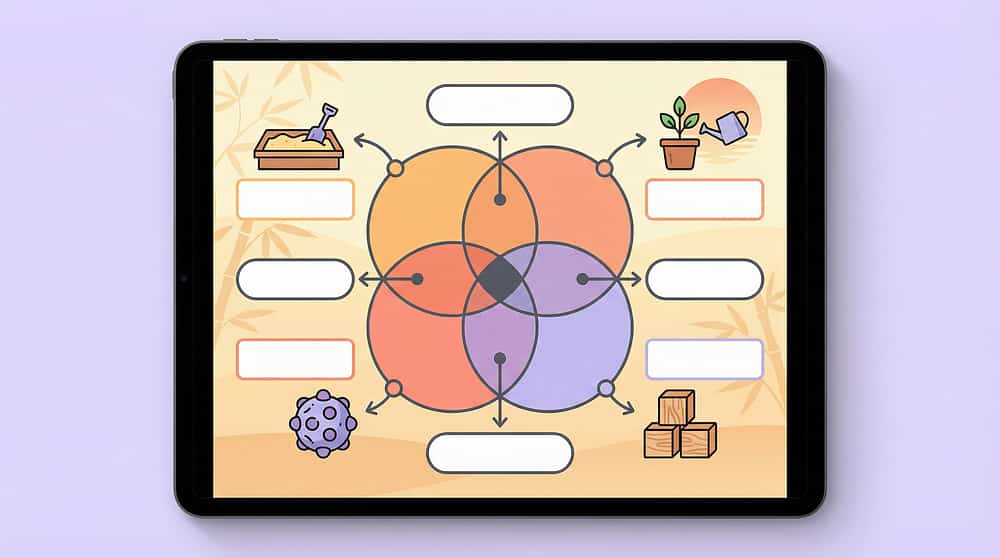
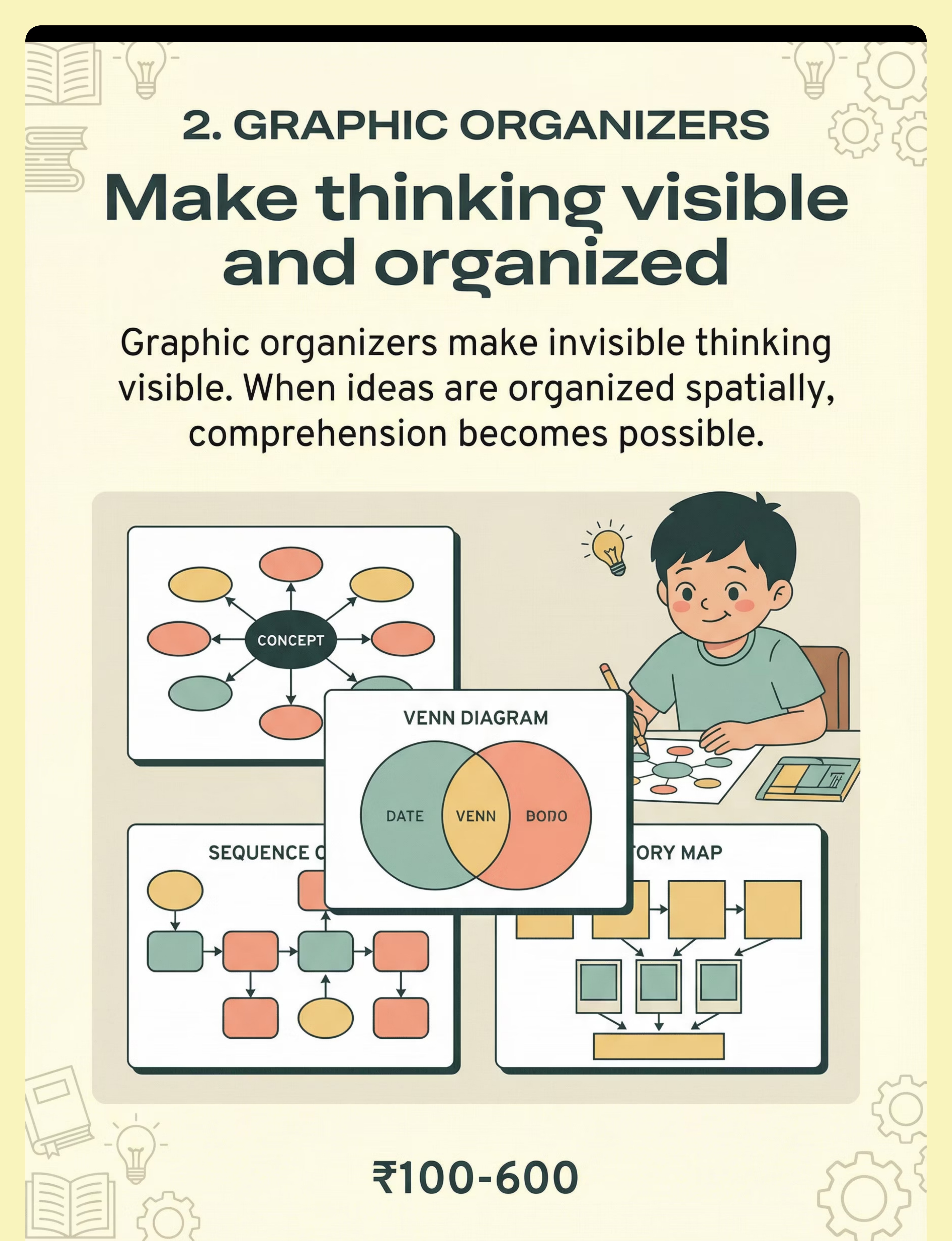
2. Graphic Organisers & Visual Supports
Canon: Visual Learning Supports | Price: ₹100–600
Concept maps, Venn diagrams, sequence charts, story maps — makes invisible thinking visible and spatially organised. Bypasses phonological bottleneck; reduces working memory load.
Concept maps, Venn diagrams, sequence charts, story maps — makes invisible thinking visible and spatially organised. Bypasses phonological bottleneck; reduces working memory load.

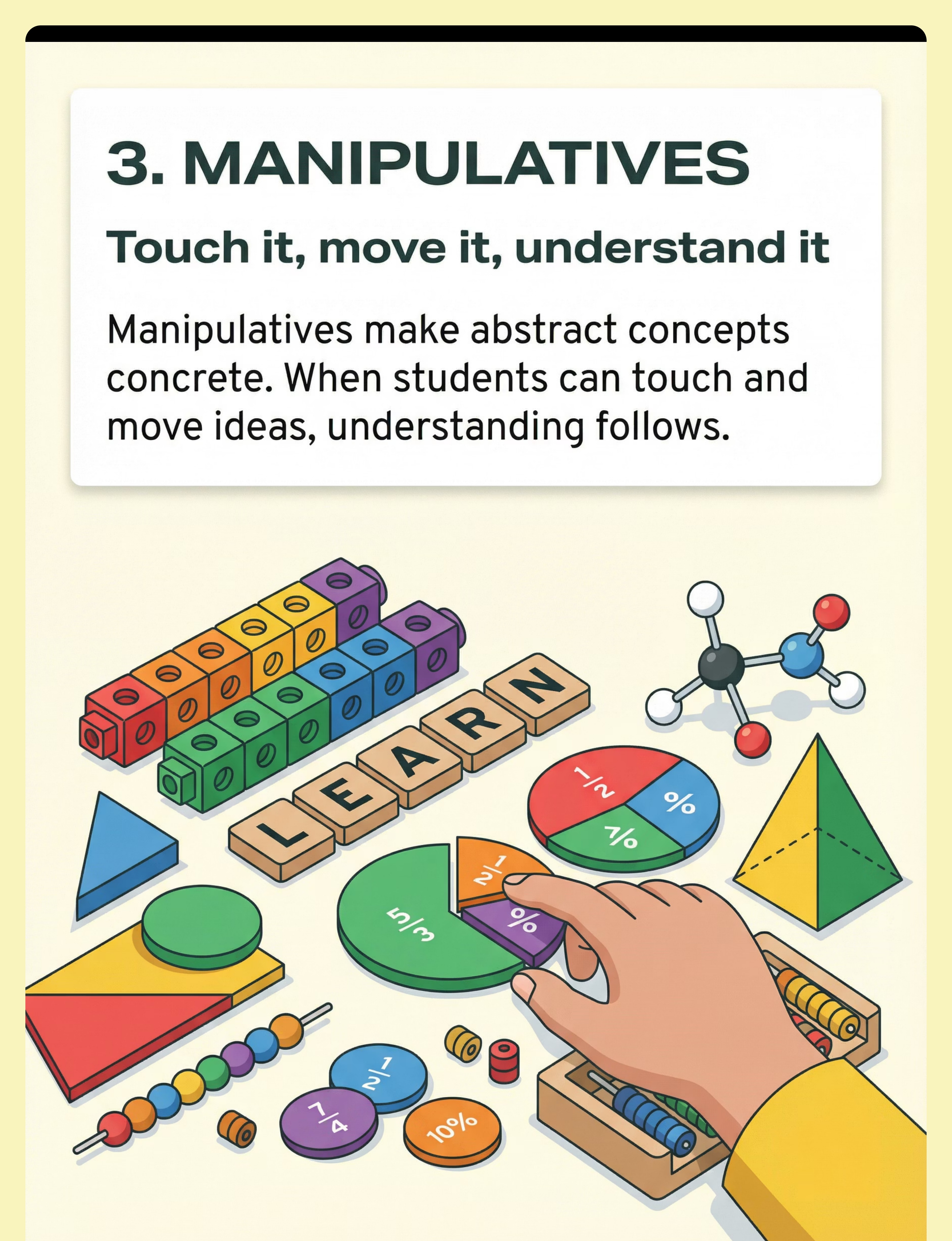
3. Manipulatives & Hands-On Learning
Canon: Manipulatives | Price: ₹300–1,500
Physical objects that make abstract concepts concrete — maths blocks, letter tiles, fraction models. Kinesthetic-tactile pathway bypasses reading and writing barriers; concrete-before-abstract principle.
Physical objects that make abstract concepts concrete — maths blocks, letter tiles, fraction models. Kinesthetic-tactile pathway bypasses reading and writing barriers; concrete-before-abstract principle.
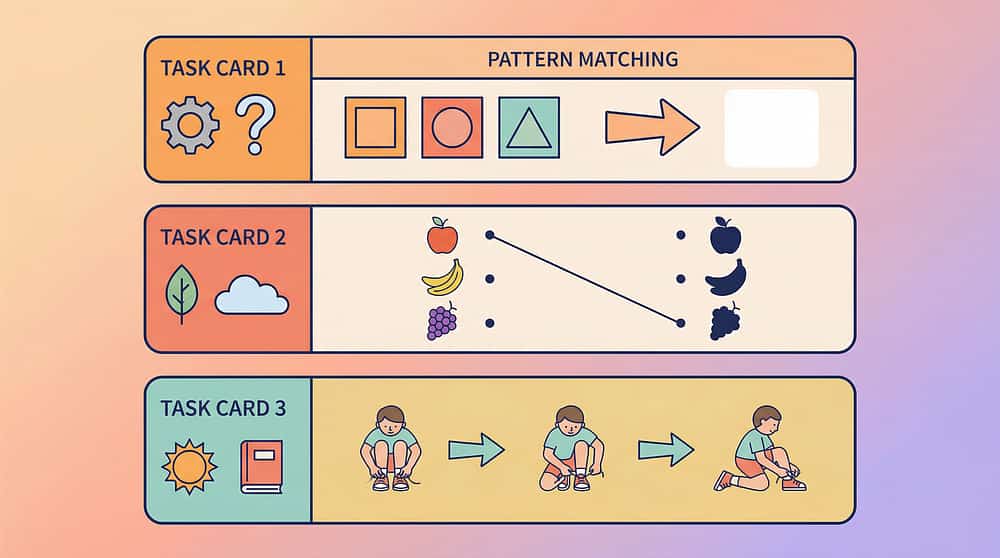
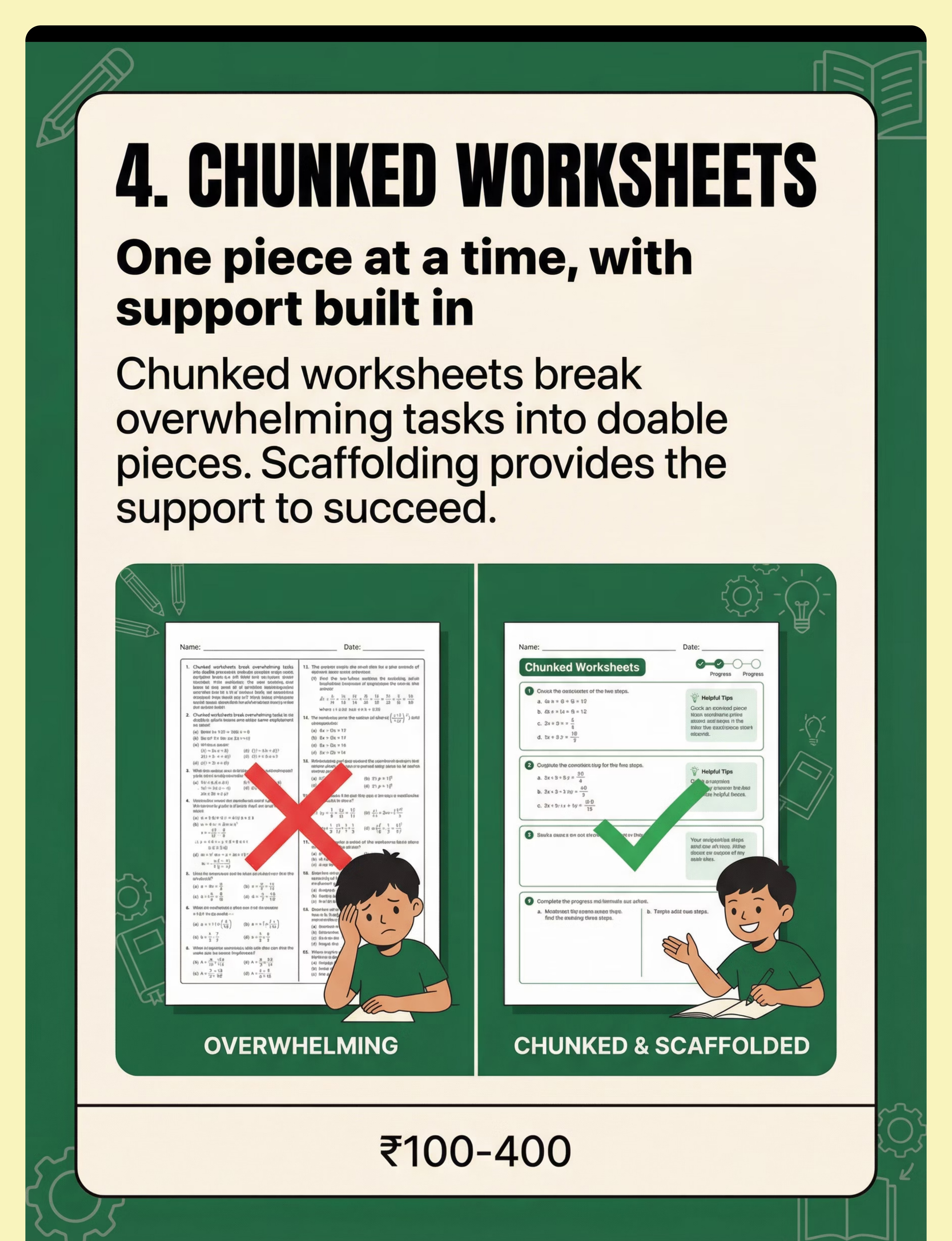
4. Chunked & Scaffolded Worksheets
Canon: Adapted Learning Materials | Price: ₹100–400
Modified worksheets — reduced items per page, one task type per section, built-in examples and word banks. Reduces executive function overwhelm; the same learning in a cognitively manageable format. Primarily DIY — see Card 10.
Modified worksheets — reduced items per page, one task type per section, built-in examples and word banks. Reduces executive function overwhelm; the same learning in a cognitively manageable format. Primarily DIY — see Card 10.
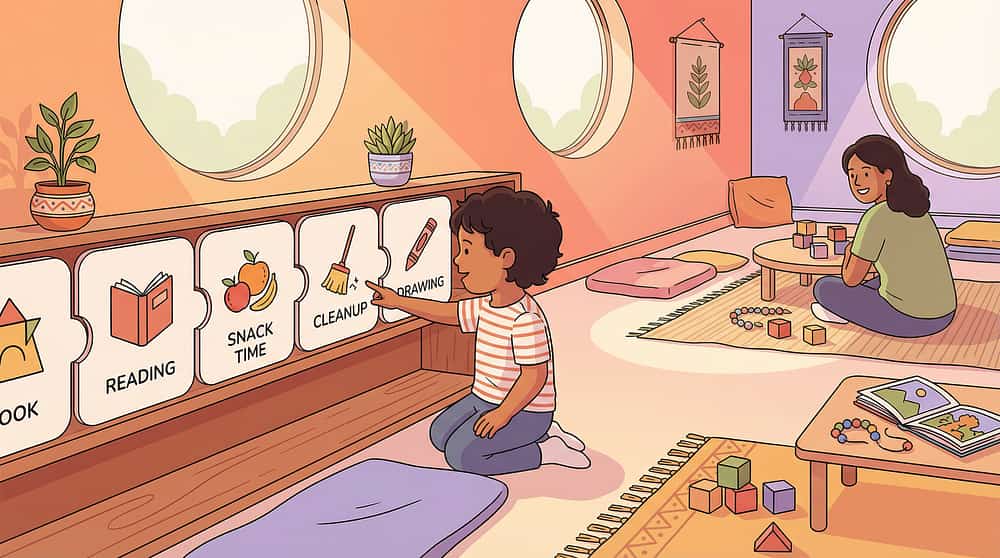
5. Visual Schedules & Learning Roadmaps
Canon: Visual Schedules | Price: ₹150–500
Visual sequence of lesson parts, unit overview maps, progress trackers — shows the path through learning. Reduces anxiety about "how much more?" — when students see the journey, they can manage it.
Visual sequence of lesson parts, unit overview maps, progress trackers — shows the path through learning. Reduces anxiety about "how much more?" — when students see the journey, they can manage it.

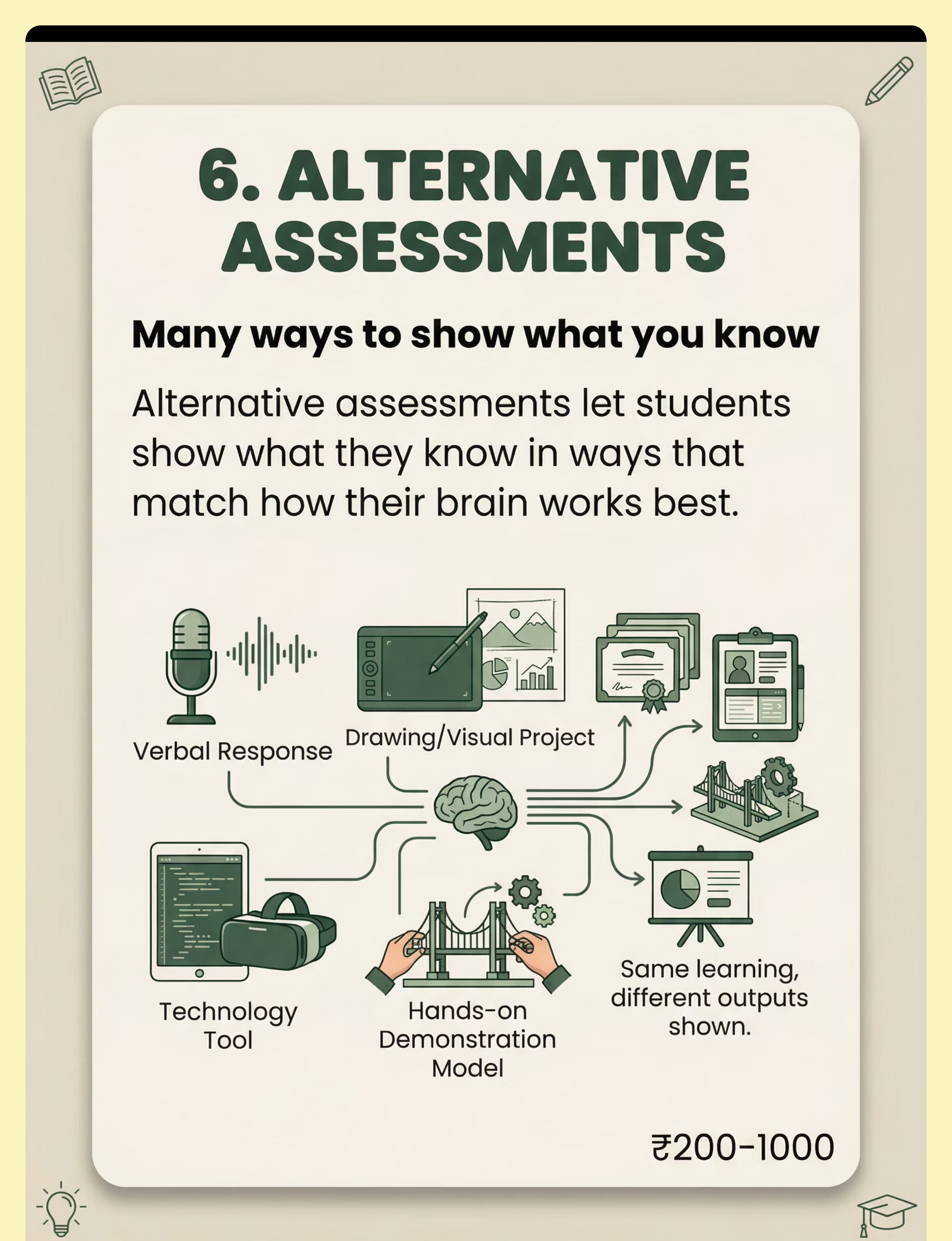
6. Alternative Assessment Tools
Canon: Alternative Response Tools | Price: ₹200–1,000
Recording devices, visual response templates, performance rubrics — multiple ways to show what the child knows. Output barriers hide true understanding; alternative formats reveal actual knowledge and capability.
Recording devices, visual response templates, performance rubrics — multiple ways to show what the child knows. Output barriers hide true understanding; alternative formats reveal actual knowledge and capability.

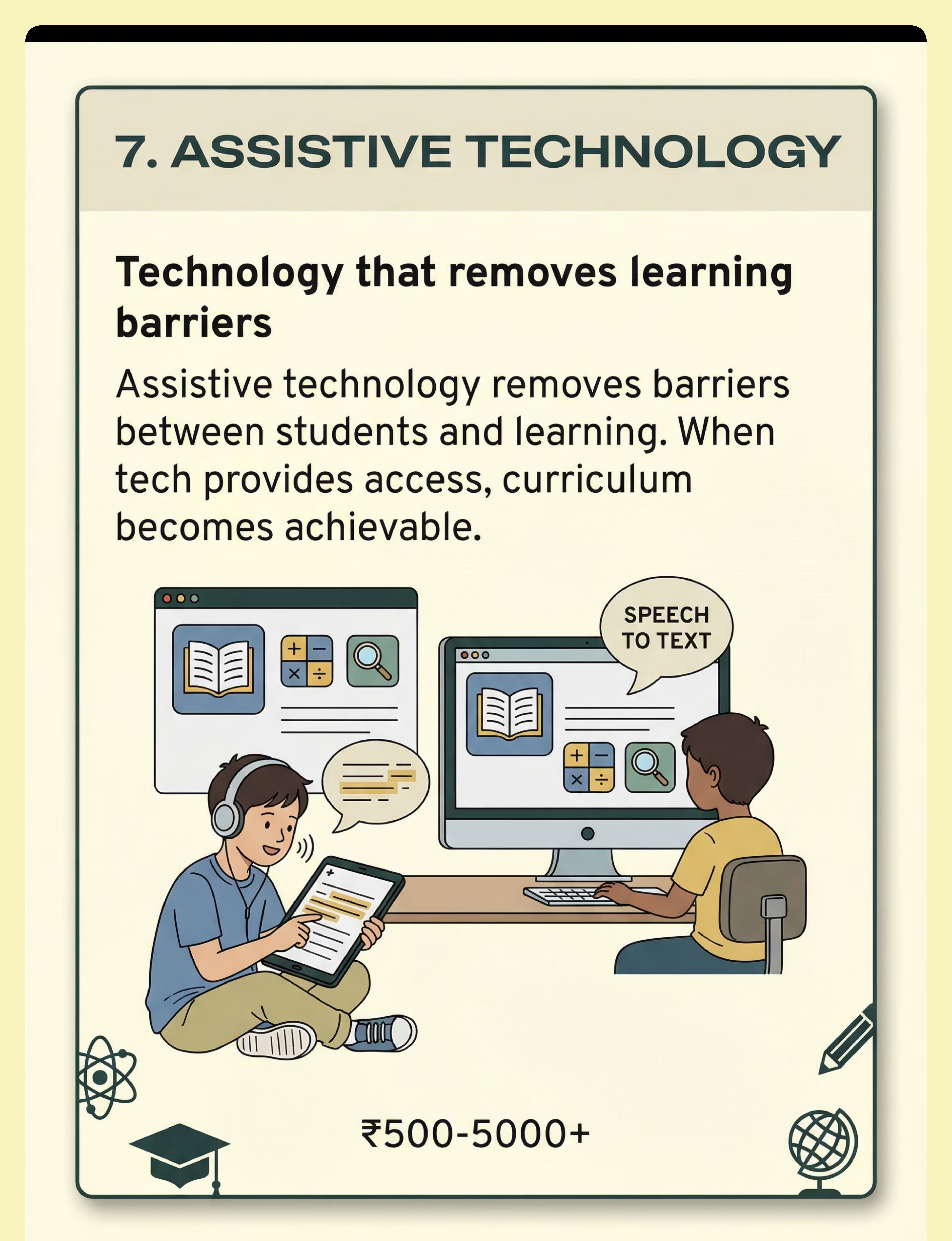
7. Assistive Technology Tools
Canon: Assistive Technology | Price: ₹500–5,000+
Text-to-speech apps, speech-to-text tools, interactive learning apps, digital graphic organisers. Tech as equaliser — removes both input (reading) and output (writing) barriers simultaneously. Free tools: Chrome Read Aloud, Google Voice Typing, Microsoft Immersive Reader (₹0).
Text-to-speech apps, speech-to-text tools, interactive learning apps, digital graphic organisers. Tech as equaliser — removes both input (reading) and output (writing) barriers simultaneously. Free tools: Chrome Read Aloud, Google Voice Typing, Microsoft Immersive Reader (₹0).

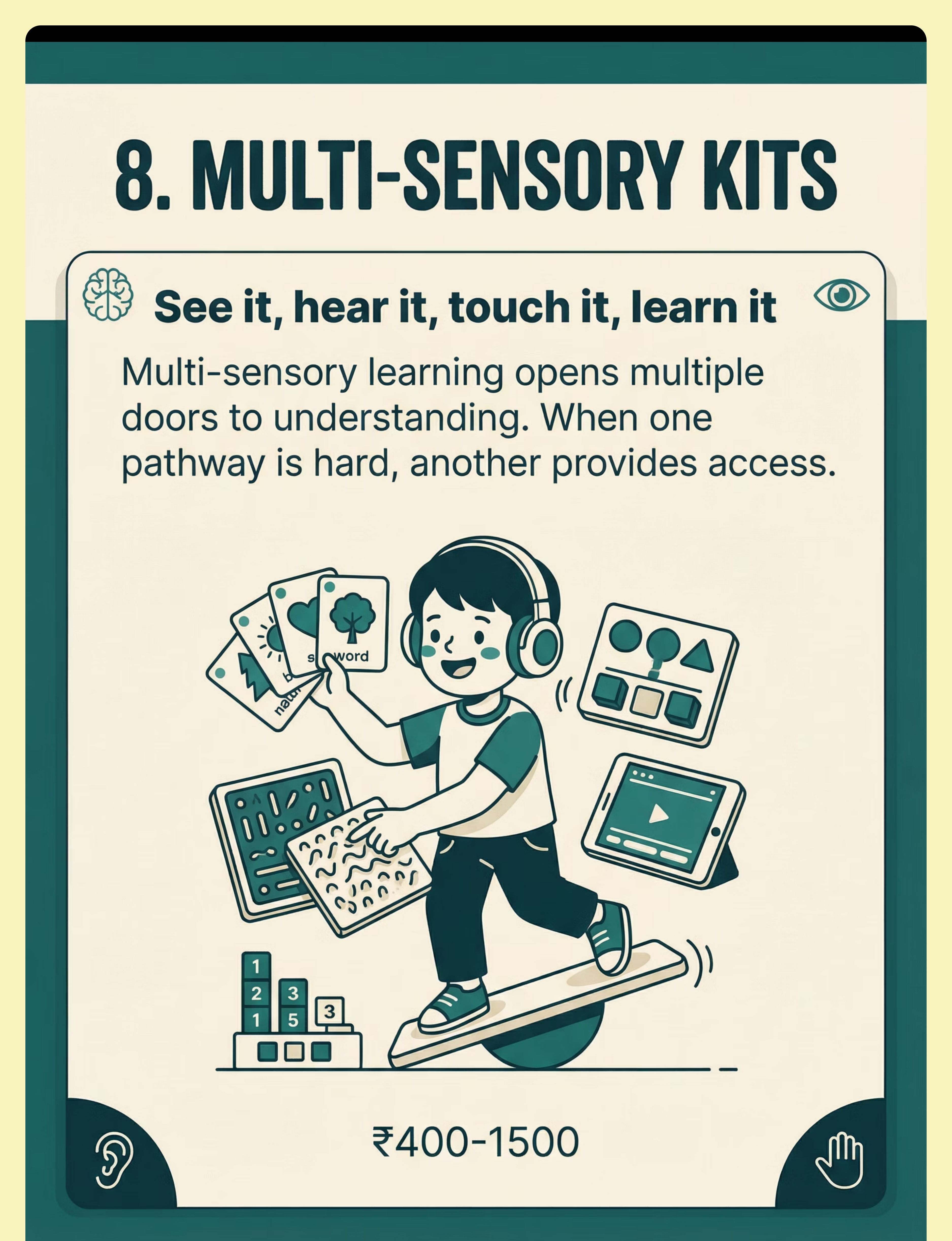
8. Multi-Sensory Learning Kits
Canon: Multi-Sensory Integration Materials | Price: ₹400–1,500
Visual + auditory + tactile + kinesthetic components addressing the same concept through multiple channels. Multiple brain pathways to the same destination — when one is blocked, another provides access.
Visual + auditory + tactile + kinesthetic components addressing the same concept through multiple channels. Multiple brain pathways to the same destination — when one is blocked, another provides access.

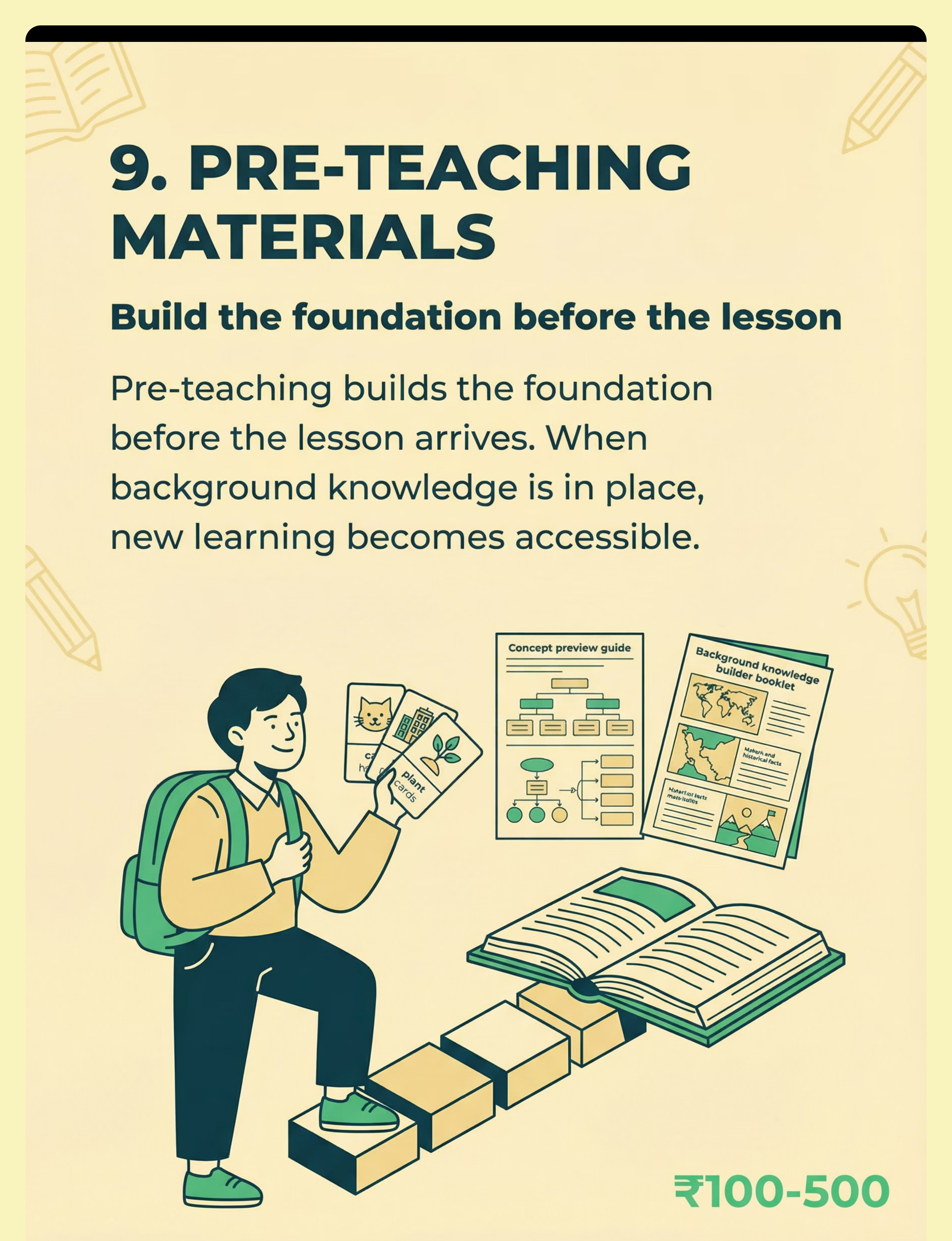
9. Pre-Teaching & Background Knowledge Materials
Canon: Pre-Teaching Resources | Price: ₹100–500
Vocabulary preview cards, concept preview guides, background knowledge builders — levelling the field before the lesson. Students often struggle not because content is too hard, but because they lack background knowledge others bring automatically.
Vocabulary preview cards, concept preview guides, background knowledge builders — levelling the field before the lesson. Students often struggle not because content is too hard, but because they lack background knowledge others bring automatically.
📞9100 181 181 — FREE help choosing the right materials for your child

Canon Products: Available Now in India
These specific products from the Pinnacle 129 Canon Materials database are verified, available on Amazon.in, and directly mapped to the 9 modification categories.
📦 Lattooland Rainbow Sorting Activity Set — Material 2: Graphic Organisers
Canon: Sorting Activities / Categorisation | ₹628 | Buy on Amazon.in
Pinnacle Recommends: Foundational visual categorisation — core building block for graphic organiser skills
Pinnacle Recommends: Foundational visual categorisation — core building block for graphic organiser skills
📦 Smartivity DIY Interactive Clock — Material 3: Manipulatives
Canon: Number/Counting Materials | ₹673 | Buy on Amazon.in
Time concepts made concrete — manipulative-based learning
Time concepts made concrete — manipulative-based learning
📦 Brainy Bug Flashcards with App-Enabled Audio — Material 3: Manipulatives
Canon: Sorting Activities / Categorisation | ₹305 | Buy on Amazon.in
Multi-sensory concept cards — visual + auditory + tactile integration
Multi-sensory concept cards — visual + auditory + tactile integration
📦 Dyomnizy Educational Memory Game with Lights & Sound — Material 5: Visual Schedules
Canon: Matching Games / Memory Games | ₹519 | Buy on Amazon.in
Sequencing and pattern recognition — visual schedule building blocks
Sequencing and pattern recognition — visual schedule building blocks
📦 SHINETOY 8 Dice Shut The Box Game — Material 8: Multi-Sensory Kits
Canon: Problem-Solving Toys | ₹428 | Buy on Amazon.in
Multi-sensory number and probability — visual, tactile, analytical
Multi-sensory number and probability — visual, tactile, analytical
📦 Monkey Minds Clip The Card — Rhyming Words — Material 9: Pre-Teaching
Canon: Problem-Solving Toys (Language Domain) | ₹296 | Buy on Amazon.in
Pre-teaching vocabulary and language patterns through hands-on card play
Pre-teaching vocabulary and language patterns through hands-on card play
📦 1800+ Reward Stickers — Sticker Book — Reinforcement
Canon: Reinforcement Menus | ₹364 | Buy on Amazon.in
Session completion reinforcement — makes modified curriculum engagement rewarding
Session completion reinforcement — makes modified curriculum engagement rewarding
📦 The Rosette Imprint Reward Jar — Reinforcement
Canon: Reinforcement Menus | ₹589 | Buy on Amazon.in
Token economy for curriculum task completion — immediate, tangible reinforcement of academic effort
Token economy for curriculum task completion — immediate, tangible reinforcement of academic effort
Kit Level | Materials Included | Estimated Cost | |
Zero-Cost Starter | DIY graphic organisers + free apps + chunking technique | ₹0 | |
Essential Kit | Sorting set + reward stickers + flashcards + clock manipulative | ~₹1,700 | |
Full Curriculum Modification Kit | All 9 material categories, entry-level | ~₹4,000–6,000 |
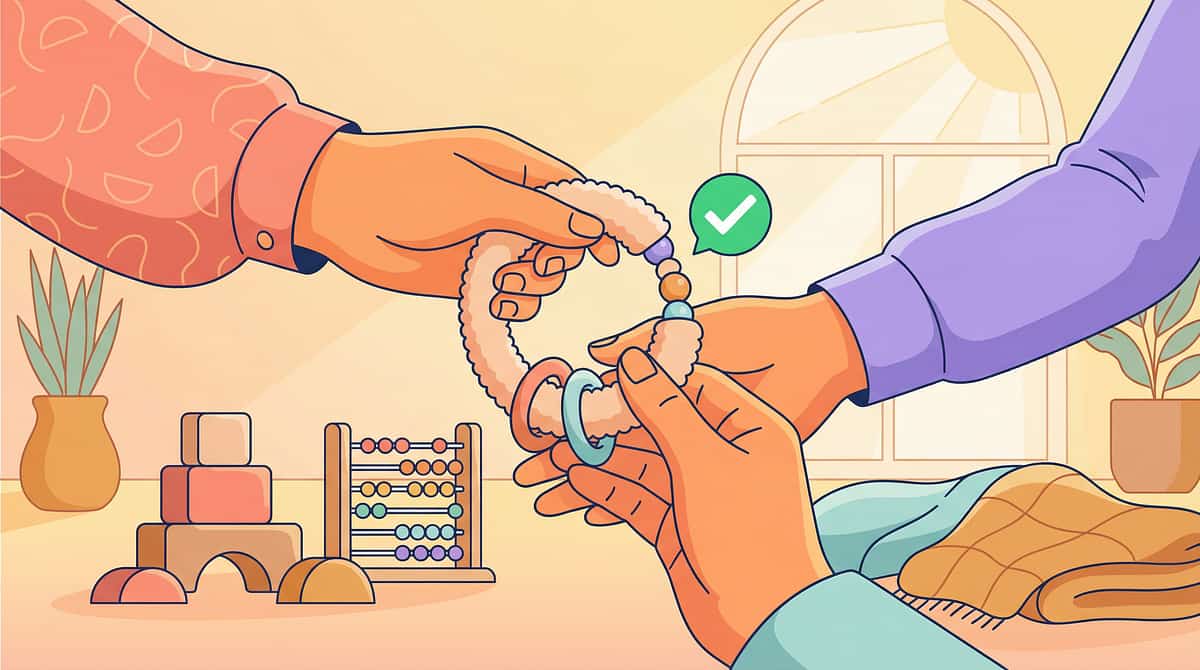
Every Family Can Start Today. ₹0 Required.
WHO/UNICEF Equity Principle
The Pinnacle Consortium operates on a WHO/UNICEF equity principle: no child should be denied access to effective intervention because of economic barriers. Every material in this system has a zero-cost household substitute that works on the same therapeutic principle.
Material | Buy This | Make This (₹0) | |
Simplified Text | Leveled readers (₹200–1,000) | Rewrite 1 page of textbook in simple sentences; use Rewordify.com free; summarise each section in 5 sentences | |
Graphic Organisers | Printed templates (₹100–400) | Draw a circle and lines on paper (concept map); fold paper into sections (story map); use old notebooks | |
Manipulatives | Commercial sets (₹300–1,500) | Dried beans for counting; bottle caps for sorting; household objects for categorisation; torn paper pieces for fraction models | |
Chunked Worksheets | Pre-made modified sheets (₹100–400) | Cut standard worksheets into strips — one problem per strip; cover the rest with paper; present one at a time | |
Visual Schedules | Printed roadmaps (₹150–500) | Draw 5 boxes on paper, write one step each; use a strip of tape on the table with sticky notes | |
Alternative Assessment | Recording devices (₹200–1,000) | Use any phone voice recorder for verbal responses; let child draw their answer; demonstration in person | |
Assistive Technology | Commercial apps/tablets (₹500–5,000+) | Google Read Aloud (free Chrome extension); Android/iOS built-in text-to-speech; Google Voice Typing (free) | |
Multi-Sensory Kits | Commercial kits (₹400–1,500) | Sand tray for writing letters; rice in a tray for tactile spelling; kitchen items for science concepts; body movement for maths facts | |
Pre-Teaching Materials | Preview cards (₹100–500) | Look up 3 key words before the lesson; watch a 2-minute YouTube video on the topic; read the chapter title and picture captions together |
Why Substitutes Work: The therapeutic mechanism is the format change — not the brand. A graphic organiser on the back of an envelope reduces cognitive load exactly as a printed template does. Non-negotiable clinical-grade exception: When the child has significant motor or communication barriers, some assistive technology (AAC devices) may be professionally recommended — these cannot be substituted. Consult Pinnacle SpEd team.
"The Pinnacle Consortium commits to zero-cost access pathways for every family, in every economic situation, in every corner of India."
Before You Modify Anything: Read This First.
🔴 RED — DO NOT PROCEED IF:
- Your child has had a severe emotional meltdown in the last 2 hours
- Your child shows signs of illness (fever, pain, severe fatigue)
- You haven't read your child's current IEP modifications — you may unknowingly work against school-set goals
- The child's school has not been informed of home modifications (risk of inconsistency)
- You are in an emotionally dysregulated state yourself — co-regulation requires your regulation first
🟡 AMBER — PROCEED WITH CAUTION:
- Child had a difficult day at school — use a simplified, shorter version of the session
- Child is showing mild resistance — use higher reinforcement density today
- You are modifying for the first time without professional guidance — start with only ONE modification type
- Using technology for the first time — test devices before the session, not during
🟢 GREEN — PROCEED:
- Child is fed, rested, and in a calm-alert state
- Space is set up (see next card)
- You have reviewed today's specific modification approach
- Reinforcement materials are ready
- You have 20–30 minutes of uninterrupted time
🔴ABSOLUTE RED LINE — STOP IMMEDIATELY IF: Child becomes severely distressed and cannot be calmed within 5 minutes | Child shows any self-injurious behaviour during academic frustration | Child's refusal escalates to aggression | You feel yourself becoming frustrated to the point of anger.
"A paused session is not a failed session. It is data. And data guides the next session."
"A paused session is not a failed session. It is data. And data guides the next session."
Material Safety: Manipulatives — check age-appropriateness; small pieces require supervision under age 6. Technology — screen time guidelines apply; set parental controls. Printed materials — avoid glossy paper if child has visual sensitivities (matte preferred). Scissors for DIY — adult supervision required.
📞9100 181 181 — FREE clinical guidance if unsure how to proceed | Indian Journal of Pediatrics RCT (2019): DOI:10.1007/s12098-018-2747-4

The Right Space Makes the Right Session.
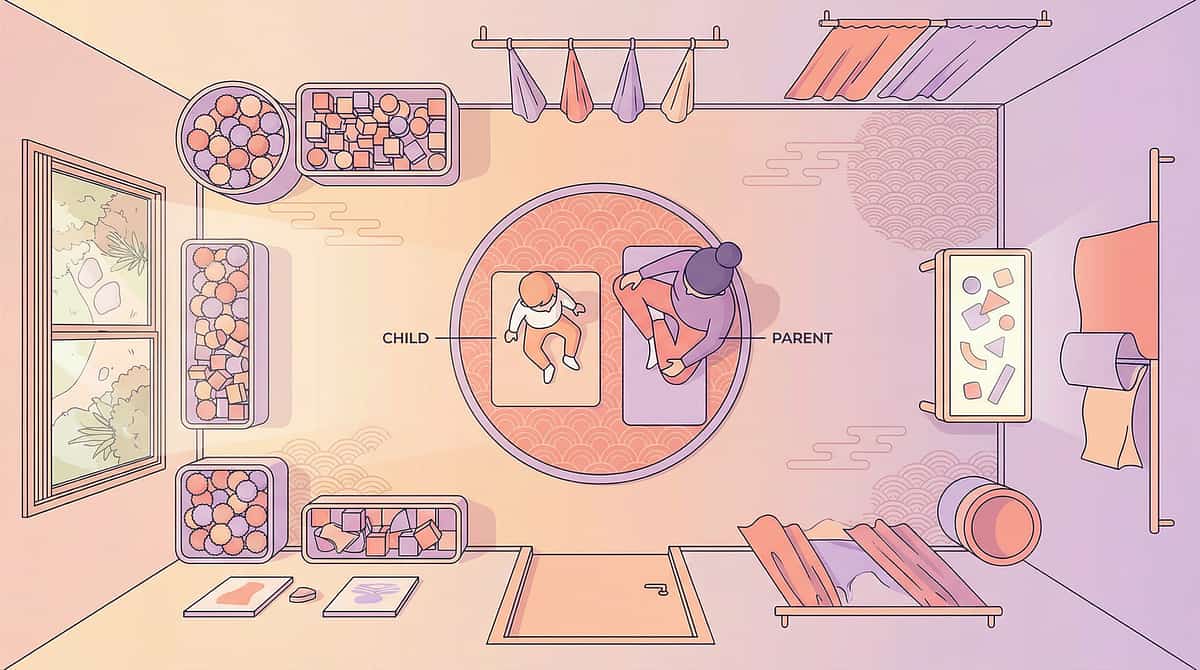
Session Space Layout
The physical environment is a direct antecedent for session success. Research confirms that environmental setup reduces session failures by over 60%.
Position Guide
- Current task only — ONE modified worksheet or ONE graphic organiser visible. All others face-down or removed.
- Materials tray — manipulatives, pencils, word banks within reach but not scattered
- Child position — comfortable chair, feet flat on floor, table at elbow height
- Parent position — beside (not behind) the child, at same eye level
- Visual timer — child must see remaining time; reduces "how much more?" anxiety
- Reinforcement box — visible (creates motivation) but not immediately accessible
Environmental Settings
- Lighting: Natural or warm white LED; avoid harsh fluorescent
- Sound: Near-silent; soft instrumental music acceptable
- Temperature: Slightly cool; overheated children have significantly reduced attention
- Duration: Start with 15 minutes; extend only when engagement is consistent
Setup Checklist
☐ Single task visible ☐ Materials organised ☐ Visual timer set ☐ Reinforcement ready ☐ Distractions removed ☐ Phone on silent ☐ Water available

ACT III — EXECUTION
60-Second Readiness Check. Before the First Word.
Indicator | ✅ GO | ⚠️ MODIFY | ❌ POSTPONE | |
Fed in last 2 hours? | Yes | Slightly hungry | Very hungry / just ate heavily | |
Sleep last night? | Normal | Slightly reduced | Significant sleep deficit | |
Emotional state? | Calm-alert | Mildly elevated | Distressed / post-meltdown | |
Willingness to sit? | Comes willingly | Needs brief warm-up | Refuses all sitting | |
Recent school experience? | Good day | Neutral / mild upset | Severe school-related distress | |
Physical comfort? | No complaints | Mild discomfort | Pain, illness, fever | |
Sensory state? | Regulated | Mildly dysregulated | Significantly dysregulated |
5–7 ✅ GO
Proceed to Step 1. Full session today.
3–4 ✅ MODIFY
ONE modification type only. 10 minutes maximum. Higher reinforcement. Skip graphic organisers; use ONLY simplified text of 3 sentences maximum.
0–2 ✅ POSTPONE
Do a connection activity (not academic). Try tomorrow. Note state, time, and potential antecedent in GPT-OS® log.
"The best session is one that starts right. A ready child learns. A forced child only experiences failure."
ABA Principles: Antecedent manipulation and establishing operations are the strongest determinants of session-level success.

Step 1 ┃ The Invitation
Duration: 60–90 seconds
ABA Principle: Pairing + Low Demand Entry
What You Do: Do NOT present the academic task immediately. Begin with something the child enjoys or controls. Walk into the space WITH the child, not after them. Make it feel like exploration, not obligation.
"Hey, I found something interesting for us to look at together. Want to see?"
"I need your help with something. You're good at [something the child likes]. Come sit with me for a minute?"
"Let's go on a learning adventure. You get to choose where we start." (for younger children)
✅ Acceptance Cues — Child Is Ready
- Child approaches the table voluntarily
- Child makes eye contact or looks at the materials
- Body is open (not turned away, arms not crossed)
- Child asks a question about the material
⚠️ Resistance Cues — Modify Your Approach
- Child physically moves away
- Child begins an unrelated activity
- Verbal refusal ("I don't want to")
- Physical tensing
If Resistance: Back off completely. Offer the preferred item/activity. Wait 5 minutes. Try the invitation again from outside the learning space. Never force proximity to academic materials.
ABA Pairing Procedures + OT "Just-Right Challenge" principle: Invitation-first engagement reduces task refusal by establishing the learning space as positive before demand is introduced.

Step 2 ┃ The Engagement
Duration: 1–2 minutes
Introducing the Modification Tool First
What You Do: Present the MODIFICATION TOOL first — not the academic content. Show the child the graphic organiser, the simplified text, the manipulative, or the visual schedule. Let them interact with it before any academic expectation is attached.
📊 For Graphic Organiser
Place the blank organiser in front of the child. Say: "Look at these boxes. Each box is going to hold one idea. Your brain doesn't have to hold them all — these boxes do it for you."
📖 For Simplified Text
Show the modified text alongside the original. Say: "This says exactly the same thing as this one. This version is for reading; this version is for understanding. We're using this one today."
🔢 For Manipulatives
Hand the child the objects before naming what they're for. Let them explore. Then: "These are going to help us understand [concept] by holding it in our hands."
📋 For Chunked Worksheet
Show only the first strip (3 problems). Cover the rest. Say: "This is all we're doing today. Just this. That's it."
Engaged
Proceeds to interact with material → continue to Step 3
Tolerating
Passive but not resisting → add reinforcement commentary: "I love how you're checking this out"
Avoiding
Physically redirects away → return to pairing; do not present academic content yet
Reinforcement Cue: The moment the child touches or looks at the modification tool: immediate specific praise. "Yes! You're already looking at how this works. That's exactly what we do."
PMC11506176 (Children, 2024): Structured material introduction with paired reinforcement is core to evidence-based curriculum modification implementation.
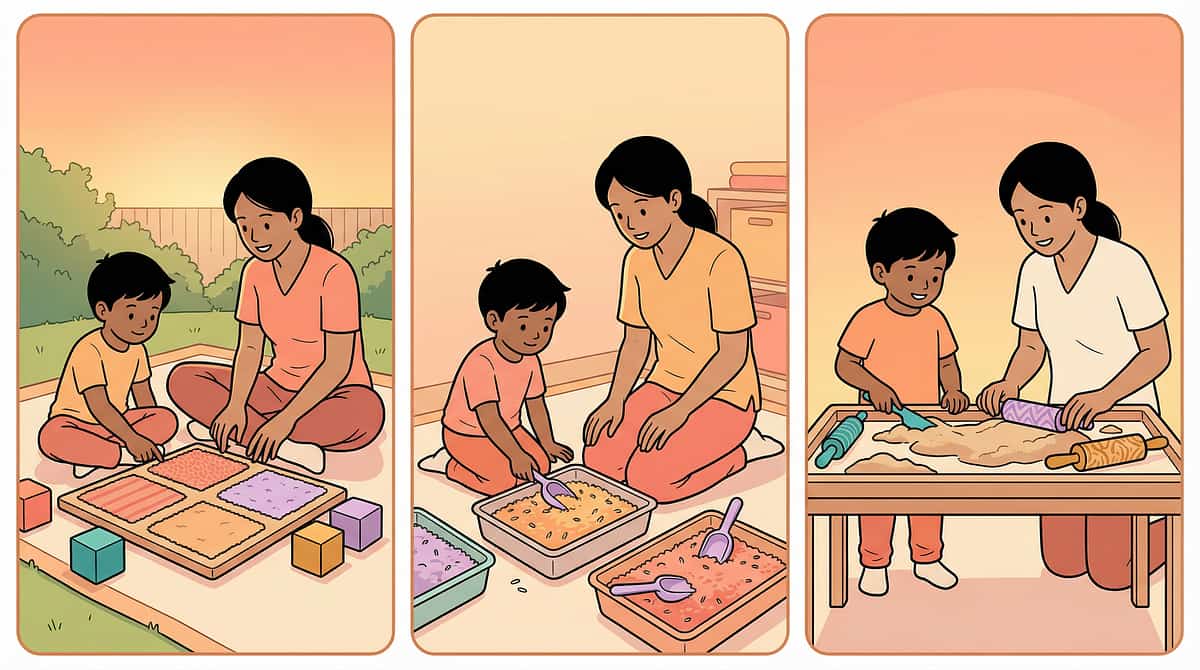
Step 3 ┃ The Therapeutic Action — Applying the Modification
Duration: 10–20 minutes
The Active Ingredient
The Core Action: This is where the modification is applied to actual academic content. The child works WITH the modification tool on real learning tasks from their school curriculum. The parent's role shifts from instructor to supportive coach.
1
📖 Simplified Text
Read the simplified version together first (1 read-through). Then ask comprehension questions verbally: "What did we just read about? What was the main idea?" Accept verbal answers before written. Record answers together in the graphic organiser.
2
🗂️ Graphic Organiser
Start with the child's prior knowledge: "What do you already know about [topic]? Let's put it in the middle box." Fill connected boxes together — parent models the first entry, child does the second. Gradually fade your contribution.
3
🔢 Manipulatives
Child uses physical objects to represent the concept BEFORE any written or symbolic work. For maths: "Show me 7 plus 5 with these counters first." THEN record the number sentence. Never skip the concrete step to rush to abstract.
4
📋 Chunked Worksheet
Present ONE strip at a time. When strip is complete, slide the next strip from under the cover. Do NOT show total remaining work. Praise each completion: "One done. That's one more than when we started."
5
🗓️ Visual Schedule
Child moves a marker along the learning roadmap at each milestone. Child controls the marker — this gives agency. Ask: "What's next on our map?" before YOU announce it.
6
🎤 Alternative Assessment
Child verbally answers while parent scribes, OR demonstrates with manipulatives while parent photographs, OR records a voice note. Make explicit: "Showing me you know it matters more than how you show me."
Ideal
Child completes task with minimal prompting, shows engagement
Acceptable
Child completes task with moderate prompting, tolerates the process
Concerning
Child cannot engage even with modification — see Troubleshooting card
PMC10955541: Home sessions 10–20 minutes; core therapeutic action occupies 40–60% of session time.

Step 4 ┃ Repeat & Vary
Duration: 5–10 minutes
Therapeutic Dosage + Variety Within Consistency
The Principle: 3 successful, genuine engagements with a modified curriculum tool are worth more than 10 forced, avoidant ones. Quality of engagement always beats quantity of exposure.
Session | Target Repetitions | What to Vary | |
Sessions 1–3 | 3–5 items | Keep format identical; vary content only | |
Sessions 4–7 | 5–8 items | Vary ONE element of the modification format | |
Sessions 8–12 | 8–12 items | Begin introducing a second modification type alongside the first | |
Sessions 13+ | Child-led pacing | Child begins to request the modification format |
For Graphic Organisers
Today: circle map → Next week: T-chart → Following week: sequence chart. Same organisational principle, different visual format.
For Manipulatives
Today: counters for addition → Next week: number line → Following week: abacus. Same concept, different concrete representation.
For Simplified Text
Today: read silently → Next week: echo read with parent → Following week: child reads while parent checks comprehension.
Satiation Indicators — Child Has Had Enough
- Responses become shorter and less thoughtful
- Body language becomes less engaged (head on table, fidgeting increases significantly)
- Child begins verbally requesting to stop
- Quality of work noticeably drops
When Satiation Appears: Do NOT push for one more. Close the session at the satiation point: "You did exactly enough. Let's close up."
General SI + ABA dosage literature: 2–3 sessions per week across 8–12 weeks as standard modification protocol.
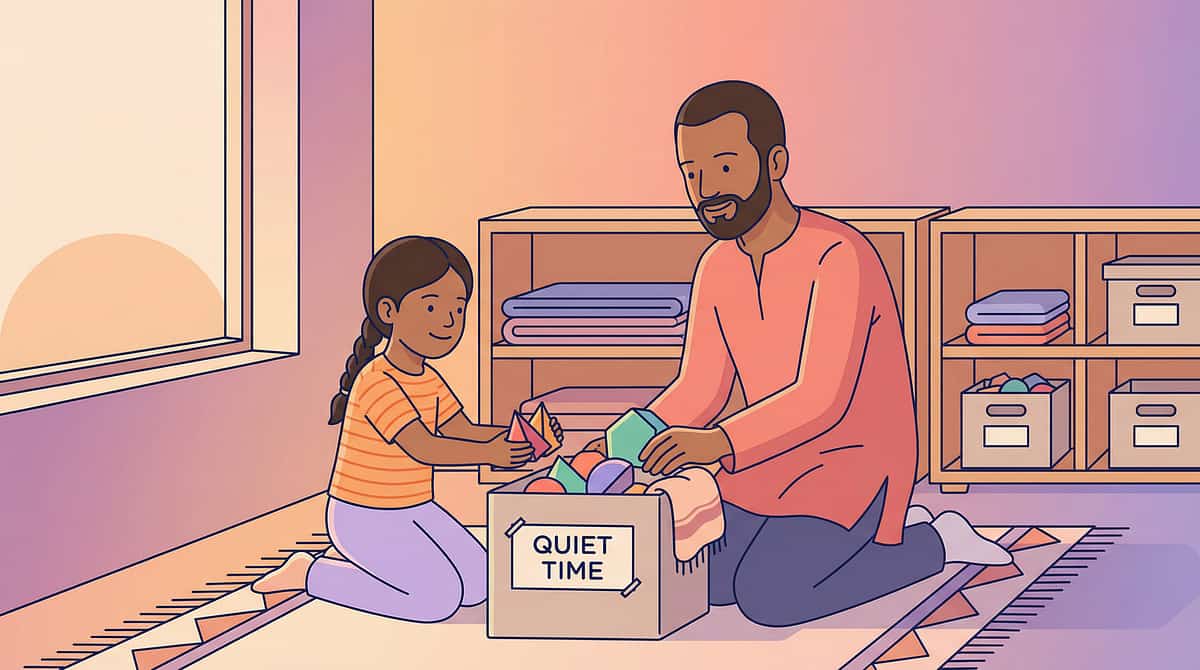
Step 5 ┃ Reinforce & Celebrate
Duration: 30–60 seconds per event
Timing Is Everything
The Golden Rule: Reinforcement must be immediate (within 3 seconds), specific (not "good job" but "good — you used the graphic organiser to hold that idea and that is exactly right"), and sincere (your tone must match your words).
"You just did something important. You let the graphic organiser hold the information for you — and it worked, didn't it?"
"Three problems. Done. Your brain handled that. Onto the next strip."
"You understood that whole concept — and you got it from the simplified text. That is real learning."
"You knew that. You just showed me in a way that works for your brain. That counts completely."
Canon Reinforcers — Available Now
DIY Reinforcers (₹0): Tally mark on a favourite chart | 5 minutes of a chosen preferred activity | Special handshake/celebration ritual | Photo of completed work | Child's choice of next activity
Token Economy: 1 token per modification tool used successfully → 5 tokens = chosen reward → 10 tokens = family celebration
"Celebrate the attempt, not only the success. The brain that tried a graphic organiser and struggled is building the neural pathway that will make it easy next month."

Step 6 ┃ The Cool-Down
Duration: 2–3 minutes
NCAEP Evidence-Based: Visual Transition Supports
The Principle: Academic sessions do not end abruptly. The brain that has been doing structured cognitive work needs a clear, predictable transition signal. Abrupt endings cause the anxiety that makes children resist starting the next session.
60 Seconds Before End
"Two more. Then we're all done for today." Parent shows 2 fingers. Visual timer showing 60 seconds remaining.
30 Seconds Before End
"One more. Last one."
At Completion
"That's all done. You worked hard. Let's pack this up together."
The Put-Away Ritual
Child places work in "Completed" folder. Child closes organiser or puts manipulatives back in tray. Parent and child put the reinforcement token together. The physical act of putting away signals neural closure.
Free Choice Time
"Now you choose. What do you want to do for the next 10 minutes?" Child has earned preferred activity time through session participation.
If Child Resists Ending: This is actually a positive sign — child was engaged. Do NOT extend the session. Say: "I know you want to keep going. That's great. We'll do more tomorrow. Same time." Offer the preferred activity as the transition bridge.
NCAEP EBP Report (2020): Visual supports and transition procedures classified as evidence-based practices for autism. Visual timers reduce transition resistance significantly.

60 Seconds of Data Now = Months of Insight Later
Record these details immediately after every session. Just 60 seconds of documentation creates a clinical intelligence picture that guides every future decision.
1. Modification Type Used Today
☐ Simplified Text ☐ Graphic Organiser ☐ Manipulatives ☐ Chunked Worksheet ☐ Visual Schedule ☐ Alternative Assessment ☐ Assistive Tech ☐ Multi-Sensory Kit ☐ Pre-Teaching ☐ Multiple
2. Engagement Level (1–5)
1 = Refused 2 = Tolerated 3 = Participated 4 = Engaged 5 = Led
3. Items Completed
___ / ___ items completed this session
4. What Worked Today
One word or phrase: ________________________________
3
Sessions of Data
Identifies which modification type works best for your child
2wk
Two Weeks of Data
Reveals optimal time of day, session length, reinforcement patterns
8wk
Eight Weeks of Data
Shows learning trajectory and informs IEP review decisions
"60 seconds of data now saves hours of guessing later. Your observations are clinical intelligence."
📞9100 181 181 — A therapist can help you interpret your data | ABA Data Collection Standards: Cooper, Heron & Heward + BACB Guidelines.
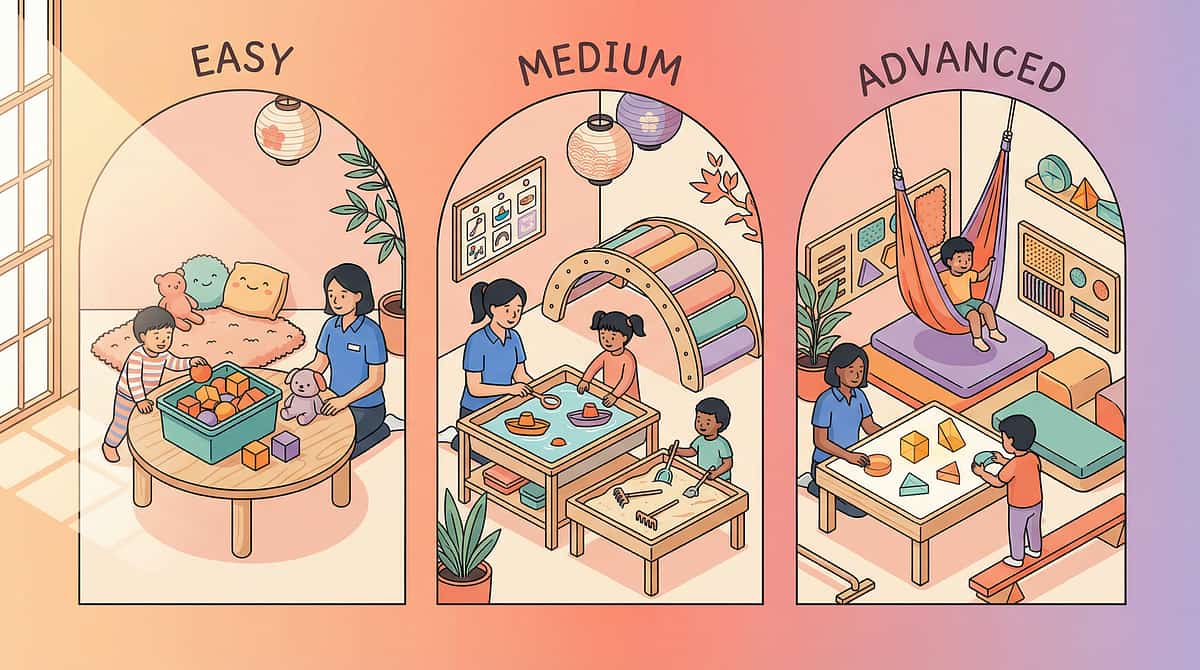
Most Sessions Don't Go Perfectly. Here's the Fix.
"My child refused to sit at all today."
Why: Environmental antecedents — the child may associate the table with frustration.
Fix: Change the location — try the floor, the sofa, the kitchen table. Re-establish the table as positive through 3 sessions of preferred activities before academic work.
Fix: Change the location — try the floor, the sofa, the kitchen table. Re-establish the table as positive through 3 sessions of preferred activities before academic work.
"Child engaged for 2 minutes then melted down."
Why: Session was too long or modification was not sufficiently simplified.
Fix: Tomorrow: 2 minutes maximum. One item only. Highest preferred reinforcer. Build duration by 60 seconds per week when engagement is sustained.
Fix: Tomorrow: 2 minutes maximum. One item only. Highest preferred reinforcer. Build duration by 60 seconds per week when engagement is sustained.
"The graphic organiser just made things more confusing."
Why: Too many boxes, too complex a format, too many modification types at once.
Fix: Start with a 2-box organiser only (Main Idea / Detail). One organiser type, used identically for 2 weeks before introducing variation.
Fix: Start with a 2-box organiser only (Main Idea / Detail). One organiser type, used identically for 2 weeks before introducing variation.
"Child can talk about the concept but refuses to write anything."
Why: Writing is a separate, significant barrier.
Fix: Accept verbal responses as valid assessment. Parent scribes. Use speech-to-text. Writing can be introduced separately as a skill — curriculum understanding and written output are different targets.
Fix: Accept verbal responses as valid assessment. Parent scribes. Use speech-to-text. Writing can be introduced separately as a skill — curriculum understanding and written output are different targets.
"School sent different materials and they're not modified."
Why: School-home coordination gap. IEP may not be implemented with fidelity.
Fix: Contact the special educator with specific examples. Request the modified versions. Document what was sent and what was needed. This is an IEP compliance issue — call 9100 181 181 for support.
Fix: Contact the special educator with specific examples. Request the modified versions. Document what was sent and what was needed. This is an IEP compliance issue — call 9100 181 181 for support.
"We did this for 3 weeks and I see no change."
Why: 3 weeks is early in an 8–12 week trajectory.
Fix: Review your tracking data. Identify which session showed the highest engagement — lean into that modification type. Book a teleconsultation with Pinnacle SpEd team to recalibrate.
Fix: Review your tracking data. Identify which session showed the highest engagement — lean into that modification type. Book a teleconsultation with Pinnacle SpEd team to recalibrate.
"Child became severely distressed during academic task."
Why: Academic frustration escalated. Task was above just-right challenge level even with modification.
Fix: Stop immediately. Do not return to academic tasks that day. Emotional regulation ALWAYS precedes curriculum. Contact Pinnacle SpEd.
Fix: Stop immediately. Do not return to academic tasks that day. Emotional regulation ALWAYS precedes curriculum. Contact Pinnacle SpEd.
"Session abandonment is not failure — it is data. And data guides the next session."
📞9100 181 181 — Stumped? Call FREE. A SpEd therapist will troubleshoot with you.
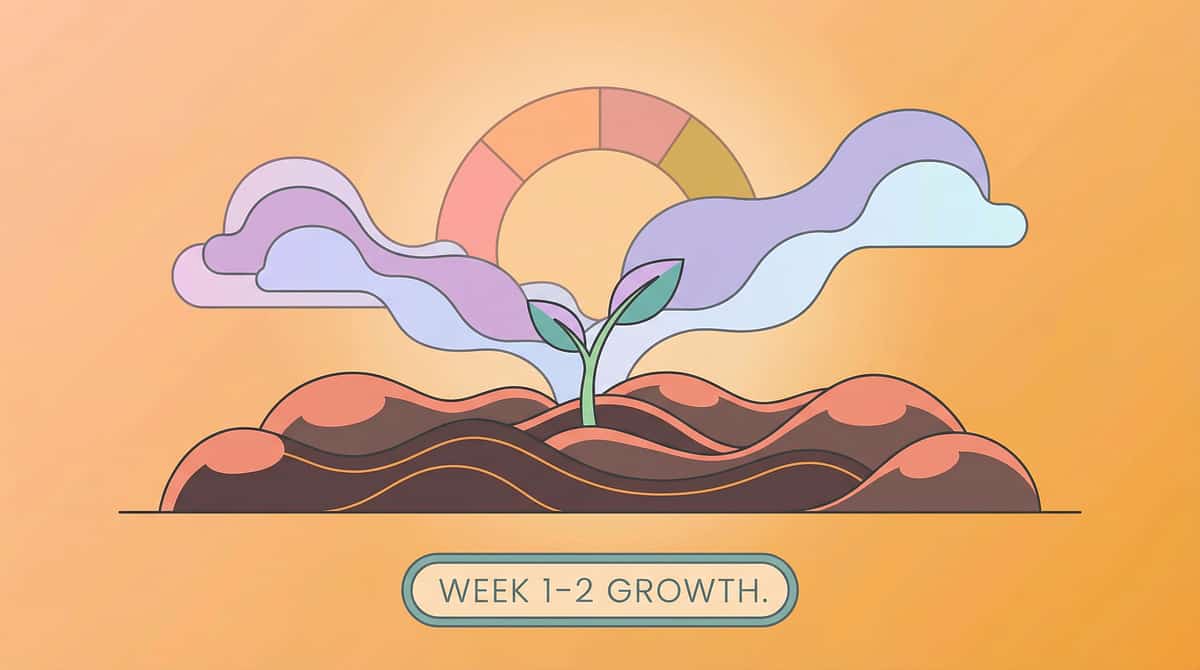
No Two Children Are Identical. Neither Should Their Modifications Be.
Reading Barriers (Primary)
- Lean heavily into: Simplified Text + Assistive Technology (text-to-speech)
- Alternative assessment: verbal responses accepted as primary output
- Pre-teaching: 3 key vocabulary words BEFORE every lesson
Writing Barriers (Primary)
- Lean heavily into: Speech-to-text + Alternative Assessment + Graphic Organisers (parent scribes)
- Accept non-written responses as equivalent academic demonstration
- Sentence starters and word banks for when writing is unavoidable
Attention / Executive Function
- Lean heavily into: Chunked Worksheets + Visual Schedules
- Maximum session length: 10 minutes with 5-minute breaks
- One task visible at a time — always
Abstract Thinking Barriers
- Lean heavily into: Manipulatives + Multi-Sensory Kits
- Never skip concrete phase to reach abstract
- Use real-world connections for every concept
For Sensory Seekers
- Tactile manipulatives: textured letters, kinetic sand, clay for models
- Movement between modification segments: stand, stretch, move — then return
- Fidget tools permitted during simplified text reading
For Sensory Avoiders
- Minimise tactile manipulatives; use visual and auditory channels primarily
- Matte paper (not glossy) for graphic organisers
- Calm, quiet environment essential before and during session
Age Band | Session Length | Items / Session | Primary Modification | |
4–6 years | 10–15 min | 3–5 items | Manipulatives + Pre-teaching | |
6–9 years | 15–20 min | 5–10 items | Graphic Organisers + Chunked Worksheets | |
9–12 years | 20–25 min | 8–12 items | Simplified Text + Alternative Assessment | |
12–16 years | 25–30 min | 10–15 items | Self-Advocacy + Technology |
ACT IV — PROGRESS ARC
Weeks 1–2: You're Building the Bridge, Not Crossing It Yet.
15%
Progress
This is where you are at the end of week 2. Tolerance and recognition are the milestones.
✅ What You Will Likely See
- Child tolerates sitting with modification materials (even if not engaging deeply)
- Child begins to recognise the modification tool (the graphic organiser isn't surprising anymore)
- One modification type shows slightly higher acceptance than others (note it — this is your data)
- Parent feels more confident about what to prepare before a session
- Reduced meltdown intensity or frequency during academic tasks (not elimination — reduction)
❌ What Is NOT Expected Yet
- Independent use of modification tools
- Significant academic task completion increase
- Child requesting the modifications
- Generalisation to school environment
- Teacher reporting improvement (too early)
"If your child sits with a graphic organiser for 8 minutes this week compared to 0 last week — that is measurable, clinically significant progress. Do not dismiss it."
Parent Emotional Preparation: Weeks 1–2 are the hardest. The results are invisible to the untrained eye. Trust the data, not the feeling. Tolerance before mastery is always the sequence.
Track This Week: Which modification type had the highest engagement rating? What time of day showed best focus? What reinforcer worked most reliably?
PMC11506176 (Children, 2024): Early-phase indicators focus on tolerance and participation. 8–12 week trajectory for measurable outcomes.

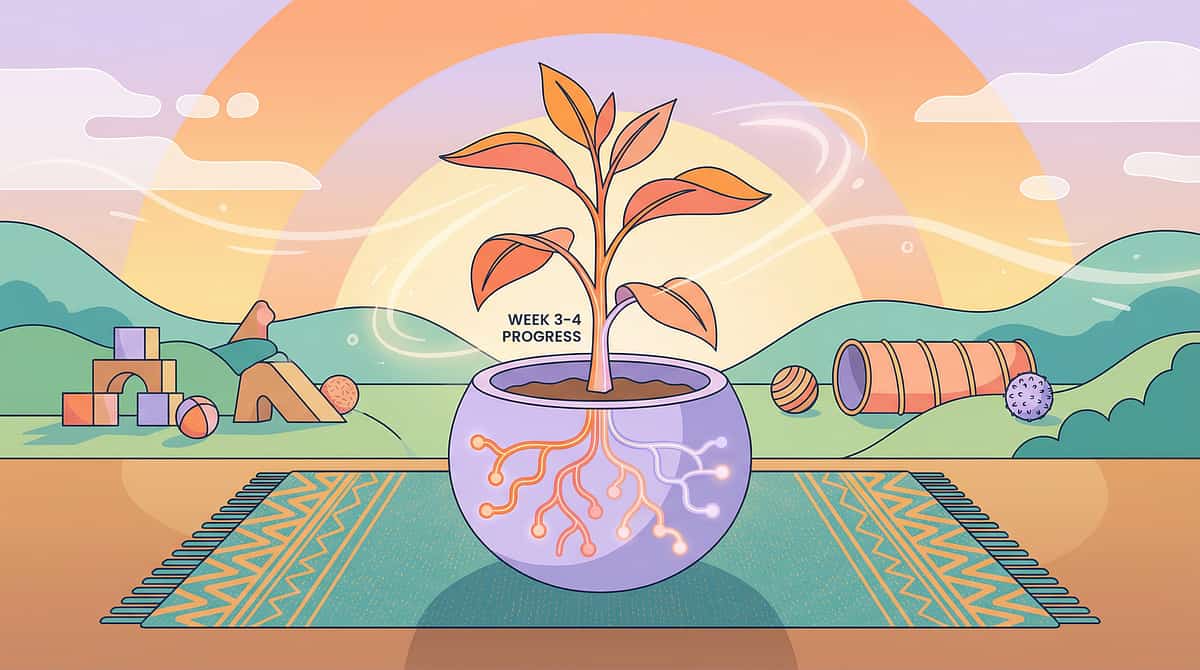
Weeks 3–4: The Neural Pathways Are Forming. Watch Carefully.
40%
Progress
Consolidation is underway. The patterns are becoming visible.
🧠 Anticipation
Child moves toward the learning space without being asked, or references the modification tool spontaneously ("Can I use the boxes?")
🧠 Reduced Resistance
The startup resistance that was 5 minutes in week 1 is now 60 seconds
🧠 Generalisation Seeds
Child spontaneously draws a "map" of something unrelated to academic work (they're applying the graphic organiser principle to their own thinking)
🧠 Increased Session Duration
Child is staying engaged for 2–3 minutes longer without prompting
🧠 Better Academic Output
With modifications in place, the quality or quantity of academic work has measurably improved — compare week 1 data to week 3 data
"You may notice that YOU are more confident. You know the sequence. You know what to prepare. You know the reinforcement that works. This is the parent skill that lasts."
When to Increase Intensity: If consolidation indicators appear consistently across 3+ consecutive sessions: Increase session length by 5 minutes | Introduce a second modification type | Begin introducing the modification concept at school: share your session notes with the SpEd teacher.
Neuroplasticity evidence: Synaptic strengthening through repeated structured input. Behavioural consolidation markers align with neural adaptation curves in paediatric populations.

Weeks 5–8: The Door Is Open. Now They're Walking Through It.
75%
Mastery Progress
The "Curriculum Accessible" badge is within reach. Check the mastery criteria below.
🏆 Mastery Badge: "Curriculum Accessible"
Unlocked when ALL of the following are observed:
- Child independently selects the modification tool for a new, unintroduced task
- Child uses graphic organiser or simplified text WITHOUT being prompted
- Child achieves equivalent comprehension on modified materials as peers on standard materials (conceptual level)
- Modification use generalises to at least one other setting (school or other caregiver's home)
- Child can explain WHY they use the modification ("these boxes hold my ideas")
8 out of 10 sessions show engagement rating of 4 or 5
Session abandonment rate drops to less than 1 per 10 sessions
Academic task completion with modifications reaches 80%+ of assigned items
Child independently uses at least one modification tool in unstructured study time
Next Level Options
- H-752: Reading Modifications — deepen reading-specific access strategies
- H-753: Math Modifications — maths-specific modification techniques
- H-755: Assessment Modifications — formal assessment access strategies
- Self-Advocacy Module — teach child to request their own modifications
PMC10955541 (2024): Measurable mastery across 24 studies. BACB mastery criteria standards for skill acquisition.
You Did This. Say That Out Loud.
"You showed up — day after day — with a graphic organiser, a strip of a worksheet, a vocabulary card, a visual timer. You did not give up when it was confusing. You did not give up when it didn't work the first time. You adapted, you tracked, you stayed. And your child learned — because you made it possible to learn."
— Pinnacle Blooms Network® Special Education Consortium
Your child can now access curriculum content that was previously inaccessible. The same concepts their classmates are learning — about photosynthesis, about subtraction, about historical events — are now concepts your child genuinely holds. Through a different door. But held.
Family Celebration — Choose One
🎉 Family Dinner
Child chooses the meal
📸 Frame It
Print one piece of academic work from this period and frame it
🗓️ Journal Entry
Write together what has changed in 8 weeks
📱 Share Your Story
Share anonymously with the Pinnacle parent community — your journey helps the next family
Parental self-efficacy research: Parent confidence is the strongest predictor of continued home-based intervention. Celebration rituals reinforce parental commitment cycles.
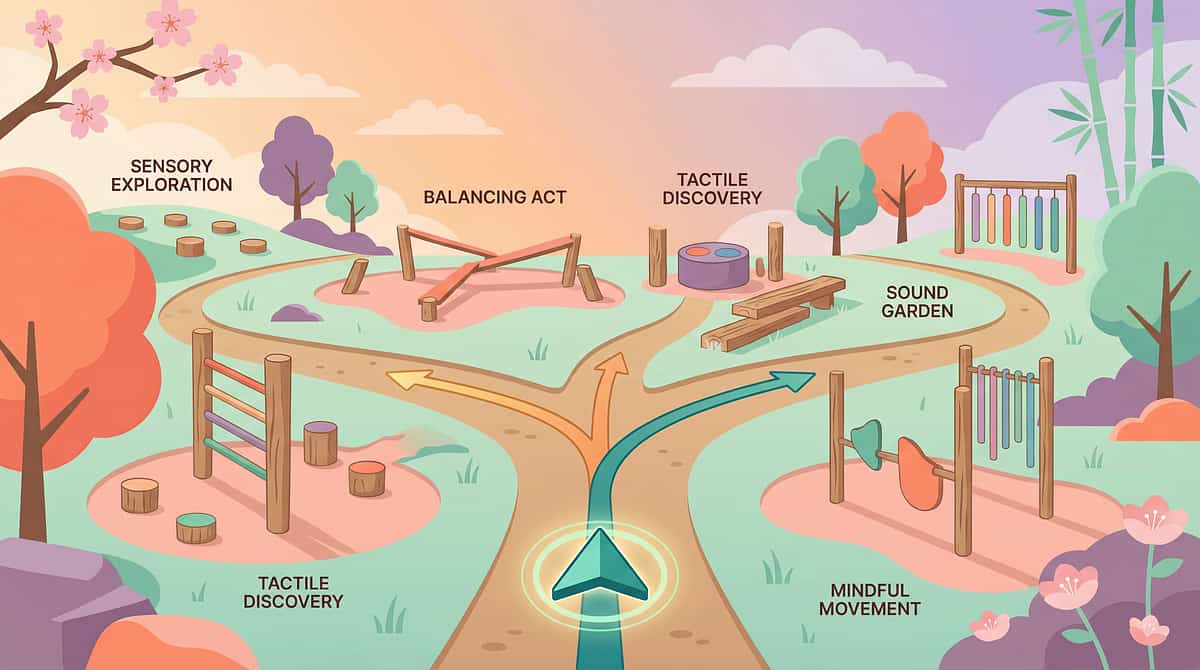
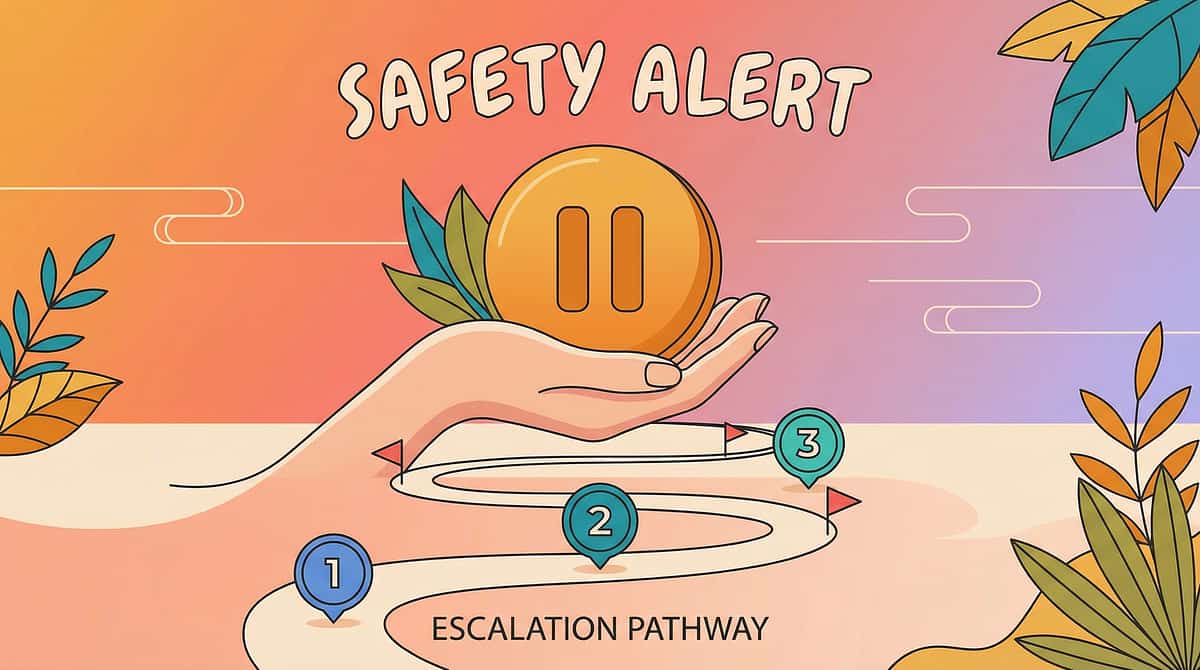
Even After Wins: Know When to Call for Help.
🔴 Behavioural Red Flags
- Academic distress escalates INTO meltdowns more than 2× per week despite modifications
- Child begins self-harming behaviours specifically when academic tasks are introduced (even modified)
- Child's behaviour at school significantly worsens after home modification sessions
- Child begins refusing ALL learning activities, including previously preferred educational play
🔴 Learning Red Flags
- After 8+ weeks, NO modification type achieves consistent engagement rating above 2
- Child shows regression in skills that were previously present
- Parent consistently cannot identify which modification works — profile may need professional reassessment
🔴 Physical Red Flags
- Child reports headaches, stomachaches consistently associated with learning sessions
- Visual difficulties observed during text-based activities (squinting, eye rubbing)
- Significant fine motor deterioration during written tasks
Escalation Pathway
- Self-resolve: Minor fluctuation — modify approach, use troubleshooting card, data for 3 sessions
- Teleconsult (1 week): Pattern of 2+ red flags → Book a Pinnacle teleconsultation: 9100 181 181
- Clinic Assessment (urgent): Self-harm, severe regression, complete refusal → Book immediate assessment
"Trust your instincts. If something feels consistently wrong, it is data — and data is acted upon."
📞9100 181 181 | pinnacleblooms.org
WHO NCF: Primary health care as platform for early identification. Referral pathways integrated into service delivery. | Pinnacle clinical escalation protocols.
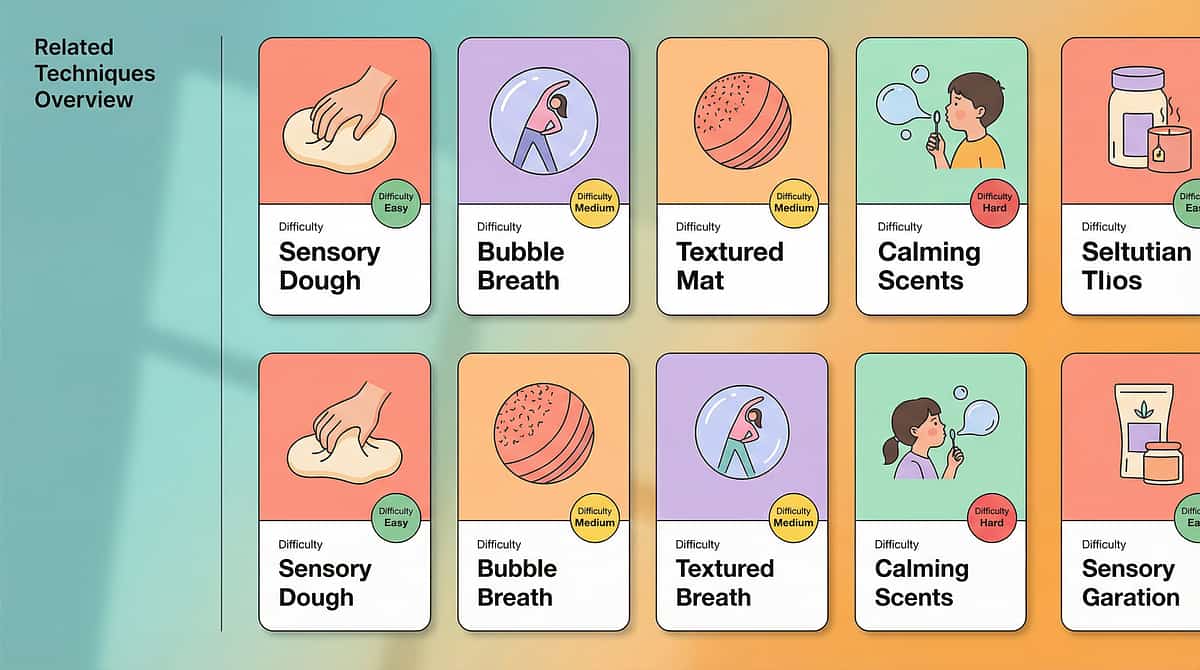
You Are Not Done. You Are On a Map.
This is not the end of the journey — it is a clearly marked waypoint. Your next-level branches depend on your child's primary barrier. Choose the path that matches where they need support most.
← Prerequisites (Complete First)
H-749: IEP Implementation at Home
H-750: Classroom Accommodations
H-750: Classroom Accommodations
→ Reading is Primary Barrier
H-752: Reading Modifications — simplification, decoding, comprehension
→ Maths is Primary Barrier
H-753: Math Modifications — manipulatives, visual maths, concrete computation
→ Assessment is Primary Concern
H-755: Assessment Modifications — formal assessment access strategies
→ All Areas Modified
Self-Advocacy Module — child learns to request their own supports
Long-Term Developmental Goal: Educational Independence — the child accesses grade-level concepts with self-selected supports, self-advocates for their modifications, and demonstrates learning through their optimal format.
WHO/UNICEF Developmental Trajectory Framework: Intervention sequencing follows evidence-based developmental cascades.
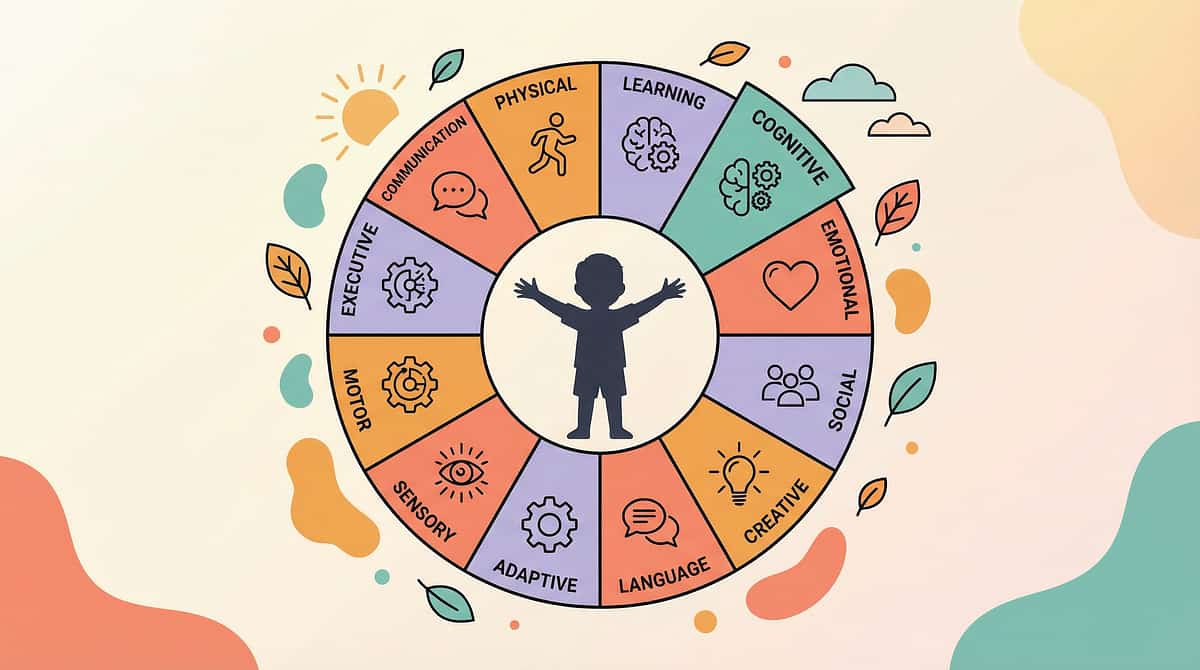
Other Techniques in the Special Education Domain
H-749: IEP Implementation at Home
🟡 Core | Visual Supports, Communication Tools
Status: ↗️ Prerequisite
Status: ↗️ Prerequisite
H-750: Classroom Accommodations
🟡 Core | Accommodation Checklists, Seating Supports
Status: ↗️ Prerequisite
Status: ↗️ Prerequisite
H-752: Reading Comprehension Modifications
🟢 Next | Leveled Readers, Graphic Organisers
Status: → Next Step
Status: → Next Step
H-753: Math Modifications
🟢 Next | Manipulatives, Visual Number Systems
Status: → Next Step
Status: → Next Step
H-755: Assessment Modifications
🔵 Advanced | Alternative Assessment Tools, Rubrics
Status: → Advanced
Status: → Advanced
H-760: Student Self-Advocacy Skills
🔵 Advanced | Self-Advocacy Scripts, IEP Participation Tools
Status: → Advanced
Status: → Advanced
"You Already Own Materials for These" Indicator:
✅ Sorting set → Also used in H-752, H-753
✅ Reward stickers → Used across all Special Education techniques
✅ Reward jar → Used across all domain techniques
✅ Flashcards → Used in H-752 Reading Modifications
✅ Sorting set → Also used in H-752, H-753
✅ Reward stickers → Used across all Special Education techniques
✅ Reward jar → Used across all domain techniques
✅ Flashcards → Used in H-752 Reading Modifications
Domain: Special Education & Inclusive Learning — Series Episode 751 of 800

This Technique Is One Piece. Here Is the Whole Picture.
H-751 sits in Domain H — Special Education & Inclusive Learning, specifically the curriculum access sub-cluster. But its impact radiates outward across your child's entire developmental profile.
Domain C: Emotional Regulation
Reduced academic frustration improves overall regulation across all settings
Domain I: Cognitive
Conceptual acquisition through modifications builds the cognitive foundation
Domain B: Social Communication
Verbal alternative assessments build expressive language and communication
Domain D: Behaviour
Reduced avoidance behaviours when curriculum is made accessible
"GPT-OS® uses your H-751 session data to calibrate recommendations across all 12 domains. Your data here improves your child's entire developmental plan."
📞9100 181 181 — FREE consultation on your child's full developmental profile | WHO NCF (2018): Five components of nurturing care require holistic developmental monitoring.

ACT V — COMMUNITY & ECOSYSTEM
From the Families. Exactly Where You Are Now.

Arjun, Age 8 — Hyderabad
Before: "A war every night. He would look at the worksheet, say he couldn't do it, and the next 45 minutes would be tears and screaming. He knew the answers when I asked him verbally — he just couldn't look at the page."
The Modification: Chunked worksheets — three items visible at a time.
8 Weeks Later: "He does his homework in 15 minutes now. He gets the strips out himself. He told his teacher 'I need my strips.' He's 8 years old and he's advocating for himself."
📋 Therapist's Notes: Executive function scaffolding through format modification. Parent-implemented with fidelity = generalisation to self-advocacy.

Meera, Age 11 — Bengaluru
Before: "Meera could tell me everything about the chapter — every detail — but on the test she'd write three words and stop. Her teacher thought she wasn't studying. I knew she knew it. I just couldn't prove it."
The Modification: Graphic organiser pre-teaching plus verbal alternative assessment. Teacher agreed to accept graphic organiser responses instead of written paragraphs.
6 Weeks Later: Assessment scores went from 40% to 78% — same knowledge, different output format.
📋 Therapist's Notes: Output barrier isolation — reading/thinking intact; written expression barrier. Alternative assessment reveals true conceptual mastery.

Rohit, Age 6 — Delhi
Before: "He has autism and was in a mainstream class. The teacher said he wasn't ready for the curriculum. But at home, when I read him the same concepts in simple sentences, he remembered everything the next day."
The Modification: Simplified text plus multi-sensory pre-teaching at home before the school lesson. Within 4 weeks, the school SpEd coordinator confirmed Rohit was engaging with classroom content for the first time.
"He is in the same class as his peers. Learning the same things. Just through a different path."
Note: Illustrative of aggregate outcomes. Individual results vary. All identifying details are anonymised.
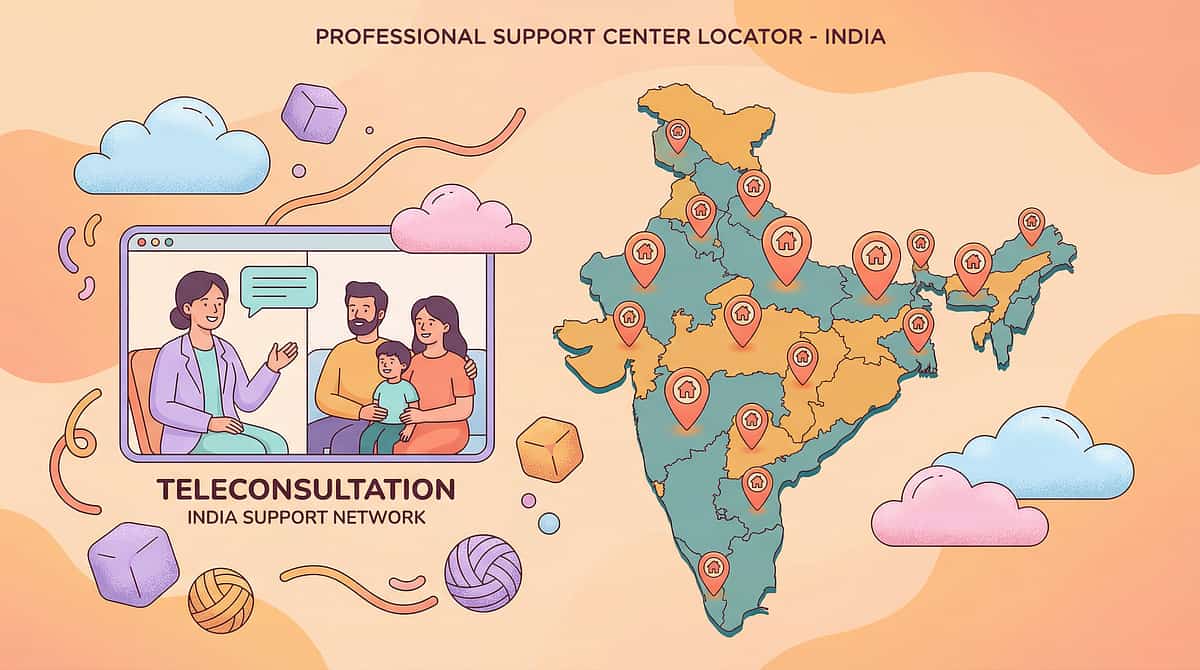
You Don't Have to Figure This Out Alone.
WhatsApp Parent Group
Join "Curriculum Modifications Support — Pinnacle" — parents navigating IEP implementation and curriculum modification at home, in schools, and with therapy teams.
pinnacleblooms.org/community/curriculum-modifications
pinnacleblooms.org/community/curriculum-modifications
Pinnacle Parent Forum
Ask questions, share what worked, find parents who have navigated your exact situation.
pinnacleblooms.org/forum/special-education
pinnacleblooms.org/forum/special-education
Peer Mentoring
Connect with an experienced parent who has already gone through curriculum modification implementation. Mentors are Pinnacle-trained, anonymised, and matched by child's age and primary challenge.
Request a Peer Mentor →
Request a Peer Mentor →
Local Parent Meetups
70+ centres across India hold monthly parent education sessions on special education and IEP navigation.
Find Your Local Session →
Find Your Local Session →
For Educators & Teachers
Share this resource with your child's school. Pinnacle offers school educator training on curriculum modification implementation.
School Partnership →
School Partnership →
"Your experience — the thing you figured out at 11pm on a Tuesday — helps the next parent who is in exactly the place you were. Consider sharing."
📞9100 181 181 — 16+ languages. Your community starts with one call.
Home + Clinic = Maximum Impact.
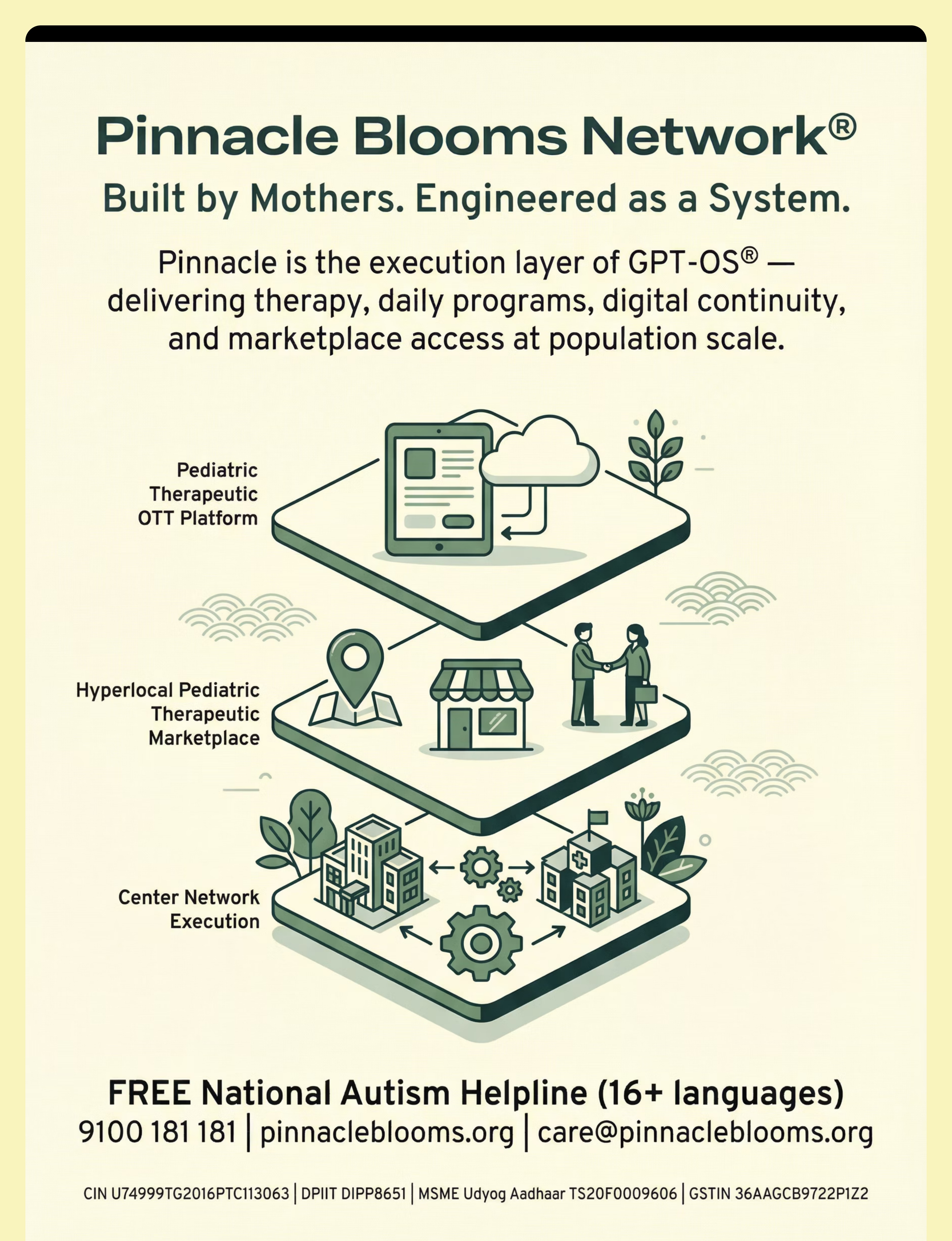
70+ Centres Across India: Hyderabad • Bengaluru • Chennai • Mumbai • Delhi • Pune • Vijayawada • Vizag • Tirupati • and 60+ more locations
Specialist Matching for H-751
Your Need | Specialist | Action | |
Curriculum modification planning | Special Educator (SpEd Lead) | ||
Written output barriers | Occupational Therapist | ||
Reading / language access | Speech-Language Pathologist | ||
Behaviour and motivation during academic tasks | ABA/BCBA Therapist | ||
Diagnostic assessment for modification planning | NeuroDev Paediatrician | ||
IEP compliance support | SpEd Consultant |
What to Expect in Your First Consultation: Review of H-751 session tracking data | AbilityScore® assessment review | Modification type matching to your child's specific profile | School coordination plan | Home plan calibration
📞FREE National Helpline: 9100 181 181 — Free. 16+ languages. 24×7. No appointment needed. | WHO NCF Progress Report (2023)

The Science Behind Every Card You Just Read.
Study | Key Finding | Link | |
PMC11506176 (Children, 2024) | 16 studies confirm evidence-based practice status for curriculum-based modifications in ASD | ||
PMC10955541 (World J Clin Cases, 2024) | Meta-analysis: Structured interventions promote academic skills, adaptive behaviour (24 studies) | ||
PMC9978394 (WHO CCD Package) | Caregiver-implemented modifications across 54 LMICs — equity-focused, household material-based | ||
NCAEP 2020 | Graphic organisers, visual supports, modified materials — classified as evidence-based practices for autism | ||
CAST / UDL Principles | Universal Design for Learning: multiple means of representation, action, engagement — foundational framework | ||
Padmanabha et al. (2019) | Indian J Pediatr: Home-based structured learning modifications show significant outcomes in Indian children | ||
WHO NCF (2018) | Nurturing Care Framework: caregiver education and environmental structuring for learning access |
For the Deeply Curious Parent
Your Session Data. Your Child's Personalised Plan. Every Family's Collective Intelligence.
What GPT-OS® Learns
Which of the 9 modification types works for your child's profile | Correlation between time-of-day and engagement quality | Reinforcement density needed | Rate of progress on Academic Readiness Index | When to recommend escalation
🔒 Privacy Assurance
All session data encrypted and anonymised at population level | No identifying information shared with third parties | You control your data: view, download, or delete at any time | Governed by India's Digital Personal Data Protection Act (2023)
"Your data helps every child like yours. When 10,000 families track which modification type works best for 8-year-olds with working memory challenges, the recommendation engine for the next family becomes precise."

See It. Then Do It.
Reel ID: H-751
Special Education & Inclusive Learning
Episode 751
75–85 seconds
"Hi, I'm [Pinnacle SpEd Lead Therapist]. In this reel, I'm going to show you 9 materials that make curriculum accessible for children with autism, ADHD, learning disabilities, and other differences that affect how they learn. Every one of these materials is available in India, most can be made at home for ₹0, and all of them are grounded in the same research principle: your child's brain can learn this — we just need to find the right door."
Video Modelling = Evidence-Based Practice: NCAEP 2020 classifies video modelling as an evidence-based practice for autism. Watching the therapist demonstrate the materials is therapeutic preparation for your own implementation. This reel is itself clinical support.
The Reel → Technique Page Connection: This Gamma page is the full clinical depth behind what the reel shows. The reel is the awareness layer. This page is the execution layer. Together, they form one complete parent education unit within the Pinnacle content ecosystem.
NCAEP EBP Report (2020): Video modelling classified as evidence-based practice. Multi-modal learning improves parent skill acquisition.
Consistency Across Caregivers Multiplies Impact.
The Research Reality: If only ONE person in your child's life uses curriculum modifications, the impact is limited. When the same modification is used by the parent, the grandparent, the school teacher, and the therapist — the neural pathway strengthens across every environment. This is the consistency principle.
"Explain to Grandparents" Script
"[Child's name] learns better when we make some small changes to how school materials are given to them. Instead of 25 maths problems at once, we give 5. Instead of a long paragraph to read, we give the same information in shorter sentences. The concept is exactly the same. The format is different. The more we all use the same approach, the faster [child's name] builds confidence and independence."
Teacher/School Communication Template
"Dear [Teacher's name], We have been implementing curriculum modifications at home based on guidance from Pinnacle / our therapy team. The modifications most effective for [child's name] are: [list from personalisation card]. We would like to coordinate these with classroom instruction. Could we schedule 15 minutes to align approaches? The full research and implementation details are at: [this URL]."
WHO CCD Package (PMC9978394): Multi-caregiver training critical for intervention generalisation and maintenance.

ACT VI — CLOSE & LOOP
Your Questions. From the Parents Who Asked First.
"Isn't modifying the curriculum just making it easier and setting my child up to fall behind?"
No. A modification changes the FORMAT — not the CONCEPT. When your child reads a simplified version of a chapter about the water cycle, they learn the same water cycle as their classmates. Simplified format + same concept = same learning destination, different door. Research consistently shows that children with learning differences learn concepts equivalent to peers when the format matches their processing profile.
"How do I get my child's school to provide modified materials?"
Start with the IEP. Ask specifically: "Which modifications are being implemented? Can I see an example of a modified worksheet from this week?" If modifications are specified in the IEP and not being provided, this is a compliance issue. Document, request in writing, and if unresolved, contact your school's Special Education Department head. Pinnacle SpEd consultants can advise on IEP advocacy: call 9100 181 181.
"My child doesn't have a formal diagnosis. Can I still use these modifications?"
Yes. Curriculum modifications are based on learning needs, not diagnoses. If your child consistently struggles with standard curriculum format — regardless of whether they have a formal diagnosis — modifications are appropriate and legal. You don't need a diagnosis to try a graphic organiser or a simplified worksheet.
"How do I know which of the 9 modifications to start with?"
Start by identifying your child's PRIMARY barrier. Reading barrier → Simplified Text + Assistive Tech. Writing barrier → Alternative Assessment + Speech-to-Text. Organisation barrier → Chunked Worksheets + Graphic Organisers. Conceptual access barrier → Manipulatives + Multi-Sensory Kits. When uncertain, start with graphic organisers — they are the highest-utility, lowest-cost, broadest-application modification available.
"Will my child become dependent on these modifications?"
Some modifications will fade as skills develop. Others may be permanent tools — this is not dependency, it is accommodation. Glasses don't create dependency on glasses. They provide access to visual information. Similarly, a graphic organiser for a child with working memory challenges is a lifelong tool, not a crutch. The goal is for the child to eventually SELF-SELECT their modifications — called self-advocacy.
"My child's school says they don't have resources to create modified materials."
Your options: (1) Create modifications at home using the DIY methods in the DIY card — most require no cost. (2) Request the school provide the digital version of materials so you can modify them. (3) Use free tools: Rewordify.com, ReadWorks, Google Forms. (4) Connect with the Pinnacle parent community — parents share modified materials for common curriculum content.
"How do I track whether the modifications are actually working?"
Use the tracking sheet from the data card. After 4 weeks: Compare engagement rating (1–5) from week 1 versus week 4. Compare task completion rate. Compare session abandonment rate. If all three are improving: the modification is working. If none are improving after 6 weeks: book a professional review. 📞 9100 181 181
"Can I use these modifications alongside clinical therapy or does it interfere?"
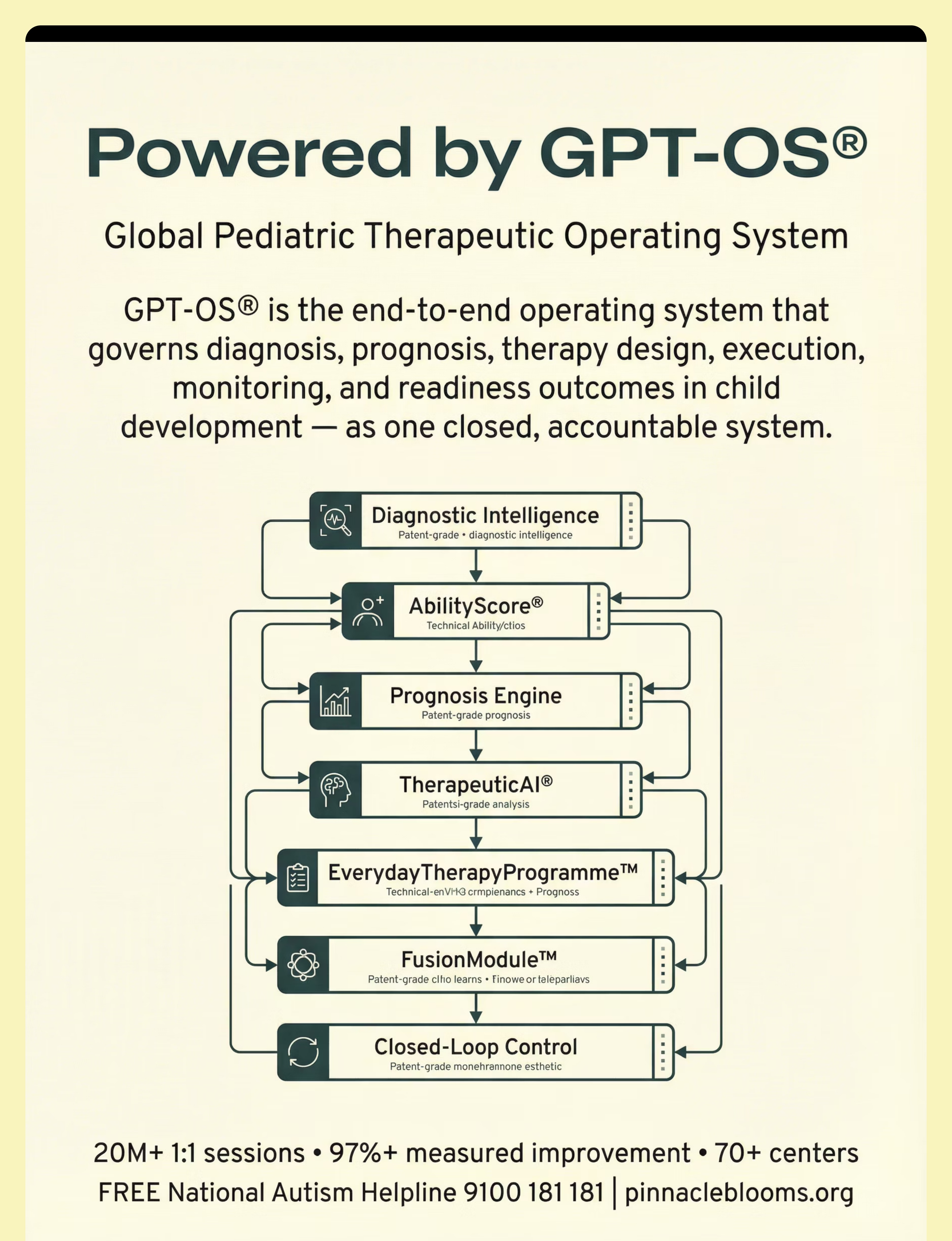
These modifications are designed to be used ALONGSIDE clinical therapy — they are the home implementation of what therapists do in clinic. The FusionModule™ within GPT-OS® coordinates exactly this — ensuring home and clinic use the same evidence-based framework. Share your tracking data with your therapy team at every session.
Preview of 9 materials that help with curriculum modifications Therapy Material
Below is a visual preview of 9 materials that help with curriculum modifications therapy material. The pages shown help educators, therapists, and caregivers understand the structure and content of the resource before use. Materials should be used under appropriate professional guidance.




Link copied!
The Modifications Don't Start When Everything Is Perfect. They Start Today.
🚀 Start This Technique Today
Start with ONE modification. Graphic organiser recommended for first session.
📞 Book a Free Consultation
A certified SpEd specialist will review your child's profile and create a personalised modification plan.
→ Explore the Next Technique
H-752: 9 Materials That Help With Reading Comprehension Modifications — if reading is your child's primary barrier.
🏛️Pinnacle Blooms Network® Consortium Seal | Validated by: 🎓 Special Education • 🧠 OT • 🗣️ SLP • 📊 ABA/BCBA • 👨⚕️ NeuroDev Pediatrics
20M+ Sessions | 97%+ Improvement | 70+ Centres | GPT-OS® | AbilityScore® | EverydayTherapy™
20M+ Sessions | 97%+ Improvement | 70+ Centres | GPT-OS® | AbilityScore® | EverydayTherapy™
📞FREE National Autism Helpline: 9100 181 181 | 16+ languages | 24×7 | No appointment | No cost | India-wide