

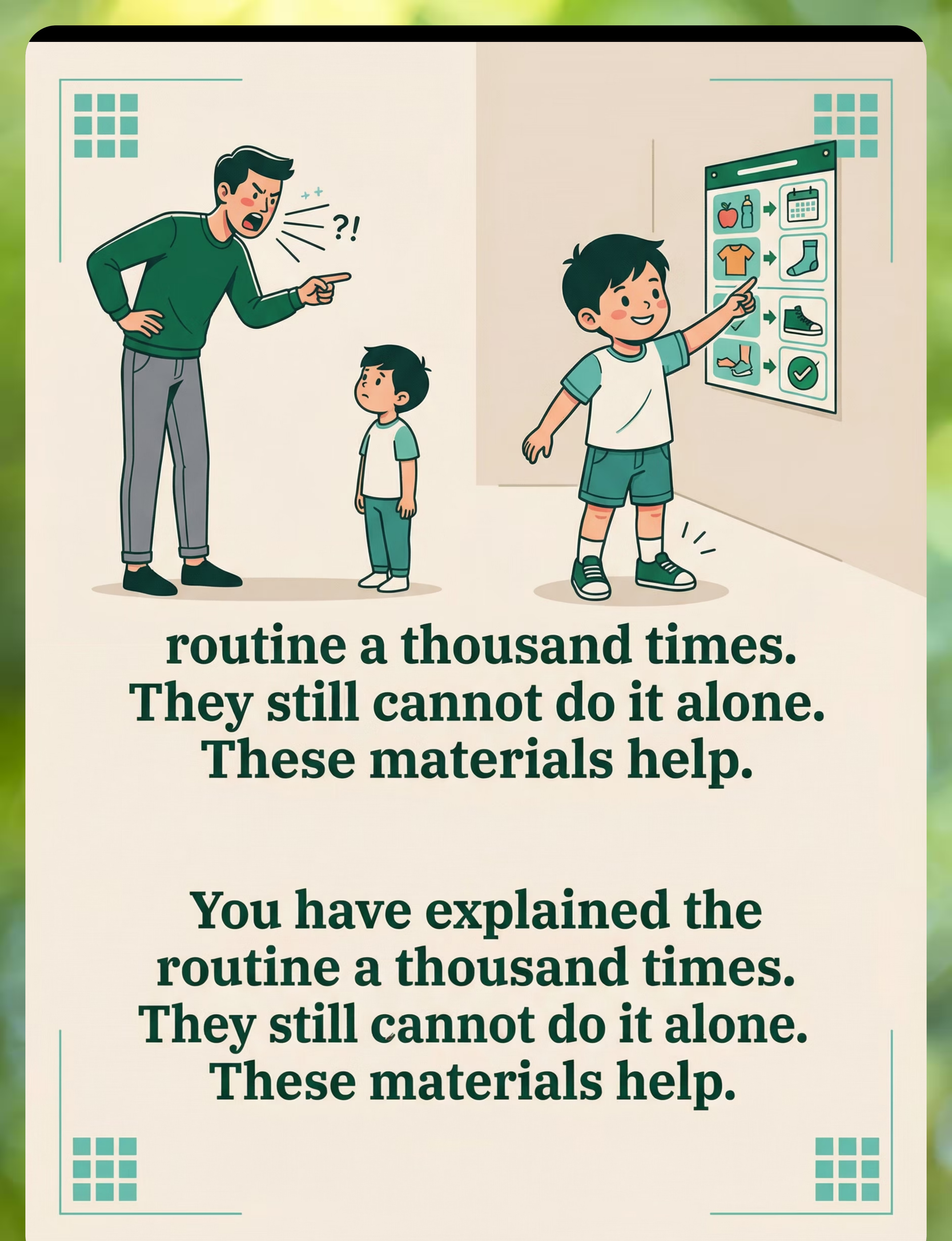
You've Explained the Morning Routine a Thousand Times. They Still Can't Do It Alone.
There is nothing wrong with your child. Their brain needs what yours provides automatically — external sequence cues. These 9 materials replace your voice.
🏥 Pinnacle Blooms Consortium
🧠 Executive Function + Daily Living
👶 Ages 3–12
The Scale of This Challenge
You Are Not Alone — The Numbers
50–80%
Executive Function Challenges
Children with ASD, ADHD, or developmental differences who experience significant executive function challenges affecting routine independence. Source: PRISMA Systematic Review 2024 | PMC11506176
1 in 6
Children Globally
Experience developmental differences affecting daily living skills — that's 240+ million children worldwide. Source: WHO Global Burden of Disease | CDC NCBDDD 2023
21M+
Therapy Sessions
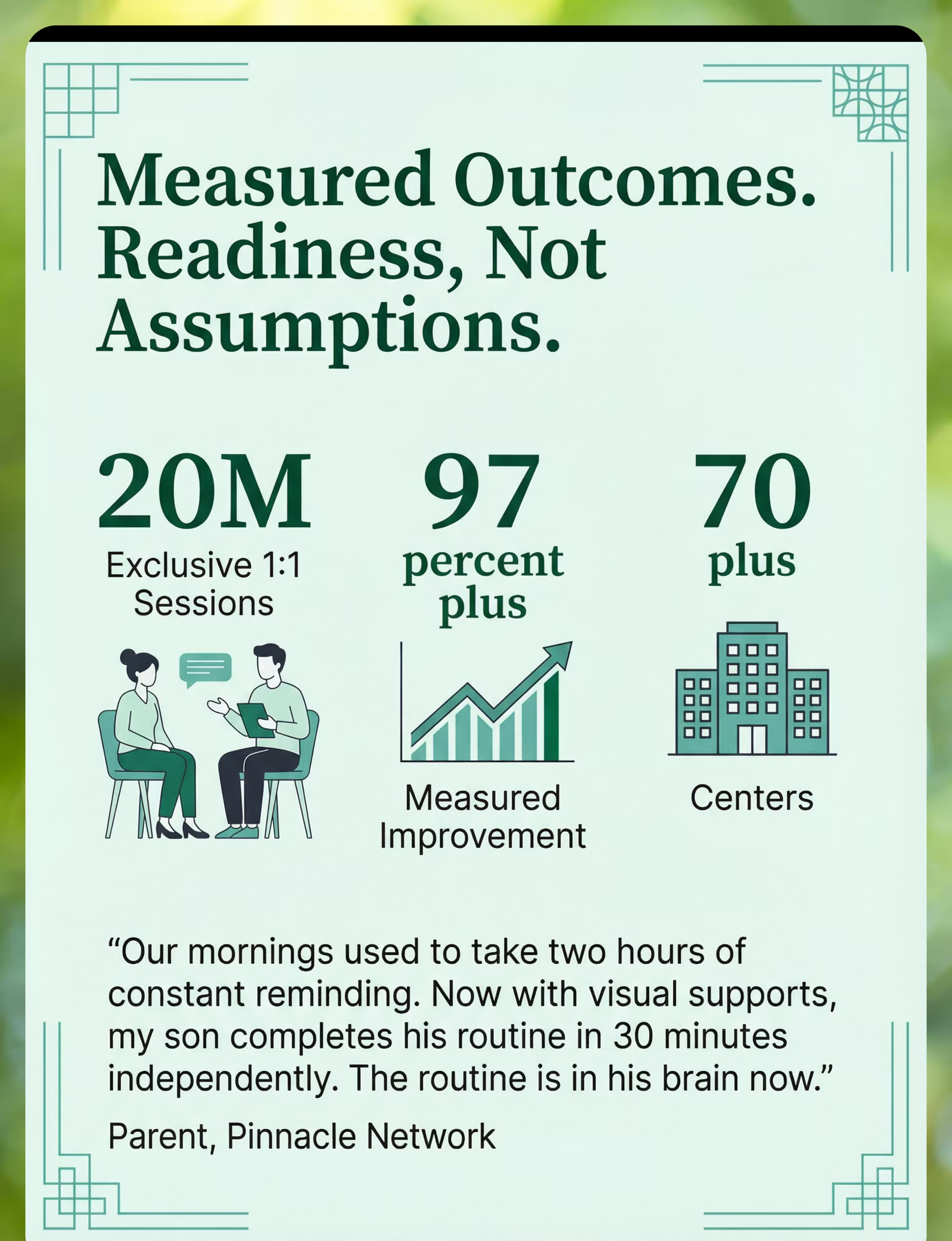
Delivered by Pinnacle Blooms Network with 97%+ measured improvement in Daily Living Independence Index. Source: Pinnacle GPT-OS® Outcome Data | 70+ Centers
If your child struggles to complete morning, bedtime, or self-care routines without step-by-step verbal prompting — you are among millions of families navigating the exact same challenge. This is not a parenting failure. It is a neurological reality that has evidence-based solutions. In India alone, an estimated 1.3–1.8 million children under age 12 have diagnoses or presentations that include executive function deficits affecting routine independence. Research by Padmanabha et al., Indian Journal of Pediatrics (2019) confirms home-based structured interventions show significant measurable outcomes across Indian family contexts — validating that these strategies work in Indian homes, not just Western clinical settings.

What's Happening in Your Child's Brain
The Working Memory-Execution Gap — Explained
The Neuroscience in Plain Language
Your child's prefrontal cortex — the brain's executive control centre — is responsible for holding multi-step sequences in working memory, generating the "start now" initiation signal, triggering the "switch to next step" transition signal, and self-monitoring progress through the sequence.
In children with ADHD, autism, or developmental differences, this circuit runs quieter. The sequence exists. The knowledge exists. But the automatic "fire this step now" signal doesn't generate reliably.
This Is Why Your Child Can Recite the Routine Perfectly But Cannot Execute It
The verbal knowledge lives in declarative memory (long-term storage). But routine execution requires working memory — a different, more fragile system that demands the prefrontal cortex works reliably in real-time.
What visual supports do: They externalise the prefrontal cortex function. Instead of the brain generating "what's next?", the visual chart generates it. The child's eyes do the work the prefrontal cortex struggles to do.
This is a wiring difference. Not a behaviour choice. Not laziness. Neurology.
Sources: Barkley (2012), Executive Functions; Pennington & Ozonoff (1996); Frontiers in Integrative Neuroscience (2020) DOI: 10.3389/fnint.2020.556660

Routine Independence — The Developmental Trajectory
Where does your child sit on the developmental timeline for routine independence?
Ages 2–3
Full adult support needed for all routine steps
Ages 3–5
Simple 2–3 step routines with reminders
Ages 5–7
Visual support needed with check-ins
Ages 8–10
Nearly independent with occasional prompts
Ages 11–12
Fully self-directed routine management
Children with ASD, ADHD, executive function differences, or developmental delays may remain in earlier stages regardless of chronological age. A 9-year-old may function at the 5–7 year stage of routine independence — not because they can't learn, but because their brain processes sequences differently. This is not regression. This is a different developmental trajectory.
What Commonly Co-Occurs with Routine Difficulties
ADHD
Working memory + initiation challenges
Autism Spectrum
Sequencing + transition difficulties
Sensory Processing
Disruption during routine steps
Anxiety
Unpredictability avoidance — routines help but demands must be gradual
DCD
Motor planning challenges in self-care sequences
Sources: WHO Care for Child Development Package (2023) | UNICEF MICS developmental indicators | PMC9978394

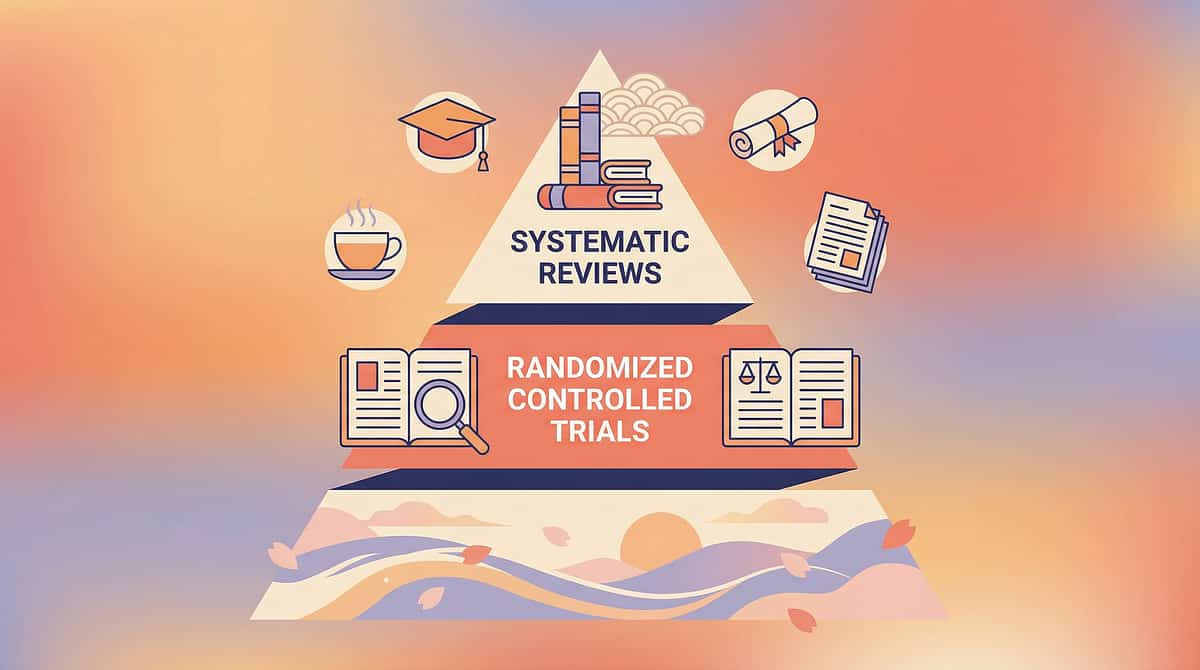
Clinically Validated. Home-Applicable. Parent-Proven.
Evidence Grade: Level I–II
Systematic Reviews + RCTs
Visual Supports = EBP
NCAEP Evidence-Based Practices Report (2020)
Visual supports are classified as an evidence-based practice for children with autism across 30+ qualifying studies. Rating: Established EBP. — National Clearinghouse on Autism Evidence and Practice
PRISMA Systematic Review, Children (2024) — PMC11506176
16 studies, 2013–2023. Visual schedule and environmental structure interventions meet criteria for evidence-based practice across adaptive behaviour, daily living, and independence domains.
Meta-analysis, World Journal of Clinical Cases (2024) — PMC10955541
24 studies. Structured daily living interventions effectively promoted adaptive behaviour, independence, and social skills across paediatric populations. DOI: 10.12998/wjcc.v12.i7.1260
Padmanabha et al., Indian Journal of Pediatrics (2019)
Home-based structured interventions for Indian children with ASD demonstrated significant measurable improvements in daily living and adaptive behaviour domains. DOI: 10.1007/s12098-018-2747-4
WHO/UNICEF Care for Child Development Package (2023) — PMC9978394
Structured routines implemented by caregivers in home environments are a core pillar of nurturing care frameworks implemented across 54 low- and middle-income countries.
Pinnacle Real-World Evidence: 21 million+ 1:1 therapy sessions | 97%+ measured improvement in Daily Living Independence Index | 70+ centres | AbilityScore® tracking
The Technique
Visual & Environmental Routine Scaffolding
Parent-Friendly Alias: "Putting the routine on the wall so your child doesn't need your voice"
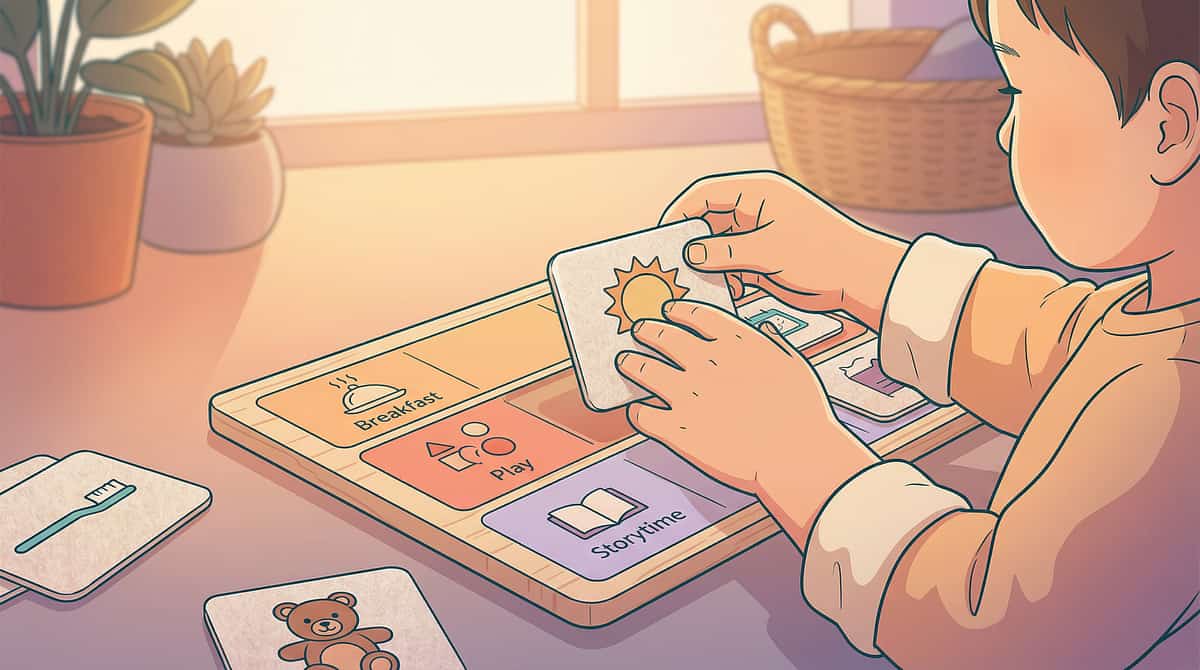
Visual and Environmental Routine Scaffolding is the practice of externalising daily routine sequences — morning, bedtime, self-care, homework, transitions — using physical materials that display what comes next, how long it takes, and what counts as "done." Rather than relying on a child's working memory to hold and execute a multi-step sequence, these materials transfer that cognitive load to the environment. The chart remembers. The timer counts. The checklist tracks. The child follows.
🟢 Daily Living Skills
🧠 Executive Functioning
🏠 Independence
🔄 Adaptive Behaviour
⏰ Time Management
Practical Details
- Age Range: 3–12 years (adaptable to teens)
- Frequency: Daily — every routine, every time, for consistency
- Session Duration: Morning (15–45 min), Bedtime (15–30 min)
- Primary Discipline: Occupational Therapy + Special Education
Canon Materials Engaged
- Visual Schedule System
- Visual Timer
- Reinforcement Menus
- Transition Objects / Comfort Items

The Consortium Behind This Technique
This technique crosses therapy boundaries because a child's brain doesn't organise by therapy type. Routine independence requires coordinated OT, ABA, SpEd, and NeuroDev inputs — which is why Pinnacle delivers it as a Consortium, not as isolated disciplines.
🔵 Occupational Therapy (Primary Lead)
OTs design the full visual routine system — selecting chart format, step granularity, timer type, and environmental organisation. OTs assess the child's processing level to determine whether photos, icons, or words work best.
Pinnacle OT Lead: Daily Living Skills + Adaptive Behaviour Track

🟣 Applied Behavior Analysis (ABA/BCBA)
BCBAs engineer the reinforcement layer — designing token economies, sticker charts, and First-Then systems that provide external motivation while routines are forming. ABA structures the data collection protocol and defines mastery criteria.
Pinnacle BCBA Lead: Reinforcement Design + Fading Protocol
🟡 Special Education (SpEd)
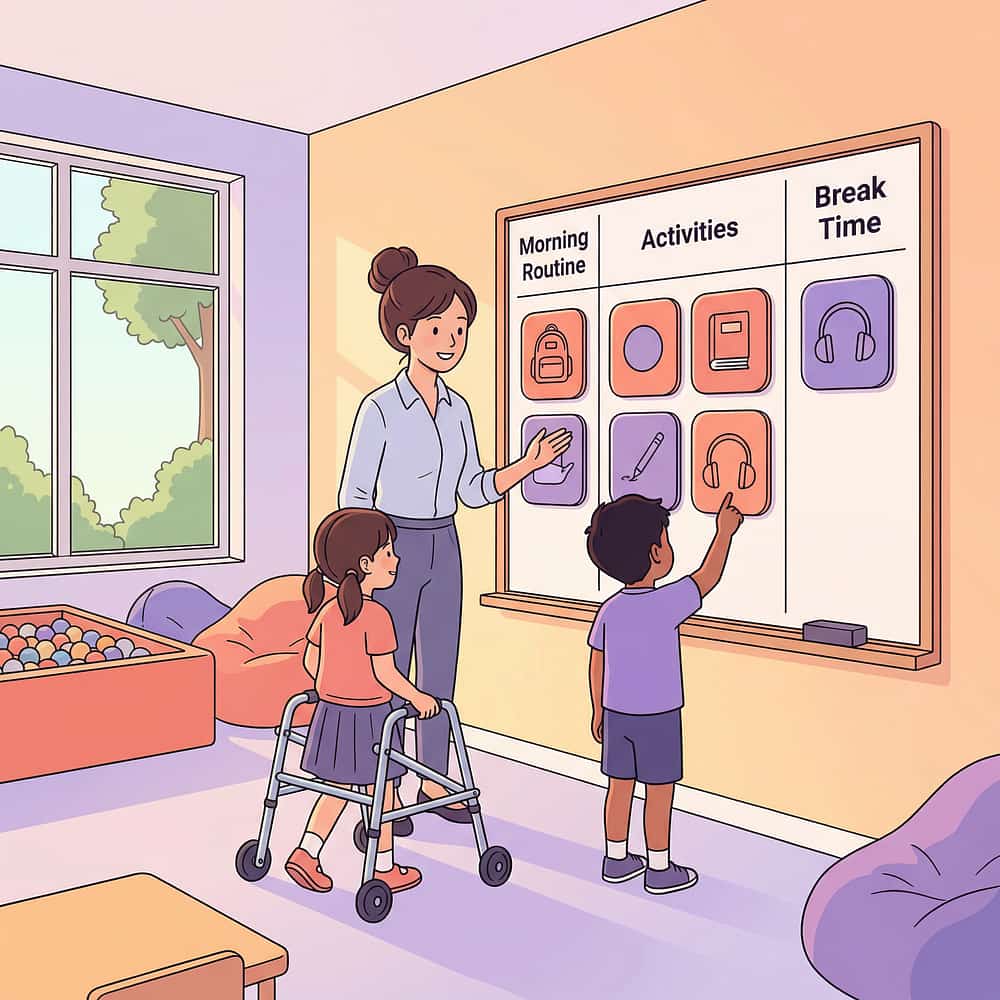
Special educators use routine scaffolding as the bridge between home and school. They design classroom-compatible visual schedules and transition systems that mirror home supports — ensuring consistency across settings.
Pinnacle SpEd Lead: Cross-Setting Generalisation

🔴 NeuroDevelopmental Paediatrics
NeuroDev physicians assess the underlying executive function profile — working memory capacity, initiation deficits, attention regulation — that determines which materials are most appropriate and at what intensity.
Pinnacle NeuroDev Lead: Diagnostic + Prognostic Framework
Sources: Adapted UNICEF/WHO Nurturing Care Framework for Multi-Disciplinary Practice (2022) | DOI: 10.1080/17549507.2022.2141327
Material 1 of 9
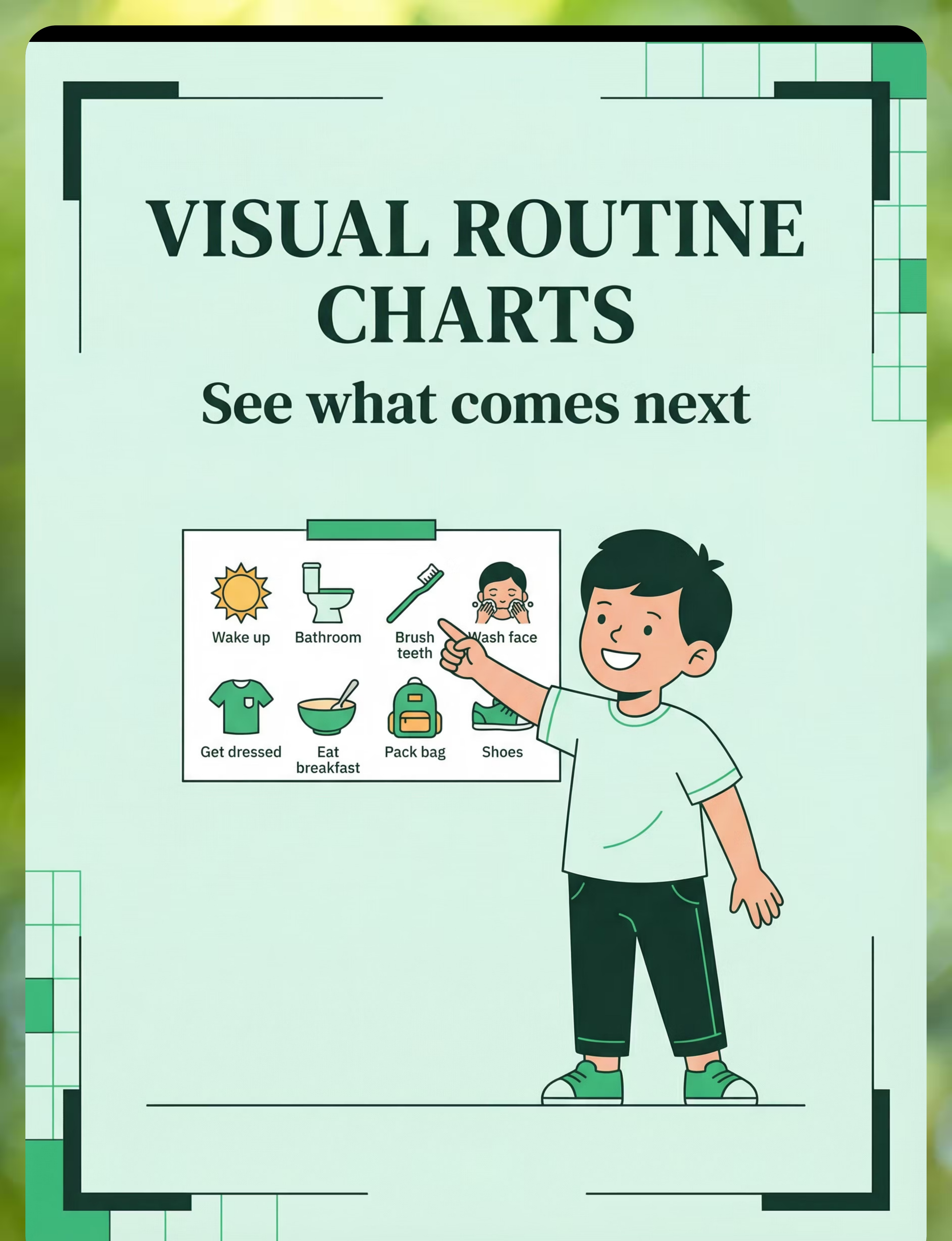
Visual Routine Charts
📋 Canon Category: Visual Schedule System
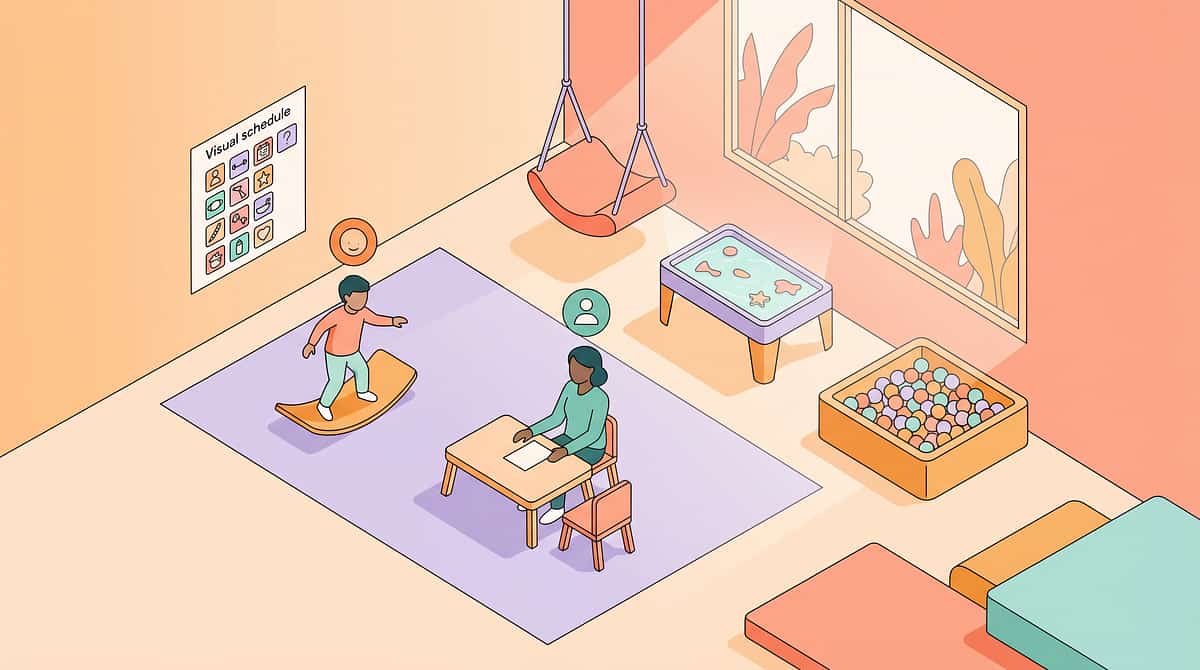
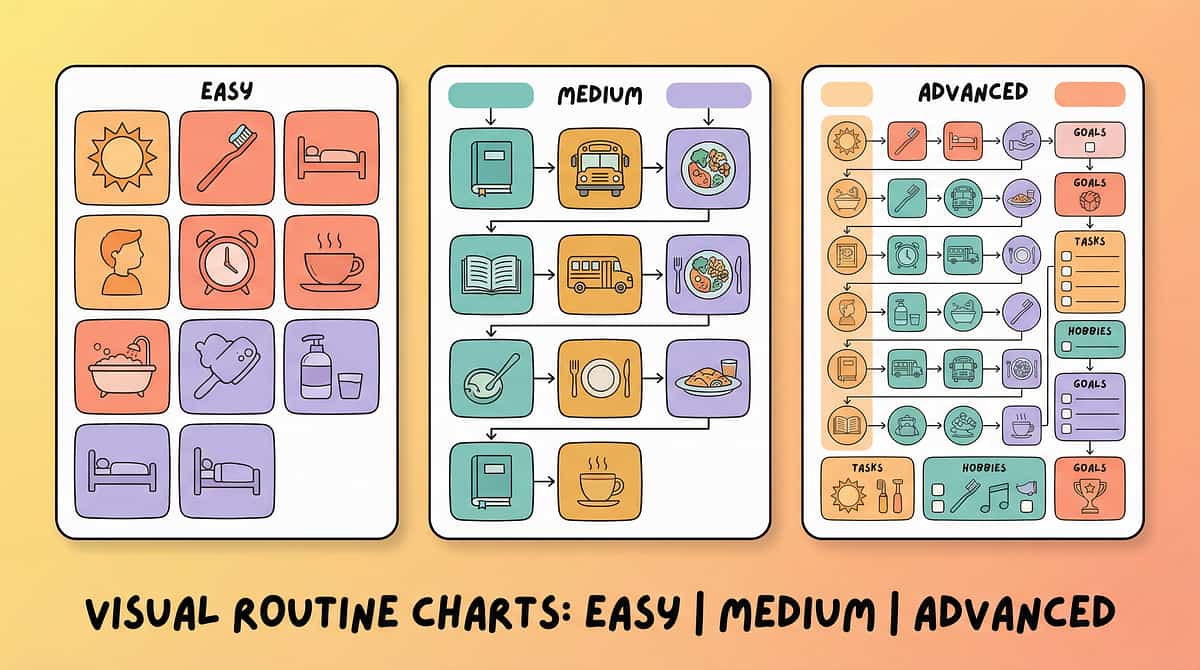
The backbone of the system. Displays the full sequence of routine steps using pictures, photos, or icons. Posted at child's eye level where the routine happens. Morning chart in bedroom. Bedtime chart in bathroom.
Why It Works
Makes the invisible sequence visible. Externalises working memory demand. The child's eyes replace the parent's voice — the chart becomes the only prompt needed for each step of the routine.
Get One
- Price Range: ₹0 (DIY) – ₹800 (laminated ready-made)
Material 2 of 9
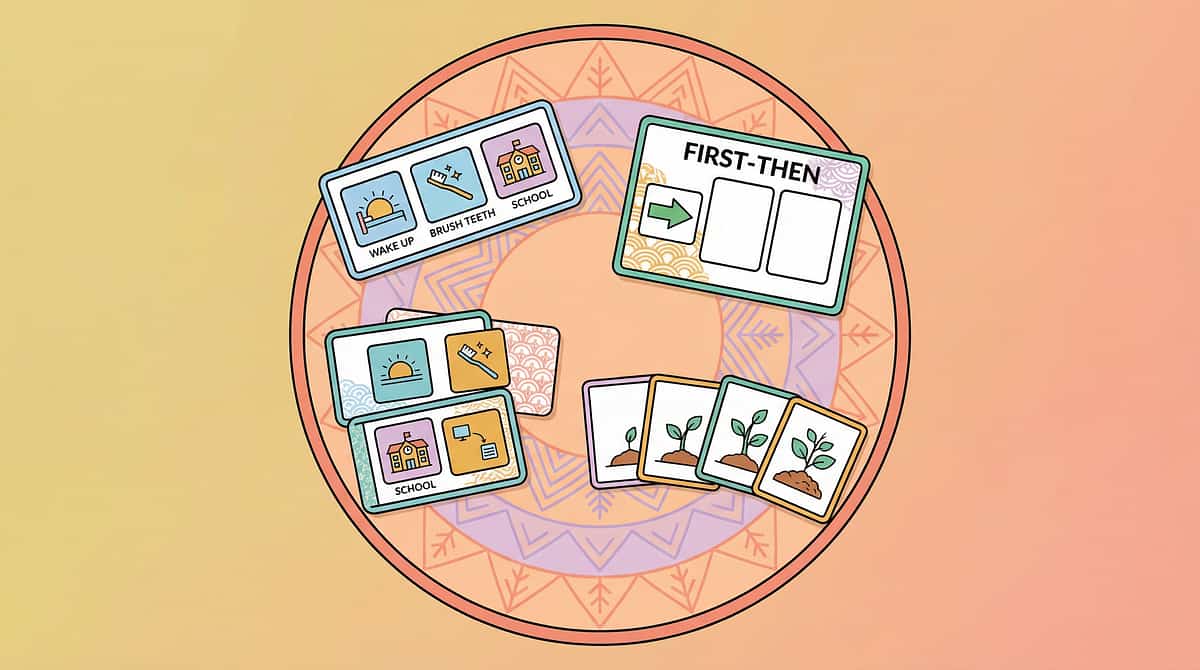
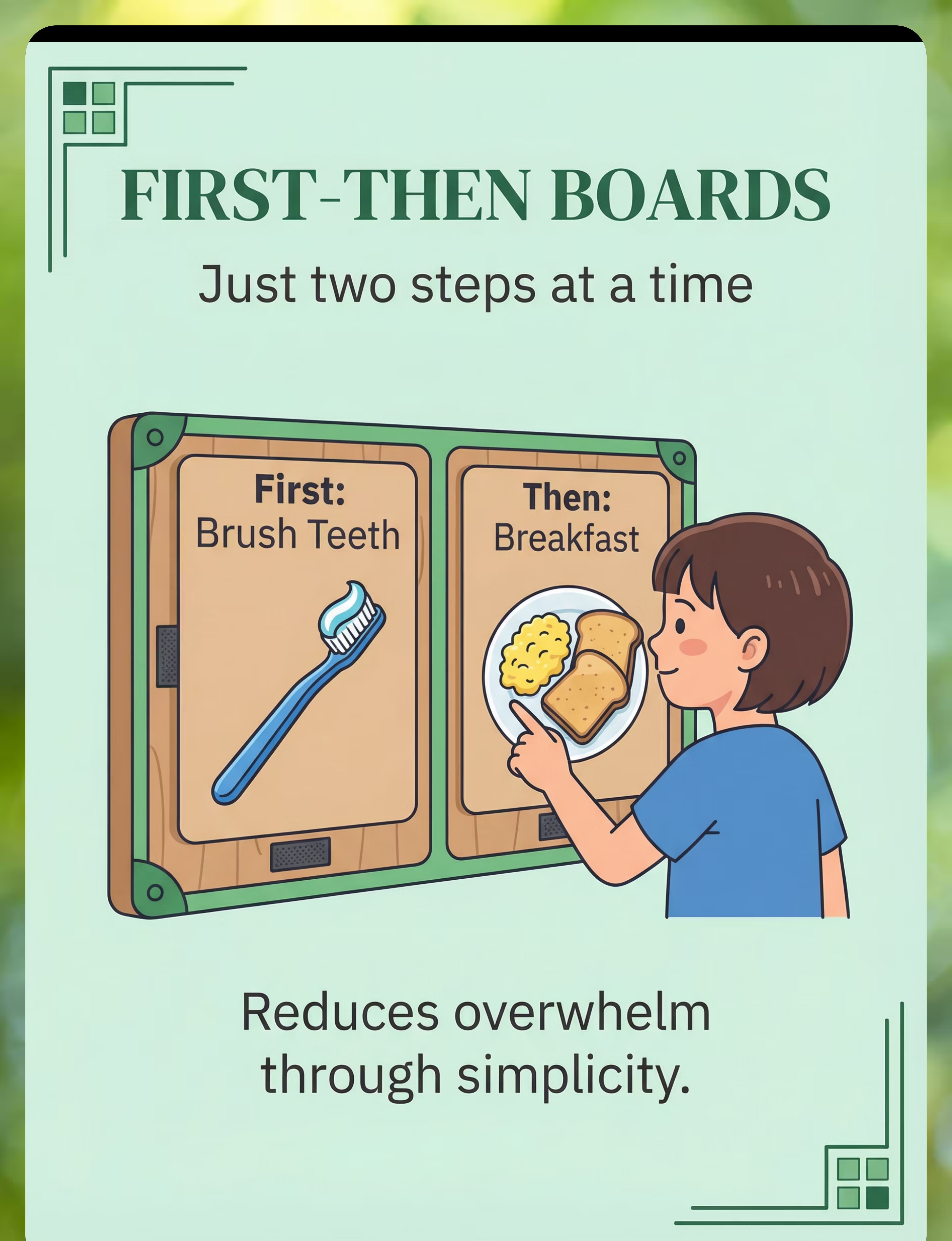
First-Then Boards
📋 Canon Category: Visual Schedule System
The simplest form of visual sequence — just two steps. "First brush teeth. Then breakfast." Reduces overwhelm for children who cannot process long sequences. The "Then" can be motivating (preferred activity) or simply informational.
Why It Works
For children with significant working memory limitations, a full 8-step chart is overwhelming. Two steps are always manageable. Start here if your child finds longer charts anxiety-inducing or refuses to engage.
Get One
- Price Range: ₹100 – ₹350 (laminated board with velcro)
Material 3 of 9
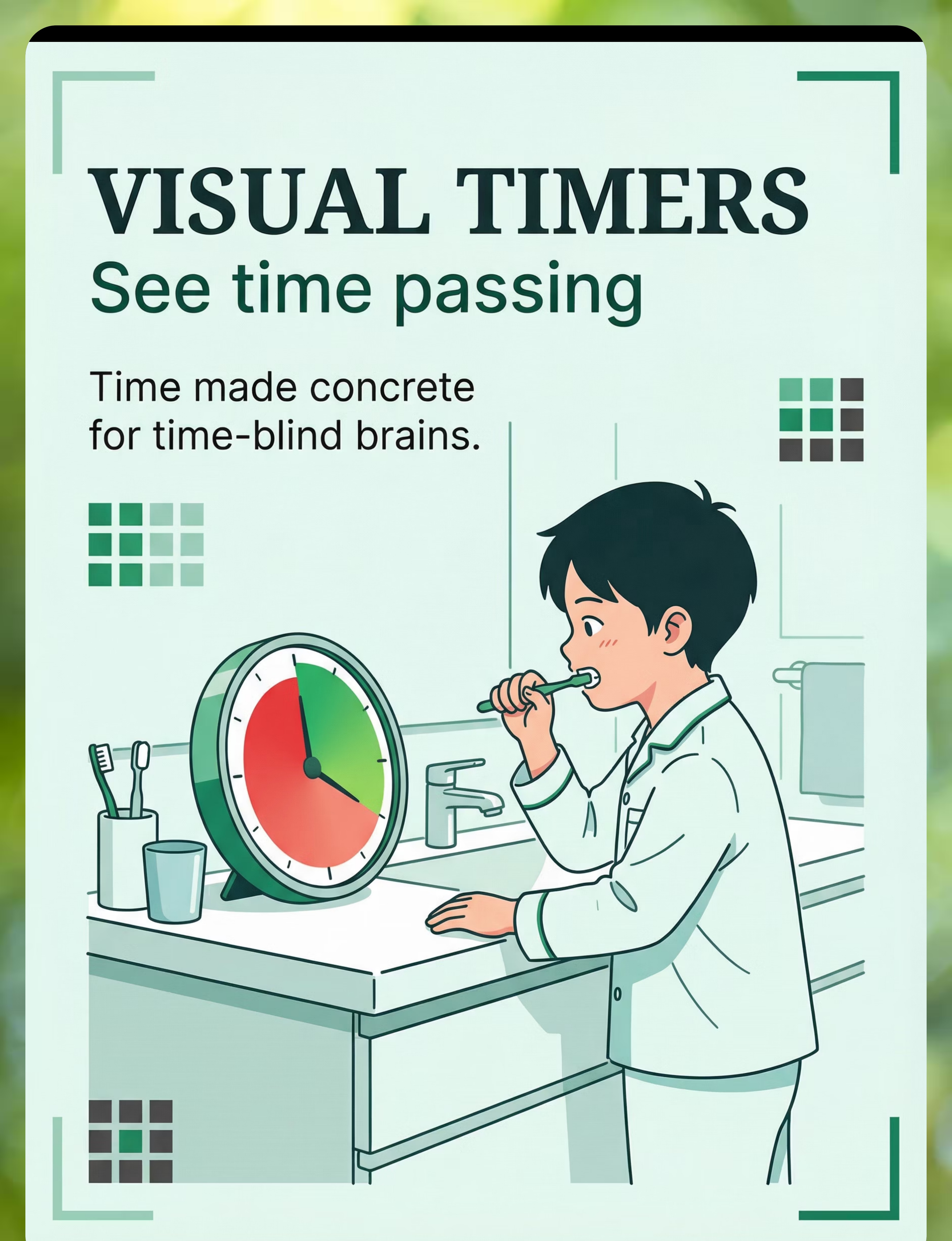
Visual Timers
⏰ Canon Category: Visual Timer
Makes time visible as a diminishing coloured section — not abstract digital numbers. Children with time blindness can see time passing. Essential for step pacing and understanding how long each task should take.
Why It Works
Time blindness is neurological. When children can see time, they can manage it. A visual timer removes the invisible pressure of "hurry up" and replaces it with a concrete, visible countdown the child can track themselves.
Get One
- Price Range: ₹500 – ₹1,500
Material 4 of 9
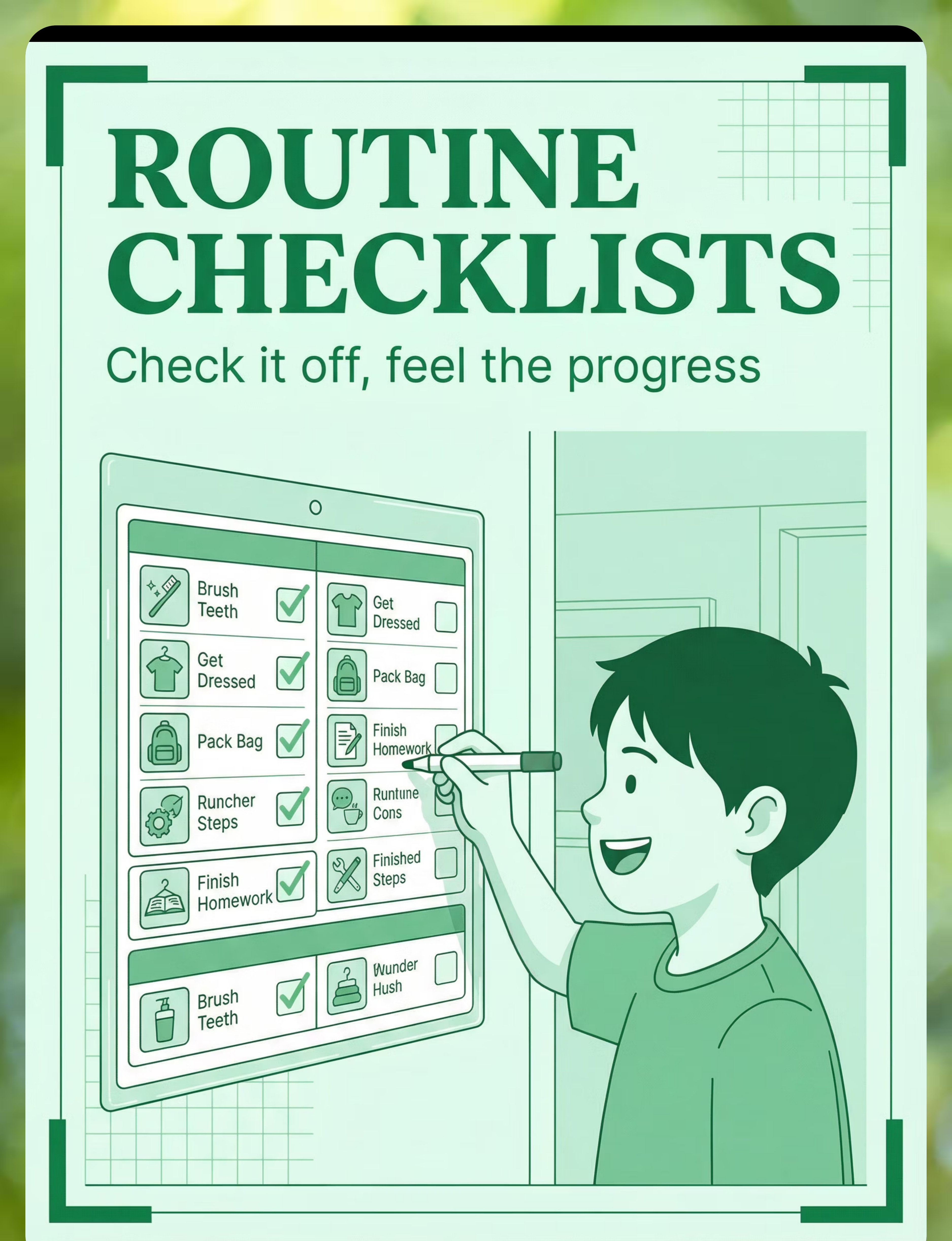
Routine Checklists
✅ Canon Category: Visual Schedule System
An interactive version — the child checks off each step as completed. Provides progress visibility, a sense of accomplishment, and self-monitoring in one simple tool. The laminated dry-erase version is the most sustainable option for daily use.
Why It Works
Each checkmark is a micro-reward. The brain receives a completion signal with every check — a small but real dopamine moment that reinforces the habit of moving through each step. Checking becomes satisfying in itself.
Get One
- Price Range: ₹50 (printed) – ₹300 (laminated with dry-erase marker)
Material 5 of 9
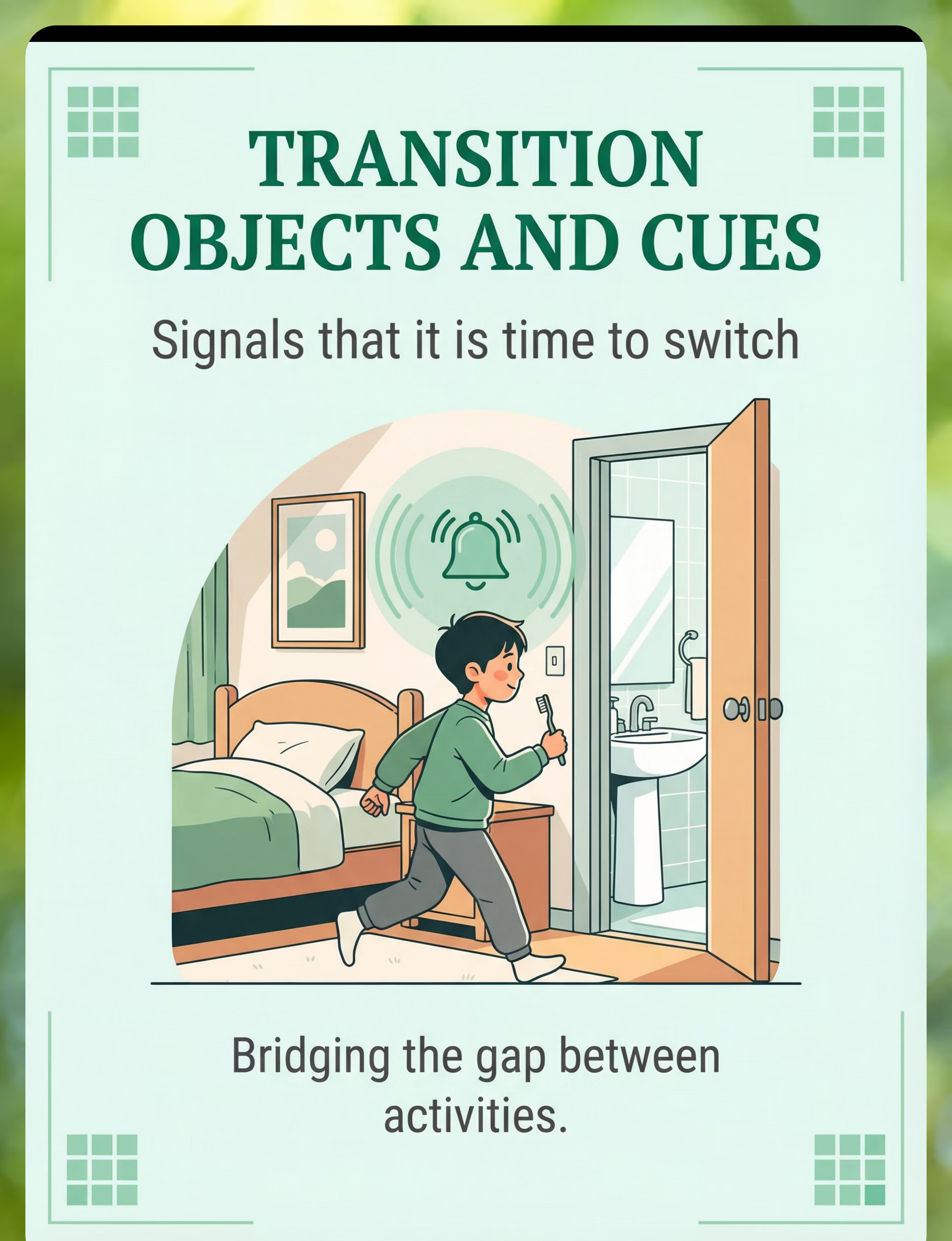
Transition Objects & Cues
🔔 Canon Category: Transition Objects / Comfort Items
Physical objects the child carries from one activity to the next, representing the next step. Plus auditory and visual cues (timer chime, a specific song) that signal "time to switch." Provides the brain with a concrete "switch now" prompt.
Why It Works
Transitions fail when the brain doesn't receive the "switch now" signal. External cues provide what internal signalling doesn't. A consistent object or sound becomes a reliable anchor for moving between routine steps without conflict.
Get One
- Price Range: ₹100 – ₹500

Material 6 of 9
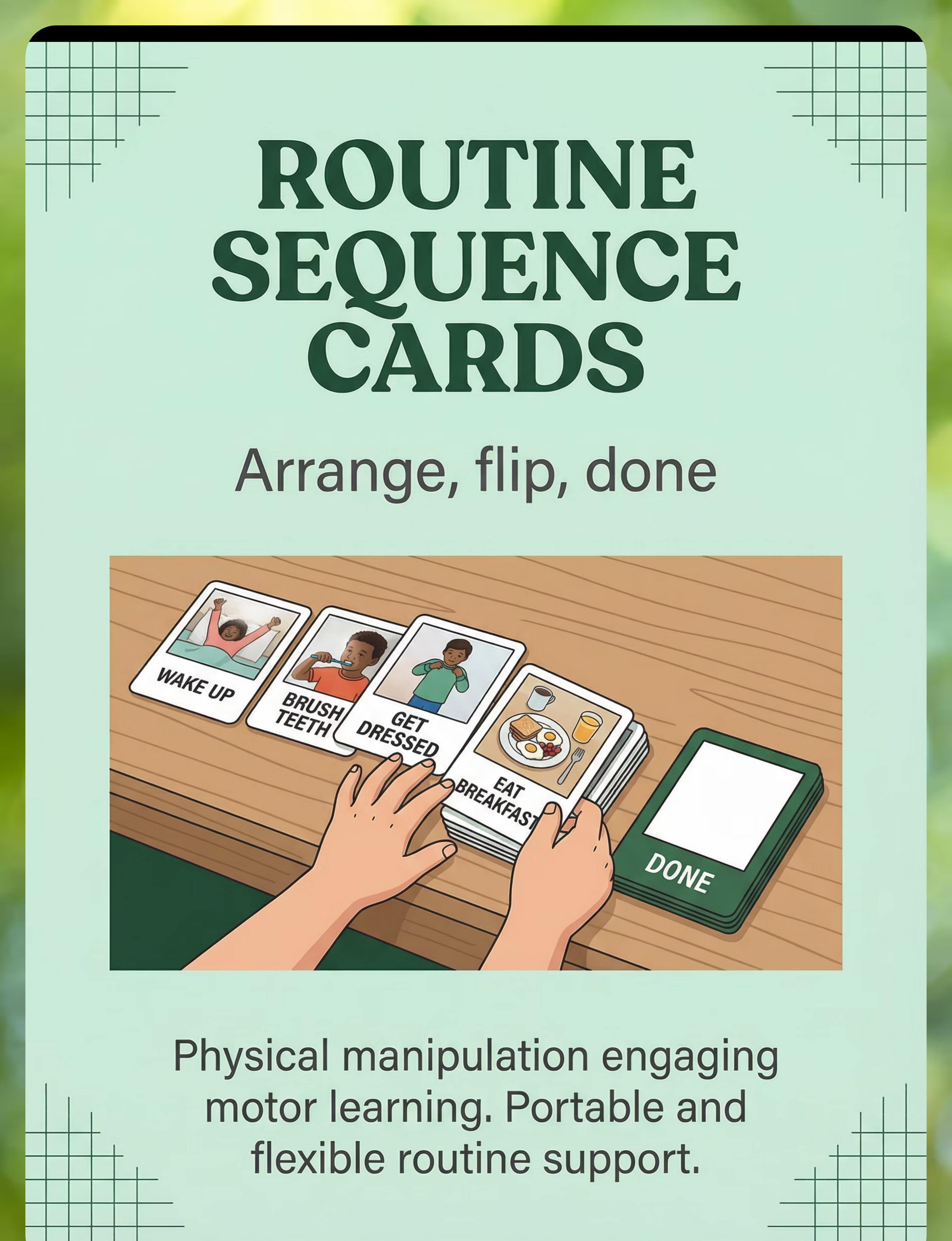
Routine Sequence Cards
🃏 Canon Category: Visual Schedule System
Individual cards — one per step — that can be arranged, touched, and physically moved to a "Done" pile. Physical manipulation adds a kinaesthetic learning dimension. These cards are portable (works on vacation) and flexible (add/remove steps easily).
Why It Works
Physically handling the card for each completed step engages motor learning. Children remember better what they have physically manipulated. Moving a card to the "Done" pile creates a satisfying, tangible sense of progress and completion.
Get One
- Price Range: ₹100 – ₹400 (laminated card set)

Material 7 of 9
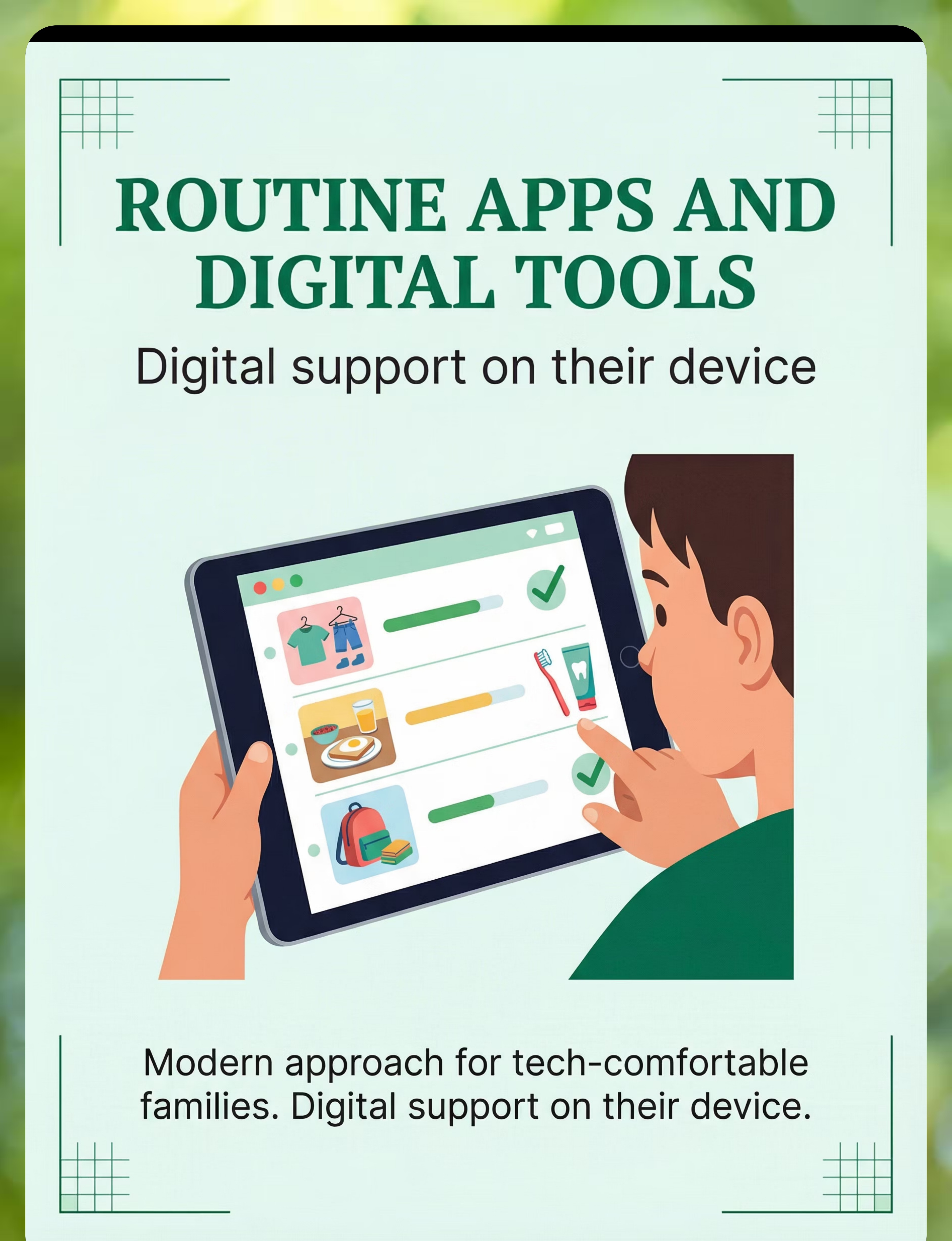
Routine Apps & Digital Tools
📱 Canon Category: Visual Schedule System (Digital)
For tech-comfortable children and families. Routine apps provide visual sequences, audio reminders, celebration sounds, and completion tracking. Works especially well for older children who may resist "babyish" picture charts.
Why It Works
Meets the child where they are. Some children engage far better with digital interfaces — the familiar feel of a tablet or phone can dramatically increase willingness to follow the routine. Note: App support should reduce screen conflict, not create it. Physical charts remain essential for young children.
Recommended Apps
- Choiceworks (iOS/Android)
- Visual Schedule Planner
- Brili
- Price Range: ₹0 – ₹2,000/year

Material 8 of 9
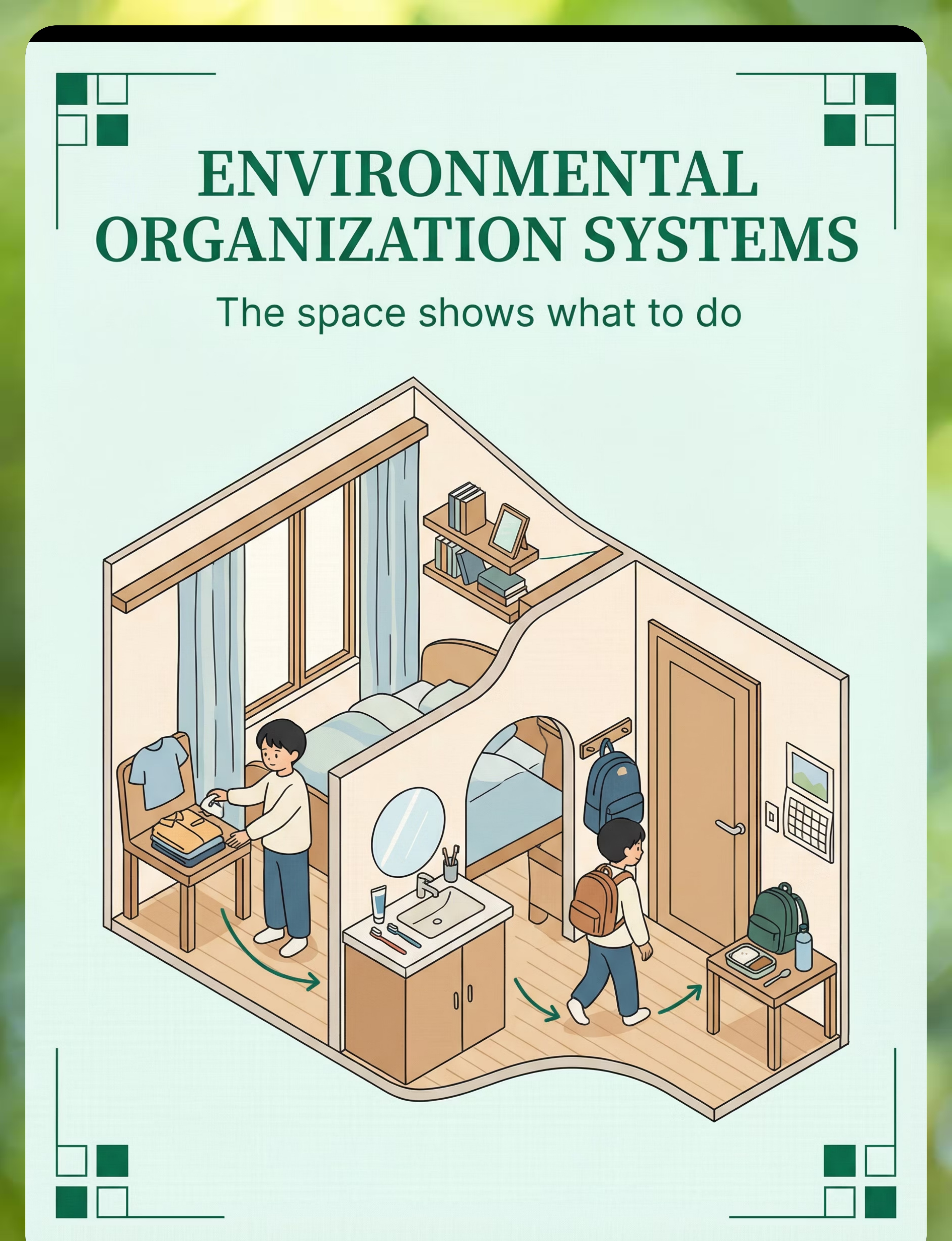
Environmental Organisation Systems
🏠 Canon Category: Visual Schedule System (Environmental)
The space itself becomes the routine cue. Clothes laid out in the getting-dressed area. Toothbrush arranged in order of use. Backpack at the door with a lunchbox spot. When everything needed is organised where the routine happens, the environment guides the child forward.
Why It Works
Eliminates the cognitive load of "where is my...?" — one less demand on working memory that is already at capacity. An organised space reduces friction at every step, making the routine easier to start and easier to sustain independently.
Get Started
- Price Range: ₹200 – ₹1,000 (baskets, labels, hooks)
Material 9 of 9
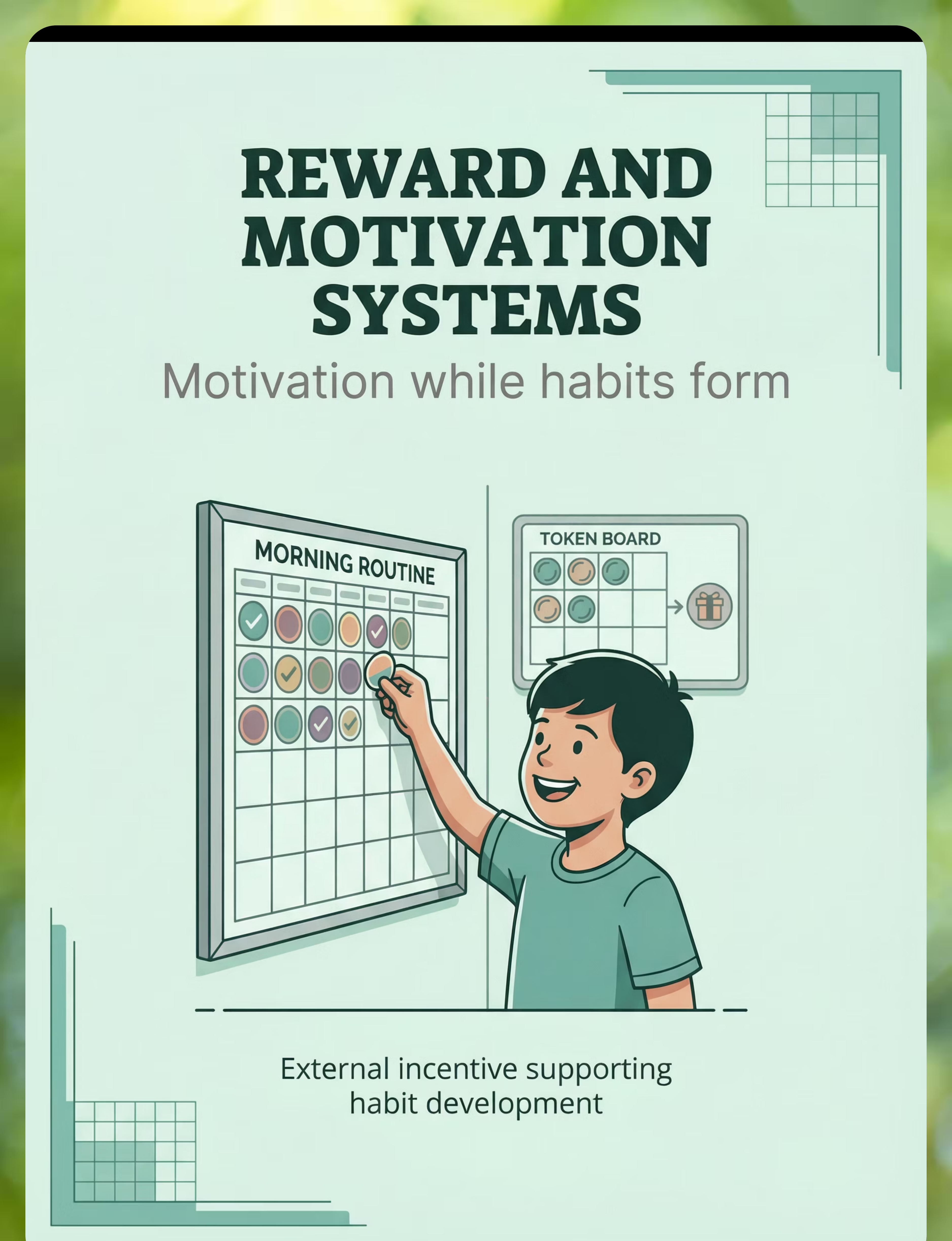
Reward & Motivation Systems
🏅 Canon Category: Reinforcement Menus
Token boards and sticker charts provide external incentive while routine habits are forming. Tokens earned for steps completed. Sticker charts show progress over days and weeks — making progress visible and motivating.
Why It Works
External rewards scaffold internal motivation. The goal is for the routine itself to become rewarding — rewards help bridge to that point. As independence grows, external rewards are faded and replaced by natural reinforcers like having extra time to play before school.
Get One
- Price Range: ₹50 – ₹600
Starter Kit (Minimum Viable Setup): Visual Chart + Visual Timer + Checklist = ₹700–₹2,000 total Budget Option (₹0): Hand-drawn picture chart + phone timer + paper checklist = a complete, clinically effective system
Every Family Can Start Today — Regardless of Budget
Per the WHO Nurturing Care Framework (2018): evidence-based caregiving interventions must be accessible across all economic contexts. These DIY options are clinically equivalent for most families.
Material | Commercial Version | DIY / Household Alternative | |
Visual Routine Chart | ₹400–800 laminated chart | Print photos of your child doing each step → laminate at stationers (₹20/sheet) → ₹80 total | |
First-Then Board | ₹100–350 with velcro | A4 paper folded into two sections → draw headers → tape pictures → ₹0 | |
Visual Timer | ₹500–1,500 Time Timer | Sand timers from toy shops ₹50–150, or phone timer facing child | |
Routine Checklist | ₹150–300 laminated + marker | Notebook + pen → cross off each step daily → ₹0 | |
Transition Cue | ₹100–500 object/chime | A specific song on phone that ALWAYS plays for this transition → ₹0 | |
Sequence Cards | ₹200–400 laminated set | Index cards + drawings + binder ring → ₹50 total | |
Environmental Organisation | ₹200–1,000 bins/labels | Repurposed cardboard boxes → handwritten labels → ₹0 | |
Reward System | ₹200–600 token board | Printed grid + stickers from any shop → ₹30 total |
The Zero-Cost Complete System: Photograph your child doing each routine step → print at local photo shop (₹5–8/photo) → arrange on cardboard with numbered steps → cover with transparent tape → post at child's eye level → use phone sand-timer app (free) → paper checklist daily. Total cost: ₹50–₹100. Clinical effectiveness: equivalent for most children.
Sources: WHO NCF Handbook (2022) | PMC9978394 — CCD Package across 54 LMICs using household materials

Pre-Session Safety Gate — Read Before Executing
🔴 RED — Do NOT Proceed If:
- Child is currently in meltdown or post-meltdown recovery (within 20 minutes)
- Child is hungry, sick, or significantly sleep-deprived
- You are about to force compliance — this system requires child buy-in, not coercion
- Charts have been used punitively — reset the relationship with the tool first
- Child has experienced a recent major change (new sibling, house move, school change)
🟡 AMBER — Modify If:
- Child is mildly tired — shorten routine steps, use First-Then only
- Child is resistant to a specific step — troubleshoot that step separately
- This is the first time introducing visual supports — do a "demo run" at a calm non-routine time first
- Child has sensory sensitivities to materials — adapt materials first
🟢 GREEN — Proceed When:
- Child is in regulated, alert state
- Routine time is not rushed or under external time pressure today
- You have already introduced the visual support as a tool, not a new demand
- You are emotionally regulated — your state directly affects your child's readiness
🛑 Stop If You See: Child becomes severely dysregulated (screaming, self-injury, property destruction) → stop immediately, do not continue, transition to calming strategy, note as data → adjust approach before next session.

60-Second Pre-Routine Readiness Assessment
Check each item before inviting your child to begin the routine. This takes less than a minute and prevents most session failures before they happen.
Child Has Eaten
Within the last 2 hours — hunger significantly impairs executive function and dysregulates even the most settled children
Adequate Sleep
Not significantly sleep-deprived — sleep deprivation collapses working memory and initiation capacity more than almost anything else
Not in Distress
No active crying, meltdown, or shutdown — the nervous system must be in a regulated state to engage with visual supports
Materials Ready
All routine materials are set up before calling the child — never ask a child to wait while you prepare
You Are Calm
You have 5+ minutes of non-rushed time — your regulated state is the single most powerful co-regulator available to your child
✅ ALL GREEN → PROCEED
Warm, low-key invitation: "Ready to try the morning chart?" — not a command, an invitation
🔶 2–3 RED FLAGS → MODIFY
Use First-Then board only (2 steps). Reduce demands. Accept partial completion today.
🔴 4+ RED FLAGS → POSTPONE
Not today. Do a calming activity instead. Note what the obstacles were. Plan for tomorrow.
"Session abandonment is not failure. It is data. If you postpone 3 sessions in a row for the same reason, that reason IS the intervention target — it's telling you what the real obstacle is."

Step 1 of 6
Invite, Don't Command
The Approach
Walk to your child 5 minutes before the routine starts — not at the last second. Get to their eye level. Use a warm, matter-of-fact tone (not cheerleader, not authoritarian — just normal).
Script to Say
"Okay, time for your morning routine. Your chart is ready. Let's go check what's first."
What NOT to Say
- ❌ "Go brush your teeth RIGHT NOW we're going to be late"
- ❌ "Why aren't you ready yet?"
- ❌ "I told you to start ten minutes ago"
Acceptance Signals to Watch For
- ✅ Child follows you to the chart location
- ✅ Child looks at the chart
- ✅ Child makes any move toward the first step
- ✅ Child asks "what does this one say?" — this is engagement!
If Child Resists
⚠️ Child freezes or says "no" → gently guide: "Come look with me, just one look" — lower the demand first. ⚠️ Child protests → acknowledge: "I know mornings are hard. The chart will help." — don't argue.
ABA Principle Embedded: Pairing — establish positive association with the chart before requiring compliance. The first week may just be "come look at the chart with me" — no demands yet. Timing: 30–60 seconds for invitation phase.

Step 2 of 6
First, Look at the Chart Together
1
Week 1–2
Stand beside your child at the chart. Don't touch it — let them discover it. Say: "What does the chart say is first?" Wait 5 seconds. Any identification of Step 1 counts as success.
2
Week 3–4
Child approaches chart independently. You stand nearby but don't initiate. If they go to the chart and identify Step 1 without prompting — this is significant progress.
3
Week 5+
Child goes directly to chart, identifies steps, begins moving through routine. Your role transitions to observer — present but not directing.
Child Response Indicators
- ✅Engagement: Child points to a step, asks about pictures, moves toward first task
- ✅Tolerance: Child allows the chart to be referenced even if not excited
- ⚠️Avoidance: Child looks away, moves away — reduce demands, pair longer before requiring
Reinforcement Cue — Begin Immediately
Whenever child correctly identifies a step from the chart: "Yes! That's right — brush teeth is first! Good looking at the chart!"
Praise the looking behaviour, not just the task completion. The habit of chart-checking is what you are building. Timing: 1–3 minutes for chart orientation.
Sources: NCAEP EBP Visual Supports 2020 | PMC11506176 | ABA Reinforcement Scheduling
Step 3 of 6
The Core Action — Independent Chart Navigation
Child moves through the routine by referencing the chart independently — checking each step, completing it, marking it as done, and identifying the next step WITHOUT verbal prompting from you.
Your Role During This Phase
Physically present but verbally quiet. Available if needed. Not directing.
Script if Child Gets Stuck
Instead of saying "now brush your teeth," say:
"Check your chart — what does it say is next?"
This redirects to the visual support rather than to your voice. You are teaching them to use the tool.
Correct Execution — What to Look For
- ✅ Child looks at chart between steps (not only when stuck)
- ✅ Child uses "done" mechanism (flipping card, checking box, moving velcro)
- ✅ Child's body moves toward each task after chart reference
- ✅ Child's pace is self-generated
Common Execution Errors
- ❌ Parent continues verbal prompting alongside the chart → Chart becomes invisible. Stop verbal prompts entirely.
- ❌ Child does routine but doesn't look at chart → Redirect: "Check your chart first."
- ❌ Chart is too far from where task happens → Move chart to task location. Bathroom chart must be IN the bathroom.
Sources: NCAEP Visual Supports EBP 2020 | PMC10955541 Meta-analysis adaptive behaviour outcomes

Step 4 of 6
The Dose — Daily Repetition With Purposeful Variation
The Magic Number: 21–30 days of consistent chart use before the first signs of internalisation appear. 60+ days before reliable independent routine is typical. Unlike once-a-week therapy activities, routine scaffolding is daily — every morning routine, every bedtime routine, every day.
01
Week 1–2: Consistency First
Same chart, same routine, same materials every day. Build the habit and the association. Do not vary anything yet.
02
Week 3–4: Introduce Gentle Variation
Add one variation (different breakfast, occasional step addition). Child learns the chart adapts to real life.
03
Week 5–8: Begin Fading
Introduce simplified version of one routine. Reduce picture detail on one step. Child begins accessing from memory for familiar steps.
Routine Variations to Build Flexibility
- Occasional "mystery card" (surprise fun step: "Step 7: Dance for 10 seconds")
- Weekend routine card (slightly different — child helps design it)
- Away-from-home routine card (travel, grandparents' house)
"3 Good Routines Beat 10 Forced Ones" — A routine completed with genuine chart engagement and positive emotional experience is worth infinitely more than a routine completed under duress. Protect the positive association.

Step 5 of 6
Reinforce the Behaviour You Want to See More Of
ABA Principle: Celebrate the ATTEMPT before the mastery. In weeks 1–2, any interaction with the chart is worth praising. Don't wait for perfect execution.
Reinforce Chart Checking
"I love how you checked your chart! That's exactly what independent kids do."
Reinforce Step Completion from Chart
"You looked at the chart, you did it yourself — that's amazing!"
Reinforce Full Routine Completion
"You did your whole morning routine with your chart! That took 25 minutes — you're getting faster every week."
Type | Example | Best For | |
Social Praise | Specific verbal celebration | Most children | |
Physical | High-five, fist bump, hug | Sensory-comfortable children | |
Token | Earn a token for chart use | Children needing tangible motivation | |
Activity | 5 extra minutes of preferred activity | Older children | |
Sticker | Add sticker to completion chart | Visual progress trackers |
Token Board Integration: Child earns 1 token for each routine completed with chart (not with verbal prompts). 5 tokens = preferred activity. Token board posted beside the routine chart. Reward Stickers — ₹364 | Reward Jar — ₹589
Fade Plan: As independence grows, shift from external praise to natural reinforcement ("You got ready in time — now you have 10 extra minutes to play"). External rewards → natural consequences → internal satisfaction.

Step 6 of 6
End Every Routine Session with a Closing Ritual
For Sequence Cards
Child moves all cards to "Done" pocket/pile as a final act → "All done! You did all the steps." → Cards stored for next routine. The physical act of completing the pile is its own satisfying ritual.
For Checklist
Child reviews completed checklist → counts the checks → "Look — 8 steps, 8 checks. You did every single one." The counting is a powerful self-monitoring celebration.
For Timer
When timer reaches zero: pause together → acknowledge → "Timer's done. Routine's done. Great work." Do not rush past this moment.
Transition to Next Activity
"Morning routine is all done. Now we eat breakfast together."
Clear, specific, warm transition. No open-ended "good job" and rush off — the closing ritual anchors the success in the child's memory.
Cool-Down Sensory Input
After a challenging routine: 2 minutes of preferred sensory activity (squeeze toy, cushion, outdoor step) to regulate before the next activity demand. Set the visual timer for cool-down itself: "3 minutes to tidy up, then breakfast."
Sources: NCAEP Visual Timer + Transition Support EBP 2020 | Sensory Integration transition theory

60 Seconds of Data. Weeks of Insight.
Guessing progress is discouraging. Measuring progress is motivating. When you record that verbal prompts went from 12/morning to 3/morning in six weeks — that is real evidence that your child is growing.
Date | Routine | Steps Completed | Chart Used? | Verbal Prompts | Duration | |
__ /__ | Morning / Bedtime | ___ / ___ | Yes / No | 0 / 1–3 / 4+ | ___ min |
1
Steps completed from chart
vs. total steps — e.g., "7 of 8 steps without prompting." This is your primary independence measure.
2
Number of verbal prompts used
Target = zero. Tracking the decline week over week IS the progress story. Every reduction matters.
3
Routine duration
Target = decreasing over weeks. From 90+ minutes to 25–30 minutes is a realistic 8-week goal for many children.

Every Challenging Session Has a Diagnosis
When things don't go as planned, the problem itself is diagnostic data. Each obstacle below has a specific root cause and a specific fix.
❓ Child ignores the chart and waits for my voice
Why: Child has learned that waiting for the verbal prompt is easier than using the chart. The verbal prompt is outcompeting the chart. Fix: For 1 week, when child waits, say "Check your chart" — redirect every single time. Do not provide the next step verbally. The chart must become the only available source of sequence information.
❓ Chart worked for 3 days then stopped
Why: Novelty effect. Chart lost its "new" status. Also: child may have detected that verbal prompts resumed. Fix: Re-introduce with child's involvement — "Let's update the chart together. What should Step 3 picture be?" Ownership increases engagement dramatically.
❓ Child can't identify pictures/icons on the chart
Why: Icons are too abstract for this child's processing level. Fix: Replace with photos of the actual child doing the actual task. Concrete photos > clipart > icons for children with ASD or young children.
❓ Child gets stuck at specific transitions
Why: That transition point has a specific obstacle — sensory difficulty, preference conflict, or sequencing challenge at that step. Fix: Add a transition object for that specific step, or break that step into 2 smaller steps on the chart.
❓ Chart works on good days but fails on hard days
Why: Executive function is state-dependent. On dysregulated days, ALL executive function systems work less well. Fix: Have a simplified "tough day chart" — just 3–4 steps, First-Then format. Lower demand on hard days.
❓ Other caregiver bypasses the chart
Why: Inconsistency. Chart system requires ALL caregivers to redirect to chart. Fix: Share this page with all caregivers. Post a note beside the chart: "Please say 'check your chart' instead of telling steps." Consistency is non-negotiable.
Progress Tracking
Weeks 1–2 — Foundation Setting
PROGRESS: ██░░░░░░░░ 15%
✅ What Progress Actually Looks Like
- Child tolerated chart being posted without protest
- Child looked at the chart when you pointed to it
- Child completed even 2 steps from the chart before needing verbal support
- One morning was less of a battle than usual
❌ What Is NOT Progress Yet (Don't Expect)
- Independent chart navigation
- Routine completion without any prompting
- Child remembering to check chart spontaneously
"It feels like nothing is working. I'm still doing everything." This is normal and expected in weeks 1–2. The chart is being encoded as a source of information. Neural pathways for new habits take 3–6 weeks to begin consolidating.
Data Target (Week 1–2): Track chart introduction → establish baseline verbal prompt count per routine → this is your starting number. Everything forward is improvement relative to this baseline. Reassurance: "If your child tolerated the chart being present for 3 days in a row without protest — that is real neurological work happening. Honour that."
Sources: PMC11506176 — Intervention outcomes emerge across 8–12 week timelines
Progress Tracking
Weeks 3–4 — The Neural Pathways Are Forming
PROGRESS: ████░░░░░░ 40%
Consolidation Indicators — Look For These
Spontaneous Chart Approach
Child walks toward chart location before you say anything — a significant milestone signalling internalisation has begun
Verbal Step Identification
Child verbally identifies the next step from the chart: "First I brush teeth" — using the chart as a language scaffold, not just a visual one
Declining Verbal Prompts
Prompts from you are reducing — even if just from 12 to 8 per routine. Any reduction is neurological evidence of progress.
Anticipatory Behaviour
Child reaches for sticker/marker before you prompt, or predicts a familiar step before reaching the chart — early generalisation signal
When to Increase Intensity
If child is engaging well with chart in ONE routine → introduce chart to a SECOND routine (add bedtime chart if morning is working).
If child is completing 5+ steps independently → add visual timer alongside chart.
Parent Milestone
"You may notice you're talking less during the routine. Less reminding, less repeating. That quiet is progress."
Compare verbal prompts (Week 1 baseline) to current week. Any reduction — record and celebrate.
🏆 Mastery Zone
Weeks 5–8 — Watching Independence Emerge
PROGRESS: ████████░░ 75%
Mastery Criteria — Specific, Observable, Measurable
✅ Unprompted Initiation
Child initiates chart reference WITHOUT any prompt from parent for 5+ consecutive routine days
✅ Minimal Verbal Prompts
Reduced to 0–1 per routine, down from baseline of 10–15
✅ Time on Track
Routine completed within expected time frame vs. 2× longer at baseline
✅ Self-Correction
Child self-corrects a skipped step by returning to chart — self-monitoring emerging
✅ Unassisted
Child completes routine even when parent is not in the same room
Generalisation Indicators
- Child references the chart at school or at grandparents' home (generalisation across settings)
- Child asks for a chart for a NEW routine they're struggling with (skill transfer)
- Child explains to a younger sibling how the chart works (full internalisation)
Maintenance Check: What happens if you don't set up the chart one morning? If child asks where the chart is — internalised system. If child reverts to waiting — chart is still needed (this is normal and fine). At Week 5–8 mastery: consider moving to a simplified chart version to begin the fade-down sequence.
Sources: PMC10955541 | BACB Mastery Criteria Standards
You Did This.
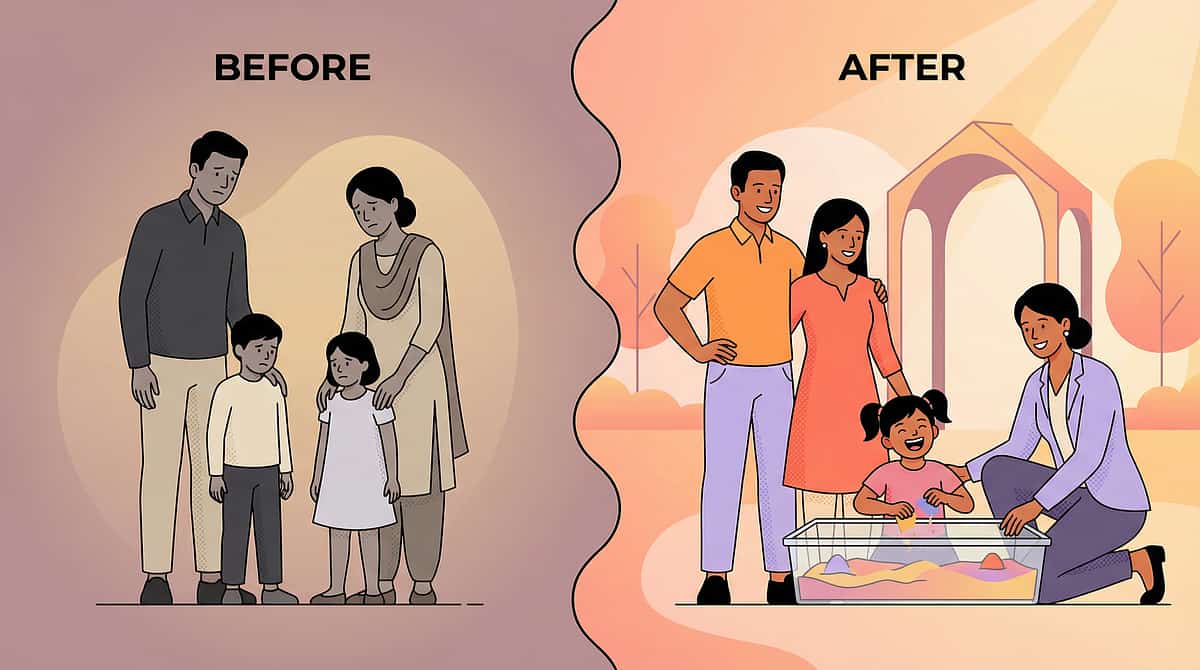
Six weeks ago: Your child stood frozen between steps, waiting for your voice. You were the external brain for their daily routine — exhausted, repeating, reminding. Today: Your child looks at the chart. Moves through steps. Checks off completions. Navigates transitions. The routine is in the environment now — not just in your voice.
You built a visual scaffolding system. You introduced it with patience. You redirected "tell me what to do next" to "check your chart" hundreds of times. You tracked data. You adapted when things didn't work. You were consistent. That is clinical-grade parenting. That is exactly what Pinnacle's 70+ centres train therapists to do — and you did it at home.
🎓 Family Celebration Suggestion
Have a "chart graduation" — create a new, more advanced chart together. Child designs it. This makes the progression visible and celebrates independence, not just compliance.
📓 Journal Prompt
"Today my child [specific behaviour] for the first time without me prompting them. Six weeks ago [contrast behaviour]. Here is what changed: [what you did differently]."
🌐 Community Celebration
Share your progress in the Pinnacle Parent Community → pinnacleblooms.org/community | Call your therapist: 📞 9100 181 181

Know When to Pause and Seek Professional Guidance
🚨 Red Flag 1: Increasing Distress
Child's distress during routine attempts is INCREASING (not decreasing) after 3+ weeks of consistent chart use. Action: OT consultation — may indicate sensory processing component requiring clinical assessment before home intervention continues.
🚨 Red Flag 2: New Anxiety or Avoidance
Child develops new anxiety or avoidance behaviours around routine times that were not present before. Action: Review approach — possibly too many demands too fast. Teleconsult before continuing. Anxiety escalation overrides routine building.
🚨 Red Flag 3: Self-Injurious Behaviour
Child's self-injurious behaviour or aggression occurs during routine transitions. Action: Stop routine intervention immediately. Requires functional behavioural assessment (FBA) by BCBA. Call 9100 181 181 now.
🚨 Red Flag 4: Significant Family Impact
Routine difficulties significantly impact school attendance, sleep quality, or family functioning after 8 weeks of consistent implementation. Action: Comprehensive evaluation. This may indicate a severity level requiring clinic-based intensive support.
🚨 Red Flag 5: Zero Progress at 8 Weeks
Child aged 8+ has zero independent routine completion after 8 weeks of consistent visual support use. Action: OT evaluation for executive function profile. May need a more intensive or individualised approach.
"Trust your instincts. If something feels wrong across multiple days — pause and ask. You know your child better than any chart does."

More Techniques in Your Child's Domain
Daily Living Skills × Executive Functioning × Adaptive Behaviour — If you have the visual chart system from K-920, you already have the primary materials for K-921, K-922, and E-540. Zero additional investment needed.
Three Families. Three Journeys. One Truth.
Mumbai | Child: 7 years, ADHD presentation
Before: "Every single morning took two hours. I was saying the same eight words in the same order every ten minutes. Brush teeth. Wash face. Get dressed. He knew the routine perfectly — he could recite it. But without me standing there directing every step, he just wandered."
After (8 weeks): Morning routine completed in 28 minutes. Parent verbal prompts went from 14/morning to 1–2. Child now checks the chart independently.
OT's Notes: "Classic working memory + initiation profile. The visual chart served as his external prefrontal cortex."
Hyderabad | Child: 9 years, ASD Level 1
Before: "Bedtime was a two-hour ordeal every night. I'd say 'get ready for bed' and she'd just sit on her bed. Not defiant — she genuinely didn't know how to start. Pyjamas, teeth, bathroom, book — I had to say each one, wait, say the next. Every night. For years."
After (6 weeks): Child completes bedtime routine with chart in 35–40 minutes with no verbal prompts. Has begun anticipating steps before reaching the chart.
Delhi | Child: 5 years, Developmental Delay
Before: "She couldn't do any part of her morning routine independently. She needed hand-holding through every single step."
After (12 weeks): Independent morning routine completion with photo chart. Parent transitions from "directing" to "available but not directing."
"Within 3 weeks she was pointing to each picture before doing the step. Within 6 weeks she was moving through the steps on her own."
Individual results vary. These are illustrative cases based on clinical profiles observed in Pinnacle's network. Names and identifying details anonymised.
You Don't Have to Navigate This Alone
Pinnacle Parent Community
Connect with families navigating the exact same challenge — consistent routines and executive function support.
Online Support Forums
- unknown link
Peer Mentoring Programme
Connect with a parent who has successfully built routine independence at home using visual supports. Pinnacle's peer mentoring programme matches by child age, diagnosis/presentation profile, and technique stage (Week 1–2 vs. Week 5–8).
Local Pinnacle Parent Meetups
Monthly parent circles at Pinnacle centres cover routine support, visual schedules, and executive function strategies. Free for enrolled families.
"Your experience is someone else's lifeline. Families in week 1 need to hear from families in week 8. Consider sharing your progress in the community."
📞FREE National Autism Helpline: 9100 181 181 (16 languages • 24×7)

Home + Clinic = Maximum Impact
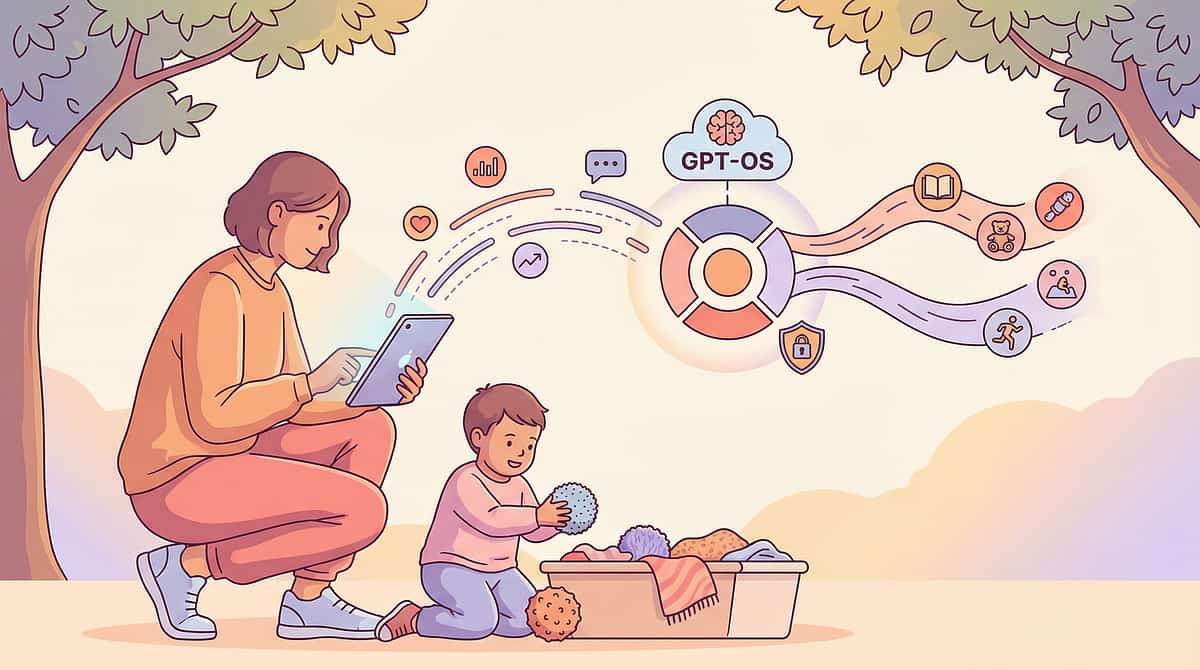
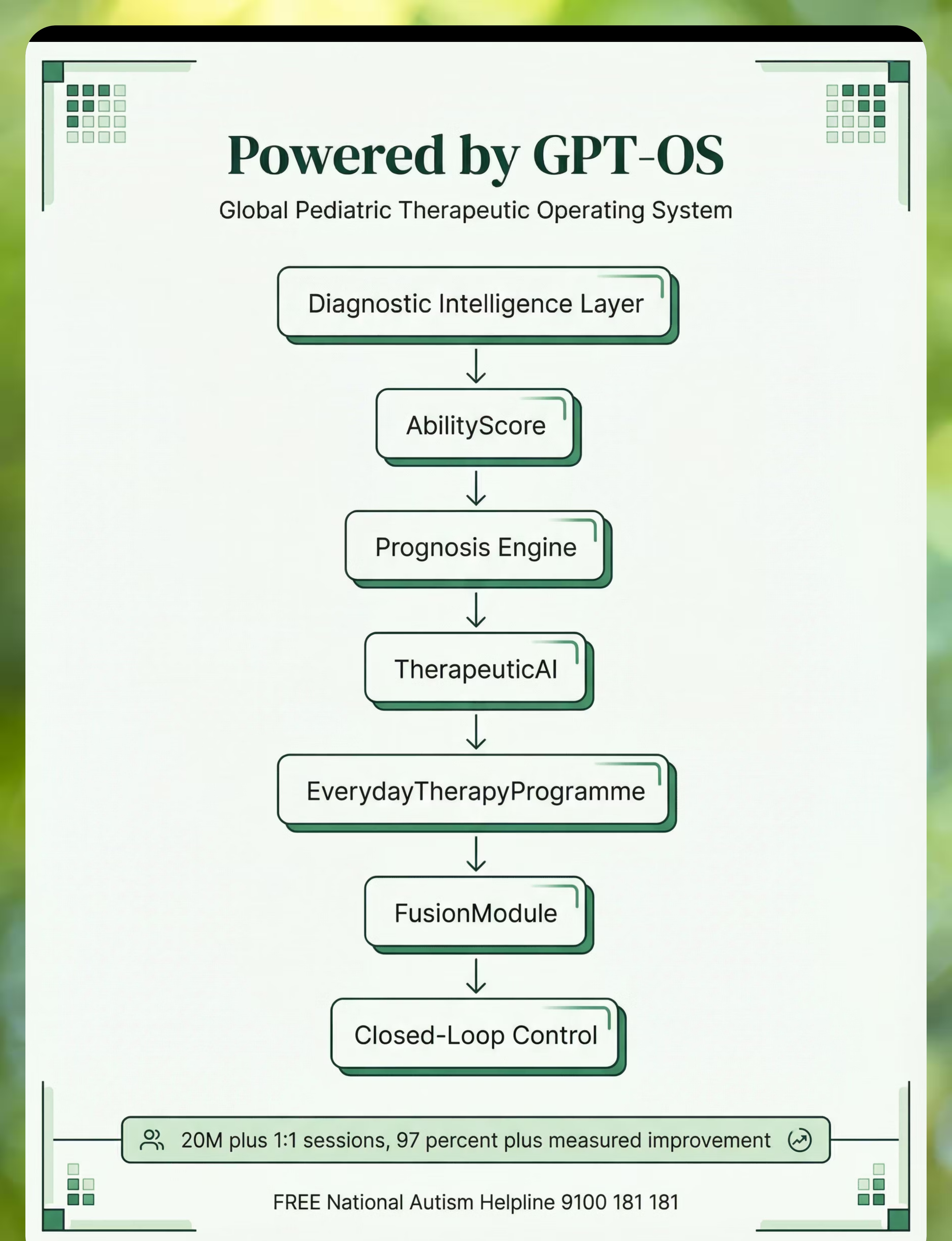
Home-based visual support is powerful. Clinic-guided home support is transformative. The combination is what GPT-OS® was built to deliver.
Occupational Therapist (Primary)
Visual routine design, daily living skills assessment, executive function evaluation, environmental modification guidance.
BCBA / ABA Therapist (Supporting)
Reinforcement system design, data collection protocol, behaviour support during transitions.
Special Educator (Supporting)
Cross-setting implementation (home-school chart consistency), IEP integration, classroom visual schedule design.
Teleconsultation (Remote)
For families outside major cities or with mobility limitations — full professional support delivered remotely.
📞FREE National Autism Helpline: 9100 181 181 — Available in 16 languages | 24×7 | Free for all families AbilityScore® Assessment: pinnacleblooms.org/abilityscore

Your Sessions. Your Data. Your Child's Better Outcomes.
What GPT-OS® Learns from K-920 Data
- Rate of verbal prompt reduction over time (working memory compensation trajectory)
- Which routine times correlate with better performance (optimal intervention windows)
- Whether visual timer or chart alone produces better outcomes for your child's profile
- Comparison to 20M+ session population patterns
Privacy Assurance
All data is anonymised at population-level aggregation. Individual family data is encrypted and visible only to your assigned therapy team. Pinnacle complies with Indian IT Act (2000) data protection standards.
Population-Level Impact
"Your child's data helps every child like yours. When 21 million sessions contribute to the algorithm, the precision of recommendations for the next child improves. You are part of something larger than one family's journey."
Sources: Digital health interventions for ASD — 21 RCTs, 1,050 participants (2024 meta-analysis) | GPT-OS® patent applications across 160+ countries

See These Materials in Action
Reel K-920
Daily Living & Independence — Episode 920
K-920 is part of the Pinnacle 999 Reels Master — the world's largest library of 60-second paediatric therapy material education reels, organised across 12 developmental domains and 999 parent-facing topics.
Related Reels in This Series
E-540 ▶
9 Materials for Morning Routines
E-541 ▶
9 Materials for Bedtime Routines
E-548 ▶
9 Materials for Visual Routine Schedules
D-371 ▶
9 Materials for Rigid Routines
H-706 ▶
9 Materials for Classroom Routines
NCAEP Note: Video modelling is classified as an Evidence-Based Practice for autism. Watching demonstration reels alongside reading technique pages activates multiple learning modalities — visual, auditory, text — for stronger parent skill acquisition.

Consistency Across Caregivers Multiplies Impact
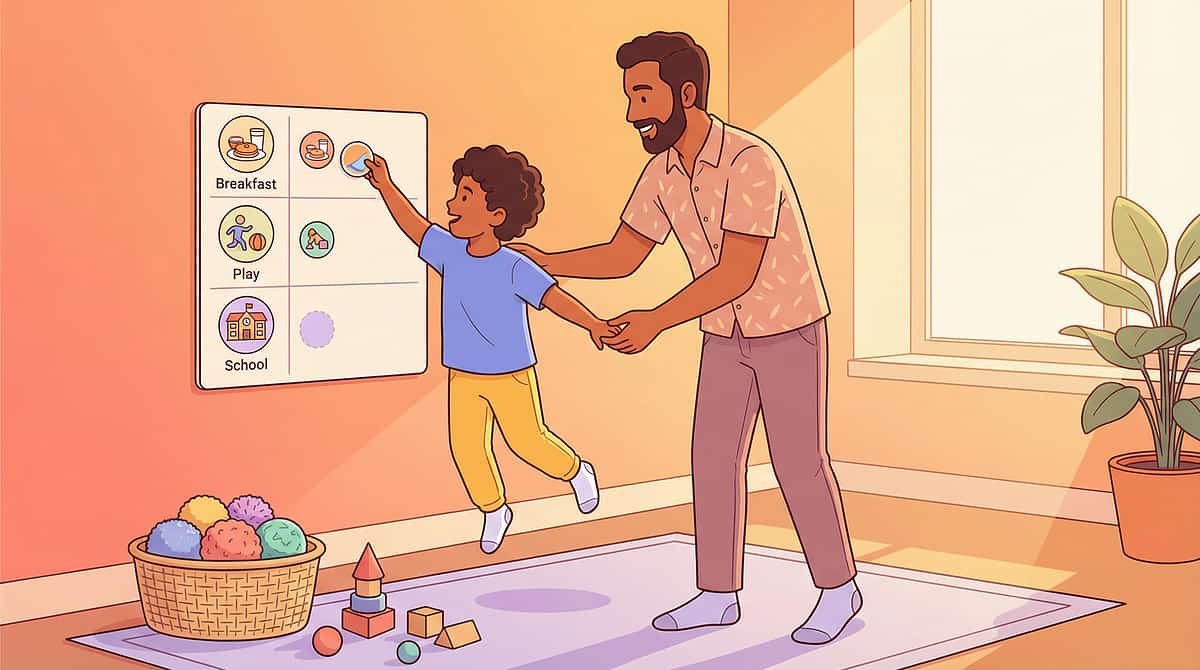
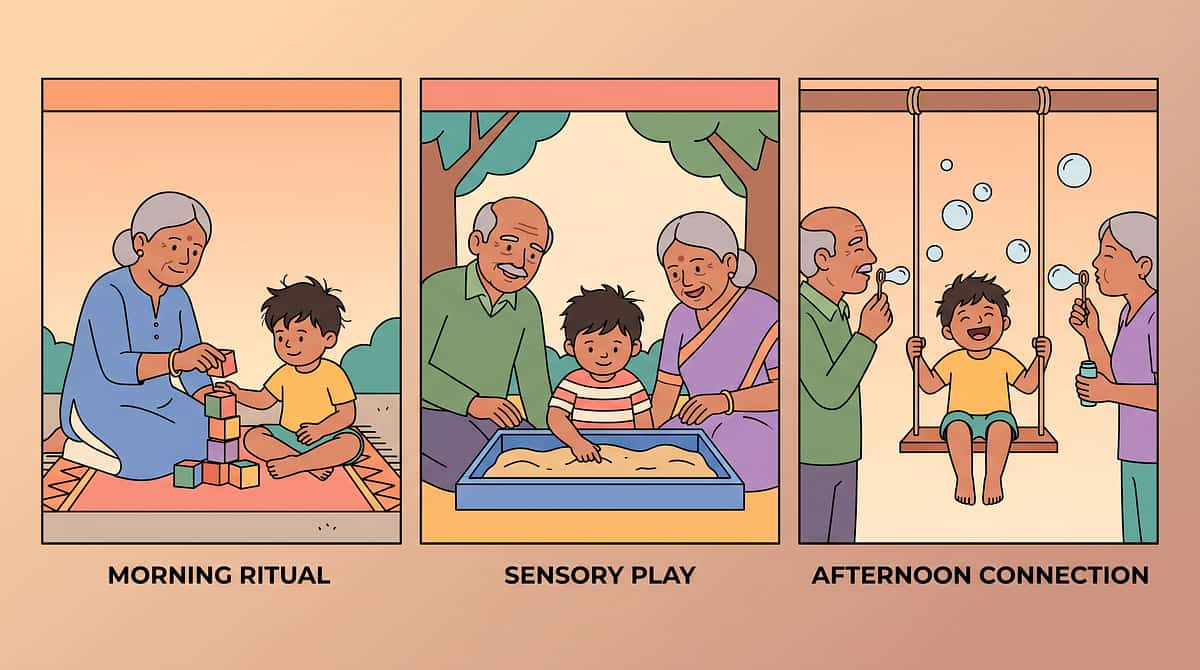
If the morning chart works when you're home but grandparents bypass it with verbal prompts on the days you work — the child learns: "Visual chart = optional." This undermines the entire system. Every caregiver who interacts with your child during routine times needs one message: "Say 'check your chart' instead of telling them the steps."
"Explain to Grandparents" Summary
"We're using a picture chart to help [child's name] remember their routine. When they seem stuck between steps, please say 'Check your chart!' and point them to it — not 'brush your teeth now.' This is their therapist-recommended approach. It's helping them become independent. Thank you for supporting it!"
Teacher/School Communication Template
"Dear [Teacher], [Child's name] uses a visual routine chart system at home (Pinnacle K-920). We would appreciate a consistent chart in the classroom for morning arrival and transitions. Redirecting to the chart ('Check your chart') rather than verbal step-by-step prompting is the clinically recommended approach. Our OT can provide a brief consultation if helpful."
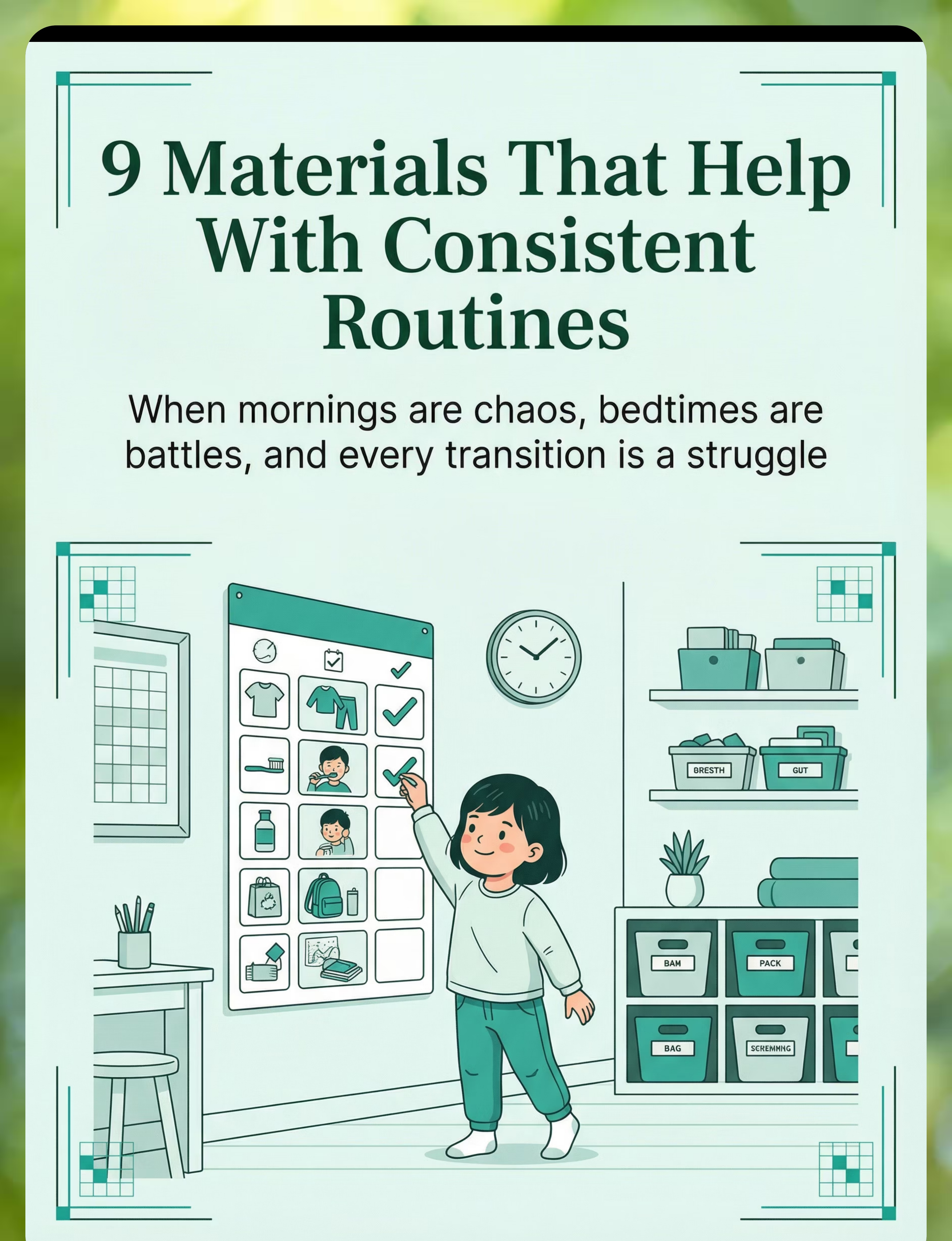
Preview of 9 materials that help with consistent routines Therapy Material
Below is a visual preview of 9 materials that help with consistent routines therapy material. The pages shown help educators, therapists, and caregivers understand the structure and content of the resource before use. Materials should be used under appropriate professional guidance.


Link copied!

Questions Parents Actually Ask
Answers to the most common questions from families implementing K-920 across Pinnacle's 70+ centre network.
Q: My child does the routine perfectly when I'm watching but falls apart when I step away. Why?
Your presence is a prompt. You are part of the stimulus environment that triggers the routine. The goal is to transfer this prompt from your physical presence to the visual chart. Gradually introduce brief absences ("I'll be in the kitchen — check your chart if you get stuck") and extend duration over weeks. Do not disappear suddenly — fade systematically.
Q: How long before I see real results?
Expect meaningful change in verbal prompts and routine duration by Week 4–6 with daily consistent implementation. Full independence typically takes 3–6 months depending on the child's profile and consistency of implementation. Children with more significant executive function challenges may take longer — this is not failure.
Q: My child is 11. Is it too late to introduce visual supports?
No. Visual supports work across all ages. For older children, app-based versions (Brili, Choiceworks) or simple word checklists are more age-appropriate than picture charts. The fundamental mechanism is the same at 11 as at 5. Many adults with ADHD use calendar and checklist systems throughout their lives.
Q: How many steps should be on the chart?
Start with the minimum viable number. For most children under 7: 3–5 steps maximum. For ages 8–12: 6–10 steps. The chart must be short enough not to overwhelm. If the first chart fails, reduce steps before anything else. You can always add steps as the child masters the short version.
Q: Should I use photos of my child or generic icons?
For children with ASD or young children (under 6): use photos of the actual child doing the actual task in the actual environment. The specificity is critical. For neurotypical children or older children: icons or words work. If generic icons aren't working, switch to photos. Photo specificity almost always increases engagement.
Q: When do I take the chart down?
Don't rush it. Keep the chart until the child consistently completes the routine independently for 3–4 consecutive weeks. Then move to a simplified version (fewer steps, words not pictures) before removing entirely. Many children benefit from having a "backup chart" available even after internalisation — especially for disrupted routines (travel, illness, season changes).
Q: My child refuses to look at the chart. What do I do?
Don't make looking a battle. Reduce the demand. Start by making the chart a game: "Let's see what Step 1 says!" — curiosity, not compliance. Second, involve the child in creating or updating the chart — ownership increases engagement dramatically. If refusal is persistent, involve a therapist. There may be an assessment or approach change needed.
Q: Our routine changes on weekends/holidays. How do I manage that?
Create a separate "Weekend Routine Chart" with different steps. Labelling it clearly as "Weekend" helps the child understand variation is expected. This actually teaches flexibility — understanding that different days have different sequences. It is harder than a single routine, but the cognitive benefit is worth it.