

9 Materials That Help With Concept Development
Building the mental categories that make learning possible
Cognitive Foundations – Episode 989
Ages 2–8 Years
Concept Formation + Cognitive Development + Pre-Academic Skills
Does This Sound Like Your Child?
"My child can name things but doesn't understand categories. She knows 'apple' and 'banana' but doesn't get that they're both 'fruit.' She can count objects but doesn't understand 'more' or 'less.' Colors, shapes, sizes, same and different – these basic concepts that other kids just pick up seem to elude her. School readiness assessments show she's behind in 'concepts' but I don't even know what that means or how to teach it."
If this resonates, you are not alone — and you are in exactly the right place. Concept development is the invisible architecture of thinking, and it can be taught. The right materials make all the difference.

The Hook: Concepts Are Invisible
What We Mean by "Concepts"
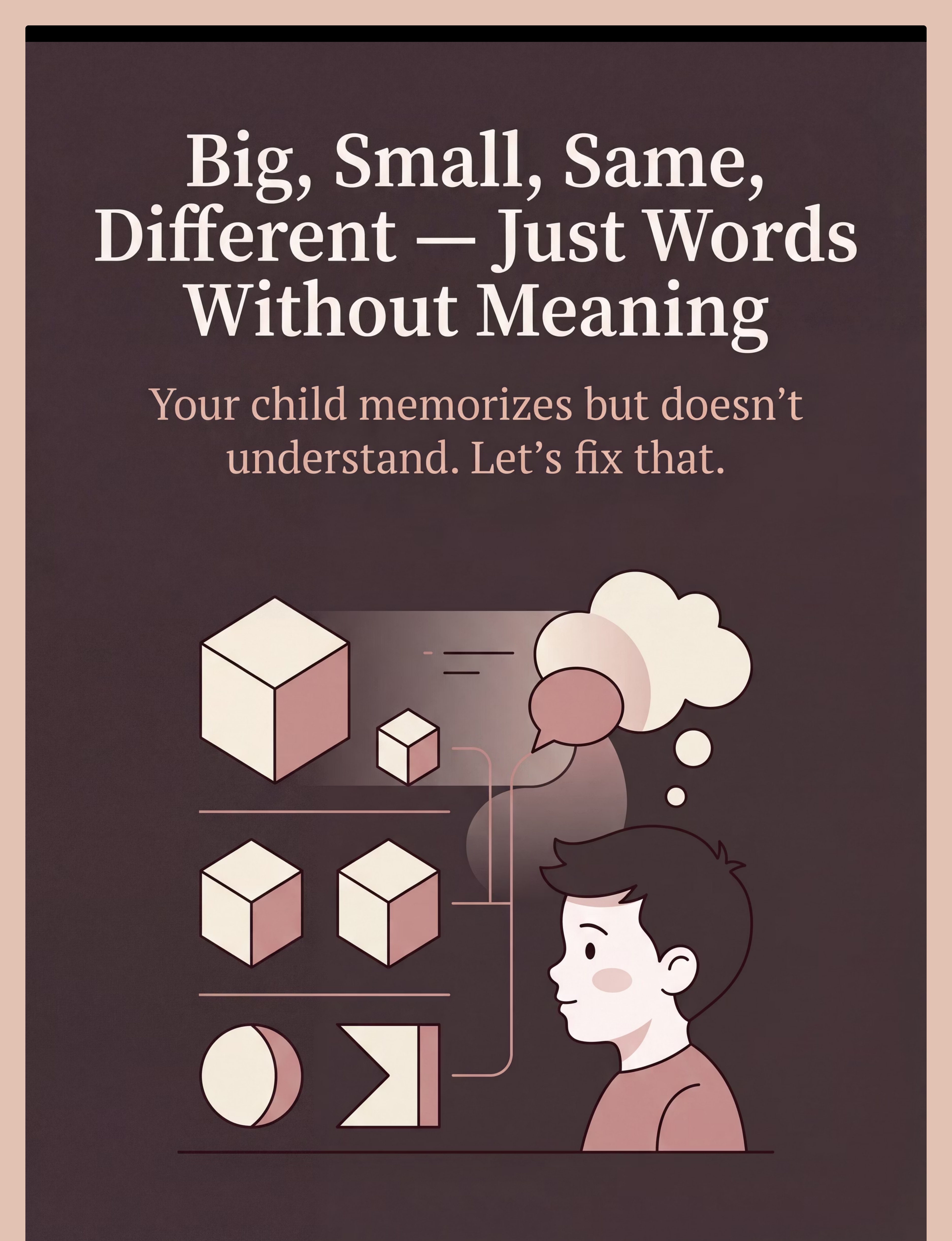
Same and different. More and less. Before and after. These concepts seem completely obvious — until you try to teach them to a child who doesn't yet grasp them.
You can't point to "bigger." You can't hold "same." But you can teach concepts with the right materials. Every direction. Every story. Every math problem. They all require concepts.
Categories, Comparisons, Relationships
These are the invisible architecture of thinking. Children who struggle with concept development aren't struggling with specific facts — they're struggling with the mental organization that makes learning possible.
The good news: concepts become concrete when you can touch them, sort them, measure them, and compare them. These 9 materials make that possible.

What Is Concept Development?
Clinical definition: Concept development refers to the cognitive ability to mentally organize information into categories based on shared attributes, understand relationships between objects and ideas, and apply abstract rules to new situations.
Concepts are the building blocks of thought — mental representations that allow us to group similar things together, distinguish between different categories, understand properties and attributes, and grasp relationships like size, position, quantity, and time.
Concept development progresses from concrete to abstract: children first understand concepts through direct sensory experience, then develop mental representations, and finally can reason about concepts without physical referents. Strong concept development is foundational for language comprehension, academic learning, problem-solving, and everyday reasoning.
A Parent's Voice: The Kindergarten Question
"My son is five and starting kindergarten next year. His preschool teacher says he struggles with 'basic concepts' — and now I'm realizing how much I took for granted. He can identify individual objects, but he doesn't understand that a dog, cat, and fish are all 'animals.' He knows the color of his shirt today, but can't tell me which crayon is 'darker.' He counts to twenty but doesn't understand 'first' and 'last.'"
The Parent's Real Question
Same and different, big and small, before and after, over and under — these relational concepts that seem so obvious to adults are genuinely confusing to a child whose concept foundations haven't yet formed. When you try to teach him, you realize: how do you explain why an apple and an orange are 'the same' and 'different' at the same time?
Why It Matters So Much
Everything in school depends on these concepts — following directions, understanding stories, doing math, learning to read. Concepts are not one subject area; they are the invisible scaffolding of all academic learning. The question every parent arrives at: What materials make the invisible visible?
Material 1 of 9
Categorization
Sorting Trays and Classification Sets
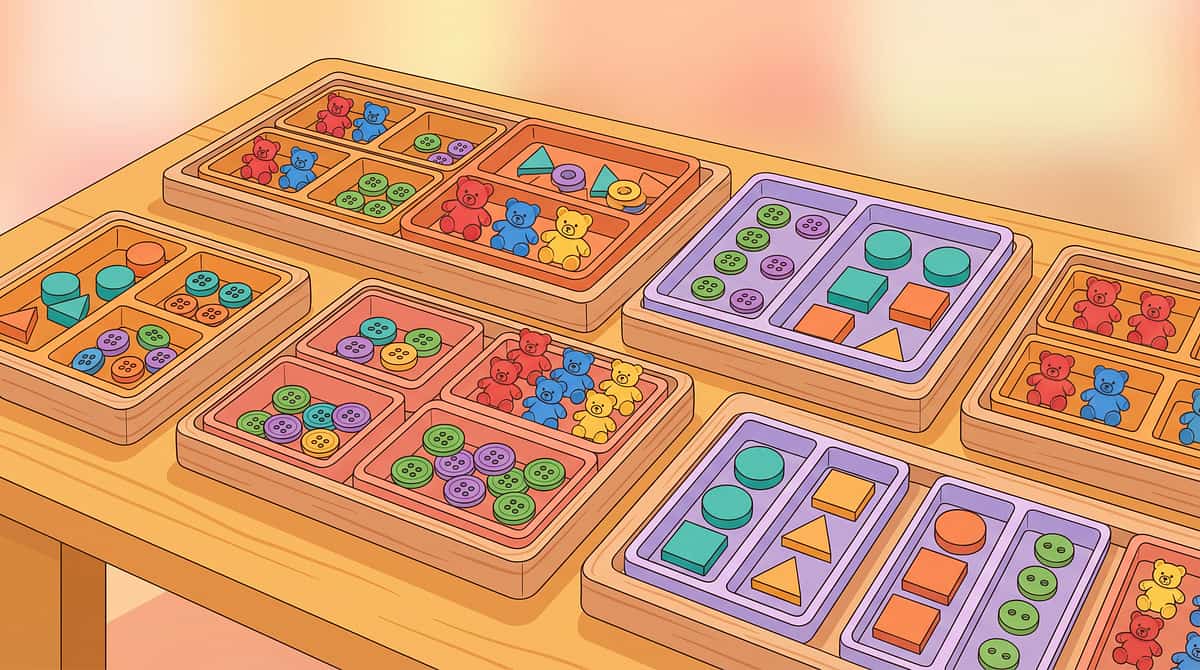
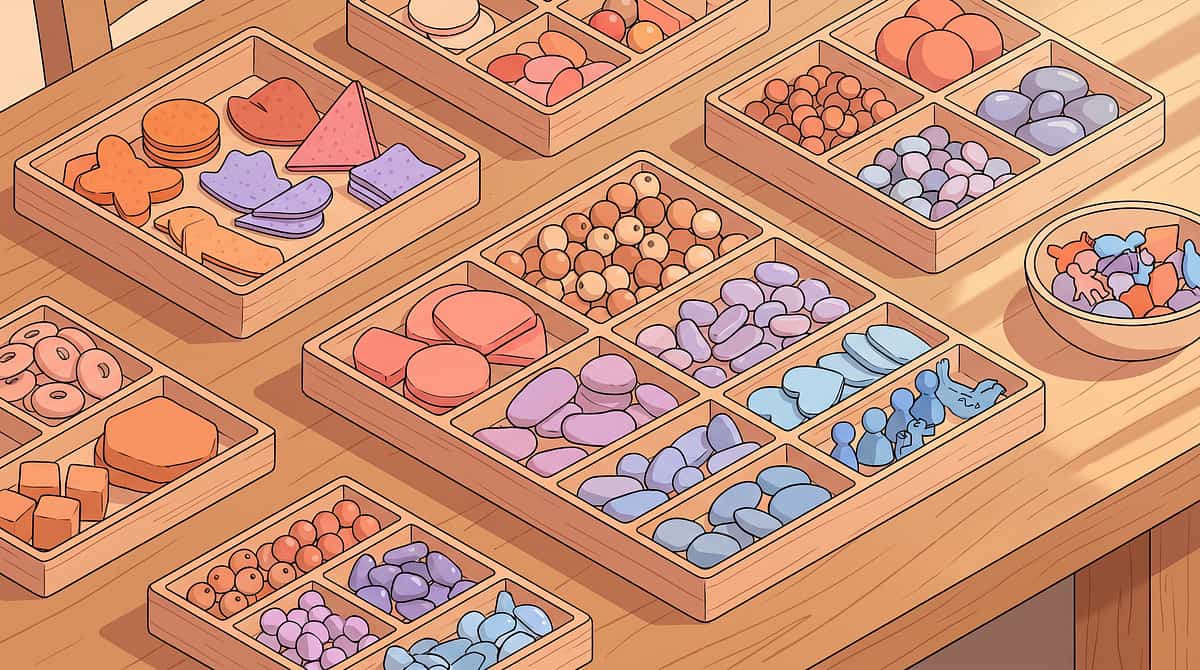
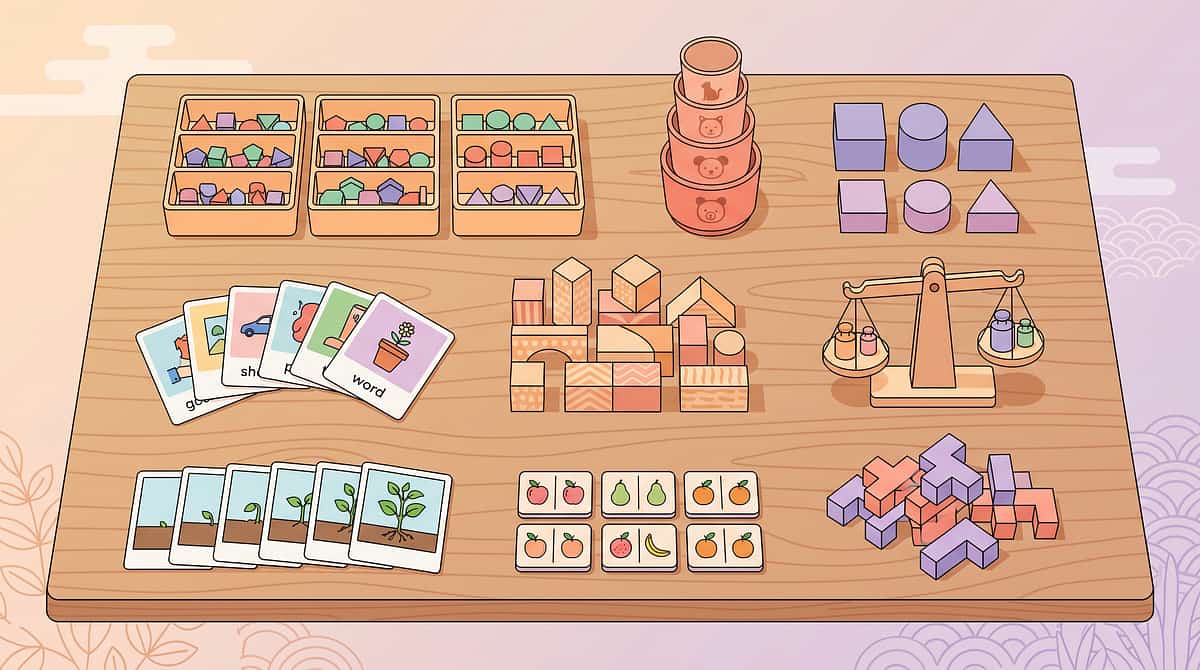
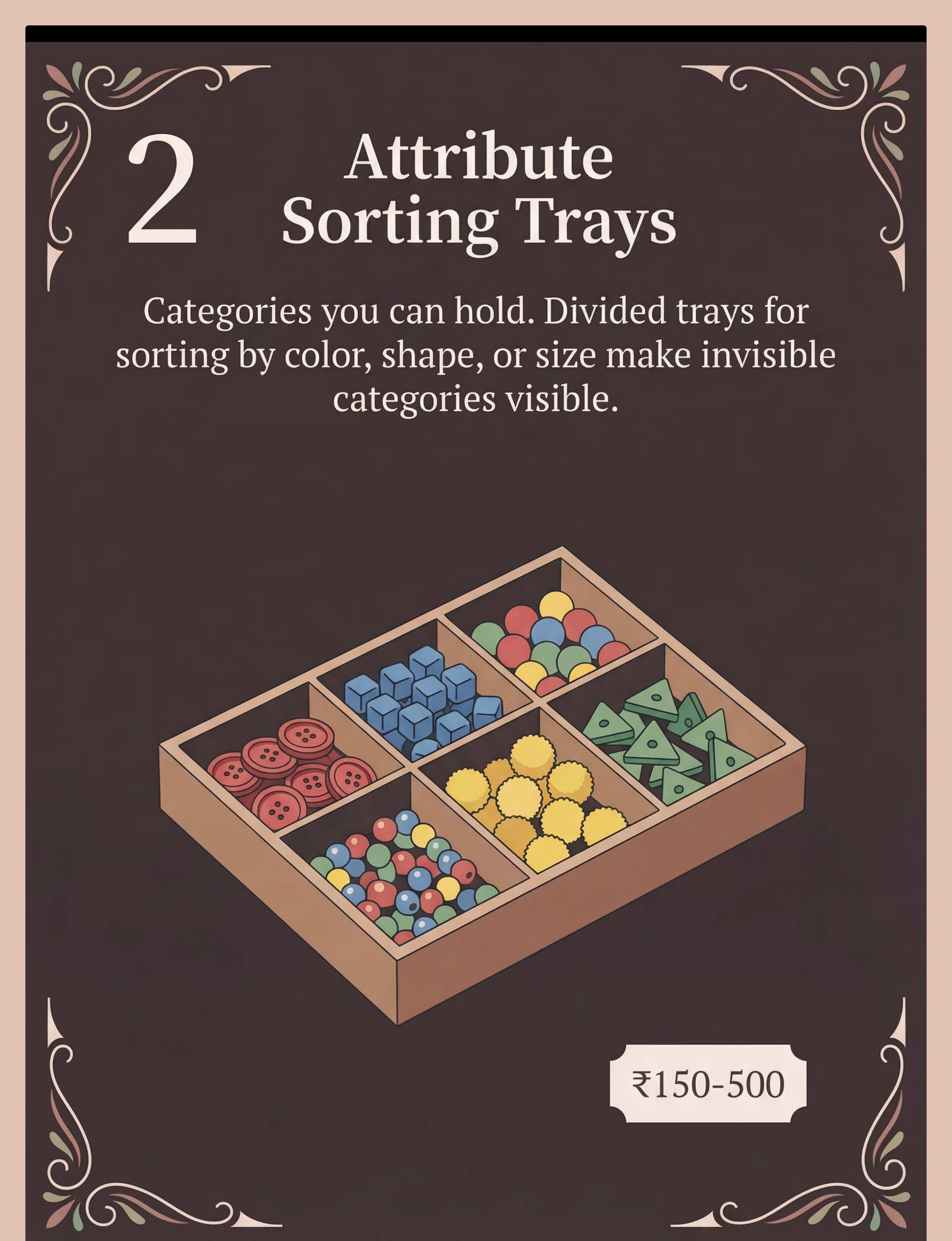
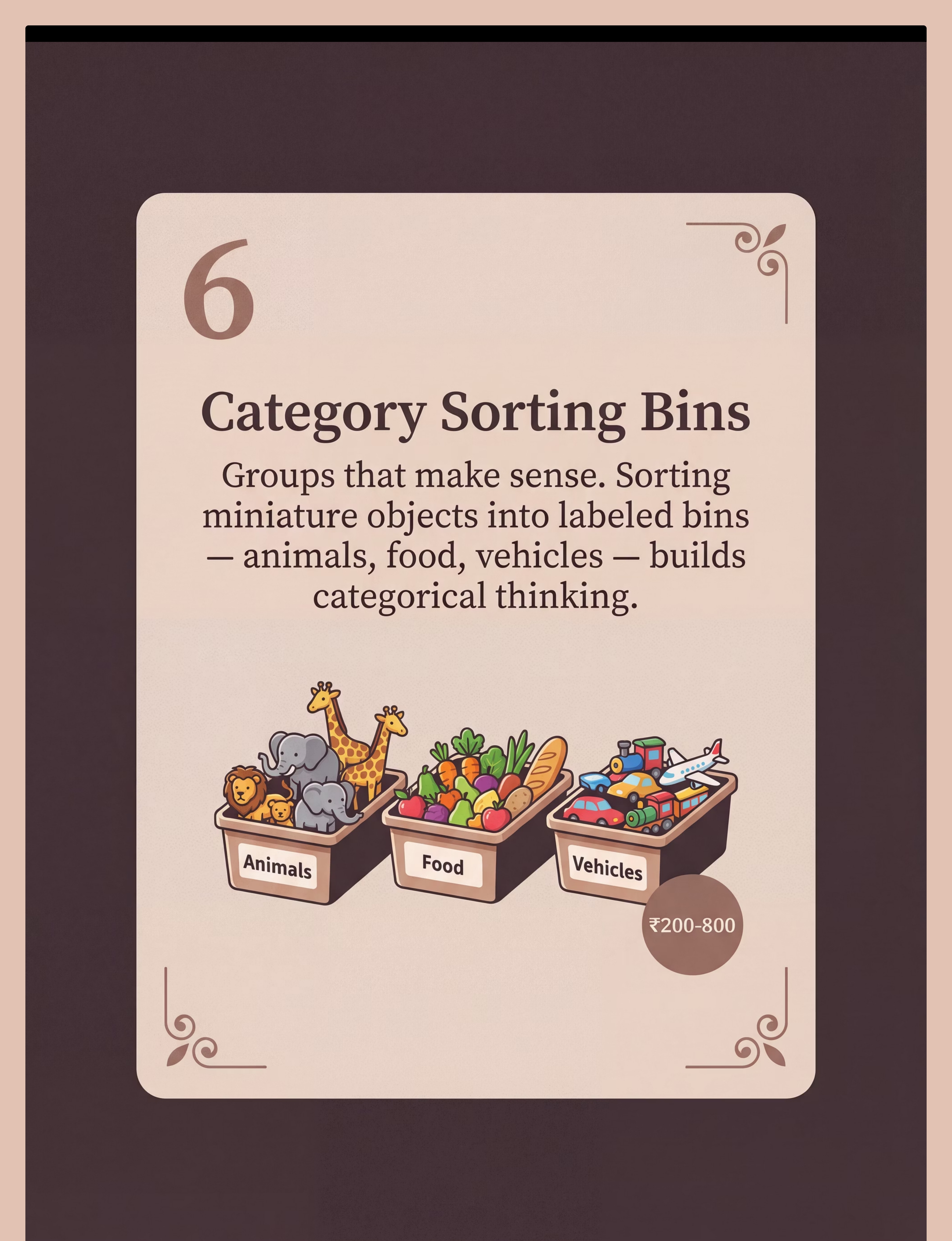
Making categories you can see and touch. When children place all red items in one section and all blue items in another, they are building the foundational understanding that objects can be grouped by shared attributes. That is the beginning of all categorical thinking.
Sorting Trays: Why It Helps
What the Science Says
Sorting materials make the abstract concept of categorization physically concrete. When a child physically moves objects into groups, they are not just organizing toys — they are constructing the mental architecture of categorical thought. Sorting develops:
- Categorical thinking — understanding that things belong to groups
- Attribute recognition — identifying properties like color, size, shape
- Flexible thinking — the same objects can be sorted different ways
- Comparison skills — "this goes here because it's the same color"
- Vocabulary development — learning the labels for attributes
- Executive function — planning, organizing, completing a task
The Key Insight
The power is in re-sorting. The same objects sorted by color, then by size, then by shape, teach that categorization is flexible — objects belong to multiple groups depending on the rule. This is one of the most important cognitive insights a young child can develop.
Sorting Progresses
From simple single-attribute sorts → to complex multi-attribute categorization, building increasingly sophisticated conceptual understanding at every stage.
Sorting Trays: What, Why, Where, How & When
1
What
Divided trays, muffin tins, or compartmentalized containers paired with collections of sortable objects — colored bears, buttons, mixed shapes, household items — that children group by shared properties.
2
Why
For children with autism or developmental delays, verbal explanation of "categories" rarely transfers. Physical sorting creates the neural experience of grouping — concepts formed through the hands reach the mind more reliably.
3
Where
Kitchen table, therapy room, floor play area, or any flat surface. Everyday household environments are ideal — the concepts transfer immediately to real-world objects around you.
4
How
Start with one attribute (color only). Once mastered, shift to shape only. Then combine: "Put all the BIG RED ones here." Narrate what the child is doing as they do it to build vocabulary alongside the concept.
5
When
Age 18 months and up for simple sorts. Begin with high-contrast categories (red vs. blue, big vs. tiny) before advancing to subtle distinctions. Use during calm, focused play times — not when the child is fatigued.
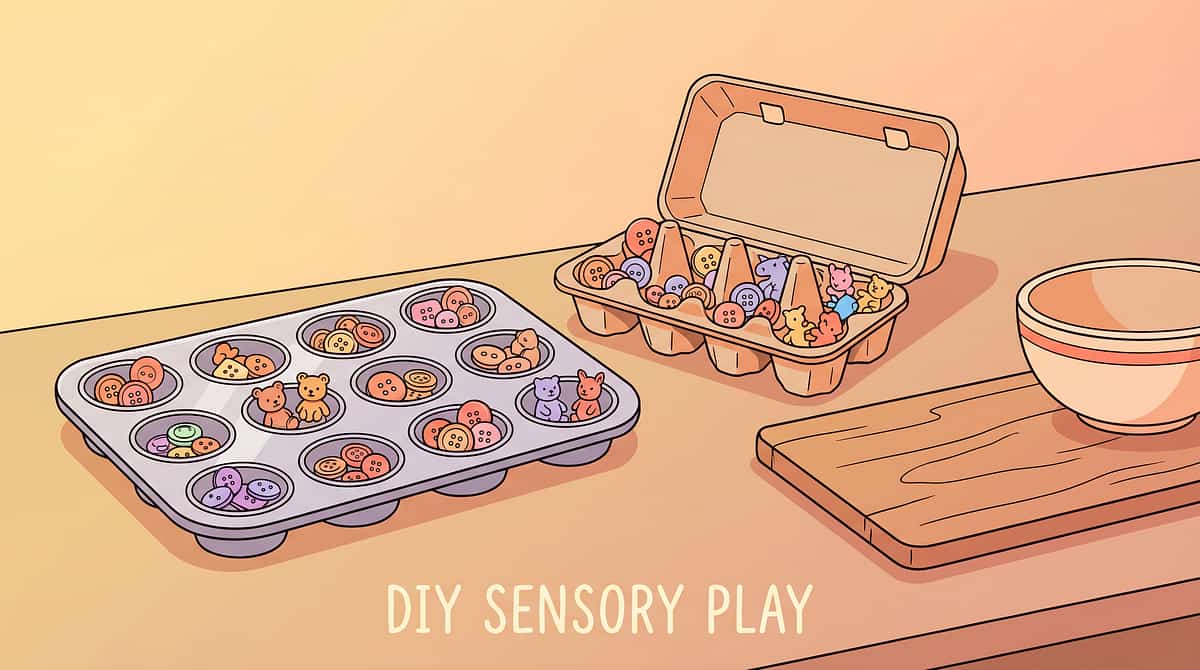
Sorting Trays: DIY at Home
You Already Have These at Home
You do not need to purchase specialty materials to begin sorting practice today. Everyday household items work just as well as commercial sets:
- Muffin tins or ice cube trays as sorting containers
- Sort household items: buttons by color, utensils by type, socks by size, toys by category
- Egg cartons with labeled sections for guided sorting
- Any container with compartments becomes a sorting tool
- Laundry sorting (darks vs. lights) is a real-life concept lesson
Commercial Options
When you are ready to invest in dedicated materials, look for:
- Sorting trays with clearly divided sections
- Collections of sortable objects (counting bears, buttons, attribute shapes)
- Attribute blocks with multiple sortable features
- Picture cards for category sorting
- Containers or bowls for free-form sorting
Price Range: ₹400–2,000

Material 2 of 9
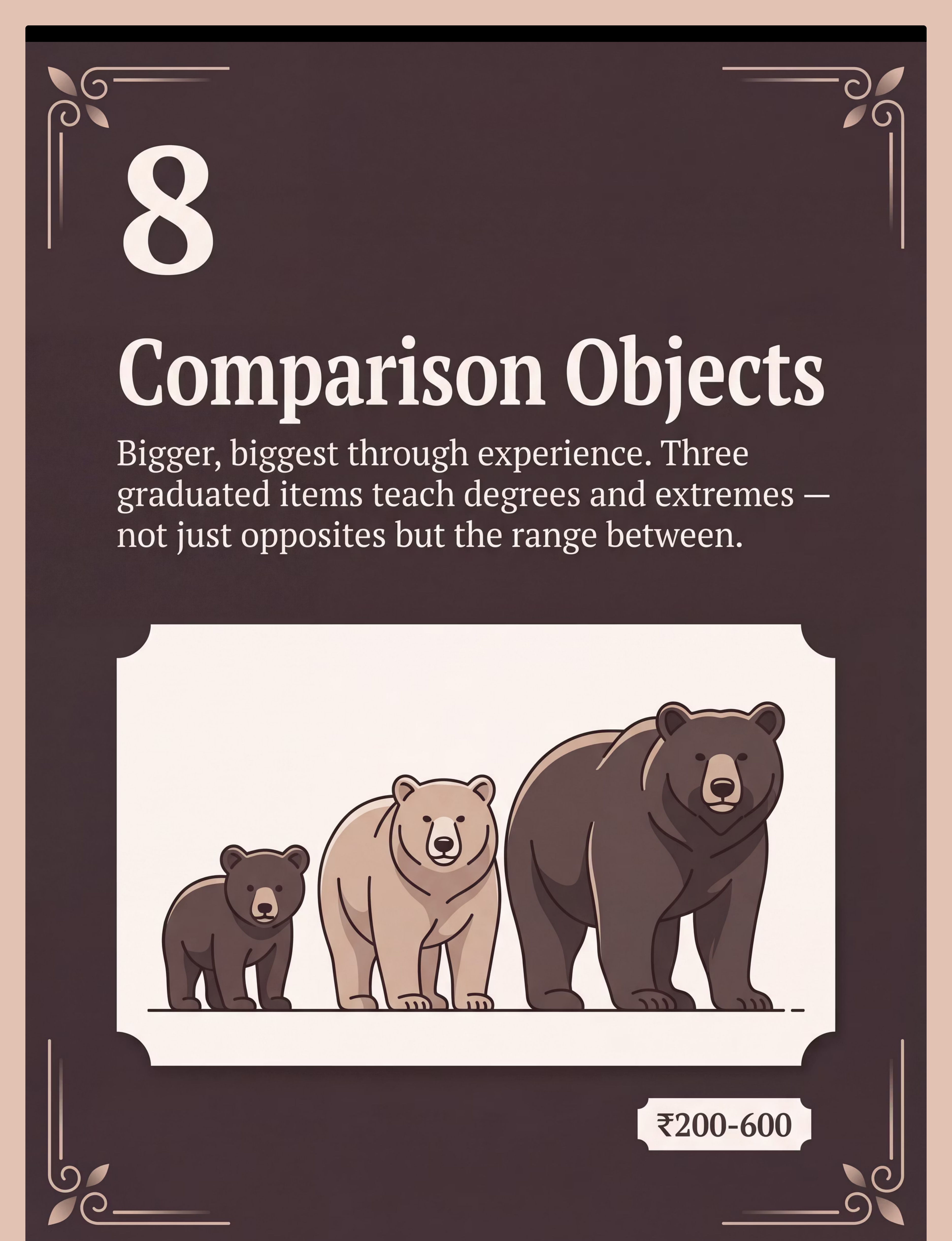
Size Concepts
Graduated Size Materials (Nesting and Stacking)
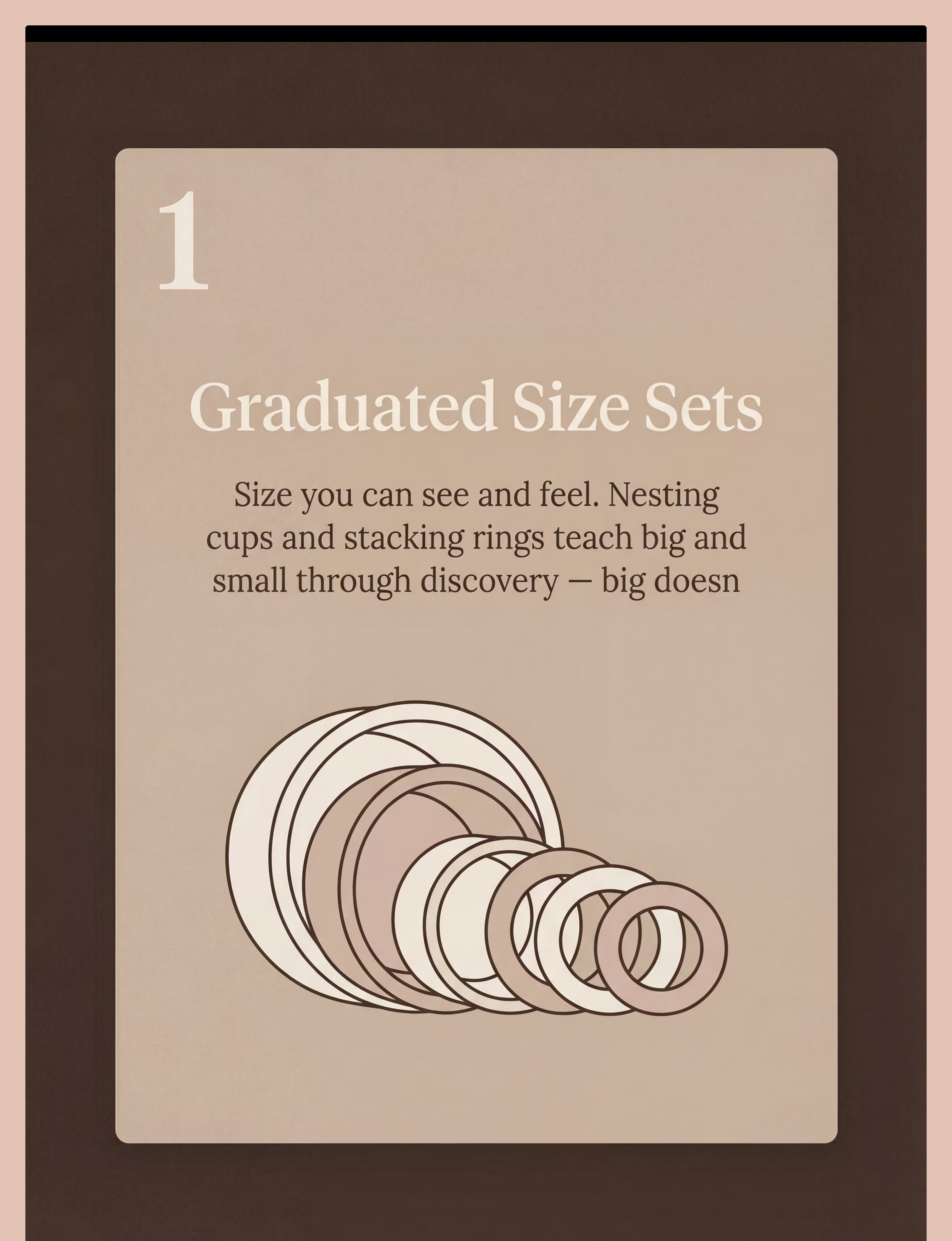
Size concepts you can feel. This cup doesn't fit inside that one — why? Because it's bigger. Size concepts become completely obvious when they are literally in your hands. Nesting cups, stacking rings, and graduated materials teach size not through verbal explanation, but through the undeniable logic of physical fit.

Nesting & Stacking: Why It Helps
The Science Behind Size Learning
Children learn big/small, bigger/smaller/biggest, and seriation (ordering by size) not through verbal explanation but through physical experience — the big cup doesn't fit inside the small one, and the rings only stack in the correct size order. These materials develop:
- Size vocabulary — big, small, medium, tiny, huge
- Comparative understanding — bigger than, smaller than
- Seriation skills — ordering from smallest to largest
- Spatial reasoning — what fits where and why
- Logical thinking — if A is bigger than B, and B is bigger than C, then A is biggest
- Self-correction — built-in feedback when the child gets it wrong
The Key Insight
Let them fail productively. When the wrong-sized cup doesn't fit, that is the learning moment — not an error to correct. Resist the urge to intervene. The material teaches. The failure is the lesson.
Every time a child discovers that a larger object cannot nest inside a smaller one, they are experiencing the law of comparative size in a way that no verbal instruction can replicate.
Material 3 of 9
Systematic Concept Teaching
Attribute Blocks and Logic Sets
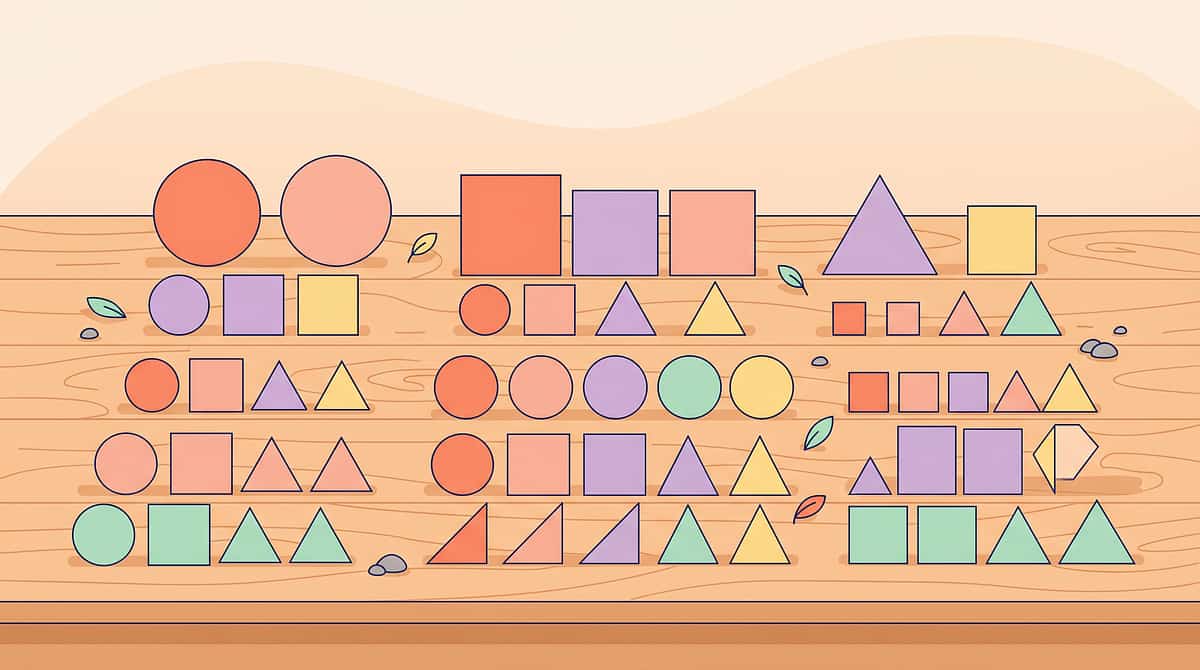
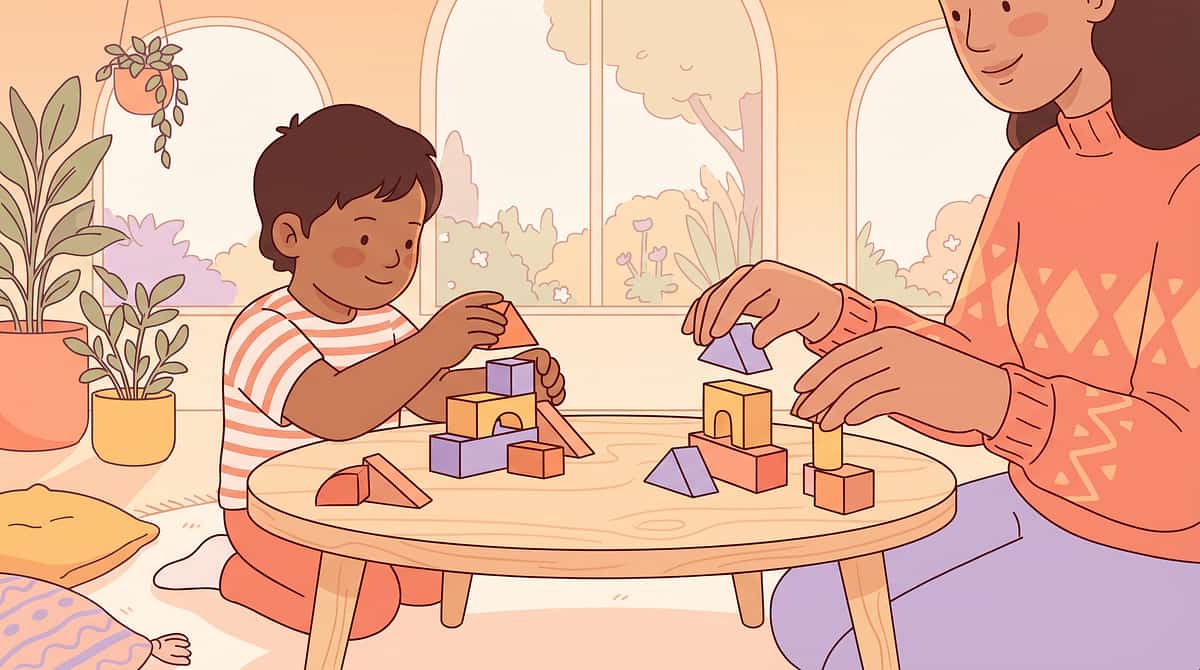
Systematic concept teaching tools. Red, blue, yellow. Big, small. Circle, square, triangle. Attribute blocks let you teach one concept at a time while everything else stays the same. They are the most precisely designed concept teaching material available for early childhood.
Attribute Blocks: Why It Helps
Engineered for Concept Teaching
Attribute blocks are specifically designed so each piece varies systematically in color, size, shape, and sometimes thickness — allowing focused work on any one attribute while all others remain controlled. This is the principle of variable isolation, the same methodology used in scientific experiments. These materials develop:
- Multi-attribute awareness — objects have many properties simultaneously
- Same/different concepts — same color but different shape
- Logical reasoning — find the one that's red AND big AND round
- Negation concepts — not red, not big
- Set theory foundations — all the circles, some of the big ones
- Vocabulary precision — thick versus thin, not just big versus small
The Key Insight
Control variables to isolate concepts. To teach "same color," use blocks that are the same shape and size but different colors. Systematic variation is the teaching power — not variety, but controlled variety.
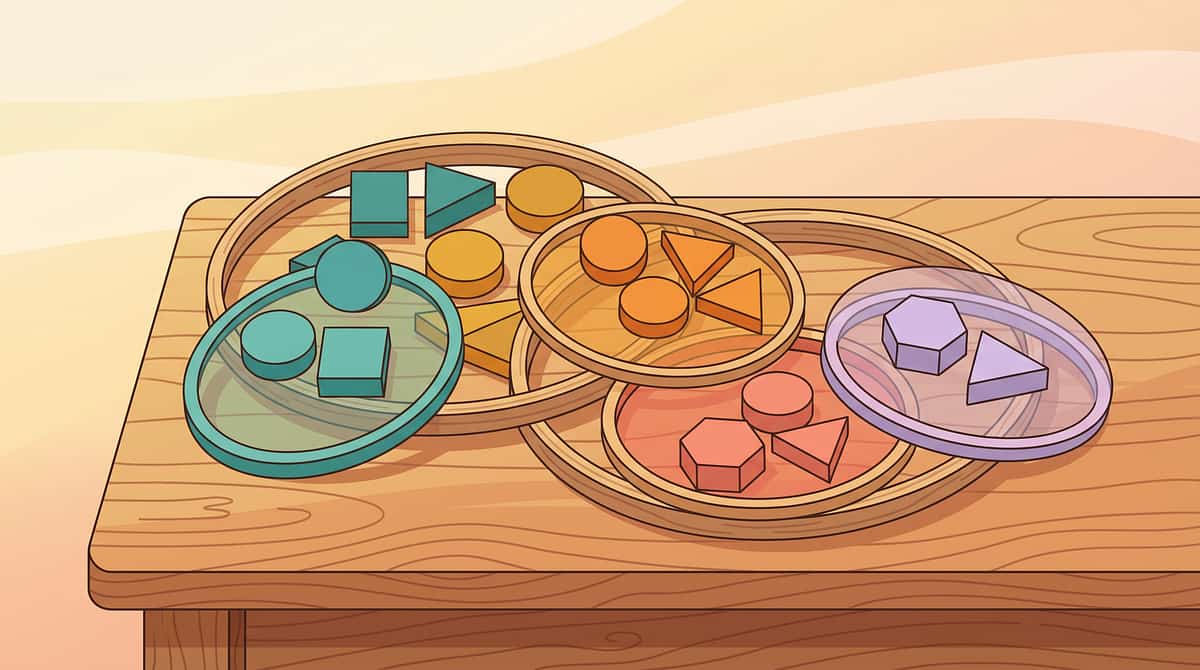
This is also how you can use Venn diagram sorting rings: "Put all the circles inside this ring. Put all the red ones inside this ring. What's in the middle? Red circles!"
Attribute Blocks: What, Why, Where, How & When
What
Standard attribute block sets varying in color (3–4 colors), size (2 sizes), shape (5–6 shapes), and thickness (thick/thin). Typically 48–60 pieces. Paired with logic cards, sorting rings, and comparison mats.
Why for Autism
The structured, rule-based nature of attribute blocks is highly compatible with how many children with autism process information. The systematic, predictable variation reduces ambiguity and provides clear, visual rules that feel safe and manageable.
Where
Therapy table or kitchen table. These materials require a flat workspace and benefit from clear organization. Spread out a work mat to define the activity space — helpful for children who need physical boundaries to focus.
How
Begin by naming all four attributes of a single block: "This one is BIG, RED, CIRCLE, and THICK." Then sort by one attribute at a time. Progress to two-attribute sorts ("all the big, red ones"), then three. Use attribute dice to make it game-like.
When
Best introduced from age 3–4 for single-attribute work. Two-attribute reasoning typically develops age 4–5. Multi-attribute logic and negation concepts emerge age 5–6.
Material 4 of 9
Representation
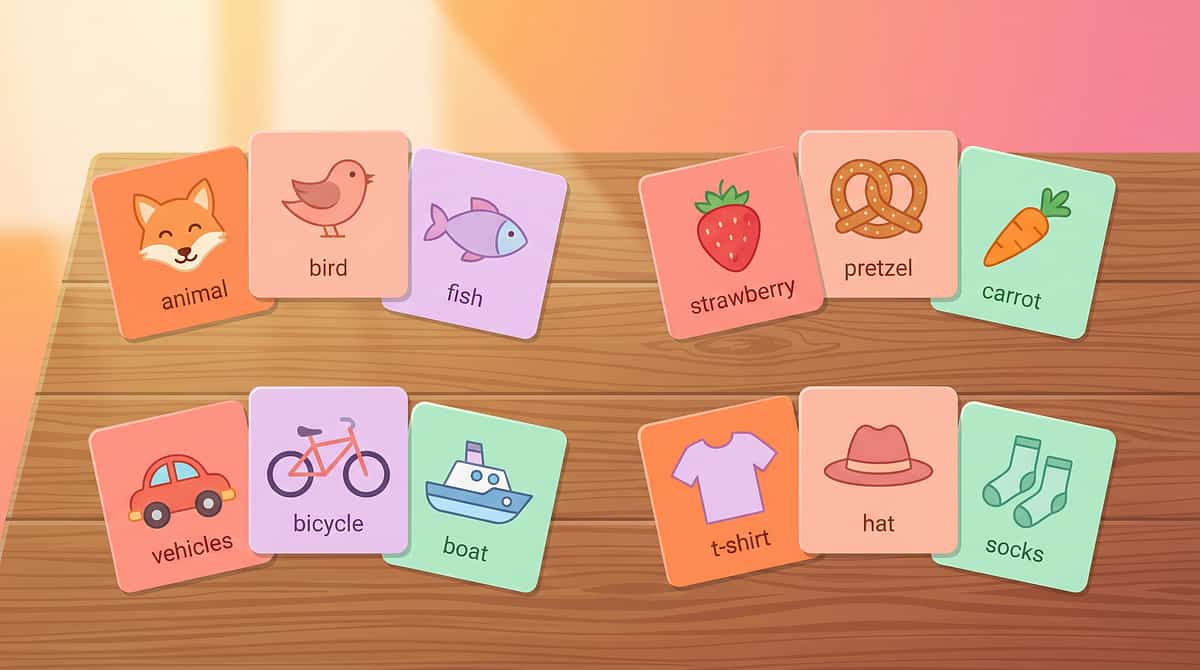
Concept Picture Cards and Category Cards
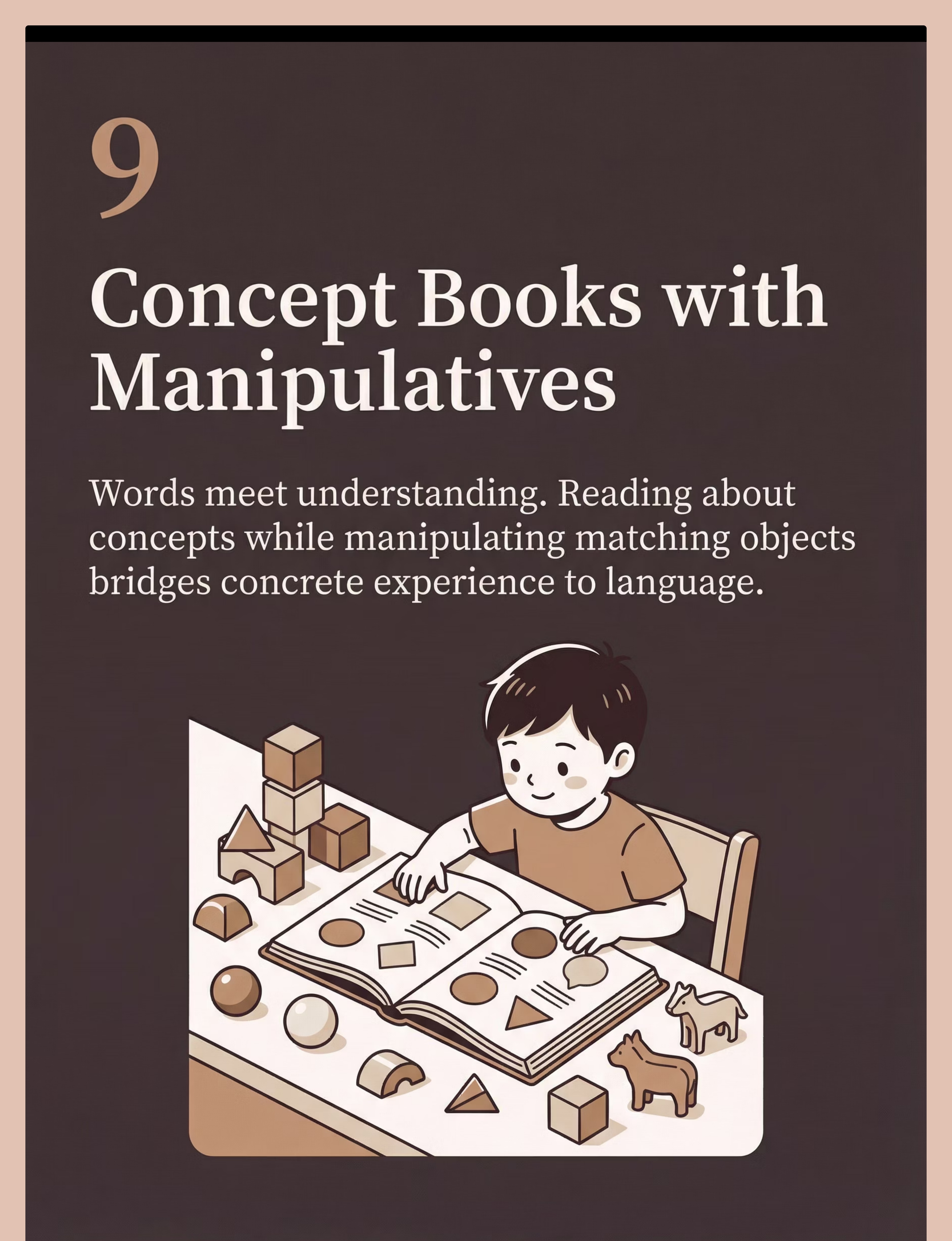
Pictures that teach invisible ideas. A picture of an apple isn't an apple — it represents an apple. That leap from real to representation is concept development in action. Picture cards bridge the gap between concrete objects and abstract concepts, making them one of the most versatile tools in the concept teaching toolkit.

Concept Cards: Why It Helps
From Concrete to Representational
Picture cards occupy the critical middle step in the concrete-to-abstract progression: between handling real objects and reasoning about purely verbal concepts. They teach:
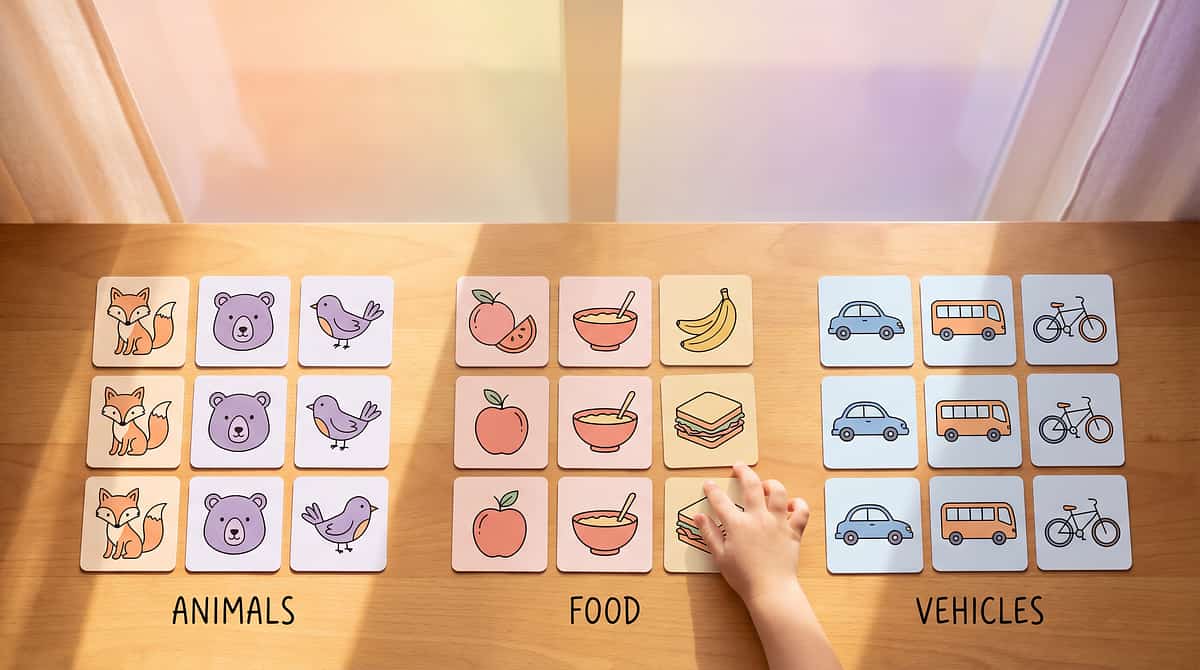
- Category membership — these pictures all show "food"
- Attributes — find all the pictures with something "red"
- Spatial concepts — the bird is "in" the tree, "on" the branch, "above" the grass
- Comparisons — which animal is bigger?
- Opposites — hot/cold, up/down, fast/slow
- Associations — what goes together? (cup and saucer, shoe and sock)
Cards are portable, infinitely variable, and progress from simple matching to complex reasoning across age and ability levels.
The Key Insight
Use real photos before cartoon images. Real photographs are easier for children to connect to real-world concepts. Abstract cartoon illustrations require an additional cognitive leap — they represent a representation. Start with photographs of actual objects from your child's environment.
Family photos make the best first category cards: "Here are people in our family. Here are animals. Here are foods we eat." Familiar context anchors new concept vocabulary.
Concept Cards: What, Why, Where, How & When
What
Category sorting cards (animals, food, vehicles, clothing), basic concept cards (spatial, quantity, temporal), opposites matching cards, what-goes-together association cards, and sequencing cards for temporal concepts.
Why for Autism
Visual learning is often a relative strength for children with autism. Picture cards leverage this strength while simultaneously building the language labels that go with each concept — creating the language-concept connection that is essential for comprehension.
Where
Anywhere. The portability of picture cards is one of their greatest strengths — waiting rooms, car trips, mealtimes, therapy sessions, bedtime. Concept practice can happen in every environment.
How
Start with 2-category sorts (food vs. not food). Expand to multiple categories. Progress from receptive tasks ("point to the animal") to expressive ("tell me what category this belongs to") to reasoning ("how do you know this is a food?").
When
Introduce picture-to-object matching from age 18 months. Simple category cards from age 2–3. Conceptual sorting and attribute tasks from age 3–4. Complex reasoning tasks from age 4 onward.
Material 5 of 9
Spatial Reasoning
Pattern Blocks and Mosaic Tiles
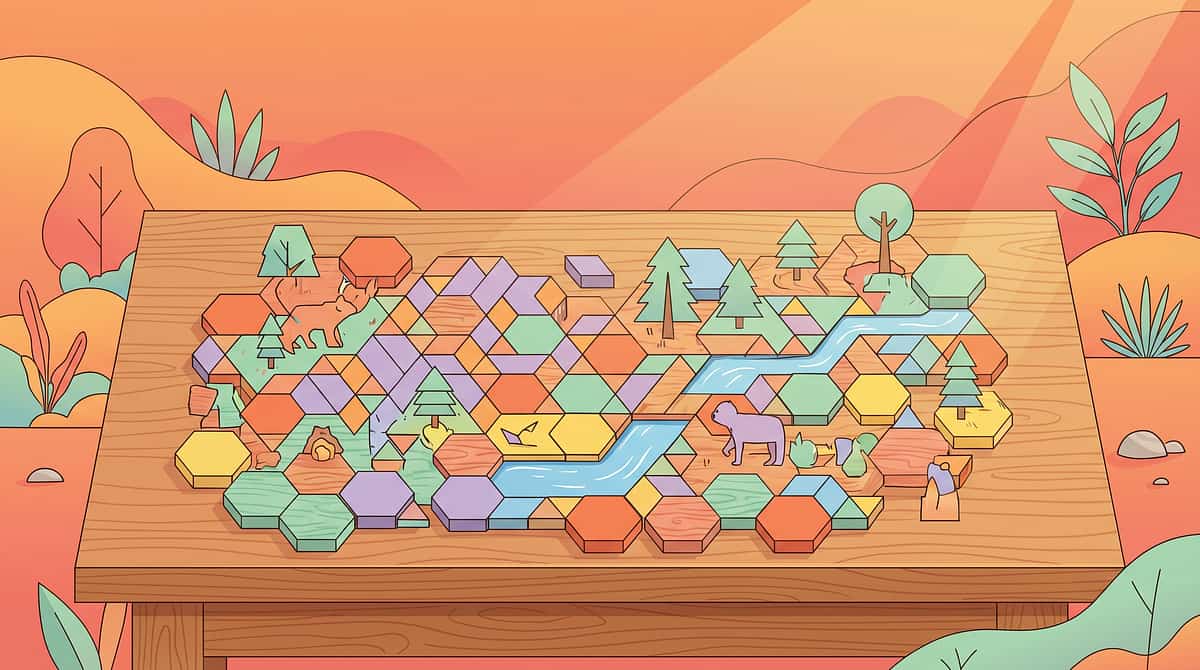
Shapes that teach relationships. Two triangles become a square. Three rhombuses become a hexagon. Pattern blocks teach that shapes have relationships — that parts combine to make wholes, and that spatial arrangement matters. This is visual-conceptual thinking in its purest form.

Pattern Blocks: Why It Helps
Spatial and Geometric Concept Building
Pattern blocks teach shape concepts, spatial relationships, and the foundational concept that parts combine to make wholes. Children develop:
- Shape recognition and naming — hexagon, trapezoid, rhombus
- Spatial vocabulary — beside, above, fits inside
- Part-whole relationships — two triangles make one square
- Symmetry concepts — mirrored arrangements
- Pattern recognition and extension — what comes next?
- Mental rotation/transformation — rotating shapes in the mind
Pattern blocks also develop visual-perceptual skills essential for reading (letter recognition) and math (geometric reasoning). They are open-ended enough for creative exploration while structured enough for targeted concept teaching.
The Key Insight
Move from copying to creating. First, children copy patterns from reference cards. Then they create their own. Creating requires deeper understanding than reproducing — it is the difference between recognizing and generating.
Use mirrors for an additional layer: symmetry concepts emerge naturally when a child sees their block design reflected. "It's the same on both sides!" is a profound conceptual discovery.

Material 6 of 9
Comparison
Comparison and Measurement Tools
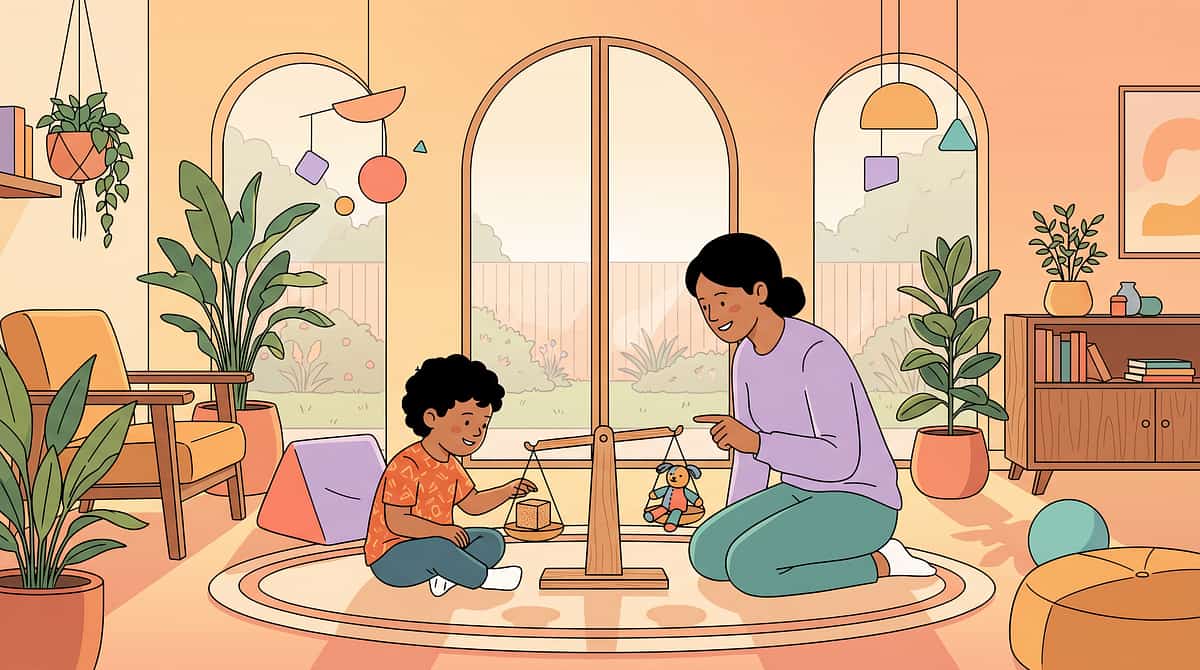
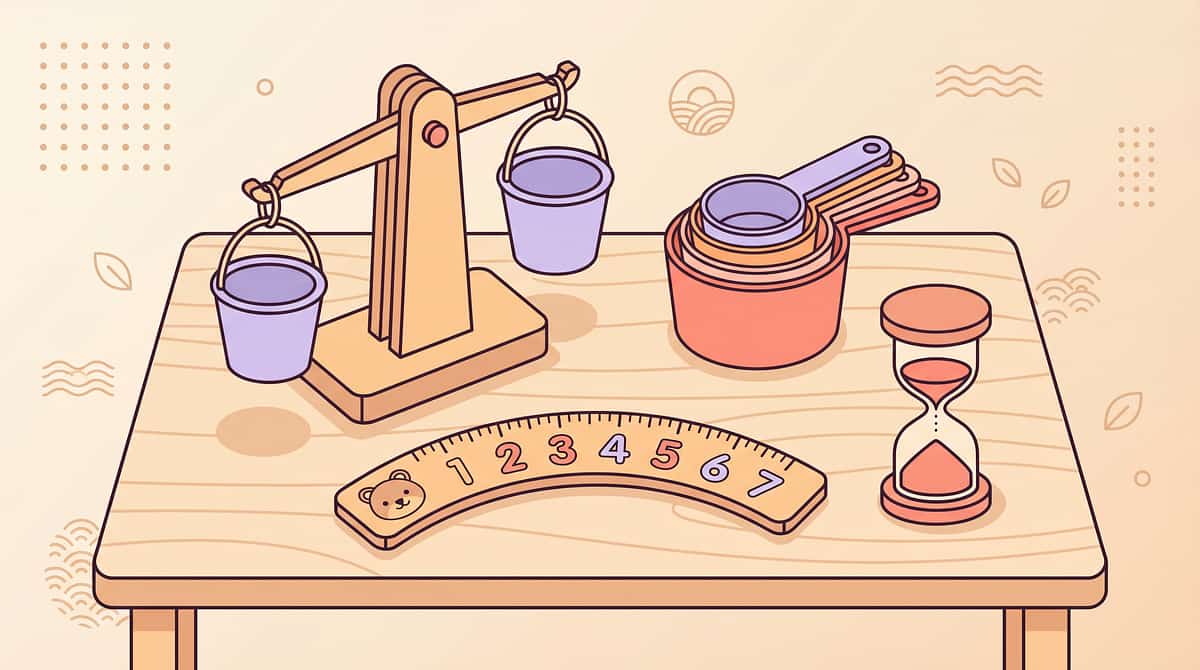
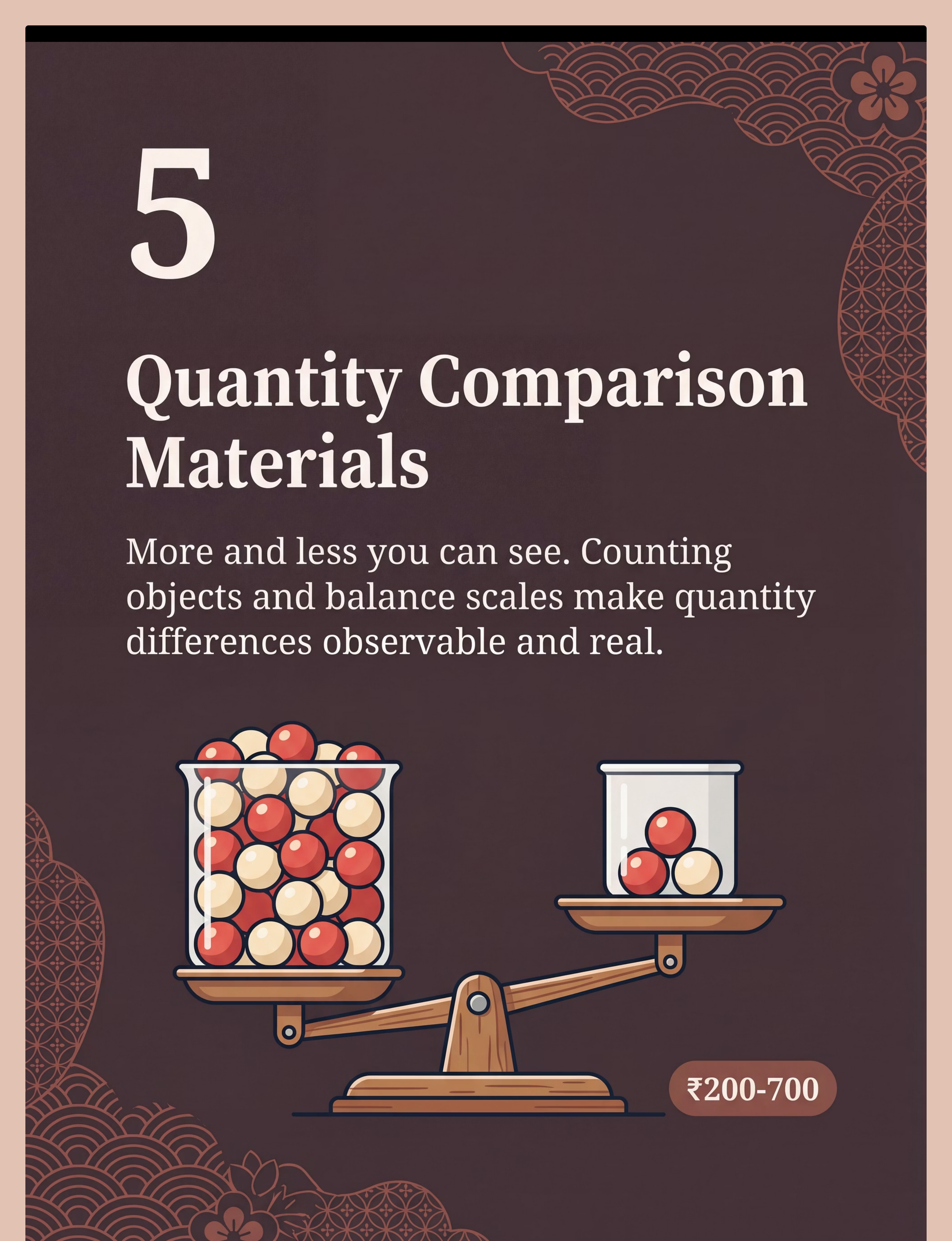
Comparisons you can prove. Which is heavier? Don't guess — find out. Measurement tools turn "I think" into "I know." That is conceptual precision. Balance scales, measuring cups, rulers, and comparison tools make abstract comparative concepts physically, objectively real.
Measurement Tools: Why It Helps
Objective Evidence for Comparative Concepts
Balance scales, measuring cups, rulers, and comparison tools make abstract comparative concepts physically real by providing objective, undeniable evidence. These tools develop:
- More/less and heavier/lighter — the scale tips, settling the question
- Bigger/smaller and taller/shorter — measurement makes it precise
- Equal and same amount — comparison containers show equivalence
- Estimation and verification — predict, then measure
- Vocabulary for comparison — heavier, lighter, the same, equal, more than, less than
These tools provide feedback that removes all ambiguity: the scale tips, the cup overflows, the ruler shows a clear number. Comparative concepts stop being matters of opinion and become verifiable facts.
The Key Insight
Always predict before measuring. "Which do you think is heavier?" creates cognitive engagement before the measurement happens. The measurement either confirms or surprises — and both outcomes teach. Confirmation builds confidence; surprise creates curiosity.
This predict-then-verify sequence is the scientific method in miniature — and it is one of the most powerful concept-teaching routines you can establish.
Measurement Tools: What, Why, Where, How & When
What
Simple balance scales with varied weights, clear graduated measuring cups and containers, child-friendly rulers and tape measures, comparison containers of the same shape but different sizes, sand and water timers for duration concepts.
Why for Autism
Measurement tools provide non-ambiguous, objective outcomes that do not require social interpretation. The scale tips to one side or the other — there is no uncertainty, no subjectivity. This clarity is deeply supportive for children who struggle with ambiguous social feedback.
Where
Kitchen (measuring during cooking is the richest real-life application), sandbox, water table, therapy room. Bath time with measuring cups offers daily natural practice with quantity and volume concepts.
How
Establish the predict-measure-discuss routine. Use consistent language: "Let's find out." Compare two objects first, then three. Introduce the vocabulary of measurement ("this side went down because it's heavier") alongside the physical experience.
When
Simple heavy/light comparisons from age 2–3. More/less quantity concepts from age 3–4. Formal measurement vocabulary and ruler use from age 4–5. Estimation and proportional thinking from age 5 onward.
Material 7 of 9
Temporal Concepts
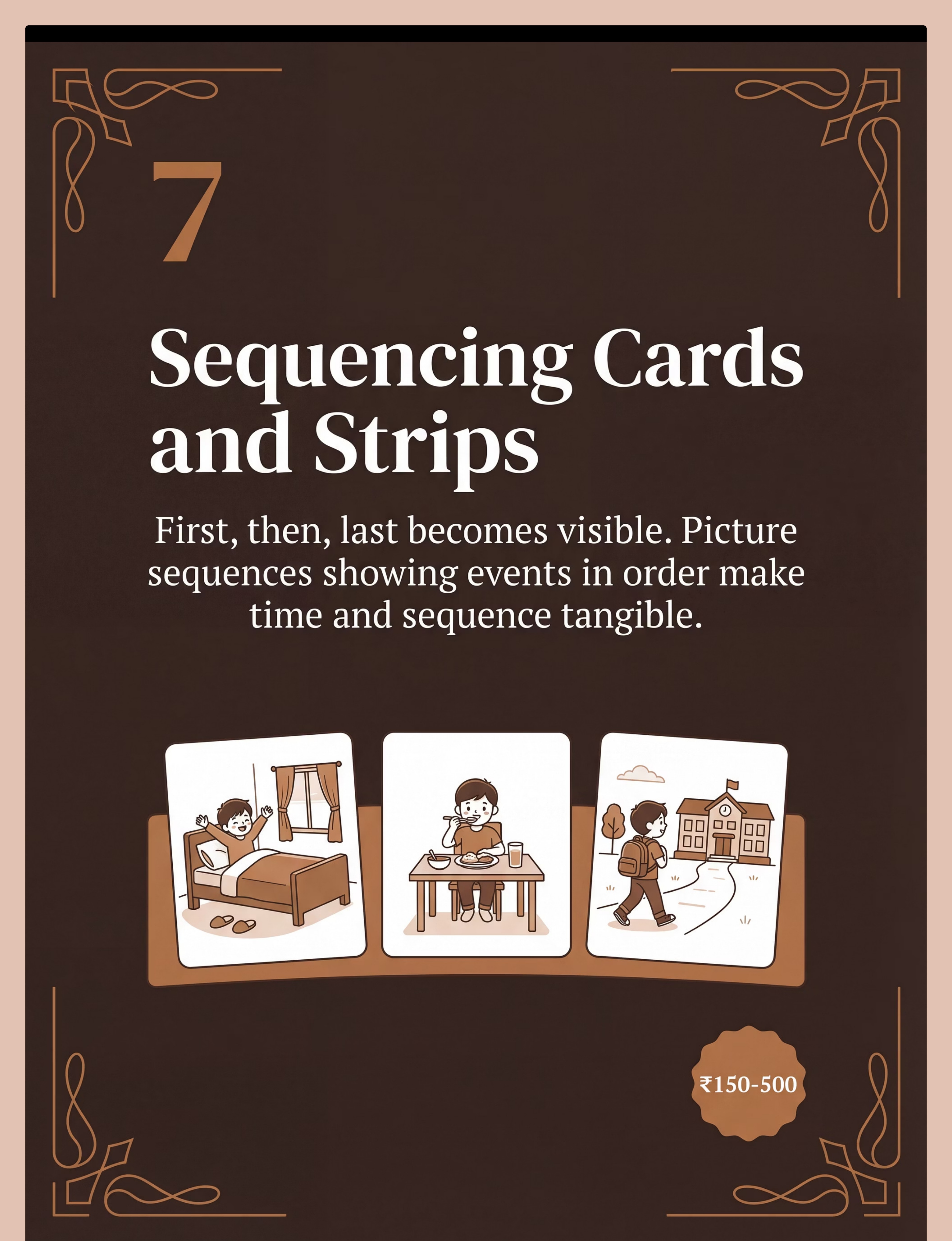
Sequencing Materials and Order Cards
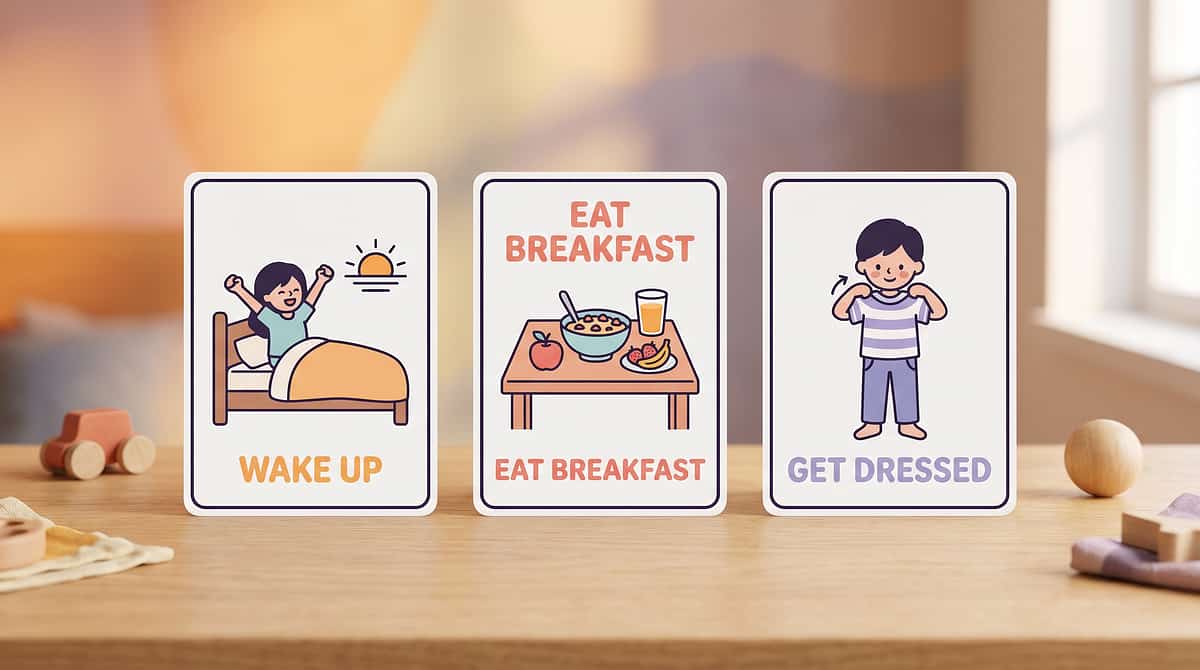
Order you can arrange. First we wake up, then we eat breakfast, then we get dressed. Sequencing cards make time visible and order touchable. They transform the invisible flow of time into a concrete, rearrangeable, understandable sequence.

Sequencing Materials: Why It Helps
Making Time Concrete
Sequencing materials teach temporal and logical order concepts — first/last, before/after, beginning/middle/end. These concepts are essential for following multi-step directions, understanding narratives, and grasping cause-effect relationships. Sequencing develops:
- Temporal vocabulary — first, then, next, last, before, after
- Logical reasoning — this happens because that happened
- Narrative comprehension — understanding story structure
- Planning and organization — what comes first in a task?
- Prediction skills — what happens next?
Sequencing is also foundational for reading comprehension (narrative structure), mathematical reasoning (procedural steps), and everyday executive function (organizing tasks).
The Key Insight
Start with experienced sequences. Children sequence their own daily routine before abstract story events. Personal relevance builds the strongest initial understanding — the child already knows what order these events happen in, so the sequencing task reveals the concept rather than demanding knowledge they don't yet have.
Then gradually move to novel sequences: life cycles, story events, logical cause-effect chains.
Sequencing Materials: What, Why, Where, How & When
What
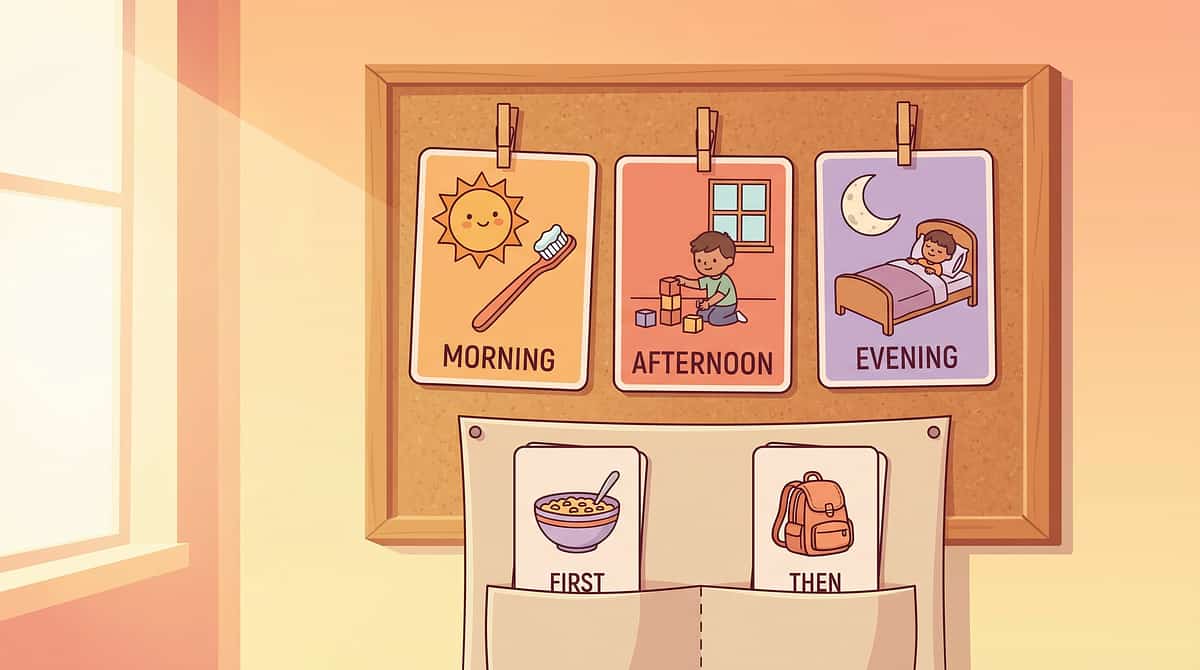
Daily routine sequencing cards, story sequencing sets (3–6 picture sequences), life cycle cards (caterpillar to butterfly, seed to plant), logical sequence cards (cause and effect), and first/then boards for visual schedules.
Why for Autism
Visual schedules using sequencing cards are already a core autism support strategy. Sequencing cards for concept development extend this familiar, trusted format into cognitive teaching — the child already understands "first/then boards," so concept teaching feels familiar and safe.
Where
Morning routines (bathroom, kitchen, bedroom walls), therapy table, story time. First/then boards work in any environment where transitions and routines happen — which is everywhere in a child's day.
How
Start with 2-part sequences ("first… then…"). Add a third step once the two-part concept is solid. Narrate as the child arranges: "You put breakfast FIRST. What comes NEXT?" Question the order: "Could you eat dinner BEFORE you wake up? Why not?"
When
2-step sequences from age 2–3. 3-step daily routine sequences from age 3–4. Complex story sequences and life cycles from age 4–5. Logical cause-effect sequences from age 5 onward.

Material 8 of 9
Comparison
Same/Different and Matching Materials
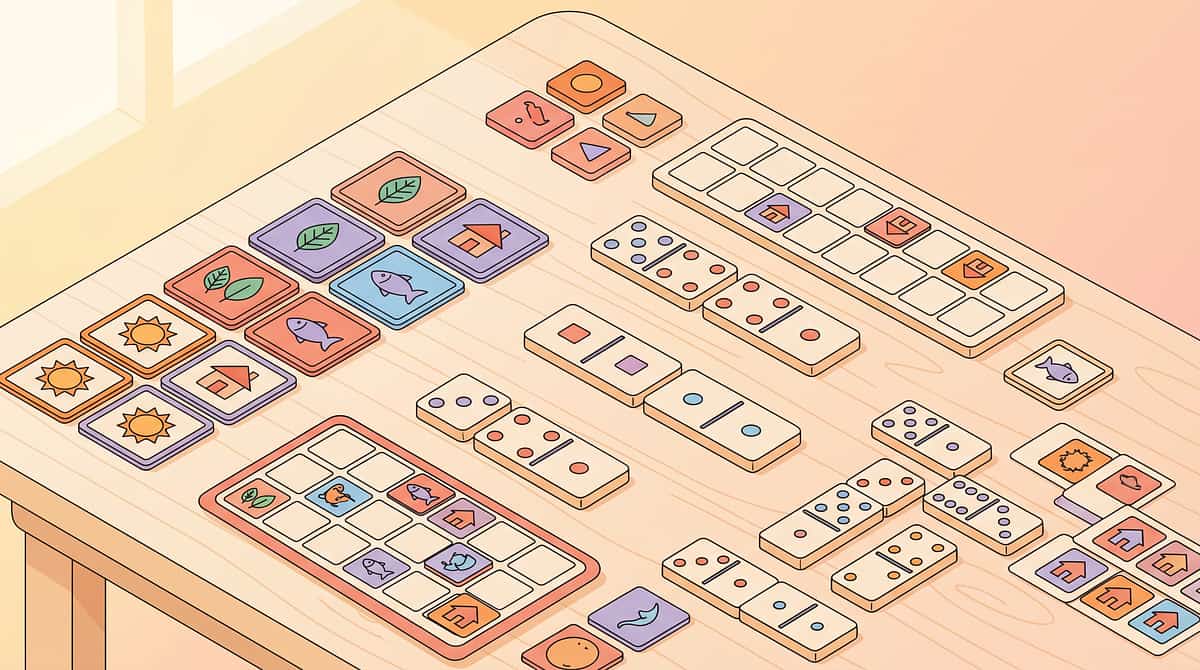
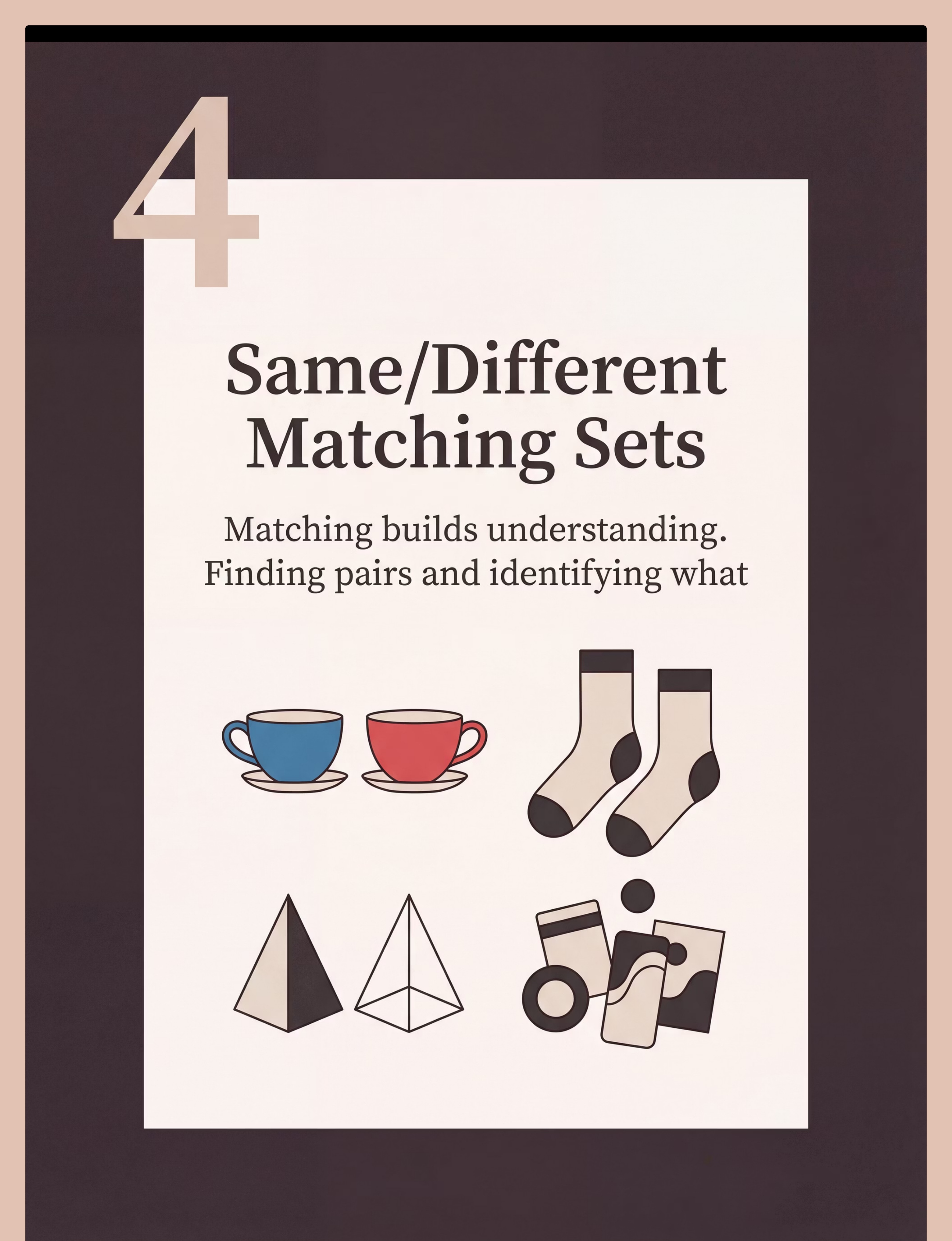
Same and different in action. Same or different? It is the most basic question in all of thinking. Every matching game builds the foundation of all comparison — and comparison is the foundation of all reasoning. These materials develop the discrimination skills that underlie reading, math, and everyday judgment.

Matching Materials: Why It Helps
The Foundation of All Comparison
Same and different are the foundational concepts underlying all categorical thinking. You cannot categorize without recognizing sameness. You cannot compare without recognizing difference. Matching games develop:
- Exact matching — identical items are the same
- Attribute matching — same color, different shape
- Category matching — both are animals, even if different animals
- Functional matching — cup goes with saucer, shoe goes with sock
- Discrimination skills — what specifically makes these different?
These concepts are prerequisites for reading (letters that look similar but are different), math (equivalent amounts), and everyday reasoning (appropriate versus inappropriate, correct versus incorrect).
The Key Insight
Progress from "same" to "how are they the same?" Identifying sameness is level one — the child can point to two matching items. Articulating how they are the same is deeper conceptual understanding — the child must identify the shared attribute. That progression, from recognition to articulation, is the goal.
"These are the same" → "These are the same COLOR" → "These are the same color AND the same size" — each step requires deeper concept mastery.
Matching Materials: What, Why, Where, How & When
What
Memory/matching card games, picture dominoes, same/different sorting cards, lotto and bingo games with matching components, and spot-the-difference activities for advanced discrimination.
Why for Autism
Many children with autism demonstrate excellent exact-matching skills — this is a strength to build on. Matching games start from a position of competence and gradually layer in more complex same/different distinctions, building confidence alongside concepts.
Where
Table games work best with defined spaces. Floor puzzles and sorting activities work in open spaces. Everyday matching: sorting laundry, matching silverware, putting toys away by type — same/different practice happens constantly in daily life.
How
Begin with exact matching (identical pictures). Progress to category matching (different pictures of dogs as "same"). Advance to attribute matching (same color but different object). Ask "how?" questions: "How do you know these are the same?"
When
Simple object-to-object matching from age 12–18 months. Picture-to-picture matching from age 2. Category matching from age 3. Complex attribute-based matching and discrimination from age 4 onward.
Material 9 of 9
Spatial Concepts
Spatial Concept Manipulatives and Position Materials
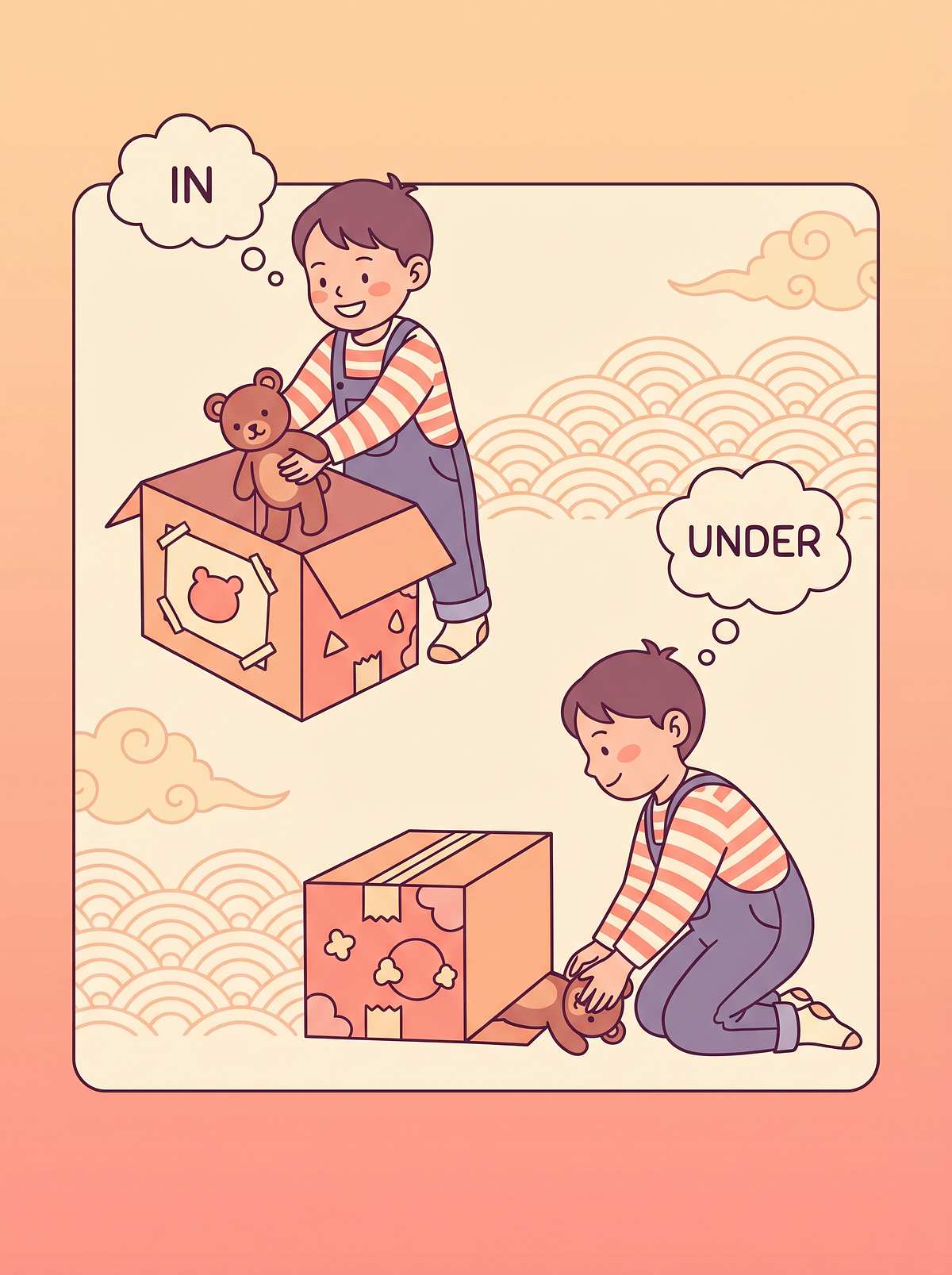
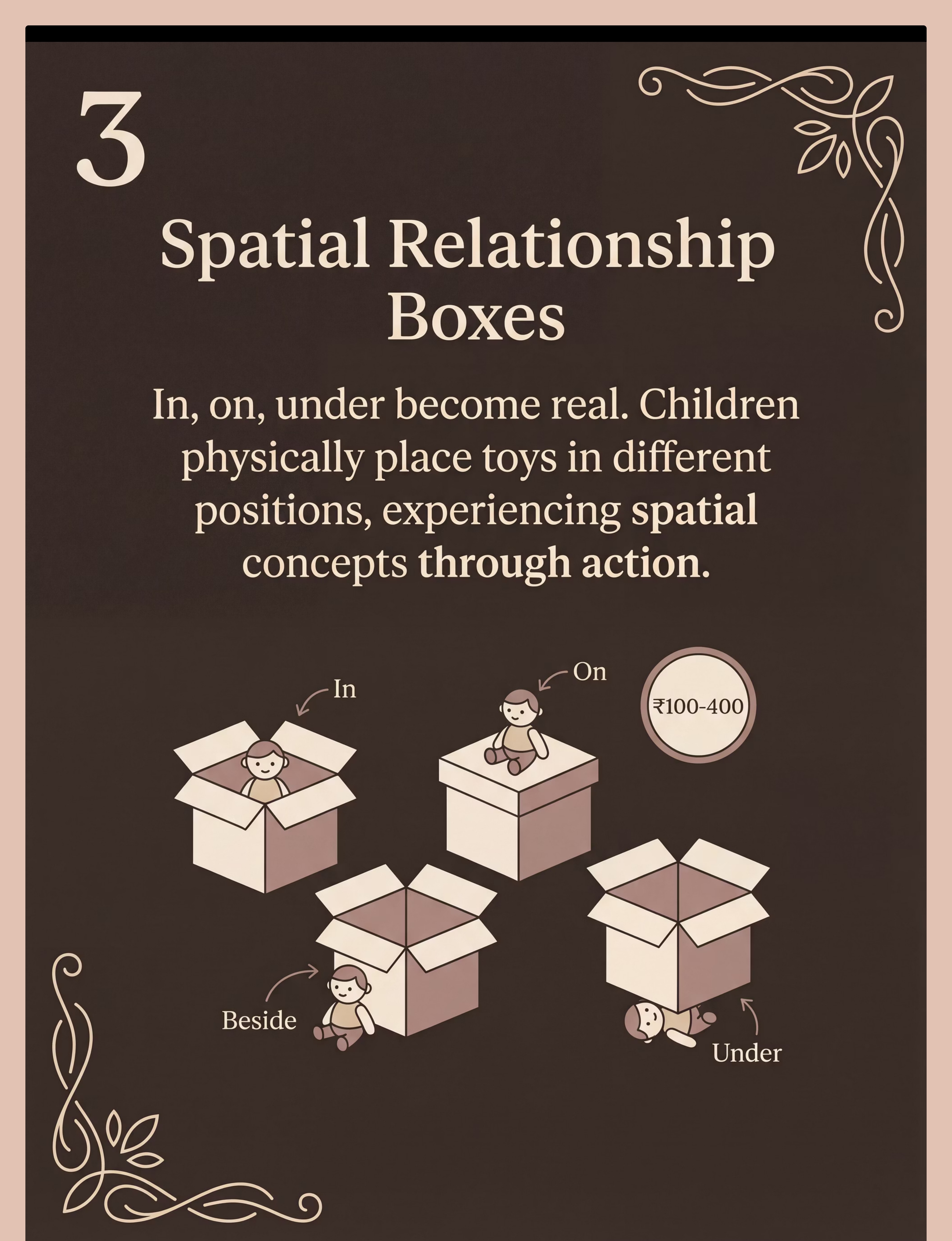
Position concepts you can place. Where is the bear? In the box. Under the box. Behind the box. Spatial concepts need physical demonstration before they can be understood abstractly. These materials make the invisible relationships of space tangible, testable, and teachable.

Spatial Manipulatives: Why It Helps
Making Position Visible
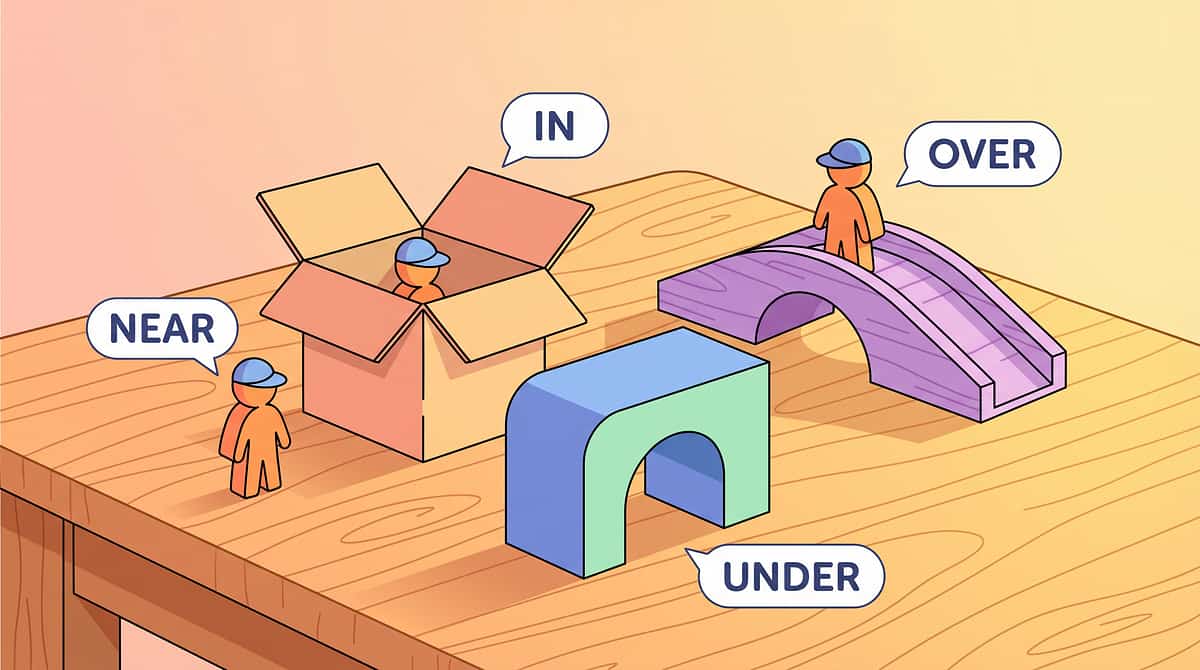
Spatial concepts — in, on, under, between, behind, in front of, beside, through, around — are essential for following directions, understanding prepositions, and navigating the world. Manipulatives that demonstrate positions make these invisible concepts visible and physically testable. These materials develop:
- Positional vocabulary — in, on, under, behind, beside, between, above, below
- Spatial reasoning — where things are in relation to each other
- Direction following — "put the bear under the bridge"
- Preposition comprehension — critical for language and literacy
- Mental visualization — imagining positions without seeing them
The Key Insight
Use the child's body first. Have them go under the table, stand behind the chair, walk between the cones. Physical, whole-body experience of spatial concepts precedes abstract understanding with objects, which in turn precedes understanding from pictures or words alone.
Body → Object → Picture → Word. This is the invariant progression for spatial concept teaching.
Spatial Manipulatives: What, Why, Where, How & When
What
Positional concept kits (small figurine + location items like boxes, tunnels, bridges), barrier games with position language, following directions games with spatial components, preposition picture cards, simple dollhouse or play scene for position play.
Why for Autism
Spatial prepositions are among the most commonly delayed language concepts in autism. Because these words refer to invisible relationships rather than tangible objects, they are uniquely difficult to learn from exposure alone. Manipulatives make these relationships concrete and teachable.
Where
Everywhere — this is the beauty of spatial concepts. The playground (on the slide, under the ladder), the kitchen (in the cupboard, on the shelf), the bedroom (under the bed, between the pillows). Spatial language is embedded in every environment.
How
Step 1: Child's body experiences the position ("get under the table"). Step 2: Child moves an object ("put the bear under the box"). Step 3: Child identifies from pictures. Step 4: Child follows verbal directions only. Narrate every position change with the preposition.
When
Simple in/on/under from age 2–3. Behind/in front/beside from age 3–4. Between/through/around from age 4–5. Complex multi-step spatial directions from age 5 onward.
Types of Concepts Your Child Needs
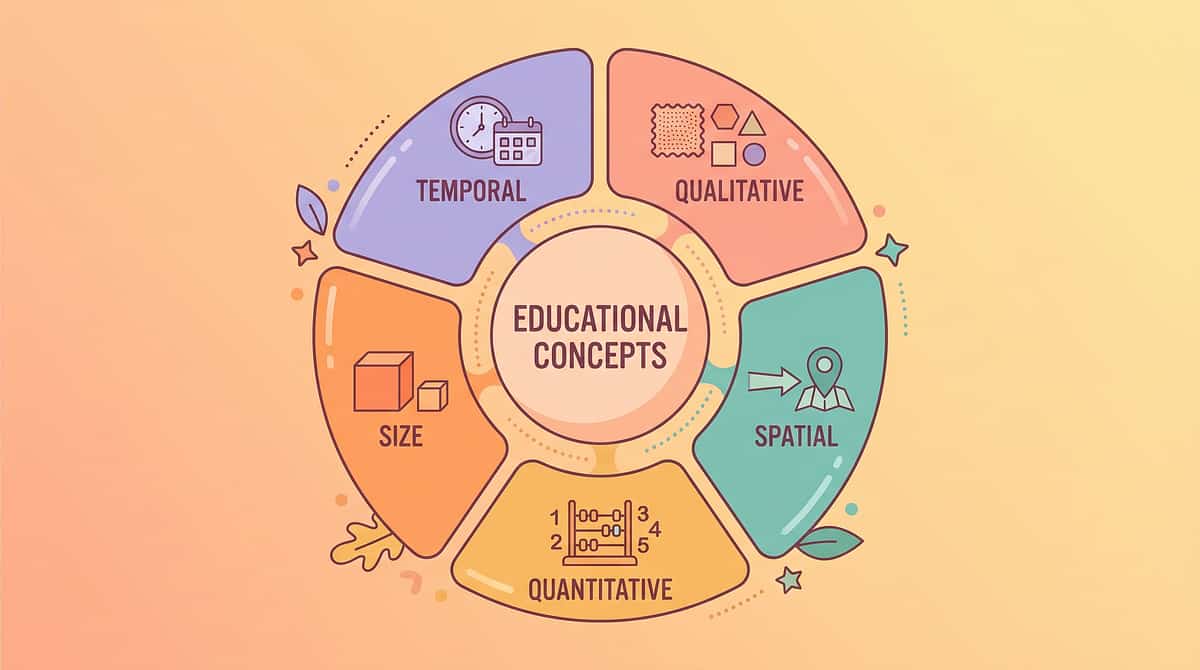
Spatial/Positional
in, on, under, over, above, below, beside, between, behind, in front of, through, around, inside, outside, near, far, top, bottom, middle, left, right
Critical for: following directions, understanding spatial language, preposition use
Quantitative
more, less, most, least, equal, all, some, none, many, few, empty, full, whole, half, part
Critical for: mathematical foundations, following directions, everyday reasoning
Size & Descriptive
big, little, small, large, tiny, huge, tall, short, long, wide, narrow, thick, thin, heavy, light
Critical for: comparison, description, mathematical concepts
Temporal/Sequential
first, last, next, before, after, beginning, middle, end, then, now, later, yesterday, today, tomorrow
Critical for: multi-step directions, narrative comprehension, planning
Qualitative/Descriptive
same, different, alike, matching, color concepts, shape concepts, texture concepts, fast, slow, hot, cold, hard, soft
Critical for: comparison, category membership, attribute identification
The Language–Concept Connection
How Language and Concepts Build Together
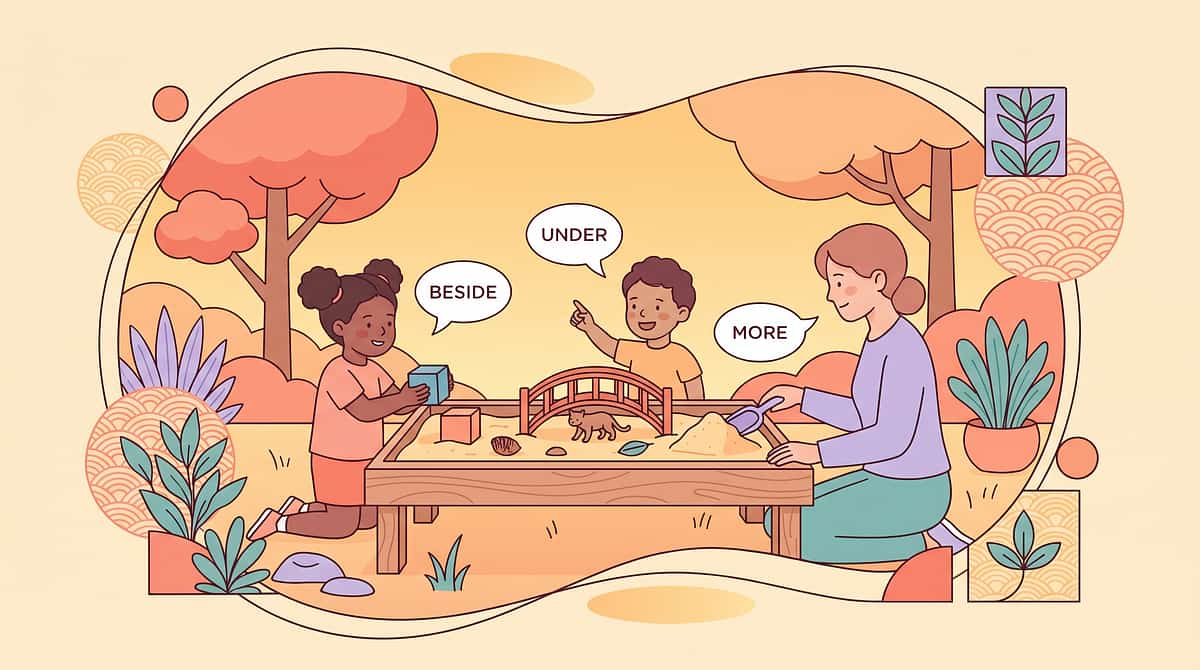
Vocabulary provides labels for concepts. Without the word "beside," the concept of beside-ness is harder to think about and harder to hold in memory. Conversely, concepts give meaning to vocabulary — the word "under" is meaningless without understanding the spatial relationship it represents.
Most academic instruction embeds concepts in language. "Put your name at the top of the paper" requires spatial AND page-orientation concepts simultaneously. Children may understand a concept before they can express it — receptive concept assessment often shows stronger skills than expressive performance.
Intervention Implication
Language therapy and concept development intervention most effectively occur together. Speech-language pathologists address both the vocabulary labels and the underlying conceptual understanding in the same session — because they develop together and support each other.
This is why the 9 materials in this guide are not just cognitive tools — they are also language-building tools. Every sort, every match, every comparison is an opportunity to hear, practice, and internalize the vocabulary of thinking.

Red Flags: When to Seek Professional Evaluation
If you notice several of these signs, please consult a qualified professional. Early intervention leads to significantly better outcomes.
By Age 3
- Cannot sort by any single attribute
- No basic category understanding (animals, food)
- Cannot follow simple spatial directions ("put it in the box")
By Age 4
- No same/different understanding
- Cannot sequence a 3-picture daily routine
- Significant difficulty with comparative concepts
School Age
- Concepts severely impacting academic performance
- Regression in previously understood concepts
- Concept delays combined with broader cognitive or language concerns
Professionals to consult: Speech-Language Pathologist (language-concept interface, basic concept assessment) · Educational Psychologist (cognitive assessment, learning differences) · Special Educator (concept teaching, pre-academic intervention) · Developmental Pediatrician (comprehensive developmental evaluation) · Occupational Therapist (sensory-motor foundations of concept learning)
Assessment tools used by professionals: Boehm Test of Basic Concepts (Boehm-3) · Bracken Basic Concept Scale (BBCS-3) · Preschool Language Scales · Clinical Evaluation of Language Fundamentals (CELF) · Comprehensive cognitive batteries

Parent Testimonial: The Light Goes On
"The kindergarten screening said 'concepts delayed' and I didn't even understand what that meant. Concepts? Isn't that just… everything? The SLP explained that my son didn't understand basic categories and relationships. She started with sorting — physical, hands-on sorting. He'd put all the red things here, all the blue things there. Then she'd dump them out and say 'now sort by shape.' The same objects, different categories. I watched the light go on. He started pointing out categories everywhere — 'those are all drinks!' at the grocery store, 'those are all circles!' in the parking lot. Concepts clicked when he could touch and move them."
— Parent, Pinnacle Network. Illustrative case; outcomes vary by child profile and intervention consistency.

A Message to Every Parent
You Are Not Supposed to Know This Already
It feels overwhelming when your child doesn't "get" things that seem obvious to everyone else. How do you explain why an apple and an orange are "the same" and "different" at once? How do you teach "before" and "after" to someone who doesn't experience time that way?
The answer isn't explaining harder. It's showing more.
Trust the Materials
These materials make invisible concepts physical. Your child will sort objects and discover categories. Measure and discover comparison. Sequence pictures and discover time. Concepts that cannot be explained can often be experienced.
Trust the materials. Follow your child's pace. Every sort, every match, every "same!" is building the foundations of thinking. You are not teaching your child facts — you are helping them learn how to think.

Implementation Philosophy
Every sort is a thought. Every match is a discovery.
Concepts cannot be explained into children's minds — they must be experienced. Materials create the experiences. The child who physically sorts objects into groups understands categorization in a way that verbal explanation cannot achieve. Follow the concrete-to-abstract progression: objects first, then pictures, then words. Let the materials teach.
The Therapist's Core Message
Children who struggle with concept development aren't struggling with specific facts — they're struggling with the mental organization that makes learning possible. The good news is that concepts can be taught. What seems abstract becomes concrete when you can touch it, sort it, measure it, compare it. These materials don't teach concepts directly — they create experiences where concepts become obvious.
What to Ask Your Therapist
Ask about: specific concept assessment for your child's profile, priority concepts for your child's age and needs, language-concept intervention integration, home practice progression, and school readiness concept targets. Every child's concept development profile is unique — personalized guidance makes a measurable difference.
Total Investment Overview
Budget Summary
Full set of all 9 materials: ₹2,700–12,200
Essential starter kit (purchased): ₹600–2,000
Starter kit (DIY/household items): Free – ₹200
The most important investment is not money — it is consistent, daily practice. 15 minutes of hands-on concept play daily outperforms 2 hours per week of formal intervention alone.
Materials by Category
- Categorization: Sorting Trays + Attribute Blocks — ₹900–3,500
- Size: Graduated Nesting/Stacking — ₹200–1,000
- Representation: Concept Picture Cards — ₹300–1,500
- Spatial: Pattern Blocks + Spatial Manipulatives — ₹700–3,000
- Comparison: Measurement Tools + Matching Games — ₹600–3,000
- Temporal: Sequencing Materials — ₹300–1,200
Save This. Share This.
🔖 Save for concept development materials | 📤 Share with families building thinking foundations
Every family supporting a child's concept development deserves access to this information. Share it with parents, caregivers, teachers, and therapists who are working to make the invisible visible.
🔖 Save
Bookmark this resource to return to when choosing materials, planning activities, or tracking your child's concept development progress.
📤 Share
Share with families working on cognitive foundations. Share with teachers and therapists supporting school readiness. Share with anyone who wants to help a child think.
▶ Follow
Coming next in the Cognitive Foundations series: Reasoning and Logic — the next step after concepts are in place.
Preview of 9 materials that help with concept development Therapy Material
Below is a visual preview of 9 materials that help with concept development therapy material. The pages shown help educators, therapists, and caregivers understand the structure and content of the resource before use. Materials should be used under appropriate professional guidance.


Link copied!

The Pinnacle Platform
Pediatric Therapeutic OTT Platform
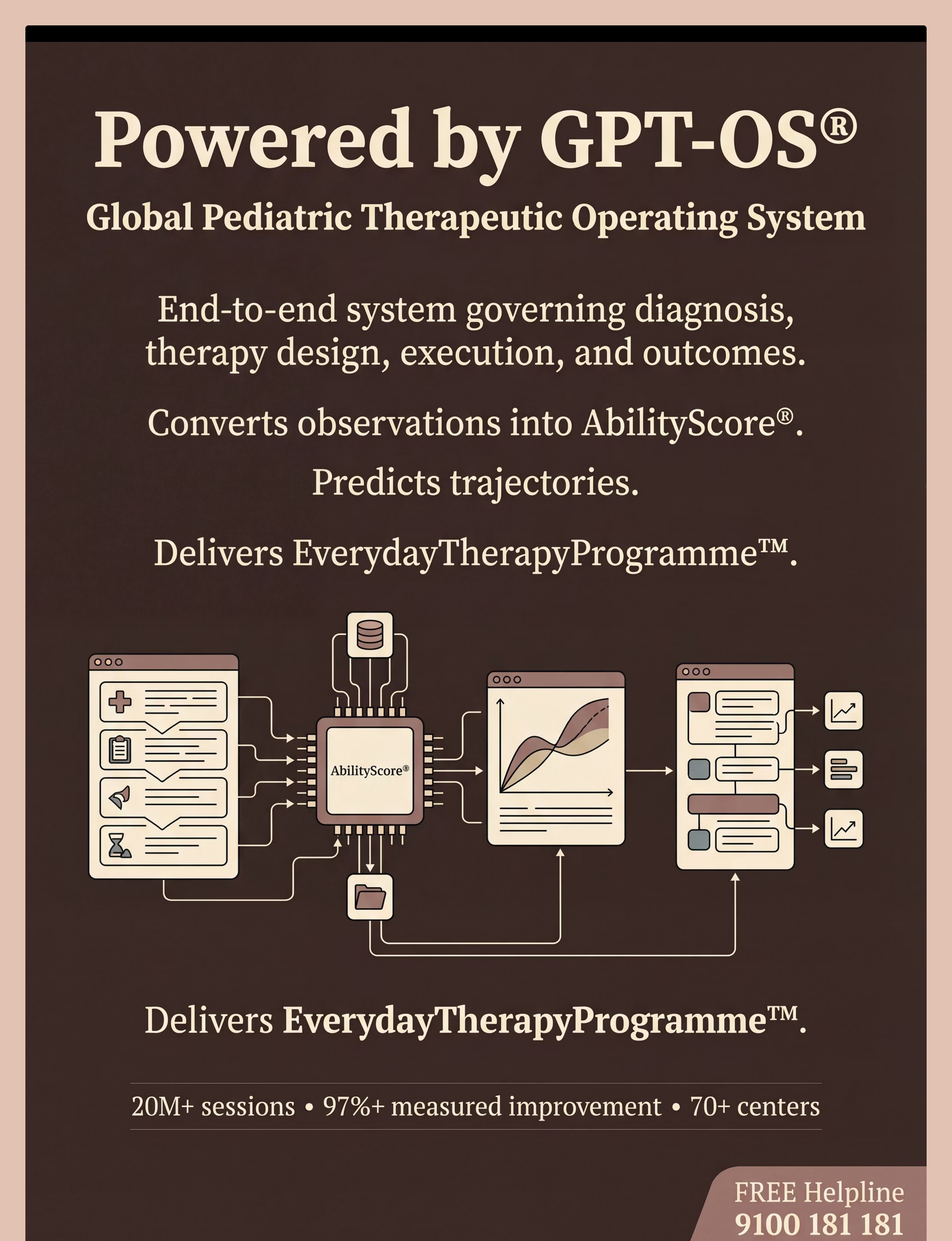
On-demand therapy guidance, parent education, and EverydayTherapyProgramme™ delivery. Access expert-guided intervention from home, at any time.
Hyperlocal Therapeutic Marketplace
Connects families to verified therapists, centers, programs, and resources. Find the right support, wherever you are.
Center Network Execution
70+ physical centers operating under GPT-OS® standards — consistent, accountable, measurable therapy delivery at every location.
Contact Pinnacle
FREE National Autism Helpline
16+ languages | 24x7 availability
16+ languages | 24x7 availability
Phone: 9100 181 181
Website: pinnacleblooms.org
Email: care@pinnacleblooms.org
Statutory Identifiers
CIN: U74999TG2016PTC113063
DPIIT: DIPP8651 (Govt. of India)
MSME: Udyog Aadhaar: TS20F0009606
GSTIN: 36AAGCB9722P1Z2
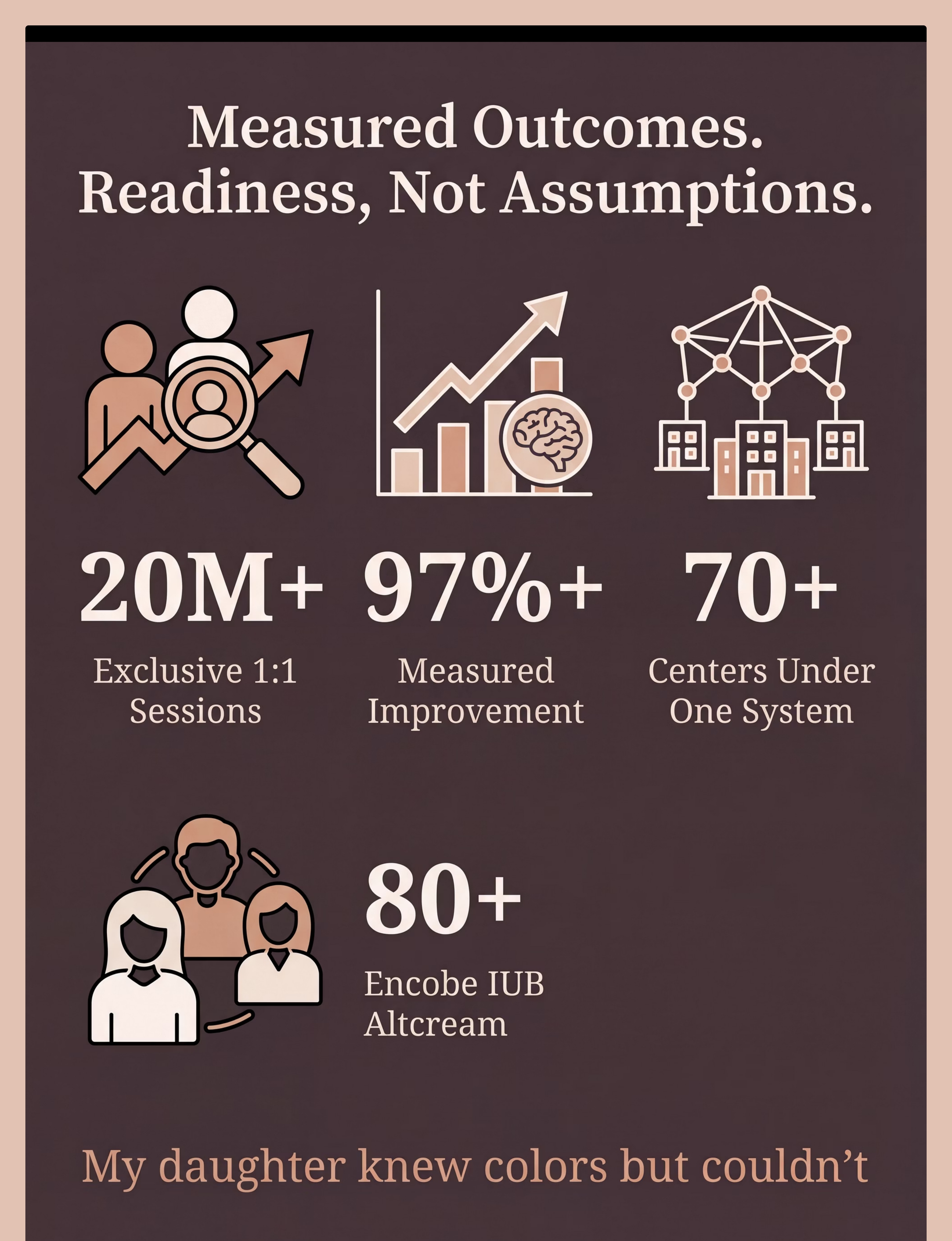
Proof: 20M+ sessions • 97%+ improvement • 70+ centers • Global IP protection