

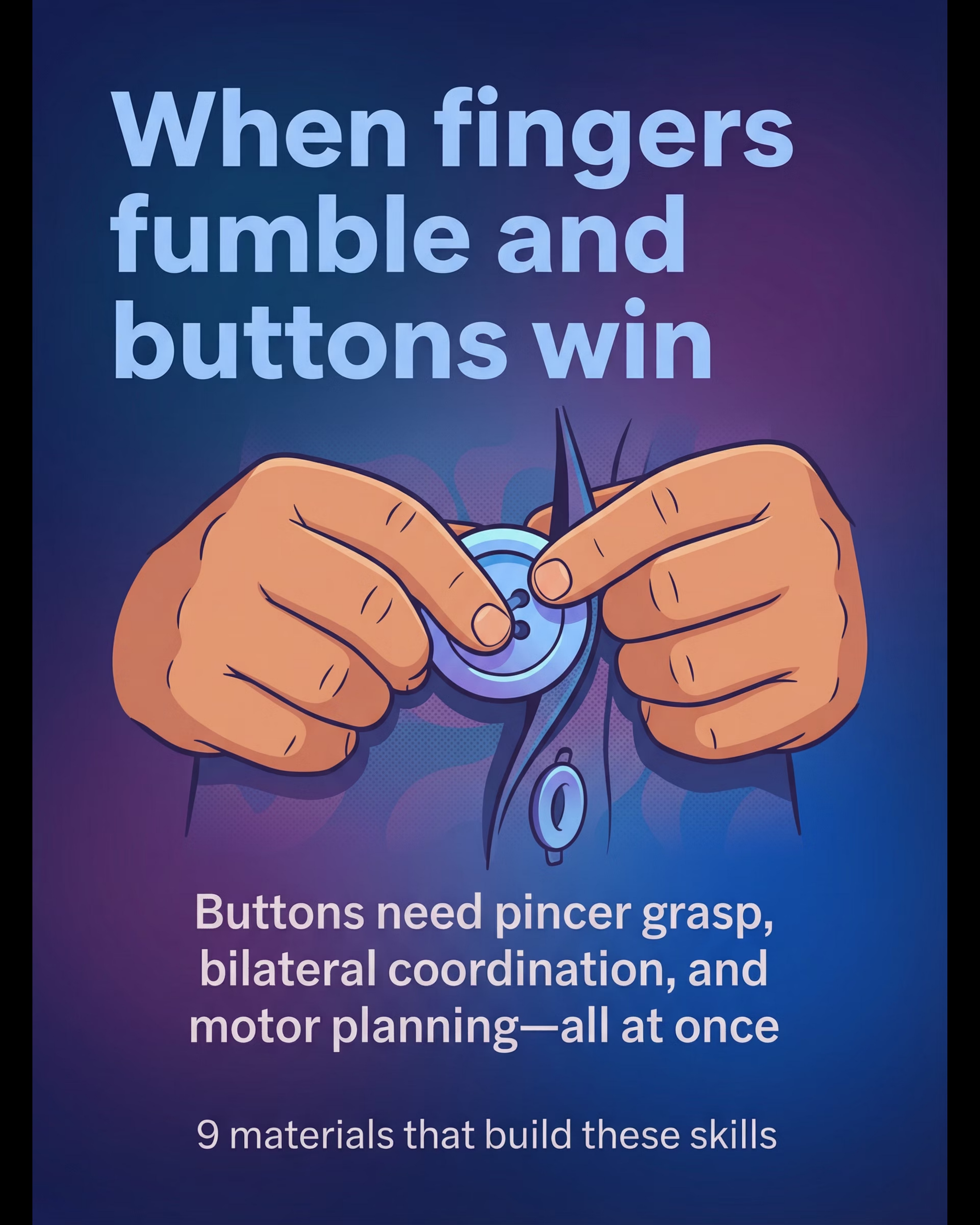
When fingers fumble and buttons win
It's 7:43 AM. School starts in twelve minutes. Your child is standing at the door in their uniform shirt — four buttons standing between them and independence. Their fingers grab the button, poke at the hole, push sideways instead of through. The button slips. Frustration rises in their face, then yours. You reach over and button it yourself. Again. Just like yesterday. Just like every single morning for the past fourteen months.
"You are not failing as a parent. Your child's nervous system is missing a specific set of component skills — and every single one of them can be built." — Pinnacle Blooms Consortium | Pediatric Occupational Therapy Lead
9 materials that build the skills buttons actually require.
E-522
Fine Motor / Dressing Independence
OT-Led
Ages 3–10

You are among millions of families navigating this exact challenge.
1 in 6
Children affected
Children experience fine motor difficulties significant enough to affect daily dressing activities. Source: CDC Developmental Disabilities Surveillance, 2023
68%
ASD & fine motor
Of children with autism spectrum disorder demonstrate significant fine motor delays affecting self-care and dressing independence. Source: PRISMA Systematic Review, PMC11506176, 2024
18 mo
Average wait
Most families wait an average of 18 months before seeking OT support, even though age 5–7 is the peak referral window. Source: AOTA Fine Motor Developmental Reports
Across Pinnacle's 70+ centers spanning India, button skill difficulties represent one of the top 5 occupational therapy referral reasons for children aged 4–8. You are not alone — and you are not too late.
"Buttoning requires the simultaneous integration of at least five distinct neuromotor skills. When even one is underdeveloped, buttons become functionally impossible — not because the child won't try, but because the prerequisite architecture isn't yet in place." — Pinnacle Consortium OT Team

Why buttons aren't simple: the neuroscience parents deserve to know.
What's Happening in the Brain
Premotor Cortex — Plans the multi-step button sequence before any hand movement begins.
Primary Motor Cortex — Executes the pincer and bilateral coordination commands simultaneously.
Cerebellum — Coordinates fine timing between both hands; calibrates force and angle.
Somatosensory Cortex — Processes tactile feedback telling fingers "the button is through."
Corpus Callosum — Coordinates left-right hemisphere communication for bilateral tasks.
In children with DCD, autism, low muscle tone, or sensory processing differences, one or more of these pathways may process information differently — requiring more deliberate, structured repetition to build motor automaticity.
In Plain Language for Parents
The Planning Problem: The brain's premotor cortex must choreograph a 7-step movement sequence before the hands move. For children with motor planning differences, this choreography doesn't happen automatically — every attempt feels like the first time.
The Coordination Problem: Both hands must do completely different things simultaneously. One holds and opens. One pinches and pushes. This bilateral split requires real-time communication between brain hemispheres.
The Grip Problem: The pincer grasp must exert precisely calibrated pressure — enough to hold the button through resistance, not so much that it deforms the buttonhole. Low muscle tone makes this calibration unreliable.
The Adjustment Problem: Mid-motion, the finger position may need micro-adjustments — rotating the button 15 degrees, shifting grip without dropping. Children with limited in-hand manipulation can't make these adjustments.
This is a wiring difference, not a behavior choice. Not stubbornness. Not laziness. Neurology.

Button skills on the WHO developmental milestone map.
Ages 2–3
Emerging pincer grasp consolidation; begins attempting zips and snaps
Ages 3–4
Should begin managing very large buttons (2"+ diameter) with assistance
Ages 4–5
Large button independence expected; medium buttons emerging
Ages 5–6
Standard shirt buttons (½") with minimal assistance
Ages 6–7
Full button independence across all clothing types
Ages 7+
Automaticity — buttons without conscious attention
📍Your child is working on one of these stages right now. Here is where we are heading: functional, independent dressing across all button types — without the morning battle.
What Commonly Co-Occurs
Button difficulties rarely exist in isolation. Children struggling with buttons frequently also show challenges with zipper manipulation, shoe tying, pencil grip, scissor use, bead stringing, and self-feeding. All of these share the same underlying component skills — addressing button skills builds a foundation that lifts all of these domains simultaneously.
Associated Conditions
- Developmental Coordination Disorder (DCD/Dyspraxia)
- Autism Spectrum Disorder
- ADHD with motor components
- Low muscle tone (hypotonia)
- Sensory processing differences
- Down syndrome
- Cerebral palsy (mild)

The evidence behind this approach.
🛡️ Level II Evidence
Multiple RCTs
Systematic Reviews
Clinical Consensus
Component-skill training for fine motor development — teaching the building blocks of a complex task before the task itself — produces significantly faster and more durable skill acquisition than repeated practice of the final task alone.
Study | Key Finding | Source | |
PRISMA Systematic Review (2024) | 16 studies confirm OT-based fine motor intervention meets evidence-based practice criteria for ASD | PMC11506176 | |
World J Clin Cases Meta-Analysis (2024) | Sensory integration + fine motor OT promotes adaptive behavior and motor skills across 24 studies | PMC10955541 | |
Indian RCT — Padmanabha et al. (2019) | Home-based OT intervention demonstrated significant fine motor outcomes in Indian pediatric population | DOI:10.1007/s12098-018-2747-4 | |
NCAEP Report (2020) | Visual supports + structured skill sequencing = evidence-based practice for autism | NCAEP 2020 | |
WHO CCD Package (2023) | Home-based caregiver-administered activities build fine motor foundations across LMICs | PMC9978394 |
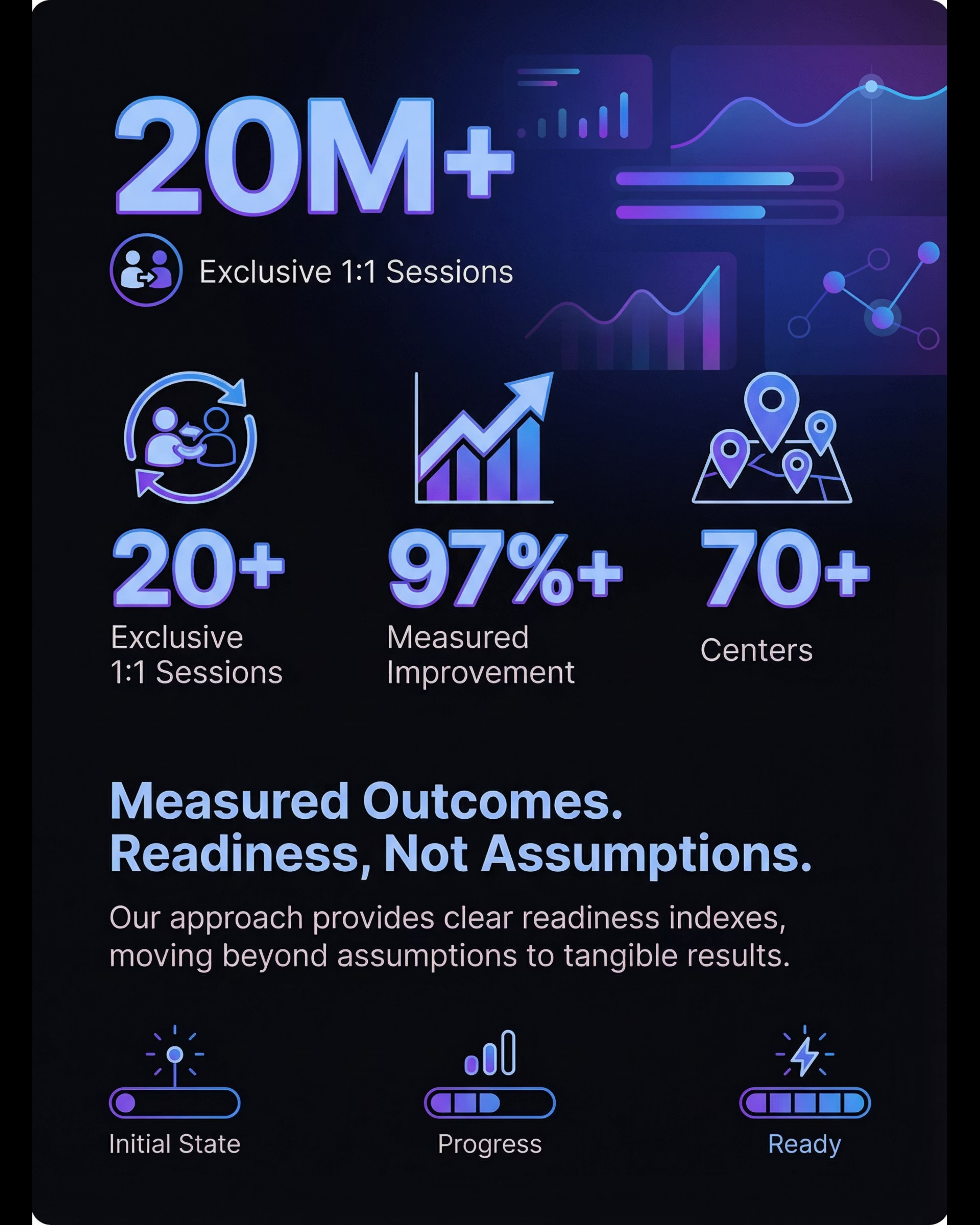
20M+
Exclusive 1:1 therapy sessions
97%+
Measured improvement across Fine Motor Readiness Index
70+
Centers across India
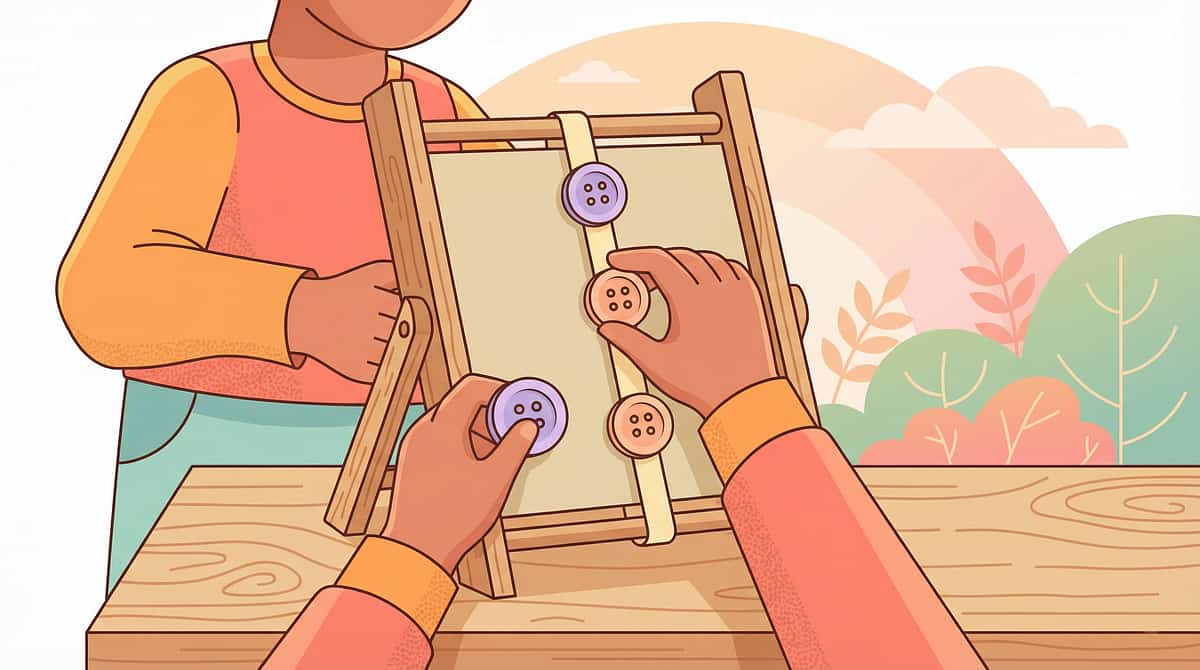
The Button Skills Builder Program: what it is and how it works.
Button Skills Training is a structured occupational therapy approach that breaks buttoning into its five essential component skills — pincer grasp strength, bilateral hand coordination, in-hand manipulation, motor planning/sequencing, and visual-motor integration — and builds each component systematically using targeted materials before combining them into functional button practice on real clothing.
Unlike simply "practicing buttons more," this approach identifies which specific component is the limiting factor for your child, addresses that bottleneck directly, and then reconstructs the complete skill from a solid foundation.
Specifications
- Age Range: 3–10 years (adaptable)
- Session Duration: 10–20 minutes daily or 3–5× weekly
- Protocol Length: 6–10 weeks for first measurable change; 12–16 weeks for functional mastery
- Setting: Home, therapy clinic, school OT room
- Primary Discipline: Pediatric Occupational Therapy (OT-led)
- Supporting Disciplines: ABA, SpEd, NeuroDev
Domain Badges
🟣 Fine Motor Skills
👔 Dressing Independence
🤲 Self-Care
🧠 Motor Planning
👐 Bilateral Coordination
E-522 | Fine Motor & Dressing Independence Series · Episode 522 of 540 · Cluster FINE-06
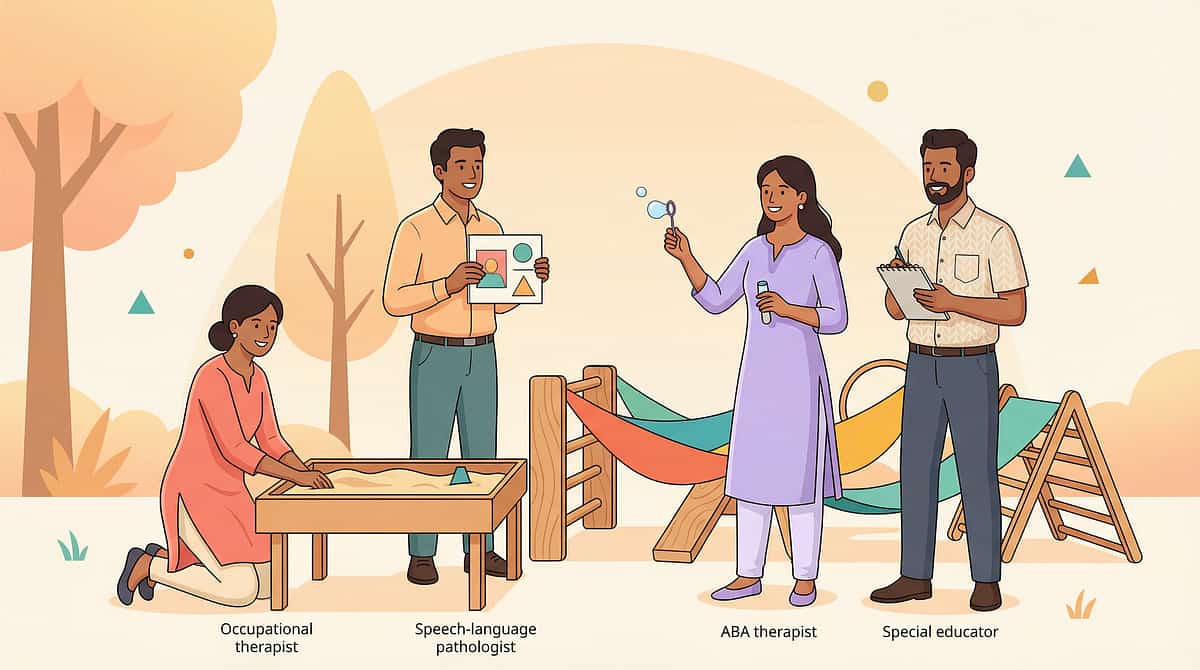
The consortium behind every button skill breakthrough.
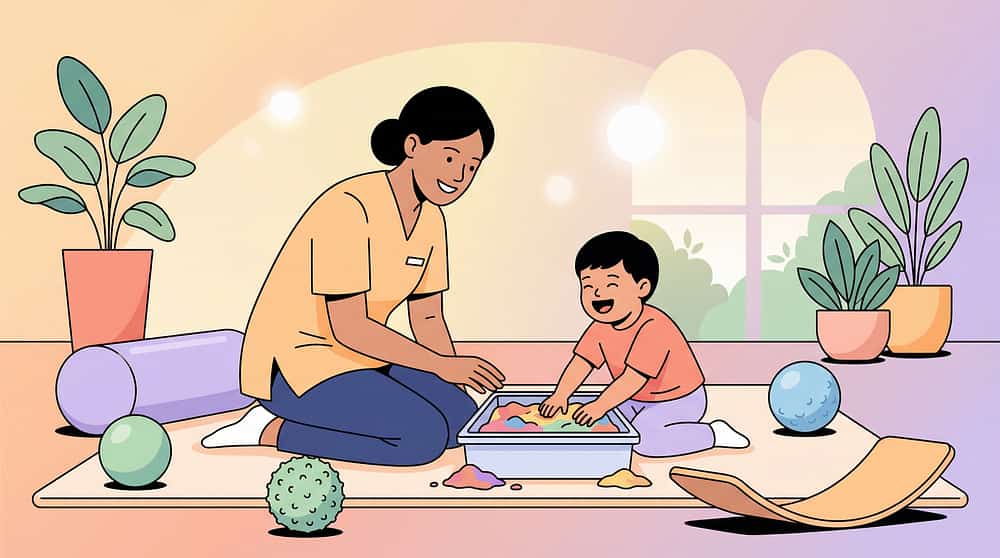
🏥 Pediatric Occupational Therapist
Primary Lead. The OT conducts the formal fine motor assessment, identifies which component skill(s) are limiting button success, prescribes the specific material progression, and guides parent protocol execution. In-clinic sessions focus on hands-on repetition using graded materials with precision calibration every 2 weeks.

🧠 ABA / BCBA Specialist
Reinforcement Architecture. The BCBA designs the reinforcement schedule that makes daily button practice sustainable. Token economies, immediate specific praise protocols, satiation monitoring, and generalization programs ensure skills transfer to actual clothing across multiple environments.
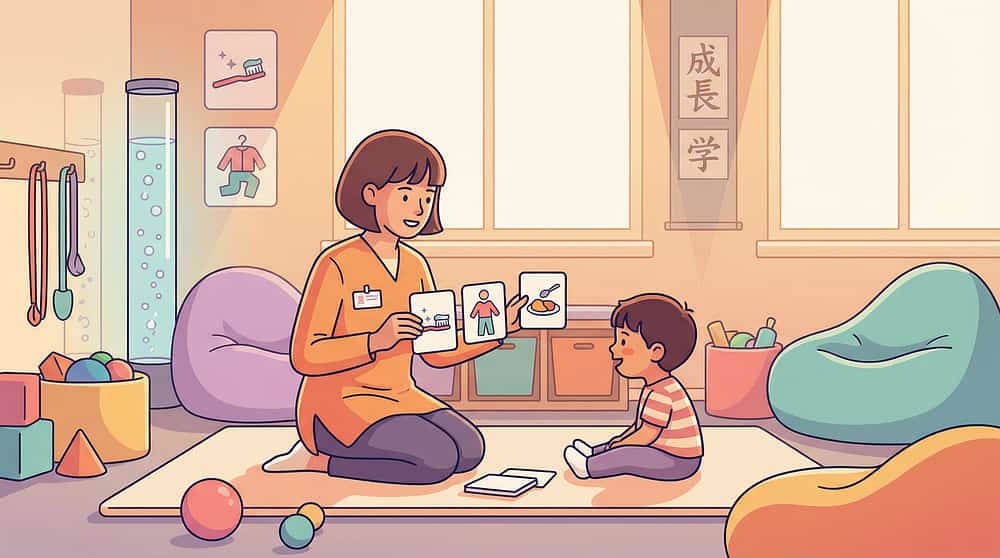
📚 Special Education Specialist
Visual Support Design. The SpEd specialist creates the visual sequence cards, task analysis charts, and step-by-step instruction cards that support children with motor planning and sequencing difficulties. Visual supports externalise the internal choreography that the brain struggles to self-generate.
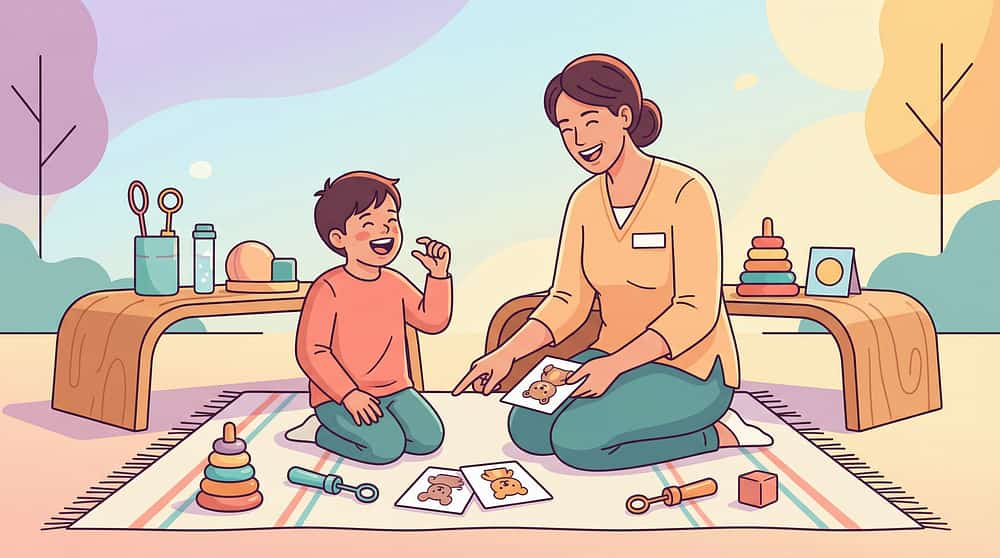
🗣️ Speech-Language Pathologist
Self-Advocacy Language. The SLP embeds button practice within communication routines — "I need help" vs. "I can do it" language, requesting preferred items that require button manipulation. Buttoning becomes a communication opportunity, not just a motor task.

👨⚕️ NeuroDevelopmental Pediatrician
Diagnostic Clarity. When button difficulties suggest underlying DCD, hypotonia, or sensory processing disorders, the NeuroDev physician provides diagnostic precision ensuring the OT program targets the correct neurological substrate. Medical co-management when neuromotor conditions are confirmed.
"The brain doesn't organize development by therapy type. A child's button failure may have a motor cause, a sensory cause, a planning cause, or a combination. The Pinnacle Consortium brings all five lenses to bear simultaneously — so nothing is missed."
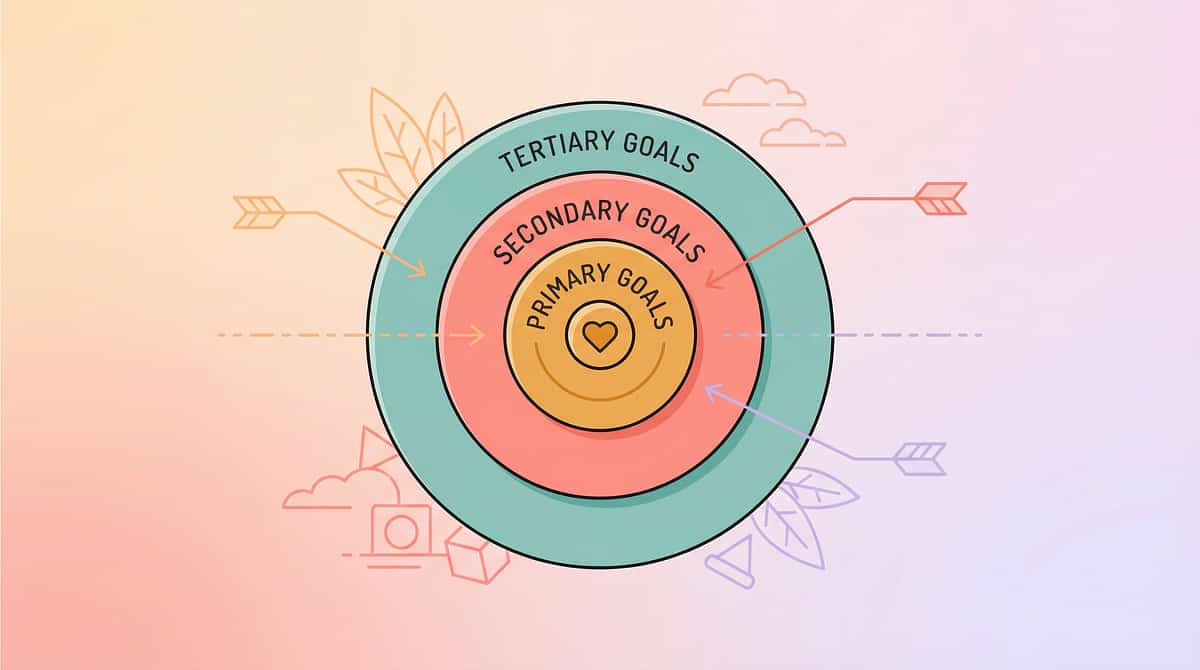
Precision targeting: what button skills training actually builds.
"Every button a child masters is not just a clothing fastener. It is a deposit in their account of self-efficacy — the deep belief that their body can be trusted to do what they ask it to do." — Pinnacle Consortium, Pediatric OT Division
Research confirms: fine motor OT promotes adaptive behavior, social skills, and independence in parallel with primary motor targets. When you build button skills, you are building the whole child. Source: PMC10955541
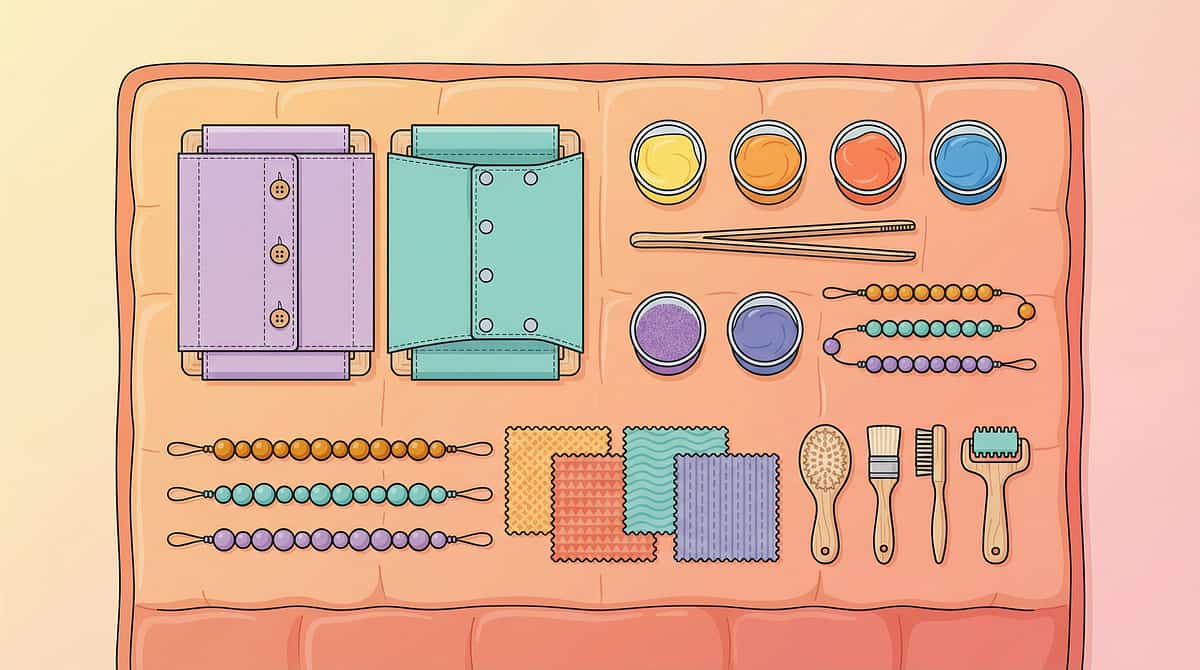
9 materials. Each addresses a specific component of button mastery.
These nine materials form a complete, evidence-based toolkit covering every component skill involved in button manipulation. You do not need all nine to begin — start with Material 1 and add progressively based on your child's limiting factor.
Material 1
Large Button Dressing Frame
Material 2
Button Snake Activity
Material 3
Graduated Button Board
Material 4
Therapy Putty
Material 5
Button Busy Book Pages
Material 6
Bilateral Coordination Kit
Material 7
Practice Vest on Stuffed Animal
Material 8
In-Hand Manipulation Game Set
Material 9
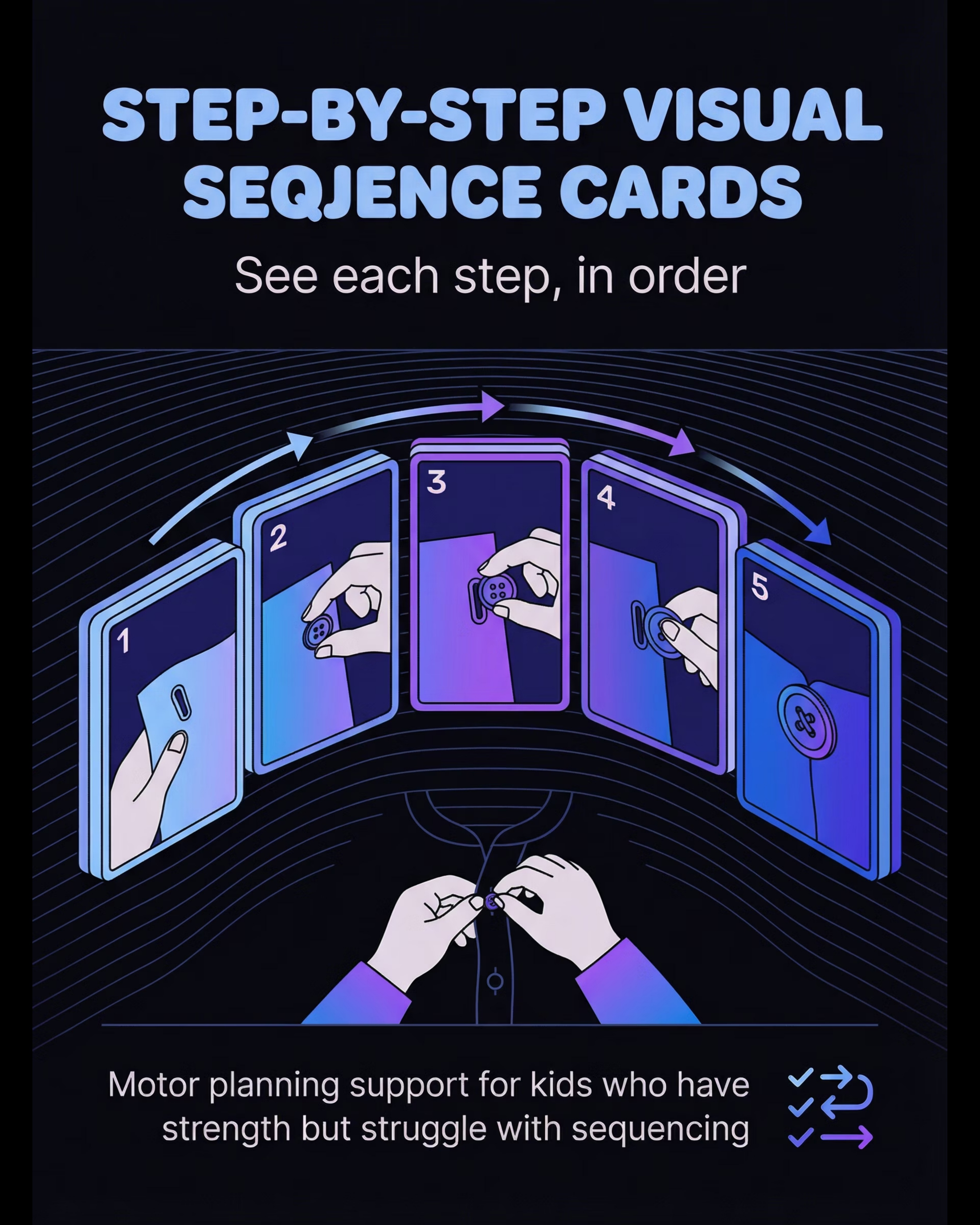
Step-by-Step Visual Sequence Cards
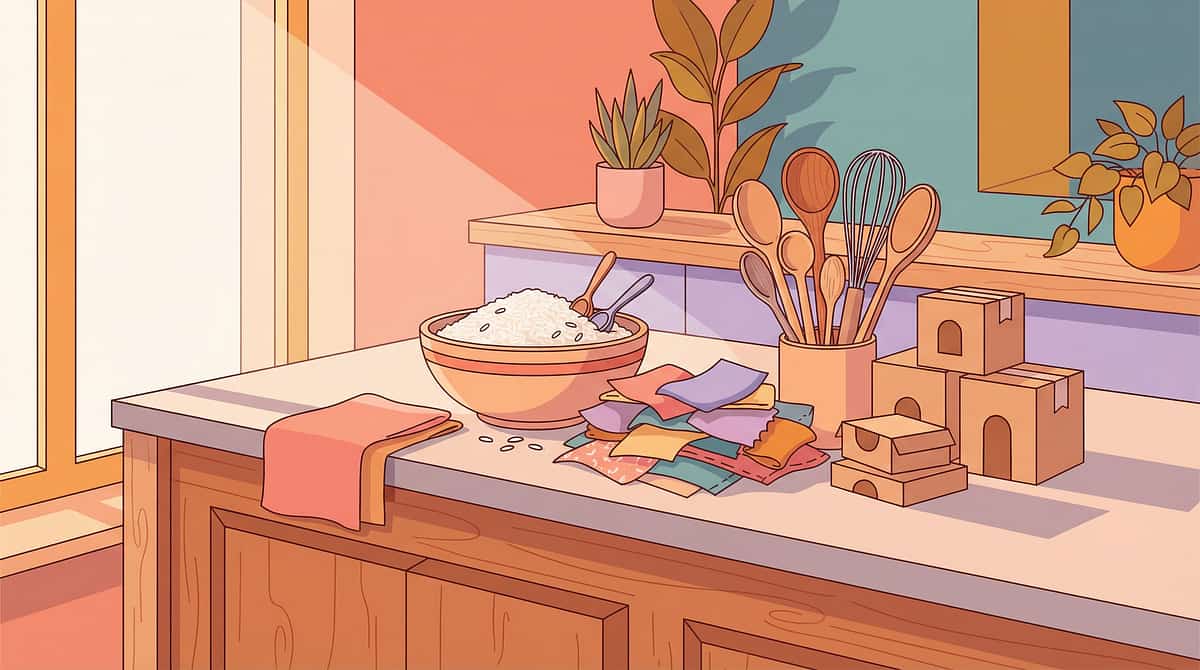
Materials 1–3: Dressing Practice Foundations
Material 1
₹300–1,200
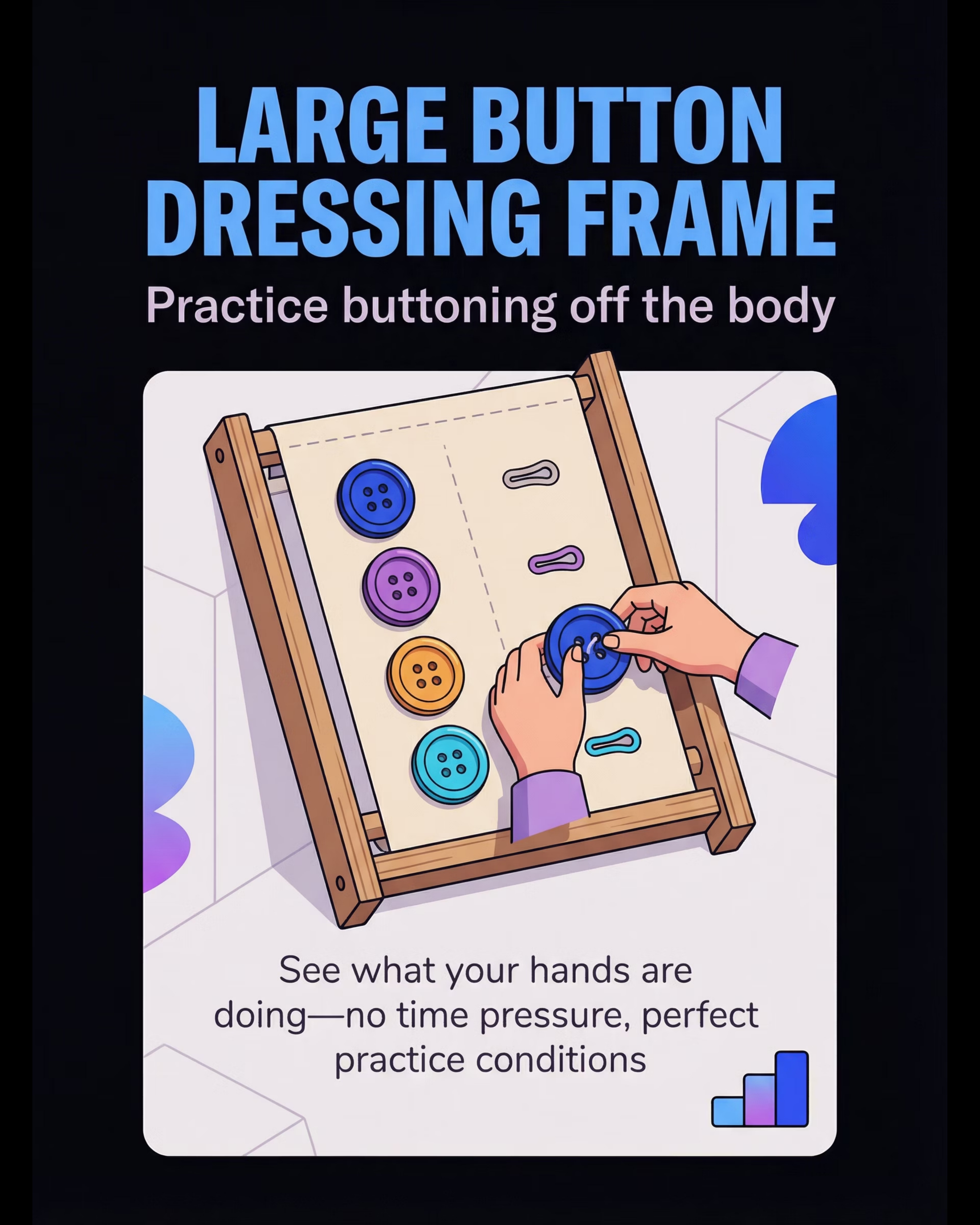
Large Button Dressing Frame
What it does: Isolates the button-through-hole motor pattern from the complexity of working on the body. The child sees exactly what their hands are doing — flat on table or vertical at eye level. No time pressure. Hundreds of repetitions per session.
Why start here: Practicing on real clothes adds body-position complexity before the motor pattern is learned. Frames build the pattern first.
🛒 Search: "montessori dressing frame large button" on Amazon.in
Material 2
₹150–500
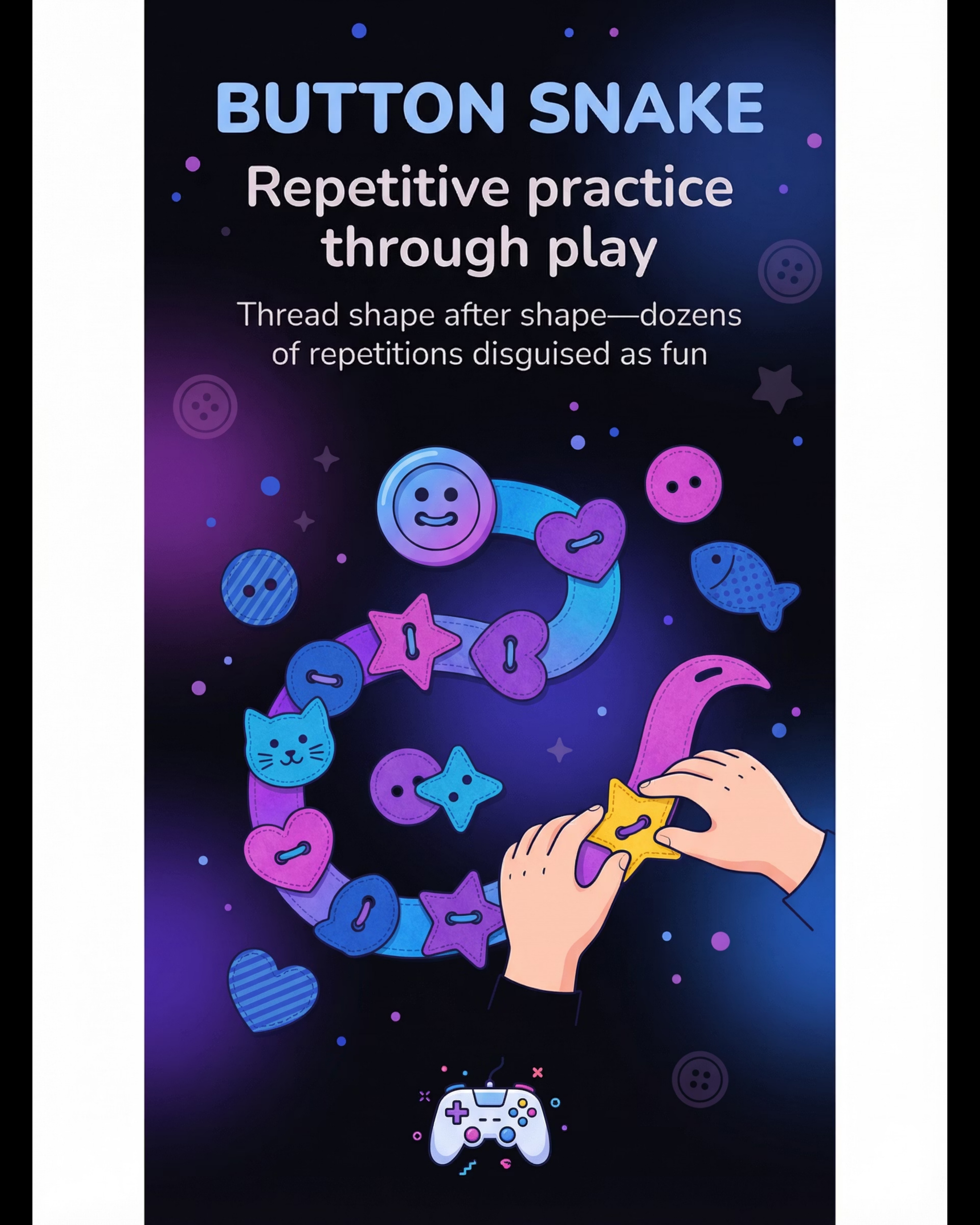
Button Snake (Button Chain Activity)
What it does: A felt strip with a large button at one end. Felt shapes with slits thread onto the "snake" by buttoning through each shape. Turns repetitive practice into play — 20+ button repetitions disguised as building a snake.
Why use this: Repetition builds automaticity, but only if the child stays engaged. Button snakes maintain motivation through novelty and visible progress.
🛒 Search: "button snake activity felt children therapy" on Amazon.in
Material 3
₹400–1,500
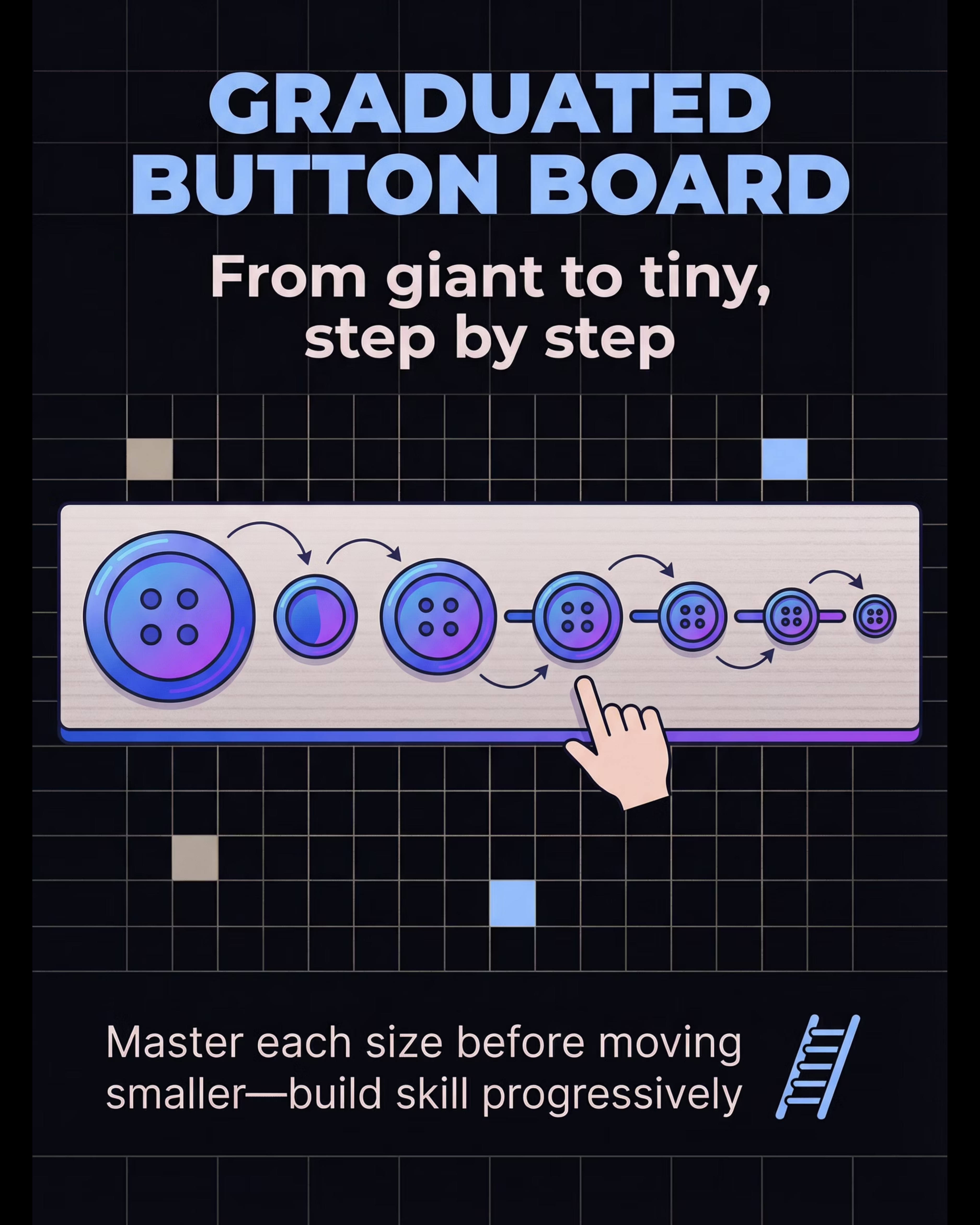
Graduated Button Board (Progressive Sizes)
What it does: Buttons arranged from 2-inch diameter down to ½-inch (standard shirt button). Child masters each size before advancing. Success at each level builds confidence and skill simultaneously.
Why use this: Button size is the single biggest determinant of success or frustration. Progress systematically — never jump to hard before mastery of easy.
🛒 Search: "graduated button board fine motor therapy" on Amazon.in
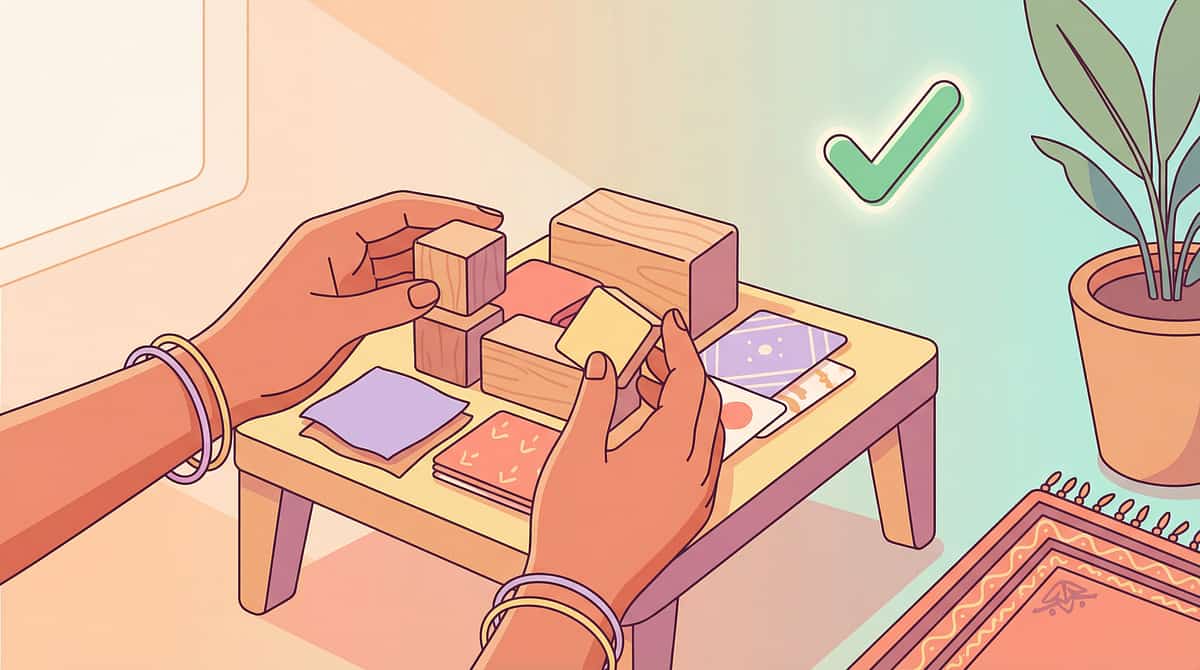
Materials 4–6: Strength, Engagement & Bilateral Training
Material 4
₹200–600
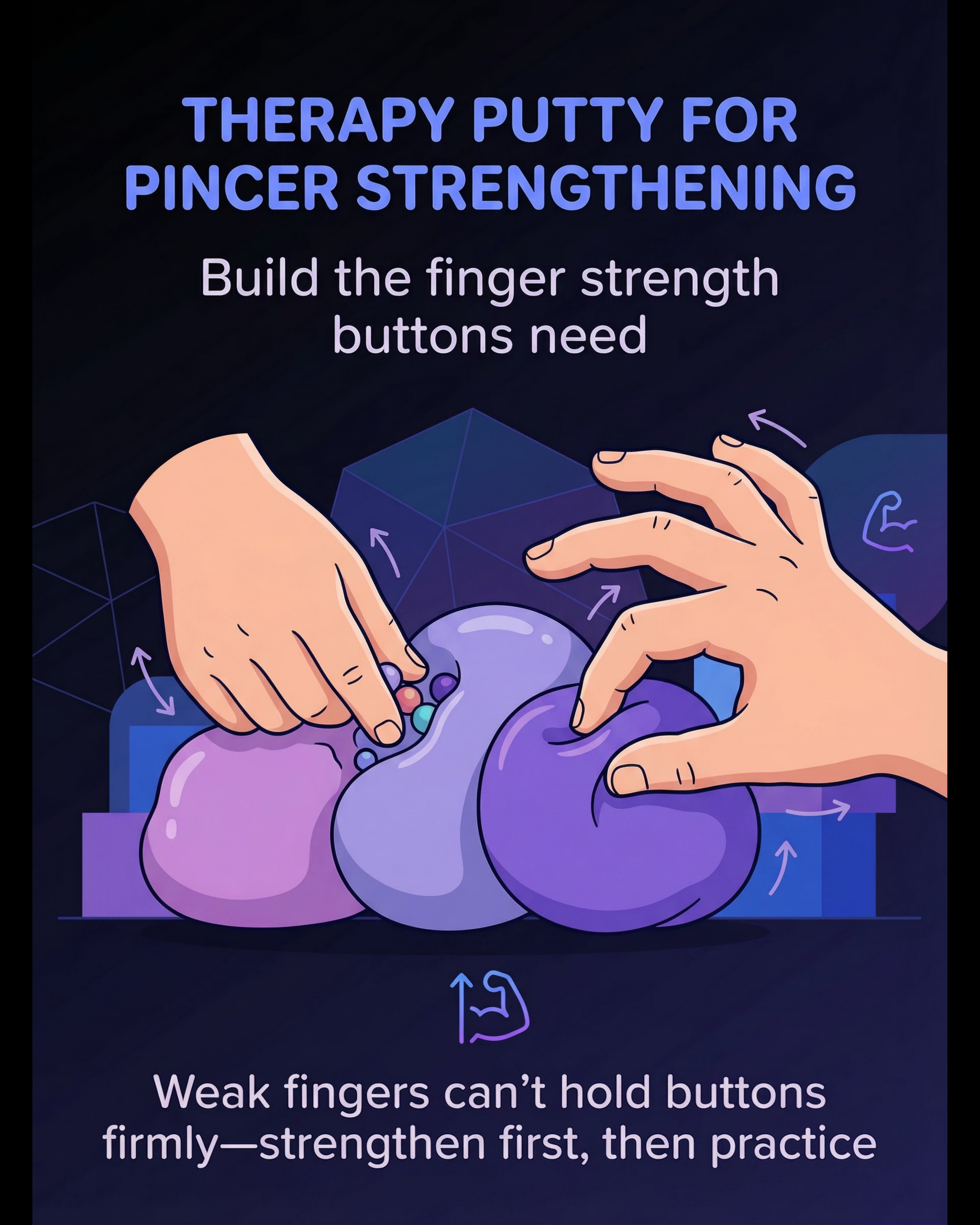
Therapy Putty (Pincer Strengthening)
What it does: Graded-resistance putty builds the pincer grasp muscle strength needed to hold a button through resistance without slipping. Activities include pinch-and-pull, bead-hiding, and tiny ball rolling. Addresses the root cause when grip weakness is the limiting factor.
Why use this: Weak fingers cannot hold buttons firmly mid-motion. Strengthen first, then practice buttons — not the other way round.
🛒 Search: "therapy putty children hand strengthening" on Amazon.in
Material 5
₹400–1,500
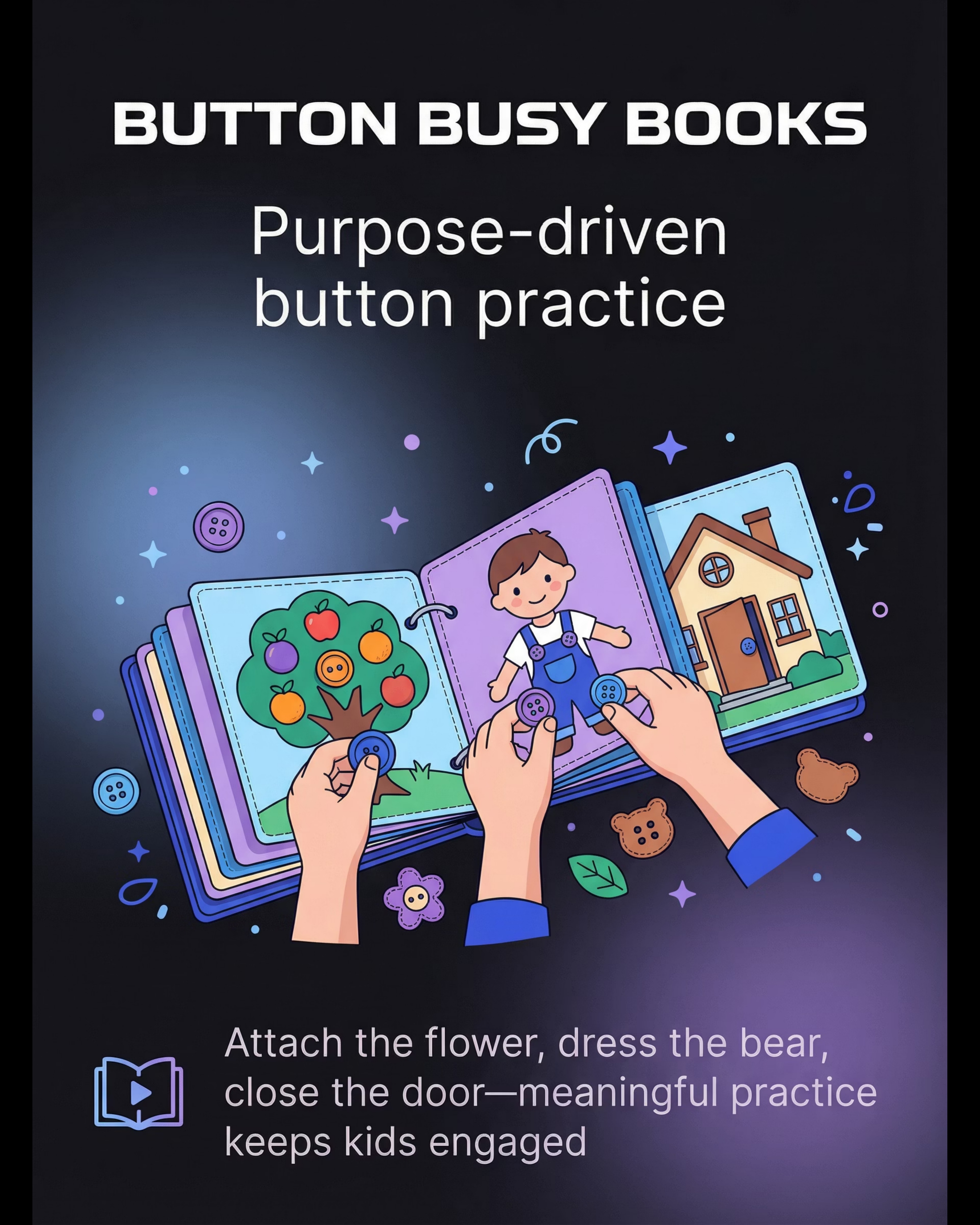
Button Busy Book Pages
What it does: Fabric activity pages where buttoning accomplishes something meaningful — attach a flower, dress a character, close a door on a house. Context and purpose drive engagement for the high repetition volumes fine motor skill-building requires.
Why use this: When buttoning serves a story or a goal, children practice more willingly and for longer — multiplying therapeutic dosage through intrinsic motivation.
🛒 Search: "busy book button activity fabric children" on Amazon.in
Material 6
₹100–600
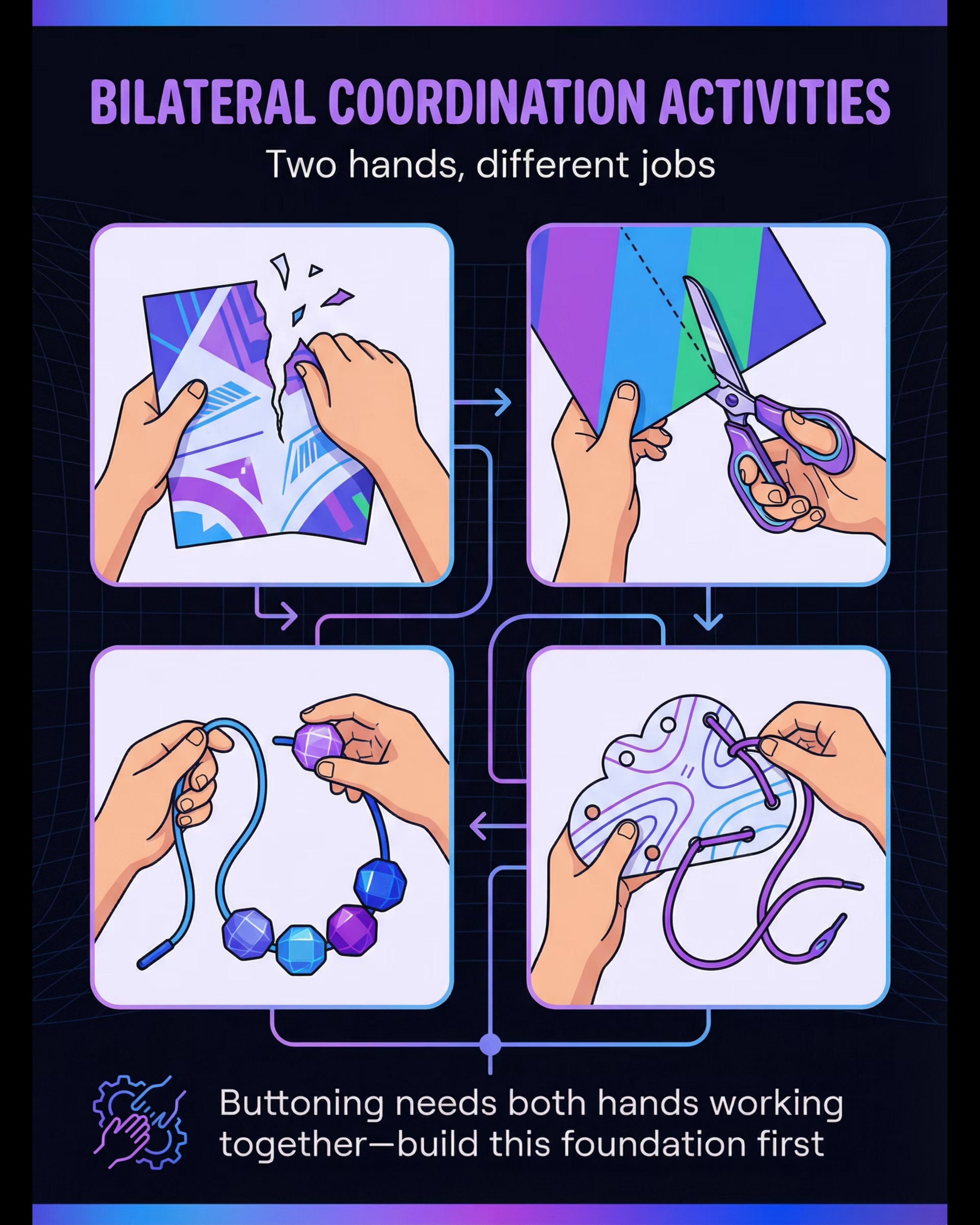
Bilateral Coordination Activity Kit
What it does: Lacing cards, bead stringing, paper tearing, scissors — activities where one hand holds while the other works. Builds the foundational bilateral split that buttoning demands. General bilateral skill transfers directly to button-specific bilateral performance.
Includes: Lacing cards + laces, large beads and cord, child-safe scissors, tearing paper.
🛒 Search: "lacing cards children fine motor bilateral" on Amazon.in
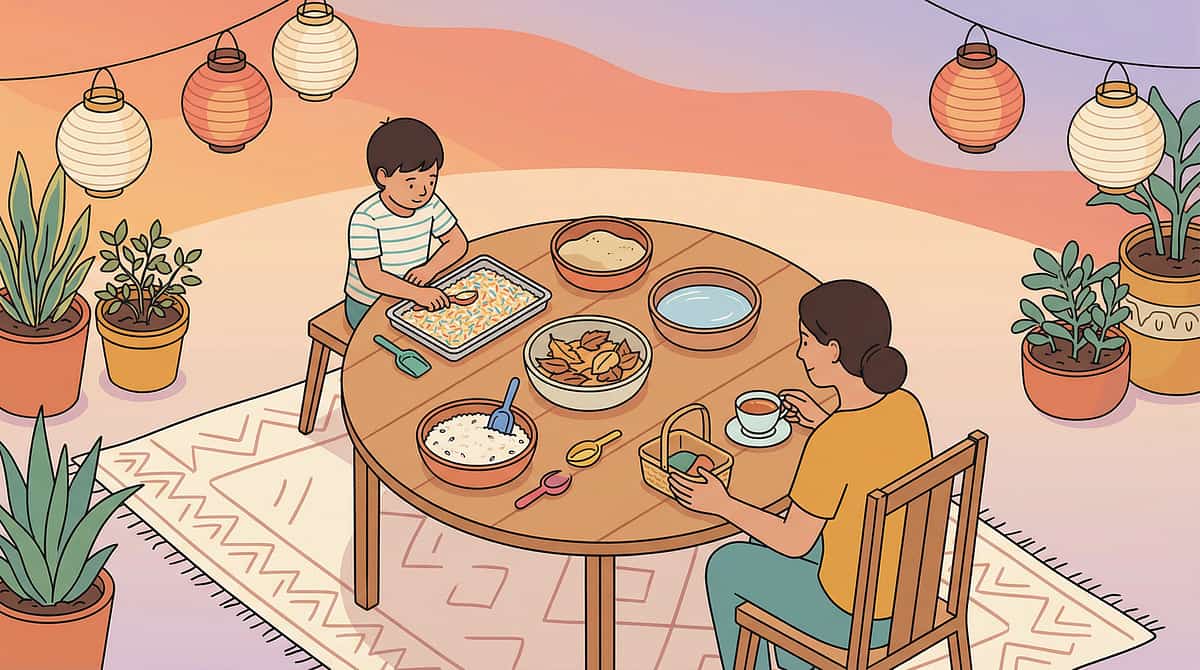
Materials 7–9: Transfer Training, In-Hand Skills & Visual Planning
Material 7
₹300–1,000
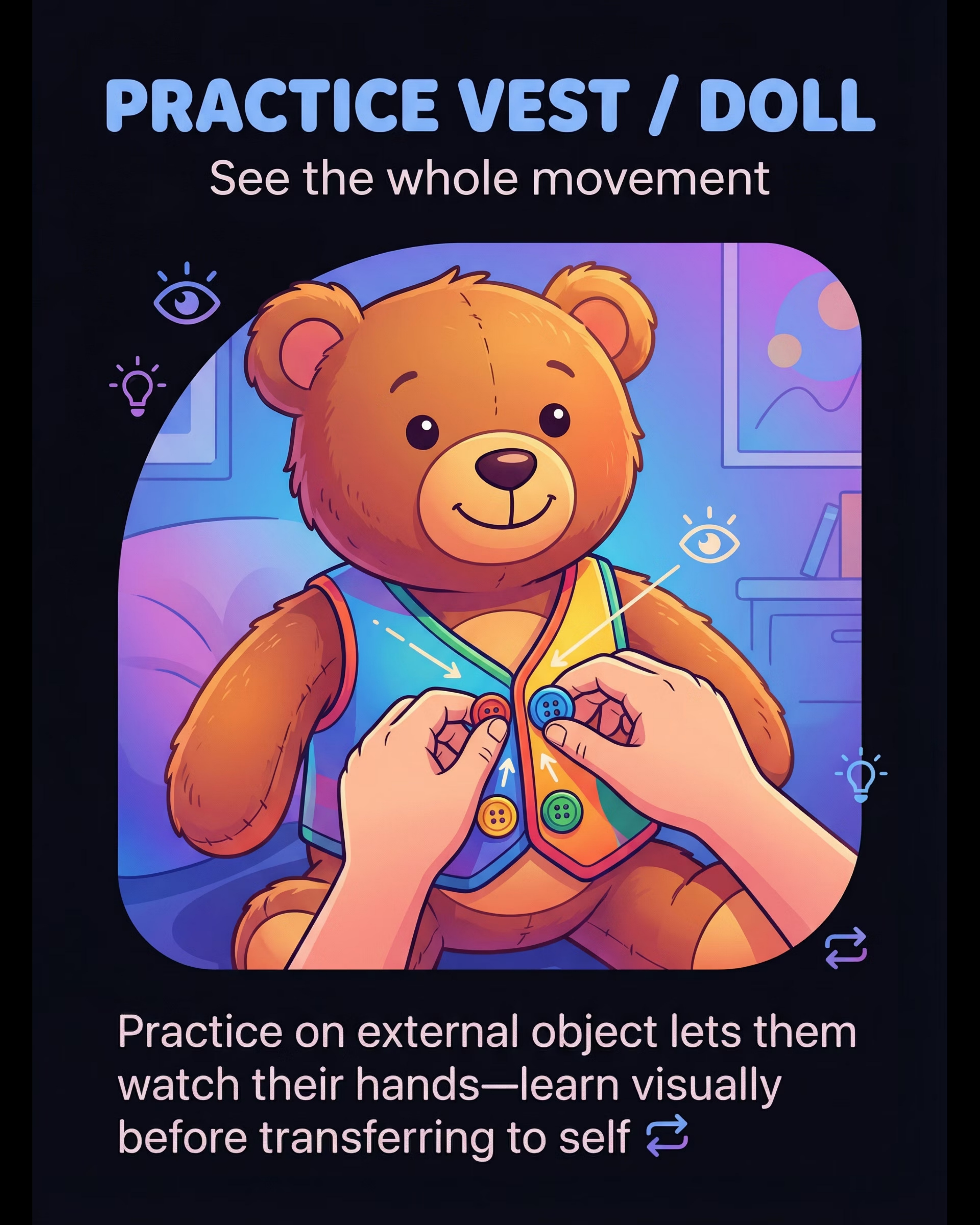
Practice Vest on Stuffed Animal
What it does: A large stuffed animal wearing a vest or shirt with large buttons lets the child practice while watching their hands from the outside — which is impossible when buttoning on their own body. Builds the visual motor pattern before the added complexity of working on themselves.
Why use this: You cannot see what you're doing when buttoning your own shirt. External practice provides the visual feedback that self-practice cannot.
✨Animal Soft Toy — ₹425 (add a button vest for ideal practice base)
Material 8
₹100–400
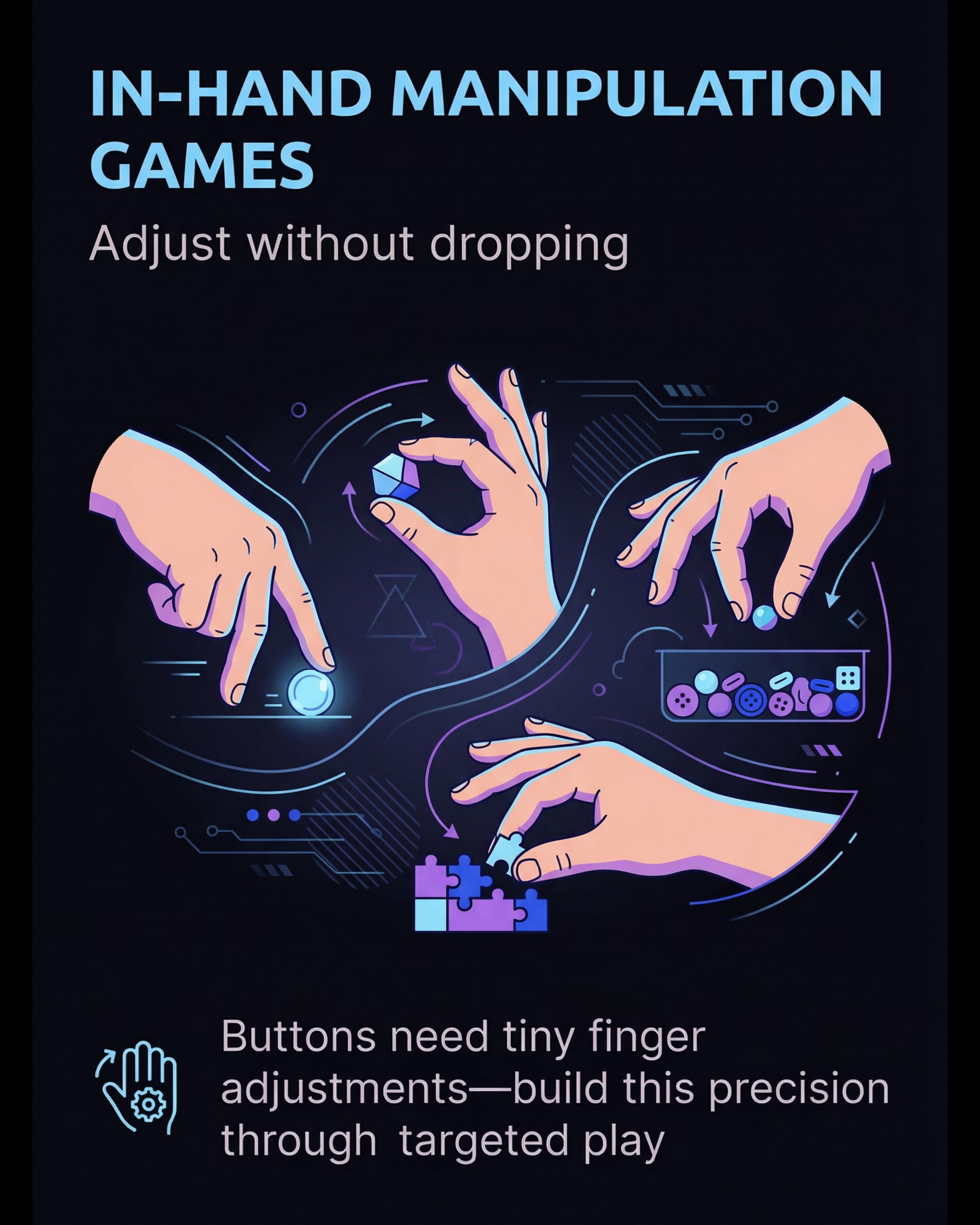
In-Hand Manipulation Game Set
What it does: Coin walking, small object sorting, rotating objects within fingers — activities that build the micro-adjustment capability buttons require. Children who can't adjust object position within their fingers will lose the button at the critical moment of push-through.
🛒 Search: "fine motor in-hand manipulation small objects children" on Amazon.in
Material 9
₹100–400
Step-by-Step Visual Sequence Cards
What it does: 7-step photographic/illustrated sequence showing exactly what each hand does, in what order, at what position. For children who have grip strength and coordination but struggle with motor planning — knowing what comes next. Externalises the internal choreography.
🛒 Search: "visual sequence cards fine motor dressing autism" on Amazon.in
Reinforcement Materials:🏆Rosette Imprint Reward Jar — ₹589 (token economy for each successful button-through) | ⭐1800+ Reward Stickers — ₹364 (sticker chart for daily practice completion)
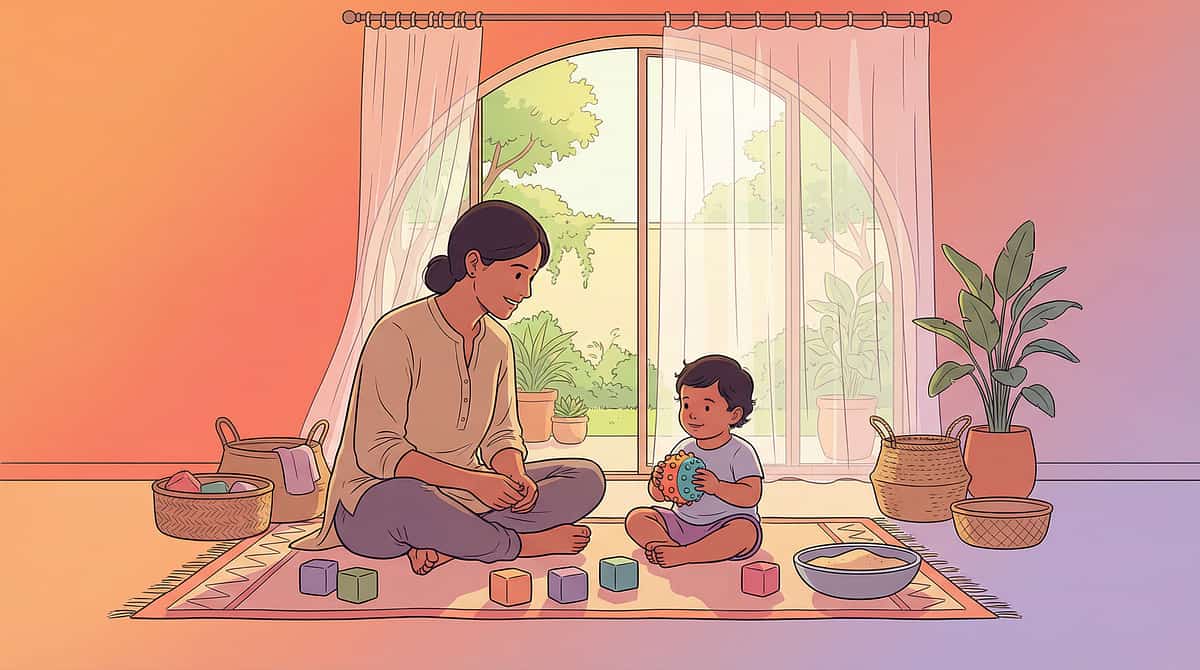
Zero rupees required to begin today. Every material has a household equivalent.
Access to evidence-based fine motor intervention should not be gated by purchasing power. Every household contains the raw materials for a world-class button skills program. — Pinnacle Consortium, aligned with WHO Nurturing Care Framework (2018)
Material | ₹ Commercial | ₹0 DIY Alternative | Why It Works | |
Dressing Frame | ₹300–1,200 | Two fabric pieces stitched to cardboard. Sew 3 large coat buttons on one side, cut matching buttonholes on the other. | Same motor pattern isolation — no body complexity. | |
Button Snake | ₹150–500 | Ribbon or shoelace + one large button sewn to end. Cut felt/cloth shapes with slits. | Identical mechanism. Felt from old clothing works perfectly. | |
Graduated Board | ₹400–1,500 | Collect buttons of 5 sizes from old shirts. Sew onto fabric strips in size order. | Same progressive difficulty principle. | |
Therapy Putty | ₹200–600 | Mix 1 cup flour, ½ cup salt, ½ cup water. Add more flour for firmer resistance. | Salt-dough putty provides comparable resistance. Not for eating. | |
Busy Book Pages | ₹400–1,500 | Felt sheets (₹20 each). Cut shapes, sew buttons on. Loose pages work fine. | Identical engagement principle. Tailor to child's interests. | |
Bilateral Activities | ₹100–600 | Paper tearing (free), cardboard lacing cards, pasta + string threading. | Same bilateral split training. Pasta threading = identical therapeutic mechanism. | |
Practice Vest | ₹300–1,000 | Adult's button-up shirt draped over large stuffed toy or plastic bottle. | Identical visual learning mechanism. | |
In-Hand Games | ₹100–400 | 10-paisa coins moving across fingers, sorting small stones, rotating a pencil within fingers. | Same in-hand manipulation pathway. | |
Sequence Cards | ₹100–400 | Photograph your own hands performing each step. Print A6, laminate with tape, ring-bind with safety pin. | Photos of actual hands outperform illustrations. |
When the clinical-grade material is non-negotiable: If the OT assessment identifies severe low muscle tone requiring precision-calibrated putty resistance, or if the child has significant sensory sensitivities requiring specific textures, the commercial material should be prioritized. Discuss with your Pinnacle OT. Call 9100 181 181.

Read this before every button session. Non-negotiable safety gates.
🔴 DO NOT PROCEED IF:
- Child has open wounds, blisters, or skin irritation on fingers or hands
- Child is in acute distress or post-meltdown within the last 30 minutes
- Any button or small component is loose, cracked, or detachable (choking hazard)
- Child is unwell, running a fever, or significantly fatigued
- Newly diagnosed or unmanaged condition affecting hand musculature — consult OT first
- Child has expressed fear or trauma associated with clothing or dressing
🟡 MODIFY SESSION IF:
- Child is mildly resistive — switch to button snake game format
- Child's grip is weaker than usual — use largest available buttons; halve session duration
- Buttons are small (under ½") and child is under age 5 — always use 1" minimum
- Session environment has unexpected loud sounds or sensory intrusions — relocate or reschedule
🟢 PROCEED WHEN:
- Child is fed, rested, regulated, and in a calm-alert state
- All buttons and materials have been safety-checked (secure, no sharp edges)
- Practice space is set up correctly
- Parent has reviewed the session protocol for today
STOP IMMEDIATELY if you observe: hand trembling, fingertip blanching, pain vocalizations, new-onset refusal to use one hand, asymmetric grip, or any sign of neurological concern. Contact your paediatrician or Pinnacle 9100 181 181 before resuming.
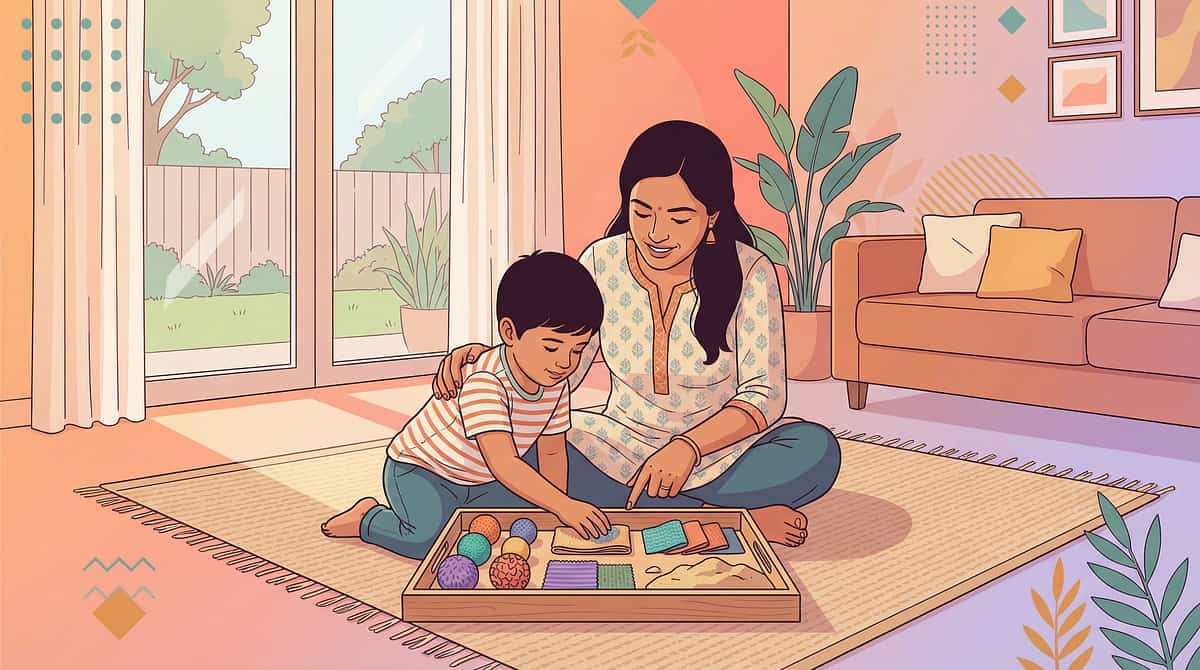
The right environment doubles the session's therapeutic value.
Setup Checklist
- Table at child's elbow height — arms rest naturally without shoulder elevation
- Non-slip mat under the dressing frame — prevents sliding during manipulation
- Single overhead light source — no shadows across the buttonhole area
- Timer set to session duration (start with 10 minutes maximum)
- Phone/TV off — no competing visual stimuli
- Preferred reinforcer visible but at distance (not on the table)
- Visual sequence cards mounted at eye level if child uses them
- "Done box" — a container where completed button snake shapes go (visible progress)
Materials Tray Layout
Place materials to the right of the child, within easy reach — not scattered. Today's button frame | Button snake | Reward tokens | Putty (if strengthening day) | Sequence cards (if needed).
Remove From Space
- Other toys or materials (attention competition)
- Screens of any kind
- Sibling presence (unless they are the practice partner)
- Background TV/radio
Sound & Lighting
Natural daylight is ideal. Calm background music (instrumental, 60 BPM) is acceptable and may aid sustained attention. Avoid table lamps that cast shadows directly onto the button area — maximum visual clarity is essential.
Parent Positioning
Sit beside the child, not behind them. The child must see that you are a co-explorer, not a supervisor. Your body language teaches them how to feel about this activity.
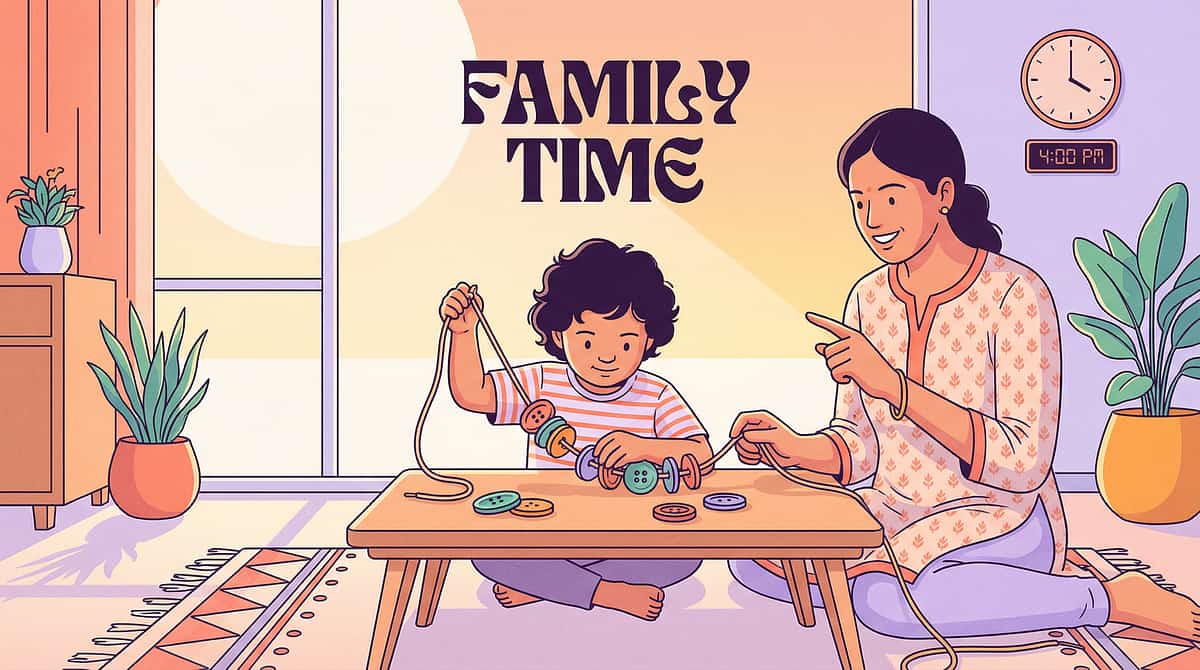
60-second pre-session check. The best session is one that starts right.
Readiness Indicators — Check All Before Starting
✅ ALL GREEN
PROCEED to The Invitation (Step 1)
⚠️ 1–2 AMBER
MODIFY: Button snake game-only format. Aim for 3 successful button-throughs. Duration: 5 minutes maximum.
🛑 ANY RED
POSTPONE: Do not push through. "Session abandonment is not failure — it is excellent clinical judgment."
How are you feeling right now? Rushed? Frustrated from the morning? If you are not in a regulated state, your child will mirror it. Take 3 slow breaths before entering the practice space. Your nervous system sets the room's tone.
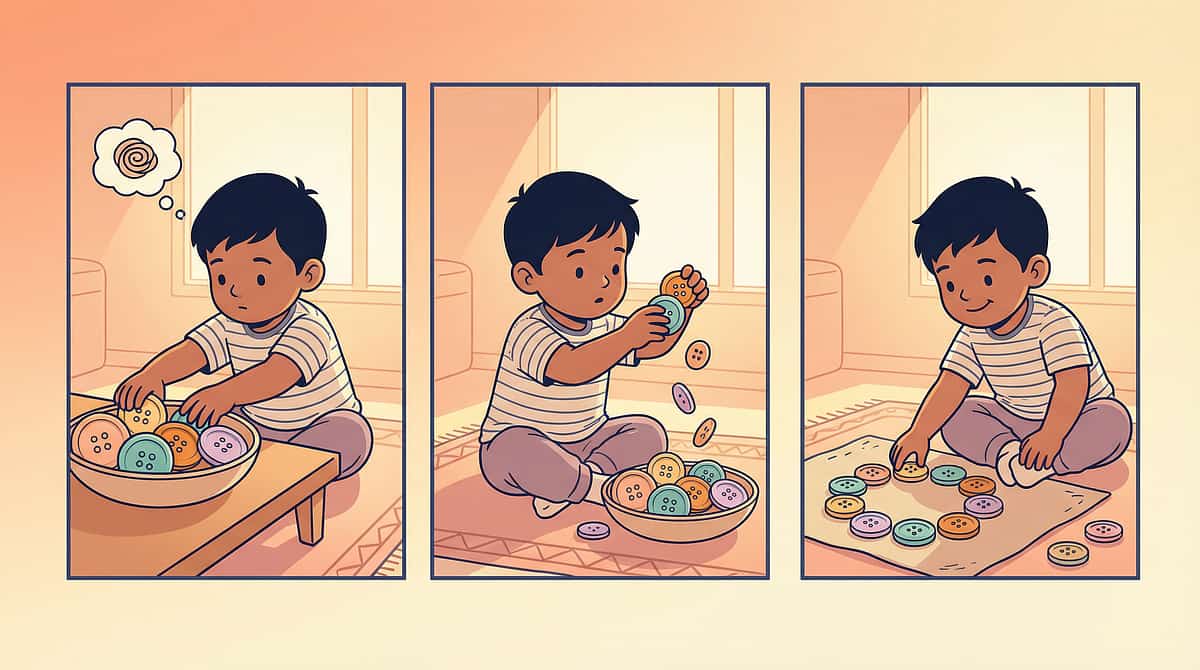
STEP 1
Duration: 30–60 seconds
ABA Pairing + OT Just-Right Challenge
Every session begins with an invitation, never a command.
Opening Scripts (use one)
"Hey, I have something really interesting I want to show you. Come see this." (Do not say "time for button practice")
"Look — I set up your button snake. Want to see if we can make it longer than yesterday?"
_(Point to visual schedule card)_ "Button time! You're going to be so good at this today."
Body Language Guide
- Kneel or sit to the child's eye level — never standing over them
- Relaxed shoulders, open palms visible on table
- Slight forward lean: "I'm interested in this too" posture
- Facial expression: genuinely curious, not testing
Acceptance Cues — Proceed When You See:
- Child moves toward the table
- Child touches or looks at the material
- Child makes any positive vocalization or gesture
Resistance Cues — Modify When You See:
- Child moves away: Reduce demand to "just look at this for 3 seconds"
- Child becomes verbal/cries: Use visual schedule; provide choice ("button snake or dressing frame first?")
- Child ignores: Bring the material to where the child is; join their activity and introduce gradually
The Principle: ABA pairing — before placing any demand, establish that the session environment is associated with positive experiences. OT Just-Right Challenge — the first moment must feel achievable, not threatening.
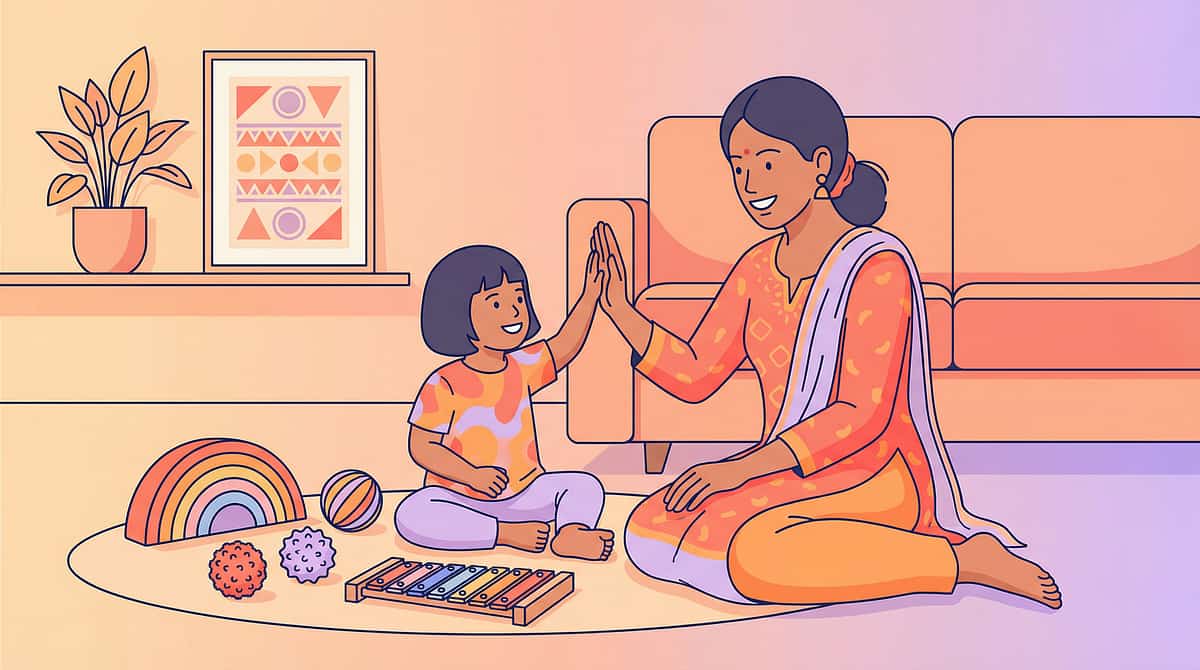
STEP 2
Duration: 1–3 minutes
Material Introduction
The child is at the table. Now introduce the material with precision.
For Dressing Frame
Place the frame flat on the table. Run your own finger along the button: "This button — see how big it is? Big button, big buttonhole." Touch the buttonhole with your finger: "This is the hole. The button goes in here." Demonstrate one complete button-through at normal speed, then slowly. Say: "Your turn. Take the button."
For Button Snake
Hold up the snake with all shapes unattached: "The snake is hungry — it needs shapes! Put a shape on by pushing the button through." Hand one shape to the child. Do NOT do it for them first — let them attempt immediately to preserve novelty.
For Graduated Board
Point to the largest button: "This is your level right now — Giant Button. When you master Giant Button, you move to Big Button. You're going to work through all of them, one at a time." Tap the large button: "Show me what you can do."
Child Response | Meaning | Action | |
Immediate attempt | Fully engaged | Observe silently — do not interrupt | |
Examines without attempting | Processing | Wait up to 20 seconds. Model once. Offer again. | |
Asks for help | Appropriate request | "Let's try together first" — hand-over-hand with light touch | |
Pushes material away | Refusal | Respect. Offer choice. Do not force. |
When child makes their first attempt (successful or not): "YES! You tried! That's exactly right." First reinforcement is for the attempt, not the success.
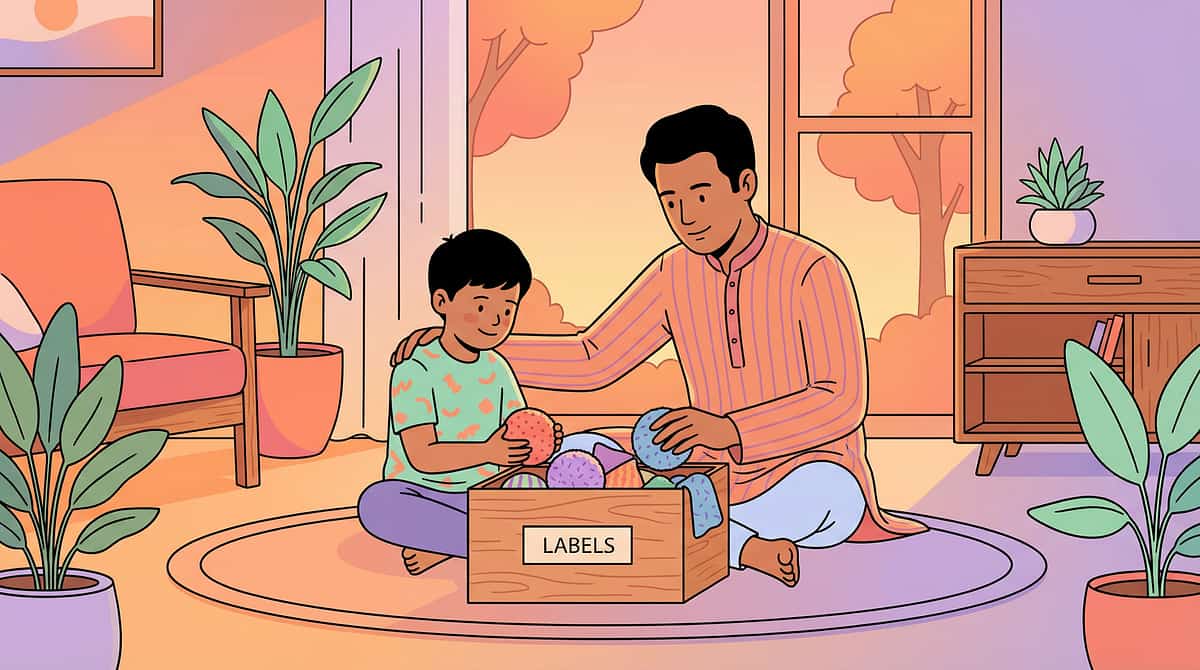
STEP 3
Duration: 5–10 minutes
The Active Ingredient
The core therapeutic event: build the button-through-hole motor pattern.
The 7-Step Button Sequence (teach this explicitly)
Position the Holding Hand
Thumb and forefinger pinch fabric on either side of the buttonhole
Pinch the Button
With the other hand, pinch the button firmly between thumb and forefinger (tip of button pointing forward)
Locate the Buttonhole
Touch the edge of the hole with the button tip before pushing
Push the Button In
Push the button tip INTO the buttonhole from the front side
Open the Hole
The holding hand simultaneously opens/widens the hole slightly
Push Through Completely
Watch for the button to emerge the other side
Secure and Confirm
Grip the emerged button on the back side and pull through. Check: button fully through, fabric lying flat. DONE.
Therapeutic Dosage: 3–5 complete button-through repetitions per session for the first 2 weeks. Increase to 8–10 as success rate climbs above 70%. Quality always beats quantity.
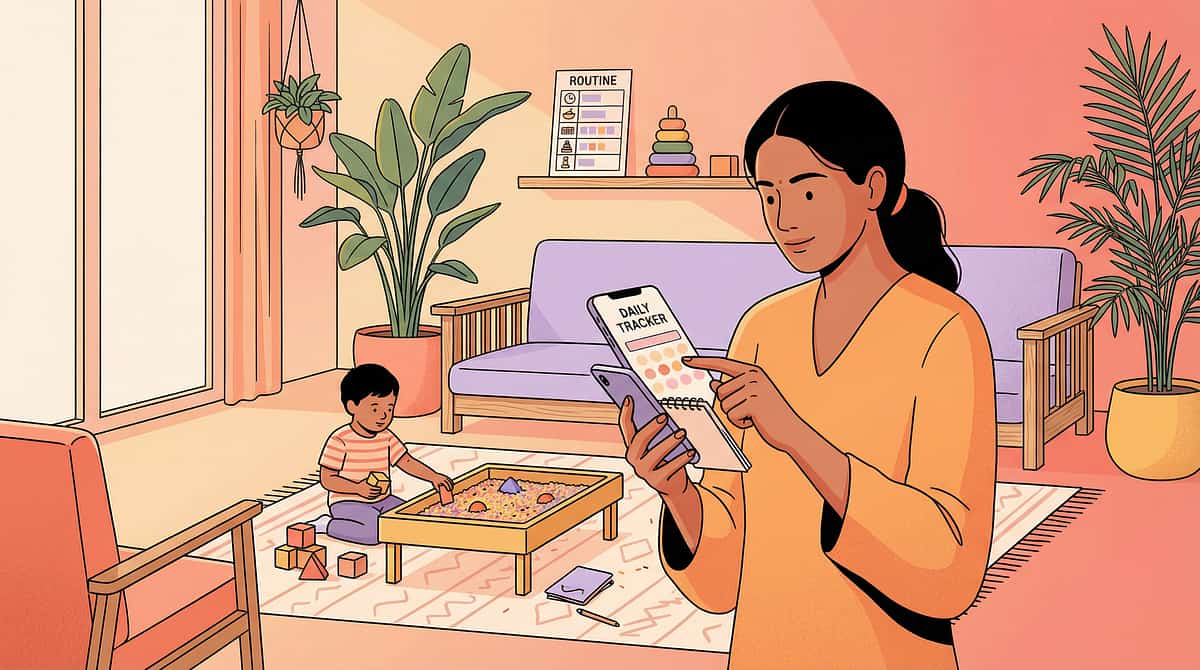
Common execution errors and how to correct them.
Error | Why It Happens | Correction | |
Button slips out before going through | Grip too weak or angle wrong | Start with therapy putty day before; use larger button | |
Buttonhole hand just sits there | Bilateral coordination gap | Verbally cue: "Helper hand — pinch the hole open!" | |
Button goes to wrong location | Visual-motor integration gap | Use high-contrast buttonhole fabric; practice at eye level | |
Sequence breaks mid-task | Motor planning gap | Use visual sequence cards + narrate each step aloud | |
Gets to Step 6 and loses button | In-hand manipulation gap | Practice in-hand manipulation games before button sessions |
STEP 4
Duration: 3–5 minutes
Dosage Architecture
3 excellent repetitions beat 10 forced ones. Every time.
Weeks 1–2
3–5 reps/session · 70% independent needed to advance
Weeks 3–4
5–8 reps/session · 75% independent needed to advance
Weeks 5–6
8–12 reps/session · 80% independent needed to advance
Weeks 7–8
10–15 reps + button size reduction · 85% consistent
"Three quality repetitions where the correct motor pattern fires completely are worth more than ten repetitions where the child is guessing. We are training neural pathways, not clocking minutes."
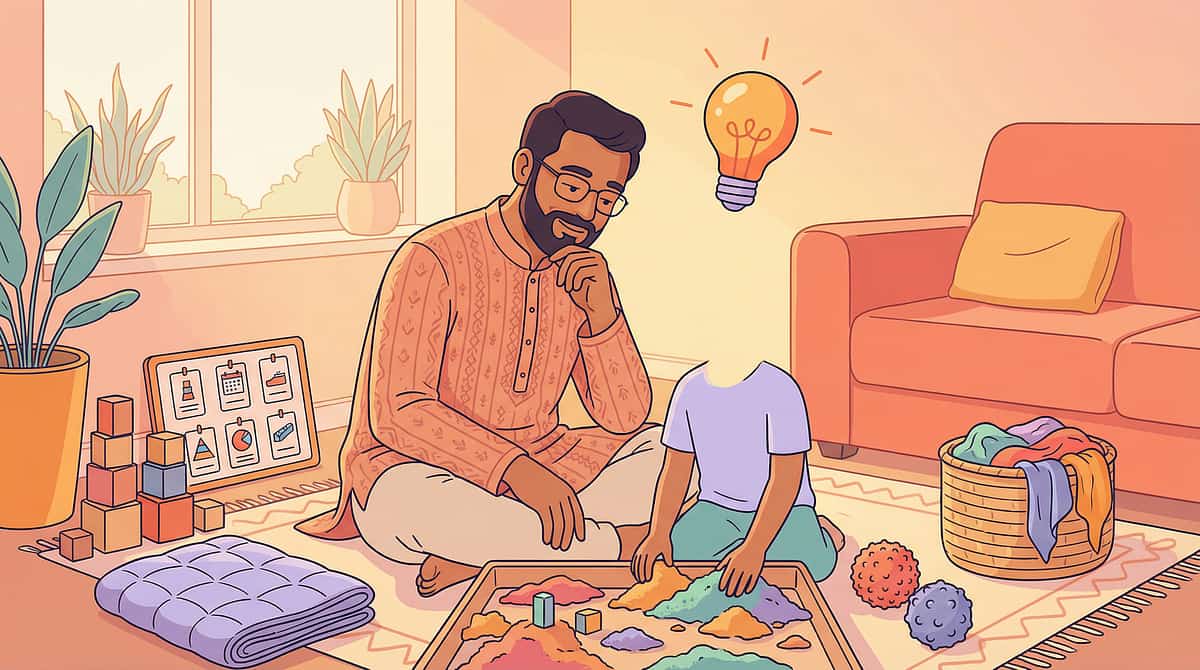
Repeat and vary: keeping sessions fresh while building automaticity.
Variation A — Change the Surface
Frame → doll vest → loose shirt on table → shirt on body. Progress through these only after mastery at each surface.
Variation B — Change the Context
Practice at therapy table → at bedroom mirror (child sees what they're doing) → in front of a sibling (introduced only after competence is established).
Variation C — Change the Reinforcement
Tokens → sticker chart → natural reinforcer ("button this, then we go to the park") → praise only (fading artificial reinforcement as skill approaches mastery).
Variation D — Change the Button
Giant (2") → Large (1.5") → Medium (1") → Small-Medium (¾") → Standard shirt (½"). Introduce next size only at 85%+ success on current size.
Satiation Indicators — Stop Current Rep and Shift Variation When:
Child's accuracy suddenly drops by 20%+ (physical fatigue)
Child breaks eye contact from the material and looks away repeatedly
Child makes humor, silly noises — engagement turning to disengagement
Child vocalizes "done," "no more," "all done" — respect immediately
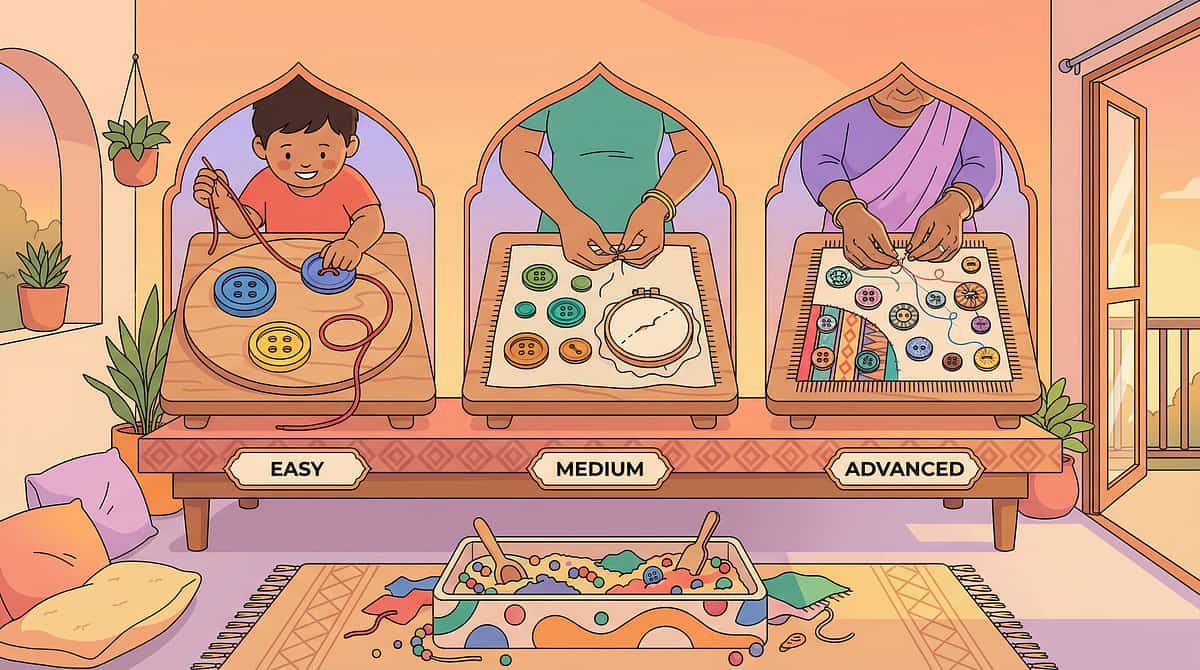
STEP 5
Within 3 seconds of each success
Timing matters more than magnitude. Immediate, specific, enthusiastic — every time.
The Reinforcement Rule: Within 3 seconds of the successful behavior. Not at the end of the session. Within 3 seconds of each button-through.
For first attempts:
"You tried! I saw your helper hand holding the fabric — that was exactly right!"
For partial success:
"You got the button halfway through — that's real progress. Now pull it the rest of the way."
For full success:
"Button through! Did you feel that? THAT is what buttoning feels like. Your fingers did it perfectly."
For breakthrough moments:
"You just buttoned a smaller button than you've ever done before. This is a big day."
Reinforcement Menu
- Social (free): Specific verbal praise + high five + fist bump
- Token Economy:Reward Jar — ₹589 — 1 token per button-through in week 1; 1 token per 3 by week 4
- Sticker Chart:1800+ Reward Stickers — ₹364 — one sticker per session completion
- Natural: "Button your vest today and we go to the playground after"
"Celebrate the attempt, not just the success. A child who tries and fails has done something neurologically identical to a child who tries and succeeds — the motor pattern fired. Reinforce the firing, not just the outcome."

STEP 6
Duration: 1–2 minutes
Session Closure
No session ends abruptly. The cool-down is part of the therapy.
Transition Warning (2 minutes before end)
"Two more button-throughs, then we're done for today. You're doing so well." Or with visual timer: _(Point to timer)_ "When the sand runs out, we put the buttons away. Two more."
Cool-Down Activity (1 minute)
Shift to a preferred, low-demand fine motor activity — squeezing the putty without a task, threading one large bead, or rolling the putty into a ball. Hands remain engaged but the performance demand drops to zero.
Material Put-Away Ritual
"Let's put the buttons in the box together." Child places materials in the storage box. This maintains agency and creates a clear session-end ritual that prevents open-ended confusion.
Transition Cue
Clear verbal: "All done with button practice. Excellent work. Now we're going to [next activity]."
Post-Session Connection Moment
30 seconds of non-task interaction — comment on something the child cares about. The session ends with relationship, not task completion. This is what brings them back tomorrow.
If child resists ending: This is excellent news — motivation is high. Honor it briefly: "Three more, then definitely done." Leave on a high note while motivation is present. This ensures tomorrow's session starts with positive anticipation.

60 seconds of data now saves months of guessing later.
Data Point 1
Attempts vs. Successes
How many button-through attempts? How many were successful (fully through without adult assistance)?
Record as: 4/6 (4 successes out of 6 attempts)
Data Point 2
Button Size Used
Which size was used today?
Giant / Large / Medium / Small-Medium / Standard
Tracks progression through the size hierarchy.
Data Point 3
Session Rating
Quick 1–5 star rating of child's engagement and regulation.
1 = Highly distressed | 3 = Neutral, completed | 5 = Engaged, motivated, requested more
"Every data point is a vote for your child's progress. After 8 sessions, the data tells you whether the current button size is right, whether the reinforcement is working, and whether it's time to advance. Without data, we are guessing. With data, we are navigating."
📥 Download: E-522 Button Skills Daily Tracker PDF · pinnacleblooms.org/trackers/E-522 | 🔗 Log sessions in GPT-OS® dashboard · pinnacleblooms.org/gpt-os/sessions — 4 sessions of data generates your first progress pattern analysis.

Most sessions don't go perfectly. Here is your repair guide.
"The child who refuses today's session has given you your most valuable data point — something in the setup was wrong. This is information, not failure."
❓ Problem 1: Child refused to sit at the table at all
Why: Session approached as a task rather than invitation; or child was not in ready state.
Fix: Next session, begin with 3 minutes of preferred play at the table before introducing materials. Never use "practice" language — use play/challenge/game framing.
Fix: Next session, begin with 3 minutes of preferred play at the table before introducing materials. Never use "practice" language — use play/challenge/game framing.
❓ Problem 2: Button keeps slipping out of child's fingers
Why: Pincer grip insufficient for button size; or button surface is smooth/slippery.
Fix: Drop one size larger. Add grip tape or rubber band around button. Insert a therapy putty strengthening session before button practice for 5 days.
Fix: Drop one size larger. Add grip tape or rubber band around button. Insert a therapy putty strengthening session before button practice for 5 days.
❓ Problem 3: Child's second hand doesn't participate
Why: Bilateral coordination deficit; brain not automatically recruiting the non-dominant hand.
Fix: Explicitly verbal-cue: "Helper hand on the fabric NOW" before each attempt. Use physical guidance for 3 sessions to establish the bilateral pattern.
Fix: Explicitly verbal-cue: "Helper hand on the fabric NOW" before each attempt. Use physical guidance for 3 sessions to establish the bilateral pattern.
❓ Problem 4: Child can button on frame but not on themselves
Why: Transfer from external object to own body is a distinct skill step — expected, not regression.
Fix: Practice on the stuffed animal vest before transitioning to self. Use a mirror so child can see their own hands.
Fix: Practice on the stuffed animal vest before transitioning to self. Use a mirror so child can see their own hands.
❓ Problem 5: Child was doing well, then suddenly regressed
Why: Illness, sleep disruption, stress, growth spurt, or button size advanced too soon.
Fix: Return to previous mastery level for 3–5 sessions. Do not persist at the harder level during regression.
Fix: Return to previous mastery level for 3–5 sessions. Do not persist at the harder level during regression.
❓ Problem 6: Child can button slowly but cannot self-dress in the morning
Why: Morning context adds time pressure, temperature, hunger — all reduce motor resources below threshold for emerging skills.
Fix: Morning practice is NOT the right context for emerging skills. Dress child in pull-over for school; practice sessions in the evening until mastery is solid.
Fix: Morning practice is NOT the right context for emerging skills. Dress child in pull-over for school; practice sessions in the evening until mastery is solid.
❓ Problem 7: Child becomes severely distressed during sessions
Why: Session demand exceeds current capacity; or previous sessions established a negative association.
Fix: Complete pause for 2 weeks. Consult Pinnacle OT immediately. Call 9100 181 181. Forcing through distress is contraindicated.
Fix: Complete pause for 2 weeks. Consult Pinnacle OT immediately. Call 9100 181 181. Forcing through distress is contraindicated.

No two children are identical. Here is how to calibrate for yours.
⬅️ Easier (bad days, regression, new environments)
- Largest available button (2"+) only
- Dressing frame flat on table (not vertical)
- Full verbal narration of every step
- Hand-over-hand assistance welcome
- 2 successful button-throughs = excellent session
- Extended reinforcement interval (reward every attempt)
➡️ Harder (breakthrough days, plateau-breaking)
- Introduce next size smaller
- Move from frame to doll vest
- Reduce verbal prompting (silent sessions)
- Time trials: "Can you button this faster than yesterday?"
- Chain multiple buttons: "Now do all five"
- Real clothing on own body
Sensory Profile Adaptations
Sensory Seeker | Sensory Avoider | |
Use buttons with interesting textures — raised patterns, ridged edges | Use smooth, simple buttons — no sensory surprises | |
Incorporate proprioceptive input before sessions (heavy work, wall push-ups) | Calming sensory input before sessions (deep pressure, weighted blanket briefly) | |
Faster pacing, more buttons per session | Slower pacing, fewer buttons, more breaks | |
Competitive elements ("beat your score") are motivating | Collaborative framing ("we do this together") preferred |
Age-Based Modifications
Age 3–4 | Age 5–7 | Age 8–10 | |
Giant buttons only (2"+) | Large to medium progression | Medium to standard shirt buttons | |
Dressing frame flat | Dressing frame vertical | Real clothing primary practice surface | |
5-minute maximum sessions | 10-minute sessions | 15-minute sessions | |
100% hand-over-hand welcome | Partial guidance | Independence expectation |

Weeks 1–2
15% Progress
Set the right expectations. Early progress is invisible to the wrong eyes.
What You Will See ✓
- Child tolerates the session for longer than Day 1
- Fewer refusals to sit at the table
- First successful button-through, even if still requiring adult help
- Child begins to anticipate the routine
- Data shows improvement in success rate from Day 1 to Day 10
What You Will NOT See Yet ✗
- Independent morning dressing
- Mastery of standard shirt buttons
- Zero frustration moments
- Consistent, reliable success every session
"If your child tolerates the button frame for 60 seconds more than they did in Week 1, that is real, measurable neural progress. The motor pathway is beginning to form. It doesn't look like buttoning yet. It looks like tolerance. Trust the process."
Parent Week 1–2 Focus: Your only goal these two weeks is to make the session feel safe and associated with positive experiences. Success at the button is secondary. A child who comes willingly to the practice area in Week 2 has made the most important progress possible.
Data Expectation: Sessions 1–5: Expect 0–2 successes per session. Sessions 6–10: Expect 2–4 successes per session. Progress is happening.
Data Expectation: Sessions 1–5: Expect 0–2 successes per session. Sessions 6–10: Expect 2–4 successes per session. Progress is happening.
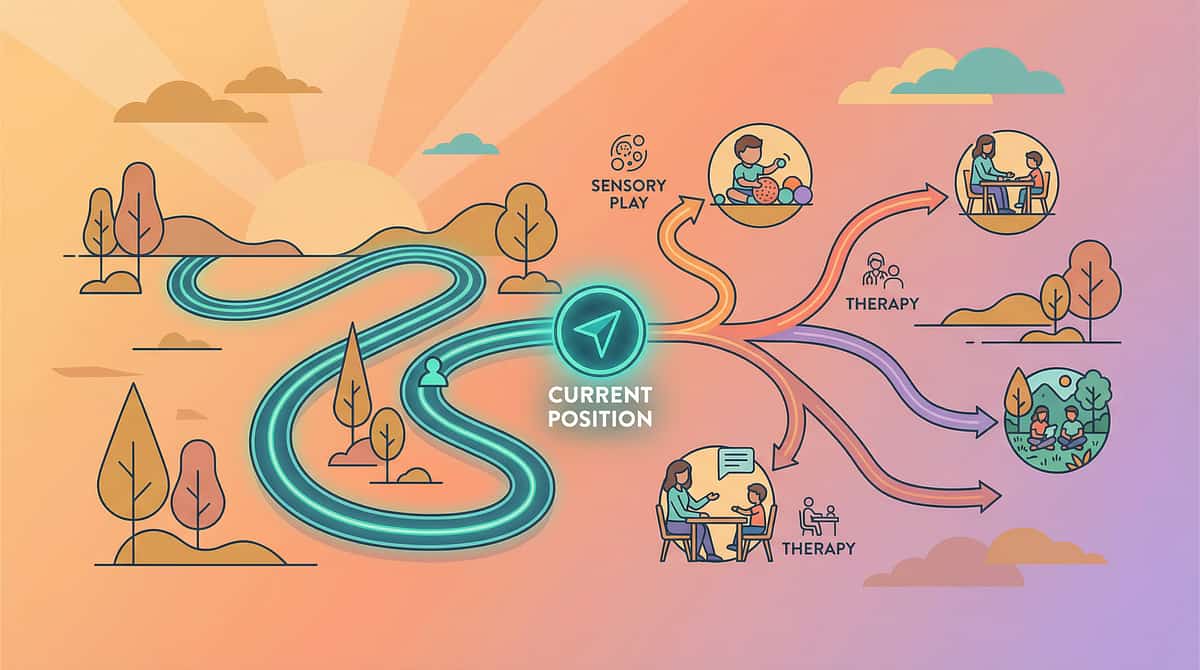
Weeks 3–4
40% Progress
The neural pathway is forming. Look for these consolidation signals.
Child asks to play the button game
Without being prompted — intrinsic motivation has activated. This is the single most powerful sign the program is working.
Success rate climbs above 50%
On the current button size. The motor pathway is consolidating. Data is your proof — track it every session.
Helper hand participates
Begins without verbal reminders. Bilateral coordination is becoming automatic — a major neurological milestone.
Child narrates steps aloud
"Push it through, now pull." When a child narrates aloud, they have transferred motor planning from visual cards to internal verbal mediation — a precursor to full motor automaticity.
First spontaneous button attempt
On real clothing — even if unsuccessful. This is the single most important transfer sign: the brain is applying its new skills to the real world.
"When to advance: if success rate is above 70% for 3 consecutive sessions, introduce next button size OR move from frame to doll vest. Do not advance on success rate alone — also assess whether the task is completed with genuine ease or still effortful attention."
Parent milestone: You may notice you are more confident now too. You know what a good session looks like. You know how to read satiation signals. You know when to push and when to ease off. This competence is as important as your child's progress. You are their primary therapist in this domain.
Weeks 5–8
75%–90% Progress
Mastery unlocked. These are the specific signs that readiness is here.
Mastery Criterion | Threshold | |
Success rate on current button size | 85%+ across 3 consecutive sessions | |
Without verbal prompting | Yes — no "helper hand" reminders needed | |
Without hand-over-hand | Yes — fully independent | |
At normal conversation pace | Approaching automatic, not slow and effortful | |
Transfer to doll vest | Successful at current size | |
Transfer to own loose clothing | Successful at current size |
Generalization Indicators — The Real Mastery Test
Child independently buttons in a new location (not the practice table)
Child buttons in front of unfamiliar person without regression
Child attempts buttoning spontaneously in morning dressing routine
Child can button while carrying on a conversation (automaticity = dual-task capacity)
🏅Mastery Badge Criteria: Button Level [current size] — MASTERED. Date: ___ | Final 3-session average: ___% | Confirmed by: ___
When to move to next size: After mastery criteria met AND 1 week of maintenance. Never advance on the same day as mastery achievement — consolidate for 5–7 more sessions first.
When to move to next size: After mastery criteria met AND 1 week of maintenance. Never advance on the same day as mastery achievement — consolidate for 5–7 more sessions first.
You did this. Your child grew because of your commitment.
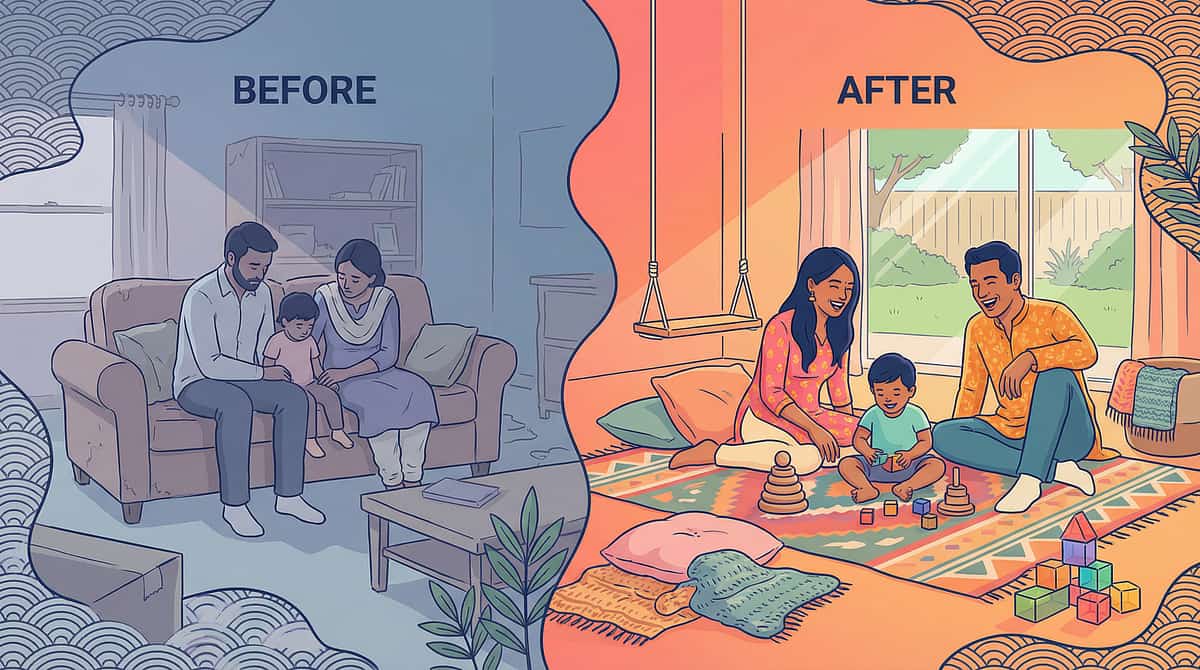
You set up the practice space. You prepared the materials. You ran the sessions when you were tired. You modified when something didn't work. You stayed consistent when progress felt invisible. You celebrated attempts before successes. You did this — for weeks, consistently, with love and patience and precision.
And your child, who could not button a single button when you started, can now button independently.
This isn't just a button. This is your child walking into school and handling their own coat. This is your child at a birthday party not needing to call you over for help. This is a deposit in the account of self-efficacy that will pay dividends across every hard skill they learn for the rest of their life.
🎉 Celebrate Visibly
Frame the data tracker showing the progression. Let your child pick tomorrow's breakfast. Call the grandparents and let your child demonstrate.
📔 Journal Prompt
"Describe what you saw in the first session versus today's session. What changed in your child? What changed in you? Write it down. You'll want to read this again."
📤 Share Your Win
Share this milestone in the Pinnacle Parent Community. Your story is exactly what another family on Card 01 needs to read today.
Even in the celebration zone, these signs mean pause and seek guidance.
🔴 Neurological Signs — Pause Immediately
- New-onset asymmetry in hand use — one hand suddenly weaker or less coordinated than before
- Tremor or involuntary movement during fine motor tasks
- Loss of previously acquired skills beyond what illness/stress explains
- Child reports pain or numbness in hands during or after sessions
🔴 Behavioral Escalation — Pause and Consult
- Intense, extended distress responses that don't resolve within 10 minutes of session ending
- Complete refusal that persists beyond 2 weeks of modified approach
- Self-injurious behavior appearing in the context of button practice
🔴 Structural Concerns — Seek Assessment
- Child cannot close or open hand fully (range of motion concern)
- Grip appears consistently weak across all fine motor tasks, not just buttons
- One hand appears significantly less functional than the other
Situation | Action | Timeline | |
Behavioral regression after illness | Pause sessions 1 week, resume with easier version | Self-resolve within 2 weeks | |
Persistent refusal (>2 weeks) | Call 9100 181 181 — teleconsultation | Within 3 days | |
Neurological symptom | Contact paediatrician immediately | Same day | |
No progress after 8 weeks of consistent sessions | Formal OT assessment | Book within 1 week |
📞FREE: 9100 181 181 · 16 languages · 24×7 — "Trust your instincts. If something feels neurologically wrong — not 'my child is resistant' but 'something about their hand function has changed' — that instinct deserves immediate professional attention."
Button skills are a waypoint, not a destination. Here is your developmental GPS.
Mastering E-522 places your child at the threshold of full dressing independence. Three or four techniques forward from here, your child will dress themselves every morning — independently, confidently, without assistance. Every component skill built in this program transfers directly to the next challenge.
Path A — Vertical
E-523: Zipper Skills → E-524: Shoe Tying → E-525: Full Dressing Independence
Path B — Foundation
Fine Motor Strengthening Intensive → Return to E-522 at standard shirt button level
Path C — Lateral
Scissor Skills | Pencil Grip | Bead Stringing (all share the same component skill substrate)
Techniques you already own materials for — and techniques that are next.
Technique | Code | Level | Materials You Already Have | Link | |
Handwashing Independence | E-521 | 🟢 Intro | No overlap | techniques.pinnacleblooms.org | |
Button Skills (THIS PAGE) | E-522 | 🟡 Core | All 9 materials above | Current | |
Zipper Skills | E-523 | 🟡 Core | Dressing frame, bilateral activities | techniques.pinnacleblooms.org | |
Shoe Tying Skills | E-524 | 🔴 Advanced | Bilateral activities, visual sequence cards | techniques.pinnacleblooms.org | |
Scissor Skills | Fine Motor | 🟡 Core | Bilateral activities, putty | techniques.pinnacleblooms.org | |
Pincer Grasp Development | Fine Motor | 🟢 Intro | Putty, in-hand games | techniques.pinnacleblooms.org |
Canon Material Cross-Reference: You already own the therapy putty, the bilateral activity kit, and the visual sequence cards from this technique. These same materials support Zipper Skills, Scissor Skills, and Shoe Tying. Invest once, deploy across multiple technique programs.

Button skills sit inside a larger story. Here is your child's full developmental landscape.
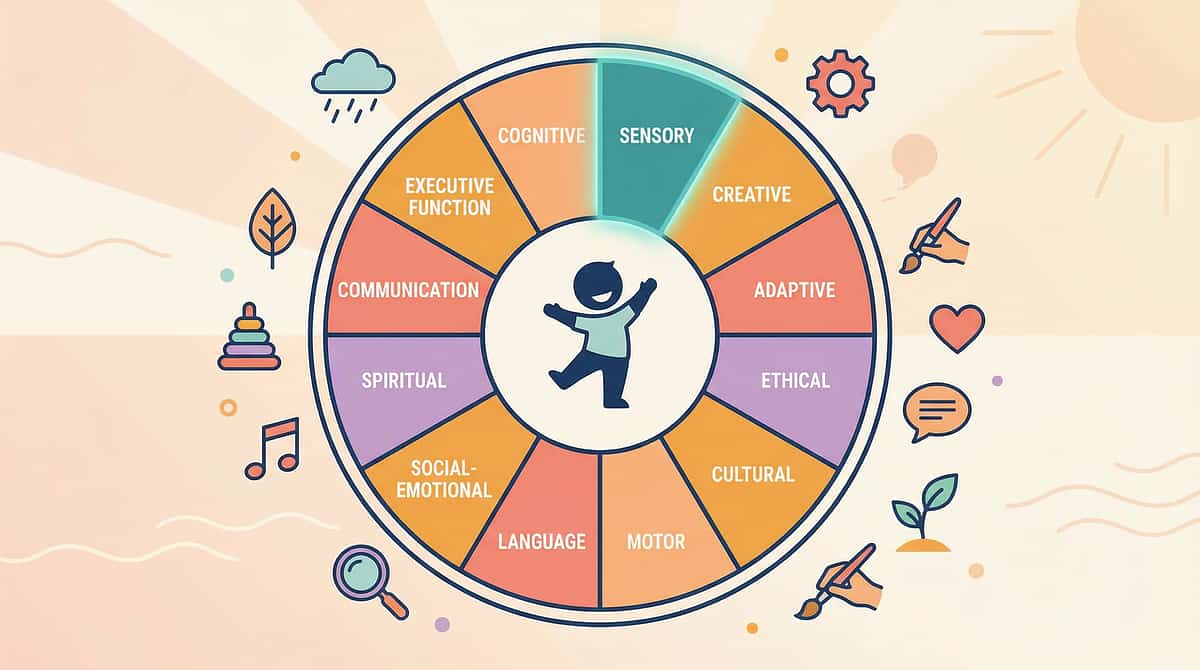
When you build button skills, you are simultaneously feeding multiple domains of development: Domain L (Self-Care) — every button mastered is a self-care independence win; Domain H (Emotional Regulation) — mastering hard things builds frustration tolerance; Domain A (Sensory Processing) — material handling and tactile feedback processing improve; Domain I (Executive Function) — the 7-step motor planning sequence builds broader sequencing capacity.
With a GPT-OS® AbilityScore® assessment, see exactly where your child stands across all 12 domains — and receive a personalized intervention sequence that optimizes progress across the full developmental map, not just one technique at a time.
Request AbilityScore® Assessment | 📞 FREE: 9100 181 181
Request AbilityScore® Assessment | 📞 FREE: 9100 181 181
From the Pinnacle Network: families who ran this exact protocol.
Bengaluru | Child: Age 7 | 14 weeks
Before: "My son could not button a single button. Not the large cardigan. Not anything. We'd been trying for over a year and getting nowhere."
After: "By Week 6, he'd mastered the large dressing frame buttons. By Week 10, he was doing his school shirt buttons himself. By Week 14, I stopped helping completely. He now buttons his jeans buttons."
OT Notes: Root cause was bilateral coordination deficit. Once we identified the limiting factor and targeted it with lacing and bead stringing, button progress accelerated significantly.
Hyderabad | Child: Age 5 | 8 weeks
Before: "She would get so frustrated she'd scream and refuse to wear anything with buttons. Mornings were a war zone. We avoided all button clothing."
After: "The button snake changed everything. She called it her 'snake game' and asked to play it. Now she buttons her own dress for school."
OT Notes: Engagement through play is not a shortcut — it is the mechanism. The motor repetitions in the button snake were identical to clinical dressing frame work.
Chennai | Child: Age 8, autism | 18 weeks
Before: "He had the grip strength — his OT confirmed that. But he couldn't sequence the steps. He'd do Step A, then jump to Step F, then get confused."
After: "The visual sequence cards were the missing piece. We made our own with photos of his actual hands. He now buttons his school uniform shirt every morning independently."
OT Notes: Motor planning differences require explicit sequencing support. This is a textbook example of the approach working exactly as designed.
All stories anonymized and representative. Individual outcomes vary by child profile, diagnosis, and intervention consistency. These represent outcomes within the Pinnacle Network across clinically supervised programs.
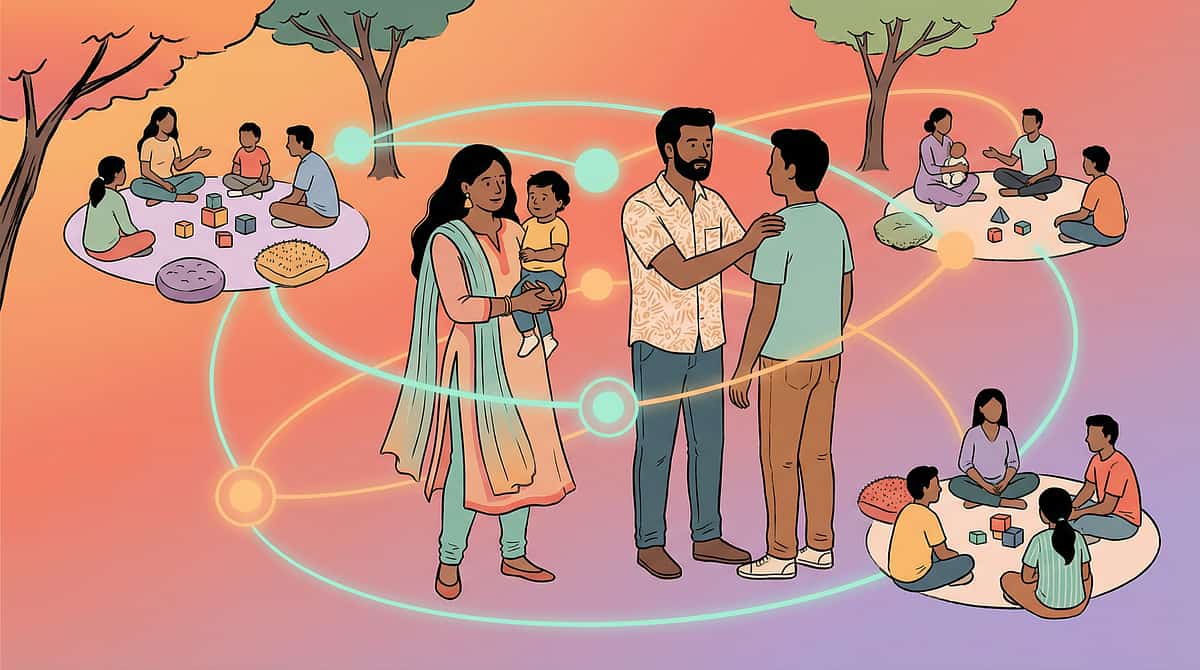
Isolation is the enemy of adherence. You are part of a community.
WhatsApp Parent Network
Fine Motor & Dressing Independence Parents — for families running the E-522 protocol. Share wins, troubleshoot together, see others' progress photos. Moderated by Pinnacle OT team.
Online Forum
Pinnacle Parent Community — Fine Motor Domain. Search: "Button Skills" | "E-522" | "Dressing Independence."
Local Parent Meetups
Pinnacle centers organize quarterly parent skill-building workshops in Fine Motor and Dressing Independence themes.
Peer Mentoring Program
Connect with a parent who has already completed E-522 with their child. Peer mentors are trained and matched by domain.
"A parent who knows another family succeeded with this exact protocol is 3× more likely to maintain consistent home practice. Community is not a nice-to-have — it is a clinical tool."

Home practice achieves maximum impact when backed by professional guidance.
Every Pinnacle center has a Pediatric Occupational Therapist trained in fine motor and dressing independence assessment and intervention. For button skills specifically, our OT team provides formal Fine Motor Assessment, component skill identification, customized material progression protocol, parent training sessions (60 minutes), and monthly progress review and protocol adjustment.
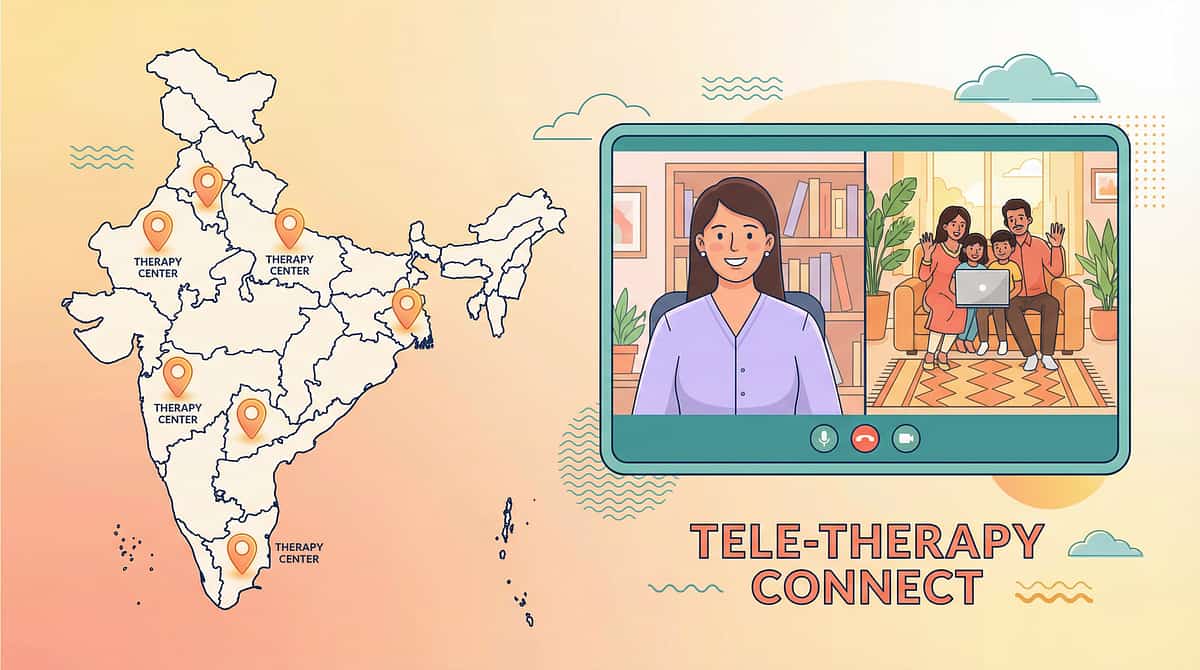
Teleconsultation
For families outside major cities or unable to attend in person:
📱 First 30-minute teleconsult for new families: FREE with helpline referral
📞9100 181 181
FREE · 16 languages · 24×7
No appointment needed to call
FREE · 16 languages · 24×7
No appointment needed to call
Home + Clinic = Maximum Impact
"Clinical sessions provide assessment precision, protocol design, and professional correction of technique errors. Home practice provides the dosage volume that clinics cannot. Neither alone is as powerful as both together. The E-522 protocol is designed to operate in both environments simultaneously."
- 70+ centers across India
- All operating under GPT-OS® clinical standards
- 20M+ exclusive 1:1 therapy sessions delivered

Deeper reading for the curious parent and the evidence-seeking professional.
# | Study | One-Sentence Finding | Link | |
1 | PRISMA Systematic Review (2024) | 16 studies confirm OT-based fine motor intervention meets evidence-based practice criteria for ASD | ||
2 | Meta-Analysis — World J Clin Cases (2024) | Sensory integration + OT promotes adaptive behavior, social skills, and motor skills across 24 studies | ||
3 | Indian RCT — Padmanabha et al. (2019) | Home-based OT interventions show significant outcomes for Indian pediatric population | ||
4 | WHO CCD Package (2023) | Home-based caregiver-administered activities build fine motor foundations across 54 LMICs | ||
5 | NCAEP Report (2020) | Visual supports + structured task sequencing classified as evidence-based for autism |
International guidelines: WHO Developmental Milestones (2022) | UNICEF Nurturing Care Framework (nurturing-care.org) | Rehabilitation Council of India — rehabcouncil.nic.in | AOTA Fine Motor Resources — aota.org
Pinnacle Clinical Data: 20M+ exclusive 1:1 sessions · Fine Motor Readiness Index validated across 70+ centers · Research inquiries: research@pinnacleblooms.org
Pinnacle Clinical Data: 20M+ exclusive 1:1 sessions · Fine Motor Readiness Index validated across 70+ centers · Research inquiries: research@pinnacleblooms.org

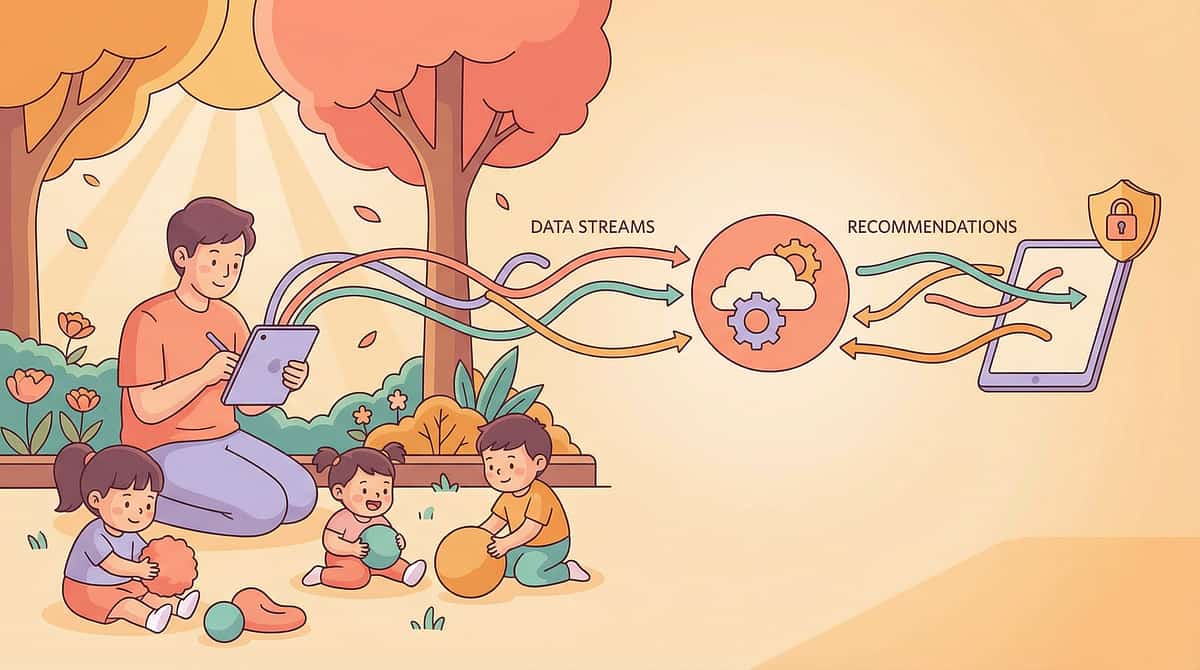
Transparency: what happens to the data you record, and why it matters.
What GPT-OS® Learns from E-522 Data
- Which button size progression timelines are typical vs. accelerated
- Which component skill deficits predict longer protocols
- Which reinforcement approaches show highest adherence rates
- Seasonal patterns (school transitions affect fine motor progress)
Privacy Assurances
- 🔒 All data anonymized and aggregated at population level
- 🔒 Individual child data never shared with third parties
- 🔒 DPIIT-registered, MSME-verified, GSTIN-compliant data governance
- 🔒 Compliant with India's Digital Personal Data Protection Act (2023)
"When 10,000 families record their E-522 session data, every future family who begins this protocol receives recommendations shaped by 10,000 actual journeys — not just clinical theory. Your data helps every child like yours, everywhere."
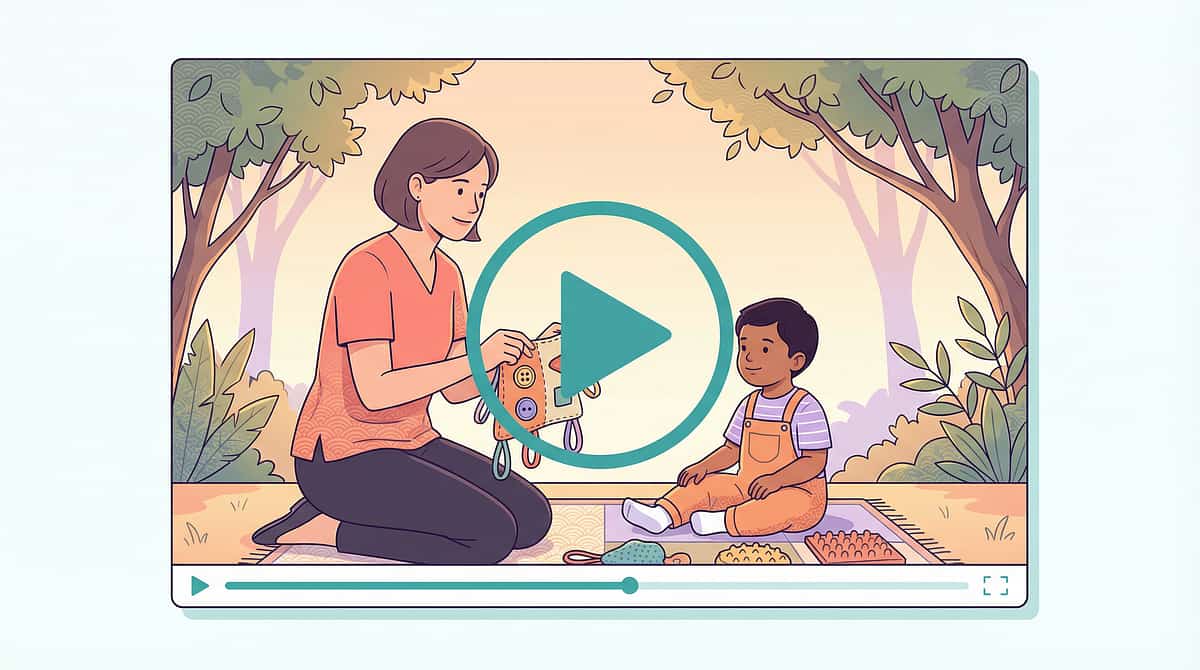
Preview of 9 materials that help with button skills Therapy Material
Below is a visual preview of 9 materials that help with button skills therapy material. The pages shown help educators, therapists, and caregivers understand the structure and content of the resource before use. Materials should be used under appropriate professional guidance.





Link copied!

Every question parents ask after reading this page.
Q1: My child is 4 and cannot button at all. Is this a developmental emergency?
Not necessarily — but it warrants attention. Age 4 is when large button independence should be emerging. If your child shows no interest or capacity for large-button manipulation by age 4.5, an OT evaluation is appropriate. The E-522 protocol is designed precisely for this age. Begin with giant buttons and measure progress over 4 weeks. If no movement, consult your OT.
Q2: Child can button at the table but not when dressing for school. Regression?
No — this is a transfer gap, not regression. The added complexity of morning time pressure, temperature, hunger, and social urgency reduces available cognitive resources below the threshold for an emerging skill. Continue low-pressure practice sessions until mastery is truly solid (85%+ success rate), then introduce morning practice.
Q3: We've been trying for 8 months. When should I worry?
After 8 weeks of structured protocol (not casual attempts) with no measurable improvement, a formal OT assessment is indicated. Eight months of unstructured "try and fail" does not count as 8 months of protocol. If you started the E-522 structured approach recently, give it the full 8–12 weeks. Call 9100 181 181 if you'd like guidance.
Q4: Should I practice buttons during morning dressing?
No — not until mastery is solid. Morning dressing is the hardest possible context for an emerging skill: time pressure, hunger, sensory overwhelm, and social urgency all reduce motor performance. Practice sessions must be dedicated, low-pressure, untimed. Morning independence follows session mastery — it doesn't precede it.
Q5: My child has autism — does this protocol work for them specifically?
Yes. The component-skill approach is particularly well-suited to autistic children who often have uneven skill profiles. The visual sequence cards, game-based practice (button snake), and clear reinforcement protocols are all designed with autistic learners in mind. The studies cited throughout this page include ASD populations specifically.
Q6: How many minutes per day should we practice?
10 minutes per day, 5 days per week, is the clinical target. Less than 5 minutes per session is unlikely to generate sufficient repetitions for motor learning. If your child consistently refuses before 10 minutes, shorten to whatever duration maintains a positive association (even 3–4 minutes) and prioritize session quality over duration.
Q7: Child can button but always misaligns — buttons in wrong holes. What do we address?
This is a visual-motor integration issue. Solutions: count the buttons aloud before starting ("1, 2, 3, 4 buttons — 1, 2, 3, 4 holes"), use color-coded buttons and matching holes for the first month, practice top-to-bottom consistently (never skip to an arbitrary button). Visual sequence cards help here.
Q8: Can we use any buttons or does the specific material matter?
Button size is the only non-negotiable specification. Always start with 1-inch minimum diameter, progressing smaller only after mastery at each level. Surface texture matters for sensory profiles — textured buttons are easier to grip. Beyond that, household buttons from old clothing are entirely appropriate for home practice.
🏛️ Validated by the Pinnacle Blooms Consortium
OT · SLP · ABA/BCBA · SpEd · NeuroDev Pediatrics · CRO | Evidence-based · Parent-executable · GPT-OS® governed
20M+ 1:1 sessions · 97%+ measured improvement · 70+ centers · 70+ countries served
📞9100 181 181 — FREE — 16 LANGUAGES — 24×7
Medical Disclaimer: This content is educational and informational. It does not constitute medical advice and does not replace individualized assessment, diagnosis, or intervention planning by licensed occupational therapists, physicians, or healthcare professionals. Persistent fine motor difficulties may indicate underlying developmental, neurological, or musculoskeletal conditions requiring professional evaluation. Individual results may vary. Statistics represent aggregate outcomes across the Pinnacle Blooms Network.
© 2025–2026 Pinnacle Blooms Network® | A unit of Bharath Healthcare Laboratories Pvt. Ltd. | CIN: U74999TG2016PTC113063 | DPIIT: DIPP8651 | MSME: TS20F0009606 | GSTIN: 36AAGCB9722P1Z2
GPT-OS®, AbilityScore®, TherapeuticAI®, FusionModule™, EverydayTherapyProgramme™ and Pinnacle Blooms Network® are registered trademarks of Bharath Healthcare Laboratories Pvt. Ltd.