

"He's smart. The teachers say so. But he can't finish a single worksheet without drifting away."
ATTENTION TRAINING — 9 Essential Materials
Executive Function & Self-Regulation | Episode L-985
Homework that should take 20 minutes takes two hours. Every verbal instruction needs to be repeated three times. And yet — give him a LEGO set or a video game, and he's locked in for an hour without blinking. You've tried the front row. The fidget toys. The sticker charts. The consequences. And you're quietly wondering: Is this my fault? Am I doing something wrong?
You are not failing. Your child's attentional system is still building its foundations. What looks like defiance is a neural pathway under construction.
WHO Nurturing Care Framework (2018): Early identification and responsive caregiving directly determine long-term developmental outcomes. Parent awareness is the first clinical intervention.

The Numbers That Change Everything
This is not rare. This is not your child alone. This is a global developmental reality.
1
Children Affected
Show clinically significant attention difficulties before age 8
American Academy of Pediatrics, 2023
2
ASD Co-occurrence
Of children with ASD experience co-occurring attention regulation challenges
PRISMA Systematic Review, 2024 — PMC11506176
3
Sessions Delivered
1:1 therapy sessions by Pinnacle — tracking attention progress in real time
Pinnacle Network Real-World Evidence
In India alone, pediatric attention difficulties affect an estimated 8–12 million children — the majority undiagnosed, the majority managed through discipline rather than intervention. Globally, ADHD prevalence stands at 5–7% of the pediatric population (WHO, 2023). But attention difficulties exist on a wide spectrum — they affect children with autism, developmental delays, anxiety, sensory processing differences, and typically developing children under high academic pressure.
The science is unanimous: Attention is a trainable skill. It is not a character trait. It is not a choice.
📞9100 181 181 — Speak to a Pinnacle specialist today. Free. Confidential.
This Is Neuroscience. Not Naughtiness.
🧠 The Attention Network (Simplified)
Attention is not one system. It is a four-layer neural architecture:
01
Arousal Layer
Locus coeruleus (brainstem) keeps the brain alert enough to process
02
Selective Filter
Anterior Cingulate Cortex decides what matters vs. what doesn't
03
Sustained Engine
Prefrontal Cortex holds focus on goal-directed activity over time
04
Executive Controller
Dorsolateral PFC manages shifting attention and inhibiting distraction
What This Means for Your Child
"He can focus on Minecraft for 3 hours but can't do 10 minutes of maths."
This makes perfect neurological sense. Video games provide constant dopamine micro-rewards (keeps arousal loop active), instant feedback (eliminates need for sustained internal motivation), and no executive demand for task initiation.
Homework provides none of these. The prefrontal cortex must work extraordinarily hard to self-sustain focus without external scaffolding.
The goal of attention training: Build that internal scaffolding.
Frontiers in Integrative Neuroscience (2020): Attention difficulties in ASD arise from prefrontal-subcortical connectivity patterns — a developmental difference, not a behavioral choice. DOI: 10.3389/fnint.2020.556660

Your Child's Attention Journey — Where They Are. Where They're Going.
1
Age 2–3
Joint attention emerges. Eye contact, social referencing.
2
Age 3–5
Sustained attention builds: 5–10 min on preferred tasks.
3
Age 5–7
Selective attention develops: filters out irrelevant input.
4
Age 7–10
Divided attention emerges: listen + write simultaneously.
5
Age 10–12+
Executive attention matures: planning, working memory.
Comorbidity Awareness
Attention difficulties commonly co-occur with: Autism Spectrum Disorder (attention dysregulation in 80% of cases), Sensory Processing Differences (over/under-responsivity disrupts arousal), Anxiety (cognitive load of worry consumes attentional resources), Language Processing Delays (auditory attention particularly affected), and Sleep Disorders (even mild sleep deficits impair prefrontal function by 20–30%).
"The prefrontal cortex continues developing until the mid-20s. Every year of appropriate training creates lasting neural pathway changes. Starting now matters." — Pinnacle NeuroDev Consortium

Research-Validated. Clinically Applied. Parent-Proven.
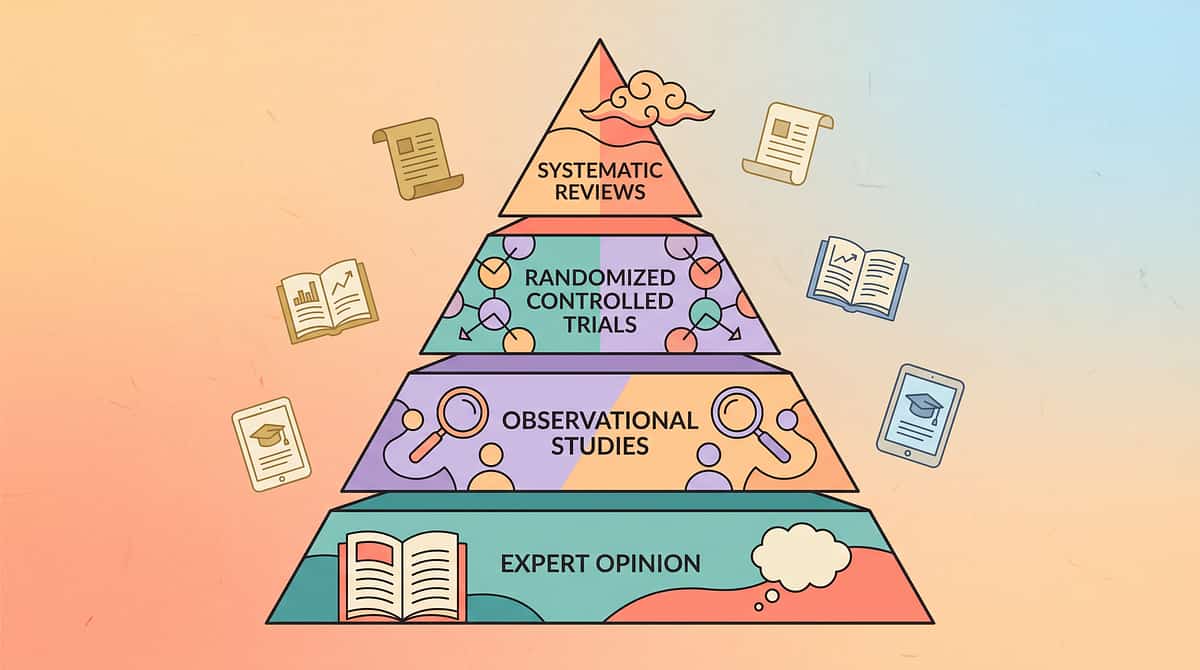
🛡️LEVEL I EVIDENCE — Systematic Review + Meta-Analysis. Attention training through structured materials meets criteria for evidence-based practice across OT, ABA, and NeuroDev disciplines.
Study | Finding | Source | |
PRISMA Meta-Analysis (2024) | 16 RCTs confirm structured attention intervention is evidence-based for ASD | PMC11506176 | |
World J Clin Cases (2024) | 24-study meta-analysis: measurable improvement across 40-min structured sessions | PMC10955541 | |
Cogmed Research (2020) | Computerized attention training transfers to real-world academic attention, ages 3–12 | Clinical trial data | |
Indian RCT — Padmanabha et al. (2019) | Home-based structured intervention delivers significant outcomes with parent-administered protocols | DOI: 10.1007/s12098-018-2747-4 | |
NCAEP (2020) | Visual supports and structured practice classified as evidence-based for attention disorders | NCAEP 2020 Report |
95%
Evidence Strength
90%
Home Applicability
95%
Parent Deliverable
Clinically validated. Home-applicable. Parent-proven. You are not experimenting. You are executing a protocol backed by thousands of hours of controlled research.

ACT II: THE KNOWLEDGE TRANSFER
Attention Training Through Structured Materials
Parent-Friendly Alias: "The Focus Builder Programme"
Attention Training through Structured Materials is a multi-sensory, evidence-based intervention methodology that uses specifically selected therapeutic materials to deliberately exercise and strengthen the neural pathways governing sustained attention, selective attention, auditory attention, and attentional control.
Unlike accommodations that work around attention difficulties (shorter tasks, more breaks, front-row seating), this approach works through deliberate, progressive practice — the same principle that builds any skill: appropriate challenge, consistent repetition, gradual escalation.
Programme Details
- 🧠Domain: L — Executive Function & Self-Regulation
- 👶Age Range: 3–12 years
- ⏱️Session Duration: 10–20 minutes daily
- 📅Programme Length: 8–12 weeks for measurable outcomes
- 🏠Setting: Home + Therapy + School
- 📋Canon Categories: Matching Games | Sorting Activities | Problem-Solving Toys | Reinforcement Menus
📱 This technique page is linked to Reel L-985: "9 Materials That Help With Attention Training" — Episode 985, Executive Function & Self-Regulation Series

A Consortium Approach. Because Attention Crosses Every Discipline.
Your child's attention system doesn't respect professional boundaries — and neither does the Pinnacle Consortium. Every specialist below contributes a unique clinical layer to building your child's attentional architecture.
Occupational Therapist (OT)
Lead Discipline for Attention Training
Uses visual tracking, sorting, and sensory-based attention tasks to build arousal regulation and sustained focus. Addresses the sensory-attentional interface — the most common root of attention dysregulation.
Speech-Language Pathologist (SLP)
Auditory Attention Specialist
Focuses on listening attention, following multi-step verbal directions, and auditory processing — the skills that most directly impact language comprehension and classroom participation.
ABA/BCBA Therapist
Behavioral Architecture
Designs reinforcement systems that make attention training intrinsically motivating. Implements data collection, shaping procedures, and discrimination training to build deliberate attentional control.
Special Educator (SpEd)
Academic Transfer
Bridges attention training to academic demands: reading tracking, mathematical sequential attention, and written task completion. Ensures skills transfer from therapy table to classroom.
NeuroDevelopmental Pediatrician
Medical Oversight
Evaluates underlying neurological contributors (ADHD, ASD, anxiety, sleep). Determines when medication evaluation is appropriate alongside behavioural training. Monitors global developmental trajectory.
"The brain does not organize attention by therapy discipline. Neither do we." — Pinnacle Blooms Consortium, 2026

Precision Targets. Not Generalised Activities.
Observable Indicators
You will know the technique is working when you see:
- ✅ Fewer reminders needed to return to tasks
- ✅ Longer sustained engagement on non-preferred activities
- ✅ Child self-corrects ("I lost my place, let me go back")
- ✅ Faster transition from starting to focusing
- ✅ Improved recall of verbal instructions
Research Anchor
Meta-analysis (PMC10955541, 2024): Structured attention intervention effectively promotes sustained attention (primary), adaptive behaviour (secondary), and academic readiness (tertiary) across 24 studies.

The 9 Materials. Clinically Selected. Home-Ready.
Sourced from the Pinnacle 128 Canon Materials System. Every item below has been evaluated for therapeutic utility, safety, and Indian market availability.
1
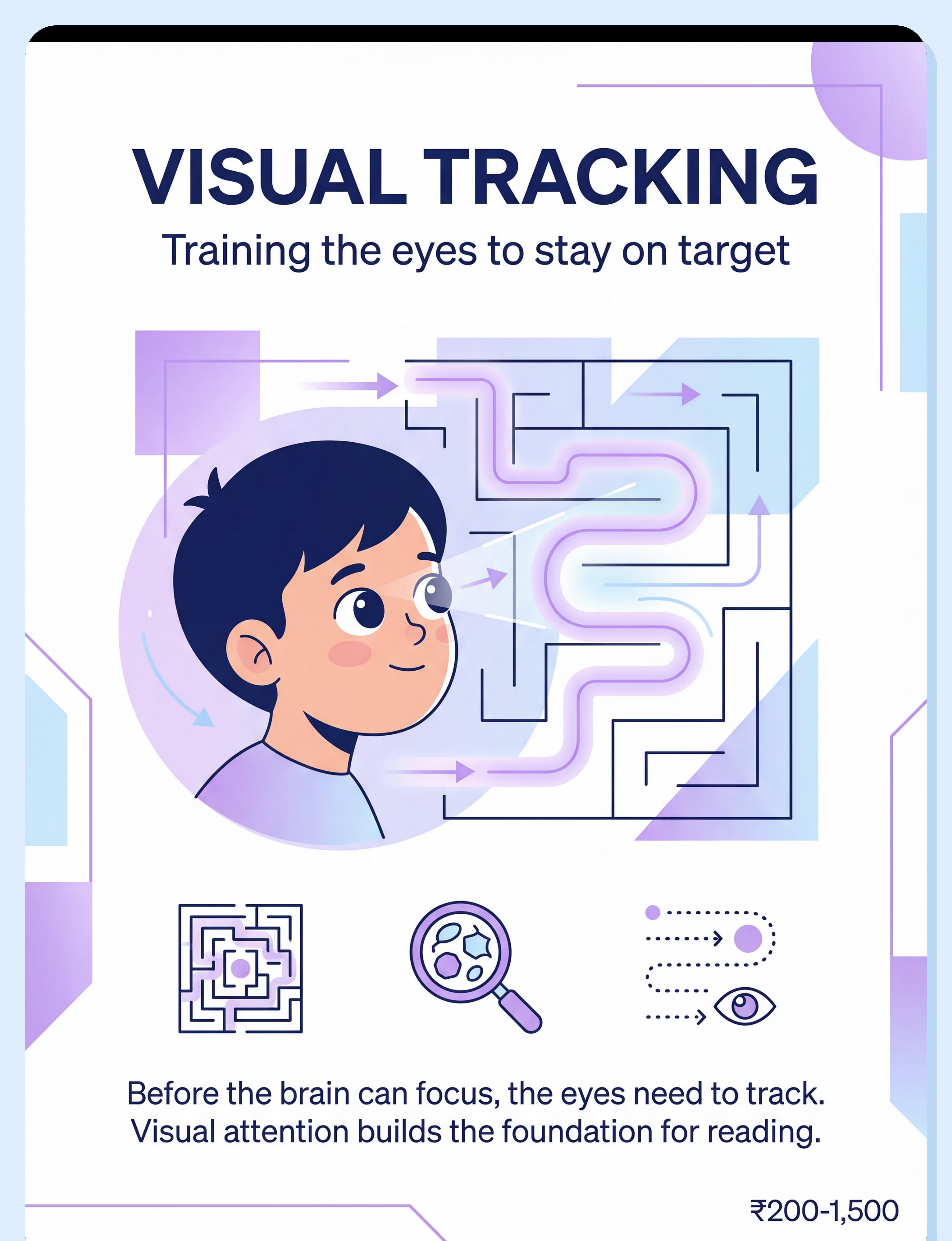
01 — Visual Tracking & Scanning
📦 Problem-Solving Toys / Visual Attention
🎯 Oculomotor control, selective visual attention, reading readiness
💰 ₹200–1,500
Maze books, I Spy books, hidden picture puzzles, dot-to-dot (high count)
2
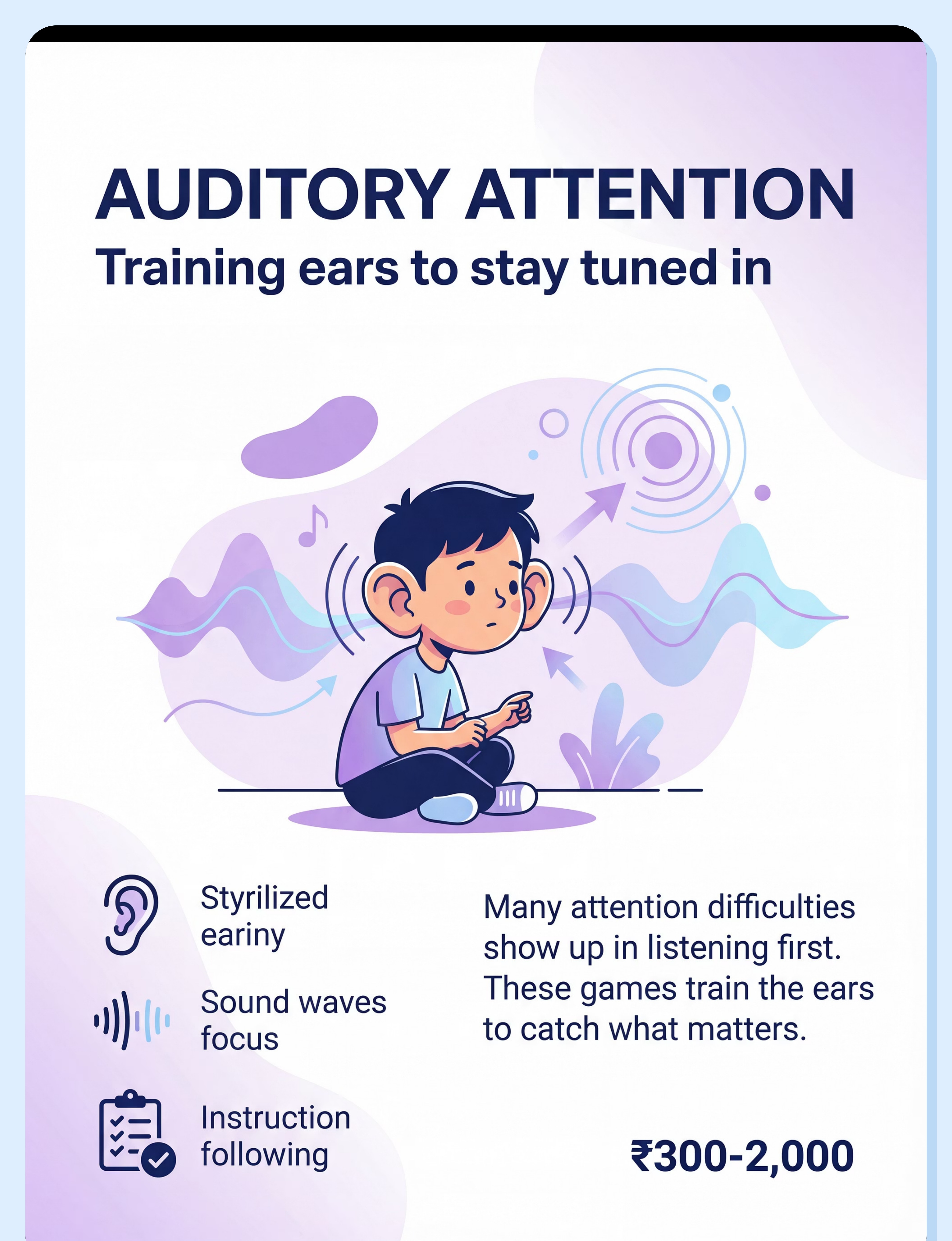
02 — Auditory Attention Games
📦 Listening / Auditory Processing
🎯 Sustained listening, instruction following, auditory discrimination
💰 ₹300–2,000
Sound identification sets, following-directions card games, musical sequence games
3
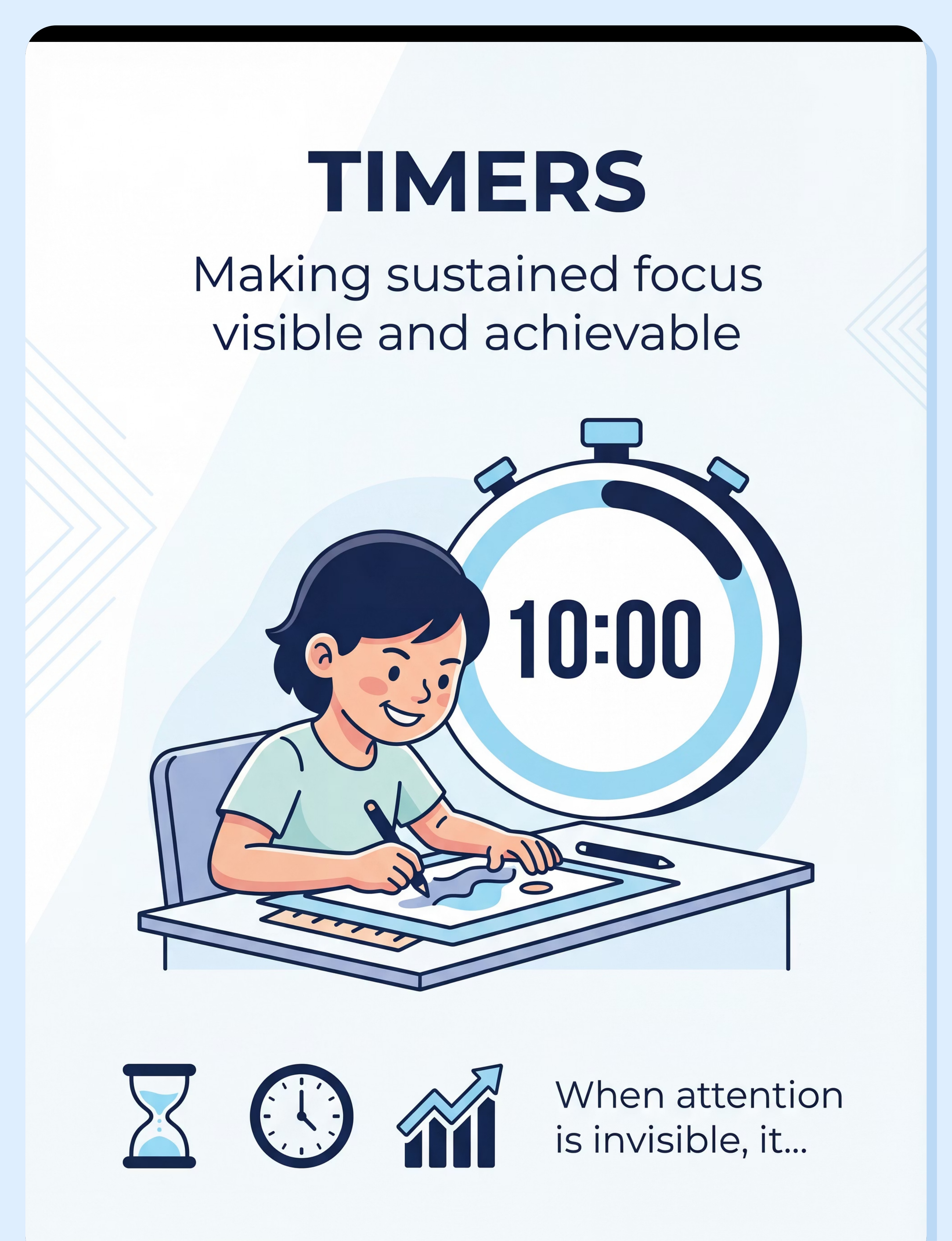
03 — Visual Timers
📦 Time Awareness / Sustained Attention Scaffolds
🎯 Sustained attention endurance, self-monitoring, goal-directed behaviour
💰 ₹300–1,500
Sand timers (3/5/10 min), Time Timer® style countdown
✅Smartivity DIY Interactive Clock — ₹673 | Buy on Amazon.in →
1
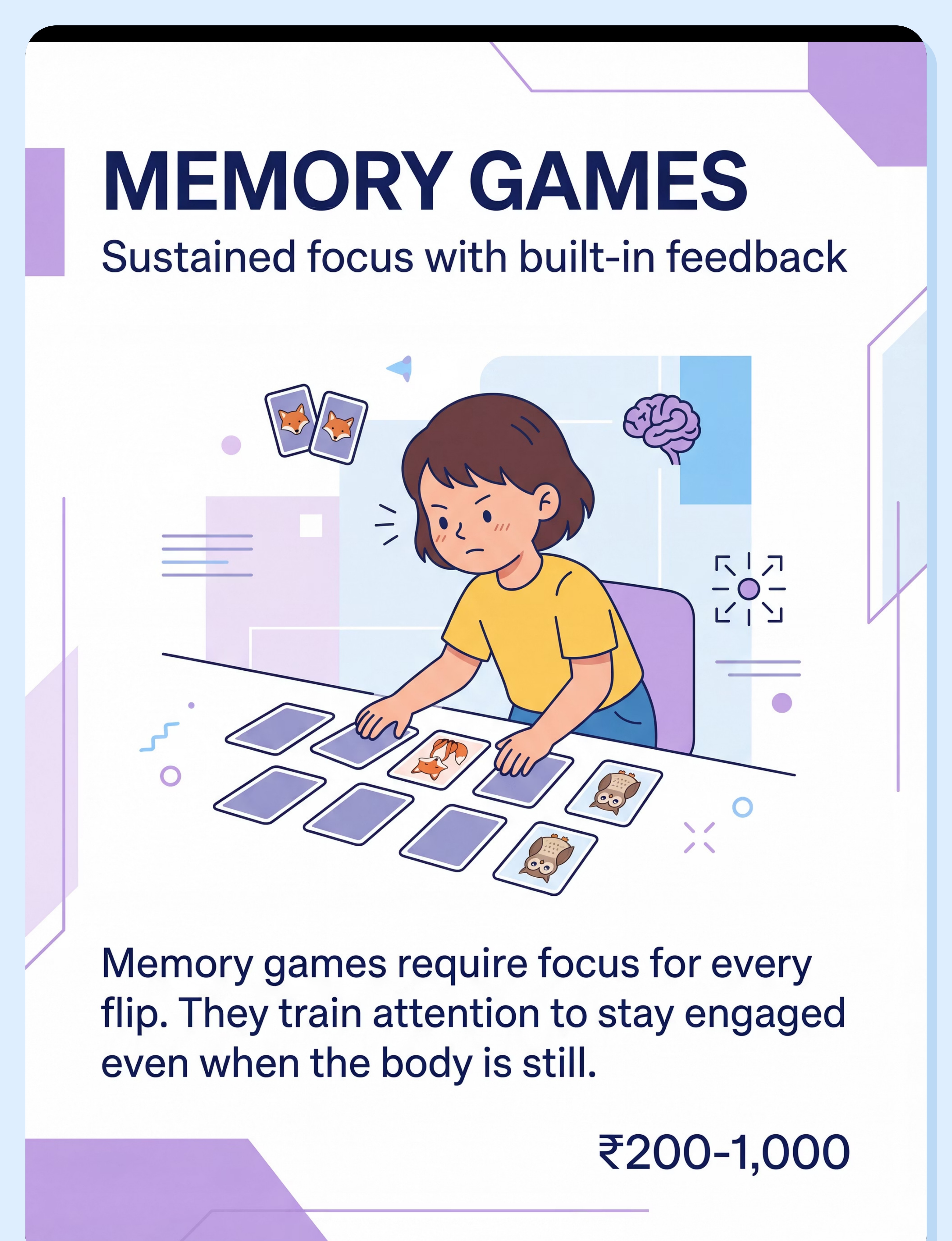
04 — Memory & Matching Games
📦 Matching Games / Memory Games (Active Canon SKU)
🎯 Sustained mental engagement, visual-spatial memory, self-monitoring
💰 ₹200–1,000
✅Dyomnizy Educational Memory Game with Lights & Sound — ₹519
2
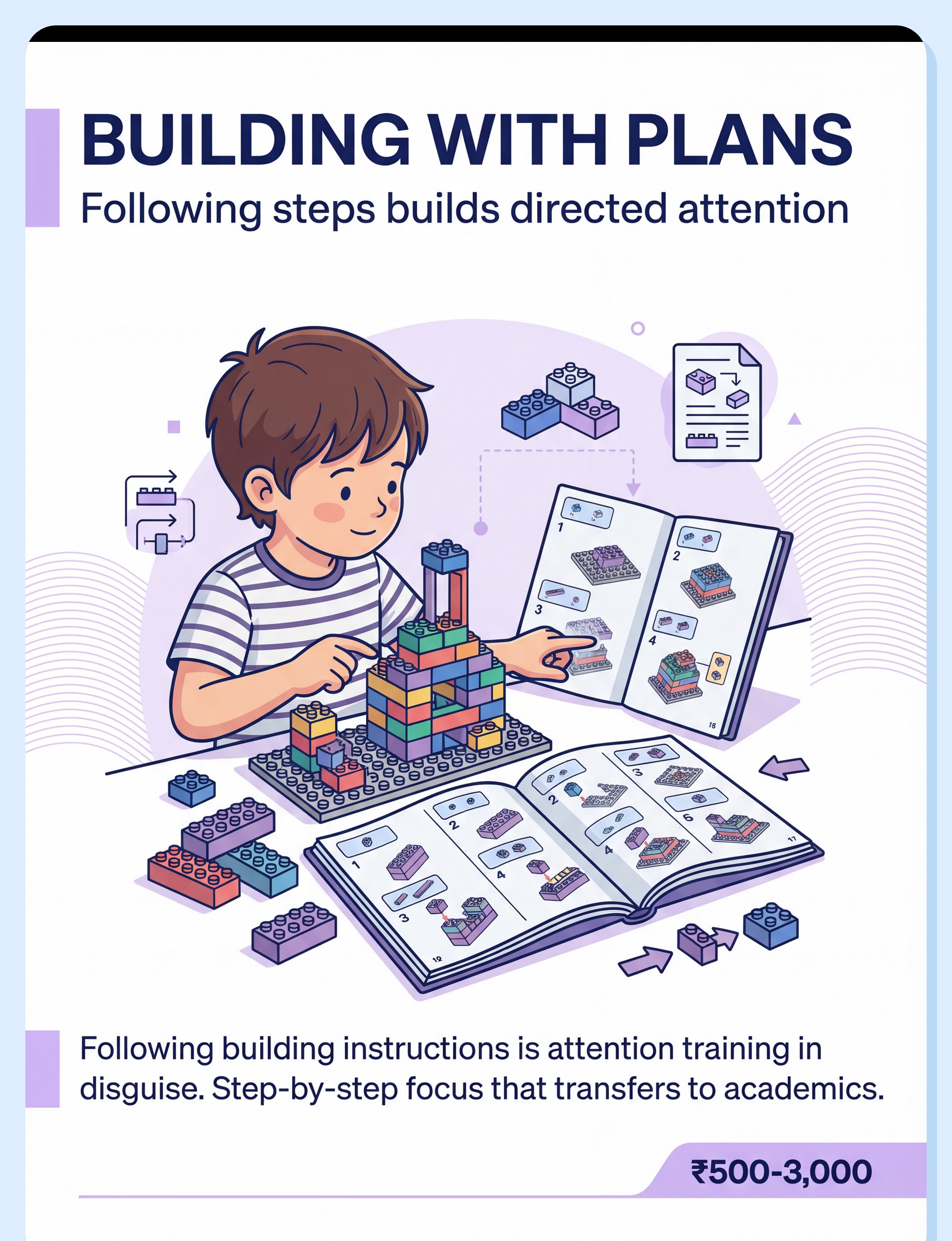
05 — Construction Sets with Plans
📦 Fine Motor / Directed Attention Tasks
🎯 Directed attention, sequential attention, step-following, academic transfer
💰 ₹500–3,000
LEGO with instruction booklets, model building kits, Perler bead pattern kits
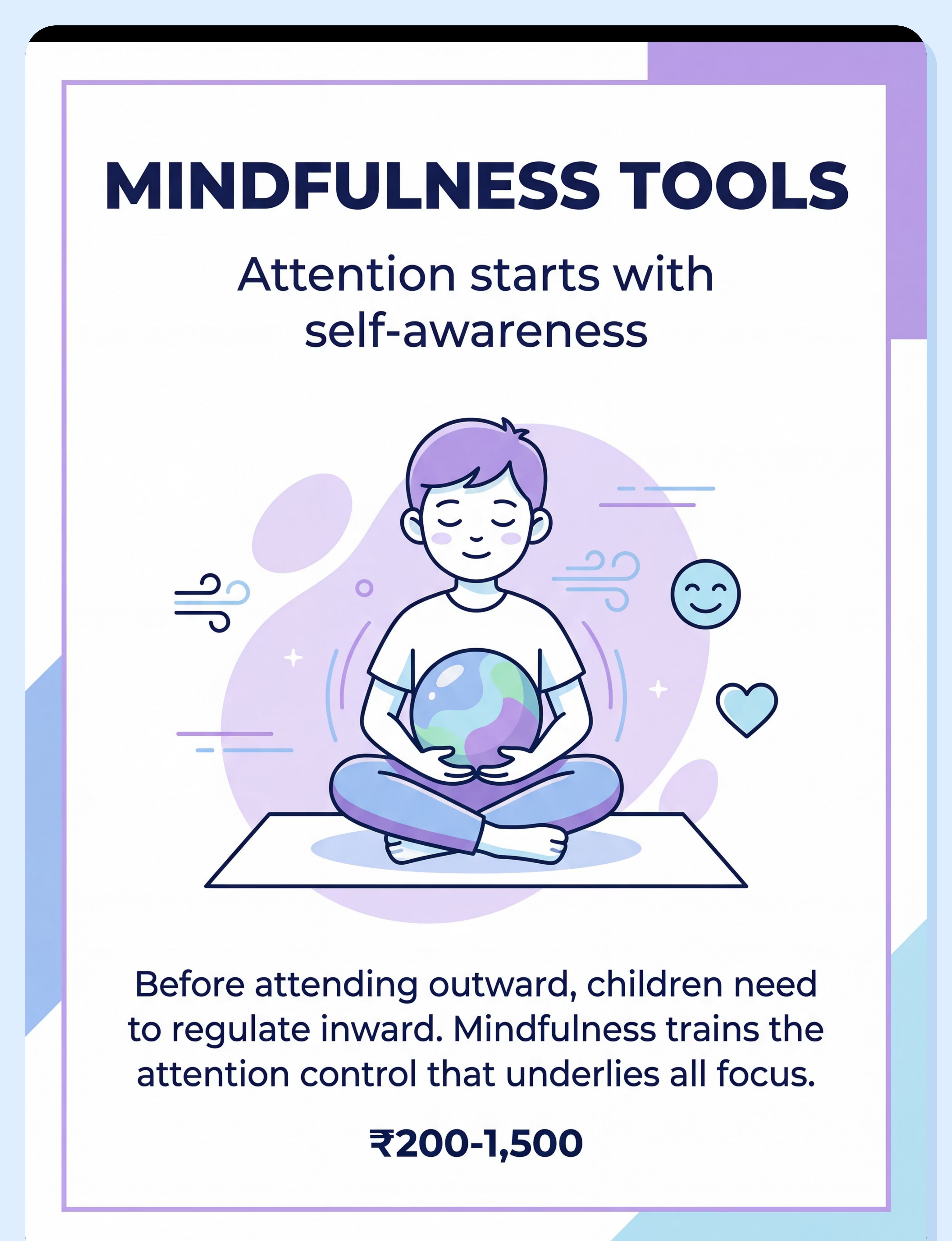
07 — Mindfulness & Body Awareness Tools
📦 Self-Regulation / Calming Tools
🎯 Arousal regulation, interoception, attentional control foundation
💰 ₹200–1,500
Hoberman sphere (breathing ball), mindfulness card decks, sensory awareness tools
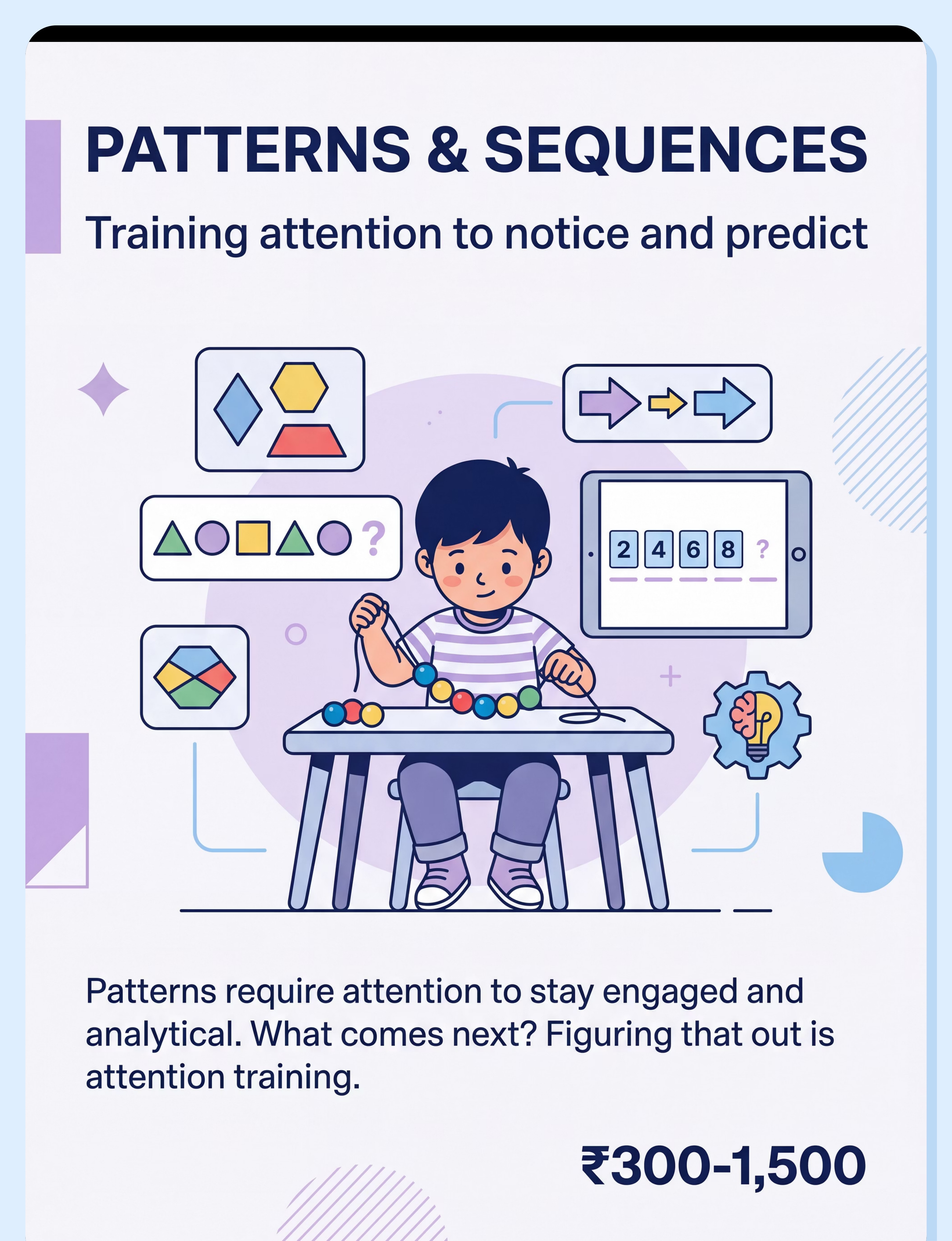
08 — Pattern & Sequence Activities
📦 Cognitive & Learning / Sequencing
🎯 Sustained cognitive attention, analytical attention, forward-thinking focus
💰 ₹300–1,500
Pattern blocks with cards, bead sequencing sets, visual sequence puzzles
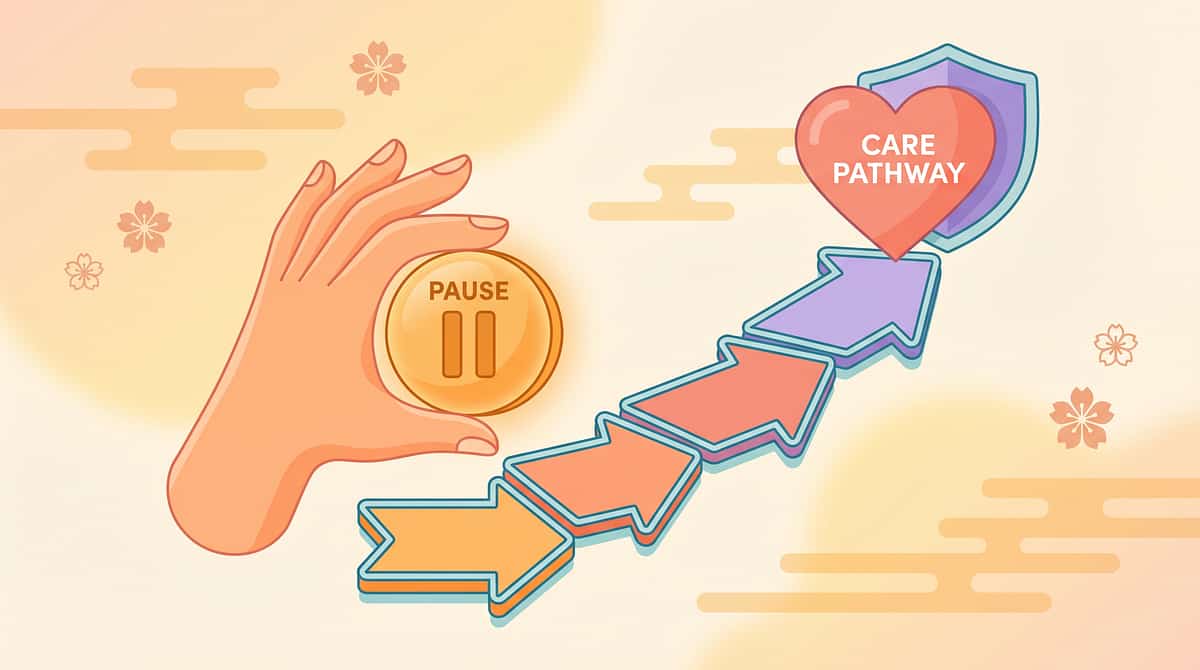
Zero-Cost Attention Training. Full Clinical Outcome.
Per WHO/UNICEF equity principles: Every intervention in this programme has a household-material equivalent. Geography and budget should never determine a child's access to therapy.
Clinical Material | Household Substitute | Why It Works Equally | |
Maze books (₹200–500) | Print free mazes from Google Images | Same oculomotor + visual tracking demand | |
Visual timer (₹300–1,500) | Phone countdown timer with screen visible | Time visibility is the therapeutic ingredient | |
Memory card game (₹200–1,000) | Cut cardstock, draw matching pairs with markers | Homemade pairs train the same sustained attention | |
Sorting activity set (₹200–628) | Sort coins, buttons, dried lentils by colour/size | Identical selective + sustained attention demand | |
Construction set (₹500–3,000) | Block towers with printed photo guides | Plan-following is the active ingredient, not brand | |
Mindfulness tools (₹200–1,500) | Balloon breathing (no props), body scan with words | The practice, not the prop, builds regulation | |
Pattern activities (₹300–1,500) | Bead strings, colour-coded chalk patterns | Pattern detection works on any medium | |
Auditory attention games | Simon Says, hand-clapping rhythms, "I Spy" | No material needed — just structured play | |
Attention training games | Spot It with household picture cards | Deliberate practice principle is material-agnostic |

Before You Begin — Read This. All of It.
🔴 RED — DO NOT PROCEED IF:
- Child is visibly unwell, feverish, or in physical discomfort
- Child had a significant meltdown or distressing event within the last 2 hours
- Child has been diagnosed with a seizure disorder — consult neurologist before any visual tracking protocols
- Child has active ear infection — auditory attention tasks are contraindicated
- Child shows signs of severe distress at the sight of materials (panic, self-injury — pause and consult OT)
🟡 AMBER — MODIFY SESSION IF:
- Child is hungry — provide snack, wait 20 minutes before starting
- Child appears fatigued — reduce session to 5 minutes maximum
- Child is hypersensitive to sound today — skip auditory attention tasks, focus on visual
- Child had a difficult school day — begin with preferred, easier materials only
🟢 GREEN — ALL CLEAR TO PROCEED IF:
- Child is fed, rested, and in a regulated emotional state
- Environment is prepared (see Card 12)
- Materials are safe and age-appropriate
- You have 20–30 uninterrupted minutes
Material Safety Checklist
- ☑️ No materials with pieces smaller than 3.5cm diameter for children under 5 (choking risk)
- ☑️ Ensure adequate lighting — visual tracking in dim light causes eye strain
- ☑️ Stop immediately if child reports headache, eye pain, or dizziness during visual tasks
- ☑️ Keep reinforcement items (stickers, jar) out of reach to preserve their reward value
- ☑️ Laser pointer — adults use only for tracking. Never direct at eyes.

The Right Environment Is 50% of the Intervention.
Position Guide
01
Child Position
Seated at table, feet flat on floor, hips at 90°. Materials directly in front. Correct postural alignment supports prefrontal activation.
02
Parent Position
Beside child (not across — avoids confrontational framing). Close enough to point and prompt, far enough to allow independent effort.
03
Materials Arrangement
Only current material visible — others stored out of sight to reduce visual distraction.
04
Timer Placement
Positioned where child can see it clearly. Visual countdown manages anticipation and reduces anxiety.
Environmental Specifications
- Lighting: Bright natural light preferred. Avoid fluorescent flicker. Desk lamp acceptable.
- Sound: Quiet. No TV, music, or background conversation. If sensory regulation music is prescribed by OT, use it.
- Temperature: Comfortable — neither too warm/drowsy nor too cold/distracted.
- Clutter: Clear table surface except for active materials. Visual clutter competes for selective attention.
- Duration: Set aside 25–30 minutes. Actual session 15–20 min. Buffer for setup and transition.
📵 Phone/tablet = OUT OF ROOM | 📺 TV = OFF | 🚪 Door = CLOSED
Sensory Integration Theory (Ayres): Environmental structure is a primary variable in intervention effectiveness. PMC10955541 meta-analysis confirms 1:1 individual structured sessions as the most effective delivery format.
ACT III: THE EXECUTION
60-Second Pre-Flight. The Best Session Starts Right.
Run through this quick checklist before every session. Your honest assessment here prevents wasted effort and protects your child's positive association with attention training.
Readiness Indicator | Check | |
✅ Child has eaten within the last 2 hours | ☐ | |
✅ Child has slept adequately (last night ≥ 8 hrs for age) | ☐ | |
✅ Child is in a regulated emotional state (not crying, not hyperactive) | ☐ | |
✅ No significant negative events in last 60 minutes | ☐ | |
✅ Child shows at least neutral affect (not actively resisting) | ☐ | |
✅ Medications (if prescribed) have been administered as scheduled | ☐ | |
✅ Parent is calm, patient, and has 20 uninterrupted minutes | ☐ |
6–7 ✅ → GO
Proceed to Step 1. Full session at standard duration and difficulty.
4–5 ✅ → MODIFY
Shorter session (8–10 min), lower-demand version. Use preferred materials only.
0–3 ✅ → POSTPONE
Reschedule for today's other optimal window (after nap, after outdoor play). Do a calming activity instead. Transition Objects, ₹425 →
"The best session is one that starts right. A postponed session is not a failure — it is clinical judgment."

Step 01
The Invitation
Duration: 30–60 seconds | ABA Principle: Pairing + Low Demand Opening
Script for Parent
"Hey [child's name], I have something interesting. Want to see?"
Show the material from a distance first. Let curiosity do the work. Do not command participation — invite it.
Body Language
- Get to child's eye level (kneel or sit)
- Relaxed shoulders, soft face, genuinely interested expression
- Do NOT stand over the child — this creates authority pressure that interferes with voluntary attention
✅ Acceptance Cues (The child is saying yes)
- Eyes shift to material
- Body orients toward material
- Reaches toward material
- Vocalises interest (any sound, any word)
- Stops current activity and looks
❌ Resistance Cues (The child is saying not yet)
- Turns body away
- Pushes material away
- Increases stereotypy or self-stimulation
- Covers eyes or ears
If resistance: Do not insist. Offer again in 5 minutes. Use a preferred reinforcer first (Reward Jar ₹589), then re-invite.
ABA Pairing Procedures + OT "Just-Right Challenge" principle: Voluntary engagement is a prerequisite for attentional learning. Forced compliance creates avoidance, not attention training.
Step 02
The Engagement
Duration: 1–3 minutes | Reinforcement schedule begins
Once the child accepts the invitation, bring the chosen material to the table. Introduce it with a brief, clear framing statement that sets expectations without pressure.
Visual Tracking Script
"This is a maze. The goal is to find the path out. Only your eyes move — not the book. Ready? Let's see if your eyes can find the way."
Memory Game Script
"These cards have pairs. We flip two at a time. If they match, we win them. If they don't, we flip them back. Your brain has to remember where everything is."
Timer Task Script
"See this timer? We're going to [activity] while the timer counts down. When it reaches zero, you're done. How long do you think you can go?"
Sorting Script
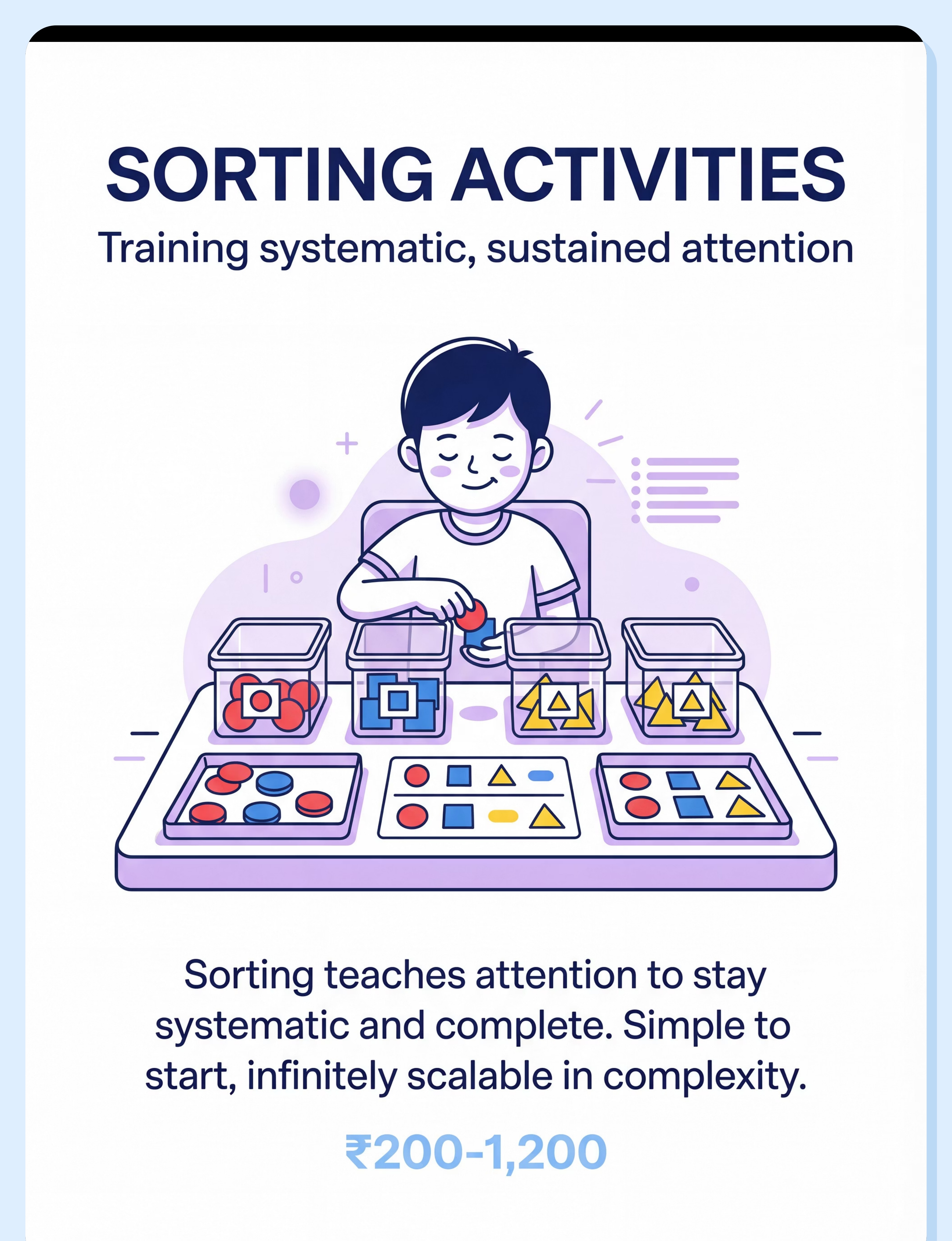
"All these [objects] are mixed up. Can you sort them into groups? You decide the rule."
Presentation Principles
- Present material at child's midline (not left or right biased)
- Use slow, deliberate movements to demonstrate
- Name the action, don't just show it
- Wait 3–5 seconds after demonstration before expecting response
Step 03
The Therapeutic Action
Duration: 8–12 minutes | This is the training stimulus
The therapeutic action is not the specific activity. It is the moment-to-moment attentional effort the child makes — the microseconds of sustained engagement, the flicker of self-correction when they drift, the return to task.
🔵 Visual Tracking
Child follows a path with eyes only (no head movement). Parent watches eye movement. Every 60 seconds: "Eyes back to the start position." Gradually increase maze complexity.
🔵 Auditory Games
Parent gives instructions at natural speech rate (no slowing). Child follows without repetition. Increase instruction length by one step every week. "Put the red block on the table, then clap twice."
🔵 Timer Tasks
Child works while timer is visible. No interruptions during timer. Parent marks duration on progress chart. Start at 3 minutes. Add 30 seconds per successful session.
🔵 Memory Game
Child must look, remember, and decide before flipping. No rushing. Begin with 4 pairs. Add 2 pairs when 80% match rate is consistent.
🔵 Construction with Plans
Child looks at instruction picture, selects pieces, builds. Parent does NOT assist unless child asks. Wait. Let the child sustain focus on problem-solving.
🔵 Sorting
Child sorts to completion. No stopping midway. If distracted, gentle redirect: "Almost done — how many left to sort?"
🔵 Mindfulness
Begin with 30-second body scan. "Close your eyes. Notice your breath. Notice your hands." Increase by 15 seconds weekly.
🔵 Patterns
Child identifies the rule, continues the pattern. If stuck, do not supply the answer. Say: "Look again. What came before it?"
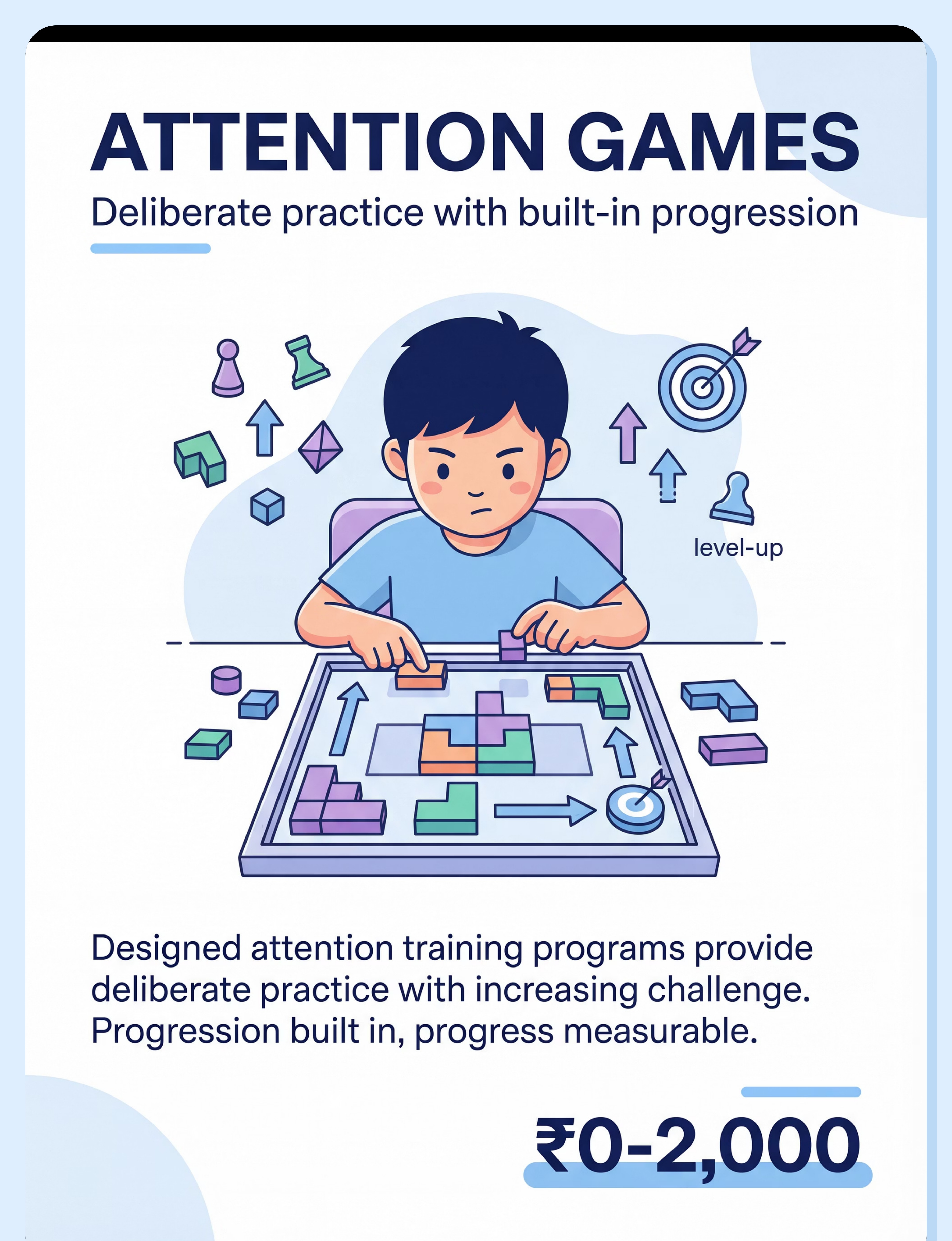
🔵 Attention Games
Follow game rules precisely. If child breaks rules to win, gently reset. The rule-following IS the attention training.
PMC10955541: Core therapeutic exposure constitutes 40–60% of structured session time. Quality of engagement matters more than quantity of repetitions.
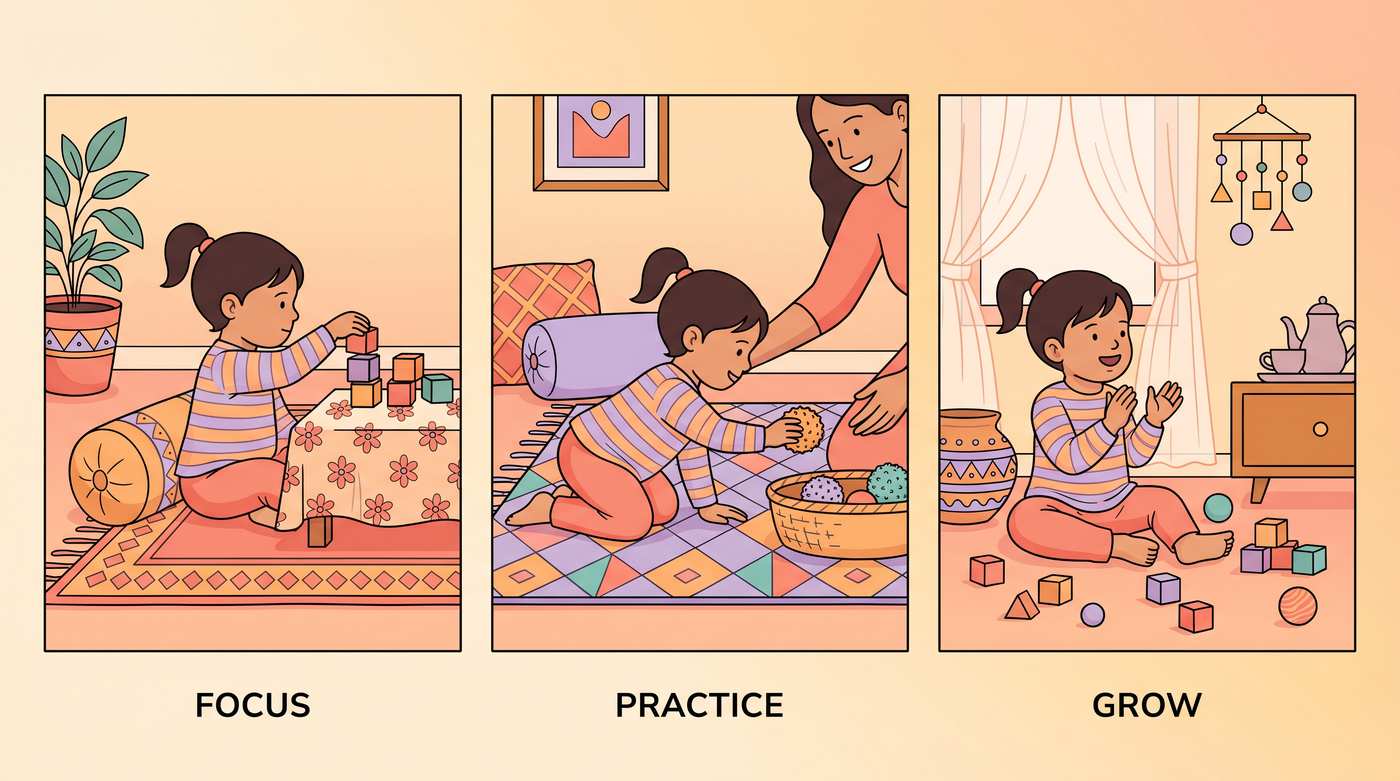
Step 04
Repeat & Vary
Duration: 3–5 minutes | Dosage + variation principle
3 excellent, engaged repetitions > 10 forced, reluctant ones.
Material | Target Reps/Session | Notes | |
Visual Tracking mazes | 2–3 complete mazes | Increase complexity, not just quantity | |
Auditory instructions | 5–8 instruction sets | Each set slightly longer than last | |
Timer tasks | 1 timer block per session | Extend duration, not repetitions | |
Memory game | 1 full game to completion | Add pairs over weeks | |
Construction | 1 complete build | Complexity increase is the progression | |
Sorting | 2–3 sort categories per session | Add attributes (colour → colour + size) | |
Mindfulness | 1–2 practices, increasing duration | Consistency over complexity | |
Patterns | 4–6 pattern sequences | Increase complexity (AB → ABBC → AABBC) | |
Attention games | 1–2 game rounds | Follow rules strictly |
Variation Principle
Same therapeutic target, different material. If child shows satiation with mazes: switch to hidden pictures (same visual selective attention, different format). Variation maintains engagement without losing therapeutic specificity.
⚠️ Satiation Indicators — Stop Before These
- Child begins making errors they weren't making 5 minutes ago
- Eye contact decreases significantly
- Fidgeting increases beyond baseline
- Child vocalises desire to stop
Sensory integration dosage research: 2–3 sessions/week, 8–12 weeks for structural gains. Within-session repetition calibrated to engagement quality, not fixed count.

Step 05
Reinforce & Celebrate
Timing is everything. Within 3 seconds. Every time.
The Reinforcement Equation: Correct Behaviour + Immediate Specific Praise + Reinforcer = Neural Pathway Strengthened
Completing a maze
"You tracked that entire path without losing it once. That's your attention muscle getting stronger."
Following a 3-step instruction
"You held all three steps in your head AND did them in order. That's working memory AND attention together."
Completing a timer block
"Five full minutes. Last week it was four. Your brain is actually changing."
Completing a sort
"You didn't stop until every single one was in the right group. That's how champions build focus."
Reinforcement Menu (Canon-Linked)
- 🏆Reward Jar — ₹589 | Token economy visual
- ⭐Sticker Book — ₹364 | 1800+ stickers, immediate tangible reward
- 🧸Transition Comfort Toy — ₹425 | Post-session comfort bridge
Reinforcement delivered within 3 seconds of the desired behaviour is 4× more effective than reinforcement delivered after 10 seconds. (ABA Core Principle: Contiguity of reinforcement)
"You tried to hold your focus even when it was hard. That's exactly what I asked for."
"You tried to hold your focus even when it was hard. That's exactly what I asked for."

Step 06
The Cool-Down
No session ends abruptly. The transition IS part of the therapy.
1
T-2 Minutes
Give advance warning: "Two more minutes, then we're all done for today." Use visual timer — show the remaining sand/time.
2
T-1 Minute
Verbal countdown cue: "One more, then we finish. You're doing great."
3
T-0: Closure
Clear, warm ending: "That's it for today. You worked really hard."
4
Material Put-Away Ritual
Invite child to assist. Provides transition ritual, task completion feeling, and a motor break from sustained seated attention.
5
Name What's Next
"After we put this away, we're going to [preferred activity/snack/outdoor play]."
If child resists ending: Do NOT extend the session. This trains attention avoidance, not attention training. Offer a choice: "Do you want to put the timer away or the cards?" Provide the transition comfort object if needed, then redirect immediately to the named next activity.
NCAEP (2020): Visual supports and transition warnings are evidence-based practices for autism. Structured endings prevent post-session dysregulation.

60 Seconds of Data Now. Weeks of Progress Visible Later.
When you record consistently, you will see the data arc — and that arc is your child's brain changing. Visible. Measurable. Irrefutable.
What to Record — 3 Fields Only
DATE: _______________
MATERIAL USED: _______________
SUSTAINED DURATION (minutes): _______________
ENGAGEMENT QUALITY (1=poor 2=moderate 3=excellent): ___
ANY NOTABLE OBSERVATION: _______________
The Data Arc Over 8 Weeks
Week 1
3 minutes sustained, engagement quality 2
Week 4
7 minutes sustained, engagement quality 3
Week 8
14 minutes sustained, engagement quality 3
📞9100 181 181 — Share your data with a Pinnacle specialist for personalised feedback. BACB ABA Data Collection Standards: Continuous duration and frequency measurement is the gold standard for attention intervention progress monitoring.

Sessions Don't Always Go Perfectly. Here's Your Fix Kit.
Session abandonment is not failure. It is data. Adjust and return.
❌ Child refused to engage with material at all
Why: Motivation not established. Material may be too novel, too difficult, or presented at wrong arousal state.
Fix: Begin with a preferred activity for 5 minutes. Embed the attention training material INTO the preferred activity. ("Let's sort these LEGO pieces by colour before we build.")
❌ Child engaged for 30 seconds then completely lost focus
Why: Duration demand exceeded current capacity. Starting point was too ambitious.
Fix: Reduce target duration to child's current maximum. If they lasted 30 seconds, make the next session target 45 seconds. Use the timer to make it visible and achievable.
❌ Child got frustrated and had a meltdown
Why: Challenge level too high. Error rate exceeded tolerance. Or arousal state was already elevated pre-session.
Fix: Check readiness checklist retrospectively. Simplify material by one level. Next session, start with a guaranteed-success variation.
❌ Child was going through the motions but not truly engaged
Why: Reinforcement value is insufficient, or material interest is low.
Fix: Audit reinforcer potency. Has the reward jar lost its value? Introduce a new preferred reinforcer. Change the material to one with higher natural interest.
❌ Child improved initially but seems to have plateaued
Why: Current challenge level no longer requires effort. Technique has become too easy.
Fix: Increase difficulty. Add pairs to memory game. Increase timer duration. Add attributes to sorting task. Introduce multi-step attention demands.
❌ Sessions cause conflict between parent and child
Why: Session has become associated with demand/correction rather than engagement/success.
Fix: Step back to pure pairing. Several sessions with zero demands — just play with the material together. Re-establish positive association before reintroducing structure.
❌ Progress at home, but no change at school
Why: Transfer hasn't happened yet. Skills are context-specific initially.
Fix: Share the Teacher Communication Template with school. Align home + school strategies. Generalisation requires multiple settings.
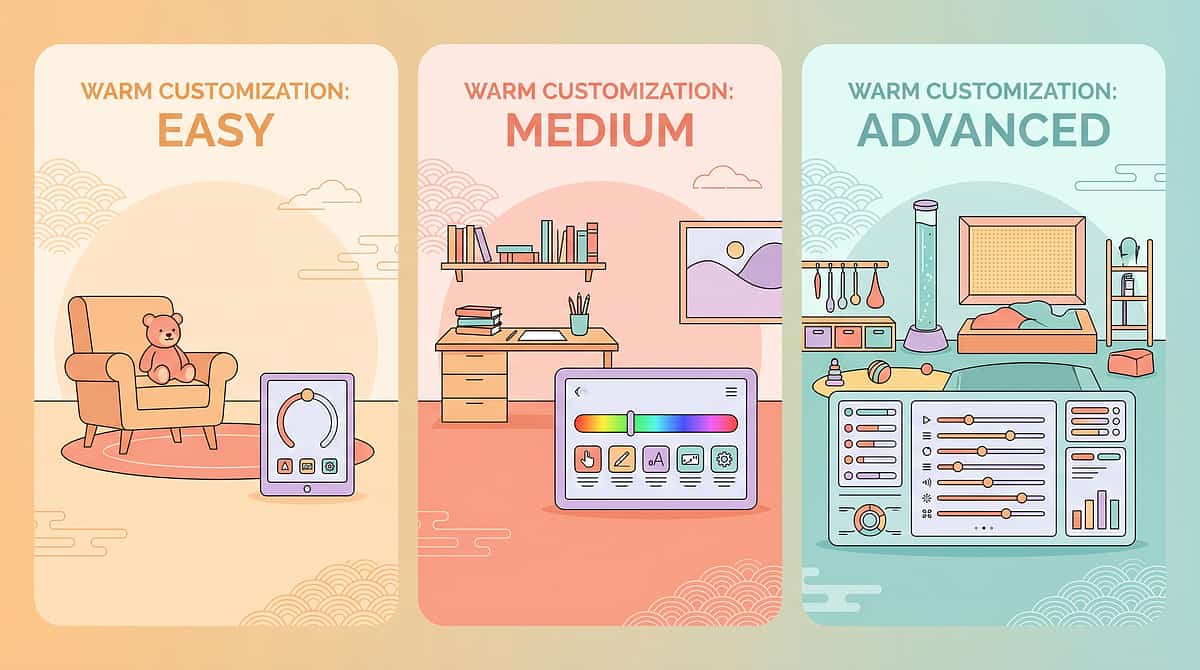
Every Child Is Different. Your Attention Training Programme Should Be Too.
1
For the Sensory Seeker
(craves stimulation)
- Use tactile materials alongside attention tasks (fidget in non-dominant hand)
- Incorporate movement breaks between attention blocks (2 min jumping jacks → 5 min timer task)
- Allow standing at table rather than seated
- Use high-stimulation reinforcers (active play, music)
2
For the Sensory Avoider
(overwhelmed by stimulation)
- Reduce materials in visual field to bare minimum
- Use quieter, less visually complex materials (simple mazes vs. I Spy)
- Build in more frequent, shorter breaks
- Use calming sensory input before session (gentle joint compression, slow rocking)
3
For Younger Children (3–5 years)
- Maximum 5-minute sessions
- Material must be highly preferred-interest linked (dinosaur sorting, vehicle matching)
- Heavy reinforcement ratio (every 30 seconds of engagement = praise)
- Movement-integrated attention tasks (sort while standing, trace patterns on floor)
4
For Older Children (9–12 years)
- Self-monitoring introduced (child rates own focus 1–5 after each block)
- Goal-setting collaborative (child chooses the timer target)
- Metacognitive language ("What strategy are you using to keep your attention on this?")
- Transfer challenges ("Use this same focus strategy during your maths homework tonight")
ACT IV: THE PROGRESS ARC
Weeks 1–2
Weeks 1–2: You Are Planting Seeds You Cannot Yet See
✅ What You Will See
- Reduced resistance to starting the session (by end of week 2)
- 10–20% longer sustained engagement than baseline
- Slightly fewer redirections needed per session
- Child begins to anticipate the session routine (predictability comfort)
- Very occasional moments of self-correction (drift → return to task)
❌ What You Will Not See Yet
- Dramatic improvement in homework completion
- Teacher reporting change at school
- Independently sustained focus without prompting
- Generalisation to non-trained tasks
The Milestone That Matters Most in Week 2:"Your child tolerates 3 more seconds of focus than in week 1. That is real, measurable, neurological progress."
Parent Emotional Preparation: This phase is the hardest. Progress is invisible to the eye but visible on your data sheet. Keep recording. Trust the data over the feeling.
PMC11506176 + General intervention timeline literature: Sensory/attentional intervention outcomes emerge across 8–12 week timelines. Early-phase indicators focus on tolerance and participation rather than mastery.

Weeks 3–4
Weeks 3–4: The Neural Pathways Are Finding Their Grooves
Consolidation Indicators — The Specific Behavioural Markers
1
✅ Anticipation
Child moves toward the session area without being called
2
✅ Preference
Child has a favourite attention material they request
3
✅ Self-Correction
Spontaneous: "Wait, I wasn't paying attention" (with or without words)
4
✅ Transfer Seed
One instance of attention strategy appearing in another context (e.g., child slows down on non-therapy reading)
"You may notice you're more confident too. You're reading your child's attention state accurately. You know when to push and when to back off. That expertise is yours." — Pinnacle Blooms Consortium

Weeks 5–8
🏆 Mastery Zone
Weeks 5–8: Watch for These Mastery Signals
Skill | Mastery Indicator | |
Sustained Attention | 15+ minutes focused engagement with ≤2 prompts per session (age 5–8) | |
Selective Attention | Completes visual tasks in distracting environment (sibling noise, TV in background) | |
Auditory Attention | Follows 4-step verbal instructions without repetition | |
Memory/Matching | Completes 20-pair memory game with strategic play (remembering positions) | |
Self-Monitoring | Voluntarily redirects own attention at least once per session without adult prompt |
Generalisation Indicators — The Real Mastery Test
- ✅ Teacher mentions improved classroom attention (unsolicited)
- ✅ Homework duration reduces by 30%+
- ✅ Child independently chooses an attention strategy during non-therapy tasks
- ✅ Sibling or peer notices ("You're really focused today")
You Did This. And It Was Hard. And It Was Worth It.
🎉 To every parent who got here: You spent 5–8 weeks waking up early, clearing the table, setting the timer, absorbing the resistance, redirecting gently, recording the data, staying consistent when there was no visible reward. You were doing neuroscience. At home. Daily. Without a degree. For your child.
The progress your child has made — even if it looks small to the outside world — represents literal structural changes in their prefrontal cortex. Neural pathways that did not exist before you started.
"From the first session where they lasted 90 seconds before drifting, to last week's 12-minute focused build. That journey is yours. Own it."
1
📸 Your Family Milestone
Take a photo of your child's current best focused-moment. Write today's date on it.
2
📓 Write It Down
"[Child's name] can now sustain focus for [X minutes] on [activity]. In week 1, it was [Y minutes]."
3
📤 Share (Optional)
Share your milestone with the Pinnacle parent community. Your story helps the next family.
📞9100 181 181 — Tell us about your child's progress. We want to know.
Even in Progress: Know When to Pause and Ask
🚨 These red flags require immediate consultation — not modification. When in doubt, call 9100 181 181.
1
🚨 Regression Without Explanation
Child loses 3+ weeks of progress after a period of mastery. May indicate medical change, anxiety spike, or undetected sensory issue. Pause and consult.
2
🚨 New Accompanying Symptoms
Attention difficulties accompanied by headaches, visual complaints, sleep changes, or emotional volatility — these require medical evaluation before continuing.
3
🚨 Consistent Severe Frustration at Threshold
If child melts down at the same point in every session for 2+ weeks, the challenge level may be exposing an underlying processing issue.
4
🚨 Zero Transfer After 8 Weeks
If 8 weeks of daily training shows no generalisation to ANY other context, a formal neuropsychological evaluation is indicated.
5
🚨 Hyperactivity Markedly Increasing
If increased attention demands are paired with escalating hyperactivity, discuss ADHD evaluation timeline with developmental paediatrician.
6
🚨 Visual-Motor Symptoms
Consistent eye rubbing, tilting head, skipping lines in reading tasks — refer to paediatric optometrist.

You Are Not Done. You Are On a Journey With a Map.
1
What Came Before
- Working Memory Foundation (L-983)
- Impulse Control Basics (L-984)
2
★ You Are Here
L-985: Attention Training — 9 Materials
Building sustained, selective, and auditory attentional foundations.
3
Where You're Going
- Path A: L-986: Cognitive Flexibility Materials
- Path B: L-987: Planning & Organisation Materials
- Path C: H-750: Focus in Classroom
Long-term developmental goal: Executive Function mastery → Academic Readiness → Functional Independence → Life Participation
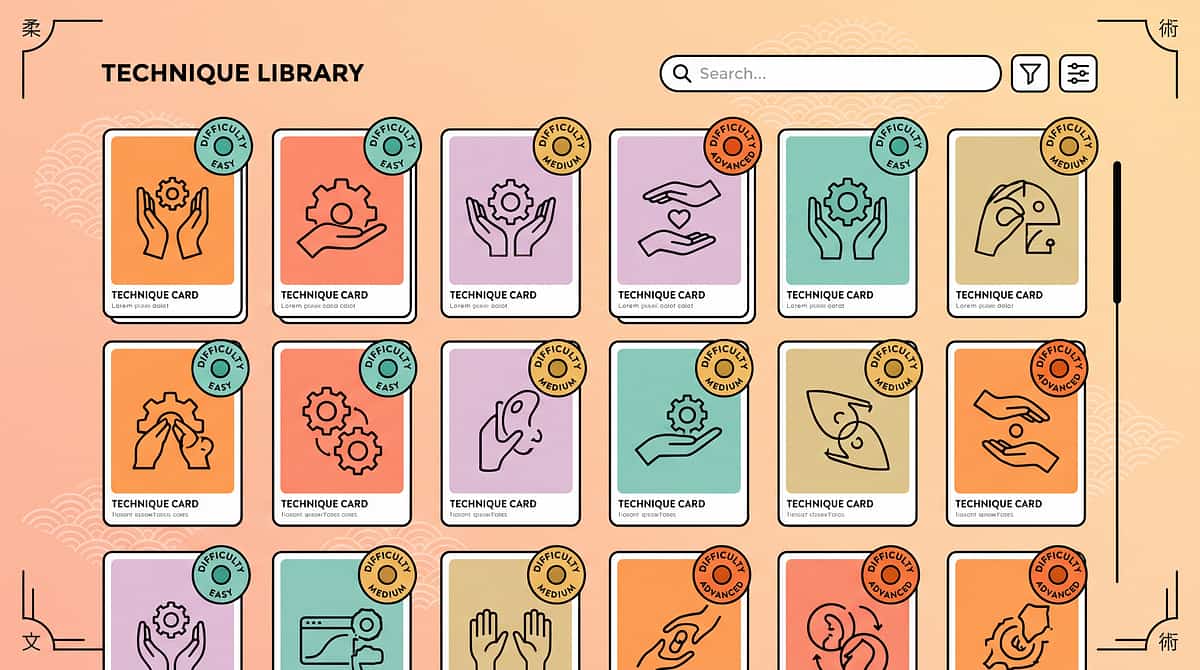
Related Techniques — Same Domain, Different Tools
If you already own materials from this programme, you can begin any of these today.
Technique | Code | Difficulty | Materials You Already Own | |
9 Materials for Joint Attention | B-135 | 🟢 Intro | Memory cards, sorting sets | |
9 Materials for Shared Attention | B-145 | 🟢 Intro | Memory cards, visual materials | |
9 Materials for Attention Skills | G-661 | 🟡 Core | Timer, memory game, sorting | |
9 Materials for Focus & Concentration | G-662 | 🟡 Core | Timer, patterns, construction | |
9 Materials for Executive Function | G-693 | 🔴 Advanced | All 9 materials from L-985 | |
9 Materials for Attention Difficulty | D-443 | 🟡 Core | Visual tracking, timers |
One Technique. One Domain. One Piece of a Larger Plan.
Other Domains That May Need Parallel Attention
- Domain A (Sensory): If sensory dysregulation is disrupting attention baseline
- Domain B (Social Communication): If joint attention deficits underlie attention difficulties
- Domain C (Emotional Regulation): If anxiety or dysregulation is competing with attention capacity
- Domain G (Attention Skills — School): If academic attention transfer is the priority
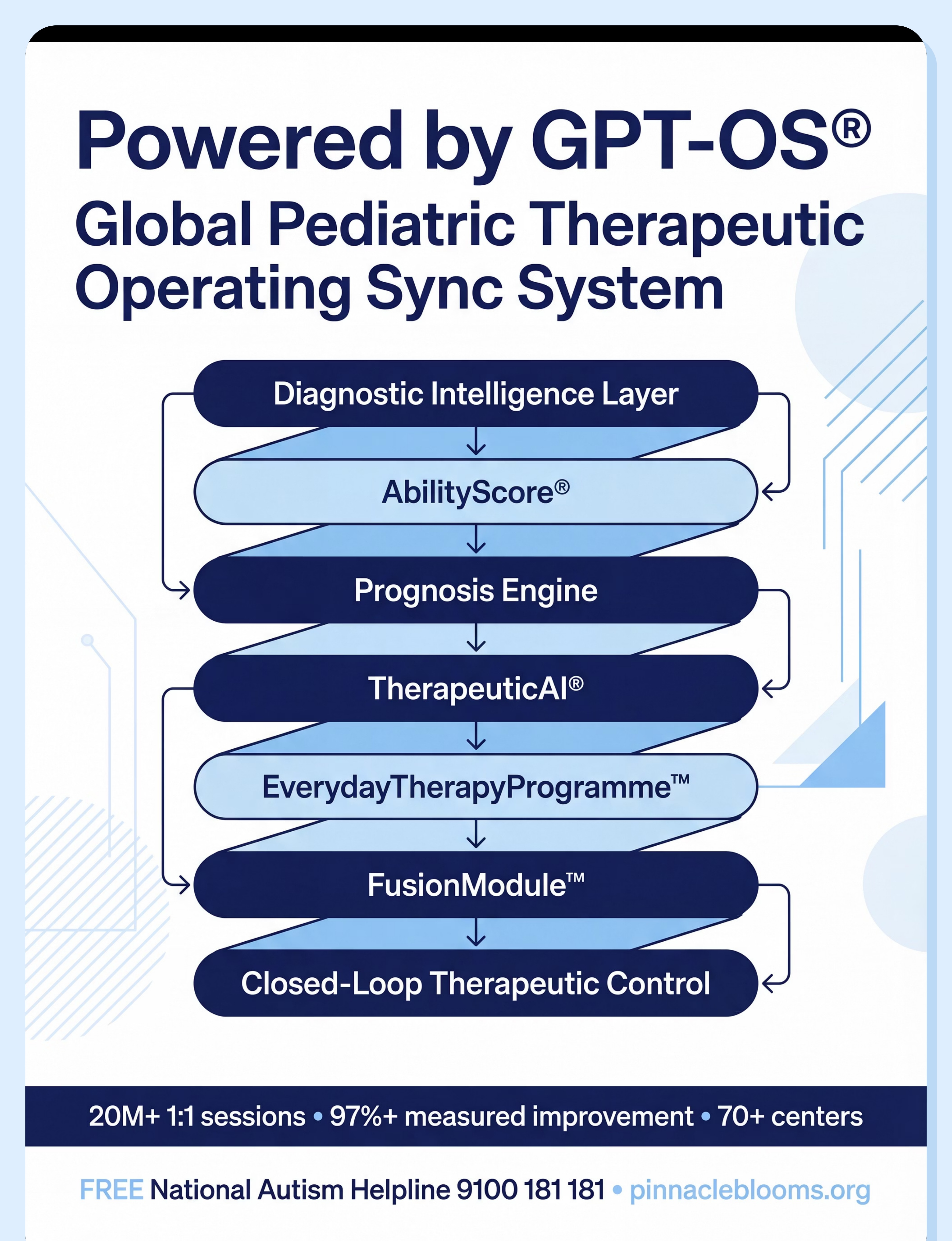
GPT-OS® Full Profile
"This technique is one piece of a larger plan. GPT-OS® maps your child's entire developmental profile across all 12 domains, generates personalised technique sequences, and tracks progress as a single system."
📞9100 181 181 — Request your child's AbilityScore® assessment
ACT V: COMMUNITY & ECOSYSTEM
From the Therapy Notes. From the Living Rooms. From Families Like Yours.
Family A | Riya, 6 years | Hyderabad
Presentation: ASD + severe sustained attention deficit. Could not focus on any non-preferred task for more than 45 seconds.
Before: Every homework session was a 2-hour ordeal ending in tears. Riya's teacher had placed her at the front, given her a fidget — nothing helped. Her parents were told to "manage expectations."
After (Week 8): Riya completes her reading worksheet in 18 minutes. She now independently uses a 10-minute sand timer during homework. Her teacher messaged: "Something has changed. She's following my instructions on the first try."
Timeline: 8 weeks. Daily 15-minute home sessions. Materials: visual timer + sorting sets + memory game.
"We stopped waiting for someone to fix her. We became her therapists. And she became the child we always knew was there." — Riya's Mother
Family B | Aryan, 9 years | Bengaluru
Presentation: ADHD evaluation pending. Gifted IQ, zero academic completion. Teachers reported "deliberately difficult."
Before: Aryan could explain quantum physics concepts from YouTube but couldn't complete a 20-question test. His parents were at odds — one believed in medication, one refused.
After (Week 10): Using the attention training programme while awaiting formal evaluation, Aryan sustained 22 minutes of focused writing. He now self-advocates: "I need to start my timer before homework."
"The materials gave him a language for his own attention. He stopped blaming himself." — Aryan's Father
Illustrative narratives based on clinical profiles across the Pinnacle Network. Individual names changed. Outcomes vary by child profile and intervention consistency.
"The families who see the fastest results share one thing: they treat session consistency like medication. Non-negotiable. Daily. Even when it's inconvenient." — Pinnacle OT Specialist, 8 years experience
You Are Not Navigating This Alone.
💬 WhatsApp Parent Community
Pinnacle Parent WhatsApp Community — Attention & Executive Function. Join 3,000+ parents navigating the same journey. Share wins, ask questions, troubleshoot sessions.
🌐 Online Parent Forum
Long-form discussions, technique reviews, material recommendations from parents who have completed 8+ weeks.
📍 Local Parent Meetups
Monthly parent meetups at all 70+ Pinnacle centers. Meet families in your city working on the same techniques.
👥 Peer Mentoring Programme
Connect with a parent who has already completed this technique programme. Free. 30-minute video call.
"Your experience — the failures, the adjustments, the breakthroughs — is clinical data for the next family. Consider sharing your journey."
📞9100 181 181 — Connect with our community team. WHO NCF Community Engagement Principles: Parent support networks are evidence-associated with improved intervention adherence and family wellbeing.
Home Training + Professional Guidance = Maximum Impact
Home-based attention training delivers 60–70% of maximum possible outcomes when executed alone. The remaining 30–40% comes from professional calibration — a trained OT or ABA specialist who can:
- Assess which attention type is the primary deficit
- Calibrate the exact difficulty progression for this specific child
- Identify co-occurring factors (sensory, anxiety, learning disability) that require separate treatment
- Adjust the programme every 4 weeks based on real data
📍70+ centres across India | Hyderabad, Bengaluru, Chennai, Mumbai, Delhi, Kolkata and 60+ cities
Your Support Options
Primary Discipline: Occupational Therapy
Secondary: ABA/BCBA
Secondary: ABA/BCBA
Teleconsultation: Video consultations for attention programme review, data interpretation, and progression planning.
Insurance & Funding: Ask about CGHS, ESI, and state-level disability support schemes.
📞9100 181 181
WHO NCF Progress Report (2023): 48% increase in countries adopting ECD policies. Primary healthcare as platform for reaching all families with evidence-based interventions.
The Science Behind This Programme. For the Curious Parent.
Study | One-Line Finding | Link | |
PRISMA Meta-Analysis, Children (2024) | Attention intervention via structured materials meets evidence-based practice criteria for ASD | ||
World J Clin Cases Meta-Analysis (2024) | 24-study analysis confirms structured attention intervention promotes sustained attention and academic skills | ||
WHO CCD Package Evidence (2023) | Home-based caregiver-delivered interventions across 54 countries show significant developmental outcomes | ||
Padmanabha et al., Indian J Pediatr (2019) | Indian RCT: home-based parent-administered intervention delivers measurable outcomes | ||
NCAEP Evidence-Based Practices Report (2020) | Visual supports, structured practice, and reinforcement classified as evidence-based for attention |
🌐 WHO Nurturing Care Framework
🌐 UNICEF Child Development
🌐 American Academy of Pediatrics — ADHD
🌐 CHADD — Children with ADHD
Your Data. Your Child's Progress. The World's Children Benefit.
The GPT-OS® Stack
What GPT-OS® Learns from Your L-985 Data
- Which attention materials produce fastest duration gains for this child's profile
- Optimal session length and frequency for this child's arousal patterns
- When to escalate to professional evaluation
- Which next technique in the sequence will be most effective
🔒 Privacy Assurance
All data is anonymised and encrypted. Individual records are never shared without consent. Aggregate, de-identified data improves recommendations for all families.
"Your data helps every child like yours. The 20M+ sessions we've delivered are what make GPT-OS® the most evidence-rich paediatric therapeutic system on Earth."
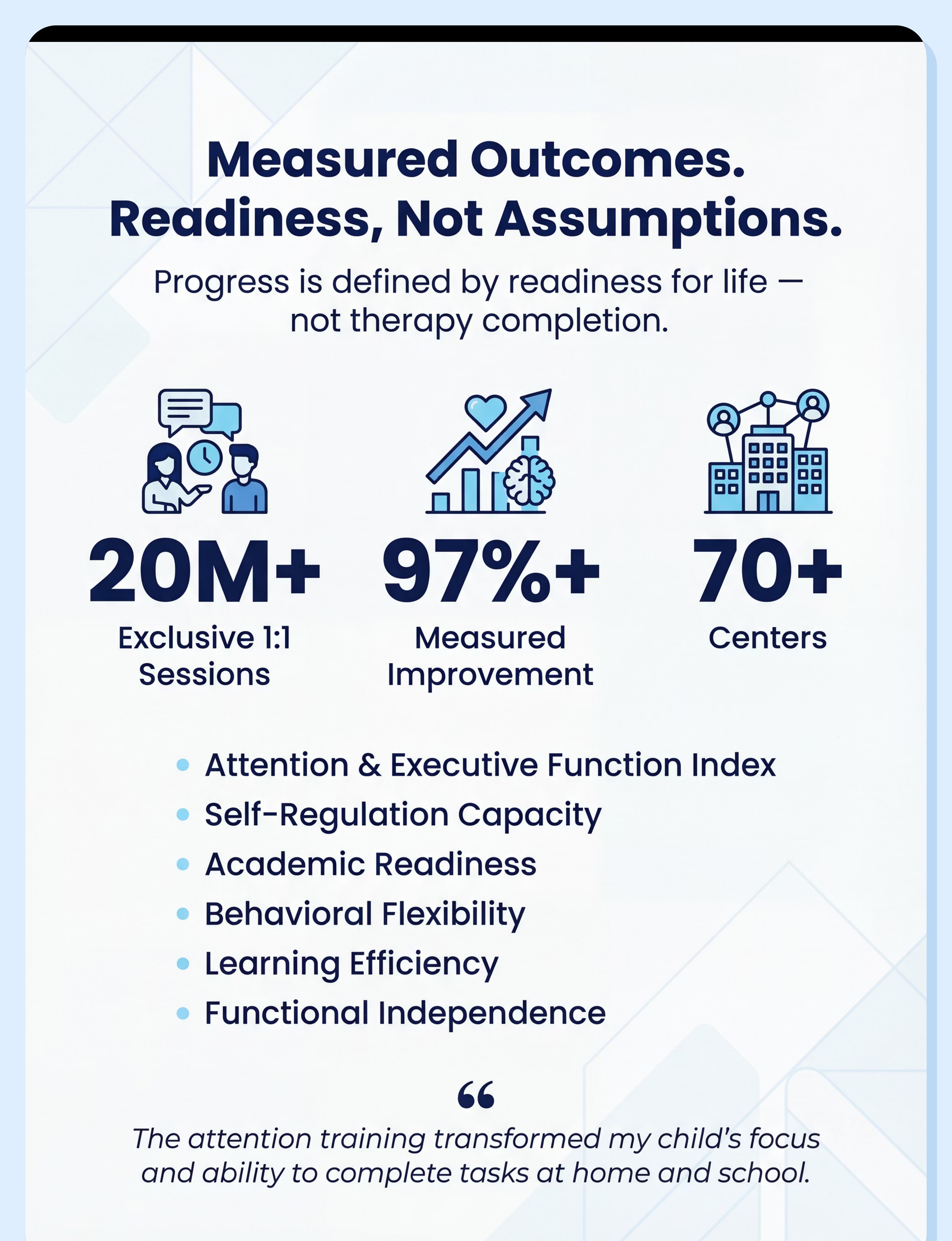
20M+
1:1 Sessions
Exclusive therapy sessions delivered
97%+
Improvement Rate
Measured improvement across network
70+
Centres
Across India, 70+ countries served
160+
Patent Countries
DPIIT8651 | MSME Certified
Watch the Reel That Brought This Programme to Life
Reel ID: L-985
Executive Function Series — Episode 985
🎬 Reel L-985: 9 Materials That Help With Attention Training
"In this reel, our Pinnacle OT specialist walks you through each of the 9 materials, demonstrates correct usage, and shows what engaged attention actually looks like — so you know exactly what you're working toward."
📱 Video modelling is classified as evidence-based practice for autism (NCAEP 2020). Multi-modal learning (visual + text + demonstration) measurably improves parent skill acquisition.
Related Reels in This Domain
- 📱 G-661: 9 Materials That Help With Attention Skills
- 📱 G-662: 9 Materials That Help With Focus and Concentration
- 📱 G-693: 9 Materials That Help With Executive Function
- 📱 H-750: 9 Materials That Help With Focus in Classroom
- 📱 D-443: 9 Materials That Help With Attention Difficulty
Consistency Across Caregivers Multiplies Impact. Share This Now.
If only one caregiver executes this programme, the child receives inconsistent messages about attention demands. Shared knowledge = shared results.
📋 Simplified Guide for Grandparents
"Your grandchild's brain needs practice to stay focused, just like legs need practice to run. We do 15 minutes of focus exercises every day with special materials. When you're with [child], please:"
- ✅ Encourage them to finish what they start
- ✅ Use the timer when they do activities
- ✅ Say specific praise: "You stayed focused on that — well done!"
- ❌ Do not say "pay attention" without showing them what to focus on
📧 Teacher/School Communication Template
"Dear [Teacher's name], we have started a structured attention training programme at home using evidence-based materials guided by Pinnacle Blooms Network's GPT-OS® system. [Child] is currently in Week [X] of an 8-week programme targeting sustained attention. We would appreciate:
- Advance notice of multi-step instructions so we can practise them at home first
- Data on classroom attention duration if possible
- Any observations about attention patterns during different subjects
Thank you for your partnership."
ACT VI: THE CLOSE & LOOP
Questions Parents Ask. Answers Clinicians Give.
Q: My child can hyperfocus on video games but can't focus on homework. Is this really an attention problem?
A: Yes — and it's the most common question we receive. Hyperfocus on preferred activities is a feature of attention dysregulation, not evidence that attention is intact. The brain's dopamine reward system creates effortless focus during high-stimulation preferred activities. The therapeutic goal is building the internal scaffolding that makes focus possible on non-preferred tasks — not eliminating the hyperfocus.
Q: How long before I see results?
A: Expect 2–4 weeks before any visible behavioural change. Data-visible progress (sustained duration increasing) typically appears within 10 days of consistent daily practice. Classroom-observable change typically emerges at weeks 6–8. Full generalisation: 12 weeks.
Q: Should I do this instead of ADHD medication evaluation, or alongside it?
A: Alongside. These are not competing interventions. Medication, if appropriate, optimises the neurological substrate for attention training. Training builds the skills and strategies that persist when medication wears off. Both approaches have a role — consult your developmental paediatrician.
Q: My child refuses every material I try. What do I do?
A: Start with zero structure. Sit with the material yourself and play with it while the child observes. Let curiosity build. The ABA pairing principle says: establish positive association with the material BEFORE introducing demand. This may take 1–2 weeks before any therapeutic use.
Q: We did well for 3 weeks and then had a terrible week. Have we lost all the progress?
A: No. Neural pathways, once formed, are not erased by a difficult week. You may see temporary regression during illness, high stress, or schedule disruption. Resume at slightly easier level (one step back in difficulty) and rebuild. The brain remembers.
Q: My child's attention improves at home but school says there's no change. Why?
A: Transfer takes time and explicit bridging. Skills learned in structured, low-distraction home environments take 4–8 additional weeks to generalise to the complex, high-distraction classroom. Share the teacher communication template (Card 37) and request school-level strategy alignment.
Q: At what age does it become ADHD rather than normal developmental variation?
A: Formal ADHD diagnosis requires symptoms present in two or more settings, onset before age 12, significant functional impairment, and symptoms exceeding developmental expectations. This is a clinical determination — consult a developmental paediatrician or child psychologist. Meanwhile, attention training benefits all children regardless of diagnostic status.
Q: Can I do this with my 3-year-old?
A: Yes, with modifications. 3-year-old sessions: 5 minutes maximum, entirely preferred materials, heavy reinforcement, movement-integrated attention tasks. The principles are identical; the parameters are dramatically compressed.
You Have Everything You Need. Start Today.
The best attention training session is the one that actually happens. Today.
1
🚀 START THIS TECHNIQUE TODAY
Launch GPT-OS® Session for L-985 and begin your child's attention training programme with full clinical support.
2
📞 BOOK A CONSULTATION
Connect with a Pinnacle OT/ABA Specialist. Free first call. All cities. Teleconsultation available.
9100 181 181
3
🗺️ EXPLORE YOUR NEXT TECHNIQUE
→ L-986: Cognitive Flexibility Materials (next in sequence)
unknown link
🏛️Validated by the Pinnacle Blooms Consortium
OT • SLP • ABA/BCBA • SpEd • NeuroDev Pediatrics • CRO
OT • SLP • ABA/BCBA • SpEd • NeuroDev Pediatrics • CRO
Preview of 9 materials that help with attention training Therapy Material
Below is a visual preview of 9 materials that help with attention training therapy material. The pages shown help educators, therapists, and caregivers understand the structure and content of the resource before use. Materials should be used under appropriate professional guidance.



Link copied!
The Pinnacle Promise
🏛️ Pinnacle Blooms Network®
Pediatric Therapeutic Consortium
"From fear to mastery. One technique at a time."
We built this for the parent at 11pm searching for answers. For the family in a tier-3 city with no specialist nearby. For the grandmother who wants to help but doesn't know how. For the teacher who has 35 students and can only spare 3 minutes.
70,000+ techniques. 40 cards each. Evidence-linked. Parent-proven. GPT-OS® powered.
The largest structured paediatric intervention knowledge base on Earth.
The largest structured paediatric intervention knowledge base on Earth.
1
OT | SLP | ABA/BCBA
Special Education | NeuroDev Pediatrics | CRO | Parents | Families
2
WHO/UNICEF-Aligned
Protocols aligned with Nurturing Care Framework and global developmental standards
3
GPT-OS® Powered
AbilityScore® | TherapeuticAI® | EverydayTherapyProgramme™ | FusionModule™
CIN | U74999TG2016PTC113063 | |
DPIIT Startup India | DIPP8651 | |
MSME Udyog Aadhaar | TS20F0009606 | |
GSTIN | 36AAGCB9722P1Z2 |
© 2026 Pinnacle Blooms Network® | A unit of Bharath Healthcare Laboratories Pvt. Ltd. | All rights reserved.
GPT-OS®, AbilityScore®, TherapeuticAI®, EverydayTherapyProgramme™, FusionModule™ and Pinnacle Blooms Network® are registered trademarks. Patents filed across 160+ countries.
GPT-OS®, AbilityScore®, TherapeuticAI®, EverydayTherapyProgramme™, FusionModule™ and Pinnacle Blooms Network® are registered trademarks. Patents filed across 160+ countries.