

Sensory Solutions Series — Episode 104
Proprioceptive Seeking — Heavy Work / Grounding Input
9 Materials That Help When Child Stomps Feet
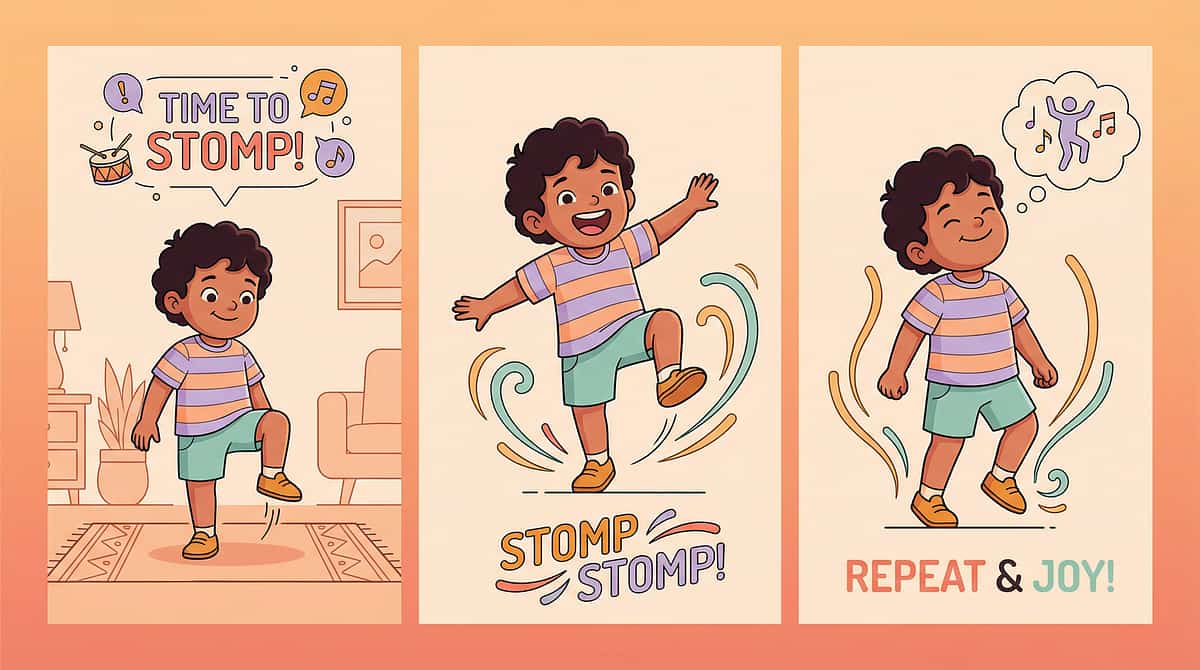
Heavy walking, pounding feet, elephant steps — their body needs to FEEL the ground to know where it is.

Ages 2–10 · Home · School · Therapy
THUMP. THUMP. THUMP.
That's not attitude. That's a body finding ground.
That's not attitude. That's a body finding ground.
"He walks like a dinosaur — THUMP THUMP THUMP. The neighbors below us complain constantly. She stomps so hard on the stairs I think she'll break them. He doesn't walk — he POUNDS. It's like she can't feel her feet unless she's slamming them down. Every step shakes the house."
If your child walks like a dinosaur, stomps through the house, and can't seem to "walk quietly" no matter how many times you ask — their body needs to FEEL the floor to know it's there. It's not defiance. It's grounding. Here are 9 materials that give their feet the input they're searching for.

Why Does My Child Stomp?
Clinical Term: Proprioceptive Seeking Through Gait / Heavy Walking Pattern
This is a sensory processing pattern where the child requires intense proprioceptive feedback through their feet and legs to feel grounded and aware of their body in space. The proprioceptive system — which processes information from muscles, joints, and connective tissue — has a high threshold and needs more intense input to register.
Heavy, stomping walking provides the joint compression and muscle activation these children need to know where their feet are. Without this input, they may feel "disconnected" from the ground or unsteady. This is NOT behavioral — it's the nervous system seeking input it needs.
Per the SPD Foundation: Children who are under-responsive to proprioceptive input often seek intense input through their movement patterns. Heavy walking and stomping provide the joint compression and deep pressure through feet and legs that helps their nervous system register where their body is in space. This is a regulatory behavior, not a behavioral choice.

What Does It Look Like?
Proprioceptive seeking through gait shows up in many ways across the day. Recognizing these signs is the first step toward understanding — and helping.
Walking Pattern
- Walks with heavy, thudding footsteps
- Stomps even when not upset
- Makes loud noise with each step
- Walks on heels or flat-footed with impact
Awareness
- Seems unaware of how loud their walking is
- Cannot "walk quietly" even when asked
- Shakes the floor when walking
- Stomps in situations requiring quiet
Movement Preferences
- Prefers stomping, marching, or heavy movement play
- May run instead of walk for more impact
- Jumps off last steps instead of stepping down
- More regulated after stomping or heavy movement

This Is NOT Behavioral
This is not defiance, carelessness, or a child "not listening" when asked to walk quietly. The child's nervous system genuinely requires more intense proprioceptive feedback to feel grounded. They may not even be aware of how heavy their walking is — because to them, it's what walking feels like when they can finally sense their feet.
Asking them to walk quietly without providing alternative input leaves them feeling disconnected and ungrounded. When we GIVE them the input they need, walking quietly becomes possible because their nervous system is regulated.
What the child hears
"Walk quietly" — with no way to comply, because their feet feel distant and vague without impact.
What the child needs
A designated, appropriate way to receive proprioceptive input — so their nervous system feels grounded without constant stomping.
Overview
9 Materials at a Glance
Each of these tools addresses the same underlying need — proprioceptive grounding — through different channels. Use them as a toolkit, not a checklist.
Stomping Pad
A place to POUND
Weighted Shoes
Feet they can feel
Mini Trampoline
Jump out the need
Stepping Stones
Every step matters
Weighted Vest
Core weight, calmer feet
Tunnel & Climbing
Heavy work, whole body
Textured Tiles
Feet that feel every surface
Stomp Rockets
Stomp hard, launch something
Resistance Walking
Heavy work with every step
Material 1 of 9
Stomping Pad / Vibration Platform
A place to POUND
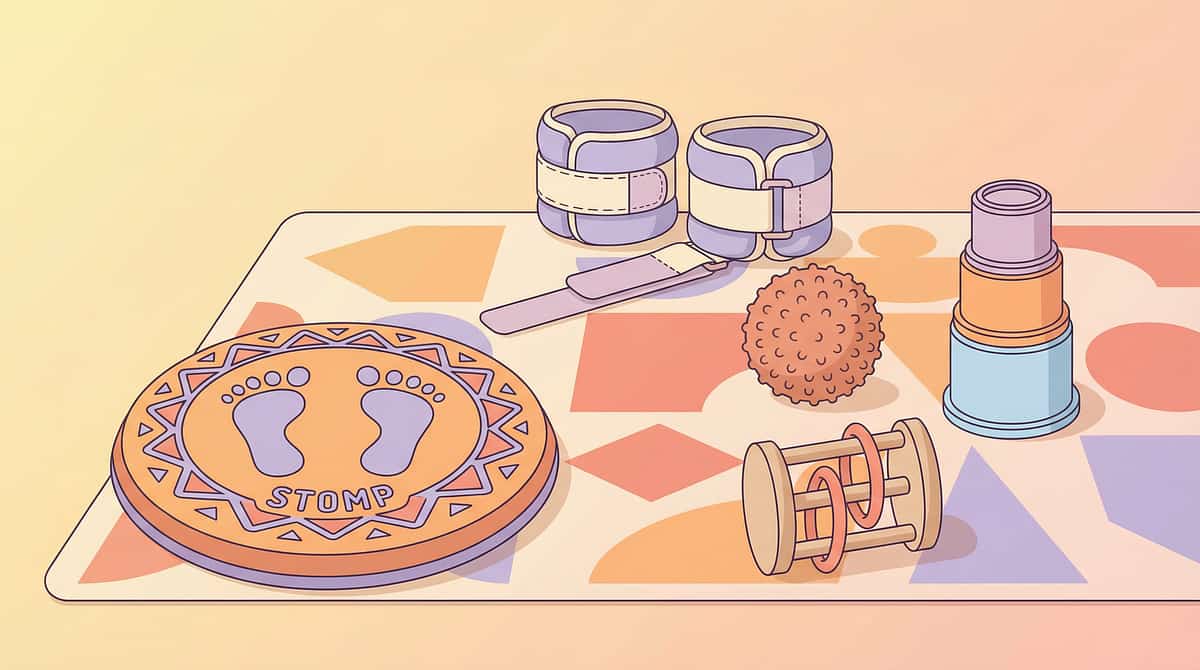
A stomping pad or vibration platform provides a designated space for heavy foot input. When the child stomps on these surfaces, they receive intense proprioceptive feedback through vibration and impact — the exact input they're seeking. By giving them a specific place to stomp, their need is met, and they may be better able to regulate their walking elsewhere.
Why It Works
Stomping pads serve as a "sensory station" — a designated place for the input the child needs. This meets the need without constant stomping throughout the day. Some platforms vibrate when stomped on, amplifying the sensory feedback even further.
How to Use
- Place in accessible location with stable surface underneath
- Instruction: "When you need to stomp, come here"
- 30–60 seconds of stomping, or until child feels regulated
- Use proactively before transitions, or when child begins stomping elsewhere
- Child learns to self-direct to pad when feeling "ungrounded"

Material 1 of 9
Stomping Pad — DIY & Safety
DIY Options
- Stack of old carpet samples or foam tiles
- Rubber gym mat folded in layers
- Large piece of dense foam (mattress topper cut)
- Inflatable stepping stones that compress when stomped
- A specific "stomping corner" with thick rug
Safety Notes
- Ensure pad doesn't slide on floor (anti-slip backing or mat underneath)
- Supervise to prevent over-enthusiastic jumping
- Check pad for wear regularly
- Clear area around pad from furniture
Cost & Products
- Price range: ₹500–3,000
- Gonge Balance Stones
- Bouncy bands stepping stones
- Custom gym mats
Clinical Tip: Use proactively (before transitions, after sitting) rather than just reactively. Build stomping breaks into the daily routine — morning, before school, after long car rides.
Material 2 of 9
Weighted Shoes / Ankle Weights
Feet they can finally feel
Adding weight to feet and ankles increases proprioceptive input with every step the child takes. The extra weight means more effort is required to lift and place feet, which provides more feedback to muscles and joints. For children who stomp because they can't "feel" their feet, the weight helps their nervous system register each step without needing to slam their feet down.
It's passive input that works continuously while walking — no extra effort required from the child or caregiver once shoes are on.
Ages 2–4
0.25–0.5 lb per ankle maximum. Start with the lightest option and observe gait carefully.
Ages 5–7
0.5–1 lb per ankle maximum. Increase gradually based on child's response and comfort.
Ages 8–10
1–1.5 lb per ankle maximum. Monitor for fatigue, tripping, or changes in gait pattern.
Material 2 of 9
Weighted Shoes — DIY, Safety & Use
DIY Options
- Velcro ankle weights (sold for exercise) worn during walking
- Heavier shoes/boots naturally provide more input
- Sand-filled pouches velcroed to shoe tops
- Weighted insoles placed in shoe bottoms
- Start light (100–200g per foot) and adjust
When & Where to Use
Use strategically — during transitions, challenging walking times, or when reduced stomping is needed (apartment living, quiet environments). Not a 24/7 intervention. Watch for fatigue, tripping, or gait changes. Reduce if child seems tired or uncoordinated. Always consult an OT for appropriate weight guidance.
Cost Range
₹300–1,500 · ProSource, Gaiam Ankle Weights, weighted shoe inserts
Safety: Do not use during running or active play. Never exceed 5% of body weight total. Don't use all day — use strategically for specific walking situations.
Material 3 of 9
Mini Trampoline / Rebounder
Jump out the stomping need
A mini trampoline provides intense, repetitive joint compression through jumping — the same input the child seeks through stomping, but in a concentrated, appropriate activity. Jumping delivers proprioceptive feedback through ankles, knees, and hips with every bounce.
After trampoline time, children often have reduced need to stomp because their proprioceptive system has been "fed." Even 2–3 minutes of jumping can shift regulation for 30–60 minutes. It's heavy work for the legs in a format that feels like pure fun.
Basic Jumping
Count to 50 or 100 bounces. Add variety: two feet, one foot, twisting, freeze on command.
Games While Jumping
Alphabet jumps (say a letter each bounce), animal jumps, catch and throw while bouncing, singing songs.
Transition Tool
Use before quiet activities, meals, school drop-off, or whenever stomping is increasing. Morning routine cornerstone.
Material 3 of 9
Mini Trampoline — DIY, Safety & Clinical Notes
DIY & Alternatives
- Outdoor trampoline if space allows
- Jumping on a mattress (supervised)
- Hopping games on firm surface
- Aggressive skipping or marching
Safety Rules
- Handle bar for stability — non-negotiable
- One child at a time only
- Place on flat, non-slip surface
- Clear surrounding area; check springs/fabric regularly
Timing Guide
- Morning: sets up regulation for the whole day
- Before transitions: pre-loads proprioceptive system
- After long sitting: resets nervous system
- Even 2–3 minutes is effective
Price range: ₹1,500–4,000 · Skywalker Mini Trampoline, JumpSport iBounce, Ativafit Rebounder. The mini trampoline is arguably the single most impactful tool in this toolkit — daily use is strongly recommended as the cornerstone of a proprioceptive sensory diet.

Material 4 of 9
Stepping Stones / Balance Path
Every step MATTERS
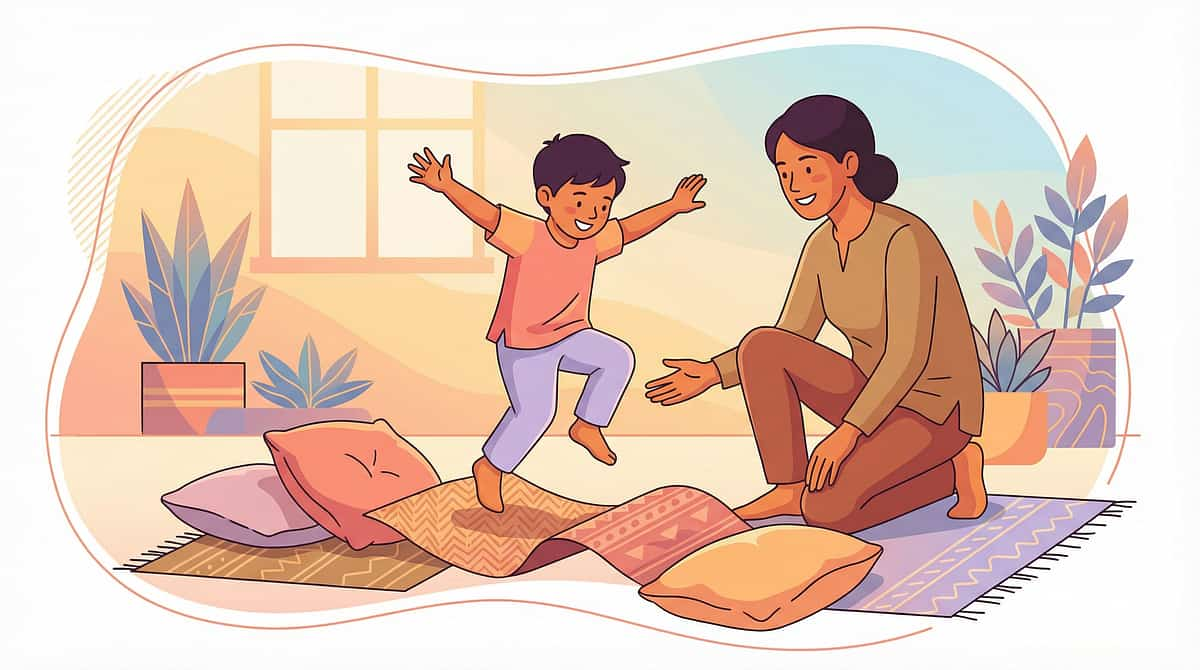
Stepping stones and balance paths require the child to pay deliberate attention to where they place their feet. This forced attention, combined with the effort of stepping up and balancing, provides rich proprioceptive input without needing to stomp. The child must feel their feet to navigate the path successfully.
Different heights and textures add variety and challenge. It channels the heavy walking impulse into purposeful, grounded stepping — and this awareness transfers to regular walking over time.
Path Setup Ideas
- Straight line path — basic practice
- Winding path — requires more attention
- Varied heights — more proprioceptive challenge
- Eyes closed (with spotter) — maximum proprioceptive demand
- Carrying objects while stepping — dual task
- Speed challenges — fast but controlled
DIY Options
- Upturned buckets or sturdy boxes at different heights
- River rocks or flat stones set in a path
- Wood stumps or log rounds (outdoor)
- Pillows arranged for stepping
- Tape "stepping spots" on floor to create attention to foot placement
Price range: ₹1,000–3,500 · Gonge River Stones, JumpOff Jo Stepping Stones, Lakeshore Balance Path
Material 4 of 9
Why Stepping Stones Work
Forced Attention Mechanism
The child must feel and place their feet deliberately rather than stomping automatically. This builds proprioceptive awareness from the ground up — quite literally.
Transfer to Everyday Gait
Regular stepping stone practice transfers to improved gait regulation in daily life. The brain learns to "check in" with feet before placing them, reducing automatic heavy stomping.
Use as Transition Activity
Incorporate as an obstacle course component or transition activity — before sitting for meals, before school, or as a calming-down walk sequence after high energy.
Safety: Ensure all stones are stable and won't tip. Non-slip surfaces are essential. Clear surrounding area for falls. Start with lower heights and progress gradually. Supervise younger children. Check stability before each use.
Material 5 of 9
Weighted Vest / Compression Vest
Core weight, calmer feet
A weighted or compression vest provides proprioceptive input to the upper body, which has organizing effects on the entire nervous system. When the core and trunk receive adequate proprioceptive input, the nervous system is calmer and may not need as much input through the feet.
The weight or compression provides constant, passive grounding that can reduce the need for active stomping. Full-body regulation starts with the core — when the trunk is regulated, the extremities often follow.
Duration
20–30 minutes at a time with breaks in between. Not designed for all-day wear.
Frequency
2–4 times daily as needed — during transitions, challenging tasks, before calm-required activities.
Weight Limit
Maximum 5–10% of child's body weight. Always consult an OT for appropriate weight selection.
Material 5 of 9
Weighted Vest — DIY, Safety & Products
DIY Options
- Fishing vest with small weights in pockets
- Heavy backpack worn briefly (not all day)
- Compression shirt with weight pouches sewn in
- Tight-fitting vest with weighted inserts
Products
- Harkla Weighted Vest
- Fun and Function Weighted Vest
- Southpaw Weighted Vest
- Price range: ₹1,500–4,500
Safety Guidelines
- Weight must not exceed 5–10% of child's body weight
- Consult OT for appropriate weight selection before starting
- Don't wear all day — use for 20–30 minute periods with breaks
- Ensure vest fits well and doesn't restrict movement or breathing
- Monitor for fatigue and posture changes
Clinical Note: Weighted vests address proprioceptive seeking at the source — the core. Not a standalone solution, but powerful when combined with other interventions in a sensory diet.
Material 6 of 9
Tunnel / Climbing Structure
Heavy work for the WHOLE body
Tunnels and climbing structures provide heavy work through the entire body. Crawling through tunnels requires pushing against the ground with hands and feet while navigating the enclosed space. Climbing involves lifting body weight against gravity — intense proprioceptive input to the whole system.
After heavy work through these activities, the proprioceptive system is more regulated and the need for stomping decreases. Full-body heavy work is often more effective than targeting just the feet — it addresses the root regulation need comprehensively.
Crawling Activities
- Tunnel crawling
- Army crawl races
- Bear crawl obstacle courses
- Crab walking challenges
Climbing Activities
- Playground structures (free!)
- Indoor climbing structure
- Couch cushion mountains
- Climbing wall (if space allows)
Indoor DIY
- Cardboard boxes taped together as tunnel
- Crawling under furniture obstacle course
- Cushion pile climbing
- Wheelbarrow walking with parent

Material 6 of 9
Tunnel & Climbing — Safety & Clinical Notes
Safety First
- Supervise all climbing at all times
- Ensure structures are stable before use
- Clear falling zones with soft surfaces
- Check weight limits on all equipment
- Age-appropriate equipment only
- Use soft surfaces under climbing areas
Build Into Daily Routine
Crawling and climbing engage arms, legs, and core simultaneously — making them the most efficient heavy work tools available. Build these activities into the morning routine: morning heavy work sets up better regulation for the entire day.
- Price range: ₹1,500–8,000
- Pacific Play Tents Tunnel
- Eezy Peezy Monkey Bars
- IKEA climbing structures
- Local playground equipment (free!)
Clinical Principle: Full-body heavy work is more effective for overall proprioceptive regulation than targeting only the feet. Crawling and climbing engage the entire proprioceptive system in one activity.
Material 7 of 9
Textured Floor Tiles / Sensory Path
Feet that feel every surface
Textured floor tiles provide additional sensory input through the feet with every step. The textures activate touch receptors and increase proprioceptive awareness without requiring stomping. When the feet receive more information from textures, the brain doesn't need as much impact input.
Sensory paths with varied textures — bumpy, ridged, spiky, soft — give the feet the richness of input they're seeking through stomping, delivered passively with every step. Use barefoot for maximum sensory benefit.
Mild Textures
Start here. Soft carpet, foam tiles, smooth rubber — gentle introduction for sensitive feet.
Moderate Textures
Ridged surfaces, grass, river stones — more information per step, building proprioceptive richness.
Intense Textures
Spiky massage mats, large bumps, gravel — maximum input for high-threshold proprioceptive seekers.

Material 7 of 9
Textured Tiles — DIY & Safety
DIY Ideas
- Doormat collection with different textures arranged in path
- Bubble wrap taped to floor (satisfying pops!)
- River rocks in shallow tray to walk across
- Different carpet samples in a line
- Bathtub mats with suction cups
- Nature walk on varied surfaces (grass, sand, gravel)
Safety Guidelines
- Ensure tiles are secured to floor — won't slip
- Check for sharp edges or unsafe textures
- Introduce new textures gradually if child shows defensiveness
- Barefoot use for maximum input — supervise on uneven surfaces
- Always observe child's reaction to new textures
Clinical Use
- Use textured paths for transitions or calm-down walking
- Combine with active heavy work for comprehensive foot/leg feeding
- Lakeshore Sensory Path, orthopedic massage mats
- Price range: ₹800–3,000

Material 8 of 9
Stomp Rockets / Foot-Activated Toys
Stomp hard, launch something
Stomp rockets and foot-activated toys give the stomping PURPOSE. The child stomps hard — and something FUN happens (rocket launches, ball pops, sound plays). This channels the stomping behavior into appropriate play while still providing the proprioceptive input the child needs.
The cause-and-effect relationship motivates hard stomping in a contained, time-limited activity rather than constant stomping throughout the day. The harder they stomp, the higher it flies — which is exactly the kind of motivating feedback that makes this tool so effective.
Stomp Rocket Games
Highest launch competition, balloon pump stomp (inflate as fast as possible), bubble stomp machine, target stomping — hit the landing zone, stomp counting challenges.
Use as Stomping Station
Set up stomp rockets as a dedicated "stomping station" activity: come stomp HERE, then transition to walking. The child gets full intensity stomping in a controlled, fun format.
Material 8 of 9
Stomp Rockets — DIY, Safety & Products
DIY Options
- Any foot-stomp activated toy works
- Stomp-activated bubble maker
- Foot pump for inflating balloons
- Step-on musical instruments
- DIY launcher with plastic bottle and paper rockets
- Foot drum or stomp board
Safety & Products
- Clear area for launching rockets — never aim at people
- Indoor foam rockets for inside play
- Check for sharp edges on launchers
- Age-appropriate toys only
Recommended Products
- Stomp Rocket Original
- Pop Rockets by Fat Brain Toys
- Foam rocket launchers
- Price range: ₹300–1,200
Clinical Note: Purpose-driven stomping is therapeutically valuable. The child gets to stomp with full intensity but in a controlled, time-limited activity. The cause-effect relationship adds motivation and makes this one of the most child-preferred tools in this toolkit.

Material 9 of 9
Resistance Walking / Weight-Bearing Activities
Heavy work with every step
Walking against resistance — through sand, water, tall grass, or with weighted attachments — provides the heavy work input stomping-seekers need without the noise and impact. The effort of pushing through resistance engages all the leg muscles and provides intense proprioceptive feedback.
Sand walking and water wading are particularly effective. These activities "load" the legs with input so stomping becomes unnecessary. Best of all, many resistance walking options are completely free — stairs, hills, grass, and sand.
Natural Surfaces
Sand, water, tall grass, snow, mud, gravel, hills, stairs — free and highly effective.
Equipment Options
Resistance bands around legs, ankle weights, pulling wagon or cart — adds resistance anywhere.
Combined Approach
Walk through sandbox with ankle weights for maximum proprioceptive loading — "stomping without stomping."

Material 9 of 9
Resistance Walking — Safety & Daily Integration
Safety Notes
- Supervise water activities at all times
- Check sand for debris before play
- Ensure resistance bands are appropriate for child's size
- Avoid overexertion — match intensity to ability
Daily Integration
- Morning walk in grass or sand
- Sandbox or sand table play (pushing hands and feet)
- Water table wading activities
- Stairs and hills on every walk — free heavy work!
Cost
- Natural surfaces: Free to minimal cost
- Equipment: ₹0–1,000
- This is the most accessible option for apartment living and budget-conscious families
Clinical Note: Resistance walking provides the heavy work these children need in a less disruptive format. Build it into the daily routine as free, everyday heavy work that any family can access.

Understanding Heavy Work
Heavy work activities are those that require pushing, pulling, lifting, or carrying against resistance. They provide intense proprioceptive input that organizes and regulates the nervous system. Children stomp to get proprioceptive input through their feet and legs — heavy work provides this input through the whole body, in concentrated bursts.
Pushing
Wall push-ups, pushing heavy objects, pushing a wagon or cart
Pulling
Tug of war, pulling wagon, resistance band activities
Carrying
Carrying groceries, books, or other weighted objects
Jumping
Trampoline, hopscotch, jump rope, marching

Heavy Work Duration Guide
2–3 min
Quick Burst
Intense heavy work for immediate regulation before transitions or when stomping is escalating.
10–15 min
Daily Routine
Moderate heavy work for daily maintenance. Morning routine, after school, before meals.
30+ min
Play-Based
Extended play-based heavy work — playground, outdoor play, climbing, running. Most naturalistic format.
Key Principle: Proactive scheduling is always more effective than reactive use. Build heavy work BEFORE problematic stomping occurs — morning, before transitions, before quiet activities. Don't wait for the stomping to start.
Your Daily Sensory Diet
A sensory diet is a personalized, scheduled plan of sensory activities that helps regulate a child's nervous system throughout the day. Here's a sample framework for proprioceptive seeking children who stomp:
1
Morning
Trampoline (50–100 jumps), animal walks, climbing, or resistance walking. Sets up regulation for the entire day.
2
Transitions
Jumping jacks, wall push-ups, stomping pad, or carrying heavy items between activities.
3
Before Quiet
Heavy work burst (2–3 min) before situations requiring soft walking — meals, car rides, quiet settings.
4
Evening
Outdoor play with running and jumping, climbing, sand or water play. Wind down with textured path walking.
5
As Needed
Stomp rockets, stomping pad when dysregulated or seeking intense impact. Meet the need directly.

The Journey to Gait Modulation
Success is not "child never stomps." Success is a child who has appropriate ways to get proprioceptive input, can stomp when and where it's appropriate, and has strategies for contexts requiring quiet walking. This progression takes time and consistency.

What NOT to Do
Understanding what to avoid is just as important as knowing what to try. Many well-intentioned approaches can inadvertently make things harder for stomping-seeking children.
Only addressing stomping verbally
Saying "walk quietly" without providing sensory input is like asking someone to see without their glasses. It cannot work without addressing the underlying need.
Punishing stomping as willful behavior
This is not defiance. Treating it as behavioral misbehavior increases shame and anxiety without reducing the sensory need — often making it worse.
Only providing heavy work reactively
Proactive scheduling — before stomping escalates — is far more effective. Reactive-only approaches keep you in a constant cycle of response.
Focusing only on the feet
Missing the whole-body proprioceptive picture means missing most of the solution. Full-body heavy work is often the most powerful intervention.
Living in an Apartment? Solutions That Work
Apartment living with a stomping-seeking child is one of the most stressful situations families face — neighbor complaints, constant anxiety about noise, and a child who genuinely cannot help it. These solutions reduce the challenge without eliminating the child's access to needed input.
Thick Padding
Heavy padding under stomping area — gym mats, carpet, thick foam — absorbs impact and reduces noise transmission to neighbors below.
Shift to Upper Body Heavy Work
Focus on heavy work that doesn't involve floor impact for indoor time. Tunnels, climbing structures, carrying, pushing — same input, quieter delivery.
Weighted Input Indoors
Weighted shoes and vests provide proprioceptive input continuously without impact noise. Especially useful during apartment hours.
Scheduled Outdoor Time
Schedule outdoor stomping time for parks, playgrounds, and natural surfaces where impact noise is welcome and natural surfaces provide great resistance.

School Accommodations That Help
Children who stomp at home almost certainly need proprioceptive support at school too. These accommodations can be requested through an IEP, 504 plan, or informal communication with the classroom teacher and school OT.
Movement Breaks
Scheduled movement breaks throughout the school day — 2–3 minutes of heavy work every 45–60 minutes.
Weighted Vest
Weighted vest during seated work and transitions — 20–30 minute periods, 2–4 times daily as needed.
Resistance Band on Chair
Resistance band stretched across chair legs provides continuous foot input during seated activities.
Walking Errands
Carrying books, delivering messages, or being the "helper" provides legitimate heavy work within the school day.
Sensory Path
Textured sensory path in the hallway for transitions between classes — feet get input with every step.

Red Flags: When to Seek Professional Evaluation
While heavy walking is usually a sensory processing pattern, some presentations warrant medical or therapeutic evaluation to rule out other contributing factors. If you notice any of the following, consult a qualified OT, physical therapist, or pediatric physician promptly.
New Onset
Sudden change in gait pattern where stomping is new — not a lifelong pattern. Warrants evaluation.
Pain or Discomfort
Child reports pain or discomfort during or after walking. Any complaint of foot, leg, or joint pain.
Asymmetric Gait
One side different from the other, or unilateral dragging — needs PT or orthopedic assessment.
Frequent Tripping
Tripping or falling significantly more than peers, especially if getting worse over time.
Muscle Weakness
Significant muscle weakness visible in walking or during play activities. May need PT evaluation.
Getting Worse
Stomping escalating despite consistent sensory interventions — full OT evaluation recommended.

Materials Summary & Where to Start
Facing 9 materials can feel overwhelming. Here's how to prioritize based on impact, cost, and ease of starting — so you can begin this week, not someday.
Start Today (Free)
Resistance walking: stairs, hills, grass, sand. Any outdoor surface. Already available.
This Week (Low Cost)
Stomp rockets (₹300–1,200) + DIY stomping pad from carpet squares or foam. Stomp station ready.
This Month (Mid-Range)
Mini trampoline (₹1,500–4,000): the single most impactful tool for daily proprioceptive regulation.
Complete Setup
Add stepping stones, textured path tiles, weighted shoes or vest for a comprehensive sensory environment.
Total comprehensive approach: approximately ₹6,000–25,000. Essential starters: ₹300–1,500. Many families see significant improvement with just the mini trampoline and stomp rockets — start there.
A Message to Parents
"The THUMP THUMP THUMP follows you everywhere. You've asked a hundred times — 'walk quietly' — and nothing changes. The neighbors complain. The floor shakes. You worry about the house. Other people stare. And your child looks at you with genuine confusion when you ask them to walk softly — like you're asking them to do something impossible."
Because for their nervous system, it is impossible — without help. Their feet feel distant and vague. They know they're down there somewhere, but they can't really FEEL them. Until they STOMP. That impact — THAT'S when their feet become real. That's when they can feel where the floor is.
Asking "walk quietly" without providing input is like asking someone to see without glasses. When we GIVE them the input they need, walking quietly becomes possible. You are not failing. Your child is not failing. The strategy just needs to change.

Save This for Your Stomping Explorer
Action
SAVE 📌 · FOLLOW for Sensory Solutions · SHARE with a caregiver who needs this
Save this for your stomping explorer. Follow for more ways to ground the body that's still learning how to feel the floor. Coming next: 9 Materials for the Child Who Crashes Into Everything.
In This Series
- A-101: Seeks Deep Pressure / Hugs Too Hard
- A-102: Bumps Into Walls
- A-103: Loves Tight Wrapping
- A-104: Stomps Feet (THIS)
- A-105: Chews on Non-Food Items
- A-106: Crashes / Jumps Off Furniture
More Proprioceptive Help
- R-201: Sensory Diet Basics
- R-203: Heavy Work for Regulation
- R-205: Movement Breaks That Work
- A-108: Weighted Materials Deep Dive
- A-107: Can't Sit Still / Constant Movement

Powered by GPT-OS®
Global Pediatric Therapeutic Operating System
GPT-OS® is the end-to-end operating system that governs diagnosis, prognosis, therapy design, execution, monitoring, and readiness outcomes in child development — as one closed, accountable system. These strategies are not guesswork — they come from a system governing millions of real therapy sessions.
Diagnostic Intelligence Layer
Converts 591+ structured observations across 349 skills and 79 developmental abilities into standardized diagnostic clarity.
AbilityScore®
A patented universal developmental score (0–1000) establishing baseline, severity, and longitudinal change across domains.
Prognosis Engine
Predicts developmental trajectories and risk windows using historical response patterns from 19M+ real therapy sessions.
TherapeuticAI®
Determines therapy focus, intensity, sequencing, and escalation thresholds — always under licensed human clinical authority.
EverydayTherapyProgramme™
Translates clinical plans into daily, home-executable micro-interventions so therapy continues beyond sessions.
FusionModule™
Coordinates speech, OT, behavior, special education, and medical inputs into a single converged therapeutic pathway.
Closed-Loop Therapeutic Control: Observation → Score → Plan → Execute → Re-measure → Adapt. Plans change only when the child's data changes. This is not software. This is therapeutic infrastructure.
Real-World Evidence & Readiness
Measured Outcomes. Readiness, Not Assumptions.
GPT-OS evaluates outcomes using standardized readiness indexes that reflect real-world functional capability. Progress is defined by readiness for life — not therapy completion.
20M+
Exclusive 1:1 Sessions
Across converged therapy disciplines — speech, OT, behavior, special education, and medical.
97%+
Measured Improvement
Across one or more readiness indexes — documented, standardized, and longitudinally tracked.
70+
Centers
Operating under a single clinical system with measurable accountability and uniform standards.
"We lived in an apartment and the stomping was destroying our relationship with neighbors. Now he has his trampoline routine, stomp rockets, and weighted activities. He can actually walk quietly when he needs to — his body finally feels the floor."
— Parent, Pinnacle Network. Illustrative case; outcomes vary by child profile.

Readiness Indexes Tracked by GPT-OS
For stomping and heavy walking, Body Regulation readiness tracks from: stomps constantly with no awareness → has designated stomping activities → can modulate walking intensity with support → can walk appropriately in varied environments with occasional prompting → regulates gait independently.
Communication Readiness Index
Behavioral Self-Regulation Index
Learning & Academic Readiness Index
Social Participation Index
Daily Living & Independence Index
Emotional Regulation Index
Caregiver Dependence Reduction Index

Pinnacle Blooms Network®
Built by Mothers. Engineered as a System.
Pinnacle is the execution layer of GPT-OS® — delivering therapy, daily programs, digital continuity, and marketplace access at population scale. From diagnosis to daily life readiness, Pinnacle operationalizes the full therapeutic stack.
Pediatric Therapeutic OTT Platform
On-demand therapy guidance, parent education, and EverydayTherapyProgramme™ delivery — accessible anytime, anywhere.
Hyperlocal Marketplace
Connects families to verified therapists, centers, programs, and resources — mapped to the child's AbilityScore® and readiness needs.
Center Network
70+ physical centers operating under GPT-OS® standards with measurable accountability and uniform clinical quality.
FREE National Autism Helpline (18+ languages):+91 9100 181 181 · pinnacleblooms.org · care@pinnacleblooms.org
CIN: U74999TG2016PTC113063 · DPIIT: DIPP8651 (Govt. of India) · MSME: TS20F0009606 · GSTIN: 36AAGCB9722P1Z2 · ISO 13485 Medical Device QMS · ISO/IEC 27001 Information Security
Preview of 9 materials that help when child stomps feet Therapy Material
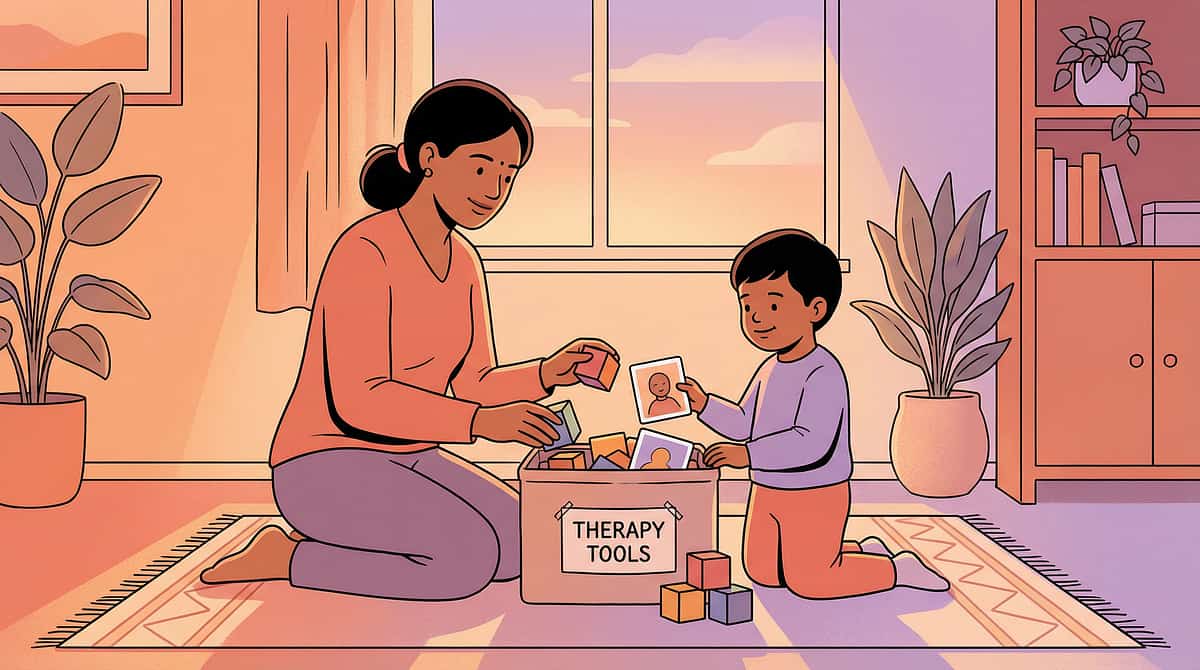
Below is a visual preview of 9 materials that help when child stomps feet therapy material. The pages shown help educators, therapists, and caregivers understand the structure and content of the resource before use. Materials should be used under appropriate professional guidance.


Link copied!
Important Notice
Educational Content Disclaimer: This content is educational. It does not replace assessment by a licensed occupational therapist. Heavy walking patterns and sensory processing differences benefit from professional evaluation to rule out motor, neurological, or orthopedic concerns. If your child's gait significantly impacts daily life, please consult a qualified professional.
Individual results may vary. Statistics represent aggregate outcomes across the Pinnacle Blooms Network. © 2025 Pinnacle Blooms Network®. All rights reserved.
Sources
SPD Foundation · Ayres, A.J. — Sensory Integration and the Child (1979, revised 2005) · Kranowitz, C.S. — The Out-of-Sync Child (1998, revised 2022) · Williams, M.S. & Shellenberger, S. — How Does Your Engine Run? The Alert Program for Self-Regulation (1996)
Sensory Solutions Series
Episode 104 of the Proprioceptive Seeking / Heavy Work Series · pinnacleblooms.org · GPT-OS® Therapeutic Intelligence
#HeavyWalking
#SensorySeeking
#ProprioceptiveInput
#HeavyWork
#OccupationalTherapy
#PinnacleBlooms