
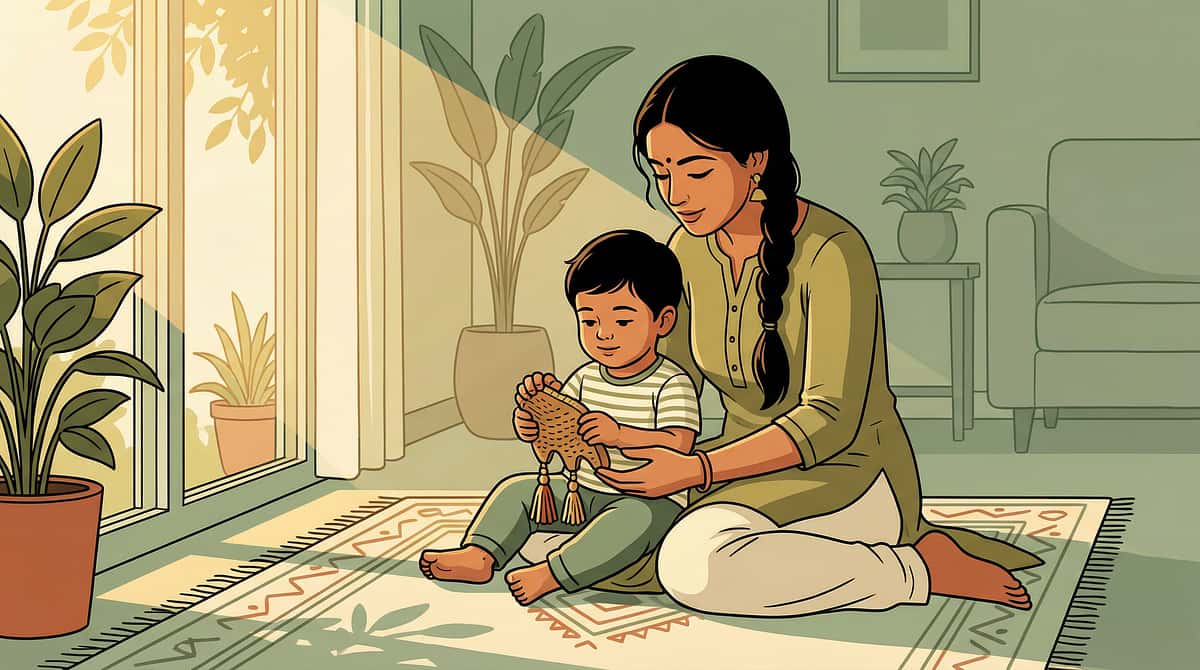
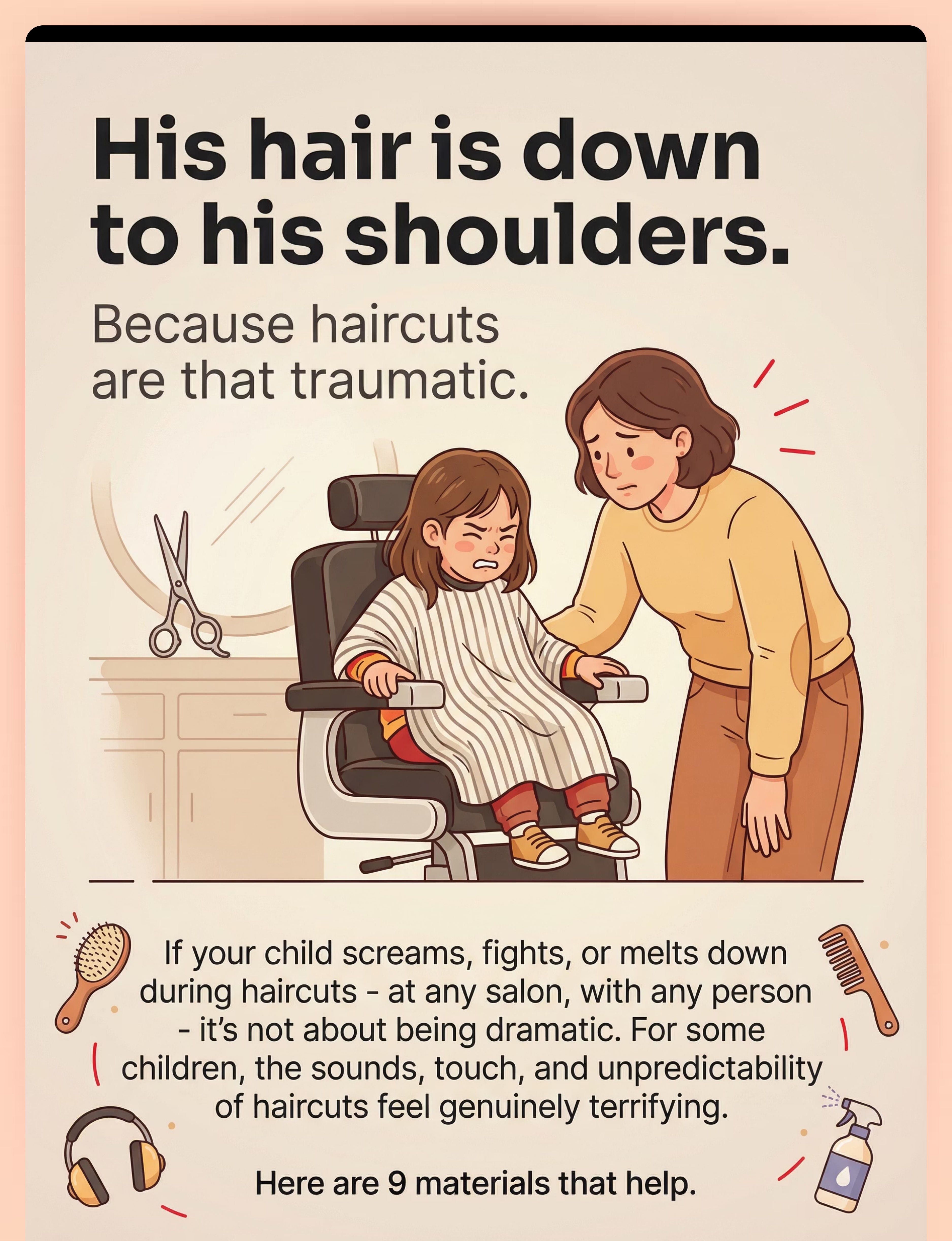
"His hair is down to his shoulders. Because haircuts are that traumatic."
You've tried three different salons. You've tried at home with children's scissors, with the TV blaring his favorite show, with your partner holding him. The moment anything comes near his head — scissors, clippers, even a comb — he screams like he's being physically hurt. His hair is past his shoulders now because you can't put him through it again. And honestly? You can't put yourself through it again either.
9 Materials That Help When Your Child Refuses Haircuts
You are not failing. Your child's nervous system is speaking. The sounds, touch, and unpredictability of haircuts are registering as genuine threat in your child's brain. This is neurology, not defiance.
🔬 Sensory Solutions Series — Episode 18
🧠 Tactile · Auditory · Visual
👶 Ages 2–12
🏠 Home or Salon
Pinnacle Blooms Consortium® — OT · SLP · ABA · SpEd · NeuroDev · CRO
You Are Not Alone — The Numbers Are Staggering
Across Pinnacle Blooms Network's 70+ centers, haircut aversion is consistently in the top 10 parent-reported daily living challenges. This is not rare. This is not your fault. And it is addressable.
80%
Sensory Difficulties
of children diagnosed with autism display sensory processing difficulties that affect daily routines including grooming.
PRISMA Systematic Review, Children (2024)
65%
Haircut Struggles
of children with sensory processing differences specifically struggle with haircuts — one of the most common grooming challenges in pediatric therapy clinics worldwide.
SPD Foundation Clinical Reports
1 in 6
Children Globally
experience developmental delays that may include sensory processing differences affecting everyday activities like haircuts.
WHO/UNICEF Developmental Monitoring Data
You are among millions of families worldwide navigating this exact challenge. Meta-analysis confirms sensory integration therapy effectively promotes social skills, adaptive behavior, and sensory processing (World J Clin Cases, 2024).
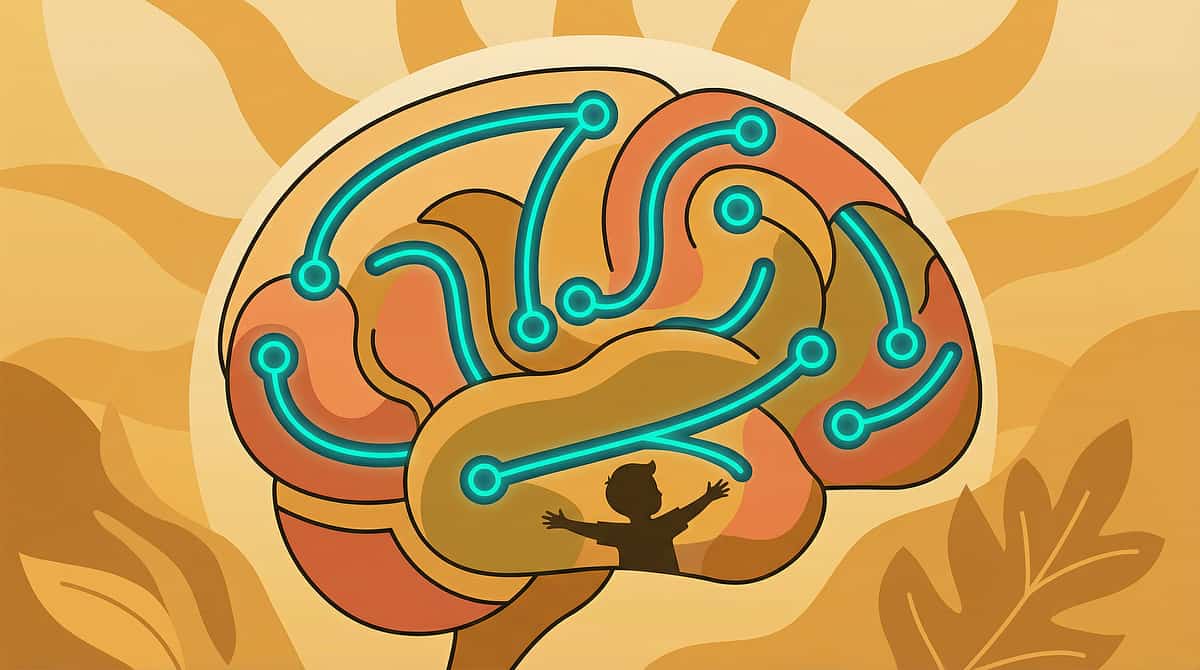
Why Haircuts Feel Like an Assault — The Neuroscience
The Scalp Problem
Your child's somatosensory cortex amplifies every sensation from the head and neck area. Light touch from scissors, falling hair fragments, and cape texture register not as "mild sensation" but as "threat." The head and neck contain among the highest density of nerve endings in the human body.
The Sound Problem
Clipper buzzing and scissor snipping are amplified in the auditory cortex. For your child, these sounds may register at perceived intensity levels far higher than what you experience — not louder in decibels, but louder in neural processing.
The Unpredictability Problem
The amygdala — the brain's threat detector — fires when it cannot predict what's coming next. "When will the scissors touch? Where will the next cut happen? When does this end?" Each unknown escalates the threat response significantly.
The Combination Problem
Haircuts are a perfect storm — simultaneous tactile, auditory, visual, and proprioceptive input, all unpredictable, all in a sensitive body zone, all while being required to sit still. This isn't one challenge. It's four, layered on top of each other.
"This is a wiring difference, not a behavior choice. Your child is not being dramatic. Their brain is processing a genuine threat."
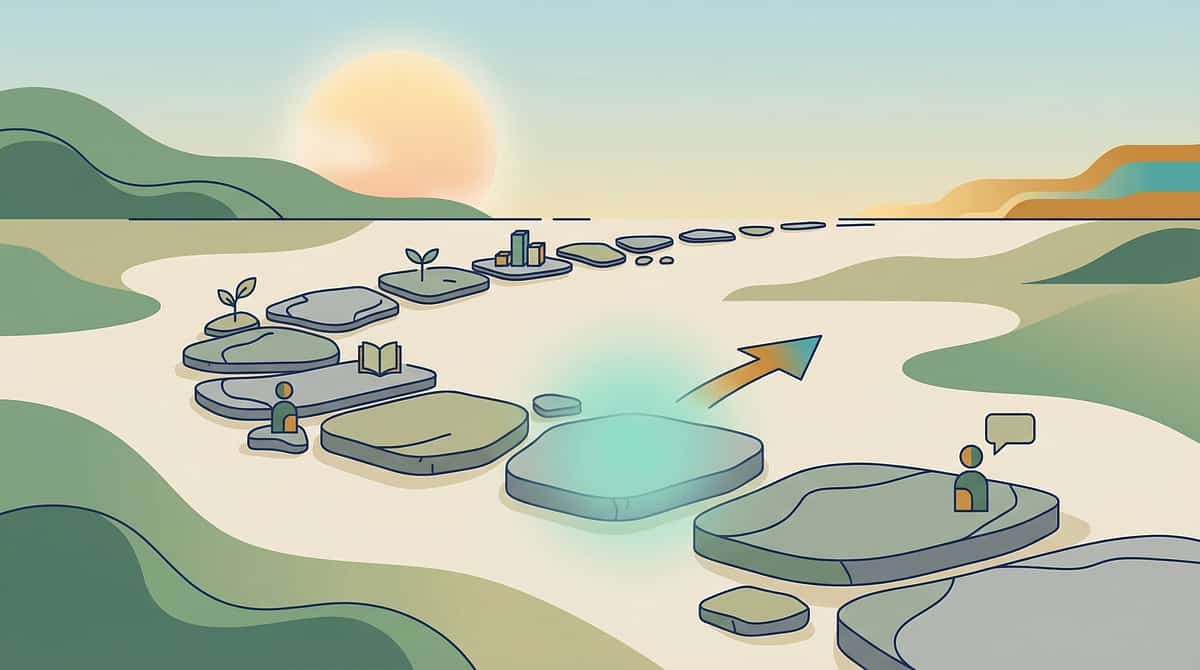
Where Haircut Aversion Sits in Your Child's Development
Understanding the developmental timeline helps you know exactly where your child is — and where they're heading. Every technique on this page moves your child forward on this timeline, at their pace, with their nervous system's cooperation.
Haircut aversion commonly co-occurs with sensitivity to nail cutting, hair brushing resistance, bath time distress, sound sensitivity, and overwhelm in busy environments. Your child's journey through this timeline is supported by every strategy introduced on this page.
A-019
Won't Let You Cut Nails
A-020
Hates Having Hair Brushed
A-021
Bath Time Meltdowns
A-036
Covers Ears at Everyday Sounds
A-048
Overwhelmed in Busy Environments

The Evidence Behind This Technique
This is not anecdote or conjecture. The 9-material haircut protocol is grounded in systematic, peer-reviewed science — validated across thousands of clinical sessions and rigorously cross-referenced by an interdisciplinary consortium.
Level I–II Evidence
Systematic Reviews + Randomized Controlled Trials
16 studies (2013–2023) evaluated in PRISMA systematic review confirm sensory integration intervention as evidence-based practice for children with ASD — including multi-sensory desensitization approaches directly applicable to haircut tolerance.
Key Finding: Sensory integration therapy effectively improves adaptive behavior, sensory processing, and participation in daily living activities including grooming routines.
Supporting Evidence
Indian Evidence: Home-based sensory interventions demonstrated significant outcomes in Indian pediatric populations (Padmanabha et al., Indian Journal of Pediatrics, 2019) — validating that parent-administered sensory strategies produce measurable results.
NCAEP Classification: Sensory integration and visual supports — both core components of this technique — are classified as evidence-based practices by the National Clearinghouse on Autism Evidence and Practice (2020).
References: PMC11506176 · PMC10955541 · DOI: 10.12998/wjcc.v12.i7.1260 · NCAEP (2020)
"Clinically validated. Home-applicable. Parent-proven across 20M+ therapy sessions at Pinnacle Blooms Network."
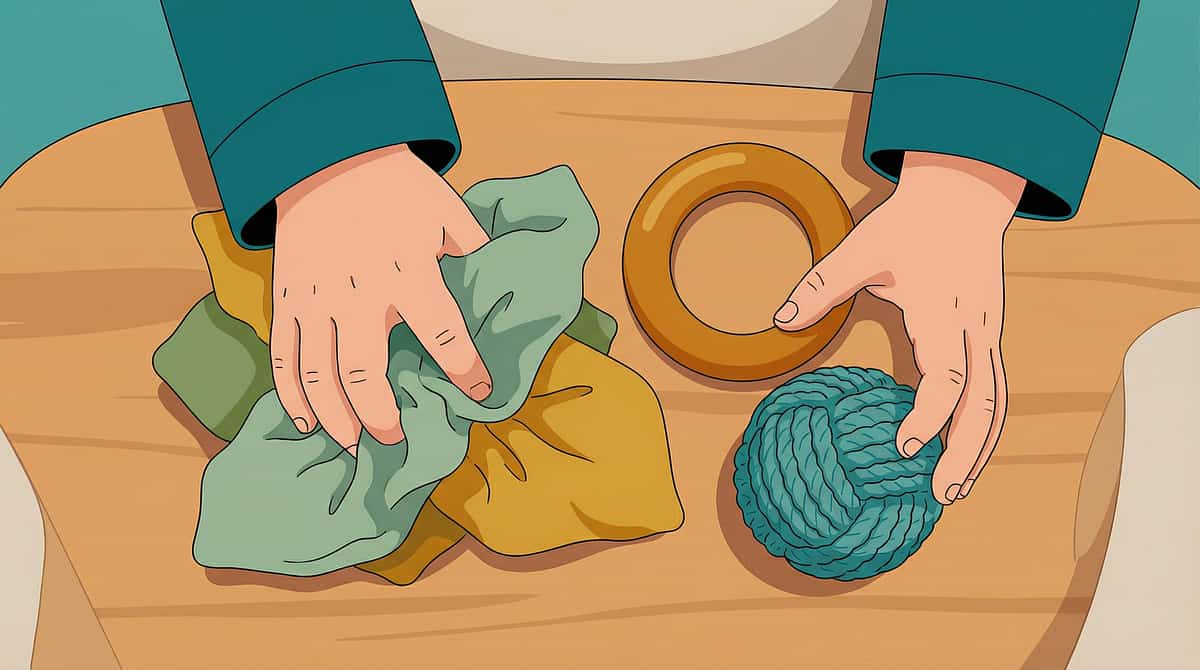
The Technique — What It Is
A-018 · Domain A · Sensory Processing
Multi-Sensory Desensitization Through Material Supports for Haircut Tolerance
Parent-Friendly Alias: "The 9-Material Haircut Survival Kit"
A systematic sensory regulation approach that uses 9 specific therapeutic materials — each targeting a different sensory trigger of haircut distress — to gradually transform haircuts from an overwhelming, multi-sensory assault into a manageable, predictable, and ultimately tolerable experience. This technique does not force compliance. It removes triggers one by one until the child's nervous system can cope with what remains.
Domain
Sensory Processing — Tactile, Auditory, Visual
Age Range
2–12 years
Setting
Home or Salon
Setup Time
30 min initial; 15–45 min per haircut
Frequency
Every haircut + daily desensitization practice between cuts
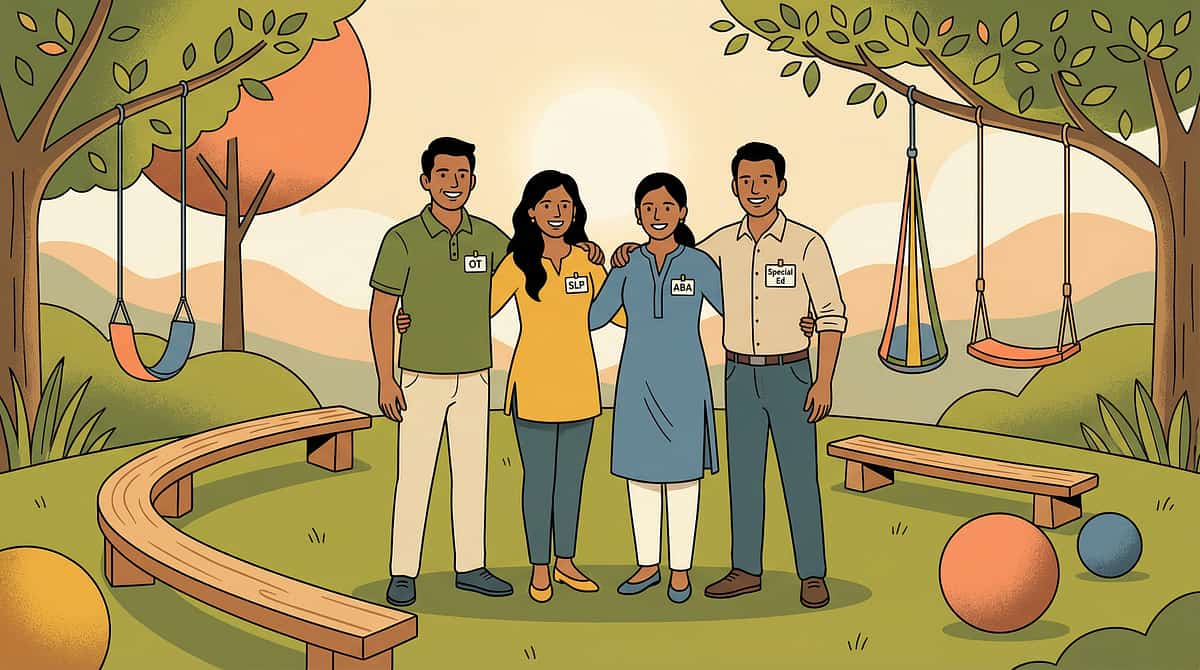
This Technique Crosses Therapy Boundaries
Because the brain doesn't organize by therapy type. Haircut aversion touches sensory processing, communication, behavior, and daily living skills simultaneously — which is why the most effective interventions draw from multiple disciplines at once.
Occupational Therapy (Lead)
OTs design the sensory diet, select materials, establish the desensitization hierarchy, and monitor sensory processing changes. The core science of "which material targets which sensory trigger" is OT domain expertise.
Speech-Language Pathology
SLPs contribute social story scripting, visual sequence design, and communication supports. For non-verbal children, SLPs develop AAC-based requests like "break please" or "all done" during haircuts.
Applied Behavior Analysis
BCBAs design the desensitization hierarchy, reinforcement schedule, First-Then board protocol, and systematic data collection. Gradual exposure methodology — from tolerating the chair, to the cape, to sounds, to scissors — is ABA's systematic desensitization framework.
NeuroDevelopmental Pediatrics
NeuroDev physicians rule out medical contributors (ear sensitivity, scalp conditions) and clear children for specific sensory approaches when medical history warrants caution.
Special educators (SpEd) also integrate haircut preparation into daily living skills curriculum and help generalize social story comprehension across settings.
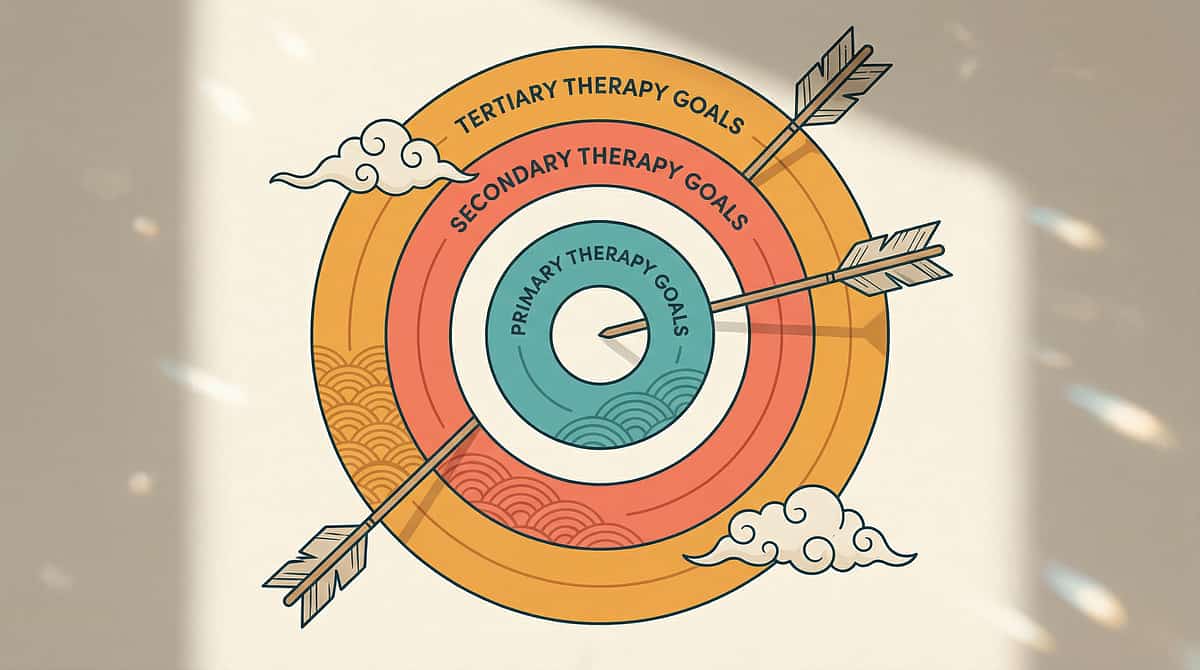
Precision Targets — This Is Not a Random Activity
Each material in the 9-item toolkit is strategically aimed at a specific, observable, measurable outcome. Understanding the target hierarchy helps you prioritize and track what's actually changing in your child's nervous system.
Meta-analysis (World J Clin Cases, 2024) confirms sensory integration therapy effectively promotes social skills (primary target), adaptive behavior (secondary), sensory processing, and motor skills (tertiary) across 24 studies. Every technique in this protocol has a measurable destination — and data collection (Card 20) shows you when you arrive.
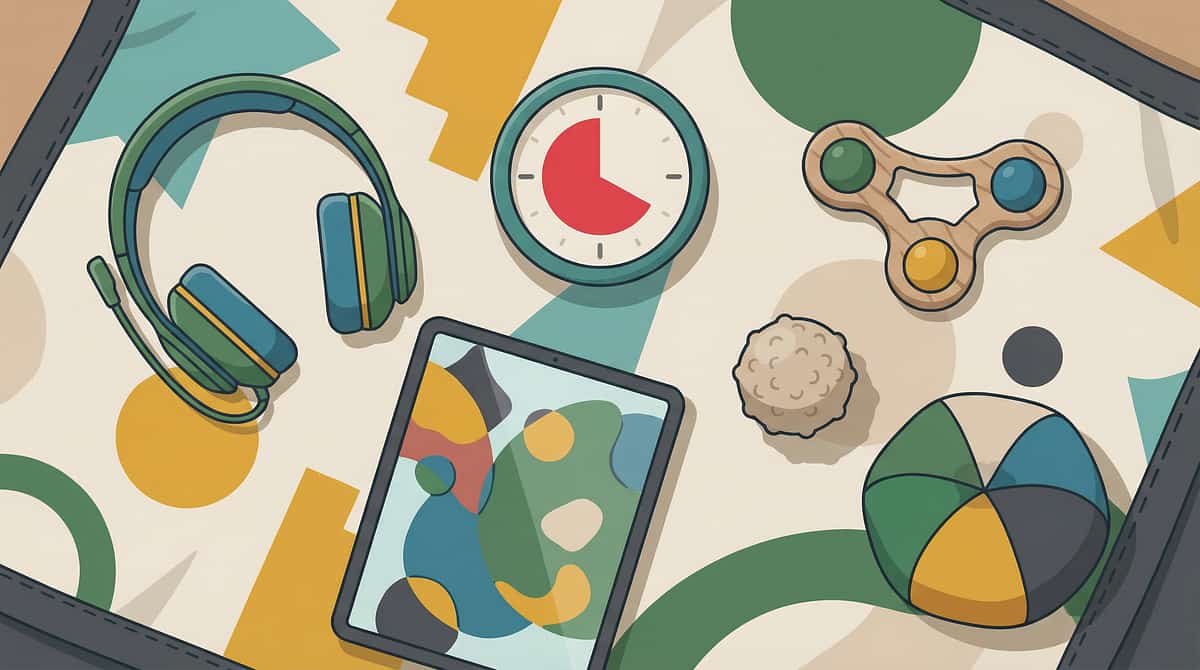
Your Haircut Toolkit — 9 Materials, Each Targeting a Different Trigger
Start with Materials 1, 4, and 5 (headphones + visual timer + tablet) — these three alone address the most common triggers and are the highest-impact entry point for most families.
# | Material | Sensory Target | Price Range | Canon Category | |
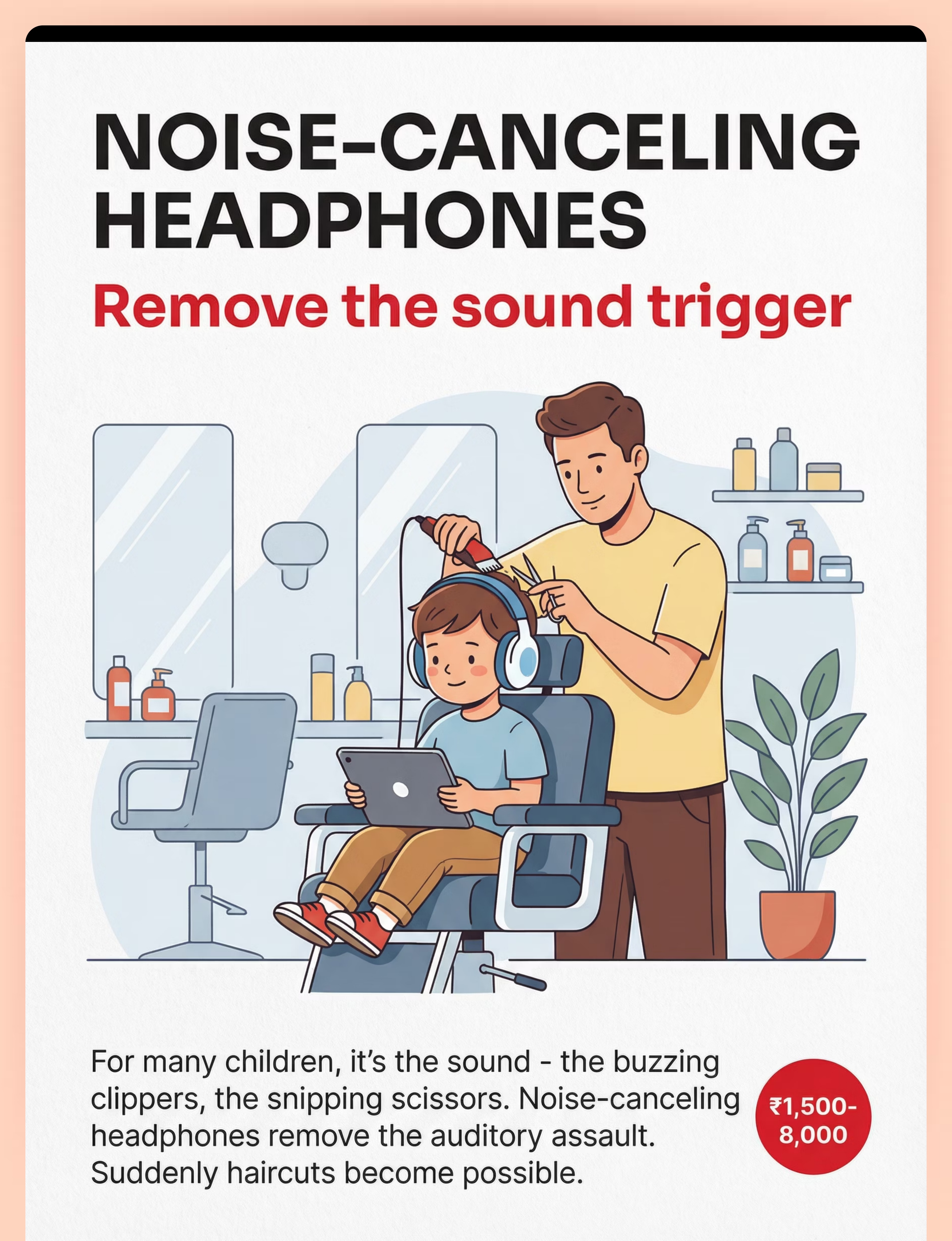
1 | Noise-Canceling Headphones (child-sized) | Auditory — removes clipper/scissor sounds | ₹1,500–8,000 | Sensory Regulation Tools | |
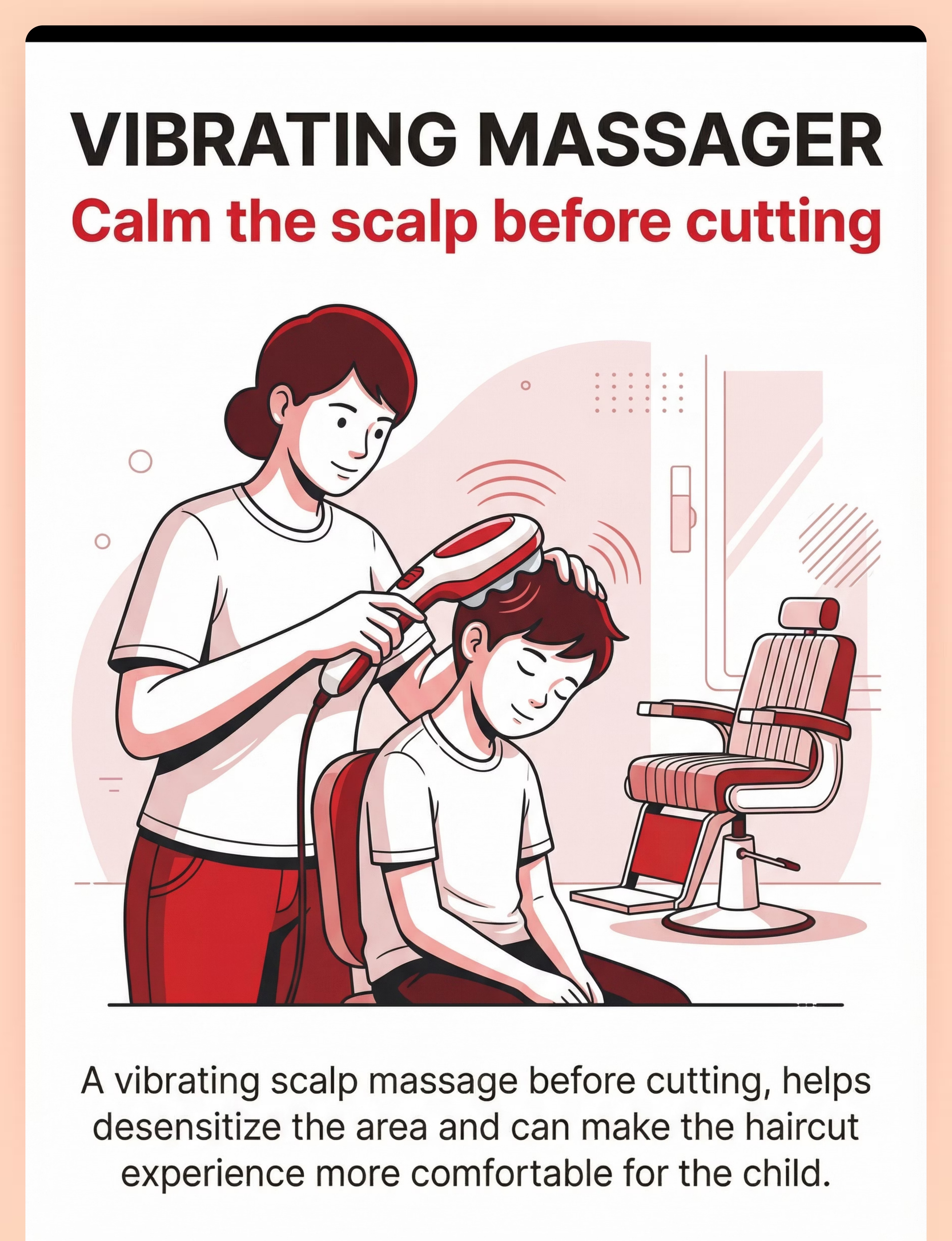
2 | Vibrating Massage Tool (handheld) | Tactile — desensitizes scalp before cutting | ₹500–2,000 | Vibrating Sensory Tools | |
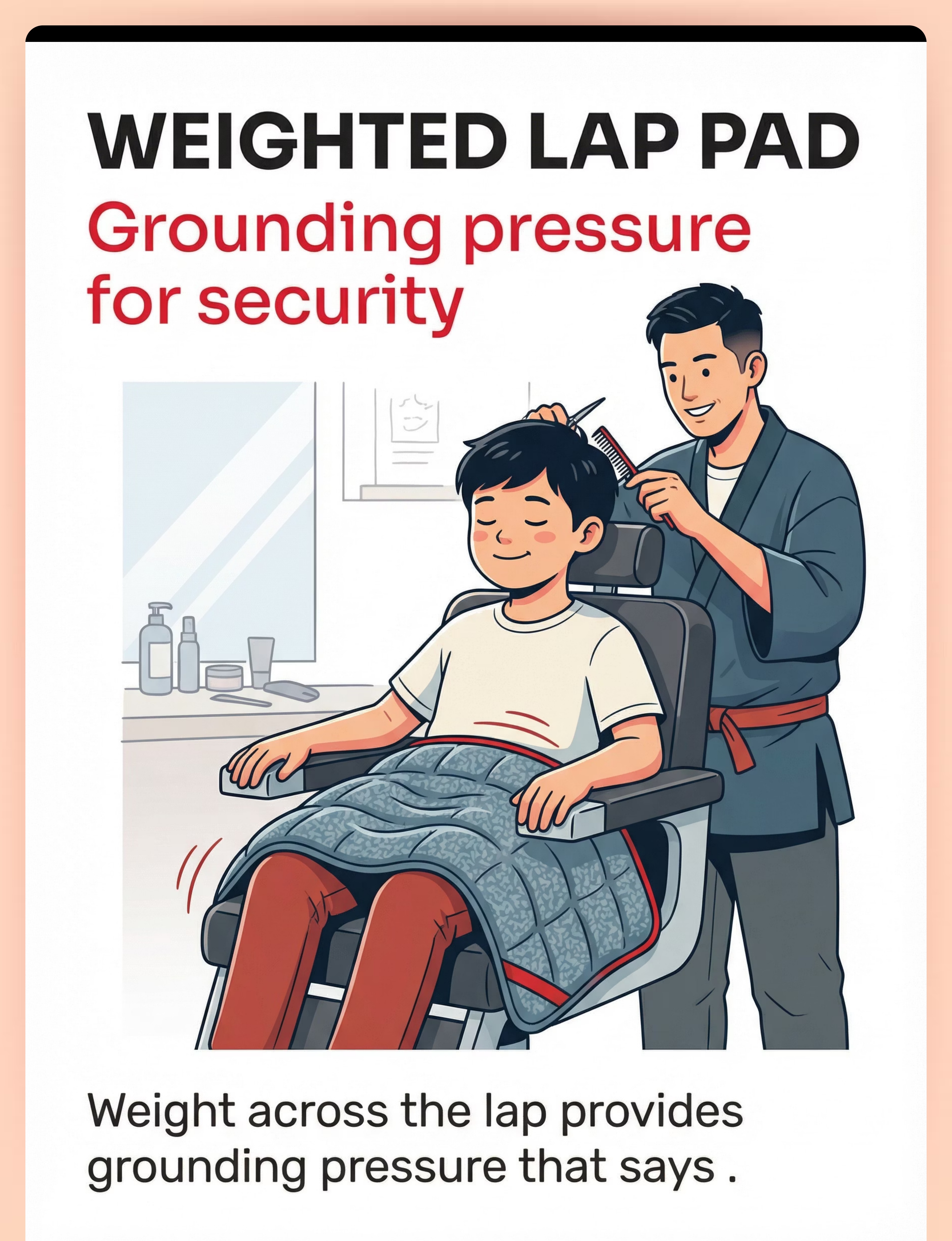
3 | Weighted Lap Pad (2–5 lbs) | Proprioceptive — grounding pressure for security | ₹800–3,000 | Weighted Blanket/Lap Pad | |
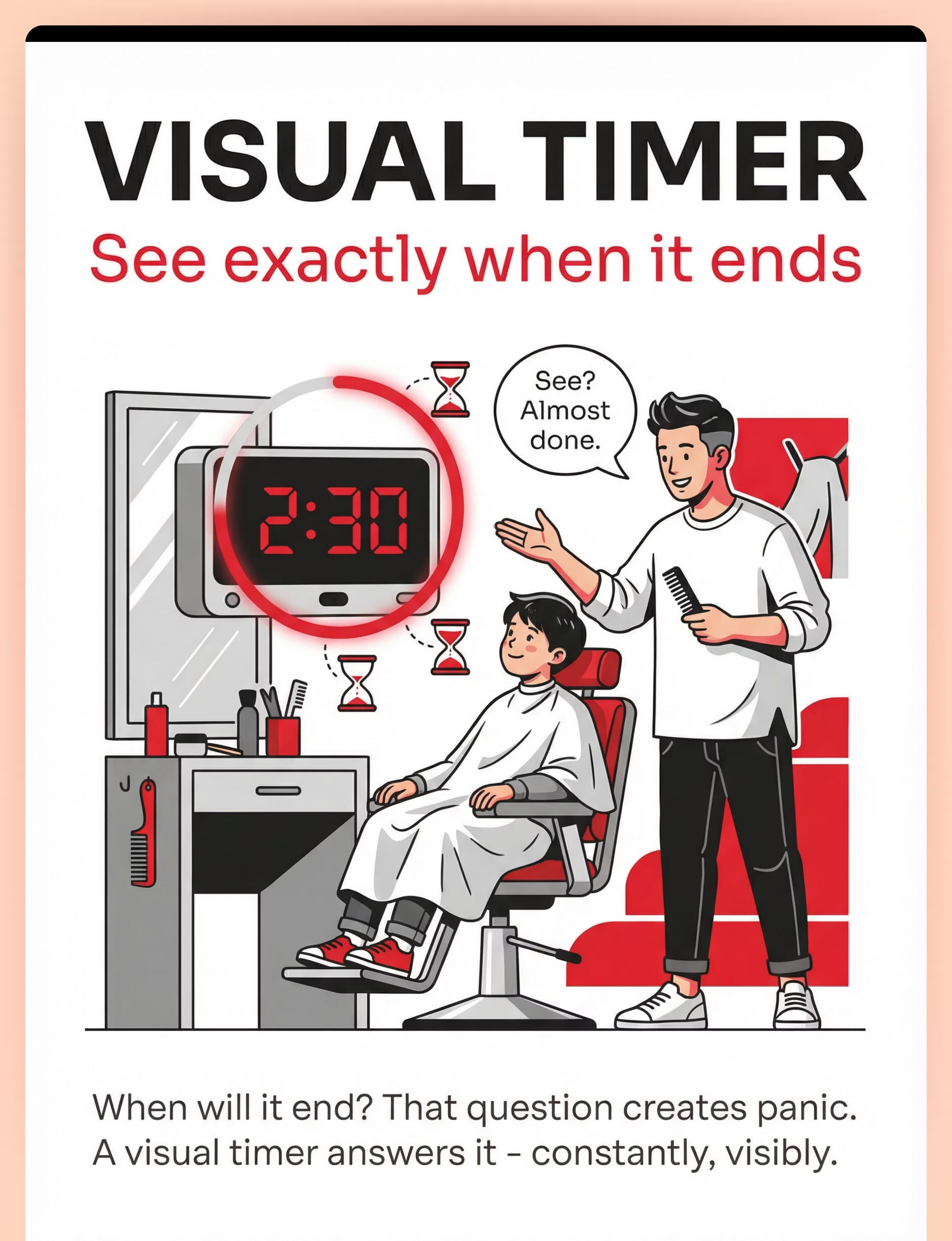
4 | Visual Timer (sand or digital) | Predictability — shows exactly when it ends | ₹200–800 | Visual Supports | |
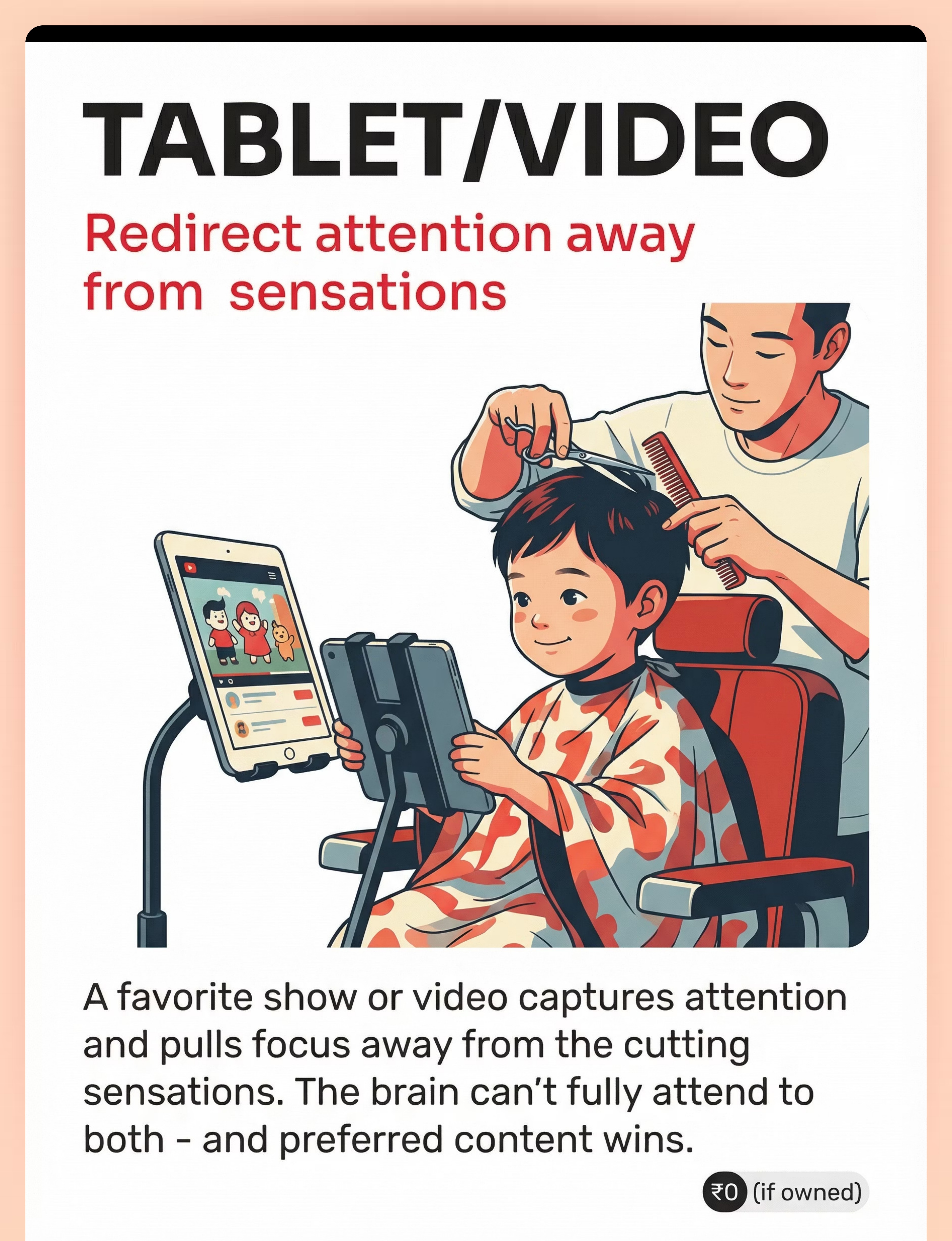
5 | Tablet/Video (downloaded content) | Attention — redirects focus from sensations | ₹0 (if owned) | Distraction/Engagement | |
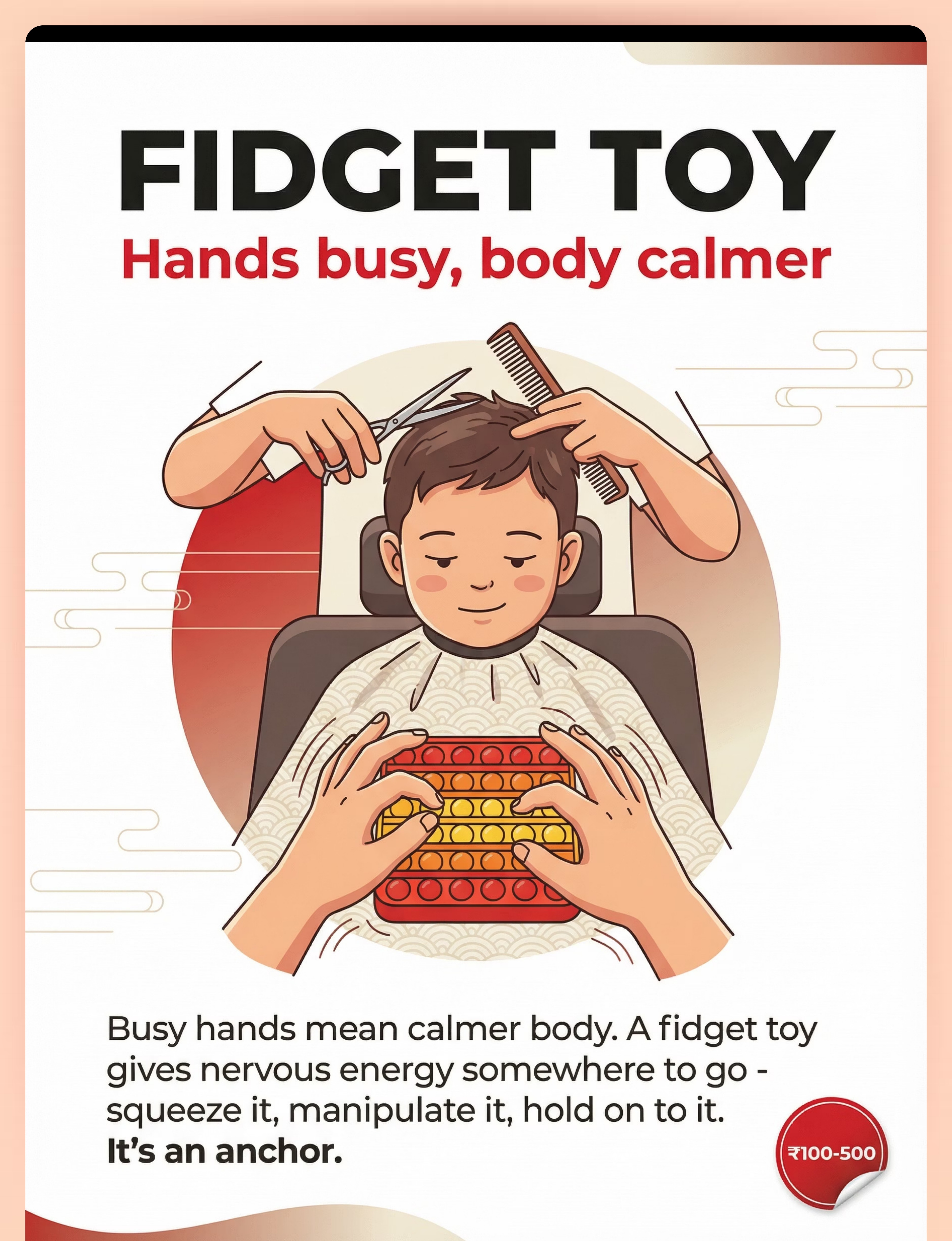
6 | Fidget Toy (stress ball, pop-it, tangle) | Motor — busy hands, calmer body | ₹100–500 | Fidget Tool Set | |
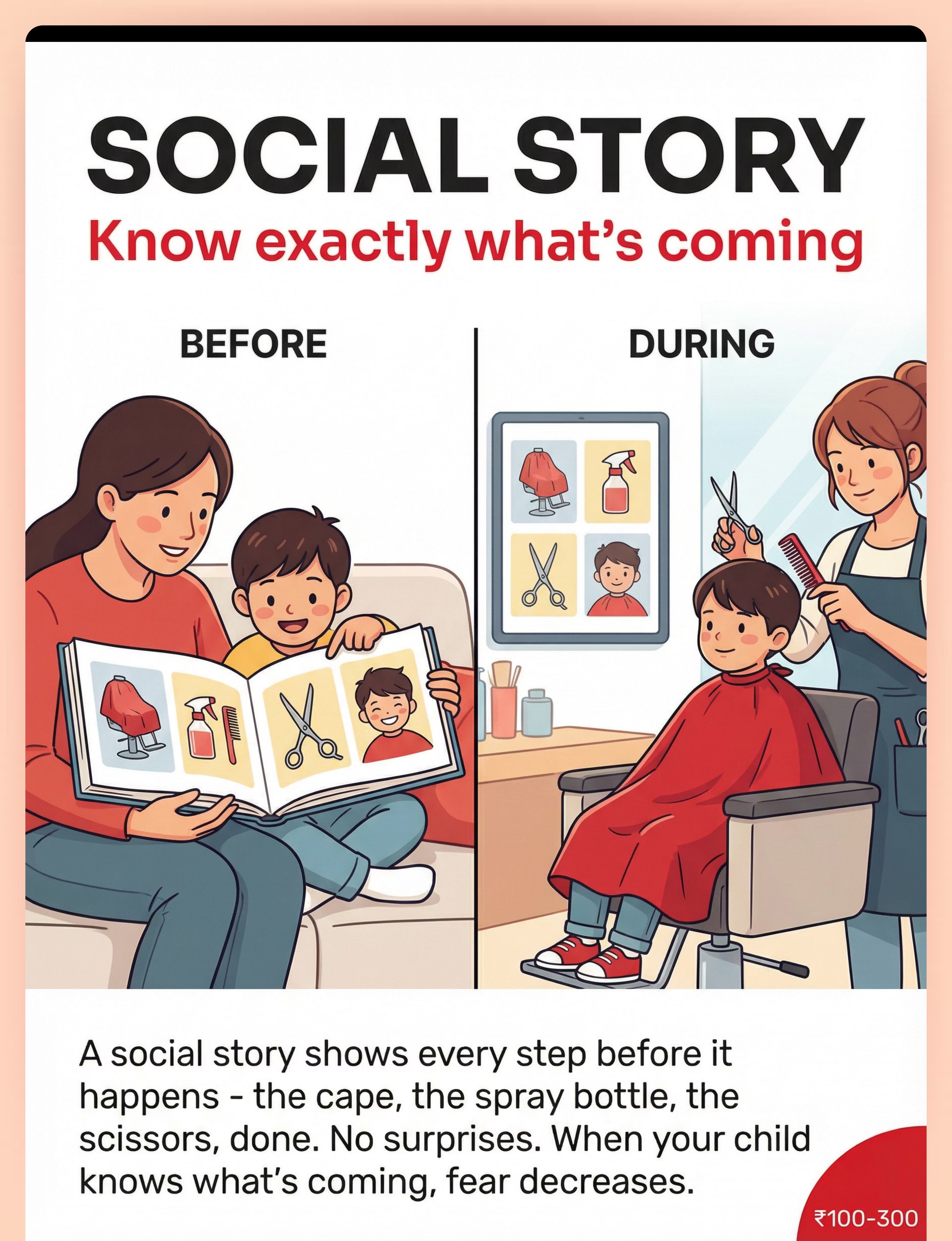
7 | Social Story (haircut-specific visual sequence) | Cognitive — eliminates fear of unknown | ₹100–300 | Visual Supports | |
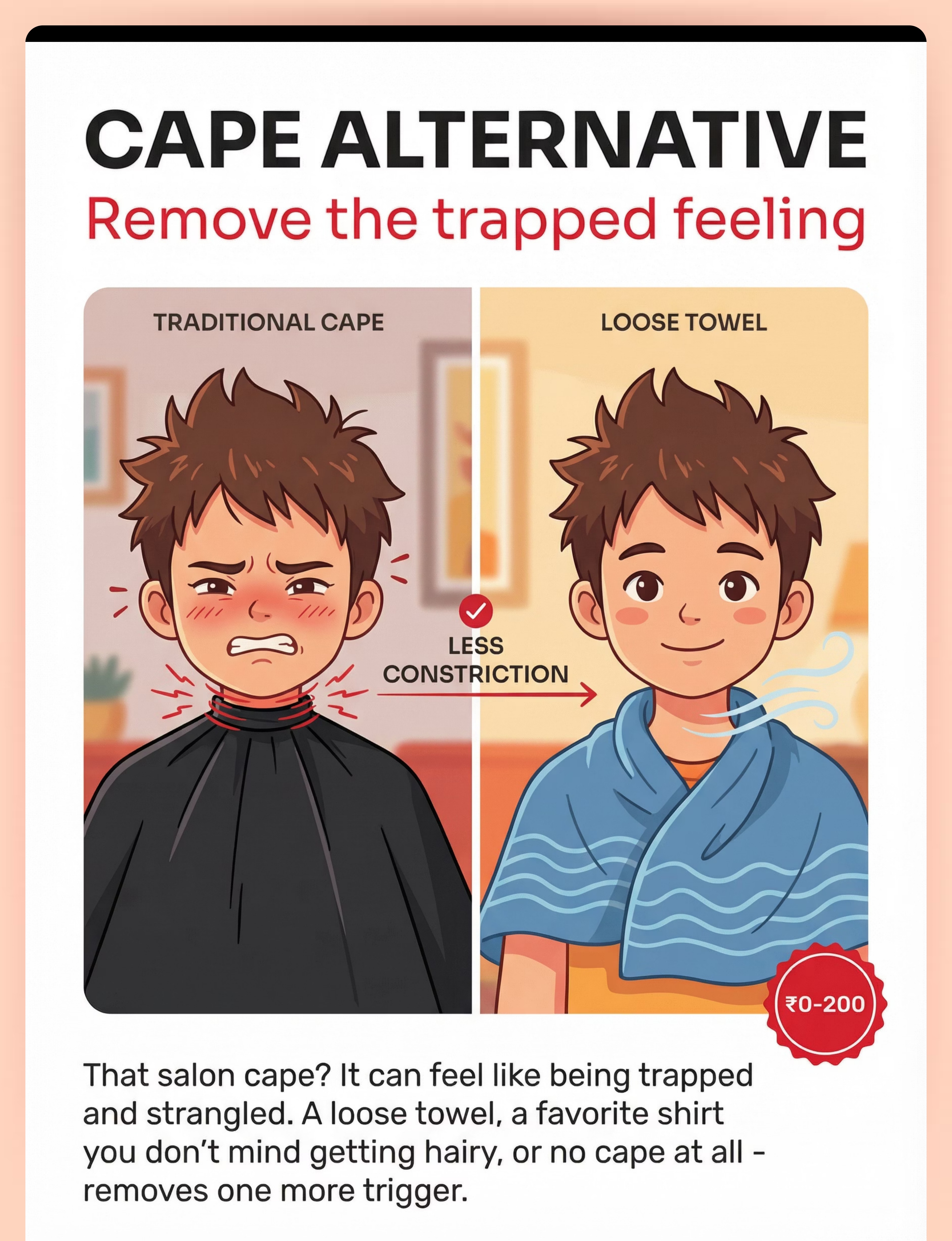
8 | Cape Alternative (loose towel or modified cover) | Tactile — removes trapped/constricted feeling | ₹0–200 | Adapted Grooming Tools | |
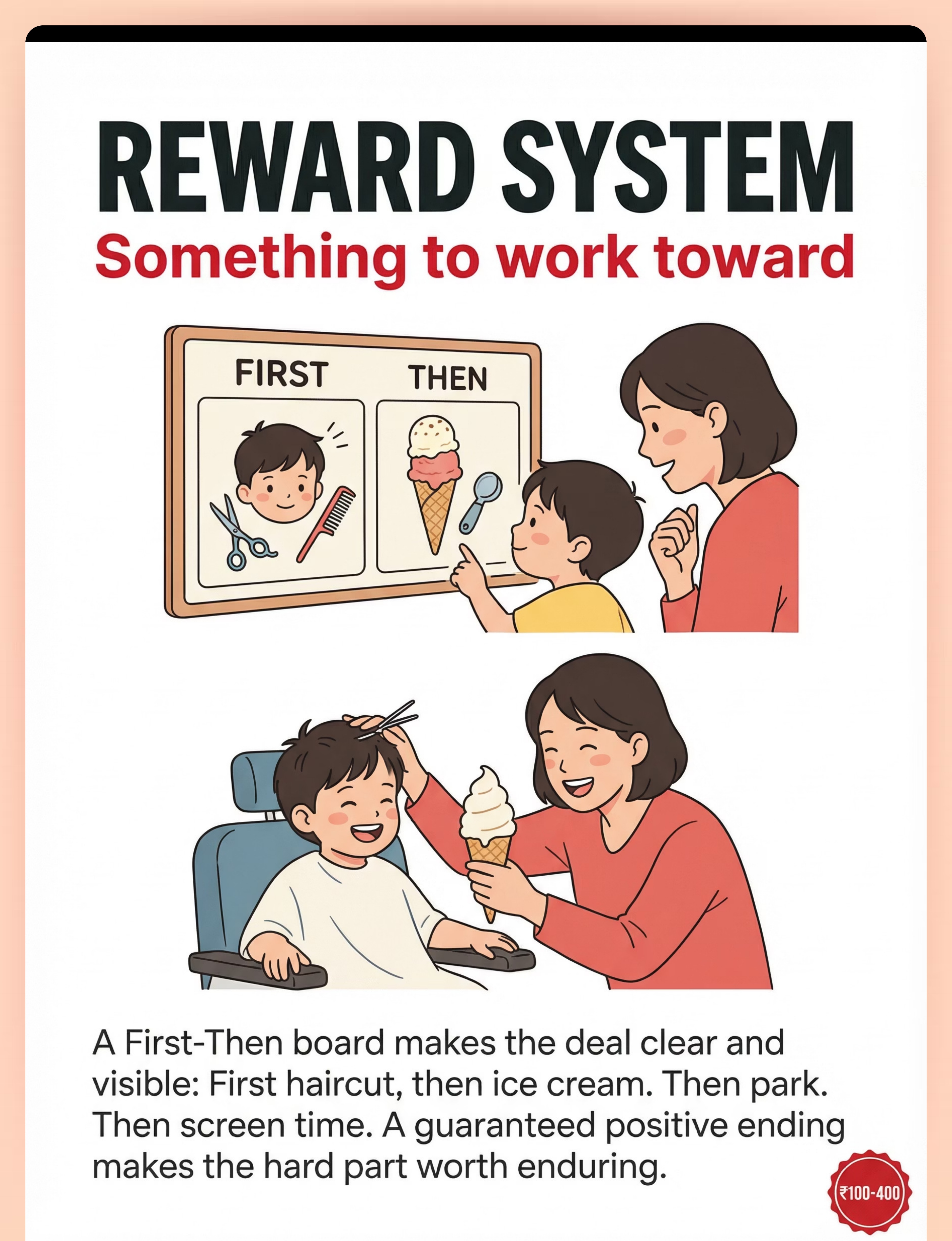
9 | Reward System / First-Then Board | Motivation — something to work toward | ₹100–400 | Reinforcement Menus |
Total Investment
Comprehensive toolkit: ₹3,000–15,000
Essential starters (Materials 1, 4, 5): ₹1,700–8,800
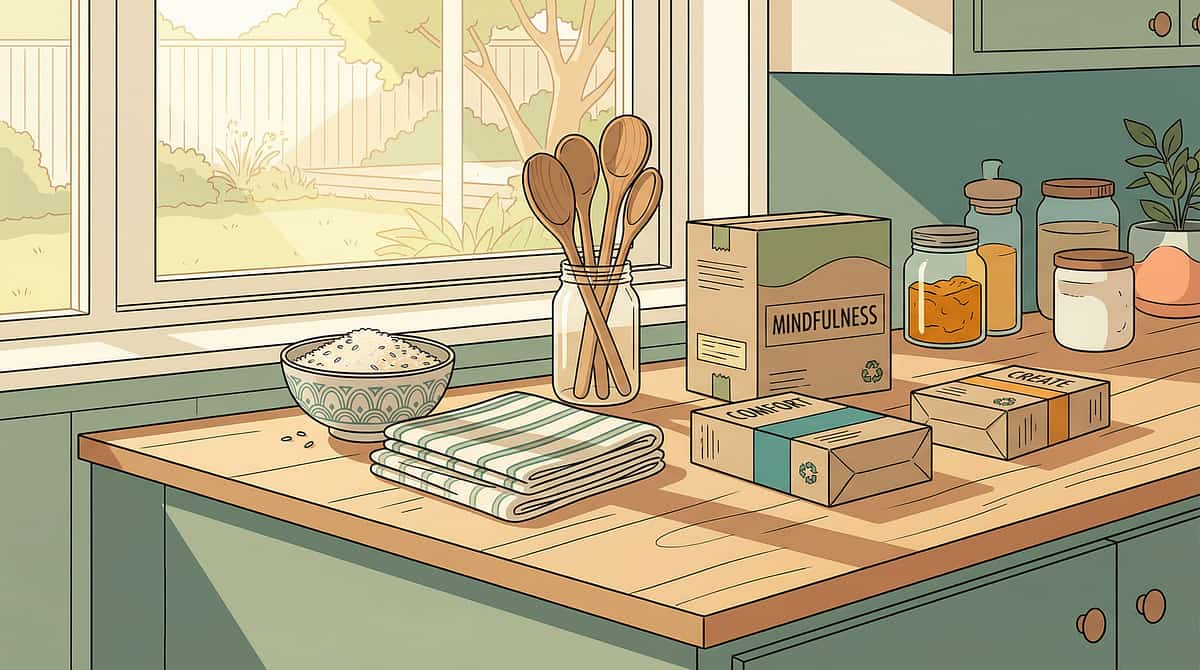
No Budget? No Amazon? Start Today With Household Items
Every material on this list has a household substitute that uses the same sensory or behavioral principle. The WHO Nurturing Care Framework explicitly emphasizes equity-focused, context-specific interventions. You do not need to buy anything to start helping your child today.
Buy This
Noise-canceling headphones → Construction ear muffs + phone with music through regular earbuds
Vibrating massage tool → Electric toothbrush (clean) on scalp or firm fingertip scalp massage
Weighted lap pad → Pillowcase filled with 1–2 kg of rice or dried beans
Visual timer → Sand timer (₹50) or phone countdown with large display
Make This (₹0 DIY)
Tablet/video → Any phone or device with downloaded favorite content
Fidget toy → Balloon filled with flour/rice, playdough, or rubber band ball
Social story → Photos of your actual salon + tools printed or drawn on paper
Cape alternative → Child's favorite large towel draped loosely, or old t-shirt
First-Then board → Paper with "FIRST: haircut picture → THEN: reward picture"
When clinical-grade IS necessary: For children with severe auditory hypersensitivity, clinical-grade noise-canceling headphones may be the only effective option — construction ear muffs may not provide sufficient decibel reduction. Consult your OT if DIY alternatives are insufficient.

⚠️ Safety Gate — Read This Before Any Haircut Attempt
Before any session begins — whether using commercial or DIY materials — review this safety checklist. Proceeding without checking these conditions can cause harm and make future haircuts harder, not easier.
🔴 DO NOT PROCEED IF:
- Child has an active ear infection or ear pain (headphones will cause distress, not relief)
- Child has an active scalp condition — eczema, psoriasis, open wounds, or severe sensitivity (consult dermatologist first)
- Child is already in a dysregulated state — post-meltdown, ill, hungry, overtired (postpone)
- Child has seizure history — vibrating tools require medical clearance before use
- You are rushed — if you cannot honor the timer and the child's pace, wait for a better day
🟡 MODIFY IF:
- Child tolerates some tools but not others — use only tolerated supports, skip the rest
- Child only tolerates one specific person — respect this and don't force with an unfamiliar person
- Previous haircut was traumatic (within past 2 weeks) — start with desensitization play only, not an actual haircut
🟢 PROCEED WHEN:
- Child is fed, rested, and in a reasonably regulated state
- All selected materials are charged, prepared, and within reach
- Timer is set and you are committed to honoring it — when time ends, cutting stops, even if unfinished
- Reward is confirmed and ready for immediate delivery after haircut
- Environment is controlled (quiet time, low traffic, familiar space preferred)
ABSOLUTE RED LINE: STOP immediately if child shows signs of genuine panic, breathing becomes irregular, child begins self-injurious behavior, or distress escalates beyond what supports can manage. Pause. Try another day. Session abandonment is not failure — it is clinical judgment.
Never restrain a child for haircuts. Desensitization should always be child-paced. Restraint creates trauma that makes future haircuts exponentially harder. If your child cannot currently tolerate any cutting, start with desensitization practice — not the actual haircut.
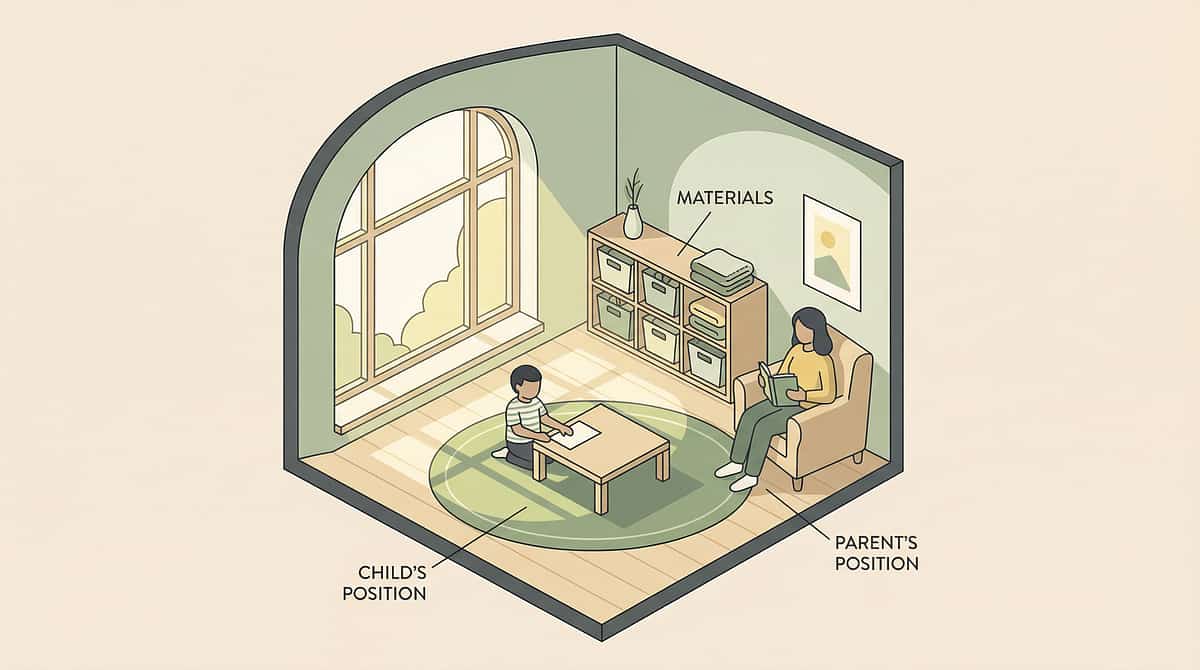
Set Up Your Haircut Station — Position Matters
Thoughtful environmental setup is a core principle of sensory integration theory, and meta-analysis confirms 1:1 sessions in structured environments produce the best outcomes. Spend 10 minutes preparing the space — it saves 30 minutes of dysregulation.
🏠 Cutting at Home — Position Guide
- Chair position: Against wall, facing away from mirror (if mirror triggers distress), at comfortable height
- Tablet/screen: Mounted at child's eye level, 30–40 cm from face
- Timer: Visible to child — on counter or attached to mirror
- Materials station: All 9 materials within parent's arm reach but NOT visible to child (reduces anticipatory overwhelm)
- Cutting tools: OUT OF SIGHT until needed — do not display scissors/clippers before starting
- Reward: Visible to child but not reachable — reinforces the "then" in First-Then
- Floor covering: Old sheet or newspaper — hair fragments on skin are a secondary trigger
- Lighting: Bright enough to cut safely — use warm lighting, avoid harsh overhead fluorescent
✂️ Going to the Salon
- Call ahead: request first appointment of the day (quietest), corner chair, permission for headphones and tablet, flexible timing
- Bring ALL support materials in a pre-packed "haircut bag" — packed the night before
- Arrive 10 minutes early for setup and social story review
- Introduce barber/stylist to the support plan before child enters
❌ What to Remove
- Other children present (comparison/distraction)
- Background TV or loud music (unless it's child's chosen content)
- Strong smells (bring your own unscented spray if needed)
- Rush — remove time pressure entirely. This takes as long as it takes.
Pre-Haircut Readiness Check — 60 Seconds
The best haircut session is one that starts right. A good 3-minute haircut with supports is worth infinitely more than a forced 15-minute haircut with tears. Run through this checklist every single time — it takes less than a minute and changes everything.
1
Child has eaten within the past 2 hours (not hungry)
2
Child has slept adequately (not overtired)
3
No meltdown or major distress episode in the past 2 hours
4
Child is not currently ill or in pain
5
Social story has been reviewed today (morning of haircut)
6
First-Then reward is confirmed — child knows and is motivated by it
7
All support materials are charged, prepared, and within reach
✅ All 7 green
GO — proceed with full protocol
🟡 5–6 green
MODIFY — shortened session, highest-impact supports only
❌ 4 or fewer
POSTPONE — do desensitization practice today, not cutting
Step 1: The Invitation
Step 1 of 6
⏱ 2–5 minutes
"Hey [child's name], remember our haircut plan? Let's look at our picture story first... and remember, FIRST haircut, THEN [reward]. Ready to sit in the chair? You've got your [fidget/headphones/tablet] ready."
Body Language That Helps
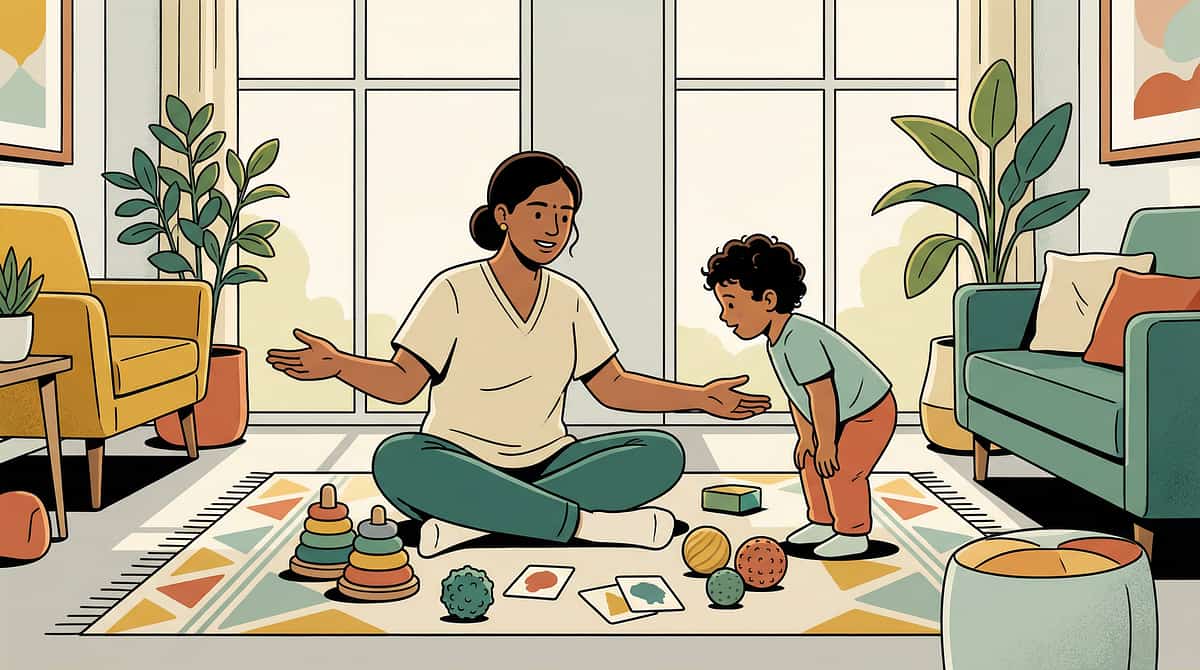
- Sit at child's level, not standing over them
- Voice: calm, slow, warm — NOT falsely cheerful
- Do NOT say "it won't hurt" — say "I'll be right here the whole time"
- Offer the chair, don't place the child in it
Acceptance Cues — Proceed
Child walks to chair voluntarily, reaches for headphones/fidget, references the reward, makes eye contact with you or the timer.
Resistance Cues + Modification
If child backs away, hides, or says "no": Do NOT force. Say: "That's okay. Want to just sit in the chair with your headphones on? No cutting yet. Just sitting."
Build tolerance to the environment first. If even sitting is refused, pivot to desensitization play — let child cut a doll's hair with safe scissors — and try the actual haircut another day.
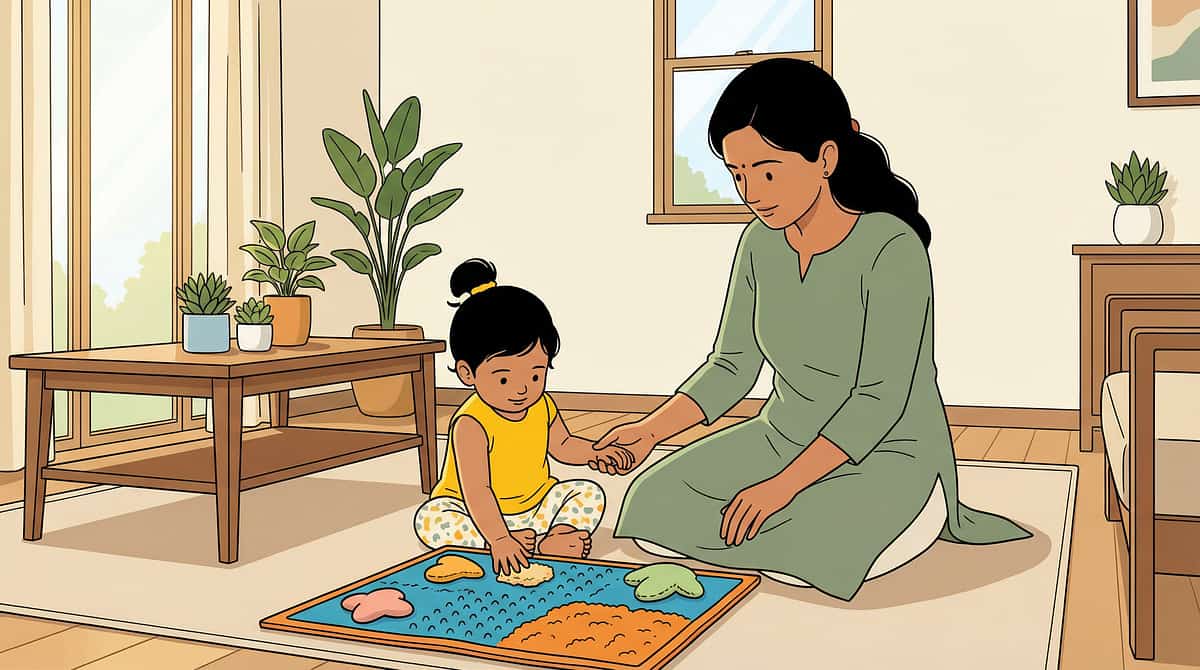
Step 2: Deploy All Supports Before Cutting Begins
Step 2 of 6
⏱ 3–5 minutes
Key Principle: All supports are deployed BEFORE any cutting tool appears. The child should be maximally regulated before the first snip. Do NOT start cutting and then scramble to add supports.
✅ Engagement
Watching tablet, manipulating fidget, body posture relaxed → proceed to Step 3
⚠️ Tolerance
Sitting but tense, not fully engaging with supports → proceed slowly, check in verbally
🔴 Avoidance
Trying to remove headphones, pushing away pad, looking for exit → pause, re-offer supports, consider whether to proceed
Don't rush this step. 3–5 minutes of thorough setup prevents a bad session. Good setup is the intervention.
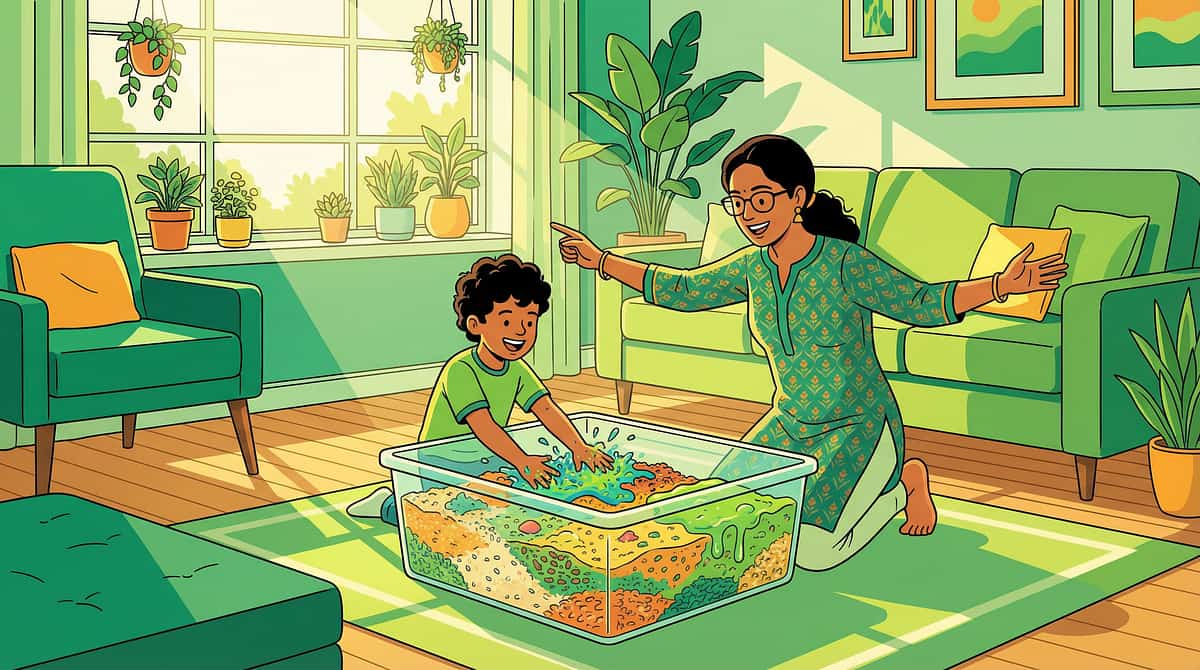
Step 3: The Therapeutic Action — Begin Cutting
Step 3 of 6
⏱ 5–20 minutes (timer-governed)
"Okay [name], starting the timer now. You can see it — [X] minutes. I'm starting."
Execution Protocol
- Start with the LEAST sensitive area (usually back of head, not near ears or forehead)
- Use SLOW, predictable strokes — no sudden movements
- Scissors first if child tolerates them better than clippers (most do)
- Periodically brush away hair fragments — falling hair on skin is a secondary trigger many parents miss
- Speak minimally: "almost done," "timer says X minutes left," "you're doing great"
- Do NOT chat with barber/other adults — your calm, focused presence is a support
❌ Common Execution Errors
- Starting with the top of the head (most sensitive area)
- Cutting near ears first (auditory + tactile overwhelm zone)
- Talking too much — adds cognitive load during cutting
- Ignoring the timer — if timer says 5 minutes, STOP at 5 minutes even if the haircut looks uneven
Child Response Spectrum
Ideal: Engaged with tablet/fidget, minimal awareness of cutting
Acceptable: Some tension, occasional flinching, but remains seated
Concerning: Escalating distress despite supports → pause, assess, consider stopping
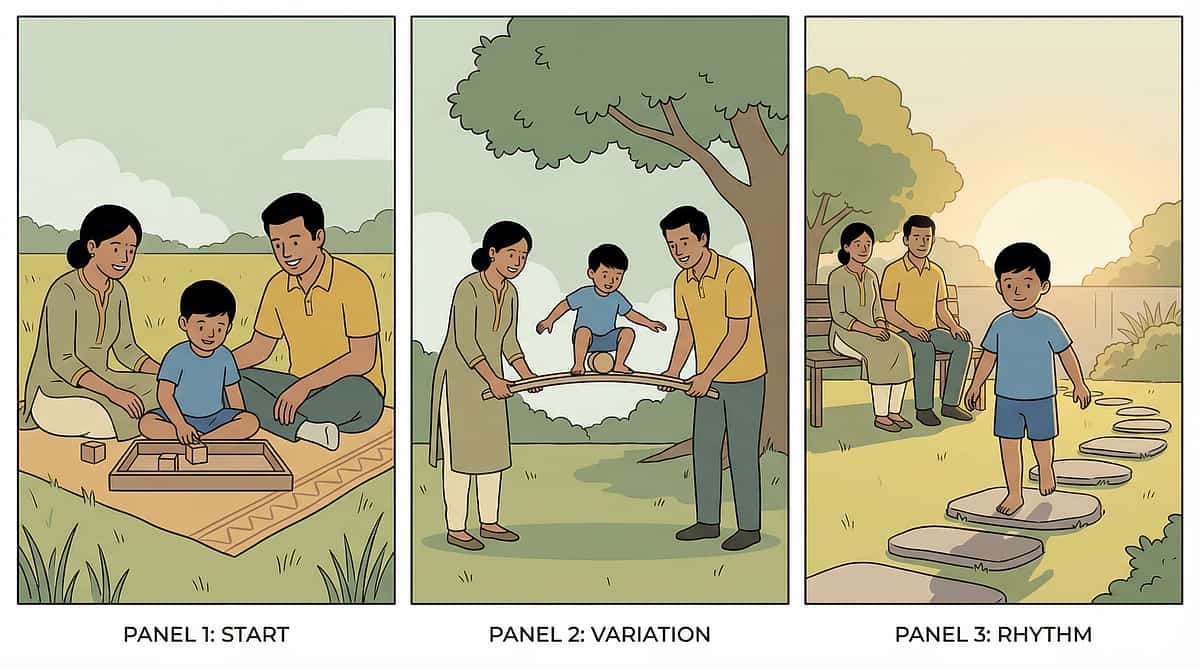
Step 4: Timed Sections With Breaks
Step 4 of 6
For children who need sectioned approach
If the timer ends and the haircut isn't complete: "Timer's done! Great job. Let's take a break." Remove cape alternative, brush off all hair fragments, give a 5–10 minute break, then re-deploy all supports and resume with a shorter or equal timer.
1
Section 1
Back of head only
⏱ 5 min → Break
2
Section 2
Left side
⏱ 3 min → Break
3
Section 3
Right side
⏱ 3 min → Break
4
Section 4
Top / fringe
⏱ 3 min → Done ✅
"3 good sections > 1 forced marathon. If after 2 sections the child's distress is escalating despite breaks, STOP. An uneven haircut is fine. You can finish another day. The goal is not a perfect haircut — the goal is building tolerance."
For children who CAN tolerate a full session: Do NOT artificially create breaks for a regulated child — breaks can also be transitions that re-trigger anxiety. If the child is calm and the timer hasn't ended, continue without interruption.
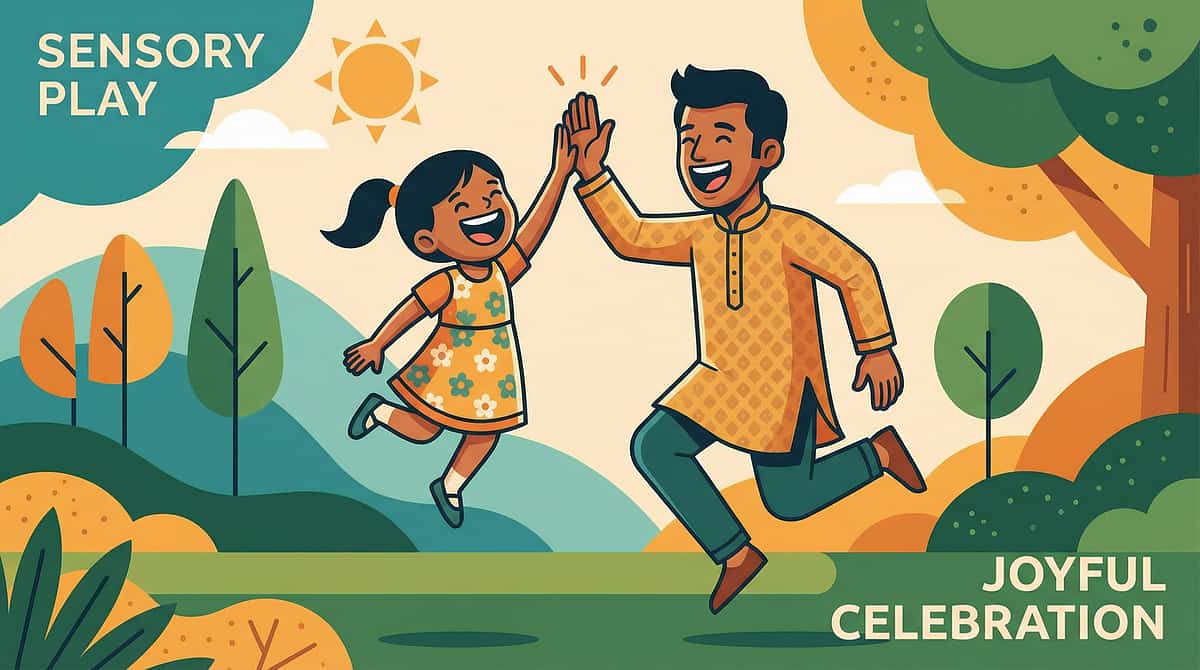
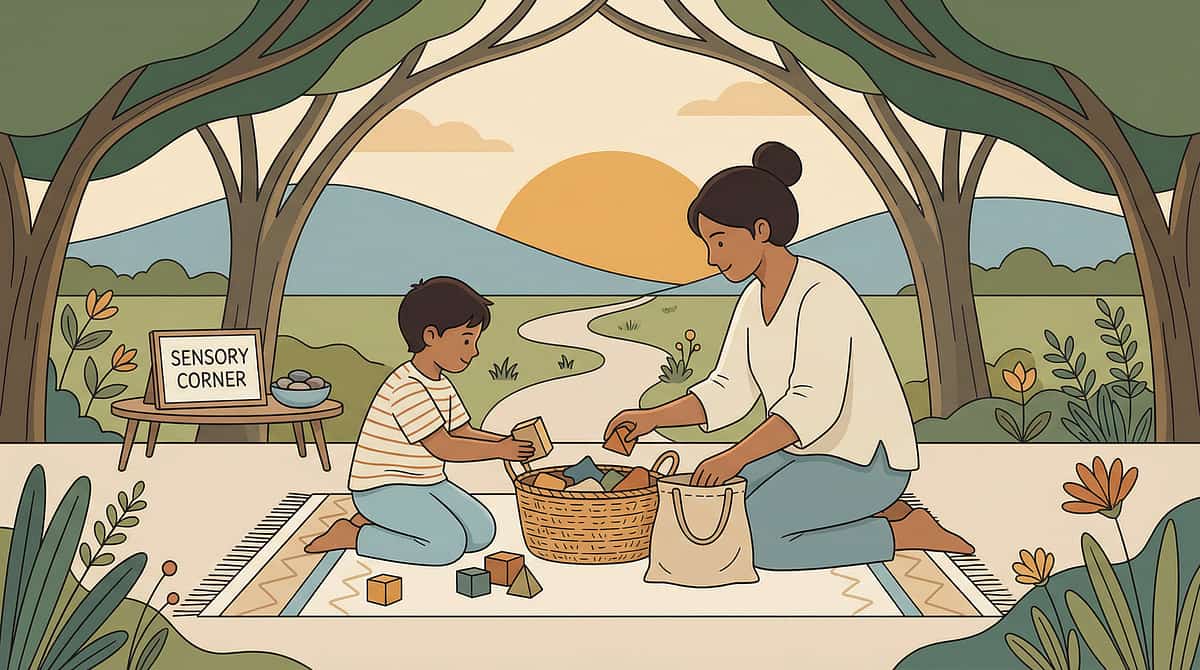
Step 5: Reinforce & Celebrate
Step 5 of 6
⏱ Within 3 seconds of final snip
"ALL DONE! You did it! You sat for your haircut!"
Reinforcement That Works
- Verbal — specific, not generic: "You sat in the chair the WHOLE time" not "good job." Name the exact behavior you want repeated.
- Reward delivery — IMMEDIATELY: The ice cream, the screen time, the park trip — NOW. Not "later." Not "after we clean up." The neural connection between "I tolerated the haircut" and "something wonderful happened" must be immediate.
- Physical: If child accepts it — a hug, high five, or their preferred celebratory gesture.
Reinforcement Menu — Customize to Your Child
- Food/treat: ice cream, favorite snack, special drink
- Activity: park, playground, screen time, favorite game
- Tangible: small toy, sticker, special item they've been wanting
- Social: video call to grandparent to show new haircut, "show off" to sibling
Key Principle: Celebrate the attempt, not just the success. Even if you only got 2 minutes of cutting done — THAT was the success. Deliver the reward fully. Trust builds on kept promises.
Step 6: The Cool-Down
Step 6 of 6
Post-Haircut Protocol
The session isn't over when the scissors go down. The cool-down phase prevents lingering sensory triggers from tainting an otherwise successful haircut — and sets the emotional tone for the next session.
❌ What NOT to Do After
- Don't process the experience extensively ("Remember how you used to be so scared?")
- Don't show the child their haircut in the mirror unless THEY want to look
- Don't lecture about how it "wasn't that bad"
- Don't compare to siblings or other children
✅ Transition Cue
"Haircut is all done. Let's go [reward activity]."
Keep it simple. Keep it positive. Move on. The less commentary you add, the cleaner the neural association between "haircut ends" and "good things follow."
Capture the Data — Right Now
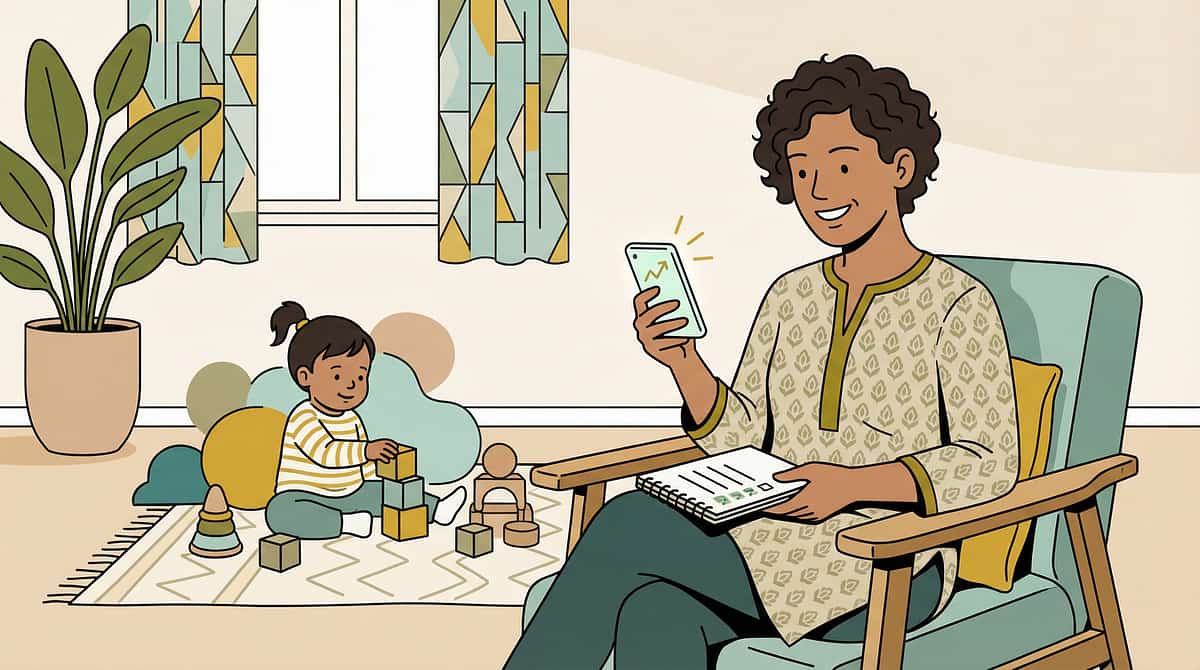
60 seconds of data now saves hours of guessing later. Track across 3–5 haircuts and you will see patterns you cannot see in any single session. Duration increasing by even 30 seconds between haircuts IS measurable progress.
Data Point | How to Record | Example | |
Duration tolerating cutting | Minutes:Seconds | "Sat for 7 minutes total" | |
Distress level | 1–5 scale (1=calm, 3=moderate fussing, 5=full meltdown) | "Started at 2, peaked at 3, ended at 2" | |
Supports used + effectiveness | List materials used + worked/didn't work | "Headphones: essential. Fidget: ignored. Timer: looked at 4 times." | |
Specific triggers observed | Note what caused escalation | "Lost it when clipper touched right ear" | |
Child state before session | Time of day + mood | "4pm, well-rested, had snack" | |
Most motivating reward | What worked best | "Ice cream > stickers today" |
📱 In-App Tracker
📄 PDF Sheet
Downloadable Haircut Tracking Sheet — print and fill after every session
📝 Simple Notebook
Date + duration + distress rating + notes. Works perfectly.

Session Didn't Go Well? That's Data, Not Failure.
Every "failed" session teaches you something about your child's sensory profile that helps the next one succeed. Work through the common problems below — most have a straightforward adjustment.
Child refused to sit in the chair at all
This is a starting point data point, not a failed haircut. Your child is at Stage 1. Next step: Practice sitting in the chair with ALL supports and NO cutting — 5 times over 2 weeks. Chair + headphones + tablet + reward for sitting only. Build chair tolerance before any cutting.
Fine until clippers turned on, then melted down
Auditory trigger is the primary driver. Switch to scissors ONLY. Try clipper desensitization separately: turn clippers on across the room while child watches tablet, gradually move closer over days.
Started okay but escalated 3 minutes in
Current tolerance ceiling is approximately 3 minutes. Set timer for 2 minutes next time (under the ceiling, not at it). Build upward by 30-second increments across sessions.
Supports worked at home but not at salon
Environment change resets tolerance. Visit salon 3 times WITHOUT cutting (just sit in chair with supports) before attempting a salon haircut. Or cut at home for now and transition to salon later.
Child pulled headphones off mid-cut
Headphone pressure on head may be aversive. Try looser ear defenders, or skip auditory support and increase other supports. Some children find headphone pressure more distressing than the sounds they're blocking.
Reward didn't motivate child
The reward wasn't motivating enough. Ask the child what they want BEFORE setting up the First-Then board. Offer 2–3 reward options and let them pick. What motivates at 8am may not motivate at 4pm.
Your Child Is Not Average — Adapt This to Them
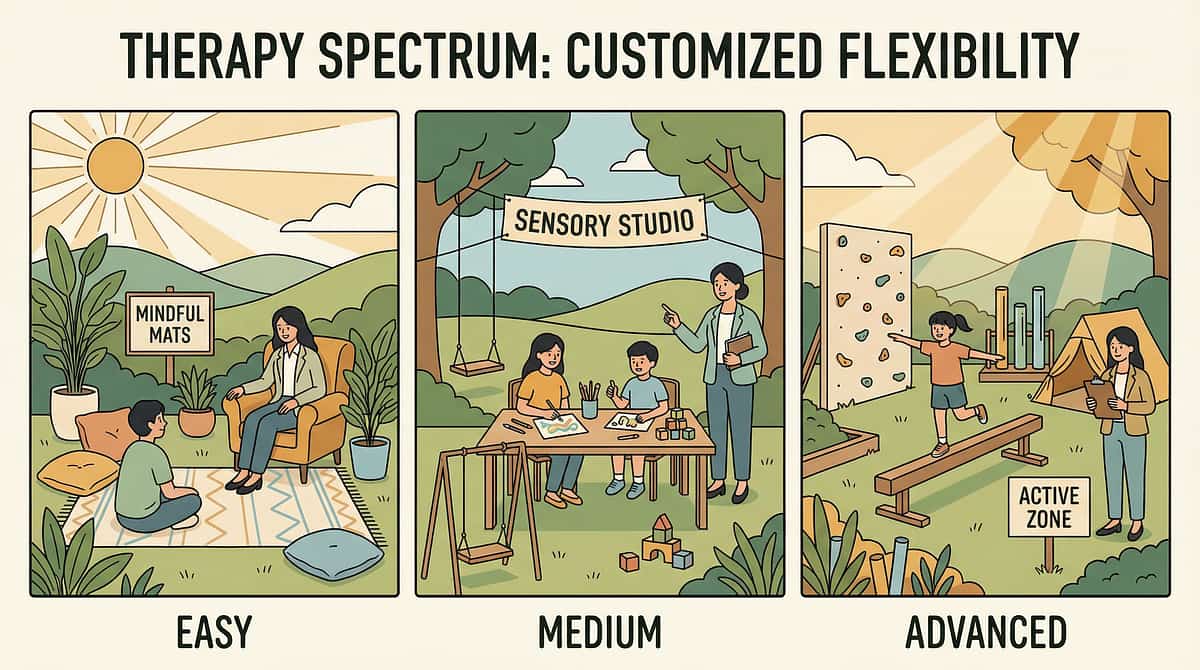
The 9-material protocol is a framework, not a rigid script. Use your child's sensory profile and the data you've collected to customize the approach. Individualized intervention planning is a core principle across OT, ABA, and SLP.
EASIER — High-Distress / Early Stage
- Cut only 1 area per session (back only, or sides only)
- Timer: 2 minutes maximum
- Deploy ALL 9 materials
- Home only, familiar person cutting
- Goal: sit in chair → tolerate 30 seconds → tolerate 2 minutes
STANDARD — Moderate Distress
- Full haircut in 2–3 sections with breaks
- Timer: 5 minutes per section
- Core supports: headphones + tablet + timer + reward
- Home or familiar salon
- Goal: complete haircut with supports in single visit
ADVANCED — Low Distress
- Full haircut in single session
- Timer: 15–20 minutes
- Minimal supports: 1–2 materials only
- Any salon, any stylist
- Goal: tolerate haircut with minimal or no supports
Sensory Profile Variations
Primarily AUDITORY: Prioritize headphones, scissors over clippers, quiet environment
Primarily TACTILE: Prioritize vibrating massage (pre-cut), cape alternative, immediate fragment cleanup
Primarily ANXIETY: Prioritize social story, visual timer, First-Then board
COMBINATION (most common): Use all 9 materials. Gradually reduce one at a time to identify what's essential.
Age-Based Modifications
Ages 2–3: Social story simplified to 4–5 pictures. Short timer (2–3 min). Parent holds child on lap if tolerated.
Ages 4–7: Full social story. Timer 5–10 min. Begin teaching self-advocacy ("I need my headphones").
Ages 8–12: Timer may not be needed — verbal updates instead. Private haircut setting may matter more. Begin transitioning away from supports toward independence.

Weeks 1–2: Building the Foundation
Don't expect a miracle. Expect a crack in the wall. Neuroplasticity takes time — but at this age, it moves faster than you think. Your child's somatosensory cortex is literally rewiring. You can't see it. The data shows it.
📊 Progress: ~15%
✅ What Progress Looks Like at This Stage
- Child tolerates sitting in the "haircut chair" for 30 seconds longer than before
- Child picks up the fidget toy without prompting
- Child references the social story ("first haircut, then ice cream")
- Distress starts 10 seconds later than the previous haircut (delayed onset = progress)
- Child accepts ONE support they previously rejected (e.g., now tolerates headphones)
⏳ What Is NOT Progress Yet
- Full haircut without distress (too early)
- Child "liking" haircuts — tolerance is the goal, not enjoyment
- Zero crying — some distress may persist for months. Reduced duration and intensity is the metric.
"If your child tolerates the material for 3 seconds longer than last time — that's real, neurological progress."

Weeks 3–4: Consolidation Signs
Something shifts around Week 3–4. You may not be able to name it exactly at first, but you'll feel it — and your data will confirm it. The protocol is beginning to take root.
📊 Progress: ~40%
Child Requests Their Supports
"Where are my headphones?" — your child is beginning to recognize and self-advocate for what helps them. This is a major neurological milestone. Note it in your data.
Timer Awareness Emerges
Child starts looking at the timer independently, checking how much time is left. They're using predictability as a coping tool — exactly what the protocol designed them to do.
Body Language Shifts
Shoulders slightly lower. Grip on armrests slightly looser. Flinching less at each cut. Parent reports: "It was still hard, but it wasn't a war." This is the consolidation moment.
Processing Through Play
Child may start pretending to give dolls or stuffed animals haircuts. This is healthy processing — the nervous system integrating the experience. Encourage it. Join in. Cut the doll's hair together.
"You may notice you're more confident too. The dread before haircut day is shifting from 'this will be a disaster' to 'this will be hard but we have a plan.' That shift in YOUR nervous system helps regulate theirs."

Weeks 5–8: Mastery Indicators
Mastery doesn't mean perfect. It means functional. It means consistent. It means your child's nervous system has learned that haircuts are survivable — and that learning is now durable across sessions and settings.
🏆 Mastery Badge Unlock — Progress: ~75%
≤2/5
Distress Rating
Consistently at or below 2 on a 5-point scale — from peak meltdown to manageable discomfort
3–4
Supports Needed
Reduced from all 9 materials to 3–4 essential ones — a sign of growing internal regulation
3/3
Consecutive Haircuts
Meets mastery criteria for 3 haircuts in a row before beginning to fade supports
✅ Full Haircut in Single Session
Tolerates complete haircut with supports — any duration
✅ Self-Advocacy Communication
Can communicate needs during haircut: "louder please" for tablet, "break" if overwhelmed
✅ Rapid Recovery
Recovery time after haircut: minutes, not hours or days
✅ Generalization
Tolerates haircut with a different person cutting, in a different location, with reduced sensitivity in adjacent grooming contexts
When mastery criteria are met for 3 consecutive haircuts, begin fading supports one at a time — remove the LEAST necessary support first (usually fidget or cape alternative). If tolerance holds across 2 haircuts without that support, it's successfully faded.

You Did This. Your Child Grew Because of Your Commitment.
Where You Started
A child who couldn't sit in a barber's chair. A parent who dreaded haircut day. Salons you were banned from. Hair down to shoulders because the alternative was worse.
Where You Are Now
A child who sits, tolerates, and survives haircuts. A parent who has a protocol, a toolkit, and data. A nervous system that is learning — slowly, measurably — that haircuts are survivable.
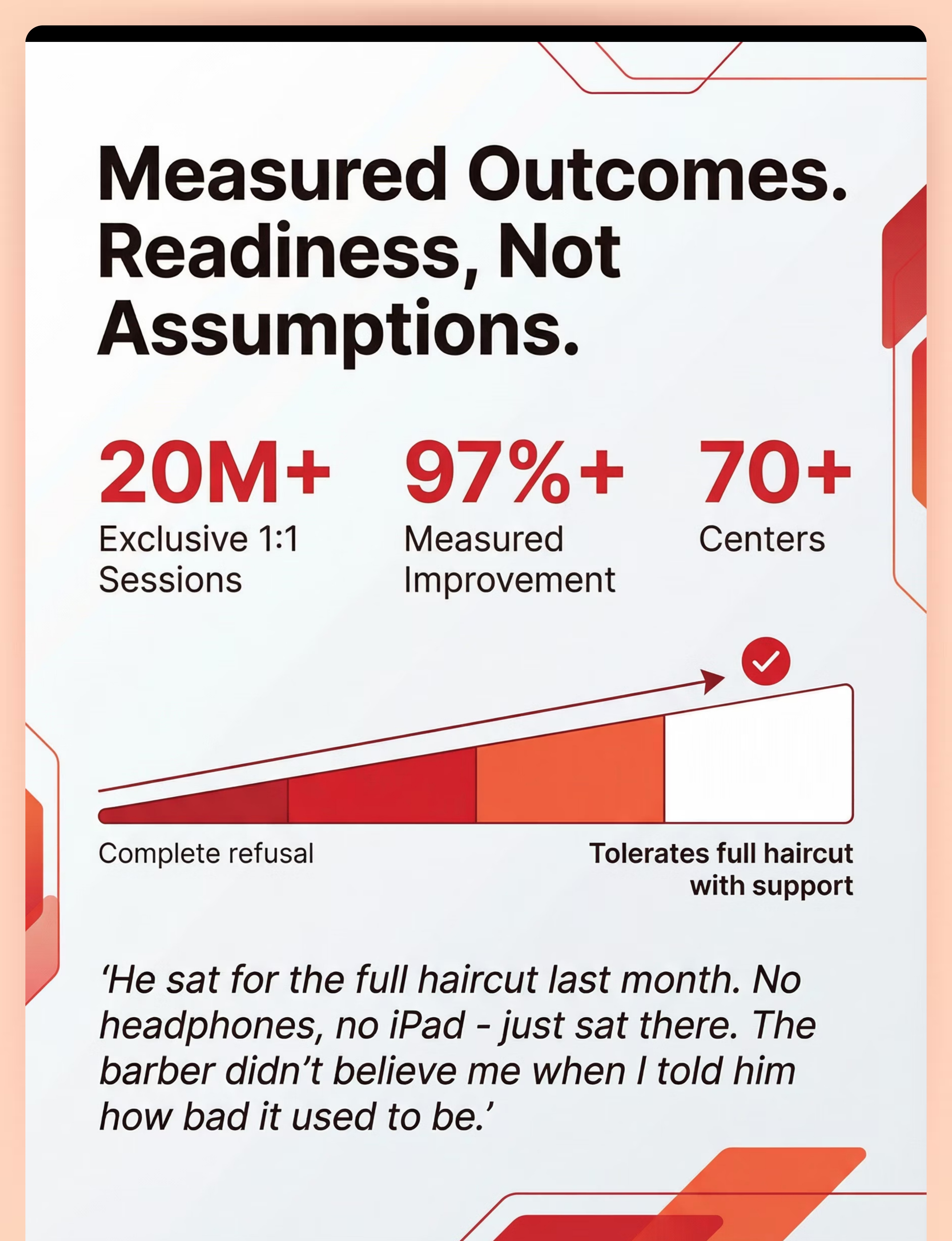
"He sat for the full haircut last month. No headphones, no iPad — just sat there. The barber didn't believe me when I told him how bad it used to be." — Parent, Pinnacle Blooms Network
Take a photo. Mark this milestone. The barber may not know what it took to get here. Your partner may not fully understand. But YOU know. And your child's nervous system knows. This matters.
Journal Prompt: Document this milestone. Write the date. Write what it looked like. One day you'll show your child: "Look how far we came."
🚩 When to Pause and Seek Professional Guidance
Even with the best-executed protocol, some situations require escalation. These are not signs of failure — they are clinical signals that the approach needs professional recalibration or medical evaluation.
🚩 Distress Increasing After 4+ Sessions
Despite consistent support use — indicates the desensitization hierarchy needs professional recalibration. The approach may be moving too fast.
🚩 New Avoidance Behaviors Developing
Refusing to enter the bathroom, resistance spreading to previously tolerated grooming — indicates possible sensitization rather than desensitization. Seek OT evaluation urgently.
🚩 Appears to Be in Genuine PAIN
Pulling at ears, scratching scalp excessively, wincing at light touch on specific areas — may indicate an underlying medical condition (ear infection, scalp eczema, folliculitis). See a doctor first.
🚩 Self-Injurious Behavior
Head banging, biting self, skin picking intensifying during haircuts — exceeds the scope of home-based intervention. Professional behavioral assessment needed immediately.
🚩 Sleep Disruption or Behavioral Regression
Lasting more than 24 hours post-haircut — may indicate the experience is traumatic rather than merely uncomfortable. Seek OT evaluation for sensory processing severity.
🚩 Parent Distress Reaching Burnout
A regulated parent is a prerequisite for a regulated child. If YOU are dreading, crying, or experiencing significant anxiety about haircuts, you need support too — ask for it.
1️⃣ Self-Resolve
Adjust difficulty level (Card 22), add more supports, extend timeline
2️⃣ Teleconsultation
3️⃣ In-Center Assessment
Full Sensory Processing Evaluation → AbilityScore® + Diagnostic Intelligence Layer
🆓 FREE Helpline
9100 181 181 (24/7, 16+ languages)
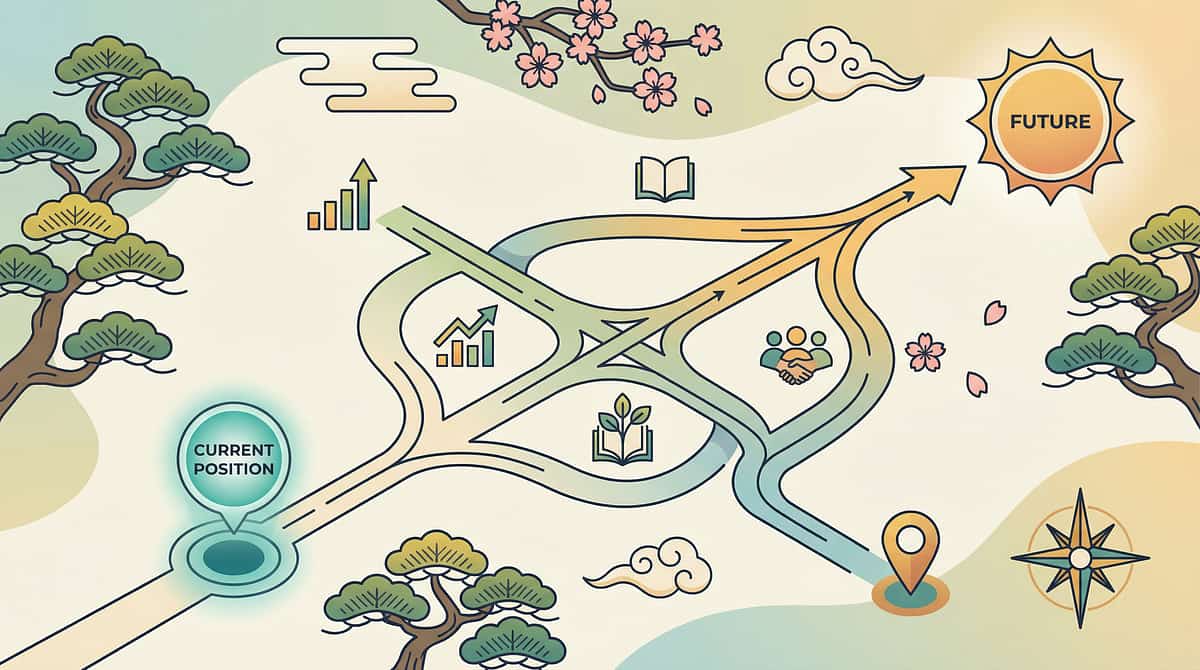
Your Child's Developmental GPS — Where You Are and Where You're Heading
This technique doesn't exist in isolation. It sits within a carefully sequenced progression architecture — with prerequisite skills feeding into it, and advanced techniques branching out from it as your child grows.
Long-Term Developmental Goal: Daily Living & Independence Index → Grooming & Personal Care → Functional Independence in All Grooming Routines
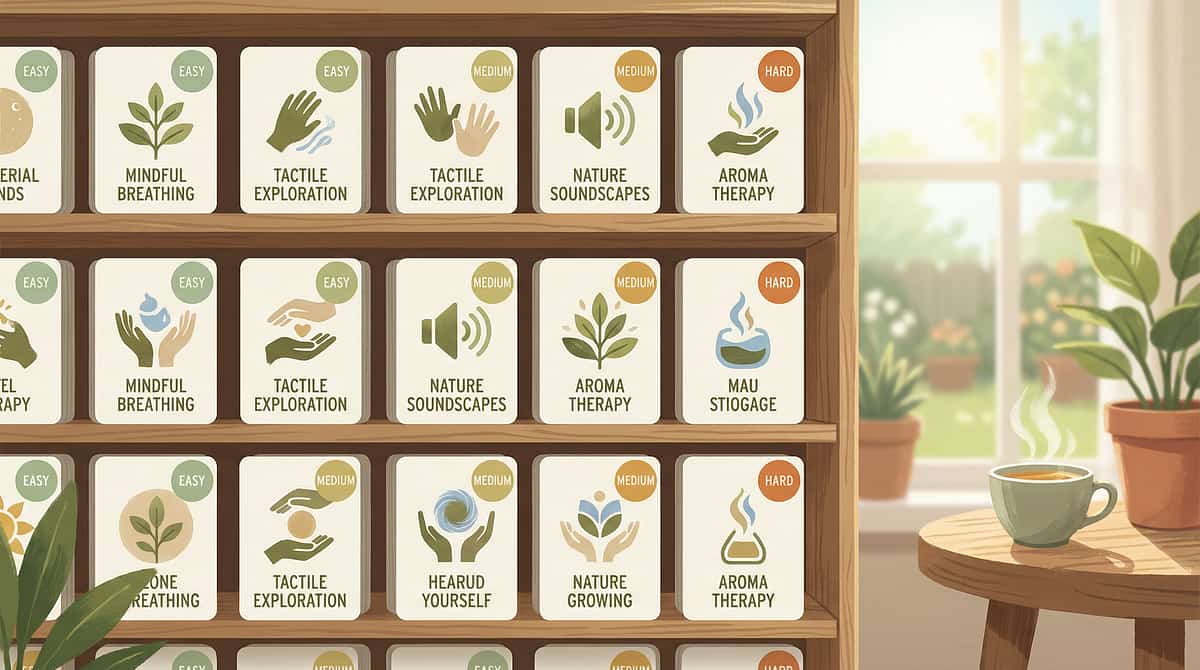
More Sensory Techniques You May Need — You Already Own Some of the Materials
Every material you purchased for haircuts works across multiple challenges. Your investment compounds. Browse the techniques below — you likely already have most of what you need to start immediately.
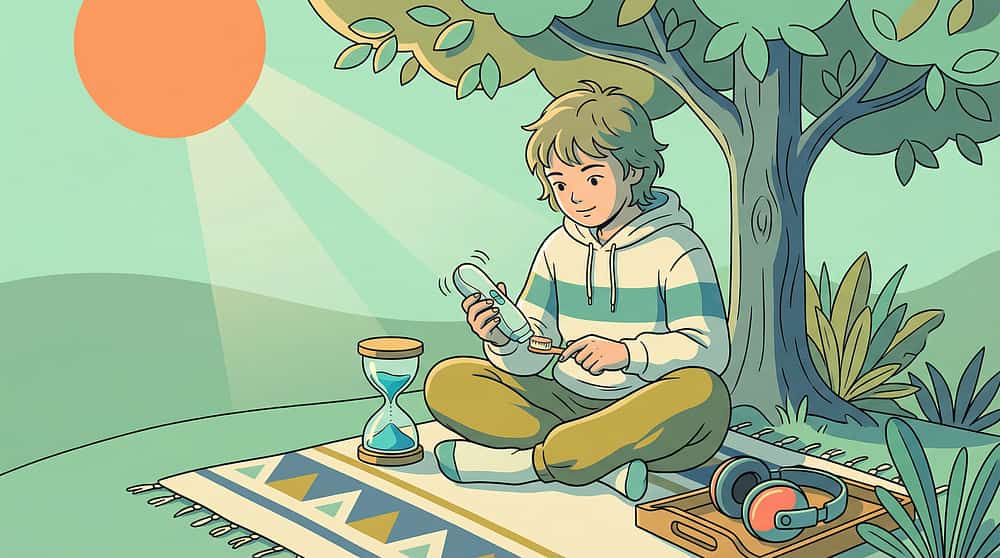
A-019: Won't Let You Cut Nails
Difficulty: Introductory
Materials you already own: Headphones, fidget toy, visual timer, reward system

A-020: Hates Having Hair Brushed
Difficulty: Introductory
Materials you already own: Vibrating massager, social story template
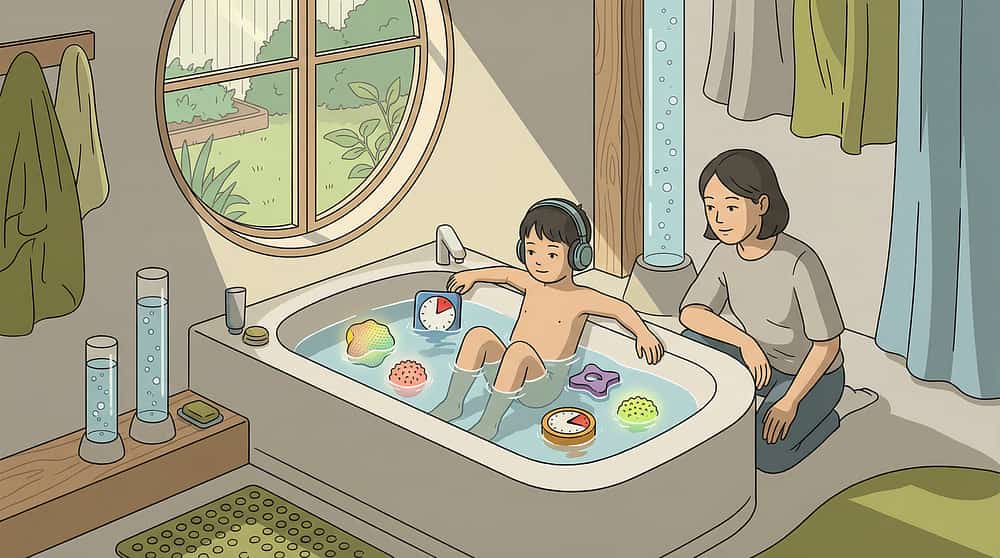
A-021: Bath Time Meltdowns
Difficulty: Introductory
Materials you already own: Visual timer, social story, reward system
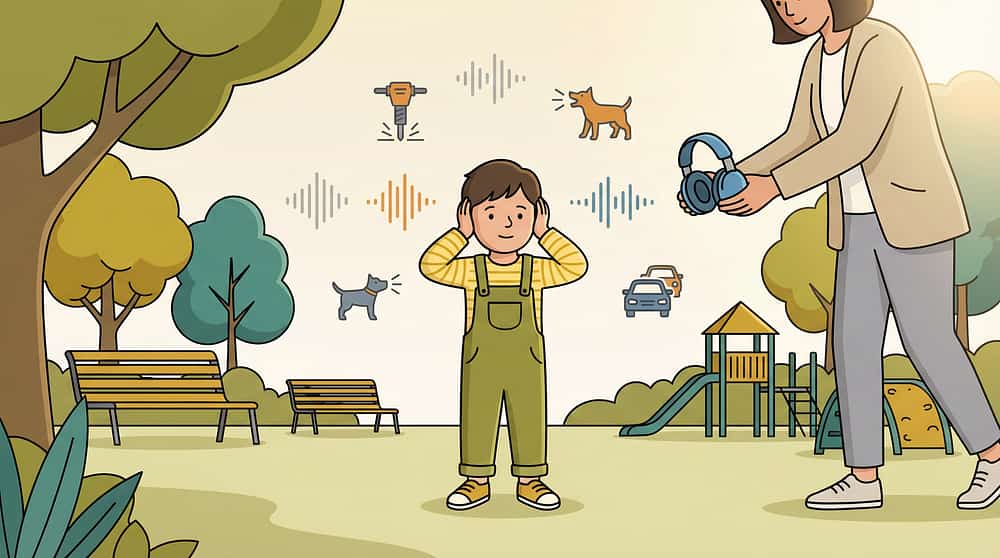
A-036: Covers Ears at Everyday Sounds
Difficulty: Core
Materials you already own: Noise-canceling headphones
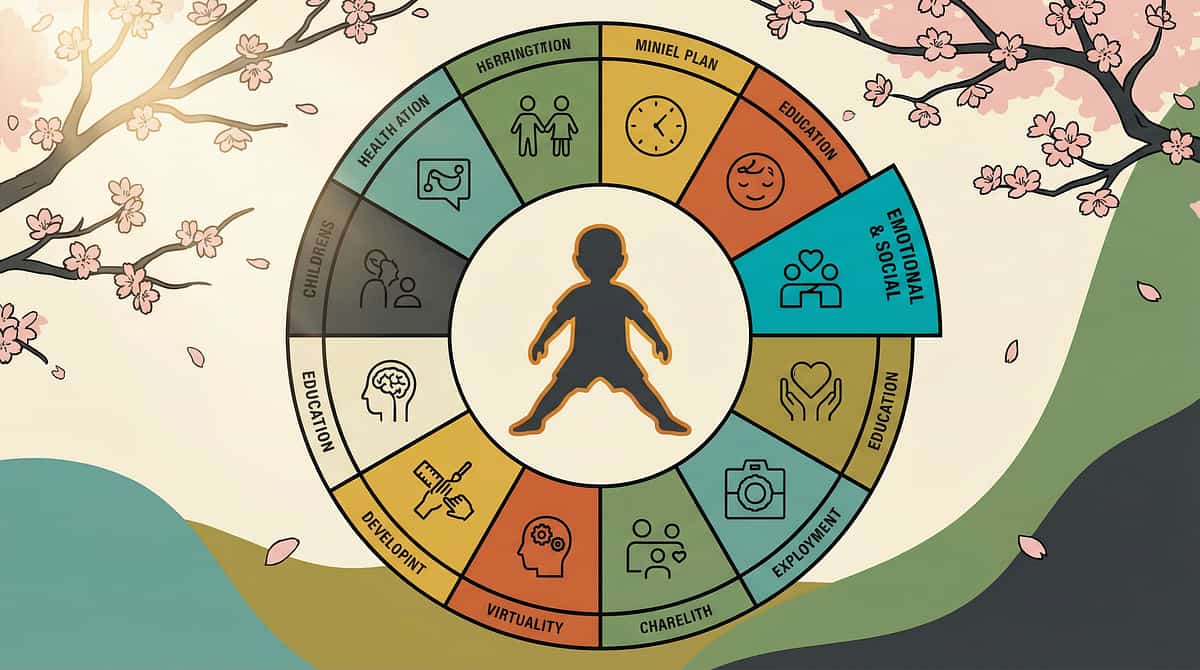
This Technique Is One Piece of a Larger Plan
Haircut tolerance sits at the intersection of Domain A (Sensory Processing) and Domain G (Adaptive Behavior / Daily Living). When your child masters this technique, it strengthens both domains simultaneously — and feeds into Domain L (Community Participation), because a child who can tolerate haircuts can access grooming services in their community independently.
See your child's full developmental profile across all 12 domains via GPT-OS® Assessment — pinnacleblooms.org | 📞 9100 181 181
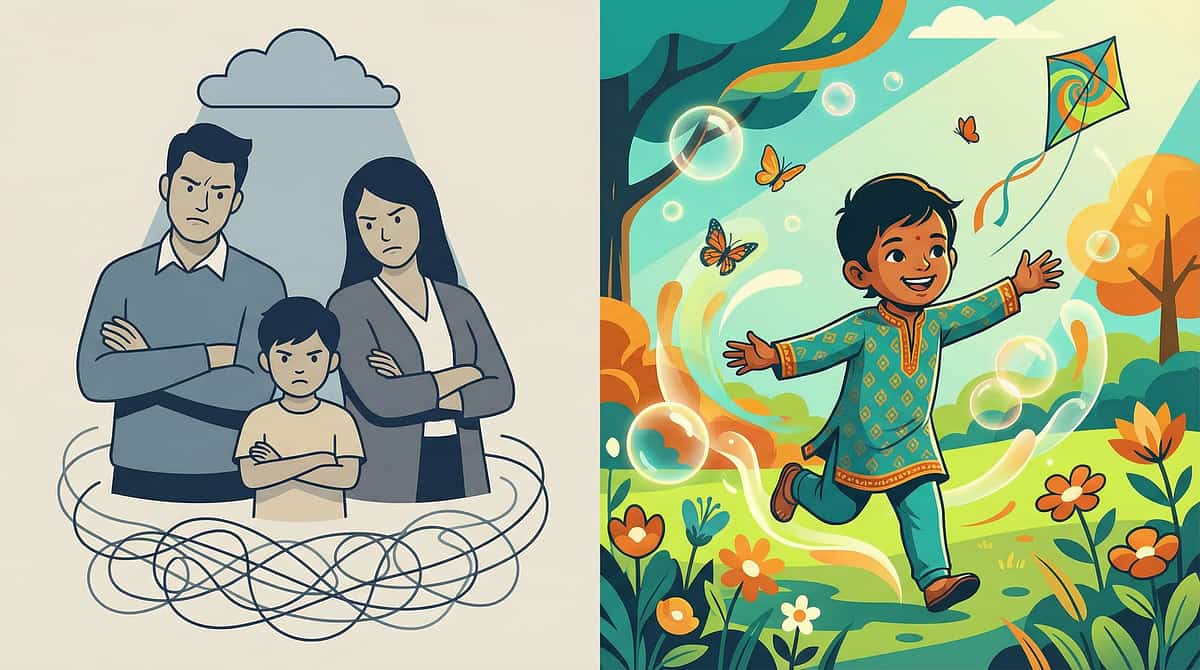
From Meltdown to Manageable — Real Families, Real Progress
Story 1 — The Parent Who Was Banned From Salons
Before: "We were banned from two salons. Not because of behavior — because of the screaming. I cut his hair at 2am while he slept."
After (Week 6): "He sat in the salon chair for 12 minutes with headphones and his tablet. The barber did a full cut. He got ice cream after. He asked to go back."
Timeline: 6 weeks of systematic desensitization using 5 of the 9 materials
Story 2 — The 3-Day Haircut
Before: "My daughter hasn't had a proper haircut in 18 months. I trim tiny sections while she's distracted — it takes 3 days to finish one haircut."
After (Week 8): "We have a 'haircut station' at home. She knows the routine — headphones on, timer set, fidget in hands. She even reminded me to set the timer last time."
Timeline: 8 weeks, emphasis on social story and visual timer
"Haircut tolerance is one of the fastest-responding targets in our Daily Living & Independence Index. Most families see measurable progress within 4–6 haircut cycles when using the full support toolkit consistently. The key variable is parental consistency — families who honor the timer and deliver rewards immediately see 3× faster progress than those who 'push through.'" — OT Clinical Lead, Pinnacle Blooms Network
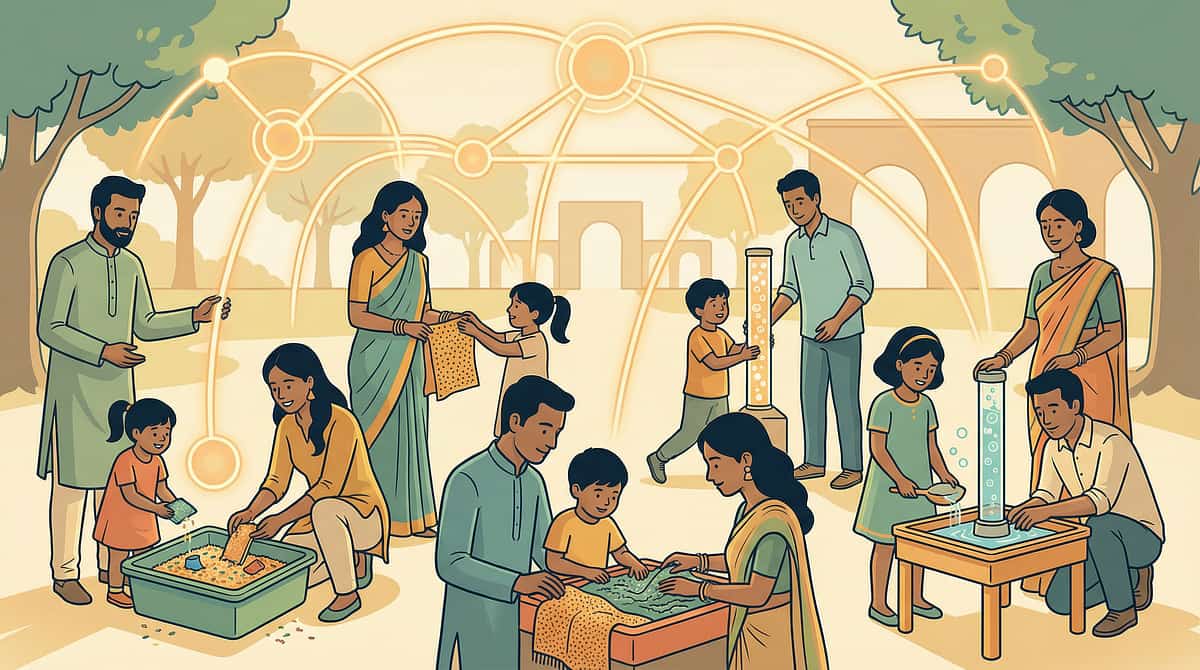
You're Not the Only One Fighting This Battle — Connect With Parents Who Understand
Something powerful happens when parents who've been through this connect with parents who are just starting. Peer narratives are the strongest motivator for home-based intervention adherence — and you deserve a community that gets it without explanation.
Grooming Challenges Parent Group
A dedicated WhatsApp community for parents navigating haircut aversion, nail cutting resistance, and other sensory grooming challenges. Real-time support from parents who are in it with you.
Pinnacle Parent Forum
Our online community for sensory processing discussions — technique questions, troubleshooting sessions that didn't go as planned, wins big and small. Browse or post at any time.
Local Parent Meetups
Find your nearest Pinnacle center's parent group. Face-to-face connection with families in your area navigating the same daily challenges — often the most powerful support of all.
Peer Mentoring Program
Connect with an experienced parent who has successfully navigated haircut aversion. Our peer mentors have been where you are and can share what worked for their child — specifically, practically, honestly.
"Your experience helps others — consider sharing your journey. The parent who finds this page next year needs to know it's possible."
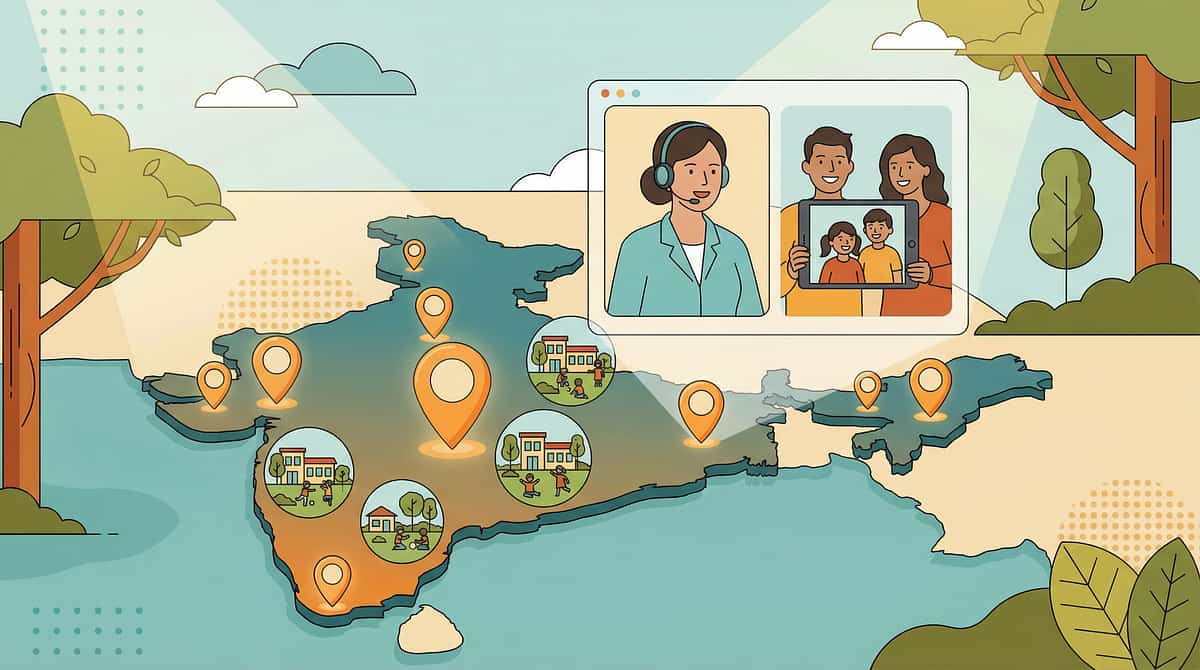
Home + Clinic = Maximum Impact
Home implementation is powerful — but it reaches its full potential when guided by clinical expertise. Professional assessment reveals sensory profile nuances that aren't visible to even the most observant parent, and individualized protocols move 3× faster than generic ones.
Your Professional Support Team
Primary Match: Occupational Therapist (Sensory Integration specialist) — for sensory diet design and desensitization hierarchy
Secondary Match: BCBA (Board Certified Behavior Analyst) — for systematic desensitization protocol and reinforcement scheduling
Contact
🗺70+ Centers Across India
📞FREE: 9100 181 181 (24/7, 16+ languages)
Your Service Path
AbilityScore® Assessment
Comprehensive Sensory Processing Evaluation across 591+ observations
Individualized Protocol
Custom sensory diet + haircut desensitization hierarchy designed for your child
Parent Training
You execute at home with professional guidance — maximizing clinical value at home frequency
EverydayTherapyProgramme™
Daily micro-interventions between haircuts to continuously build tolerance
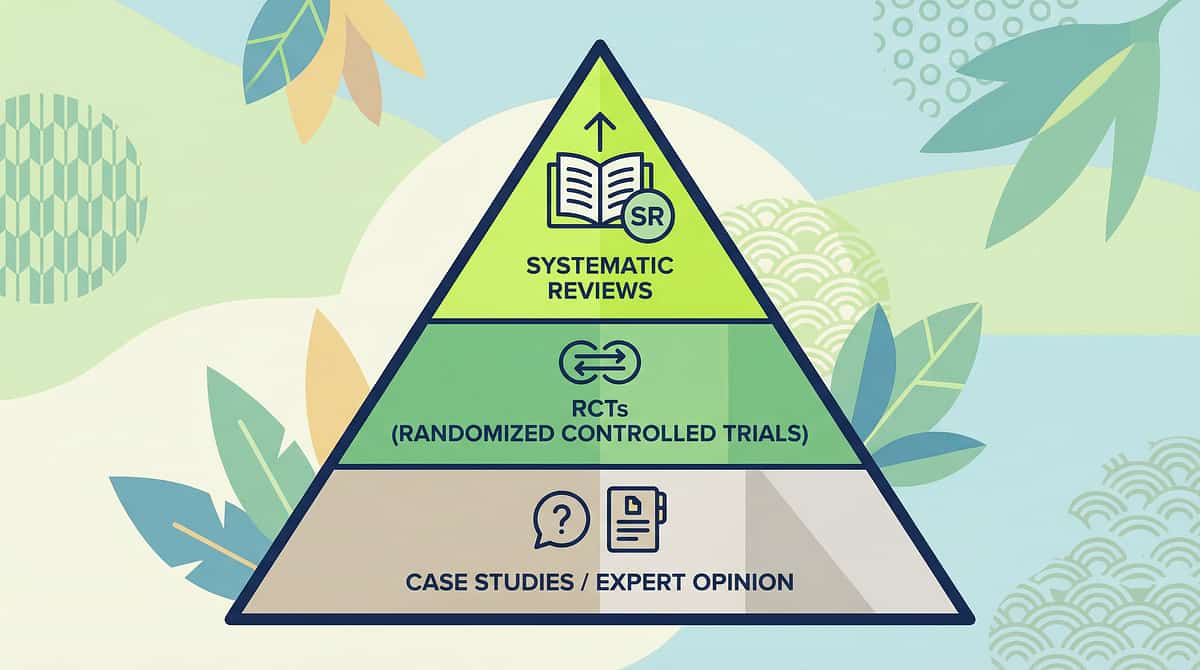
The Science Behind Every Material on This Page
These are not cherry-picked studies. This is the systematic, peer-reviewed evidence base. Deeper reading for the curious parent — and for any professional who questions whether what you're doing has scientific support.
Level I: Systematic Reviews & Meta-Analyses
PRISMA Systematic Review (2024): 16 articles from 2013–2023 confirm sensory integration intervention meets criteria as evidence-based practice for children with ASD. → PubMed: PMC11506176
Meta-Analysis (World J Clin Cases, 2024): 24 studies demonstrated effective promotion of social skills, adaptive behavior, sensory processing, and motor skills. → PMC10955541 | DOI: 10.12998/wjcc.v12.i7.1260
Level II: Randomized Controlled Trials
Padmanabha et al. (Indian J Pediatr, 2019): Home-based sensory interventions in Indian pediatric population — significant outcomes for parent-administered sensory strategies. → DOI: 10.1007/s12098-018-2747-4
Frontiers in Integrative Neuroscience (2020): Framework for evaluating sensory processing treatment in ASD — establishes neurological basis. → DOI: 10.3389/fnint.2020.556660
Level III: Frameworks & Guidelines
WHO Nurturing Care Framework (2018):nurturing-care.org/ncf-for-ecd/
WHO/UNICEF CCD Package (2023): Implemented across 54 LMICs. → PMC9978394
NCAEP Evidence-Based Practices Report (2020): Classifies sensory integration and visual supports as evidence-based practices for autism.
Int J Speech-Lang Pathol (2022): Adapted NCF for SLPs. → DOI: 10.1080/17549507.2022.2141327
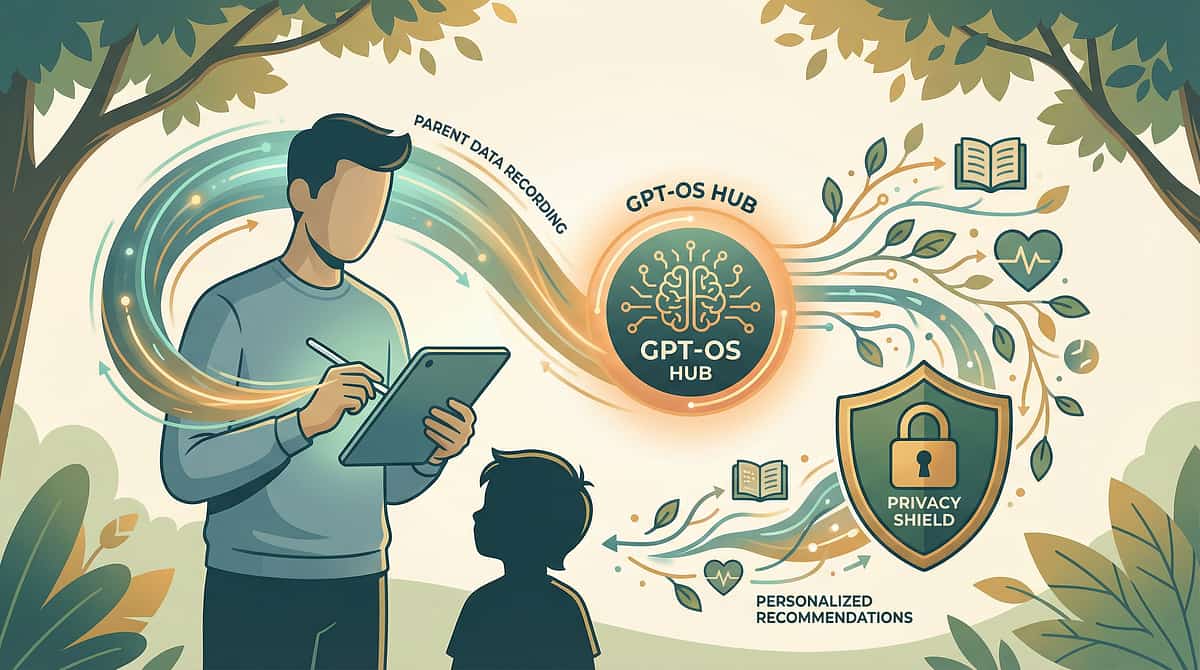
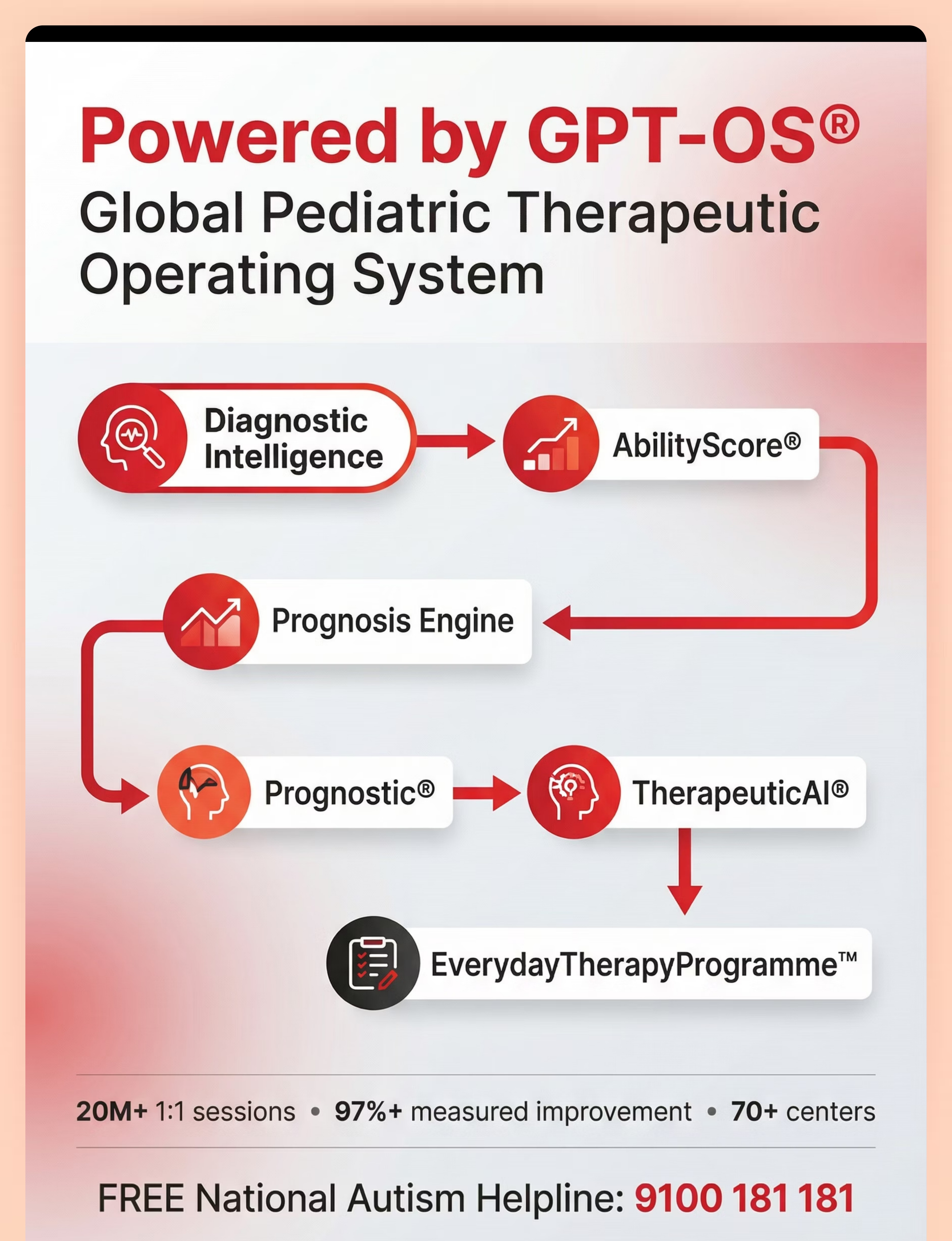
Powered by GPT-OS® — Global Pediatric Therapeutic Operating System
Your haircut data doesn't disappear after a session. It feeds a closed-loop therapeutic intelligence system that learns from 20M+ sessions — and uses that learning to accelerate your child's specific journey.
What GPT-OS® Learns From This Technique
Your haircut tolerance data feeds the Daily Living & Independence Index and the Sensory Regulation Index. Across millions of sessions, GPT-OS® has identified that children who achieve haircut tolerance within 6 weeks (vs. 12+) share specific sensory profile patterns that predict faster response to auditory desensitization across other domains.
Privacy & Protection
All data encrypted, anonymized for population-level analytics, individually protected under Indian DPDP Act 2023 and GDPR-equivalent standards. Your data helps every child like yours — while protecting your child specifically.
Proof Strip
20M+ 1:1 sessions · 97%+ measured improvement · 70+ centers · Patents filed across 160+ countries
"This is not software. This is therapeutic infrastructure."
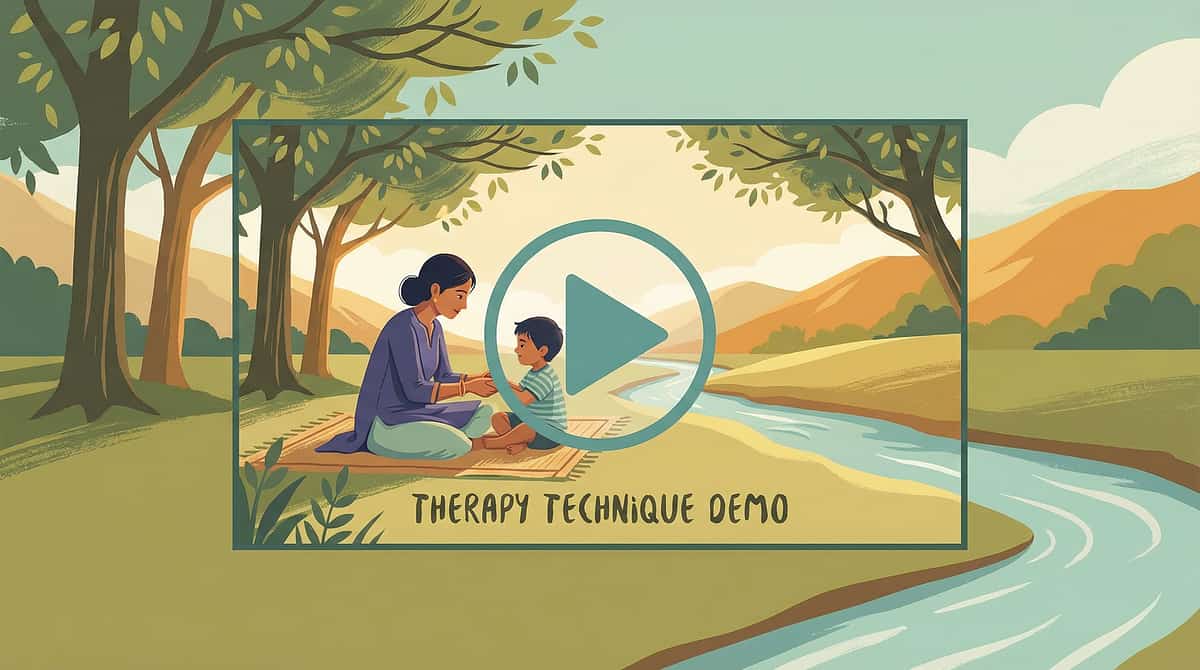
Watch the Original Reel: A-018
You've read the science. Now watch it in action. Video modeling is classified as an evidence-based practice for autism (NCAEP, 2020). Seeing the materials used with a real child reinforces everything you've read and bridges the gap between knowing and doing.
🎬 Reel Details
Reel Title: 9 Materials That Help When Child Refuses Haircuts
Series: Sensory Solutions — Episode 18
Domain: Multi-Sensory Processing — Tactile, Auditory & Visual
Duration: 60 seconds
Presented by: The Pinnacle Blooms OT Clinical Team — the same occupational therapists who designed the 9-material protocol, validated it across thousands of sessions, and train parents daily on its execution.
Multi-Modal Learning
NCAEP (2020) classifies video modeling as an evidence-based practice for autism. Multi-modal learning (reading + watching + doing) improves parent skill acquisition significantly over reading alone.
After watching, return to the Step-by-Step execution cards (Cards 14–19) with fresh eyes — the video makes each step click in a different way.

Consistency Across Caregivers Multiplies Impact
If only one parent knows the protocol, it fails the moment someone else needs to supervise a haircut. Share this — especially with the grandparent who says "just hold him down, it'll be over in a minute." Consistency across all caregivers is what separates slow progress from fast progress.
📱 Share via WhatsApp
Pre-formatted message with page link — tap and send to your co-parent, family members, or anyone who helps with your child's care.
📧 Share via Email
Template email for sharing with extended family, grandparents, or daycare providers who supervise grooming routines.
🔗 Copy Link
techniques.pinnacleblooms.org/sensory/haircut-refusal-9-materials — share directly in any message or group.
📄 Family Guide (1-Page PDF)
Simplified version of the 9-material protocol for grandparents, babysitters, and other caregivers. Everything they need to know without needing to read the full page.
📄 School/Daycare Letter
Template explaining your child's sensory needs around grooming for teachers and staff — professional language, ready to print and hand over.
💳 Barber/Salon Card
Wallet-sized card explaining accommodations your child needs — to hand to a new barber before the session begins. Normalizes the supports and sets expectations calmly.
Frequently Asked Questions
The most common questions parents ask — answered with the same evidence-based, no-judgment clarity as the rest of this page.
My child is 2 years old — is it too early to start this?
No. Desensitization is most effective when started early. For toddlers, simplify: use only 3–4 materials (headphones, tablet, reward) and keep sessions under 3 minutes. At this age, you're building tolerance foundations, not expecting full haircuts.
Can I skip the social story? My child doesn't seem to understand pictures yet.
Even pre-verbal children benefit from visual sequences. Use real photos of YOUR tools and YOUR setting. The brain processes predictability through images even before linguistic comprehension. Try it for 3 haircuts before deciding it doesn't help.
What if the salon won't let me bring all these materials?
Find a different salon. A salon that doesn't accommodate a child's sensory needs is not the right salon. Many salons — especially those familiar with special needs families — will welcome your toolkit. Call ahead. If no local salon accommodates, cut at home until your child's tolerance allows transition.
How long until my child doesn't need any supports at all?
This varies enormously. Some children fade all supports within 3–6 months. Others use 1–2 key supports (headphones, tablet) into adolescence. The goal is functional tolerance, not zero support. Many neurotypical adults listen to music during haircuts — that's a support too.
My partner thinks I'm "babying" our child with all these materials. How do I explain?
Share Card 03 (the neuroscience card). This is not babying — this is providing scaffolding for a nervous system that processes sensory input differently. You wouldn't tell a child with poor eyesight to "just try harder to see." Sensory processing differences require tools, not willpower.
Should I use clippers or scissors?
Start with scissors. Clippers produce vibration (tactile) AND buzzing (auditory) — two simultaneous triggers. Scissors are silent and produce only tactile input. If your child eventually tolerates scissors well, you can introduce clippers on low settings for neckline only, with headphones on.
What about cutting hair while the child sleeps?
Cutting hair while a child sleeps does not build any tolerance — it bypasses the nervous system rather than training it. This protocol gives you a path toward waking haircuts with genuine coping skills. If you've been cutting during sleep as a survival strategy, that's understandable — but this protocol is the path forward.
My child's hair is already very long — should I do a big cut first or gradually shorten?
Gradual. A dramatic first cut requires long session tolerance that your child likely doesn't have yet. Trim 1–2 cm per session. It may take 3–4 haircuts to reach the desired length. Each successful short session builds tolerance for the next.
You Have the Science. You Have the Materials. You Have the Protocol. Start Today.
Every card on this page has moved you closer to the moment where haircuts are manageable. You have the neuroscience, the toolkit, the step-by-step protocol, the troubleshooting guide, the safety checks, and the progress markers. The only thing left is the first session.
🆓 FREE Helpline
9100 181 181 — 24/7, 16+ languages
🌐 Website
📍 Find a Center
70+ centers across India — find your nearest location
✅ Validated by Pinnacle Blooms Consortium® — OT · SLP · ABA · SpEd · NeuroDev · CRO
Preview of 9 materials that help when child refuses haircuts Therapy Material
Below is a visual preview of 9 materials that help when child refuses haircuts therapy material. The pages shown help educators, therapists, and caregivers understand the structure and content of the resource before use. Materials should be used under appropriate professional guidance.


Link copied!
The Pinnacle Promise
🖐 OT
🗣 SLP
🧩 ABA
📚 SpEd
🩺 NeuroDev
🔬 CRO
"From fear to mastery. One technique at a time." — The Pinnacle Blooms Consortium
20M+
Exclusive 1:1 Sessions
Delivered across the Pinnacle Blooms Network
97%+
Measured Improvement
Across families using GPT-OS® guided protocols
70+
Physical Centers
Serving families from 70+ countries worldwide
160+
Patent Countries
GPT-OS® therapeutic infrastructure protected globally
Pinnacle Blooms Network®
Built by Mothers. Engineered as a System.
Pediatric Therapeutic OTT Platform | Hyperlocal Therapeutic Marketplace | 70+ Physical Centers
A unit of Bharath Healthcare Laboratories Pvt. Ltd.
CIN: U74999TG2016PTC113063 | DPIIT: DIPP8651
📞9100 181 181 (24/7, 16+ languages)
Medical Disclaimer
This content is educational. It does not replace assessment by a licensed occupational therapist or mental health professional. If haircut anxiety significantly impacts daily functioning or causes severe distress, please consult qualified professionals. Individual results may vary. Statistics represent aggregate outcomes across the Pinnacle Blooms Network. Desensitization should always be child-paced and never forced. Never restrain a child for haircuts.
Navigation
© 2026 Pinnacle Blooms Network®, unit of Bharath Healthcare Laboratories Pvt. Ltd. All rights reserved.