
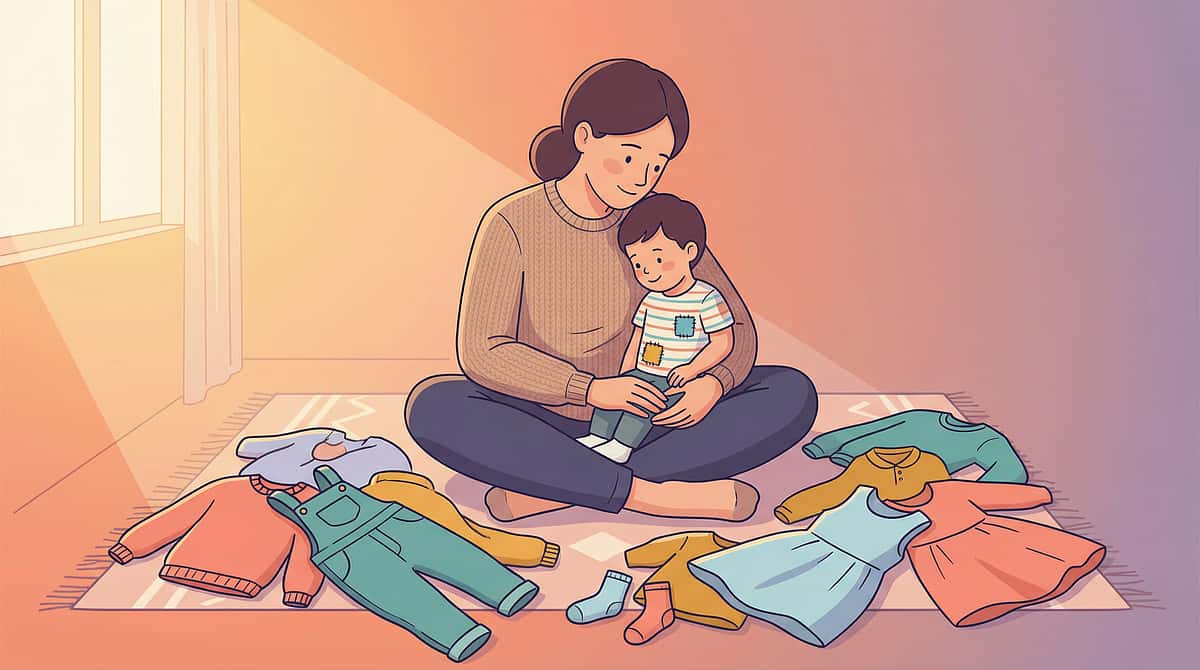
.She Only Wears the Same 3 Shirts. Everything Else "Hurts."
You've bought 20 shirts. She touches each one, flinches, and reaches for the same faded, threadbare tee she's worn every day for six months. You've tried bribing, reasoning, crying in the laundry room. Nothing works.
You are not failing. Your child's nervous system is accurately detecting fabric textures that register as genuinely painful. This is neurology — not pickiness, not defiance, not poor parenting.
Here are 9 materials and strategies that expand your child's comfortable wardrobe — validated across 20 million therapy sessions and grounded in the highest levels of clinical evidence.
Pinnacle Blooms Consortium®
Sensory Solutions Series — Episode 4
Evidence base: WHO Nurturing Care Framework (2018) — early identification and parental awareness directly impacts developmental outcomes. nurturing-care.org/ncf-for-ecd
You Are Not Alone: The Numbers
Fabric refusal is not rare — it is a shared reality for millions of families worldwide. Every unworn, still-tagged garment in your child's closet is not a parenting failure. It is a sensory reality that spans continents.
80%
Experience Sensory Differences
Of children diagnosed with autism experience sensory processing differences (PRISMA Systematic Review, 2024 — PMC11506176)
65–90%
Clothing Tactile Defensiveness
Of children with SPD demonstrate clothing-related tactile defensiveness including fabric refusal (Occupational Therapy International)
1 in 36
Children Diagnosed with ASD
In the US (CDC, 2023). In India, an estimated 18 million children are on the spectrum.
You are among millions of families worldwide navigating this exact challenge every single morning. Your child's closet full of unworn, still-tagged clothing is not a parenting failure — it is a sensory reality shared across continents.
References: PMC11506176 | PMC10955541 | DOI: 10.12998/wjcc.v12.i7.1260
What's Happening in Your Child's Brain
Understanding the neuroscience behind fabric refusal transforms the morning battle from a power struggle into a manageable sensory challenge. The brain science is clear — and it validates everything your child is communicating.
The Neuroscience
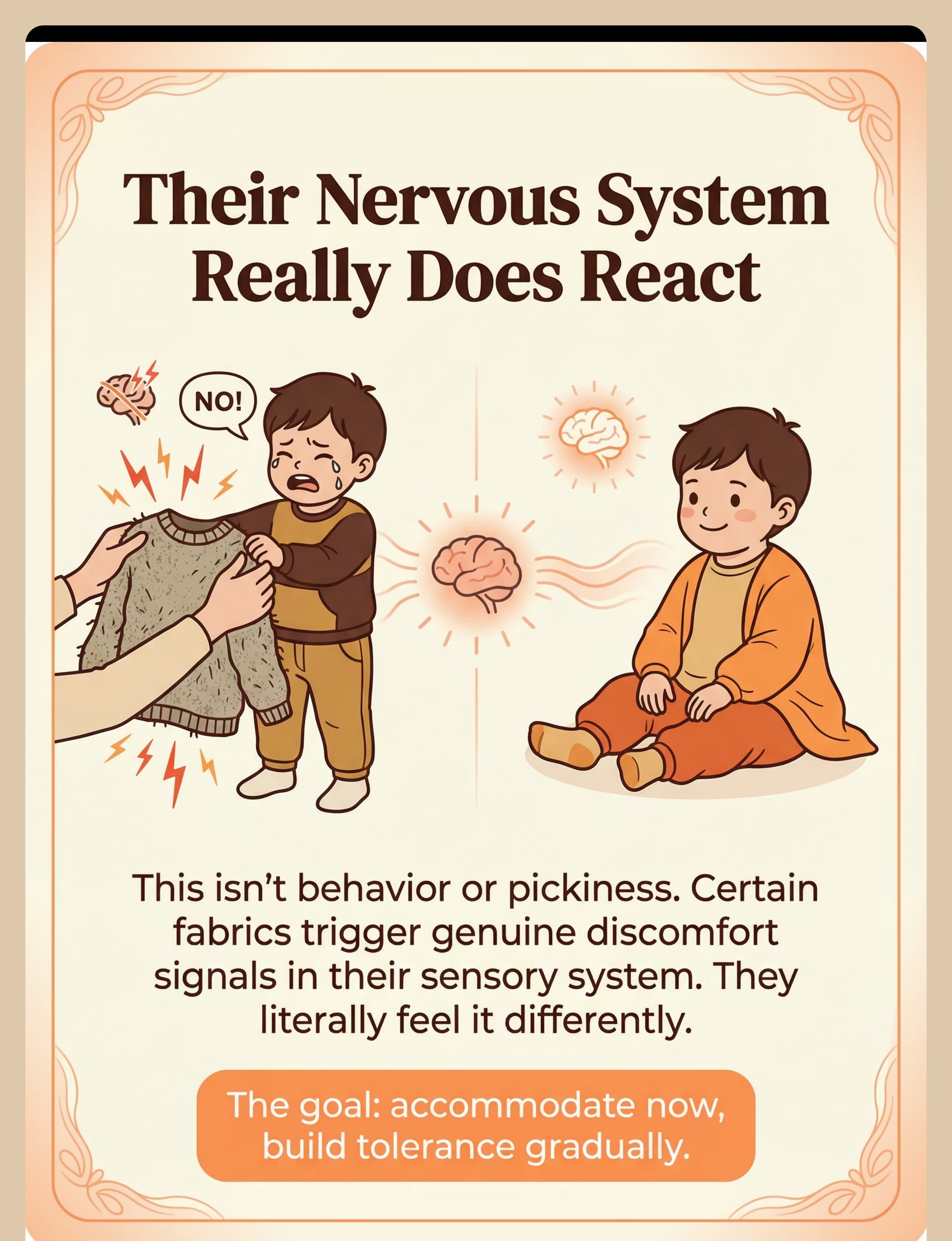
The somatosensory cortex is the brain's texture processing center. In children with tactile hypersensitivity, this region over-amplifies signals from fabric fibers touching skin. What you feel as "soft cotton," your child's brain registers as "coarse sandpaper."
The C-tactile afferent nerve fibers — which process pleasant touch in neurotypical individuals — fire differently. The thalamic gating mechanism that normally filters low-priority touch signals operates with a lower threshold, meaning every thread, weave pattern, and fiber composition is detected and evaluated individually.
What This Means For You
Your child is not choosing to reject clothing. Their nervous system is performing an accurate but hypersensitive analysis of every fabric that touches their skin.
They can genuinely distinguish between bamboo and cotton, between new and washed, between flatlock seams and overlock seams — because their brain processes all of it at high intensity.
Key message: "This is a wiring difference, not a behavior choice. Your child literally feels fabrics differently than you do."
Research: Frontiers in Integrative Neuroscience (2020) — Comprehensive framework for evaluating sensory integration/sensory processing treatment in ASD. DOI: 10.3389/fnint.2020.556660
Where This Sits in Development
Fabric refusal does not appear overnight. It follows a predictable developmental arc — and knowing where your child sits on that arc helps you understand both the challenge and the opportunity ahead.
6–12 Months
Begins to notice texture differences in toys and blankets
12–24 Months
Fabric preferences may start to emerge — certain sleepwear rejected
2–3 Years ← TYPICAL ONSET
Strong fabric preferences crystallize. Limited acceptable wardrobe becomes apparent.
3–5 Years
Dressing battles escalate. School uniform issues begin. Family conflict increases.
5–8 Years
With intervention, tolerance expands. Without intervention, rigidity may deepen.
Comorbidity awareness: Fabric refusal frequently co-occurs with clothing tag sensitivity (A-003), seam sensitivity in socks (A-005), waistband aversion (A-006), and temperature sensitivity (A-007) — because they share the same tactile processing pathway.
References: PMC9978394 | WHO/UNICEF CCD Package (2023)
The Evidence Behind This Technique
Evidence Grade: Level I–II
Systematic Review + RCT Supported
This is not a wellness trend or an anecdotal strategy. The Fabric-Specific Tactile Desensitization Protocol is grounded in the highest tiers of clinical evidence, validated by systematic reviews, meta-analyses, and randomized controlled trials.
PRISMA Systematic Review (2024)
16 articles spanning 2013–2023 confirm that sensory integration intervention meets criteria for evidence-based practice in children with ASD. PMC11506176
Meta-Analysis (24 Studies)
Sensory integration therapy effectively improves social skills, adaptive behavior, sensory processing, and motor skills. PMC10955541
Indian RCT (Padmanabha et al., 2019)
Home-based sensory interventions produce significant measurable outcomes when parents are properly trained — the exact model this technique enables. DOI: 10.1007/s12098-018-2747-4
Key finding: 40+ studies across sensory integration for autism. "Clinically validated. Home-applicable. Parent-proven."
The Technique: What It Is
A-004
Fabric-Specific Tactile Desensitization & Accommodation Protocol
Parent-Friendly Alias: "The Fabric Freedom Plan" — expanding your child's comfortable wardrobe through the right materials, strategic preparation, and gradual tolerance building.
A multi-layered intervention combining immediate sensory accommodation (finding fabrics that work NOW), environmental modification (making rejected fabrics more tolerable through washing and softening), and systematic desensitization (gradually expanding fabric tolerance through structured, play-based exposure).
Domain
Sensory — Tactile Processing (SEN-TAC)
Age Range
2–8 years (primary), adaptable to older children
Session Duration
5–15 minutes (tolerance building) | Ongoing (accommodation strategies)
Frequency
Daily accommodation + 3–5x/week tolerance building
Canon Materials: Sensory-Friendly Clothing, Fabric Swatches, Compression Garments, Weighted Items, Visual Supports, Texture Exploration Kit
Who Uses This Technique
Fabric sensitivity crosses therapy boundaries — because the brain does not organize itself by therapy type. Effective intervention draws on four disciplines working in coordinated partnership.
Occupational Therapist (OT)
Designs the sensory profile assessment, fabric tolerance hierarchy, compression garment fit, and desensitization protocol. Evaluates which specific fabric properties trigger the child's tactile defensiveness.
Board Certified Behavior Analyst (BCBA)
Structures the reinforcement schedule for fabric tolerance trials. Designs visual choice board protocols. Establishes data collection for tracking wardrobe expansion.
Speech-Language Pathologist (SLP)
Supports vocabulary development for fabric description — giving the child language to communicate preferences ("soft," "scratchy," "too tight") rather than relying solely on behavioral refusal.
NeuroDevelopmental Pediatrician
Rules out dermatological conditions and allergies. Provides clinical documentation for school uniform accommodations. Monitors for co-occurring sensory processing indicators.
Research anchor: Adapted UNICEF/WHO Nurturing Care Framework for SLPs (2022). DOI: 10.1080/17549507.2022.2141327
What This Technique Targets
This protocol addresses a layered hierarchy of outcomes — from the immediate daily challenge of dressing to long-term developmental gains that affect school participation, independence, and family wellbeing.
🎯 Primary Target: Fabric Tolerance Expansion
Observable indicator: Number of acceptable fabric types increases from baseline. For example, 2 fabrics → 5+ fabrics over 8 weeks of structured intervention.
Secondary Targets
- Dressing independence — child selects and puts on clothing with minimal support
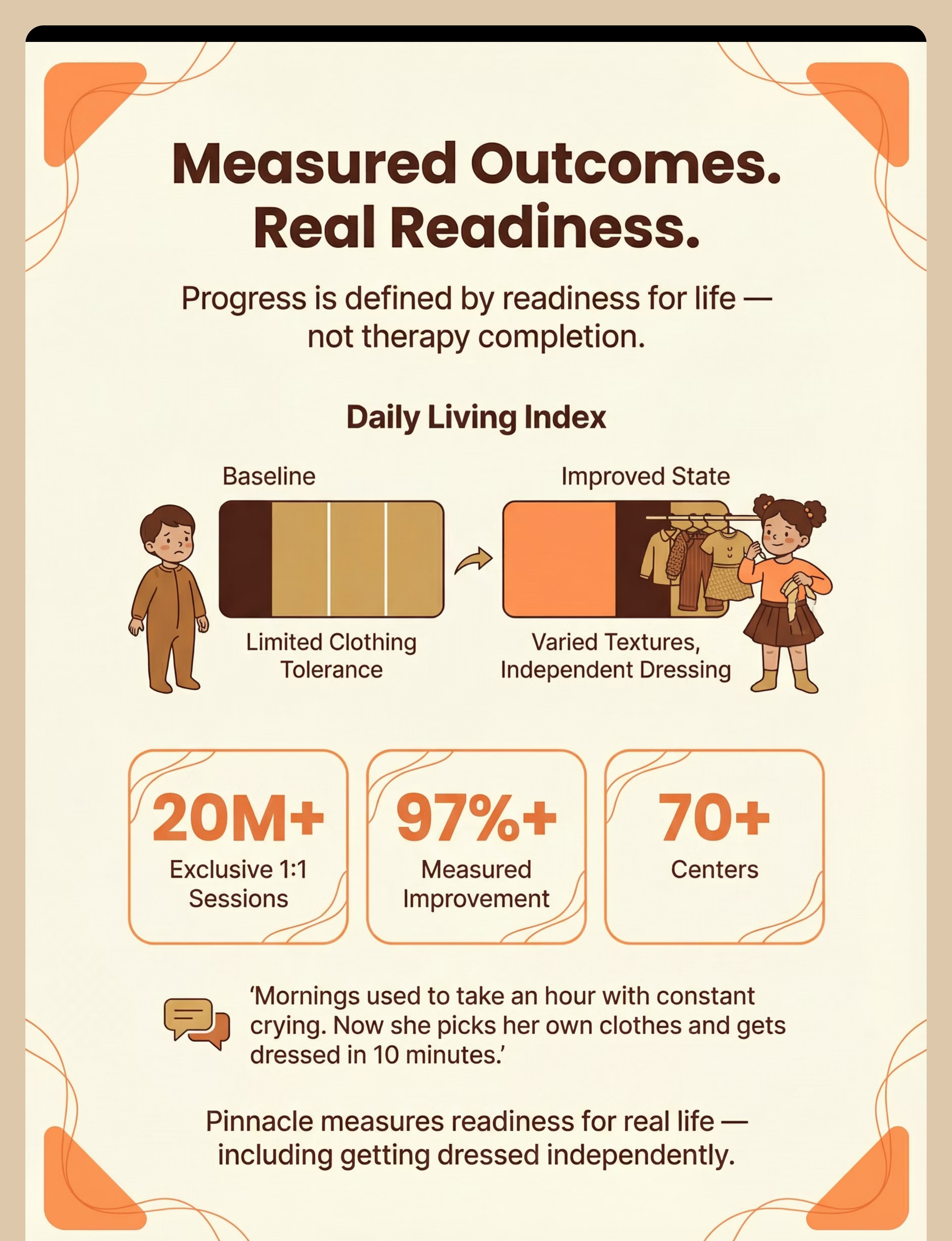
- Morning routine duration reduction — dressing time decreases from 30+ minutes to under 10
- Emotional regulation during dressing — meltdowns decrease in frequency and intensity
- Self-advocacy — child communicates fabric preferences using words rather than distress behaviors
Tertiary Targets: Long-Term Developmental Gains
- Social participation — attends school, events, and activities requiring specific attire
- Self-care independence — contributes to the Daily Living & Independence Index
- Sensory processing maturation — nervous system tolerance broadens across domains
- Parent-child relationship quality — dressing is no longer a daily battleground
Meta-analysis (World J Clin Cases, 2024): Sensory integration therapy effectively promoted social skills, adaptive behavior, sensory processing, and motor skills across 24 studies. PMC10955541
What You Need: The 9 Materials
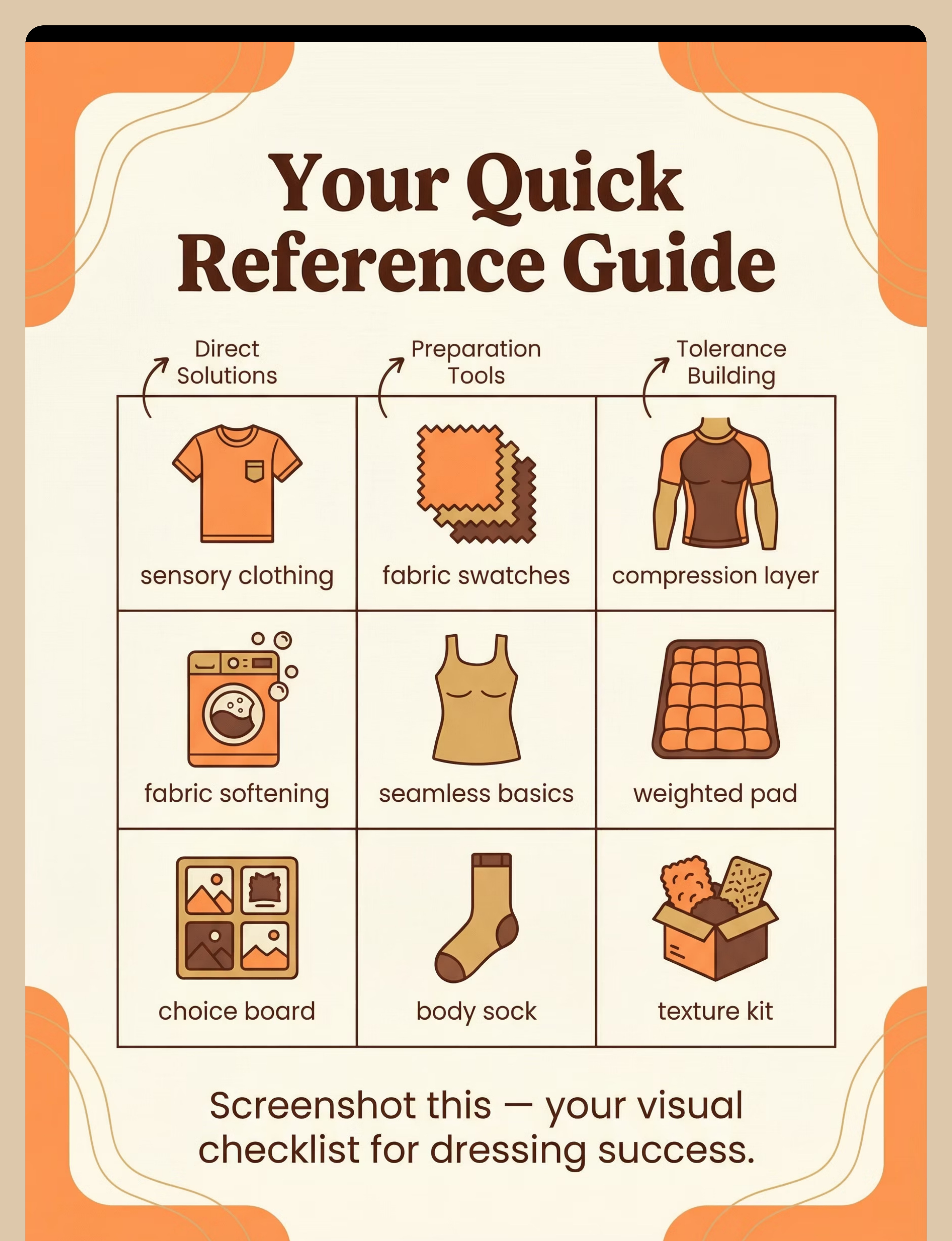
These nine materials form the complete toolkit for the Fabric Freedom Plan. You don't need all of them to start — but understanding each one lets you build toward a comprehensive approach tailored to your child's specific tolerance profile.
Direct Fabric Solutions
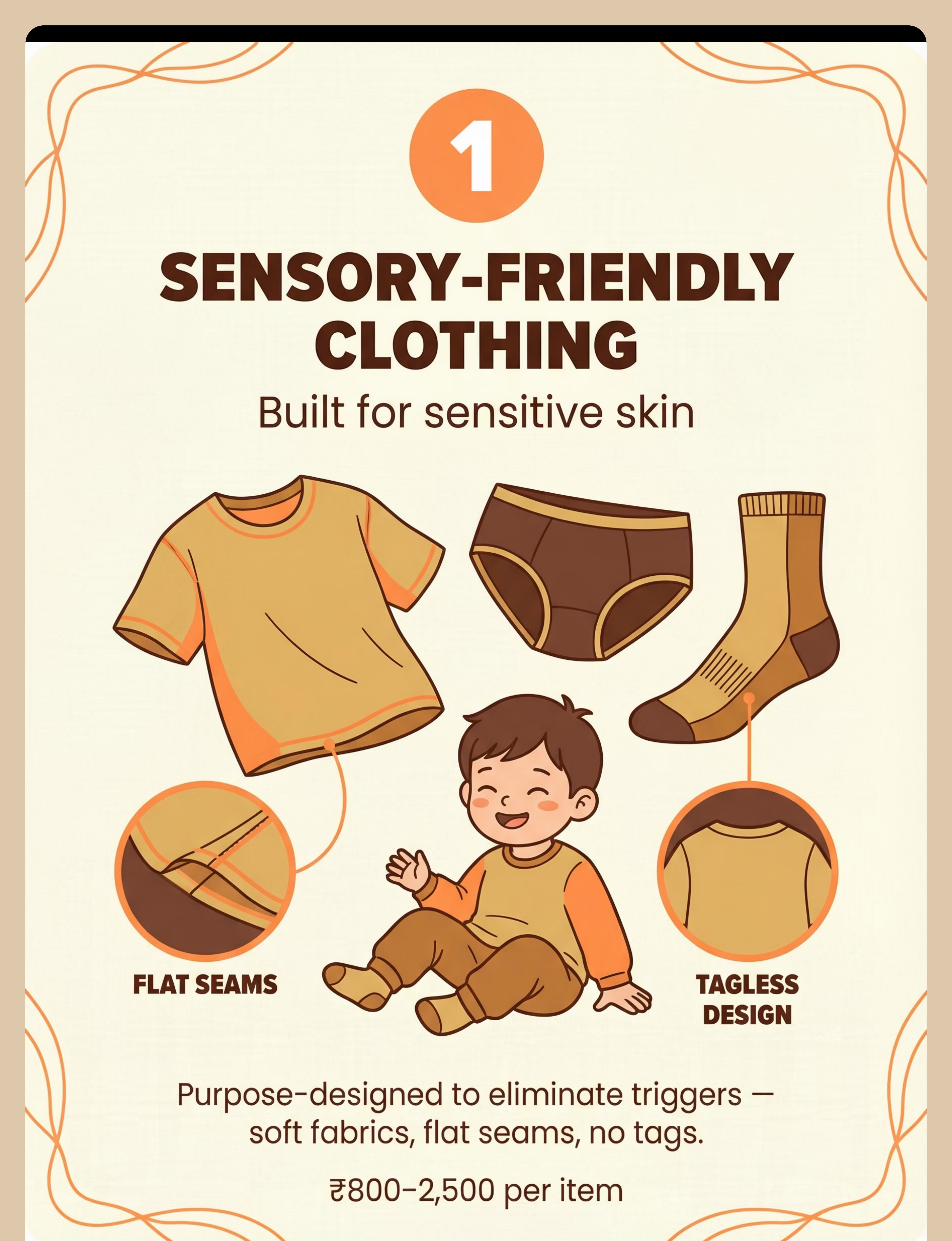
- 1. Bamboo Fabric Clothing — Sensory-Friendly Clothing
- 2. Modal / Micromodal Fabrics — Sensory-Friendly Clothing
- 3. Fleece & Minky Fabrics — Sensory-Friendly Clothing
Preparation Strategies
- 4. Pre-Worn / Hand-Me-Down Clothing — Accommodation Strategy
- 5. Intensive Pre-Washing Protocol — Accommodation Strategy
- 6. Seamless Sensory Clothing — Specialized Clothing
Assessment & Tolerance Building
- 7. Fabric Swatch Testing Kit — Assessment Tool
- 8. Compression Base Layers — Compression Garments
- 9. Gradual Fabric Exposure Program — Therapeutic Protocol
Total investment for comprehensive approach: ₹2,000–8,000 | Essential starters (under ₹500): Pre-Washing Protocol + Hand-Me-Downs + DIY Fabric Swatch Kit
Material 1: Bamboo Fabric Clothing
Bamboo fiber is structurally smoother than cotton at the microscopic level — a measurable physical property, not just a marketing claim. For children with tactile hypersensitivity, this structural difference is the difference between a shirt they'll wear and one they'll throw across the room.
Why It Works
Bamboo fiber has a naturally round, smooth surface that minimizes friction against sensitive skin. It is naturally hypoallergenic and maintains softness after repeated washing — unlike cotton, which can stiffen and roughen over time.
How to Use It
Start with bamboo t-shirts and underwear — the highest-contact garments. Pre-wash 3–5 times before first wear. Introduce alongside a preferred fabric swatch so the child can compare and choose.
Cost & Availability
₹500–1,200 per garment. Available online and in specialty children's clothing stores. Search: "bamboo sensory clothing children India."
Category: Sensory-Friendly Clothing
Material #1 of 9
Material 2: Modal / Micromodal Fabrics
Modal is a semi-synthetic fiber derived from beech tree pulp. Micromodal takes this further — it is one of the softest fabrics in commercial production. For children on the sensory sensitivity spectrum, modal garments can bridge the gap between preferred and non-preferred textures.
Key Properties
- Extraordinarily soft against skin — softer than premium cotton
- Moisture-wicking — reduces the damp, clammy sensation that triggers many children
- Lightweight and breathable — reduces thermal discomfort layered on top of tactile sensitivity
- Maintains softness after hundreds of washes
How to Use It
Modal works exceptionally well as underwear and base layers — garments worn closest to the skin where tactile sensitivity is highest. Introduce as an alternative to cotton underwear first, then expand to t-shirts and pajamas.
Pro tip: Buy in the same color and style as a currently accepted garment. Reduce all variables except fabric type so the child can isolate and evaluate the texture difference.
₹400–1,000/garment
Material #2 of 9
Material 3: Fleece & Minky Fabrics
Fleece and Minky fabrics occupy a unique position in the sensory-friendly wardrobe — they provide consistent, enveloping softness with a predictable texture that many tactile-sensitive children find deeply regulating rather than aversive.
What Makes These Different
Fleece is a synthetic knit with a consistent, uniform pile. Minky (plush polyester) has a dense, velvet-like surface. Both eliminate the variable weave patterns of woven fabrics that many sensory-sensitive children find unpredictable and distressing.
Best Use Cases
Ideal for pajamas, loungewear, and weekend clothing when school uniform requirements don't apply. Also excellent as a transition fabric — introduce in low-demand, high-comfort settings first (bedtime, couch time) before extending to daytime wear.
Limitation to Know
Fleece is warmer than cotton — not suitable for hot climates without climate control. Monitor for overheating, which independently heightens tactile sensitivity.
₹400–1,000/garment
Material #3 of 9
Material 4: Pre-Worn / Hand-Me-Down Clothing
This is the most underutilized strategy in sensory-friendly clothing — and it costs nothing. New clothing is structurally harsher than worn clothing. Fabric fibers are stiffer, dye finishes are unbroken, and the tactile profile is at its most irritating precisely when the garment is brand new.
The principle: Your child's "favorite old shirt" is not just emotionally preferred — it is physically different from a new shirt. The fibers have softened, the weave has relaxed, and the surface has been transformed by dozens of washes.
Strategy A: Buy More of What Works
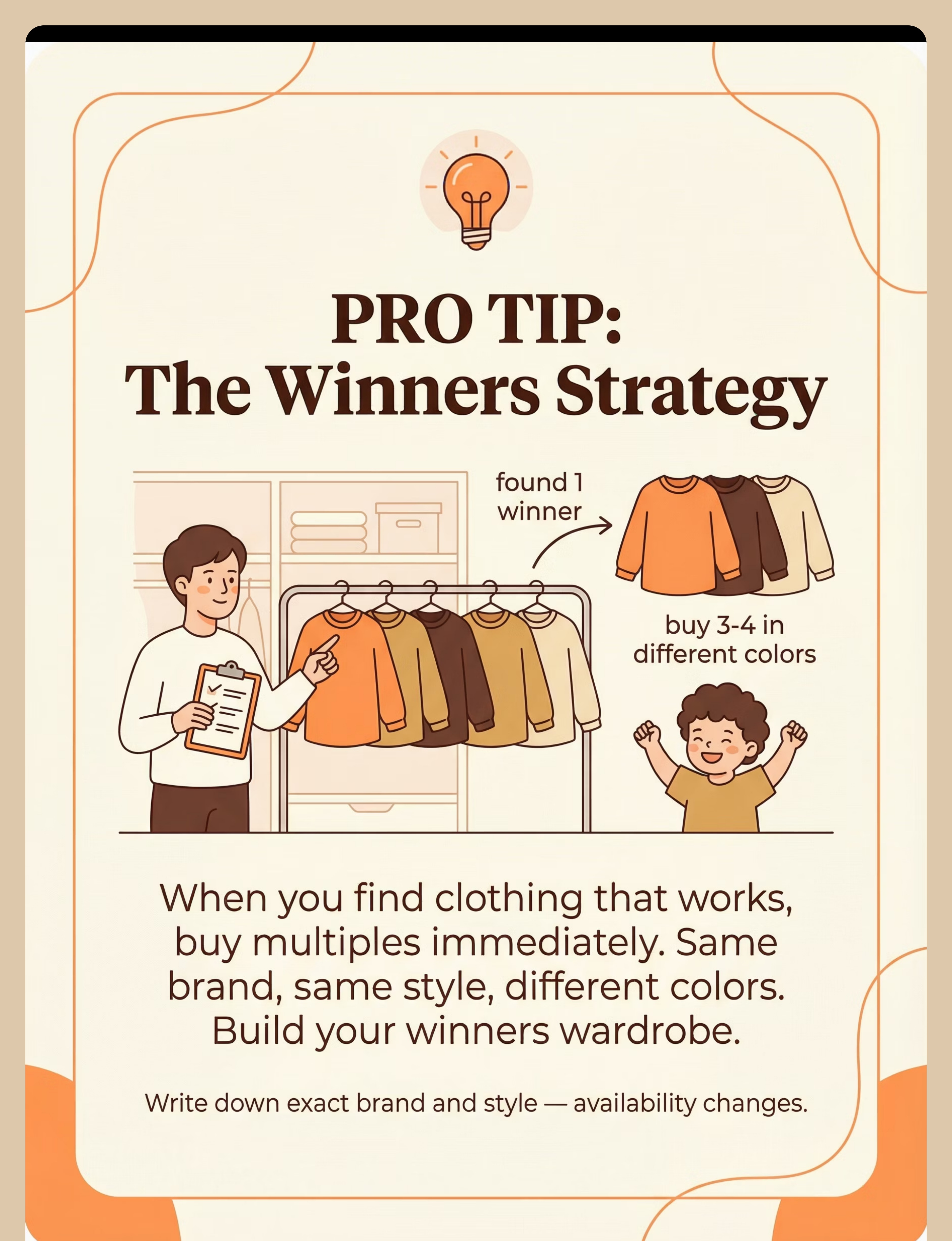
Identify your child's 2–3 currently accepted items. Note the exact brand, style number, and fabric composition. Buy multiple copies — new ones will need 5–10 washes to reach the tactile profile your child accepts.
Strategy B: Source Pre-Worn
Thrift stores, clothing swaps, and family hand-me-downs provide already-softened garments. The tactile harshness of newness has already been washed away — giving your child a better starting point.
Cost: ₹0–500
Material #4 of 9
Material 5: Intensive Pre-Washing Protocol
The Intensive Pre-Washing Protocol is a zero-cost, high-impact accommodation strategy that transforms newly purchased clothing into sensory-acceptable garments before your child ever touches them. This single strategy can rescue an entire wardrobe of rejected items.
01
Wash 1–3: Break the Fiber
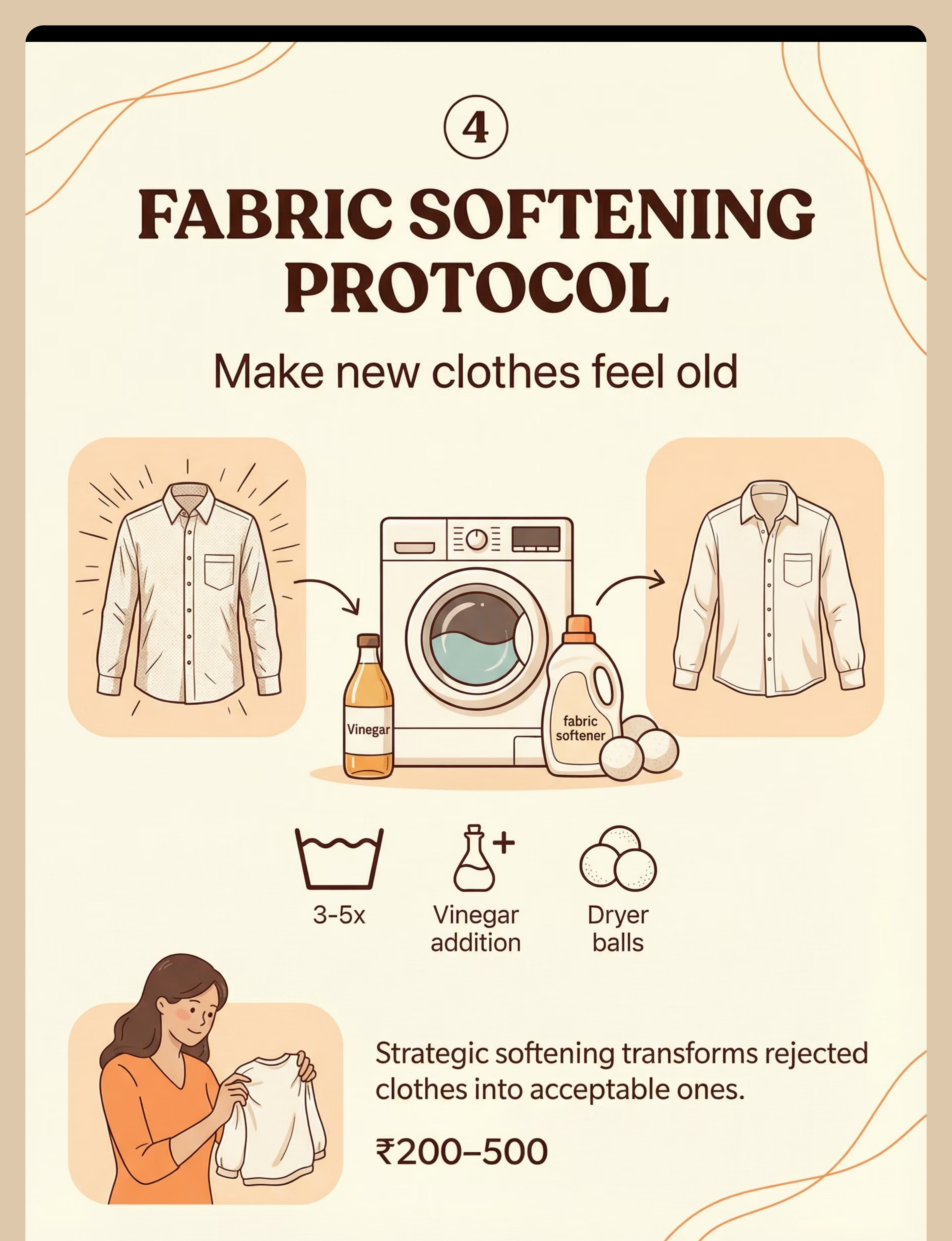
Wash in warm water with a fragrance-free, dye-free detergent. This begins breaking down the sizing agents and stiffening chemicals applied during manufacturing.
02
Wash 4–6: Soften the Surface
Add ½ cup of white vinegar (₹30) to the rinse cycle instead of fabric softener. Vinegar naturally breaks down residual detergent and softens fibers without chemical fragrance.
03
Wash 7–10: Final Conditioning
Repeat vinegar rinse. Line-dry in natural sunlight — sun-drying naturally softens fibers further and eliminates chemical scent from machine drying.
Pro tip: Test one item from a new batch before washing the entire purchase. If it passes the swatch test after 5 washes, proceed with the full batch. If it fails after 10 washes, that fabric composition may not be compatible with your child's sensory profile.
Cost: ₹200–400
Material #5 of 9
Material 6: Seamless Sensory Clothing
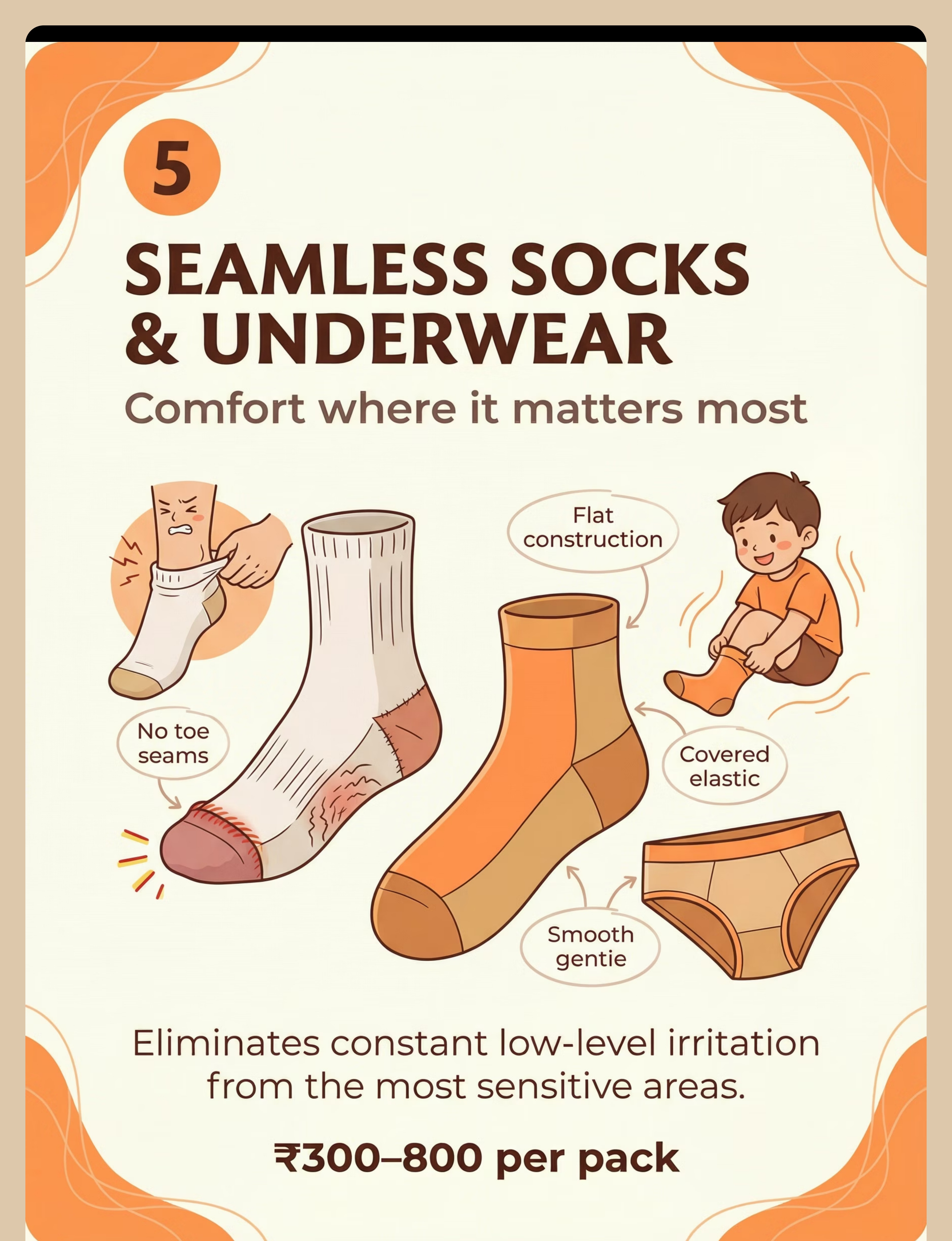
For many tactile-sensitive children, the fabric itself is not the primary trigger — the seams are. Interior seams create raised ridges of doubled fabric that press against skin with every movement. Seamless clothing eliminates this variable entirely, often unlocking fabric tolerance that was previously blocked by seam discomfort.
What "Seamless" Actually Means
True seamless clothing is knitted in a circular construction — there are no seams because the garment was never cut and sewn. The result is a smooth, uniform interior surface with no pressure points. This is especially important for socks, underwear, and undershirts — the highest-contact garments.
DIY Seamless Modification
For garments you already own, turn them inside-out to move interior seams to the exterior. Cover remaining interior seam ridges with soft fabric tape or ribbon sewn flat against the surface.
This zero-cost modification can immediately transform a rejected garment into a wearable one — especially effective for school uniforms where purchasing alternatives is not an option.
Cost: ₹600–1,500/garment
Material #6 of 9
Material 7: Fabric Swatch Testing Kit
The Fabric Swatch Testing Kit is both an assessment tool and a therapeutic instrument. It gives you clinical-grade data about your child's tolerance hierarchy while simultaneously functioning as the core material for every tolerance-building session described in this protocol.
What to Include
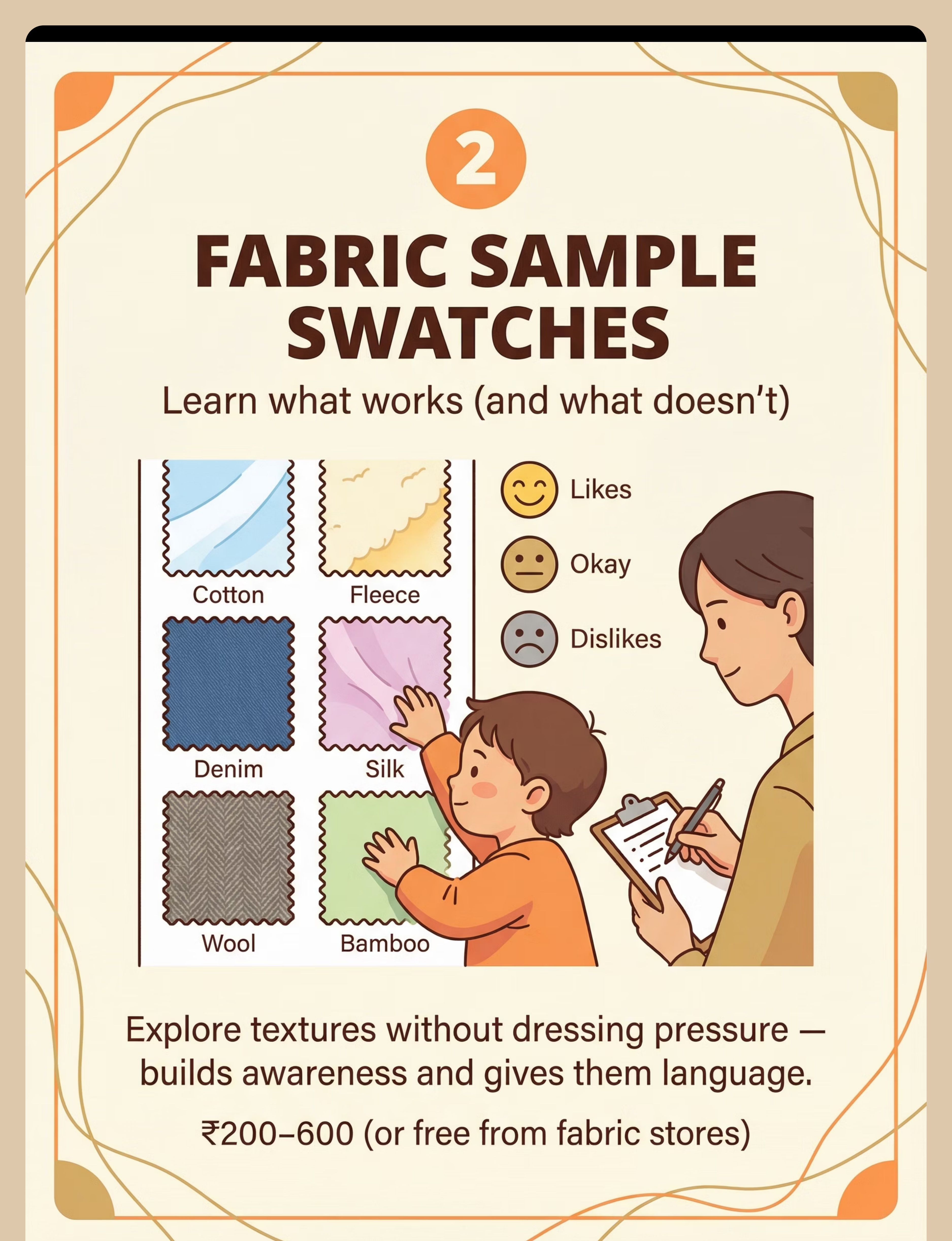
Cut 10cm × 10cm squares from: cotton (old t-shirt), polyester, bamboo, modal, fleece, minky, denim, wool/wool-blend, silk or satin, and jersey knit. Label each square with the fabric name and a simple icon.
How to Assemble (DIY — Free)
Source fabric scraps from old clothing, fabric stores, or tailors. Store in a labeled ziplock bag or small container. Add a sorting card with three columns: 😊 Feels Good / 😐 It's Okay / 😟 Don't Like.
What You Learn From It
Within one session, you have your child's complete fabric tolerance hierarchy — a map that guides every clothing purchase decision for the next 6–12 months. This eliminates the guesswork that leads to expensive wardrobe mistakes.
"The swatch kit changed everything — we stopped guessing and started knowing." — Parent, Hyderabad (Pinnacle Network outcome)
Cost: ₹200–1,000 (DIY or commercial)
Material #7 of 9
Material 8: Compression Base Layers
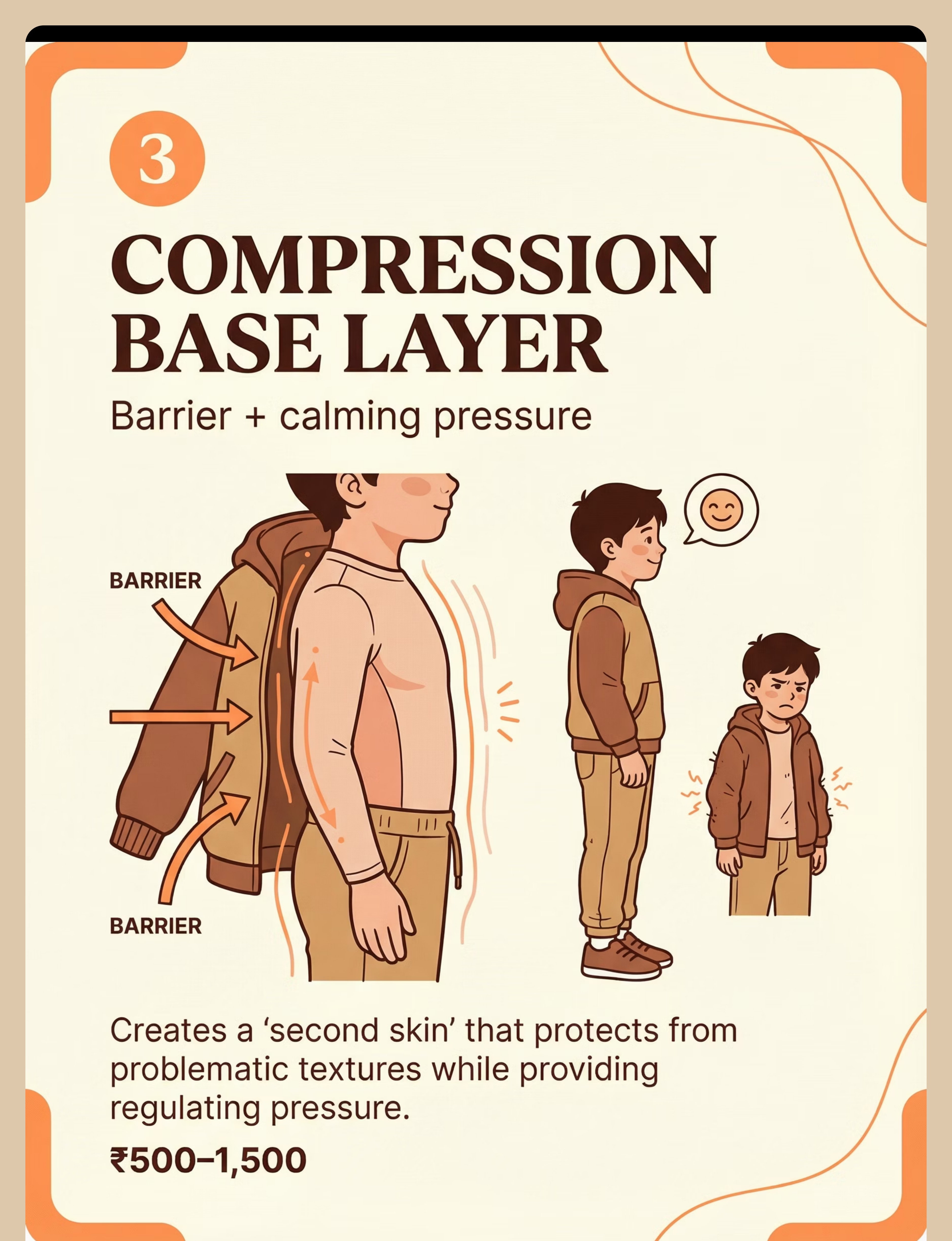
Compression garments work on a different sensory principle than fabric softness — they provide consistent, firm, proprioceptive input that helps regulate the nervous system's overall tactile sensitivity. Think of it as turning down the volume on the sensory alarm before adding the potentially triggering fabric on top.
The Mechanism
Deep pressure input activates the proprioceptive system, which has a calming and organizing effect on the tactile system. A child wearing a compression base layer underneath a school uniform is simultaneously receiving regulating proprioceptive input that reduces tactile overreactivity.
Key Application
Compression base layers are the most effective immediate strategy for school uniform tolerance. Wear under the uniform shirt and trousers. The compression layer serves as the primary skin contact, while the uniform fabric touches the compression layer — not the skin directly.
DIY Alternative
A snug-fitting dance leotard or athletic undershirt from a thrift store (₹50–200) achieves similar proprioceptive input. Must be tight but not restrictive — two fingers should fit comfortably under the garment at any point.
Cost: ₹500–1,200
Material #8 of 9
Material 9: Gradual Fabric Exposure Program
The Gradual Fabric Exposure Program is not a product you purchase — it is the therapeutic protocol that ties all eight materials together into a coherent, scientifically grounded intervention. It is the most powerful tool in this toolkit, and it costs nothing beyond your time and consistency.
Phase 1: Proximity Without Demand
Non-preferred fabrics are present in the environment but no touching is required. Child becomes comfortable with their presence over 1–2 sessions.
Phase 2: Voluntary Contact
Child chooses when and how to touch fabrics. The swatch sorting game (Card 16) is the primary vehicle. All contact is voluntary, play-based, and reinforced immediately.
Phase 3: Extended Tolerance
Child holds non-preferred fabrics for increasing durations. Brief try-ons of neutral fabrics are introduced. Compression base layers support extended wear of previously rejected items.
Phase 4: Generalization
Tolerance built in sessions transfers to real dressing situations. Child independently selects from an expanded wardrobe. New fabrics are introduced without structured protocol.
Cost: ₹0 (DIY) + OT consult recommended
Material #9 of 9
DIY & Substitute Options
Because every parent, in every village, in every country deserves access to this intervention. The full protocol is executable without purchasing any specialized products. Here is a complete buy-vs-make guide for every material in this toolkit.
Buy This | Make This (₹0–₹50) | |
Bamboo clothing (₹500–1,200) | Identify currently accepted clothes. Buy more of the exact same brand, style, and fabric composition. | |
Fabric swatch kit (₹500–1,000) | Cut 10cm squares from old clothes and fabric store scraps. Label each. Create a "likes/okay/dislikes" sorting card. | |
Compression base layer (₹500–1,200) | Snug-fitting dance leotard or athletic undershirt from thrift store. Must be tight but not restrictive. | |
Seamless clothing (₹600–1,500) | Turn regular clothing inside-out to move seams to exterior. Cover interior seams with fabric tape or soft ribbon. | |
Pre-washing supplies (₹200–400) | White vinegar (₹30) added to rinse cycle achieves similar softening. Sun-dry on line to naturally soften fibers. |
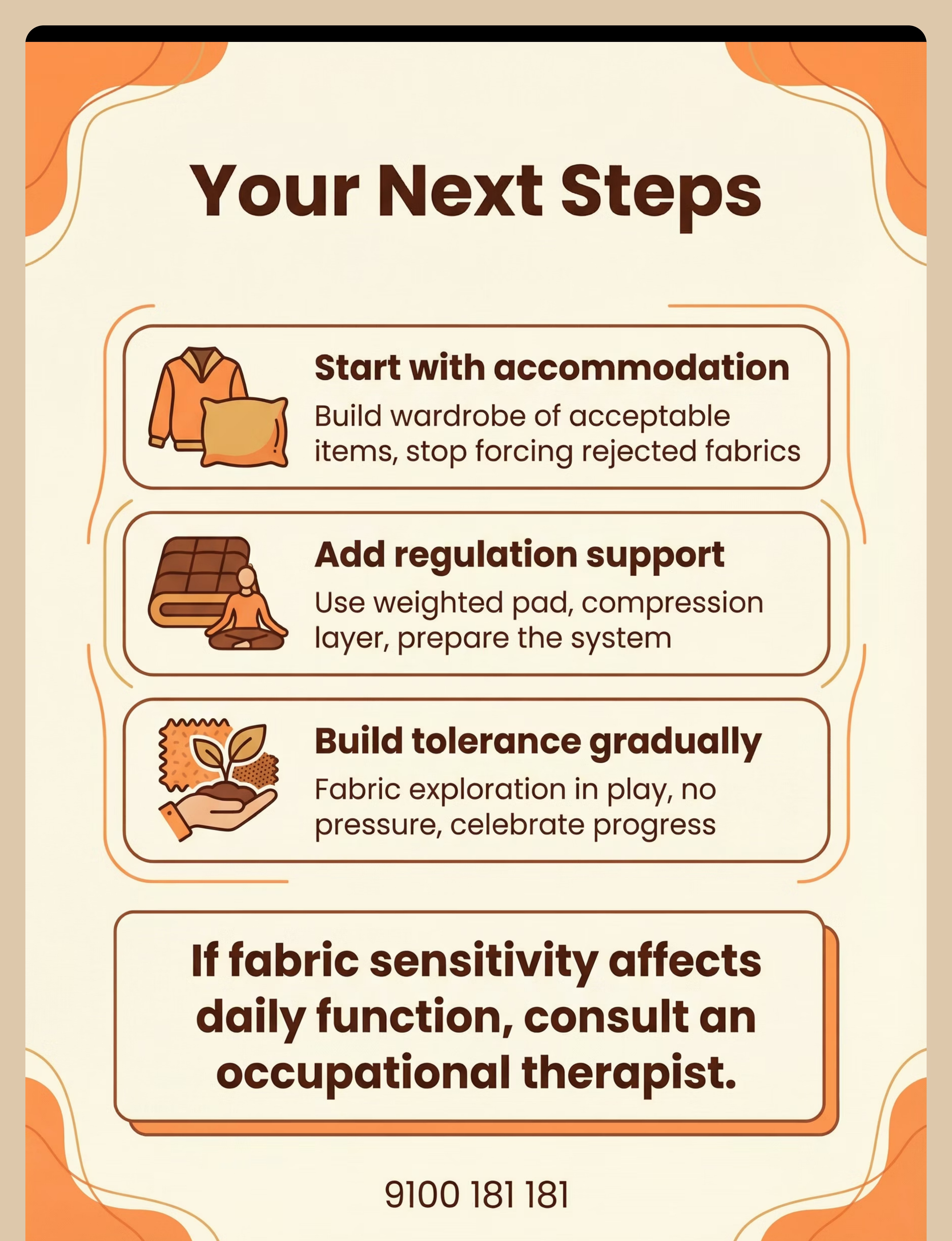
Zero-cost version of this technique: Identify your child's 2–3 accepted items → buy identical replacements → wash all new items 5–10 times before first wear → let child sort fabrics by touch in play (no pressure) → celebrate every new accepted item.
Caveat: For severe fabric restriction (fewer than 3 acceptable items) or significant functional impairment, clinical-grade OT assessment is strongly recommended. | WHO Nurturing Care Framework (2018) — context-specific, equity-focused interventions. PMC9978394
Safety First: Before You Begin
Every session begins with a 60-second safety check. The right conditions multiply impact. The wrong conditions multiply harm. This traffic-light system protects both your child's nervous system and your therapeutic relationship.
🟢 GREEN — Proceed
- Child is calm, fed, and rested
- No skin irritation, rash, or open wounds on contact areas
- Environment is quiet, predictable, low-demand
- You have at least 10–15 minutes without time pressure
- You are calm and prepared — your state matters
🟡 AMBER — Modify
- Child is slightly dysregulated → Use shorter exposure, preferred fabrics only
- Recent meltdown (within 1 hour) → Skip tolerance building, use accommodation only
- Child recovering from illness → Skin sensitivity may be temporarily heightened
- Time pressure (school morning) → NOT the time for tolerance building. Accommodate today, practice tomorrow.
🔴 RED LINE — Stop & Consult
- Complete inability to tolerate ANY clothing
- Fabric sensitivity appearing suddenly — rule out dermatitis, allergies, skin conditions
- Self-injury related to fabric — scratching until bleeding, skin picking at contact points
- Significant functional impairment — cannot attend school due to uniform
- Extreme distress lasting hours after wearing non-preferred fabric
- Any skin reaction (redness, welting, hives) when fabric touches skin
Call Pinnacle National Autism Helpline: 9100 181 181 — FREE, 18+ languages. For when accommodation strategies aren't sufficient, the wardrobe is extremely restricted (fewer than 5 acceptable items), or daily functioning is significantly impaired.
Research anchor: Padmanabha et al. (2019) — home-based sensory intervention safety protocols. DOI: 10.1007/s12098-018-2747-4
Set Up Your Space
The environment is not background — it is an active ingredient in every session. A well-configured space reduces baseline arousal, increases the child's sense of safety, and doubles the effectiveness of every therapeutic action you take.
Lay Out Materials in Order
Place 3–5 fabric swatches or clothing items on a clean, flat surface — bed or floor mat. Position the child's preferred/accepted item FIRST in the lineup as a comfort anchor.
Arrange by Tolerance Level
Neutral items in the middle, challenging items at the end. Always have a "safe" preferred outfit ready nearby — the child can always return to comfort.
Optimize the Environment
Remove visual clutter — only session-relevant items visible. Remove tags from all items. No distracting toys. No time pressure. Comfortable room temperature (temperature extremes heighten tactile sensitivity).
Position Yourself Correctly
Sit at child's level. Side-by-side, not face-to-face. Relaxed posture with hands visible. Natural light preferred. No overhead fluorescent lighting. Quiet environment — no TV or competing auditory input.
Sensory Integration Theory (Ayres): Environmental setup is a core principle. 1:1 individual treatment in structured environments was most effective. PMC10955541
Is Your Child Ready? Readiness Check
The best session is one that starts right. A 60-second pre-session assessment protects both the child's nervous system and your therapeutic relationship. Skipping a session is always better than forcing one.
✅ Complete This Checklist First
- Child has eaten within the last 2 hours
- Child has had adequate sleep
- No meltdown in the past 60 minutes
- No illness symptoms or skin irritation present
- Child is in a regulated, neutral-to-positive state
- No time pressure — you have 15+ minutes
- You are calm and not frustrated about clothing today
✅ All Green → GO
Begin with Step 1: The Invitation. Full session as described.
⚠️ 1–2 Amber → MODIFY
Shortened version only: preferred fabrics today, brief touch-only exposure to one new texture, extra reinforcement for any engagement.
🔴 Any Red → POSTPONE
Use accommodation only today. Offer preferred clothing without any exposure component. Try again tomorrow. No guilt — this is clinical judgment, not failure.
Step 1: The Invitation
Step 1 of 6
Duration: 30–60 seconds
The opening of every session sets the emotional tone for everything that follows. The goal is play, not therapy — even though this IS therapy. Your child should feel invited, not assessed. Curious, not obligated.
"Hey [child's name], want to play the fabric game? Let's see which ones feel nice today. You pick first!"
Body Language
- Casual, playful tone — NOT clinical or therapeutic
- Sit beside child, not across from them
- Touch a swatch yourself first — model that it is safe
- Smile. This is play, not a test.
Reading the Response
Acceptance looks like: Child approaches the materials, touches or picks up a swatch, looks at you and the materials with curiosity.
Resistance looks like: Child turns away or says "no," body tenses, moves toward preferred/safe items.
If resistance: "That's okay! Let's just play with this one you like." Start with accepted fabric only. End the session positively. Try again tomorrow.
Step 2: The Engagement
Step 2 of 6
Duration: 1–3 minutes
Material introduction follows a deliberate sequence. You are not presenting a challenge — you are presenting a spectrum. The preferred fabric is the anchor that makes the neutral fabric safe to approach.
1
1. PREFERRED
A fabric you know the child accepts. This is the comfort anchor — always first.
2
2. NEUTRAL
A fabric the child hasn't strongly rejected. The test item — placed second, not first.
3
3. CHALLENGING
Keep nearby but not in active play. Available only if child reaches for it independently.
"Feel this one — this is the soft one you like! Now let's see how this one feels. You can touch it or not — totally your choice."
Engagement ✅
Child touches, holds, or describes the fabric → Reinforce immediately!
Tolerance ✅
Child touches briefly, doesn't pull away → Praise: "You tried it!"
Avoidance ➡️
Child refuses touch → "That's okay. Let's go back to the soft one."
Research anchor: PMC11506176 — sensory integration intervention with structured material introduction.
Step 3: The Therapeutic Action
Step 3 of 6
Duration: 3–5 minutes
This is the heart of the protocol. The Fabric Sorting Game is the primary therapeutic vehicle — designed to feel completely like play while accomplishing four clinical objectives simultaneously.
The Setup
Spread 5–6 fabric swatches on the surface. Give child two containers labeled with pictures (not just words): 😊 "Feels Good" | 😐 "It's Okay" | 😟 "Don't Like." Let child sort each fabric independently.
What Is Happening Clinically
- Child engages with non-preferred textures voluntarily
- Child builds vocabulary for fabric preferences
- You receive clinical-grade data on their tolerance hierarchy
- Child experiences agency and control over the sensory experience
Common Execution Errors
- Placing fabric directly on child's skin → Let child handle it themselves
- Correcting the child's sorting ("But this one is soft!") → Their perception IS their reality
- Rushing → Let them hold each swatch as long as they need
- Ignoring the "It's Okay" category → This is where tolerance expansion happens
Step 4: Repeat & Vary
Step 4 of 6
Target: 3–5 sorts per session, 2–3x/week
Repetition builds neural pathways. Variation maintains engagement. Rotate between these five activity variations across sessions — never use more than one variation within a single session.
Variation A: Fabric Matching
Match swatches to clothing items. "Which shirt feels like this swatch?" Builds recognition and expands category association.
Variation B: Fabric Hide-and-Seek
Hide swatches under cushions. Child finds and sorts them. Adds movement and excitement to what might otherwise feel repetitive.
Variation C: Fabric Art
Glue swatches onto paper to make a texture collage. Engages with non-preferred textures through craft — no wearing required.
Variation D: Fabric Detective
Child closes eyes, touches swatch, guesses which fabric it is. Builds descriptive language AND tolerance simultaneously.
Variation E: Dress the Teddy
Child chooses fabric swatches to "dress" a stuffed animal. Projects clothing decisions onto toy, not self — a powerful projection technique.
Satiation indicators — the child has had enough when: Sorting becomes rushed or random | Child starts playing with something else | Energy drops or fidgeting increases | Child directly says "all done." "3 good sorts are worth more than 10 forced ones."
Step 5: Reinforce & Celebrate
Step 5 of 6
Reinforce within 3 seconds of desired behavior
Reinforcement is not a reward for compliance — it is neurological signal amplification. When you celebrate an attempt within three seconds, you strengthen the neural association between fabric engagement and positive experience. This is the mechanism behind tolerance expansion.
Child touches non-preferred fabric: "You touched it! That was brave!"
Child sorts a challenging fabric: "You figured out exactly how that one feels. Great job!"
Child uses a descriptive word: "You said 'scratchy' — that tells me exactly what you feel. Thank you for using your words!"
Child tries a new clothing item briefly: "You tried it on! Even for 10 seconds — that's a WIN."
Reinforcement Menu
Verbal Praise
Immediate, specific, enthusiastic — most powerful reinforcer for most children
Physical
High-five or preferred physical interaction — match to child's preferences
Visual Tracker
Sticker on a "Fabric Explorer" chart — visible, cumulative progress
Activity Choice
Preferred activity after session — earns "favorite shirt time"
KEY PRINCIPLE: "Celebrate the attempt, not just the success. A child who touches a non-preferred fabric for 2 seconds and says 'I don't like it' has shown MORE courage than a child who never engages."
Step 6: The Cool-Down
Step 6 of 6
Duration: 1–2 minutes
Every session must end on a regulated, positive note. The cool-down is not optional — it is the emotional signal that closes the loop and prepares the nervous system for the transition back to everyday life.
1
Transition Warning
"Two more swatches, then we're all done with the fabric game!" Give the child advance notice — abrupt endings can trigger dysregulation that colors the memory of the whole session.
2
Return to Preferred Fabric
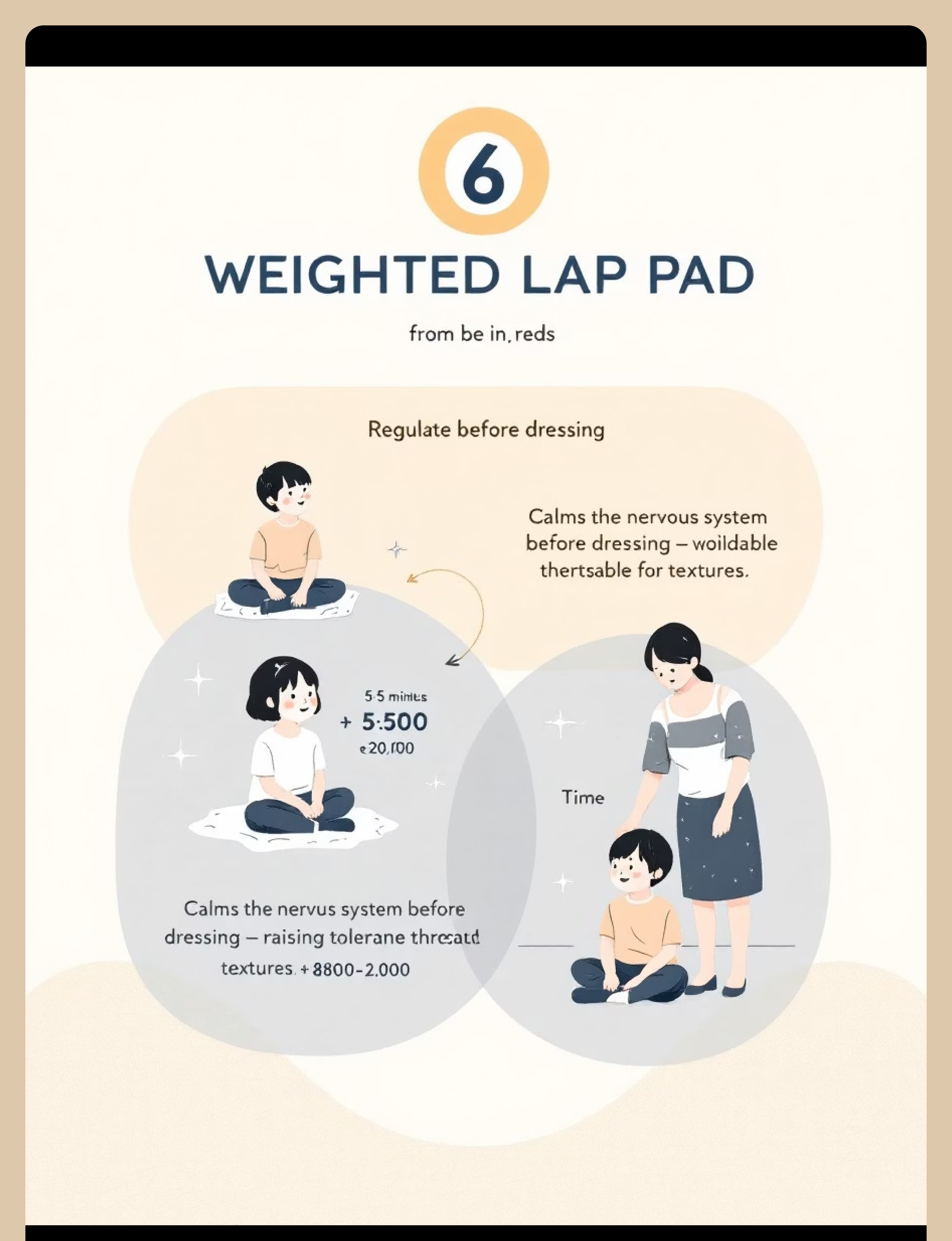
Let the child hold, squeeze, or wrap in their preferred fabric. Deep pressure input: firm hug, weighted lap pad, or compression. This is nervous system first aid — always available.
3
Material Put-Away Ritual
Child helps put swatches back in container — participatory closure that builds a sense of completion. "Let's put the fabrics to sleep. We'll play again [day]."
4
Bridge to Next Activity
Offer a completely non-fabric activity: snack, outdoor play, preferred toy. This creates a clean transition and ensures the post-session association is positive.
If child resists ending: Offer one more turn: "One more swatch, then all done." Use a visual timer if available. Never end on a negative — always return to a preferred fabric before closing.
Capture the Data: Right Now
Within 60 seconds of session end, record four data points. This is not bureaucracy — it is the intelligence layer that personalizes the protocol for your child over time. Without data, you are guessing. With data, you are guided.
1
Fabrics Touched Today
List the names of every fabric the child made contact with during the session — preferred, neutral, and challenging.
2
New Fabric Accepted or Tolerated
Yes/No + which fabric. "Tolerated" counts — brief contact without distress is a measurable milestone worth tracking.
3
Child's Overall Mood During Session
😊 Happy / 😐 Neutral / 😟 Distressed. One-second observation. This is your readiness data for the next session.
4
Dressing Ease This Morning
Easy / Some difficulty / Major struggle. Tracks real-world functional impact of the protocol over time.
"60 seconds of data now saves hours of guessing later." Download: [Fabric Tolerance Tracking Sheet — PDF] | [GPT-OS® In-App Tracker]
ABA data collection standards — continuous measurement (frequency, duration, latency) as standard practice. BACB Guidelines + Cooper, Heron & Heward (Applied Behavior Analysis)
What If It Didn't Go As Planned?
Session challenges are not failures — they are clinical data. Every unexpected response tells you something specific and actionable about your child's current sensory state and tolerance ceiling. Here is how to decode and respond to the five most common challenges.
Problem 1: Child refused to touch any swatch
Why: Demand avoidance or previous negative association. This was too much too fast.
Fix: Next session, don't present swatches. Simply lay preferred fabric on table while child plays nearby. Just proximity. No demand.
Fix: Next session, don't present swatches. Simply lay preferred fabric on table while child plays nearby. Just proximity. No demand.
Problem 2: Child became distressed
Why: The neutral or challenging fabric triggered a genuine sensory aversion response.
Fix: Immediately return to preferred fabric. Provide deep pressure. Reduce to preferred-only next time.
Fix: Immediately return to preferred fabric. Provide deep pressure. Reduce to preferred-only next time.
Problem 3: Child only sorted preferred fabrics
Why: This IS progress — the child engaged with the activity and is building categorization skills.
Fix: Celebrate this. Over multiple sessions, add one neutral fabric at a time.
Fix: Celebrate this. Over multiple sessions, add one neutral fabric at a time.
Problem 4: Child threw or destroyed the swatches
Why: Overwhelm, frustration, or sensory-triggered fight response. Not a behavior problem — a sensory communication.
Fix: Reduce materials to 2 swatches. Increase preferred sensory input before next session.
Fix: Reduce materials to 2 swatches. Increase preferred sensory input before next session.
Problem 5: Morning dressing is still a disaster
Why: Tolerance building takes weeks. Accommodation is immediate.
Fix: Accommodation first, tolerance second. Build the "winners wardrobe" with only accepted fabrics. Fight the dressing battle with MATERIALS, not willpower.
Fix: Accommodation first, tolerance second. Build the "winners wardrobe" with only accepted fabrics. Fight the dressing battle with MATERIALS, not willpower.
"Session abandonment is not failure — it's data."
Adapt & Personalize
No two children have identical sensory profiles. The protocol scales up and down based on your child's current regulation state, tolerance ceiling, age, and sensory subtype. Here is your complete customization guide.
EASIER — Bad Days & Early Stages
Only preferred fabrics. Touch-only — never wear. 2 minutes maximum. Extra reinforcement for any engagement whatsoever.
STANDARD — As Described in Steps 1–6
Preferred + neutral fabrics. Touch and sort activities. 5–10 minutes. Standard reinforcement menu.
HARDER — Breakthrough & Advanced Stages
Include challenging fabrics in the mix. Brief try-on of neutral fabrics (10–30 seconds). 10–15 minutes. Reinforcement for extended tolerance duration.
By Sensory Profile
Avoider: Slow approach, small swatches, child controls all contact, lots of escape options available at all times.
Seeker: Larger fabric pieces, wrapping/draping activities, more tactile variety in single session.
By Age
- 2–3 years: Fabric peek-a-boo, texture books, teddy dress-up only
- 4–5 years: Full sorting game, "Fashion Show" with quick try-ons, fabric detective
- 6–8 years: Fabric journal (describes and rates), shopping participation, wardrobe planning
Week 1–2: What to Expect
Progress Stage 1
~15% toward mastery
The first two weeks are about establishing the protocol, not seeing the results. Neural pathway formation is invisible at this stage — but it is happening. Manage your expectations carefully, and you will sustain the consistency that makes the difference.
What You WILL Likely See
- Child engages with the fabric activity, even briefly
- Child sorts preferred fabrics correctly and consistently
- Child may touch one neutral fabric without distress
- Dressing battles may not change yet — this is completely normal
What "Progress" Looks Like Now
- Tolerating a non-preferred swatch for 3 seconds longer than Day 1
- Using a word to describe a fabric ("scratchy") instead of just refusing
- Willingness to sit near the materials without fleeing the room
What Is NOT Progress Yet
- Child does not suddenly accept new clothing items
- Morning routine is not yet faster or calmer
- Wardrobe has not expanded
"If your child tolerates the bamboo swatch for 3 seconds longer than last week — that's real neural pathway formation. Trust the process."
Week 3–4: Consolidation Signs
Progress Stage 2
~40% toward mastery
By weeks three and four, the protocol has become a familiar routine. The child's nervous system has begun to form stable associations between fabric engagement and positive experience. Watch for these consolidation signals — they confirm that tolerance expansion has genuinely begun.
Child Begins Requesting the Fabric Game
Anticipation is the most powerful consolidation signal. A child who asks for the session has formed a positive neural association with fabric engagement. This is the tipping point.
"It's Okay" Pile Gets More Items
The neutral category growing is clinical evidence of tolerance expansion. Track this quantitatively — count the items in each pile each session.
More Specific Fabric Language
Child describes fabrics with more specific language ("bumpy," "smooth," "rough") vs. just "don't like." Vocabulary development and tolerance expansion occur together.
May Accept ONE New Clothing Item
Especially if intensively pre-washed. This is the first real-world transfer of session gains — celebrate it visibly and specifically.
"You may notice you're more confident too. You're reading your child's sensory cues faster. The morning battles are shorter — not because the child changed overnight, but because YOU learned what works."
Week 5–8: Mastery Indicators
Progress Stage 3
~75–100% toward mastery
Mastery is observable, measurable, and generalizable. These are the specific criteria that define successful completion of the A-004 protocol — and the foundation for progression to the next technique in the series.
3+
New Fabric Types Accepted
Beyond original "safe" list — the core mastery measure
50%+
Dressing Time Reduction
From baseline — a direct functional quality-of-life measure
75%+
Meltdown Reduction
Fabric-related meltdowns decreased in frequency and intensity
Additional Mastery Criteria
- Child can wear a non-preferred fabric for a functional duration (e.g., full school day with compression layer underneath)
- Child independently selects clothing from expanded wardrobe
- Child uses verbal communication about fabric preferences consistently
Generalization Indicators
- Tolerates new clothing without intensive pre-washing (standard 2–3 washes sufficient)
- Accepts fabric variety in non-clothing contexts (furniture, car seats, bedding)
- Participates in clothing shopping without distress
Maintenance check: Does tolerance persist when the structured protocol is paused for 1 week? If yes → Mastery. If regression → Continue protocol at reduced frequency.
Celebrate This Win
You did this.
Eight weeks ago, your child had 3 acceptable shirts. Today, they have a wardrobe. Eight weeks ago, mornings meant tears. Today, they mean choices.
You learned the neuroscience. You built the swatch kit. You ran the sessions — on tired mornings, after long work days, when it felt like nothing was working. You kept going. Your child's nervous system literally rewired because you showed up consistently with the right materials and the right approach.
Family Celebration Suggestion
Let your child pick a new outfit — from a store, with their hands, choosing the fabric THEY want. Frame this as their achievement. They earned it.
Photo/Journal Prompt
Take a photo of your child choosing clothing independently. Date it. Write down the three fabrics they now accept that they didn't eight weeks ago. You'll want this memory.
Share This Win
Your story helps another parent start their journey. Share in the Pinnacle Parent Community — your outcome data strengthens the evidence base for every family that follows.
Red Flags: When to Pause
Trust your instincts. The following signs indicate that home protocol alone is insufficient and that professional evaluation is warranted. Pausing and seeking support is not defeat — it is the most clinically responsible action a caregiver can take.
🔴 Complete Inability to Tolerate Any Clothing
May indicate severe sensory, dermatological, or psychological issues requiring comprehensive evaluation beyond what home intervention can address.
🔴 Fabric Sensitivity Appearing Suddenly
If a previously tolerant child suddenly refuses all fabrics, rule out skin conditions (eczema, contact dermatitis, allergic reactions), illness, or trauma before resuming protocol.
🔴 Self-Injury Related to Fabric
Scratching until bleeding at fabric contact points, skin picking, or tearing at clothing aggressively. This requires immediate clinical evaluation — do not attempt continued home protocol.
🔴 Significant Functional Impairment
Child cannot attend school, social events, or essential activities due to fabric refusal despite 8+ weeks of consistent intervention.
🔴 Regression After Initial Progress
Tolerance that was clearly building suddenly collapses. Investigate triggers — illness, environmental change, trauma — before resuming.
Escalation pathway: 1. Self-resolve with modified protocol → 2. Teleconsultation with Pinnacle OT → 3. In-person clinic evaluation.
Pinnacle Center Locator:pinnacleblooms.org/centers | Helpline: 9100 181 181 (FREE, 18+ languages)
Pinnacle Center Locator:pinnacleblooms.org/centers | Helpline: 9100 181 181 (FREE, 18+ languages)
The Progression Pathway
A-004 does not exist in isolation. It is one node in a carefully sequenced tactile sensitivity series. Knowing where you've been and where you're headed transforms isolated technique use into a coherent developmental plan.
← Prerequisites
A-001: Touch Sensitivity (General) — foundational tactile regulation
A-003: Clothing Tag Sensitivity — targeted tag-specific intervention
A-003: Clothing Tag Sensitivity — targeted tag-specific intervention
📍 YOU ARE HERE
A-004: Fabric Refusal — 9 Materials Protocol
Complete this technique before advancing to the next level.
Complete this technique before advancing to the next level.
→ Next Level Options
A-005: Seam Sensitivity in Socks
A-006: Waistband Sensitivity
A-007: Temperature Sensitivity in Clothing
A-006: Waistband Sensitivity
A-007: Temperature Sensitivity in Clothing
Browse full Tactile Sensitivity Series:techniques.pinnacleblooms.org/sensory/tactile
Related Techniques in This Domain
You have already assembled materials for this technique. The good news: those same materials unlock five additional techniques in the Tactile Sensitivity Series. Your investment goes further than you may realize.
Technique | Level | Materials You Already Have | |
A-001: Touch Sensitivity (General) | Intro | Fabric swatches, texture kit | |
A-002: Hates Being Touched | Intro | Compression garments, weighted items | |
A-003: Clothing Tag Sensitivity | Intro | Seamless clothing, scissors | |
A-005: Seam Sensitivity in Socks | Core | Seamless socks, compression layers | |
A-006: Waistband Sensitivity | Core | Compression layers, seamless items | |
A-007: Temperature Sensitivity | Core | Fabric swatches, layering system |
"You already own materials for 4 of these techniques." Domain: Sensory — Tactile Processing (SEN-TAC)
Browse full domain:techniques.pinnacleblooms.org/sensory/tactile
Your Child's Full Developmental Map
This technique is one carefully placed piece in a 12-domain developmental system. Understanding how A-004 connects to your child's broader profile transforms individual technique use into whole-child developmental planning.
Domain A: Sensory ← PRIMARY
Tactile processing, sensory regulation, fabric and texture tolerance
Domain G: Self-Care
Dressing independence, grooming, daily living skills
Domain H: Emotional
Regulation during transitions, emotional vocabulary, distress tolerance
Domain L: Family
Reduced caregiver stress, improved parent-child relationship quality, family routine functioning
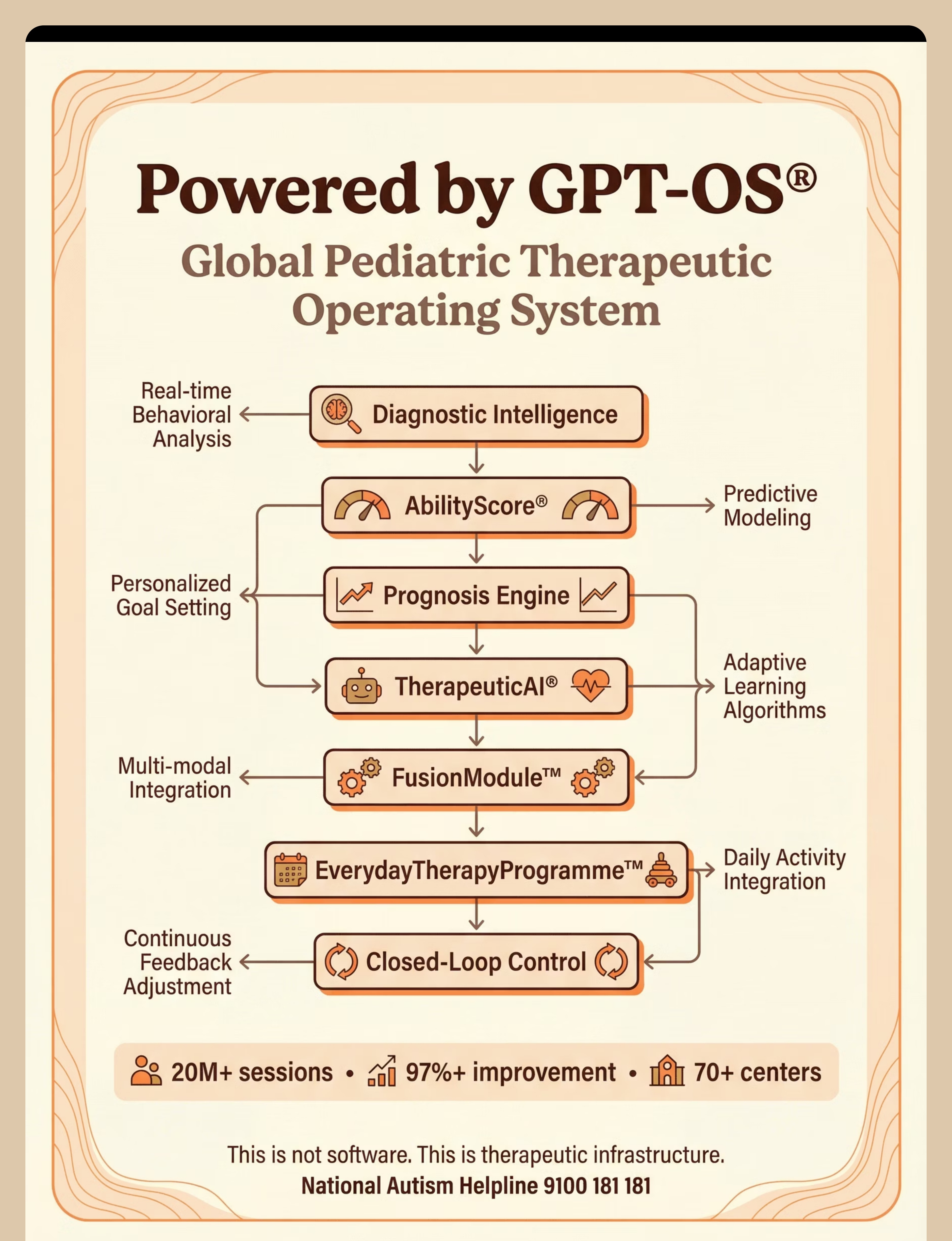
"This technique is one piece of a larger plan. Your child's development is a 12-domain system — and GPT-OS® maps all of it."
See your child's full profile: GPT-OS® Dashboard → pinnacleblooms.org
See your child's full profile: GPT-OS® Dashboard → pinnacleblooms.org
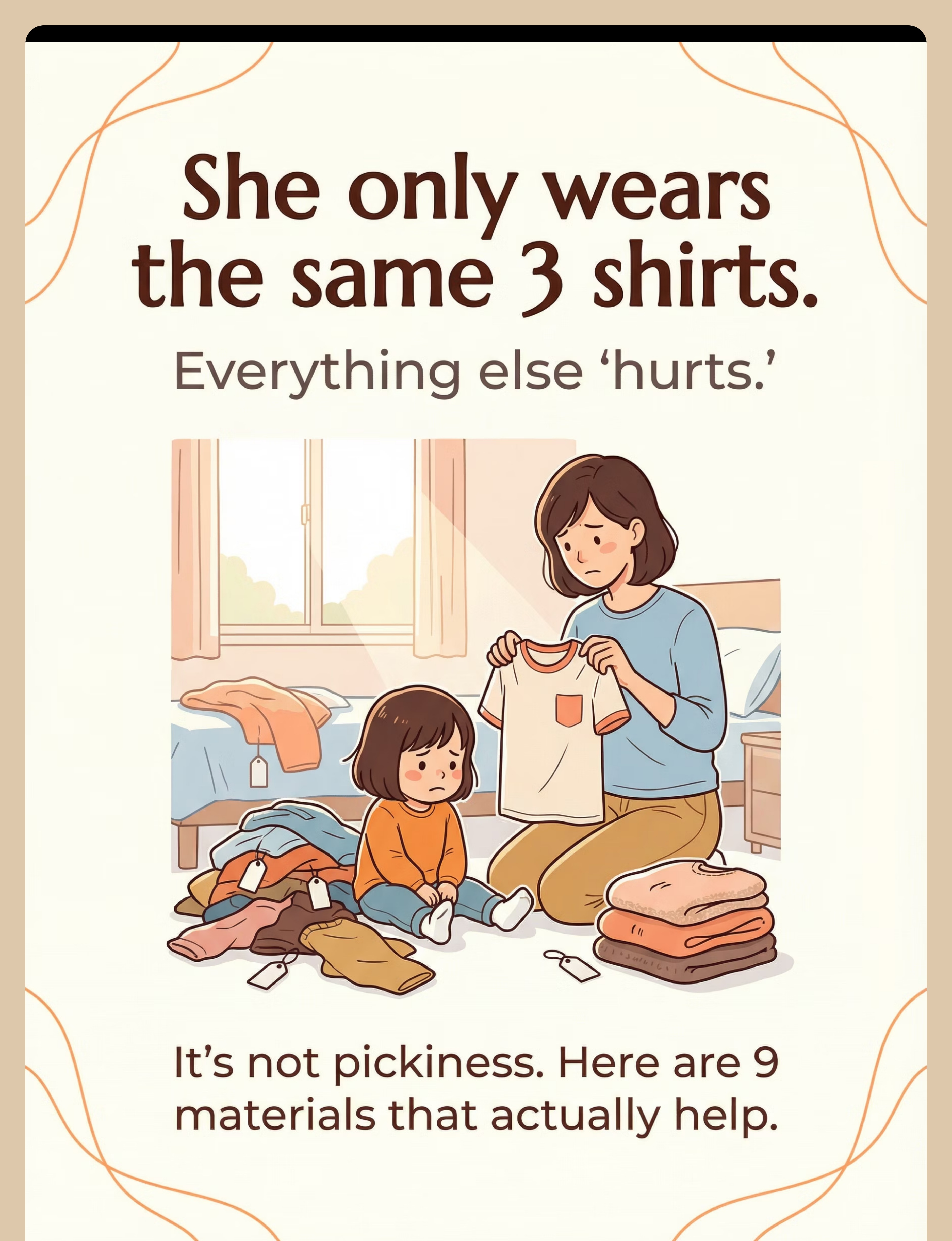
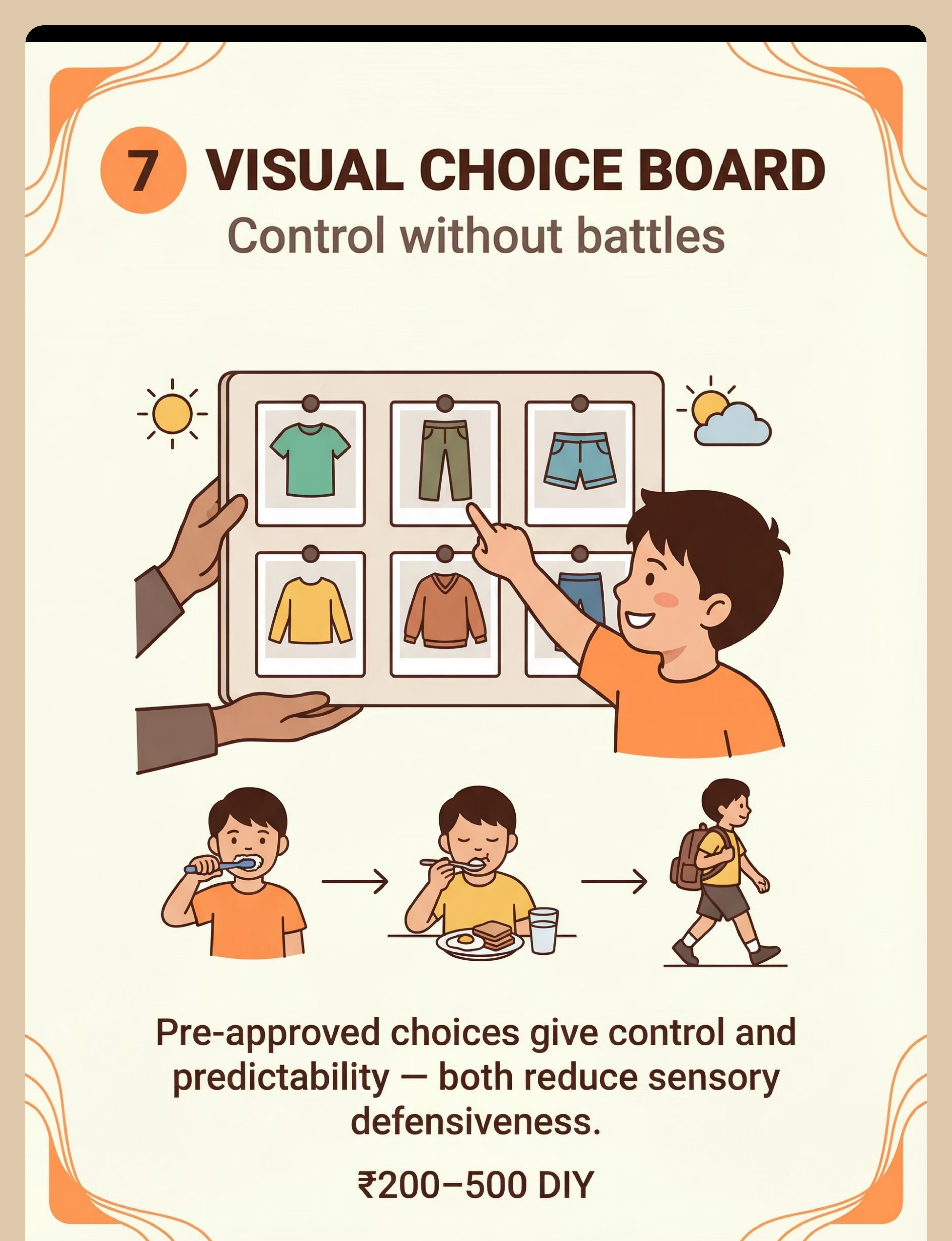
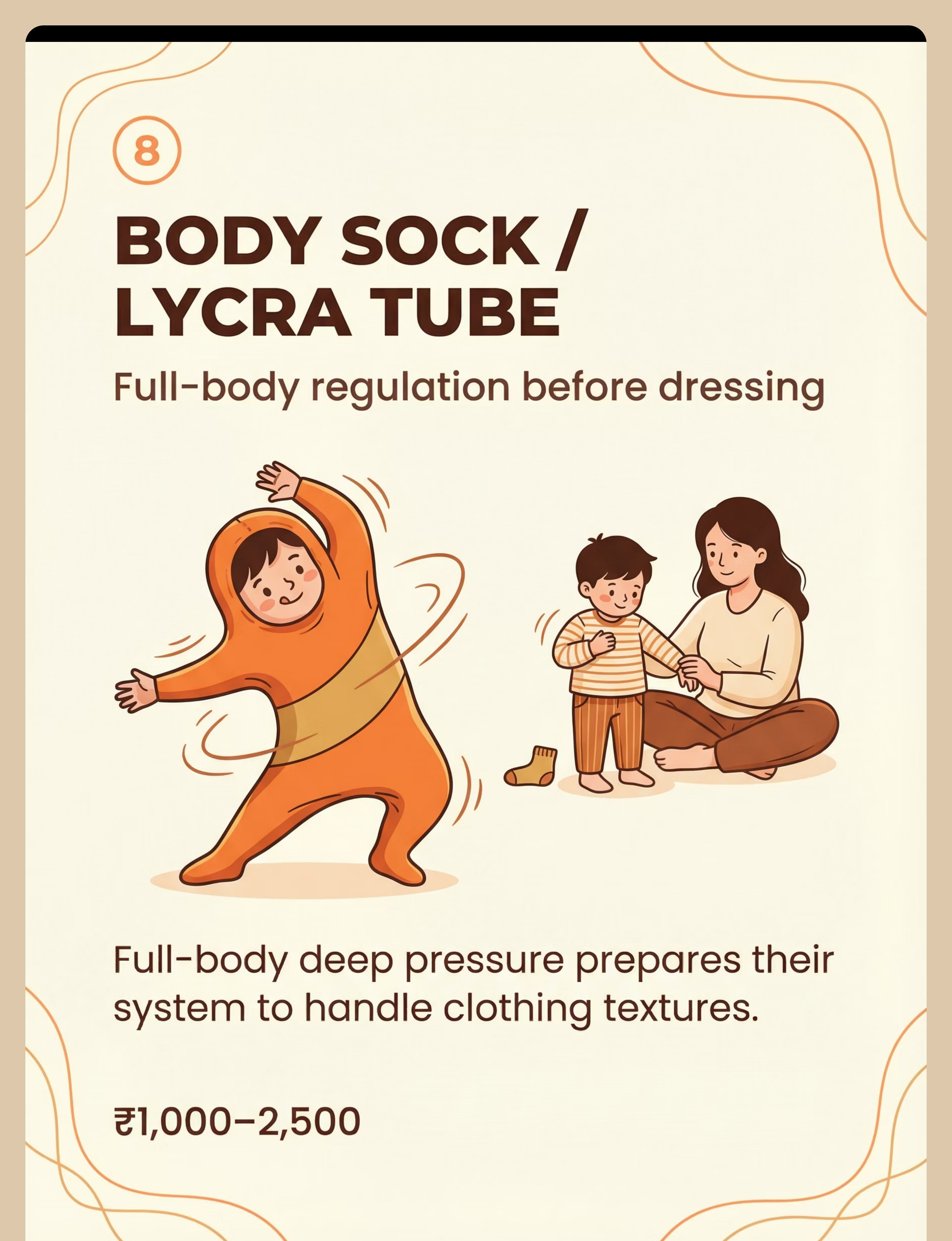
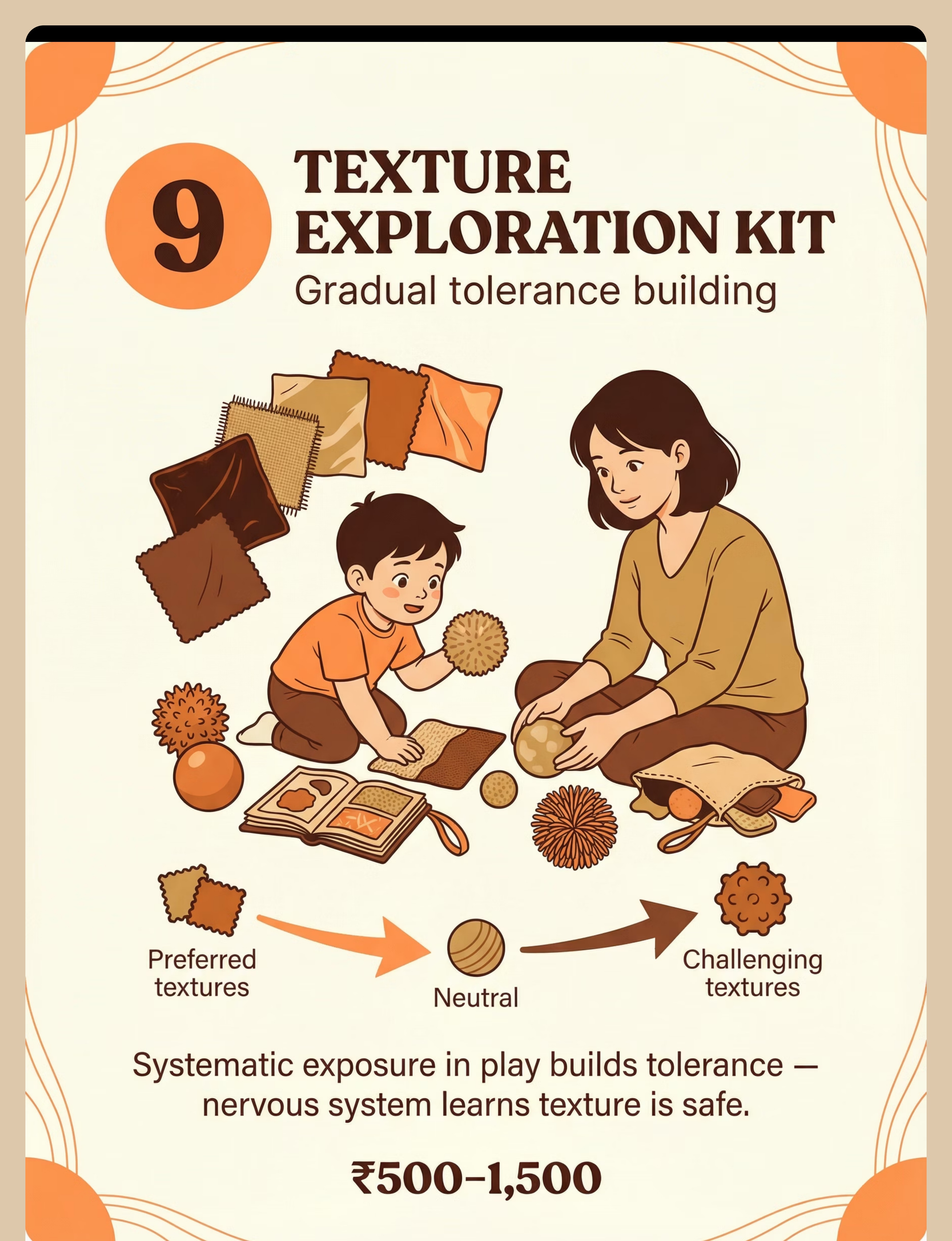
Preview of 9 materials that help when child refuses certain fabrics Therapy Material
Below is a visual preview of 9 materials that help when child refuses certain fabrics therapy material. The pages shown help educators, therapists, and caregivers understand the structure and content of the resource before use. Materials should be used under appropriate professional guidance.
Share this resource
Help others discover thisLink copied!
Families Who Have Been Here
Family A — Hyderabad
Before: Aarav (age 4) wore exactly 2 cotton t-shirts. Every morning was a 45-minute battle. Parents had spent over ₹25,000 on unworn clothing. Family members called him "spoiled."
After 12 weeks: Aarav now accepts bamboo, modal, and pre-washed cotton. Wardrobe expanded from 2 to 14 items. Morning dressing takes 8 minutes.
"We went from 2 acceptable shirts to 14 in three months. The swatch kit changed everything — we stopped guessing and started knowing."
Family B — Chennai
Before: Meera (age 5) could not wear her school uniform. Parents received weekly calls from school. Medical exemption documentation was being considered.
After 8 weeks: Compression base layer underneath uniform resolved 90% of distress. Intensive pre-washing of the uniform removed the remaining irritation. Meera now attends full school days without incident.
"Eight weeks. That's all it took to go from weekly school calls to full attendance."
From the Therapist's Notes: "Fabric refusal is one of the most impactful sensory challenges to address because the results are visible DAILY. Every morning becomes measurably easier."
Illustrative cases based on aggregate Pinnacle Network outcomes. Individual results vary.