
When Every Thought Must Come Out NOW
Your child bursts in mid-sentence — again. At dinner, during phone calls, in class. He knows the rule. He can recite it perfectly. But the moment a thought enters his head, it must exit his mouth — immediately, urgently, as if waiting even five seconds would erase it forever. You are not failing. Your child's brain is wired to prioritize urgency over patience. That wiring can be supported — with the right materials.
🧠 Social Communication
👶 Ages 4–12
🏠 Home + School + Therapy
You Are Among Millions
Interrupting is one of the most common reasons parents seek speech-language and behavioral consultation worldwide. It affects friendships, classroom participation, and family dynamics — but it responds to structured intervention with the right materials. You are among millions of families navigating this exact challenge.
40–67%
ADHD & Interrupting
of children with ADHD exhibit persistent interrupting behavior as a core executive function difficulty — Journal of Attention Disorders, Systematic Review (2023)
80%+
Autism & Turn-Taking
of children diagnosed with autism display social communication processing differences that affect conversational turn-taking — PRISMA Systematic Review, Children (2024)
3 in 10
Typically Developing
children aged 4–8 interrupt frequently enough to impact classroom and social participation — Developmental Psychology population studies
With over 18 million children estimated to have developmental or neurobehavioral differences across India (Lancet Global Health, 2022), conversational skills support is a national-scale need being addressed by Pinnacle Blooms across 70+ centers.

Why Every Thought Feels Like an Emergency
The Brain Science
- Prefrontal Cortex — impulse control center, still developing until age 25
- Basal Ganglia — the "brake pedal" for behavior
- Working Memory Circuits — the "mental notepad" that holds thoughts (only 3–5 items!)
- Anterior Cingulate Cortex — the "conflict monitor" detecting competing demands
What This Means for Your Child
The Impulse Control System: Your child's prefrontal cortex is still under construction. When a thought arrives, the signal to "say it now" fires faster than the signal to "wait your turn."
The Working Memory Bottleneck: Your child genuinely fears losing the thought. Holding a thought WHILE monitoring a conversation WHILE suppressing the urge to speak is a triple cognitive load. For many children, the system overflows.
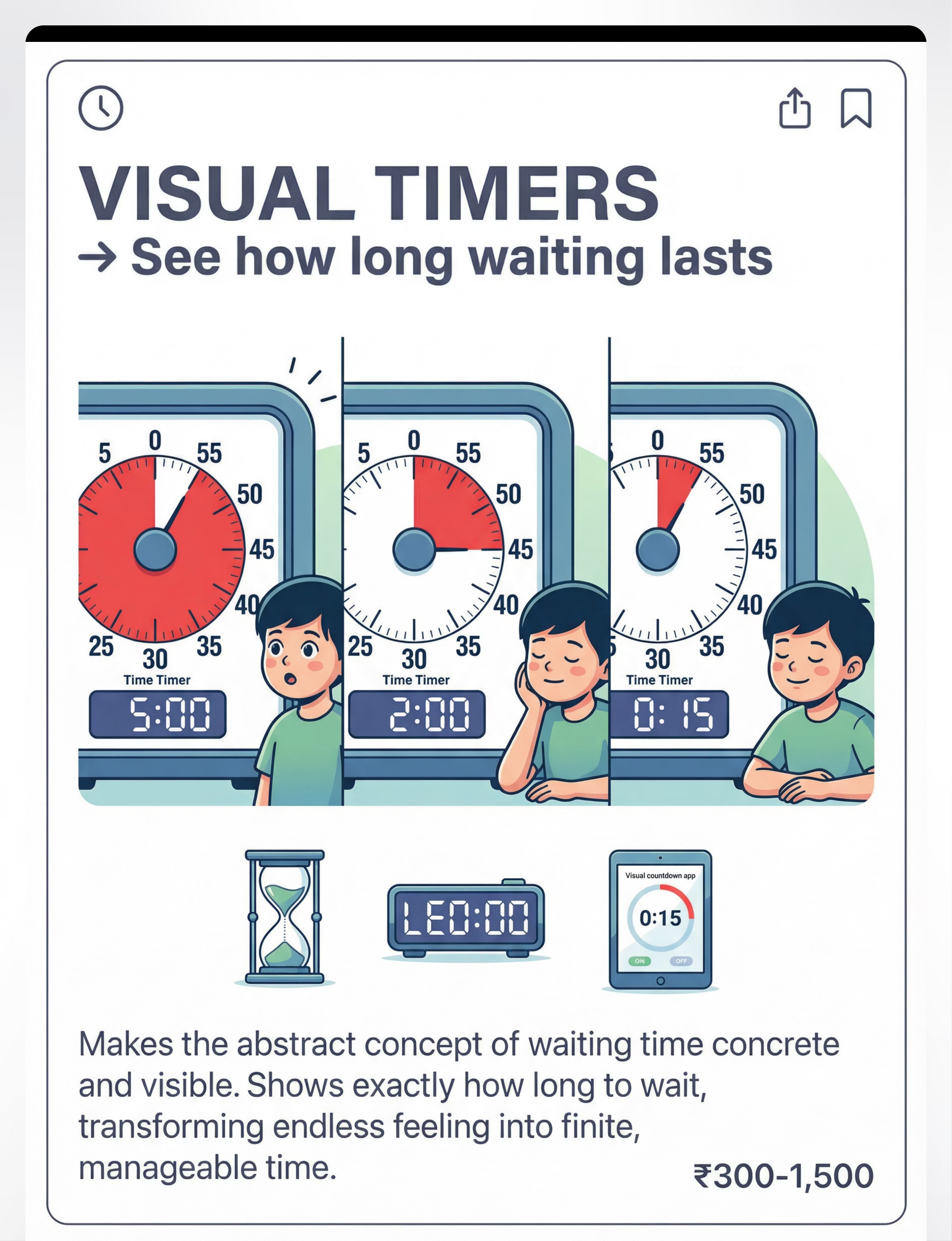
The Time Perception Gap: Children with executive function differences often experience time differently. Without a visible endpoint, "wait" feels like "wait forever."
Key Insight: This is a wiring difference, not a behavior choice. The materials on this page provide external scaffolding for internal processes that haven't fully developed yet.

Your Child's Developmental Position
Understanding where interrupting fits in normal development helps you calibrate your response — and your expectations. The timeline below maps the progression from typical toddler behavior to the critical support zones where materials-based intervention makes the biggest difference.
1
Age 2–3
All children interrupt. Turn-taking rules are not yet understood. This is completely typical.
2
Age 3–4
Emerging awareness of conversational turns. Beginning to wait with heavy adult scaffolding. Interrupting is still very common.
3
Age 4–5 ⚠️
Intervention Window Opens. Children should begin responding to turn-taking cues. If interrupting persists with no awareness, external supports become valuable.
4
Age 5–7 🔴
Rules understood intellectually but not executed under cognitive load. Peer and classroom impact begins. Materials bridge the knowing-doing gap.
5
Age 7–9 🔴
Critical Support Zone. Social consequences intensify. Friends avoid conversations. Teacher frustration mounts. Without intervention, patterns solidify.
6
Age 9–12
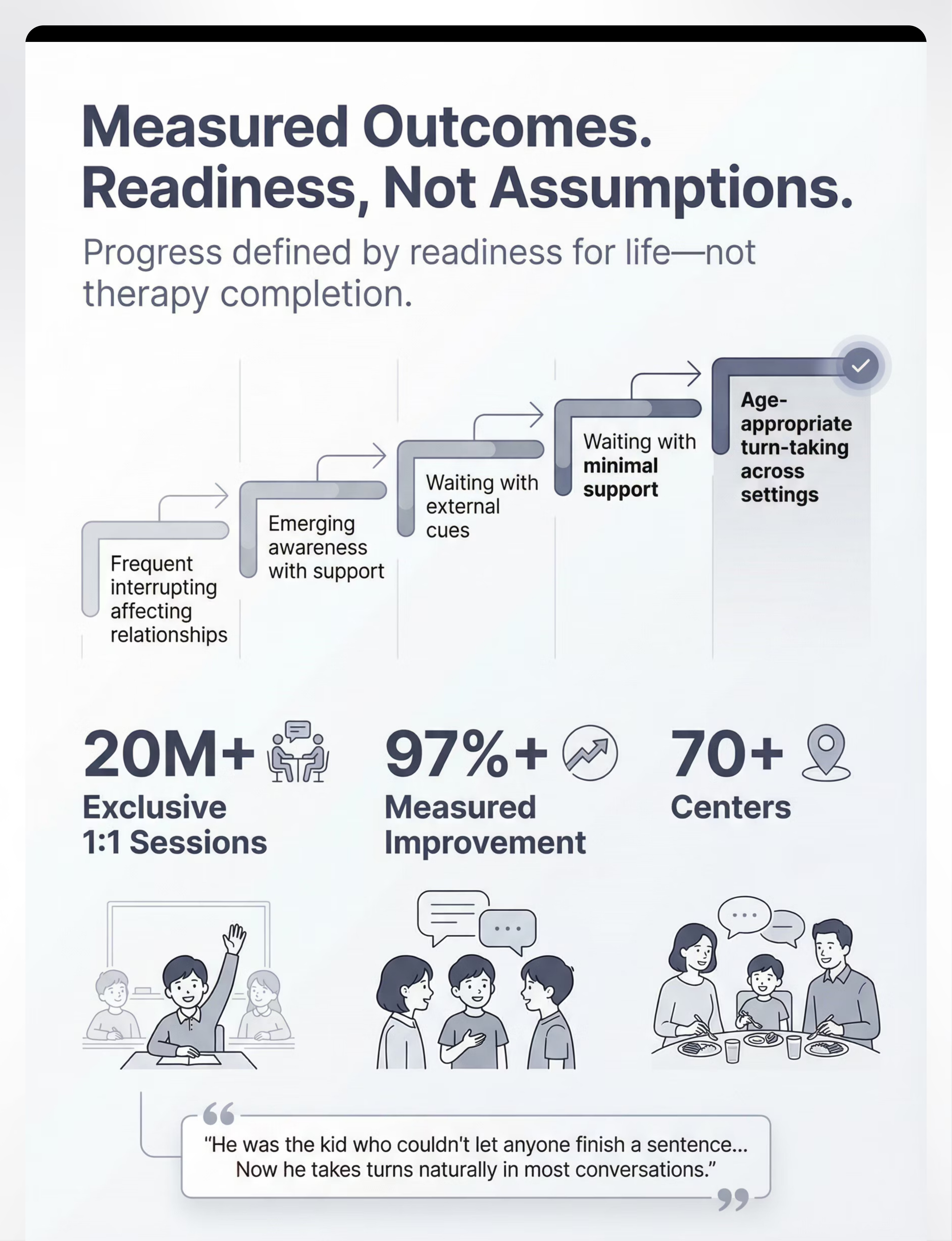
With consistent material-supported practice, turn-taking can become more automatic. Without support, patterns may persist into adolescence.
Persistent interrupting commonly co-occurs with: ADHD (40–67%), Autism Spectrum, Anxiety (urgency-driven), and Language Processing Differences. Your child is here — and there is a clear path forward.

Clinically Validated. Home-Applicable. Parent-Proven.
The 9 materials on this page are drawn from interventions classified as evidence-based by international bodies including WHO, NCAEP, ASHA, and BACB. You are not experimenting — you are implementing proven science.
🛡️ Visual Supports — NCAEP (2020)
The National Clearinghouse on Autism Evidence and Practice classifies visual supports — including visual timers, cue cards, and social stories — as an established evidence-based practice. These form the foundation of 6 of the 9 materials on this page.
📖 Social Stories — Established Evidence Base
Carol Gray's Social Stories have been validated across multiple systematic reviews for improving social communication skills including conversational turn-taking.
🗣️ Turn-Taking — ASHA Clinical Practice
ASHA guidelines include conversational turn-taking as a core pragmatic language intervention target with structured materials support.
🔬 Executive Function — Behavioral Evidence
ABA research demonstrates that externalizing executive functions significantly improves impulse control in children aged 4–12. Indian RCT (Padmanabha et al., 2019) confirms home-based structured interventions in Indian pediatric populations. DOI: 10.1007/s12098-018-2747-4
Level II — Evidence-Based Practice
WHO • NCAEP • ASHA • BACB Validated
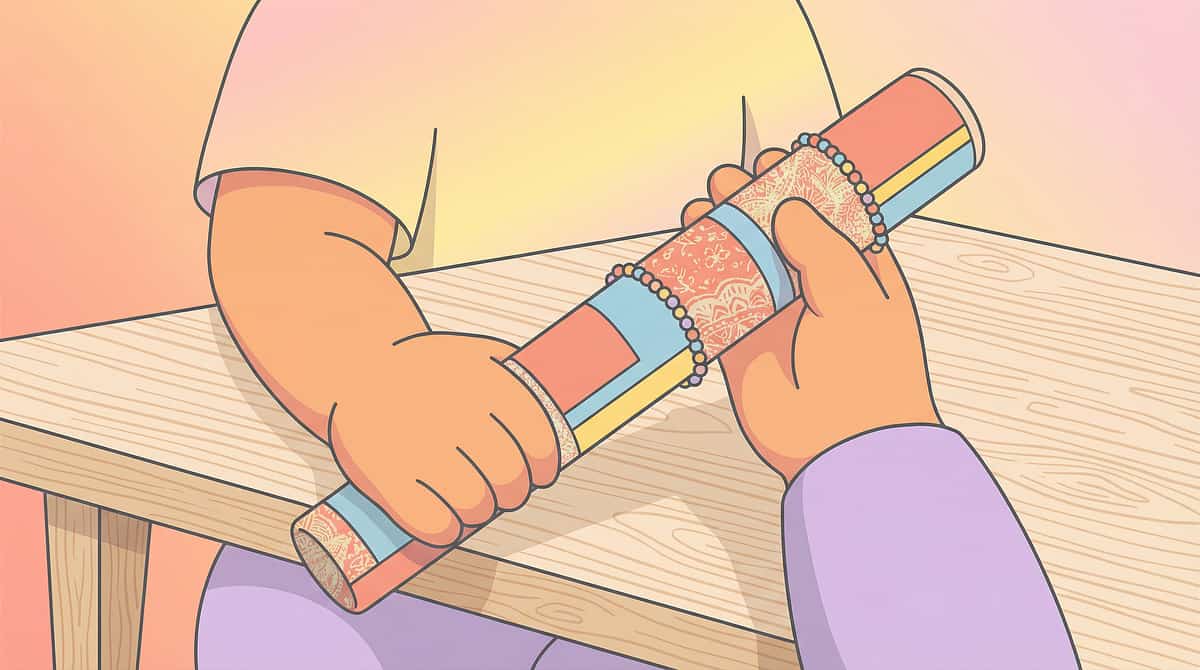
Material-Supported Conversational Turn-Taking Intervention
Parent-Friendly Alias: "Teaching My Child to Wait and Speak"
This technique uses 9 categories of physical materials and visual tools to externalize the invisible rules of conversation — making turn-taking visible, waiting tangible, and thought-preservation possible. Instead of relying on verbal reminders alone (which your child already knows but cannot execute under cognitive load), these materials provide the external scaffolding that bridges the gap between knowing the rule and following it in the moment.
🏷️ Domain
Social Communication | Executive Function | Self-Regulation | Pragmatic Language
👶 Ages
4–12 years | Daily practice, 10–30 min sessions | 8–12 week structured protocol
🏠 Settings
Home + School + Therapy | Fully home-executable with or without clinician
💰 Investment
₹50–₹2,000 total | Many materials can be made at home for free

Your Multi-Disciplinary Team
Turn-taking requires language skills, behavioral control, sensory regulation, and environmental structure — simultaneously. That's why the Pinnacle Blooms FusionModule™ coordinates all four disciplines. "This technique crosses therapy boundaries because the brain doesn't organize by therapy type."
Speech-Language Pathologist (SLP)
Primary lead. Addresses pragmatic language deficits — the "social rules" of conversation. Teaches turn-taking frameworks, conversational repair strategies, and narrative structure. Targets ASHA pragmatic language benchmarks.
Board Certified Behavior Analyst (BCBA)
Targets impulse control through applied behavior analysis. Designs reinforcement schedules, token economies, and functional behavior assessment of interrupting patterns.
Occupational Therapist (OT)
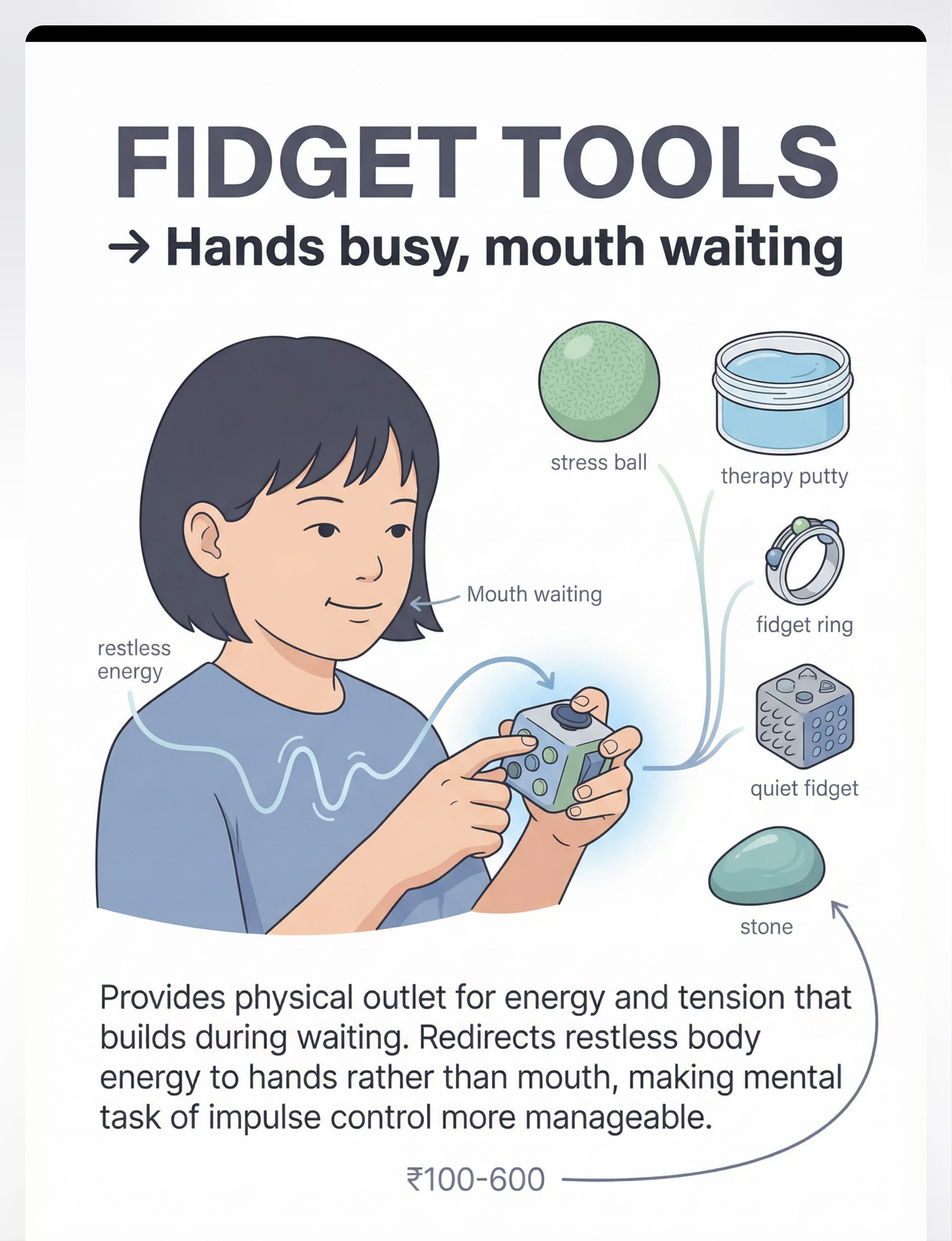
Addresses the sensory and self-regulation component. Fidget tools, proprioceptive input for calming arousal during waiting, and sensory diet integration.
Special Educator (SpEd)
Implements classroom-compatible strategies: visual cue cards, classroom talking objects, structured discussion protocols, and social stories integrated into the school day.
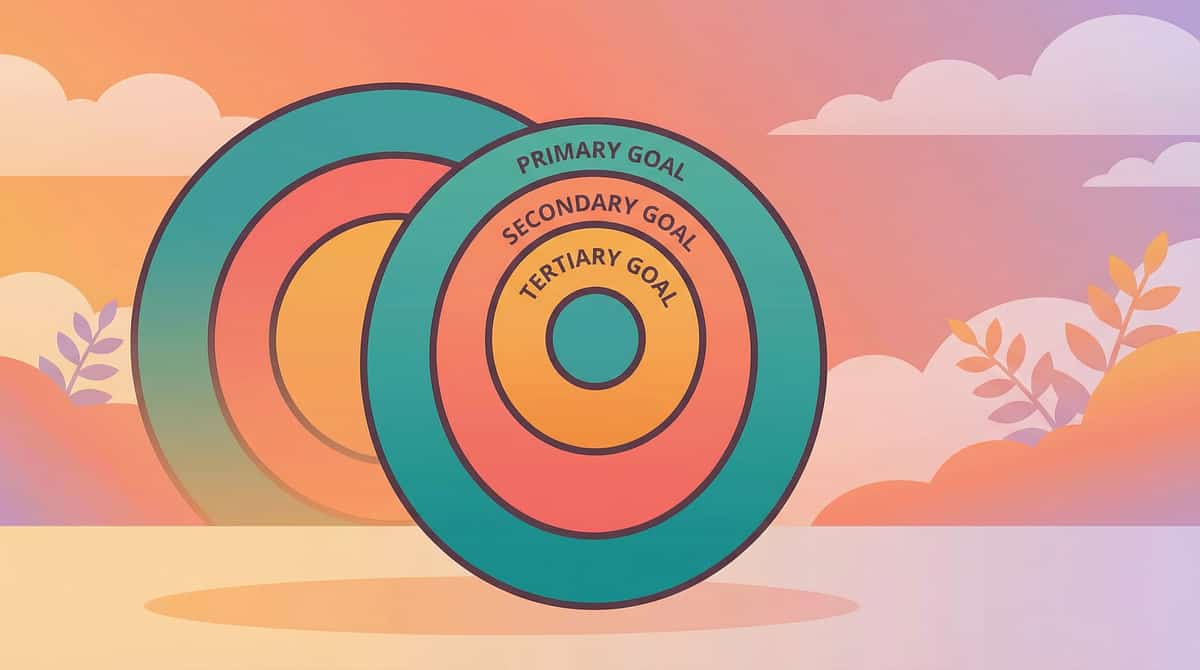
Precision Targets — What These Materials Address
These materials work across three concentric rings of impact — from the core conversational skill outward to broader developmental gains that ripple through every area of your child's life.
🎯 Primary Target — Conversational Turn-Taking
The core skill: waiting for one's turn to speak, recognizing when another person is speaking, and inserting one's contribution at an appropriate moment. Observable: child waits for pause before speaking, allows others to complete sentences, raises hand or uses signal before contributing.
🎯 Secondary Targets
- Impulse Control — Inhibiting the automatic response to speak immediately
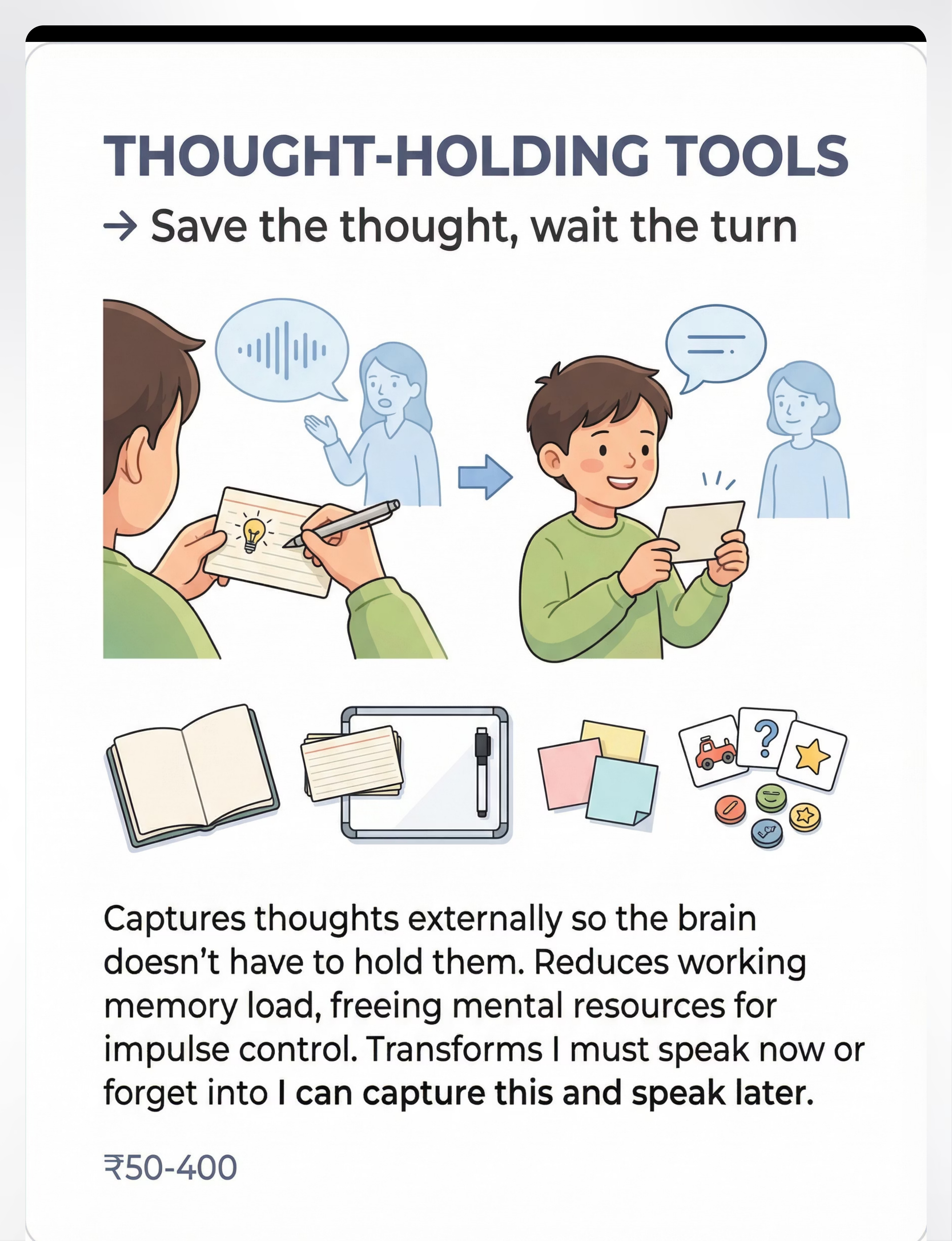
- Working Memory Support — Externally capturing thoughts so the brain doesn't have to hold them
- Social Awareness — Recognizing conversational cues
- Perspective-Taking — Understanding how interrupting makes others feel
🎯 Tertiary Developmental Gains
- Peer Relationship Quality — Friends engage in longer, richer conversations
- Classroom Participation — Teacher perceives child as attentive and cooperative
- Self-Esteem — Reduction in negative feedback about social behavior
- Academic Performance — Better classroom engagement leads to improved learning
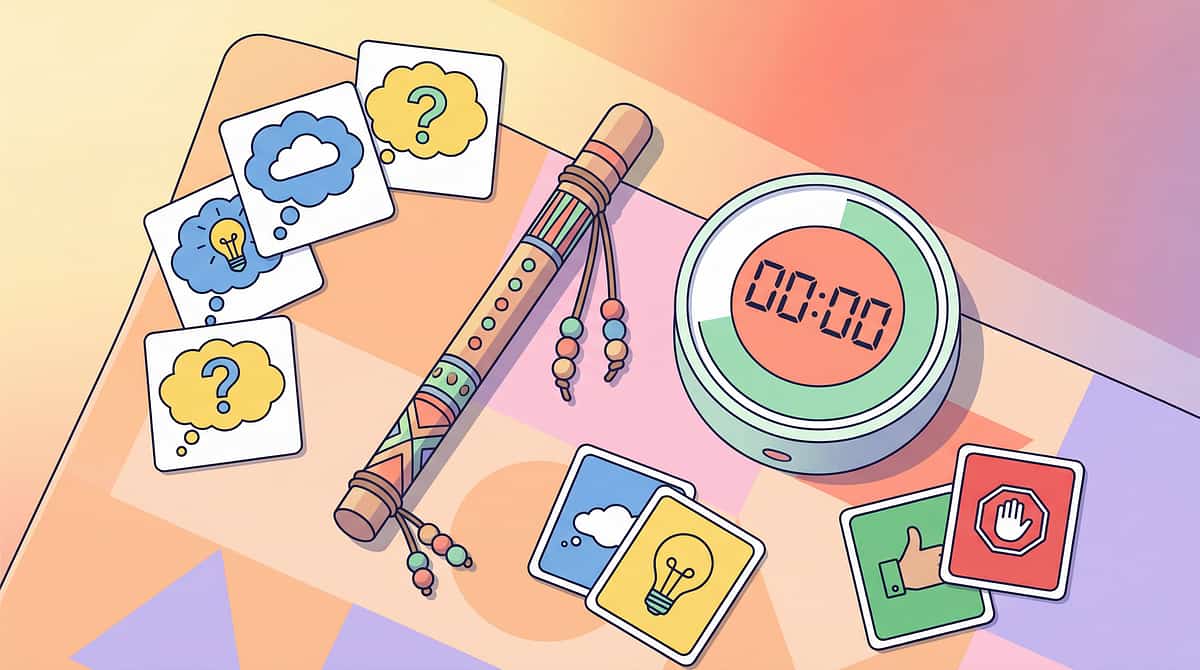
The 9 Materials — Your Complete Kit
Each of these 9 materials targets a specific aspect of the interrupting challenge — from making turns visible, to capturing thoughts, to managing the anxiety of waiting. Start with one. Build your kit over time.
# | Material | Canon Category | Price (INR) | Link | |
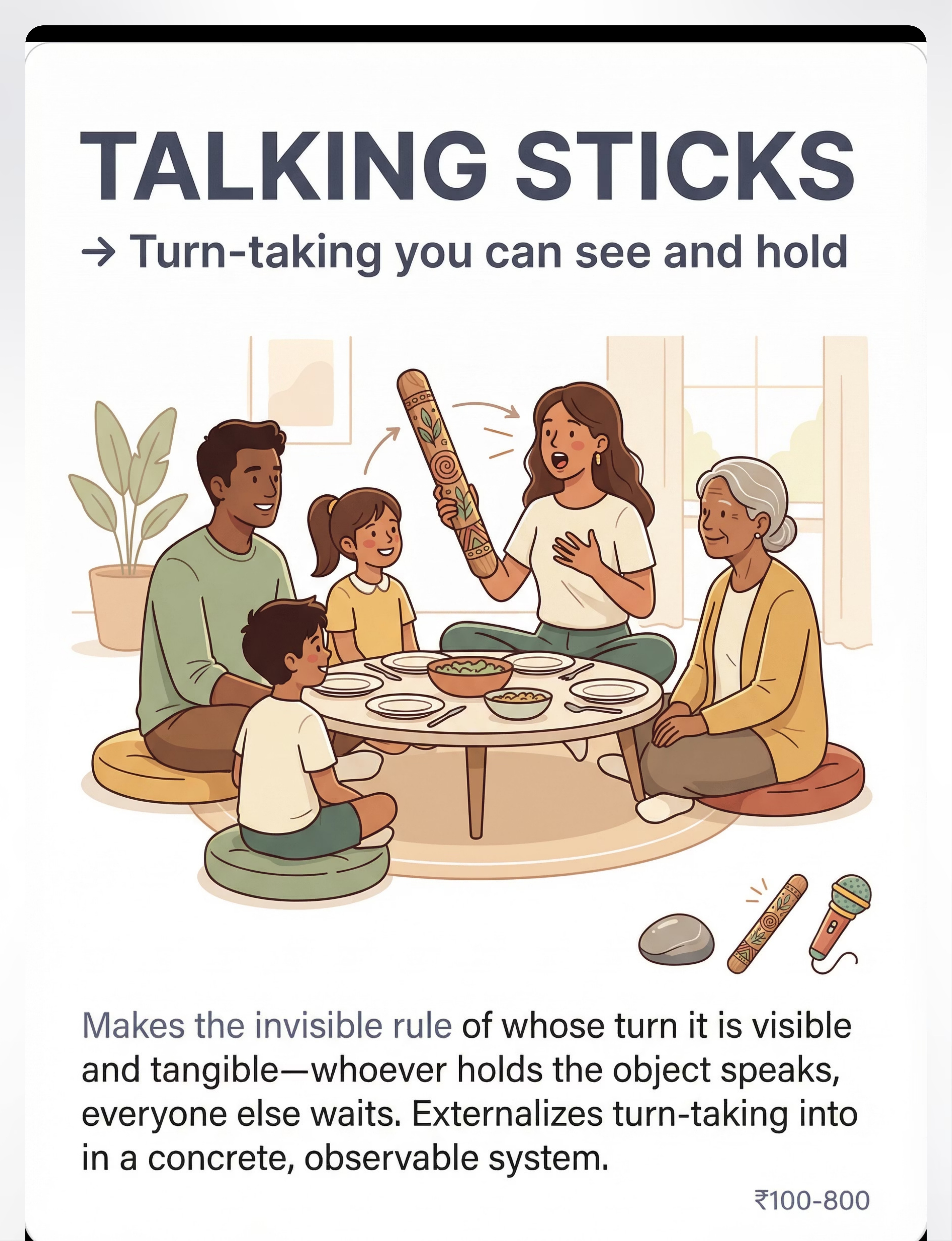
1 | Talking Sticks & Conversation Objects | Turn-Taking & Cooperative Games | ₹100–800 | materials.pinnacleblooms.org | |
2 | Visual Timers for Waiting | Visual Timer & Time Concept Tool | ₹300–1,500 | materials.pinnacleblooms.org | |
3 | Thought-Holding Cards & Notebooks | Social Skills Cards & Scenarios | ₹50–400 | materials.pinnacleblooms.org | |
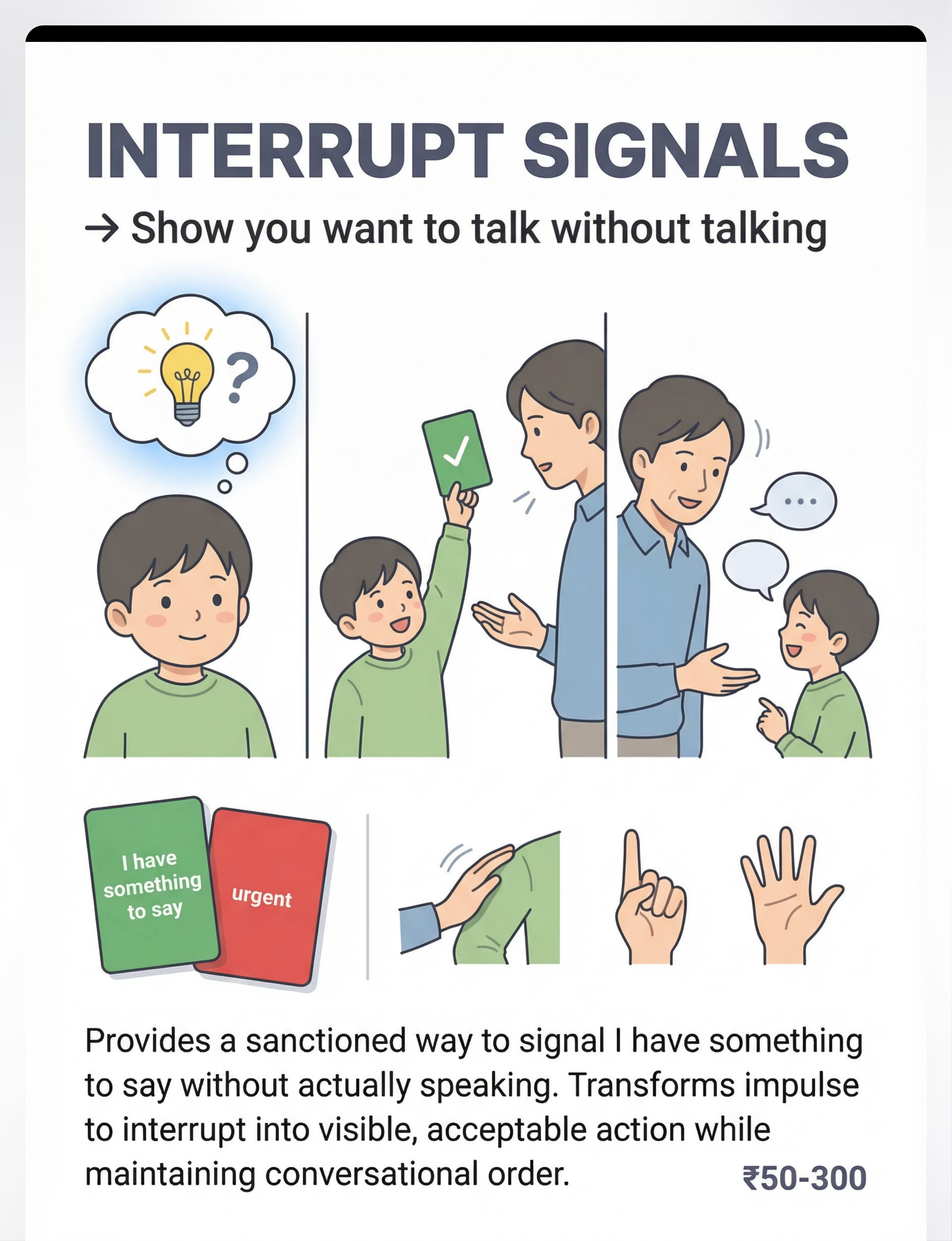
4 | Interrupt Cards & Hand Signals | Visual Rules & Expectations Cards | ₹50–300 | materials.pinnacleblooms.org | |
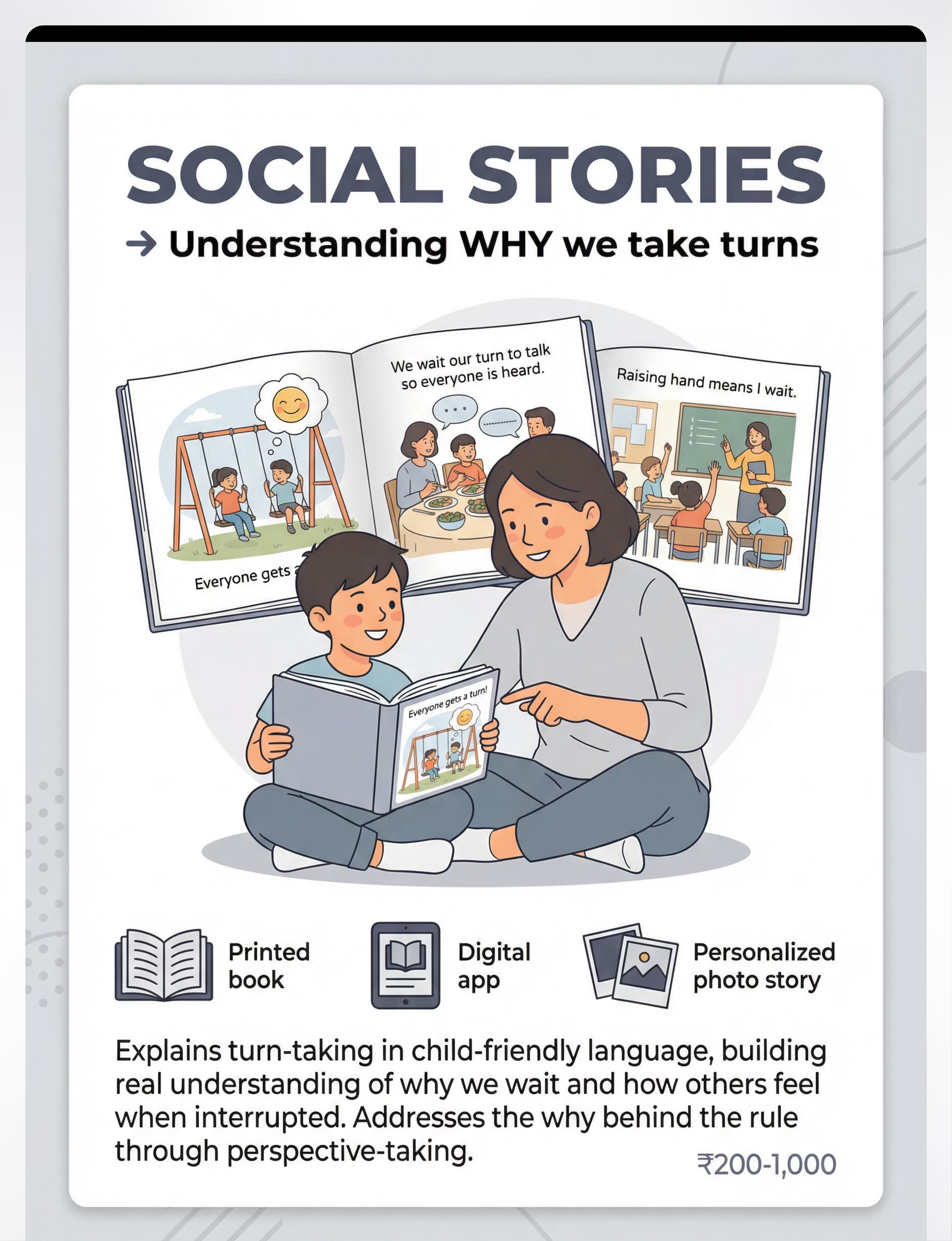
5 | Social Stories About Turn-Taking | Social Skills Cards & Scenarios | ₹200–1,000 | materials.pinnacleblooms.org | |
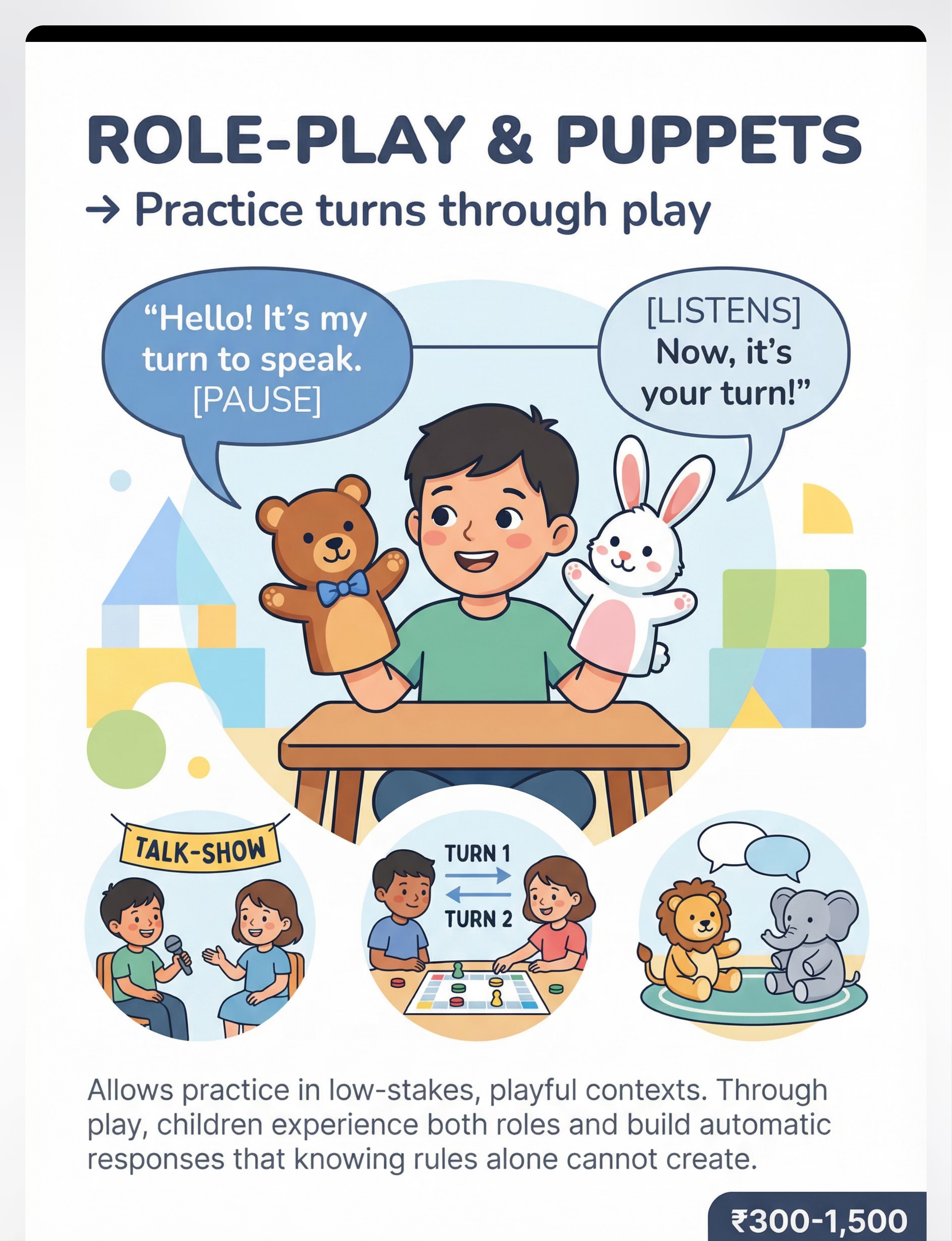
6 | Role-Play Games & Puppets | Role-Play & Pretend Play Props | ₹300–1,500 | materials.pinnacleblooms.org | |
7 | Fidget Tools for Waiting | Sensory/Fidget Tools | ₹100–600 | materials.pinnacleblooms.org | |
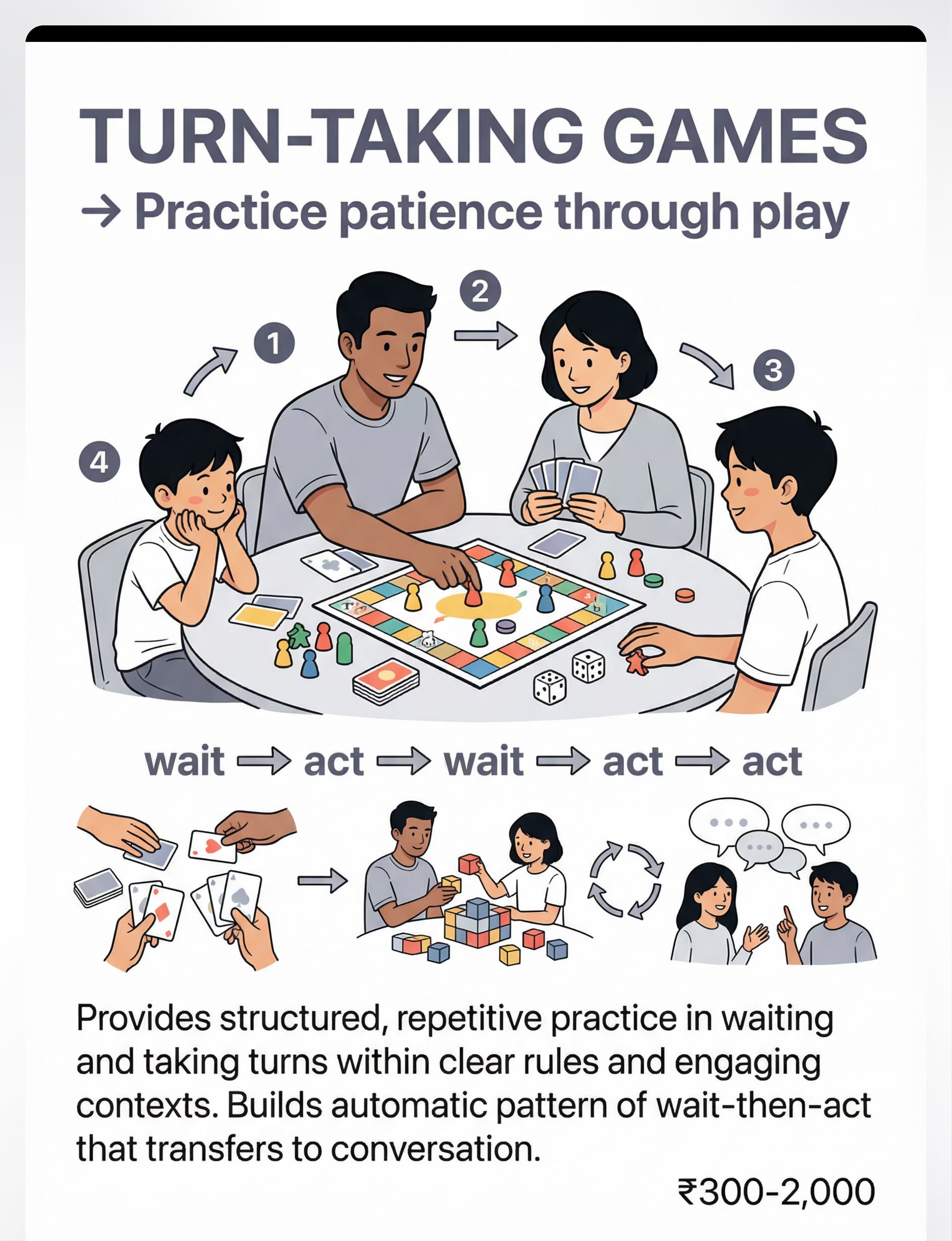
8 | Turn-Taking Games & Cooperative Activities | Turn-Taking & Cooperative Games | ₹300–2,000 | materials.pinnacleblooms.org | |
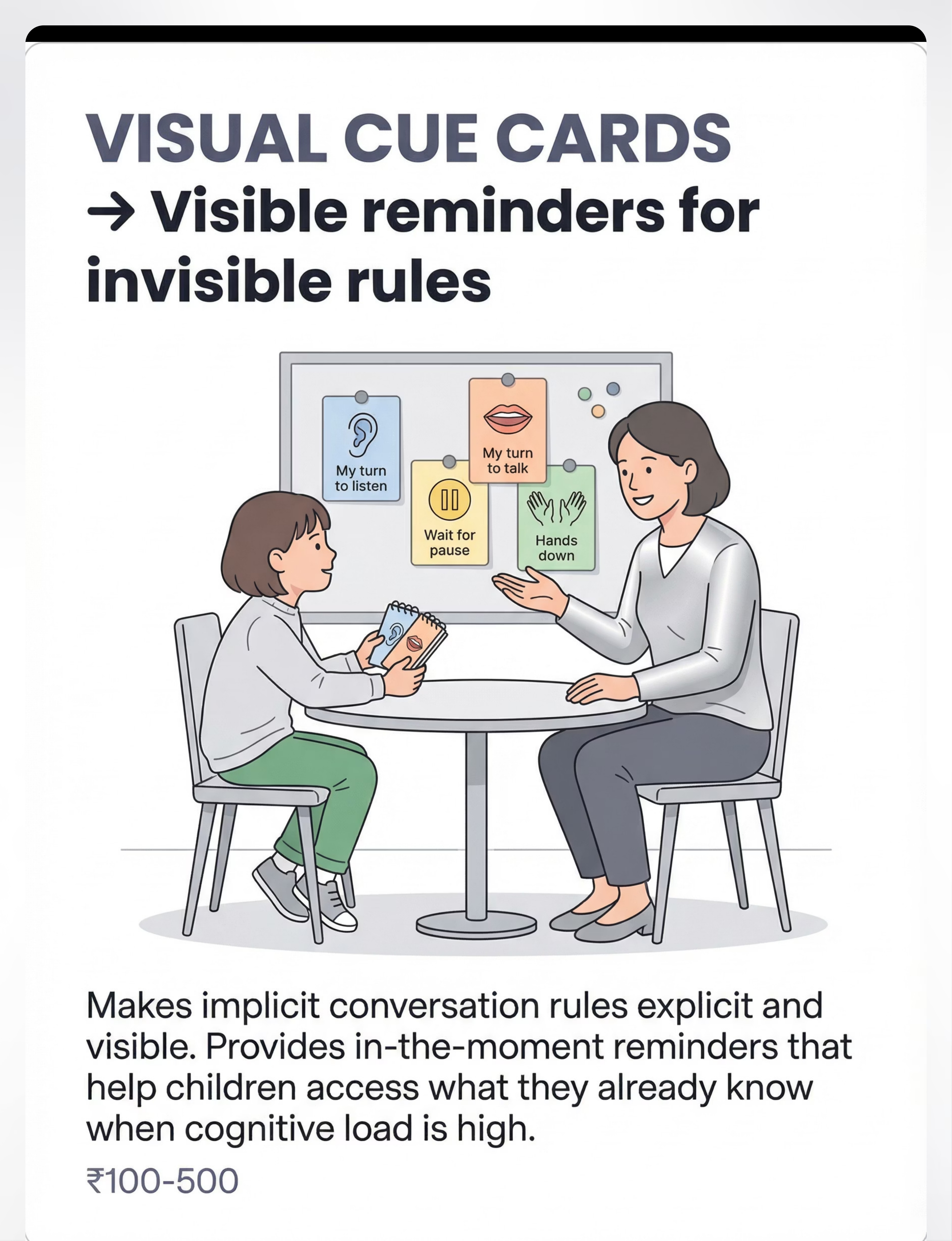
9 | Visual Conversation Cue Cards | Visual Rules & Expectations Cards | ₹100–500 | materials.pinnacleblooms.org |
✅Pinnacle Recommends Starter Kit: Any talking object (free — use a special stone or toy microphone) + thought-capture cards or sticky notes (₹50) + turn-taking games you already have at home (free). Start today for ₹50 or less.

Every Family Can Start Today — Zero Cost Options
This page follows the WHO/UNICEF inclusion principle: every parent, regardless of economic status, can execute this intervention TODAY with household items. Here is a DIY substitute for every single material on the list.
Material | Buy This | Make This (Free/Low Cost) | |
Talking Stick | Decorated talking stick (₹200) | A special stone, a wooden spoon, any distinctive household object designated as "the talking thing" | |
Visual Timer | Time Timer® (₹800) | Sand timer from a board game, phone timer with visual display, paper countdown chain | |
Thought-Holding Tools | Dedicated waiting notebooks (₹200) | Index cards (₹50), sticky notes, or a "thought token" (any small object) placed in a cup to signal "I have something to say" | |
Interrupt Signals | Signal card set (₹150) | Cut colored paper — green = "I have something to say," red = "urgent." Or teach hand signals: gentle hand on parent's arm, raised finger | |
Social Stories | Printed social story books (₹500) | Write your own using Carol Gray's framework — descriptive, perspective, directive, affirmative sentences. Include photos of your child. | |
Puppets | Hand puppet set (₹500) | Socks with drawn faces, stuffed animals your child already has, paper bag puppets | |
Fidget Tools | Fidget cube set (₹300) | Rubber bands, smooth stones, playdough, textured fabric — any quiet, non-distracting hand occupation | |
Board Games | Cooperative games (₹800) | UNO, Snakes & Ladders, building towers with blocks taking turns — any game with turns | |
Cue Cards | Laminated cue card set (₹200) | Draw simple cards with words and stick figures: "Listen," "Wait," "My Turn," "Excuse Me." Tape to the dinner table. |
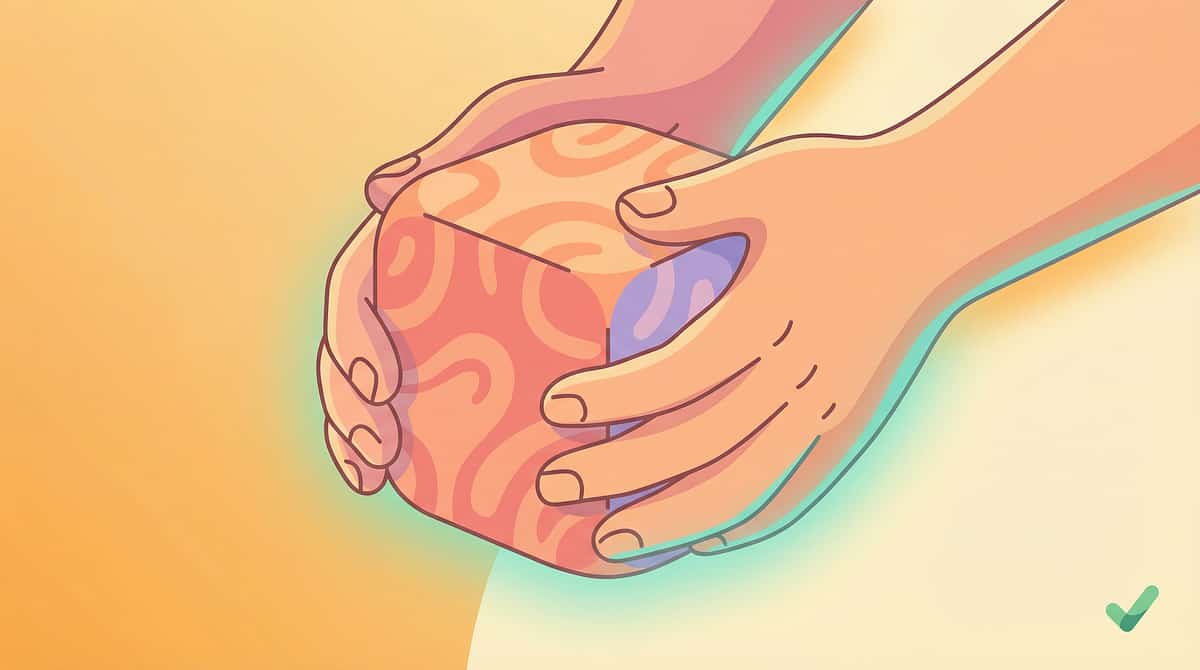
Safety First — Before You Begin
The best session is one that starts in the right conditions. Use this traffic-light system before every practice to ensure your child — and you — are set up for success, not frustration.
🟢 GREEN — Proceed When
- Child is calm, fed, rested, and in a regulated state
- Environment is familiar and low-distraction
- You have 10–30 uninterrupted minutes
- Materials are prepared and within reach
- You are calm and patient (your regulation matters too)
🟡 AMBER — Modify When
- Child is mildly distracted or tired → shorten to 5 minutes, use only 1 material
- Recent frustration → start with puppets or games, not rule-based materials
- Unfamiliar setting → use portable materials only (signal cards, fidget tool)
- Multiple people present → simplify to talking stick only
🔴 RED — Stop / Do Not Proceed When
- Child is in active meltdown or emotional dysregulation
- Child has just received negative feedback about interrupting
- You are feeling angry, frustrated, or punitive
- Child is ill, hungry, or significantly under-slept
⚠️Emotional Safety — Critical: Chronic negative feedback about interrupting damages self-esteem. These materials are TOOLS, not PUNISHMENTS. Balance correction with acknowledgment. Your child needs to know they are loved even when they interrupt. FREE National Autism Helpline: 9100 181 181
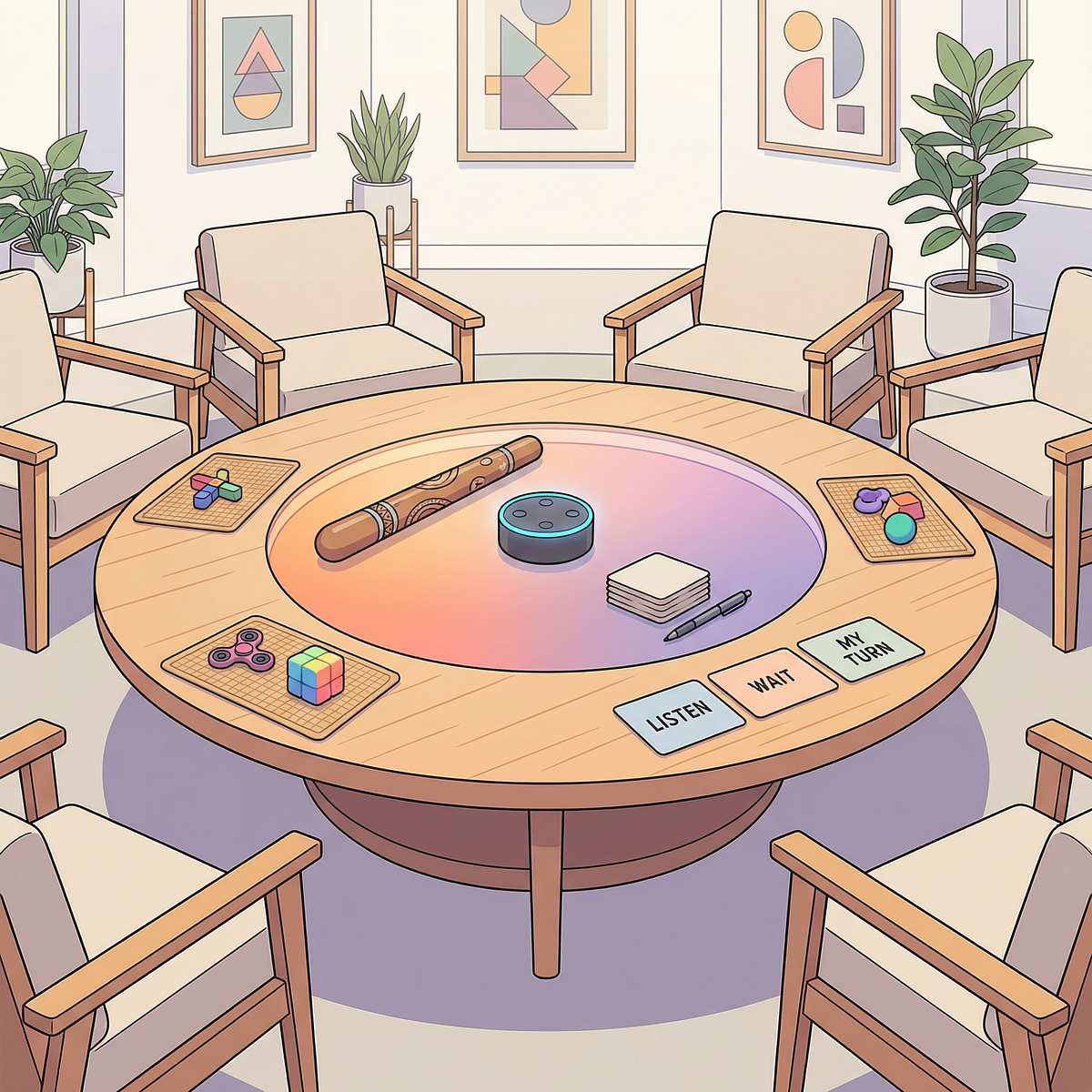
Set Up Your Space — The 5-Minute Preparation
Your environment is the first material. A well-prepared space reduces friction, keeps the session on track, and signals to your child that something intentional and positive is about to happen.
1
Conversation Area
A table or floor space where all participants can see each other. Circle or semi-circle seating works best — ensure the child can see everyone's faces.
2
Materials Station
Within arm's reach: talking stick, visual timer, thought-capture cards, interrupt signal cards. Pre-position before the session begins — scrambling for materials mid-conversation breaks the flow.
3
Visual Cue Cards
Posted at eye level or flat on the table. "Listen" / "Wait" / "My Turn" / "Excuse Me" visible without effort.
4
Fidget Access
Fidget tool already in the child's hand or on their placemat. Not handed as a consequence — available proactively, before the session starts.
❌Remove from space: Screens, tablets, phones (unless used as timer) | Noisy background — TV, music, traffic | Toys unrelated to the session | Other children not participating. 💡 Good lighting | 🔇 Low noise | ⏰ No time pressure

Pre-Session Readiness Check (60 Seconds)
Before every session, run through this 60-second checklist. The single biggest predictor of a successful practice session is starting under the right conditions — not how good your materials are or how long you practice.
✅ Child has eaten within the last 2 hours
✅ Child has had adequate sleep
✅ No meltdown or significant emotional event in the last 30 minutes
✅ Child is alert and responsive to conversation
✅ Child is not in the middle of a preferred activity
✅ At least one other conversation partner is available
✅ YOU are calm, patient, and not in a rush
All Green → GO
Begin with Step 1: The Invitation.
1–2 Amber → MODIFY
Use only the talking stick + 5-minute timer. Keep it short and successful.
Any Red → POSTPONE
Do a calming activity together instead. Tomorrow is fine. The best session is one that starts right.

Step 1 — The Invitation (1 minute)
Step 1 of 6
"Hey [child's name], I have a fun new thing for our family. See this [talking stick/object]? We're going to play a game where whoever holds this gets to talk, and everyone else gets to listen. Then we pass it! Want to try?"
What Acceptance Looks Like
Child reaches for the object, asks questions about it, shows curiosity, nods, or says yes. Smile. Keep it light. Hold the object with visible interest. This is play, not correction.
What Resistance Looks Like
Child ignores you, says "no," walks away, or immediately starts talking without the object. This is fine. Don't force. Say: "That's okay! It'll be here when you're ready." Try again at dinner or tomorrow.
Timing: 30–60 seconds. If the child isn't interested within 60 seconds, postpone. Never begin a session against resistance — a refused session is still a session that builds trust.
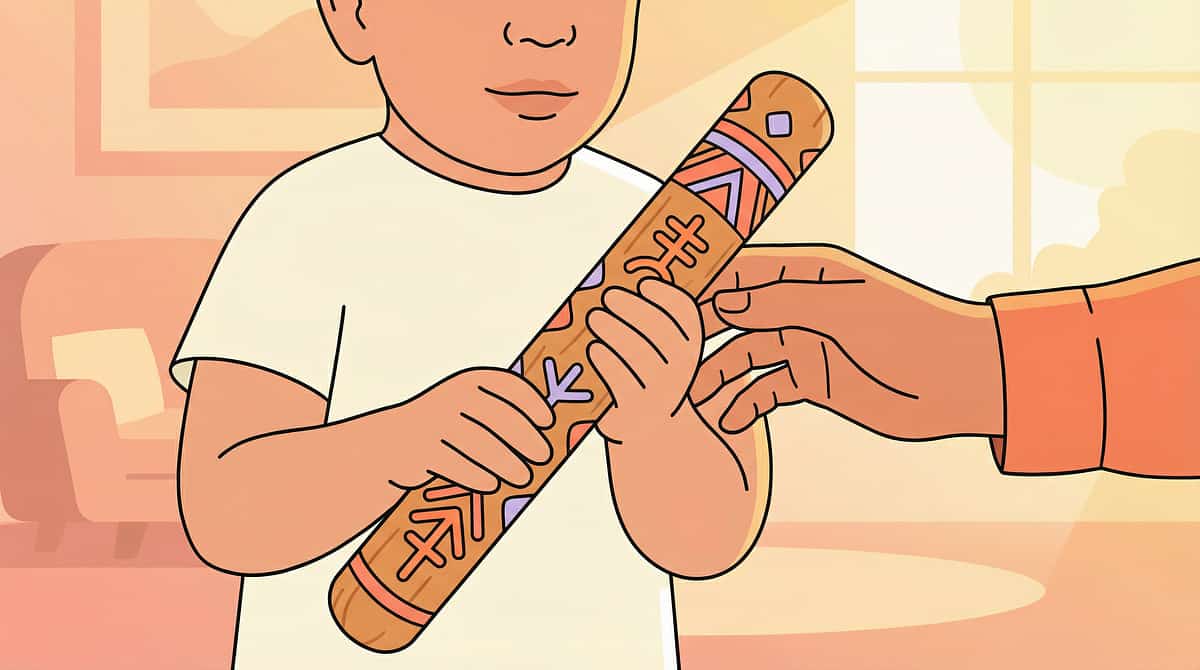
Step 2 — Introduce the Materials (2–3 minutes)
Step 2 of 6
Start with ONE material only — the talking stick is recommended as the first material. Introducing too much at once overwhelms the child and dilutes the core concept.
"Okay! Here's how it works. When I hold the stick, it's my turn to talk. Watch — [demonstrate speaking briefly for 15 seconds]. Now I pass it to you. Your turn!"
🟢 Engaged
Takes the object, speaks when holding it, passes it back. This is the goal.
🟡 Tolerant
Holds the object but doesn't fully follow the rule yet — that's real progress! Acknowledge and continue.
🔴 Avoidant
Refuses the object, talks without it, gets frustrated — simplify and shorten. End on any positive note.
The MOMENT the child waits even one second or takes the object before speaking: "You waited! That was awesome. Your turn — go!" Reinforcement is the engine. Timing beats length every time.

Step 3 — Practice the Turn-Taking Cycle (5–10 minutes)
Step 3 of 6
The core cycle runs continuously for 5–10 minutes. Keep parent speaking turns very short (15–30 seconds) to maximize the child's practice opportunities. All supporting materials are active simultaneously: visual timer is visible, thought-capture card is available, fidget tool is in hand.
When the child interrupts during practice — do NOT say "Don't interrupt" or "It's not your turn." Instead: "Ooh, you have a thought! Quick — write it on your card / put your signal card up. I'll be done in 10 seconds, then it's your turn." Reinforce the replacement behavior, not the suppression. If the child uses ANY signal instead of blurting — that is the win.
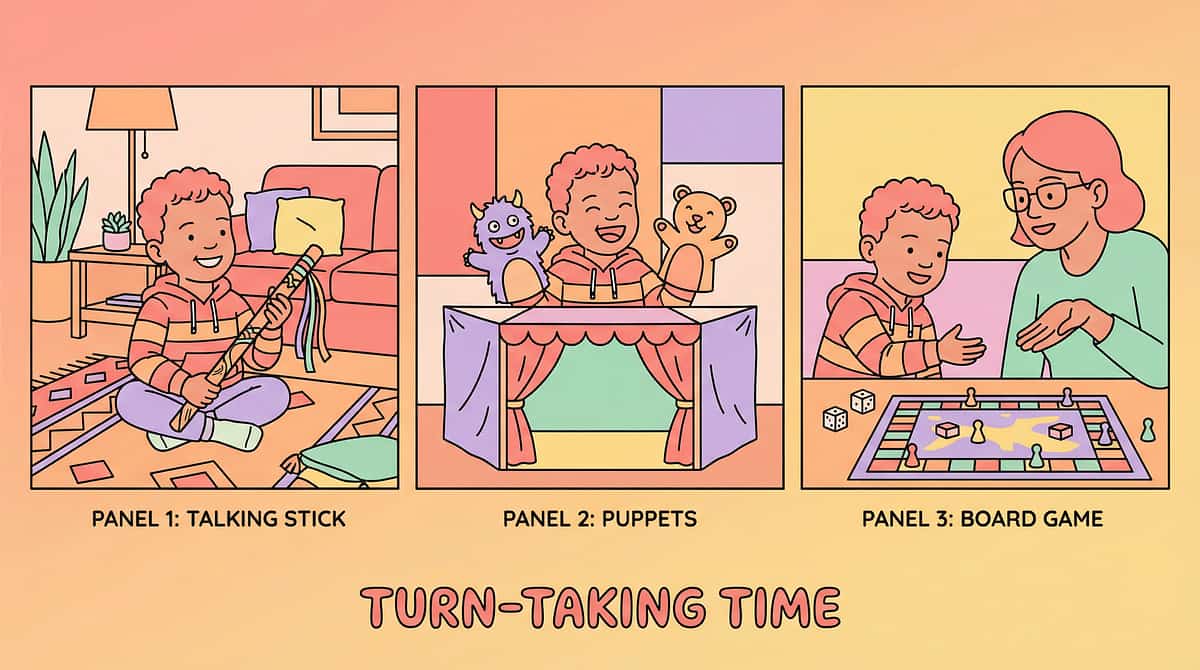
Step 4 — Repeat & Vary (3–5 minutes)
Step 4 of 6
Target: 3–5 full turn-taking cycles per session in Week 1. Build to 8–10 by Week 4. 3 good cycles beats 10 forced cycles. Quality of engagement matters more than quantity of repetitions.
🎭 Puppet Version
Puppets take turns talking. Child controls both sides — this gives them full agency and removes social pressure while building the same neural pathways.
🎲 Game Version
Play UNO or a card game but add a rule: before playing your card, say one sentence about your day. Others listen while you speak.
📖 Story Version
Read a social story about turn-taking before the practice round. The story primes the brain for the skill that follows.
👨👩👧👦 Family Version
Include siblings and grandparents. More people = more practice. Everyone follows the same rules — no exceptions, including parents.
Satiation indicators: Child becomes fidgety, responds with single words, looks away, or asks to stop. Honor this. "Great practice today! Let's do this again tomorrow."

Step 5 — Reinforce & Celebrate
Step 5 of 6
"You had a thought, you wrote it down, and you WAITED. That is incredible. I'm so proud of you. Now tell me your thought — it's your turn!"
Verbal Praise
Specific to the behavior: "You waited!" — not just "Good job!" Specificity teaches the child exactly what to repeat.
Token System
Earn a star/sticker for each successful wait. 5 stars = preferred activity. Visual and tangible.
Natural Reward
"Because you waited, you got to share your WHOLE thought and everyone listened!" The conversation itself becomes the reward.
Physical Affirmation
High five, thumbs up, hug if appropriate. Physical affirmation anchors the emotional memory of success.
Critical Principle: Celebrate the attempt, not just the success. If the child started to interrupt, caught themselves, and used a signal card — THAT is a triumph. "You almost jumped in, but you stopped and used your card. That takes so much brain power. I'm amazed."
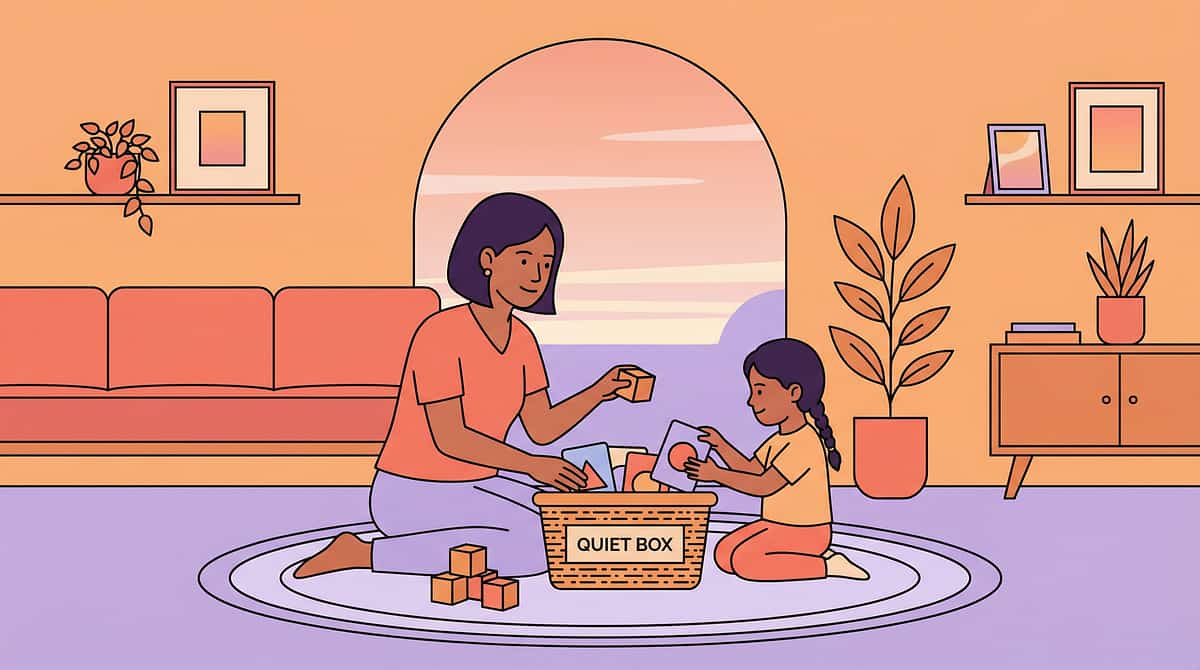
Step 6 — Cool-Down & Transition (2 minutes)
Step 6 of 6
How a session ends is as important as how it begins. A warm, deliberate close reinforces the child's sense of accomplishment and sets positive expectations for next time.
01
Transition Warning
"Two more turns, then we're all done for today!" — Give advance notice so the ending isn't abrupt or surprising.
02
Closing Thought
Pass the talking object one final time. Each person says one thing they liked about the conversation. This builds positive associations with structured turn-taking.
03
Put Away Together
Child participates in returning materials to their spot. This builds ownership and routine. "The talking stick goes back to its spot. We'll use it again at dinner / tomorrow / next time."
04
Calming Input
Deep breath together, hand squeeze, or quiet moment. Transitions out of structured practice deserve the same intentionality as transitions in.
If child resists ending: "I know you have more to say! That's wonderful. You can write your thoughts in your notebook and share them next time. Your thoughts won't be lost."

Record This — 60 Seconds, Right Now
"60 seconds of data now saves hours of guessing later." Week-over-week trends reveal what's working, what needs adjusting, and when to celebrate breakthroughs. Track these three data points after every session.
1
Wait Count
How many times did the child successfully wait for their turn today? Mark a tally: |||
2
Interrupt Count
How many times did the child interrupt despite having materials available? Note the number without judgment — it's baseline data, not a grade.
3
Signal Use
Did the child use any replacement behavior — signal card, writing, hand signal, fidget — instead of interrupting? Yes / No / Partially
📋 PDF Tracker
Downloadable GPT-OS® tracking sheet — print and keep on the fridge or in your session folder
📱 GPT-OS® App
In-app tracker linked to EverydayTherapyProgramme™ data entry — auto-graphs your progress over time
📝 Simple Notebook
Write today's date and three numbers: waits / interrupts / signals used. That's all you need.

What If It Didn't Go As Planned?
"Session abandonment is not failure — it's data." Every difficult session teaches you something about your child's current state and needs. Here are the 7 most common challenges and exactly what to do about each.
🔧 "My child refused to use the talking object."
Why: New materials feel controlling to some children. Fix: Let the child choose the talking object. Make it their favorite toy. Or skip the object and start with games only.
🔧 "They used the signal card but then talked anyway."
Why: Signal card use IS progress — the impulse override takes longer to develop. Fix: Acknowledge the signal immediately: "I see your card! Give me 5 seconds." Speed of response matters enormously.
🔧 "They interrupted more with the timer visible."
Why: For some children, watching time pass increases anxiety. Fix: Remove the visual timer temporarily. Use a talking object only. Reintroduce the timer in Week 3.
🔧 "My child got upset and cried when corrected."
Why: Correction sensitivity, possibly from accumulated negative feedback. Fix: STOP correcting. Only reinforce successful waits. Ignore interruptions entirely for 1 week — only celebrate the wins.
🔧 "The siblings won't follow the rules."
Why: System works only if everyone participates. Fix: Make it a family game. Siblings earn rewards too. Nobody is exempt — including parents.
🔧 "It worked at home but not at school."
Why: Generalization takes time and coordination. Fix: Share materials with the teacher. Send a cue card set for the classroom desk. Coordinate via the teacher communication template (Card 37).
🔧 "We tried for a week and nothing changed."
Why: One week is too early for behavior change. Neural pathway formation takes 3–4 weeks minimum. Fix: Continue. Review data. Are there ANY moments of waiting? Those moments ARE progress.
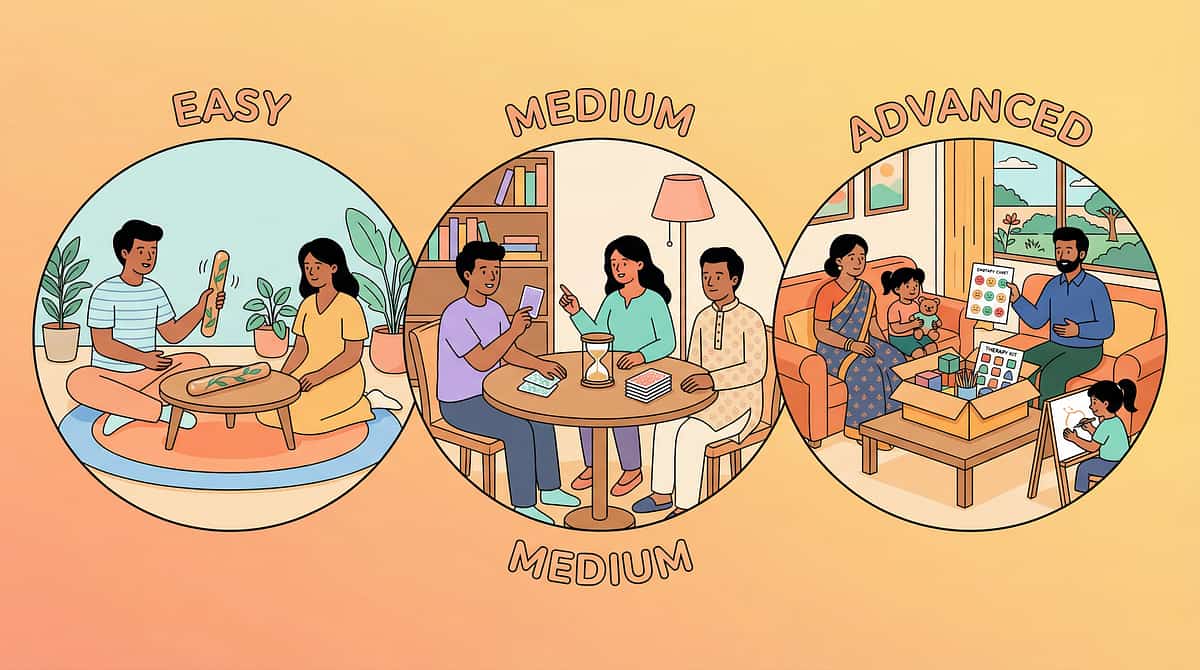
Adapt to Your Child — No Two Children Are Identical
These materials are a starting framework, not a rigid prescription. Adjust difficulty, duration, and profile to match your child's unique presentation. Here is your complete personalization guide.
⬅️ Easier (Younger/Early Weeks/Tough Days)
- Use only 1 material (talking stick)
- 2-minute sessions
- 2 people only (you and child)
- Praise every attempt, ignore all interruptions
- Conversations about child's favorite topic only
➡️ Harder (Older/Later Weeks/Breakthroughs)
- Combine 3–4 materials simultaneously
- 15–20 minute sessions
- 4+ family members participating
- Introduce new contexts (restaurant, phone call, playdate)
- Fade materials gradually — can the child wait without the object?
1
ADHD Profile
Extra fidget tools, shorter turns, more frequent reinforcement, physical movement breaks between cycles
2
Autism Profile
More visual structure, social stories before every session, consistent routine, predictable turn order
3
Anxiety Profile
Remove timer (time pressure increases anxiety), use thought-holding cards heavily, extra warmth and reassurance
4
Gifted/Verbal
Longer speaking turns, more complex topics, journal-style thought capture, debate-style turn-taking

Week 1–2: Emerging Awareness
Progress: ~15%
Weeks 1–2
"If your child paused for even one second before interrupting this week — if they reached for the signal card even once — that is REAL PROGRESS. The neural pathway is forming. You may not see it yet, but it's building."
✅ What Progress Looks Like
- Child picks up the talking object with interest (even if they don't follow rules perfectly)
- Child uses the signal card once or twice (even if they also interrupt)
- Child mentions materials between sessions: "Where's the talking stick?"
- You notice 1–2 moments where the child pauses before speaking — even briefly
⏳ What Is NOT Progress Yet
- Consistent waiting (that comes in weeks 3–4)
- No interrupting at school (generalization takes weeks)
- Self-monitoring without cues (way too early)
Expected Metrics
- Wait count: 2–5 per session
- Interrupt count: Still high (that's okay)
- Signal use: Emerging (even once = breakthrough)

Week 3–4: The Rule Is Taking Root
Progress: ~40%
Weeks 3–4
"You may notice you're more confident too. The strategies are becoming natural to your family. You're not just practicing — you're building a family communication culture."
Child reaches for the talking object automatically before speaking
Signal card use becomes more consistent session to session
Child catches themselves mid-interruption: "Oh wait — it's not my turn"
Thought-holding cards show more entries — the child is capturing thoughts
Duration of waiting increases from seconds to tens of seconds
Self-correction appears without adult prompting — the most exciting milestone
When to Increase Difficulty: If the child consistently waits with one material, introduce a second. If 2-person conversations work, try 3–4 people. Always expand from a position of success, never from frustration.

Week 5–8: Mastery Emerging
Progress: ~75%
Weeks 5–8
✅ 70%+ Success Rate
Child waits for turn in 70%+ of conversational opportunities at home — consistent, not occasional
✅ Independent Signal Use
Child uses signal or thought-capture independently, without reminder from a caregiver
✅ Generalization
Turn-taking transfers to at least one new setting — school, grandparent's house, or a playdate
✅ 50% Reduction
Interrupting frequency reduced by 50%+ from baseline week 1 data
"He raised his hand at school today and waited!" — Parent, Pinnacle Network
🏆 Mastery Unlocked — when consistent across 3+ settings for 2+ weeks. Can the child wait without the physical talking object? If yes → material fading has begun. If not → keep materials in place. There is no rush.

You Did This. Your Child Grew Because of Your Commitment.
Remember Card 01? The child who couldn't let anyone finish a sentence. The dinner table chaos. The teacher's frustration. The friends pulling away.
Look at where you are now. Your child waits. Not perfectly — but measurably. Not everywhere — but in more places every week. Not always — but more often than before. That transformation didn't happen by accident. It happened because you showed up, set up the materials, ran the sessions, captured the data, and celebrated the small wins.
Have a special family dinner where the child leads the conversation using the talking stick. Let them feel the power of the skill they've built. Take a photo. Write the date. This is a milestone worth marking.
📸 Document the Milestone
Capture this moment in your GPT-OS® family journal — a record of progress your child will treasure
📤 Share with Your Team
Tell your therapy team so they can celebrate with you — shared wins multiply motivation for everyone
Red Flags — When to Pause and Seek Guidance
These materials are powerful — and for most families, sufficient. But there are specific signs that a professional evaluation is warranted. Trust your instincts. If something feels wrong, pause and ask. That's not failure. That's parenting.
🔴 No Improvement After 6+ Weeks
No improvement after 6+ weeks of consistent daily practice. This may indicate an underlying condition (ADHD, autism, language processing difference) requiring professional evaluation.
🔴 Significant Worsening
Interrupting worsens significantly — if the child becomes more aggressive, defiant, or distressed about the materials, stop and consult.
🔴 Anxiety About Speaking
Child stops sharing thoughts entirely. Overcorrection can create the opposite problem — immediately remove all structured practice and focus on encouragement only.
🔴 Peer Relationships Deteriorating
If friendships are suffering despite material use, professional social skills intervention and peer group work is needed.
🔴 Emotional Distress Signs
Excessive crying, withdrawal, self-criticism ("I'm stupid," "Nobody likes me"), or refusal to participate in conversations at all.
🔴 Teacher Reports Escalation
If classroom behavior worsens or new behaviors emerge, a comprehensive evaluation is warranted. Contact your Pinnacle center.
Escalation Pathway: Self-resolve → GPT-OS® teleconsultation → Pinnacle center visit → Comprehensive AbilityScore® assessment
📞FREE National Autism Helpline: 9100 181 181 (16+ languages, 24x7) | 🔗 pinnacleblooms.org/centers
📞FREE National Autism Helpline: 9100 181 181 (16+ languages, 24x7) | 🔗 pinnacleblooms.org/centers
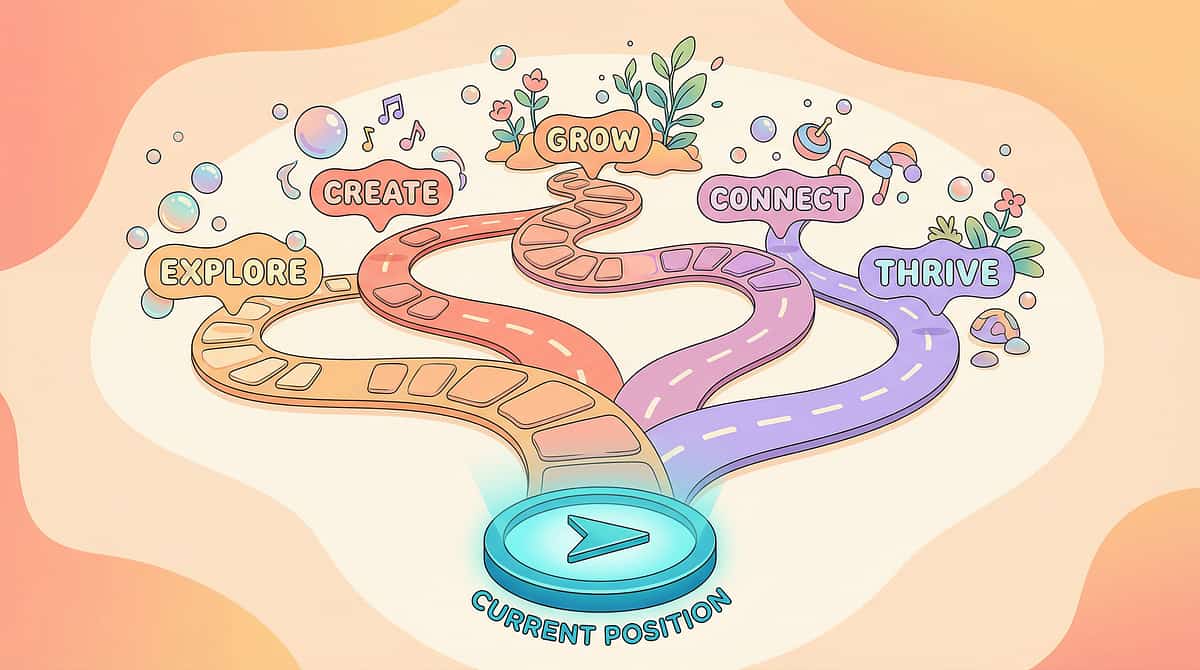
Your Child's Progression Pathway
This technique sits within a carefully sequenced progression. Knowing what comes before and after helps you understand exactly where you are — and where you're going with your child's social communication development.
Lateral Alternatives
- K-1500: Understanding Executive Function in Children (parent education)
- K-1505: Building Impulse Control at Home (broader strategies)
- K-1510: When to Seek Evaluation for ADHD (screening guidance)
Long-Term Goal
Age-appropriate conversational turn-taking across settings — at home, school, with peers, with adults, in structured and unstructured conversations. This is the destination. Every session moves you closer.
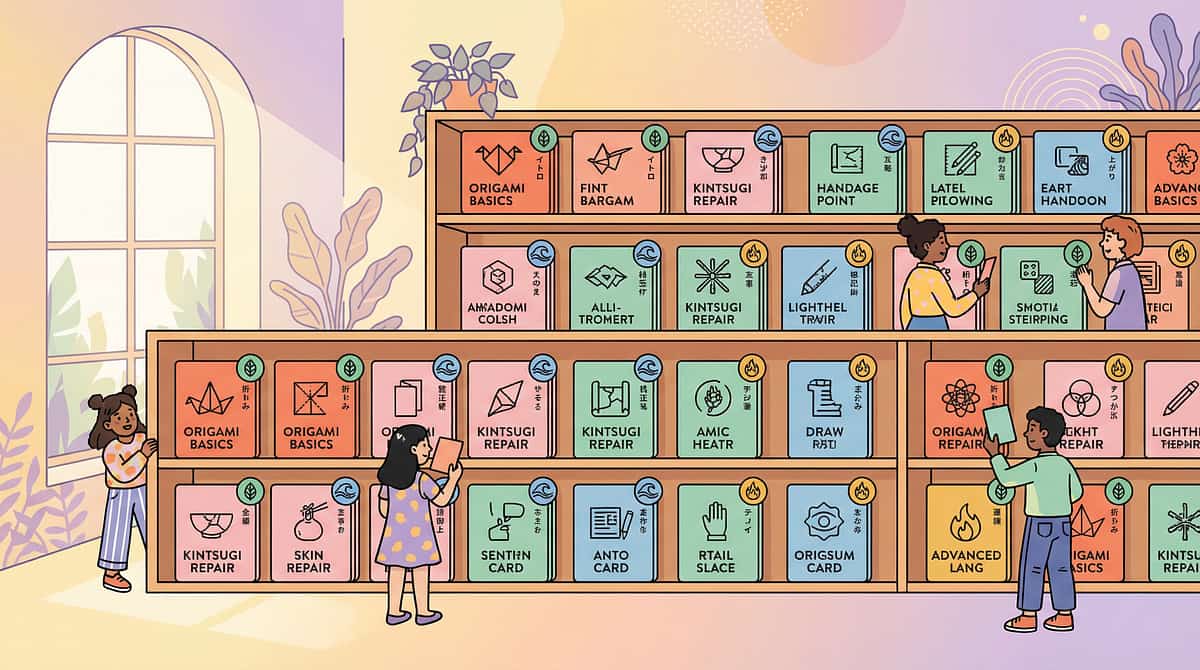
Related Techniques in Social Communication
The materials you've already gathered for B-210 give you a head start on every technique in this domain. Your investment in this kit extends far beyond one technique.
Technique | Difficulty | You Have Materials | Primary Materials Used | |
B-208: Difficulty Taking Turns in Play | Intro | ✅ Yes | Turn-taking games, puppets | |
B-209: Trouble Listening to Others | Intro | ✅ Yes | Visual cue cards, social stories | |
B-211: Difficulty Answering Questions | Core | ✅ Yes | Thought-holding tools, cue cards | |
B-212: Topic Maintenance Challenges | Core | ✅ Yes | Social stories, conversation games | |
B-215: Impulse Control in Social Situations | Advanced | ✅ Yes | Fidget tools, visual timers, signal cards | |
K-1505: Building Impulse Control at Home | Parent Education | ✅ Yes | All 9 materials apply |
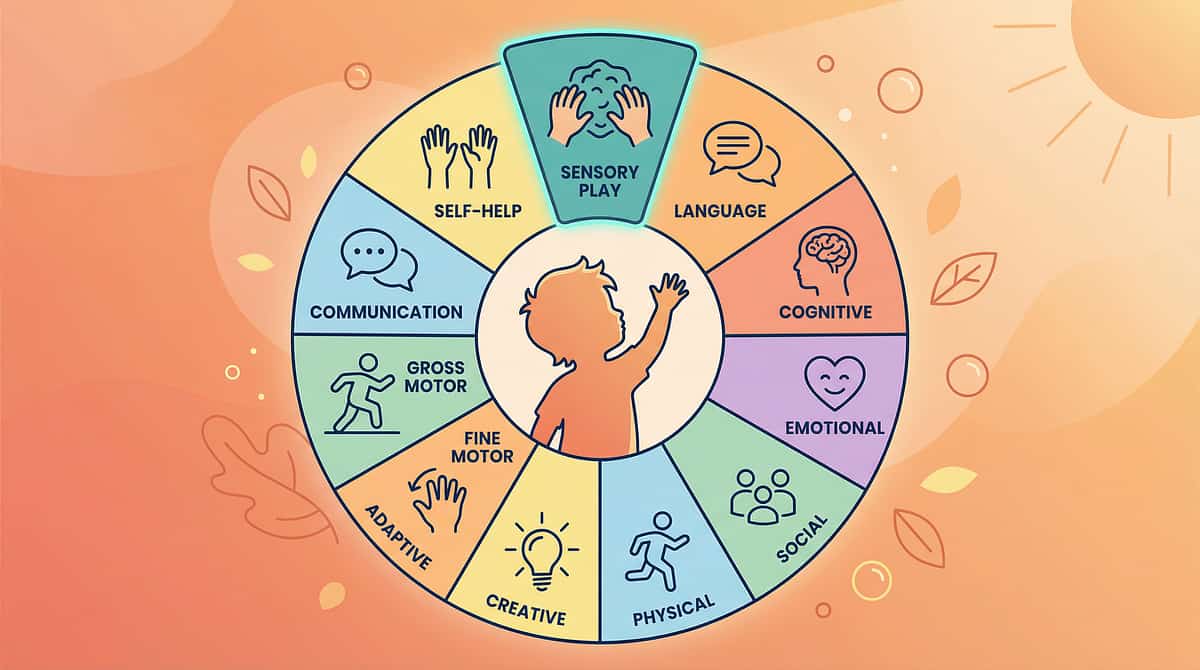
One Technique in a Larger Plan
This technique sits within Domain B: Social Communication — one of 12 developmental domains in the Pinnacle GPT-OS® framework. Your child's complete developmental profile spans all 12 domains, and this technique is one carefully placed piece of a personalized, data-driven plan.
See Your Child's Full Profile
🔗 GPT-OS® Developmental Dashboard — pinnacleblooms.org/gptos
📞 Request an AbilityScore® Assessment: 9100 181 181
GPT-OS® Core Stack
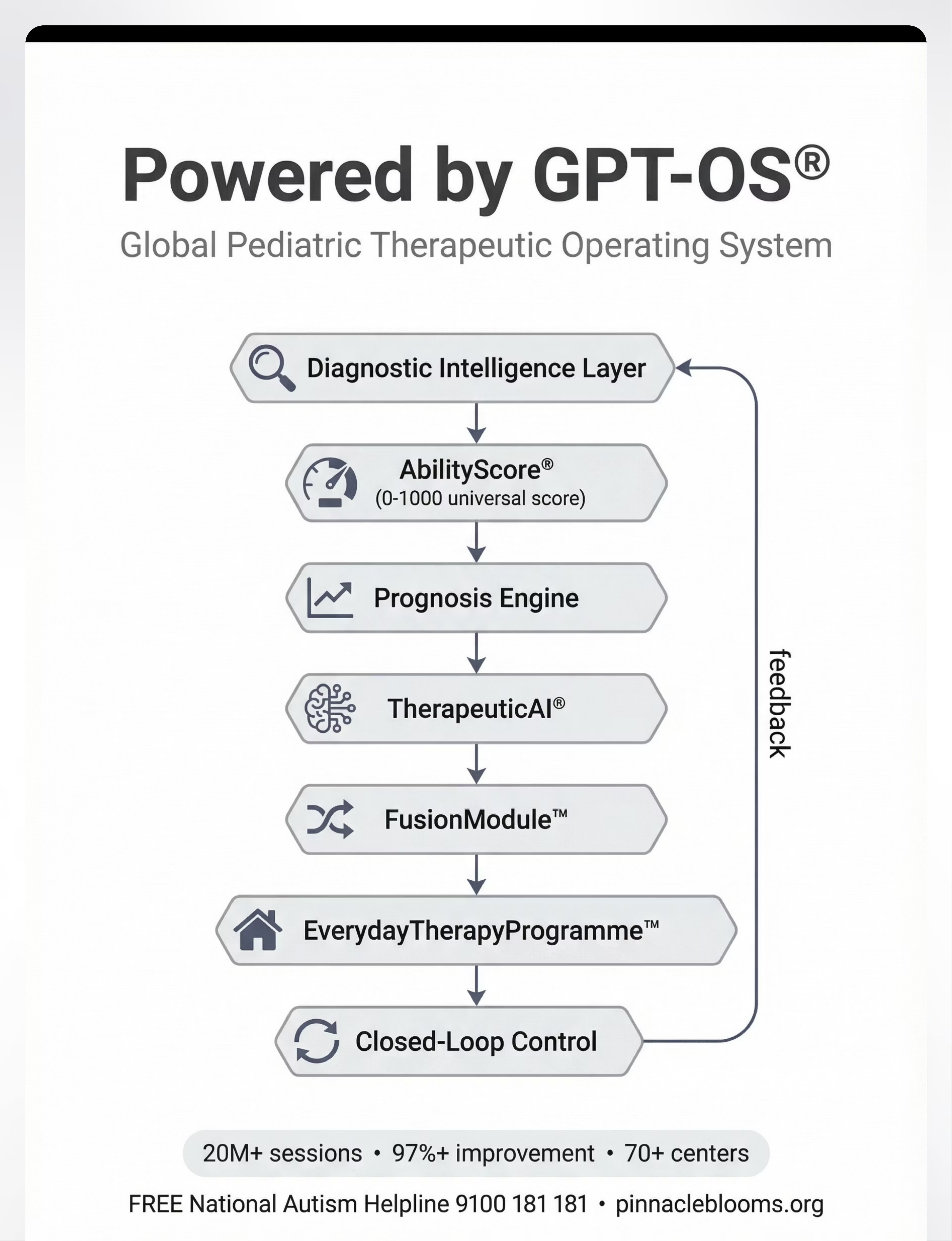
Diagnostic Intelligence Layer → AbilityScore® (0–1000) → Prognosis Engine → TherapeuticAI® → FusionModule™ → EverydayTherapyProgramme™ → Closed-Loop Therapeutic Control

Families Who've Been Where You Are
"My son was the kid who couldn't let anyone finish a sentence. In class, at home, with friends — he just burst in with his thoughts constantly. We started with a talking stick at dinner and thought-holding cards at school. By month two, he was waiting, actually waiting, looking at the stick and knowing his turn would come. His teacher noticed the change before we did. 'He raised his hand today and waited,' she told me. Waited. Such a simple word, but for him it was huge. Now, almost a year later, he takes turns naturally in most conversations. The desperate urgency is gone. He knows he'll get his turn."
— Parent, Pinnacle Blooms Network. Illustrative case; outcomes vary by child profile.
From the Therapist's Notes: "This child's AbilityScore® showed significant executive function challenges with relatively strong language comprehension — meaning he understood the rules perfectly but couldn't execute them under cognitive load. Materials-based intervention provided the external scaffolding his internal systems needed. Progress followed the typical 8–12 week trajectory."
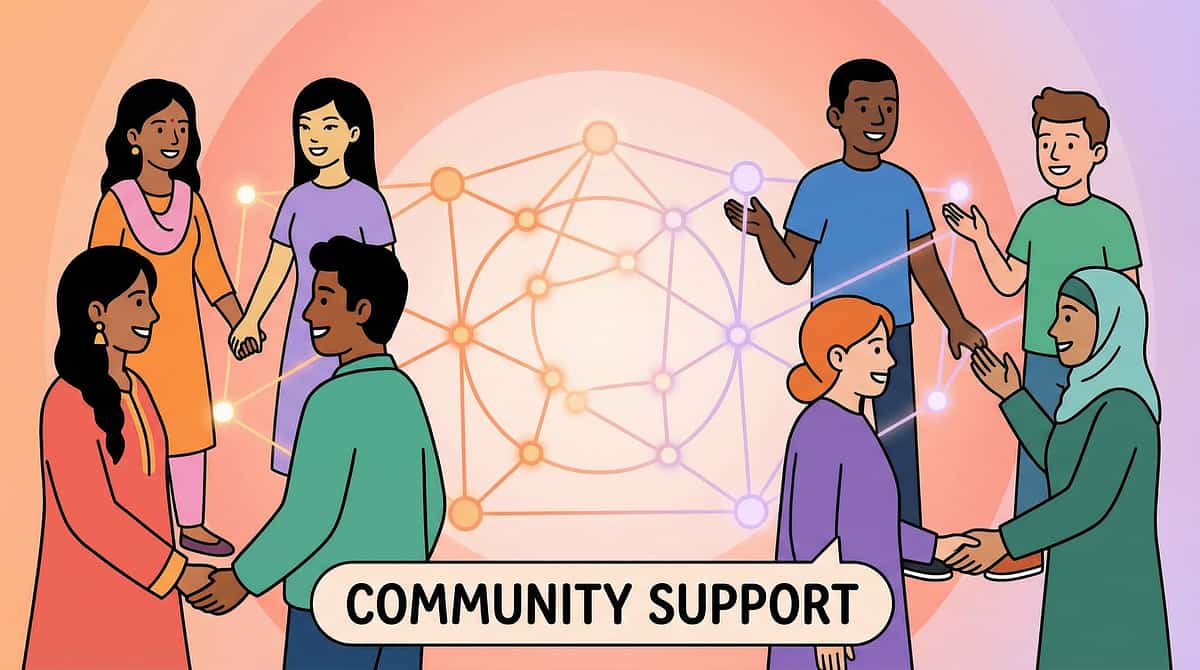
You Are Not Alone in This
The families who've walked this road before you have something invaluable to share: proof that it gets better, and the lived wisdom of exactly how. Connect with the Pinnacle community — you don't have to figure this out alone.
💬 Parent Community
Join other families navigating turn-taking, conversational skills, and social communication development. Share wins, troubleshoot challenges, and find solidarity with parents who truly understand. 🔗 Pinnacle Parent Community
📍 Local Parent Meetups
Find your nearest Pinnacle center and connect with families in your city who are using these same techniques and materials. 🔗 pinnacleblooms.org/centers
🤝 Peer Mentoring
Connect with an experienced parent who has navigated this journey and come out the other side. Sometimes the most powerful guidance comes from someone who has lived it. 📞 9100 181 181 — ask for Parent Peer Support
"Your experience helps others. Consider sharing your journey — the parent behind you needs to hear it worked."
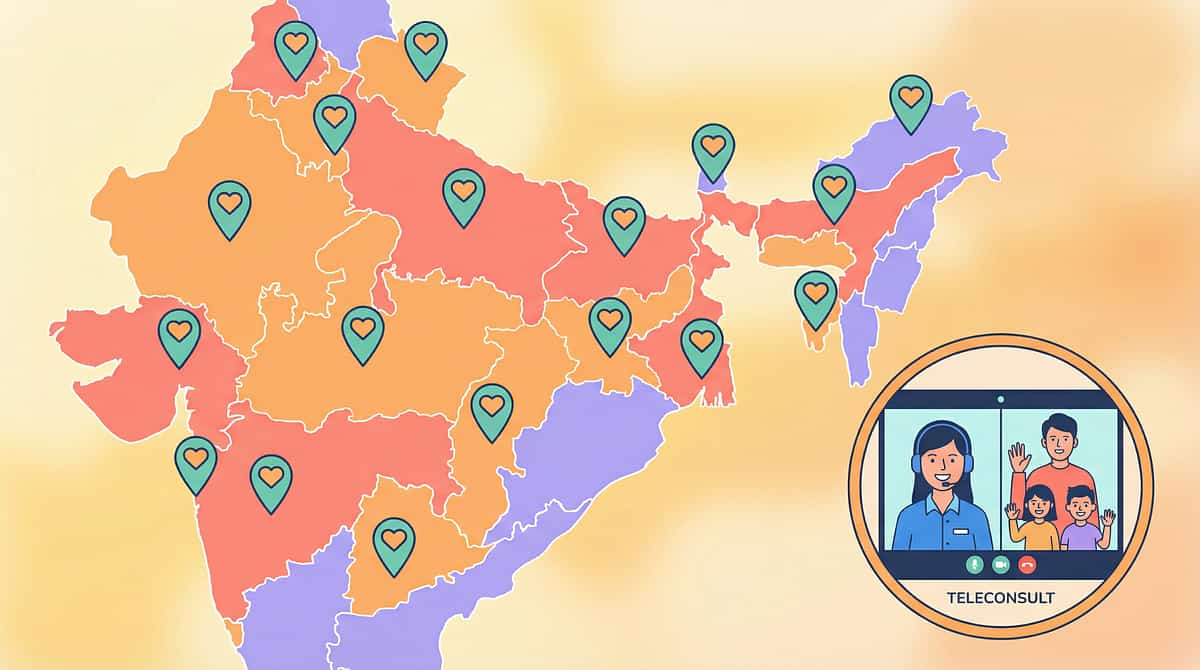
Professional Support — When Home Meets Clinic
Home practice and clinical support are most powerful when they operate as one integrated system. The Pinnacle FusionModule™ ensures your home sessions and clinic sessions reinforce each other — not duplicate or contradict. "Home + Clinic = Maximum Impact."
🗣️ Speech-Language Therapy
Pragmatic language assessment and conversational intervention targeting ASHA benchmarks
🧩 Behavioral Therapy
Impulse control and reinforcement strategies through BCBA-supervised ABA protocols
👥 Social Skills Groups
Peer-based turn-taking practice with children who are learning the same skills simultaneously
🏠 EverydayTherapyProgramme™
Daily home-extension protocols that connect clinic sessions to every day of the week
🔗 Find your nearest center: pinnacleblooms.org/centers — 70+ centers across India
📹 Teleconsultation for families outside center radius: pinnacleblooms.org/teleconsult
📞 FREE National Autism Helpline: 9100 181 181 (16+ languages, 24x7)
📹 Teleconsultation for families outside center radius: pinnacleblooms.org/teleconsult
📞 FREE National Autism Helpline: 9100 181 181 (16+ languages, 24x7)
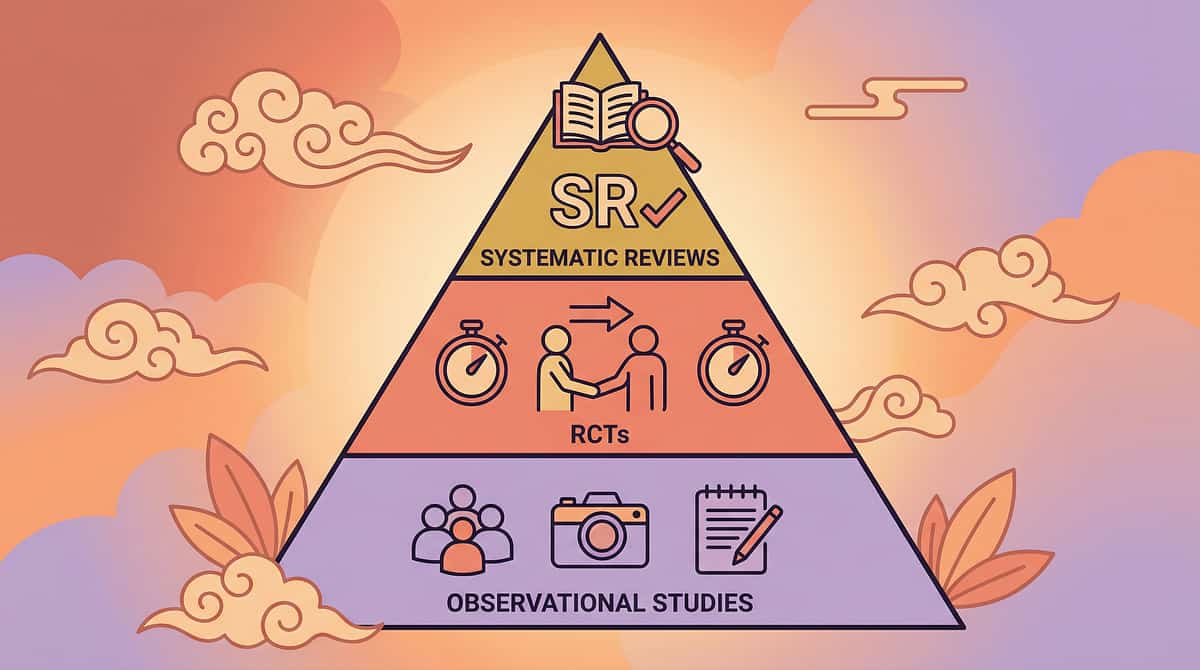
The Science Behind This Page
Every technique on this page is grounded in peer-reviewed evidence. These are the key studies. "Deeper reading for the curious parent — and the clinician who wants to verify."
PRISMA Systematic Review (2024)
16 articles confirm sensory integration and structured intervention meets evidence-based practice criteria for children with ASD. 🔗 PMC11506176
Meta-Analysis — World Journal of Clinical Cases (2024)
24 studies: Structured intervention effectively promotes social skills, adaptive behavior, and developmental outcomes. 🔗 PMC10955541 | DOI: 10.12998/wjcc.v12.i7.1260
WHO Care for Child Development Package (2023)
Age-specific, evidence-based caregiver recommendations implemented across 54 LMICs. 🔗 PMC9978394
NCAEP Evidence-Based Practices Report (2020)
Visual supports and social narratives classified as established evidence-based practices for autism. National Clearinghouse on Autism Evidence and Practice, UNC Chapel Hill.
Indian Pediatric RCT (2019)
Home-based structured interventions demonstrated significant outcomes in Indian pediatric populations. 🔗 DOI: 10.1007/s12098-018-2747-4 (Padmanabha et al., Indian J Pediatr)
UNICEF/WHO Nurturing Care Framework for SLPs (2022)
Multi-disciplinary contribution to nurturing care components including responsive caregiving. 🔗 DOI: 10.1080/17549507.2022.2141327
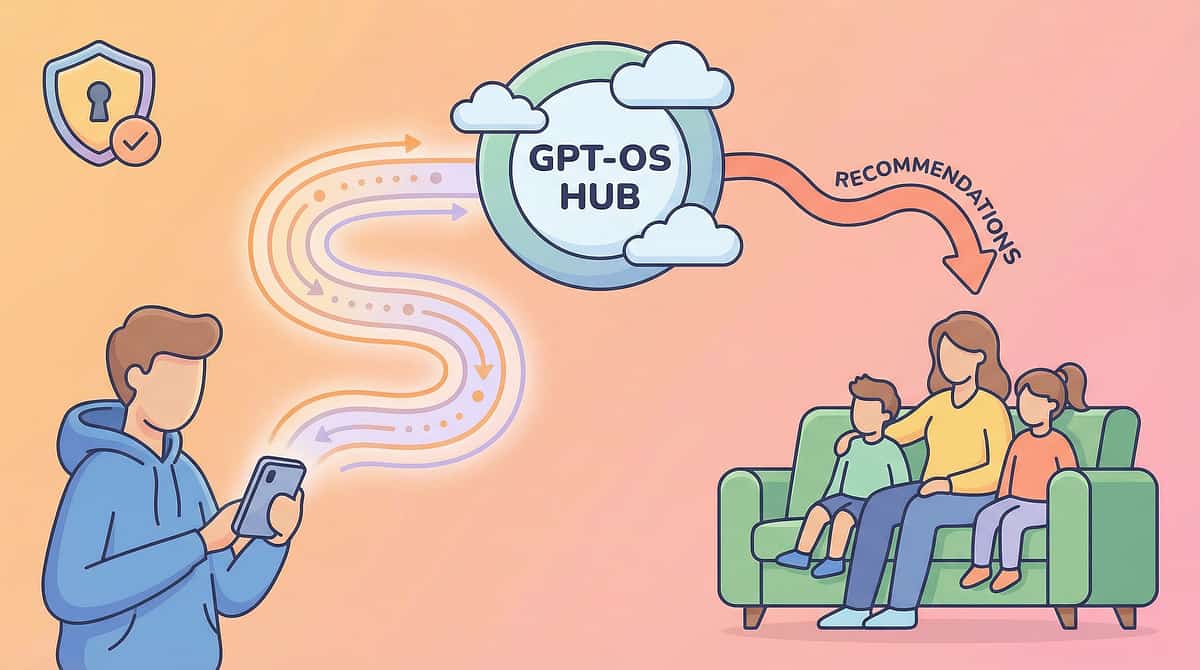
How GPT-OS® Powers Your Child's Progress
Your session data doesn't just sit in a notebook — it feeds a living therapeutic intelligence system trained on 20 million+ session outcomes across 70+ Pinnacle centers. The more data you record, the more precisely the system guides your next step.
🔒 Your Privacy is Protected
Your data is encrypted, anonymized at population level, and never shared with third parties. Compliant with Indian IT Act and international data protection standards.
Population-Level Impact
"Your data doesn't just help your child — it helps every child like yours. When 20 million sessions inform the algorithm, every new family benefits from collective wisdom." This is not software. This is therapeutic infrastructure.
Watch the Reel — B-210
A Pinnacle therapist demonstrates all 9 materials in action — the talking stick being passed, the visual timer counting down, the thought card being written, the signal card being raised, the puppet conversation, the board game waiting. Real materials. Real technique. 60 seconds.
🎬 Reel ID: B-210
9 Materials That Help When Child Interrupts
📂 Series: Episode 210
Social Communication & Self-Regulation Solutions
⏱ Duration: 60 seconds
Concise, clinician-presented, home-ready
🏷️ Domain
Social Communication + Executive Function
Presented by the Pinnacle Blooms Social Communication Therapy Team — Speech-Language Pathologists and Behavioral Therapists specializing in conversational skills development.
🔗 Follow Pinnacle Blooms for parent education content | 🔗 Browse all 999 Reels: pinnacleblooms.org/reels
🔗 Follow Pinnacle Blooms for parent education content | 🔗 Browse all 999 Reels: pinnacleblooms.org/reels
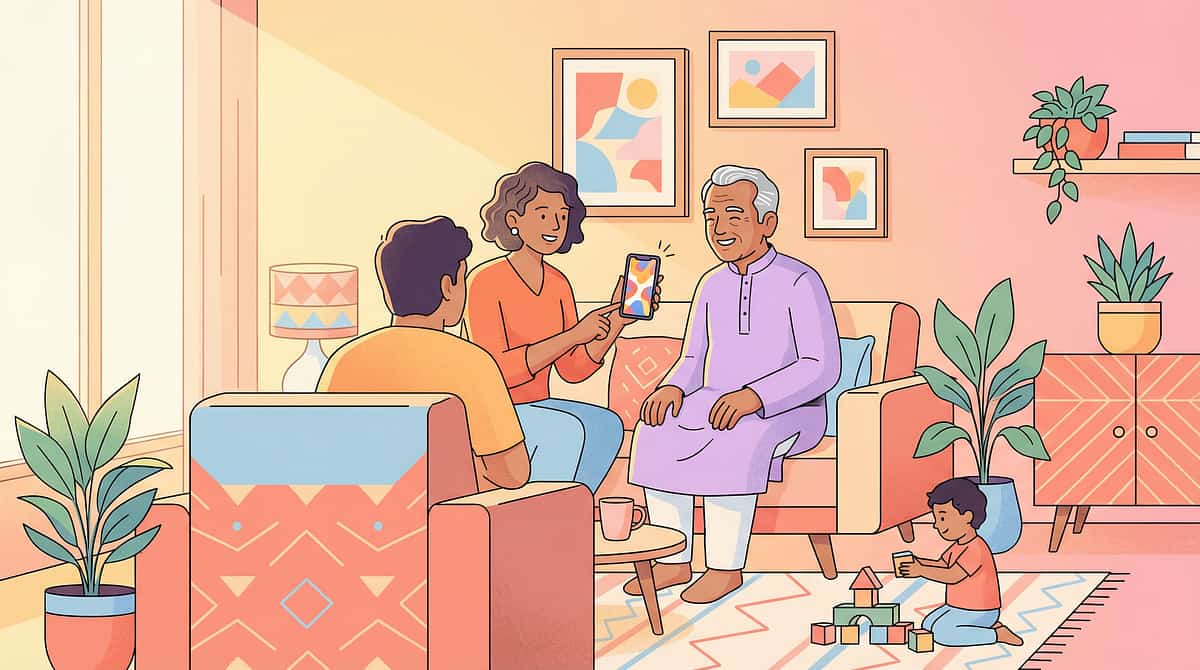
Share This With Everyone Who Talks to Your Child
"Consistency across caregivers multiplies impact." If only one parent uses the materials, the child practices waiting in one relationship. If grandparents, teachers, and siblings all participate, the skill generalizes faster — because the child practices in every conversation.
"We're using a talking stick at dinner — whoever holds it talks, everyone else listens. It helps [child's name] practice waiting. Please use it too when you visit. If [child's name] holds up the green card, it means they want to speak. Just nod and let them know you'll give them a turn soon. That's all you need to do."
📱 WhatsApp
Send this page to your spouse, grandparents, or child's teacher in one tap
📧 Email
Forward the complete technique page to anyone who spends time with your child
📄 Family Guide PDF
Simplified 1-page version for grandparents who prefer print over screens
📄 Teacher Template
Share strategies with school — coordinates classroom materials with home practice for faster generalization
Frequently Asked Questions
How long before I see improvement?
Most families notice emerging awareness within 1–2 weeks. Consistent turn-taking improvement typically appears at weeks 3–4. Significant reduction across settings usually requires 5–8 weeks of daily practice.
Does this work for children with ADHD?
Yes. These materials are particularly effective for ADHD-profile children because they externalize executive functions. Fidget tools and visual timers are especially helpful. Consider extra-short turns, more frequent reinforcement, and movement breaks.
What if my child can't write yet?
Thought-holding works without writing. Use picture cards, tokens placed in a cup, or a "thought stone" — a special stone the child holds to remember they have something to say. Works beautifully for pre-writers.
Should I use all 9 materials at once?
No. Start with 1 material (talking stick recommended). Add materials one at a time as the child becomes comfortable. Most families use 3–4 materials simultaneously by Week 3–4.
What if my child won't participate?
Never force. Make it a game, not a rule. Let the child choose the talking object. If they refuse entirely, try a board game that requires turn-taking. The skill builds through play.
Will this work at school?
With coordination, yes. Share the teacher communication template (Card 37) and send portable materials (signal cards, cue cards, fidget tool). Classroom generalization typically begins 2–3 weeks after home mastery.
My child interrupts because they're excited, not rude. Is this still needed?
Absolutely. Excitement-driven interrupting is the most common type and the most responsive to these materials. The goal isn't to suppress excitement — it's to help the child hold the excitement for a few seconds until it's their turn.
When should I seek professional help?
If daily practice for 6+ weeks shows no improvement, or if interrupting is accompanied by significant peer rejection, academic impact, or emotional distress, a professional evaluation is recommended. Call: 9100 181 181.

Your Next Step — Start Now
Everything you need is on this page. The science, the materials, the protocol, the adaptations, the community, and the professional pathway. The only thing left is the first session. Start today — even with a single talking object from your kitchen drawer.
🟢 Start This Technique Today
GPT-OS® guided session launcher — personalized setup based on your child's age and profile
🔵 Book a Consultation
Connect with a Speech-Language Pathologist or Behavioral Therapist specializing in social communication
📞 9100 181 181
📞 9100 181 181
⚪ Explore Next Technique
Browse related techniques in Social Communication domain
🔗 techniques.pinnacleblooms.org/social-communication/
🔗 techniques.pinnacleblooms.org/social-communication/
✅ Validated by Pinnacle Blooms Consortium
🗣️ SLP • 🧩 BCBA • 🤲 OT • 📚 SpEd • 🩺 NeuroDev
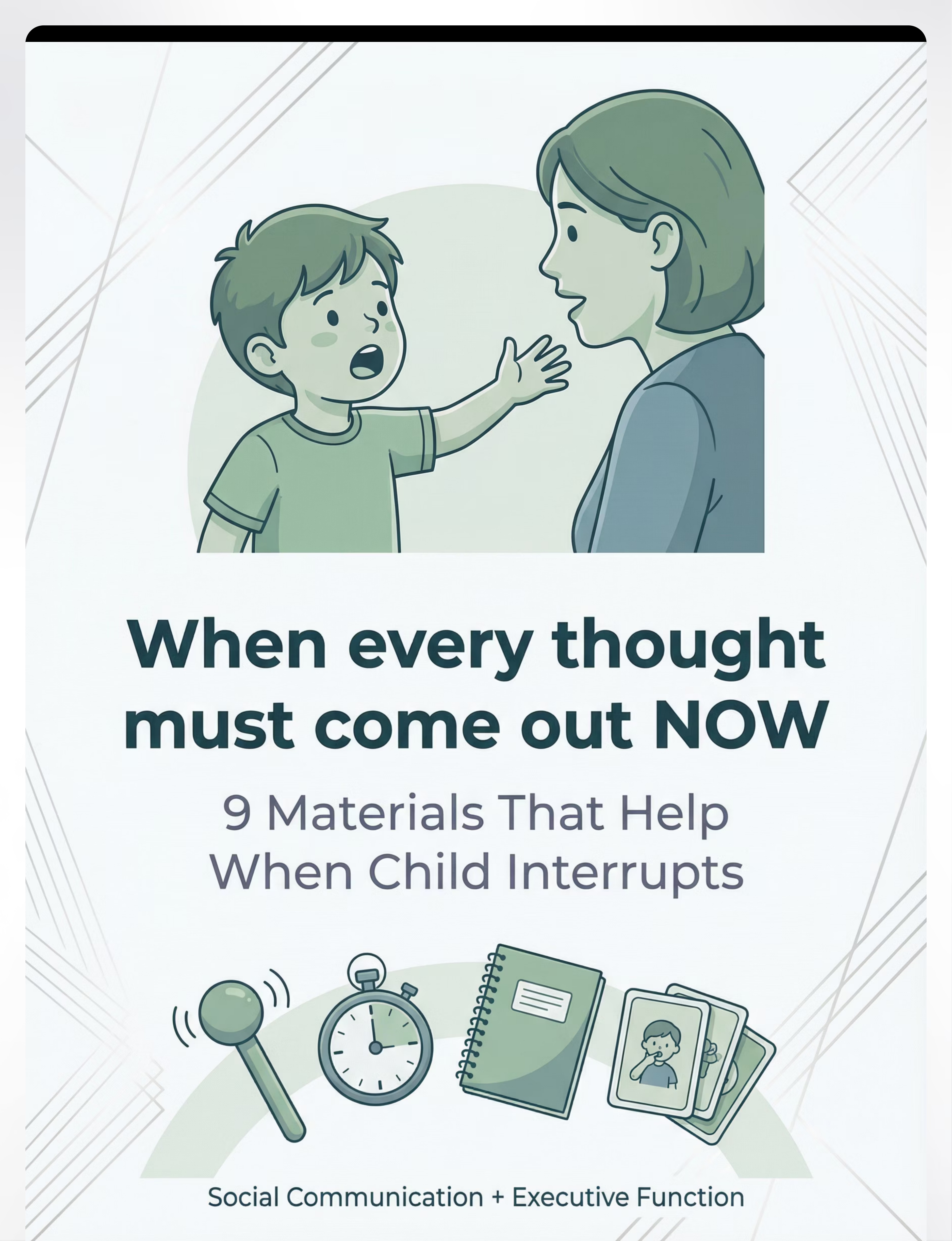
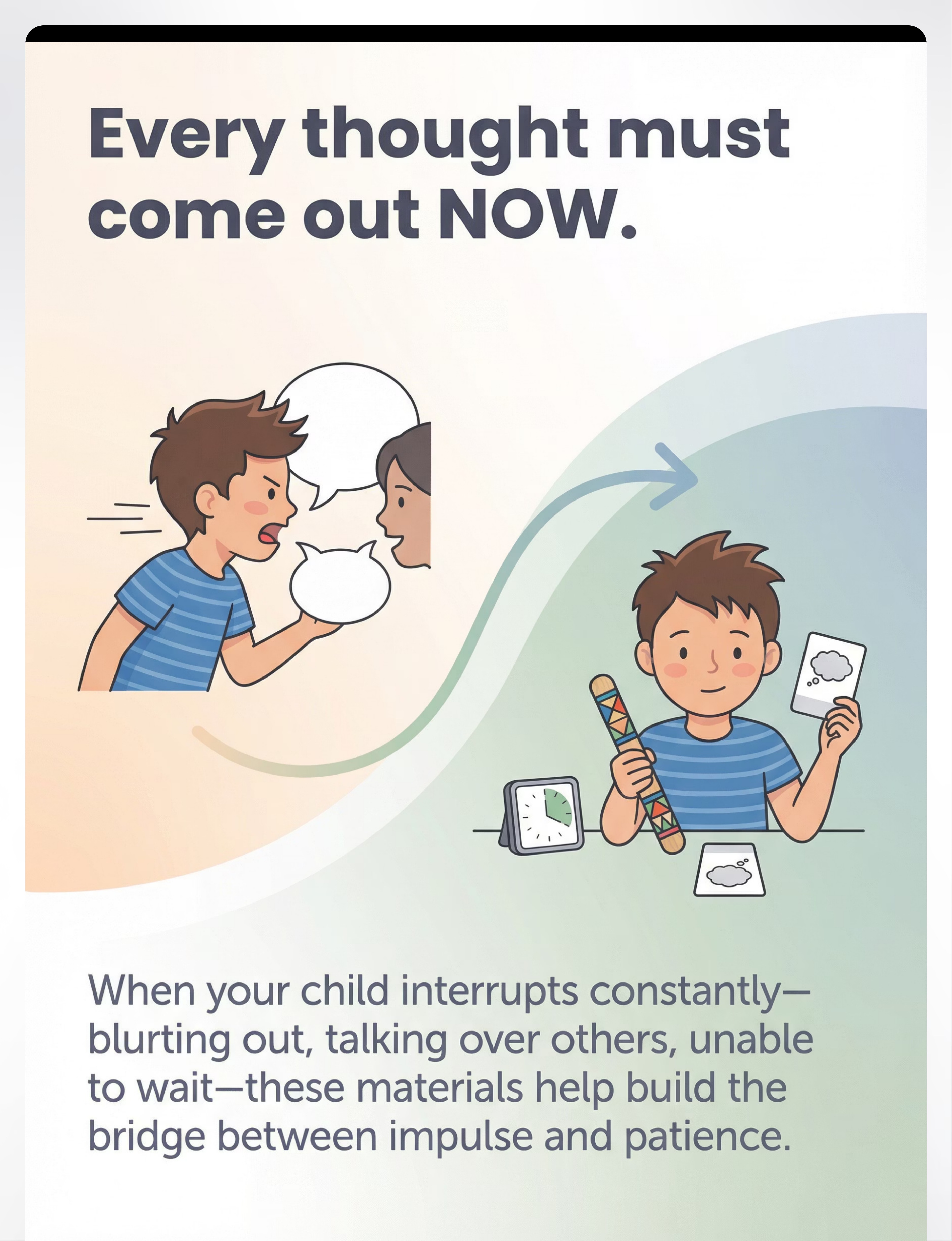
Preview of 9 materials that help when child interrupts Therapy Material
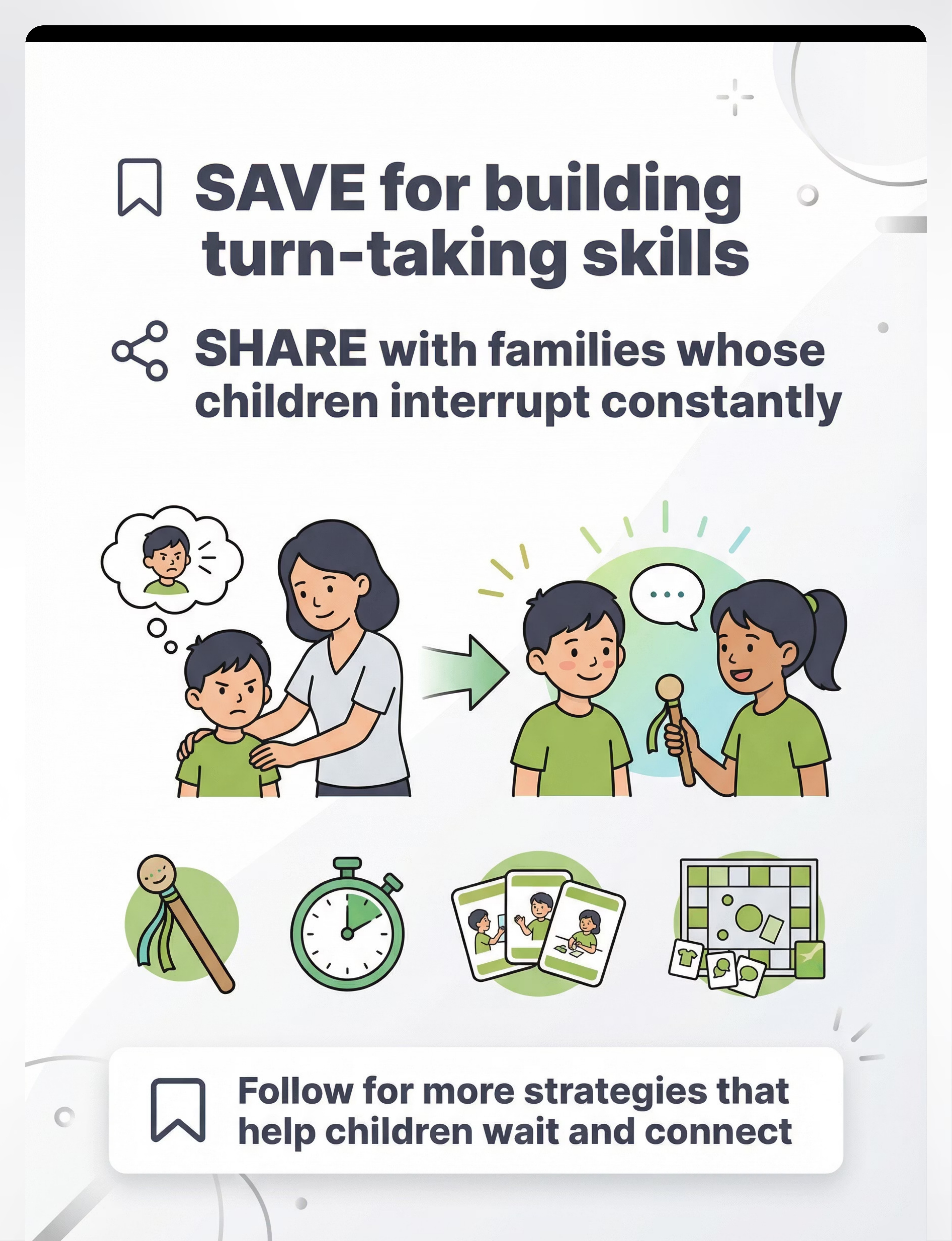
Below is a visual preview of 9 materials that help when child interrupts therapy material. The pages shown help educators, therapists, and caregivers understand the structure and content of the resource before use. Materials should be used under appropriate professional guidance.


Link copied!

From Fear to Mastery. One Technique at a Time.
A parent arrived on this page scared, confused, and exhausted by constant interrupting. By now, they understand the science, have the materials, know the protocol, can track progress, and are connected to professional support and community. The fear has been replaced with competence.
This is the Pinnacle promise: every family, in every home, with every child — armed with evidence, empowered by knowledge, supported by systems.
Speech-Language Pathology • Applied Behavior Analysis
Occupational Therapy • Special Education
NeuroDevelopmental Pediatrics • Clinical Research
Medical Disclaimer: This content is educational. It does not replace assessment by a licensed speech-language pathologist, behavioral therapist, or healthcare provider. Persistent interrupting behavior should be evaluated comprehensively. Individual results may vary. Statistics represent aggregate outcomes across the Pinnacle Blooms Network.
© 2026 Pinnacle Blooms Network®, unit of Bharath Healthcare Laboratories Pvt. Ltd. All rights reserved. CIN: U74999TG2016PTC113063 | DPIIT: DIPP8651 | GSTIN: 36AAGCB9722P1Z2
📞FREE National Autism Helpline: 9100 181 181 | 🌐pinnacleblooms.org | Next: B-211: Difficulty Answering Questions