
Music Class Is Supposed to Be Fun. For Your Child, It's Torture.
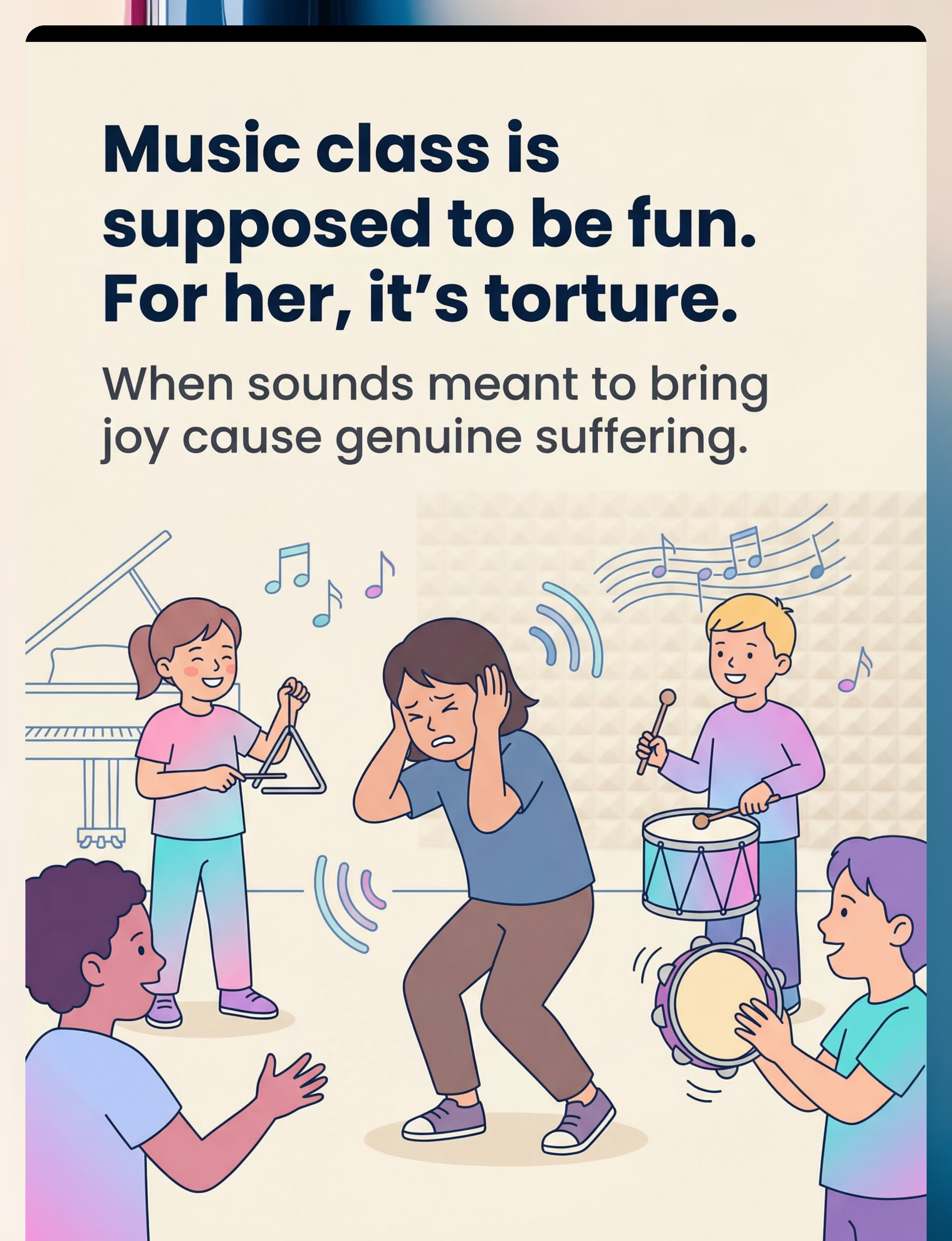
You know this moment. The school schedule says "Music" and your child's body tenses. The hands go to the ears before they even enter the room. Inside, the sounds hit like walls — piano, drums, singing, triangles, all at once, all at full volume, with nowhere to hide. This is Auditory Over-Responsivity in a music class environment. There is a name for this. There is neuroscience behind this. And there are 9 specific materials that can transform music class from excluded nightmare to included success.
You are not failing. Your child's nervous system is speaking. This page will teach you to answer it.
Pinnacle Blooms Consortium® | Sensory Solutions Series — Episode A-040
Drafted by: Pediatric Occupational Therapists · Board Certified Behavior Analysts · Audiologists · Special Educators · NeuroDevelopmental Pediatricians · Validated through 20M+ exclusive 1:1 therapy sessions across 70+ centers
You Are Not Alone — The Numbers Are Clear
80%+
Auditory Sensitivity
of children with autism experience sensory processing difficulties, with auditory sensitivity among the most prevalent
1 in 6
Children Worldwide
experience sensory processing challenges significant enough to affect daily functioning
60-70%
Music Class Distress
of children with auditory over-responsivity identify school music class as among their most distressing environments
Music class is a uniquely difficult auditory environment — multiple simultaneous sound sources, unpredictable instruments, wide volume ranges, and typically hard-surfaced rooms that amplify echo. When your child's auditory system registers every sound at maximum intensity without filtering, this combination becomes genuinely overwhelming. Your child's distress is not unusual, not a character flaw, and not attention-seeking. It is a documented neurological pattern shared by millions of children worldwide.
With over 18 million children estimated to be on the autism spectrum across India, and 80%+ experiencing sensory processing challenges, auditory over-responsivity in school settings affects millions of families. Pinnacle Blooms Network has addressed auditory sensory challenges across 20M+ therapy sessions, building the largest evidence base in Asia for sensory intervention outcomes.
PRISMA Systematic Review (2024): 16 articles from 2013–2023 confirm sensory processing differences in 80%+ of children with ASD | PMC11506176 · Meta-analysis (World J Clin Cases, 2024): Sensory integration therapy demonstrates significant positive outcomes across 24 studies | PMC10955541
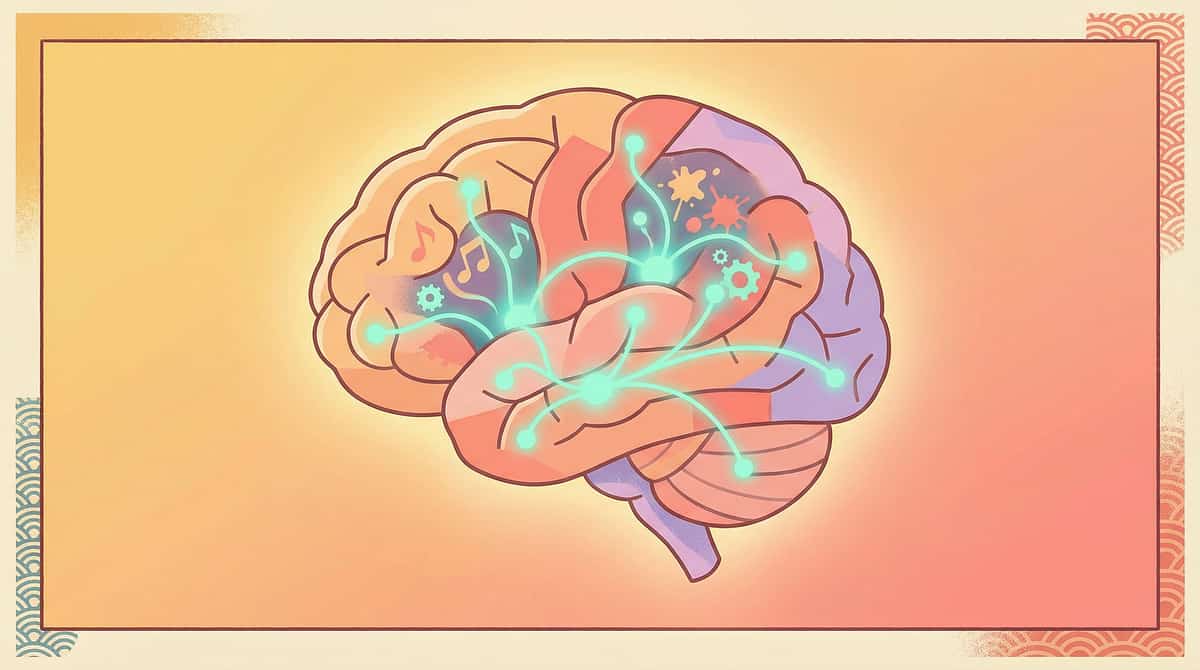
What's Happening in Your Child's Brain During Music Class
The Typical Brain in Music Class
Hears drums, piano, singing, and triangles simultaneously → thalamic filter automatically turns down unimportant sounds → auditory cortex processes the blend as "music" → child enjoys and participates.
Your Child's Brain in Music Class
Hears drums at FULL volume + piano at FULL volume + singing at FULL volume + triangles at FULL volume + echo at FULL volume — ALL AT ONCE → thalamic filter is OPEN — nothing gets turned down → auditory cortex receives ALL input at maximum intensity → amygdala reads this as THREAT → fight-or-flight activates → child covers ears, runs, screams, or shuts down.
The Critical Point
This is NOT a behavior choice. This is a wiring difference in how the auditory system gates and filters sound input. The thalamic relay station — which in typical development selectively dampens irrelevant sounds — is functioning differently in your child. Every sound arrives at the cortex at full intensity. Music class, with its multiple simultaneous sound sources, is the perfect storm for this particular wiring pattern.
"This is a wiring difference, not a behavior problem. Your child isn't choosing to be difficult — their brain is processing sound differently." — Pinnacle Blooms Consortium, Pediatric OT Division
Frontiers in Integrative Neuroscience (2020): Neurological basis for sensory processing differences in ASD | DOI: 10.3389/fnint.2020.556660
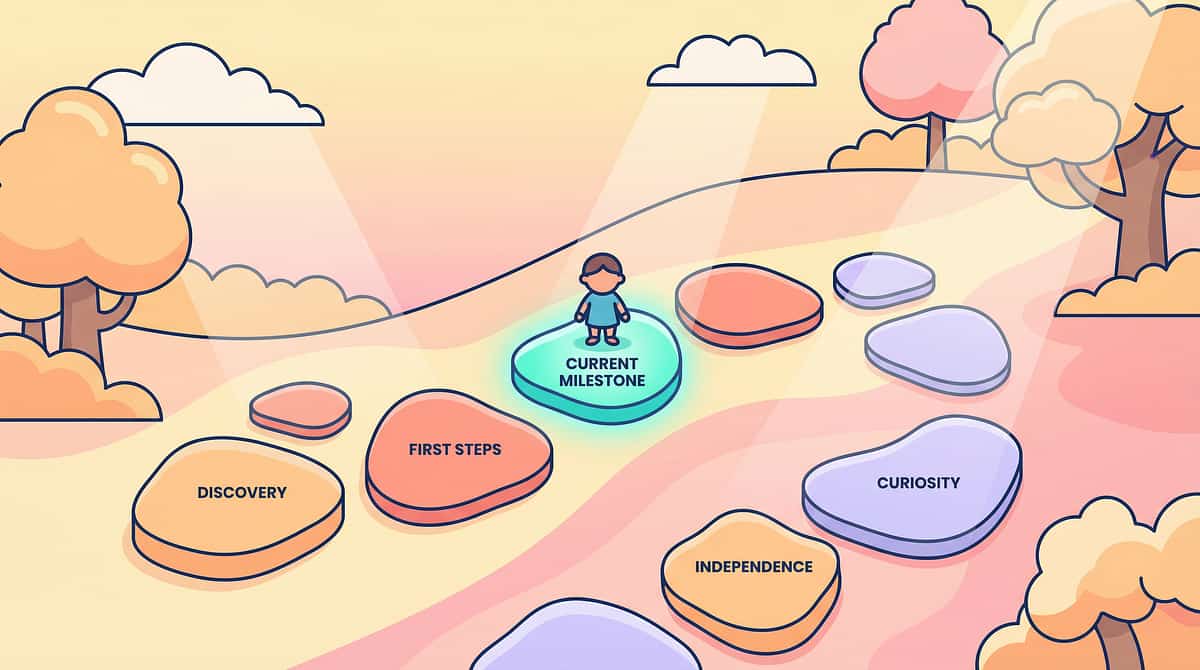
Where Auditory Over-Responsivity Sits in Your Child's Development
1
0–12 Months
Startle to loud sounds; turns to sound source
2
1–3 Years
Tolerates environmental variety; copes with moderate noise
3
3–5 Years
⭐ Music Class Challenges Peak Here — School entry brings mandatory group acoustic environments
4
5–8 Years
Navigates complex auditory environments with support
5
8–12 Years
Self-manages auditory environment with learned accommodations
Auditory over-responsivity is typically identifiable from 12–18 months, but the challenge intensifies dramatically at school entry (ages 3–5) when children encounter mandatory, uncontrolled acoustic environments for the first time — particularly music class, assembly halls, and cafeterias. Your child is in the zone of greatest mismatch between environmental demand and neural capacity.
Commonly co-occurs with: tactile defensiveness, visual sensitivity, anxiety disorders (often secondary to repeated overwhelm), and auditory processing disorder. If your child experiences multiple sensory sensitivities, a comprehensive evaluation is recommended.
WHO Care for Child Development (CCD) Package: Age-specific milestones implemented across 54 countries | PMC9978394

The Science Is Clear: These Strategies Work
LEVEL I–II: STRONG EVIDENCE — Systematic reviews + controlled trials + clinical consensus
"Sensory integration intervention meets criteria to be considered an evidence-based practice for children with ASD" — PRISMA Systematic Review, 2024 (16 articles, 2013–2023)
Systematic Review (Level I)
16 peer-reviewed articles (2013–2023) confirm sensory integration intervention as evidence-based for children with autism, including auditory modulation strategies. | PMC11506176
Meta-Analysis (Level I)
24 studies demonstrate significant promotion of sensory processing, social skills, adaptive behavior, and motor skills. Effect sizes significant across multiple outcome domains. | PMC10955541
Indian RCT (Level II)
Home-based sensory interventions demonstrated significant outcomes in Indian pediatric populations, validating parent-administered protocols. | DOI: 10.1007/s12098-018-2747-4
Real-World Evidence (Level III)
Pinnacle Blooms Network — 20M+ exclusive 1:1 therapy sessions across 70+ centers with 97%+ measured improvement rate via GPT-OS® therapeutic system.
Evidence Strength: 85% — Strong systematic review + meta-analysis + controlled trial support. Clinically validated. Home-applicable. Parent-proven.

The Technique: Music Class Auditory Accommodation Protocol
🎵 SEN-AUD-MUS | Sensory Processing → Auditory Over-Responsivity → Music Class
Also known as: "The Music Class Survival Kit — 9 Tools That Help Your Child Stay and Participate"
A multi-material, multi-strategy intervention protocol designed to reduce auditory sensory load in music class environments, enabling children with auditory over-responsivity to participate in music education rather than be excluded from it. The protocol combines sensory protection tools (ear defenders, strategic seating), predictability supports (visual schedules, preparation strategies), self-regulation aids (fidget tools, break systems), participation modifications (alternative roles, quieter instruments), and tolerance-building approaches (graduated exposure, home music exposure), along with self-advocacy tools (communication cards).
Age Range
3–12 years
Session Duration
30–45 min (per music class)
Frequency
Every music class + daily home preparation
Approach
Parent-school collaboration, incremental implementation

Who Uses This Technique — Across Disciplines
This technique crosses therapy boundaries — because the brain doesn't organize by therapy type. Music class distress requires a coordinated multi-disciplinary response.
Occupational Therapist (Primary Lead)
Designs the sensory accommodation plan. Evaluates auditory processing profile. Selects appropriate ear protection. Creates graduated exposure protocols and establishes sensory diet to support auditory modulation throughout the school day.
Board Certified Behavior Analyst
Develops the break signal system and reinforcement schedule. Creates communication card training protocol. Establishes graduated exposure hierarchy using systematic desensitization principles. Tracks participation data and adjusts interventions.
Special Educator
Coordinates with music teacher on modified participation options. Writes accommodation plan for education records (IEP/504 equivalent). Creates visual supports specific to the music class routine. Ensures accommodations generalize across school settings.
Neurodevelopmental Pediatrician
Evaluates for underlying conditions (hyperacusis, auditory processing disorder). Rules out medical causes of sound sensitivity. Provides medical documentation supporting school accommodations. Monitors medication effects on sensory processing.
Also contributing: Audiologist (hearing evaluation, auditory processing assessment), Speech-Language Pathologist (communication card design, self-advocacy language), Music Therapist (controlled therapeutic music exposure). At Pinnacle Blooms, the FusionModule™ coordinates all disciplines into ONE converged plan.
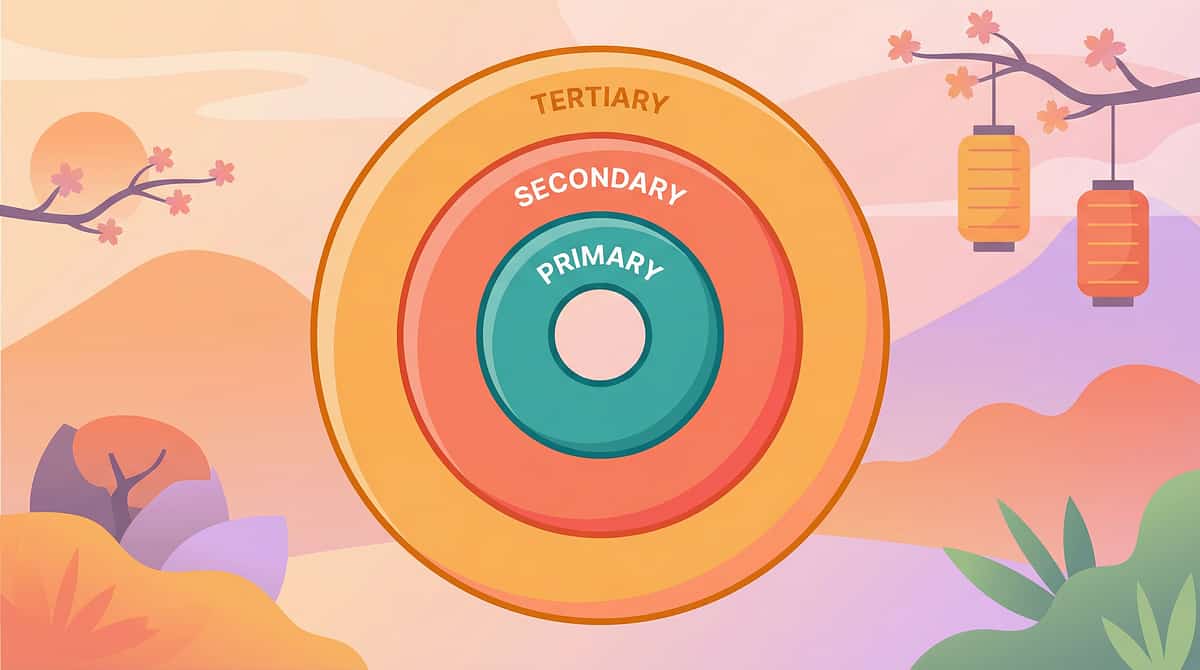
Precision Targets — This Is a Targeted Intervention
🎯 Primary Target
Auditory modulation in multi-source acoustic environments — remaining in and participating in music class without sensory overwhelm, meltdown, or exclusion. Observable: child stays in music room for progressively longer durations, uses ear protection independently, uses break system before meltdown threshold.
Secondary & Tertiary Targets
Secondary: Self-advocacy skills, anxiety reduction around music class, self-regulation strategies that generalize, and social inclusion with peers.
Tertiary: Skills transfer to assembly, cafeteria, and sports events; sensory processing maturation; family advocacy confidence; teacher-parent collaboration.
Meta-analysis (World J Clin Cases, 2024): SI therapy effectively promoted social skills, adaptive behavior, sensory processing, and motor skills across 24 studies | PMC10955541
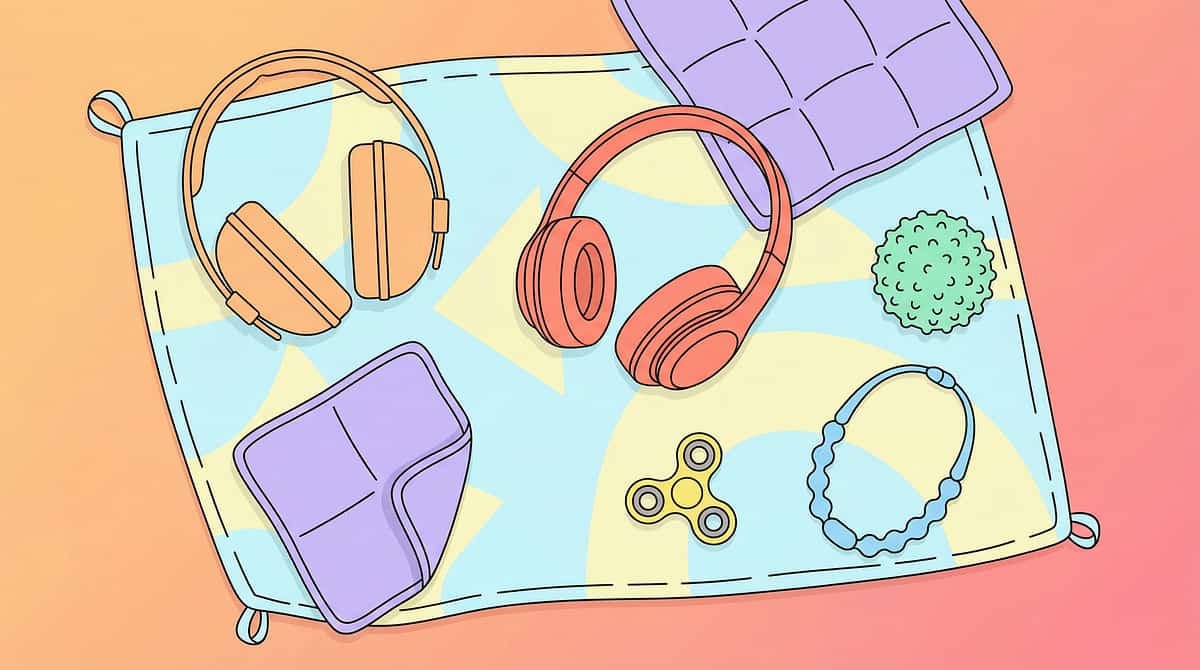
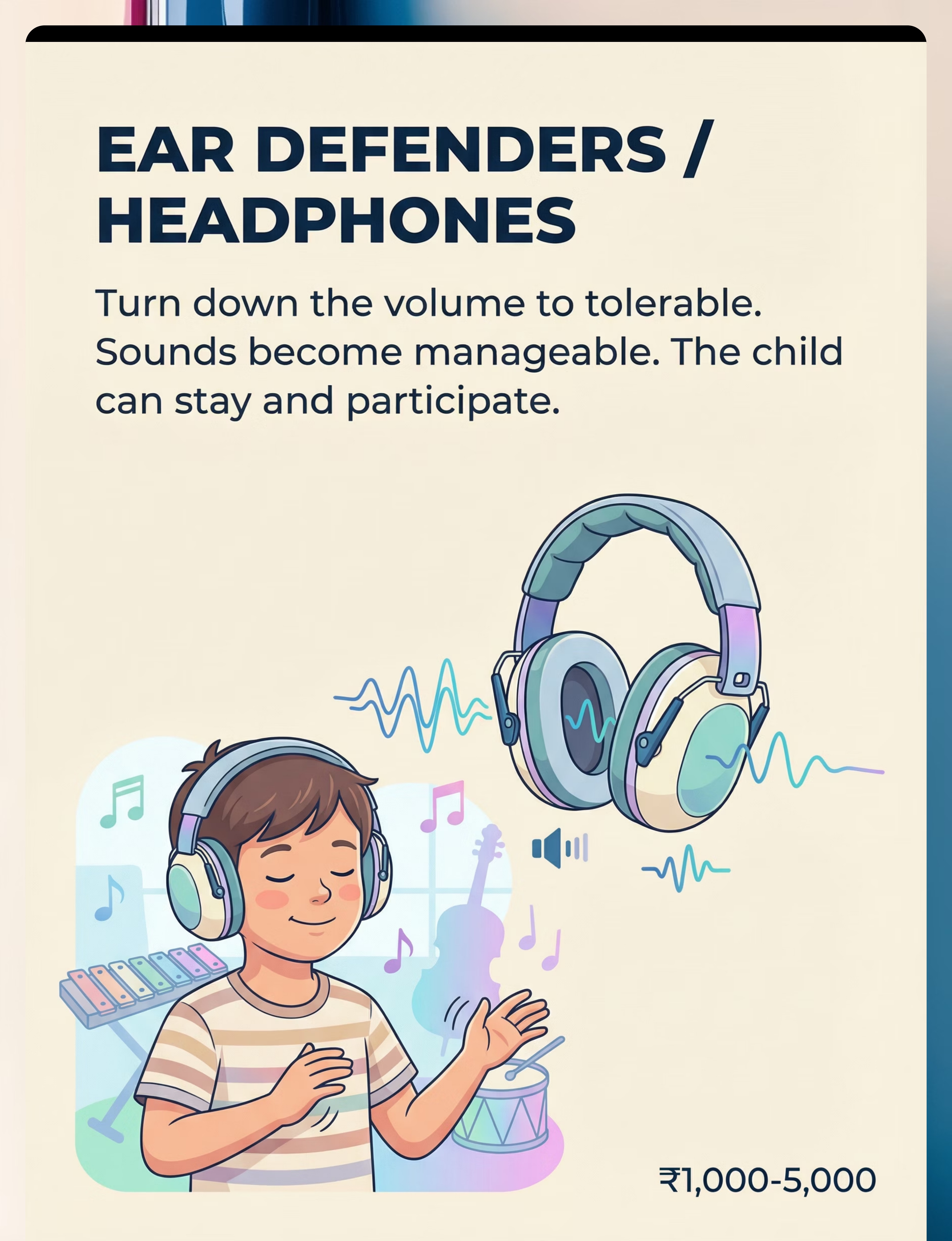
Material 1: Noise-Reducing Ear Defenders / Headphones
Canon: Noise-Reducing Headphones / Ear Defenders
Category: Sensory Regulation & Nervous System Modulation
₹1,000–5,000
The most direct intervention available — ear defenders reduce decibel levels reaching the child's ears while still allowing them to hear instruction. This single tool can transform music class from impossible to manageable, making it the cornerstone of the accommodation protocol.
Passive Over-Ear Defenders
15–30 dB reduction. Most reliable for younger children. Easy to use, no batteries.
Active Noise-Canceling Headphones
Electronic cancellation of ambient sound. Excellent for consistent background noise.
Musician's Earplugs
Preserve sound quality while reducing volume. Ideal once child is comfortable with ear protection concept.
Loop Earplugs
Discreet, stylish option for older children concerned about peer perception.
Pinnacle Recommends: Start with passive over-ear defenders for reliability and ease of use. Upgrade to musician's earplugs once the child is comfortable with the ear protection concept. → materials.pinnacleblooms.org/noise-reducing-headphones-ear-defenders
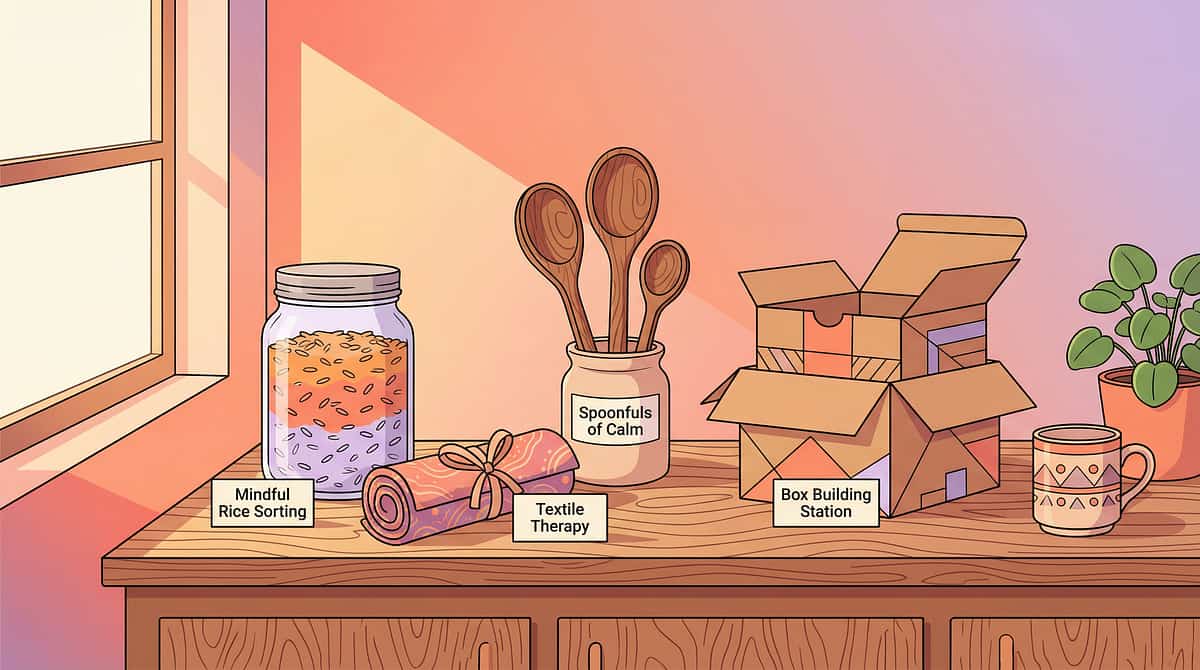
Materials 2 & 3: Strategic Seating + Visual Schedule System
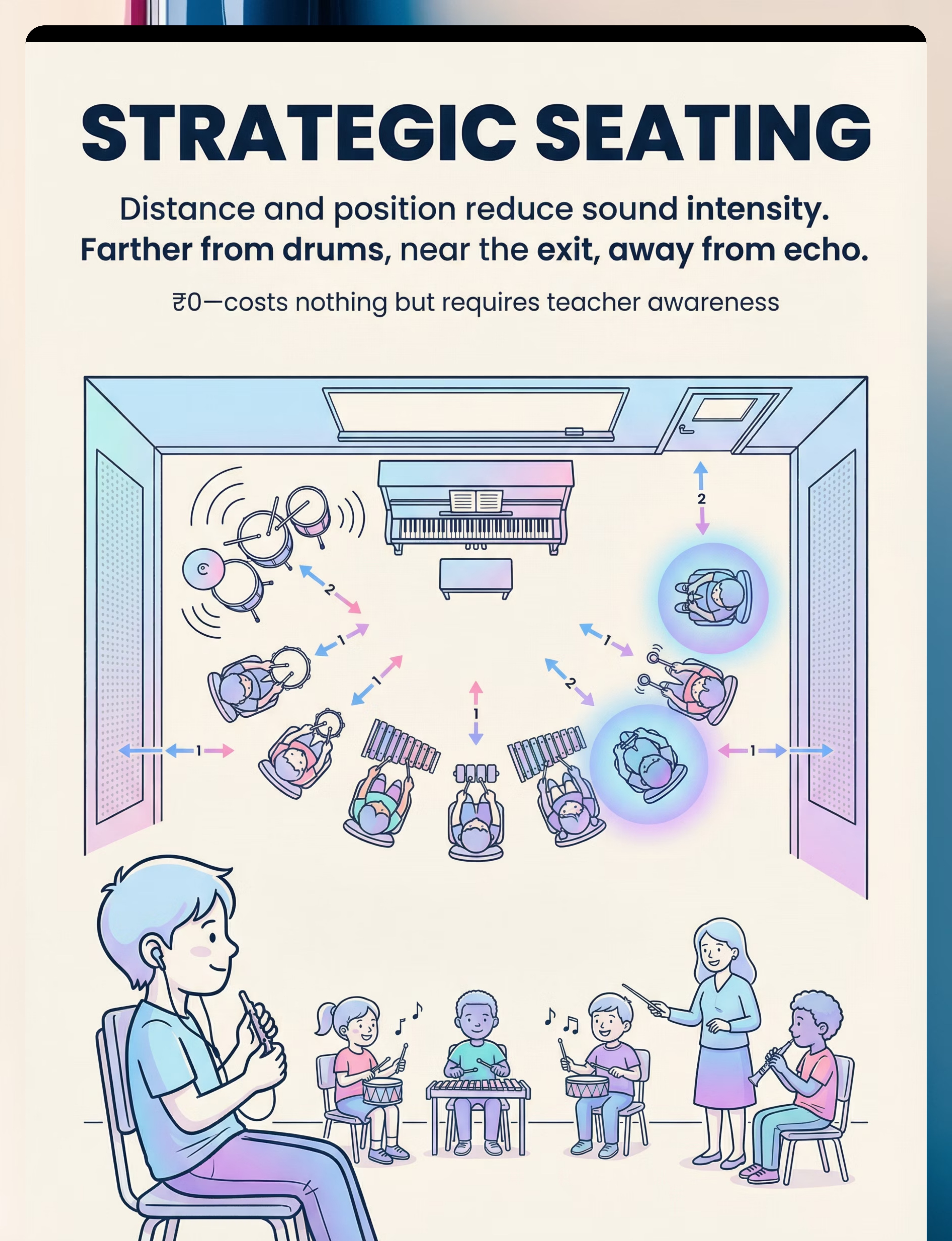
Material 2: Strategic Seating
₹0 — Environmental Modification
Why Position Matters
Sound intensity decreases with distance from the source. Positioning your child farthest from drums, near the exit, and away from hard reflective walls uses physics to reduce auditory load at zero cost.
- Room acoustic awareness map
- Consistent seating assignment (same spot every class)
- Visual marker for child's designated spot
- Clear, unobstructed path to exit or quiet space
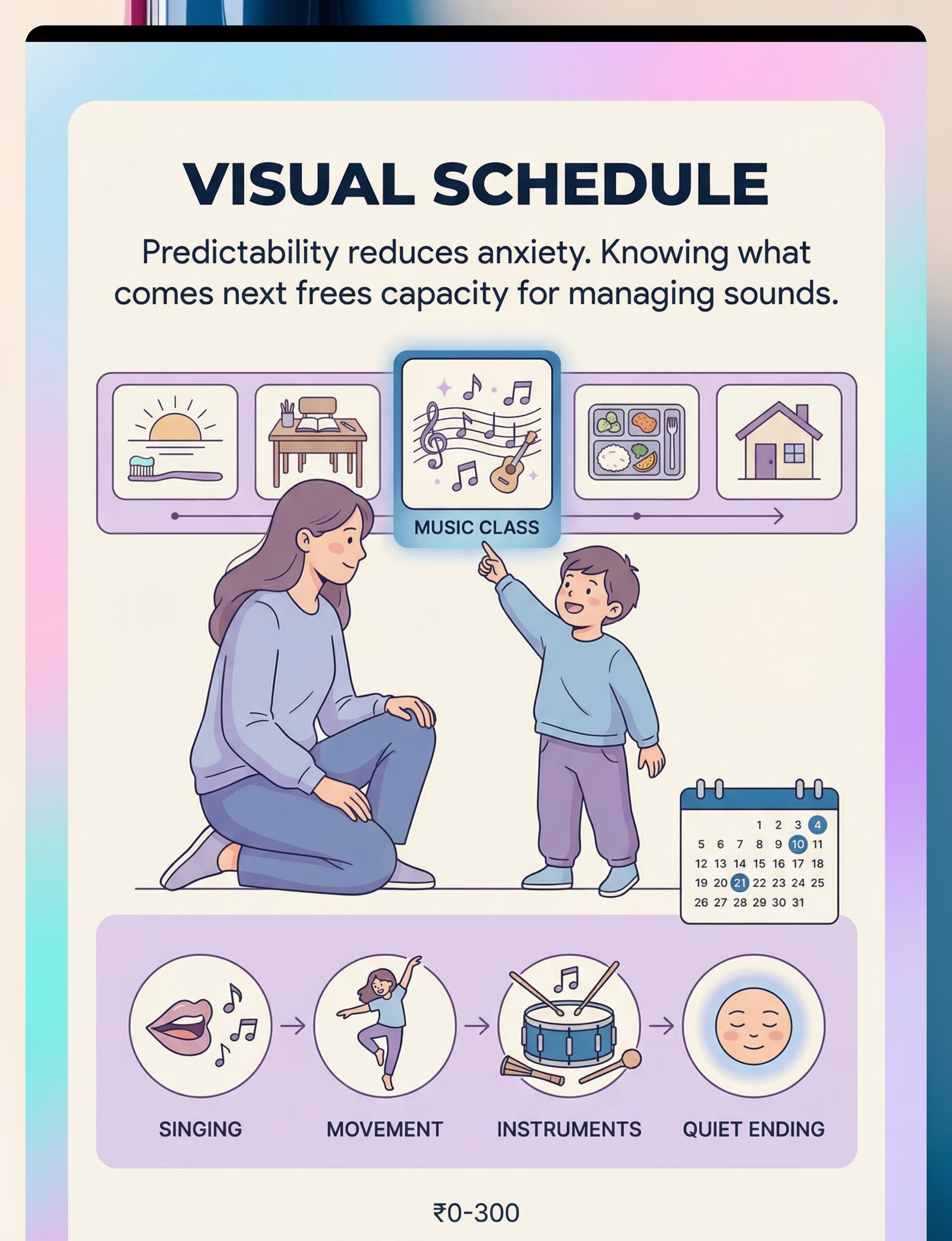
Material 3: Visual Schedule System
₹0–300
Predictability Reduces Anxiety
When the child knows when music class happens, what activities will occur, and what comes after — the cognitive load of uncertainty is eliminated, freeing mental capacity for managing sensory input.
- Daily schedule with music class clearly marked
- Music-class-specific activity sequence card
- Visual timer or countdown for transitions

Materials 4 & 5: Designated Quiet Space + Fidget / Tactile Grounding Tool
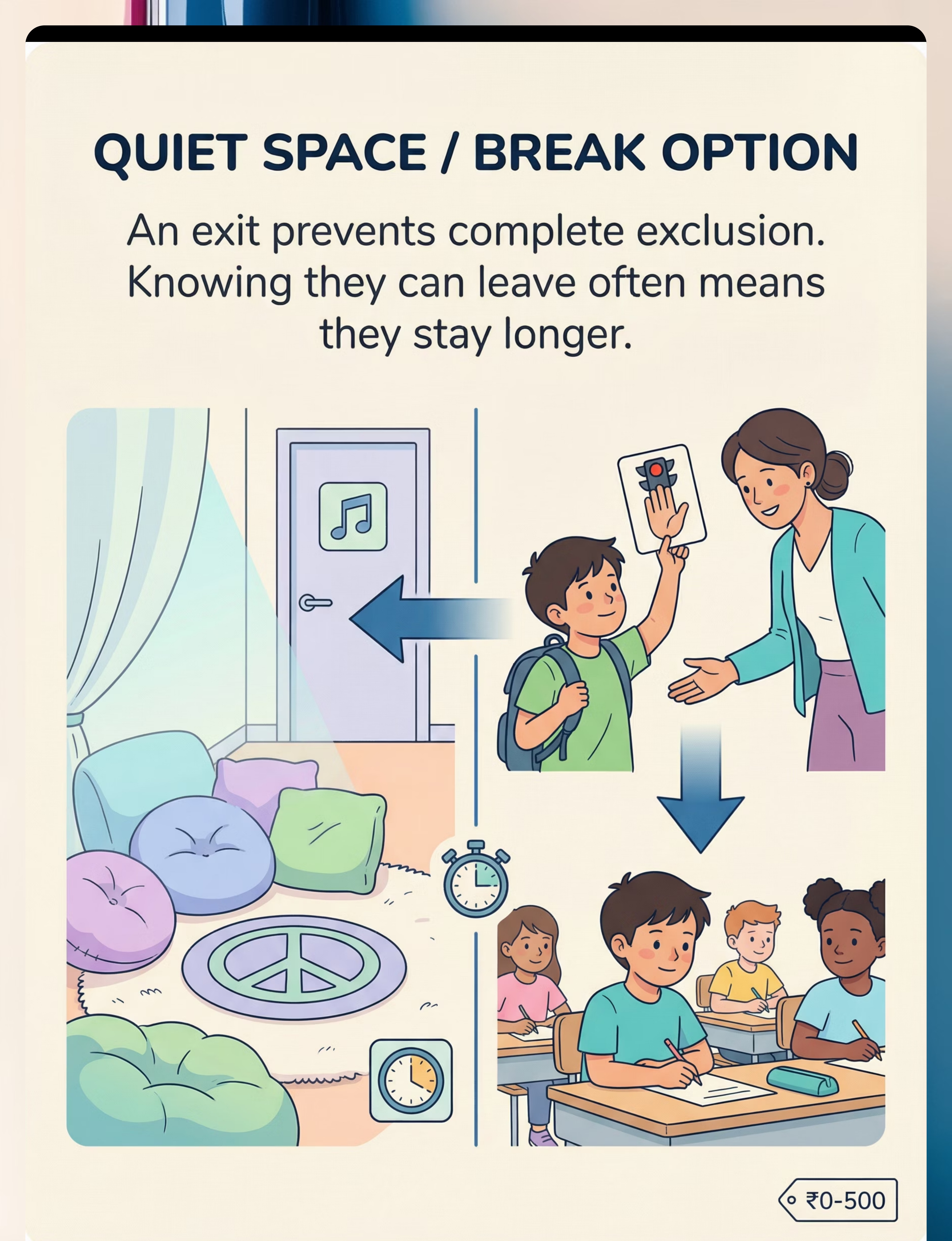
Material 4: Designated Quiet Space / Break Option
₹0–500
Knowing Escape Is Possible Reduces Panic
A break signal combined with a quiet space gives the child an exit before meltdown. A 2-minute break at the right moment prevents a 20-minute meltdown. Critically, the break is accessed by the child's own signal — this builds self-advocacy.
- Break request signal card (carried by child)
- Designated quiet space with supervision
- Timer for break duration (visual)
- Calm-down tools available in quiet space
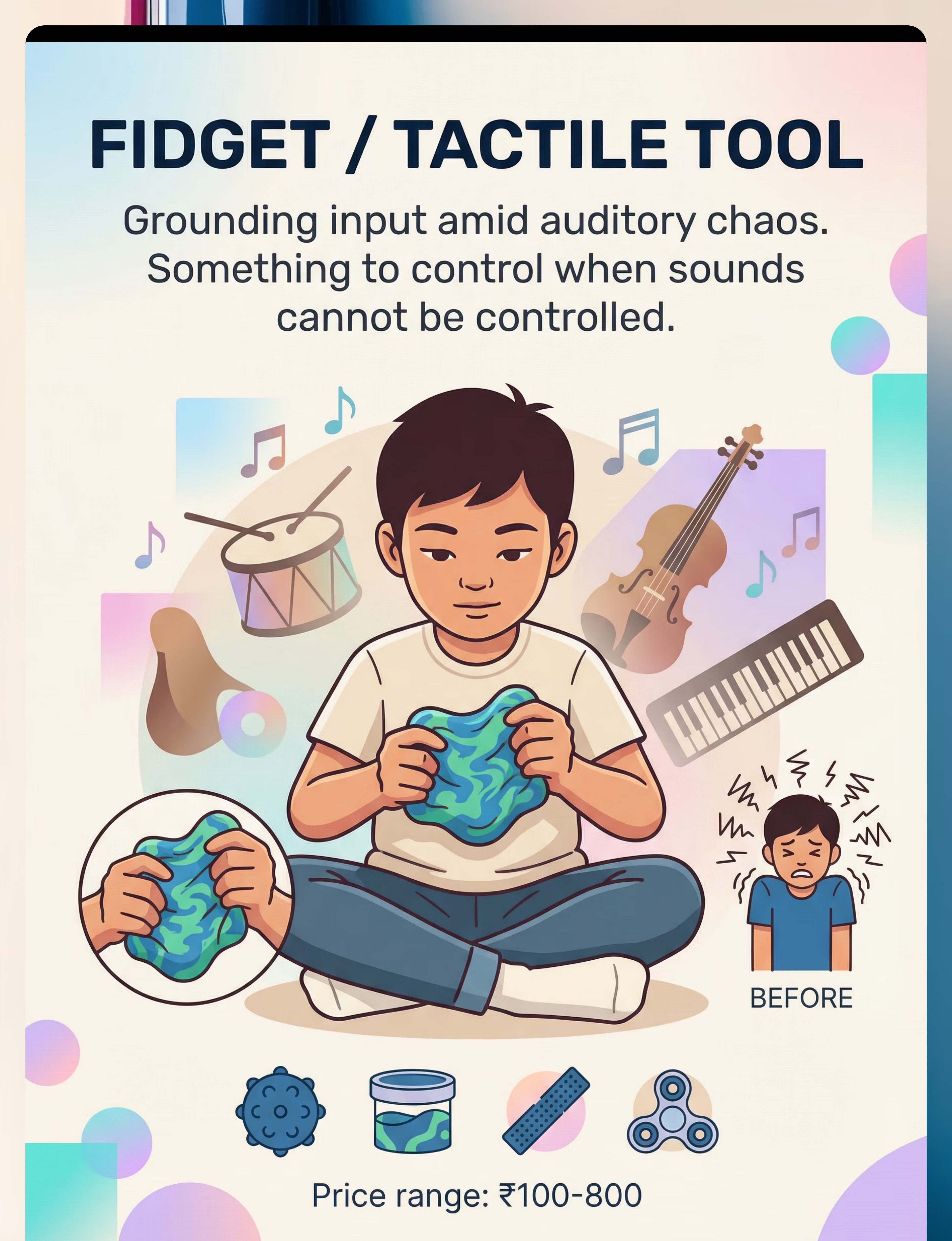
Material 5: Fidget / Tactile Grounding Tool
₹100–800
Engaging Another Sensory Channel
When the auditory system is overwhelmed, rhythmic, repetitive tactile input competes with auditory overload and provides something controllable in an uncontrollable environment.
- Quiet fidget toys (no noise — critical!)
- Textured sensory toys or therapy putty
- Stress ball or smooth stone
- Weighted lap pad for proprioceptive grounding
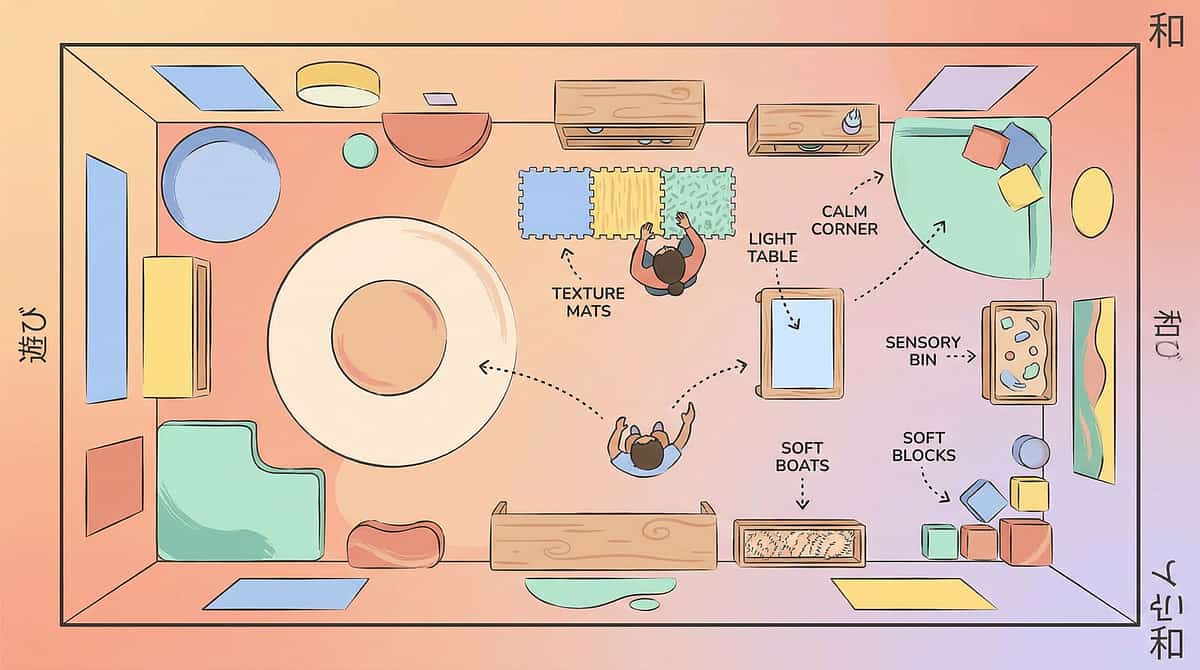
Materials 6, 7, 8 & 9: Participation, Exposure, Music at Home & Self-Advocacy
Material 6: Modified Participation Options (₹0)
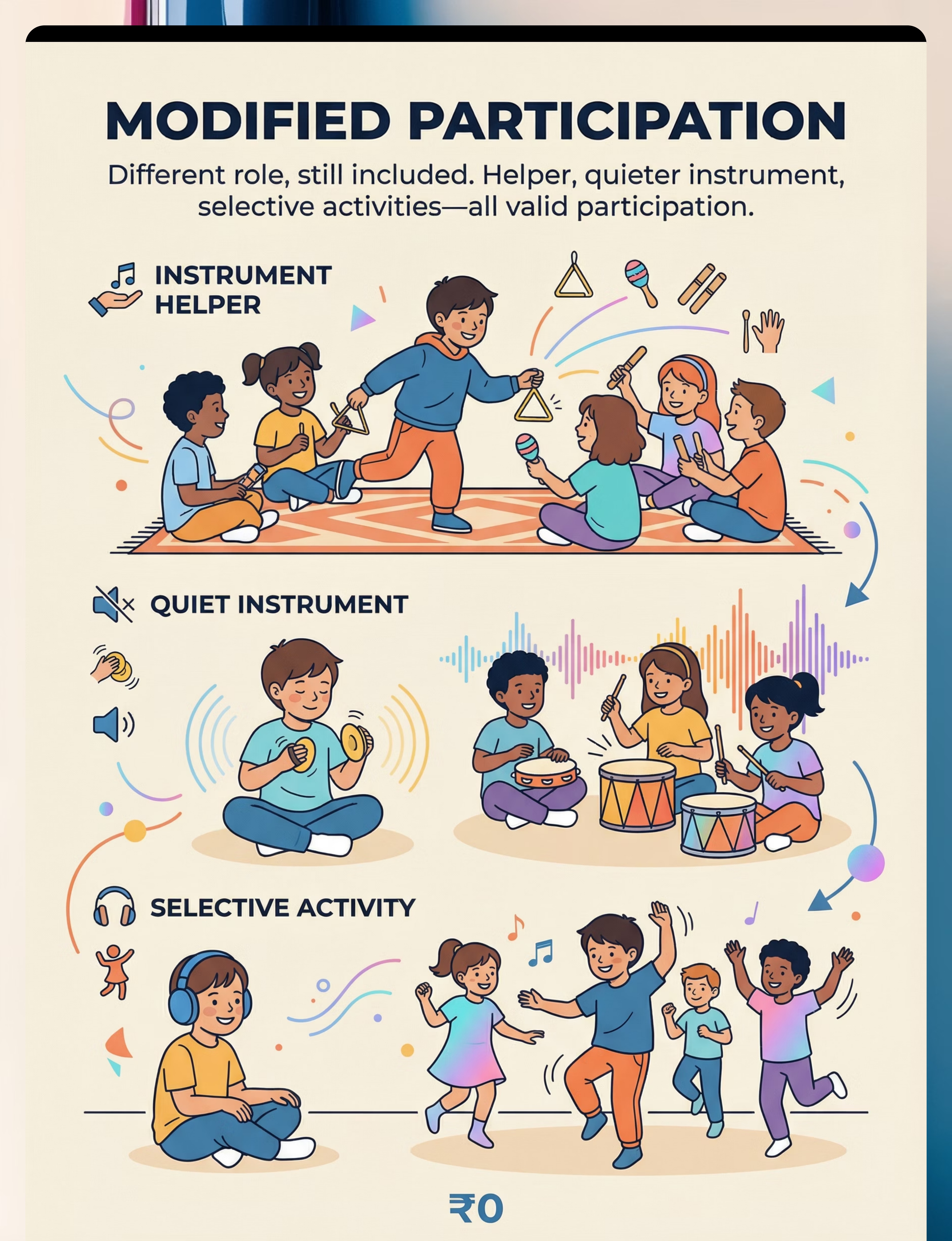
Different role, still included. Helper roles (instrument distributor, setup helper), quieter instruments (soft shakers, finger cymbals, egg shakers), and selective participation in tolerable segments enable inclusion without full sensory exposure. This is teacher collaboration at its most powerful.
Material 7: Graduated Exposure Protocol (₹0)
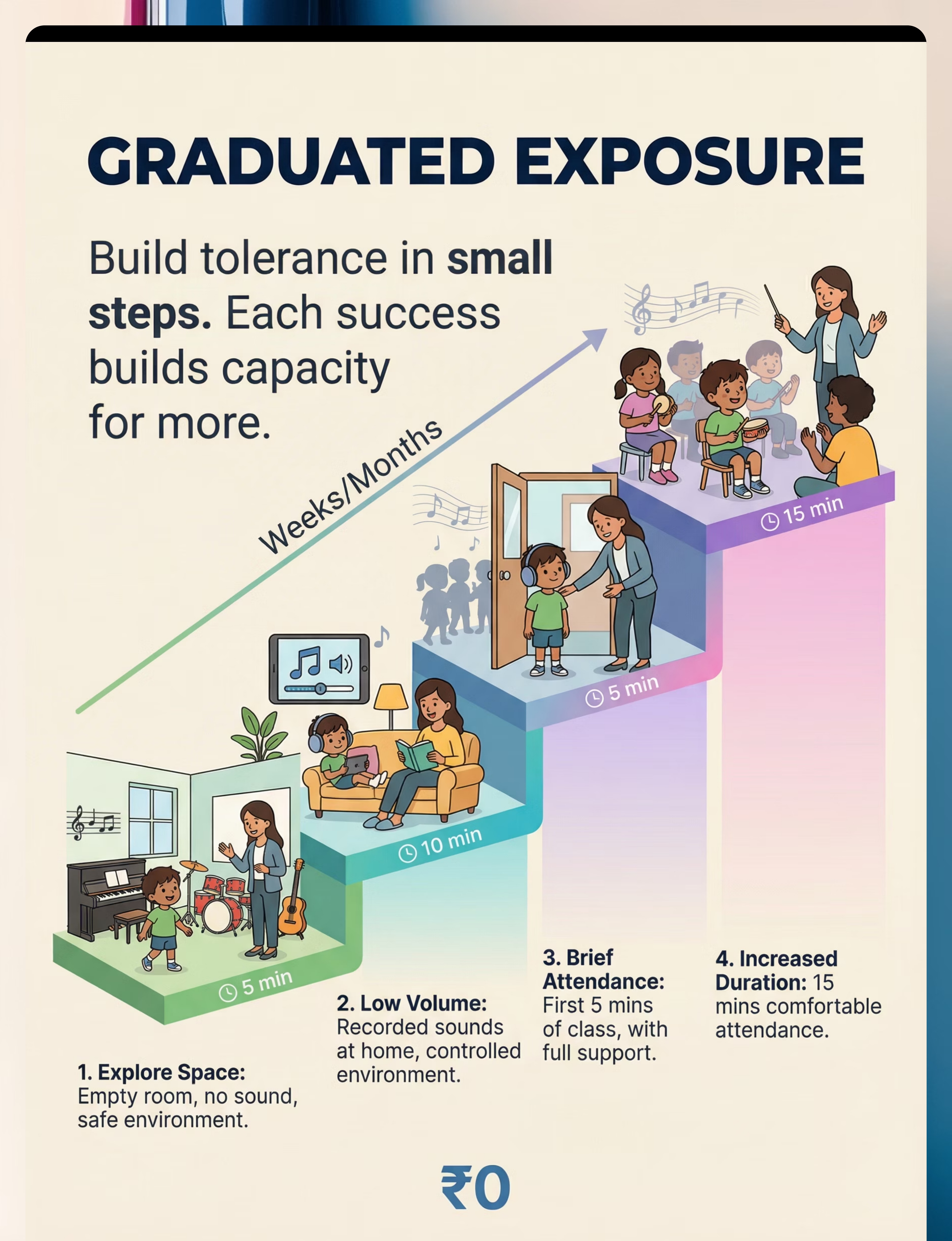
Build tolerance in steps, not leaps. Visit empty music room → listen to recordings at home at low volume → attend 5 minutes → attend 10 minutes → attend full class. Each success builds neural capacity for the next step.
Material 8: Calming Home Music Exposure (₹0)
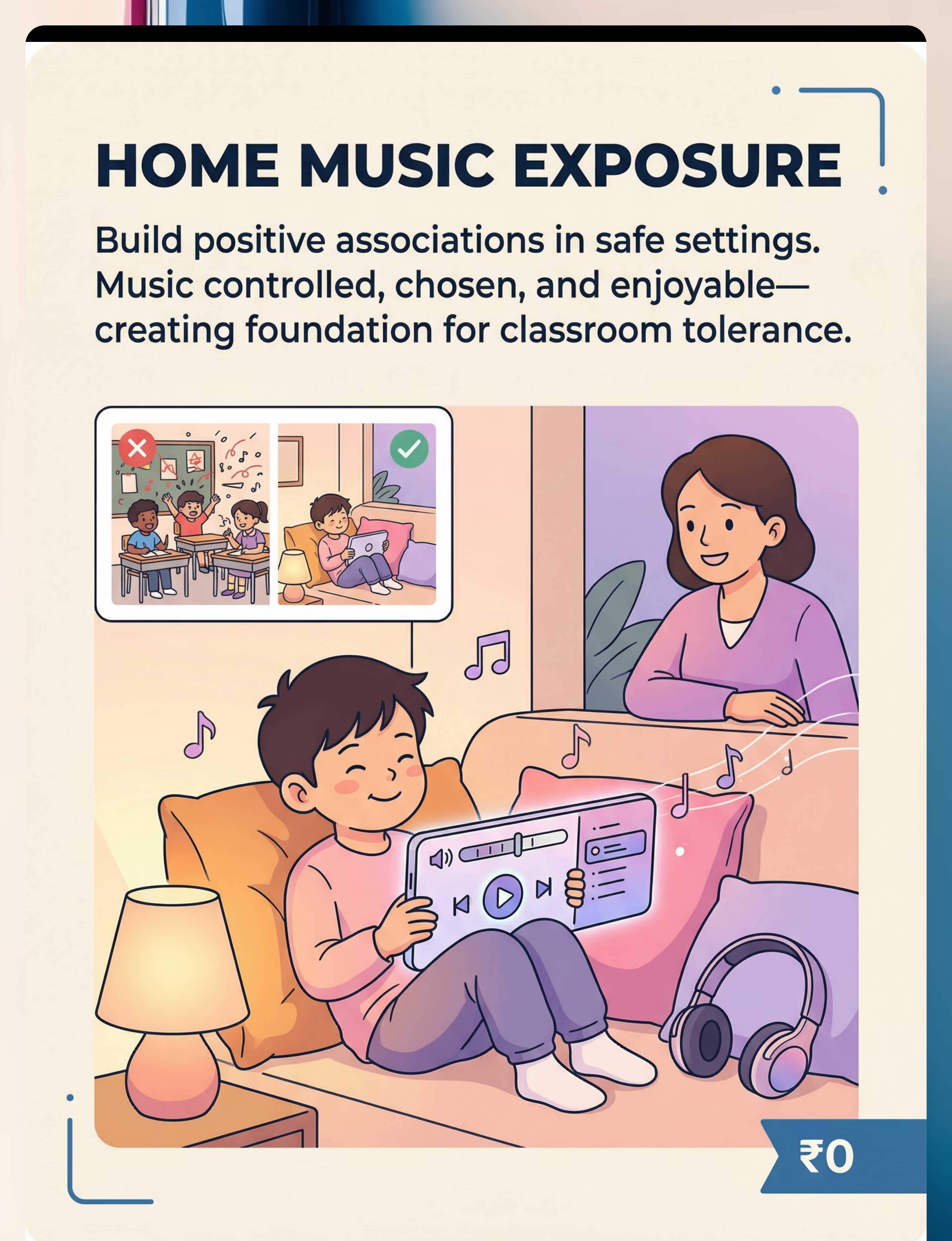
Positive associations in safe settings build the foundation for classroom tolerance. Child-controlled music at home — chosen, adjusted, stopped when wanted — creates the neural experience that music can be enjoyable, not just overwhelming.
Material 9: Communication Card for Self-Advocacy (₹0–200)
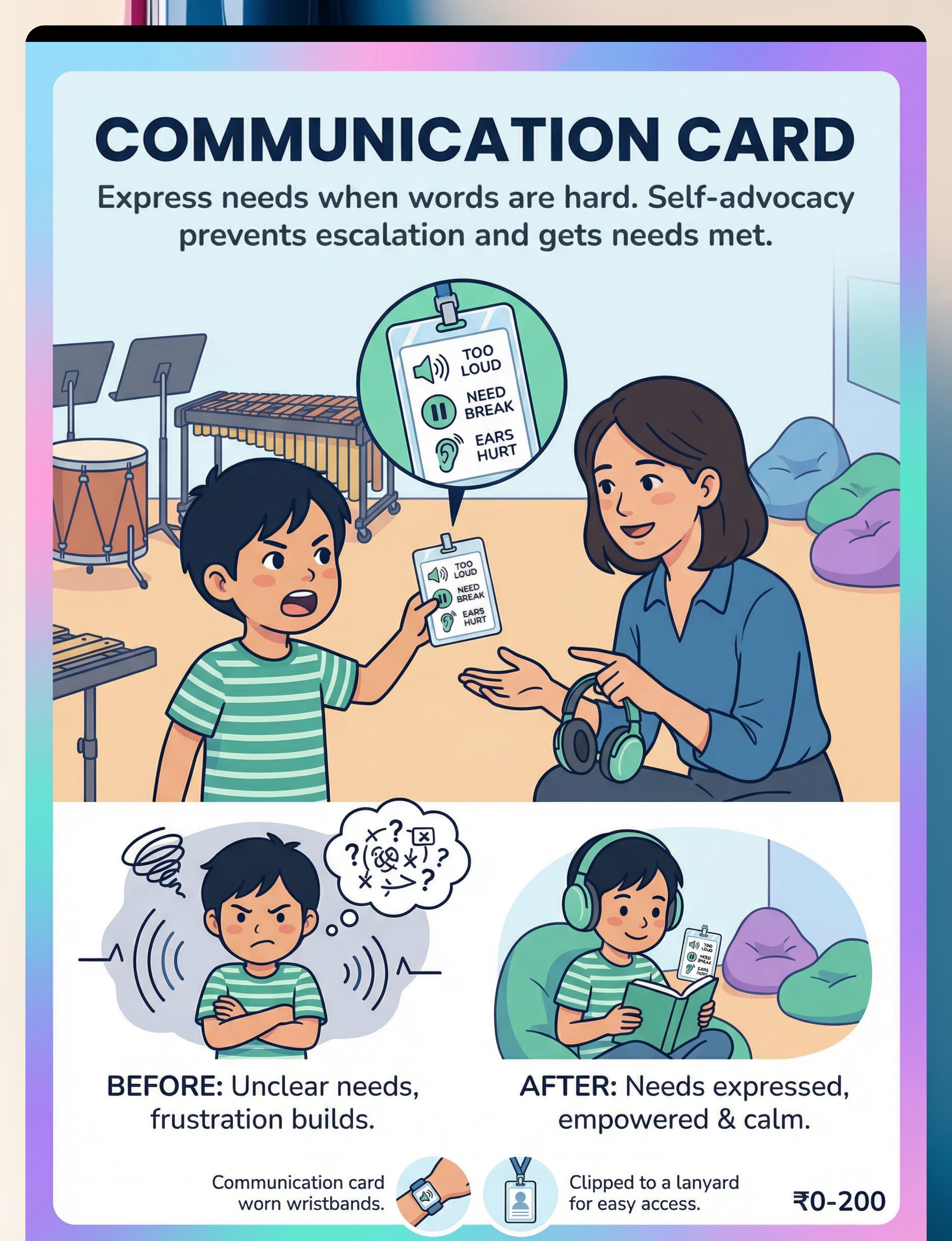
Voice when words fail. Many children cannot articulate sensory distress in the moment. A card showing "Too Loud," "Need Break," "Ears Hurt" gets needs met and prevents escalation. → materials.pinnacleblooms.org/communication-boards-low-tech-aac
Total Cost Range: ₹0–5,000 | Essential Starters: ₹1,000–2,000 — Ear defenders + fidget tool + printed visual schedule and communication cards cover the core protocol.

Every Parent Can Do This Today — Regardless of Budget
The WHO/UNICEF inclusion principle demands that every parent, regardless of economic status, can execute this technique TODAY with household items. The substitute works because the underlying sensory principle is identical — the material is the vehicle, but the principle is the therapy.
Buy This | Make This — Zero Cost Alternative | |
Noise-Reducing Ear Defenders (₹1,000–5,000) | Over-ear industrial hearing protection from hardware stores (₹200–400). Cotton balls in ears as absolute minimum emergency measure only. | |
Visual Schedule System (₹0–300) | Draw daily schedule on paper with music class highlighted. Create music class sub-schedule with stick figures: Singing → Movement → Instruments → Quiet Ending. | |
Break Signal Card (₹0–200) | Red/yellow/green circle cards on paper, laminated with clear tape. Red = "too loud, need to leave." Yellow = "getting hard." Green = "I'm okay." | |
Fidget / Tactile Tool (₹100–800) | Smooth stone. Piece of velvet or textured fabric. Hair elastic around wrist. Rubber band ball made by child. | |
Communication Card (₹0–200) | Hand-drawn pictures on cardstock: speaker icon with X = "too loud," pause button = "need break," ear with lines = "ears hurt." Laminate with clear tape. |
When clinical-grade material IS non-negotiable: For severe auditory over-responsivity, proper noise-reducing ear defenders with known dB reduction ratings are essential. Industrial hearing protection (₹200–400 at hardware stores) provides adequate protection at a fraction of branded cost. Cotton balls are an emergency measure only — they provide minimal and inconsistent reduction.

⚠️ Safety First — Read This Before You Begin
🔴 ABSOLUTE CONTRAINDICATIONS — Do Not Proceed If:
Child has active ear infection, ear pain, or recent ear surgery — consult physician first. Child has hearing loss — audiologist evaluation required BEFORE ear defenders. Child is in active meltdown or fully dysregulated. Ear protection completely eliminates ability to hear safety alerts (fire drill). Medical condition affecting ear canal that would be worsened by in-ear devices.
🟡 MODIFY AND PROCEED WITH CAUTION IF:
Child had a difficult morning — use maximum supports. Music class will be louder than usual (performance rehearsal) — consider half-attendance. Child recovering from illness (sensitivity increases when unwell). School has not yet agreed to accommodations. Child is new to ear protection — practice at home first.
🟢 PROCEED WHEN:
Child is fed, rested, and in a regulated baseline state. Ear protection practiced at home. Music teacher is aware and supportive. Break signal system has been practiced. Quiet space is identified and supervised. Full kit is packed: ear defenders + fidget + communication card + visual schedule reviewed.
🛑 Stop the Protocol If: Child shows ear pain (medical evaluation needed). Distress INCREASES despite full accommodations over 3+ sessions — reassess with OT. Child develops anticipatory anxiety extending to school avoidance — consult psychologist. Behavioral regression in other areas after music class — reduce intensity immediately.
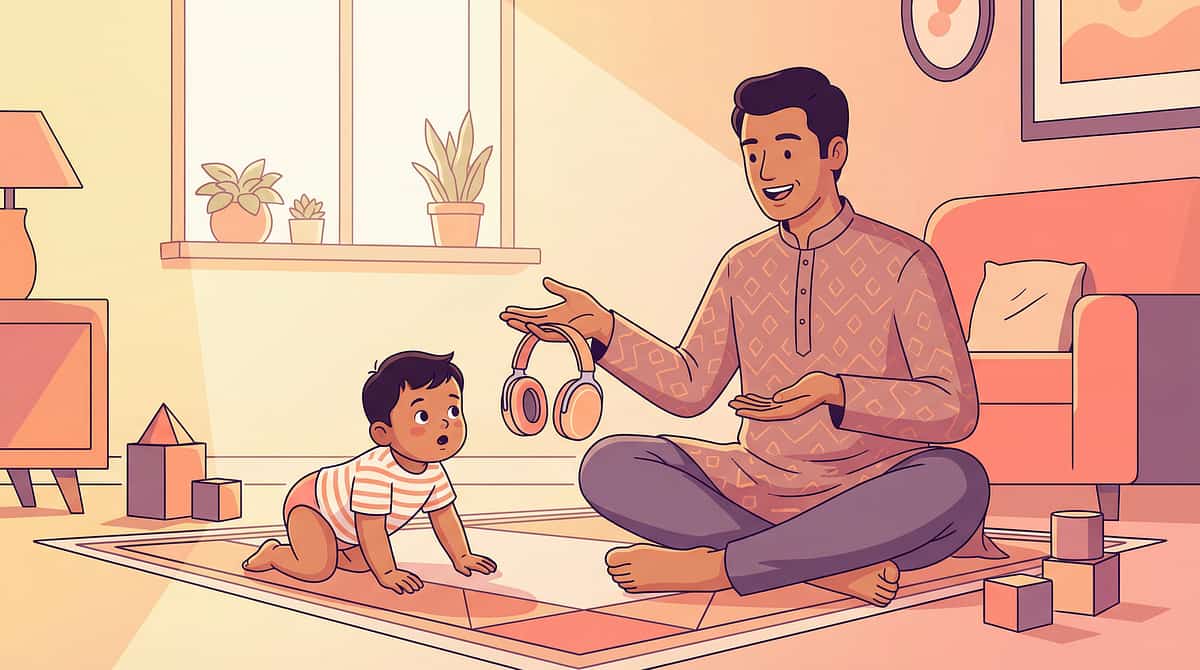
Setting Up for Success — Before Music Class Begins
Strategic Room Position
Your child's optimal position in the music room:
- Farthest from drums, brass, and loud percussion
- Near the exit — clear path to quiet space
- Away from hard reflective walls that amplify echo
- Visual marker on the floor for their consistent spot
- Line of sight to the teacher for visual instruction
Morning of Music Class — Setup Checklist
- Pack the Kit: Ear defenders ✓ | Fidget tool ✓ | Communication card ✓ | Break signal card ✓
- Review the Schedule: "Today has music class. You have your ear helpers. You can take a break if needed."
- Confirm with Teacher: Seating arranged ✓ | Break system active ✓ | Quiet space available ✓ | Modified participation discussed ✓
- Child's State Check: Fed ✓ | Rested ✓ | Not ill ✓ | Baseline regulated ✓ — if any fail, consider shortened attendance
Home Practice Space: Set up a calm corner at home to practice wearing ear defenders, using break signal cards, and listening to recorded music at controlled volumes — the "rehearsal space" for music class tolerance.
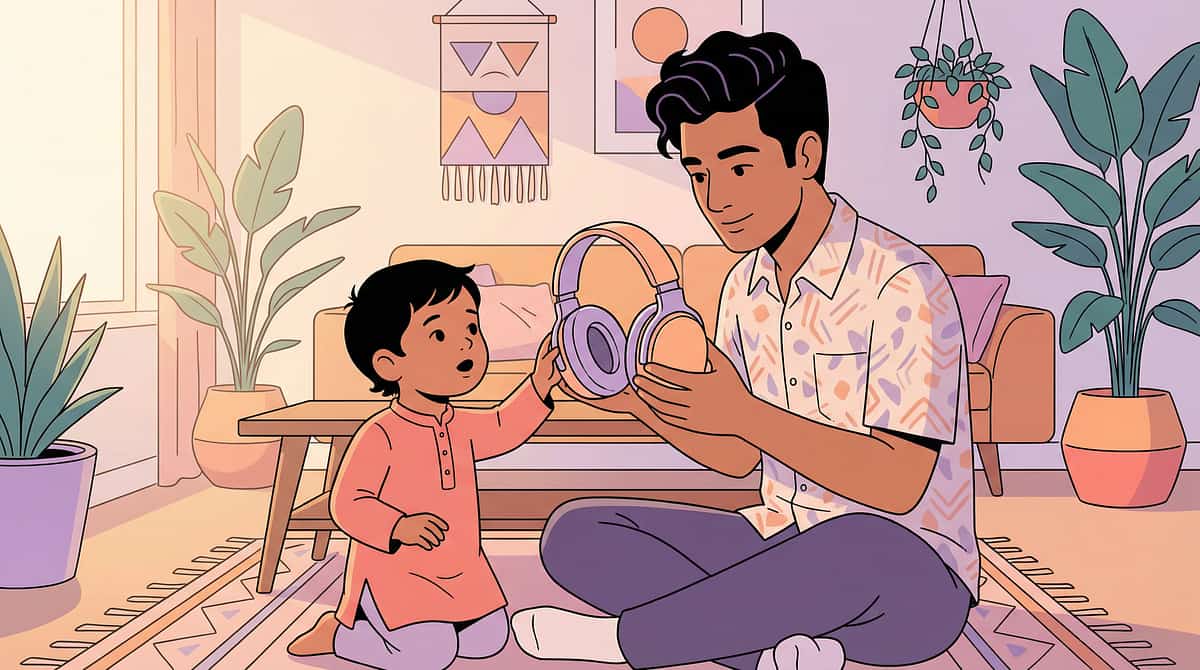
Pre-Music Class Readiness Check — 60 Seconds That Determine Success
Indicator | ✅ Go | ⚠️ Modify | ❌ Postpone | |
Child is fed and hydrated | Yes | Partially | No — hungry/dehydrated | |
Child is not ill (no ear pain, no fever) | Healthy | Minor issue | Active illness | |
No meltdown in the last hour | Calm baseline | Recovering | Active/recent meltdown | |
Ear protection available and child will wear it | Ready and willing | Willing but new | Refuses entirely | |
Music teacher aware of accommodations | Confirmed | Partially informed | Not informed at all | |
Quiet space / break option is available | Set up + supervised | Available, unsupervised | Not available | |
Child's overall regulation today | Good day | Mixed day | Very difficult day |
All ✅
Proceed with standard protocol
Any ⚠️
Proceed with MAXIMUM supports — ear defenders + break option + shortened attendance + modified participation
Any ❌
Postpone today. Not failure — clinical precision. Do an alternative calming activity instead.
"The best session is one that starts right. Pushing through when the child isn't ready creates trauma, not tolerance."
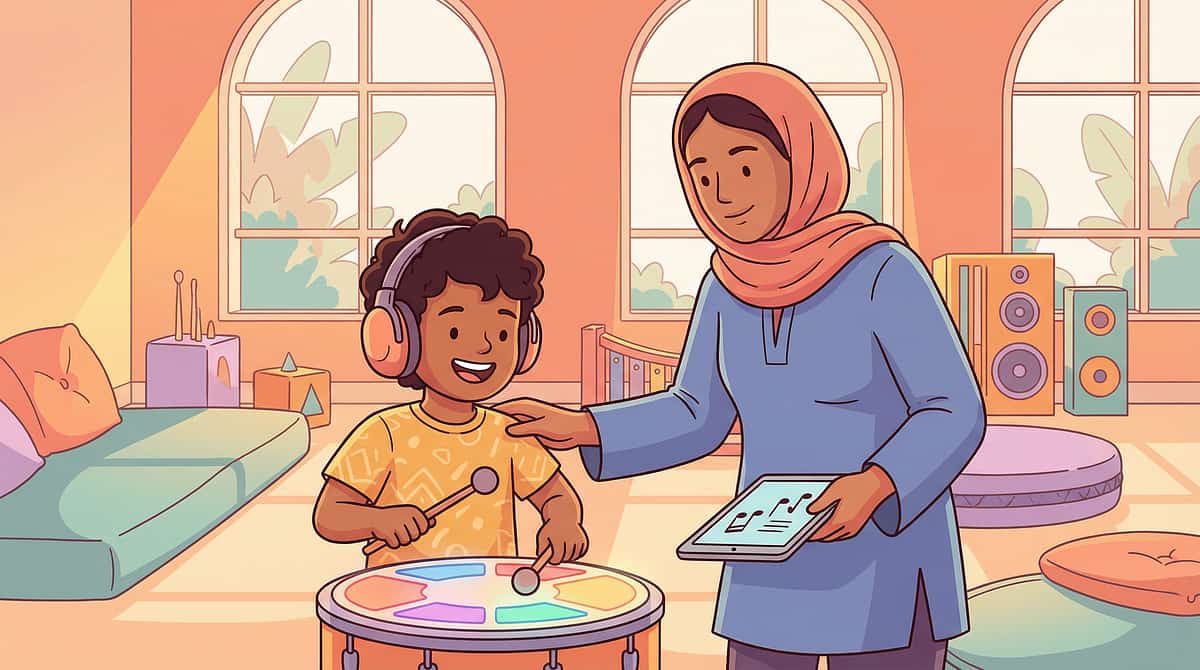
Step 1: The Invitation — Preparing Your Child
STEP 1 OF 6
Timing: 2–5 minutes before music class
"Music class is next. Let's get your helpers ready. Here are your ear protectors. Here is your break card. Remember — if the sounds get too big, show your card and you can go to the quiet corner. You're going to sit in your special spot by the door. Want to hold your fidget tool too?"
What Acceptance Looks Like
Child puts on ear defenders willingly. Takes communication card. Holds fidget tool. Walks toward music room without significant resistance. Mild apprehension is normal and acceptable — it is not a barrier to proceeding.
Body Language Guidance: Calm, matter-of-fact tone. Not anxious, not overly enthusiastic. Treat supports as normal tools — like glasses for eyes, ear defenders are for ears. Do not communicate your own anxiety.
What Resistance Looks Like — And How to Modify
- Refuses ear defenders → Offer earplugs or play "astronaut helmet" game. If still refuses, use break option as primary support.
- Shows significant anxiety → Shorten planned attendance (just 5 minutes). Validate: "I know it's hard. You have your helpers. Let's try for just the first part."
- Refuses to go → Do NOT force. This is data, not defiance. Skip today, address with OT/team.
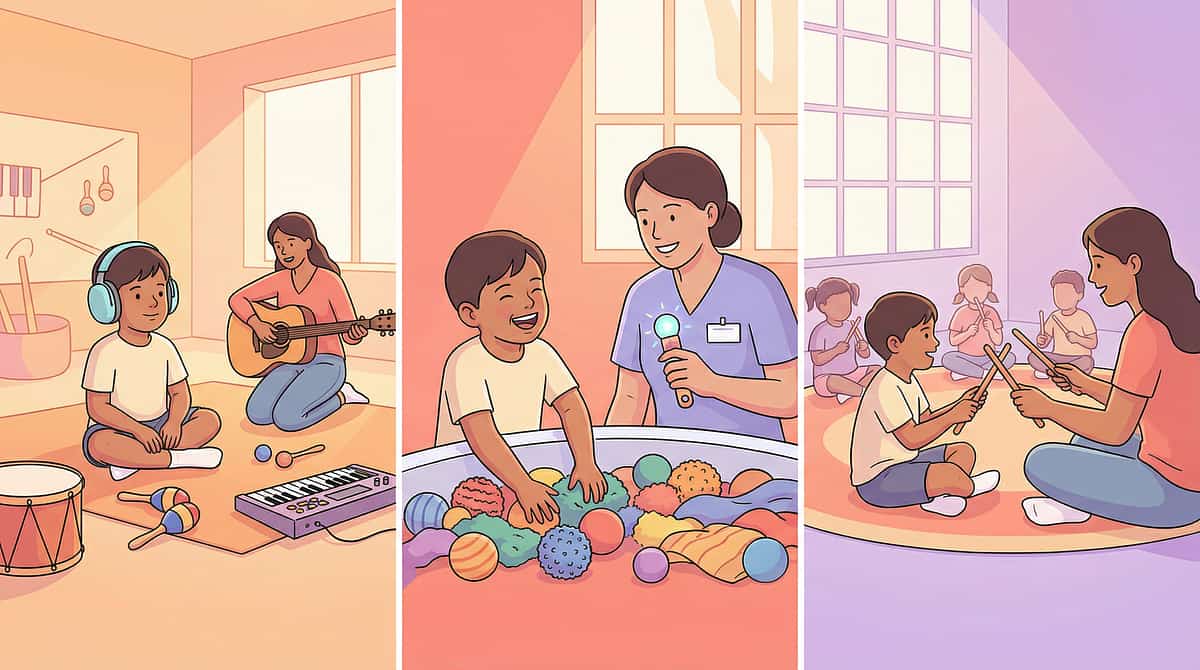
Step 2: The Engagement — Entering Music Class
STEP 2 OF 6
Timing: First 2–3 minutes of class
Guide child to their strategic seating position. Confirm ear protection is on and comfortable. Place fidget tool in hands. Make brief eye contact with the music teacher. Step back and allow the teacher to monitor.
Child's Response | Meaning | Your Action | |
Sits in position, looks around calmly | Regulated, engaging | Continue. No intervention needed. | |
Adjusts ear defenders, fidgets actively | Self-regulating — good | This is COPING. Leave them to it. | |
Watches other children, doesn't participate | Observing — acceptable | Modified participation IS participation. Don't push. | |
Body tenses, hands go toward ears over defenders | Approaching threshold | Watch closely. Quietly remind of break option. | |
Shows break card or signals | Self-advocating — excellent | Honor it IMMEDIATELY. This is the system working. |
Reinforcement Cue: After 2–3 minutes of calm presence in the room: subtle thumbs up, warm smile, or whispered "You're doing great." Do NOT draw attention in front of peers — low-key acknowledgment protects dignity and builds intrinsic confidence.
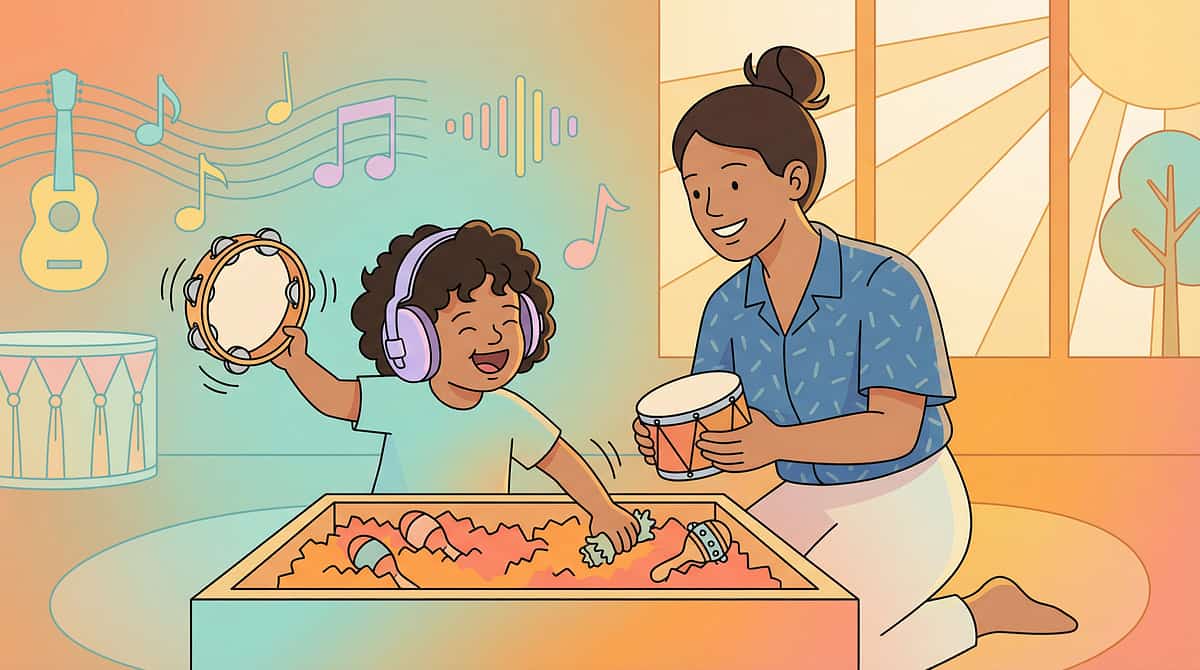
Step 3: The Therapeutic Action — Being in Music Class
STEP 3 OF 6
Core Exposure Phase
The child is IN the music room, WITH auditory protection, DURING an active music class. This IS the therapeutic exposure. The nervous system is processing music class sounds at a reduced, tolerable intensity. Every minute of calm presence is building neural tolerance.
✅ Sit and observe with ear defenders
Valid participation — presence is progress
✅ Play a quieter instrument (soft shaker, finger cymbals)
Modified participation — full engagement on adapted terms
✅ Be the "instrument helper" — distributing or collecting
Alternative role participation — included, contributing, belonging
✅ Participate in movement/dance, break during instruments
Selective participation — child-managed sensory pacing
Duration Goal: Start with whatever the child can tolerate — even 5 minutes is a WIN. The goal in early sessions is ANY duration of calm, protected presence. Increase only after consistent success at the current level. | Meta-analysis (2024): Structured therapeutic sessions with clear active phases showed optimal outcomes | PMC10955541
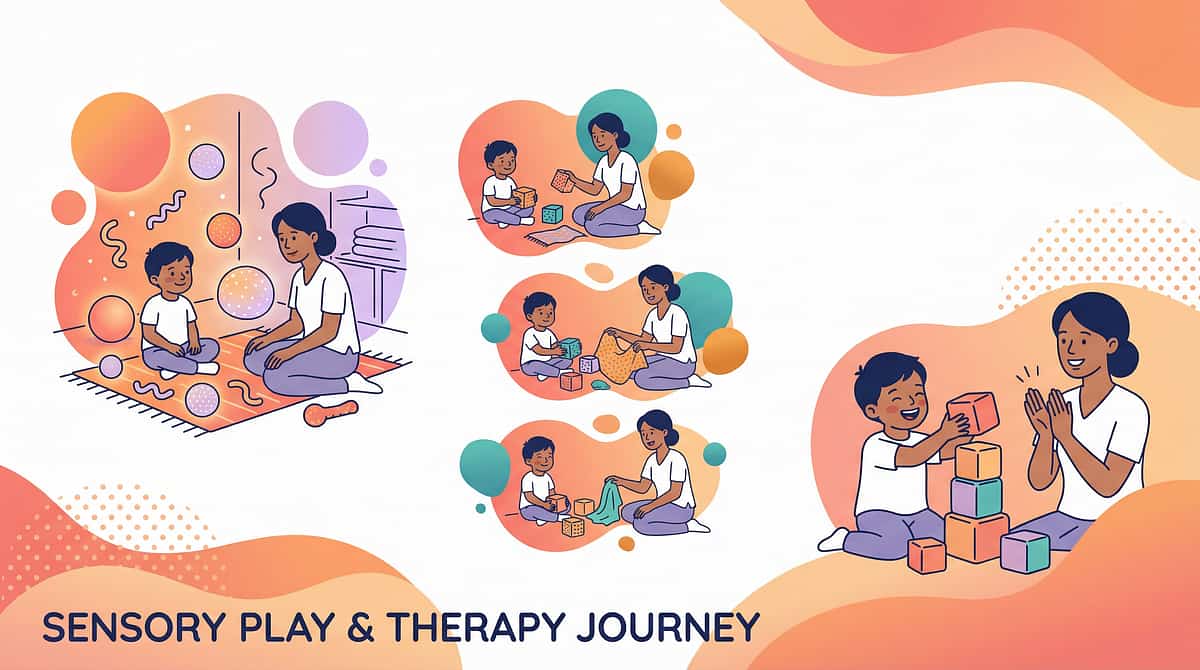
Step 4: Repeat & Vary — Building Tolerance Across Sessions
STEP 4 OF 6
Weeks 1–8+
Tolerance is built through repeated successful exposures, not single heroic attempts. Aim for consistency over intensity.
1
Weeks 1–2
Attend every scheduled session with FULL supports. Keep duration at child's current tolerance level — do not extend yet.
2
Weeks 3–4
If child is consistently calm with supports, begin extending duration by 2–3 minutes per session.
3
Week 5+
If child is attending full class with supports, begin minor variations: try a quieter part without ear defenders for 2 minutes — with immediate access to ear protection if needed.
Satiation Indicators — When the Child Has Had Enough
- Fidgeting increases beyond baseline
- Breaks become more frequent within a single session
- Child asks "Is music over yet?" repeatedly
- Body language shifts from regulated to tense
The Core Principle
"3 good sessions > 10 forced sessions. Consistent, tolerated exposure builds durable neural pathways. Forced, overwhelming exposure creates trauma and aversion."

Step 5: Reinforce & Celebrate
STEP 5 OF 6
Timing: Within 60 seconds of leaving the room
"You stayed in music class for [X minutes] today! You used your ear helpers. You played the shaker. You took one break and came back. That was really brave and really smart."
Reinforcement Menu — Choose What Motivates Your Child
- Verbal praise: Specific, immediate, genuine — name exactly what they did
- Physical: High-five, pat on shoulder (if child accepts touch)
- Token: Sticker chart — 5 music classes with supports = chosen reward
- Natural consequence: "Because you stayed in music, you got to play the shaker with everyone!"
- Choice-based: "You made it through music! You choose what we do for the next 5 minutes."
Timing Matters
Deliver reinforcement within 3–60 seconds of the desired behavior. Be SPECIFIC — name exactly what the child did. Match intensity to the child's preference — some children dislike effusive praise; a quiet thumbs up may work better.
Critical Principle: Celebrate the attempt, not just the success. A child who attended for 5 minutes with supports and then needed to leave has SUCCEEDED — they were IN the room, USING tools, MANAGING their nervous system. That is worth celebrating.
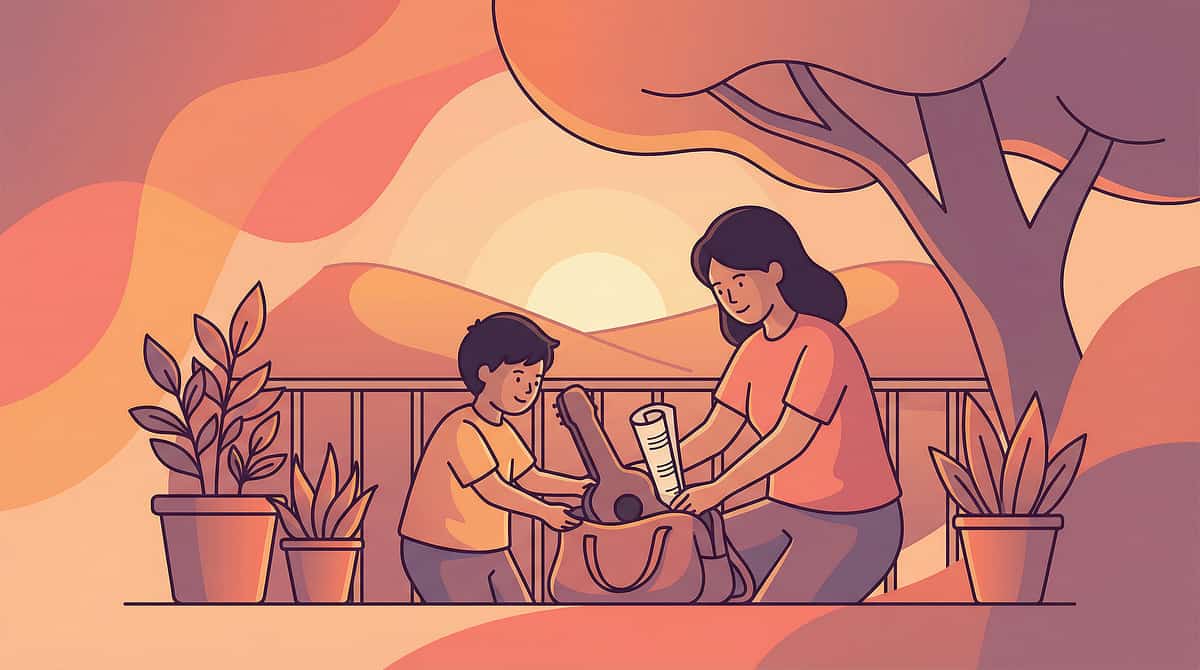
Step 6: The Cool-Down — After Music Class
STEP 6 OF 6
Timing: 2–5 minutes after leaving music class
Music class, even with supports, is an auditory load. The child's nervous system needs a buffer before the next activity.
Quiet Transition
Walk calmly to the next activity. No loud hallways, no immediate assembly. Route through quieter corridors if possible.
Decompression Time
2–3 minutes of low-demand, low-sensory activity: sitting quietly, looking at a favorite book, gentle proprioceptive input (hands pressed together, wall push-ups).
Ear Defender Removal
Child removes ear protection when THEY are ready — not on adult's schedule. If they want to keep wearing them for the transition, let them.
Low-Key Check-In
"How was music today?" Accept whatever answer you get. If the child doesn't want to talk about it, don't push.
If the Session Was Difficult: Don't analyze or problem-solve immediately. Allow extra recovery time (5–10 minutes of quiet). Validate: "That was hard today. It's okay. We'll figure out how to make it better." Do NOT cancel the next music class — address with the team instead.

Capture the Data: 60 Seconds That Save Hours of Guessing
Tracking three simple data points after every session transforms guesswork into clinical precision. Data drives decisions — without tracking, we're guessing.
Duration in Music Class
Minutes from entering to leaving. Example: "12 minutes today"
Number of Breaks Taken
Simple tally. Example: "2 breaks"
Distress Level (1–5)
1 = calm throughout, 3 = moderate difficulty, 5 = meltdown/removal. Example: "Level 2 today"
Weekly Pattern Tracker
Week | Monday | Wednesday/Friday | End of Week | Trend | |
1 | 5 min / 3 breaks / Level 4 | 7 min / 2 breaks / Level 3 | 8 min / 2 breaks / Level 3 | ↗ Improving | |
2 | 10 min / 1 break / Level 2 | 10 min / 1 break / Level 2 | 12 min / 1 break / Level 2 | ↗ Stabilizing |
Optional tracking: Which activities were tolerated vs. difficult · Whether child used communication card · Whether ear defenders stayed on · Specific sounds that caused most distress. Use the GPT-OS® in-app tracker for automated pattern recognition.
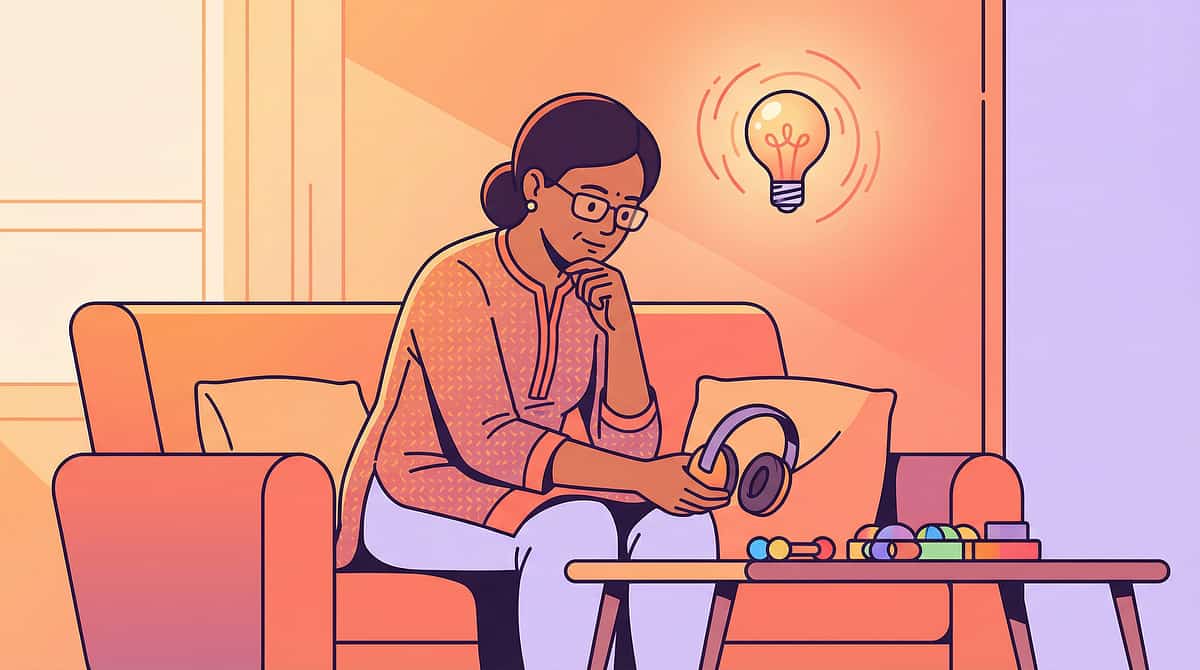
When Things Don't Go as Planned — And They Won't Always
"My child refused to wear the ear defenders."
Practice at home first — wear them during TV, during blender noise, during car rides. Make it normal. Try different styles: over-ear, in-ear, headband-style. If all ear protection is refused, rely on strategic seating + break system + modified participation as primary supports.
"The music teacher won't cooperate."
Frame as inclusion, not special treatment. Provide educational materials about auditory over-responsivity. Request a formal meeting. Offer solutions, not just problems. If informal approaches fail, escalate to formal accommodation requests through school administration. Document everything.
"My child had a meltdown despite all supports."
This happens — it's data, not failure. Ask: Were all supports in place? Was something different today? Reduce intensity next session. If meltdowns occur at full supports for 3+ consecutive sessions, reassess with OT.
"My child doesn't want to go to music class at all."
Avoidance is a reasonable response to repeated overwhelming experiences. Don't force attendance without supports. Start graduated exposure: visit empty music room → listen to recordings at home → attend 3 minutes → build up.
"The sound sensitivity seems to be getting worse."
Check for: ear infection, increased stress, sleep disruption, routine changes. Sensitivity amplifies when the child is tired or overstimulated. If worsening persists for 2+ weeks despite supports, seek professional evaluation (OT + audiologist).
"Session abandonment happens — is that failure?"
No. Session abandonment is DATA. It tells you the threshold was exceeded. Next session: start earlier in the class (when it's quieter), reduce duration target, add supports. The child who leaves after 5 minutes has still had 5 minutes of protected exposure. That's more than zero.
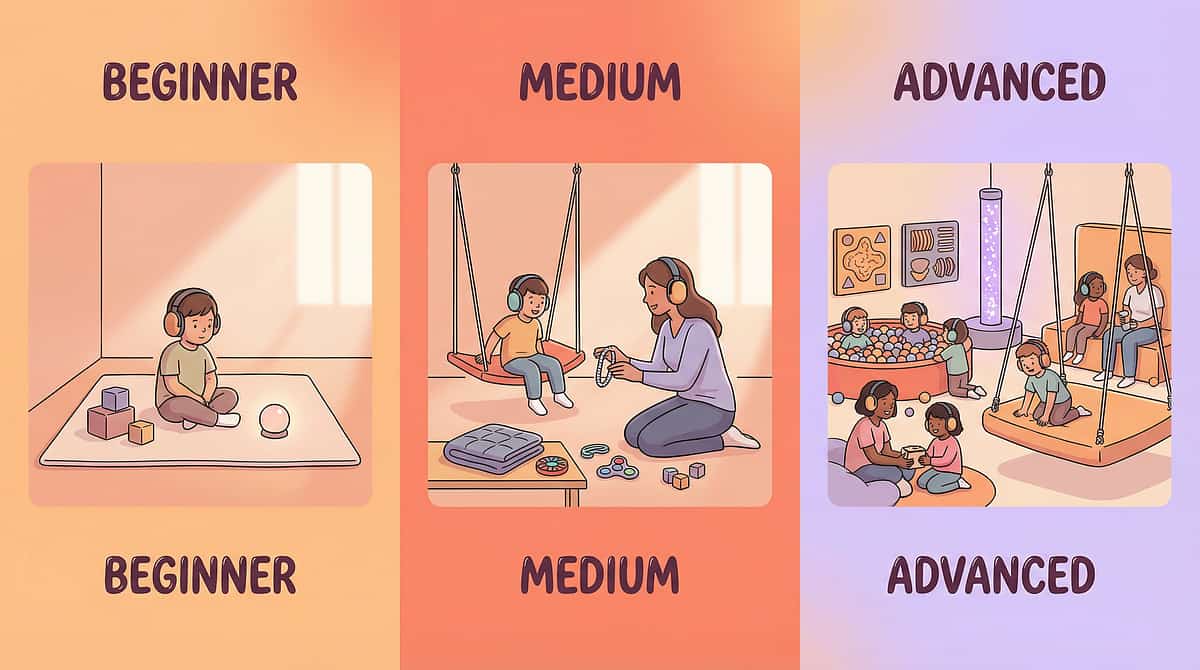
Adapt to Your Child's Unique Auditory Profile
Every child's auditory profile is unique. This protocol is a framework — not a fixed prescription. Adapt it to the specific pattern of sensory challenge your child experiences.
Sensitive to SPECIFIC Instruments
Focus on ear protection during those specific activities + break signal timed to those segments + modified participation (observer role during trigger instruments) + gradual home exposure to recorded versions of trigger sounds.
Overwhelmed by ALL Music Class Sounds
Maximum ear protection at all times + strategic seating farthest from all sources + shortest tolerable attendance + very gradual increase. Consider a comprehensive auditory processing evaluation.
Significant ANTICIPATORY ANXIETY
Visual schedules + social stories about music class + practice runs in empty music room + supports ALWAYS available (ear defenders in backpack) + morning preparation routine + anxiety management strategies (breathing, grounding).
Loves Music at Home, Can't Handle Music CLASS
Build the bridge. Home music exposure with gradual complexity increase + graduated classroom attendance starting with quietest portions + ear protection to make classroom music approximate home-level intensity.
Age-Based Modifications
1
Ages 3–4
Adult-managed supports. Teacher and parent implement all accommodations. Attendance may be partial.
2
Ages 5–8
Begin self-advocacy training. Child learns to use communication card. Graduated independence.
3
Ages 9–12
Shift toward self-management. Child selects and manages own ear protection. Self-advocates directly with teachers.

Week 1–2: Establishing the Foundation
Progress Phase 1
15%
Progress Milestone
Foundation building underway
What Progress Looks Like at This Stage
- Child enters music room with supports (ear defenders on) — even for 5 minutes
- Uses break system at least once — self-advocacy is developing
- Tolerates sitting in strategic position while music happens around them
- Shows ANY reduction in anticipatory anxiety compared to pre-intervention
What Is Not Progress Yet — And That's Okay
- Full class attendance without breaks
- Participation in playing instruments
- Removal of ear defenders
- Enthusiasm about music class
"If your child went from refusing to enter the music room to sitting inside for 5 minutes with ear defenders and a break — that is ENORMOUS progress. The nervous system is beginning to learn that this environment, while challenging, is survivable with the right tools."
Parent emotional preparation: This is the phase where you may feel like nothing is working. This is normal. You are building foundation, not seeing the building yet. Keep tracking data — the trend will emerge.

Week 3–4: The Neural Pathways Are Forming
Progress Phase 2
40%
Progress Milestone
Consolidation underway
Consolidation Indicators
Duration Increasing
Even 2–3 more minutes per session signals neural adaptation — the auditory system is learning tolerance.
Breaks Decreasing or Shorter
Child is regulating more efficiently — the threshold for overwhelm is beginning to rise.
Anticipatory Anxiety Reducing
Child may begin showing PREFERENCE for certain parts of music class: "I like the singing part." Ear defenders go on more naturally, with less resistance.
Behavioral Signals at Home
Child talks about music class without distress. May hum songs from class. Transition TO music class requires less preparation. Recovery TIME after class shortens.
When to Increase: If the child has had 3 consecutive sessions at the current duration/support level with distress level ≤ 2 (out of 5) — consider extending duration by 3–5 minutes OR trying modified participation in one new activity.

Week 5–8: Mastery Emerging
Progress Phase 3
75%
Progress Milestone
Mastery criteria within reach
Attendance
Full music class (or substantial portion) with ear protection. Takes 0–1 breaks per session.
Participation
Participates in at least 1–2 activities per class. Modified participation fully counts.
Self-Advocacy
Uses communication card or verbal request when needed. Manages ear protection independently.
Generalization
Skills transfer to assembly, sports day, cafeteria. Child can articulate needs: "It's too loud."
Important Note: Some children will ALWAYS need accommodations — ear protection, strategic seating, break access. And that's OKAY. The goal is functional participation, not absence of support. Just as a child with vision differences wears glasses permanently, a child with auditory differences may use ear protection permanently. Success is participation, not cure.

🎉 You Did This. Your Child Grew Because of Your Commitment.
Remember Card 1? The child who covered her ears and cried before even entering the music room? Who the school said was "being difficult"?
That child now walks into music class with her ear defenders. She sits in her spot. She plays the shaker. She takes a break when she needs one. She came home last week and said she "kind of likes the singing part."
You Learned
About auditory over-responsivity and the neuroscience behind your child's experience.
You Advocated
With the school, the music teacher, and your child's team — not once, but consistently.
You Showed Up
Session after session, when progress felt invisible. You kept tracking, kept trying, kept believing.
Your Child Is Included
Participating, self-advocating, and discovering that music can be enjoyable when the environment is adapted to their nervous system.
Celebration Suggestion: Mark this milestone with something special — a family outing, a favorite meal, a note to your child: "I'm proud of how brave you are in music class." And celebrate yourself too. You've been an occupational therapist, an advocate, a data collector, and a cheerleader. That takes energy.
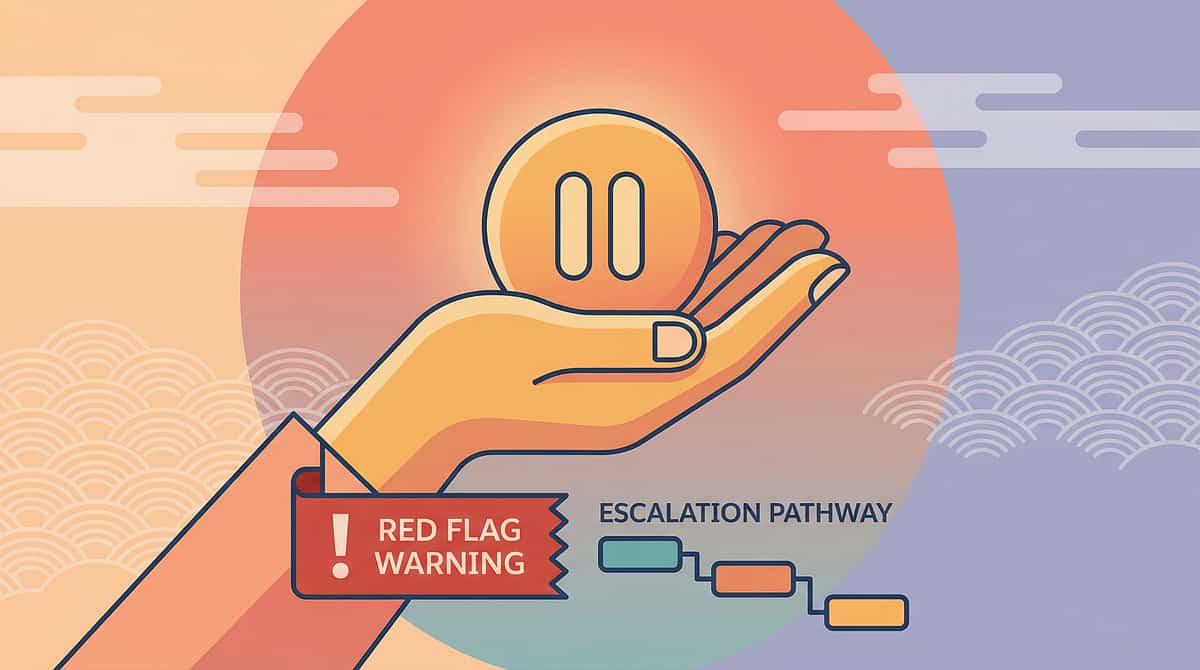
🚩 Red Flags — When to Pause and Seek Professional Guidance
🔴 Escalating Distress Despite Full Accommodations for 3+ Weeks
Meltdowns returning or worsening despite ear defenders, breaks, and modifications. May indicate insufficient accommodation level or underlying condition (hyperacusis, auditory processing disorder). Do: Pause music class. Consult OT for comprehensive sensory evaluation. Consider audiology referral.
🔴 Anxiety Generalizing to School Avoidance
Child doesn't want to go to school at all on music days. Anxiety about school increasing generally. Do: Address immediately. Consult psychologist. Consider temporary music class exemption while anxiety is treated.
🔴 Physical Symptoms: Ear Pain, Headaches, Nausea with Sound
May indicate hyperacusis, vestibular involvement, or medical condition. Do: Medical evaluation by pediatrician. Audiology assessment. Pause music class until cleared.
🔴 Behavioral Regression in Other Areas After Music Class
Sleep disturbances, increased tantrums, regression in other skills following music class days. The sensory load is exceeding recovery capacity. Do: Reduce music class exposure immediately. Consult team.
🔴 Self-Injurious Behavior Related to Sound
Child hits own ears, bangs head, or bites self during/after sound exposure. Do: Immediate removal from auditory trigger. Do NOT return without professional guidance. Urgent OT + behavior team consultation.
Escalation Pathway: Self-manage → Teleconsult with Pinnacle OT → Clinic visit for sensory evaluation → Audiology assessment → Comprehensive intervention plan
"If something feels wrong, pause and ask. Your instincts about your child are valid data."

The Progression Pathway — Where You Are, Where You're Heading
Lateral Alternatives
If this approach didn't fully resonate:
- A-039 (general environmental noise management) — if challenge extends beyond music class
- Music Therapy — controlled, therapeutic music exposure as separate preparation
- Therapeutic Listening Programs (Vital Links, iLS) — under OT guidance for auditory system retraining
Long-Term Developmental Goal
Functional participation in group acoustic environments across settings — music class, assembly, cafeteria, sports events, community gatherings — with self-managed accommodations and self-advocacy skills.
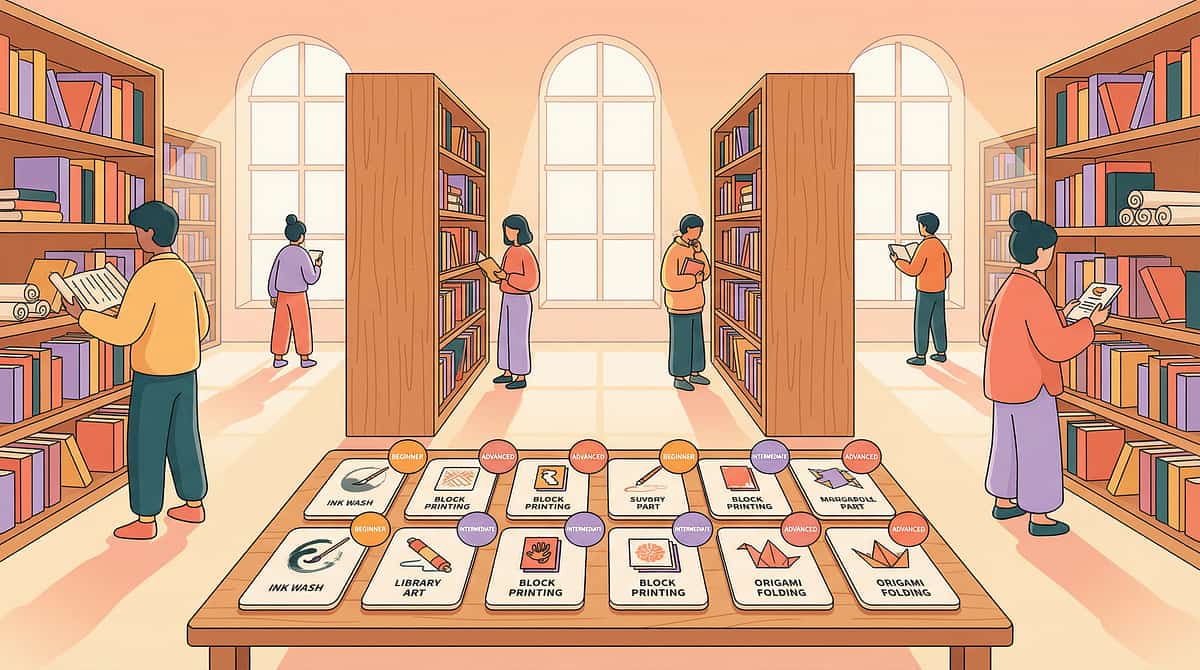
Related Techniques in the Auditory Sensory Processing Domain
The materials you've built for music class — ear defenders, fidget tools, communication cards, break system — apply directly to these related challenges. Your investment compounds.
Technique | Difficulty | Materials You Already Own | |
A-036: Hand Dryer Fear — Sudden loud sound desensitization | Intro | Ear defenders ✓, graduated exposure protocol ✓ | |
A-037: Sensitivity to Sudden Sounds — Startle response management | Intro | Ear defenders ✓, communication cards ✓, visual schedule ✓ | |
A-039: Crowded Noisy Places — Multi-source environment tolerance | Core | Ear defenders ✓, fidget tools ✓, break system ✓ | |
A-041: Assembly Overwhelm — Large group acoustic management | Core | Ear defenders ✓, strategic seating ✓, break system ✓ | |
A-042: Cafeteria Challenges — Mealtime sensory environment | Core | Ear defenders ✓, strategic seating ✓, communication cards ✓ | |
A-045: Auditory Processing in Classroom — Filtering teacher voice from background noise | Advanced | Ear defenders ✓, strategic seating ✓, visual supports ✓ |
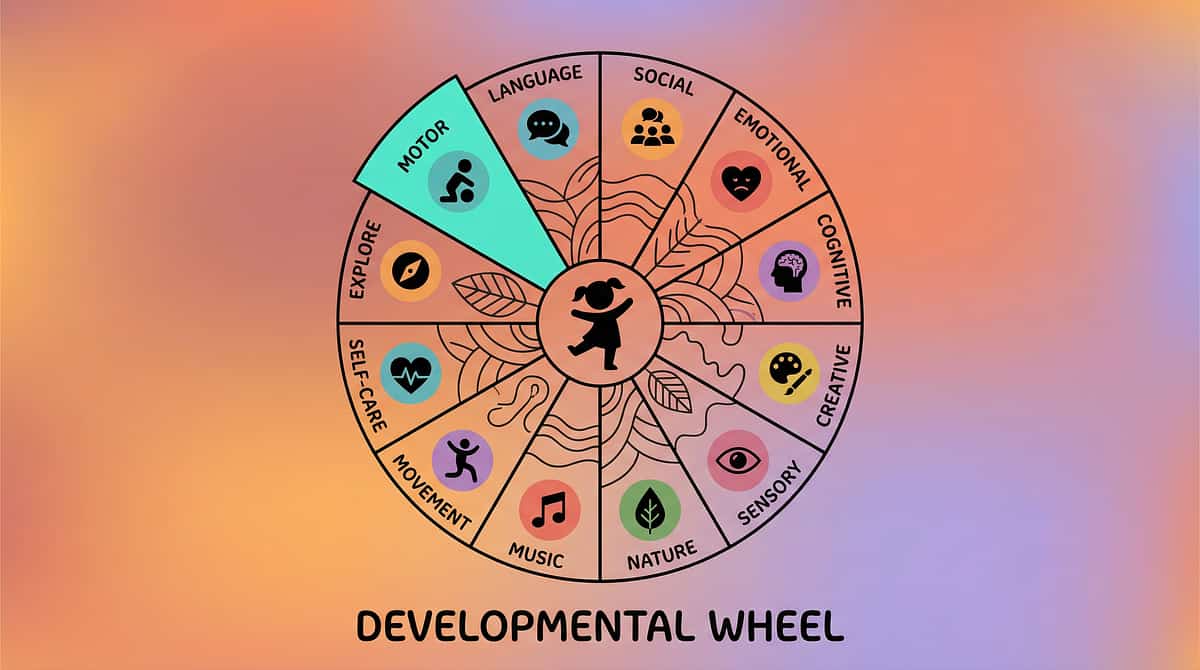
This Technique Is One Piece of a Larger Plan
Current Technique's Position: Domain A: Sensory Processing → Sub-domain: Auditory Over-Responsivity → Specific: Music Class Environment
→ Domain D
Social-Emotional: Inclusion in peer activities, reduced social isolation
→ Domain J
Self-Regulation: Developing coping strategies for overwhelming input
→ Domain K
Daily Living: Managing auditory environments independently
→ Domain L
Academic Readiness: Participating in all school activities, including specials
See your child's full developmental profile across all 12 domains → Request AbilityScore® assessment: Call 9100 181 181

From Exclusion to Inclusion — Real Families, Real Outcomes
Family Vignette 1 — From Meltdown to Music
Before: "Music class was her nightmare. She'd have a meltdown every single time. The school was about to exclude her permanently."
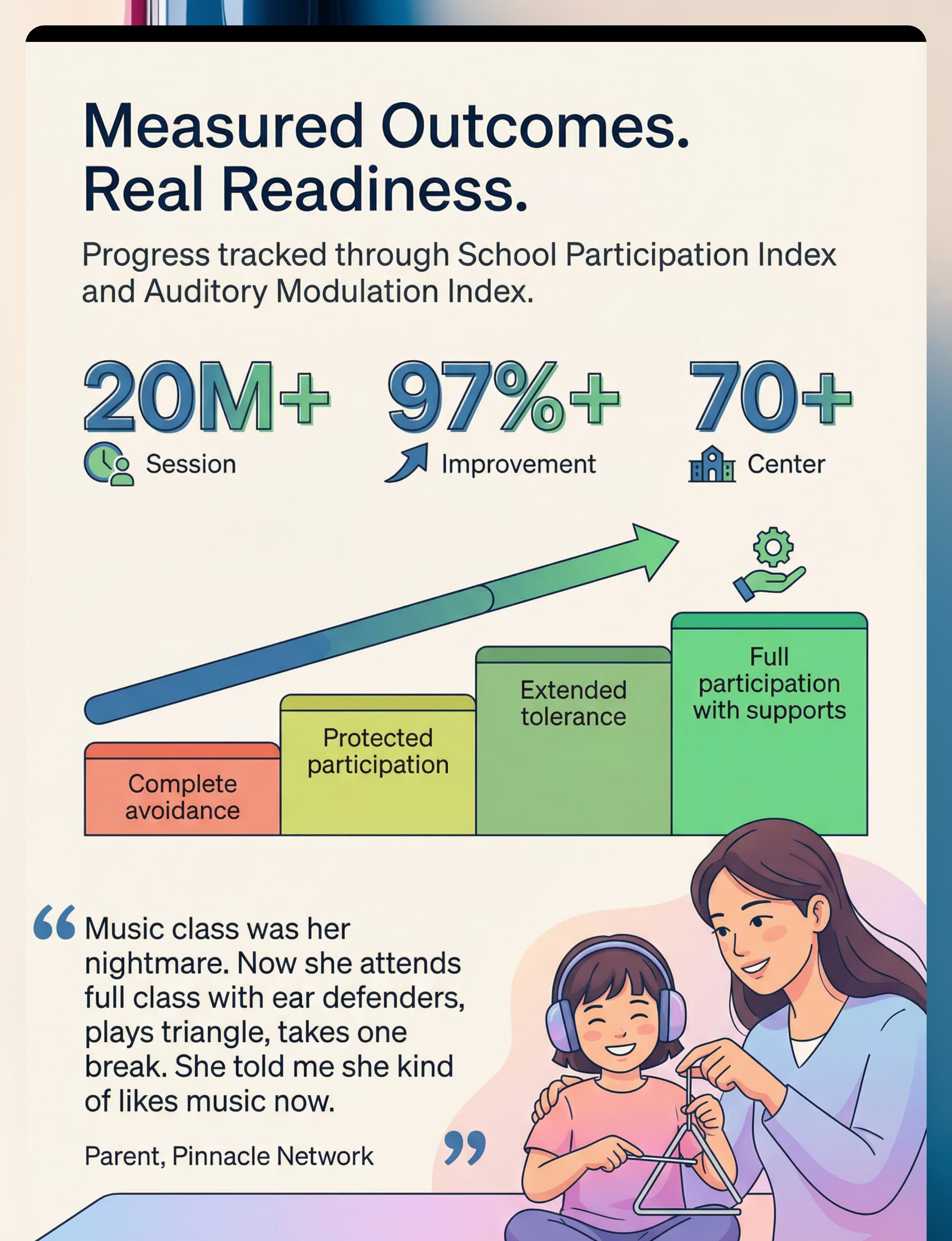
After: "First week: 10 minutes with two breaks. Now: full class with ear defenders, plays triangle and shakers, takes one break most days. She told me last week she 'kind of likes music now.' She's included. She's participating. She's not suffering anymore." — Parent, Pinnacle Network
Family Vignette 2 — From "Disruptive" to Discovered
Before: "The school kept calling us. 'Your son is disruptive in music class.' He wasn't disruptive. He was in pain."
After: "Three months in, he stays for the whole class. He discovered he loves the xylophone — it's one of the softer instruments." — Parent, Pinnacle Network
"Music class is one of the environments where we see the fastest transformation with the right supports. Ear protection alone often converts a non-participant into a willing attendee. Adding strategic seating and break access typically gets the child through the full class within 4–6 weeks. The key is school collaboration." — Pinnacle OT Division
Illustrative cases; outcomes vary by child profile.

Connect With Other Parents Navigating Auditory Sensory Challenges
You are not alone. Thousands of families across the Pinnacle Blooms Network are navigating this exact challenge — and building community around it. Your experience is valuable. Your insights help other parents who are just starting this journey.
WhatsApp Group
"Auditory Sensory Support — Music & School" — real-time peer connection with other parents navigating music class challenges.
Online Forum
Pinnacle Parent Community — Sensory Processing thread. Share experiences, ask questions, find strategies that worked for other families.
Local Meetups
Pinnacle center parent meetups — find your nearest center and connect with local families facing similar challenges.
Peer Mentoring
Connect with an experienced parent who has already navigated music class challenges. Request a peer mentor match.
"Your experience helps others — consider sharing your journey. The parent who just started the music class protocol desperately needs to hear from someone who's been through it."

Your Professional Support Team — Home + Clinic = Maximum Impact
Therapist Matching by Discipline
- Occupational Therapist (Sensory Integration): Comprehensive sensory evaluation, ear protection selection, graduated exposure design, school consultation
- Audiologist (via referral): Hearing evaluation, auditory processing assessment, hyperacusis evaluation
- Behavior Analyst: Break system design, communication card training, reinforcement scheduling
- Special Educator: Accommodation plan writing, school advocacy support, visual support creation
How to Access Support
70+ Pinnacle Centers Across India
Find your nearest center using the interactive locator → pinnacleblooms.org
Find your nearest center using the interactive locator → pinnacleblooms.org
Can't Visit a Center?
Book a teleconsultation — your child's OT, wherever you are.
Book a teleconsultation — your child's OT, wherever you are.
FREE National Autism Helpline: 9100 181 181
(16+ languages, 24×7)
"Home + clinic = maximum impact. The strategies on this page are more powerful when supported by professional evaluation and guidance."
(16+ languages, 24×7)
"Home + clinic = maximum impact. The strategies on this page are more powerful when supported by professional evaluation and guidance."
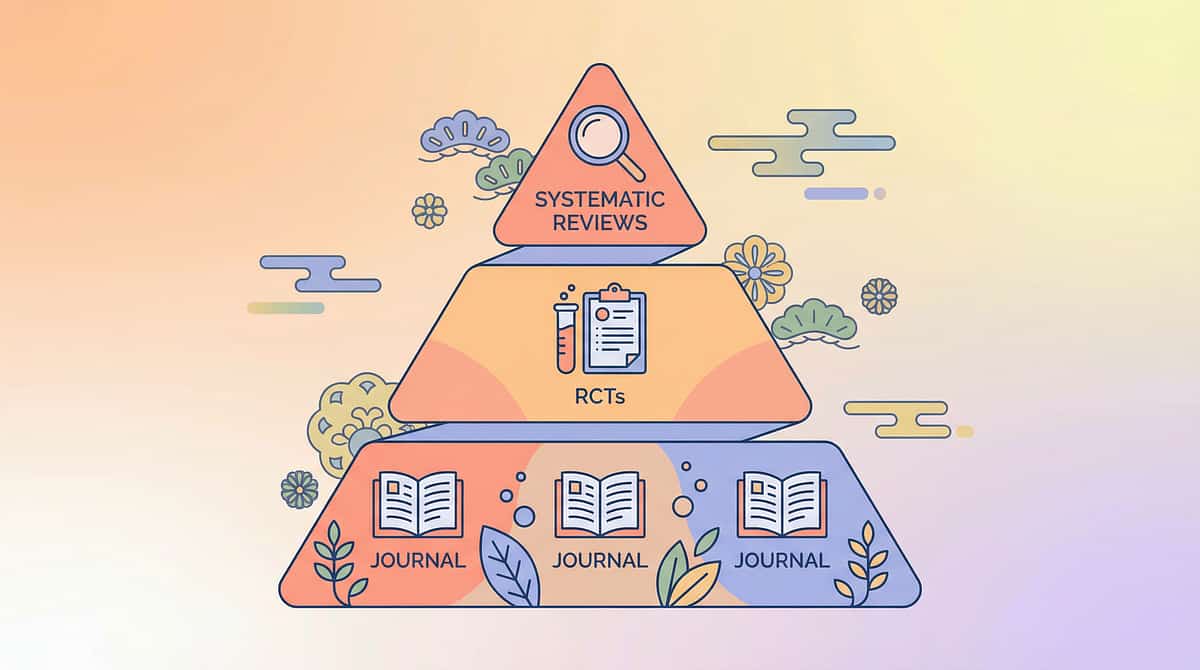
The Evidence Base — For the Parent Who Wants to Go Deeper
Direct Research Links
PubMed
PMC11506176 | PMC10955541 | PMC9978394
DOI References
10.3389/fnint.2020.556660 | 10.1007/s12098-018-2747-4 | 10.12998/wjcc.v12.i7.1260
WHO / UNICEF
nurturing-care.org | WHO CCD Package (PMC9978394)
Clinical Bodies
spdfoundation.net | aota.org | ncaep.fpg.unc.edu

How GPT-OS® Learns From Your Child's Music Class Journey
How Your Data Helps Every Child
When your child's music class tolerance data joins the 20M+ session database, it improves recommendations for every family navigating auditory challenges. Your participation in the system makes the system smarter — for your child and for millions of others.
Privacy Assurance
Your child's data is encrypted, anonymized for population research, and never shared with third parties. You own your child's data. You can request deletion at any time.
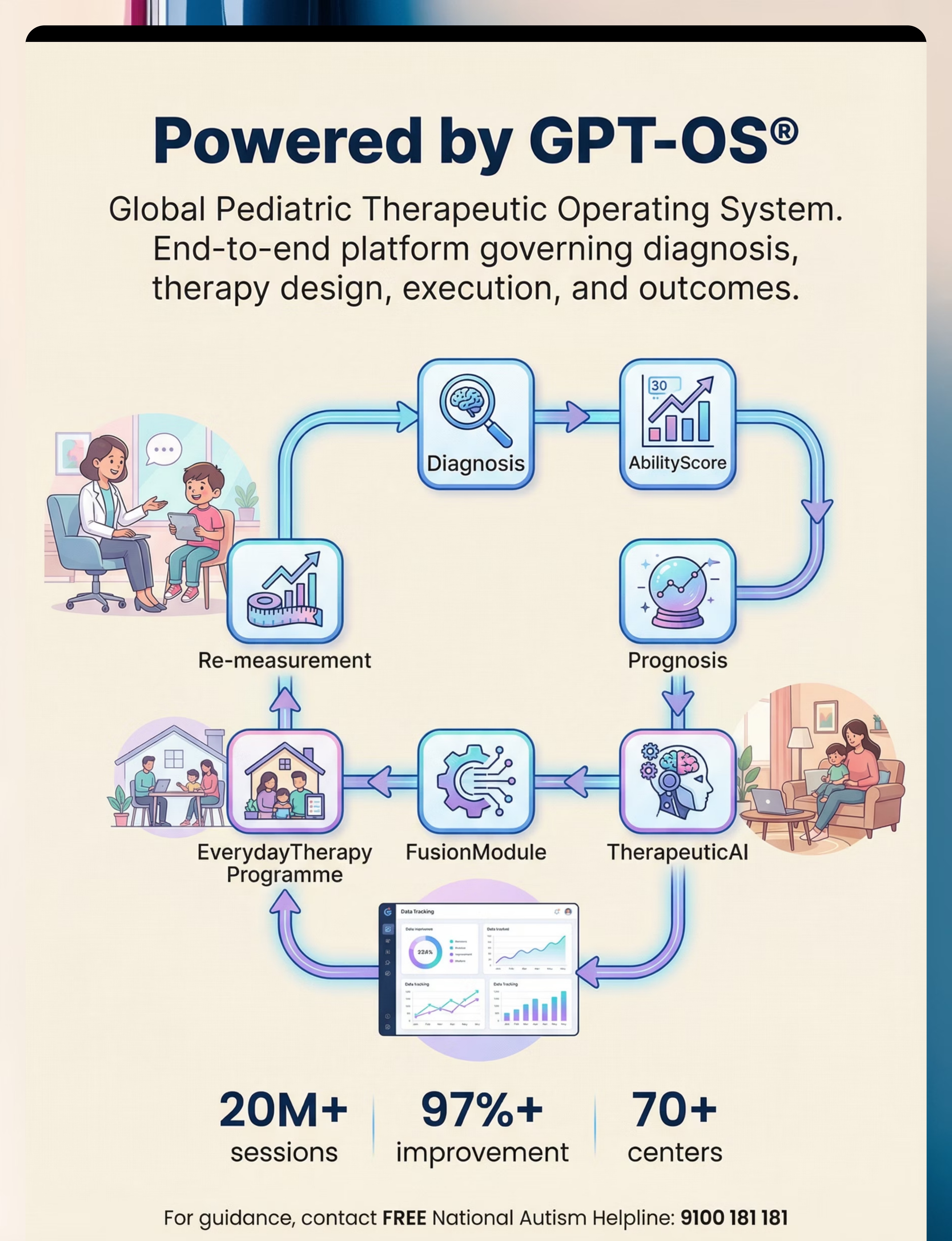
EverydayTherapyProgramme™ delivers daily home activities supporting auditory modulation, pre-music class preparation routines, and progress reports for the school team — all coordinated through a single therapeutic operating system.
Frequently Asked Questions — Music Class Distress
Will my child always need ear defenders in music class?
Many children use ear protection long-term, and that's perfectly fine — it's an accommodation, not a crutch. Some children gradually reduce their need as auditory tolerance builds. Others prefer to keep ear protection as a reliable tool throughout school. The goal is participation, not removal of supports.
Is this actually autism, or could it be something else?
Auditory over-responsivity occurs in autism, sensory processing disorder, ADHD, anxiety disorders, hyperacusis, and sometimes in typically developing children. A comprehensive OT and/or audiology evaluation identifies the specific pattern. The strategies on this page work regardless of diagnosis — they address the sensory experience, not the label.
How long does it take to see improvement?
Most families see measurable change within 2–4 weeks of consistent accommodation implementation. Full participation typically takes 6–12 weeks. Consistency is more important than speed.
The school says accommodations are "unfair to other students." What do I do?
Accommodations level the playing field — they don't create unfairness. Ear defenders allow your child to access the same education as peers. Request a formal meeting. Bring documentation. If needed, escalate to school administration. Share this page as educational material.
Can music therapy help alongside these classroom strategies?
Yes. Music therapy is a separate, controlled therapeutic intervention where a trained music therapist works individually with your child — controlled volume, predictable structure, child-led pacing. It builds positive music associations and auditory tolerance in a safe environment that supports classroom participation.
My child has started humming loudly during music class. Is this a problem?
Humming is often a self-regulation strategy — the child creates a controlled sound to compete with unpredictable sounds. It's a coping mechanism, not defiance. If disruptive, offer ear protection (reduces the need to mask with humming) or allow humming in the break space.
What if the distress extends to all auditory environments, not just music class?
If your child struggles in music class, cafeteria, assembly, playground, AND home environments, a comprehensive sensory processing evaluation is strongly recommended. Pervasive auditory over-responsivity requires a whole-child sensory diet designed by an OT. → Call 9100 181 181 for guidance.
Preview of 9 materials that help during music class distress Therapy Material
Below is a visual preview of 9 materials that help during music class distress therapy material. The pages shown help educators, therapists, and caregivers understand the structure and content of the resource before use. Materials should be used under appropriate professional guidance.


Link copied!
Your Next Step — Start Today
Your child arrived at this page being excluded from music class. By the end of this protocol, they can be included — participating, self-advocating, and discovering that music can be enjoyable when the environment is adapted to their nervous system.
📞 Book a Consultation
Schedule with a Pinnacle OT — in-person at 70+ centers OR teleconsultation. FREE National Autism Helpline: 9100 181 181 (16+ languages, 24×7)
📄 Download Resources
Family Guide (1-Page PDF) · Teacher Communication Template · Break Card Printable (ready to laminate)
🔄 Share This Page
Send to everyone who cares for your child — family, teachers, grandparents. Consistency across caregivers multiplies impact.
PINNACLE BLOOMS CONSORTIUM® | OT · SLP · ABA · SpEd · NeuroDev · Audiology | "From fear to mastery. One technique at a time."
This content is educational. It does not replace assessment by a licensed occupational therapist, audiologist, or healthcare provider. Individual results may vary. Statistics represent aggregate outcomes across the Pinnacle Blooms Network.
© 2025 Pinnacle Blooms Network®, unit of Bharath Healthcare Laboratories Pvt. Ltd. | CIN: U74999TG2016PTC113063 | DPIIT: DIPP8651 | MSME: TS20F0009606 | GSTIN: 36AAGCB9722P1Z2
Powered by GPT-OS® — Global Pediatric Therapeutic Operating System | 20M+ sessions | 97%+ improvement | 70+ centers | pinnacleblooms.org | care@pinnacleblooms.org
FREE National Autism Helpline: 9100 181 181 (16+ languages, 24×7)