
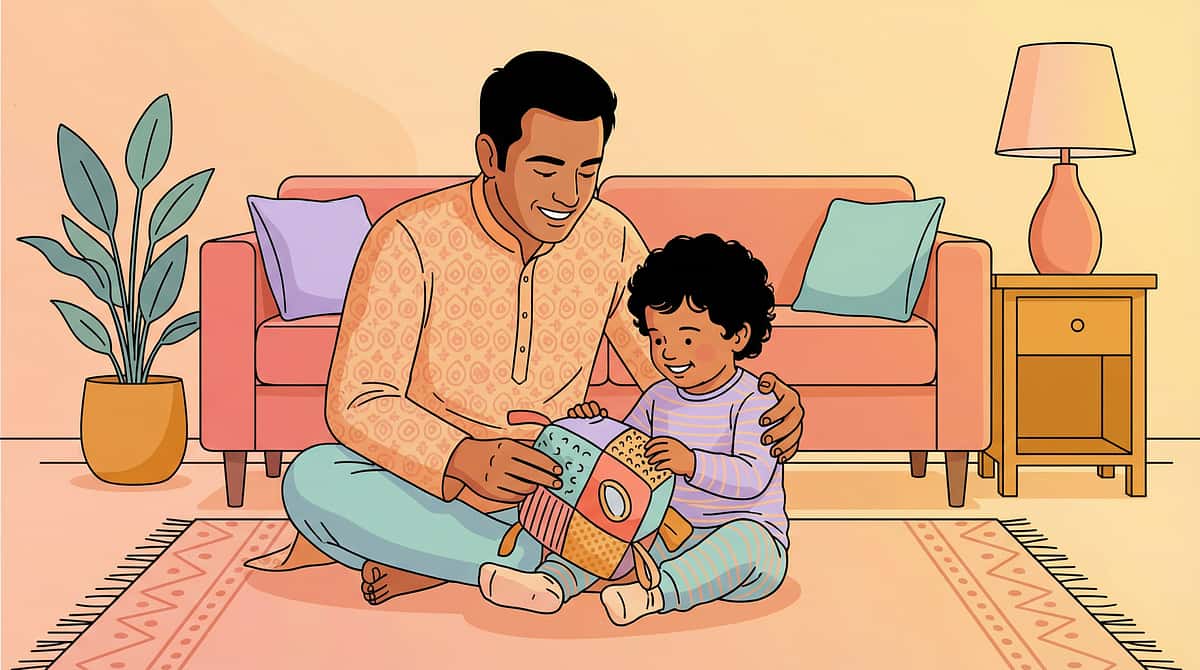
When Every Birthday Party Invitation Feels Like a Threat
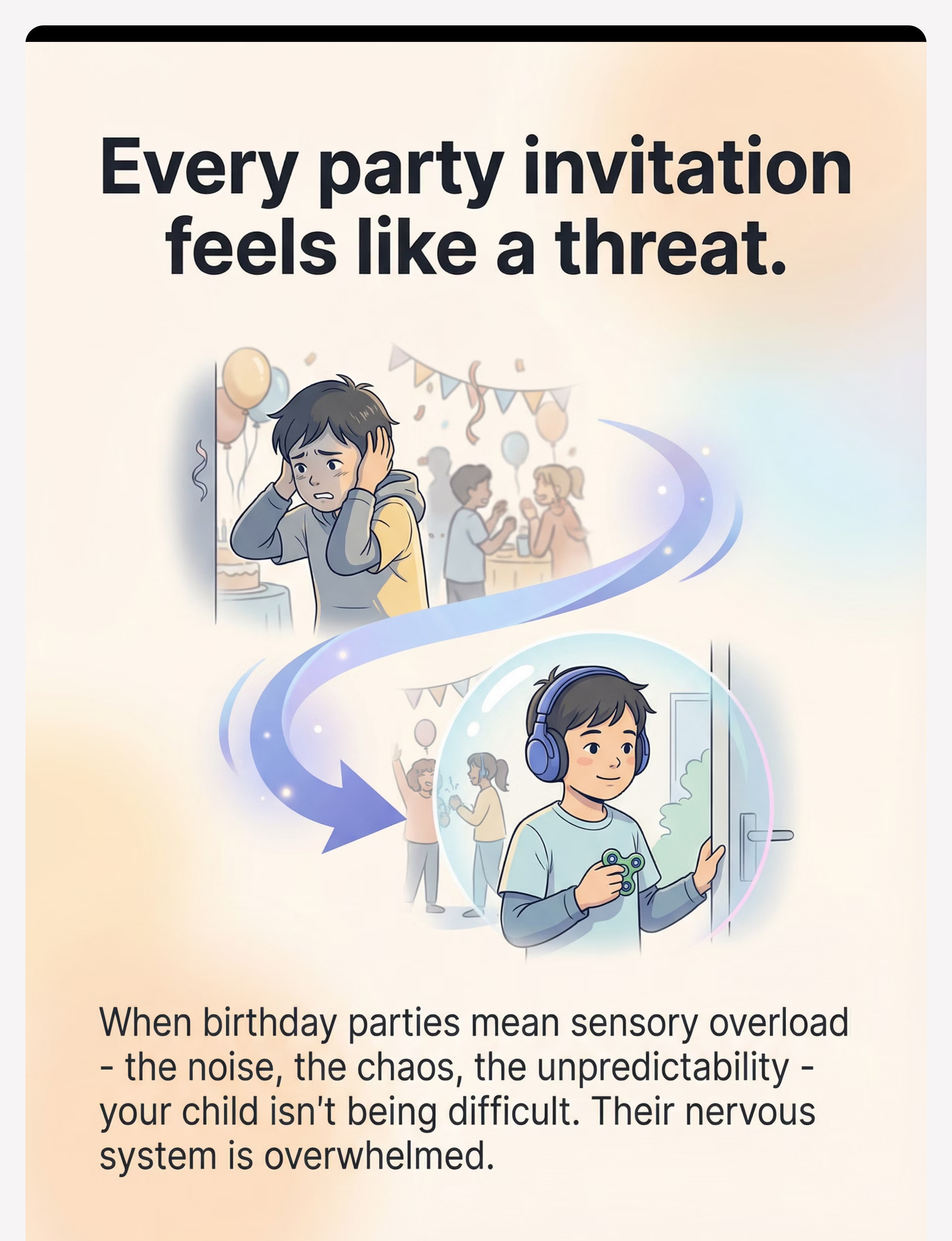
The invitation arrives. Your stomach drops. You already know what's coming — the pounding music, the screaming children, the echoing venue, the balloon pops that make your child's entire body seize with terror. He wants to go. He wants friends, cake, to be included. But within twenty minutes, he's either melting down or hiding under a table, hands pressed against his ears, tears streaming while other children laugh and play around him.
You are not failing. Your child's nervous system is speaking. This is multi-sensory environmental overwhelm — and 9 specific materials can transform noisy birthday parties from impossible to manageable.
Pinnacle Blooms Network®
Sensory Solutions Series — Episode 35
Built by Mothers. Engineered as a System. | WHO Nurturing Care Framework (2018): Early identification and parental awareness directly impacts developmental outcomes across responsive caregiving and early learning domains. Reference: nurturing-care.org/ncf-for-ecd
You Are Among Millions
These numbers are not meant to alarm — they are meant to assure you that your experience is shared by millions of families worldwide navigating the same daily battlegrounds of birthday parties, festivals, school events, and celebrations.
80%
Children with ASD
experience sensory processing difficulties significant enough to impact daily functioning — PRISMA Systematic Review, 2024 (PMC11506176)
16%
School-Age Children Globally
demonstrate sensory processing differences that impact daily functioning, even without an autism diagnosis (SPD Foundation)
18M
Families in India
navigate some form of sensory processing challenge — with 1 in 100 children affected by autism (INCLEN Trust/ICMR)
You are not navigating this alone. You are among millions of families worldwide who watch their children struggle in environments that other children process without effort. Birthday parties, festivals, weddings, school events — all become battlegrounds. The data normalizes your experience and points toward the solution.

This Is Neurology, Not Behavior
The Typical Filtering System
In typical neural processing, the brain automatically filters sensory input — damping background noise, ignoring peripheral movement, amplifying the voice speaking directly to you. This happens in the thalamus and somatosensory cortex without conscious effort.
In Your Child's Brain
This filtering system works differently. Input that should be dampened arrives at full intensity. The auditory cortex processes party music, screaming, balloon pops, and game instructions with equal urgency. Every sensory channel broadcasts at maximum volume simultaneously.
The amygdala interprets this flood as danger and triggers fight (meltdown), flight (hiding/running), or freeze (shutdown). This is a wiring difference, not a behavior choice.
Frontiers in Integrative Neuroscience (2020): Comprehensive framework for evaluating sensory integration in ASD, establishing neurological basis for sensory-based interventions. DOI: 10.3389/fnint.2020.556660

Your Child Is Here. Here Is Where We're Heading.
Multi-sensory environmental overwhelm doesn't emerge in isolation. It sits within a developmental trajectory that the WHO, UNICEF, and pediatric research have mapped extensively. Where your child is on this timeline is a waypoint, not a destination.
1
Age 2–3
Sensory preferences and aversions become noticeable. Children begin avoiding loud environments, covering ears, or resisting crowded spaces.
2
Age 3–5
The gap widens as social expectations increase. Birthday parties, preschool assemblies, festivals — this is often when families first seek professional evaluation.
3
Age 5–8
School environments add daily complex sensory demands. Children who struggle at parties often struggle at assemblies, lunch rooms, and PE class.
4
Age 8–12
Self-awareness develops. The child may begin avoiding social events independently, creating isolation patterns that compound over time.
With structured intervention, the nervous system can build tolerance through supported positive experiences — and the techniques on this page are how you begin. Commonly co-occurs with: Auditory processing difficulties, anxiety, attention differences, food selectivity, sleep challenges.
WHO Care for Child Development Package: Age-specific evidence-based recommendations for caregivers. Implemented in 54 LMICs. | UNICEF MICS indicators for developmental monitoring across 197 countries. References: PMC9978394 | WHO/UNICEF CCD Package (2023)

Clinically Validated. Home-Applicable. Parent-Proven.
Evidence Grade: Level I–II (Strong)
Sensory integration intervention has been rigorously evaluated across multiple systematic reviews and meets the criteria for evidence-based practice for children with autism spectrum disorder. This is not anecdote — this is convergent clinical evidence.
16 Articles
PRISMA systematic review (2013–2023) confirms sensory integration intervention as evidence-based practice for children with ASD (PMC11506176)
24 Studies
Meta-analysis demonstrates effective promotion of social skills, adaptive behavior, sensory processing, and motor skills (PMC10955541)
Indian RCT
Padmanabha et al. (2019): Home-based sensory interventions show significant outcomes in Indian pediatric populations. DOI: 10.1007/s12098-018-2747-4
21 RCTs
1,050 participants: Digital health interventions for ASD show promise across multiple outcome domains (2024 meta-analysis)
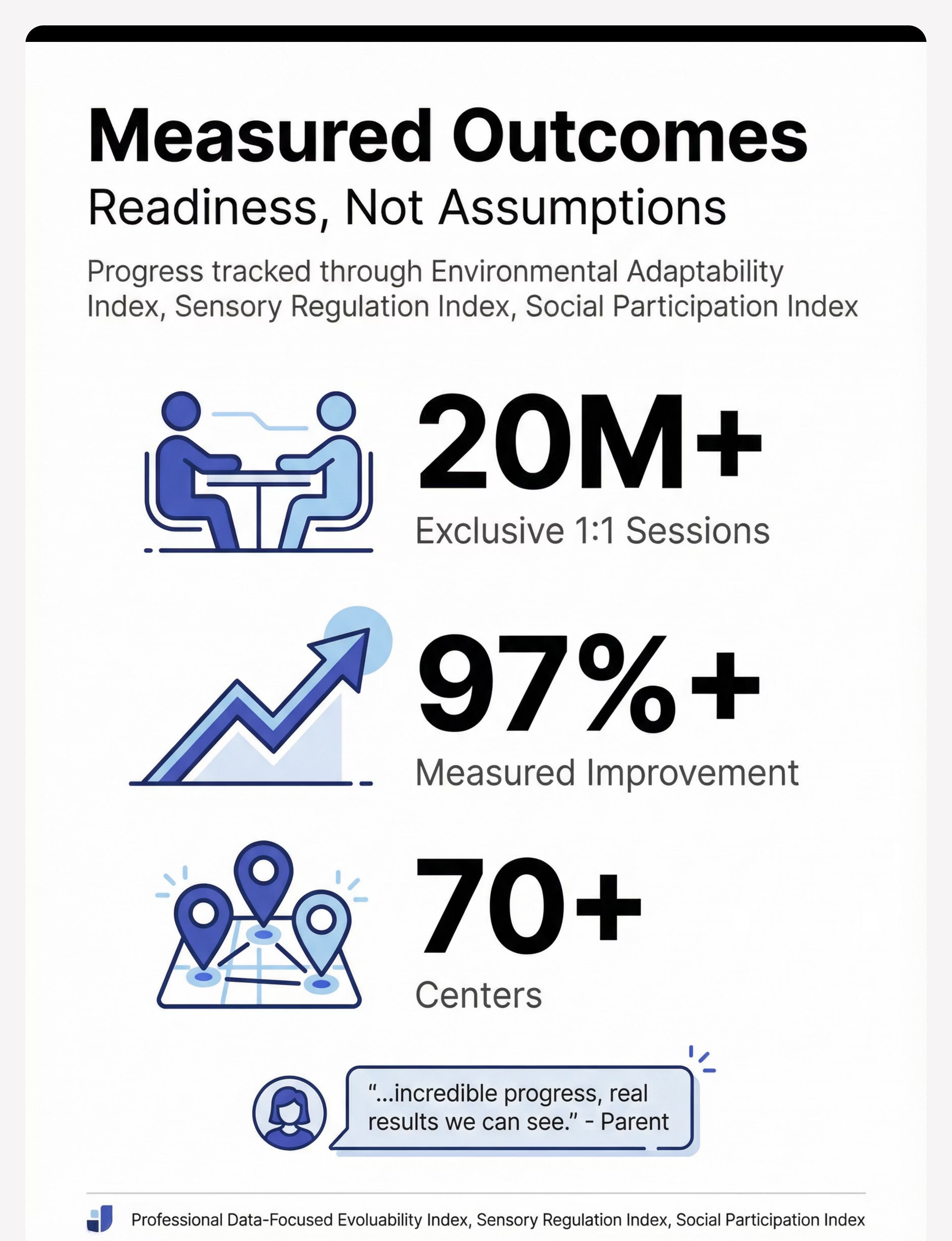
The Pinnacle Blooms Consortium — comprising Pediatric OTs, SLPs, BCBAs, Special Educators, and NeuroDevelopmental Pediatricians — affirms high confidence in these strategies based on convergent clinical evidence and 20M+ exclusive 1:1 therapy sessions producing 97%+ measured improvement rates across 70+ centers.
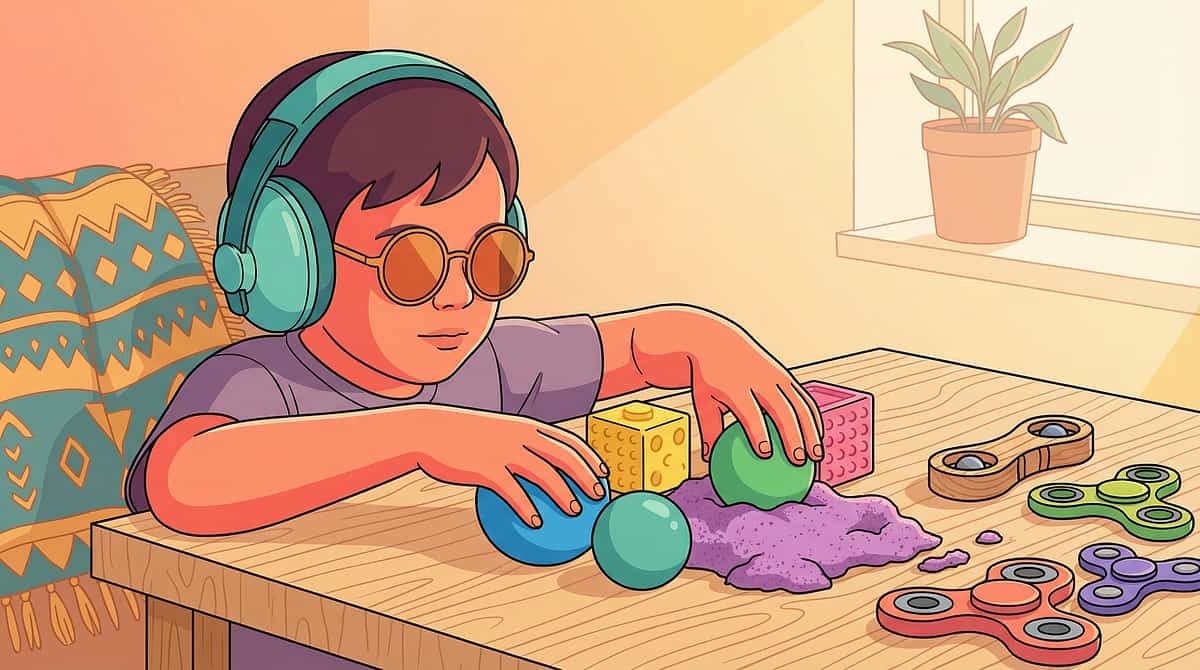
Multi-Sensory Environmental Regulation for Birthday Parties
Parent-Friendly Alias: "The Birthday Party Survival Kit"
Definition: A layered intervention approach that combines sensory load reduction, regulation resources, predictability enhancement, escape planning, and social anchoring to enable children with sensory processing differences to participate in complex, uncontrolled social environments like birthday parties. Rather than attempting to eliminate sensory challenges (impossible in party environments), this technique bridges the gap between the child's nervous system capacity and the environment's demands through 9 specific materials deployed simultaneously.
🎯 Domain
Sensory Processing — Multi-Sensory Overwhelm / Environmental Regulation (SEN-ENV-OVR)
👶 Age Range
2–12 years
📍 Setting
Community + Social Events + Home (preparation)
⏱ Duration
Event-dependent: 15 minutes to full party
🔁 Frequency
As social events arise; practice preparation weekly
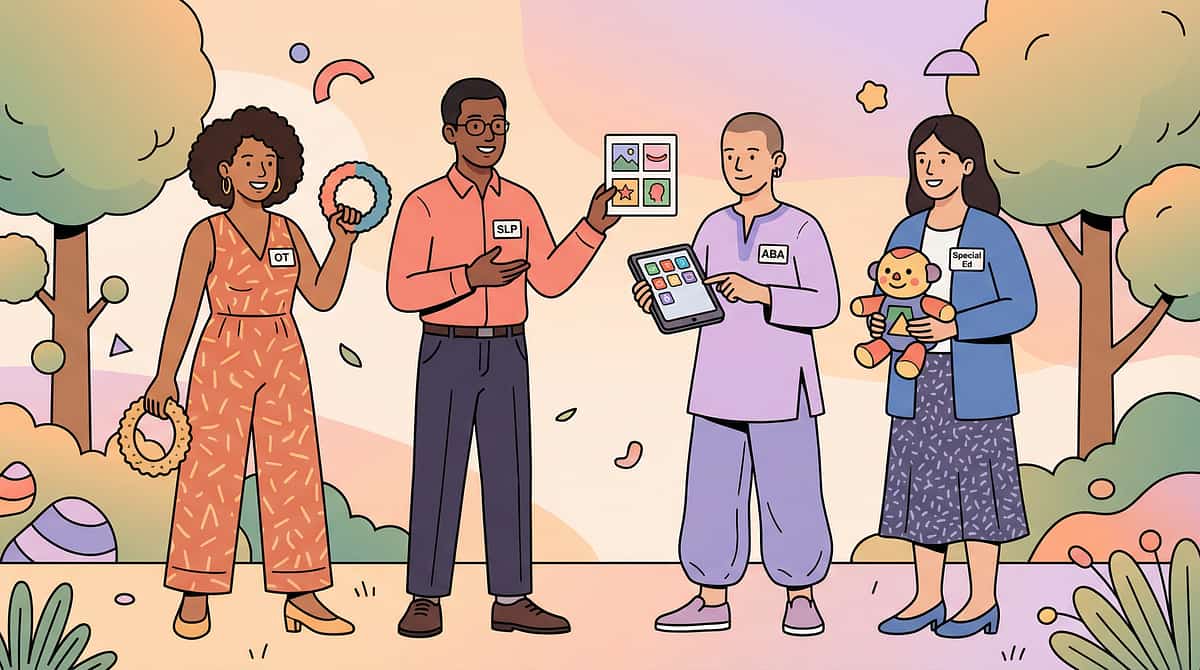
A Consortium Approach — Because the Brain Doesn't Organize by Therapy Type
Birthday party participation requires regulation, behavioral flexibility, social communication, cognitive preparation, and medical oversight — simultaneously. No single discipline owns this challenge, which is why the Pinnacle Blooms Consortium deploys a coordinated team approach.
Occupational Therapist (PRIMARY LEAD)
Designs the sensory regulation strategy. Evaluates the child's specific sensory profile — which systems are over-responsive, under-responsive, or seeking — and recommends materials matched to the child's unique pattern. Determines weighted lap pad specifications, headphone type, toolkit contents, and break zone protocols.
Board Certified Behavior Analyst (BCBA)
Addresses anxiety and avoidance patterns around party attendance. Designs graduated exposure plans, develops reinforcement strategies, and creates the behavioral framework for the social story. Ensures coping strategies are behaviorally specific and measurable.
Speech-Language Pathologist (SLP)
Supports social communication demands — navigating group conversations, following game instructions, managing turn-taking in chaotic environments. May also address oral motor sensitivities related to party food challenges.
Special Educator
Adapts social story content to the child's cognitive and comprehension level. Creates visual supports, coping cards, and simplified party schedules that the child can reference independently.
NeuroDevelopmental Pediatrician
Evaluates whether sensory challenges are part of a broader developmental profile. Rules out or addresses comorbid conditions (anxiety disorder, ADHD) that compound party overwhelm. Monitors medication effects on sensory tolerance if applicable.
Adapted UNICEF/WHO Nurturing Care Framework for SLPs (2022): Multiple disciplines contribute to nurturing care components including responsive caregiving and early learning. DOI: 10.1080/17549507.2022.2141327
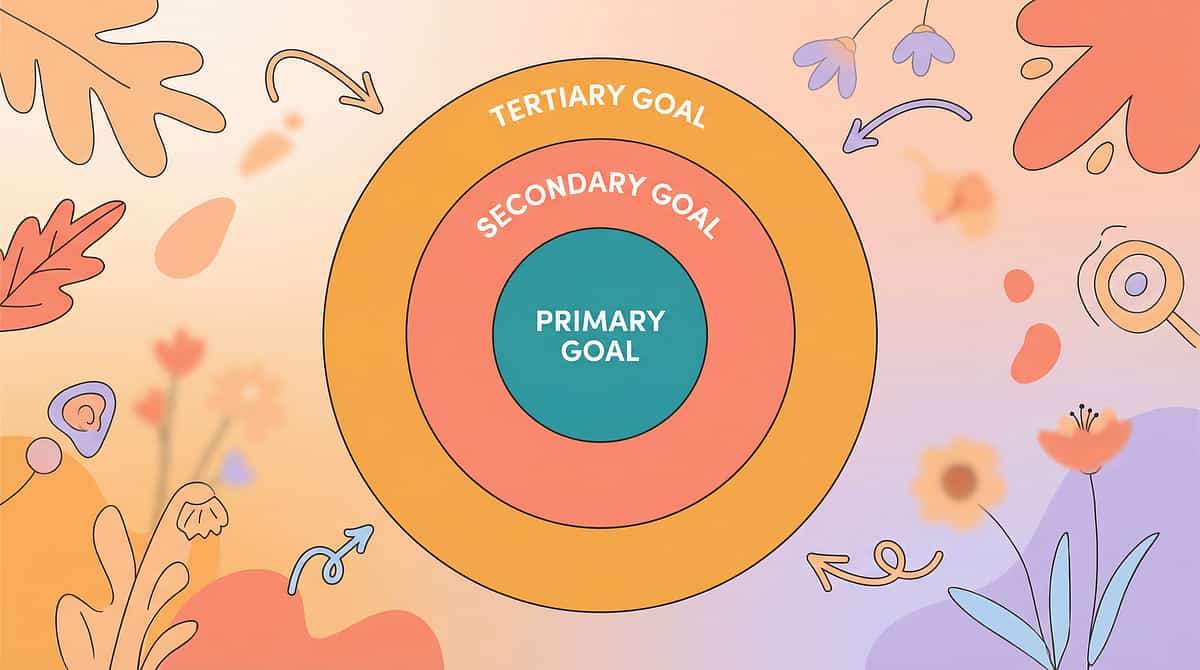
Precision Tools for Specific Outcomes
The primary goal is the child's capacity to function in complex, uncontrolled, multi-sensory environments. Secondary targets address the sensory, social, and emotional building blocks. Long-term tertiary gains include generalization to restaurants, malls, school assemblies, weddings, and festivals — full community participation.
Meta-analysis (World J Clin Cases, 2024): Sensory integration therapy promoted social skills (primary), adaptive behavior (secondary), sensory processing, and motor skills (tertiary) across 24 studies. Reference: PMC10955541
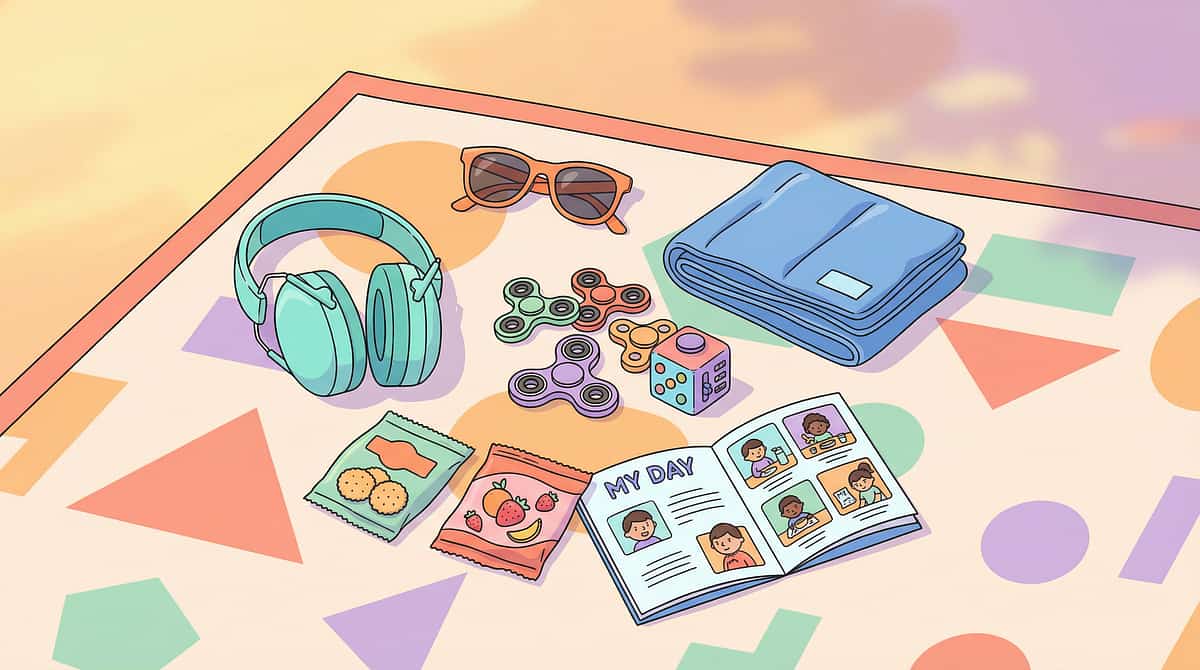
Your Birthday Party Toolkit — 9 Materials, Complete List
These 9 materials work in layers. You don't need all of them to begin — but the more you deploy simultaneously, the greater the combined effect. Total Investment Range: ₹0–10,000 (most strategies are zero-cost).
# | Material | Canon Category | Price (INR) | Resource | |
1 | Noise-Reducing Headphones / Loop Earplugs⭐ Pinnacle Recommends | Sensory Regulation Tools | ₹500–8,000 | ||
2 | Sensory Toolkit / Calm-Down Kit | Emotional & Behavioral Regulation | ₹500–2,000 | ||
3 | Sunglasses / Tinted Lenses | Sensory Regulation Tools | ₹200–2,000 | ||
4 | Social Story / Party Prep Narrative | Visual Supports & Scheduling | ₹0–500 | ||
5 | Quiet Break Zone / Exit Strategy Map | Environmental Adaptation | ₹0 | Planning strategy — no purchase needed | |
6 | Weighted Lap Pad / Compression Vest⭐ Pinnacle Recommends | Sensory Regulation Tools | ₹1,000–4,000 | ||
7 | Familiar Food / Safe Snacks | Familiar Anchors | ₹100–500 | Home-prepared | |
8 | Buddy System / Familiar Peer | Social Support | ₹0 | Social strategy — no purchase needed | |
9 | Arrival / Departure Strategy | Environmental Adaptation | ₹0 | Timing strategy — no purchase needed |
Essential Starters (budget-limited): Noise-reducing headphones + sensory toolkit basics + social story + exit strategy = under ₹2,000 for transformative impact.
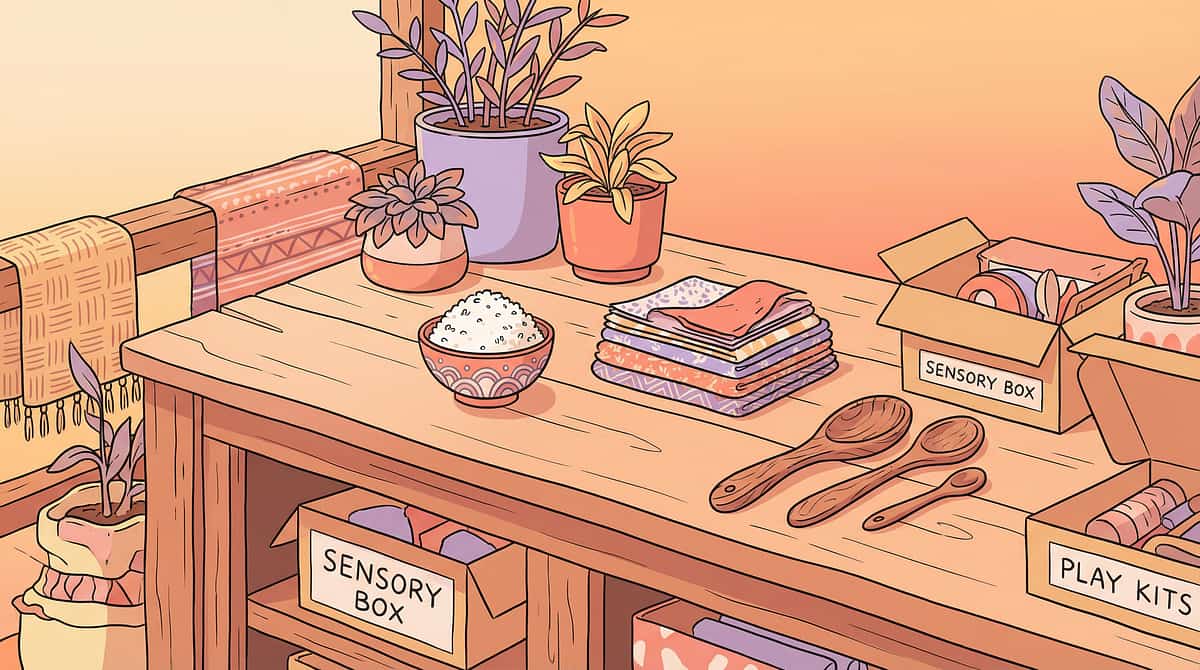
Every Family Can Do This Today — Regardless of Budget
The WHO/UNICEF Nurturing Care Framework emphasizes equity-focused interventions. Not every family can order from Amazon. Not every village has same-day delivery. Here is how you execute this technique TODAY with household items. The sensory principle remains identical — a rice-filled cloth bag provides the same deep pressure input as a commercial weighted pad. The nervous system doesn't read brand labels; it reads sensory input.
Buy This | Make This (Zero-Cost) | |
Noise-reducing headphones (₹500–8,000) | Over-ear earmuffs (industrial style) from any hardware store; foam earplugs reduce volume | |
Commercial sensory toolkit (₹500–2,000) | Small bag + rubber ball + smooth stone + hair tie + favorite small toy + soft fabric | |
Tinted sunglasses (₹200–2,000) | Regular sunglasses from any shop — even ₹50 roadside sunglasses filter visual chaos | |
Commercial social story (₹200–500) | Handmade story with drawings: "Today we go to Riya's party. If it's too loud, I can tell Amma and we'll go outside." | |
Weighted lap pad (₹1,000–4,000) | Fill a cloth bag with 500g–1kg of rice or dal. Stitch closed. Place on child's lap. | |
Compression vest (₹2,000–4,000) | Snug-fitting athletic shirt or tank top under party clothes provides similar pressure input |
When Clinical-Grade Is Non-Negotiable: If your child has a known auditory processing disorder, invest in proper filtered earplugs (Loop, Vibes) rather than foam. Sound quality matters for social participation. | WHO NCF Handbook (2022): PMC9978394
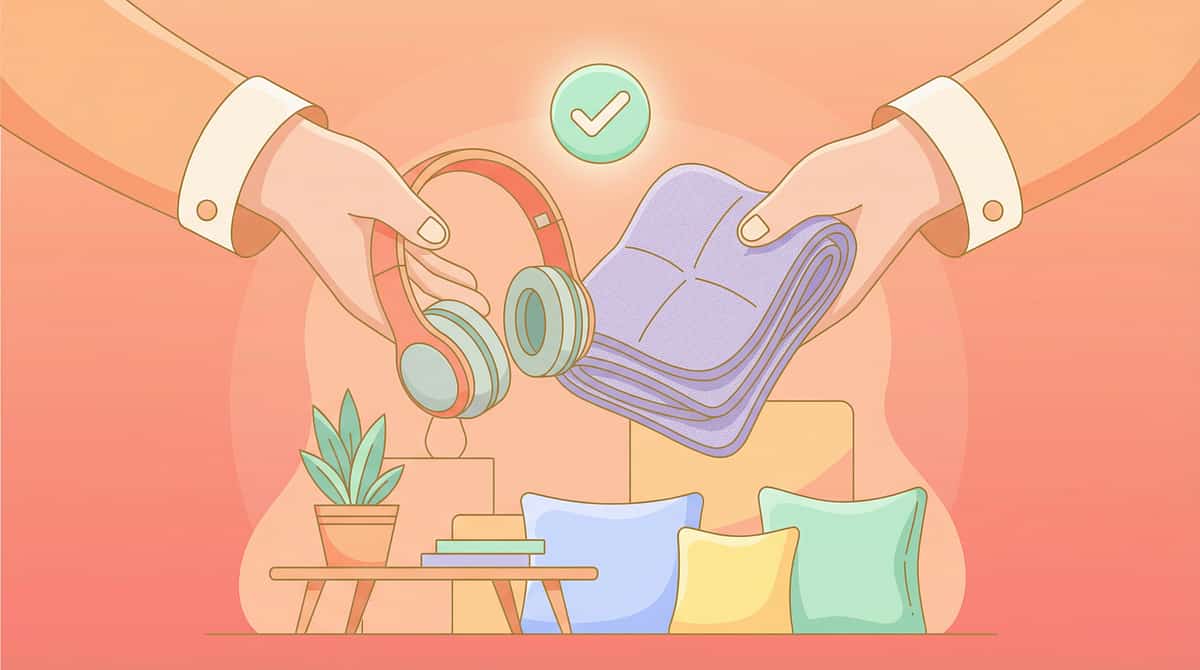
Read This Before the Next Party
🔴 RED — Do Not Proceed If:
- Child is already severely dysregulated or in active meltdown before arrival
- Child has an ear infection or ear pain — no headphones/earplugs until resolved
- Weighted items exceed 10% of child's body weight — reduce weight immediately
- Child has a known seizure disorder triggered by visual stimuli — consult neurologist before sunglasses strategy
- Child has expressed genuine terror (not just reluctance) about attending — forcing attendance creates trauma associations
🟡 Amber — Modify Approach If:
- Child is fatigued, hungry, or had a difficult day — reduce expected duration significantly
- Child is recovering from illness — sensory thresholds are lower when unwell
- Party involves known severe triggers (fireworks, specific loud entertainment)
- No quiet break zone can be identified at venue — have car prepared as backup
🟢 Green — Proceed When:
- Child is rested, fed, and in a baseline-regulated state
- All materials packed and tested; headphones fit, toolkit stocked, food prepared
- Social story has been reviewed at least once
- Exit strategy and break zone are planned; buddy is briefed
Material Safety Notes: Test all headphones at home before party day. Check toolkit items for choking hazards (children under 3: no small items). Weighted items: snug but not restrictive; remove if child is overheating. Sunglasses: ensure they don't impair vision on stairs or in dimly-lit venues.
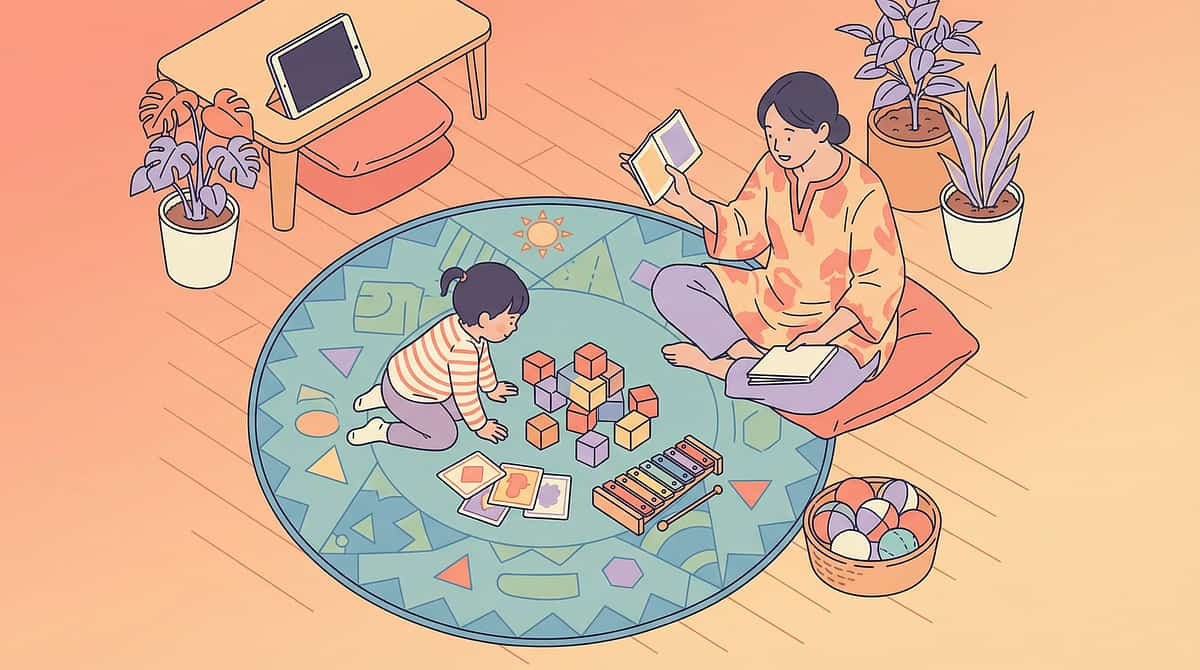
The Party Starts at Home — Days Before
A well-prepared party entry is the single greatest predictor of a positive outcome. This three-stage protocol gives your child's nervous system every advantage before the first balloon pop.
The pre-party protocol is not extra work — it is the intervention. Each step reduces the cognitive and sensory surprise that amplifies overwhelm. When your child walks through that door having already rehearsed the experience in their mind, every tool packed and ready, every strategy discussed — their nervous system arrives prepared rather than ambushed.
Sensory Integration Theory (Ayres): Environmental setup is a core principle. Meta-analysis confirms structured preparation significantly impacts session effectiveness. Reference: PMC10955541
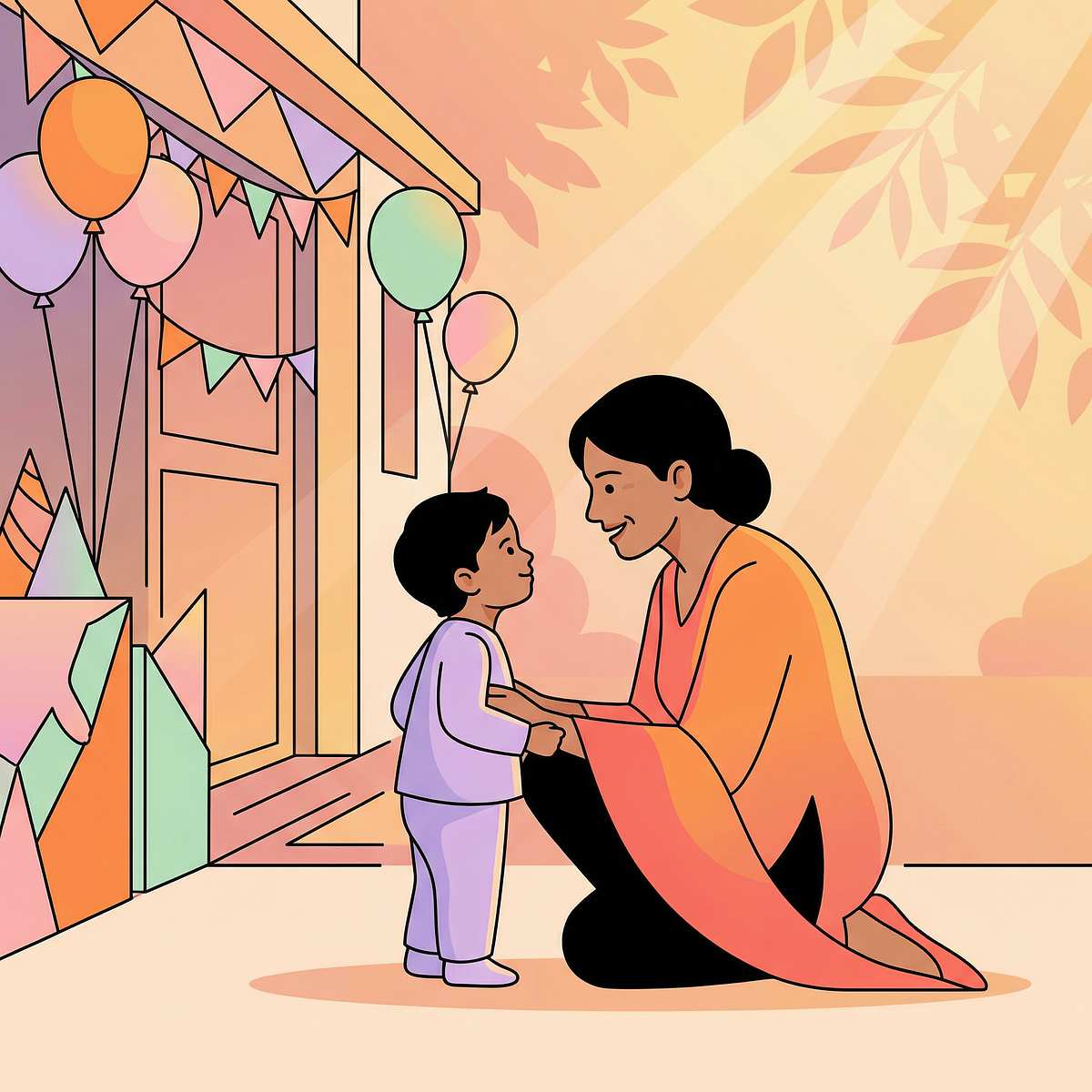
The 60-Second Check Before You Walk In
You're at the venue. Before walking through the door, run this rapid readiness assessment. This is your go/no-go gate — the moment where preparation meets real-world conditions.
1
Physical State
Is your child fed, rested, and physically comfortable? Hunger and fatigue dramatically lower sensory thresholds.
2
Emotional Baseline
Is your child in a relatively calm state? Not coming off a meltdown, argument, or difficult transition?
3
Tools Ready
Headphones accessible? Toolkit in bag? Weighted lap pad? Familiar food packed? Sunglasses available?
4
Plan Communicated
"We'll stay for one hour. You have your headphones. If you need a break, squeeze my hand."
5
Exit Route Known
Have you identified the quiet break zone? Is the car accessible for emergency retreat?
6
Buddy Briefed
If using buddy system, has the buddy been reminded of their role and the signal?
🟢 All Green → GO
Walk in with confidence. You are prepared.
🟡 1–2 Amber → MODIFY
Reduce expected duration. Deploy maximum supports. Set earlier departure.
🟠 3+ Amber → POSTPONE
Consider driving past the venue, dropping off the gift, and having a private celebration another day. This is protection, not failure.
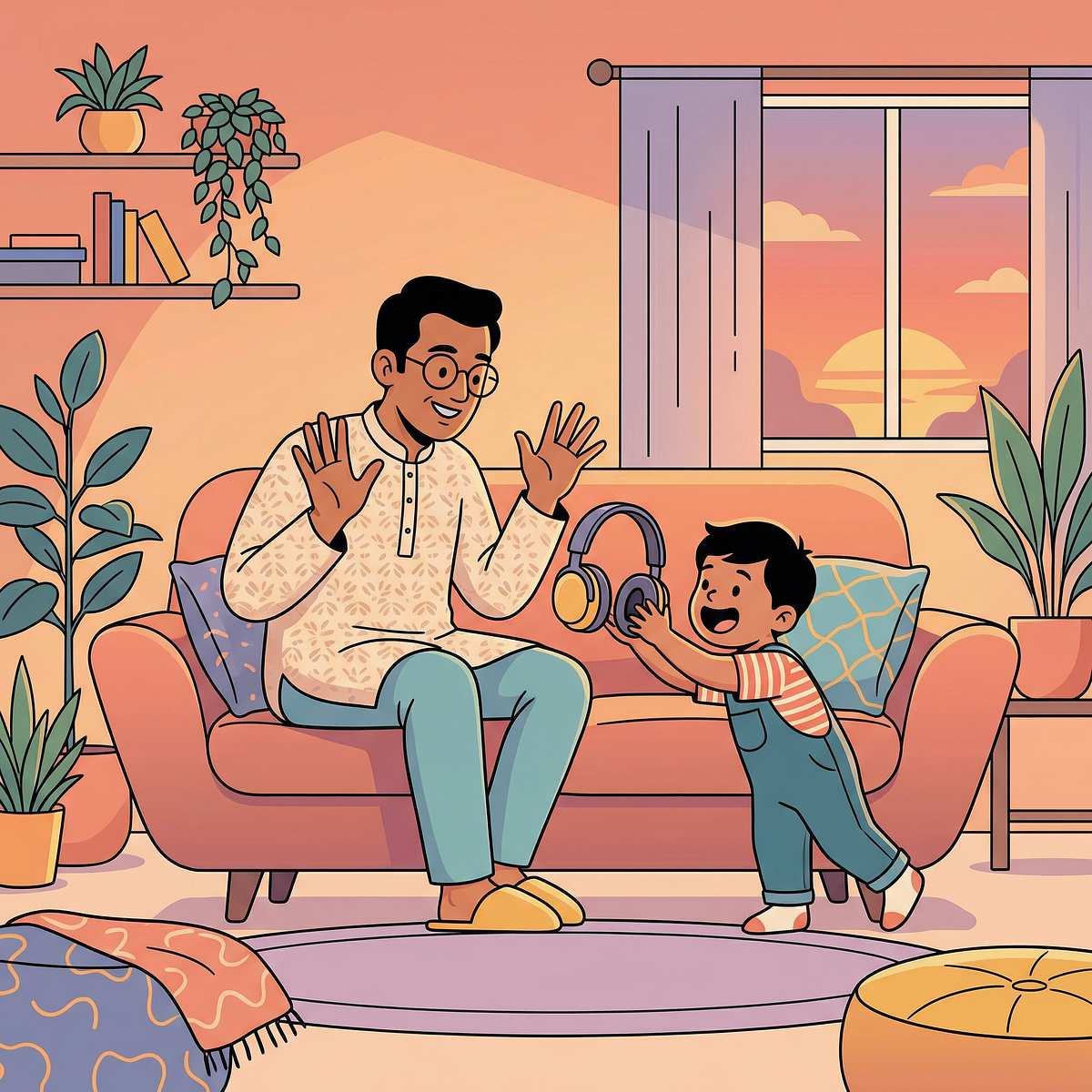
Material 1 — Noise-Reducing Headphones / Loop Earplugs
⭐ Pinnacle Recommends
Step 1 of 9
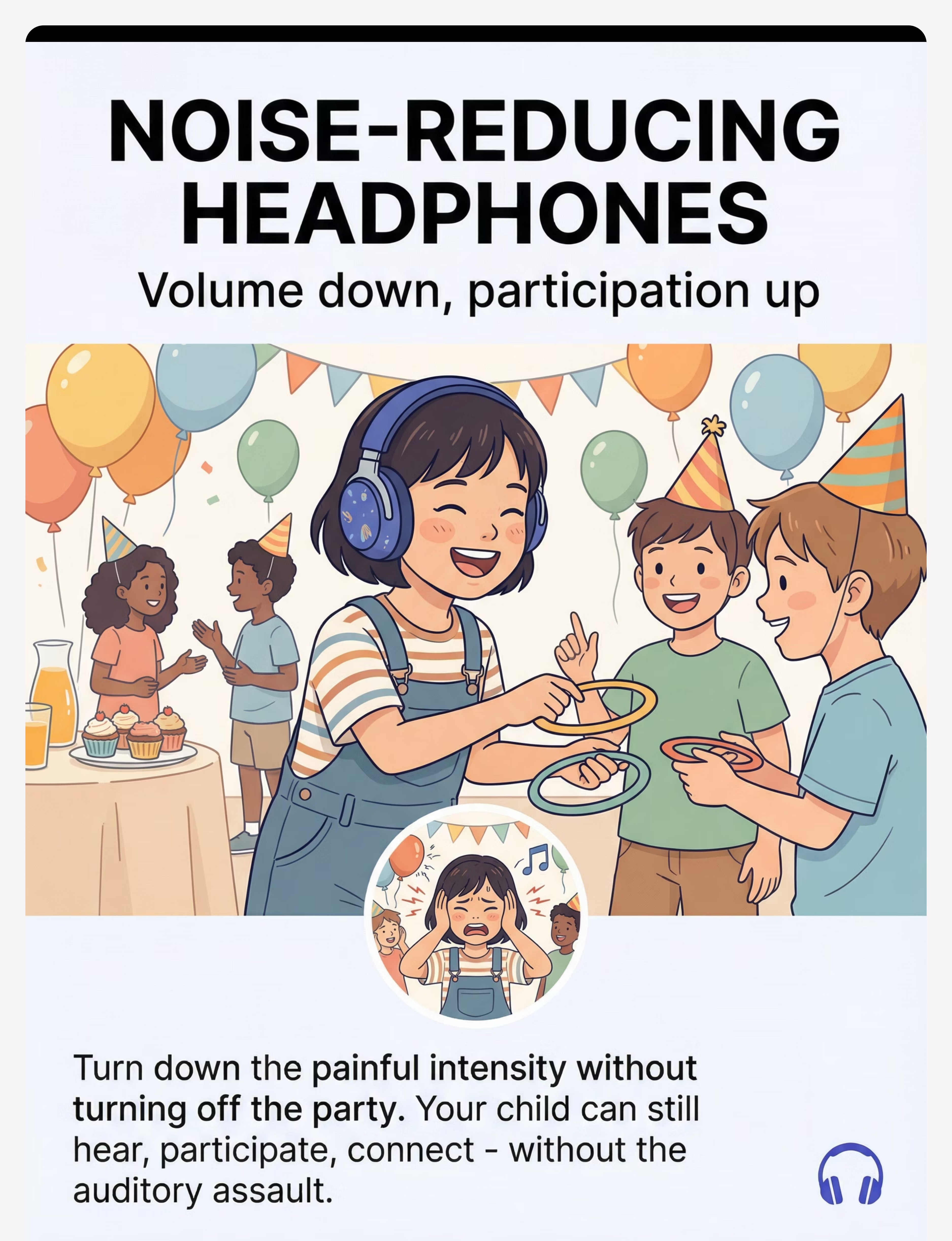
The Science: Party venues measure 85–100+ dB — approaching industrial noise levels. Music, screaming children, echoing venues, balloon pops, singing, game noise-makers — all simultaneous. Noise-reducing headphones or filtered earplugs lower the decibel level by 20–30 dB without eliminating sound. The child can still hear conversation, follow activities, and participate socially — but the painful intensity drops below their overwhelm threshold.
What To Say
"Time to put on your party headphones! They help the music sound just right."
What To Do
- Before entering: place headphones on child or help insert earplugs
- Adjust fit — snug but comfortable, not pressing on ears
- Test: ask child to respond to your voice at normal volume
- Let child control removal — never remove without consent
Products & Pricing
- Kid-sized noise-reducing headphones — ₹500–3,000
- Loop Quiet or Loop Experience — ₹2,000–4,000
- Vibes Hi-Fidelity Earplugs — ₹3,000–5,000
- Calmer by Flare Audio — ₹2,500–4,000
DIY Alternative
Over-ear earmuffs (industrial style) from any hardware store provide good protection. Regular foam earplugs reduce volume but muffle speech clarity.
Normalization
Frame as "cool party headphones" not a disability device. Many stylish options look like fashion accessories or gaming headphones. Many celebrities wear headphones in public — normalize this choice.
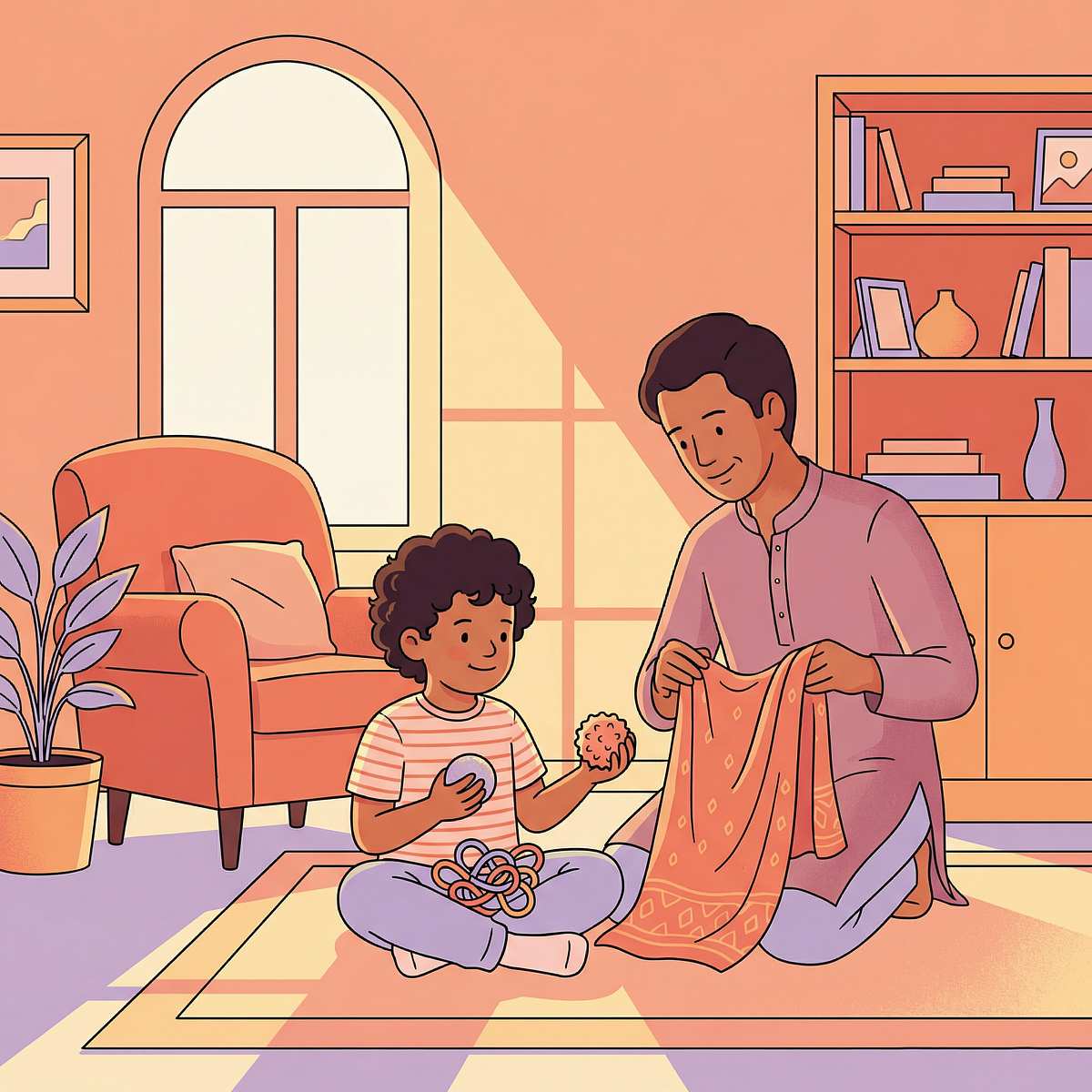
Material 2 — Sensory Toolkit / Calm-Down Kit
Step 2 of 9
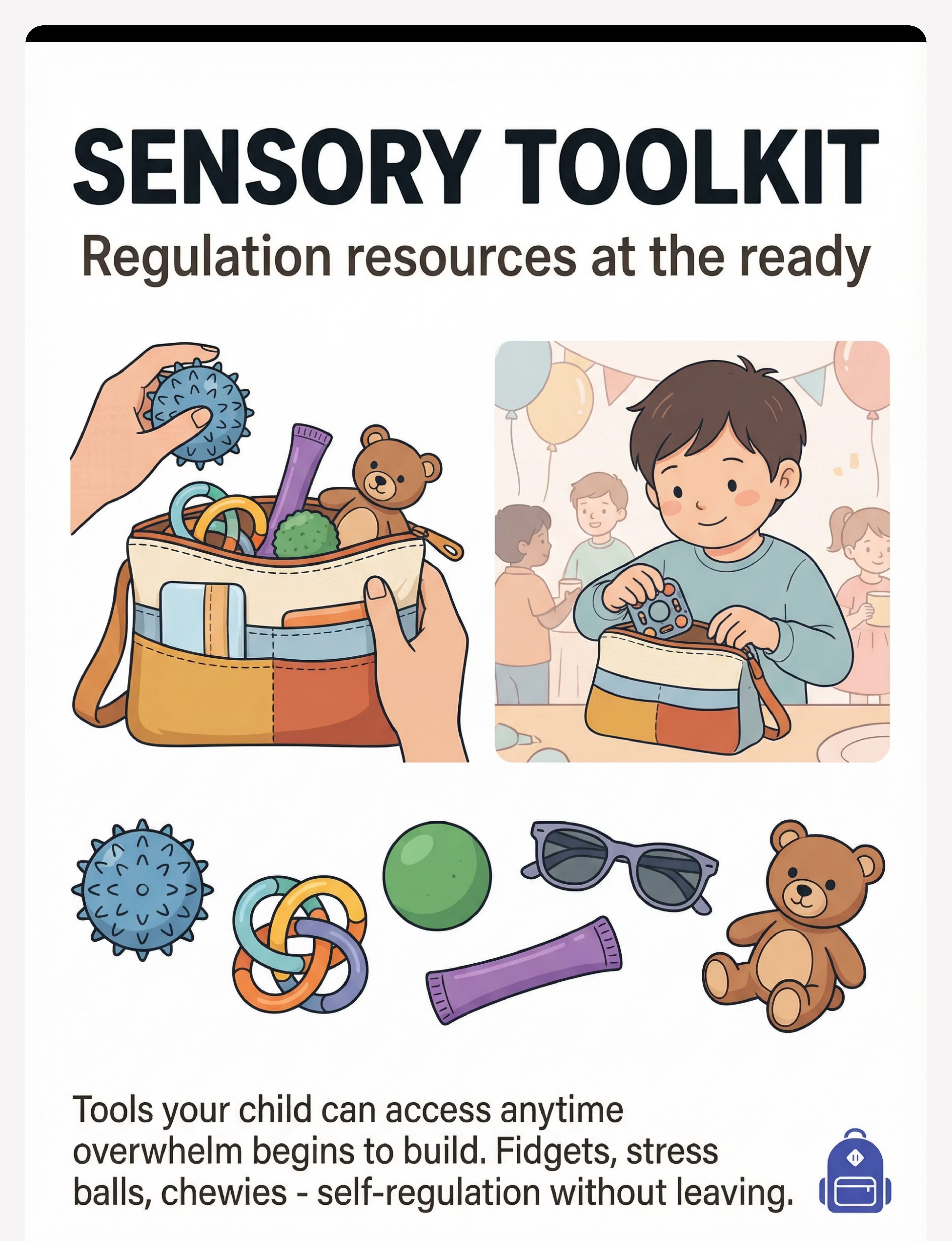
The Science: A portable sensory toolkit provides regulation resources the child can access whenever overwhelm begins building — before it reaches meltdown threshold. Fidgets provide tactile regulation through repetitive input. Stress balls deliver proprioceptive feedback through hand compression. Chewies offer oral sensory organization. The toolkit provides both regulation tools AND psychological security — the child knows they have resources available.
Tactile Fidgets
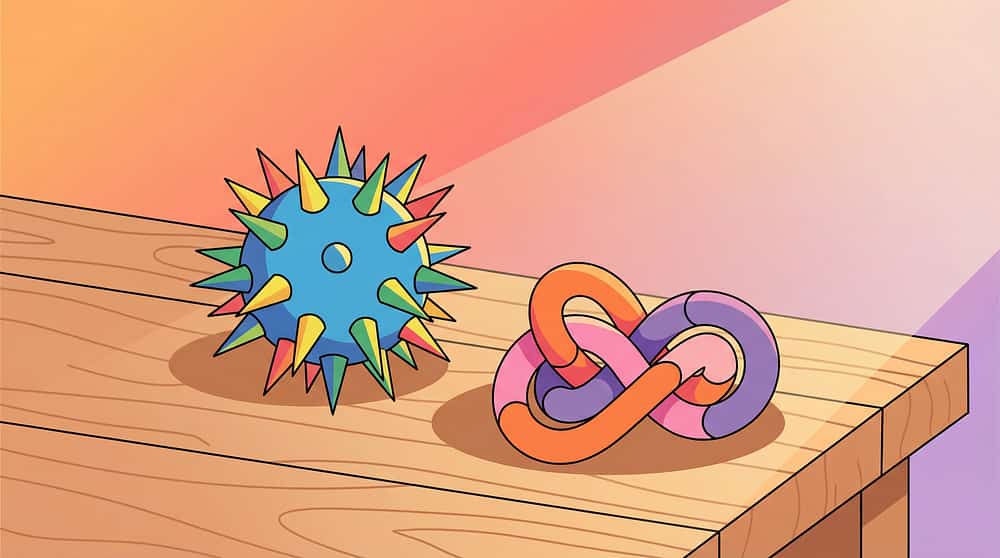
2–3 items: spiky ball, tangle toy, textured putty. Provide repetitive tactile input for grounding.

Stress Ball + Chewy
1 stress ball or squeeze toy. 1 chewy tube or chewable necklace for oral sensory organization.
Comfort + Calm
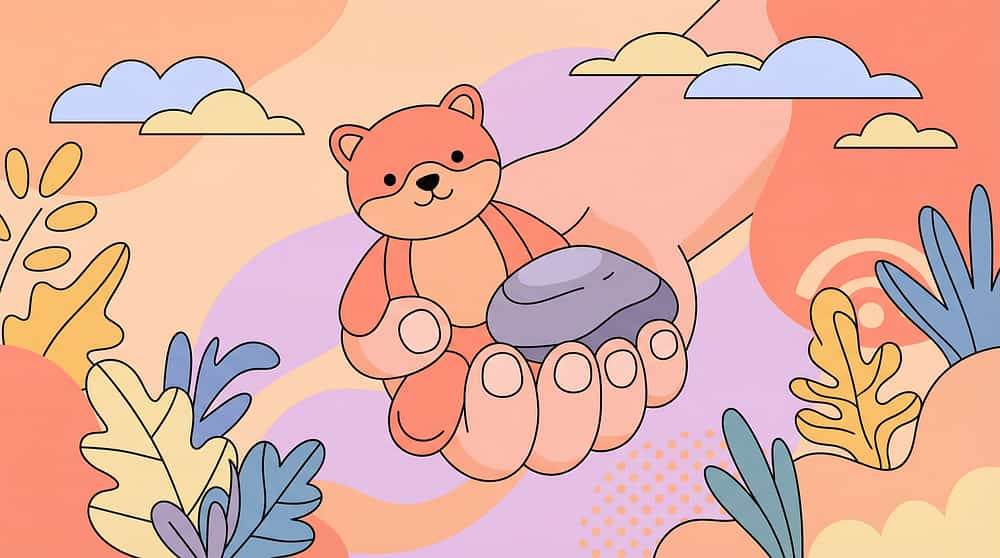
Small comfort object, lavender sachet, and a visual coping card: "I can take a break. I can use my tools. I am brave."
What To Say: "Your toolkit is in your bag. You can reach in anytime you need something." Let child self-select — don't dictate which item. Before entering, let child choose one item to hold: "Which tool do you want to start with?"
DIY (₹0): Small bag from home + rubber ball + smooth stone + hair tie + favorite small toy + soft fabric. Safety: No choking hazards for children under 3. Practice using items at home so child knows each tool's purpose.

Material 3 — Sunglasses / Tinted Lenses
Step 3 of 9
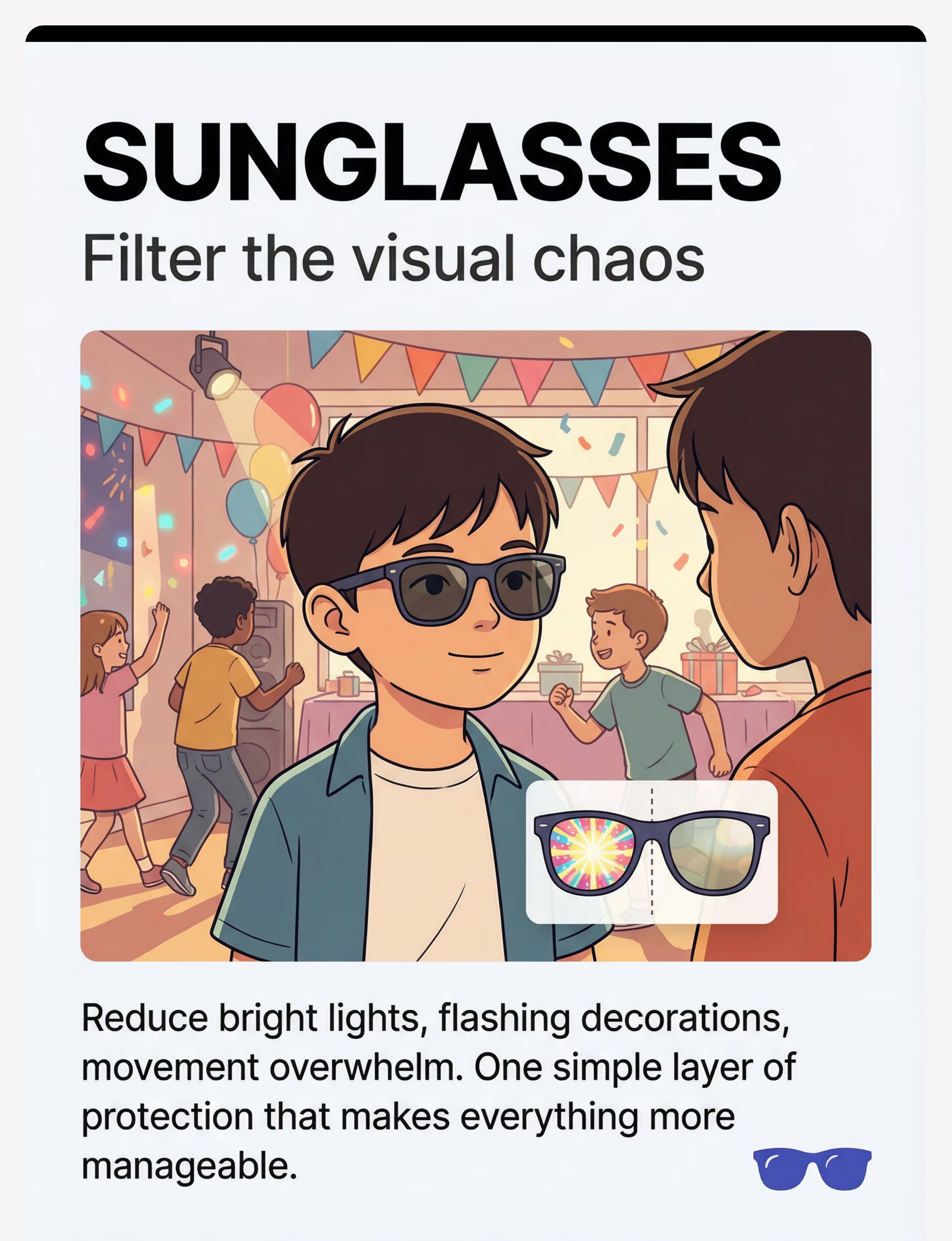
The Science: Visual overwhelm is underestimated at parties. Bright lights, flashing decorations, the movement of many children, colorful chaos — all load the visual processing system. Sunglasses reduce visual intensity by filtering incoming light, decreasing the cumulative sensory load. For children with visual processing sensitivities, this single accommodation can prevent the "stacking" effect where auditory + visual overwhelm together push past the threshold.
What To Say
"Want to wear your cool party sunglasses? They make the lights just right."
Application
Offer before entry or when child squints, looks away from lights, or rubs eyes. Let child choose when to wear and remove. Some prefer them throughout; others use them only during high-stimulus moments (cake with candles, flashing lights, games).
Options & Pricing
- Kid-sized sunglasses (any style) — ₹200–500
- Tinted lenses: rose (calming), blue (reducing glare), amber (warm filtering) — ₹500–2,000
- Wrap-around styles for peripheral filtering
- Blue-light filtering glasses for screen-heavy party environments
- Irlen lenses for specific visual processing needs — specialist prescription
DIY
Regular ₹50–100 sunglasses from any shop. The filtering principle is identical.
Safety Note
Ensure lenses don't impair vision on stairs or in dim areas. Very dark lenses in already-dim venues may create trip hazards.
Material 4 — Social Story / Party Prep Narrative
Step 4 of 9 — Do This DAYS Before the Party
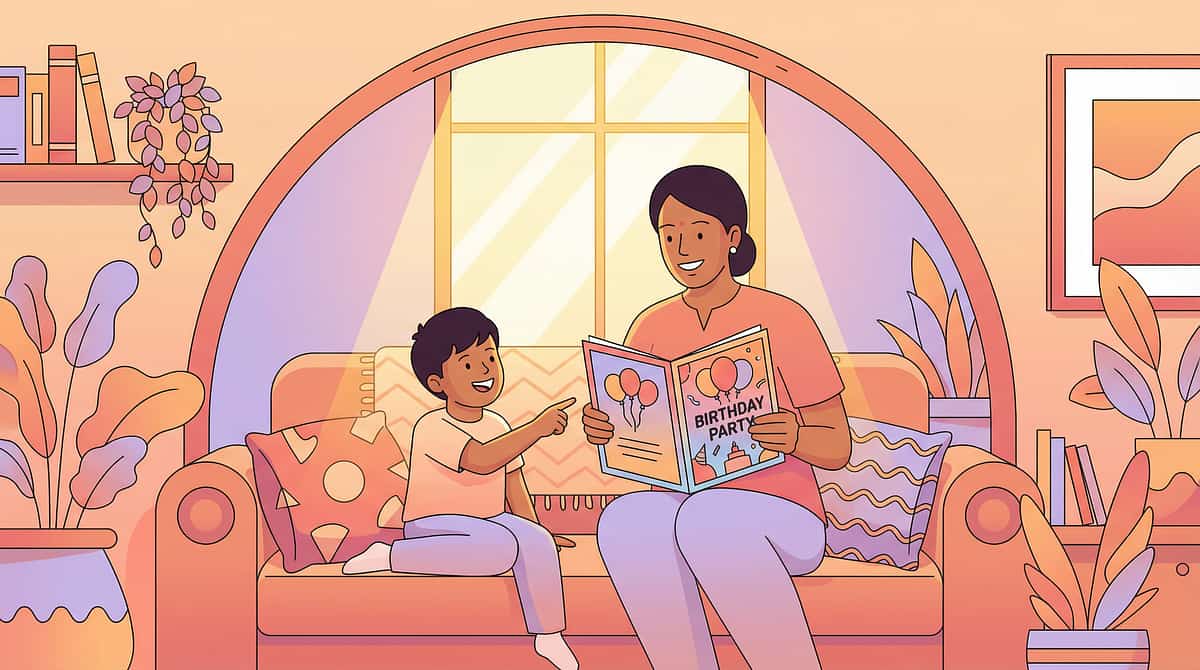
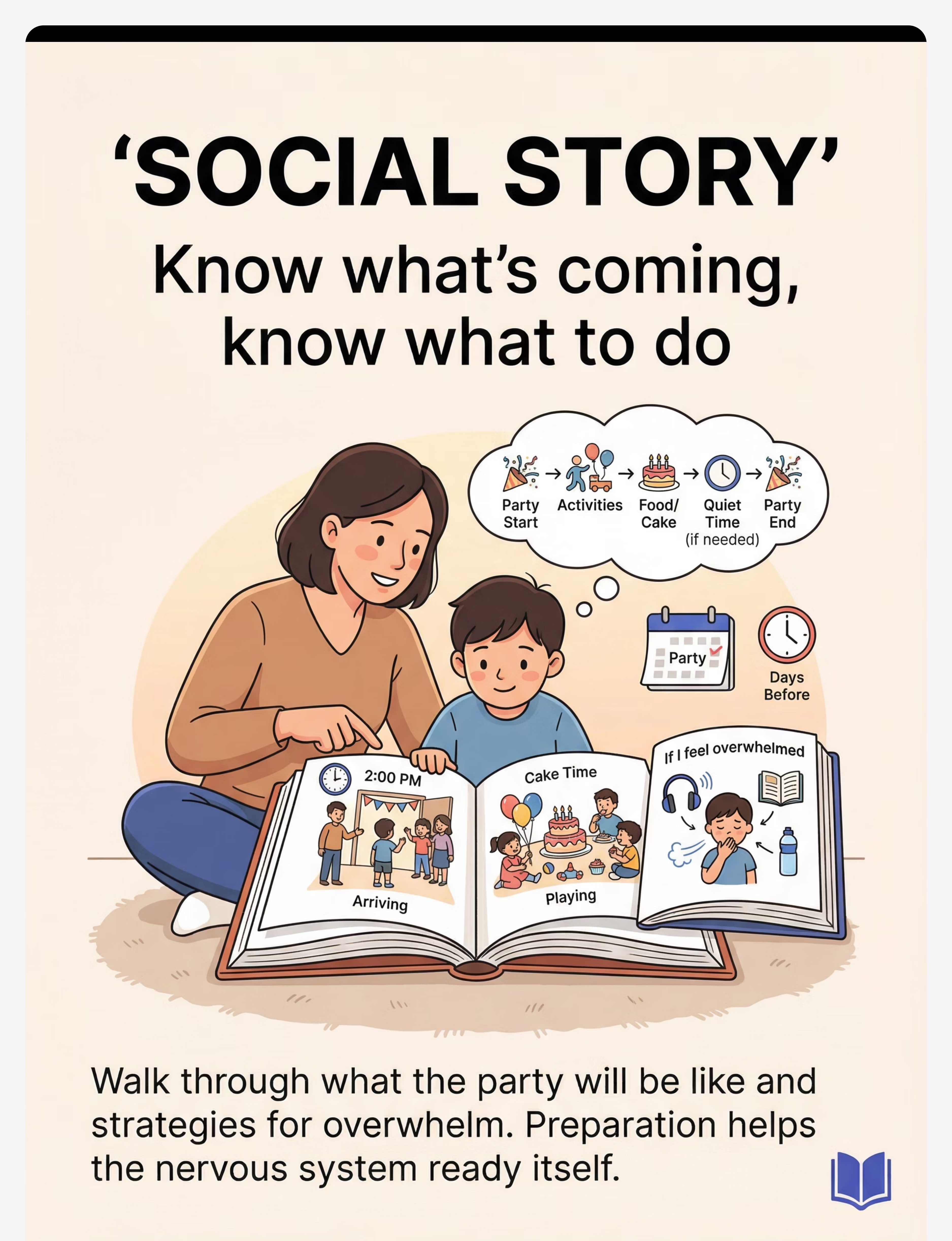
The Science: Unpredictability amplifies sensory overwhelm exponentially. When a child doesn't know what to expect, every new stimulus is processed as potentially threatening by the amygdala. A social story pre-loads the cognitive framework — the child's brain can predict "loud singing is coming" rather than processing it as a surprise threat. Cognitive preparation reduces anticipatory anxiety and provides a mental map for coping.
Sample Social Story (customize for your child's party):
"Today we're going to [name]'s birthday party at [venue]. There will be music, games, and cake. There might be balloons. Some sounds will be loud. If it feels too loud, I can put on my headphones. If my body feels wiggly, I can use my fidget from my bag. If I need a break, I can squeeze [parent]'s hand twice and we'll go to our quiet spot. We'll stay for [time]. Then we'll go home and [calming activity]. I am brave and I have tools to help me."
Days Before
Read together 2–3 times. Use the birthday child's name, the venue if known, expected activities. Photo-based stories using venue photos (Google the venue) are even more effective.
Morning Of
Review social story one final time. Brief review — don't overdo it. The story should feel familiar, not like a test.
At the Party
Bring a summary card or have story on phone. Be realistic — don't promise fun; acknowledge difficulty and focus on coping strategies.
DIY (₹0): Paper + pen + simple drawings. Photo-based stories using venue photos are even more effective.
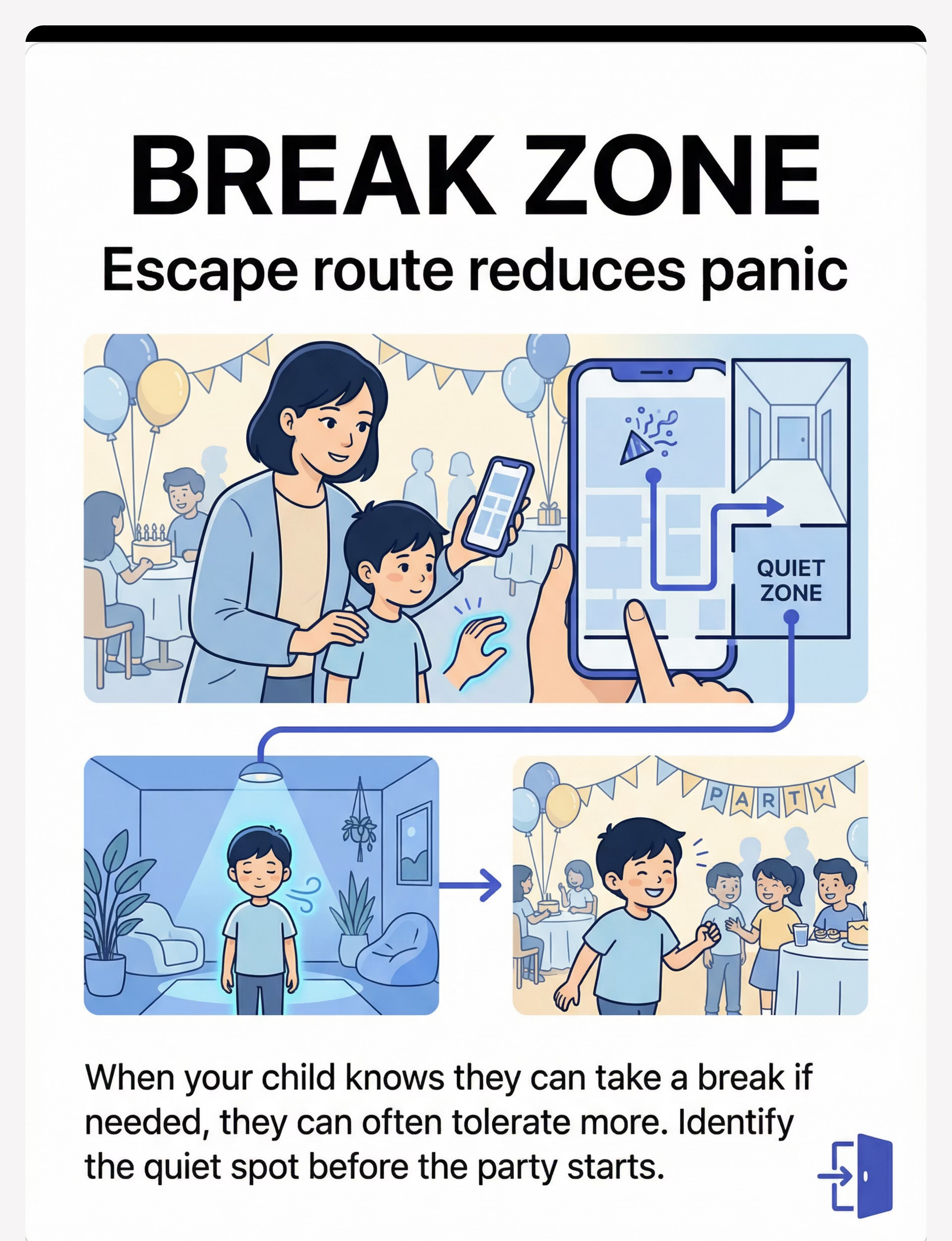
Material 5 — Quiet Break Zone / Exit Strategy Map
Step 5 of 9
₹0 — Highest-Value, Zero-Cost Strategy
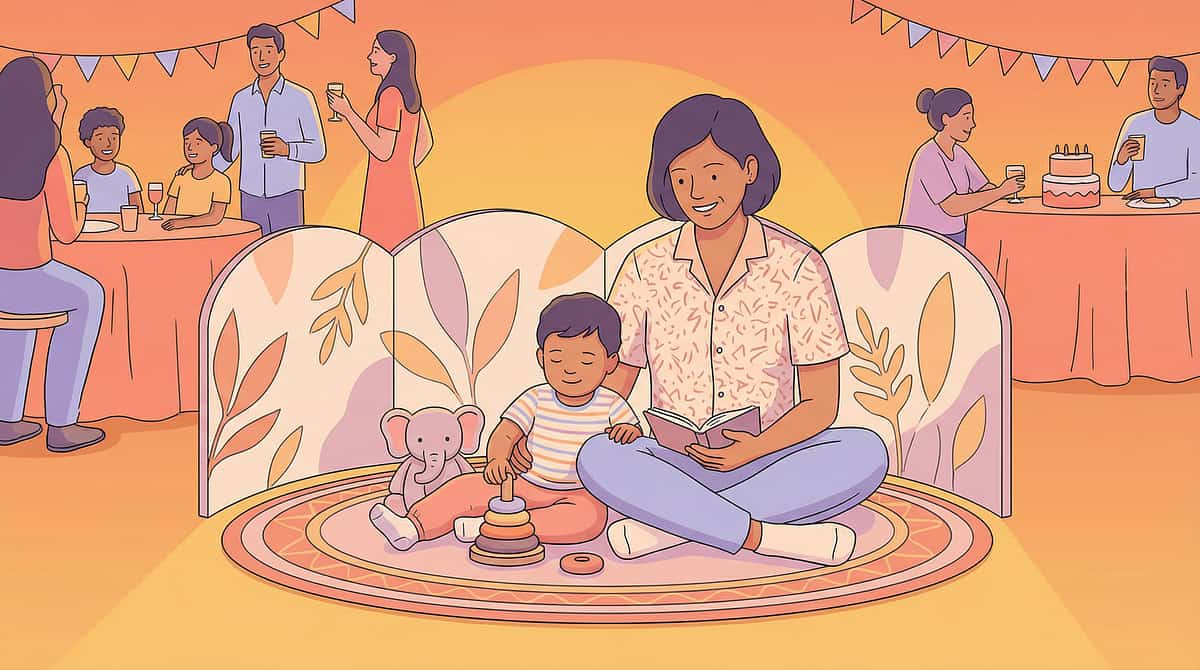
The Science: The trapped feeling escalates overwhelm into panic. When a child in sensory distress perceives no escape, the amygdala's threat response intensifies exponentially. Knowing escape is possible paradoxically increases tolerance — the safety valve reduces the pressure. Children with a known break option consistently tolerate more than those without one.
The Break Protocol
- At first signal, immediately move — no "just 5 more minutes"
- In the break zone: low stimulation, quiet, fidgets available, deep breathing if willing
- Duration: 5–10 minutes usually sufficient — let the child decide when ready to return
- Return is optional — if threshold has been reached, departure is the right call
Communication With Host
"We might need to step out for short breaks — it helps him manage the excitement!" Positive framing reduces stigma and invites understanding rather than judgment.
Price: ₹0
Planning is free. This is the highest-value, lowest-cost strategy on this entire page. It requires only forethought and communication.
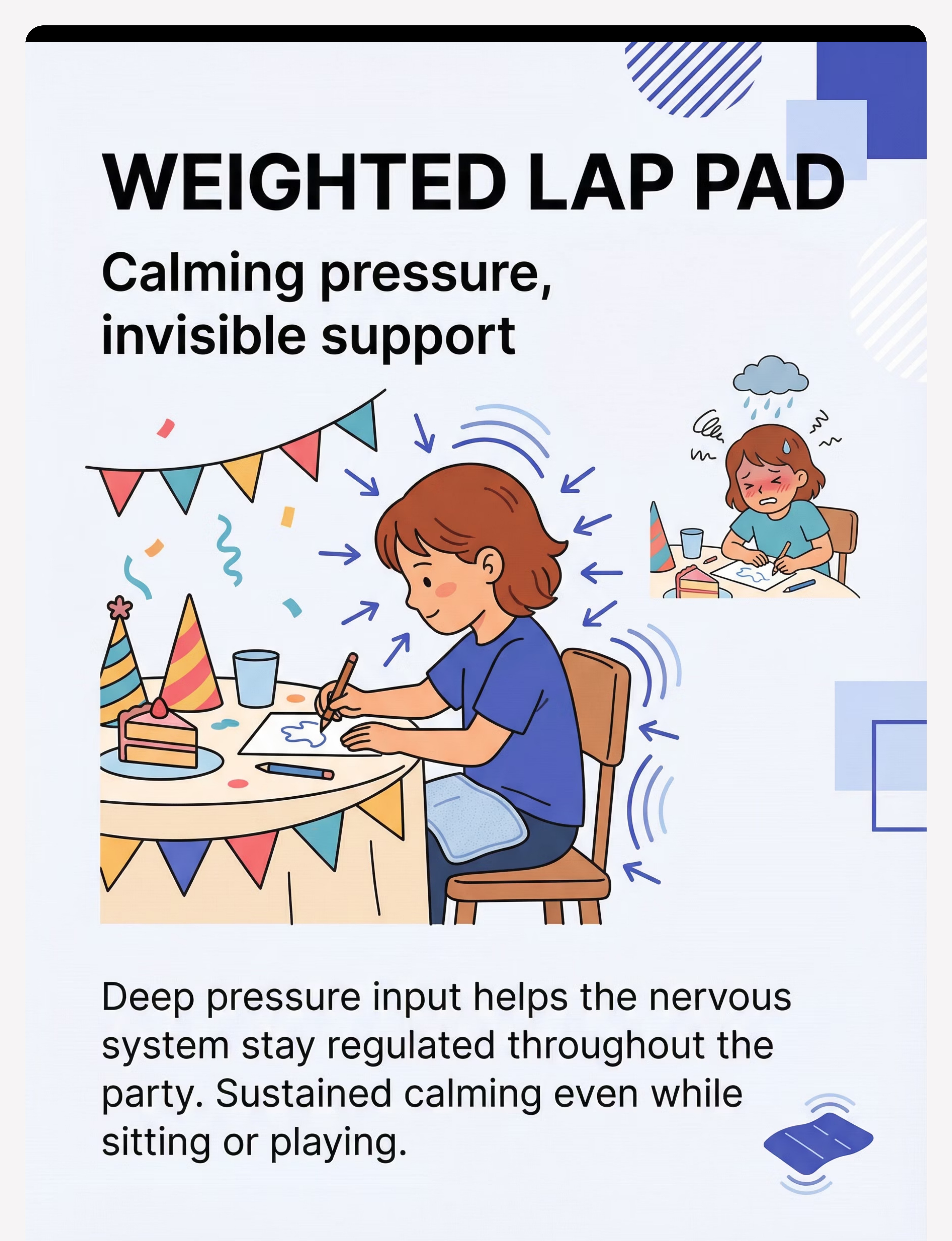
Material 6 — Weighted Lap Pad / Compression Vest
⭐ Pinnacle Recommends
Step 6 of 9
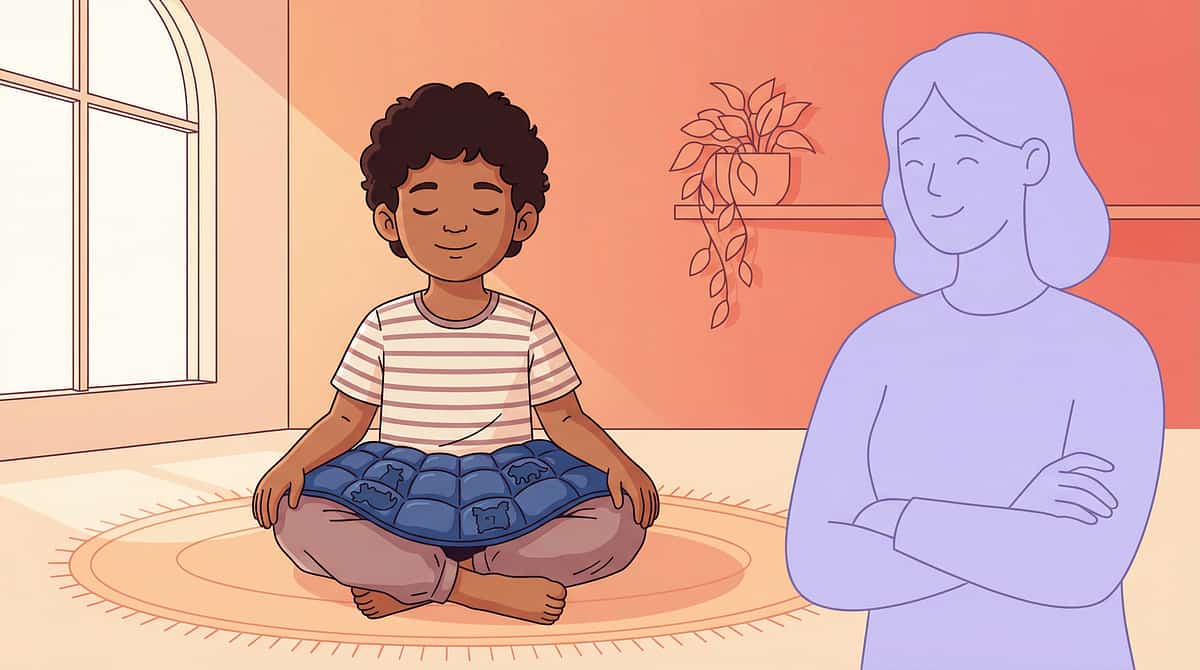
The Science: Deep pressure input activates the parasympathetic nervous system ("rest and digest") — directly counteracting the sympathetic "fight or flight" response triggered by sensory overwhelm. A weighted lap pad or compression vest provides sustained calming proprioceptive input throughout the event. This is invisible support — the child receives clinical-grade regulation without standing out.
What To Do
- Place weighted lap pad on child's lap when they sit at the party table
- OR: compression vest worn under party clothes — put on at home before leaving
- Weighted lap pad can also be used during break zone time for enhanced calming
- Monitor: if child pushes it away, remove. If child pulls it closer, it's working.
Weight Guidelines
Approximately 10% of child's body weight. A 20kg child → 2kg lap pad. Never exceed this guideline.
Products & Pricing
- Weighted lap pad (1–3 lbs) — ₹1,000–2,500
- Compression vest (Spio, SmartKnit) — ₹2,000–4,000
- Weighted stuffed animal — ₹800–2,000
- Compression shirt (under party clothes) — ₹1,000–2,000
DIY (₹0–100)
Fill a cloth bag with 500g–1kg of rice or dried beans. Stitch closed. Provides identical deep pressure input. A snug-fitting athletic shirt approximates compression vest effects.
Safety
Never exceed 10% of body weight. Remove if child overheats. Compression should be snug, not restrictive.
Materials 7 & 8 — Familiar Food + Buddy System
Steps 7 & 8 of 9
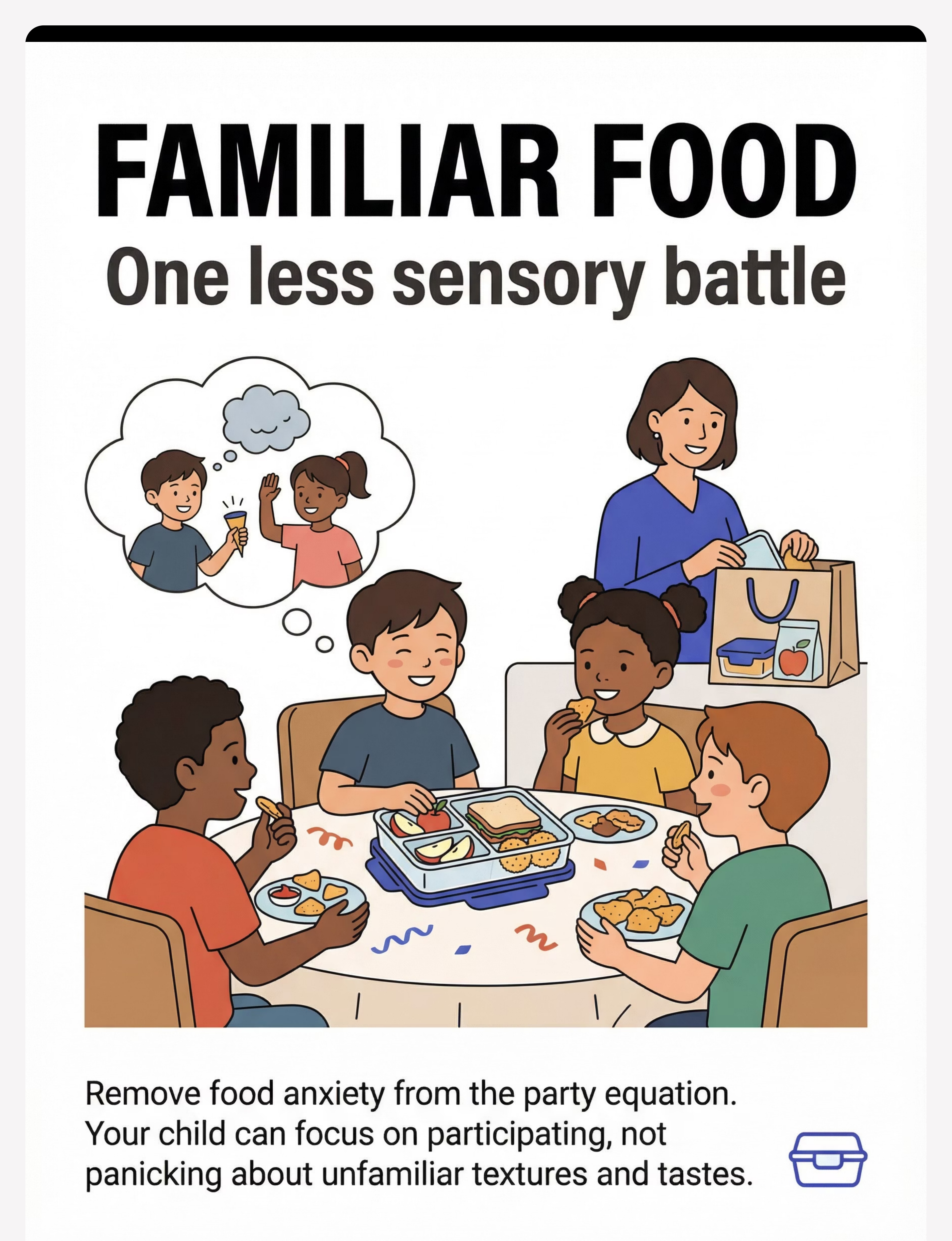
Material 7: Familiar Food / Safe Snacks
The Science: Party food adds another sensory layer — unfamiliar textures, appearances, tastes, smells. For children with oral sensory sensitivities, being expected to eat unfamiliar food compounds stress exponentially. Bringing familiar foods eliminates this entire sensory channel from the overwhelm equation. The child can focus on social participation, not food panic.
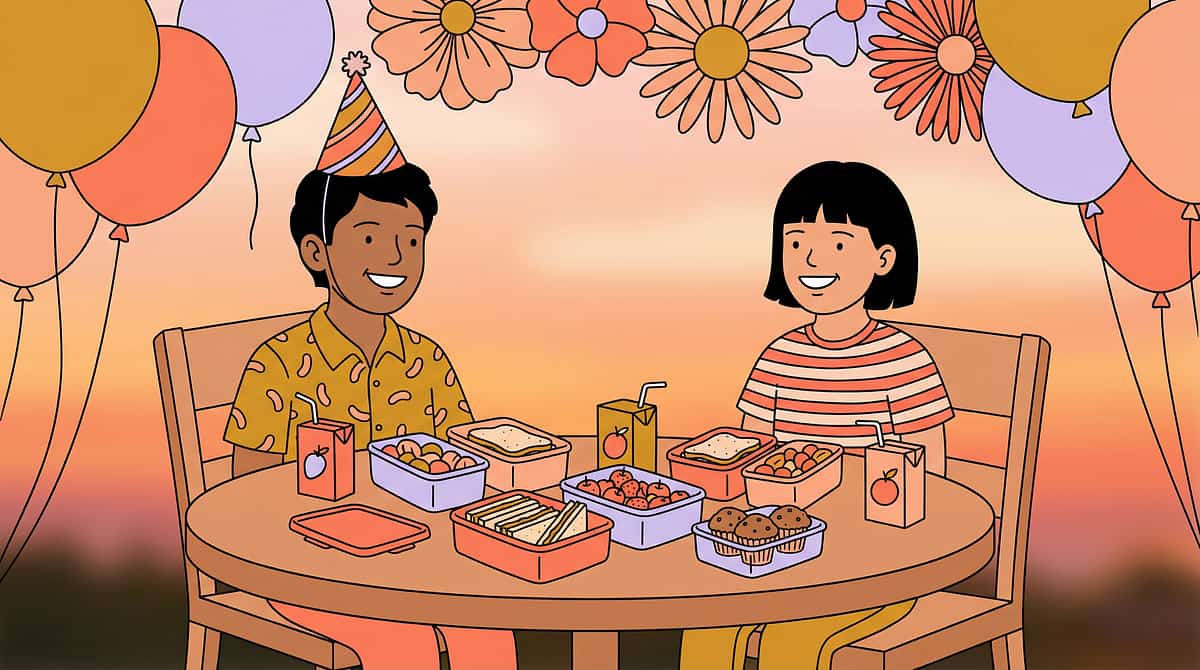
What To Do: Pack preferred foods in a small container — familiar crackers, fruit, safe snacks, preferred drink in a familiar cup/bottle. Bring an alternative treat (homemade cupcake) if party cake is unlikely to be tolerated.
Host Communication: "He has some food sensitivities, so I'm bringing a few things he can eat. Please don't worry about including him in the food!" Most hosts understand without requiring detailed explanations.
Price: ₹100–500 (food from home kitchen)
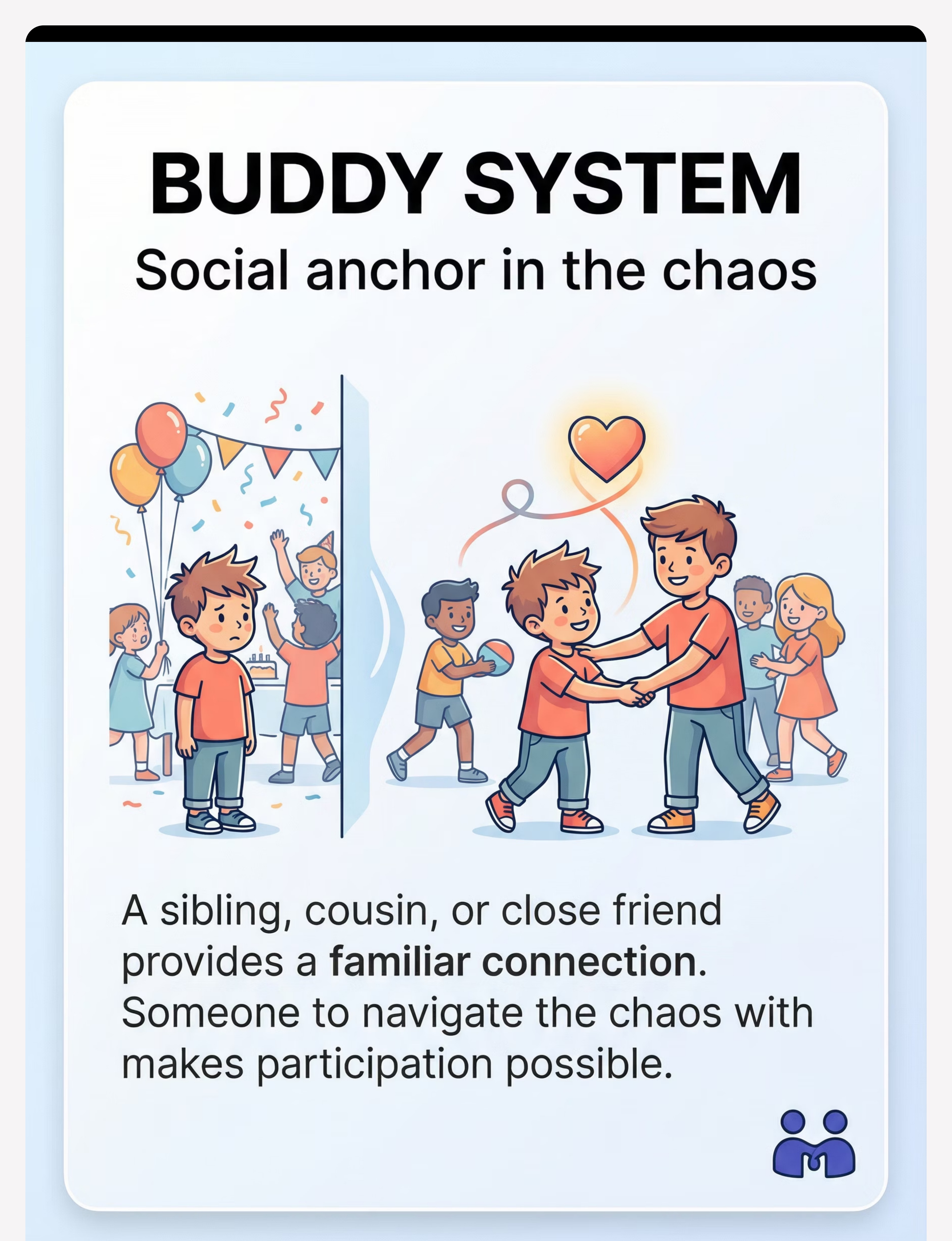
Material 8: Buddy System / Familiar Peer
The Science: A buddy — a sibling, cousin, or close friend — provides a social anchor. Someone familiar to navigate the chaos with reduces social processing demand and provides a safe connection in an overwhelming environment.
What To Do:
- Identify buddy: sibling, cousin, close friend at the same party
- Brief buddy: "Can you help [child] stay included? If they look overwhelmed, check on them."
- Establish code word between child and buddy for "I need help"
- Thank and acknowledge buddy afterward
Important: Don't overburden the buddy — they should enjoy the party too. The buddy is support, not supervisor.
Price: ₹0
Material 9 — Arrival / Departure Strategy
Step 9 of 9
₹0 — Highest-Impact Zero-Cost Intervention
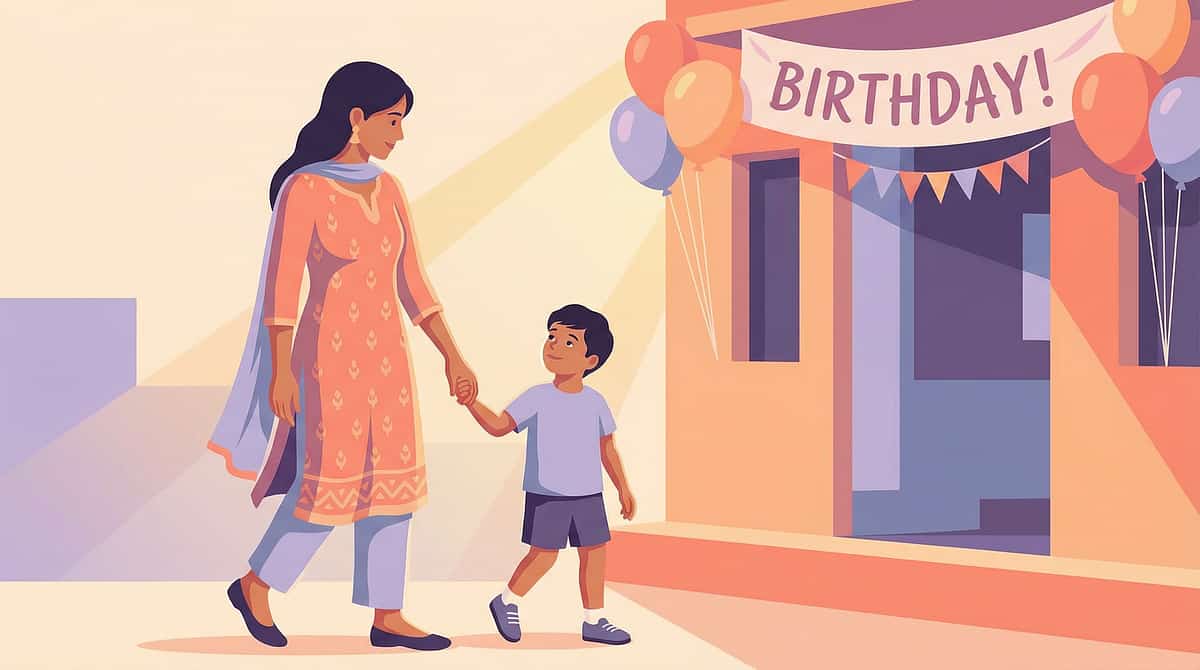
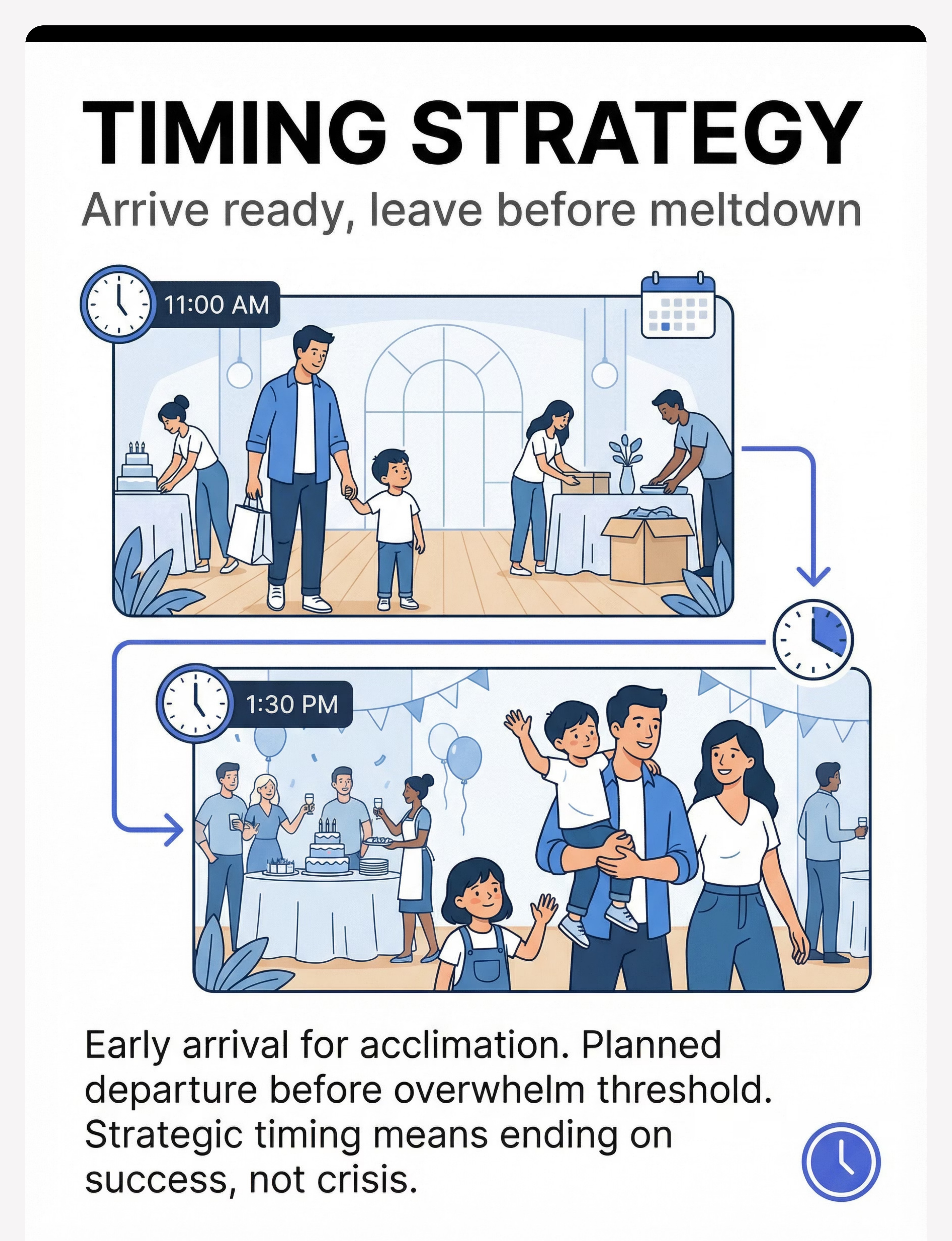
The Science: Strategic timing is one of the highest-impact, zero-cost interventions for party success. Arriving early allows acclimation while the venue is still calm. Planned departure before meltdown threshold means the experience ends on a positive note — building positive associations that make future parties more tolerable.
1
Arrive Early
15–20 minutes before other guests. Acclimate in calm space. Establish break zone. Position regulation tools while venue is still manageable.
2
Set Duration
Communicate planned departure to child BEFORE the party: "We'll stay for one hour." Use visual cues: "When the big hand reaches 12, we go home."
3
Depart On Time
Leave at planned time even if things seem fine. The last 15 minutes of "pushing it" can undo 2 hours of success. Meltdown threshold can be reached suddenly.
Reframe: Early departure is success, not failure. "You participated for [X time] while staying regulated" = victory. The goal is positive party experiences that build tolerance over time, not endurance tests that create trauma associations.
After the Party: Plan calm activity (quiet time, favorite show, snuggle). Reduce demands for rest of day — fatigue and delayed dysregulation are normal. Reflect: What worked? What didn't? Update social story with lessons learned. Celebrate: "You went to the party and used your tools! That's incredible."

Real Parties Are Messy — Here's What to Do
Even the best preparation meets real-world chaos. These are the most common mistakes families make — and exactly how to course-correct. Every troubleshooting scenario is an opportunity to refine your approach for the next party.
Mistake | Why It Fails | Do This Instead | |
"They need to learn to handle it" — forcing without supports | Creates negative associations; may traumatize; worsens future tolerance | Supported attendance with tools. Permission to leave always available. | |
Removing supports after one good party | One success ≠ stable tolerance. Premature removal causes setbacks. | Gradual, systematic reduction over multiple successes — months, not days. | |
Extending stay because "they're doing so well" | Meltdown threshold hits suddenly. Last 15 minutes destroy the whole experience. | Leave at planned time. Success = ending while regulated. | |
Not preparing child beforehand | Unpredictability multiplies overwhelm dramatically | Social story + venue preview + clear schedule = essential preparation | |
Comparing to other children | Creates shame. Other children have different nervous systems. | Compare only to your child's own baseline and progress over time. |
Sensory Seeker Profile
May need MORE input — proprioceptive activities before the party (jumping, heavy work), fidgets with strong feedback. Don't reduce stimulation; redirect it.
Sensory Avoider Profile
Maximum protection — headphones + sunglasses + compression + break zone focus. Layer every support available.
Age 2–5 Adaptations
Parent as primary buddy, shorter expected duration (15–30 min), simpler toolkit with 2–3 familiar items only.
Age 8–12 Adaptations
Self-directed tool use, discreet supports, full involvement in planning their own regulation strategy.

First Parties: Survival Is the Win
Party 1–2
What Progress Looks Like
- Child tolerates venue entry
- Uses at least one tool (headphones, fidget)
- Takes a break without full meltdown
- Stays 15–30+ minutes
- Leaves in a regulated state (even if tired)
What Is NOT Progress Yet
- Full-party attendance
- Independent tool use without reminders
- Active participation in all games
- Eating party food comfortably
- Comfortable without any supports
If your child stayed 20 minutes wearing headphones, used their fidget, took one break, and left before melting down — that is a clinical success. Document it. Celebrate it. Do not minimize it.
What to track: Duration of regulated attendance. Number of tools used. Number of breaks needed. Child's self-report ("Was it okay?" / "Was it hard?"). Recovery time after party. These data points become your baseline for measuring progress.

Building the Neural Pathway
Party 3–5
Across parties 3–5 with consistent support, look for consolidation indicators — signs that your child's brain is beginning to build new, safer associations with the party environment.
Initiating Interest
Child begins asking about upcoming parties — with interest rather than dread. This shift alone is a profound neurological signal.
Self-Initiated Tool Use
Child reaches for headphones before being reminded. Self-regulation is beginning to internalize.
Extended Duration
Stay extends: 30 minutes → 45 minutes → 1 hour. Break frequency decreases: 3 breaks → 2 → 1.
Engagement Moments
Brief participation in a game, a conversation with a peer, a genuine smile during cake — these are breakthrough moments worth documenting.
Reduced Anticipatory Anxiety
Less distress in the days before the party. The narrative shifting from "threat" to "manageable challenge" in your child's nervous system.
Parent milestone: You may notice you're more confident too. Packing the toolkit becomes automatic. Reading overwhelm signals becomes intuitive. You are becoming an expert in your child's regulation — and that expertise is irreplaceable.

From Surviving to Participating
Party 6–10+
Across 6–10+ parties with continued (but potentially reducing) support, mastery indicators begin to emerge. These are not endpoints — they are milestones worth celebrating on the journey toward full community participation.
1–2 Hours With Moderate Support
Duration extends significantly. Child participates in select activities — not all, and that's perfectly fine.
Self-Management
Reaches for tools independently. Communicates needs: "I need a break" or "Can I have my headphones?" — self-advocacy is emerging.
Expressing Preferences
"I liked the games but not the singing." The child is differentiating experience — a sophisticated cognitive and regulatory achievement.
Shorter Recovery
Post-party recovery time shortens. The nervous system is processing the experience more efficiently each time.
Important: Some children may always need some accommodations. This is not failure — it is accessibility. Glasses are not a failure of vision. Headphones are not a failure of hearing. The goal is not "parties without any tools." The goal is "participation and positive association with social gatherings."
When to reduce supports: Gradually. One tool at a time. Never remove everything at once. Maintain each reduced configuration for 2–3 more parties before removing the next support layer.

You Did This.
You arrived on this page scared — dreading the next invitation. You've now equipped yourself with 9 materials and a layered strategy that transforms birthday party attendance from impossible to manageable.
Your child grew because of your commitment. Whether they attended for 20 minutes or 2 hours — whether they used every tool or just headphones — whether they participated in games or sat quietly with their fidget watching — they were there. Present. Not at home watching party photos on social media. THERE.
Document This Milestone
Photo. Journal entry. A note in your phone. This is the moment you look back on when the next hard day comes. Small wins compound into transformation.
Share With Your Village
Share with your co-parent, grandparents, the school. The strategies that work at parties work everywhere — consistency across caregivers multiplies impact.
Keep Going
Each party is a practice. Each practice builds neural tolerance. Each positive experience overwrites a negative association. You are building something lasting.

Trust Your Instincts — If Something Feels Wrong, Pause
🔴 Red Flag Indicators
These strategies work for most families navigating typical sensory processing challenges around party attendance. Contact Pinnacle Blooms or your pediatric professional if you observe any of the following:
🔴 Overwhelming Fear
Child becomes severely distressed days before any social event — preventing any party attendance entirely.
🔴 Safety Concerns
Meltdowns involve self-harm or aggression — hitting head, biting self, throwing objects dangerously.
🔴 No Progress
Tolerance isn't building despite maximum support, consistent strategy application over 3+ months.
🔴 Pervasive Avoidance
Not just parties but school, restaurants, family gatherings, shopping — multiple environments affected simultaneously.
🔴 Regression
A child who was tolerating parties begins refusing again without a clear identifiable trigger.
🔴 Physical Symptoms
Persistent headaches, gastrointestinal distress, sleep disruption specifically linked to social event anticipation.
01
Self-Resolve
Modify strategies, reduce demands, try smaller gatherings first
02
Teleconsultation
Book with Pinnacle Blooms — 9100 181 181 (FREE, 16+ languages)
03
Center Visit
Comprehensive sensory processing evaluation + individualized plan at a Pinnacle center near you
Where You've Been. Where You're Going.
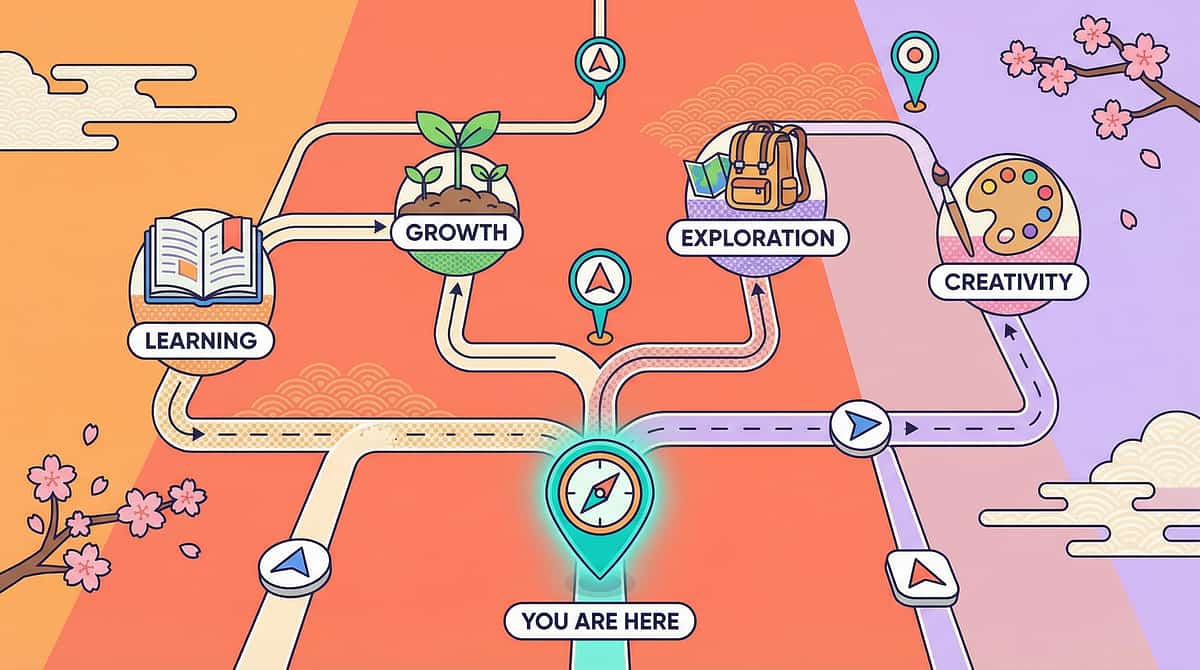
This technique sits within the Environmental Overwhelm & Community Participation cluster of the Pinnacle Blooms Sensory Processing domain. Understanding where A-035 fits in the larger progression helps you plan your child's journey toward full community access.
Long-term developmental goal: Full community participation — the child navigates restaurants, malls, school events, family gatherings, and public celebrations with graduated independence. Each technique in this cluster builds on the neural pathways established by the previous one.
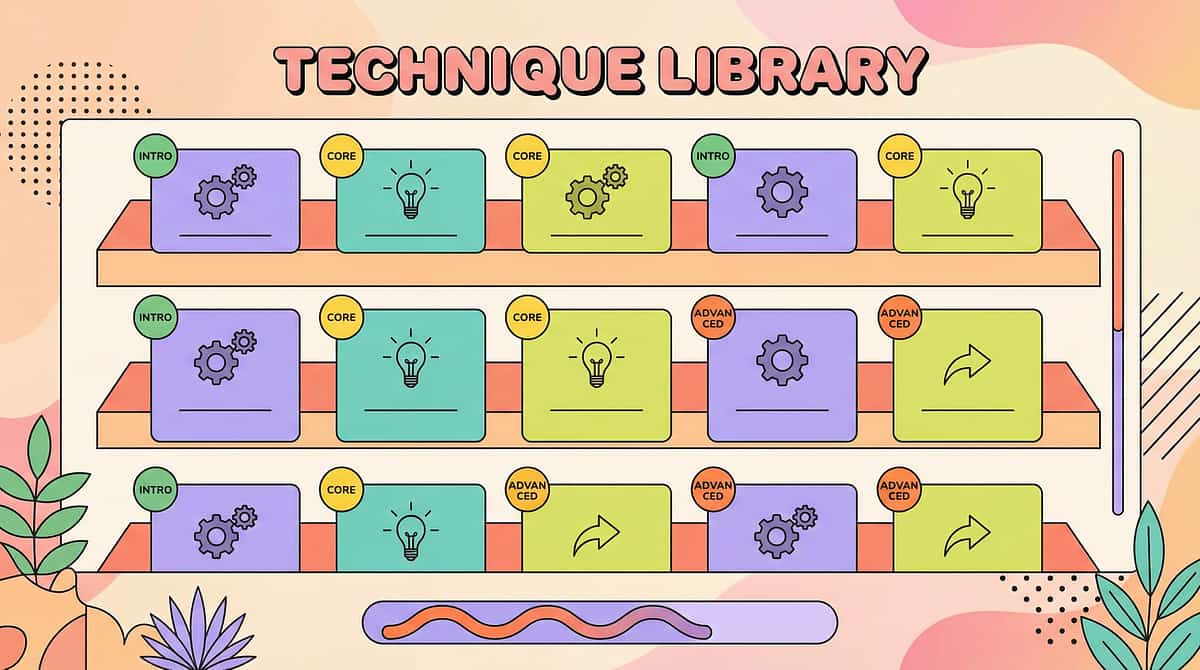
More Sensory Processing Techniques You Can Explore
These techniques share materials with A-035 — you may already own what you need. Each one builds on the neural tolerance established through birthday party participation, generalizing your child's skills to new environments and challenges.
A-033: Vacuum Cleaner Distress
Materials shared: Noise-reducing headphones, social story | Difficulty: Intro — the single-source auditory desensitization foundation for this technique.
A-034: Fire Alarm Anxiety
Materials shared: Noise-reducing headphones, break zone | Difficulty: Intro — sudden-onset sound tolerance building.
A-036: Restaurant Overwhelm
Materials shared: Full sensory toolkit, familiar food, timing strategy | Difficulty: Core — similar multi-sensory + social demands, different environment.
A-037: Shopping Mall Chaos
Materials shared: Headphones, sunglasses, break zone, buddy system | Difficulty: Core — open-ended duration + visual complexity.
A-038: School Assembly Overload
Materials shared: Headphones, weighted lap pad, social story | Difficulty: Core — institutional environment + peer pressure dynamics.
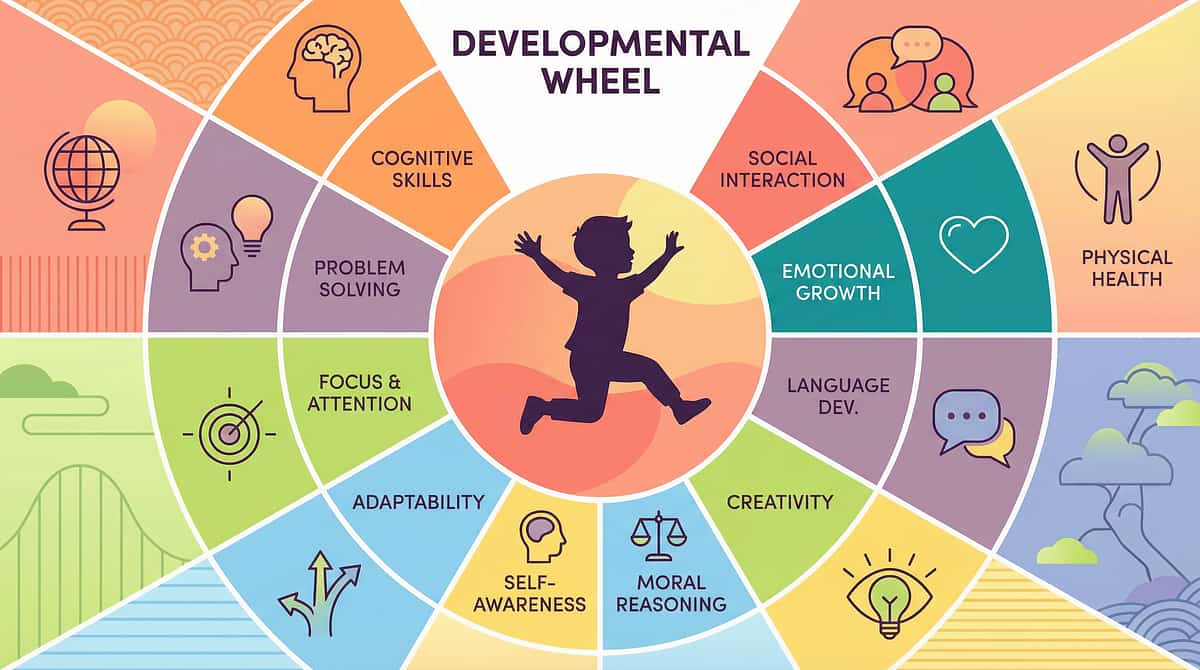
This Technique Is One Piece of a Larger Plan
Sensory Processing is one of 12 developmental domains in the GPT-OS® framework. Your child's birthday party challenges don't exist in isolation — they connect to auditory processing, social communication, emotional regulation, motor planning, and executive function.
Your child's unique profile across these 12 domains determines their personalized therapy path. GPT-OS® maps this through the AbilityScore® — a universal developmental score (0–1000) that tracks baseline, progress, and readiness across all domains simultaneously.
See your child's full profile: Book an AbilityScore® assessment → Call 9100 181 181 (FREE, 16+ languages, 24x7)
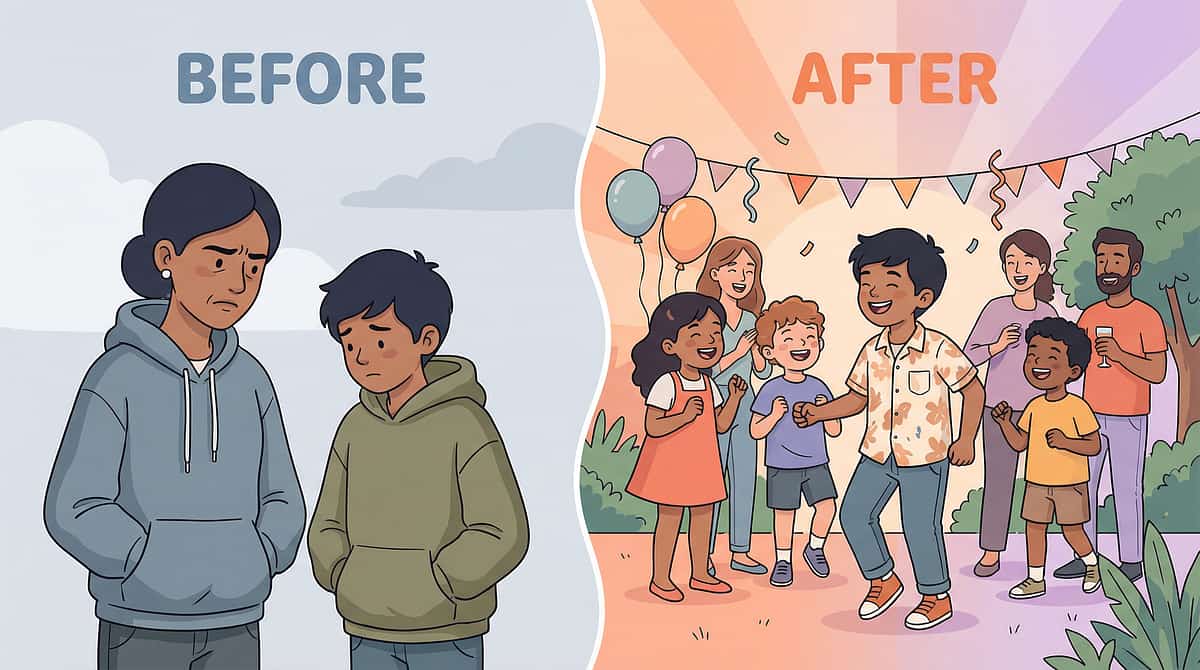
Real Families. Real Parties. Real Progress.
Family 1 — Age 4, Hyderabad
Before: Could not enter birthday party venues. Would scream in the parking lot. Family stopped accepting invitations entirely. Social isolation growing.
Strategy: Noise-reducing headphones + sensory toolkit + social story + 30-minute maximum stay.
After (3 months): Attends parties for 45 minutes with headphones and one break. Participated in cake cutting for the first time. Asked to go to the next party.
"Birthday parties used to end in tears — his and mine. Now he has his headphones and his bag of tools. He's not just surviving parties — he's starting to enjoy them."
Strategy: Noise-reducing headphones + sensory toolkit + social story + 30-minute maximum stay.
After (3 months): Attends parties for 45 minutes with headphones and one break. Participated in cake cutting for the first time. Asked to go to the next party.
"Birthday parties used to end in tears — his and mine. Now he has his headphones and his bag of tools. He's not just surviving parties — he's starting to enjoy them."
Family 2 — Age 7, Bangalore
Before: Would hide under tables at every party. Fear of balloons made venues impossible. Had not attended a party in over a year.
Strategy: Graduated approach — started with small home gatherings (3–4 children) with full support. Progressed to larger parties over 6 months.
After (6 months): Attends parties for 1–1.5 hours with moderate support. Initiates play with 1–2 peers. Tolerates balloons from a distance with headphones on.
Strategy: Graduated approach — started with small home gatherings (3–4 children) with full support. Progressed to larger parties over 6 months.
After (6 months): Attends parties for 1–1.5 hours with moderate support. Initiates play with 1–2 peers. Tolerates balloons from a distance with headphones on.
From the Therapist's Notes: "Environmental tolerance builds through repeated positive experiences. The critical factor is ending each experience while the child is still regulated — success breeds success. Forcing endurance breeds avoidance."
Illustrative cases based on aggregate clinical patterns from Pinnacle Blooms Network. Individual results vary.
You Are Not Alone in This
One of the most isolating experiences for families navigating sensory processing challenges is believing that no one else understands. Join a community of families who do — families who pack the sensory toolkit, read the social story, arrive early, and leave on time. Families who measure success in minutes of regulated attendance, not full-party endurance.
Sensory Solutions Parent Community
WhatsApp support group for families actively using these strategies. Share what's working, ask questions, get real-time support from parents who are one party ahead of you on this journey.
Pinnacle Parent Network
Local meetups organized by Pinnacle centers across India. Connect with families in your city navigating the same environments — parties, festivals, schools, malls.
Online Forum
Share experiences, ask questions, and learn from families ahead of you on this journey. Your experience helps others — a parent searching tonight is exactly where you were when you found this page.
"Consistency across caregivers multiplies impact." Share this page with your spouse, grandparents, school teacher, and anyone involved in your child's social life. | Contact: pinnacleblooms.org/community | 9100 181 181
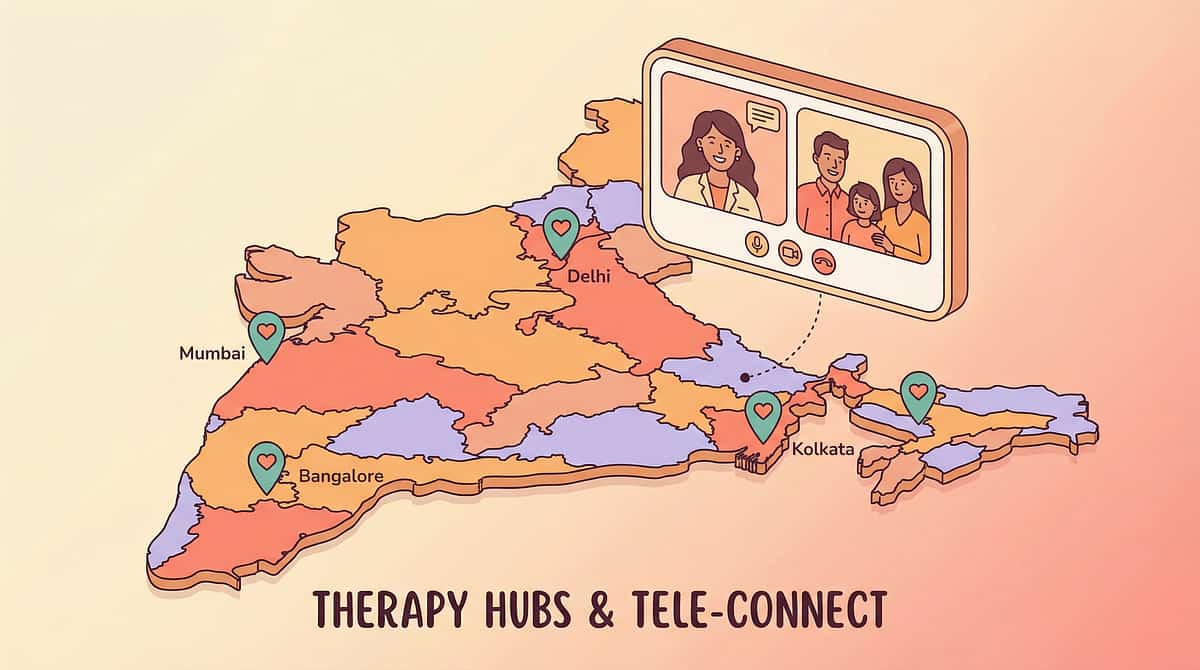
Home + Clinic = Maximum Impact
The strategies on this page work best when supported by professional guidance. Home implementation and clinical therapy are not alternatives — they are multipliers of each other. Here is what each discipline offers beyond what you can do independently.
Occupational Therapy
- Comprehensive sensory processing evaluation to understand your child's specific profile
- Individualized regulation strategy beyond the 9 materials here
- Therapeutic listening programs for significant auditory processing components
- Graduated exposure plans for systematic tolerance building
- Sensory diet recommendations for daily nervous system regulation
Behavioral Support (BCBA)
- Anxiety management strategies for anticipatory party dread
- Desensitization protocols for specific phobias (balloons, loud sounds)
- Social skills building for party-specific situations
- Coping skill development with measurable outcomes
Access Pinnacle Support
70+ centers across India | Teleconsultation available for remote families | FREE National Autism Helpline: 9100 181 181 (16+ languages, 24x7)
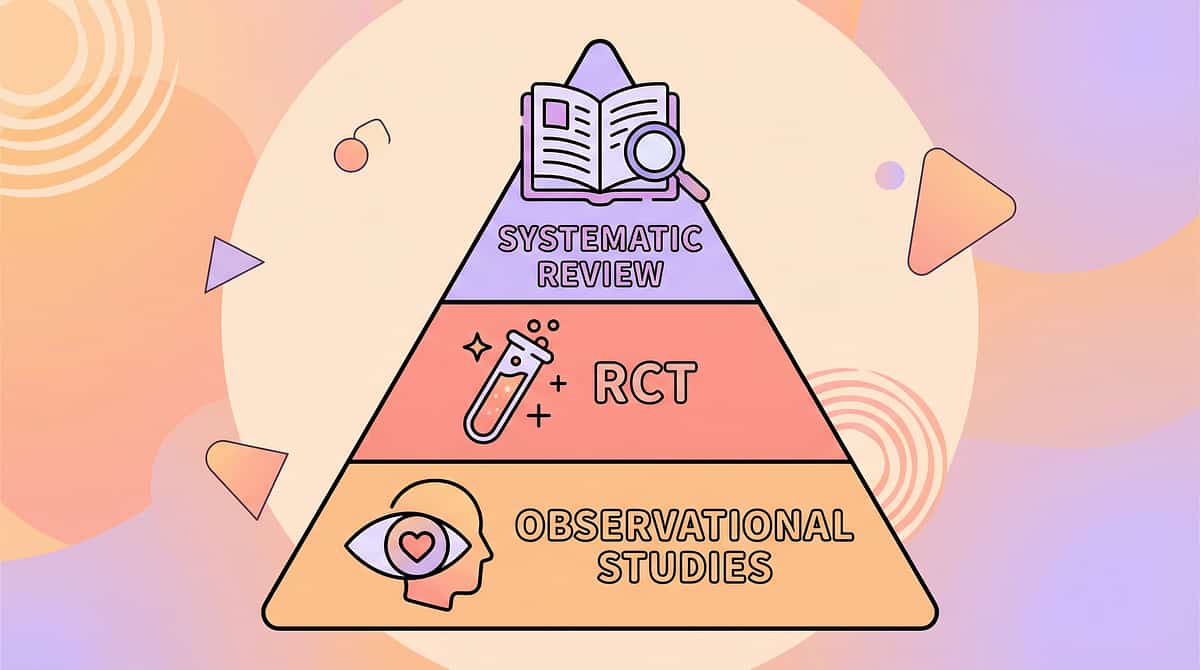
For the Parent Who Wants to Go Deeper
These are the primary studies and frameworks underpinning every recommendation on this page. This technique draws from Levels I–III of the evidence pyramid — systematic reviews, meta-analyses, randomized controlled trials, and clinical consensus.
1
PRISMA Systematic Review (2024)
"Sensory integration intervention meets criteria for evidence-based practice for children with ASD" — 16 articles, 2013–2023. PMC11506176
2
Meta-Analysis (World J Clin Cases, 2024)
"Sensory integration therapy effectively promoted social skills, adaptive behavior, sensory processing, and motor skills" — 24 studies. PMC10955541 | DOI: 10.12998/wjcc.v12.i7.1260
3
Indian RCT (Padmanabha et al., 2019)
Home-based sensory interventions demonstrate significant outcomes in Indian pediatric populations. DOI: 10.1007/s12098-018-2747-4
4
WHO Nurturing Care Framework (2018)
Evidence-based framework for responsive caregiving and early learning across 54 LMICs. PMC9978394 | nurturing-care.org
5
Frontiers in Integrative Neuroscience (2020)
Comprehensive evaluation framework for sensory processing treatment in ASD, establishing neurological basis for sensory-based interventions. DOI: 10.3389/fnint.2020.556660
6
NCAEP Evidence-Based Practices Report (2020)
National Clearinghouse on Autism Evidence and Practice — classifies visual supports and video modeling as evidence-based practices.
Additional Resources: SPD Foundation: spdfoundation.net | AOTA Guidelines: aota.org | Miller, L.J. — Sensational Kids | Kranowitz, C.S. — The Out-of-Sync Child
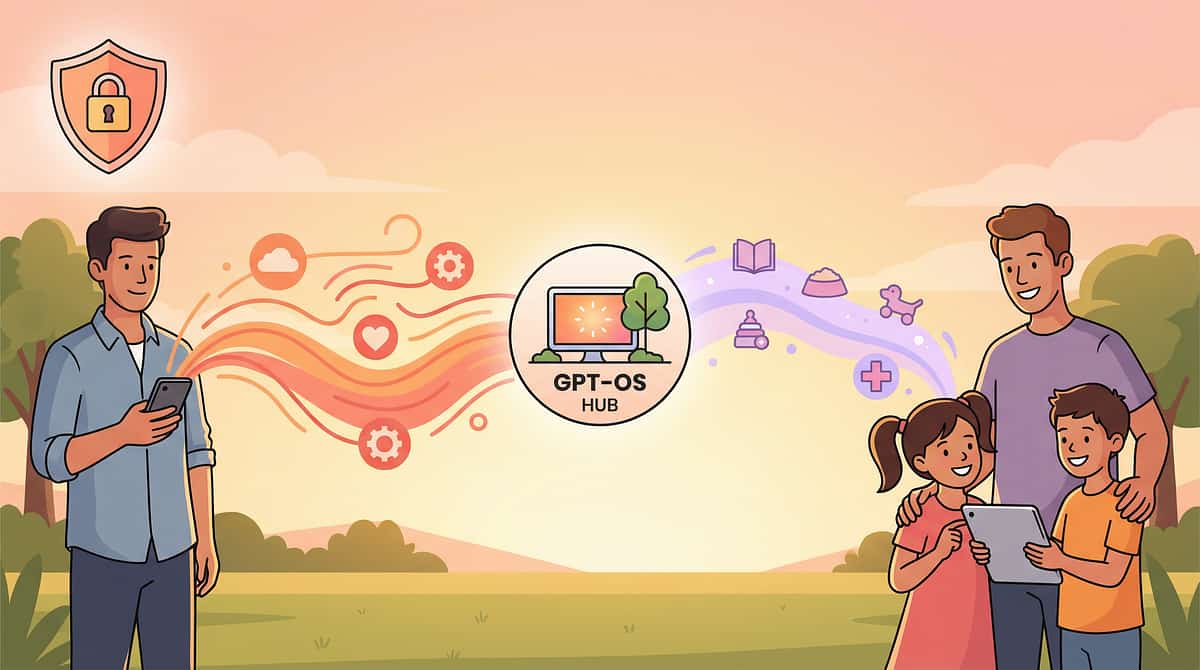
Your Data Helps Every Child Like Yours
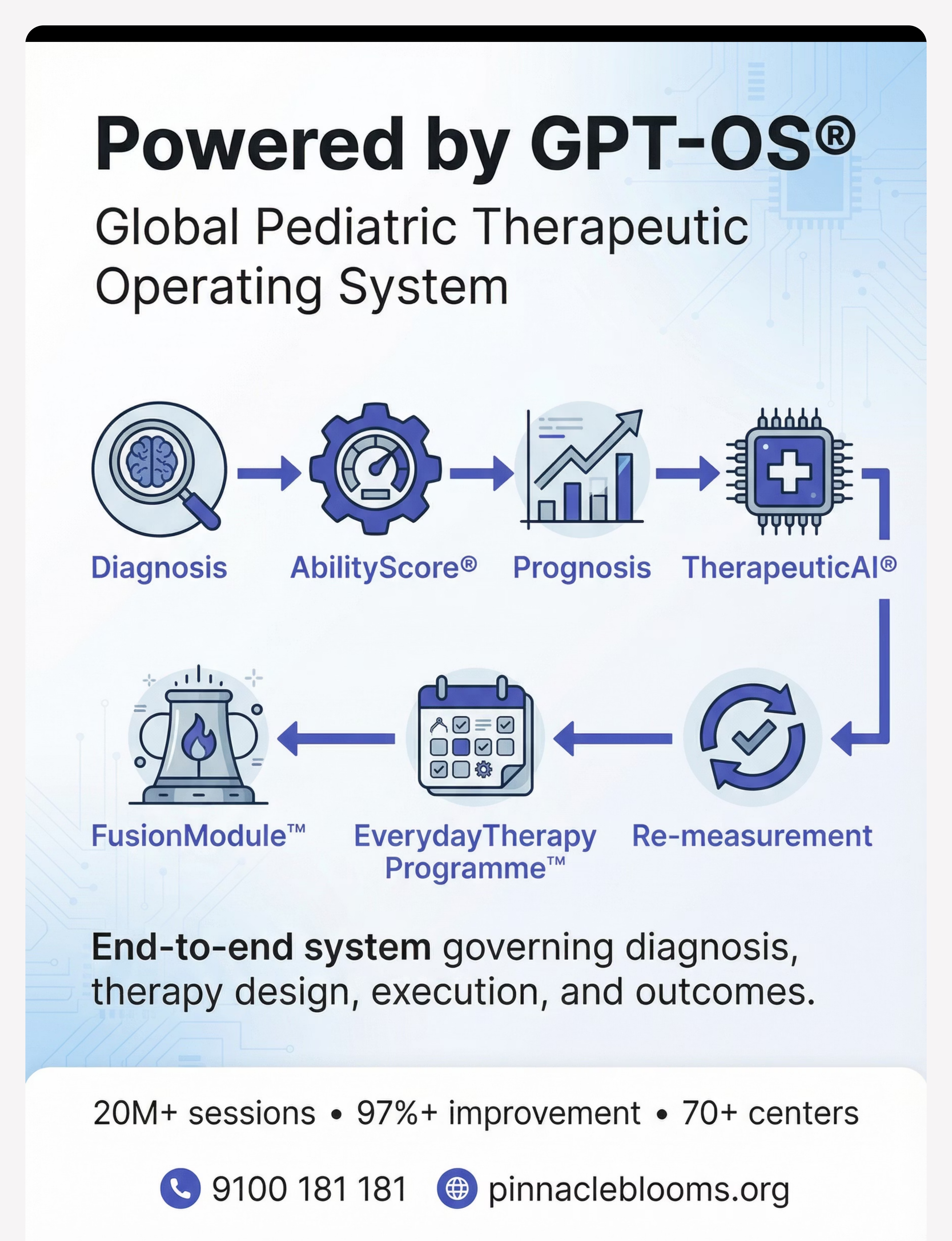
When you track your child's party attendance, tool use, duration, and regulation outcomes, this data flows into GPT-OS® — the Global Pediatric Therapeutic Operating System governing diagnosis, therapy design, execution, and outcomes across 70+ Pinnacle centers.
Loading...
What GPT-OS® Learns
- Which material combinations produce the longest regulated attendance
- Optimal timing strategies by age, sensory profile, and venue type
- Progression curves from "cannot attend" to "active participation"
- Which DIY alternatives perform equivalently to commercial products
Privacy Commitment
Your child's data is de-identified in population analyses. Individual data is visible only to your assigned clinical team. Pinnacle operates under Indian data protection regulations and ISO/IEC 27001 information security standards.
Your data doesn't just help your child — it helps the 18 million families in India navigating similar challenges.
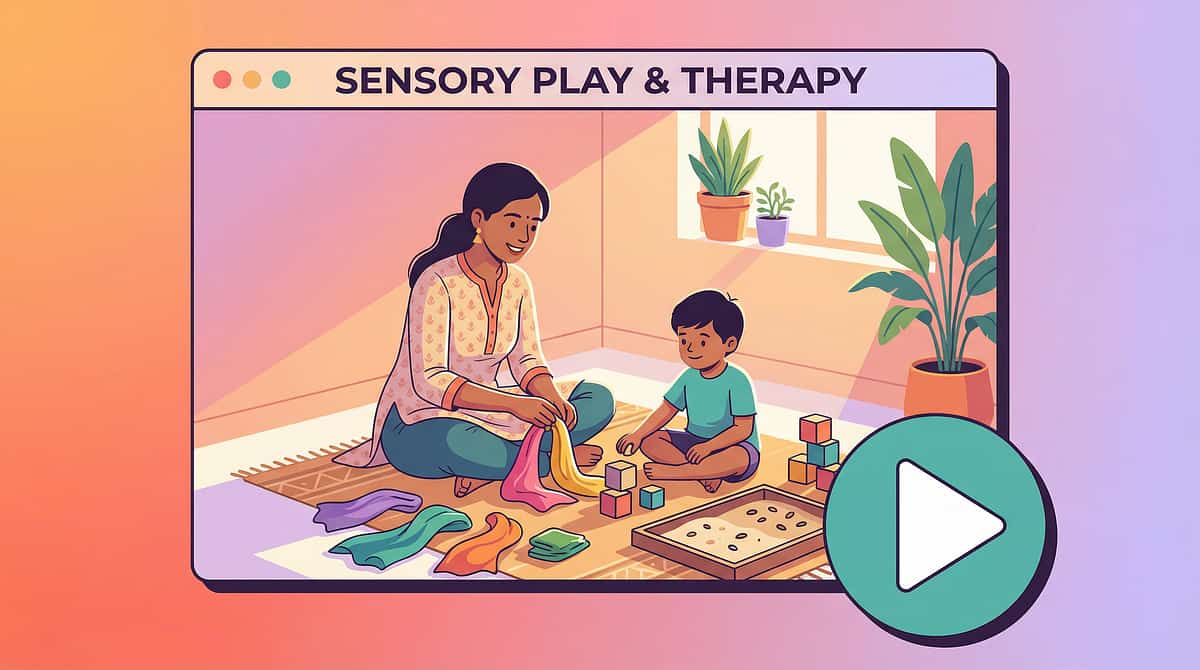
See These Materials in Action
Reel A-035
Sensory Solutions — Episode 35
Watch a Pinnacle Blooms therapist demonstrate each of the 9 materials — from fitting noise-reducing headphones to packing the sensory toolkit to executing the break zone strategy. Video content reinforces what you've read through a different learning modality.
Domain
Sensory Processing — Environmental Overwhelm
Duration
60 seconds
Evidence Base
Video modeling is classified as an evidence-based practice for autism (NCAEP, 2020)
Multi-modal learning (visual + text + demonstration) improves parent skill acquisition. Reel A-035 is part of the Sensory Solutions Series produced by the Pinnacle Blooms Consortium for parent and caregiver education.
Consistency Across Caregivers Multiplies Impact
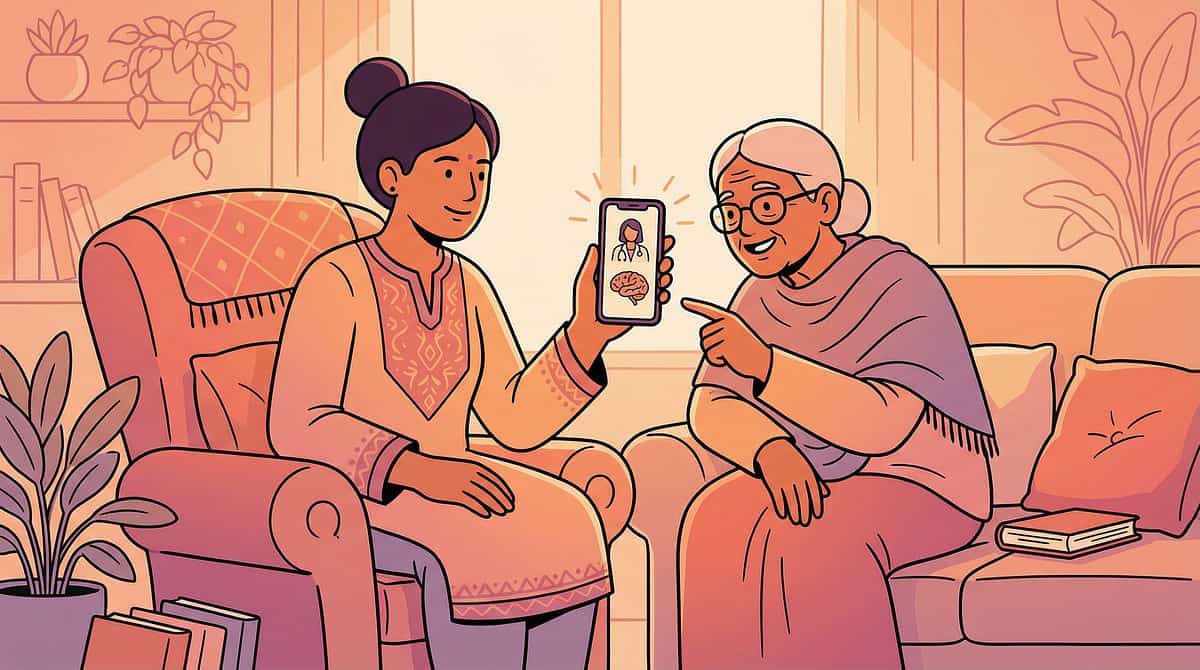
If only one parent knows these strategies, their impact is limited to one caregiver's presence. When grandparents, school teachers, extended family, and all caregivers understand the approach, your child's support becomes seamless and continuous — at home, at school, at parties, and everywhere in between.
1
"Explain to Grandparents" Version
"[Child's name] has sensory differences that make loud, chaotic environments overwhelming. It's not behavior — it's how their brain processes stimulation. At birthday parties, we use headphones to reduce noise, a bag of calming tools, sunglasses for bright lights, and we plan breaks. Please support these strategies and never remove their headphones without asking."
2
Teacher/School Communication Template
"[Child] benefits from sensory supports during school events (assemblies, sports days, celebrations). Supports include: noise-reducing headphones, access to a quiet break area, and a fidget tool. These are clinically recommended accommodations, not preferences."
WHO CCD Package: Multi-caregiver training is critical for intervention generalization and maintenance. Reference: PMC9978394

Your Questions, Answered
My child refuses to wear headphones. What do I do?
Don't force. Introduce headphones at home during enjoyable activities (watching a favorite show, playing music they like). Build positive association before using in challenging environments. At the party, keep headphones available but let the child decide. Many reach for them once the noise starts.
Won't using all these tools make my child dependent on them?
Glasses don't make eyes dependent. Headphones don't make ears dependent. Sensory tools provide accessibility while the nervous system builds tolerance through positive experiences. Supports are reduced gradually as tolerance increases — over months, not days. Accessibility is not dependency.
Other parents judge me for bringing all this stuff. How do I handle it?
Their judgment comes from ignorance about sensory processing, not parenting expertise. You are implementing evidence-based, clinically validated strategies. A brief explanation ("he has sensory sensitivities — these tools help him enjoy parties") usually suffices. Your child's regulation matters more than other adults' opinions.
How long until my child can attend parties without support?
Timeline varies enormously by child. Some children reduce supports within 3–6 months. Others benefit from some accommodations permanently. Both are valid outcomes. The goal is participation and positive association, not elimination of all supports.
Should I warn the host about my child's needs?
Only if you're comfortable. Brief, positive framing works: "He has some sensory sensitivities, so we might take breaks." You are never obligated to explain or disclose. Some hosts are wonderfully accommodating; others are not — both responses are information for future decisions.
My child used to be fine at parties. Why are they struggling now?
Sensory tolerance can fluctuate. Growth spurts, developmental changes, increased social demands, accumulated stress, changes in routine — all can shift tolerance. Regression is often temporary with resumed support. It is not a step backward; it is information.
Didn't find your answer? Ask GPT-OS® → pinnacleblooms.org | Still need help? Book a teleconsultation → 9100 181 181 (FREE, 16+ languages, 24x7)
From Fear to Mastery. One Party at a Time.
The next birthday party invitation doesn't have to be a threat. You have 9 materials, a layered strategy, a preparation protocol, a safety framework, and a community of families who understand exactly where you are standing right now.
🟢 Start This Technique Today
Pack the sensory toolkit. Write the social story. Test the headphones. You have everything you need. Begin with the next invitation.
🔵 Book a Professional Consultation
For personalized sensory evaluation and individualized party strategy. FREE, 16+ languages, 24x7.
⬜ Explore the Next Technique
Continue your journey: A-036 — 9 Materials That Help With Restaurant Overwhelm. Same toolkit, new environment.
Validated by the Pinnacle Blooms Consortium
OT • SLP • BCBA • SpEd • NeuroDev
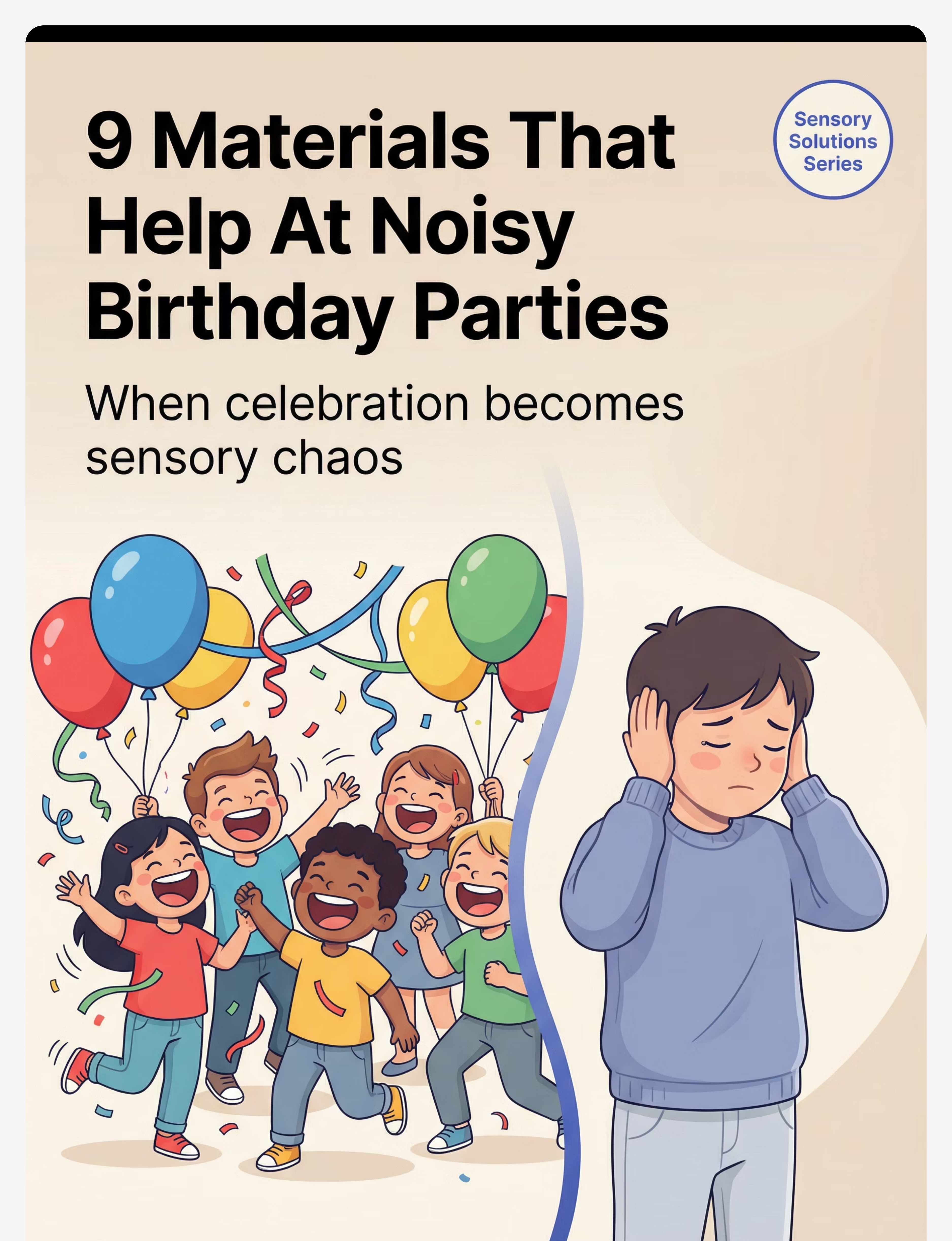
Preview of 9 materials that help at noisy birthday parties Therapy Material
Below is a visual preview of 9 materials that help at noisy birthday parties therapy material. The pages shown help educators, therapists, and caregivers understand the structure and content of the resource before use. Materials should be used under appropriate professional guidance.


Link copied!
From Fear to Mastery. One Technique at a Time.
You arrived on this page dreading the next birthday party invitation. You leave equipped with 9 evidence-based materials, a layered support strategy, clinical research backing, and a community of families walking the same path.
Your child's nervous system is not broken. It processes the world differently. With the right tools, the right preparation, and the right support, participation is possible — and with repeated positive experiences, tolerance grows.
The Pinnacle Blooms Consortium
Pediatric Occupational Therapists • Speech-Language Pathologists • Board Certified Behavior Analysts • Special Educators • NeuroDevelopmental Pediatricians • Clinical Research Professionals • Gamma.app Designers • Mothers • Fathers • Families • Caregivers
Powered by GPT-OS®
Global Pediatric Therapeutic Operating System
20M+ Sessions • 97%+ Measured Improvement • 70+ Centers • Patents Filed Across 160+ Countries
20M+ Sessions • 97%+ Measured Improvement • 70+ Centers • Patents Filed Across 160+ Countries
Explore More Techniques
Return to Top
Next: Restaurant Overwhelm (A-036)
Medical Disclaimer: This content is educational and does not replace assessment by a licensed occupational therapist or healthcare provider. Significant sensory modulation difficulties may require comprehensive sensory processing evaluation and individualized intervention. Individual results vary. Statistics represent aggregate outcomes across the Pinnacle Blooms Network. Sensory tolerance timelines vary significantly between children.
© 2026 Pinnacle Blooms Network®, unit of Bharath Healthcare Laboratories Pvt. Ltd. All rights reserved. CIN: U74999TG2016PTC113063 | DPIIT: DIPP8651 (Govt. of India) | MSME: TS20F0009606 | GSTIN: 36AAGCB9722P1Z2
FREE National Autism Helpline: 9100 181 181 (16+ languages, 24x7) | pinnacleblooms.org | care@pinnacleblooms.org | techniques.pinnacleblooms.org